
As filed with the Securities and Exchange Commission on April 13, 2015
Registration No. 333-
UNITED STATES
SECURITIES AND EXCHANGE COMMISSION
Washington, D.C. 20549
FORM S-1
REGISTRATION STATEMENT
UNDER
THE SECURITIES ACT OF 1933
LightBeam Electric Company
(Exact name of registrant as specified in its charter)
| Delaware | 4911 | 26-4637531 | ||
| (State or other jurisdiction of incorporation or organization) |
(Primary Standard Industrial Classification Code Number) |
(I.R.S. Employer Identification Number) |
(Address, including zip code, and telephone number, including area code, of registrant’s principal executive offices)
400 Harbor Drive, Suite B
Sausalito, CA 94965
(415) 992-3499
James Lavelle
Chairman and Chief Executive Officer
400 Harbor Drive, Suite B
Sausalito, CA 94965
(415) 992-3499
(Name, address, including zip code, and telephone number, including area code, of agent for service)
Copies to:
| Christopher T. Jensen David W. Pollak Morgan, Lewis & Bockius LLP 101 Park Avenue New York, NY 10178 (212) 309-6000 |
Richard D. Truesdell, Jr. Byron B. Rooney Davis Polk & Wardwell LLP 450 Lexington Avenue New York, NY 10017 (212) 450-4000 |
Approximate date of commencement of proposed sale to the public:
As soon as practicable after the effective date of this Registration Statement.
If any of the securities being registered on this Form are to be offered on a delayed or continuous basis pursuant to Rule 415 under the Securities Act of 1933, check the following box. ¨
If this Form is filed to register additional securities for an offering pursuant to Rule 462(b) under the Securities Act, please check the following box and list the Securities Act registration statement number of the earlier effective registration statement for the same offering. ¨
If this Form is a post-effective amendment filed pursuant to Rule 462(c) under the Securities Act, check the following box and list the Securities Act registration statement number of the earlier effective registration statement for the same offering. ¨
If this Form is a post-effective amendment filed pursuant to Rule 462(d) under the Securities Act, check the following box and list the Securities Act registration statement number of the earlier effective registration statement for the same offering. ¨
Indicate by check mark whether the registrant is a large accelerated filer, an accelerated filer, a non-accelerated filer, or a smaller reporting company. See the definitions of “large accelerated filer,” “accelerated filer” and “smaller reporting company” in Rule 12b-2 of the Exchange Act. (Check one):
| Large accelerated filer | ¨ | Accelerated filer | ¨ | |||
| Non-accelerated filer | x (Do not check if a smaller reporting company) | Smaller reporting company | ¨ |
CALCULATION OF REGISTRATION FEE
|
| ||||
| Title of Each Class of Securities to be Registered |
Proposed Maximum Aggregate Offering Price(1) |
Amount of Registration Fee(1)(2) | ||
| Common Stock, $0.01 par value per share |
$100,000,000.00 | $11,620.00 | ||
|
| ||||
|
| ||||
| (1) | Estimated solely for the purpose of calculating the registration fee pursuant to Rule 457(o) under the Securities Act of 1933, as amended. Includes the offering price of any additional shares that the underwriters have the option to purchase. |
| (2) | Calculated pursuant to Rule 457(o) based on an estimate of the proposed maximum aggregate offering price. |
The Registrant hereby amends this Registration Statement on such date or dates as may be necessary to delay its effective date until the Registrant shall file a further amendment which specifically states that this Registration Statement shall thereafter become effective in accordance with Section 8(a) of the Securities Act of 1933, as amended, or until the Registration Statement shall become effective on such date as the Commission, acting pursuant to said Section 8(a), may determine.
The information in this preliminary prospectus is not complete and may be changed. These securities may not be sold until the registration statement filed with the Securities and Exchange Commission is effective. This preliminary prospectus is not an offer to sell nor does it seek an offer to buy these securities in any jurisdiction where the offer or sale is not permitted.
| Preliminary Prospectus |
Subject to Completion, dated April 13, 2015 |
Shares
LIGHTBEAM ELECTRIC COMPANY
Common Stock
$ Per Share
This is an initial public offering of our common stock. We are offering shares of our common stock. We anticipate that the initial public offering price of our common stock will be between $ and $ per share.
Prior to this offering, there has been no public market for our common stock. We intend to apply to list our common stock on the New York Stock Exchange under the symbol “LEC.”
We are an “emerging growth company” as defined in Section 2(a)(19) of the Securities Act of 1933, as amended, and, as such, have elected to comply with certain reduced public company reporting requirements for this prospectus and future filings.
Investing in our common stock involves a high degree of risk. See “Risk Factors” beginning on page 21.
| Per Share | Total | |||
| Initial public offering price |
$ | $ | ||
| Underwriting discounts and commissions(1) |
$ | $ | ||
| Proceeds, before expenses, to LightBeam Electric Company |
$ | $ | ||
| (1) | The underwriters will also be reimbursed for certain expenses incurred in this offering. See “Underwriting” for additional information. |
To the extent that the underwriters sell more than shares of common stock, the underwriters have the option to purchase up to an additional shares from us within 30 days from the date of this prospectus at the initial public offering price less the underwriting discount.
Neither the Securities and Exchange Commission nor any state securities commission has approved or disapproved of these securities or determined if this prospectus is truthful or complete. Any representation to the contrary is a criminal offense.
The underwriters expect to deliver the shares of common stock to the purchasers on , 2015.
Joint Book-Running Managers
| BMO Capital Markets | Macquarie Capital | RBC Capital Markets |
Co-Manager
Roth Capital Partners
Prospectus dated , 2015
| Page | ||||
| 1 | ||||
| 21 | ||||
| 56 | ||||
| 58 | ||||
| 59 | ||||
| 60 | ||||
| 62 | ||||
| 69 | ||||
| Unaudited Pro Forma Condensed Combined Financial Information |
75 | |||
| Management’s Discussion and Analysis of Financial Condition and Results of Operations |
91 | |||
| 132 | ||||
| 143 | ||||
| 174 | ||||
| 187 | ||||
| 194 | ||||
| 195 | ||||
| 196 | ||||
| 201 | ||||
| Material U.S. Federal Income Tax Considerations for Non-U.S. Holders of Common Stock |
203 | |||
| 207 | ||||
| 211 | ||||
| 211 | ||||
| 212 | ||||
| F-1 | ||||
Neither we nor the underwriters have authorized anyone to provide any information or to make any representations other than those contained in this prospectus or in any free writing prospectuses we have prepared. We and the underwriters take no responsibility for, and can provide no assurance as to the reliability of, any other information that others may give you. This prospectus is an offer to sell, and seeks offers to buy, only the shares of common stock offered hereby, but only under circumstances and in jurisdictions where it is lawful to do so. The information contained in this prospectus or any free writing prospectus is current only as of the date of this document, regardless of its time of delivery or the time of any sale of shares of our common stock. Our business, financial condition, results of operations and prospects may have changed since that date.
Persons who come into possession of this prospectus and any such free writing prospectus in jurisdictions outside the United States are required to inform themselves about and to observe any restrictions as to this offering and the distribution of this prospectus and any such free writing prospectus applicable to that jurisdiction.
i
Notice to Investors
Upon the completion of this offering, we will be a holding company with certain U.S. operating subsidiaries that are “public utilities” (as defined in the Federal Power Act, or “FPA”) and, therefore, subject to the jurisdiction of the U.S. Federal Energy Regulatory Commission, (“FERC,”) under the FPA. While our U.S. operating subsidiaries that are subject to FPA regulation will hold certain limited exemptions from the FPA’s direct and indirect merger and acquisition provisions, a purchaser or direct or indirect holder of ten percent or more of our voting securities may not hold such exemptions. The FPA places certain restrictions and requirements on the transfer to a “holding company” under FPA Section 203(a)(2) of an amount of our voting securities sufficient to convey direct or indirect control over us, and FERC’s regulations assume that a direct or indirect voting right of ten percent or greater constitutes control. The FPA requires the holding company either to obtain prior authorization from FERC prior to the transfer of an amount of our common stock sufficient to convey direct or indirect “control” over any of our public utility subsidiaries, or to qualify for a blanket authorization granted under FERC’s regulations for certain types of transfers generally deemed by FERC not to convey direct or indirect “control.” We intend to conduct this offering in a manner consistent with FERC’s guidance on “control” and the requirements for applicable authorizations granted under FERC’s regulations. Additionally, our amended and restated certificate of incorporation will prohibit, absent prior FERC authorization, any person that is a “holding company” from acquiring, through this offering or in subsequent purchases other than secondary market transactions, an amount of our common stock sufficient to convey direct or indirect “control” over any of our public utility subsidiaries without the prior written consent of our board of directors and authorization of FERC. This prospectus does not constitute an offer to sell any share of our common stock to any person in violation of these or any other provisions of our amended and restated certificate of incorporation, or any applicable regulation or order of the FERC.
Industry and Market Data
This prospectus includes industry data and forecasts that we obtained from industry publications and surveys, public filings and internal company sources. Statements as to our market position and market estimates are based on independent industry publications, government publications, third-party forecasts, management’s estimates and assumptions about our markets and our internal research. While we are not aware of any misstatements regarding the market, industry or similar data presented herein, such data involve risks and uncertainties and are subject to change based on various factors, including those discussed under the headings “Forward-Looking Statements” and “Risk Factors” in this prospectus. In addition, estimates of historical growth rates in the markets where we operate are not necessarily indicative of future growth rates in such markets.
Trademarks and Trade Names
We own or have rights to various trademarks, service marks and trade names that we use in connection with the operation of our business and that are protected under applicable intellectual property laws. This prospectus may also contain trademarks, service marks and trade names of third parties, which are the property of their respective owners. Our use or display of third parties’ trademarks, service marks, trade names or products in this prospectus is not intended to, and should not be read to, imply a relationship with or endorsement or sponsorship of us.
ii
Currency and Exchange Rate Information
Certain information in this prospectus is presented in British pounds. In this prospectus, references to “£” and “British pounds” are to the lawful currency of the United Kingdom, and references to “$,” “US$,” “U.S. dollars” and “dollars” are to the lawful currency of the United States. All dollar amounts herein are in U.S. dollars, unless otherwise stated.
The following chart sets forth for each of 2010, 2011, 2012, 2013 and 2014, and each completed month to date during 2015, the high, low, period average and period end noon buying rates in the City of New York for cable transfers of British pounds as certified for customs purposes by the Federal Reserve Bank of New York expressed as U.S. dollars per British pound.
| U.S. dollars per British pound | ||||||||||||||||
| High | Low | Period Average(1) |
Period End |
|||||||||||||
| Year |
||||||||||||||||
| 2010 |
$ | 1.6370 | $ | 1.4344 | $ | 1.5415 | $ | 1.5392 | ||||||||
| 2011 |
1.6691 | 1.5358 | 1.6105 | 1.5537 | ||||||||||||
| 2012 |
1.6275 | 1.5301 | 1.5918 | 1.6262 | ||||||||||||
| 2013 |
1.6574 | 1.4837 | 1.5668 | 1.6574 | ||||||||||||
| 2014 |
1.7165 | 1.5517 | 1.6461 | 1.5578 | ||||||||||||
| Month |
||||||||||||||||
| January 2015 |
1.5361 | 1.5022 | 1.5142 | 1.5026 | ||||||||||||
| February 2015 |
1.5499 | 1.5027 | 1.5329 | 1.5439 | ||||||||||||
| March 2015 |
1.5391 | 1.4686 | 1.4958 | 1.4850 | ||||||||||||
| (1) | The average of the noon buying rates on the last business day of each month during the relevant one-year period and, in respect of monthly information, the average of the noon buying rates on each business day for the relevant one-month period. |
The noon buying rate for British pounds on April 3, 2015 was £1.00 = $1.4916.
Our inclusion of these exchange rates is not meant to suggest that the British pound amounts actually represent such U.S. dollar amounts or that such amounts could have been converted into U.S. dollars at any particular rate or at all.
For information on the impact of fluctuations in exchange rates on our operations, see “Risk Factors—Risks Related to Our Projects—Currency exchange rate fluctuations may have an impact on our financial results and condition” and “Management’s Discussion and Analysis of Financial Condition and Results of Operations—Quantitative and Qualitative Disclosure About Market Risk—Foreign Currency Risk.”
Presentation of Financial Information
LightBeam Electric Company plans to acquire the Initial Portfolio (as defined below) through consummation of the Acquisitions (as defined below) of the Founding Companies (as defined below) concurrently with the completion of this offering and has been deemed the accounting acquirer. The financial statements of the Founding Companies listed below are presented as follows:
| • | Certain subsidiaries of Solar Power Generation, Ltd. (“SPGL”) and Solar Power Investments Limited (“SPIL”), which are wholly-owned subsidiaries of Sustainable Power Generation Limited, are included in the Solar Power Generation Portfolio (“SPGP”) combined financial statements; |
| • | Green States Energy, Inc. and its subsidiaries are included in the Green States Energy consolidated financial statements; |
iii
| • | Global Ampersand LLC and its subsidiaries are included in the Global Ampersand consolidated financial statements; |
| • | Certain subsidiaries of Constantine Wind Energy, Ltd. (“CWE”) are included in the Constantine Wind Energy Portfolio combined financial statements; |
| • | Certain subsidiaries of Muirden Energy LLP are included in the Muirden Energy Portfolio combined financial statements; and |
| • | Certain subsidiaries of Mosscliff Environmental, Ltd. are included in the Mosscliff Environmental Portfolio combined financial statements. |
Certain of the Founding Companies, Solar Power Generation Portfolio (“SPGP”), Green States Energy, Inc. and subsidiaries (“GSE”) and Global Ampersand LLC (“Global”) and subsidiaries being acquired in these Acquisitions have been deemed to be predecessors. In instances where we are acquiring groups of related companies that collectively comprise a single business, we have considered the facts and circumstances surrounding the history of each entity to determine which of the Founding Companies to present as the reporting entity. Accordingly, this prospectus includes audited annual historical financial statements and unaudited interim historical financial statements for LightBeam Electric Company and each of the predecessors, as applicable. This prospectus does not include historical financial statements of certain entities comprising the Huerfano wind project we are acquiring from subsidiaries of Tamra-Tacoma Capital Partners, LLC and does not include the historical financial statements of Fifty ID RE Ltd., which will acquire the Constantine Wind Energy Portfolio, the Muirden Energy Portfolio and the Mosscliff Environmental Portfolio, as the assets, liabilities and operations of those two entities are not materially significant to an understanding of our business or future prospects after giving effect to the Acquisitions and the completion of the offering and financing. In addition, this prospectus contains certain pro forma financial information about LightBeam Electric Company, giving effect to the consummation of the Acquisitions and completion of this offering and the financing. See “Unaudited Pro Forma Condensed Combined Financial Information.”
Cautionary Statement Regarding the Use of Non-GAAP Measures
This prospectus contains references to Adjusted EBITDA and cash available for distribution, which are not measures under generally accepted accounting principles in the United States (“U.S. GAAP”) and, therefore, may differ from definitions of these measures used by other companies in our industry. We define Adjusted EBITDA as net income plus interest expense, income tax expense, depreciation and amortization and certain non-cash items. We define cash available for distribution as net cash provided by operating activities, determined in accordance with U.S. GAAP, as adjusted for the items set forth under “Cash Dividend Policy—General—Estimate of Future Cash Available for Distribution.” We disclose Adjusted EBITDA and cash available for distribution because we believe that these measures may assist investors in assessing our financial performance and the anticipated cash flow from our projects. Neither of these measures should be considered the sole measure of our performance and should not be considered in isolation from, or as a substitute for, the financial statements included elsewhere in this prospectus prepared in accordance with U.S. GAAP. For further discussion of the limitations of these non-U.S. GAAP measures and the reconciliations of Adjusted EBITDA to net income and cash available for distribution to net cash provided by (used in) operating activities, see “Selected Historical Financial Data” and footnote (b) thereto and “Cash Dividend Policy” elsewhere in this prospectus.
iv
Certain Terms Used in This Prospectus
| • | “Acquisitions” refers to the purchase agreements and related transactions pursuant to which we will acquire the projects in our Initial Portfolio from our initial Members concurrently with the completion of this offering; |
| • | “CFDs” refers to the U.K. contracts for differences arrangements; |
| • | “COD” refers to the commercial operation date of the applicable project; |
| • | “DGCL” refers to the Delaware General Corporation Law; |
| • | “EPC” refers to engineering, procurement and construction; |
| • | “FERC” means the Federal Energy Regulatory Commission, a U.S. Government agency; |
| • | “FIT” refers to feed-in-tariff rate structure; |
| • | “Founding Companies” refers to certain subsidiaries of Solar Power Generation, Ltd., a U.K. limited company, certain subsidiaries of Solar Power Investments Limited, a U.K. limited company, Green States Energy, Inc., a Delaware corporation, Global Ampersand LLC, a Delaware limited liability company, certain subsidiaries of Constantine Wind Energy, Ltd., a U.K. limited company, TTCP Energy Finance Fund II, LLC, a Delaware limited liability company, certain subsidiaries of Mosscliff Environmental, Ltd., a U.K. limited company, certain subsidiaries of Muirden Energy LLP, a U.K. limited liability partnership, and Fifty ID RE Ltd., a U.K. limited company; |
| • | “FPA” refers to the Federal Power Act; |
| • | “initial Members” refers to the individuals and entities which will be contributing our Initial Portfolio to us pursuant to the Acquisitions through contributions by them and their affiliates of all of the ownership interests held by them in the Founding Companies, including, without limitation, Sustainable Power Generation Limited, a U.K. limited company, ACM California LLC, a Delaware limited liability company, and Tamra-Tacoma Capital Partners, LLC, a Delaware limited liability company, in return for cash and shares of our common stock; |
| • | “Initial Portfolio” refers to the diversified portfolio of projects with a total generating capacity of approximately 239 MW in the United Kingdom and the United States consisting primarily of solar, as well as wind and biomass power generation, that we will own upon the completion of this offering; |
| • | “IPPs” refers to independent power producers; |
| • | “ISOs” refers to independent system operators, which are organizations that administer wholesale electricity markets; |
| • | “ITCs” refers to investment tax credits; |
| • | “JOBS Act” refers to the Jumpstart Our Business Startups Act of 2012; |
| • | “LECs” refers to the U.K. levy exemption certificates; |
| • | “LightBeam” refers to LightBeam Electric Company without giving effect to the Acquisitions. |
| • | “LightBeam Developer Network” or “LDN” refers to our series of mutually beneficial relationships with an international group of regional developers; |
| • | “MBR” refers to market-based rates; |
| • | “Members” refers to the developers who participate in our LDN; |
| • | “MW” refers to megawatts; |
v
| • | “MWh” refers to megawatt hours; |
| • | “Net capacity” or “net MW” refers to the maximum, or rated, power generating capacity, in MW, of a project minus all station use and losses; |
| • | “O&M” refers to operations and maintenance services provided at our various projects; |
| • | “PPAs” refers to the power purchase agreements through which our projects have contracted to sell energy, and in some cases environmental attributes (such as credits, benefits and emissions reductions), to various offtakers; |
| • | “PTCs” refers to production tax credits; |
| • | “PURPA” refers to the U.S. Public Utility Regulatory Policies Act of 1978, as amended; |
| • | “QF” means an electric power generating facility that is a “qualifying facility” under FERC regulations; |
| • | “REC” refers to Renewable Energy Certificate; |
| • | “RO” refers to the U.K. Renewables Obligation; |
| • | “ROC” refers to the U.K. renewable obligation certificates; and |
| • | “RPS” refers to Renewable Portfolio Standards. |
vi
The following summary highlights information contained elsewhere in this prospectus. It does not contain all the information you need to consider in making your investment decision. You should read this entire prospectus carefully before making your investment decision and should consider, among other things, the matters set forth under “Risk Factors,” “Selected Historical Financial Data,” “Unaudited Pro Forma Condensed Combined Financial Information,” “Management’s Discussion and Analysis of Financial Condition and Results of Operations,” and the financial statements appearing elsewhere in this prospectus.
Unless the context provides otherwise, references herein to “we,” “our,” “us,” and “our company” refer to LightBeam Electric Company, a Delaware corporation, after giving effect to the Acquisitions. Concurrently with the completion of this offering, our initial Members will sell their ownership interests in the Founding Companies to LightBeam, which we refer to as the “Acquisitions,” in return for cash and shares of our common stock and, in certain cases, contingent consideration. See “The Acquisitions.” Unless otherwise indicated, the information contained in this prospectus assumes: (i) the Acquisitions have been consummated; (ii) an initial public offering price of $ per share of common stock (the midpoint of the estimated offering price range set forth on the cover page of this prospectus); (iii) the payment of a -for-1 stock dividend to the current stockholders of LightBeam immediately prior to the consummation of the Acquisitions and this offering; and (iv) the underwriters have not exercised their option to purchase additional shares.
About LightBeam Electric Company
We are a growth and yield oriented company formed to acquire and manage high quality clean and renewable electric generation projects with stable, long-term cash flow. Our primary business objective is to pay our stockholders a consistent and growing cash dividend that is sustainable on a long-term basis. Upon the completion of this offering, we will own a diversified portfolio of projects that are operational, under construction or in advanced development, with a total generating capacity of approximately 239 MW in the United Kingdom and the United States consisting primarily of solar, as well as wind and biomass power generation. The projects in our Initial Portfolio will sell substantially all of their electric generating output pursuant to PPAs with creditworthy counterparties, with a capacity-weighted, average remaining life of approximately 19 years. With these agreements and the addition of new electric generating capacity over time, we expect to generate stable and growing cash flow available for distribution to our stockholders.
A differentiating part of our growth strategy is our LDN. Through our LDN, we have developed mutually beneficial relationships with an international group of regional developers who operate in attractive, high growth markets. We have selected our initial Members based on their experience in identifying, developing and operating global clean and renewable power generation projects, the quality of their projects in operation and under construction, and their potential to contribute additional projects to us in the future. We believe that our initial Members are well-positioned to continue to take advantage of the rapid growth of the global clean and renewable power market because of their local knowledge, relationships and expertise.
Our initial Members are those developers from whom we will acquire our Initial Portfolio. We also have entered into options to purchase (collectively, “Purchase Options”) certain additional projects from our initial Members and additional developers with a total generating capacity of approximately 104 MW, which would increase the size and breadth of our portfolio. Although we plan to primarily acquire projects in operation, we may also acquire projects that are under construction or in advanced development with minimal risk of delay or incompletion.
We believe that being part of our LDN will result in meaningful benefits to our Members that will enhance their competitive position in their respective markets and help drive their growth. Among other benefits, we
1
believe that our relationships with global financial institutions and the cultivation of our relationships with leading vendors of services and equipment required in the electric generation industry will provide our Members with improved access to construction financing on more favorable terms, and increased purchasing power and reduced costs for their procurement of equipment and services. As a result, we expect that our Members will be able to execute their development activities on a more efficient and profitable basis, and that participation in our LDN will provide our Members with greater liquidity and diversification of their project investments as well as a high degree of visibility on our project requirements, while aligning their interests with ours.
We expect that this relationship with our initial Members, as well as the Purchase Options, will provide us with opportunities to add new electric generation capacity to our portfolio in the future. We believe that our initial Members will continue to contribute additional projects to us as we believe they would prefer to be a part of our strategic partnership rather than sell their projects to larger companies that compete with them. We also believe that the benefits of our LDN will attract other regional developers to become Members, which will provide us with additional growth opportunities. See “Business—Our LightBeam Developer Network.”
We were founded in 2008, but have conducted minimal operations and have not generated significant revenue to date. We will not conduct any significant operations and generate significant revenue unless we successfully complete the Acquisitions and this offering. We cannot assure you that we will successfully complete the Acquisitions, which will be a condition to the completion of this offering.
Current Operations
We expect to generate approximately $ million and $ million of cash available for distribution for the 12 months ended June 30, 2016 and December 31, 2016, respectively. We have established our initial quarterly dividend level based upon a targeted annual payout ratio of approximately % of projected annual cash available for distribution. Accordingly, we expect to set our initial quarterly dividend at $ per share of common stock, or $ per share on an annual basis. See “Cash Dividend Policy.”
We intend to target a % annualized growth rate in our cash available for distribution per share over the -year period following the completion of this offering.
The following chart provides an overview of our Initial Portfolio by counterparty credit rating, contract duration, technology and region, in each case based on MW capacity.
| Project Description |
Location | COD | Rated MW(1) |
# of Projects |
Counterparty | Counterparty Credit Rating |
Remaining Duration(2) |
|||||||||||||||||||
| Solar |
||||||||||||||||||||||||||
| Bradenstoke |
Wiltshire, U.K. | Q3 - 2015 | 70.4 | 1 | U.K. Structure(3) | U.K. Structure | (4) | 20 | ||||||||||||||||||
| Owl’s Hatch |
Kent, U.K. | Q1 - 2015 | 51.9 | 1 | U.K. Structure(3) | U.K. Structure | (4) | 20 | ||||||||||||||||||
| Hadlow |
Kent, U.K. | Q1 - 2015 | 18.9 | 1 | U.K. Structure(3) | U.K. Structure | (4) | 20 | ||||||||||||||||||
| North Farm |
Dorset, U.K. | Q1 - 2015 | 11.5 | 1 | U.K. Structure(3) | U.K. Structure | (4) | 20 | ||||||||||||||||||
| Southfield Farm |
Somerset, U.K. | Q3 - 2015 | 9.2 | 1 | U.K. Structure(3) | U.K. Structure | (4) | 20 | ||||||||||||||||||
| Bake Farm |
Wiltshire, U.K. | Q3 - 2015 | 5.0 | 1 | U.K. Structure(3) | U.K. Structure | (4) | 20 | ||||||||||||||||||
| Newlands |
Weymouth, U.K. | Q3 - 2015 | 5.0 | 1 | U.K. Structure(3) | U.K. Structure | (4) | 20 | ||||||||||||||||||
| Crowpitts |
Devon, U.K. | Q3 - 2015 | 4.9 | 1 | U.K. Structure(3) | U.K. Structure | (4) | 20 | ||||||||||||||||||
| North Carolina |
North Carolina, U.S. | 2011 | 5.2 | 6 | Tennessee Valley Authority | Aaa /AA+ | 17 | |||||||||||||||||||
| Massachusetts 1 |
Massachusetts, U.S. | 2014 | 4.4 | 1 | Town of Sandwich | A2 / AA+ | 20 | |||||||||||||||||||
| Massachusetts 2 |
Massachusetts, U.S. | 2014 | 3.8 | 1 | MA Dev Financial Agency | A3 / A+ | 20 | |||||||||||||||||||
| New Mexico 1 |
New Mexico, U.S. | 2011 | 2.9 | 3 | Southwestern Public Service Co. | Baa1 / A- | 17 | |||||||||||||||||||
| New Mexico 2 |
New Mexico, U.S. | 2013 | 2.5 | 1 | City of Roswell | Aa3 / AA | 19 | |||||||||||||||||||
|
|
|
|
|
|||||||||||||||||||||||
| 195.6 | 20 | |||||||||||||||||||||||||
|
|
|
|
|
|||||||||||||||||||||||
2
| Project Description |
Location | COD | Rated MW(1) |
# of Projects |
Counterparty | Counterparty Credit Rating |
Remaining Duration(2) |
|||||||||||||||||||
| Biomass |
||||||||||||||||||||||||||
| El Nido |
California, U.S. | 2011 | (5) | 12.5 | 1 | PG&E | Baa1 / BBB | 17 | ||||||||||||||||||
| Chowchilla |
California, U.S. | 2011 | (5) | 12.5 | 1 | PG&E | Baa1 / BBB | 17 | ||||||||||||||||||
|
|
|
|
|
|||||||||||||||||||||||
| 25.0 | 2 | |||||||||||||||||||||||||
|
|
|
|
|
|||||||||||||||||||||||
| Wind |
||||||||||||||||||||||||||
| CWE |
Multiple Locations, U.K. | 2012 - Q3-15 | 8.8 | 74 | Opus Energy Ltd.; Smartest Energy Ltd; EDF Energy |
U.K. Structure | (4) | 18-20 | ||||||||||||||||||
| Huerfano |
Colorado, U.S. | 2013 | 8.0 | 1 | San Isabel Electric Authority |
Not Rated | (6) | 24 | ||||||||||||||||||
| Muirden Portfolio |
Multiple Locations, U.K. | 2014 - Q2-15 | 0.9 | 2 | U.K. Structure(3) | U.K. Structure | (4) | 20 | ||||||||||||||||||
| Mosscliff Portfolio |
Multiple Locations, U.K. | 2013 - Q1-15 | 0.6 | 4 | U.K. Structure(3) | U.K. Structure | (4) | 19-20 | ||||||||||||||||||
|
|
|
|
|
|||||||||||||||||||||||
| 18.3 | 81 | |||||||||||||||||||||||||
|
|
|
|
|
|||||||||||||||||||||||
| Total |
238.9 | 103 | ||||||||||||||||||||||||
|
|
|
|
|
|||||||||||||||||||||||
| (1) | With regard to solar projects, all references to rated capacity (e.g., MW) refer to measurements of direct current, or “DC,” except where otherwise noted. The rated capacities of our biomass, natural gas and wind projects are based on alternating current, or “AC,” output. |
| (2) | For U.K. projects, the expiration is shown as the year when the FIT or ROC incentive expires. For other projects, expiration is shown as the last year in which the primary power sales agreement expires. The remaining duration is as of December 31, 2014. |
| (3) | The U.K. projects that have not yet reached COD do not have FIT or ROC contracts in place. Nevertheless, U.K. energy suppliers are required to purchase FIT project output (which is intended to be less than the aggregate of all the suppliers’ renewable obligations) and those who participate in the ROC program are required to pay the ROC buyout price for requirements that are not met by the purchase of ROC project output, so the revenues for these projects when completed can be reasonably estimated based on that assumption (see “Business—Our Initial Portfolio—Typical Project Agreements—Energy Sale Arrangements in the U.K.”). |
| (4) | U.K. Government Supported Renewable Contract Structure: Electricity suppliers in the U.K. are required to participate in the FIT program and, as a result of government policy, economically incentivized to participate in the ROC program (see “Business—Our Initial Portfolio—Typical Project Agreements—Energy Sale Arrangements in the U.K.”). While many electricity suppliers do not have credit ratings, the contracted cash flows are supported by the required participation of all electricity suppliers. We consider the cash flows from these projects to be as secure as projects with high credit counterparties. |
| (5) | Date of repowering is listed here instead of the original COD. |
| (6) | San Isabel Electric Association, Inc. (“San Isabel”) is a rural electric cooperative, providing retail electric service in all or parts of seven counties in Southern Colorado. San Isabel is one of 44 member cooperatives in Tri-State Generation and Transmission Association, Inc. (“Tri-State”), a taxable wholesale electric power generation and transmission cooperative operating on a not-for-profit basis. Tri-State has an issuer rating of Baa1 and A by Moody’s Investors Service Inc. (”Moody’s”) and Standard & Poor’s Rating Services (“S&P”), respectively, and a senior unsecured rating of A-1 by Fitch Rating Inc. (“Fitch”). |
3
The following charts provide an overview of the fuel source, geographic and counterparty characteristics of our Initial Portfolio.
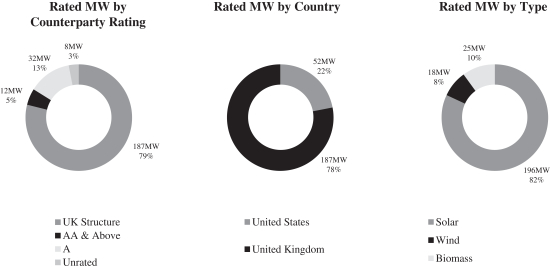
| (1) | See footnote 4 to the chart of projects in our Initial Portfolio above. |
Our Growth Strategy
We believe we are well-positioned to expand our ownership of global clean and renewable energy generation projects through our relationships with our initial Members and with additional developers that become Members of our LDN. Fragmentation within the global renewable power market has created inefficiency but also provides for opportunity. Energy policy and regulation tend to be regionalized, and regional developers often possess local knowledge, relationships and expertise that provide them with a competitive advantage in developing clean and renewable power projects. However, regional developers also face a number of competitive challenges because of their lack of purchasing power and economies of scale relative to larger energy companies. These challenges include a higher cost of capital and more difficulty obtaining financing, less favorable pricing on equipment and services, and uncertainty regarding the ability to monetize their projects. We have developed our LDN in order to address these challenges, enabling these developers to compete more effectively and to drive the ongoing growth of their businesses and, in turn, support our growth objectives. We believe our LDN will provide our Members with a series of benefits that will ultimately help them improve their competitiveness and enhance their overall economic returns, including monetization of assets, efficiencies of transaction replication, improved access to financing on more favorable terms, benefits of purchasing power, increased efficiency and alignment of interests. See “Business—Our LightBeam Developer Network.”
We believe that, as the benefits of our LDN to our initial Members become more widely known in the global clean and renewable power generation market, we will be able to expand our network of Members to increase the number of potential projects we may acquire in the future.
4
The table below provides information about the projects for which we have entered into Purchase Options. Upon commencing commercial operations, these projects are expected to have many of the characteristics of the projects in our Initial Portfolio, including long-term contracts with creditworthy counterparties and recently or newly constructed, long-lived projects that we believe will generate stable cash flow.
| Developer |
Project |
Type | Location | Expected COD |
Number of Projects |
Rated MW |
||||||||||
| RRAM |
Hook Valley | Solar | United Kingdom | 2014 | 1 | 15.30 | ||||||||||
| RRAM |
Burrowton / Saundercroft | Solar | United Kingdom | 2014 | 1 | 12.67 | ||||||||||
| RRAM |
Helios (Higher Hill & Park Wood) | Solar | United Kingdom | 2011 | 2 | 9.97 | ||||||||||
| RRAM |
Wyld M; Knockworthy | Solar | United Kingdom | 2012-2013 | 2 | 9.48 | ||||||||||
| RRAM |
Whitley | Solar | United Kingdom | 2014 | 1 | 7.57 | ||||||||||
| RRAM |
Blenches Mill | Solar | United Kingdom | 2014 | 1 | 6.08 | ||||||||||
| RRAM |
Raglington | Solar | United Kingdom | 2013 | 1 | 5.73 | ||||||||||
| RRAM |
Crossways | Solar | United Kingdom | 2012 | 1 | 5.00 | ||||||||||
| RRAM |
Chilton Cantelo | Solar | United Kingdom | 2012 | 1 | 5.00 | ||||||||||
|
|
|
|
|
|||||||||||||
| SUBTOTAL |
11 | 76.80 | ||||||||||||||
| Forum |
Ontario Solar |
Solar | Canada | 2014-2016 | Multiple | 6.70 | ||||||||||
| Tamra Tacoma |
Pleasant Hill Wind Farm | Wind | United States | 2014 | 1 | 20.00 | ||||||||||
|
|
|
|
|
|||||||||||||
| TOTAL |
>12 | 103.50 | ||||||||||||||
| (1) | With regard to solar projects, all references to rated capacity (e.g., MW) refer to measurements of direct current, or “DC,” except where otherwise noted. The rated capacities of our biomass, natural gas and wind projects are based on alternating current, or “AC,” output. |
The acquisition of the projects in the table set forth above is subject to negotiation of definitive agreements, due diligence, achievement of development milestones in certain cases, our ability to secure the funds necessary to consummate the acquisitions through debt and/or equity financing, third-party consents, regulatory approvals, approval by our independent directors and other conditions. See “ Risk Factors—Risks Related to Our Acquisition Strategy and Future Growth—We may not exercise the Purchase Options or close on the acquisitions of the projects included in the Purchase Options and may not enter into additional Purchase Options on favorable terms, or at all.”
Our Business Strategy
Our primary business objective is to pay our stockholders a consistent and growing cash dividend that is sustainable on a long-term basis. We expect to accomplish this in the following manner:
Secure Future Acquisitions from Current and Future Members of our LDN. We expect that our initial Members and additional developers that join our LDN will be our most significant source of future acquisitions. We believe that our highly differentiated strategy targeting an alternative means for regional developers to monetize their operating projects and projects under construction will attract additional high quality energy companies to join our LDN. We also believe that the Purchase Options we have entered into, together with additional ones we intend to secure following this offering, will help to ensure a strong pipeline of acquisition opportunities.
Focus Globally on High Quality Diversified Assets in Low Risk Environments. Our goal is to become a top-tier global clean and renewable independent power producer. Our Initial Portfolio consists of projects in the United Kingdom and the United States. We selected these jurisdictions because they have stable governments and highly-developed economies that are large consumers of electricity. These regions have a significant presence of high quality regional energy companies as well as regulatory climates that are favorable to producers of clean and renewable energy. We expect to acquire on a global basis additional high quality projects in stable markets from experienced, regional developers. Our Initial Portfolio is also diversified by fuel source,
5
consisting primarily of solar, as well as wind and biomass. We expect that any additional projects we acquire will utilize such fuel sources or other proven sources. We believe that such geographic and fuel source diversification will tend to reduce the magnitude of individual project risk or regional exposure to climactic, regulatory, political, economic and other geographic risks or risks related to a particular sector of the clean and renewable energy industry. We expect that this will provide a more stable cash flow profile over the long term than a non-diversified portfolio, while also providing us with access to opportunities in additional markets that are expected to experience significant growth in clean and renewable energy generation.
Maintain Sound Financial Practices and Prudent Leverage to Grow our Cash Dividend. We intend to maintain a commitment to disciplined financial practices and prudent leverage to enable us to pay a consistent and growing cash dividend to, and serve the long-term interests of, our stockholders. Our financial practices will include a risk and credit policy focused on transacting with creditworthy counterparties, a hedging policy designed to reduce interest rate and currency exchange risks and a dividend policy, which is based on distributing a significant portion of cash available for distribution each quarter. We intend to evaluate various alternatives for financing future acquisitions to use our leverage effectively and efficiently to maximize our cash available for distribution.
Our Competitive Strengths
We believe that we are well positioned to execute our business strategy because of the following competitive strengths.
Our LightBeam Developer Network. We believe that our LDN presents a compelling alternative for a diverse international group of regional developers to monetize their high quality clean and renewable generation projects and to enhance their regional competitiveness. We select Members with experience in developing and operating stable projects, possessing growing pipelines of future projects under construction and established relationships in their regional markets, presenting growth opportunities for them and us. Since we do not currently engage in development activities in the markets in which our Members are active, we believe that we do not compete with such activities and that participating in our LDN will present a more attractive alternative for developers than monetizing their assets through arrangements with competitors. We believe that the mutually beneficial relationships of our LDN create a valuable and durable alignment of interests to ensure we are working collaboratively toward a common set of objectives. As of the date of this prospectus, our LDN has no operating history. See “Business—Our LightBeam Developer Network.”
Contracted Projects with Stable Cash Flow from Creditworthy Counterparties. The contracted, diverse nature of our Initial Portfolio supports stable cash flow. Our projects sell electricity to a diverse set of creditworthy counterparties. These contracts have a capacity-weighted average remaining life of approximately 18.7 years.
New, Diverse Portfolio of High-Quality Generating Assets. We benefit from an Initial Portfolio that consists primarily of recently constructed projects and projects under construction. All of our completed projects were constructed with equipment produced by experienced manufacturers and have achieved a COD within the past four years. Our Initial Portfolio is composed of 103 high quality projects with approximately 239 MW of clean and renewable energy capacity. We expect the diversification of our Initial Portfolio geographically and by fuel source should reduce our exposure to risks specific to particular sectors of the clean and renewable energy industry. We believe that the modern and high quality nature of our Initial Portfolio will result in relatively low operating and maintenance costs and will help us to achieve our expected levels of availability and performance.
Experienced Strategic and Operational Management. Our executive management team has extensive experience in managing public companies, developing and financing projects, identifying and closing acquisitions, and understanding regulation and regulatory environments, including over 100 years of combined
6
experience in energy and project finance. The members of our board of directors also have experience with clean and renewable energy, project finance and acquisitions, including as executives of energy companies and other publicly-traded companies, regulatory officials, investment bankers and corporate attorneys. We believe that this blend of experience in our industry and with managing public companies will serve to support our efforts in identifying, acquiring and integrating profitable clean and renewable energy projects.
We believe that the experience of our executive management and board of directors in energy, project finance and acquisitions, as well as the management and operational expertise of our Members, will enable us to efficiently acquire and integrate profitable clean and renewable energy projects.
Industry Overview
According to the U.S. Energy Information Administration (“EIA”) International Energy Outlook 2013, global net electricity generation is expected to grow at a compound annual growth rate (“CAGR”) of 2.8% from 2010 to 2020. Although the 2008-2009 global economic recession slowed the rate of growth in global demand for electricity, demand returned in 2010. According to the EIA, net electricity generation from renewable energy accounted for 20.6% of global net electricity generation in 2010, making it the third largest contributor after coal and natural gas. Over the period from 2010 to 2020, the EIA expects net electricity generation from renewable energy to be the fastest growing source of net electricity generation at a CAGR of 4.5%.
Renewable energy is generated using naturally-replenishing resources such as water, wind, sunlight, plant and wood waste / biomass, and geothermal energy. In many parts of the world, increasing concerns regarding manufacturing jobs, security of energy supply and the environmental consequences of greenhouse gas emissions (“GHG”), as well as the outlook for fossil-fuel prices, have resulted in governmental policies that support an increase in electricity generation from renewable energy. The significant growth in electricity generation from renewable energy is principally the result of an improvement in the cost competitiveness of renewable energy technologies and support from governments to increase the contribution of electricity generation from renewable energy. By 2020, net electricity generation from renewable energy is projected to account for 24.4% of global net electricity generation. While wind and solar resources are intermittent, depending on the time of day and climatic conditions, improving storage technology and the dispersing of wind power and solar power projects over wide geographic areas can mitigate these concerns.
Renewable Power Generation Market in the United Kingdom
The U.K. faces the challenges of replacing life-expiring coal and nuclear generating capacity and complying with policy objectives to cut carbon emissions.
The Department of Energy and Climate Change (“DECC”) estimates that about a fifth of the U.K.’s electricity generating capacity may have to close over this decade as the U.K.’s power stations age and as EU environmental legislation, notably the Large Combustion Plant Directive (“LCPD”) and Industrial Emissions Directive (“IED”), impose stricter standards. Specifically, there is a requirement to close coal and oil stations that have “opted out” of the LCPD that is expected to lead to the retirement of 12 GW of major capacity in Great Britain by 2016. The LCPD aims to reduce emissions of sulphur dioxide, nitrogen oxides and dust from large combustion plants. All plants built after 1987 must comply with the emission limits in LCPD. Existing plants can either comply with the LCPD through installing emission abatement equipment or elect to “opt out” of the directive. All existing plants that “opt out” must close by the end of 2015, driving the need for new generation plants to be commissioned in order to maintain the country’s security of supply. The IED imposes similar restrictions on conventional generation, with remaining coal-fired and some gas-fired generation expected to close by 2023.
7
The European Union (“EU”) and U.K. targets for reducing carbon emissions also require investment in low carbon electricity generation. Compared to other EU Member States, the U.K. generates a relatively low proportion of electricity from renewable sources. DECC has estimated that, in 2011, only 3.8% of gross energy consumption (including electricity and other uses of energy output such as heating and transportation) was procured from renewable sources versus the U.K. national target of 15% by 2020. The share for electricity (excluding other types of energy consumption) was 9.2% in 2011 from renewable sources, up from 6.7% in 2010.
The U.K.’s national target under the Renewable Energy Directive is for 15% of gross energy consumption to come from renewable sources by 2020. The U.K. government put in place a Renewable Energy Roadmap in July 2011 to achieve that objective, which was then updated in December 2012.
Renewable Power Generation Market in the United States
Industry participants in the United States have increasingly transitioned to building renewable generation resources in response to more stringent environmental regulations and supportive federal and state incentives and policy initiatives. Edison Electric Institute (“EEI”), a trade group of electric utilities and generators, estimates that 17 GW of new generation capacity was added in the United States in 2013. Natural gas (7,370 MW) and solar (4,936 MW) accounted for the majority of the new capacity, with solar having a record breaking year in 2013 and surpassing wind for the first time as the leading source of new renewable capacity. In 2012, renewables were the dominant source of new capacity within the U.S. power generation industry, contributing 50.2% of capacity growth.
In its Annual Energy Outlook 2013, the EIA forecasts that capacity additions from 2012 to 2040 will total 340 GW. Annual additions in 2012 and 2013 remain relatively high, averaging 22 GW per year. Of those early builds, 51% are renewable plants.
U.S. federal, state and local governments have established various incentives to support the development of renewable energy. These incentives include accelerated tax depreciation, ITCs, PTCs, cash grants and RPS programs.
8
Our Organizational Structure and the Acquisitions
LightBeam Electric Company is a Delaware corporation formed in 2008. We have entered into a series of agreements described under “The Acquisitions” to acquire, concurrently with and as a condition to the completion of this offering, the assets and entities constituting our Initial Portfolio held by the Founding Companies. The Founding Companies, on a pro forma combined basis, had revenues of approximately $25.6 million for the year ended December 31, 2014. Upon the completion of this offering and the Acquisitions, we will own a diversified portfolio of projects with a total generating capacity of approximately 239 MW in the United Kingdom and the United States. See “Business—Our Initial Portfolio.”
The following diagram illustrates our organizational structure immediately following the completion of this offering.
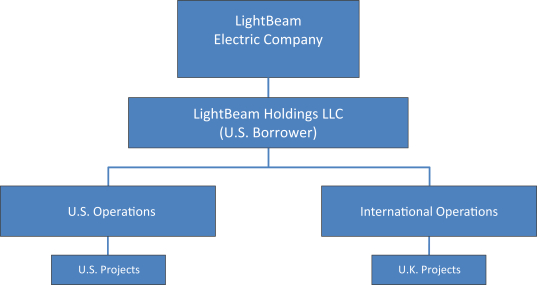
The aggregate consideration being paid by us to acquire our Initial Portfolio from the initial Members of our LDN is estimated to be approximately $190.2 million, consisting of approximately $122.8 million in cash and contingent consideration, and $67.4 million in LightBeam common stock (representing shares, assuming a stock price of $ per share, the mid-point of the estimated offering price range on the cover page of this prospectus). We will also assume approximately $56.4 million in indebtedness (exclusive of prepayment penalties) relating to our Initial Portfolio, of which approximately $ million will be repaid at the completion of the Acquisitions and this offering. The total consideration excludes certain earn-out arrangements and is also subject to adjustment based upon the pricing terms of this offering. In addition, after the completion of the Acquisitions and this offering, we expect to pay additional consideration in excess of $230.0 million to the sellers of one of the Founding Companies contingent upon completion of certain projects under construction that we are acquiring. For further information regarding such arrangements, adjustments and deferrals, see “The Acquisitions.” The purchase price for each project is based upon a fair market value approach, which takes into account each project’s economic characterization, technology type, size and location. We will use the proceeds of this offering and a credit facility for approximately $ million that we will enter into to acquire the Initial Portfolio.
9
We also expect to issue concurrently with the completion of this offering and on the six-month anniversary of the completion of this offering an aggregate of shares of our common stock, or % of the outstanding shares of our common stock after the completion of this offering, to our officers and certain employees and consultants. See “Management—Employment and Consulting Agreements with our Named Executive Officers” and “Management—Post-IPO Share Awards.”
Risk Factors
An investment in our common stock involves a high degree of risk. Below is a summary of certain key risk factors that you should carefully consider before you invest in our common stock. This list is not exhaustive. Please read the full discussion of these risks and other risks described under “Risk Factors.”
Risks Related to our Projects, Acquisition Strategy, Future Growth and Financial Activities
| • | We have conducted minimal operations and have not generated significant revenue to date, and certain of the Founding Companies also have recent histories of substantial operating losses. |
| • | We will not have experience operating the projects in our Initial Portfolio prior to the completion of this offering. |
| • | We cannot assure you that we will be able to successfully integrate the operations of the projects in our Initial Portfolio or institute Company-wide systems and procedures to successfully manage the combined Initial Portfolio on a consolidated basis. |
| • | Our LDN may not provide the benefits that we expect, which may impair our ability to obtain additional project acquisition opportunities from them or attract new Members. |
| • | The pro forma financial information presented in this prospectus covers periods when the collective group of assets and entities in our Initial Portfolio were not under common control or management and, therefore, may not be indicative of our future financial or operating results. |
| • | Many of the projects in our Initial Portfolio were recently constructed or are under construction and have a limited operating history. |
| • | Our growth strategy is dependent in part upon the acquisition of the projects for which we have entered into Purchase Options and other attractive power projects developed by third-parties, and any failure by us to acquire projects subject to Purchase Options or to enter into additional Purchase Options or inability of such development companies to obtain the requisite financing to develop and construct projects could have a material adverse effect on our ability to grow our business. |
| • | We may not be able to manage our growth efficiently. |
| • | Our projects rely on a limited number of key power purchasers. |
| • | A prolonged environment of low prices for natural gas, or other conventional fuel sources, could have a material adverse effect on our long-term business prospects, financial condition and results of operations. |
| • | Our operations are subject to numerous land use, environmental, health and safety laws and regulations and permit requirements. If the projects we acquire do not comply with, or are subject to liability under, applicable laws, regulations or permit requirements, we may be required to incur significant costs, pay penalties or fines or curtail or cease operations of the affected projects. |
| • | Government regulations providing incentives for renewable generation could change at any time, and such changes may negatively impact our growth strategy. |
10
Risks Related to This Offering and Ownership of Our Common Stock
| • | We are a holding company with no operations of our own, and we will depend on our projects for cash to fund all of our operations and expenses, including to make dividend payments. |
| • | We cannot guarantee that our forecast will prove to be accurate. Our forecast assumes the completion of the acquisition of the projects for which we have entered into Purchase Options, which projects we cannot assure you we will be able to acquire. If we do not acquire such projects, our cash available for distribution would be reduced. In addition, our actual results of operations for the forecast period will likely be different than the results disclosed in the forecast and the variations may be material. |
| • | Our cash available for distribution to holders of our shares may be reduced as a result of restrictions on our subsidiaries’ cash distributions to us under the terms of their indebtedness. |
| • | There is no existing market for our shares, and we do not know if one will develop with adequate liquidity to sell our shares at prices equal to or greater than the offering price. |
| • | Future sales of our shares of common stock in the public market by us or by our stockholders could lower our share price, dilute your ownership in us and may adversely affect the market price of our shares. |
Emerging Growth Company Status
We are an “emerging growth company” as defined in the Jumpstart Our Business Startups Act (the “JOBS Act”). As such, we are eligible, for up to five years, to take advantage of certain exemptions from various reporting requirements that are applicable to other publicly traded entities that are not “emerging growth companies.” These exemptions include:
| • | the option to present only two years of audited financial statements and only two years of related Management’s Discussion and Analysis of Financial Condition and Results of Operations in the registration statement of an initial public offering of common equity securities; |
| • | not being required to comply with the auditor attestation requirements of Section 404 of the Sarbanes-Oxley Act of 2002 (the “Sarbanes-Oxley Act”); |
| • | reduced executive compensation disclosure obligation in our registration statements, periodic reports and proxy statements; and |
| • | exemptions from the requirements of holding a non-binding advisory vote on executive compensation and golden parachute arrangements. |
An “emerging growth company” can take advantage of the extended transition period provided in Section 13(a) of the Securities Exchange Act of 1934, as amended (the “Exchange Act”), for complying with new or revised accounting standards. In other words, an “emerging growth company” can delay the adoption of certain accounting standards until those standards would otherwise apply to private companies. We are choosing to “opt out” of this extended transition period and, as a result, we will comply with new or revised accounting standards on the relevant dates on which adoption of such standards is required for non-emerging growth companies. Under federal securities laws, our decision to “opt out” of the extended transition period is irrevocable. We intend to take advantage of the remaining exemptions. As a result, we do not know if some investors will find our common stock less attractive. The result may be a less active trading market for our common stock, and our share price may become more volatile.
We will remain an “emerging growth company” until the earliest of: (i) the last day of the first fiscal year in which our annual gross revenues exceed $1 billion; (ii) the last day of the fiscal year following the fifth anniversary of the date of this offering; (iii) the date that we become a “large accelerated filer” as defined in Rule 12b-2 under the Exchange Act, which would occur if the market value of our common units that is held by non-affiliates exceeds
11
$700 million as of the last business day of our most recently completed second fiscal quarter; or (iv) the date on which we have issued more than $1 billion in non-convertible debt during the preceding three-year period.
Corporate Information
Our principal executive offices are located at 400 Harbor Drive, Suite B, Sausalito, California 94965. Our telephone number is (415) 992-3499. Our website is located at www.lightbeamelectric.com. We expect to make available our periodic reports and other information filed with or furnished to the U.S. Securities and Exchange Commission (the “SEC”) free of charge through our website as soon as reasonably practicable after those reports and other information are electronically filed with or furnished to the SEC. Information on our website or any other website is not incorporated by reference herein and does not constitute a part of this prospectus.
12
The Offering
| Common stock offered by us |
shares |
| Common stock to be outstanding after this offering |
shares, or shares if the underwriters exercise their option to purchase additional shares in full. |
| Option to purchase additional shares |
We have granted the underwriters an option for a period of 30 days from the date of this prospectus to purchase up to additional shares of our common stock at the initial public offering price less the underwriting discounts and commissions. |
| Use of proceeds |
The net proceeds from this offering will be approximately $ , (based upon an assumed initial public offering price of $ , the midpoint of the estimated offering price range set forth on the cover page of this prospectus), after deducting estimated underwriting discounts and commissions and estimated offering expenses payable by us. We intend to use the net proceeds from this offering to pay a portion of the cash consideration payable to the initial Members pursuant to the Acquisitions. We expect to enter into a credit facility for approximately $ million in the aggregate to be used to pay the remaining portion of the cash consideration payable to the initial Members pursuant to the Acquisitions, to repay approximately $ million of indebtedness (exclusive of prepayment penalties) relating to the Initial Portfolio and for working capital and general corporate purposes. See “Use of Proceeds” and “Management’s Discussion and Analysis of Financial Condition and Results of Operations—Liquidity” for additional information. |
| Cash dividends |
We intend to pay regular quarterly cash dividends in U.S. dollars to holders of shares of our common stock. Our quarterly dividend will initially be set at $ per share of common stock, or $ per share of common stock on an annualized basis, and the amount may be changed in the future without advance notice. We expect to pay a quarterly dividend on or about the 45th day following each fiscal quarter to stockholders of record on the last day of such quarter. With respect to our first dividend payable on or about to holders of record on , we intend to pay a pro-rated dividend covering the period from the completion of this offering through , based on our initial dividend level and the actual length of that period. |
| Our ability to pay our initial and subsequent dividends, if any, is subject to various restrictions and other factors. For a detailed discussion of the basis upon which we established our initial quarterly dividend and factors that could affect our ability to pay dividends at that level or at all, see “Cash Dividend Policy.” |
13
| Risk factors |
See “Risk Factors” beginning on page 21 and the other information included in this prospectus for a discussion of factors you should carefully consider before deciding to invest in our common stock. |
| Material U.S. Federal Income Tax Considerations for Non-U.S. Holders of Common Stock |
For a discussion of material U.S. federal income tax considerations for non-U.S. holders of shares of our common stock, see “Material U.S. Federal Income Tax Considerations for Non-U.S. Holders of Common Stock.” |
| NYSE symbol |
We intend to apply to list our common stock on the New York Stock Exchange under the symbol “LEC.” |
The number of shares of our common stock outstanding immediately after this offering is based on (i) shares of common stock outstanding as of , 2015, (ii) shares to be issued pursuant to the Acquisitions, (iii) shares to be issued in this offering and (iv) an estimated shares to be issued concurrently with the completion of this offering and on the six-month anniversary of the completion of this offering to our officers and certain employees and consultants, but excludes (x) shares of common stock reserved for future issuance under the LightBeam Electric Company 2015 Long-Term Incentive Plan (the “2015 Incentive Plan”), as well as any shares of our common stock reserved for future issuance pursuant to the adjustment provisions of the plan and (y) the issuance of shares of common stock to consummate the acquisitions contemplated by the Purchase Options, as well as any other acquisitions we may complete in the future.
Unless otherwise indicated, all information in this prospectus:
| • | assumes consummation of the Acquisitions; |
| • | assumes no exercise by the underwriters of their option to purchase up to shares of our common stock in this offering; and |
| • | gives effect to the -for-1 stock dividend to be paid to the current stockholders of LightBeam immediately prior to the consummation of the Acquisitions and this offering. |
14
SUMMARY HISTORICAL AND PRO FORMA FINANCIAL DATA
Summary historical financial data of LightBeam as of and for the years ended December 31, 2014 and 2013 and pro forma financial data as of and for the year ended December 31, 2014 are set forth below. Certain of the Founding Companies being acquired by LightBeam in the Acquisitions have been deemed to be predecessors. Accordingly, summary historical and pro forma financial data are also presented for each of such predecessors as of the dates and for the periods indicated. The summary historical financial data as of the fiscal year end of LightBeam and each predecessor and for such completed fiscal years have been derived from the audited historical financial statements of LightBeam and its predecessors, each of which is included elsewhere in this prospectus. The summary historical data as of the interim balance sheet dates and for the interim periods of SPGP have been derived from the unaudited historical financial statements of SPGP, which are included elsewhere in this prospectus. The summary pro forma financial data as of and for the year ended December 31, 2014 have been derived from the audited and unaudited historical financial data of LightBeam and its predecessors included elsewhere in this prospectus and certain unaudited historical financial data not included in this prospectus. The results for any interim period are not necessarily indicative of the results that may be expected for a full year.
The historical results of LightBeam and its predecessors are not necessarily indicative of future performance. You should read the information in this section in conjunction with “Use of Proceeds,” “Capitalization,” “Unaudited Pro Forma Financial Data,” “Management’s Discussion and Analysis of Financial Condition and Results of Operations,” “The Acquisitions,” and the historical financial statements of LightBeam and its predecessors that are included elsewhere in this prospectus.
15
SUMMARY HISTORICAL AND PRO FORMA FINANCIAL DATA
LightBeam Electric Company, Inc.
(In 000’s, Except Per Share Data)
| Combined Pro Forma as Adjusted |
||||||||||||
| Year Ended December 31, |
Year
Ended December 31, |
|||||||||||
| 2014 | 2013 | 2014 | ||||||||||
| Statement of Operations Data: |
||||||||||||
| Revenues |
$ | — | $ | — | $ | |||||||
|
|
|
|||||||||||
| General And Administrative |
$ | 6,295 | $ | 1,075 | $ | |||||||
|
|
|
|
|
|
|
|||||||
| Operating Loss |
(6,295 | ) | (1,075 | ) | ||||||||
|
|
|
|
|
|
|
|||||||
| Net Loss |
$ | (6,295 | ) | $ | (1,075 | ) | $ | |||||
|
|
|
|
|
|
|
|||||||
| Net Loss Per Share—Basic and Diluted |
$ | (396.83 | ) | $ | (71.46 | ) | $ | |||||
|
|
|
|
|
|
|
|||||||
| Weighted Average Shares Used In Computing Net Loss Per Share—Basic and Diluted |
15,864 | 15,045 | ||||||||||
|
|
|
|
|
|
|
|||||||
| Other Financial Data: |
||||||||||||
| Adjusted EBITDA(a)(c) |
$ | (6,295 | ) | $ | (1,075 | ) | $ | |||||
|
|
|
|
|
|
|
|||||||
| Cash Flow Data: |
||||||||||||
| Net Cash provided by (used in) |
||||||||||||
| Operating activities |
$ | (3,376 | ) | $ | (687 | ) | $ | |||||
| Investing activities |
$ | (391 | ) | $ | (564 | ) | $ | |||||
| Financing activities |
$ | (3,719 | ) | $ | 1,614 | $ | ||||||
| Balance Sheet Data: |
||||||||||||
| Working capital(b) |
$ | (2,533 | ) | $ | 98 | $ | ||||||
| Software development costs |
$ | 70 | $ | — | $ | |||||||
| Development projects |
$ | 323 | $ | 503 | $ | |||||||
| Total assets |
$ | 4,723 | $ | 959 | $ | |||||||
| Total stockholders’ equity (deficit) |
$ | (2,140 | ) | $ | 601 | $ | ||||||
16
Solar Power Generation Portfolio (Predecessor)
(In 000’s, Except Per Share Data)
| Six-month period Ended December 31, |
Year ended June 30, |
|||||||||||||||
| 2014 | 2013 | 2014 | 2013 | |||||||||||||
| Statement of Operations Data: |
|
|||||||||||||||
| General and Administrative |
$ | 491 | $ | 237 | $ | 586 | $ | 120 | ||||||||
|
|
|
|
|
|
|
|
|
|||||||||
| Net Loss |
$ | (491 | ) | $ | (237 | ) | $ | (586 | ) | $ | (120 | ) | ||||
|
|
|
|
|
|
|
|
|
|||||||||
| Net Loss Per Share—Basic and Diluted |
$ | (674 | ) | $ | (353 | ) | $ | (855 | ) | $ | (482 | ) | ||||
|
|
|
|
|
|
|
|
|
|||||||||
| Weighted Average Shares Used In Computing Net Loss Per Share—Basic and Diluted |
729 | 671 | 685 | 250 | ||||||||||||
|
|
|
|
|
|
|
|
|
|||||||||
| Other Financial Data: |
||||||||||||||||
| Adjusted EBITDA(a)(c) |
$ | (491 | ) | $ | (237 | ) | $ | (586 | ) | $ | (120 | ) | ||||
|
|
|
|
|
|
|
|
|
|||||||||
| Balance Sheet Data: |
||||||||||||||||
| Working capital(b) |
$ | (34,997 | ) | $ | (3,629 | ) | $ | (395 | ) | |||||||
| Development projects |
$ | 33,952 | $ | 2,874 | $ | 275 | ||||||||||
| Total long-term assets |
$ | 33,952 | $ | 2,874 | $ | 275 | ||||||||||
| Due to related party |
$ | 12,683 | $ | 3,629 | $ | 395 | ||||||||||
| Related party loans |
$ | 6,540 | $ | — | $ | — | ||||||||||
| Total shareholders’ deficit |
$ | (1,150 | ) | $ | (755 | ) | $ | (120 | ) | |||||||
17
Green States Energy, Inc. and Subsidiaries (Predecessor)
(In 000’s, Except Per Share Data)
| Year Ended December 31, |
||||||||
| 2014 | 2013 | |||||||
| Statement of Operations Data: |
||||||||
| Revenue |
||||||||
| Electricity |
$ | 1,985 | $ | 1,139 | ||||
| Solar renewable energy credits |
3,911 | 2,240 | ||||||
|
|
|
|
|
|||||
| Total Revenue |
5,896 | 3,379 | ||||||
| Operating Expenses |
5,209 | 5,165 | ||||||
|
|
|
|
|
|||||
| Operating Income (Loss) |
687 | (1,786 | ) | |||||
|
|
|
|
|
|||||
| Other Income (Expense): |
||||||||
| Grant income |
413 | 306 | ||||||
| Bargain purchase gain |
— | 713 | ||||||
| Gain on NCST settlement |
1,283 | — | ||||||
| Changes in fair value of derivative liability—stock |
(466 | ) | (740 | ) | ||||
| Interest expense |
(2,942 | ) | (1,966 | ) | ||||
|
|
|
|
|
|||||
| Total Other Expense |
(1,712 | ) | (1,687 | ) | ||||
|
|
|
|
|
|||||
| Net Loss |
$ | (1,025 | ) | $ | (3,473 | ) | ||
|
|
|
|
|
|||||
| Net Loss Attributable to Green States Energy, Inc. |
$ | (558 | ) | $ | (5,245 | ) | ||
|
|
|
|
|
|||||
| Net Loss Per Share—Basic and Diluted |
$ | (0.03 | ) | $ | (0.27 | ) | ||
|
|
|
|
|
|||||
| Weighted Average Shares Used In Computing Net Loss Per Share—Basic and Diluted |
18,546 | 19,267 | ||||||
|
|
|
|
|
|||||
| Other Financial Data: |
||||||||
| Adjusted EBITDA(a) |
$ | 4,788 | $ | 528 | ||||
|
|
|
|
|
|||||
| Cash Flow Data: |
||||||||
| Net cash provided by (used in) |
||||||||
| Operating activities |
$ | (257 | ) | $ | (653 | ) | ||
| Investing activities |
$ | (5,445 | ) | $ | (14,619 | ) | ||
| Financing activities |
$ | 5,702 | $ | 15,819 | ||||
| Balance Sheet Data: |
||||||||
| Working capital(b) |
$ | (3,197 | ) | $ | (19,160 | ) | ||
| Investment in energy property |
$ | 58,559 | $ | 50,197 | ||||
| Total assets |
$ | 69,782 | $ | 58,970 | ||||
| Long-term liabilities |
$ | 53,624 | $ | 24,693 | ||||
| Total equity |
$ | 9,869 | $ | 10,565 | ||||
| Adjusted EBITDA Reconciliation: |
||||||||
| Net loss |
$ | (1,025 | ) | $ | (3,473 | ) | ||
| Less: |
||||||||
| Bargain purchase gain |
— | 713 | ||||||
| Add: |
||||||||
| Depreciation and amortization |
2,405 | 2,008 | ||||||
| Change in fair value of derivative liability—warrants |
466 | 740 | ||||||
| Interest expense |
2,942 | 1,966 | ||||||
|
|
|
|
|
|||||
| Adjusted EBITDA |
$ | 4,788 | $ | 528 | ||||
|
|
|
|
|
|||||
18
Global Ampersand (Predecessor)
(In 000’s, Except Per Share Data)
| Year Ended | ||||||||
| December 31, | ||||||||
| 2014 | 2013 | |||||||
| Statement of Operations Data: |
||||||||
| Revenue |
$ | 16,022 | $ | 15,966 | ||||
| Operating Expenses |
17,808 | 19,989 | ||||||
|
|
|
|
|
|||||
| Loss from Operations |
(1,786 | ) | (4,023 | ) | ||||
|
|
|
|
|
|||||
| Other Income (Expense): |
||||||||
| Grant income |
121 | 120 | ||||||
| Interest expense |
(6,059 | ) | (5,732 | ) | ||||
|
|
|
|
|
|||||
| Total Other Expense |
(5,938 | ) | (5,612 | ) | ||||
|
|
|
|
|
|||||
| Net Loss |
$ | (7,724 | ) | $ | (9,635 | ) | ||
|
|
|
|
|
|||||
| Other Financial Data: |
||||||||
| Adjusted EBITDA(a) |
$ | 446 | $ | (1,752 | ) | |||
|
|
|
|
|
|||||
| Cash Flow Data: |
||||||||
| Net cash provided by (used in) |
||||||||
| Operating activities |
$ | (1,571 | ) | $ | (3,688 | ) | ||
| Investing activities |
$ | — | $ | 1,136 | ||||
| Financing activities |
$ | 1,442 | $ | 2,329 | ||||
| Balance Sheet Data: |
||||||||
| Working capital(b) |
$ | (55,541 | ) | $ | (57,617 | ) | ||
| Property, plant, and equipment, net |
$ | 17,415 | $ | 19,527 | ||||
| Total assets |
$ | 23,661 | $ | 26,059 | ||||
| Current portion of long-term debt and accrued interest |
$ | 55,104 | $ | 57,569 | ||||
| Long-term liabilities |
$ | 1,892 | $ | 2,013 | ||||
| Members’ deficit |
$ | (35,829 | ) | $ | (36,104 | ) | ||
| Adjusted EBITDA Reconciliation: |
||||||||
| Net Loss |
$ | (7,724 | ) | $ | (9,635 | ) | ||
| Add: |
||||||||
| Depreciation |
2,111 | 2,151 | ||||||
| Interest expense |
6,059 | 5,732 | ||||||
|
|
|
|
|
|||||
| Adjusted EBITDA |
$ | 446 | $ | (1,752 | ) | |||
|
|
|
|
|
|||||
19
SUMMARY HISTORICAL AND PRO FORMA FINANCIAL DATA
(In 000’s, Except Per Share Data)
| (a) | Adjusted EBITDA is defined as net income plus interest expense, income tax expense, depreciation and amortization less certain non-cash items. Adjusted EBITDA is a non-U.S. GAAP financial measure. Adjusted EBITDA is not a measure of performance or liquidity under U.S. GAAP and should not be considered by investors in isolation to, or as a substitute for, a measure of profit, or as an indicator of operating performance or cash flows from operating activities as determined in accordance with U.S. GAAP. LightBeam does not consider this non-U.S. GAAP financial measure to be a substitute for, or superior to, the information provided by U.S. GAAP. The U.S. GAAP measure most directly comparable to Adjusted EBITDA is net income. The presentation of Adjusted EBITDA should not be construed as an inference that future results will be unaffected by unusual items. LightBeam believes Adjusted EBITDA is useful to investors in evaluating our operating performance because: |
| • | securities analysts and other interested parties use such calculations as a measure of financial performance and borrowers’ ability to service debt; |
| • | it is used by our management for internal planning purposes, including certain aspects of our consolidated operating budget and capital expenditures; and |
| • | it will be used by investors to assess the ability of our assets to generate sufficient cash flows to make distributions to our stockholders. |
Adjusted EBITDA has limitations as an analytical tool, and you should not consider it in isolation or as a substitute for analysis of our results as reported under U.S. GAAP. Some of these limitations include:
| • | it does not reflect our cash expenditures or future requirements for capital expenditures or contractual commitments; |
| • | it does not reflect changes in, or cash requirements for, working capital; |
| • | it does not reflect significant interest expense or the cash requirements necessary to service interest or principal payments on our outstanding debt; |
| • | it does not reflect payments made or future requirements for income taxes; |
| • | although it reflects adjustments for factors that we do not consider indicative of future performance, we may, in the future, incur expenses similar to the adjustments reflected in our calculation of Adjusted EBITDA in this prospectus; and |
| • | although depreciation and amortization are non-cash charges, the assets being depreciated and amortized will often have to be replaced in the future and Adjusted EBITDA does not reflect cash requirements for such replacements. |
Investors are encouraged to evaluate each adjustment and the reasons LightBeam considers it appropriate for supplemental analysis.
| (b) | Working capital is defined as current assets less current liabilities. |
| (c) | There are no adjustments between net loss and adjusted EBITDA. |
| (d) | The year over year increase was a result of increased legal and accounting fees incurred in connection with this offering, as well as general corporate matters. |
20
Investing in our common stock involves a high degree of risk. Before you invest in our common stock, you should carefully consider the following risks, as well as general economic and business risks, and all of the other information contained in this prospectus. Any of the following risks could have a material adverse effect on our business, financial condition and results of operations and cause the trading price of our common stock to decline, which would cause you to lose all or part of your investment. When determining whether to invest, you should also refer to the other information contained in this prospectus, including our combined and pro forma financial statements and the related notes thereto.
Risks Related to Our Projects
We have conducted minimal operations and have not generated significant revenue to date, and certain of the Founding Companies also have recent histories of substantial operating losses.
We were founded in 2008, but have conducted minimal operations and have not generated significant revenue to date. We have a limited performance record and operating history, and, therefore, limited historical financial information upon which you can evaluate our operating performance, our ability to implement and achieve our growth strategy and/or our ability to pay dividends in the future. We cannot assure you that we will be successful in implementing our growth strategy.
Each of the opinions of the independent registered public accounting firm auditing the annual financial statements of the Company and each of the Founding Companies deemed to be its predecessors included in this prospectus contains a qualification as to the ability of such company to continue as a going concern. Each such company has generated substantial operating losses during the periods presented in this prospectus. Although we expect that, as more of the projects in our Initial Portfolio commence commercial operations and earn revenue and we and the Members of our LDN benefit from our increased scale, purchasing power and access to financing, we will begin generating operating profits, we cannot assure you that we will be able to do so.
We will not have experience operating the projects in our Initial Portfolio prior to the completion of this offering.
We will acquire all of the projects in our Initial Portfolio concurrently with the completion of this offering. Accordingly, our management team has no direct experience with the operation of these projects. Our management team may encounter difficulty hiring and training qualified personnel or working with service providers in order to effectively operate these projects. Certain aspects of the projects in our Initial Portfolio may not meet the specifications we expect from the diligence process. These projects may not perform according to our expectations and we may be unable to maintain the availability of these projects consistent with their prior performance or at efficient cost levels. Our inability to operate these projects profitably and efficiently would have a material adverse effect on our business, financial condition and results of operations.
The projects in our Initial Portfolio lack a combined operating history. We cannot assure you that we will be able to successfully integrate the operations of the projects in our Initial Portfolio or institute company-wide systems and procedures to successfully manage the combined Initial Portfolio on a consolidated basis.
The projects in our Initial Portfolio are currently owned by the initial Members of our LDN and will be acquired by us in the Acquisitions. These projects have been operated by our separate Founding Companies and lack a combined operating history. We will need to integrate the projects in our Initial Portfolio. The integration process could result in the departure of key employees of our O&M providers, the disruption of ongoing business or inconsistencies in standards, controls, procedures and policies that adversely affect our and their ability to maintain relationships with clients, customers and employees. Our inability to successfully integrate these projects would have a material adverse effect on our business, financial condition and results of operations.
21
Our LDN may not provide the benefits that we expect, which may impair our ability to obtain additional project acquisition opportunities from them or attract new Members.
We believe that our LDN will provide our initial Members with improved access to financing on more favorable terms and that the experience of our management team in developing, financing and acquiring clean and renewable energy projects, supplemented by an experienced team of legal, accounting and technical advisors, will reduce transaction costs and the time required for transaction execution. We also believe that our scale and relationships with service companies, equipment manufacturers and equipment suppliers will provide our initial Members with increased purchasing power. However, our initial Members and any future Members may cease to participate in our LDN. Members do not have any obligation to provide us with opportunities to acquire additional projects or access to their relationships. In particular, if our initial Members do not obtain monetization of assets, efficiencies of transaction replication, improved access to financing on more favorable terms, benefits of purchasing power, increased efficiency, alignment of interests, or other expected benefits of participating in our LDN, they may decide to discontinue participating in our LDN, depriving us of access to additional project acquisition opportunities. The failure of our LDN to provide these expected benefits or the departure of Members from our LDN may also impair our ability to attract new Members. These reduced growth opportunities or loss of relationships could have a material adverse effect on our business, financial condition and results of operations.
The pro forma financial information presented in this prospectus covers periods when the collective group of assets and entities in our Initial Portfolio were not under common control or management and, therefore, may not be indicative of our future financial or operating results.
The pro forma financial information presented in this prospectus covers periods when the assets and entities in our Initial Portfolio were not under common control or management and is based on various adjustments, assumptions and preliminary estimates and may not be an indication of our financial condition or results of operations following the Acquisitions and the completion of this offering for several reasons. See “Unaudited Pro Forma Condensed Combined Financial Information.” Our actual financial condition and results of operations following the Acquisitions and the completion of this offering may not be consistent with, or evident from, this pro forma financial information.
Many of the projects in our Initial Portfolio were recently constructed or are under construction and have a limited operating history.
Many of the projects in our Initial Portfolio that we will acquire upon completion of this offering were recently constructed or are under construction, and projects may not perform as we expect. As a result, our assumptions and estimates regarding the performance of these projects are and will be made without the benefit of a meaningful operating history, which may impair our ability to accurately estimate our financial condition and results of operations. The ability of the projects to perform as we expect will also be subject to risks inherent in newly constructed clean and renewable energy projects, including equipment performance below our expectations, system failures and outages. In addition, certain of the projects in our Initial Portfolio which remain under construction (including five of our U.K. solar projects) do not as yet have PPAs or other contractual arrangements in place, and, therefore, we are subject to the risk that the pricing and other terms of such contracts will be less favorable than our estimates, if we are able to enter into such contracts at all. The failure of some or all of our projects to perform according to our expectations could have a material adverse effect on our business, financial condition and results of operations.
The loss of one or more of our executive officers, key employees, asset managers or O&M providers may adversely affect our ability to effectively manage our operating projects and acquire construction projects on schedule.
We depend on our experienced management team, and the loss of one or more key executives could have a negative impact on our business. Our management will coordinate, review and rely on the services of third-party
22
asset managers, while also directly monitoring the performance of our generation assets. The projects in our Initial Portfolio are currently operating under long-term O&M contracts with experienced operators. We expect that any additional projects we acquire in the future will also operate under similar long-term arrangements. The loss of any such asset managers or O&M providers, through the expiration of our agreements with them, because of their non-performance, or for other reasons, could have a negative effect on our business. We also depend on our ability to retain and motivate key employees and attract qualified new employees. In particular, because the solar and wind power industries are evolving, there is a scarcity of experienced employees in such industries. We may not be able to replace departing members of our management team, key employees, asset managers or O&M providers. Integrating new executives into our management team and training new employees with no prior experience in the power industry or certain of the segments thereof in which we operate could prove disruptive to our projects, require a disproportionate amount of resources and management attention and ultimately prove unsuccessful. An inability to attract and retain sufficient technical and managerial personnel could limit our ability to effectively manage our operating projects and acquire construction projects on schedule and within budget, which could have a material adverse effect on our business, financial condition and results of operations. An inability to retain new asset managers or O&M providers could also negatively affect the operations and performance of our projects, resulting in reduced availability, lower revenue or increased costs, which also could have a material adverse effect on our business, financial condition and results of operations.
We may not be able to manage our growth efficiently.
We are also seeking to expand rapidly through the acquisition of additional new projects. You should consider our prospects in light of the risks and uncertainties emerging and growing companies encounter in evolving industries such as ours. Our lack of operating history and experience and anticipated near-term growth could also make it difficult for us to manage our project expansion efficiently due to the lack of experience of our management team in managing our Initial Portfolio or our inability to employ a sufficient number of skilled personnel or otherwise to effectively manage our capital expenditures and control our costs, including the requisite general and administrative costs necessary to achieve our anticipated growth. These challenges could adversely affect our ability to manage and operate our current or future operating projects in a manner consistent with our expectations, which could have a material adverse effect on our business, financial condition and results of operations.
Our projects rely on a limited number of key power purchasers.
There are a limited number of possible power purchasers for electricity and renewable energy certificates or credits produced in a given geographic location. Because the projects we will acquire upon completion of this offering depend on sales of electricity and renewable energy certificates or credits to certain key power purchasers, our projects will be highly dependent upon these power purchasers fulfilling their contractual obligations under their respective PPAs or pursuant to jurisdictional mandates under RPS. Our projects’ power purchasers may not comply with their contractual payment obligations or satisfy such mandates or may become subject to insolvency or liquidation proceedings during the term of the relevant contracts and, in such event, we may not be able to find another purchaser on similar or favorable terms or at all. In addition, we are exposed to the creditworthiness of our power purchasers, and there is no guarantee that any power purchaser will maintain its credit rating, if any. However, if one of our U.K. power purchasers fails to perform, a project may approach another electricity supplier and that electricity supplier would be required to make FIT or ROC payments according to the applicable program. Nevertheless, if we were unable to engage another electricity supplier to purchase the power generated by our U.K. projects under the rules of the applicable program, as a result of changes in the applicable program rules or otherwise, we would be subject to competition to identify and obtain a replacement purchaser. We cannot assure you that we would be able to do so on acceptable terms, or at all. To the extent that any of our projects’ power purchasers are, or are controlled by, governmental entities, our projects may also be subject to legislative or other political action that impairs their contractual performance. Failure by any key power purchasers to meet their contractual commitments or the insolvency or liquidation of one or more of our power purchasers could have a material adverse effect on our business, financial condition and results of operations.
23
If the energy production by or availability of our projects is less than expected, our projects may not be able to satisfy minimum production or availability obligations with their counterparties, which could result in a material adverse effect on our business, financial condition and results of operations.
Our energy production or the availability of the projects we will acquire upon completion of this offering could be less than we have projected due to various factors, including unexpected solar or wind conditions, lack of availability of fuel for biomass-fueled projects, natural disasters, equipment underperformance, operational issues, changes in law or actions taken by third parties. Our Initial Portfolio’s PPAs contain provisions that require us to produce a minimum amount of energy or be available a minimum percentage of time over periods of time specified in the PPAs. A failure to produce sufficient energy or to be sufficiently available to meet our commitments under our PPAs could result in the payment of damages or the termination of PPAs and could have a material adverse effect on our business, financial condition and results of operations.
As our PPAs, many of which are relatively short-term in duration, expire, we may not be able to replace them with agreements on similar terms in light of our reliance on certain customers and increasing competition in the markets in which we operate.
Many of our PPAs (particularly in the U.K.) are relatively short-term in duration and will need to be extended or replaced. The energy generation industry is characterized by intense competition and our projects encounter competition from utilities, industrial companies and other independent energy producers, in particular with respect to our uncontracted output. In recent years, there has been increasing competition among generators for PPAs and other off-take agreements and this has contributed to a reduction in electricity prices in certain markets characterized by excess supply above designated reserve margins. If there is a decrease in demand for electricity from commercial or industrial customers, the power marketing firms that are customers of many of the U.K. projects in our Initial Portfolio may not renew such PPAs. In light of these market conditions, we may not be able to replace an expiring or terminated agreement with an agreement on equivalent terms and conditions, including at prices that permit operation of the related project on a profitable basis. In addition, we believe many of our competitors have well-established relationships with our current and potential suppliers, lenders, customers and have extensive knowledge of our target markets. As a result, these competitors may be able to respond more quickly to evolving industry standards and changing customer requirements than we will be able to. Adoption of technology more advanced than ours could reduce our competitors’ production costs resulting in their having a lower cost structure than is achievable with the technologies we currently employ and adversely affect our ability to compete for PPA renewals. If we are unable to replace an expiring or terminated PPA, the affected facility may temporarily or permanently cease operations. External events, such as a severe economic downturn, could also impair the ability of some counterparties to our PPAs and other agreements to pay for energy and/or other products and services received. Our inability to enter into new or replacement PPAs or to compete successfully against current and future competitors in the markets in which we operate could have a material adverse effect on our business, financial condition and results of operations.
We depend on a limited number of suppliers of solar panels and wind turbines and other system components to adequately meet anticipated demand for our solar and wind energy production. Any shortage, delay or component price change from these suppliers, including as a result of changes in exchange rates, taxes or tariffs, could result in sales and installation delays, cancellations and loss of market share.
The projects we will acquire upon completion of this offering will purchase solar panels, inverters, wind turbines and other system components from a limited number of suppliers, making us susceptible to quality issues, shortages and price changes. If we fail to develop, maintain and expand our relationships with these or other suppliers, we may be unable to adequately meet anticipated demand for our solar or wind energy production, or we may only be able to offer solar or wind energy at higher costs or after delays. If one or more of the suppliers that we rely upon to meet anticipated demand ceases or reduces production, we may be unable to quickly identify alternate suppliers or to qualify alternative products on commercially reasonable terms, and we may be unable to satisfy this
24
demand. In particular, there are a limited number of inverter suppliers. Once we acquire a plant that is designed to use a particular inverter, if that type of inverter is not readily available at an anticipated price, we may incur additional delay and expense to redesign the plant. There have also been periods of industry-wide shortage of key components, including solar panels and wind turbines, in times of rapid industry growth. The manufacturing infrastructure for some of these components has a long lead time, requires significant capital investment and relies on the continued availability of key commodity materials, potentially resulting in an inability to meet demand for these components. Any decline in the exchange rate of the functional currency of our solar projects compared to the functional currency of our component suppliers could increase our component prices. In addition, the U.S. government has imposed tariffs on solar cells manufactured in China. These tariffs will increase the price of solar panels containing these Chinese-manufactured cells, which may harm our financial results in the event we purchase such panels. In addition, warranties provided by suppliers of equipment for our projects may be limited by the ability of the supplier to satisfy its warranty obligations or by the expiration of applicable time or liability limits, which could reduce or void the warranty protection, or the warranties may be insufficient to compensate us for our losses. Any of these shortages, delays, tariffs or warranty issues could limit our growth, cause cancellations or have a material adverse affect on our business, financial condition and results of operations.
Our business will benefit from the declining cost of solar panels and wind turbines, and our business, financial condition and results of operations would be harmed if this trend reversed or did not continue.
Our business has benefited from the declining cost of solar panels and wind turbines and the raw materials necessary to manufacture them. If solar panel and wind turbine and raw materials prices increase or do not continue to decline, our growth could slow and our business, financial condition and results of operations would suffer. In addition, some of the solar panels used in our solar energy plants come from manufacturers based in China, some of whom benefit from favorable foreign regulatory regimes and governmental support, including subsidies. If this support were to decrease or be eliminated, or if tariffs imposed by the U.S. government were to materially increase the prices of these solar panels, our ability to purchase these products on competitive terms or to access specialized technologies from those countries could be restricted. Any of those events could harm us by requiring us to pay higher prices or to purchase solar panels or other system components from alternative, higher-priced sources.
The production of solar energy depends heavily on suitable meteorological conditions. If meteorological conditions are unexpectedly unfavorable, the electricity production from our solar energy projects may be substantially below our expectations and our ability to timely deploy new projects may be adversely impacted.
The energy produced and revenue and cash receipts generated by a solar energy project depend on suitable solar and weather conditions, both of which are beyond our control. Furthermore, components of the solar energy plants we will acquire upon completion of this offering, such as panels and inverters, could be damaged by severe weather, such as hailstorms or tornadoes. In these circumstances, we generally would be obligated to bear the expense of repairing the damaged solar energy plants. Sustained unfavorable weather also could unexpectedly delay construction of solar energy plants, leading to increased expenses and decreased revenue and cash receipts in the relevant periods. Weather patterns could change, making it harder to predict the average annual amount of sunlight striking each location where we have such facilities. This could make our solar energy projects less economical overall or make individual plants less economical. Any of these events or conditions could harm our business, financial condition and results of operations.
Even if an operating project’s sunlight is consistent with our long-term estimates, the unpredictable nature of weather often results in daily, monthly and yearly material deviations from the average sunlight we may anticipate during a particular period. If the sunlight at a project is materially below the average levels we expect for a particular period, our revenue from electricity sales from the project could correspondingly be less than expected. A diversified portfolio of projects located in different climates tends to reduce the magnitude of the deviation, but material deviations may still occur. As illustrated in the forecast presented elsewhere in this prospectus, our cash
25
available for distribution will be most directly affected by the volume of electricity generated and sold by our projects we will acquire upon completion of this offering. However, for a static portfolio of projects, the consolidated expenses, including operating expenses and interest payments on indebtedness, have less variability than the volume of electricity generated and sold. Accordingly, decreases in the volume of electricity generated and sold by our projects will typically result in a proportionately greater decrease in our cash available for distribution. See “Cash Dividend Policy—Forecasted Cash Available for Distribution.”
A reduction in electricity generation and sales, whether due to the inaccuracy of sunlight assessments or otherwise, could lead to a number of material adverse consequences for our business, including:
| • | our projects’ hedging arrangements being ineffective or more costly; |
| • | our projects’ failure to produce sufficient electricity to meet our commitments under our PPAs, hedge arrangements or contracts for sale of renewable energy certificates, which could result in our having to purchase electricity or renewable energy certificates on the open market to cover our obligations or result in the payment of damages or the termination of a PPA; and |
| • | our projects not generating sufficient cash flow to make payments of principal and interest as they become due on project-related debt, or to pay dividends to holders of our common stock. |
Electricity generated from wind energy depends heavily on suitable wind conditions and wind turbines being available for operation. If wind conditions are unfavorable or below our expectations, or our wind turbines are not available for operation, our wind projects’ electricity generation and the revenue generated from our wind projects may be substantially below our expectations.
The revenue generated by the projects we will acquire upon completion of this offering will be principally dependent on the number of MWh generated in a given time period and the quantity of electricity generation from a wind power project will depend heavily on wind conditions, which are variable. Variability in wind conditions can cause our project revenues to vary significantly from period to period. We base our decisions about which wind projects to acquire as well as our electricity generation estimates, in part, on the findings of long-term wind and other meteorological studies conducted on the project site and its region, which measure the wind’s speed, prevailing direction and seasonal variations. Projections of wind resources also rely upon assumptions about turbine placement, interference between turbines and the effects of vegetation, land use and terrain, which involve uncertainty and require us to exercise considerable judgment. We may make incorrect assumptions in analyzing these wind and other meteorological studies and projecting future conditions. Any of these factors could cause our wind projects to generate less electricity than we expect and reduce our revenue from electricity sales, which could have a material adverse effect on our business, financial condition and results of operations.
Even if an operating project’s historical wind resources are consistent with our long-term estimates, the unpredictable nature of wind conditions often results in daily, monthly and yearly material deviations from the average wind resources we may anticipate during a particular period. If the wind resources at a project are materially below the average levels we expect for a particular period, our revenue from electricity sales from the project could correspondingly be less than expected. A diversified portfolio of projects located in different climates tends to reduce the magnitude of the deviation, but material deviations may still occur. As illustrated in the forecast presented elsewhere in this prospectus, our cash available for distribution will be most directly affected by the volume of electricity generated and sold by our projects we will acquire upon completion of this offering. However, for a static portfolio of projects, the consolidated expenses, including operating expenses and interest payments on indebtedness, have less variability than the volume of electricity generated and sold. Accordingly, decreases in the volume of electricity generated and sold by our projects will typically result in a proportionately greater decrease in our cash available for distribution. See “Cash Dividend Policy—Forecasted Cash Available for Distribution.”
A reduction in electricity generation and sales, whether due to the inaccuracy of wind energy assessments or otherwise, could lead to a number of material adverse consequences for our business similar to those described above resulting from a reduction in solar electricity generation and sales.
26
The biomass projects we will acquire upon completion of this offering depend on suppliers under fuel supply agreements and increases in fuel costs may adversely affect the profitability of the projects.
Revenues earned by the biomass projects we will acquire upon completion of this offering may be affected by the availability, or lack of availability, of a stable supply of fuel at reasonable or predictable prices. To the extent possible, the projects we will acquire upon completion of this offering will attempt to match fuel cost setting mechanisms in supply agreements to energy payments formulas in the PPA. To the extent that fuel costs are not matched well to PPA energy payments, increases in fuel costs may adversely affect the profitability of the projects.
The amount of energy generated at the projects is highly dependent on suppliers under certain fuel supply agreements fulfilling their contractual obligations. The loss of significant fuel supply agreements or an inability or failure by any supplier to meet its contractual commitments may adversely affect our results. Upon the expiration or termination of existing fuel supply agreements, we or our project operators will have to renegotiate these agreements or may need to source fuel from other suppliers. Our project operators may not be able to renegotiate these agreements or enter into new agreements on similar terms. Furthermore, there can be no assurance as to availability of the supply or pricing of fuel under new arrangements and it can be very difficult to accurately predict the future prices of fuel.
The amount of energy generated at the projects is dependent upon the available fuel supply. The long-term availability of such resources may decrease, which could have a material adverse effect upon our business, financial condition and results of operations.
We may be unable to complete construction of any projects we have agreed to acquire or any future construction projects on time, and our construction costs could increase to levels that make a project too expensive to complete or make the return on our investment in that project less than expected.
There may be delays or unexpected developments in completing construction of any projects we have agreed to acquire or any future construction projects, which could cause the construction costs of these projects to exceed our expectations. Most of these construction projects are constructed under fixed-price and fixed-schedule contracts with construction and equipment suppliers. However, these contracts will provide for limitations on the liability of these contractors to pay liquidated damages for cost overruns and construction delays. We may suffer significant construction delays or construction cost increases as a result of underperformance of these contractors and equipment suppliers, as well as other suppliers, to our projects. Additionally, various other factors could contribute to construction-cost overruns and construction delays, including:
| • | inclement weather conditions; |
| • | failure to receive solar panels, inverters, turbines or other critical components and equipment necessary to maintain the operating capacity of our projects, in a timely manner or at all; |
| • | failure to complete interconnection to transmission networks, which relies on several third parties, including interconnection facilities provided by local utilities; |
| • | failure to maintain all necessary rights to land access and use; |
| • | failure to receive quality and timely performance of third-party services; |
| • | failure to obtain and maintain environmental and other permits or approvals; |
| • | appeals of environmental and other permits or approvals that we hold; |
| • | compliance with permit conditions requiring slow-downs or stoppages of construction following the discovery of human remains, archeological or paleontological resources; |
| • | lawful or unlawful protests by or work stoppages resulting from local community objections to a project; |
| • | shortage of skilled labor on the part of our contractors; |
27
| • | adverse environmental and geological conditions; and |
| • | force majeure or other events out of our control. |
Any of these factors could make a project too expensive to complete or otherwise make the project an unattractive investment for us.
Natural or man-made events may cause our power production to fall below our expectations.
Our electricity generation levels depend upon our ability to maintain the working order of the solar, wind, natural gas and biomass projects we will acquire upon completion of this offering. A natural or man-made disaster, severe weather or accident could damage or require us to shut down our plants or turbines or related equipment and facilities, impeding our ability to maintain and operate our projects and decreasing electricity generation levels and our revenues. These events could also degrade equipment or components and the interconnection and transmission facilities’ lives or maintenance costs.
To the extent we experience a prolonged interruption at one of our operating projects due to natural or man-made events and such events are not fully covered by insurance, our electricity generation levels could materially decrease, which could have a material adverse effect on our business, financial condition and results of operations.
Maintenance, expansion and refurbishment of electric generation facilities involve significant risks that could result in unplanned power outages or reduced output.
Although the projects in our Initial Portfolio that we will acquire upon completion of this offering are relatively new, they may require periodic upgrading and improvement in the future. Any unexpected operational or mechanical failure, including failure associated with breakdowns and forced outages, shortage of or inability to acquire critical replacement or spare parts or failure in the operation of transmission facilities, including the failure of generator leads to available electricity transmission or distribution networks, could reduce our projects’ generating capacity below expected levels, reducing our revenues and jeopardizing our ability to pay dividends. For example, our two biomass facilities in California recently had mechanical failures relating to the transmission systems, which led to operational downtime, suboptimal performance and remediation expenses. Degradation of the performance of our projects above levels provided for in the related PPAs or other agreements with power purchasers may also reduce our revenues. Unanticipated capital expenditures associated with maintaining, upgrading or repairing our projects may also reduce profitability.
If we make any major modifications to our projects or electric transmission lines, we may be required to comply with more stringent environmental regulations, which would likely result in substantial additional capital and other expenditures. We may also choose to repower, refurbish or upgrade our projects based on our assessment that such activity will provide adequate financial returns. Such projects require time for development and capital expenditures before commencement of commercial operations, and key assumptions underpinning a decision to make such an investment may prove incorrect, including assumptions regarding construction costs, timing, available financing and future fuel and power prices. This could have a material adverse effect on our business, financial condition and results of operations.
A prolonged environment of low prices for natural gas or other conventional fuel sources, or a market with excess generating capacity, or changes to market mechanisms, could have a material adverse effect on our long-term business prospects, financial condition and results of operations.
A prolonged period of historically low prices for traditional fossil fuels, particularly natural gas, could cause demand for solar and wind power to decrease. Power prices in the U.K. have generally increased since the opening of the Langeled Pipeline in October 2006. However, in 2014 wholesale power prices in the U.K. declined on a year-
28
over-year basis for the first time since 2009, while natural gas prices also declined. In addition, if markets develop excess generating capacity, this may also adversely affect the price of electricity we sell at market prices. Low spot market power prices, particularly in the U.K., if combined with other factors, could have a material adverse effect on our results of operations and cash available for distribution. In addition, depending on the region, electricity generated by solar energy projects competes most effectively with expensive peak-hour electricity from the electric grid, rather than the less expensive average price of electricity. Modifications to the utilities’ peak hour pricing policies or rate design, such as to a flat rate, would require us to lower the price of our solar energy projects to compete with the price of electricity from the electric grid. Meanwhile, cheaper conventional fuel sources could also have a negative impact on the power prices we are able to negotiate upon the expiration of our current PPAs or upon entering into a PPA for a subsequently acquired project. For example, global oil and natural gas prices have significantly declined in recent months. We are subject to spot-market electricity pricing exposure under certain of our PPAs, including variable pricing components of the PPAs for our solar projects in North Carolina, Massachusetts and New Mexico, as well as the pricing of fuel for our biomass facilities and inflation adjustments and grid benefit revenue in the U.K. As a result, the price of our power subject to the open market could be materially and adversely affected, which could, in turn, have a material adverse effect on our results of operations and cash available for distribution. Accordingly, in such event, our future growth prospects could be adversely affected if we remain solely focused on renewable energy projects and are unable to transition to conventional projects such as gas-fired projects. In the U.K., a number of regulatory changes to the EU electricity market (including changes to energy trading and transmission charging) could have an adverse impact on electricity prices. A decline in the market price of electricity or a fall in the cost of generating electricity from non-renewable sources could reduce the price of electricity generated by solar photovoltaic (“PV”) facilities and wind farms, which in turn would have an adverse effect on the Company’s business. In addition, the EU is committed to greater integration of the European electricity markets, in particular through integration of transmission allocation and energy trading between and among countries. The EU’s objective is to increase cross-border market efficiency with a consequent control or reduction in electricity prices. This could have an adverse effect on our business, financial condition and results of operations.
Our competitive position could be adversely affected by changes in technology, prices, industry standards and other factors
The markets in which the projects that we will acquire upon completion of this offering operate change rapidly because of technological innovations and changes in prices, industry standards, product instructions, customer requirements and the economic environment. New technology or changes in industry and customer requirements may put pressure on the profitability of our projects by increasing the incentives of counterparties to our long-term contracts to seek new alternative projects or request higher service standards.
Our operations are subject to numerous land use, environmental, health and safety laws and regulations. If the projects we acquire do not comply with applicable laws, regulations or permit requirements, we may be required to pay penalties or fines or curtail or cease operations of the affected projects.
The projects we will acquire upon completion of this offering are subject to numerous land use, environmental, health and safety laws and regulations in each of the jurisdictions in which such projects operate or will operate. These laws and regulations require the projects to, among other requirements, obtain and maintain permits and approvals, undergo environmental impact assessments and review processes, monitor impacts to the environment and endangered species and implement land use, environmental, health and safety programs and procedures and mitigation measures to control risks associated with the siting, construction, operation and decommissioning of projects. For example, to obtain permits some projects, in certain cases, may be required to undertake programs to protect and maintain local endangered species. If such programs are not successful, our projects could be subject to increased levels of mitigation, penalties or revocation of our permits. In addition, permits and approvals are generally subject to periodic renewal and challenges from third parties.
If we do not comply with applicable land use, environmental, health and safety laws, regulations or permit requirements, or fail to obtain, maintain or renew necessary permits or approvals, we may be required to pay
29
penalties or fines or curtail or cease operations of the affected projects. Violations of environmental and other laws, regulations and permit requirements, including those relating to, among other matters, air and water emissions, environmental impact studies, wetlands, avian species, endangered and threatened species and habitats, historical, archaeological, religious or cultural resources, noise and protection of human remains, may also result in criminal sanctions, injunctions or revocation of our permits.
Land use, environmental, health and safety laws, regulations and permit requirements may change or become more stringent. Any such changes could require our projects to incur additional material costs. Our projects’ costs of complying with current and future land use, environmental, health and safety laws, regulations and permit requirements, and any liabilities, fines or other sanctions arising thereunder, could have a material adverse effect on our business, financial condition and results of operations.
We will use hazardous materials in the projects we will acquire, and any claims relating to improper handling, storage, release or disposal of, or exposure to, these or other hazardous materials or noncompliance with applicable laws and regulations could adversely affect our business, financial condition and results of operations.
The projects we will acquire upon completion of this offering use chemicals and biological and hazardous materials and generate waste products and are subject to a variety of federal, regional/state, local and foreign laws and regulations governing the use, generation, manufacture, storage, handling and disposal of these materials and waste products. We cannot be sure that the safety measures that we will implement for handling and disposing of these chemicals, materials and waste products will be compliant with legal requirements or adequate to eliminate the risk of injury or contamination. In the event of injury or contamination, we could be held liable for any resulting damages. Violations of such laws or regulations could restrict our ability to expand facilities or pursue certain technologies, require us to acquire equipment or incur potentially significant compliance costs or sanctions, including fines, penalties or the partial or total stoppage of the projects, and otherwise adversely affect our business, financial condition and results of operations.
Certain environmental laws impose liability on current and previous owners and operators of real property and arrangers for the disposal of hazardous substances for the cost of removal or remediation of hazardous substances, even if the owner, operator or arranger did not know of, or was not responsible for, the release of such hazardous substances. In addition to actions brought by governmental agencies, private plaintiffs may also bring claims arising from the presence of hazardous substances on a property or exposure to such substances. Our liabilities at properties we own, lease or operate or at third-party sites where we send hazardous substances arising from releases of, or exposure to, hazardous substances could have a material adverse effect on our business, financial condition and results of operations.
Some of the projects we will acquire include dangerous workplaces at which hazardous materials are handled. If we fail to maintain safe work environments, we may be exposed to significant financial losses, as well as civil and criminal liabilities.
The projects we will acquire upon the completion of this offering often put their employees and others in close proximity with large pieces of mechanized equipment, moving vehicles, manufacturing or industrial processes, heat or liquids stored under pressure and highly regulated materials. We will be responsible for the safety of these persons at most of our projects and, accordingly, required to implement safe practices and safety procedures, which will also be applicable to on-site subcontractors such as our O&M services providers. If we fail to design and implement such practices and procedures, the practices and procedures we implement are ineffective or our O&M service providers or other suppliers do not follow them, the personnel at these facilities may become injured and our and others’ property may become damaged. Unsafe work sites also have the potential to increase the cost of a project to our customers or the operation of a facility, and raise our operating costs. Any of the foregoing could have a material adverse effect on our business, financial condition and results of operations.
30
The projects we will acquire rely on interconnections to transmission lines and other transmission facilities that are owned and operated by third parties. Construction projects that we own or may acquire are exposed to interconnection and transmission facility development and curtailment risks, which may delay the completion of such construction projects or reduce the return to us on those investments.
The projects we will acquire upon completion of this offering depend upon interconnection to electric transmission lines owned and operated by regulated utilities to deliver the electricity they generate. A failure or delay in the operation or development of these interconnection or transmission facilities could result in our losing revenues because such a failure or delay could limit the amount of power our operating projects deliver or delay the completion of construction projects that we own or may acquire. In addition, certain of our operating projects’ generation of electricity may be curtailed without compensation due to transmission limitations or limitations on the electricity grid’s ability to accommodate intermittent electricity generating sources, reducing our revenues and impairing our ability to capitalize fully on a particular project’s potential. Such a failure or curtailment at levels above our expectations could have a material adverse effect on our business, financial condition and results of operations.
Our use and enjoyment of real property rights for our projects may be adversely affected by the rights of lienholders and leaseholders that are superior to those of the grantors of those real property rights to our projects.
The ownership interests in the land on which our projects are located may be subject to mortgages securing loans or other liens (such as tax liens) and other easement, lease rights and rights-of-way of third parties (such as leases of oil or mineral rights) that were created prior to our projects’ easements, leases and rights-of-way. As a result, certain of our projects’ rights under these easements, leases or rights-of-way may be subject, and subordinate, to the rights of those third parties. We perform title searches, obtain title insurance and enter into non-disturbance agreements to protect ourselves against these risks. Such measures may, however, be inadequate to protect our operating projects against all risk of loss of our rights to use the land on which our projects are located, which could have a material adverse effect on our business, financial condition and results of operations. In addition, certain lands, such as lands owned by the federal government and under the jurisdiction of the U.S. Department of Interior’s Bureau of Land Management, or the “Bureau of Land Management,” are subject to contractual rights that permit the Bureau of Land Management to adjust rent due on properties to market terms. Any such loss or curtailment of our rights to use the land on which our projects are located and any increase in rent due on such lands could have a material adverse effect on our business, financial condition and results of operations.
We will not own all of the land on which the projects we will acquire are located, which could result in disruption to our operations.
We will not own all of the land on which the projects we will acquire upon completion of this offering and related assets are located and we will, therefore, be subject to the possibility of less desirable terms and increased costs to retain necessary land use if we do not have valid leases or rights-of-way or if such rights-of-way lapse or terminate. Although such projects have obtained rights to construct and operate these assets pursuant to related lease arrangements, our rights to conduct those activities will be subject to certain exceptions, including the term of the lease arrangement. Our loss of these rights, through our inability to renew right-of-way contracts or otherwise, may adversely affect our ability to operate our projects.
The North American operating projects we will acquire upon completion of this offering are subject to various government regulations, approvals, and compliance requirements that regulate the sale of electricity.
The U.S. electric generating projects we will acquire upon completion of this offering are subject to extensive federal, state and local laws and regulation. Compliance with the requirements under these various
31
regulatory regimes may cause us to incur significant additional costs, and failure to comply with such requirements could result in the disconnection and/or shutdown of the noncomplying facility, our inability to sell electricity from the non-complying facility, the default of any contracts that we have for the sales that were to be made from the non-complying facility, the imposition of liens, fines, refunds and interest, and/or civil or criminal liability.
Public utilities under the FPA are required to obtain pre-sale FERC approval for all wholesale sales of electric energy, capacity and ancillary services, except for public utilities that hold FPA exemptions, including certain smaller (under 20 MW) wind, solar, waste and biomass (which includes landfill gas) fueled power generators, which instead must satisfy the requirements for FERC QF status under PURPA and FERC’s implementing regulations under PURPA (“PURPA Regulations”). Many of our current U.S. projects make wholesale sales of energy and capacity in interstate commerce and are public utilities for purposes of the FPA, subject to certain partial exemptions from the FPA and the Public Utility Holding Company Act of 2005 (“PUHCA”), as described below.
All of the current U.S. electric generating facilities we will acquire upon completion of this offering are QFs under PURPA and the PURPA Regulations. We are permitted by FERC to make wholesale sales (sales for resale) of electricity from a QF that is no larger than 20 MW without further FERC approval. A QF typically may not use any fuel other than a FERC-approved alternative fuel, except for limited use of commercial-grade fuel for certain specified start-up, emergency and reliability purposes. We are required to document the QF status of each of our facilities with FERC, which typically involves disclosing upstream facility ownership, fuel and size characteristics, power sales, interconnection matters, and related technical disclosures.
Our wholesale sales under market-based rate (“MBR”) authority are subject to certain market behavior rules, and if any of our generating companies are deemed to have violated those rules, we will be subject to potential disgorgement of profits associated with the violation, penalties, refunds of unlawfully collected amounts with interest, and/or suspension or revocation of MBR authority. If such generating companies were to lose their MBR authority, such companies would be required to obtain the FERC’s acceptance of a cost-of-service rate schedule and could become subject to the significant accounting, record-keeping, and reporting requirements that are imposed on utilities with cost-based rate schedules, and would require prior specific authorization from FERC to issue equity or debt securities. This could have a material adverse effect on the rates we are able to charge for power from our facilities and the day-to-day operation of our business.
The U.S. regulatory environment for electric generation has undergone significant changes in the last several years due to state and federal policies affecting wholesale competition and the creation of incentives for the addition of large amounts of new renewable generation and, in some cases, transmission assets. These changes are ongoing and we cannot predict the future design of the wholesale power markets or the ultimate effect that the changing regulatory environment will have on our business. In addition, in some of these markets, interested parties have proposed material market design changes, including the elimination of a single clearing price mechanism, as well as proposals to re-impose traditional cost-of-service regulation of wholesale power sales.
Since our revenue from the sale of electricity by our power projects depends in part on the existence of competitive markets, a reversal or discontinuation of the competitive restructuring of the electric power markets could damage our business prospects and financial results.
A QF that is larger than 20 MW requires further MBR authority to sell wholesale electric energy and capacity at negotiated rates and thereby avoid cost-of-service rate regulation. Wholesale sellers granted such MBR authority also are typically granted various blanket authorizations and waivers from certain regulations under the FPA, including blanket authorization to issue equity or debt securities. FERC has the discretion to award a wholesale seller MBR authority. Eligibility for MBR authority is predicated on a variety of factors, primarily including the overall market power that the power seller—together with all of its FERC-defined
32
“affiliates”—has in the relevant market. At present, none of our facilities is required to hold MBR authority. In the future, if we acquire or develop a non-QF generator or any generator larger than 20 MW, or engage in certain other U.S. power sale or transmission activities, we may be required to obtain MBR authority or otherwise comply with FERC regulations from which we are now immune. Those FERC regulations set forth extensive public reporting requirements, limitations on geographic market presence, pre-consummation approvals of direct and indirect mergers and acquisitions, approvals of certain financings, limitations on transactions with entities that are our affiliates, and other matters.
All of our current operating projects located in North America are also subject to reliability standards such as those imposed by the North American Electric Reliability Corporation (“NERC”). If we fail to comply with the mandatory reliability standards, we could be subject to sanctions, including substantial monetary penalties. We are subject to certain state regulations that may affect the sale of electricity from our projects, the operations of our projects, as well as the potential for state electricity taxes. In addition, any changes to government or internal utility regulations and policies that favor electric utilities could reduce our competitiveness and cause a significant reduction in demand for our products and services. For example, certain jurisdictions have proposed assessing fees on customers purchasing energy from solar energy projects and attempted to impose new charges that would disproportionately impact solar energy system customers who utilize net metering, either of which would increase the cost of energy to those customers and could reduce demand for our solar energy production. Changes in regulatory treatment at the state level are difficult to predict and could have a significant impact on our ability to operate and on our financial condition and results of operations.
ISOs and RTOs determine market design, market rules, tariffs, cost allocations and bidding rules for the regional power markets that they operate, which are subject to frequent changes.
Several of our North American electric generation projects are located in regions in which the wholesale electric markets are administered by Independent System Operators (“ISOs”) and Regional Transmission Organizations (“RTOs”). Several of our current operating projects are subject to the California ISO (“CAISO”), which is the ISO that prescribes rules for the terms of participation in the Californian energy market and the Electric Reliability Council of Texas (“ERCOT”), which is the ISO that prescribes the rules for and terms of participation in the Texan energy market. Many of these entities can impose rules, restrictions and terms of service that are quasi-regulatory in nature and can have a material adverse impact on our business. In some geographic markets, electric utilities may be required under PURPA and the PURPA regulations to buy electric energy and capacity from our QFs and pay them at rates based on the “avoided costs” of the electric utility, while in other geographic markets electric utilities may not be required to do so. In many geographic markets, electric utilities are no longer required under PURPA and the PURPA Regulations to purchase the electric energy and capacity from our QFs that are larger than 20 MW unless they have contractually agreed to do so prior to the prospective termination of this requirement.
The ISOs and RTOs operate each of the FERC-regulated wholesale power markets across most of the continental U.S. (New England, New York, the Mid-Atlantic region, the Midwest, the Southwest and California, except for an entirely intrastate market in a portion of Texas where we currently have no QFs located), and the ISOs and RTOs themselves develop and determine subject to FERC review, their market rules, market clearing practices and pricing rules including floors and ceilings on prices for electric energy, capacity and ancillary services, as well as establish eligibility requirements for market participation. Bulk power transmission within the ISO and RTO regional markets are only available from such organizations and not from transmission-owning utilities. Even though our QFs hold partial immunity from some direct rate regulation by FERC, any of our QFs that sells wholesale electricity in an ISO or RTO market, or is interconnected to a utility located in an ISO or RTO geographic territory, is subject to the applicable ISO or RTO tariff and rules and to that ISO or RTO’s market pricing practices, which in each case set variable, real-time prices for energy that undergo changes based on that particular ISO or RTO’s market practices. In each case the ISO’s or RTO’s tariff, market rules, and practices—which we do not control—govern the setting of variable, real-time prices for energy that undergo changes in real time due to economic factors and ISO or RTO rules.
33
While FERC regulates each of the ISOs and RTOs (except for the Texas intrastate market), FERC substantially defers to the market practices and tariff interpretations of the ISOs and RTOs, and each of the ISOs and RTOs modifies its requirements, market rules and practices frequently. We have no ability to control the price-setting, market-design and other activities and requirements of the ISOs and RTOs. The types of price limitations and other regulatory mechanisms that the ISOs and RTOs impose may have a material adverse effect on the profitability of our current owned power projects or any power projects we may acquire in the future that sell electricity into such markets. FERC regulations affecting wholesale power sales, and ISO and RTO rules, tariffs and practices are all beyond our control, and all change frequently. If we enter a new jurisdiction, we will be subject to additional regulatory requirements with which we may not yet have direct experience. The lack of uniformity of regulatory and business practices, the possibility that requirements and practices will change, and the difficulties we may face in entering new markets with which we are unfamiliar could affect our financial performance in existing and new markets, which could affect our business, financial condition and results of operations.
Our industry could be subject to increased regulatory oversight.
Our industry could be subject to increased regulatory oversight. Changing regulatory policies and other actions by governments and third parties with respect to curtailment of electricity generation, electricity grid management restrictions, interconnection rules and transmission may all have the effect of limiting the revenues from, and increasing the operating costs of, our projects, which could have a material adverse effect on our business, financial condition and results of operations. FERC enforcement of market rules and ISO and RTO tariffs is vigorous, trading practice requirements and prohibitions are technical and are modified frequently, and FERC has wide discretion to impose corrective and punitive sanctions.
Due to regulatory restructuring initiatives at the federal, provincial, state and foreign levels, the electricity industry has undergone changes over the past several years. Future government initiatives will further change the electricity industry, including the Electricity Market Reform (“EMR”) introduced in the U.K., as described below. Some of these initiatives may delay or reverse the movement towards competitive markets. We cannot predict the future design of wholesale power markets or the ultimate effect that on-going regulatory changes will have on our business, financial condition and results of operations.
Risks that are beyond our control, including but not limited to acts of terrorism or related acts of war, natural disaster, hostile cyber intrusions or other catastrophic events, could have a material adverse effect on our business, financial condition and results of operations.
The projects we will acquire upon completion of this offering and the projects that we may acquire in the future, as well as the facilities of third parties on which they rely, may be targets of terrorist activities, as well as events occurring in response to or in connection with them, that could cause environmental repercussions and/or result in full or partial disruption of the projects’ ability to generate, transmit, transport or distribute power. Strategic targets, such as energy projects, may be at greater risk of future terrorist activities than other domestic targets. Hostile cyber intrusions, including those targeting information systems as well as electronic control systems used at our plants and for the related distribution systems, could severely disrupt business operations and result in loss of service to customers, as well as create significant expense to repair security breaches or system damage.
Furthermore, certain of our power generation assets are located in or near active earthquake zones in California, and certain of our project companies and suppliers conduct their operations in the same region or in other locations that are susceptible to natural disasters. In addition, some of the locations where certain of our projects and their suppliers are located, from time to time, have experienced shortages of water, electric power and natural gas. The occurrence of a natural disaster, such as an earthquake, drought, flood or localized extended outages of critical utilities or transportation systems or any critical resource shortages, affecting us or our
34
suppliers, could cause a significant interruption in our business, damage or destroy our facilities or those of our suppliers or the manufacturing equipment or inventory of our suppliers.
Any such terrorist acts, environmental repercussions or disruptions or natural disasters could result in a significant decrease in revenues or significant reconstruction or remediation costs, beyond what could be recovered through insurance policies, which could have a material adverse effect on our business, financial condition and results of operations.
The projects we will acquire upon completion of this offering are not able to insure against all potential risks and may become subject to higher insurance premiums.
The projects we will acquire upon completion of this offering are exposed to the risks inherent in the construction and operation of solar, wind and biomass projects, such as breakdowns, manufacturing defects, natural disasters, terrorist attacks and sabotage. We are also exposed to environmental risks. We have insurance policies covering certain risks associated with our business. Our insurance policies do not, however, cover losses as a result of force majeure. In addition, our insurance policies for some of our projects cover losses as a result of certain types of natural disasters, terrorist attacks or sabotage, among other things, but such coverage is not always available in the insurance market on commercially reasonable terms and is often capped at predetermined limits. In addition, our insurance policies are subject to annual review by our insurers and may not be renewed on similar or favorable terms or at all. A serious uninsured loss or a loss significantly exceeding the limits of our insurance policies could have a material adverse effect on our business, financial condition and results of operations.
Our global operations subject us to risks associated with the legislative, judicial, accounting, regulatory, political and economic risks and conditions specific to the countries or regions in which we operate, which could adversely affect our financial performance.
We will acquire projects in our Initial Portfolio located in the United Kingdom and the United States, and plan on expanding our operations to additional global markets. Our future operating results in global markets could be negatively affected by a variety of factors, most of which are beyond our control. These factors include political conditions, including political instability, economic conditions, legal and regulatory changes or constraints, trade policies, currency regulations, and other matters in any of the countries or regions in which we operate, now or in the future. Other factors which may impact our operations include foreign trade, monetary and fiscal policies of the United Kingdom and the United States and of other countries, laws, regulations and other activities of foreign governments, agencies and similar organizations. Additional risks inherent in our global operations generally include, among others, the costs and difficulties of managing global operations and adverse tax consequences.
International operations subject us to political and economic uncertainties.
The projects in our Initial Portfolio that we will acquire upon completion of this offering include solar, wind and biomass projects located in the United Kingdom and the United States. We intend to rapidly expand and diversify our portfolio by acquiring additional clean and renewable energy projects. As a result, our activities are subject to significant political and economic uncertainties that may adversely affect our operating and financial performance. These uncertainties include, but are not limited to:
| • | the risk of a change in renewable power pricing policies, possibly with retroactive effect; |
| • | measures restricting the ability of our facilities to access the grid to deliver electricity at certain times or at all; |
| • | the macroeconomic climate and levels of energy consumption in the countries where we have operations; |
| • | the comparative cost of other sources of energy; |
| • | changes in taxation policies and/or the regulatory environment in the countries in which we have operations, including reductions to renewable power incentive programs; |
35
| • | the imposition of currency controls and foreign exchange rate fluctuations; |
| • | high rates of inflation; |
| • | protectionist and other adverse public policies, including local content requirements; |
| • | import/export tariffs, increased regulations or capital investment requirements; |
| • | changes to, or increased, land use and environmental regulations and permitting requirements; |
| • | difficulty in timely identifying, attracting and retaining qualified technical and other personnel; |
| • | difficulty competing against competitors who may have greater financial resources and/or a more effective or established localized business presence; |
| • | difficulty in developing any necessary partnerships with local businesses on commercially acceptable terms; and |
| • | being subject to the jurisdiction of courts other than those of the United States, which courts may be less favorable to us. |
These uncertainties, many of which are beyond our control, could have a material adverse effect on our business, financial condition and results of operations.
We may expand our international operations into countries where we currently have no presence, which would subject us to risks that may be specific to those new markets.
As we intend to expand our operations through the acquisition of additional clean and renewable energy projects, we may decide to expand into other international markets. Risks inherent in an expansion of operations into new international markets include the following:
| • | inability to work successfully with third parties having local expertise to develop and construct projects and operate plants; |
| • | restrictions on repatriation of earnings and cash; |
| • | multiple, conflicting and changing laws and regulations, including those relating to export and import, the power market, tax, the environment, health and safety, labor and other government requirements, approvals, permits and licenses; |
| • | difficulties in enforcing agreements in foreign legal systems; |
| • | changes in general economic and political conditions, including changes in government-regulated rates and incentives relating to clean and renewable generation; |
| • | political and economic instability, including wars, acts of terrorism, political unrest, boycotts, sanctions and other business restrictions; |
| • | difficulties with, and extra-normal costs of, recruiting and retaining local individuals skilled in international business operations; |
| • | international business practices that may conflict with other customs or legal requirements to which we are subject, including anti-bribery and anti-corruption laws; |
| • | risk of nationalization or other expropriation of private enterprises and land; |
| • | financial risks, such as longer sales and payment cycles and greater difficulty collecting accounts receivable; |
| • | fluctuations in currency exchange rates; |
| • | high rates of inflation; |
| • | inability to obtain, maintain or enforce intellectual property rights; and |
| • | inability to obtain adequate financing on attractive terms and conditions. |
36
Doing business in new international markets will require us to be able to respond to rapid changes in the particular market, legal and political conditions in these countries. We may not be able to timely develop and implement policies and strategies that will be effective in each international jurisdiction where we may decide to conduct business.
Changes in foreign withholding taxes could adversely affect our results of operations.
We will conduct a portion of our operations in the United Kingdom, and may in the future expand our business into other foreign countries. We are subject to risks that foreign countries may impose additional withholding taxes or otherwise tax our foreign income. Currently, distributions of earnings and other payments, including interest, to us from our foreign projects could constitute ordinary dividend income taxable to the extent of our earnings and profits, which may be subject to withholding taxes imposed by the jurisdiction in which such entities are formed or operating. Any such withholding taxes will reduce the amount of after-tax cash we can receive. If those withholding taxes are increased, the amount of after-tax cash we receive will be further reduced.
Currency exchange rate fluctuations may have an impact on our financial results and condition.
We have exposures to currency exchange rate fluctuations related to buying, selling and financing our business in currencies other than the local currencies of the countries in which we will operate after the completion of this offering. A substantial portion of the payments we will receive are in British pounds. Currency exchange rate fluctuations may disrupt the business of our suppliers by making their purchases of raw materials more expensive and more difficult to finance. We intend to reduce our exposure by aligning our costs with the currency in which we obtain revenues or, if that is impracticable, through financial instruments that provide offsets or limits to our exposures. However, any measures that we may implement in the future to reduce the effect of currency exchange rate fluctuations and other risks of our global operations may not be effective or may be expensive. We cannot provide assurance that currency exchange rate fluctuations will not otherwise have a material adverse effect on our business, financial condition or results of operations or cause significant fluctuations in quarterly and annual results of operations.
In addition, foreign currency translation risk arises upon the translation of balance sheet and income statement items of our foreign subsidiaries whose functional currency is the British pound or another currency other than the U.S. dollar into U.S. dollars for purposes of preparing the financial statements included elsewhere in this prospectus, which are presented in U.S. dollars. The assets and liabilities of our non-U.S. dollar denominated subsidiaries are translated at the closing rate at the date of reporting and income statement items are translated at the average rate for the period. These currency translation differences may have significant negative or positive impacts. Upon the disposal of a non-U.S. dollar denominated subsidiary, the cumulative amount of exchange differences relating to that non-U.S. dollar denominated subsidiary are reclassified from equity to profit or loss. Our foreign currency translation risk relates to our operations in the United Kingdom. Foreign currency transaction risk arises when we or our subsidiaries enter into transactions where the settlement occurs in a currency other than the functional currency of us or our subsidiary. Exchange differences (gains and losses) arising on the settlement of monetary items or on translation of monetary items at rates different from those at which they were translated on initial recognition during the period or in previous financial statements are recognized in profit or loss in the period in which they arise. In order to reduce significant foreign currency transaction risk from our operating activities, we may use forward exchange contracts to hedge forecasted cash inflows and outflows.
Our cross-border operations require us to comply with anti-corruption laws and regulations of the U.K. government, U.S. government and various other jurisdictions.
Doing business in multiple countries requires us and our subsidiaries to comply with the laws and regulations of the U.K. government, U.S. government and various other jurisdictions. Our failure to comply with these rules and regulations may expose us to liabilities. These laws and regulations may apply to our companies,
37
individual directors, officers, employees and agents and may restrict our operations, trade practices, investment decisions and partnering activities. In particular, our non-U.S. operations are subject to U.S. and foreign anti-corruption laws and regulations, such as the Foreign Corrupt Practices Act of 1977 (“FCPA”). The FCPA prohibits U.S. companies and their officers, directors, employees and agents acting on their behalf from corruptly offering, promising, authorizing or providing anything of value to foreign officials for the purposes of influencing official decisions or obtaining or retaining business or otherwise obtaining favorable treatment. The FCPA also requires companies to make and keep books, records and accounts that accurately and fairly reflect transactions and dispositions of assets and to maintain a system of adequate internal accounting controls. As part of our business, we deal with state-owned business enterprises, the employees and representatives of which may be considered foreign officials for purposes of the FCPA. As a result, business dealings between our employees and any such foreign official could expose our company to the risk of violating anti-corruption laws even if such business practices may be customary or are not otherwise prohibited between our company and a private third-party. Violations of these legal requirements are punishable by criminal fines and imprisonment, civil penalties, disgorgement of profits, injunctions, debarment from government contracts as well as other remedial measures. The U.K. Bribery Act 2010 has a broader scope than the U.S. provisions, covering not only the bribery of foreign public officials, but also “general bribery offenses,” and is applicable to both the public and private sectors. It is also an offense for commercial organizations to fail to prevent bribery on their behalf (but subject to a defense if appropriate procedures have been established to prevent such acts). We will establish policies and procedures designed to assist us and our personnel in complying with applicable U.K., U.S. and other laws and regulations; however, we cannot assure you that these policies and procedures will completely eliminate the risk of a violation of these legal requirements, and any such violation (inadvertent or otherwise) could have a material adverse effect on our business, financial condition and results of operations.
Risks Related to Our Acquisition Strategy and Future Growth
The growth of our business depends on locating and acquiring interests in additional attractive power projects at favorable prices.
Our business strategy includes acquiring additional attractive power projects that are either operational, construction-ready, or, in certain circumstances, under advanced development. We intend to pursue opportunities to acquire projects from our initial and future Members pursuant to purchase options, joint venture agreements and similar arrangements. Various factors could affect the availability of attractive projects to grow our business, including:
| • | competing bids for a project from other IPPs, strategic investors, private equity firms, equipment manufacturers, commercial lenders and others, including companies that may have substantially greater capital and other resources than we do; |
| • | fewer third-party acquisition opportunities than we expect, which could result from, among other things, available projects having less desirable economic returns or higher risk profiles than we believe suitable for our business plan and investment strategy; |
| • | our failure to acquire projects subject to any current or future Purchase Options or to enter into additional Purchase Options for which we are currently in negotiations; |
| • | projects that we may acquire were not developed by us. We have had no control over the PPAs and other contracts to which those projects may be subject, and contractual terms may not be commercially favorable to us. In addition, as is discussed below, the acquisition of existing power projects involves numerous risks. When our options to acquire such projects are not exclusive or are subject to conditions on exercise, those projects may be less economically attractive to us or may not be assured to become our assets; |
| • | our failure to successfully finance project acquisitions; and |
| • | local opposition to solar energy project construction or wind turbine installations is growing in certain markets due to concerns about alleged impacts of solar and wind projects, including aesthetic, wildlife, |
38
| noise, health and other alleged impacts. In addition, indigenous communities in the United States, including Native Americans and First Nations, are becoming more involved in the development of projects and have certain treaty rights that can negatively affect the viability of projects. As a result, for these and other reasons, litigation and challenges to projects has increased. |
Any of these factors could prevent us from executing our growth strategy or otherwise have a material adverse effect on our business, financial condition and results of operations.
Additionally, even if we consummate acquisitions that we believe will be accretive to cash available for distribution per share, those acquisitions may in fact result in a decrease in cash available for distribution per share as a result of incorrect assumptions in our evaluation of such acquisitions, unforeseen consequences or other external events beyond our control. Furthermore, if we consummate any future acquisitions, our capitalization and results of operations may change significantly, and stockholders will not generally have the opportunity to evaluate the economic, financial and other relevant information that we will consider in determining the application of these funds and other resources.
We will not acquire certain of the projects in our Initial Portfolio until their completion after the closing of this offering.
Certain of the projects in our Initial Portfolio, including five of our U.K. solar projects, will remain under construction as of the closing of this offering. We have agreed to acquire such projects upon their completion. Although the sellers of such projects will be responsible for the costs of constructing the completion of such projects, the completion of such projects is subject to construction risks, including the risks described above in the risk factor titled, “We may be unable to complete construction of any projects we have agreed to acquire or any future construction projects on time, and our construction costs could increase to levels that make a project too expensive to complete or make the return on our investment in that project less than expected.” If such projects are not completed on a timely basis or at all, we will not generate revenues from such projects, which could have a material adverse effect on our business, financial condition and results of operations.
We may not exercise the Purchase Options or close on the acquisitions of the projects included in the Purchase Options and may not enter into additional Purchase Options on favorable terms, or at all.
Any Purchase Options that we have entered into or enter into in the future will be subject to risks and uncertainty and ultimately we may not acquire any of the projects covered thereby. If we seek to exercise Purchase Options, the consummation and timing of any acquisitions pursuant to such Purchase Options will depend upon, among other things, our ability to obtain any necessary consents and our ability to obtain financing on acceptable terms. We cannot assure you that we will be able to successfully consummate any future acquisitions pursuant to such Purchase Options. In addition, certain of the projects covered by the Purchase Options may require substantial capital expenditures in order to maintain compliance with applicable regulatory requirements or otherwise make them suitable for our commercial needs. Such regulatory requirements may be different than those which exist at the time of acquisition of our Initial Portfolio, and any regulatory incentives, subsidies or mandated pricing may also be less favorable. For these or a variety of other reasons, we may decide not to or may be unable to exercise a Purchase Option or may be unable to complete the acquisition of the projects covered thereby. In addition, there can be no assurance that we will be able to enter into additional Purchase Options with the initial Members or additional Members on favorable terms or at all, or that we will be able to successfully negotiate and execute satisfactory definitive acquisition agreements with respect to any such additional Purchase Options.
Acquisition of existing power projects involves numerous risks.
Our strategy includes acquiring existing power projects. The acquisition of existing projects involves numerous risks, many of which may not be able to be discovered through our due diligence process, including
39
exposure to previously existing liabilities and unanticipated costs; difficulty in integrating the acquired projects into our existing business; and, if the projects are in new markets, the risks of entering markets where we have limited experience. While we will perform our due diligence on prospective acquisitions, we may not be able to discover all potential operational deficiencies in such projects. A failure to achieve the financial returns we expect when we acquire projects could have a material adverse effect on our ability to implement our growth strategy and, ultimately, our business, financial condition and results of operations.
Our growth strategy is dependent in part upon the acquisition of attractive power projects developed by third-parties and any inability of such development companies to obtain the requisite financing to develop and construct projects could have a material adverse effect on our ability to grow our business.
Power project development is a capital intensive, high-risk business that relies heavily on and, therefore, is subject to the availability of debt and equity financing sources to fund projected construction and other projected capital expenditures. As a result, in order to successfully develop a project, development companies from which we may seek to acquire projects must obtain at-risk funds sufficient to complete the development phase of their projects. Our strategy is to provide long-term equity financing for the projects we acquire, thereby replacing shorter-term construction finance and equity investors. Although we expect that our willingness to acquire such projects through entry into letters of intent, purchase options or similar agreements will assist development companies in attracting shorter-term financing, we cannot assure you that such development companies will be able to obtain such debt or equity financing. We must also obtain the funds required for us to pay the cash portion of any such acquisition from equity, debt or bank financings, including tax equity transactions, or from government grants in order to successfully complete our acquisitions and fund the required construction and other capital costs of the acquired projects. We currently intend to acquire projects that are construction-ready, which is generally the point in time when the project is able to procure construction financing. Any significant disruption in the credit and capital markets, or a significant increase in interest rates, could make it difficult for development companies to successfully develop attractive projects as well as limit a project’s ability to obtain financing to complete the construction of a project we may seek to acquire. If development companies from which we seek to acquire projects are unable to raise funds or to secure construction financing, the ability to grow our project portfolio may be limited, which could have a material adverse effect on our ability to implement our growth strategy and, ultimately, our business, financial condition and results of operations.
Our ability to grow our cash available for distribution is substantially dependent on our ability to make acquisitions on economically favorable terms.
Our goal of growing our cash available for distribution and increasing dividends to our stockholders is substantially dependent on our ability to make and finance acquisitions on terms that result in an increase in cash available for distribution per share. We have established a -year targeted annualized growth rate in our cash available for distribution per share of %. To grow our cash available for distribution per share through acquisitions, we must be able to acquire new generation assets, such as the projects subject to Purchase Options in our favor, on economically favorable terms. Our forecast assumes the completion of the acquisition of the projects for which we have entered into Purchase Options, which projects we cannot assure you we will be able to acquire. If we do not acquire such projects, our cash available for distribution would be reduced. Even if we consummate acquisitions that we believe will be accretive to cash available for distribution per share, those acquisitions may in fact result in a decrease in cash available for distribution per share as a result of incorrect assumptions in our evaluation of such acquisitions, unforeseen consequences or other external events beyond our control. If we are unable to make accretive acquisitions because we are unable to identify attractive acquisition opportunities, negotiate acceptable purchase contracts, obtain financing on economically acceptable terms (as a result of the then current market value of our shares or otherwise) or are outbid by competitors, or if we are unable for any reason to acquire some or all of the projects subject to such Purchase Options, we may not be able to realize our targeted growth in cash available for distribution per share.
40
Government regulations providing incentives for renewable generation could change at any time, and such changes may negatively impact our growth strategy.
Our growth strategy depends in part on government policies that support renewable generation and enhance the economic viability of owning renewable electric generation assets. Renewable energy sources in the United Kingdom can currently benefit from a comprehensive suite of incentives, including FITs, ROCs and LECs. These incentives reflect and are consistent with the commitment made by EU member states to meet certain renewable energy targets. Renewable energy sources in the United States currently benefit from various federal and state governmental incentives, such as PTCs, ITCs, ITC cash grants, loan guarantees, RPS programs and accelerated tax depreciation. The existence of these policies and programs is reflected in the price we charge for electricity generated by our projects. To the extent that these programs are cancelled, withdrawn, revised, not renewed or similar ones are not made available (whether at the federal, state, provincial, EU or EU member state level), there could be a decreased demand for renewable energy, and this could reduce the number of projects available to us for acquisition which could have a material adverse effect on our ability to implement our growth strategy and, ultimately, our business, financial condition and results of operations. Specifically in relation to the U.K., in order to maintain investor confidence, the U.K. government has to date ensured that the benefits already granted to operating renewable energy generation projects are exempted from future regulatory change; this practice is referred to as “grandfathering.” Grandfathering is a policy decision and, as such, there is no guarantee that the practice of grandfathering will be continued. Court judgments in the U.K. have to date supported the view that a government should not make retrospective changes that reduce support for existing accredited projects, though such judgments may not be followed in the future or their precedent may be overturned by legislation.
U.K. Electricity Market Reform
The U.K.’s EMR will close the RO to new accreditation (subject to certain limited grace periods which will permit some projects to be accredited after that date) as of April 1, 2017 and earlier in relation to certain new solar PV projects (see below). In addition, ROCs issued after April 1, 2027 will be replaced by “fixed price certificates.” DECC has stated that it intends to maintain existing levels and duration of support for current participants under the RO but there is no guarantee that this will be the case. It is possible change in law provisions may be triggered under pre-existing PPAs as a result of EMR, giving counterparties (i.e. power purchasers) the ability to re-open or even terminate some agreements.
EMR will be relevant to new assets developed by us, particularly where those investments will be supported under CFDs, (a description of which is set forth below). Some projects that are not or cannot be accredited under the RO may not be entitled to CFD support. Solar PV and onshore wind projects will have to compete for a CFD in annual allocation rounds for which there is a limited budget, and as such it is likely that they will receive less support under a CFD than would have been available under the RO.
Levy Control Framework
The Levy Control Framework has been established to make sure that DECC achieves its fuel, energy and climate change goals in a way that is consistent with economic recovery and minimizing the impact on consumer bills. Where the cost of renewables support regimes exceeds the relevant cap, the U.K. Treasury can request that DECC put in place a plan that will bring its spend back down within the cap. Support levels under the RO, FIT and CFDs may require to be adjusted. Adjustments are likely to be restricted to support levels for new projects, in line with the U.K. government’s grandfathering policy, although this cannot be guaranteed. If this occurs, it could have a material adverse effect on our business, financial condition and results of operations.
U.K. Government withdrawal of RO for certain new solar PV projects
The U.K. government announced recently that it intends to close the RO to new solar PV generating stations of greater than 5 MW as of April 1, 2015 (subject to certain grace periods). The current levels of RO support for
41
existing projects will not be changed. The grace periods are proposed to apply to projects in development and which are completed by March 31, 2016 provided certain conditions are met. Although all of the ROC projects in our Initial Portfolio will either have been completed by the April 1, 2015 deadline or are eligible for the grace period, the withdrawals of the RO will require new larger solar PV projects that we may acquire or construct to bid for support under the new CFD regime. The U.K. government’s decision has been challenged by several solar companies. To date, we are not aware of any judgment being issued. This could have a material adverse effect on our business, financial condition and results of operations.
Community Energy – Infrastructure Act 2015 and Code
The Infrastructure Act 2015 was passed earlier this year with the overall aim of making the delivery of infrastructure projects in the U.K. more efficient. The Act introduces several changes to the U.K. energy sector, including the right for individuals or community groups to acquire a stake in renewable energy projects that have a capacity of at least 5 MW. In essence, the legislation establishes a code for renewables developers to develop structures which are intended to support community energy projects. The legislation is passed to make it mandatory to offer community groups the opportunity to participate in a project. The community is then given the opportunity to invest on a pari passu basis (it is not intended to be offered free of charge or at a discount). Delegated legislation is required before this right takes effect, however, and such legislation is not yet in place. This creates uncertainty as to the obligations of private investors since it is unclear how this right will be implemented and what obligations may be imposed or what risks may result for project developers.
U.K. Government withdrawal of agricultural subsidies for land used for solar power
The U.K. government has recently announced that, from January 2015, farmers who allow solar panels to be placed on their land will no longer be eligible for any farm subsidy payments under the U.K.’s Common Agriculture Policy for that land. The intention is to encourage the development of large scale rooftop mounted solar generating facilities. As a result of this change in the regulations, farmers will be less incentivized to lease their land to solar developers, or to seek higher lease payments to compensate for the subsidy withdrawal, which may have an adverse effect on our ability to develop new assets.
We face competition, including from investor-owned utilities, dividend-oriented investment vehicles, diversified energy IPPs, private equity funds, strategic investors, renewable energy sellers and lessors of equipment to self-generators, and other renewable energy IPPs and, in particular, other solar and wind power companies.
We believe our primary competitors are investor-owned utilities, dividend-oriented investment vehicles, diversified energy IPPs, private equity funds, strategic investors and some solar and wind power companies or IPPs focused on renewable energy generation. We compete with these companies to acquire well-developed projects with projected stable cash flows that can be built in a cost-effective manner. We also compete with other solar and wind power developers for the limited pool of personnel with requisite industry knowledge and experience. We purchase solar panels, inverters and other system components from a limited number of suppliers, making us susceptible to quality issues, shortages and equipment delivery delays and price changes. Furthermore, in recent years, there have been times of increased demand for wind turbines and their related components, causing turbine suppliers to have difficulty meeting the demand. If there are shortages of these components in the future, solar panel, inverter, turbine and other component manufacturers may give priority to other market participants, including our competitors, who may have resources greater than ours.
We also compete with investor-owned utilities, dividend-oriented investment vehicles, diversified energy IPPs, private equity funds, strategic investors and other renewable energy companies (and power companies in general) for the lowest cost financing, which provides the highest returns for our projects. We will compete on price if we sell electricity into power markets at wholesale market prices. Depending on the regulatory framework and market dynamics of a region, we may also compete with other solar or wind power companies and other renewable energy
42
generators when our projects bid on or negotiate for long-term power sale agreements or sell electricity into the spot market. Our ability to compete on price with other wind power companies and other renewable energy IPPs may be negatively impacted if the regulatory framework of a region favors other sources of renewable energy over solar or wind power, or if there are limited or no incentives for renewable electric projects in a particular market.
We have no control over where our competitors may erect solar or wind projects. Our solar energy projects may face competition in local markets from utilities, construction companies or increasingly sophisticated electrical and roofing companies. In addition, our competitors may erect wind projects adjacent to our wind projects that may cause upwind array losses to occur at our wind projects. Upwind array losses reflect the diminished wind resource available at a project resulting from interference with available wind caused by adjacent wind turbines. An adjacent wind power project that causes upwind array losses could have a material adverse effect on our business, financial condition and results of operations.
Any change in power consumption levels could have a material adverse effect on our business, financial condition and results of operations.
The amount of solar and wind power consumed by the electric utility industry is affected primarily by the overall demand for electricity, environmental and other government regulations and the price and availability of fuels such as nuclear, coal, natural gas and oil as well as other sources of renewable energy. A decline in prices for these fuels could cause demand for solar and wind power to decrease and adversely affect the demand for renewable energy. For example, low natural gas prices have led, in some instances, to increased natural gas consumption by electricity-generating utilities in lieu of other power sources. In addition, global oil prices have significantly declined in recent months. To the extent renewable energy becomes less cost-competitive on an overall basis as a result of a lack of governmental incentives, cheaper alternatives or otherwise, demand for solar and wind power and other forms of renewable energy could decrease. Slow growth in overall demand for electricity or a long-term reduction in the demand for renewable energy could have a material adverse effect on our plan to grow our business and could, in turn, have a material adverse effect on our results of operations and cash available for distribution.
Some U.S. states with RPS programs have met, or will in the near future, meet such targets through projects under contract, which could cause demand for new solar and wind power and other power capacity to decrease.
Some U.S. states with RPS targets have met, or in the near future will meet, their targets through the recent increase in renewable energy development activity. For example, California, which has one of the most aggressive RPS in the United States, is poised to meet its current target of 25% renewable energy generation by 2016 and has the potential to meet its goal of 33% renewable power generation by 2020 with already-proposed new renewable projects. As a result of achieving these targets, and if these U.S. states do not increase their targets in the near future, demand for additional solar and wind power generating capacity could decrease. To the extent other states and provinces do not become market leaders in their stead or increase their RPS targets, demand for power from solar and wind power and other renewable energy projects could decrease in the future, which could have a material adverse effect on our business and our growth.
New projects being developed that we may acquire may need governmental approvals and permits, including environmental approvals and permits, for construction and operation. Any failure to obtain necessary permits could adversely affect the amount of our growth.
The design, construction and operation of clean and renewable projects are highly regulated, require various governmental approvals and permits, including environmental approvals and permits, and may be subject to the imposition of conditions that vary by jurisdiction. In some cases, these approvals and permits require periodic renewal, and the terms of a subsequently issued permit may not be consistent with those of the permit initially issued. We cannot predict whether all permits required for a given project will be granted or whether the
43
conditions associated with the permits will be achievable. The denial or loss of a permit essential to a project or the imposition of more stringent conditions upon renewal could impair the construction and delay the operating date of a project. In addition, we cannot predict whether the permits will attract significant opposition from third parties or whether the permitting process will be lengthened due to complexities, legal claims or appeals. Delay in the review and permitting process for a project can impair or delay our ability to acquire, construct or operate a project or increase the cost such that the project is no longer attractive to us, which could adversely affect the amount of our growth. If we acquire or develop a generating project or group of adjacent projects larger than 20 MW in size, we may be required to obtain MBR authority from FERC, the availability of which is conditioned on our (including our voting investors) not possessing market power in the electric sector, among other FERC requirements. The FERC’s orders that grant such wholesale sellers MBR authority reserve the right to revoke or revise that authority if the FERC subsequently determines that the seller can exercise market power in transmission or generation, create barriers to entry, or engage in abusive affiliate transactions. In addition, public utilities are subject to FERC reporting requirements that impose administrative burdens and that, if violated, can expose us to criminal and civil penalties or other risks.
U.K. energy policy and Electricity Market Reform may impact our ability to develop new projects.
The U.K. is currently implementing significant changes to its electricity regulatory approach, which includes changes to the way incentives will be made available to new renewable energy projects. In addition, the U.K. government continues to review its broader energy policy. It is unclear at present how these changes will impact the renewable energy sector, but there is a risk that these regulatory and policy developments could constrain our ability to develop economically viable new projects in the U.K. In particular, the U.K. government has indicated that it is not supportive of continuing large scale development of new onshore wind projects or of providing subsidy support to large-scale solar projects. Although the U.K. government has stated their intention not to alter the regime applicable to already operating projects, there is also a risk that the existing regime applicable to our operational projects could be withdrawn or revised, the consequence of which may have a material adverse effect on our business, financial condition and results of operations.
While we will own only solar, wind and biomass projects upon completion of this offering, in the future we may decide to expand our acquisition strategy to include other types of projects or transmission projects. Any future acquisition of projects or transmission projects in other sectors may present unforeseen challenges and result in a competitive disadvantage relative to our more-established competitors.
While we will own only solar, wind and biomass projects upon completion of this offering, in the future we may expand our acquisition strategy to include other types of projects or transmission projects. There can be no assurance that we will be able to identify attractive acquisition opportunities or acquire such projects at a price and on terms that are attractive or that, once acquired, such projects will operate profitably. Additionally, these acquisitions could expose us to increased operating costs, unforeseen liabilities or risks, and regulatory and environmental concerns associated with entering new sectors of the power industry, including requiring a disproportionate amount of our management’s attention and resources, which could have an adverse impact on our business as well as place us at a competitive disadvantage relative to more established energy market participants. Our ownership or control of transmission projects could lead to us becoming subject to cost-of-service ratemaking and accounting requirements and to additional approval and public reporting requirements imposed by the FERC under the FPA. If we own or control a transmission project, we may have little control over the revenues or the selection of customers, since FERC imposes strict “open-access” and non-discrimination requirements on most non-governmental transmission facilities. A failure to successfully integrate such acquisitions into our existing project portfolio as a result of unforeseen operational difficulties or otherwise, could have a material adverse effect on our business, financial condition and results of operations.
44
We are subject to risks associated with litigation or administrative proceedings that could materially impact our operations, including proceedings in the future related to projects we subsequently acquire.
We are subject to risks and costs, including potential negative publicity, associated with lawsuits, in particular, with respect to environmental claims and lawsuits or claims contesting the development or operation of our projects. See “Business—Legal Proceedings.” The result of and costs associated with defending any such lawsuit, regardless of the merits and eventual outcome, may be material and could have a material adverse effect on our operations. In the future, we may be involved in legal proceedings, disputes, administrative proceedings, claims and other litigation that arise in the ordinary course of business related to a project that we subsequently acquire. For example, individuals and interest groups may sue to challenge the issuance of a permit for a project or seek to enjoin construction or operation of a project. We may also become subject to claims from individuals who live in the proximity of our projects based on alleged negative health effects related to acoustics caused by wind turbines. In addition, we may subsequently become subject to legal proceedings or claims contesting the construction or operation of our projects. Any such legal proceedings or disputes could delay completion of the construction of a project in a timely manner or at all, or materially increase the costs associated with commencing or continuing commercial operations at a project. Settlement of claims and unfavorable outcomes or developments relating to these proceedings or disputes, such as judgments for monetary damages, injunctions or denial or revocation of permits, could have a material adverse effect on our ability to implement our growth strategy and, ultimately, our business, financial condition and results of operations.
Pursuant to our cash dividend policy, we intend to distribute substantially all of our cash available for distribution through regular quarterly dividends, and our ability to grow and make acquisitions with cash on hand could be limited.
Pursuant to our cash dividend policy, we intend to distribute substantially all of our cash available for distribution through regular quarterly dividends to holders of our common stock, as discussed in more detail in “Cash Dividend Policy.” As such, our growth may not be as fast as that of businesses that reinvest their available cash to expand ongoing operations. To the extent we issue additional equity securities in connection with any acquisitions or growth capital expenditures, the payment of dividends on these additional equity securities may increase the risk that we will be unable to maintain our per share dividend rate. We may also rely upon external financing sources, including the issuance of debt and equity securities and bank borrowings to fund our acquisitions and growth capital expenditures. The incurrence of bank borrowings or other debt to finance our growth strategy will result in increased interest expense and the imposition of additional or more restrictive covenants, which, in turn, may impact our ability to pay dividends to holders of our common stock. We may decide not to pursue otherwise attractive acquisitions if the projected short-term cash flow from the acquisition or investment is not adequate to service the capital raised to fund the acquisition or investment, after giving effect to our available cash reserves.
In the future, we may acquire certain projects in joint ventures, and our partners’ interests may conflict with our and our stockholders’ interests.
In the future, we may acquire certain projects in joint ventures. Joint ventures inherently involve a lesser degree of control over business operations, which could result in an increase in the financial, legal, operational or compliance risks associated with a project, including, but not limited to, variances in accounting internal control requirements. To the extent we do not have a controlling interest in a project, our joint venture partners could take actions that decrease the value of our investment and lower our overall return. In addition, conflicts of interest may arise in the future between us and our stockholders, on the one hand, and our joint venture partners, on the other hand, where our joint venture partners’ business interests are inconsistent with our and our stockholders’ interests. Further, disagreements or disputes between us and our joint venture partners could result in litigation, which could increase our expenses and potentially limit the time and effort our officers and directors are able to devote to our business, all of which could have a material adverse effect on our business, financial condition and results of operations.
45
Risks Related to Our Financial Activities
Our indebtedness may adversely affect our ability to operate our business and impair our ability to pay dividends.
After giving effect to the Acquisitions, this offering and the use of proceeds therefrom, our pro forma combined as adjusted indebtedness as of December 31, 2014 would have been approximately $ million, or approximately % of our total pro forma combined capitalization of approximately $ million at such date. See “Unaudited Pro Forma Condensed Combined Financial Information,” “Capitalization” and “Use of Proceeds” for a discussion of the related pro forma adjustments and assumptions.
Our indebtedness could have important consequences, including, for example:
| • | failure to comply with the covenants in the agreements governing these obligations could result in an event of default under those agreements, which could be difficult to cure, or result in our bankruptcy; |
| • | our debt service obligations require us to dedicate a portion of our cash flow to pay principal and interest on our debt, thereby reducing the funds available to us for working capital or to pay dividends, and adversely affecting our ability to borrow to operate and grow our business; |
| • | our limited financial flexibility could reduce our ability to plan for and react to unexpected opportunities; and |
| • | our debt service obligations could make us vulnerable to adverse changes in general economic, credit and capital markets, industry and competitive conditions and adverse changes in government regulation and place us at a disadvantage compared with competitors with less debt. |
Any of these consequences could have a material adverse effect on our business, financial condition and results of operations. Certain of the Founding Companies are currently in non-compliance or have previously failed to comply with the covenants and other terms of the project-level debt agreements. Following their acquisition by us, the Founding Companies may continue to face difficulties in complying with such requirements. If we do not comply with our obligations under our debt instruments, we may be required to refinance all or part of our existing debt, borrow additional amounts or sell securities, which we may not be able to do on favorable terms or at all. In addition, increases in interest rates and changes in debt covenants may reduce the amounts that we can borrow, reduce our cash flows and increase the equity investment we may be required to make to ensure complete construction of projects we acquire. These increases could cause some of our projects to become economically unattractive. If we are unable to raise additional capital or generate sufficient operating cash flow to repay our indebtedness, we could be in default under our lending agreements and could be required to delay construction of our projects, reduce overhead costs, reduce the scope of our projects or abandon or sell some or all of our projects, all of which could have a material adverse effect on our business, financial condition and results of operations.
If our subsidiaries default on their obligations under their project-level debt, we may decide to make payments to lenders to prevent foreclosure on the collateral securing the project-level debt, which would, without such payments, cause us to lose our ownership interest in the subsidiary or in some or all of its assets.
Our subsidiaries incur various types of debt. Non-recourse debt is repayable solely from the applicable project’s revenues and is secured by the project’s physical assets, major contracts, cash accounts and, in many cases, our ownership interest in the project subsidiary. Limited recourse debt is debt where we have provided a limited guarantee, and recourse debt is debt where we have provided a full guarantee, which means if our subsidiaries default on these obligations, we will be liable directly to those lenders, although in the case of limited recourse debt only to the extent of our limited recourse obligations. To satisfy these obligations, we may be required to use amounts distributed by our other subsidiaries as well as other sources of available cash, reducing our cash available to execute our business plan and pay dividends to holders of our shares. In addition,
46
if our subsidiaries default on their obligations under non-recourse financing agreements, we may decide to make payments to prevent the lenders of these subsidiaries from foreclosing on the relevant collateral. Such a foreclosure would result in our losing our ownership interest in the subsidiary or in some or all of its assets. The loss of our ownership interest in one or more of our subsidiaries or some or all of their assets could have a material adverse effect on our business, financial condition and results of operations.
We are subject to indemnity obligations.
We provide a variety of indemnities in the ordinary course of business to contractual counterparties and to our lenders and other financial partners. In addition, although we primarily rely on limited recourse or non-recourse financing at our project-level entities we sometimes provide specific indemnities to support such financings.
Our failure to pay any of these indemnities would enable the applicable project lenders to foreclose on the project collateral. In addition, the payments we may be obligated to make pursuant to these indemnities could have a material adverse effect on our business, financial condition and results of operations. See “Management’s Discussion and Analysis of Financial Condition and Results of Operations” elsewhere in this prospectus.
To the extent that we engage in hedging activities to reduce our currency exchange rate exposure, we may be prevented from realizing the full benefits of exchange rate increases above the level of the hedges. However, because we are not fully hedged, we will continue to have exposure on the unhedged portion of the currency we exchange.
Our hedging activities may not be as effective as we anticipate in reducing the volatility of our future cash flows. Our hedging activities can result in substantial losses if hedging arrangements are imperfect or ineffective or our hedging policies and procedures are not followed properly or do not work as intended. Further, hedging contracts are subject to the credit risk that the other party may prove unable or unwilling to perform its obligations under the contracts, particularly during periods of weak and volatile economic conditions. Certain of the financial instruments we may use to hedge our exchange rate exposure may be required to be accounted for on a mark-to-market basis. This would cause periodic earnings volatility due to fluctuations in exchange rates. Any exposure to adverse currency exchange rate fluctuations could materially and adversely affect our financial condition and results of operations.
We enter into PPAs when we sell our electricity into non-ISO markets or where we believe it is otherwise advisable. Under a PPA, we contract to sell all or a fixed proportion of the electricity generated by one of our projects, sometimes bundled with renewable energy certificates and capacity or other environmental attributes (such as credits, benefits and emissions reductions), to a power purchaser, often a utility. We do this to stabilize our revenues from that project. We are exposed to the risk that the power purchaser will fail to perform under a PPA, with the result that we may have to sell our electricity at the market price, which could be substantially lower than the price provided in the applicable PPA. In most instances, we also commit to sell minimum levels of generation. If the project generates less than the committed volumes, we may be required to buy the shortfall of electricity on the open market or make payments of liquidated damages or be in default under a PPA, which could result in its termination.
We sometimes seek to sell forward a portion of our renewable energy certificates or other environmental credits to fix the revenues from those attributes and hedge against future declines in prices of renewable energy certificates or other environmental attributes (such as credits, benefits and emissions reductions). If our projects do not generate the amount of electricity required to earn the renewable energy certificates or other environmental attributes (such as credits, benefits and emission reductions) sold forward or if for any reason the electricity we generate does not produce renewable energy certificates or other environmental attributes (such as credits, benefits and emissions reductions) for a particular state, we may be required to make up the shortfall of renewable energy certificates or other environmental attributes (such as credits, benefits and emissions reductions) through purchases on the open market or make payments of liquidated damages. Further, current
47
market conditions may limit our ability to hedge sufficient volumes of our anticipated renewable energy certificates or other environmental attributes (such as credits, benefits and emissions reductions), leaving us exposed to the risk of falling prices for renewable energy certificates or other environmental attributes (such as credits, benefits and emissions reductions). Future prices for renewable energy certificates or other environmental attributes (such as credits, benefits and emissions reductions) are also subject to the risk that regulatory changes will adversely affect prices.
Risks Related to This Offering and Ownership of Our Common Stock
We are a holding company with no operations of our own, and we will depend on our projects for cash to fund all of our operations and expenses, including to make dividend payments.
Our operations are conducted entirely through our projects and our ability to generate cash to meet our debt service obligations or to pay dividends is dependent on the earnings and the receipt of funds from our project subsidiaries through distributions or intercompany loans. Our projects’ ability to generate adequate cash depends on a number of factors, including sunlight, wind and other weather conditions, timely completion of construction of projects that we acquire in the future, the price of electricity, payments by key power purchasers, increased competition, foreign currency exchange rates, compliance with all applicable laws and regulations and other factors. See “—Risks Related to Our Projects.” Our ability to declare and pay regular quarterly cash dividends will be subject to our obtaining sufficient cash distributions from our project subsidiaries after the payment of operating costs, debt service and other expenses. See “Cash Dividend Policy.” We may lack sufficient available cash to pay dividends to holders of our shares due to shortfalls attributable to a number of operational, commercial or other factors, including insufficient cash flow generation by our projects, as well as unknown liabilities, the costs associated with government regulation, increases in our operating or general and administrative expenses, principal and interest payments on our and our subsidiaries’ outstanding debt, tax expenses, working capital requirements and anticipated cash needs.
We cannot guarantee that our forecast will prove to be accurate. Our forecast assumes the completion of the acquisition of the projects for which we have entered into Purchase Options, which projects we cannot assure you we will be able to acquire. If we do not acquire such projects, our cash available for distribution would be reduced. In addition, our actual results of operations for the forecast period will likely be different than the results disclosed in the forecast and the variations may be material.
The forecast presented elsewhere in this prospectus was prepared using assumptions that our management believes are reasonable. See “Cash Dividend Policy—Forecasted Cash Available for Distribution for the Fiscal Years Ending June 30, 2016 and December 31, 2016—Forecast Limitations, Assumptions and Other Considerations.” These include assumptions regarding the future composition of our project portfolio, future operating costs of our projects, our projects’ future level of electricity generation, interest rates, foreign currency exchange rates, administrative expenses, tax treatment of income, future capital expenditure requirements and the absence of material adverse changes in economic conditions or government regulations. They also include assumptions about sunlight, wind and other weather patterns (which are variable and difficult to predict) and availability of our equipment. Our forecast also assumes the completion of the acquisition of the projects for which we have entered into Purchase Options, which are subject to negotiation of definitive agreements, due diligence, achievement of development milestones in certain cases, our ability to secure the funds necessary to consummate the acquisitions through debt and/or equity financing, third-party consents, regulatory approvals, approval by our independent directors and other conditions. If we do not acquire such projects, our cash available for distribution would be reduced.
In particular, our cash available for distribution is most directly affected by the volume of electricity generated and sold by our projects because revenue from electricity sales is the most significant component of our net income and net cash provided by operating activities. However, for a static portfolio of projects, our expenses, including operating expenses and interest payments on indebtedness, have less variability than the
48
volume of electricity generated and sold. Accordingly, decreases in the volume of electricity generated and sold by our projects typically result in a proportionately greater decrease in our cash available for distribution. For example, if the forecasted volume of electricity generated by our projects for the year ended June 30, 2016 increased or decreased by %, we estimate that our forecasted net cash provided by operating activities and cash available for distribution would correspondingly increase or decrease by approximately $ (or approximately % with respect to forecasted cash available for distribution) and that our 2015 net income would correspondingly increase or decrease by approximately $ . See “Cash Dividend Policy—Forecasted Cash Available for Distribution for the Fiscal Years Ending June 30, 2016 and December 31, 2016.” For an explanation of the portfolio effect on our projected output, see “Management’s Discussion and Analysis of Financial Condition and Results of Operations.”
In addition, the forecast assumes that no unexpected risks materialize during the forecast period. Any one or more of these assumptions may prove to be incorrect, in which case our actual results of operations will be different from, and possibly materially worse than, those contemplated by the forecast. There can be no assurance that the assumptions underlying the forecast will prove to be accurate. Actual results for the forecast period will likely vary from the forecast results and those variations may be material. We make no representation that actual results achieved in the forecast period will be the same, in whole or in part, as those forecasted herein.
Our cash available for distribution to holders of our shares may be reduced as a result of restrictions on our subsidiaries’ cash distributions to us under the terms of their indebtedness.
Following completion of this offering, we intend to declare and pay regular quarterly cash dividends on all of our outstanding shares. However, in any period, our ability to pay dividends to holders of our shares depends on the performance of our subsidiaries and their ability to distribute cash to us as well as all of the other factors discussed under “Cash Dividend Policy.” The ability of our subsidiaries to make distributions to us may be restricted by, among other things, the provisions of existing and future indebtedness.
Restrictions on distributions to us by our subsidiaries under the agreements governing their respective project-level debt could limit our ability to pay anticipated dividends to holders of our shares. These agreements contain financial tests and covenants that our subsidiaries must satisfy prior to making distributions. If any of our subsidiaries is unable to satisfy these restrictions or is otherwise in default under such agreements, it would be prohibited from making distributions to us that could, in turn, limit our ability to pay dividends to holders of our shares. The terms of our project-level indebtedness typically require commencement of commercial operations prior to our ability to receive cash distributions from a project. The terms of any such indebtedness also typically include cash management or similar provisions, pursuant to which revenues generated by projects subject to such indebtedness are immediately, or upon the occurrence of certain events, swept into an account for the benefit of the lenders under such debt agreements. As a result, project revenues typically only become available to us after the funding of reserve accounts for, among other things, debt service, taxes and insurance at the project level. In some instances, projects may be required to sweep cash to reserve funds intended to mitigate the results of pending litigation or other potentially adverse events. If our projects do not generate sufficient cash available for distribution, we may be required to fund dividends from working capital, proceeds from this offering, the sale of assets or by obtaining other debt or equity financing, which may not be available, any of which could have a material adverse effect on the price of our shares and on our ability to pay dividends at anticipated levels or at all. See “Management’s Discussion and Analysis of Financial Condition and Results of Operations.”
Our ability to pay regular dividends on our shares is subject to the discretion of our board of directors.
Our stockholders will have no contractual or other legal right to dividends. The payment of future dividends on our shares will be at the discretion of our board of directors and will depend on, among other things, our earnings, financial condition, capital requirements, level of indebtedness, statutory and contractual restrictions applying to the payment of dividends, including the requirements of Section 170 of the Delaware General Corporation Law (the “DGCL”) that we pay dividends only out of surplus or net profits for the fiscal year in
49
which the dividend is declared or the preceding fiscal year, and other considerations that our board of directors deems relevant. Our board of directors will have the authority to establish cash reserves for the prudent conduct of our business, and the establishment of or increase in those reserves could result in a reduction in cash available for distribution to pay dividends on our shares at anticipated levels. Accordingly, we may not be able to make, or may have to reduce or eliminate, the payment of dividends on our shares, which could adversely affect the market price of our shares.
There is no existing market for our shares, and we do not know if one will develop with adequate liquidity to sell our shares at prices equal to or greater than the offering price.
Prior to this offering, there has not been a public market for our shares. We cannot predict the extent to which investor interest in our company will lead to the development of an active trading market on any stock exchanges or otherwise or how liquid that market might become. If an active trading market does not develop, you may have difficulty selling our shares that you purchase in this offering. The initial public offering price for our shares was determined by negotiations between us and the underwriters and may not be indicative of prices that will prevail in the open market following this offering. Consequently, you may not be able to sell our shares at prices equal to or greater than the price you paid in this offering or at all.
We are an “emerging growth company,” and we cannot be certain if the reduced reporting requirements applicable to “emerging growth companies” will make our shares less attractive to investors.
We are an “emerging growth company.” For as long as we are an “emerging growth company,” we may take advantage of exemptions from various reporting requirements that are applicable to other public companies that are not “emerging growth companies,” including not being required to comply with the auditor attestation requirements of Section 404 of the Sarbanes-Oxley Act and certain reduced disclosure obligations regarding executive compensation in this prospectus and in our periodic reports and proxy statements and exemptions from the requirements of holding a non-binding advisory vote on executive compensation and stockholder approval of any golden parachute payments not previously approved. We could be an “emerging growth company” for up to five years, although circumstances could cause us to lose that status earlier. See “Prospectus Summary—Emerging Growth Company Status.” We cannot predict if investors will find our shares less attractive because we may rely on these exemptions. If some investors find our shares less attractive as a result, there may be a less active trading market for our shares and our share price may be more volatile.
Under the JOBS Act, “emerging growth companies” can also delay adopting new or revised accounting standards until such standards apply to private companies. In addition, Section 107 of the JOBS Act also provides that an “emerging growth company” can take advantage of the extended transition period provided in Section 7(a)(2)(B) of the Securities Act for complying with new or revised accounting standards that have different effective dates for public and private companies. In other words, an “emerging growth company” can delay the adoption of such accounting standards until those standards would otherwise apply to private companies until the first to occur of the date the subject company (i) is no longer an “emerging growth company” or (ii) affirmatively and irrevocably opts out of the extended transition period provided in Section 7(a)(2)(B) of the Securities Act. Although we are choosing to “opt out” of the extended transition period relating to the exemption from new or revised financial accounting standards, we may choose to take advantage of some, but not all, of these other provisions. We have availed ourselves of the exemption from disclosing certain executive compensation information in this prospectus pursuant to the JOBS Act. We have also availed ourselves of the option to present only two years of audited financial statements and related Management’s Discussion and Analysis of Financial Condition and Results of Operations in this prospectus. We cannot predict if investors will find our shares less attractive because we will rely on these exemptions. If some investors find our shares less attractive as a result, there may be a less active trading market for our shares and our share price may be more volatile.
50
If securities or industry analysts do not publish or cease to publish research or reports about us, our business or our market, or if they change their recommendations regarding our shares adversely, the price and trading volume of our shares could decline.
The trading market for our shares will be influenced by the research and reports that industry or securities analysts may publish about us, our business, our market or our competitors. If any of the analysts who may cover us change their recommendations regarding our shares adversely, or provide more favorable relative recommendations about our competitors, the price of our shares would likely decline. If any analyst who may cover us were to cease coverage of our company or fail to regularly publish reports on us, we could lose visibility in the financial markets, which in turn could cause the price or trading volume of our shares to decline.
Market interest and foreign exchange rates may have an effect on the value of our shares.
One of the factors that will influence the price of our shares will be the effective dividend yield of our shares (i.e., the yield as a percentage of the then market price of our shares) relative to market interest rates. An increase in market interest rates, which are currently at low levels relative to historical rates, may lead prospective purchasers of our shares to expect a higher dividend yield and, our inability to increase our dividend as a result of an increase in borrowing costs, insufficient cash available for distribution or otherwise, could result in selling pressure on, and a decrease in the market price of, our shares as investors seek alternative investments with higher yield.
The price of our shares may fluctuate significantly, and you could lose all or part of your investment.
Volatility in the market price of our shares may prevent you from being able to sell your shares at or above the price you paid for your shares. The market price of our shares could fluctuate significantly for various reasons, including:
| • | our operating and financial performance and prospects; |
| • | our quarterly or annual results of operations or those of other companies in our industry; |
| • | a change in interest rates or changes in currency exchange rates; |
| • | the public’s reaction to our press releases, our other public announcements and our filings with the SEC; |
| • | changes in, or failure to meet, earnings estimates or recommendations by research analysts who track our shares or the stock of other companies in our industry; |
| • | the failure of research analysts to cover our shares; |
| • | strategic actions by us, our power purchasers or our competitors, such as acquisitions or restructurings; |
| • | new laws or regulations or new interpretations of existing laws or regulations applicable to our business; |
| • | changes in accounting standards, policies, guidance, interpretations or principles; |
| • | material litigation or government investigations; |
| • | changes in applicable tax laws; |
| • | changes in general conditions in the U.K., U.S., or global economies or financial markets, including those resulting from war, incidents of terrorism or responses to such events; |
| • | changes in key personnel; |
| • | sales of shares by us, members of our management team or our principal stockholders; |
| • | termination of lock-up agreements with our management team and principal stockholders; |
| • | the granting or exercise of rights to acquire our common stock; |
| • | volume of trading in our shares; and |
| • | the realization of any risks described under “Risk Factors.” |
51
In addition, volatility in the stock markets has had a significant impact on the market price of securities issued by many companies, including companies in our industry. The changes frequently appear to occur without regard to the operating performance of the affected companies. Hence, the price of our shares could fluctuate based upon factors that have little or nothing to do with our company, and these fluctuations could materially reduce the market price of our shares and cause you to lose all or part of your investment. Further, in the past, market fluctuations and price declines in a company’s stock have led to securities class action litigation. If such a suit were to arise, it could have a substantial cost and divert our resources regardless of the outcome.
In addition, we intend to use shares of our common stock as consideration to complete the Acquisitions, the purchase of the projects subject to Purchase Options, as well as future acquisitions of entities or assets. To the extent our share price declines from the price at which we sell shares in this offering, we may need to issue more shares to complete such acquisitions, which could further negatively impact our stock price and dilute your investment.
If we fail to implement and maintain proper and effective internal controls, our ability to produce accurate and timely financial statements could be impaired and our reputation could be harmed.
We have identified material weaknesses in internal control over financial reporting of LightBeam and certain Founding Companies. The material weaknesses identified relate primarily to the current lack of sufficient accounting personnel to support the accounting of routine transactions and the financial reporting process as well as a lack of technical expertise to appropriately account for complex, non-routine transactions. LightBeam and certain of the Founding Companies also currently lack sufficient policies and procedures surrounding financial reporting. Such material weaknesses resulted in adjustments to our and certain of the Founding Companies’ financial statements, some of which were material adjustments. We are addressing these material weaknesses by hiring additional personnel with appropriate accounting knowledge and public company financial reporting experience to build our financial management and reporting infrastructure, engaging a third party to provide additional accounting services, improving our technology, and further developing and documenting our accounting policies and financial reporting procedures in advance of becoming a public company and thereafter. We cannot assure you that we will be successful in implementing these measures or, if implemented, such measures will be effective. In addition, we will be required to incur costs in improving our internal control system and the hiring and training of additional personnel.
Neither we nor our independent registered public accounting firm has performed an evaluation of our internal control over financial reporting during any period in accordance with the provisions of the Sarbanes-Oxley Act. In light of the resulting material weaknesses that were identified as a result of the limited procedures performed, we believe that it is possible that additional material weaknesses and/or control deficiencies may have been identified if such an evaluation had been performed.
Failure to implement and maintain effective internal controls over financial reporting could adversely affect our ability to report our financial results accurately and timely, reputation, financial condition and results of operations. Failure to comply with the Sarbanes-Oxley Act and the other legal and regulatory requirements placed upon us as a public company could also potentially subject us to sanctions or investigations by the SEC or other regulatory authorities and to litigation.
We will incur increased costs and demands upon management as a result of complying with the laws and regulations affecting public companies, which could harm our operating results, and such costs may increase when we cease to be an “emerging growth company.”
As a public company, we will incur significant legal, accounting, investor relations and other expenses that generally are not incurred by private companies, including costs associated with public company reporting requirements. We also have incurred and will incur costs associated with current corporate governance requirements, various provisions of the Sarbanes-Oxley Act and the Dodd-Frank Act of 2010, as well as rules implemented by the SEC and the stock exchanges on which we expect our shares will be traded.
52
Such costs may increase when we cease to be an “emerging growth company.” For as long as we remain an “emerging growth company,” we may take advantage of certain exemptions from various reporting requirements that are applicable to other public companies that are not “emerging growth companies” including, but not limited to, not being required to comply with the auditor attestation requirements of Section 404 of the Sarbanes-Oxley Act, reduced disclosure obligations regarding executive compensation in our periodic reports and proxy statements, and exemptions from the requirements of holding a non-binding advisory vote on executive compensation and stockholder approval of any golden parachute payments not previously approved. We may take advantage of these reporting exemptions until we are no longer an “emerging growth company.” See “Prospectus Summary—Emerging Growth Company Status.” After we are no longer an “emerging growth company,” we expect to incur additional expenses and devote substantial management effort toward ensuring compliance with those requirements applicable to companies that are not “emerging growth companies.”
The expenses incurred by public companies for reporting and corporate governance purposes have increased dramatically over the past several years. We expect these rules and regulations to increase our legal and financial compliance costs substantially and to make some activities more time consuming and costly. We are currently unable to estimate these costs with a high degree of certainty. Greater expenditures may be necessary in the future with the advent of new laws and regulations pertaining to public companies. If we are not able to comply with reporting and corporate governance requirements in a timely manner, the market price of our shares could decline and we could be subject to sanctions or investigations by the SEC, the applicable stock exchanges or other regulatory authorities, which would require additional financial and management resources. Because the JOBS Act has only recently been enacted, it is not yet clear whether investors will accept the more limited disclosure requirements that we may be entitled to follow while we are an “emerging growth company.” To the extent investors are not comfortable with a more limited disclosure regime, they may not be comfortable purchasing and holding our shares if we elect to comply with the reduced disclosure requirements. We also expect that, as a public company, it will be more expensive for us to obtain director and officer liability insurance.
The accounting treatment for many aspects of our business is complex and any changes to the accounting interpretations or accounting rules governing our business could have a material adverse effect on our GAAP reported results of operations and financial results.
The accounting treatment for many aspects of our business is complex, and our future results could be adversely affected by changes in the accounting treatment applicable to our business. In particular, any changes to the accounting rules regarding the following matters may require us to change the manner in which we operate and finance our business:
| • | revenue recognition and related timing; |
| • | intra-company contracts; |
| • | operation and maintenance contracts; |
| • | joint venture accounting, including the consolidation of joint venture entities and the inclusion or exclusion of their assets and liabilities on our balance sheet; |
| • | long-term vendor agreements; and |
| • | foreign holding company tax treatment. |
You will suffer immediate and substantial dilution.
The initial public offering price per share is substantially higher than our pro forma net tangible book value per share immediately after the offering. As a result, you will pay a price per share that substantially exceeds the pro forma book value of our assets after subtracting our liabilities. At our offering price of $ per share, the mid-point of the estimated offering price range set forth on the cover page of this prospectus, you will incur immediate and substantial dilution in the amount of $ per share. See “Dilution.”
53
As a result of the FPA and FERC’s regulations in respect of transfers of control, absent prior authorization by FERC, we may not convey, nor will an investor in our company generally be permitted to obtain, a direct and/or indirect voting interest in 10% or more of our issued and outstanding voting securities, and a violation of this limitation could result in civil or criminal penalties under the FPA and possible further sanctions imposed by FERC under the FPA.
Upon completion of this offering, we will be a holding company with U.S. operating subsidiaries that are “public utilities” (as defined in the FPA) and, therefore, subject to FERC’s jurisdiction under the FPA. While the U.S. electric assets we will acquire upon completion of this offering are Qualifying Facilities that are not themselves subject to FERC merger, acquisition, or securities regulation, if we acquire or develop projects that are not entitled to these immunities from FERC regulation, the FPA would require us either to (i) obtain prior authorization from FERC to transfer an amount of our voting securities sufficient to convey direct or indirect control over any of our public utility subsidiaries or (ii) qualify for a blanket authorization granted under or an exemption from FERC’s regulations in respect of transfers of control. Similar restrictions apply to purchasers of our voting securities who are a “holding company” under the PUHCA in a holding company system that includes a transmitting utility or an electric utility, or an “electric holding company,” regardless of whether our voting securities are purchased in this offering or in subsequent offerings, in open market transactions or otherwise. A purchaser of our voting securities would be a “holding company” under the PUHCA and an electric holding company if the purchaser acquired direct or indirect control over 10% or more of our voting securities or if FERC otherwise determined that the purchaser could directly or indirectly exercise control over our management or policies (e.g., as a result of contractual board or approval rights). Under the PUHCA, a “public-utility company” is defined to include an “electric utility company,” which is any company that owns or operates facilities used for the generation, transmission or distribution of electric energy for sale, and which includes EWGs such as our U.S. operating subsidiaries. Accordingly, absent prior authorization by FERC or a general increase to the applicable percentage ownership under a blanket authorization, for the purposes of sell-side transactions by us and buy-side transactions involving purchasers of our securities that are electric holding companies, no purchaser can acquire 10% or more of our issued and outstanding voting securities. A violation of these regulations by us, as sellers, or an investor, as a purchaser of our securities, could subject the party in violation to civil or criminal penalties under the FPA, including civil penalties of up to $1 million per day per violation and other possible sanctions imposed by FERC under the FPA.
As a result of the FPA and FERC’s regulations in respect of transfers of control, and consistent with the requirements for blanket authorizations granted thereunder or exemptions therefrom, absent prior authorization by FERC, no purchaser of our shares in this offering, or subsequent offerings of our voting securities, will be permitted to purchase an amount of our securities from us that would cause such purchaser and its affiliate and associate companies to collectively hold 10% or more of our voting securities outstanding on a post-offering basis. Additionally, purchasers in this offering should manage their investment in us in a manner consistent with FERC’s regulations in respect of obtaining direct or indirect “control” of our company. Accordingly, following the completion of this offering, absent prior authorization by FERC, investors in our shares that are electric holding companies are advised not to acquire a direct and/or indirect voting interest in 10% or more of our issued and outstanding voting securities, whether in connection with an offering by us, open market purchases or otherwise.
Provisions of our organizational documents and Delaware law might discourage, delay or prevent a change of control of our company or changes in our management and, as a result, depress the trading price of our shares.
Upon the completion of this offering, our amended and restated certificate of incorporation and amended and restated bylaws will contain provisions that could discourage, delay or prevent a change in control of our company or changes in our management that the stockholders of our company may deem advantageous. These provisions will:
| • | establish a classified board of directors such that not all members of the board are elected at one time; |
| • | limit the removal of directors by the stockholders; |
54
| • | authorize the issuance of blank check preferred stock that our board of directors could issue to increase the number of outstanding shares and to discourage a takeover attempt; |
| • | prohibit our stockholders from calling a special meeting of stockholders; |
| • | prohibit stockholder action by written consent, which requires all stockholder actions to be taken at a meeting of our stockholders; |
| • | provide that the board of directors is expressly authorized to adopt, or to alter or repeal our bylaws; |
| • | establish advance notice requirements for nominations for election to our board of directors or for proposing matters that can be acted upon by stockholders at stockholder meetings; and |
| • | prohibit the acquisition of shares of common stock if FERC approval is required, as described above, and has not been obtained. |
These anti-takeover defenses could discourage, delay or prevent a transaction involving a change in control of our company. These provisions could also discourage proxy contests and make it more difficult for you and other stockholders to elect directors of your choosing and cause us to take corporate actions other than those you desire. See “Description of Capital Stock.”
Future sales of our shares in the public market by us or by our stockholders could lower our share price, dilute your ownership in us and adversely affect the market price of our shares.
Upon the completion of the offering, the shares that we are selling in this offering will be freely tradable without restriction under the Securities Act unless acquired by affiliates of ours. In addition, the shares to be issued to our officers and certain employees and consultants will be registered under the Securities Act and freely tradable without restriction unless acquired by our affiliates. The shares to be issued pursuant to the Acquisitions and the shares outstanding prior to the date of this prospectus have not been registered under the Securities Act, and, therefore, may not be sold unless registered under the Securities Act or sold pursuant to an exemption from registration, such as the exemption provided by Rule 144. Furthermore, certain of the stockholders of the initial Members and our executive officers and directors will agree to certain restrictions on the sale, transfer or other disposition of these shares pursuant to lock-up agreements with the underwriters. The restrictions under the lock-up agreements with the underwriters will lapse 180 days after the date of this prospectus. Subject to compliance with Rule 144 and with any lock-up restrictions, the initial Members, our executive officers and our other stockholders may be able to sell a substantial number of shares in the public market. We will issue shares to our officers, employees and certain consultants in the future and may also issue additional shares in subsequent public offerings.
We cannot predict the effect, if any, that future issuances or sales of our shares by us or our stockholders will have on the market price of our shares. Sales of substantial amounts of our shares, or the perception that such sales could occur, may adversely affect prevailing market prices for our shares. See “The Acquisitions” and “Shares Eligible for Future Sale.”
55
This prospectus contains forward-looking statements. All statements other than statements of historical fact included in this prospectus are forward-looking statements. The words “may,” “could,” “should,” “believe,” “expect,” “anticipate,” “intend,” “estimate,” “plan,” “predict,” “forecast” and other expressions that are predictions of or indicate future events and trends and that do not relate to historical matters identify forward-looking statements. You should not place undue reliance on these forward-looking statements. Although forward-looking statements reflect management’s good faith beliefs, reliance should not be placed on forward-looking statements because they involve known and unknown risks, uncertainties and other factors, which may cause the actual results, performance or achievements to differ materially from anticipated future results, performance or achievements expressed or implied by such forward-looking statements. Forward-looking statements in this prospectus speak only as of the date of this prospectus. We undertake no obligation to publicly update or revise any forward-looking statement, whether as a result of new information, future events, changed circumstances or otherwise. These forward-looking statements are subject to numerous risks and uncertainties, including, but not limited to:
| • | our lack of experience operating the projects in our Initial Portfolio; |
| • | the limited operating history of the recently constructed projects in our Initial Portfolio; |
| • | fluctuations in supply, demand, prices and other conditions for electricity and other commodities; |
| • | the ability of our counterparties to satisfy their financial commitments or business obligations; |
| • | our electricity generation, our projections thereof and factors affecting production, including sun, wind and other weather conditions, availability and curtailment; |
| • | the availability of, and fluctuations in the cost of, system components for our projects; |
| • | our ability and the ability of our Members to complete construction projects on schedule and within budgeted costs; |
| • | changes in, or additional, laws, including applicable tax laws and environmental regulations; |
| • | our ability to obtain, maintain and comply with required permits; |
| • | public response to and changes in the local, state, provincial and federal regulatory framework affecting clean and renewable energy projects, including the potential expiration of various subsidies and tax credits in the U.K. and the U.S.; |
| • | our ability to complete acquisitions of projects subject to Purchase Options and to enter into additional Purchase Options; |
| • | our ability to identify and acquire additional projects at favorable prices; |
| • | the availability of financing for our power projects; |
| • | an increase in interest rates; |
| • | competition from other power project developers; |
| • | development constraints, including the availability of interconnection and transmission access; |
| • | potential environmental liabilities and the cost and conditions of compliance with applicable environmental laws and regulations; |
| • | our ability to operate our business efficiently, manage capital expenditures and costs effectively and generate cash flow; |
| • | our expectations regarding the time during which we will be an “emerging growth company” under Section 2(a)(19) of the Securities Act; |
56
| • | our ability to retain and attract executive officers and key employees; |
| • | the effective life and cost of maintenance of our equipment; |
| • | our ability to keep pace with and take advantage of new technologies; |
| • | the effects of litigation, including administrative and other proceedings or investigations, relating to our projects under construction and those in operation; |
| • | negative public or community response to our power projects; and |
| • | other factors discussed under “Risk Factors.” |
We derive many of our forward-looking statements from our forecasts, which are based upon many detailed assumptions, including industry data referenced elsewhere in this prospectus. While we believe our assumptions are reasonable, we caution that it is very difficult to predict the impact of known factors, and it is impossible for us to anticipate all factors that could affect our actual results. Important factors that could cause actual results to differ materially from our expectations are disclosed under “Risk Factors,” “Cash Dividend Policy—Forecasted Cash Available for Distribution for the Fiscal Years Ending December 31, 2015 and 2016—Forecast Limitations, Assumptions and Other Considerations” and “Management’s Discussion and Analysis of Financial Condition and Results of Operations” in this prospectus. All written and oral forward-looking statements attributable to us, or persons acting on our behalf, are expressly qualified in their entirety by the cautionary statements in this prospectus as well as other cautionary statements that are made from time to time in our other filings with the SEC or public communications. You should evaluate all forward-looking statements made in this prospectus in the context of these risks and uncertainties.
We caution you that the important factors referenced above may not contain all of the factors that are important to you. In addition, we cannot assure you that we will realize the results or developments we expect or anticipate or, even if those results or developments are substantially realized, that they will result in the consequences we anticipate or affect us or our operations in the way we expect.
57
We estimate the net proceeds to us from this offering will be approximately $ million ($ million if the underwriters exercise their option to purchase additional shares in full), based upon an assumed public offering price of $ per share, which is the midpoint of the estimated offering price range set forth on the cover page of this prospectus, and after deducting estimated underwriting discounts and commissions and estimated offering expenses payable by us.
We intend to use the net proceeds from this offering to pay $ million of the cash consideration to be paid to our initial Members pursuant to the Acquisitions, as described in “The Acquisitions.” We expect to enter into a credit facility for approximately $ million in the aggregate to be used to pay the remaining portion of the cash consideration payable to the initial Members pursuant to the Acquisitions, to repay $ million of indebtedness (exclusive of prepayment penalties) relating to our Initial Portfolio, which bore interest ranging from 2.50% to 9.00% as of December 31, 2014, and for working capital and general corporate purposes.
The table below sets forth a list of the loans to be repaid from the proceeds of this offering and borrowings under our credit facility concurrently with the completion of this offering.
| Entity |
Outstanding Principal as of , 2015 |
Interest Type |
Interest Rate at December 31, 2014 |
Maturity | ||||||||||||
| SPGP - Facility Agreements-Macquarie Loan No. 1 |
$ | Variable | 7.50 | % | 12/12/2015 | |||||||||||
| SPGP - Facility Agreements - Macquarie Loan No. 2 |
Variable | 7.50 | % | 12/20/2015 | ||||||||||||
| GSE - Hunt Electric Corp. - Note Payable - NC1 |
Fixed | 6.35 | % | 2/5/2025 | ||||||||||||
| GSE - Hunt Electric Corp. - Note Payable - NM1 |
Fixed | 9.00 | % | 9/1/2018 | ||||||||||||
| GSE - Note Payable - Empower Note |
Fixed | 3.00 | % | 12/19/2019 | ||||||||||||
| GSE - Note Payable - Altru Note |
Fixed | 2.50 | % | 6/1/2016 | ||||||||||||
|
|
|
|
|
|
|
|
|
|||||||||
| TOTAL |
$ | |||||||||||||||
|
|
|
|
|
|
|
|
|
|||||||||
In connection with the Acquisitions, we will also issue to our initial Members shares as consideration for the projects in our Initial Portfolio they will contribute to us. One of our directors and principal stockholders following this offering has interests in one of our initial Members. See “The Acquisitions” and “Certain Relationships and Related Party Transactions.”
58
The following table sets forth the cash and cash equivalents and the capitalization as of December 31, 2014 on (i) an actual basis for LightBeam Electric Company, (ii) a pro forma combined basis to reflect the Acquisitions and other pro forma adjustments and assumptions set forth under the heading “Unaudited Pro Forma Condensed Combined Financial Information” as if each has occurred on such date and (iii) a pro forma combined basis, as adjusted to reflect the Acquisitions, the Financing and other pro forma adjustments and assumptions set forth under the heading “Unaudited Pro Forma Condensed Consolidated Combined Financial Information” as if each has occurred on such date.
We derived this table from, and it should be read in conjunction with and is qualified in its entirety by reference to, our and our initial Members’ historical financial statements and our unaudited pro forma condensed combined financial information and the accompanying notes included elsewhere in this prospectus. You should also read this table in conjunction with “Prospectus Summary—Our Organizational Structure and the Acquisitions,” “Use of Proceeds,” “Selected Historical Financial Data,” “Unaudited Pro Forma Condensed Combined Financial Information,” “Management’s Discussion and Analysis of Financial Condition and Results of Operations” and “The Acquisitions.”
| As of December 31, 2014 | ||||||||||||
| Actual | Pro Forma Combined | Pro Forma Combined, As Adjusted |
||||||||||
| (in thousands) | ||||||||||||
| Cash and Cash Equivalents |
$ | 407 | $ | 8,905 | $ | |||||||
|
|
|
|
|
|
|
|||||||
| Short-Term Indebtedness |
||||||||||||
| Current portion of long-term debt |
— | 45,864 | ||||||||||
|
|
|
|
|
|
|
|||||||
| Long-Term Debt: |
||||||||||||
| Long-term debt |
— | 43,428 | ||||||||||
| Convertible note payable |
— | 37,629 | ||||||||||
|
|
|
|
|
|
|
|||||||
| Total Long-Term Debt |
— | 81,057 | ||||||||||
|
|
|
|
|
|
|
|||||||
| Total Stockholders’ (Deficit) Equity: |
||||||||||||
| Common stock, $0.01 par value per share, 30,000 shares authorized and 16,045 shares issued and outstanding, actual |
— | — | ||||||||||
| Common stock, $0.01 par value per share, shares authorized and shares issued and outstanding, pro forma combined |
— | — | ||||||||||
| Common stock, $0.01 par value per share, shares authorized and shares issued and outstanding, pro forma combined, as adjusted |
— | — | ||||||||||
| Loans to officer and employee |
(375 | ) | (375 | ) | ||||||||
| Additional paid-in capital |
7,066 | 388,108 | ||||||||||
| Accumulated deficit |
(8,831 | ) | 2,231 | |||||||||
|
|
|
|
|
|
|
|||||||
| Total Stockholders’ (Deficit) Equity |
(2,140 | ) | 389,964 | |||||||||
|
|
|
|
|
|
|
|||||||
| Total Capitalization |
$ | (2,140 | ) | $ | 516,885 | $ | ||||||
|
|
|
|
|
|
|
|||||||
59
Dilution is the amount by which the offering price paid by the purchasers of shares of our common stock sold in this offering will exceed the as adjusted pro forma combined net tangible book value per share of our common stock after the offering. Prior to the Acquisitions, our initial Members will not own any shares of our common stock and, accordingly, in order to more meaningfully present the dilutive impact on the purchasers in this offering, we have presented dilution in net tangible book value per share to investors in this offering assuming that the issuance of our shares in connection with the Acquisitions has occurred. At December 31, 2014, we would have had a pro forma combined net tangible book value of approximately $ million, or $ per share to be issued to our initial Members pursuant to the Acquisitions. After giving further effect to this offering and the use of proceeds therefrom, the as adjusted pro forma combined net tangible book value at December 31, 2014 attributable to our shares of common stock would have been $ million, or $ per share. Purchasers of our shares in this offering will experience substantial and immediate dilution in as adjusted pro forma combined net tangible book value per share, as illustrated in the following table:
| Assumed initial public offering price per share |
$ | |||||||
| Pro forma combined net tangible book value per share as of December 31, 2014, assuming the issuance of shares to our initial Members in the Acquisitions(1) |
$ | |||||||
| Increase in pro forma combined net tangible book value per share attributable to net cash proceeds of this offering, |
||||||||
| Decrease in pro forma combined net tangible book value per share attributable to issuance of shares in this offering |
||||||||
|
|
|
|||||||
| As adjusted pro forma combined net tangible book value per share after the Acquisitions, issuance and sale of shares of common stock in this offering and the use of proceeds therefrom(2) |
||||||||
|
|
|
|||||||
| Immediate dilution in pro forma combined net tangible book value per share to purchasers in this offering(3) |
$ | |||||||
|
|
|
| (1) | Pro forma combined net tangible book value per share is determined by dividing pro forma net tangible book value of approximately $ million as of December 31, 2014 by the sum of the number of our shares outstanding after the issuance of shares to our initial Members pursuant to the Acquisitions, but before this offering. |
| (2) | Based on as adjusted pro forma combined net tangible book value of approximately $ million as of December 31, 2014 divided by of our shares to be outstanding after this offering. Assumes an initial public offering price of $ per share, the midpoint of the estimated offering price range set forth on the cover page of this prospectus. If the initial public offering price were to increase or decrease by $1.00 per share, then dilution in net tangible book value per share would equal $ and $ , respectively. |
| (3) | Dilution is determined by subtracting the as adjusted pro forma combined net tangible book value per share after giving effect to the Acquisitions (but before this offering) from the initial public offering price per share of common stock paid by an investor in this offering. |
60
The following table sets forth, as of December 31, 2014, the differences among the number of shares of common stock purchased, the total consideration paid or exchanged and the average price per share paid by our existing stockholders after giving effect to the Acquisitions, but immediately prior to this offering, and by purchasers of our shares of common stock in this offering, assuming an initial public offering price of $ per share (the midpoint of the estimated offering price range set forth on the cover page of this prospectus).
| Shares | Total Consideration | Average Price Per Share |
||||||||||||||||
| Number | Percent | Amount | Percent | |||||||||||||||
| Existing Stockholders(1) |
% | $ | % | $ | ||||||||||||||
| Purchasers in this offering |
% | $ | % | $ | ||||||||||||||
| (1) | Total consideration paid by our existing stockholders consists of our pro forma stockholders’ equity of $ million, giving effect to the Acquisitions, as adjusted for $ million of cash consideration we expect to pay our initial Members in connection with the Acquisitions from the proceeds of this offering. |
61
The following discussion includes forward-looking statements relating to our cash dividend policy as well as an illustrative forecast of our possible future operating results for each of the years ending December 31, 2015 and 2016. This forecast of future operating results and cash available for distribution in future periods is based on the assumptions described below and other assumptions believed by us to be reasonable as of the date of this prospectus. However, we cannot assure you that any or all of these assumptions will be realized. These forward-looking statements are based upon estimates and assumptions about circumstances and events that have not yet occurred and are subject to all of the uncertainties inherent in making projections. This forecast should not be relied upon as fact or as an accurate representation of future results. Future results will be different from this forecast, and the differences may be materially less favorable. Our operations are subject to numerous risks and uncertainties, including those discussed above under the caption “Risk Factors” and “Forward-Looking Statements.” You should not place undue emphasis on these forward-looking statements.
Our actual results in future periods may also be materially different than our and our initial Members’ historical financial results or our pro forma financial results. For additional information regarding our historical financial results, you should refer to our and our initial Members’ audited historical financial statements included elsewhere in this prospectus.
General
Our Cash Dividend Policy
We intend to pay regular quarterly dividends in U.S. dollars to holders of our common stock. Our quarterly dividend will initially be set at $ per share, or $ per share on an annualized basis. Our ability to pay dividends will be subject to the risks cited above and the factors described below under “—Risks Regarding Our Cash Dividend Policy.” We have no legal obligation to pay any cash dividends to holders of our shares of common stock. We have established our initial quarterly dividend level based on a targeted cash available for distribution payout ratio of %, after considering the annual cash available for distribution that we expect our projects will be able to generate following the commencement of commercial operations at all of our construction projects and with due regard to retaining a portion of the cash available for distribution to grow our business. We intend to grow our business primarily through the acquisition of operational and construction-ready power projects, which, we believe, will facilitate the growth of our cash available for distribution and enable us to increase our dividend per share over time.
We expect to pay a quarterly dividend, if any, on or about the 45th day following each fiscal quarter, on or about the 15th day of each February, May, August and November, to holders of record of our shares of common stock on or about the first day of each such month. With respect to our first dividend payable on or about , 2015 to holders of record on , 2015, we intend to pay a pro-rated dividend covering the period from the completion of this offering through , 2015, based on our initial dividend level and the actual length of that period.
Our cash available for distribution is likely to fluctuate from quarter to quarter, perhaps significantly, as a result of variability and other factors. See “Risk Factors.” Accordingly, during quarters in which we generate cash available for distribution in excess of the amount required to pay our stated quarterly dividend, we may reserve a portion or all of the excess to fund dividends in future quarters, to fund the acquisition of additional power projects, to increase our cash reserves, or to fund additional business activities to support the growth or operation of our business. In addition, we may use sources of cash not included in our calculation of cash available for distribution, such as certain net cash provided by financing and investing activities, to pay dividends to holders of our shares of common stock in quarters in which we do not generate sufficient cash available for distribution to fund our stated quarterly dividend. Although these other sources of cash may be substantial and available to fund a dividend payment in a particular period, we will exclude these items from our calculation of cash available for distribution because we consider them non-recurring or otherwise not representative of the operating cash flows we typically expect to generate.
62
Estimate of Future Cash Available for Distribution
Our management team considered various financial performance and liquidity measures, including net income (loss), and cash available for distribution, in assessing the amount of cash that we expect our projects will be able to generate during the forecast period. Cash available for distribution is a non-U.S. GAAP financial measure that we intend to use to assist us in determining whether we are generating cash flow at a level that can sustain, or support an increase in, our dividend.
We believe that an understanding of cash available for distribution is useful to investors in evaluating our ability to pay dividends pursuant to our stated cash dividend policy. We define “cash available for distribution” as net cash provided by operating activities, determined in accordance with U.S. GAAP, as adjusted by:
| • | adding or subtracting changes in operating assets and liabilities; |
| • | subtracting deposits into (or adding withdrawals from) restricted cash accounts, which are required pursuant to the cash reserve requirements of financing agreements, to the extent they are paid from operating cash flows during a period; |
| • | adding distributions received from our non-controlling interests in other entities or subtracting cash distributions from non-controlling interests in our consolidated subsidiaries; |
| • | subtracting scheduled debt service payments and repayments in accordance with related borrowing arrangements, to the extent they are paid from operating cash flows during a period; |
| • | subtracting non-expansionary capital expenditures, if any, to the extent they are paid from operating cash flows during a period; |
| • | subtracting all project-level and corporate-level taxes paid or due to be paid in the U.S. or in foreign jurisdictions; and |
| • | adding or subtracting other items as necessary to present the cash flows we deem representative of our core business operations. |
For a reconciliation of cash available for distribution to net cash provided by (used in) operating activities and of cash available for distribution to net income, in each case, for the year ended December 31, 2014 and for the years ending June 30, 2016 and December 31, 2016, see “—Unaudited Cash Available for Distribution for the Twelve Months Ended December 31, 2014” and “—Forecasted Cash Available for Distribution,” respectively.
We disclose cash available for distribution because management believes it will be used by investors and analysts to evaluate our liquidity. However, cash available for distribution has limitations as an analytical tool because it excludes depreciation and accretion, does not capture the level of capital expenditures necessary to maintain the operating performance of our projects, is not reduced for principal payments on our project indebtedness except to the extent they are paid from operating cash flows during a period and excludes the effect of certain other cash flow items, all of which could have a material effect on our financial condition and results from operations. Cash available for distribution is a non-U.S. GAAP measure and should not be considered an alternative to net income, net cash provided by (used in) operating activities or any other liquidity measure determined in accordance with U.S. GAAP, nor is it indicative of funds available to fund our cash needs. In addition, our calculation of cash available for distribution is not necessarily comparable to cash available for distribution as calculated by other companies. Investors should not rely on cash available for distribution as a substitute for any U.S. GAAP measure, including net income (loss) and net cash provided by (used in) operating activities. For a discussion of the risks and uncertainties with respect to our forecasted cash available for distribution see “Risk Factors—Risks Related to This Offering and Ownership of Our Common Stock—We cannot guarantee that our forecast will prove to be accurate. Our actual results of operations for the forecast period will likely be different than the results disclosed in the forecast and the variations may be material,” and “Risk Factors—Risks Related to This Offering and Ownership of Our Common Stock—Our cash available for distribution to holders of our shares may be reduced as a result of restrictions on our subsidiaries’ cash distributions to us under the terms of their indebtedness.”
63
Risks Regarding Our Cash Dividend Policy
We do not have a sufficient operating history as an independent company upon which to rely in evaluating whether we will have sufficient cash available for distribution and other sources of liquidity to allow us to pay dividends on our shares of common stock at our initial quarterly dividend level on an annualized basis. While we believe that we will have sufficient available cash to enable us to pay the aggregate dividend on our shares of common stock for the years ending June 30, 2016 and December 31, 2016, we may be unable to pay the quarterly dividend or any amount on our shares of common stock during these periods or any subsequent period. Holders of our shares of common stock have no contractual or other legal right to receive cash dividends from us on a quarterly or other basis and, while we currently intend to maintain our initial dividend following the completion of this offering and to grow our business and increase our dividend per share over time, our cash dividend policy is subject to all the risks inherent in our business and may be changed at any time. Some of the reasons for such uncertainties in our stated cash dividend policy include the following factors:
| • | Our cash available for distribution presented in this section assumes the completion of the acquisition of the projects for which we have entered into Purchase Options, which are subject to negotiation of definitive agreements, due diligence, achievement of development milestones in certain cases, our ability to secure the funds necessary to consummate the acquisitions through debt and/or equity financing, third-party consents, regulatory approvals, approval by our independent directors and other conditions. If we do not acquire such projects, our cash available for distribution would be reduced. |
| • | Our subsidiaries are subject to restrictions on distributions under the agreements governing their respective project-level debt. Additionally, we may incur debt in the future to acquire new projects, the terms of which will likely require commencement of commercial operations prior to our ability to receive cash distributions from such acquired projects. These agreements likely will contain financial tests and covenants that our subsidiaries must satisfy prior to making distributions. If any of our subsidiaries is unable to satisfy these restrictions or is otherwise in default under our financing agreements, it would be prohibited from making distributions to us, which could, in turn, limit our ability to pay dividends to holders of our shares of common stock at our intended level or at all. |
| • | Our board of directors will have the authority to establish cash reserves for the prudent conduct of our business, and the establishment of or increase in those reserves would reduce the cash available to pay our dividends. Our board will determine the amount of any cash dividends depending on our financial condition, results of operations, cash flow, long-term prospects and any other matters that our board deems relevant. |
| • | We may lack sufficient cash available for distribution to pay our dividends due to operational, commercial or other factors, some of which are outside of our control, including insufficient cash flow generation by our projects, as well as unexpected operating interruptions, weather conditions, legal liabilities, the cost associated with government regulation, changes in governmental subsidies or regulations, increases in our operating or selling, general and administrative expenses, principal and interest payments on our and our subsidiaries’ outstanding debt, tax expenses, working capital requirements and anticipated cash reserve needs. See “Risk Factors” for a discussion of the risks to which our business is subject. Our other sources of liquidity may also be insufficient to fund shortfalls in cash available for distribution to pay our dividend. |
| • | Section 170 of the DGCL allows our board of directors to declare and pay dividends on the shares of our common stock either: |
| • | out of its surplus, as defined in and computed in accordance with the DGCL; or |
| • | in case there shall be no such surplus, out of its net profits for the fiscal year in which the dividend is declared and/or the preceding fiscal year. |
| • | We expect that we will rely primarily upon external financing sources, including commercial bank borrowings and issuances of debt and equity securities, to fund any future growth capital expenditures. To the extent we are unable to finance growth externally, our cash dividend policy could significantly impair our |
64
| ability to grow. If external financing is not available to us on acceptable terms, our board of directors may decide to finance acquisitions with cash from operations, which would reduce or even eliminate our cash available for distribution and, in turn, impair our ability to pay dividends to holders of our common stock. To the extent we issue additional shares of capital stock to fund growth capital expenditures, the payment of dividends on those additional shares may increase the risk that we will be unable to maintain or increase our per share dividend level. There are no limitations in our bylaws on our ability to issue additional shares of capital stock, including preferred stock that would have priority over our common stock with respect to the payment of dividends. Additionally, the incurrence of additional commercial bank borrowings or other debt to finance our growth would result in increased interest expense, which in turn may impact our cash available for distribution and, in turn, our ability to pay dividends to holders of our common stock. |
Unaudited Cash Available for Distribution for the Twelve Months Ended December 31, 2014
If we had completed the transactions contemplated in this prospectus on January 1, 2014, our unaudited cash available for distribution for the twelve months ended December 31, 2014 would have been approximately $ million. In addition, our cash available for distribution after investing and funding activities would have been approximately $ million for the twelve months ended December 31, 2014. These amounts would have been insufficient to pay the full quarterly cash dividend on all of our shares of common stock to be outstanding immediately after consummation of this offering based on our initial quarterly dividend of $ per share of our common stock per quarter (or $ per share on an annualized basis).
Our calculation of unaudited cash available for distribution does not include incremental external general and administrative expenses that we expect to incur as a result of being a publicly traded company, including costs associated with SEC reporting requirements, independent auditor fees, investor relations activities, stock exchange listing, registrar and transfer agent fees, incremental director and officer liability insurance and director compensation. We estimate that these incremental external general and administrative expenses initially will be approximately $ million per year. Such expenses are not reflected in our unaudited pro forma condensed combined financial information included elsewhere in this prospectus.
Our unaudited pro forma condensed combined financial information, from which our unaudited cash available for distribution was derived, does not purport to present our results of operations had the transactions contemplated in this prospectus actually been completed as of the dates indicated. We derived the amounts of unaudited cash available for distribution stated above in the manner shown in the table below. As a result, the amount of unaudited cash available should only be viewed as a general indicator of the amount of cash available for distribution that we might have generated had we been formed and completed the transactions contemplated in this prospectus in earlier periods.
Forecasted Cash Available for Distribution
Forecast Summary
Based upon the assumptions described below and other assumptions that we believe to be reasonable as of the date of this prospectus, the forecast indicates that we will generate cash available for distribution during the years ending June 30, 2016 and December 31, 2016 of $ million and $ million, respectively.
Year ending June 30, 2016
Our forecast for the year ending June 30, 2016 indicates that we expect to generate cash available for distribution during the period of $ million.
Year ending December 31, 2016
Our forecast for the year ending December 31, 2016 indicates that we expect to generate cash available for distribution during the period of $ million.
65
LightBeam Electric Company
Forecasted Cash Available for Distribution for the Fiscal Years Ending
June 30, 2016 and December 31, 2016
Forecast Limitations, Assumptions and Other Considerations
While we believe that the assumptions underlying the forecast are reasonable in light of management’s current expectations concerning future events, we can give you no assurance that our assumptions will be realized or that we will generate cash available for distribution during the forecast periods at the levels forecasted, in which event we may not be able to pay cash dividends on our shares of common stock at our initial dividend level or at all. Assumptions and estimates underlying the forecast are inherently uncertain, and our future operating results are subject to a wide variety of risks and uncertainties, including significant business, economic, and competitive risks and uncertainties described under the headings “Risk Factors” and “Forward-Looking Statements” elsewhere in this prospectus. Any one of these risks or uncertainties could cause our actual results to differ materially from those contained in the forecast. Accordingly, we cannot assure you that the prospective results in the forecast above are indicative of our future performance. Our actual results will differ from those presented, and the differences could be material. Purchasers of our shares of common stock should not regard inclusion of the forecast in this prospectus as a representation by any person that the results contained in the forecast will be achieved.
We do not as a matter of course make public projections as to future sales, earnings or other results. However, our management has prepared the prospective financial information set forth below to present an illustration of management’s expectations of our future ability to pay dividends. The accompanying prospective financial information was not prepared with a view toward public disclosure or with a view toward complying with the guidelines established by the American Institute of Certified Public Accountants with respect to prospective financial information, but, in the view of our management, was prepared on a reasonable basis, reflects the best currently available estimates and judgments, and presents, to the best of management’s knowledge and belief, the expected course of action and our expected future financial performance. However, this information is not fact and should not be relied upon as being necessarily indicative of future results, and readers of this prospectus are cautioned not to place undue reliance on the prospective financial information.
Neither our independent registered public accounting firm, nor any other independent registered public accountants, have compiled, examined or performed any procedures with respect to the prospective financial information contained herein, nor have they expressed any opinion or any other form of assurance on such information or its achievability, and assume no responsibility for, and disclaim any association with, the prospective financial information.
The forecast has been prepared using assumptions that we believe to be reasonable and that are consistent with our intended course of action for the entities acquired in the Initial Portfolio for the periods presented, except that such assumptions exclude all other unexpected charges or events that may occur. The key assumptions upon which the forecast is based are as follows:
Potential Risks
Our business is exposed to numerous risks that could have a material adverse effect on our business, financial condition, results of operations or cash available for distribution. However, we have assumed that no such risks will materialize for the purposes of preparing the forecast. For a discussion of the important factors that could cause actual results to differ materially from our forecast, see “Risk Factors” and “Management’s Discussion and Analysis of Financial Condition and Results of Operations” elsewhere in this prospectus.
Initial Public Offering and Acquisitions
The forecast assumes that we will raise net proceeds of $ million in this offering through the issuance of shares of our common stock at an initial public offering price per share of $ , the
66
midpoint of the estimated offering price range set forth on the cover page of this prospectus. The forecast also assumes that the proceeds of this offering will be used as described in “Use of Proceeds” and that, in connection with the completion of this offering, we will enter into the Acquisitions. See “The Acquisitions.”
The forecast also assumes that we will acquire all of the projects subject to Purchase Options for an aggregate of approximately $ million. The acquisition of such projects is subject to negotiation of definitive agreements, due diligence, achievement of development milestones in certain cases, our ability to secure the funds necessary to consummate the acquisitions through debt and/or equity financing, third-party consents, regulatory approvals, approval by our independent directors and other conditions. If we do not acquire such projects, our cash available for distribution would be reduced.
MWh Sold
After all of our projects have commenced commercial operations, we expect to generate and sell an aggregate of MWh of electricity from the projects in our Initial Portfolio during a typical year, based upon the assumptions described above.
Project Expense
Project expense is comprised of the direct costs of operating and maintaining our projects, including labor, service arrangements, land lease royalty payments, property taxes, insurance, power scheduling and forecasting, environmental costs and contractual administration. Expenses are forecast based on historical experience, land contracts, contracted service arrangements and other management estimates.
The forecast assumes our operating projects will operate within budgeted operating costs, including with respect to repair and maintenance costs, and that there will be no unusual, non-recurring or unexpected operating, repair or maintenance charges.
Depreciation and Amortization
The depreciation and amortization expense reflected in the forecast is based on the carried historical cost basis of our individual projects.
Total Operating Expenses
Total operating expenses consist principally of general and administrative expenses.
Interest Expense
The forecast assumes that interest expense is based on the expected level of interest paid on our project-level debt facilities. For each of our projects, project-level debt facilities include a fixed-loan amortization schedule, such that loan balances at any point in time are known. The project-level financings are either based on fixed interest rates or floating London Interbank Offered Rate, or “LIBOR,”—based interest rates.
The forecast makes the following assumptions regarding our project-level debt facilities:
| • | our project-level debt facilities will bear interest at the rates currently applicable to our project-level facilities; and |
| • | we and our subsidiaries will remain in compliance with, and not be in default under, any project-level debt facilities during the forecast periods. |
See “Management’s Discussion and Analysis of Financial Condition and Results of Operations” for a description of our project-level financing arrangements, including applicable interest rates.
67
Our estimate of interest expense during the forecast periods and thereafter is based on the estimated scheduled amortization for project-level indebtedness, as shown in the following table:
Tax Provision (Benefit)
The forecast assumes that, following the completion of this offering, we will be subject to federal and state income taxes as a U.S. corporation, that certain of our subsidiaries will be subject to U.K. federal and provincial income taxes and that valuation allowances will be established and maintained with respect to certain net operating losses.
Cash Flows from Operating Activities
The forecast of working capital increase is based on the projected difference between cash receipts and accrued revenue.
Capital Expenditures
The forecast assumes we will have limited capital expenditures other than in connection with the construction of our projects pursuant to the budgets for our construction projects. Operational capital expenditure items, other than non-recurring items, for which cash reserves have been provided, are estimated to be approximately $ and $ in each of the years ending June 30, 2016 and December 31, 2016, respectively, for minor improvements and capital outlays associated with our operating assets.
Exchange Rates
The forecast assumes that the average exchange rate between the U.S. dollar and the British pound will be approximately for the years ending June 30, 2016 and December 31, 2016, respectively. The assumed average exchange rates were determined by reference to actual exchange rates from and forward exchange rates for .
Significant Accounting Policies
In preparing the forecast, we have applied the accounting policies used in the preparation of the financial statements shown elsewhere in this prospectus. See “Management’s Discussion and Analysis of Financial Condition and Results of Operations—Critical Accounting Policies” and financial statements included elsewhere in this prospectus.
68
SELECTED HISTORICAL FINANCIAL DATA
(In 000’s, Except Per Share Data)
Selected historical financial data of LightBeam as of and for the years ended December 31, 2014 and 2013 are set forth below. Certain of the Founding Companies being acquired by LightBeam in the Acquisitions have been deemed to be predecessors. Accordingly, selected historical financial data are also presented for each of such predecessors as of the dates and for the periods indicated. The selected historical financial data as of the fiscal year end of LightBeam and each predecessor and for such completed fiscal years have been derived from the audited historical financial statements of LightBeam and its predecessors, each of which is included elsewhere in this prospectus. The selected historical financial data as of the interim balance sheet dates and for the interim periods presented of SPGP, have been derived from the unaudited historical financial statements of SPGP, which is included elsewhere in this prospectus. The results for any interim period are not necessarily indicative of the results that may be expected for a full year.
The historical results of LightBeam and its predecessors are not necessarily indicative of future performance. You should read the information in this section in conjunction with “Use of Proceeds,” “Capitalization,” “Unaudited Pro Forma Financial Data,” “Management’s Discussion and Analysis of Financial Condition and Results of Operations,” “The Acquisitions,” and the historical financial statements of LightBeam and its predecessors that are included elsewhere in this prospectus.
69
LightBeam Electric Company, Inc.
(In 000’s, Except Per Share Data)
| Year Ended December 31, |
||||||||
| 2014 | 2013 | |||||||
| Statement of Operations Data: |
||||||||
| General and Administrative(c) |
$ | 6,295 | $ | 1,075 | ||||
|
|
|
|
|
|||||
| Operating Loss |
(6,295 | ) | (1,075 | ) | ||||
|
|
|
|
|
|||||
| Net Loss |
$ | (6,295 | ) | $ | (1,075 | ) | ||
|
|
|
|
|
|||||
| Net Loss Per Share—Basic and Diluted |
$ | (396.83 | ) | $ | (71.46 | ) | ||
|
|
|
|
|
|||||
| Weighted Average Shares Used In Computing Net Loss Per Share—Basic and Diluted |
15,864 | 15,045 | ||||||
|
|
|
|
|
|||||
| Balance Sheet Data (at period end): |
||||||||
| Working capital(b) |
$ | (2,533 | ) | $ | 98 | |||
| Software development costs |
$ | 70 | $ | — | ||||
| Development projects |
$ | 323 | $ | 503 | ||||
| Total assets |
$ | 4,723 | $ | 959 | ||||
| Total Stockholders’ equity (deficit) |
$ | (2,140 | ) | $ | 601 | |||
| Cash Flow Data: |
||||||||
| Net cash provided by (used in) |
||||||||
| Operating activities |
$ | (3,376 | ) | $ | (687 | ) | ||
| Investing activities |
$ | (391 | ) | $ | (564 | ) | ||
| Financing activities |
$ | 3,719 | $ | 1,614 | ||||
| Other Financial Data: |
||||||||
| Adjusted EBITDA(a)(c)(d) |
$ | (6,295 | ) | $ | (1,075 | ) | ||
|
|
|
|
|
|||||
| Adjusted EBITDA Reconciliation: |
||||||||
| Net loss |
$ | (6,295 | ) | $ | (1,075 | ) | ||
| No adjustments |
— | — | ||||||
|
|
|
|
|
|||||
| Adjusted EBITDA |
$ | (6,295 | ) | $ | (1,075 | ) | ||
|
|
|
|
|
|||||
70
Solar Power Generation Portfolio (Predecessor)
(In 000’s, Except Per Share Data)
| Six-Month Period Ended December 31, |
Year Ended June 30, |
|||||||||||||||
| 2014 | 2013 | 2014 | 2013 | |||||||||||||
| Statement of Operations Data: |
||||||||||||||||
| General and Administrative Expenses |
$ | 491 | $ | 237 | $ | 586 | $ | 120 | ||||||||
|
|
|
|
|
|
|
|
|
|||||||||
| Net Loss |
$ | (491 | ) | $ | (237 | ) | $ | (586 | ) | $ | (120 | ) | ||||
|
|
|
|
|
|
|
|
|
|||||||||
| Net Loss Per Share—Basic and Diluted |
$ | (674 | ) | $ | (353 | ) | $ | (855 | ) | $ | (482 | ) | ||||
|
|
|
|
|
|
|
|
|
|||||||||
| Weighted Average Shares Used In Computing Net Loss Per Share—Basic and Diluted |
729 | 671 | 685 | 250 | ||||||||||||
|
|
|
|
|
|
|
|
|
|||||||||
| Balance Sheet Data (at period end): |
||||||||||||||||
| Working capital(b) |
$ | (34,997 | ) | $ | (3,629 | ) | $ | (395 | ) | |||||||
| Development in progress |
$ | 33,952 | $ | 2,874 | $ | 275 | ||||||||||
| Total long-term assets |
$ | 33,952 | $ | 2,874 | $ | 275 | ||||||||||
| Due to related party |
$ | 12,683 | $ | 3,629 | $ | 395 | ||||||||||
| Related party loans |
$ | 6,540 | $ | — | $ | — | ||||||||||
| Total shareholder’s deficit |
$ | (1,150 | ) | $ | (755 | ) | $ | (120 | ) | |||||||
| Other Financial Data: |
||||||||||||||||
| Adjusted EBITDA(a)(c) |
$ | (491 | ) | $ | (237 | ) | $ | (586 | ) | $ | (120 | ) | ||||
|
|
|
|
|
|
|
|
|
|||||||||
| Adjusted EBITDA Reconciliation: |
||||||||||||||||
| Net loss |
$ | (491 | ) | $ | (237 | ) | $ | (586 | ) | $ | (120 | ) | ||||
|
|
|
|
|
|
|
|
|
|||||||||
| No adjustments |
— | — | — | — | ||||||||||||
|
|
|
|
|
|
|
|
|
|||||||||
| Adjusted EBITDA |
$ | (491 | ) | $ | (237 | ) | $ | (586 | ) | $ | (120 | ) | ||||
|
|
|
|
|
|
|
|
|
|||||||||
71
Green States Energy, Inc. and Subsidiaries (Predecessor)
(In 000’s, Except Per Share Data)
| Year Ended December 31, |
||||||||
| 2014 | 2013 | |||||||
| Statement of Operations Data: |
||||||||
| Revenue |
||||||||
| Electricity |
$ | 1,985 | $ | 1,139 | ||||
| Solar renewable energy credits |
3,911 | 2,240 | ||||||
|
|
|
|
|
|||||
| Total Revenue |
5,896 | 3,379 | ||||||
| Operating Expenses |
5,209 | 5,165 | ||||||
|
|
|
|
|
|||||
| Operating Income (Loss) |
687 | (1,786 | ) | |||||
|
|
|
|
|
|||||
| Other Income (Expense): |
||||||||
| Grant income |
413 | 306 | ||||||
| Bargain purchase gain |
— | 713 | ||||||
| Gain on NCST settlement |
1,283 | — | ||||||
| Change in fair value of derivative liability—warrants |
(466 | ) | (740 | ) | ||||
| Interest expense |
(2,942 | ) | (1,966 | ) | ||||
|
|
|
|
|
|||||
| Total Other Expense |
(1,712 | ) | (1,687 | ) | ||||
|
|
|
|
|
|||||
| Net Loss |
$ | (1,025 | ) | $ | (3,473 | ) | ||
|
|
|
|
|
|||||
| Net Loss Attributable to Green States Energy, Inc. |
$ | (558 | ) | $ | (5,245 | ) | ||
|
|
|
|
|
|||||
| Net Loss Per Share—Basic and Diluted |
$ | (0.03 | ) | $ | (0.27 | ) | ||
|
|
|
|
|
|||||
| Weighted Average Shares Used In Computing Net Loss Per Share—Basic and Diluted |
18,546 | 19,267 | ||||||
|
|
|
|
|
|||||
| Balance Sheet Data (at period end): |
||||||||
| Working capital(b) |
$ | (3,197 | ) | $ | (19,160 | ) | ||
| Investment in energy property |
$ | 58,559 | $ | 50,197 | ||||
| Total assets |
$ | 69,782 | $ | 58,970 | ||||
| Long-term liabilities |
$ | 53,624 | $ | 24,693 | ||||
| Total equity |
$ | 9,869 | $ | 10,565 | ||||
| Cash Flow Data: |
||||||||
| Net cash provided by (used in) |
||||||||
| Operating activities |
$ | (257 | ) | $ | (653 | ) | ||
| Investing activities |
$ | (5,445 | ) | $ | (14,619 | ) | ||
| Financing activities |
$ | 5,702 | $ | 15,819 | ||||
| Other Financial Data: |
||||||||
| Adjusted EBITDA(a) |
$ | 4,788 | $ | 528 | ||||
|
|
|
|
|
|||||
| Adjusted EBITDA Reconciliation: |
||||||||
| Net loss |
$ | (1,025 | ) | $ | (3,473 | ) | ||
| Less: |
||||||||
| Bargain purchase gain |
— | 713 | ||||||
| Add: |
||||||||
| Depreciation, amortization and accretion |
2,405 | 2,008 | ||||||
| Change in fair value of derivative liability—warrants |
466 | 740 | ||||||
| Interest expense |
2,942 | 1,966 | ||||||
|
|
|
|
|
|||||
| Adjusted EBITDA |
$ | 4,788 | $ | 528 | ||||
|
|
|
|
|
|||||
72
Global Ampersand (Predecessor)
(In 000’s, Except Per Share Data)
| Year Ended December 31, |
||||||||
| 2014 | 2013 | |||||||
| Statement of Operations Data: |
||||||||
| Revenue |
$ | 16,022 | $ | 15,966 | ||||
| Operating Expenses |
17,808 | 19,989 | ||||||
|
|
|
|
|
|||||
| Loss from Operations |
(1,786 | ) | (4,023 | ) | ||||
|
|
|
|
|
|||||
| Other Income (Expense): |
||||||||
| Grant income |
121 | 120 | ||||||
| Interest expense |
(6,059 | ) | (5,732 | ) | ||||
|
|
|
|
|
|||||
| Total Other Expense |
(5,938 | ) | (5,612 | ) | ||||
|
|
|
|
|
|||||
| Net Loss |
$ | (7,724 | ) | $ | (9,635 | ) | ||
|
|
|
|
|
|||||
| Other Financial Data: |
||||||||
| Adjusted EBITDA(a) |
$ | 446 | $ | (1,752 | ) | |||
|
|
|
|
|
|||||
| Cash Flow Data: |
||||||||
| Net cash provided by (used in) |
||||||||
| Operating activities |
$ | (1,571 | ) | $ | (3,688 | ) | ||
| Investing activities |
$ | — | $ | 1,136 | ||||
| Financing activities |
$ | 1,442 | $ | 2,329 | ||||
| Balance Sheet Data: |
||||||||
| Working capital(b) |
$ | (55,541 | ) | $ | (57,617 | ) | ||
| Property, plant, and equipment, net |
$ | 17,415 | $ | 19,527 | ||||
| Total assets |
$ | 23,661 | $ | 26,059 | ||||
| Current portion of long-term debt and accrued interest |
$ | 55,104 | $ | 57,569 | ||||
| Long-term liabilities |
$ | 1,892 | $ | 2,013 | ||||
| Members’ deficit |
$ | (35,829 | ) | $ | (36,104 | ) | ||
| Adjusted EBITDA Reconciliation: |
||||||||
| Net Loss |
$ | (7,724 | ) | $ | (9,635 | ) | ||
| Add: |
||||||||
| Depreciation |
2,111 | 2,151 | ||||||
| Interest expense |
6,059 | 5,732 | ||||||
|
|
|
|
|
|||||
| Adjusted EBITDA |
$ | 446 | $ | (1,752 | ) | |||
|
|
|
|
|
|||||
73
SELECTED HISTORICAL FINANCIAL DATA
(In 000’s, Except Per Share Data)
| (a) | Adjusted EBITDA is defined as net income plus interest expense, income tax expense, depreciation and amortization less certain non-cash items. Adjusted EBITDA is a non-U.S. GAAP financial measure. Adjusted EBITDA is not a measure of performance or liquidity under U.S. GAAP and should not be considered by investors in isolation to, or as a substitute for, a measure of profit, or as an indicator of operating performance or cash flows from operating activities as determined in accordance with U.S. GAAP. LightBeam does not consider this non-U.S. GAAP financial measure to be a substitute for, or superior to, the information provided by U.S. GAAP. The U.S. GAAP measure most directly comparable to Adjusted EBITDA is net income. The presentation of Adjusted EBITDA should not be construed as an inference that future results will be unaffected by unusual items. LightBeam believes Adjusted EBITDA is useful to investors in evaluating our operating performance because: |
| • | securities analysts and other interested parties use such calculations as a measure of financial performance and borrowers’ ability to service debt; |
| • | it is used by our management for internal planning purposes, including certain aspects of our consolidated operating budget and capital expenditures; and |
| • | it will be used by investors to assess the ability of our assets to generate sufficient cash flows to make distributions to our stockholders. |
Adjusted EBITDA has limitations as an analytical tool, and you should not consider it in isolation or as a substitute for analysis of our results as reported under U.S. GAAP. Some of these limitations include:
| • | it does not reflect our cash expenditures or future requirements for capital expenditures or contractual commitments; |
| • | it does not reflect changes in, or cash requirements for, working capital; |
| • | it does not reflect significant interest expense or the cash requirements necessary to service interest or principal payments on our outstanding debt; |
| • | it does not reflect payments made or future requirements for income taxes; |
| • | although it reflects adjustments for factors that we do not consider indicative of future performance, we may, in the future, incur expenses similar to the adjustments reflected in our calculation of Adjusted EBITDA in this prospectus; and |
| • | although depreciation and amortization are non-cash charges, the assets being depreciated and amortized will often have to be replaced in the future and Adjusted EBITDA does not reflect cash requirements for such replacements. |
Investors are encouraged to evaluate each adjustment and the reasons LightBeam consider it appropriate for supplemental analysis.
| (b) | Working capital is defined as current assets less current liabilities. |
| (c) | There are no adjustments between net loss and Adjusted EBITDA. |
| (d) | The year over year increase was a result of increased legal and accounting fees incurred in connection with this offering, as well as general corporate matters. |
74
UNAUDITED PRO FORMA CONDENSED COMBINED FINANCIAL INFORMATION
(in thousands, except share data)
The following unaudited pro forma condensed combined financial information gives effect to the Acquisitions by LightBeam Electric Company for consideration of $190,159, consisting of $121,480 in cash, $67,429 in LightBeam common stock (representing shares, assuming a stock price of $ per share, the mid-point of the estimated offering price range on the cover page of this prospectus) and $1,250 in contingent consideration. In addition, we have given recognition to noncontrolling interest in certain entities to be acquired. We will also assume approximately $56,380 in indebtedness (exclusive of prepayment penalties) relating to our Initial Portfolio, of which approximately $ will be repaid at the completion of the Acquisitions and this offering. The Acquisitions will be partially funded by the proceeds of this offering. We also expect to incur indebtedness under our credit facility of $ (the “Financing”) to pay the remaining portion of any cash consideration payable due to the Initial Members. In addition, after the completion of the Acquisitions and this offering, we expect to pay additional consideration in excess of $230,000 to the sellers of one of the Founding Companies contingent upon completion of certain projects under construction that we are acquiring, with such costs being capitalized as payments are made. The unaudited pro forma condensed combined information has been prepared in accordance with Securities and Exchange Commission Regulation S-X Article 11, using the acquisition method of accounting, and is based on the historical financial statements of LightBeam and the Founding Companies after giving pro forma effect to the items referred to above. The pro forma adjustments included herein related to the Acquisitions and the Financing are based upon our current expectations resulting from negotiations to date.
Following the provisions of Financial Accounting Standards Board (“FASB”)’s Accounting Standards Codification (“ASC”) 805, Business Combinations (“ASC 805”), LightBeam is deemed to be the accounting acquirer. ASC 805 requires, among other things, that assets acquired and liabilities assumed be recognized at their fair values, as determined in accordance with ASC 820, Fair Value Measurements, as of the acquisition date. In addition, the applicable accounting literature requires that consideration transferred be measured at the closing date of the asset acquisition, which may be different than the amount of consideration assumed in the unaudited pro forma condensed combined financial information. The unaudited pro forma condensed combined balance sheet gives effect to the Acquisitions and this offering as if they had occurred on December 31, 2014. The unaudited pro forma condensed combined statements of operations for the years ended December 31, 2014 give effect to the Acquisitions and this offering as if they had occurred on January 1, 2014, representing the beginning of the latest fiscal year presented.
With respect to other potential cost savings, LightBeam has not and cannot quantify these savings until completion of the acquisitions of the Founding Companies. It is anticipated that these savings will be offset by costs related to LightBeam’s new corporate management and by the costs associated with being a public company. However, many of these costs, like the savings they offset, are currently not factually supportable and cannot be accurately quantified at this time. Accordingly, neither the expected savings nor certain of the anticipated costs have been included in the unaudited pro forma combined financial information.
The pro forma adjustments are based on estimates, available information and certain assumptions and may be revised as additional information becomes available. The pro forma financial information does not purport to represent what LightBeam’s financial position or results of operations would actually have been if such transactions in fact had occurred on those dates and are not necessarily representative of LightBeam’s financial position or results of operations for any future period. Since the Founding Companies were not under common control or management, historical results may not be comparable to, or indicative of, future performance. The unaudited pro forma condensed combined financial information should be read in conjunction with the other financial statements included elsewhere in this prospectus and “Management’s Discussion and Analysis of Financial Condition and Results of Operations”.
75
LIGHTBEAM ELECTRIC COMPANY
UNAUDITED PRO FORMA CONDENSED COMBINED BALANCE SHEET
DECEMBER 31, 2014
(in thousands)
| LightBeam Electric Company |
(4) Founding Companies |
(5) Purchase Accounting |
(6) Other Pro Forma Adjustments |
Total Pro Forma Combined |
(7) Pro Forma Adjustments for Offering and Financing |
Total Pro Forma Combined, as Adjusted |
||||||||||||||||||||||
| Assets |
||||||||||||||||||||||||||||
| Current Assets: |
||||||||||||||||||||||||||||
| Cash and cash equivalents |
$ | 407 | $ | 7,882 | $ | — | $ | — | $ | 8,289 | $ | $ | ||||||||||||||||
| Restricted cash |
— | 15,030 | — | — | 15,030 | |||||||||||||||||||||||
| Accounts receivable |
— | 4,113 | — | — | 4,113 | |||||||||||||||||||||||
| Accounts receivable—related party |
— | 479 | (479 | ) | — | — | — | — | ||||||||||||||||||||
| Value-added tax receivable |
— | 711 | — | — | 711 | |||||||||||||||||||||||
| Deferred financing costs—net |
— | 905 | (905 | )5(A) | — | — | 7(B)ii | |||||||||||||||||||||
| Costs of initial public offering |
3,922 | — | — | — | 3,922 | 7(A) | ||||||||||||||||||||||
| Prepaid expenses and other current assets |
— | 1,145 | — | — | 1,145 | |||||||||||||||||||||||
|
|
|
|
|
|
|
|
|
|
|
|
|
|
|
|||||||||||||||
| Total Current Assets |
4,329 | 30,265 | (1,384 | ) | — | 33,210 | ||||||||||||||||||||||
|
|
|
|
|
|
|
|
|
|
|
|
|
|
|
|||||||||||||||
| Long-Term Assets: |
||||||||||||||||||||||||||||
| Property, plant and equipment |
— | 152,021 | (878)5 | (B) | — | 151,143 | ||||||||||||||||||||||
| Intangible assets |
— | 8,227 | 90,5275 | (B) | — | 98,754 | ||||||||||||||||||||||
| Restricted cash |
— | 1,933 | — | — | 1,933 | |||||||||||||||||||||||
| Deferred financing costs—net |
— | 2,050 | (2,050 | )5(A) | — | — | 7(B)ii | |||||||||||||||||||||
| Goodwill |
— | — | 9,325 | 5(F) | — | 9,325 | ||||||||||||||||||||||
| Other assets |
393 | 1,923 | — | — | 2,316 | |||||||||||||||||||||||
|
|
|
|
|
|
|
|
|
|
|
|
|
|
|
|||||||||||||||
| Total Long-Term Assets |
393 | 166,154 | 96,924 | — | 263,471 | |||||||||||||||||||||||
|
|
|
|
|
|
|
|
|
|
|
|
|
|
|
|||||||||||||||
| Total Assets |
$ | 4,722 | $ | 196,419 | $ | 95,540 | $ | — | $ | 296,681 | $ | $ | ||||||||||||||||
|
|
|
|
|
|
|
|
|
|
|
|
|
|
|
|||||||||||||||
76
LIGHTBEAM ELECTRIC COMPANY
UNAUDITED PRO FORMA CONDENSED COMBINED BALANCE SHEET (CONTINUED)
DECEMBER 31, 2014
(in thousands)
| LightBeam Electric Company |
(4) Founding Companies |
(5) Purchase Accounting |
(6) Other Pro Forma Adjustments |
Total Pro Forma Combined |
(7) Pro Forma Adjustments for Offering and Transaction Costs |
Total Pro Forma Combined, as Adjusted |
||||||||||||||||||||||
| Liabilities and Stockholders’ (Members’) Equity |
||||||||||||||||||||||||||||
| Liabilities |
||||||||||||||||||||||||||||
| Current Liabilities: |
||||||||||||||||||||||||||||
| Current portion of long-term debt |
$ | — | $ | 76,171 | $ | (57,853 | ) | $ | — | $ | 18,318 | $ | 7(B)i | $ | ||||||||||||||
| Accounts payable and accrued liabilities |
4,561 | 23,248 | — | — | 27,809 | |||||||||||||||||||||||
| Related party payable |
— | 21,969 | (21,969 | ) | — | — | ||||||||||||||||||||||
| Deferred revenue |
— | 639 | (518 | )5(G) | — | 121 | ||||||||||||||||||||||
| Derivative liabilities |
— | 1,316 | (1,316 | )5(H) | — | — | ||||||||||||||||||||||
| Common stock to be issued |
2,200 | — | — | — | 2,200 | |||||||||||||||||||||||
| Other current liabilities |
101 | 120 | — | — | 221 | |||||||||||||||||||||||
|
|
|
|
|
|
|
|
|
|
|
|
|
|
|
|||||||||||||||
| Total Current Liabilities |
6,862 | 123,463 | (81,656 | ) | — | 48,669 | ||||||||||||||||||||||
|
|
|
|
|
|
|
|
|
|
|
|
|
|
|
|||||||||||||||
| Long-Term Liabilities: |
||||||||||||||||||||||||||||
| Long-term debt, less current maturities |
— | 18,189 | (17,756 | ) | — | 433 | 7 | (B)i | ||||||||||||||||||||
| Convertible note payable |
— | 37,629 | — | — | 37,629 | |||||||||||||||||||||||
| Asset retirement obligation |
— | 961 | — | — | 961 | |||||||||||||||||||||||
| Development service fee payable |
— | 600 | — | — | 600 | |||||||||||||||||||||||
| Deferred tax liability |
— | 445 | — | — | 445 | |||||||||||||||||||||||
| Related party payable |
— | 28,265 | (28,265 | ) | — | — | ||||||||||||||||||||||
| Deferred revenue |
— | 15,921 | (15,921 | )5(G) | — | — | ||||||||||||||||||||||
|
|
|
|
|
|
|
|
|
|
|
|
|
|
|
|||||||||||||||
| Total Long-Term Liabilities |
— | 102,010 | (61,942 | ) | — | 40,068 | ||||||||||||||||||||||
|
|
|
|
|
|
|
|
|
|
|
|
|
|
|
|||||||||||||||
| Total Liabilities |
6,862 | 225,473 | (143,598 | ) | — | 88,737 | ||||||||||||||||||||||
|
|
|
|
|
|
|
|
|
|
|
|
|
|
|
|||||||||||||||
77
LIGHTBEAM ELECTRIC COMPANY
UNAUDITED PRO FORMA CONDENSED COMBINED BALANCE SHEET (CONTINUED)
DECEMBER 31, 2014
(in thousands)
| LightBeam Electric Company |
(4) Founding Companies |
(5) Purchase Accounting |
(6) Other Pro Forma Adjustments |
Total Pro Forma Combined |
(7) Pro Forma Adjustments for Net Proceeds of this Offering |
Total Pro Forma Combined, as Adjusted |
||||||||||||||||||||||
| Stockholders’ (Members’) Equity: |
||||||||||||||||||||||||||||
| Loans to officer and employee |
(375 | ) | — | — | — | (375 | ) | |||||||||||||||||||||
| Common stock |
— | 21 | (21 | ) | — | — | ||||||||||||||||||||||
| Additional paid-in capital |
7,066 | 7,224 | 182,935 | 5(C) | 7,263 | 6(A),6(B) | 204,488 | 7 | (A) | |||||||||||||||||||
| Accumulated deficit |
(8,831 | ) | (47,254 | ) | 65,579 | 5(D),5(E) | (7,263 | )6(A),6(B) | 2,231 | |||||||||||||||||||
| Accumulated other comprehensive income (loss) |
— | 122 | (122 | ) | — | — | ||||||||||||||||||||||
| Subscription receivable |
— | (1 | ) | 1 | — | — | ||||||||||||||||||||||
|
|
|
|
|
|
|
|
|
|
|
|
|
|
|
|||||||||||||||
| Total Stockholders’ (Members’) Equity |
(2,140 | ) | (39,888 | ) | 248,372 | — | 206,344 | |||||||||||||||||||||
|
|
|
|
|
|
|
|
|
|
|
|
|
|
|
|||||||||||||||
| Noncontrolling interest |
— | 10,834 | (9,234 | ) | — | 1,600 | ||||||||||||||||||||||
| Total Equity |
(2,140 | ) | (29,054 | ) | 239,138 | — | 207,944 | |||||||||||||||||||||
|
|
|
|
|
|
|
|
|
|
|
|
|
|
|
|||||||||||||||
| Total Liabilities and Stockholders’ (Members’) Equity |
$ | 4,722 | $ | 196,419 | $ | 95,540 | $ | — | $ | 296,681 | $ | $ | ||||||||||||||||
|
|
|
|
|
|
|
|
|
|
|
|
|
|
|
|||||||||||||||
78
LIGHTBEAM ELECTRIC COMPANY
UNAUDITED PRO FORMA CONDENSED COMBINED STATEMENT OF OPERATIONS
FOR THE YEAR ENDED DECEMBER 31, 2014
(in thousands, except per share data)
| LightBeam Electric Company |
(4) Founding Companies |
(6) Other Pro Forma Adjustments |
Total Pro Forma Combined |
(7) Pro Forma Adjustments for Offering and Financing |
Total Pro Forma Combined, as Adjusted |
|||||||||||||||||||
| Revenues |
$ | — | $ | 25,543 | $ | — | $ | 25,543 | $ | $ | ||||||||||||||
| Costs of Revenues |
— | 24,848 | 3,943 | 6(E) | 28,791 | |||||||||||||||||||
|
|
|
|
|
|
|
|
|
|
|
|
|
|||||||||||||
| Gross Margin |
— | 695 | (3,943 | ) | 3,248 | |||||||||||||||||||
| General and Administrative Expenses |
6,295 | 1,709 | (2,880 | )6(C),6(F) | 5,124 | |||||||||||||||||||
|
|
|
|
|
|
|
|
|
|
|
|
|
|||||||||||||
| Operating Loss |
(6,295 | ) | (1,014 | ) | (1,063 | ) | (8,372 | ) | ||||||||||||||||
|
|
|
|
|
|
|
|
|
|
|
|
|
|||||||||||||
| Other Income (Expense) |
||||||||||||||||||||||||
| Interest expense |
— | (9,893 | ) | 6,951 | 6(D) | (2,942 | )7B(iii);7B(iv);7B(v) | |||||||||||||||||
| Interest expense—related party |
— | (1,178 | ) | 1,178 | — | |||||||||||||||||||
| Foreign currency transaction gain (loss) |
— | (73 | ) | — | (73 | ) | ||||||||||||||||||
| Other income |
— | 534 | — | 534 | ||||||||||||||||||||
| Gain on sale of assets |
— | 1,323 | — | 1,323 | ||||||||||||||||||||
| Change in fair value of derivative liability |
— | (466 | ) | — | (466 | ) | ||||||||||||||||||
|
|
|
|
|
|
|
|
|
|
|
|
|
|||||||||||||
| Total Other Income (Expense) |
— | (9,753 | ) | 8,129 | (1,624 | ) | ||||||||||||||||||
|
|
|
|
|
|
|
|
|
|
|
|
|
|||||||||||||
| Loss Before Income Tax |
(6,295 | ) | (10,767 | ) | 7,066 | (9,996 | ) | |||||||||||||||||
|
|
|
|
|
|
|
|
|
|
|
|
|
|||||||||||||
| Income Taxes |
— | — | — | 6(G) | — | |||||||||||||||||||
|
|
|
|
|
|
|
|
|
|
|
|
|
|||||||||||||
| Net Loss |
(6,295 | ) | (10,767 | ) | 7,066 | (9,996 | ) | |||||||||||||||||
| Net Loss Attributable to Non-Controlling Interest |
— | (467 | ) | — | (467 | ) | ||||||||||||||||||
|
|
|
|
|
|
|
|
|
|
|
|
|
|||||||||||||
| Net Loss Attributable to LightBeam |
$ | (6,295 | ) | $ | (10,300 | ) | $ | 7,066 | $ | (9,529 | ) | $ | $ | |||||||||||
|
|
|
|
|
|
|
|
|
|
|
|
|
|||||||||||||
| Loss Per Share—Basic & Diluted |
$ | (396.83 | ) | $ | ||||||||||||||||||||
|
|
|
|
|
|||||||||||||||||||||
| Weighted Average Shares Outstanding (8) |
15,864 | |||||||||||||||||||||||
|
|
|
|
|
|||||||||||||||||||||
79
LIGHTBEAM ELECTRIC COMPANY
NOTES TO THE UNAUDITED PRO FORMA CONDENSED
COMBINED FINANCIAL STATEMENTS
(in thousands)
Note 1—General
In 2012, LightBeam embarked upon a strategy of acquiring and consolidating a diverse, worldwide portfolio of renewable and clean energy projects, including solar, wind, natural gas and biomass power generation. LightBeam plans to acquire its Initial Portfolio of projects concurrent with the completion of this offering.
Note 2—Accounting Policies and Presentation
The unaudited pro forma condensed combined financial information has been compiled in a manner consistent with the accounting policies adopted by LightBeam. Certain reclassifications have been made to the historical financial information of the Founding Companies presented herein to conform to LightBeam’s historical presentation.
Note 3—Material Nonrecurring Charges Contemplated Within 12 Months Following the Transaction
LightBeam expects to incur certain nonrecurring charges and their related tax effects, which will result directly from the transaction and which will be included in the statement of operations of LightBeam within the 12 months following the transaction. Such expenses include consulting expenses and professional fees. Stock-based compensation, prepayment penalties associated with assumed debt to be repaid with the offering and financing proceeds and other costs directly attributable to the transaction, which have not been included in the unaudited pro forma condensed combined statement of operations, are estimated to be $ .
Note 4—Historical Financial Information of the Founding Companies
The underlying historical financial information of the Founding Companies acquired has been derived from either the interim or annual financial statements of the Founding Companies included elsewhere in this prospectus and also from interim financial information of the Founding Companies not included in this prospectus.
80
LIGHTBEAM ELECTRIC COMPANY
NOTES TO THE UNAUDITED PRO FORMA CONDENSED
COMBINED FINANCIAL STATEMENTS
(in thousands)
Note 4—Historical Financial Information of the Founding Companies (Continued)
Founding Companies
Unaudited Pro Forma Condensed Combined Balance Sheet
December 31, 2014
| Solar Power Generation Portfolio |
Green States Energy, Inc. and Subsidiaries |
Global Ampersand |
Constantine Wind Energy Portfolio |
Muirden Energy Portfolio |
Mosscliff Power Portfolio |
Founding Companies |
||||||||||||||||||||||
| (b) | (a) | (a) | (a) | (a) | (a) | |||||||||||||||||||||||
| Assets |
||||||||||||||||||||||||||||
| Current Assets: |
||||||||||||||||||||||||||||
| Cash and cash equivalents |
$ | 932 | $ | 898 | $ | 313 | $ | 5,033 | $ | 685 | $ | 21 | $ | 7,882 | ||||||||||||||
| Restricted cash |
15,030 | — | — | — | — | — | 15,030 | |||||||||||||||||||||
| Accounts receivable |
— | 1,492 | 1,252 | 1,295 | 40 | 34 | 4,113 | |||||||||||||||||||||
| Accounts receivable—related party |
— | — | — | 479 | — | — | 479 | |||||||||||||||||||||
| Value-added tax receivable |
— | — | — | 650 | — | 61 | 711 | |||||||||||||||||||||
| Deferred financing costs—net |
677 | 228 | — | — | — | — | 905 | |||||||||||||||||||||
| Prepaid expenses and other current assets |
31 | 475 | 491 | 125 | — | 23 | 1,145 | |||||||||||||||||||||
|
|
|
|
|
|
|
|
|
|
|
|
|
|
|
|||||||||||||||
| Total Current Assets |
16,670 | 3,093 | 2,056 | 7,582 | 725 | 139 | 30,265 | |||||||||||||||||||||
|
|
|
|
|
|
|
|
|
|
|
|
|
|
|
|||||||||||||||
| Long-Term Assets: |
||||||||||||||||||||||||||||
| Property, plant and equipment |
33,952 | 58,559 | 17,415 | 37,672 | 2,058 | 2,365 | 152,021 | |||||||||||||||||||||
| Intangible assets, net |
— | 5,734 | 2,493 | — | — | — | 8,227 | |||||||||||||||||||||
| Restricted cash |
— | 1,310 | — | 623 | — | — | 1,933 | |||||||||||||||||||||
| Deferred financing costs, net |
— | 1,086 |
|
— |
|
862 | 47 | 55 | 2,050 | |||||||||||||||||||
| Other assets |
— | — |
|
1,697 |
|
— | — | 226 | 1,923 | |||||||||||||||||||
|
|
|
|
|
|
|
|
|
|
|
|
|
|
|
|||||||||||||||
| Total Long-Term Assets |
33,952 | 66,689 | 21,605 | 39,157 | 2,105 | 2,646 | 166,154 | |||||||||||||||||||||
|
|
|
|
|
|
|
|
|
|
|
|
|
|
|
|||||||||||||||
| Total Assets |
$ | 50,622 | $ | 69,782 | $ | 23,661 | $ | 46,739 | $ | 2,830 | $ | 2,785 | $ | 196,419 | ||||||||||||||
|
|
|
|
|
|
|
|
|
|
|
|
|
|
|
|||||||||||||||
| (a) | Balance sheet information at December 31, 2014 was derived from the audited financial statements of the respective Founding Company, as presented elsewhere in this prospectus. |
| (b) | Balance sheet information at December 31, 2014 was derived from the unaudited interim financial statements of the respective Founding Company, as presented elsewhere in this prospectus. |
81
LIGHTBEAM ELECTRIC COMPANY
NOTES TO THE UNAUDITED PRO FORMA CONDENSED
COMBINED FINANCIAL STATEMENTS
(in thousands)
Note 4—Historical Financial Information of the Founding Companies (Continued)
| Solar Power Generation Portfolio |
Green States Energy, Inc. and Subsidiaries |
Global Ampersand |
Constantine Wind Energy Portfolio |
Muirden Energy Portfolio |
Mosscliff Power Portfolio |
Founding Companies |
||||||||||||||||||||||
| (b) | (a) | (a) | (a) | (a) | (a) | |||||||||||||||||||||||
| Liabilities and Stockholders’ (Members’) Equity |
||||||||||||||||||||||||||||
| Liabilities |
||||||||||||||||||||||||||||
| Current Liabilities: |
||||||||||||||||||||||||||||
| Current portion of long-term debt |
$ | 15,818 | $ | 2,500 | $ | 55,104 | $ | 2,530 | $ | 110 | $ | 109 | $ | 76,171 | ||||||||||||||
| Accounts payable and accrued liabilities |
16,627 | 1,835 | 2,372 | 2,000 | 301 | 113 | 23,248 | |||||||||||||||||||||
| Related party payable |
19,223 | — | — | 162 | 1,247 | 1,337 | 21,969 | |||||||||||||||||||||
| Deferred revenue |
— | 518 | 121 | — | — | — | 639 | |||||||||||||||||||||
| Derivative liabilities |
— | 1,316 | — | — | — | — | 1,316 | |||||||||||||||||||||
| Other current liabilities |
— | 120 | — | — | — | — | 120 | |||||||||||||||||||||
|
|
|
|
|
|
|
|
|
|
|
|
|
|
|
|||||||||||||||
| Total Current Liabilities |
51,668 | 6,289 | 57,597 | 4,692 | 1,658 | 1,559 | 123,463 | |||||||||||||||||||||
|
|
|
|
|
|
|
|
|
|
|
|
|
|
|
|||||||||||||||
| Long-Term Liabilities: |
||||||||||||||||||||||||||||
| Long-term debt, less current maturities |
— | 433 | — | 15,035 | 1,381 | 1,340 | 18,189 | |||||||||||||||||||||
| Convertible note payable |
— | 37,629 | — | — | — | — | 37,629 | |||||||||||||||||||||
| Asset retirement obligation |
105 | 488 | — | 344 | 7 | 17 | 961 | |||||||||||||||||||||
| Development service fee payable |
— | 600 | — | — | — | — | 600 | |||||||||||||||||||||
| Deferred tax liability |
— | 445 | — | — | — | — | 445 | |||||||||||||||||||||
| Related party payable |
— | — | — | 28,265 | — | — | 28,265 | |||||||||||||||||||||
| Deferred revenue |
— | 14,029 | 1,892 | — | — | — | 15,921 | |||||||||||||||||||||
|
|
|
|
|
|
|
|
|
|
|
|
|
|
|
|||||||||||||||
| Total Long-Term Liabilities |
105 | 53,624 | 1,892 | 43,644 | 1,388 | 1,357 | 102,010 | |||||||||||||||||||||
|
|
|
|
|
|
|
|
|
|
|
|
|
|
|
|||||||||||||||
| Total Liabilities |
51,773 | 59,913 | 59,489 | 48,336 | 3,046 | 2,916 | 225,473 | |||||||||||||||||||||
|
|
|
|
|
|
|
|
|
|
|
|
|
|
|
|||||||||||||||
| (a) | Balance sheet information at December 31, 2014 was derived from the audited financial statements of the respective Founding Company, as presented elsewhere in this prospectus. |
| (b) | Balance sheet information at December 31, 2014 was derived from the unaudited interim financial statements of the respective Founding Company, as presented elsewhere in this prospectus. |
82
LIGHTBEAM ELECTRIC COMPANY
NOTES TO THE UNAUDITED PRO FORMA CONDENSED
COMBINED FINANCIAL STATEMENTS
(in thousands)
Note 4—Historical Financial Information of the Founding Companies (Continued)
| Solar Power Generation Portfolio |
Green States Energy, Inc. and Subsidiaries |
Global Ampersand |
Constantine Wind Energy Portfolio |
Muirden Energy Portfolio |
Mosscliff Power Portfolio |
Founding Companies |
||||||||||||||||||||||
| (b) | (a) | (a) | (a) | (a) | (a) | |||||||||||||||||||||||
| Stockholders’ (Members’) Equity: |
||||||||||||||||||||||||||||
| Common stock |
$ | 1 | $ | 19 | $ | — | $ | — | $ | — | $ | 1 | $ | 21 | ||||||||||||||
| Additional paid-in capital |
— | 7,224 | — | — | — | — | 7,224 | |||||||||||||||||||||
| Accumulated deficit |
(1,197 | ) | (8,208 | ) | (35,828 | ) | (1,656 | ) | (229 | ) | (136 | ) | (47,254 | ) | ||||||||||||||
| Accumulated other comprehensive income (loss) |
46 | — | — | 59 | 13 | 4 | 122 | |||||||||||||||||||||
| Subscription receivable |
(1 | ) | — | — | — | — | — | (1 | ) | |||||||||||||||||||
|
|
|
|
|
|
|
|
|
|
|
|
|
|
|
|||||||||||||||
| Total Stockholders’ (Members’) Equity |
(1,151 | ) | (965 | ) | (35,828 | ) | (1,597 | ) | (216 | ) | (131 | ) | (39,888 | ) | ||||||||||||||
|
|
|
|
|
|
|
|
|
|
|
|
|
|
|
|||||||||||||||
| Non-controlling interest |
— | 10,834 | — | — | — | — | 10,834 | |||||||||||||||||||||
| Total Equity |
(1,151 | ) | 9,869 | (35,828 | ) | (1,597 | ) | (216 | ) | (131 | ) | (29,054 | ) | |||||||||||||||
|
|
|
|
|
|
|
|
|
|
|
|
|
|
|
|||||||||||||||
| Total Liabilities and Stockholders’ (Members’) Equity |
$ | 50,622 | $ | 69,782 | $ | 23,661 | $ | 46,739 | $ | 2,830 | $ | 2,785 | $ | 196,419 | ||||||||||||||
|
|
|
|
|
|
|
|
|
|
|
|
|
|
|
|||||||||||||||
| (a) | Balance sheet information at December 31, 2014 was derived from the audited financial statements of the respective Founding Company, as presented elsewhere in this prospectus. |
| (b) | Balance sheet information at December 31, 2014 was derived from the unaudited interim financial statements of the respective Founding Company, as presented elsewhere in this prospectus. |
83
LIGHTBEAM ELECTRIC COMPANY
NOTES TO THE UNAUDITED PRO FORMA CONDENSED
COMBINED FINANCIAL STATEMENTS
(in thousands)
Note 4—Historical Financial Information of the Founding Companies (Continued)
Founding Companies
Unaudited Pro Forma Condensed Combined Statement of Operations
For the Year Ended December 31, 2014
| Solar Power Generation Portfolio |
Green States Energy, Inc. and Subsidiaries |
Global Ampersand |
Constantine Wind Energy Portfolio |
Muirden Energy Portfolio |
Mosscliff Power Portfolio |
Founding Companies |
||||||||||||||||||||||
| (d) | (c) | (c) | (c) | (c) | (c) | |||||||||||||||||||||||
| Revenues |
$ | — | $ | 5,896 | $ | 16,022 | $ | 3,471 | $ | 44 | $ | 110 | $ | 25,543 | ||||||||||||||
| Costs of Revenues |
— | 5,209 | 17,808 | 1,684 | 47 | 100 | 24,848 | |||||||||||||||||||||
|
|
|
|
|
|
|
|
|
|
|
|
|
|
|
|||||||||||||||
| Gross Margin |
— | 687 | (1,786 | ) | 1,787 | (3 | ) | 10 | 695 | |||||||||||||||||||
| General and Administrative Expenses |
840 | — | — | 694 | 152 | 23 | 1,709 | |||||||||||||||||||||
|
|
|
|
|
|
|
|
|
|
|
|
|
|
|
|||||||||||||||
| Operating Income (Loss) |
(840 | ) | 687 | (1,786 | ) | 1,093 | (155 | ) | (13 | ) | (1,014 | ) | ||||||||||||||||
|
|
|
|
|
|
|
|
|
|
|
|
|
|
|
|||||||||||||||
| Other Income (Expense): |
||||||||||||||||||||||||||||
| Interest expense |
— | (2,942 | ) | (6,059 | ) | (789 | ) | (52 | ) | (51 | ) | (9,893 | ) | |||||||||||||||
| Interest expense—related party |
— | — | — | (1,178 | ) | — | — | (1,178 | ) | |||||||||||||||||||
| Foreign currency transaction gain (loss) |
— | — | — | (69 | ) | (4 | ) | — | (73 | ) | ||||||||||||||||||
| Other income |
— | 413 | 121 | — | — | — | 534 | |||||||||||||||||||||
| Gain on sale of assets |
— | 1,283 | — | 40 | — | — | 1,323 | |||||||||||||||||||||
| Change in fair value of derivative liability |
— | (466 | ) | — | — | — | — | (466 | ) | |||||||||||||||||||
|
|
|
|
|
|
|
|
|
|
|
|
|
|
|
|||||||||||||||
| Total Other Expense |
— | (1,712 | ) | (5,938 | ) | (1,996 | ) | (56 | ) | (51 | ) | (9,753 | ) | |||||||||||||||
|
|
|
|
|
|
|
|
|
|
|
|
|
|
|
|||||||||||||||
| Loss Before Income Tax |
(840 | ) | (1,025 | ) | (7,724 | ) | (903 | ) | (211 | ) | (64 | ) | (10,767 | ) | ||||||||||||||
|
|
|
|
|
|
|
|
|
|
|
|
|
|
|
|||||||||||||||
| Income Taxes |
— | — | — | — | — | — | — | |||||||||||||||||||||
|
|
|
|
|
|
|
|
|
|
|
|
|
|
|
|||||||||||||||
| Net Loss |
(840 | ) | (1,025 | ) | (7,724 | ) | (903 | ) | (211 | ) | (64 | ) | (10,767 | ) | ||||||||||||||
| Net Loss Attributable to Non-Controlling Interest |
— | (467 | ) | — | — | — | — | (467 | ) | |||||||||||||||||||
|
|
|
|
|
|
|
|
|
|
|
|
|
|
|
|||||||||||||||
| Net Loss Attributable to LightBeam and Founding Companies |
$ | (840 | ) | $ | (558 | ) | $ | (7,724 | ) | $ | (903 | ) | $ | (211 | ) | $ | (64 | ) | $ | (10,300 | ) | |||||||
|
|
|
|
|
|
|
|
|
|
|
|
|
|
|
|||||||||||||||
| (c) | Statement of operations information for the year ended December 31, 2014 was obtained from the audited financial statements of the respective Founding Company, as presented elsewhere in this prospectus. |
| (d) | Statement of operations information for the year ended December 31, 2014 was derived from the unaudited interim financial statements of the respective Founding Company, as presented elsewhere in this prospectus. |
84
LIGHTBEAM ELECTRIC COMPANY
NOTES TO THE UNAUDITED PRO FORMA CONDENSED
COMBINED FINANCIAL STATEMENTS
(in thousands)
Note 5—Purchase Accounting
The total purchase price for these Acquisitions is $190,159. The purchase consideration is comprised of $121,480 in cash, $67,429 of LightBeam’s common stock (representing shares, assuming a stock price of $ per share, the mid-point of the estimated offering price range on the cover page of this prospectus) and $1,250 in contingent consideration. We also are assuming approximately $56,380 in outstanding indebtedness related to the Initial Portfolio. Total acquisition cost expected to be incurred in conjunction with the Acquisitions is estimated to be $ .
The purchase price for the Acquisitions is based upon a negotiated amount or private market valuation (“PMV”) for each Founding Company. Upon acquisition, each of the sellers of the Founding Companies is guaranteed a minimum premium of 15% over the applicable Founding Company’s PMV and a maximum premium of 40% based upon the market capitalization of LightBeam at the date of the completion of this offering. For the purpose of the unaudited pro forma condensed combined financial information, we have assumed the minimum premium of 15% in determining the purchase price.
Our purchase of SPGP consists of eight projects being acquired. It is expected that certain of the projects will be operational at the offering date, while other projects will be either under construction or pending approval of permit applications, the construction of which will not have commenced. Operational projects at the offering date will be acquired based upon the negotiated purchase price as described above. For projects under construction, advances will be made to the seller at the offering date, sufficient to fund development and construction costs incurred to date on such projects. The balance of the purchase price will be paid upon construction completion and adequate performance testing. As of the date of this offering, the pro forma purchase price for the collective group of SPGP entities being acquired is $23,165.
Subsequent to the date of the Acquisition and this offering, we expect to pay additional consideration in excess of $230,000 to the sellers of SPGP contingent upon completion of certain projects under construction that we are acquiring, with such costs being capitalized as payments are made. Accordingly, the purchase price for the SPGP entities is a function of construction costs incurred and entities in operation at the acquisition dates.
85
LIGHTBEAM ELECTRIC COMPANY
NOTES TO THE UNAUDITED PRO FORMA CONDENSED
COMBINED FINANCIAL STATEMENTS
(in thousands)
Note 5—Purchase Accounting (Continued)
The total purchase price of $190,159 was allocated to the net tangible and intangible assets acquired and liabilities assumed based on their estimated fair values as if the Acquisitions took place on December 31, 2014. The expected useful lives of the fixed assets acquired range from five to 30 years. The amortization period for intangible assets is generally the length of the contract and the intangible assets acquired have contract lengths ranging from eight years to 20 years. The information below represents the preliminary purchase price allocation to the net assets of the Founding Companies acquired:
| Fair value of consideration transferred | ||||
| Cash |
$ | 121,480 | ||
| Common shares |
67,429 | |||
| Contingent consideration |
1,250 | |||
|
|
|
|||
| Total consideration transferred |
190,159 | |||
| Fair value of non-controlling interest acquired |
1,600 | |||
|
|
|
|||
| Total |
$ | 191,759 | ||
|
|
|
|||
| Identifiable assets acquired and liabilities assumed |
||||
| Current assets |
$ | 28,881 | ||
| Property, plant and equipment—Fixed assets |
90,808 | |||
| Property, plant and equipment—Assets under development |
60,335 | |||
| Intangible assets—Power agreements |
94,850 | |||
| Intangible assets—Other |
3,904 | |||
| Restricted cash |
1,933 | |||
| Other assets |
1,923 | |||
| Current liabilities excluding current portion of long term debt |
(23,489 | ) | ||
| Debt |
(56,380 | ) | ||
| Other long-term liabilities |
(2,006 | ) | ||
|
|
|
|||
| Total identifiable net assets |
$ | 200,759 | ||
|
|
|
|||
| Goodwill |
$ | 9,325 | ||
|
|
|
|||
| Bargain purchase gain |
$ | (18,325 | ) | |
|
|
|
|||
Adjustments related to purchase accounting are as follows:
| A. | Adjustment represents the elimination of $2,955 of deferred financing costs from the historical balance sheet of the Founding Companies acquired in purchase accounting. |
| B. | Amount represents the fair value adjustment to property and intangible assets of the Founding Companies acquired as a result of purchase accounting. We determined the fair value of such assets using an income approach to valuation, including estimating future cash flows for each individual asset and applying the relevant discount rate. |
| C. | The effects of the Acquisitions have been recorded to additional paid-in capital. The ultimate source of funding for the Acquisitions is expected to be a combination of proceeds raised from this offering and borrowings under a corporate credit facility. The effects on additional paid-in capital will be adjusted as pro forma recognition is given for the anticipated equity and debt funding to occur on the date of the completion of this offering. |
86
LIGHTBEAM ELECTRIC COMPANY
NOTES TO THE UNAUDITED PRO FORMA CONDENSED
COMBINED FINANCIAL STATEMENTS
(in thousands)
Note 5—Purchase Accounting (Continued)
| D. | Elimination of accumulated deficit in the Founding Companies has occurred by adjusting the historical accumulated deficit of entities/operations subject to the Acquisitions. Retained earnings/accumulated deficit have been further affected by the recognition of the bargain purchase gain resulting from the Acquisitions. |
| E. | The bargain purchase gain was a result of a negotiated reduced price and that the seller was highly motivated. In addition, the gain was also driven primarily by the financial distress of the operating entities and LightBeam’s ability to leverage Global’s preexisting relationships with the contractor involved in the project. |
In assessing whether LightBeam has correctly identified all of the assets acquired and all of the liabilities assumed, management conducted the following reviews:
| • | A review of the book value of all the balance sheet accounts to determine the fair value to be transferred to LightBeam and to confirm that all acquired assets and assumed liabilities have been properly identified; |
| • | A review of the appraisal report for reasonableness of assumptions used; and |
| • | A review of the financial model regarding discount rates and future capital expenditures. |
After conducting its reviews regarding the fair value, LightBeam concluded that all available information had been considered and the valuation measurements appropriately reflected the transaction and the bargain purchase gain should be recognized.
| F. | The preliminary goodwill recognized in the Acquisitions is generally attributable to intangible assets that do not qualify for separate recognition, synergies expected to be realized through administrative, sales and operating cost savings and capital expenditure efficiencies and annual revenue synergies expected to be achieved from the integration of the Founding Companies assets into the Company’s existing operations. |
The preliminary allocation of the purchase consideration is based on management’s estimates, judgments and assumptions. These estimates, judgments and assumptions are subject to change upon final valuation and should be treated as preliminary values. The final allocation of consideration will include changes in (1) estimated fair values of property and equipment, (2) allocation to intangible assets and liabilities, (3) contingent consideration, and (4) other assets and liabilities. Furthermore, the allocations will be determined as of the closing date of the Acquisitions and not December 31, 2014. For target companies with a non-controlling interest, the implied value for 100% of the target’s equity was estimated based on the purchase price for the controlling interest. The fair value of the non-controlling interest was calculated as the difference between (i) the implied fair value of 100% of the target’s equity and (ii) the percentage of the target’s equity acquired. We determined the fair value of each target entity’s equity using the income and cost replacement approach.
| G. | Amount represents the adjustment for the fair value of deferred revenue. The fair value estimate for the deferred revenue considered the costs to satisfy the obligation plus a reasonable profit margin on those costs. The costs were based on the forecasted operating profit for the company and the profit margin was based on market participant margins. The costs and profit margin were discounted at the required return for working capital. |
87
LIGHTBEAM ELECTRIC COMPANY
NOTES TO THE UNAUDITED PRO FORMA CONDENSED
COMBINED FINANCIAL STATEMENTS
(in thousands)
Note 5—Purchase Accounting (Continued)
| H. | Derivative liabilities—As a result of certain change in control provisions associated with Founding Company debt, certain derivative liabilities were eliminated. Further the derivative associated with certain outstanding warrants was also eliminated in conjunction with the Acquisitions. |
Note 6—Other Pro Forma Adjustments
Other pro forma adjustments included in the unaudited pro forma condensed combined balance sheet and statements of operations are as follows:
| A. | Stock compensation—At the date of initial public offering, certain individuals who will serve as employees and members of LightBeam’s management team will receive share grants. The amount of the share grants is dependent upon our market capitalization on the date of the completion of this offering and the number of common shares to be issued in connection with the Acquisitions on such date. Adjustment represents the portion of share grants that will be fully vested on or before the first anniversary of this offering. |
We have estimated $ of stock compensation will be issued to officers and other employees of LightBeam. Such amounts were not included in our historical financial statements. We have reflected such amounts within the unaudited pro forma condensed combined balance sheet and have excluded such amounts from the unaudited pro forma condensed combined statement of operations, due to their nature as material nonrecurring charges.
In addition, we will issue on the six-month anniversary of the closing of this offering shares of LightBeam common stock to certain members of management and consultants in consideration of services performed by each of them in connection with the Acquisitions and this offering.
| B. | Consultant compensation—We have executed consulting agreements with several individuals who, since 2013, have been providing various energy industry related and financial consulting services related to this offering. These agreements provide compensation of varying amounts that will be paid in common stock to the consultants, contingent upon the initial public offering. |
We have estimated the accumulated cost of consulting services, which will be expensed at the time of this offering, to be $7,263. We have reflected such costs within the unaudited pro forma condensed combined balance sheet and have excluded them from the unaudited pro forma condensed combined statement of operations, due to their nature as material nonrecurring charges.
| C. | Executive compensation—We have entered into employment agreements with certain individuals who will become members of the LightBeam management team. The terms of the agreements provide for employment to commence at the date of completion of, and contingent upon, this offering. |
For the purpose of the unaudited pro forma condensed combined statement of operations, we have determined that had we had such employees providing service since January 1, 2014, we would have recognized $1,773 in compensation expense for the year ended December 31, 2014.
| D. | Elimination of historical interest expense on debt not assumed—Adjustment represents the reversal of historic interest expense of $8,129 incurred within the Founding Companies during the year ended December 31, 2014. As LightBeam is not acquiring the related debt, we have adjusted for the cost of borrowing. |
88
LIGHTBEAM ELECTRIC COMPANY
NOTES TO THE UNAUDITED PRO FORMA CONDENSED
COMBINED FINANCIAL STATEMENTS
(in thousands)
Note 6—Other Pro Forma Adjustments (Continued)
| E. | Depreciation and amortization—represents a reduction to depreciation expense of $1,048 and an increase in amortization expense of $4,991, respectively, for the year ended December 31, 2014. As a result of the purchase price allocation the value of property, plant, and equipment decreased and the value of intangible assets increased, respectively, on the acquisition date. The useful lives of property, plant, and equipment range from five to 30 years and the amortization period for intangible assets is eight to 20 years. |
| F. | Transaction costs- represents legal and accounting costs related to the Acquisitions totaling $4,653 for the year ended December 31, 2014 that are being reversed from the historical financial information. |
| G. | Includes adjustment of income taxes for the items described in notes (C) through (F) above, using an estimated aggregate statutory income tax rate of the jurisdictions for which the above adjustments relate. Using this method, the estimated aggregate income tax rate used is percent for the year ended December 31, 2014. |
Note 7—Pro Forma Adjustments for Offering and Financing
We expect to fund the Acquisitions using proceeds raised through this offering and the Financing which is described as follows:
| A. | Offering—The net proceeds of $ (assuming an initial offering price of $ per share, the midpoint of the estimated price range on the cover page of this prospectus) from the issuance of shares of LightBeam common stock were recorded net of estimated offering costs. Offering costs consist of underwriting discounts and commissions, accounting fees, legal fees and printing expenses directly related to this offering totaling $3,992 were capitalized for the year ended December 31, 2014. We have reclassified such amounts to additional paid in capital at the time of the offering. |
| B. | Financing—Concurrent with the Acquisitions and this offering, we will enter into a corporate credit facility which provides us the ability to borrow up to approximately $ . |
We have summarized the effects of this financing as follows:
| i. | Debt—At the date of the Acquisition and this offering, we plan to borrow up to $ under such facility to help fund the cash portion of the purchase price paid in conjunction with the Acquisitions and to repay approximately $ of assumed indebtedness relating to our Initial Portfolio. |
| ii. | Deferred financing costs—Amount represents $ of upfront fees incurred related to the establishment of the corporate credit facility. |
| iii. | Interest expense—Amount represents $ of interest expense for the year ended December 31, 2014, on borrowings incurred at the date of this offering of $ . Interest costs have been calculated based on the average interest rate within the corporate credit agreements of %. |
| iv. | Amortization of deferred financing costs—Amount represents approximately $ related to the amortization of deferred financing costs for the year ended December 31, 2014. Such amounts relate to upfront fees incurred in conjunction with debt incurred at the offering date. |
| v. | Elimination of historical interest expense related to debt assumed and repaid—Adjustment represents the reversal of historic interest expense of $ incurred within the Founding Companies during the year ended December 31, 2014. As LightBeam is acquiring the related debt and immediately repaying with proceeds from the Offering and Financing, we have adjusted for the cost of borrowing. |
89
LIGHTBEAM ELECTRIC COMPANY
NOTES TO THE UNAUDITED PRO FORMA CONDENSED
COMBINED FINANCIAL STATEMENTS
(in thousands)
Note 8—Net Income per Share
The shares used in computing net income per share include:
| • | shares to be issued on the offering date and shares to be issued on or before the first anniversary of the offering date to management of LightBeam. |
| • | shares to be issued to consultants of LightBeam on the offering date. |
| • | shares to be issued on the offering date to the stockholders of the Founding Companies in connection with the Acquisitions. |
| • | shares representing the number of shares sold in this offering. |
90
MANAGEMENT DISCUSSION AND ANALYSIS OF
FINANCIAL CONDITION AND RESULTS OF OPERATIONS
You should read the following discussion of the financial condition and results of operations of LightBeam and the Founding Companies that are predecessors in conjunction with LightBeam’s historical consolidated financial statements, the historical financial statements for the predecessors, and the unaudited pro forma condensed combined financial information, each of which is included elsewhere in this prospectus, as well as the information presented under “Summary Historical Financial Data,” “Capitalization,” “Selected Historical Financial Data,” and “Material U.S. Federal Income Tax Consideration for Non-U.S. Holders of Common Stock.” Furthermore, the following discussion contains forward-looking statements that involve risks and uncertainties. Actual results may differ materially from those discussed in the forward-looking statements as a result of various factors, including, without limitation, those set forth in “Risk Factors,” “Special Note Regarding Forward-Looking Statements” and other matters included elsewhere in this prospectus. Unless otherwise indicated, all amounts (other than share numbers) presented in this section are shown in thousands.
Overview
We are a growth and yield-oriented company formed to acquire and manage high quality clean and renewable electric generation projects with stable, long-term cash flow. Our primary business objective is to pay stockholders a consistent and growing cash dividend that is sustainable on a long-term basis. Upon the completion of this offering, we will own a diversified portfolio of projects that are operational, under construction or in advanced development with a total generating capacity of approximately 239 MW in the United Kingdom and the United States consisting primarily of solar, as well as wind and biomass power generation. The projects in the Initial Portfolio will sell substantially all of their electric generating output pursuant to PPAs with creditworthy counterparties, with a capacity-weighted, average remaining life of approximately 19 years. With these agreements and the addition of new electric generating capacity over time, we expect to generate stable and growing cash flow available for distribution to stockholders.
Our initial Members are those developers from whom we will acquire our initial Portfolio. We also have entered into Purchase Options to acquire certain additional projects from our initial Members and additional developers with a total generating capacity of approximately 104 MW, which would increase the size and breadth of our portfolio. Although we plan to primarily acquire projects in operation, we may also acquire projects that are in advanced development or whose construction is in process.
LightBeam plans to acquire its Initial Portfolio of projects concurrently with the completion of this offering and has been deemed the accounting acquirer. Certain of the Founding Companies being acquired by LightBeam have been deemed to be predecessors. As such, this section includes Management’s Discussion and Analysis of Financial Condition and Results of Operations for LightBeam (both on a pro forma combined basis to give effect to the Acquisitions and the consummation of this offering, and an actual basis), as well as for SPGP, GSE and Global, all considered to be predecessors.
LIGHTBEAM ELECTRIC COMPANY – PRO FORMA COMBINED
Factors and Trends Affecting the Combined Business
Our business is dependent on revenue from electricity generation and sales. As such, we expect the following factors will affect the results of our business: (i) growth of renewable energy demand; (ii) government regulations and incentives; (iii) cost improvements; (iv) technological improvements; and (v) environmental rules and regulations.
91
Growth of Renewable Energy
Renewable energy has been the fastest growing source of new capacity within the global power generation industry in recent years. We believe the strong growth can be attributed primarily to improvements in the cost of renewable energy technologies, coupled with government policies supporting increased electricity generation from renewable energy.
We expect the growth trend to continue due to the following factors:
| • | renewable power relies on freely available sources of fuel, such as wind, water and sun and is not subject to fuel-price volatility or market disruptions of traditional fuels, such as coal, nuclear, oil, and natural gas; the result is stability in the price of electricity provided by renewable power; |
| • | environmental concerns over thermal power generation, including GHGs and other pollutants, which may lead to stricter environmental regulations and an increase in the cost of thermal power; |
| • | continuing reductions in the cost of renewable power generation; and |
| • | the aging and retirement of traditional thermal and nuclear power plants, which require significant investments to upgrade and will require replacement by alternative power sources as they retire. |
Government regulations and incentives
We operate in regulated markets. The degree of regulation to which our activities are subject varies by country and by state and is often subject to change. New laws and regulations may be adopted or become applicable to our facilities, which could have a material adverse effect on our business. In some of the markets in which we operate, regulation is carried out by national regulatory authorities. There are various additional layers of regulation at the state, regional and/or local levels. The scope, nature and extent of regulation differ among the various states, regions and/or localities. We are subject to a varied and complex body of laws and regulations that is subject to frequent changes and that both public officials and private parties may seek to enforce.
Government incentives lower the price of renewable power generation, allowing it to compete with traditional power sources. The current regulatory environments in the United Kingdom and the United States favor the development of renewable energy sources, though incentives and policies differ by region. A change in these policies to less favorable policies could affect demand for renewable energy, adversely affecting our results of operations and also potentially reducing the number of projects available to us for acquisition, negatively impacting our ability to implement our growth strategy.
Renewable energy sources in the United Kingdom can currently benefit from a comprehensive suite of incentives, including FITs, ROCs and LECs. These incentives reflect and are consistent with the commitment made by EU member states to meet certain renewable energy targets.
Renewable energy sources in the United States can currently benefit from various federal and state government incentives designed to reduce the cost and encourage the development of energy from renewable sources, such as PTCs, ITCs, ITC cash grants, loan guarantees, RPS programs and accelerated tax depreciation and relaxed regulation of electricity sales rates and of merger, acquisition and divestiture transactions.
Cost improvements
A key component of our growth strategy is the cost improvements we expect to generate for our Members, Among other benefits, we believe that our relationships with global financial institutions and the cultivation of
92
our relationships with leading vendors of services and equipment required in the electric generation industry will provide our Members improved access to construction financing on more favorable terms, and increased purchasing power and reduced costs for their procurement of equipment and services. As a result, we expect that our Members will be able to execute their development activities on a more efficient and profitable basis, and that participation in our LDN will provide our Members with greater liquidity and diversification of their project investments as well as a high degree of visibility on our project requirements, while aligning their interests with ours.
Technological improvements
The cost of providing energy via renewable sources has decreased in recent years due to improved construction costs and operating efficiencies from technological improvements. Solar costs continue to decline as the ability of solar panels to convert sunlight into electric power has improved significantly over recent years and is expected to increase further. Wind projects continue to become more efficient at harnessing wind power with innovations in tower height and blade length. The IEA estimates that over the last 10 years, technology improvements have decreased the costs of wind energy in the U.S. between 24% and 39% depending on wind speed, with the greatest improvements at lower wind speeds. Improving storage technology also serves to mitigate the effects of variable wind and solar energy generation due to intermittent wind and light conditions.
Environmental rules and regulations
Concerns over the environmental consequences of GHG emissions have resulted in existing and proposed environmental regulations in Europe and North America designed to limit GHG emissions from coal-fired plants. E.U. environmental legislation imposes standards on reducing emissions from large combustion plants, with plants built before 1987 that opt out of compliance required to close by the end of 2015. Similar standards on conventional coal-fired and some gas-fired plants will impose emissions restrictions, with non-complying plants expected to close by 2023.
In the U.S., new Environmental Protection Agency (“EPA”) rules regulating emissions from new, existing and modified power plants are expected to be finalized in 2015. The compliance period is expected to begin in 2020.
As a result of the above existing and proposed E.U. and North American regulations, it is expected that there will be a need for new power generation, including via renewable sources.
Factors and Trends Affecting Our Results of Operations
The primary factors that will affect our results of operations include (i) the timing of commencement of commercial operations, (ii) the structure of PPAs and other arrangements, (iii) operational issues including generation efficiency and weather conditions, (iv) interest expense, debt financing requirements and going concern issues, (v) expenses associated with becoming a public company, (vi) future acquisitions, (vii) seasonality, (viii) location of power generation assets and tax repatriation, (ix) foreign exchange, (x) cash distribution restrictions, (xi) derivatives and hedging risks and expenses, and (xii) capital expenditure requirements.
Timing and Commencement of Operations
Many of the projects in our Initial Portfolio that we will acquire upon completion of this offering were recently constructed or are under construction. We will need to integrate the projects in our Initial Portfolio.
The ability of projects to perform as we expect will be subject to risks inherent in newly constructed clean and renewable energy projects, including equipment performance below our expectations, system failures and
93
outages. The failure of some or all of our projects to perform according to our expectations could have a material adverse effect on our business, financial condition and results of operations.
The comparability of our results of operations will be significantly influenced by the volume of projects that become operational during a particular year. The number of projects becoming operational and the length of lead times for projects under construction will significantly affect our revenue and operating profit, which could make the comparison of periods difficult.
We expect the commencement of operations of these projects to have a positive impact on our financial performance.
The Structure of PPAs and Other Arrangements
The projects in our Initial Portfolio will sell their electric generating output pursuant to PPAs with creditworthy counterparties, with a capacity-weighted, average remaining life of approximately 18 years. With these agreements and the addition of new electric generating capacity over time, we expect to generate stable and growing cash flow available for distribution to our stockholders.
Under a PPA, we contract to sell all or a fixed proportion of the electricity generated by one of our projects, sometimes bundled with renewable energy certificates and capacity or other environmental attributes (such as credits, benefits and emissions reductions), to a power purchaser, often a utility. We do this to stabilize our revenues from that project. We are exposed to the risk that the power purchaser will fail to perform under a PPA, with the result that we may have to sell our electricity at the market price, which could be substantially lower than the price provided in the applicable PPA. In most instances, we also commit to sell minimum levels of generation. If the project generates less than the committed volumes, we may be required to buy the shortfall of electricity on the open market or make payments of liquidated damages or be in default under a PPA, which could result in its termination. Pricing under the PPAs is either fixed, variable or has price escalators for the duration of the contract, which we believe enables us to increase overall customer lifetime value.
Fixed-price contracts provide consumers with price protection against increases in natural energy prices. Incorporated into the calculation of our fixed prices are also prevailing billing charges, switching fees, volumetric conversion rates and other charges. Although we are advised in advance of future changes in these items through tariff filings and notices by the local regulated utility, changes in these fees, rates and other charges could occur before the termination date of our current fixed-price contracts. Our inability to pass through those additional costs to customers on fixed-price contracts would negatively impact projected margins on those contracts. With respect to our variable-price contracts, we are generally able to pass through increased costs; however customers may terminate these contracts at any time if they are not satisfied with the current rate being charged. In addition, we may decide not to pass through the entire cost of significant commodity price increases in a given monthly period to avoid excessive customer complaints and attrition.
Many of our PPAs (particularly in the U.K.) are relatively short-term in duration and will need to be extended or replaced in the near future.
Operational Issues Including Generation Efficiency and Weather Conditions
Solar and wind resource levels, weather conditions and the performance of our Initial Portfolio represent significant factors that could affect our operating results because these variables impact our energy sales.
Our projects will include a diversified portfolio of fuel sources, located in different climates, in order to reduce the magnitude of the effect of weather conditions. Nevertheless, a significant portion of the energy we expect to generate is from solar and wind sources, which are dependent on suitable weather conditions.
94
Electricity generated by a solar energy project depends heavily on suitable solar and weather conditions. Components of the solar energy plants, such as panels and inverters, could be damaged by severe weather, such as hailstorms or tornadoes. Weather patterns could change, making it harder to predict the average annual amount of sunlight striking each location where we have such facilities.
Electricity generated from wind energy depends heavily on suitable wind conditions and wind turbines being available for operation. We base our decisions about which wind projects to acquire as well as our electricity generation estimates, in part, on the findings of long-term wind and other meteorological studies conducted on the project site and its region, which measure the wind’s speed, prevailing direction and seasonal variations. Projections of wind resources also rely upon assumptions about turbine placement, interference between turbines and the effects of vegetation, land use and terrain, which involve uncertainty and require us to exercise considerable judgment.
We have mitigated the risk of weather conditions through our portfolio of newly constructed assets, with most of our clean and renewable assets either having achieved commercial operation date (COD) within the past three years or in the late stages of construction. Given the modern nature of our Initial Portfolio, which includes a substantial number of relatively low operating and maintenance cost solar generation assets, we expect to achieve high fleet availability and expend modest maintenance-related capital expenditures.
Loss of availability of our projects as a result of weather-related or other operational problems would adversely affect our revenue and results of operations. However, we will use third-party asset managers with experience in the regions where our generation assets are located to assist with oversight of operations and maintenance, production monitoring and analysis, outage evaluation and improvement. We have also entered into operating and maintenance agreements with qualified operations and maintenance operations.
From time to time, assessments of our equipment will be made to ensure they are operating efficiently. We will make improvements as deemed necessary.
Interest Expense, Debt Financing Requirements and Going Concern Issues
We plan to assume approximately $ million of indebtedness relating to our Initial Portfolio and will incur $ million of indebtedness under the credit facility we expect to enter into prior to the completion of this offering, as described under “—Liquidity and Capital Resources—Debt Service and Other Contractual Obligations—Term Loan and Revolving Credit Facility.” We may also rely upon debt to fund future acquisitions and growth capital expenditures. Our financial statements following this offering will reflect the impact of the interest expense associated with the expected indebtedness.
In the near term, our debt repayments and interest expense for projects to be acquired are primarily related to projects owned by GSE. The project-level financings are either based on fixed interest rates or floating London Interbank Offered Rate, or “LIBOR,”—based interest rates. Our credit facility is also expected to bear interest at floating rates. Changes in interest rates could have an adverse effect on our cost of capital as we currently do not hedge against changes in interest rates. Going forward, we will look at programs to offset interest changes in interest rates, either through an underlying fixed rate on the debt instrument or through interest rate swaps, caps or similar hedging instruments.
Our ability to continue as a going concern is dependent on our ability to obtain financing through completion of this offering and future equity and debt financing. We believe we will continue to be able to secure the additional financing required. However, there is no assurance that financing will be available when needed.
Expenses Associated With Becoming a Public Company
The expenses incurred by public companies for reporting and corporate governance purposes have increased dramatically over the past several years. We expect these rules and regulations to increase our legal and financial
95
compliance costs substantially and to make some activities more time consuming and costly. We are currently unable to estimate these costs with a high degree of certainty. Greater expenditures may be necessary in the future with the advent of new laws and regulations pertaining to public companies.
An increase in expenses in preparation of becoming public was seen in recent periods due to the hiring of additional personnel with appropriate accounting knowledge and public company financial reporting expertise to build our financial management and reporting infrastructure, engaging a third party to provide additional accounting services, improving our technology, and further developing and documenting our accounting policies and financial reporting.
Subsequent to this offering, expected legal and compliance expenses will include support services, filing annual and quarterly reports with the SEC, increased audit fees, investor relations, directors’ fees, directors’ and officers’ insurance, legal fees, stock exchange listing fees, and registrar and transfer agent fees. Our financial statements following this offering will reflect the impact of these increased expenses.
Future Acquisitions
A significant part of our growth strategy is future acquisitions of further projects. We perform extensive due diligence on potential projects. Our focus is on acquiring and managing high quality clean and renewable electric generation projects with stable, long-term cash flow. In evaluating new projects, we consider the quality of management and the quality of the counterparties to the long-term contracts under which they operate to assess the stable, predictable cash flow we expect such projects to generate. We also consider the quality of equipment installed in these projects to ensure the equipment is manufactured and designed to support the operating profile we expect. We also have entered into Purchase Options to acquire certain additional projects from our initial Members and additional developers with a total generating capacity of approximately 104 MW, increasing the size and breadth of our LDN. The acquisition of such projects is subject to negotiation of definitive agreements, due diligence, achievement of development milestones in certain cases, our ability to secure the funds necessary to consummate the acquisitions through debt and/or equity financing, approval by our independent directors and other conditions.
To execute our growth strategy, we have entered into an agreement with an investment banking firm to assist us in identifying potential acquisitions of renewable energy generating assets. See “Liquidity and Capital Resources—Debt Service and Other Contractual Obligations.”
Seasonality
The volume of energy we expect to generate, and therefore the amount of cash flow we receive from our projects, is affected by weather and seasonality. A significant portion of our solar projects’ annual output is produced from May through September, when solar resources tend to be most favorable. Our wind projects produce a significant portion of their output from October through April, when wind resource tends to be most favorable. Contracted cash flow can also be impacted by PPAs that contain multipliers to incentivize output during periods characterized by high demand.
The seasonal fluctuations in revenue can have a material short term impact on our interim financial statements and may be misleading if considered apart from our annual financial statements and operating cycle.
Location of Power Generation Assets and Tax Repatriation
We will acquire projects in our Initial Portfolio located in the United Kingdom and the United States, and plan on expanding our operations to additional global markets. Changes in taxation policies and foreign withholding requirements in foreign tax jurisdictions could reduce the amount of after tax cash we receive and our cash available for distribution.
96
Foreign Exchange
A substantial portion of the payments we will receive are in British pounds. We intend to reduce our exposure to currency fluctuations by aligning our costs with the currency in which we obtain revenues or, if that is impracticable, through financial instruments that provide offsets or limits to our exposures.
We present our financial statements in U.S. dollars. Foreign currency translation risk arises upon the translation of balance sheet and income statement items of our foreign subsidiaries, whose functional currency is the British pound or other non-U.S. currency, into U.S. dollars. The assets and liabilities of our non-U.S. dollar denominated subsidiaries are translated at the closing rate at the date of reporting. Income statement items are translated at the average rate for the period. These currency translation differences may have significant negative or positive impacts. Upon the disposal of a non-U.S. dollar denominated subsidiary, the cumulative amount of exchange differences relating to that non-U.S. dollar denominated subsidiary are reclassified from equity to profit or loss.
Cash Distribution Restrictions
Our subsidiaries are subject to restrictions on distributions under the agreements governing their respective project-level debt and the credit facility we expect to enter into in connection with this offering. See “Liquidity and Capital Resources—Debt Service and Other Contractual Obligations.” Additionally, we may incur debt in the future to acquire new projects, the terms of which will likely require commencement of commercial operations prior to our ability to receive cash distributions from such acquired projects. These agreements likely will contain financial tests and covenants that our subsidiaries must satisfy prior to making distributions. If any of our subsidiaries is unable to satisfy these restrictions or is otherwise in default under our financing agreements, it would be prohibited from making distributions to us, which could, in turn, limit our ability to pay dividends to holders of our shares of common stock at our intended level or at all.
Derivatives and Hedging Risks and Expenses
In order to reduce significant foreign currency transaction risk from our operating activities, we may use forward exchange contracts to hedge forecasted cash inflows and outflows. We currently do not manage future foreign exchange risk exposures that cause both earnings and cash volatility by utilizing a hedging strategy. As of each company’s respective balance sheet date, we had no derivative contracts outstanding. We do not enter into financial instrument transactions for trading or speculative purposes. We have not established any special purpose entities and do not have any material off-balance sheet financing transactions. We will continue to monitor their foreign currency exposure and will implement a hedging strategy if we determine that there is a material risk and that the hedge is cost-effective.
Any future hedging activities may not be as effective as we anticipate in reducing the volatility of our future cash flows. Future hedging activities could result in substantial losses if hedging arrangements are imperfect or ineffective or our hedging policies and procedures are not followed properly or do not work as intended. Further, hedging contracts are subject to the credit risk that the other party may prove unable or unwilling to perform its obligations under the contracts, particularly during periods of weak and volatile economic conditions. Certain of the financial instruments we may use to hedge our exchange rate exposure may be required to be accounted for on a mark-to-market basis. This would cause periodic earnings volatility due to fluctuations in exchange rates. Any exposure to adverse currency exchange rate fluctuations could materially and adversely affect our financial condition and results of operations.
Capital Expenditure Requirements
Power project development is a capital intensive business. We expect that we will rely primarily upon external financing sources, including commercial bank borrowings and issuances of debt and equity securities, to fund any future growth capital expenditures. See “—Liquidity and Capital Resources.”
97
Key Performance Indicators
The following operational and financial metrics are significant in evaluating our performance: (i) Megawatt hour generation; (ii) nameplate megawatt capacity; (iii) Megawatt hours sold; (iv) generation availability; (v) average realized price; (vi) adjusted EBITDA; and (vii) cash available for distribution. Each of these metrics is discussed below.
Operational Metrics
Megawatt Hour Generation
Upon the completion of this offering, we will own a diversified portfolio of projects that are operational, under construction or in advanced development with a total generating capacity of approximately 305 MW. The portfolio will consist of projects in the United Kingdom and the United States comprised primarily of solar, as well as wind, natural gas and biomass power generation. Megawatt hour generation refers to total generating capacity of the portfolio of projects owned. The aggregate generation of our power generation assets is indicative of the periodic production of our total portfolio.
Nameplate Megawatt Capacity
Nameplate capacity reflects the economic ownership interests in the projects we will own, excluding unowned minority interest. We believe the nameplate capacity is indicative of our overall production capacity and changes from period to period are indicative of the growth rate of our capacity and potential revenue generation.
Megawatt Hours Sold
Megawatt hours sold is the total volume of electricity generated and sold by our projects during a particular period. We track megawatt hours sold as an indicator of our ability to recognize revenue from the generation of electricity at our projects.
Generation Availability
Generation availability refers to the actual amount of time a power generation asset produces electricity divided by the amount of time such asset is expected to produce electricity, which reflects anticipated maintenance and interconnection interruptions. We track generation availability as a measure of the operational efficiency of our business.
Average Realized Price
For any period presented, average realized electricity price represents total revenue from electricity sales and energy derivative settlements divided by the aggregate number of Megawatt hours sold.
Financial Metrics
Adjusted EBITDA
Adjusted EBITDA is defined as net income (loss) plus interest expense, income tax expense, depreciation and amortization and certain non-cash items. Adjusted EBITDA is a non-U.S. GAAP financial measure. Adjusted EBITDA is not a measure of performance or liquidity under U.S. GAAP and should not be considered by investors in isolation to, or as a substitute for, a measure of profit, or as an indicator of operating performance or cash flows from operating activities as determined in accordance with U.S. GAAP. We do not consider this non-U.S. GAAP financial measure to be a substitute for, or superior to, the information provided by U.S. GAAP.
98
The U.S. GAAP measure most directly comparable to Adjusted EBITDA is net income. The presentation of Adjusted EBITDA should not be construed as an inference that future results will be unaffected by unusual items. We believe Adjusted EBITDA is useful to investors in evaluating our operating performance because:
| • | securities analysts and other interested parties use such calculations as a measure of financial performance and borrowers’ ability to service debt; |
| • | it is used by our management for internal planning purposes, including certain aspects of our consolidated operating budget and capital expenditures; and |
| • | it will be used by investors to assess the ability of our assets to generate sufficient cash flows to make distributions to our stockholders. |
For a more detailed description of Adjusted EBITDA, including a reconciliation to its most direct financial measures calculated in accordance with GAAP, see footnote (b) under “Selected Historical Financial Data” elsewhere in this prospectus.
Cash Available For Distribution
We define “cash available for distribution” as net cash provided by operating activities, determined in accordance with U.S. GAAP, as adjusted by:
| • | adding or subtracting changes in operating assets and liabilities; |
| • | subtracting deposits into (or adding withdrawals from) restricted cash accounts, which are required pursuant to the cash reserve requirements of financing agreements, to the extent they are paid from operating cash flows during a period; |
| • | adding distributions received from our non-controlling interests in other entities or subtracting cash distributions from non-controlling interests in our consolidated subsidiaries; |
| • | subtracting scheduled debt service payments and repayments in accordance with related borrowing arrangements, to the extent they are paid from operating cash flows during a period; |
| • | subtracting non-expansionary capital expenditures, if any, to the extent they are paid from operating cash flows during a period; |
| • | subtracting all project-level and corporate-level taxes paid or due to be paid in the U.S. or in foreign jurisdictions; and |
| • | adding or subtracting other items as necessary to present the cash flows we deem representative of our core business operations. |
We believe that an understanding of cash available for distribution is useful to investors in evaluating our ability to pay dividends pursuant to our stated cash dividend policy.
For a more detailed discussion of cash available for distribution, including a reconciliation to net income, see “Cash Dividend Policy — Unaudited Cash Available for Distribution for the Twelve Months Ended December 31, 2014.”
Liquidity and Capital Resources
Liquidity Position
Our business will require substantial capital to fund (i) investments in our construction projects, (ii) current operational costs, (iii) debt service payments, (iv) dividends to holders of our common stock, (v) potential investments in new acquisitions, (vi) modifications to our projects, (vii) unforeseen events and (viii) other business expenses.
99
We expect that we will rely primarily upon external financing sources, including commercial bank borrowings and issuances of debt and equity securities, to fund any future growth capital expenditures.
We intend to pay regular quarterly dividends in U.S. dollars to holders of our common stock. As described under “—Term Loan and Revolving Credit Facility” below, any dividend payments will be subject to the limitations set forth in our credit facility. Our board of directors will have the authority to establish cash reserves for the prudent conduct of our business, and the establishment of or increase in those reserves would reduce the cash available to pay our dividends. Our board will determine the amount of any cash dividends depending on our financial condition, results of operations, cash flow, long-term prospects and any other matters that our board deems relevant.
As part of our liquidity strategy, our board of directors may reserve a portion, or all, of the excess cash flows in above-average cash flow years to fund dividends in future quarters, to fund the acquisition of additional clean and renewable energy power projects, to increase our cash reserves, or to fund additional business activities to support the growth or operation of our business. Our inability to obtain external funding or restrictions under our credit facility and the terms of any additional financing we may obtain in the future could each adversely affect our ability to acquire additional clean and renewable projects or pay dividends. Any decision of our board of directors to use limited available funds for capital expenditures or acquisitions could also limit our ability to pay dividends.
Debt Service and Other Contractual Obligations
After giving effect to the Acquisitions, this offering and the use of proceeds therefrom, our pro forma combined as adjusted indebtedness as of December 31, 2014 would have been approximately $ million.
Certain of the projects in our Initial Portfolio have been financed through the incurrence of project-level debt. The table set forth below presents the basic terms of such project level-debt.
| Entity |
Outstanding Principal As of , 2015: |
Interest Type |
Interest Rate at December 31, 2014: |
Maturity | ||||||||||
| SPGLP - Facility Agreements - Macquarie Loan No. 1 |
$ | Variable | 7.50% | 12/12/2015 | ||||||||||
| SPGLP - Facility Agreements - Macquarie Loan No. 2 |
Variable | 7.50% | 12/20/2015 | |||||||||||
| GSE - Note Payable - Hunt Electric Corp. - NC1 |
Fixed | 6.35% | 2/5/2025 | (1) | ||||||||||
| GSE - Note Payable - Hunt Electric Corp. - NM1 |
Fixed | 9.00% | 9/1/2018 | |||||||||||
| GSE - Note Payable - Empower Note |
Fixed | 3.00% | 12/19/2019 | |||||||||||
| GSE - Note Payable - Altru Note |
Fixed | 2.50% | 6/1/2016 | |||||||||||
| TOTAL |
$ | |||||||||||||
| (1) | On February 5, 2015, the Hunt Electric Corp. NC1 note was paid off and the company entered into a new loan with Bridge bank, which bears interest rate at 6.35% and matures on February 5, 2025. |
We have entered into an agreement with a mergers and acquisitions advisory firm to assist us in identifying potential acquisitions of renewable energy generating assets. In connection with the Acquisitions, we will pay an amount equal to the greater of (a) $300,000 and (b) the sum of (i) 3.0% of the first $10 million in transaction value paid in each Acquisition, (ii) 1.0% of the amount of transaction value in any Acquisition in excess of $10 million, up to $25 million, and (iii) 0.5% of the amount of transaction value paid in any Acquisition in excess of $25 million.
100
In January 2015, LightBeam entered into an agreement with an accounting and consulting firm to assist in the preparation of financial disclosures and the implementation of a new accounting system in connection with this offering. In exchange for these services the firm is to receive cash and stock as compensation. The stock compensation is contingent upon the completion of this offering and will be issued as restricted shares. LightBeam estimates the stock compensation to be approximately $ (assuming an initial public offering at the mid-point of the estimated initial public offering price range on the cover page of this prospectus).
Term Loan and Revolving Credit Facility
In connection with this offering, we expect to enter into a credit facility (the “Credit Facility”) through a wholly-owned subsidiary of LightBeam (“HoldCo”) consisting of a $ million senior secured term loan (the “Term Loan”) and up to a $ million senior secured revolving credit facility (the “Revolver”). The Term Loan will be used to finance the Acquisitions. The Revolver will be used for ongoing working capital requirements, capital expenditures, permitted acquisitions and general corporate purposes and will include borrowing capacity for letters of credit.
We expect the funding of the Term Loan to occur contemporaneously with the closing of this offering. Each of HoldCo and its direct and indirect existing and subsequently acquired or organized domestic subsidiaries (excluding subsidiaries designated as unrestricted subsidiaries and certain other subsidiaries) will guarantee the Credit Facility.
The material terms we expect for the Credit Facility are summarized below.
Maturity and Amortization
We expect the Term Loan will mature on the -year anniversary, and the Revolver will mature on the -year anniversary, of the funding date of the Term Loan. We expect the outstanding principal amount of the Term Loan will be payable in equal quarterly amounts of % per annum, with the remaining balance payable on the maturity date. We do not expect the Revolver to require amortization with respect to outstanding borrowings.
Interest Rate
All outstanding amounts under the Revolver are expected to bear interest at a rate per annum equal to, at HoldCo’s option, either (a) a base rate plus a margin between % and % or (b) LIBOR plus a margin between % and %. For the Term Loan, the base rate will be subject to a LIBOR “floor” of % and the Term Loan will bear interest at a rate per annum, at HoldCo’s option, equal to (a) a base rate plus % or (b) LIBOR plus %. During the occurrence of any event of default, the applicable interest rate shall be increased by % per annum and shall be by reference to the applicable base rate with respect to any unpaid amount due other than repayment of principal.
Commitment Fees
The unused portion of the Revolver will be subject to commitment fees of % per annum multiplied by the daily average undrawn portion of the Revolver (reduced by any outstanding letters of credit), provided that the commitment fee shall be % if the undrawn portion exceeds % of the revolving commitments.
Prepayments
We expect the Credit Facility to provide for voluntary prepayments, in whole or in part, subject to notice periods and a prepayment premium of %. The Credit Facility will require HoldCo to prepay outstanding borrowings in certain circumstances.
101
Representations and Warranties
We expect that the Credit Facility will contain customary and appropriate representations and warranties including, without limitation, representations and warranties related to: organization; requisite power and authority; qualification; equity interests and ownership; due authorization; no conflict; governmental consents; binding obligation; historical financial statements; projections; no material adverse effect; no restricted junior payments; adverse proceedings; payment of taxes; properties; environmental matters; no defaults; material contracts; governmental regulation; federal reserve regulations; Exchange Act compliance; employee matters; employee benefit plans; certain fees; solvency; compliance with statutes; disclosure; anti-terrorism laws; anti-money laundering; embargoed persons; and energy regulatory matters.
Covenants
We expect the Credit Facility will contain customary affirmative covenants, subject to exceptions, by including, without limitation, covenants related to: financial statements and other reports; existence; maintenance of properties; books and records; inspections; compliance with laws; and regulatory matters. We expect the Credit Facility will also contain customary negative covenants, subject to exceptions, including, without limitation, covenants related to: indebtedness; liens; no further negative pledges; restricted junior payments; restrictions on subsidiary distributions; investments; sales and leasebacks; transactions with affiliates; conduct of business; and amendments or waivers of organizational documents and certain material contracts.
We expect the Credit Facility will contain a minimum interest coverage ratio of :1.00 and a maximum consolidated leverage ratio of :1.00, each tested quarterly.
Distributions of cash to LightBeam, to fund dividend payments or otherwise, will constitute “restricted payments” permitted only if, after giving effect thereto, HoldCo would remain in compliance with the financial covenants.
Collateral
The Credit Facility, each guarantee and certain related interest rate or currency hedging arrangements are expected to be secured by first priority security interests in (i) all of HoldCo’s and each guarantor’s assets, (ii) 100% of the capital stock of HoldCo owned by LightBeam and (iii) certain intercompany debt (collectively, the “Collateral”). Notwithstanding the foregoing, we expect the Collateral will exclude the capital stock and assets of non-recourse subsidiaries.
Events of Default
We expect the Credit Facility to include customary events of default, including payment defaults, covenant defaults, breach of representations or warranties, cross-defaults, certain bankruptcy and insolvency events, certain ERISA-related events, changes in control or ownership and invalidity of any loan document.
102
LIGHTBEAM ELECTRIC COMPANY
Overview
LightBeam was incorporated in the state of Delaware on September 22, 2008. The Company’s initial business strategy involved identifying locations in northern California as prospective sites for the installation of solar power generating facilities and carrying out the permitting process for the development of these facilities. The Company had investments in three planned solar energy facilities in Gridley, California, Orinda, California and Lafayette, California at the Bay Area Rapid Transit (“BART”) stations. The Company has incurred legal, engineering, consulting and other costs related to acquiring power purchase agreements, leases, permits, authorizations, and other intangible assets.
During 2013 and 2014, the Company expanded its business strategy to include the planned identification, acquisition, operation and consolidation of a diverse, worldwide portfolio of existing renewable and clean energy projects, including solar, wind, natural gas and biomass power generation projects. The Company has negotiated with several owners of renewable energy facilities in the United Kingdom and the United States who indicated their intent to sell their projects to the Company. The Company plans to consummate the acquisition of these projects concurrently with the completion of this offering.
Significant Factors and Trends Affecting LightBeam’s Business
LightBeam has a limited history of operations upon which to evaluate its future potential. During its first six years of operations, LightBeam identified five separate locations as prospective solar energy production sites. Three of these sites are located in the city of Gridley, California, and the other two are located at the BART stations in Lafayette and Orinda, California. LightBeam incurred pre-development costs (legal fees, consulting fees, engineering fees, and other expenditures) related to each of these five projects. LightBeam sold its rights to the development of two of the Gridley, California sites, Gridley Main and Gridley Two to an unrelated third party in 2011 and 2012, respectively. LightBeam sold its rights to the Gridley WWTP Project (so called because it is to be located at the Gridley Waste Water Treatment Plan facility) to a different unrelated third party in 2014. LightBeam distributed the development rights to the two BART projects to an affiliate in 2014.
Significant Factors Affecting Results of Operations and Financial Condition
LightBeam did not generate any operating revenues during the years ended December 31, 2014 and December 31, 2013. Since its inception, with the exception of the sales of two Gridley pre-development projects, LightBeam’s operations have been funded through the issuance of common stock. The future operations of LightBeam will be dependent upon raising additional equity capital via this offering along with the concurrent acquisition of the Initial Portfolio. In addition, LightBeam expects to finance a portion of its acquisitions of the Initial Portfolio through the establishment of a credit facility or other debt financing.
Results of Operations—LightBeam Electric Company
Year Ended December 31, 2014 Compared to Year Ended December 31, 2013
The following table sets forth the operating results of LightBeam for the years ended December 31, 2014 and 2013:
| For the Years Ended December 31, |
Increase (Decrease) ($) |
Increase (Decrease) (%) |
||||||||||||||
| 2014 | 2013 | |||||||||||||||
| Statement of Operations Data |
||||||||||||||||
| General and Administrative Expenses |
$ | 6,295 | $ | 1,075 | $ | 5,220 | 486 | % | ||||||||
|
|
|
|
|
|
|
|||||||||||
| Operating Loss |
(6,295 | ) | (1,075 | ) | 5,220 | 486 | % | |||||||||
|
|
|
|
|
|
|
|||||||||||
| Net Loss |
$ | (6,295 | ) | $ | (1,075 | ) | $ | 5,220 | 486 | % | ||||||
|
|
|
|
|
|
|
|||||||||||
103
Revenues
LightBeam has not generated any operating revenues during the years ended December 31, 2014 and 2013.
General and Administrative Expenses
| • | General and administrative expenses pertain to operational expenses and include rent, legal and professional, utilities, insurance, consulting fees, stock compensation, travel, and salaries and employee benefits. The increase year over year for general and administrative expenses was principally the result of increases in legal and accounting, stock compensation, travel expense and salaries and wages related to the acquisition of the entities in the Initial Portfolio. |
| • | Legal and accounting fees increased year over year by $4,637 to $4,653 for the year ended December 31, 2014 from $16 for the year ended December 31, 2013. This increase was a result of increased legal and accounting fees incurred in connection with the acquisition of the entities to be acquired with the proceeds from this offering, as well as general corporate matters. |
| • | Stock compensation increased year over year by $275 to $450 for the year ended December 31, 2014 from $175 for the year ended December 31, 2013 relating to common stock issued for services. |
| • | Travel expense increased year over year by $135 to $423 for the year ended December 31, 2014 from $288 for the year ended December 31, 2013. This increase was a result of increased travel expenses incurred by employees and by consultants primarily in connection with work related to the planned acquisition of these companies. |
| • | Salaries and wages expense increased year over year by $54 to $495 for the year ended December 31, 2014 from $441 for the year ended December 31, 2013. |
Liquidity and Capital Resources—LightBeam Electric Company
Liquidity Position
| December 31, | ||||||||
| 2014 | 2013 | |||||||
| Cash and cash equivalents |
$ | 407 | $ | 456 | ||||
|
|
|
|
|
|||||
| Total |
$ | 407 | $ | 456 | ||||
|
|
|
|
|
|||||
Overview
LightBeam’s liquidity position, as measured by cash and cash equivalents, decreased by $49 during 2014. The decrease during 2014 was attributable to the cash expenditures exceeding the amount of capital contributions received during the period.
The consolidated financial statements of LightBeam have been prepared on a going concern basis. LightBeam’s ability to continue as a going concern is dependent upon the continuing ability to obtain equity financing or new debt financing to fund its operations until positive cash flow is generated from ongoing business operations. See Note 2 to the audited consolidated financial statements of LightBeam for further information.
Cash Flows
Year Ended December 31, 2014 Compared to Year Ended December 31, 2013
| 2014 | 2013 | Change | ||||||||||
| Year Ended December 31, |
||||||||||||
| Net cash used in operating activities |
$ | (3,376 | ) | $ | (687 | ) | $ | (2,689 | ) | |||
| Net cash used in investing activities |
(391 | ) | (564 | ) | 173 | |||||||
| Net cash provided by financing activities |
3,719 | 1,614 | 2,105 | |||||||||
104
Net Cash Used in Operating Activities
Net cash used in operating activities during the year ended December 31, 2014 compared to the year ended December 31, 2013 increased $2,689 primarily due to an increase in operating loss of $5,220, offset by an increase in non-cash stock compensation of $275 and an increase in accounts payable of $2,186, primarily as a result of accruals for costs directly related to the planned initial public offering, and salaries and payroll taxes payable of $72.
Net Cash Used in Investing Activities
| 2014 | 2013 | |||||||
| Year Ended December 31, |
||||||||
| Costs incurred for development projects |
(391 | ) | (564 | ) | ||||
|
|
|
|
|
|||||
| Net cash used in investing activities |
$ | (391 | ) | $ | (564 | ) | ||
|
|
|
|
|
|||||
Changes in net cash used in investing activities were driven by decreases in development costs paid during the year.
Net Cash Provided by Financing Activities
| 2014 | 2013 | |||||||
| Year Ended December 31, |
||||||||
| Loans to officer and employee |
$ | (25 | ) | $ | (81 | ) | ||
| Repayments of officer and employee loans |
— | 107 | ||||||
| Referral fees |
(56 | ) | (42 | ) | ||||
| Deferred costs of initial public offering |
(2,114 | ) | — | |||||
| Common stock to be issued |
2,200 | — | ||||||
| Issuance of common stock |
3,714 | 1,630 | ||||||
|
|
|
|
|
|||||
| Net cash provided by financing activities |
$ | 3,719 | $ | 1,614 | ||||
|
|
|
|
|
|||||
Net cash provided by financing activities during the year ended December 31, 2014 compared to net cash provided by financing activities during the year ended December 31, 2013 increased by $2,105 as a result of cash received for common stock to be issued of $2,200, an increase in the amount of cash received from common stock issued of $2,084, and a decrease in loans to officer and employee of $56. This increase was partially offset by cash paid for costs incurred in connection with this offering of $2,114 as well as a decrease in stockholder loan repayments of $107.
Debt Service and Other Contractual Obligations
LightBeam had no debt obligations at December 31, 2014. During the year ended December 31, 2014, LightBeam entered into a financing arrangement related to the legal sale of its membership interests in Gridley WWTP to an unaffiliated party, with the right to repurchase at a future date. Should LightBeam exercise its right to repurchase, LightBeam will be obligated to pay $1,003.
LightBeam is currently leasing its offices in Sausalito, California on a month-to-month rental agreement at the rate of $3,152 per month. LightBeam is also leasing one automobile at a monthly rate of $470 (not in thousands).
LightBeam has entered into an agreement with a merger and acquisition advisory firm to assist in identifying potential acquisitions of renewable energy generating assets. In connection with the Acquisitions,
105
LightBeam will pay an amount equal to the greater of (a) $300,000 and (b) the sum of (i) 3.0% of the first $10 million in transaction value paid in each Acquisition, (ii) 1.0% of the amount of transaction value in any Acquisition in excess of $10 million, up to $25 million, and (iii) 0.5% of the amount of transaction value paid in any Acquisition in excess of $25 million.
In January 2015, LightBeam entered into an agreement with an accounting and consulting firm to assist in the preparation of financial disclosures and the implementation of a new accounting system in connection with this offering. In exchange for these services the firm is to receive cash and stock as compensation. The stock compensation of approximately $ (representing shares, assuming an initial public offering price of $ , the mid-point of the estimated initial public offering price range on the cover page of this prospectus) is contingent upon the completion of this offering and will be issued as restricted shares.
Off Balance Sheet Arrangements
LightBeam had no off balance sheet arrangements other than the power purchase agreements described elsewhere in this prospectus.
Critical Accounting Policies
Use of Estimates
The preparation of the financial statements requires management to make significant estimates and assumptions that affect the reported amounts of assets and liabilities and disclosure of contingent assets and liabilities at the date of the consolidated financial statements and the reported amounts of revenues and expenses during the reporting period. In addition, significant estimates are made in projecting future cash flows to quantify impairment of assets, deferred tax assets, and the estimates employed in management’s calculation of the fair value of stock compensation. LightBeam considers an accounting estimate to be critical to the financial statements if (i) the estimate is complex in nature or requires a high degree of judgment and (ii) if different estimate and assumptions were used, the results could have a material impact on the consolidated financial statements. On an ongoing basis, LightBeam evaluates estimates and the application of the policies. LightBeam bases estimates on historical experience, current conditions and on various other assumptions that LightBeam believes are reasonable under the circumstances, the results of which form the basis for making judgments about the carrying values of assets and liabilities that are not readily apparent from other sources. Actual results may differ from these estimates under different assumptions or conditions.
Development Projects
The Company capitalizes all expenditures directly related to the pre-development of its projects. These expenditures include legal fees, consulting fees, costs related to acquiring power purchase agreements, permits and authorizations regarding installation and operation of the power generating facilities, related geotechnical and environmental site assessment fees and similar reports. The Company will start amortizing these costs on a straight-line basis over the estimated useful life of the asset once placed in service.
The Company periodically evaluates its investments in long-lived assets for impairment to determine whether events have occurred that would require revision of the remaining useful life of intangible assets or render them not recoverable.
Stock Compensation
LightBeam issues common stock to individuals in exchange for services. The fair value of common stock issued for services is based upon the value of the services being provided and the number of shares issued is determined by the fair value of common stock most recently issued for cash. Stock compensation is charged to the general and administrative expenses classification within the consolidated statements of operations.
106
Provisions
Provisions are recognized when LightBeam has a present obligation (legal or constructive) as a result of a past event, it is probable that the entity will be required to settle the obligation, and a reliable estimate can be made of the amount of the obligation.
The amount recognized as a provision is the best estimate of the consideration required to settle the present obligation at the end of the reporting period, taking into account the risks and uncertainties surrounding the obligation. Where a provision is measured using cash flows estimated to settle the present obligation, its carrying amount is the present value of those cash flows.
Income Taxes
LightBeam accounts for income taxes using the liability method. Deferred tax assets and liabilities are recognized for the expected tax consequences of temporary differences arising between the tax bases of assets and liabilities and their reported amounts for financial reporting purposes.
LightBeam records valuation allowance to reduce its deferred tax assets to the amount expected to be realized. In assessing the adequacy of recorded valuation allowances, LightBeam considers a variety of factors including the scheduled reversal of deferred tax liabilities, future taxable income and prudent and feasible tax planning strategies.
LightBeam follows applicable authoritative guidance on accounting for uncertainty in income taxes, which among other things, prescribes a recognition threshold and measurement attribute for the financial statement recognition and measurement of a tax position taken or expected to be taken in a tax return, and provides guidance on derecognition, classification, interest and penalties, accounting in interim periods, disclosure and transition. The amount recognized is subject to estimate and management judgment with respect to the likely outcome of each uncertain tax position. The amount that is ultimately sustained for an individual uncertain tax position or for all uncertain tax positions in the aggregate could differ from the amount recognized. As of the balance sheet dates, LightBeam had no uncertain tax positions and no unrecognized tax benefits. Penalties and interest, if assessed by income tax authorities, are included in general and administrative expenses. For the years ended December 31, 2014 and 2013, LightBeam did not incur any penalties or interest.
Recently Issued Accounting Standards
In September 2014, the Financial Accounting Standards Board (FASB) issued Accounting Standards Update (ASU) 2014-12, Compensation—Stock Compensation (Topic 718): Accounting for Share-Based Payments When the Terms of an Award Provide That a Performance Target Could Be Achieved after the Requisite Service Period (a consensus of the FASB Emerging Issues Task Force), which amends current guidance for stock compensation tied to performance targets. The amendments require that a performance target that affects vesting and that could be achieved after the requisite service period be treated as a performance condition and apply existing guidance in Topic 718 as it relates to awards with performance conditions that affect vesting to account for such awards. ASU 2014-12 will be effective for interim and annual periods beginning after December 15, 2015 with early adoption permitted. The adoption of ASU 2014-12 is not expected to have a material impact on LightBeam’s financial position, results of operations or cash flows.
In August 2014, the FASB issued ASU 2014-15, Disclosure of Uncertainties about an Entity’s Ability to Continue as a Going Concern. The standard will explicitly require management to assess an entity’s ability to continue as a going concern, and to provide related footnote disclosures in certain circumstances.
Specifically, the new standard defines substantial doubt, requires assessments each annual and interim period, provides an assessment period of one year from the issuance date, and requires disclosures both when substantial doubt is alleviated by management’s plans and when substantial doubt remains unalleviated. ASU
107
2014-15 will be effective for annual periods ending after December 15, 2016, and for annual periods and interim periods thereafter. Early application is permitted. LightBeam is currently in the process of evaluating the impact of adoption of this ASU on LightBeam’s consolidated financial statements.
In May 2014, the FASB issued ASU No. 2014-09, Revenue from Contracts with Customers. This ASU supersedes the revenue recognition requirements in Accounting Standards Codification 605—Revenue Recognition and most industry-specific guidance throughout the Codification. The standard requires that an entity recognizes revenue to depict the transfer of promised goods or services to customers in an amount that reflects the consideration to which the company expects to be entitled in exchange for those goods or services.
In doing so, companies will need to use more judgment and make more estimates than under today’s guidance. These may include identifying performance obligations in the contract, estimating the amount of variable consideration to include in the transaction price and allocating the transaction price to each separate performance obligation. This ASU is effective on January 1, 2017 and should be applied retrospectively to each prior reporting period presented or retrospectively with the cumulative effect of initially applying the ASU recognized at the date of initial application. LightBeam is currently in the process of evaluating the impact of adoption of this ASU on LightBeam’s consolidated financial statements.
108
SOLAR POWER GENERATION PORTFOLIO
Overview
Company Description
Solar Power Generation Limited (SPGL) and Solar Power Investments Limited (SPIL) both engage in the development and operation of utility-scale solar photovoltaic sites in the United Kingdom. Each site, under UK permitting regulations, is required to be housed in an individual special purpose vehicle (SPV), which is set up as a wholly-owned subsidiary under SPGL or SPIL. SPGL and SPIL are wholly-owned subsidiaries of Sustainable Power Generation Limited (Sustainable).
The information included in management’s discussion and analysis includes only the SPVs subject to the acquisition by LightBeam, contingent on the closing of this offering, which consist of the following:
| • | Southfield Farm Solar Park Limited (Southfield Farm) |
| • | Hadlow Solar Park Limited (Hadlow) |
| • | Crowpitts Solar Park Limited (Crowpitts) |
| • | North Farm Solar Park Limited (North Farm) |
| • | Owl’s Hatch Solar Park Limited (Owl’s Hatch) |
| • | Newlands Farm Solar Park Limited (Newlands) |
| • | Bake Farm Solar Park Limited (Bake Farm) |
| • | Bradenstoke Solar Park Limited (Bradenstoke) |
The collective group of SPVs to be acquired by LightBeam from SPGL and SPIL are referred to as the Solar Power Generation Portfolio, or SPGP.
Significant Factors and Trends Affecting SPGP’s Business
SPGP is dependent on the demand for renewable energy and the prices for electricity, renewable credits and other energy attributes. The power purchase agreements (PPAs) entered into by SPGP convey all electricity output, renewable energy credits and other attributes generated by the projects to the buyer for a period of time. Since the economic life of a solar power plant typically exceeds the term of a PPA, demand for renewable energy and the price for the various attributes associated with plant output will determine the level of revenue in the future.
After a period of sharp and significant growth, particularly in the area of solar, the U.K. renewables market is going through a period of transition. Specifically, the focus of the subsidy regime which had supported the aforementioned development of the solar sector has shifted from large ground mounted solar developments to ‘less mature’ technology such as offshore wind. This change has been driven by the substitution of the mechanism for allocating subsidies for renewable installations from ‘Renewable Obligation Certificates’ (ROCs) to an auction process known as ‘Contract for Difference’ (CFDs). This change takes effect from April 1, 2015. Part of SPGL’s response is to expedite the completion of those projects eligible for the expiring credits. In order to further mitigate the corresponding risk of a reduction in industry investment, SPGP has had to shift its strategy to a focus on smaller scale solar installations (under 5MW) which fall within the FITs (Feed In Tariff) regime. Management has been aware of the gradual phasing out of ROCs by 2017 and successfully implemented efficiencies within the business to ensure continued viability. This has been complimented by technological advances which have produced a continual and sustained reduction in the cost per MW build price for new installations. While the UK government may have indicated its reticence to support certain renewables, EU-centric obligations are expected to continue to drive growth in the renewables sector. Given the efficiencies associated with solar technological advances, SPGP is well placed to take advantage of this growth.
109
Significant Factors Affecting Results of Operations and Financial Condition
Of the projects included within SPGP, two are currently funded and became operational prior to the end of March 2015 and will therefore not be affected by the withdrawal of ROCs. North Farm (11.5 MW) and Hadlow (18.9 MW) are funded via external financing and had begun construction in December 2014. Bradenstoke (70.4 MW) and Owl’s Hatch (51.9 MW) commenced construction in January 2015. Owl’s Hatch became operational in March 2015 and Bradenstoke is expected to become operational during the third quarter of 2015. Of the remaining sites, Southfield Farm (9.2 MW) is expected to fall within the grace period for the ROC regime albeit at a reduced ROC multiplier of 1.3x per MWh generated, rather than the pre-April 2015 rate of 1.4x. The ROC multiplier is determined by the date the project becomes operational. Once accredited at a certain level, the ROC multiplier (or “banding level”) is fixed for a 20-year term. Newlands Farm (5.0 MW), Crowpitts (4.9 MW) and Bake Farm (5.0 MW) are expected to fall within the FIT regime.
Results of Operations—Solar Power Generation Portfolio
SPGP began construction on Hadlow and North Farm in December 2014 and on Bradenstoke and Owl’s Hatch in January 2015. Hadlow, North Farm and Owl’s Hatch are operational as of March 2015. Bradenstoke is scheduled to become operational during the third quarter of 2015. Accordingly, SPGP has not reported any revenues to date and all expenses have been capitalized, except for general and administrative expenses, which have been expensed. General and administrative expenses totaled $491 and $237 for the six months ended December 31, 2014 and 2013, respectively, and $586 and $120 for the years ended June 30, 2014 and 2013, respectively.
Other comprehensive income relates to the translation of the financial statements from local functional currency for all of the SPVs to United States Dollars (“USD”).
Liquidity and Capital Resources—Solar Power Generation Portfolio
Liquidity Position
| December 31, | June 30, | |||||||||||||||
| 2014 | 2013 | 2014 | 2013 | |||||||||||||
| Cash |
$ | 932 | $ | — | $ | — | $ | — | ||||||||
| Restricted cash(1) |
15,030 | — | — | — | ||||||||||||
|
|
|
|
|
|
|
|
|
|||||||||
| Total |
$ | 15,962 | $ | — | $ | — | $ | — | ||||||||
|
|
|
|
|
|
|
|
|
|||||||||
| (1) | Consists of certain cash balances restricted for the construction of the Hadlow and North Farm facilities and is held awaiting the release to a supplier. |
In January 2015, SPGL entered into a share purchase agreement with Siem Europe Sarl (Siem) to sell the shares of Bradenstoke Solar Park Limited for a nominal amount. In addition, after the successful completion of construction and subsequent sale of Bradenstoke Solar Park Limited, SPGL will receive a deferred payment based on final consideration. LightBeam will be acquiring Bradenstoke Solar Park Limited in connection with the Acquisition.
Overview
SPGP’s operations and development costs have been funded by British Solar Renewables Limited (BSR), a subsidiary of Sustainable. All construction through December 31, 2014 was funded by external construction finance.
The combined financial statements of SPGP have been prepared on a going concern basis. SPGP’s ability to continue as a going concern is dependent upon the continuing ability to obtain debt or equity financing to fund its operations until positive cash flow is generated from ongoing business operations. See Note 2 to the audited combined financial statements of SPGP for further information.
110
Cash Flows
Six Months Ended December 31, 2014 Compared to Six Months Ended December 31, 2013
Net Cash Used in Operating Activities
| 2014 | 2013 | Change | ||||||||||
| Six Months Ended December 31, |
||||||||||||
| Net cash used in operating activities |
$ | (33 | ) | $ | — | $ | (33 | ) | ||||
| Net cash used in investing activities |
(21,609 | ) | — | (21,609 | ) | |||||||
| Net cash provided by financing activities |
22,577 | — | 22,577 | |||||||||
SPGP’s cash flows from operating activities primarily relate to prepayment of value added tax and other prepayments, related to the operations of the SPVs, in the amount of $33 for the six months ended December 31, 2014.
Net Cash Used in Investing Activities
| 2014 | 2013 | |||||||
| Six Months Ended December 31, |
||||||||
| Purchases of development in progress |
$ | (6,513 | ) | $ | — | |||
| Increase in restricted cash |
(15,096 | ) | — | |||||
|
|
|
|
|
|||||
| Net cash used in investing activities |
$ | (21,609 | ) | $ | — | |||
|
|
|
|
|
|||||
SPGP purchased development in progress in the amount of $31,359 during the six months ended December 31, 2014, of which $24,846 was financed through advances from related parties and accounts payable and other accrued expenses. SPGP also received proceeds from the issuance of facility agreements, which proceeds were restricted for the construction of the Hadlow and North Farm facilities.
Net Cash Provided by Financing Activities
| 2014 | 2013 | |||||||
| Six Months Ended December 31, |
||||||||
| Advances from related parties |
$ | 936 | $ | — | ||||
| Proceeds from issuance of facility agreements |
15,096 | — | ||||||
| Proceeds from related party loans and subscription receivable |
6,545 | — | ||||||
|
|
|
|
|
|||||
| Net cash provided by financing activities |
$ | 22,577 | $ | — | ||||
|
|
|
|
|
|||||
SPGP obtained two facility agreements with Macquarie Bank Limited in the amount of $15,096 during the six months ended December 31, 2014, in addition to advances and loans from related parties in the amount of $7,481 for the six months ended December 31, 2014.
Non-Cash—Investing Activities
SPGP received services from a related party for the development of certain projects in the amounts of $8,146 and $1,284 for the six months ended December 31, 2014 and 2013, respectively, and $2,421 and $277 for the years ended June 30, 2014 and 2013, respectively. These amounts have been recorded in development in progress on the combined balance sheets.
SPGP financed the purchase of development in progress through accounts payable in the amount of $16,700 for the six months ended December 31, 2014. Capitalized interest in the amount $135 was incurred on related party loans and the facility agreements, which has been capitalized within development in progress.
111
Non-Cash—Financing Activities
Advances and loans from related parties amount to $8,533 and $1,521 for the six months ended December 31, 2014 and 2013, respectively, and $2,421 and $277 for the years ended June 30, 2014 and 2013, respectively.
Deferred financing costs in the amount of $712 for the six months ended December 31, 2014 were financed through the facility agreements.
Debt Service and Other Contractual Obligations
As of June 30, 2014, there were no debt service and other contractual obligations.
The following table summarizes the contractual obligations of SPGP as of December 31, 2014:
| Payments due by period | ||||||||||||||||||||||||||||
| 2015 | 2016 | 2017 | 2018 | 2019 | Thereafter | Total | ||||||||||||||||||||||
| Facility agreements |
$ | 15,818 | $ | — | $ | — | $ | — | $ | — | $ | — | $ | 15,818 | ||||||||||||||
| Due to related parties |
12,683 | — | — | — | — | — | 12,683 | |||||||||||||||||||||
| Related party loans |
6,540 | — | — | — | — | — | 6,540 | |||||||||||||||||||||
| Lease commitments |
129 | 172 | 172 | 172 | 172 | 3,615 | 4,432 | |||||||||||||||||||||
| Asset retirement obligations(1) |
— | — | — | — | — | 1,126 | 1,126 | |||||||||||||||||||||
|
|
|
|
|
|
|
|
|
|
|
|
|
|
|
|||||||||||||||
| Total |
$ | 35,170 | $ | 172 | $ | 172 | $ | 172 | $ | 172 | $ | 4,741 | $ | 40,599 | ||||||||||||||
|
|
|
|
|
|
|
|
|
|
|
|
|
|
|
|||||||||||||||
| (1) | – Represents expected cash payments adjusted for inflation for estimated costs to perform asset retirement activities. |
As of December 31, 2014, the Hadlow and North Farm facilities have entered into EPC contracts with BSR for the construction of the solar facilities.
SPGP has entered into various options to lease the land specified for each of the solar facilities. SPGP does not anticipate exiting any of the agreements and expects to exercise all open option agreements upon the permitting and approval of the sites. In the majority of cases, there is no cost to SPGP to enter into these lease options.
Off Balance Sheet Arrangements
SPGP had no off balance sheet arrangements as of December 31, 2014 and 2013 other than the power purchase agreements described elsewhere in this prospectus.
Critical Accounting Policies
The preparation of the financial statements requires management to make estimates and judgments that affect the reported amounts of assets, liabilities, revenues, and expenses and related disclosure of contingent assets and liabilities. SPGP considers an accounting estimate to be critical to the financial statements if (i) the estimate is complex in nature or requires a high degree of judgment and (ii) if different estimate and assumptions were used, the results could have a material impact on the combined financial statements. On an ongoing basis, SPGP evaluates estimates and the application of the policies. SPGP bases estimates on historical experience, current conditions and on various other assumptions that SPGP believes are reasonable under the circumstances, the results of which form the basis for making judgments about the carrying values of assets and liabilities that are not readily apparent from other sources. Actual results may differ from these estimates under different assumptions or conditions. The policies that SPGP believes are critical to the preparation of the combined financial statements are presented below.
112
Revenue Recognition
SPGP will not generate revenue until financing is obtained and construction of the sites is completed. Prior to or upon completion of construction, SPGP will either sell the individual sites to related parties or third parties, or will sell the electricity the site generates under the terms of a PPA or at spot market prices. Revenue would then be recognized based upon the amount of electricity delivered at rates specified under the PPA contracts, assuming all other revenue recognition criteria are met.
Impairment of Long-Lived Assets and Intangible Assets
SPGP reviews its investment in sites under development for impairment whenever events or changes in circumstances indicate that the carrying value of an asset may not be recoverable. When evaluating impairment, if the undiscounted cash flows estimated to be generated by a site is less than their carrying amount, management compares the carrying amount of the sites to their fair value in order to determine whether an impairment loss has occurred. The amount of the impairment loss is equal to the excess of the asset’s carrying value over its estimated fair value.
Asset Retirement Obligation
In connection with the acquisition or development of energy property, SPGP may have the legal requirement to remove long-lived assets constructed on leased property and to restore the leased property to its condition prior to the construction of the long-lived assets. This legal requirement is referred to as an asset retirement obligation (“ARO”). If SPGP determines that an ARO is required for a specific energy property, SPGP records the present value of the estimated liability during the construction of the facility. AROs recorded for owned and leased facilities are recorded by increasing the carrying value of investment in energy property and recording an ARO liability. The ARO asset is depreciated over the facility’s useful life, while the ARO liability is accreted to its future value over the facility’s useful life.
Income Taxes
SPGP accounts for income taxes using the liability method. Deferred tax assets and liabilities are recognized for the expected tax consequences of temporary differences arising between the tax bases of assets and liabilities and their reported amounts for financial reporting purposes.
SPGP records valuation allowance to reduce its deferred tax assets to the amount expected to be realized. In assessing the adequacy of recorded valuation allowances, SPGP considers a variety of factors including the scheduled reversal of deferred tax liabilities, future taxable income and prudent and feasible tax planning strategies.
SPGP follows applicable authoritative guidance on accounting for uncertainty in income taxes, which, among other things, prescribes a recognition threshold and measurement attribute for the financial statement recognition and measurement of a tax position taken or expected to be taken in a tax return, and provides guidance on de-recognition, classification, interest, and penalties, accounting in interim periods, disclosure and transition. The amount recognized is subject to estimate and management judgment with respect to the likely outcome of each uncertain tax position. The amount that is ultimately sustained for an individual uncertain tax position or for all uncertain tax positions in the aggregate could differ from the amount recognized. As of the balance sheet dates, SPGP had no uncertain tax positions and no unrecognized tax benefits. Penalties and interest assessed by income tax authorities are included in general and administrative expenses.
Recently issued accounting standards
In February 2015, the Financial Accounting Standards Board (FASB) issued Accounting Standards Update (ASU) 2015-02, Consolidation, which affects reporting entities that are required to evaluate whether they should
113
consolidate certain legal entities. ASU 2015-15 will be effective for companies’ fiscal years and for interim periods within those fiscal years beginning after December 15, 2015 and for non-public companies beginning after December 16, 2016; early adoption is permitted. SPGP is currently in the process of evaluating the impact of adoption of this ASU on SPGP’s combined financial statements.
In January 2015, the FASB issued ASU 2015-01, Income Statement—Extraordinary and Unusual Items to simplify income statement presentation requirements by eliminating the concept of extraordinary items. ASU 2015-01 will be effective for fiscal years and interim periods within those fiscal years, beginning after December 15, 2015. The adoption of ASU 2015-01 will have no impact on SPGP’s results of operations.
In August 2014, the FASB issued ASU 2014-15, Disclosure of Uncertainties about an Entity’s Ability to Continue as a Going Concern. The standard will explicitly require management to assess an entity’s ability to continue as a going concern, and to provide related disclosures in certain circumstances. The new standard incorporates and expands upon certain principles that are currently in the auditing standards. Specifically, the new standard defines substantial doubt, requires assessments each annual and interim period, provides an assessment period of one year from the issuance date, and requires disclosures both when substantial doubt is alleviated by management’s plans and when substantial doubt remains unalleviated. ASU 2014-15 will be effective for annual periods ending after December 15, 2016, and for annual periods and interim periods thereafter. Early application is permitted. SPGP is currently in the process of evaluating the impact of adoption of this ASU on SPGP’s combined financial statements.
In June 2014, the FASB issued ASU 2014-10, Development Stage Entities (Topic 915): Elimination of Certain Financial Reporting Requirements, Including an Amendment to Variable Interest Entities Guidance in Topic 810, Consolidation, which eliminates development stage entities from certain parts of U.S. generally accepted accounting principles. This guidance permits the company to eliminate the requirements for development stage companies to (1) present inception-to-date information on the statement of operations and members’ equity and cash flows, (2) label the financial statements as those of a development stage entity, (3) disclose a description of the development stage activities in which the entity is engaged and (4) disclose the first year in which the entity is no longer in the development stage. ASU 2014-10 is effective for years beginning after December 15, 2014, with early adoption permitted. SPGP has adopted ASU 2014-10, and as such, no longer is required to present the items noted above.
114
GREEN STATES ENERGY, INC.
Overview
GSE, including its subsidiaries, is an Independent Power Producer (“IPP”) that acquires, develops and operates clean electric generating plants in the United States of America. Its business objective is to acquire high-quality contracted cash flows, primarily from developing and owning solar generation assets serving utility and commercial customers. GSE currently owns 12 operating utility-scale solar PV power plants with an aggregate capacity of more than 18 MW. GSE has the ability to take clean energy power plant projects through the development process, through financing and construction, to operations. It believes it is well-positioned to capitalize on the growth in renewable power electricity generation, both through project originations as well as through acquisitions from unaffiliated third parties. GSE has offices in Connecticut, New Jersey, and South Carolina.
Organization
The consolidated financial statements include the results of GSE, its consolidated subsidiaries, consisting of GSE Operations Company, LLC (“GSE OPS”), a wholly owned subsidiary of GSE, GSE NC 1, LLC (“GSENC”), GSENM1, LLC (“GSENM1”), SEV NM Phase 2, LLC (“GSENM2”) and GSE MA1, LLC (“GSEMA1”) a wholly owned subsidiary of GSE, GSE MA2, LLC (“GSEMA2”) and its variable interest entity, GSE Development Company, LLC (“GSEDEV”).
Significant Factors and Trends Affecting GSE’s Business
Clean energy has been one of the fastest growing sources of electricity generation in North America and globally over the past decade. GSE expects the renewable energy generation segment in particular to continue to offer high growth opportunities driven by:
| • | the significant reduction in the cost of solar and other renewable energy technologies, which will lead to grid parity in an increasing number of markets; |
| • | distribution charges and the effects of an aging transmission infrastructure, which enable renewable energy generation sources located at a customer’s site, or distributed generation, to be more competitive with, or cheaper than, grid-supplied electricity; |
| • | the replacement of aging and conventional power generation facilities in the face of increasing industry challenges, such as regulatory barriers, increasing costs of and difficulties in obtaining and maintaining applicable permits, and the decommissioning of certain types of conventional power generation facilities, such as coal and nuclear facilities; |
| • | the ability to couple renewable power generation with other forms of power generation, creating a hybrid energy solution capable of providing energy on a 24/7 basis while reducing the average cost of electricity obtained through the system; |
| • | the desire of energy consumers to lock in long-term pricing of a reliable energy source; |
| • | renewable power generation’s ability to utilize freely available sources of fuel, thus avoiding the risks of price volatility and market disruptions associated with many conventional fuel sources; |
| • | environmental concerns over conventional power generation; and |
| • | government policies that encourage development of renewable power, such as state renewable portfolio standard programs, which motivate utilities to procure electricity from renewable resources. |
GSE is dependent on the demand for renewable energy and the prices of electricity, renewable credits and other energy attributes. The long-term PPAs entered into by GSE convey all electricity output, renewable energy credits and other attributes generated by the projects to the buyer for a period of time. Since the economic life of a solar power plant typically exceeds the term of a PPA, demand for renewable energy and the price for the various attributes associated with plant output will determine the level of revenue in the future.
115
Significant Factors Affecting Results of Operations and Financial Condition
Industry participants in the United States have increasingly transitioned to building renewable generation resources in response to more stringent environmental regulations and supportive federal and state incentives and policy initiatives. U.S. federal, state and local governments and utilities have established various incentives to support the development of renewable energy. These incentives include accelerated tax depreciation, cash grants and other energy programs. GSE’s financial condition and results of operations have been and will continue to be affected by weather conditions and the age of its solar projects.
Government regulations providing incentives for renewable generation could change at any time, and such change may negatively impact GSE’s growth strategy. GSEMA1 sells SRECs under a Massachusetts legislative program. If the program were to be cancelled, then GSE would be at risk of losing $8.9M of revenue for the period from 2015—2022 on the GSEMA2 project. GSE’s other project in Massachusetts, GSEMA2, has an insurance product to mitigate the change in law risk for the specific SREC contract.
Other significant factors that could affect GSE’s results of operations and financial condition are:
| • | solar resource levels, weather conditions and the performance of the solar energy facilities; |
| • | timing of commencement of commercial operations of additional solar energy facilities; |
| • | terms of any financing arrangements; and |
| • | capital and operational expenses. |
Key Performance Indicators
Key performance indicators include actual performance measured against the expectations set in the following table for each project:
| NC_1 | NM_P1 | NM_P2 | MA_1 | MA_2 | ||||||||||||||||
| System Expected Life |
30 years | 30 years | 30 years | 30 years | 30 years | |||||||||||||||
| System Size (kW) |
5,138 | 2,880 | 2,500 | 4,356 | 3,796 | |||||||||||||||
| Yr System Production |
7,563,445 | 5,679,857 | 4,892,344 | 5,836,000 | 5,015,000 | |||||||||||||||
| Specific Yield |
1,472 | 1,972 | 1,957 | 1,340 | 1,321 | |||||||||||||||
| Annual Degradation |
0.50 | % | 0.50 | % | 0.50 | % | 0.50 | % | 0.50 | % | ||||||||||
| Annual Availability Assumed |
100.00 | % | 100.00 | % | 100.00 | % | 100.00 | % | 100.00 | % | ||||||||||
116
Results of Operations—Green States Energy, Inc. and Subsidiaries
Year Ended December 31, 2014 Compared to Year Ended December 31, 2013
The following table sets forth the operating results of GSE for the years ended December 31, 2014 and December 31, 2013:
| (In thousands) | Increase (Decrease) ($) |
Increase (Decrease) (%) |
||||||||||||||
| 2014 | 2013 | |||||||||||||||
| Statement of Operations Data: |
||||||||||||||||
| Revenues |
$ | 5,896 | $ | 3,379 | $ | 2,517 | 74 | % | ||||||||
|
|
|
|
|
|
|
|||||||||||
| Operation and maintenance expense |
(2,804 | ) | (3,143 | ) | 339 | (11 | %) | |||||||||
| Depreciation and Amortization |
(2,405 | ) | (2,021 | ) | (384 | ) | 19 | % | ||||||||
|
|
|
|
|
|
|
|||||||||||
| Total Operating Income (Loss) |
687 | (1,785 | ) | 2,472 | (138 | %) | ||||||||||
|
|
|
|
|
|
|
|||||||||||
| Other Income (Expense) |
||||||||||||||||
| Grant income |
413 | 306 | 107 | 35 | % | |||||||||||
| Bargain purchase gain |
— | 713 | (713 | ) | (100 | %) | ||||||||||
| Gain on NCST settlement |
1,283 | — | 1,283 | 100 | % | |||||||||||
| Change in fair value of derivative liability—warrants |
(466 | ) | (741 | ) | 275 | (37 | %) | |||||||||
| Interest expense |
(2,942 | ) | (1,966 | ) | (976 | ) | 50 | % | ||||||||
|
|
|
|
|
|
|
|||||||||||
| Total Other Expense |
(1,712 | ) | (1,688 | ) | (24 | ) | 1 | % | ||||||||
|
|
|
|
|
|
|
|||||||||||
| Net Loss |
$ | (1,025 | ) | $ | (3,473 | ) | $ | 2,448 | (70 | %) | ||||||
|
|
|
|
|
|
|
|||||||||||
Revenues
GSE derives revenues from the sale of electricity and solar renewable energy credits (SREC), (collectively, “energy generation”). Energy generation is recognized as electricity is generated by the solar energy facilities and delivered to the customers. Revenues are recorded on an accrual basis and are based on actual output and contractual sales prices.
The increase in revenues for the year ended December 31, 2014 compared to the year ended December 31, 2013 was a result of the construction of the two Massachusetts projects that were placed into service in 2014. GSEMA1 was placed into service on May 24, 2014 and GSEMA2 was placed into service on June 25, 2014. GSE recognized additional revenue of approximately $1,840 from GSEMA1 and GSEMA2 facilities in 2014.
The following is a summary of GSE’s sources of revenue from energy generation for the years ended December 31, 2014 and 2013:
| 2014 | 2013 | |||||||
| PPA Revenue |
$ | 1,985 | $ | 1,139 | ||||
| SREC Revenue |
3,911 | 2,240 | ||||||
|
|
|
|
|
|||||
| $ | 5,896 | $ | 3,379 | |||||
|
|
|
|
|
|||||
Operation and Maintenance Expense
Operation and maintenance expense includes all direct costs associated with energy generation and all general and administrative expense of GSE. Such direct costs include operations and maintenance, lease payments, property taxes, and insurance. General and administrative expense includes rent, utilities, insurance, salaries and employee benefits. Total operations and maintenance expense decreased by $339 in 2014.
117
Direct cost increased due to the addition of GSEMA1 and GSEMA2. GSE incurred $370 of additional costs due to the added operating expenses of the Massachusetts projects.
General and administrative expenses decreased period-over-period for the year ended December 31, 2014 principally as a result of a decrease in stock-based compensation of $780.
Depreciation and Amortization
Depreciation for property, plant and equipment is calculated using the straight-line method over the assets’ useful lives of thirty years. Depreciation increased in 2014 due to the construction of GSEMA1 and GSEMA2.
Other Income (Expense)
Other income (expense) is comprised of interest expense, change in fair value related to warrant derivatives, 1603 Treasury Grant income, settlement gains on the NCST settlement as well as a bargain purchase specific to the GSENM1 project.
| • | Grant income increased period-over-period by $107 to $413 for the year ended December 31, 2014 as compared to $44 to $306 for the year ended December 31, 2013. This increase was a result of the additions of the GSEMA1 and GSEMA2 projects. |
| • | Bargain purchase gain was zero for the year ended December 31, 2014 due to the fact there were no acquisitions in 2014 that had a bargain purchase gain. |
| • | Settlement gains increased by $1,283 due to a settlement agreement with North Carolina Solar Trust (NCST) in December 2014. In December 2011, GSEDEV entered into an agreement to pay NCST for their participation in the GSENC1 acquisition. In December 2014, GSEINC executed a settlement agreement with NCST for a total amount of $750, which resulted in a gain of $1,283. |
| • | The change in fair value of stock warrants period-over-period resulted in a loss of $466 for the year ended December 31, 2014 compared to a loss of $741 for the year ended December 31, 2013. This change was a result of the change in the fair value due to the increase in the volatility factor as well as additional warrants issued in 2014. |
| • | Interest expense increased period-over-period by $976 to $2,942 for the year ended December 31, 2014 from $1,966 for the year ended December 31, 2013. This increase was a result of the increased debt related to the addition of the Massachusetts projects and a full year of debt for the GSENMP2 project, as well as increased interest due to higher interest rates due to the default on specific payment provisions on certain loans. |
Liquidity and Capital Resources—Green States Energy, Inc. and Subsidiaries
Liquidity Position
| December 31, | ||||||||
| 2014 | 2013 | |||||||
| Cash and cash equivalents |
$ | 898 | $ | 906 | ||||
| Restricted cash¹ |
1,310 | 781 | ||||||
|
|
|
|
|
|||||
| Total |
$ | 2,208 | $ | 1,687 | ||||
|
|
|
|
|
|||||
| (1) | Consists primarily of $500 related to Red Stone Energy Fund, LLC, the Tax Equity Investor, $510 of debt service reserve funds held and related to the long-term debt with Bridge Bank, and $300 related to the development of GSEMA1 and GSEMA2. |
118
Overview
GSE has historically focused capital expenditures on new projects, which have been funded by debt, tax equity, and GSE equity. For the year ended December 31, 2013, budgeted capital expenditures allocated to the completion of the Massachusetts projects were approximately $9,895. GSE financed these projects through long-term debt with Hunt Electric Corporation and Bridge Bank and proceeds from the 1603 Treasury Grant.
For the GSENC project, the promissory notes with Hunt Electric Corporation do not include any financial covenants; however, as of December 31, 2013 and 2014, GSE was in default on certain payment provisions, therefore GSE was required to pay a default interest rate of 12%. On February 5, 2015 GSE refinanced this note with Bridge Bank. The new $8,900 loan is collateralized by certain assets of GSENC, bears interest at 6.35%, requires quarterly principal payments, and matures on February 5, 2025. GSE was in compliance with all other applicable covenants.
GSE generally manages cash and debt to provide for working capital requirements as needed.
Current liabilities decreased by $17,422 to $6,289 at December 31, 2014. Current liabilities at December 31, 2013 included $9,895 of construction payable for the GSEMA1 project. On July 3, 2014, GSE refinanced the $9,895 construction payable into long-term debt with Bridge Bank for the GSEMA1 project that was placed into service in May 2014. The decrease was offset by increases in payables, deferred grant income, and the derivative liabilities related to warrants.
Long-term liabilities increased by $28,931 to $53,624 at December 31, 2014. The increase related to the financing obtained for the construction of Massachusetts projects in GSEMA1 and GSEMA2. Financing in GSEMA1 of $10,824 and GSEMA2 of $8,020 was obtained through Bridge Bank, who provided the refinancing of the $9,895 construction payable (see above) and issued new term loans. In 2014 and 2013 GSE also received $2,100 and $5,000, respectively, as part of the 1603 program from the U.S. Treasury for the GSEMA1 and GSEMA2 projects, which were used to partially reduce the outstanding balances of long-term debt at December 31, 2014 and 2013.
Cash Flows
Year Ended December 31, 2014 Compared to Year Ended December 31, 2013
| 2014 | 2013 | Change | ||||||||||
| Year Ended December 31, |
||||||||||||
| Net cash used in operating activities |
$ | (257 | ) | $ | (653 | ) | $ | 396 | ||||
| Net cash used in investing activities |
(5,445 | ) | (14,619 | ) | 9,174 | |||||||
| Net cash provided by financing activities |
5,702 | 15,819 | (10,117 | ) | ||||||||
Net Cash Used in Operating Activities
Net cash used in operating activities during the year ended December 31, 2014 compared to net cash used in operating activities during the year ended December 31, 2013 changed primarily due to decrease in net loss from operations, taking into account increases in accounts receivable, depreciation and amortization, and reductions in accounts payable and accrued expenses, share-based compensation, and the change in fair value of warrants.
119
Net Cash Used in Investing Activities
| 2014 | 2013 | |||||||
| Year Ended December 31, |
||||||||
| Acquisition of business |
$ | — | $ | (6,700 | ) | |||
| Purchase of energy property and equipment |
(12,607 | ) | (8,388 | ) | ||||
| Grant receivable, net of deferred grant income |
7,691 | — | ||||||
| Proceeds from sale of investment in energy property |
— | 525 | ||||||
| Restricted cash |
(529 | ) | (56 | ) | ||||
|
|
|
|
|
|||||
| Net cash used in investing activities |
$ | (5,445 | ) | $ | (14,619 | ) | ||
|
|
|
|
|
|||||
The decrease in net cash used in investing activities period-over-period was driven by the construction of assets in Massachusetts in 2014, partially offset by grant proceeds received compared to acquisitions and investment in GSE’s New Mexico projects which occurred in 2013.
Net Cash Provided by Financing Activities
| 2014 | 2013 | |||||||
| Year Ended December 31, |
||||||||
| Payments on deferred developer fee |
$ | (30 | ) | $ | (144 | ) | ||
| Payments of construction contract payable |
(9,895 | ) | — | |||||
| Proceeds from notes payable |
22,112 | 15,874 | ||||||
| Payments on notes payable |
(5,692 | ) | (594 | ) | ||||
| Payment of deferred financing costs |
(890 | ) | (1,031 | ) | ||||
| Issuance of common stock-net of offering costs |
274 | 1,891 | ||||||
| Distributions to noncontrolling interest |
(177 | ) | (177 | ) | ||||
|
|
|
|
|
|||||
| Net cash provided by (used in) financing activities |
$ | 5,702 | $ | 15,819 | ||||
|
|
|
|
|
|||||
The primary drivers of the decrease in net cash provided by financing activities period-over-period was primarily a result of the receipt of funding from Bridge Bank for the New Mexico projects in 2013 compared to the refinancing of the construction loan and new financing obtained from Bridge Bank for the Massachusetts projects in 2014.
Debt Service and Other Contractual Obligations
The following table summarizes the contractual obligations of GSE as of December 31, 2014:
| Payments due by period | ||||||||||||||||||||||||||||
| 2015 | 2016 | 2017 | 2018 | 2019 | Thereafter | Total | ||||||||||||||||||||||
| Contractual Obligations |
||||||||||||||||||||||||||||
| Notes payable¹ |
$ | 2,500 | $ | 2,141 | $ | 2,185 | $ | 7,023 | $ | 5,692 | $ | 20,588 | $ | 40,129 | ||||||||||||||
| Asset retirement obligation |
29 | 31 | 33 | 35 | 37 | 1,974 | 2,139 | |||||||||||||||||||||
| Land lease payments |
394 | 395 | 396 | 397 | 398 | 7,328 | 9,308 | |||||||||||||||||||||
|
|
|
|
|
|
|
|
|
|
|
|
|
|
|
|||||||||||||||
| Total |
$ | 2,923 | $ | 2,567 | $ | 2,614 | $ | 7,455 | $ | 6,127 | $ | 29,890 | $ | 51,576 | ||||||||||||||
|
|
|
|
|
|
|
|
|
|
|
|
|
|
|
|||||||||||||||
| (1) | Includes GSENC1 note that was refinanced in February of 2015. |
On February 5, 2015, GSE refinanced the Hunt Electric Corporation NC1 note with Bridge Bank. The new $8,900 loan is collateralized by certain assets of GSENC, bears fixed interest at 6.35%, requires monthly interest payments, quarterly principal payments based on the schedule in the loan documents, and matures on February 5, 2025.
120
Off Balance Sheet Arrangements
GSE had no off balance sheet arrangements as of December 31, 2014 and 2013 other than the power purchase agreements described elsewhere in this prospectus.
Critical Accounting Policies
The preparation of the financial statements requires management to make estimates and judgments that affect the reported amounts of assets, liabilities, revenues, and expenses and related disclosure of contingent assets and liabilities. GSE considers an accounting estimate to be critical to the financial statements if (i) the estimate is complex in nature or requires a high degree of judgment and (ii) if different estimate and assumptions were used, the results could have a material impact on the consolidated financial statements. On an ongoing basis, GSE evaluates estimates and the application of the policies. GSE bases estimates on historical experience, current conditions and on various other assumptions that GSE believes are reasonable under the circumstances, the results of which form the basis for making judgments about the carrying values of assets and liabilities that are not readily apparent from other sources. Actual results may differ from these estimates under different assumptions or conditions. The policies that GSE believes are critical to the preparation of the consolidated financial statements are presented below.
Revenue Recognition
GSE derives revenues from the sale of electricity and renewable energy credits. GSE also receives other income through receipt of grants from government entities.
Energy generation revenue and solar renewable energy credits revenue are recognized as electricity is generated by the solar energy facility, delivered to the customers and when collectability is reasonably assured. Revenues are based on actual output and contractual sale prices set forth in long-term PPAs. GSE has a limited number of customers, generally of high credit quality.
When GSE is eligible for Section 1603 Grants, GSE recognizes a receivable and corresponding deferred income for the grants when the projects achieve COD. Eligibility and collectability is determined based upon an analysis of the related Solar Energy Facility’s compliance with legal and regulatory requirements, and completion of related Section 1603 Grant applications. Deferred grant income is amortized using the straight-line method over the useful life of the related Solar Energy Facility. These grants are based on the level of capital expenditures for qualifying projects. U.S. GAAP does not address accounting for grants, hence International Accounting Standard (IAS) 20 is generally followed. IAS 20 allows for the Company’s approach of recording the grant as deferred income and amortizing the deferred income using the straight-line method over the useful life of the asset starting on the application date of the grant.
Impairment of Long-Lived Assets and Intangible Assets
GSE periodically evaluates its investment in long lived assets for impairment whenever events have occurred that would require revision of the remaining useful life of equipment and improvements and purchased intangible assets or render them not recoverable. If such circumstances arise, GSE uses an estimate of the undiscounted value of expected future operating cash flows to determine whether the long-lived assets are impaired. The Company’s estimate of future operating cash flows are based on the historical energy generation performance at each facility, with the selling price fixed based upon the power purchase agreement (PPA) for each facility. If the aggregate undiscounted cash flows are less than the carrying amount of the assets, the resulting impairment charge to be recorded is calculated based on the excess of the carrying value of the assets over the fair value of such assets, with the fair value determined based on an estimate of discounted future cash flows.
121
Asset Retirement Obligation
In connection with the acquisition or development of energy property, GSE may have the legal requirement to remove long-lived assets constructed on leased property and to restore the leased property to its condition prior to the construction of the long-lived assets. This legal requirement is referred to as an asset retirement obligation or ARO. If GSE determines that an ARO is required for a specific energy property, GSE records the present value of the estimated liability during the construction of the facility. AROs recorded for owned facilities are recorded by increasing the carrying value of investment in energy property and depreciated over the facility’s useful life, while an ARO recorded for a leasing arrangement is accounted for as a liability in the initial period recognized and amortized over the solar energy facility’s useful life. After initial recognition of the liability, GSE accretes the ARO to its future value over the facility’s useful life.
Stock Warrants
Warrants may be issued in connection with debt or equity financings. A warrant is convertible into one share of common stock and its fair value on issuance is recorded in additional paid-in capital in the accompanying balance sheets. GSE accounts for warrants issued with a fixed exercise price as equity instruments. Warrants issued with exercise prices based on the greater of a multiple of a future financing event or a fixed amount are accounted for as liability instruments, with changes in the fair value recognized in other income. A warrant is convertible into one share of common stock and its fair value on issuance is recorded in additional paid-in capital in the accompanying balance sheets. The fair value of the warrants is estimated using the Black-Scholes pricing model based on assumptions of expected volatility, risk-free rate of return, expected life, potential dividends and expected forfeitures.
Share-Based Payments
GSE has established a share-based compensation plan (the Plan) providing for restricted share awards to executives, board members and service providers. Awards under the Plan include both a service condition, which is continuous employment over a four-year period, and a performance condition defined as a change in control or liquidity event.
Equity-settled share-based payments to directors, officers and employees are measured at the fair value of the equity instruments, less the fair value of the proceeds received on granting the equity instruments, at the grant date. Amounts are expensed based on the vested balance at each reporting period when the vesting conditions are deemed probable. Service conditions are deemed probable and expensed upon completion of the service period. Performance conditions are deemed probable when GSE is ensured that the performance event will or has occurred.
At the end of the reporting period, GSE revises its estimate of the number of equity instruments expected to ultimately vest. The impact of the revision of the original estimates, if any, is recognized in the accompanying statements of operations such that the cumulative expense reflects the revised estimate.
Income Taxes
GSE accounts for income taxes using the asset and liability method. Deferred tax assets and liabilities are recognized for the expected tax consequences of temporary differences arising between the tax bases of assets and liabilities and their reported amounts for financial reporting purposes.
GSE records valuation allowance to reduce its deferred tax assets to the amount expected to be realized. In assessing the adequacy of recorded valuation allowances, GSE considers a variety of factors including the scheduled reversal of deferred tax liabilities, future taxable income and prudent and feasible tax planning strategies.
122
GSE follows applicable authoritative guidance on accounting for uncertainty in income taxes, which among other things, prescribes a recognition threshold and measurement attribute for the financial statement recognition and measurement of a tax position taken or expected to be taken in a tax return, and provides guidance on derecognition, classification, interest and penalties, accounting in interim periods, disclosure and transition. The amount recognized is subject to estimate and management judgment with respect to the likely outcome of each uncertain tax position. The amount that is ultimately sustained for an individual uncertain tax position or for all uncertain tax positions in the aggregate could differ from the amount recognized. As of the balance sheet dates, GSE had no uncertain tax positions and no unrecognized tax benefits. Penalties and interest assessed by income tax authorities are included in operations and maintenance expenses. For the years ended December 31, 2014 and 2013, GSE did not incur any penalties or interest.
Recently Issued Accounting Standards
In February 2015, the Financial Accounting Standards Board (FASB) issued Accounting Standards Update (ASU) 2015-02, Consolidation, which affects reporting entities that are required to evaluate whether they should consolidate certain legal entities. ASU 2015-15 will be effective for companies’ fiscal years and for interim periods within those fiscal years beginning after December 15, 2015 and for non-public companies beginning after December 16, 2016; early adoption is permitted. GSE is currently in the process of evaluating the impact of adoption of this ASU on GSE’s consolidated financial statements.
In January 2015, the FASB issued ASU 2015-01, Income Statement—Extraordinary and Unusual Items to simplify income statement presentation requirements by eliminating the concept of extraordinary items. ASU 2015-01 will be effective for fiscal years and interim periods within those fiscal years, beginning after December 15, 2015. The adoption of ASU 2015-01 will have no impact on GSE’s results of operations.
In May 2014, the FASB issued ASU 2014-09, Revenues from Contracts with Customers, which provides guidance for revenue recognition. The standard’s core principle is that a company will recognize revenue when it transfers promised goods or services to customers in an amount that reflects the consideration to which the company expects to be entitled in exchange for those goods or services. In doing so, companies will need to use more judgment and make more estimates than under today’s guidance. These may include identifying performance obligations in the contract, estimating the amount of variable consideration to include in the transaction price and allocating the transaction price to each separate performance obligation. This guidance will be effective for GSE in the first quarter of its fiscal year ending December 31, 2017. GSE is currently in the process of evaluating the impact of this adoption of this ASU on GSE’s consolidated financial statements.
123
GLOBAL AMPERSAND LLC AND SUBSIDIARIES OVERVIEW
Company Description
Global Ampersand LLC (“Global”) was formed under the state laws of Delaware on August 26, 2006 and is wholly-owned by ACM California LLC. Global engages in activities related to developing, owning, managing and operating biomass energy production facilities. Global owns a 100% capital interest in El Nido Power, LLC (“El Nido”) and Ampersand Chowchilla Biomass LLC (“Chowchilla”), respectively. El Nido and Chowchilla each operates a 12.5MW biomass-fired electrical generation facility in El Nido and Chowchilla, California. El Nido and Chowchilla each use wood waste, construction waste, agricultural products, and other types of organic materials as fuel to generate electricity for sale to utility companies.
Certain costs of energy generation facilities built in the United States may qualify for energy investment tax credits as provided under Section 48 of the Internal Revenue Code (“IRC”) (“Section 48 Tax Credit”) or alternatively, upon election, may be eligible for the United States Department of the Treasury (“Treasury”) grant payment for specified energy property in lieu of tax credits pursuant to a Section 1603 Grant as detailed in the Revenue Recognition section below.
Global is an exempt wholesale generator pursuant to Section 1262(6) of the Public Utility Holding Company Act of 2005 as determined by the Federal Energy Regulatory Commission. Global sells electricity to Pacific Gas and Electric (PG&E) pursuant to two PPAs, each 20 years in term. On December 12, 2008, the Chowchilla facility’s commercial operation date was agreed to with PG&E with the PPA beginning on that date. The PPA was later amended and now expires in February 2031. In February 2009, the El Nido facility’s commercial operation date was agreed to with PG&E with the PPA beginning on that date and continuing through February 2031.
Significant Factors and Trends Affecting Global’s Business
Biomass power generation is dependent on market prices for energy, capacity, renewable credits and biomass fuel and the demand for renewable electricity. Entering into a long-term PPA conveys all energy, capacity and renewable energy credits generated by the plants to the buyer for a period of time and limits the plant’s dependence on market prices, except prices for biomass fuel.
Biomass fuel includes a wide variety of feed stocks, including construction waste, agricultural waste, logging and sawmill waste, tree trimmings and municipal green waste. Due to the variety of feed stocks and the distance that biomass fuel can be economically transported, factors affecting price are often regional and typically only affect a limited number of feed stocks. Biomass fuel is typically processed using diesel powered tub grinders or chippers and is transported by truck. Therefore, the price of diesel influences the processing and transportation costs for biomass fuel.
Significant Factors Affecting Results of Operations and Financial Condition
On December 12, 2008, the Chowchilla facility’s commercial operation date was deemed and the term of the PPA began and will continue through February 7, 2031. On February 21, 2009, the Merced facility’s commercial operation date was deemed and the term of the PPA began and will continue through February 7, 2031. The plants required an extensive ramp up and testing period which extended into 2013. During this period of time, maintenance and repair costs were high as compared to other biomass plants. As improvements were made and preventative maintenance schedules established, costs have been reduced. As a result of the expenditures, electricity generation and revenues have improved.
Global and its subsidiaries have filed for Section 1603 Grants related to refurbishment of the Facilities, held by Global in the aggregate amount of $24,582,257. Between September 2012 and January 2013, the US Department of Treasury authorized payment for $2,272,726 of the total amount requested and has effectively denied payment on the remaining amounts based on the difference in the interpretation of the service dates of the
124
Facilities. Global is currently contesting this position. As such, Global has not recorded the receivable and related deferred revenue for the denied portion of the Section 1603 Grants. Global is eligible for Production Tax Credits in lieu of the Section 1603 Grants and may decide to pursue the tax credits if a favorable resolution cannot be reached with the US Department of Treasury regarding the service dates of the facilities.
Results of Operations—Global Ampersand LLC and Subsidiaries
Year Ended December 31, 2014 Compared to Year Ended December 31, 2013
The following table sets forth the operating results of Global for the years ended December 31, 2014 and 2013:
| Year ended December 31, | Increase (Decrease) ($) |
Increase (Decrease) (%) |
||||||||||||||
| 2014 | 2013 | |||||||||||||||
| Statement of Operations Data |
||||||||||||||||
| Revenues |
$ | 16,022 | $ | 15,966 | $ | 56 | 0 | % | ||||||||
| Operating Expenses |
17,808 | 19,989 | (2,181 | ) | (11 | %) | ||||||||||
|
|
|
|
|
|
|
|||||||||||
| Loss from Operations |
(1,786 | ) | (4,023 | ) | 2,237 | (56 | %) | |||||||||
|
|
|
|
|
|
|
|||||||||||
| Other Income (Expense) |
||||||||||||||||
| Interest expense |
(6,059 | ) | (5,732 | ) | (327 | ) | 6 | % | ||||||||
| Grant income |
121 | 120 | 1 | 1 | % | |||||||||||
|
|
|
|
|
|
|
|||||||||||
| Total Other Expense |
(5,938 | ) | (5,612 | ) | (326 | ) | 6 | % | ||||||||
|
|
|
|
|
|
|
|||||||||||
| Net Loss |
$ | (7,724 | ) | $ | (9,635 | ) | $ | 1,911 | (20 | %) | ||||||
|
|
|
|
|
|
|
|||||||||||
Revenues
Global derives revenue from the generation of electricity. Energy generation is recognized as electricity is generated from biomass power facilities and delivered to the grid. Revenues are recorded on an accrual basis and are based on actual output and contractual sales prices.
Revenues slightly increased by $56, from $15,966 during the year ended December 31, 2013 to $16,022 during the year ended December 31, 2014. During the years ended December 31, 2014 and 2013, Global sold 139,088 MWh and 137,753 MWh of electricity, respectively, to PG&E at the contract price as set forth in Global’s PPA with PG&E. The contract price obtained by Global for its electricity remained unchanged year over year under Global’s PPA with PG&E.
Operating Expenses
Operations and Maintenance
Operations and Maintenance (O&M) expense includes interconnection costs, turbine servicing costs, materials, supplies, shared services and administrative expenses attributable to projects, and costs and expenses under administrative service agreements, O&M agreements and general and administrative expenses. O&M expense decreased year over year by $1,947 to $10,136 for the year ended December 31, 2014 from $12,083 for the year ended December 31, 2013.
This decrease was a result of the following:
| • | Various improvements made in 2013 and early 2014 which reduced maintenance costs and chemical usage and improved plant reliability. These improvements included a reduction in vehicle and rolling stock costs of $358, training of staff led to a reduction in outside contractors of $185 outage support and $250 environmental consulting, and a 2013 purchase of the baghouse and ash handling system has led to a reduction in costs of $170. |
125
| • | Cost of labor decreased year over year by $1,000 to $3,584 for the year ended December 31, 2014 from $4,584 for the year ended December 31, 2013. This decrease was a result of various factors, including reduction of a plant management position and O&M tech support, elimination of defined benefit pension plan and no relocation expenses. |
| • | Property tax expense remained relatively unchanged year over year, decreasing slightly by $17 to $281 for the year ended December 31, 2014 from $298 for the year ended December 31, 2013. |
Cost of Fuel
Cost of fuel decreased year over year by $195 to $5,561 for the year ended December 31, 2014 from $5,756 for the year ended December 31, 2013. This decrease was a result of the types of fuel used.
Depreciation
Depreciation expense remained relatively unchanged, decreasing slightly year over year by $40 to $2,111 for the year ended December 31, 2014 from $2,151 for the year ended December 31, 2013.
Other Income (Expense)
Other income (expense) is comprised of interest expense and other income through the receipt of grants from government entities.
| • | Interest expense increased year over year by $327 to $6,059 for the year ended December 31, 2014 from $5,732 for the year ended December 31, 2013. This increase was a result of a $1,450 increase in promissory notes and a full year of interest expense on advances made in the second half of 2013. |
| • | Grant income remained relatively consistent year over year, at $121 for the year ended December 31, 2014 from $120 for the year ended December 31, 2013. |
Liquidity and Capital Resources—Global Ampersand LLC and Subsidiaries
Liquidity Position
| December 31 | ||||||||
| 2014 | 2013 | |||||||
| Cash and cash equivalents |
$ | 313 | $ | 442 | ||||
| Restricted cash¹ |
1,697 | 1,507 | ||||||
| Letter of credit facilities |
8,000 | 8,000 | ||||||
|
|
|
|
|
|||||
| Total |
$ | 10,010 | $ | 9,949 | ||||
|
|
|
|
|
|||||
| (1) | 2014 consists primarily of $1,000 performance assurance with PG&E, $300 deposit for letters of credit and $397 of general deposits. 2013 consists primarily of $1,000 performance assurance with PG&E, $300 deposit for letters of credit and $207 of general deposits. |
Overview
Global’s liquidity position, as measured by cash and cash equivalents, restricted cash plus letter of credit facilities, increased by $61 at December 31, 2014 compared to the prior year. The increase at December 31, 2014 from December 31, 2013 was attributable to lease deposits with CAT Financial for loaders, which is recorded as restricted cash.
Global has historically focused capital expenditures on refurbishing the biomass power plants and improving operations. Capital expenditures have been funded by borrowings from related parties.
126
Global’s letter of credit facilities contain customary representations, warranties and covenants and events of default customary for financings of this type. As of December 31, 2014, Global was in compliance with all applicable covenants.
Global generally manages cash and debt to provide for working capital requirements as needed.
The consolidated financial statements of Global have been prepared on a going concern basis. Global’s ability to continue as a going concern is dependent upon the continuing ability to obtain debt or equity financing to fund its operations until positive cash flow is generated from ongoing business operations. See Note 2 to the audited consolidated financial statements of Global for further information.
Cash Flows
Year Ended December 31, 2014 Compared to Year Ended December 31, 2013
| 2014 | 2013 | Change | ||||||||||
| Year Ended December 31, |
||||||||||||
| Net cash used in operating activities |
$ | (1,571 | ) | $ | (3,688 | ) | $ | 2,117 | ||||
| Net cash provided by investing activities |
— | 1,136 | (1,136 | ) | ||||||||
| Net cash provided by financing activities |
1,442 | 2,329 | (887 | ) | ||||||||
Net Cash Used in Operating Activities
Net cash used in operating activities decreased $2,117 during the year ended December 31, 2014 to $1,571, compared to net cash used in operating activities during the year ended December 31, 2013 of $3,688, which is primarily due to the decrease in net loss of $1,911.
Net Cash Provided by Investing Activities
There was no net cash provided by investing activities during the year ended December 31, 2014. During the year ended December 31, 2013, the net cash provided by investing activities of $1,136 was from cash received from grants. Global did not purchase any equipment which was classified as capital expenditures during the years ended December 31, 2014 and 2013. All purchases in 2014 and 2013 of parts and equipment were classified as repairs and maintenance, spare parts or small tools.
Net Cash Provided by Financing Activities
| 2014 | 2013 | |||||||
| Year Ended December 31, |
||||||||
| Proceeds from notes payable |
$ | 1,450 | $ | 483 | ||||
| Cash advances on debt |
— | 1,879 | ||||||
| Cash payments made on financing arrangements |
(8 | ) | (33 | ) | ||||
|
|
|
|
|
|||||
| $ | 1,442 | $ | 2,329 | |||||
|
|
|
|
|
|||||
Net cash provided by financing activities during the year ended December 31, 2014 decreased by $887 to $1,442 compared to net cash provided by financing activities during the year ended December 31, 2013 of $2,329, which was a result of a reduction in cash advances received from Global’s lender of $1,879 from 2013 to 2014. This was partially offset by an increase in proceeds from notes payable of $967. In 2014, Global entered into a number of promissory note agreements totaling $1,450 from related parties to fund operations due to cash flow issues.
127
Debt Service and Other Contractual Obligations
The following table summarizes the contractual obligations of Global as of December 31, 2014:
| Payments due by period | ||||||||||||||||||||||||
| 2015 | 2016 | 2017 | 2018 | 2019 | Thereafter | |||||||||||||||||||
| Contractual Obligations |
||||||||||||||||||||||||
| Land lease payments¹ |
$ | 192 | $ | 192 | $ | 204 | $ | 204 | $ | 204 | $ | 408 | ||||||||||||
| Facilities operating commitment2 |
260 | 260 | 260 | 260 | 260 | 1,040 | ||||||||||||||||||
| Convertible senior secured note |
7,500 | — | — | — | — | — | ||||||||||||||||||
| Term note agreement |
33,329 | — | — | — | — | — | ||||||||||||||||||
| Promissory notes |
1,933 | — | — | — | — | — | ||||||||||||||||||
|
|
|
|
|
|
|
|
|
|
|
|
|
|||||||||||||
| Total |
$ | 43,214 | $ | 452 | $ | 464 | $ | 464 | $ | 464 | $ | 1,448 | ||||||||||||
|
|
|
|
|
|
|
|
|
|
|
|
|
|||||||||||||
| (1) | Represents various agreements that provide for payments to landowners for the right to use the land upon which the projects are located. |
| (2) | Represents future minimum facilities operation fees required under the agreement with the Operator, not including escalation cost, reimbursable or operating cost. |
Off Balance Sheet Arrangements
Global had no off balance sheet arrangements other than the power purchase agreements described elsewhere in this prospectus.
Critical Accounting Policies
The preparation of the financial statements requires management to make estimates and judgments that affect the reported amounts of assets, liabilities, revenues, and expenses and related disclosure of contingent assets and liabilities. Global considers an accounting estimate to be critical to the financial statements if (i) the estimate is complex in nature or requires a high degree of judgment and (ii) different estimates and assumptions were used, the results could have a material impact on the consolidated financial statements. On an ongoing basis, Global evaluates estimates and the application of the policies. Global bases estimates on historical experience, current conditions and on various other assumptions that Global believes are reasonable under the circumstances, the results of which form the basis for making judgments about the carrying values of assets and liabilities that are not readily apparent from other sources. Actual results may differ from these estimates under different assumptions or conditions. The policies that Global believes are critical to the preparation of the consolidated financial statements are presented below.
Revenue Recognition
Global derives revenues from the generation of energy. Energy generation revenue is recognized as electricity is generated and delivered to the grid from either the Chowchilla or Merced biomass power facilities (Facilities), and collectability is reasonably assured. Revenues are based on actual output and contractual sale prices set forth in long-term PPAs, assuming all other revenue recognition criteria are met. Global evaluates its PPAs to determine whether they are in substance leases or derivatives and, if applicable, recognizes revenue pursuant to ASC 840 Leases and ASC 815 Derivatives and Hedging, respectively. As of December 31, 2014 and 2013, there were no PPAs that were accounted for as derivatives. Revenue from the PPAs are accounted for as operating lease revenue.
When Global is eligible for Section 1603 grants, Global recognizes receivable and corresponding deferred revenue for the grants when the Facilities are placed in service and the Section 1603 Grant is awarded. Eligibility and collectability are determined based upon an analysis of the related Facilities’ compliance with legal and regulatory requirements, and completion of related Section 1603 Grant applications. Deferred grant income is amortized using the straight-line method over the useful life of the related energy facilities.
128
Accounts Receivable
Accounts receivable are stated at the amount Global expects to collect from outstanding balances. Global provides for probable uncollectible amounts through a charge to earnings and a credit to an allowance for doubtful accounts based on its assessment of the current status of individual accounts. Balances outstanding after Global has used reasonable collection efforts are written off through a charge to the allowance for doubtful accounts and a credit to accounts receivable.
As of December 31, 2014 and 2013, Global has reviewed and determined that all balances in accounts receivable are fully collectible and, accordingly, there is no allowance for doubtful accounts.
Impairment of Long-Lived Assets and Intangible Assets
Global periodically evaluates its investments in long lived assets for impairment whether events have occurred that would require revision of the remaining useful life of equipment and improvements and purchased intangible assets or render them not recoverable. If such circumstances arise, Global uses an estimate of the undiscounted value of expected future operating cash flows to determine whether the long-lived assets are impaired. If the aggregate undiscounted cash flows are less than the carrying amount of the assets, the resulting impairment charge to be recorded is calculated based on the excess of the carrying value of the assets over the fair value of such assets, with the fair value determined based on an estimate of discounted future cash flows.
Provisions
Global has elected to be treated as a partnership for federal and state income tax purposes. Accordingly, there is no provision for federal and state income taxes.
Income Taxes
Global accounts for income taxes using the asset and liability method. Deferred tax assets and liabilities are recognized for the expected tax consequences of temporary differences arising between the tax bases of assets and liabilities and its reported amounts for financial reporting purposes.
Global records valuation allowances to reduce its deferred tax assets to the amount expected to be realized. In assessing the adequacy of recorded valuation allowances, Global considers a variety of factors including the scheduled reversal of deferred tax liabilities, future taxable income and prudent and feasible tax planning strategies.
Global follows applicable authoritative guidance on accounting for uncertainty in income taxes, which, among other things, prescribes a recognition threshold and measurement attribute for the financial statement recognition and measurement of a tax position taken or expected to be taken in a tax return, and provides guidance on derecognition, classification, interest and penalties, accounting in interim periods, disclosure and transition. The amount recognized is subject to estimate and management judgment with respect to the likely outcome of each uncertain tax position. The amount that is ultimately sustained for an individual uncertain tax position or for all uncertain tax positions in the aggregate could differ from the amount recognized. As of the balance sheets date, Global had no uncertain tax positions and no unrecognized tax benefits. Penalties and interest assessed by income tax authorities are included in general and administrative expenses. For the years ended December 31, 2014 and 2013, Global did not incur any penalties or interest.
Recently Issued Accounting Standards
In February 2015, the Financial Accounting Standards Board (FASB) issued Accounting Standards Update (ASU) 2015-02, Consolidation, which affects reporting entities that are required to evaluate whether they should
129
consolidate certain legal entities. ASU 2015-15 will be effective for companies’ fiscal years and for interim periods within those fiscal years beginning after December 15, 2015 and for non-public companies beginning after December 16, 2016; early adoption is permitted. Global is currently in the process of evaluating the impact of adoption of this ASU on its consolidated financial statements.
In January 2015, the FASB issued ASU 2015-01, Income Statement—Extraordinary and Unusual Items to simplify income statement presentation requirements by eliminating the concept of extraordinary items. ASU 2015-01 will be effective for fiscal years and interim periods within those fiscal years, beginning after December 15, 2015. The adoption of ASU 2015-01 will have no impact on Global’s results of operations.
In November 2014, FASB issued ASU 2014-17, Pushdown Accounting, which gives an acquired entity the option of applying pushdown accounting in its stand-alone financial statements upon a change-in-control event. ASU 2014-17 is effective immediately. Global is assessing the impact the adoption of ASU 2014-17 will have on its financial position, results of operations or cash flows following this offering.
In August 2014, the FASB issued ASU 2014-15, Disclosure of Uncertainties about an Entity’s Ability to Continue as a Going Concern. The standard will explicitly require management to assess an entity’s ability to continue as a going concern, and to provide related disclosures in certain circumstances. The new standard incorporates and expands upon certain principles that are currently in the auditing standards. Specifically, the new standard defines substantial doubt, requires assessments each annual and interim period, provides an assessment period of one year from the issuance date, and requires disclosures both when substantial doubt is alleviated by management’s plans and when substantial doubt remains unalleviated. ASU 2014-15 will be effective for annual periods ending after December 15, 2016, and for annual periods and interim periods thereafter. Early application is permitted. Global is currently in the process of evaluating the impact of adoption of this ASU on its consolidated financial statements.
In May 2014, the FASB issued ASU 2014-09, Revenues from Contracts with Customers, which provides guidance for revenue recognition. The standard’s core principle is that a company will recognize revenue when it transfers promised goods or services to customers in an amount that reflects the consideration to which expects to be entitled in exchange for those goods or services. In doing so, companies will need to use more judgment and make more estimates than under today’s guidance. These may include identifying performance obligations in the contract, estimating the amount of variable consideration to include in the transaction price and allocating the transaction price to each separate performance obligation. This guidance will be effective for Global in the first quarter of its fiscal year ending December 31, 2017. Global is currently in the process of evaluating the impact of this adoption of this ASU on its consolidated financial statements following this offering.
130
QUANTITATIVE AND QUALITATIVE DISCLOSURE ABOUT MARKET RISK
LightBeam and the predecessors have limited exposure to market risk due to the nature of the financial instruments carried on their balance sheets. Financial instruments as of each company’s respective balance sheet dates consisted of cash and cash equivalents, security deposits, accounts receivable, accounts payable, accrued liabilities, long-term debt and credit facilities. Each company’s financial position is subject to market risk, including, but not limited to, changes in the value of financial instruments including those resulting from changes in interest rates and foreign currency exchange rates. As of each company’s respective balance sheet dates the fair value of these financial instruments approximated carrying values.
Each company is exposed to changes in interest rates primarily through amounts outstanding under various credit facilities. As of each company’s respective balance sheet date, management has analyzed the effect of interest rates on the various credit facilities, for which there was approximately $197,195 of outstanding borrowings as of each company’s respective balance sheet date. Based on the outstanding borrowings under the various agreements at each company’s respective balance sheet date, increase in the interest rate would result in an additional $1,972 of annual interest expense.
LightBeam and the predecessors are subject to foreign currency risk through international operations. SPGP carried cash denominated in the British Pound Sterling. Accounts whose functional currency is not the U.S. dollar and translated using exchange rates in effect at period-end for assets and liabilities and exchange rates averaged over the period for results of operations. The related translation adjustments are reported in accumulated other comprehensive income in equity. Transaction gains and losses are reported in the consolidated statement of operations. As a result, both positive and negative currency fluctuations against the U.S. dollar may affect results of operations and accumulated other comprehensive income. Exposure to foreign currency exchange risk is minimized in relation to the results of operations since a significant portion of revenue is denominated in U.S. dollars. This situation may change in the future if revenue earned and expenses incurred denominated in foreign currencies increases.
LightBeam and the predecessors currently do not manage future foreign exchange risk exposures that cause both earnings and cash volatility by utilizing a hedging strategy. As of each company’s respective balance sheet date, LightBeam and the predecessors had no derivative contracts outstanding. LightBeam and the predecessors do not enter into financial instrument transactions for trading or speculative purposes. LightBeam and the predecessors have not established any special purpose entities and do not have any material off balance sheet financing transactions. LightBeam and the predecessors will continue to monitor their foreign currency exposure and will implement a hedging strategy if LightBeam and the predecessors feel that there is a material risk and that the hedge is cost effective.
131
Overview of the Global Electricity Generation Industry
According to EIA International Energy Outlook 2013, global net electricity generation is expected to grow at a CAGR of 2.8% from 2010 to 2020. Although the 2008-2009 global economic recession slowed the rate of growth in global demand for electricity, demand returned in 2010. According to the EIA, net electricity generation from renewable energy accounted for 20.6% of global net electricity generation in 2010, making it the third largest contributor after coal and natural gas. Over the period from 2010 to 2020, the EIA expects net electricity generation from renewable energy to be the fastest growing source of net electricity generation at a CAGR of 4.5%.
Renewable energy is generated using naturally-replenishing resources such as water, wind, sunlight, plant and wood waste / biomass, and geothermal energy. In many parts of the world, increasing concerns regarding manufacturing jobs, security of energy supply and the environmental consequences of GHG emissions, as well as the outlook for fossil-fuel prices, have resulted in governmental policies that support an increase in electricity generation from renewable energy. The significant growth in electricity generation from renewable energy is principally the result of an improvement in the cost competitiveness of renewable energy technologies and support from governments to increase the contribution of electricity generation from renewable energy. By 2020, net electricity generation from renewable energy is projected to account for 24.4% of global net electricity generation. While wind and solar resources are intermittent, depending on the time of day and climatic conditions, improving storage technology and the dispersing of wind power and solar power projects over wide geographic areas can mitigate these concerns.
An increase in unconventional natural gas resources such as shale gas, in particular, in North America, is expected to result in growth in net electricity generation from natural gas at a CAGR of 2.2% from 2010 to 2020.
The EIA expects net electricity generation from nuclear power to increase at a CAGR of 3.3% from 2010 to 2020. However, there is still considerable uncertainty regarding the future of nuclear power, which suggests that the EIA’s expectations for the addition of new nuclear power generating capacity may not be fully realized. Further, the EIA expects approximately 98% of the increase in net electricity generating capacity from nuclear power to occur in non-OECD countries, with China, Brazil and India accounting for the largest growth through 2020. Future net electricity generation from renewable energy, natural gas, and, to a lesser extent, nuclear power is largely expected to displace net electricity generation from coal, although coal is expected to remain the largest source of global net electricity generation through 2020.
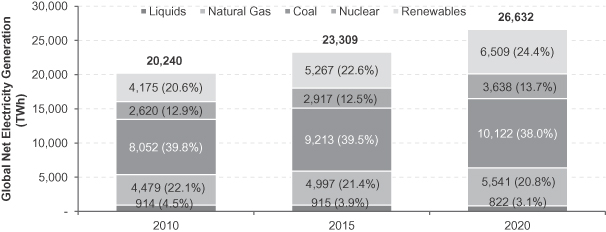
Source: International Energy Outlook 2013 – U.S. Energy Information Administration
132
Over the period from 2010 to 2020, the EIA expects 45% and 34% of the increase in net electricity generation from renewable energy to be from hydro power and wind power, respectively. While hydro power represented 81.5% of global net electricity generation from renewable energy in 2010, its contribution is expected to decline to approximately 68.4% by 2020 as projects utilizing other renewable energy technologies, including wind power and solar power, come online. Net electricity generation from wind power is expected to increase at a CAGR of 10.5% from 2010 to 2020, increasing its contribution to global net electricity generation from renewable energy from 8.2% in 2010 to 17.5% in 2020.
Global Net Electricity Generation from Renewable Energy by Energy Source
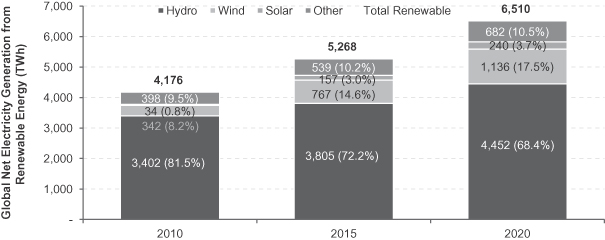
Source: International Energy Outlook 2013 – U.S. Energy Information Administration
Drivers of Growth in Renewable Power
In many countries and power markets around the world, governments and electricity customers are concerned with issues of energy security, sustainability and the environmental impacts related to power generation. Renewable power has advantages in these areas relative to traditional thermal power generation. These advantages have led governments to promote the adoption of renewable power in many jurisdictions throughout the world. In addition, advancements in renewable power technology that improve efficiency and lower costs also enhance growth. Significant growth drivers that may increase the use of renewable power include:
| • | No fuel requirement. The majority of power generation plants currently in operation are fueled by coal, nuclear and natural gas. Changing supply and demand factors for these fuels lead to price volatility for the generator plants that purchase them, which in turn can lead to volatility in the price of electricity paid by off-takers and end-use customers. In addition, some generators must import fuels from other countries and are exposed to market disruptions and political risks as a result. Renewable power relies on freely available sources of fuel, such as wind, water and sun and is not subject to fuel-price volatility or market disruptions. As power generation from renewable sources increases in a market or country, concerns about energy, security and price volatility in that market may be reduced. As a result, governments have an incentive to continue to promote further development of renewable power generation. |
| • | Environmental concerns over thermal power generation. Traditional fossil-fuel based thermal power generation emits greenhouse gas emissions and other pollutants that renewable sources of power generally do not. Government incentives or mandates to use a specified proportion of renewable power generation in the overall power generation mix can help jurisdictions achieve targets to limit or reduce greenhouse |
133
| gas emissions and other harmful pollutants. Stricter environmental regulations in certain jurisdictions may have the effect of increasing the cost of thermal power generation, which can bring renewable power generation closer to grid-parity in those jurisdictions. |
| • | Reductions in the cost of renewable power generation. As a result of the decreasing construction and operating costs of renewable power, technological advancements and efficiency improvements, and tax subsidies being provided in many jurisdictions, the cost of renewable power has come down significantly and in some cases is comparable to older technology. According to a study by Lazard’s Global Power, Energy and Infrastructure Group, the cost of utility-scale solar energy is as low as 5.6 cents per kilowatt-hour, and wind is as low as 1.4 cents. In comparison, the cost of natural gas is at least 6.1 cents per kilowatt-hour and coal costs 6.6 cents. Without subsidies, the firm’s analysis shows solar costs of at least 7.2 cents per kilowatt-hour, with wind costing 3.7 cents. |
| • | Challenges to aging and traditional thermal and nuclear power generation. The continued reliance on large aging coal and nuclear plants is a source of concern for power system regulators and the general public. Coal plants are facing increasing legislative pressures to make significant environmental compliance investments. In some cases, these increased environmental compliance costs are accelerating the retirement of coal plants, which need to be replaced with new capacity. Following the 2011 Fukushima nuclear disaster in Japan and in light of ongoing cost uncertainties and concern over nuclear waste disposal, public opposition to new nuclear construction and to further extending investments in existing nuclear plants has increased. Continued retirements of aging thermal and nuclear plants provide additional development opportunities for renewable power to fill that supply gap. |
| • | Governments in many jurisdictions are using a variety of policies to encourage development of renewable power. According to REN21, a global policy network backed by the IEA, at least 118 countries (including all 27 European Union countries) had renewable energy targets in place by early 2012, and 109 countries had policies to support renewable energy in the power sector, including tax subsidies, grants, low-cost loans, FITs and RPS. The EIA indicates that 29 U.S. states and the District of Columbia have RPS or similar policy goals in place that require load-serving utilities to procure electricity from renewable energy generating sources. |
Overview of Core Power Markets
Renewable Power Generation Market in the United Kingdom
The U.K. faces the challenges of replacing life-expiring coal and nuclear generating capacity and complying with policy objectives to cut carbon emissions.
The DECC estimates that about a fifth of the U.K.’s electricity generating capacity may have to close over this decade as the U.K.’s power stations age and as EU environmental legislation, notably the LCPD and IED, impose stricter standards. Specifically, there is a requirement to close coal and oil stations that have “opted out” of the LCPD that will lead to the retirement of 12 GW of major capacity in Great Britain by 2016. The LCPD aims to reduce emissions of sulphur dioxide, nitrogen oxides and dust from large combustion plants. All plants built after 1987 must comply with the emission limits in LCPD. Existing plants can either comply with the LCPD through installing emission abatement equipment or elect to “opt out” of the directive. All existing plants that “opt out” must close by the end of 2015, driving the need for new generation plants to be commissioned in order to maintain the country’s security of supply. The IED imposes similar restrictions on conventional generation, with remaining coal-fired and some gas-fired generation expected to close by 2023.
The EU and U.K. targets for reducing carbon emissions also require investment in low carbon electricity generation. Compared to other EU Member States, the U.K. generates a relatively low proportion of electricity from renewable sources. DECC has estimated that in 2011, only 3.8% of gross energy consumption (including electricity and other uses of energy output such as heating and transportation) was procured from renewable sources versus the national target of 15% by 2020. The share for electricity (excluding other types of energy consumption) was 9.2% in 2011 from renewable sources, up from 6.7% in 2010.
134
The U.K.’s national target under the Renewable Energy Directive is for 15% of gross energy consumption to come from renewable sources by 2020. The U.K. government put in place a Renewable Energy Roadmap in July 2011 to achieve that objective, which was then updated in December 2012.
Growth Drivers / Current Support Mechanisms for U.K. Renewable Power Generation
| • | The Renewables Obligation. The RO has been the primary support mechanism for renewable electricity projects in the U.K. to date. The RO came into effect in 2002 in England, Wales and Scotland, followed by Northern Ireland in 2005. It places an obligation on energy suppliers to source an annually increasing proportion of the electricity they supply to customers from eligible renewable sources. In order to comply with their obligations, suppliers may present ROCs or pay a buyout price to the Office of Gas and Electricity Markets (“Ofgem”). ROCs are green certificates that are issued to generators for each “unit (MWh)” of eligible renewable electricity generated. Once a renewable generator is found eligible, it will receive ROCs for 20 years. Suppliers purchase the necessary ROCs from generators (together with the electricity generated) in lieu of having to pay the buyout price for any obligation that is not covered by the required amount of renewable generation. The buyout price per MWh of electricity is adjusted by Ofgem each year to reflect changes in the retail price index (“RPI”). It was £30 per MWh in the base year, 2002 / 2003. The buyout price for 2015 / 2016 has been set at £44.33 per MWh. The price suppliers will pay to renewable generators for ROCs tracks closely with the buyout price set by Ofgem. |
In addition to the ROC price, suppliers may also pay generators a “ROC Recycle” price on a £/MWh basis. The ROC Recycle price is determined annually based on the total buyout payments to Ofgem in a given compliance year. Ofgem pools these funds and then divides the aggregate amount by the number of ROCs generated in that compliance year. This value becomes the ROC Recycle price. The ROC Recycle funds are redistributed to suppliers pro-rata based on each supplier’s annual ROC compliance. Suppliers may, but are not obligated to offer generators the ROC Recycle price as part of a PPA. The table below shows the final ROC Recycle price for recent compliance years:
| Obligation Period |
Final recycle value (£/MWh) | |
| 2013-14 |
£0.70 | |
| 2012-13 |
£3.67 | |
| 2011-12 |
£3.58 | |
| 2010-11 |
£14.35 | |
| 2009-10 |
£15.17 | |
| 2008-09 |
£18.61 |
Pursuant to the EMR, the RO will close to all new generation in the future, with the closing date depending on the technology. Solar PV projects greater than 5 MW are not eligible to participate in the RO after March 31, 2015 unless they have achieved certain milestones that provide them with a grace period through March 2016 to achieve final accreditation. All of the ROC projects in our Initial Portfolio will either have been completed by the April 1, 2015 deadline or are eligible for the grace period. The milestones include having satisfied financial planning and grid connection conditions. Doing so extends their eligibility to participate in the RO through March 31, 2016. Wind projects will be eligible to participate in the RO through March 2017. The RO will be replaced by a CFD scheme and the first auction for CFDs was completed in February 2015. In its December 2013 report titled “Electricity Market Reform Delivery Plan,” the DECC stated that the CFD will “help achieve total U.K. renewable deployment of around 42 GW by 2020, generating around 109 TWh (or around 33% of electricity but with a range of 30-36%)” and “will be enable additional investments of around GBP 40 billion in renewable electricity generation projects up to 2020.” Existing operational projects (and those which are certified and commence operations) are “grandfathered” under the current regime, which will continue to apply to them (but see below with respect to transitional arrangements and the move to “fixed price certificates”).
| • | The small scale Feed-In Tariffs. The FIT supports renewable energy generation sites with a capacity of 5 MW or less. Generators are paid a generation tariff for the renewable component of electricity generated |
135
| and an export tariff for the commodity component of the electricity generated and exported to the grid. Each MWh purchased by an electricity supplier from a FIT project is counted towards the U.K.’s requirement to source 15% of its total energy needs from renewable sources by 2020. Large electricity suppliers are required to purchase energy generated by FIT-eligible projects. While the RO scheme will close to all new renewable projects greater than 5 MW, the FIT scheme will continue to stay in place for renewable projects of 5 MW or less. The small scale FIT applies in Great Britain only; small scale generators in Northern Ireland are supported by the RO. |
| • | The Levy Exemption Certificates (“LECs”). Renewable generators are also eligible to receive transferable exemptions from the Climate Change Levy (“CCL”) in the form of LECs. The CCL is a tax on some non-domestic supplies of energy to help fund carbon reduction initiatives and provide energy efficiency incentives. Businesses can avoid paying the CCL if they source their electricity from CCL exempt sources such as renewable sources (except large-scale hydro). LECs are issued to accredited renewable generators for each MWh of renewable electricity produced. Renewable generators monetize this value through the receipt and sale of LECs, which are bundled with the electricity and ROCs when sold to a supplier. Suppliers use LECs as part of the evidence to demonstrate to HMRC that the electricity they supplied to consumers in the U.K. is from renewable sources and therefore exempt from the CCL. The LEC value is established by the ability to avoid the CCL, which for April 2014 through March 2015 is set at £5.41 per MWh. This aspect of U.K. regulation is set to expire in 2023 and it may or may not be extended. |
| • | The Non-Fossil Fuel Orders. A small minority of wind farms in the U.K. operate under the Non-Fossil Fuel Orders (“NFFO”) and the Scottish Renewables Obligation (“SRO”) of 1994, 1997, and 1998 (1999 in Scotland). NFFO and SRO provide a single fixed price for each unit of power generated by the contracted wind farms and delivered onto the grid over a 15 year period. No new NFFO contracts have been awarded since 1999. |
Off-taker Agreements
In the U.K. all electricity suppliers are required to comply with the national RO by procuring ROCs and the associated power from accredited renewable generators. The ROC buyout price is fixed for 20 years, adjusted annually only for inflation. The number of ROCs that are issued to renewable generators for each MWh of eligible generation is based on a multiplier that is determined by Ofgem, based upon the technology and COD of the project. The cost of the ROCs is passed on to consumers through the price at which their suppliers sell them power. To maintain sufficient demand for ROCs each year, Ofgem tracks ROC production, and, if production is expected to exceed the annual RO requirement, Ofgem will increase the RO requirement. In terms of the power price portion of the PPA, as most PPAs have power priced as a pass-through percentage of the wholesale rate, suppliers are essentially taking a transaction fee on the power, which gives them an incentive to compete for and enter into these PPAs, which we expect to continue as long as the RO is in place.
In terms of FIT offtake, only suppliers with more than 250,000 customers are required to participate in the program. However, a number of smaller suppliers may voluntarily participate, since suppliers must enter into off-take agreements with accredited renewable generators in order for the U.K. to achieve its goal of sourcing 15% of total energy needs from renewable sources by 2020. As the FIT price is pegged to a project’s COD, if a given counterparty became bankrupt in the future, we expect that the project would be able to enter into a PPA with another counterparty at the same price.
Most of the customers of projects in the U.K. renewable energy market are power marketing firms that buy wholesale electricity and then supply primarily commercial and industrial customers. Only a small number of suppliers own any of their own generation. Electricity purchased from generators is transmitted to the end users through the National Grid or regional Distribution Network Operators (“DNOs”). All of the U.K. projects in our Initial Portfolio will be interconnected through DNOs. Scheduling and balancing is managed by the supplier who pays for electricity based upon the readings at the project meter at the point of interconnection. End users of electricity receive one bill from suppliers for electricity usage as well as charges to fund these distribution and transmission networks.
136
As noted above, Ofgem allows suppliers to charge an environmental rider on customer bills to pay for the additional cost of procuring renewable energy, including supplier’s administrative costs. The result is that in the U.K., as compared to markets like the United States, management believes the relationship between off-taker and generator is less adversarial and price competitive, as suppliers have certainty of their ability to recover the costs of renewable energy procurement.
Electricity Market Reform
The Energy Act 2013 provides a legislative framework for EMR which will introduce very significant changes to the U.K. electricity market. In summary, it is comprised of four key components:
| (i) | long-term contracts for difference for low carbon generation (“CFDs”); |
| (ii) | a Carbon Price Floor; |
| (iii) | a Capacity Mechanism to encourage the availability of capacity, demand reduction measures and storage in order to ensure security of supply; and |
| (iv) | an “Emissions Performance Standard” to limit how much carbon power stations can emit. |
Two of these components are of particular relevance to the renewables sector: CFDs and the carbon price floor.
Commencing in 2015, generators with a CFD will receive a 15-year, fixed strike price for power generated, indexed to the Consumer Price Index. The electricity will be sold into the market under a PPA, and any shortfall (or excess) in the market price will be paid (or retained) by a U.K. government counterparty. CFDs will be allocated under annual rounds, in which the strike price will be determined. In each round, generators will bid a specified strike price, although if the amount of power supply in any auction exceeds the available demand (determined by the U.K. government) not all bidders may receive a CFD. There will be separate allocations and budgets for different technologies, in particular distinguishing between established and new technologies. If the budget is insufficient to satisfy all applications for a CFD, what is known as “constrained allocation,” projects in the same situation will have to compete with one another for a CFD. The most expensive schemes which require higher strike prices will be unsuccessful in obtaining a CFD. Solar PV and onshore wind are “established technologies” and will compete for the same allocation. It is predicted that there will be constrained allocation for established technologies.
The first CFD auction was completed in February 2015. While not necessarily indicative of future auction results, this first auction saw limited success for solar PV, with winning strike prices ranging between £50/MWh and £79/MWh.
The CFD counterparty will be a government-owned counterparty, the Low Carbon Contracts Company Ltd. A supplier obligation is being introduced to fund CFDs.
Under transitional arrangements, ROCs issued after April 1, 2027 will be replaced with “fixed price certificates” a new form of certificate. DECC has indicated that the intention is to maintain levels and length of support for existing participants under the RO with the long-term value of a fixed price certificate to be set at the prevailing ROC buy-out price in 2027 plus 10% and indexed to either CPI or RPI, which the U.K. government has said it intends to target as the long-term value of the ROC. A key feature of the fixed price certificate is that the U.K. will become the single buyer of renewable attributes.
The second key element, the carbon price floor, was introduced to encourage additional investment in low-carbon power generation by providing greater support and certainty to the carbon price. The floor will be based on an assessment of a desired target price for carbon realized by the EU Emissions Trading Scheme (ETS) and will be given effect by levying carbon price support on fossil fuel generators in the U.K. under the Climate Change Levy. Carbon price support is likely to affect RO-supported renewable generators by increasing the wholesale electricity market price to reflect the additional carbon costs incurred by fossil fuel generators.
137
Outlook
We believe that wholesale power prices are likely to rise at or above the U.K.’s rate of inflation in the near future. From 2001 through November 2014, wholesale power prices in the U.K. increased at a compound annual rate of 6.45% compared to 2.82% for the RPI. Ofgem expects power prices to continue to rise primarily as a result of the market’s increased reliance on natural gas generation which is expected to double between now and 2020 as the U.K. begins the process of retiring a substantial portion of their coal fleet due to age and environmental regulations. In addition, the U.K. is increasingly reliant on European natural gas which is priced on an oil-linked basis.
Renewable Power Generation Market in the United States
Industry participants in the United States have increasingly transitioned to building renewable generation resources in response to more stringent environmental regulations and supportive federal and state incentives and policy initiatives. EEI estimates that 17 gigawatts of new generation capacity was added in the United States in 2013. Natural gas (7,370 MW) and solar (4,936 MW) accounted for the majority of the new capacity, with solar having a record breaking year in 2013 and surpassing wind for the first time as the leading source of new renewable capacity. In 2012, renewables were the dominant source of new capacity within the U.S. power generation industry, contributing 50.2% of capacity growth.
In its “Annual Energy Outlook 2013,” the EIA forecasts that capacity additions from 2012 to 2040 will total 340 gigawatts. Annual additions in 2012 and 2013 remain relatively high, averaging 22 gigawatts per year. Of those early builds, 51 percent are renewable plants.
U.S. federal, state and local governments have established various incentives to support the development of renewable energy. These incentives include accelerated tax depreciation, ITCs, PTCs, cash grants and RPS programs.
Growth Drivers / Current Support Mechanisms of U.S. Renewable Power Generation
| • | Modified Accelerated Cost Recovery System. Wind and solar projects qualify for the U.S. federal Modified Accelerated Cost Recovery System depreciation. This schedule allows a taxpayer to recognize the depreciation of tangible property on a five-year basis even though the useful lives of such property are generally greater than five years. |
| • | The ITC and 1603 Cash Grant Program. These are U.S. federal incentives that are available after the project commences commercial operations and provide an income tax credit or cash grant for up to 30% of eligible installed costs. A solar project must commence commercial operations on or before December 31, 2016, to qualify for the 30% ITC. A solar project that commences commercial operations after December 31, 2016, may qualify for an ITC equal to 10% of eligible installed costs. Alternatively, in order to qualify for the 1603 Cash Grant, a solar project must have begun construction by the end of 2011 and have commenced commercial operations on or before December 31, 2016. Wind project owners may elect to claim an ITC equal to 30% of the capital cost of qualified equipment for wind projects placed in service on or after January 1, 2009 for which construction begins before January 1, 2014. |
| • | The PTC. The PTC is a U.S. federal incentive that provides a U.S. federal income tax credit on a ¢/kWh basis for all qualifying energy produced by a qualifying U.S. wind project during the first ten years after it commences commercial operations. The PTC is no longer available for new wind projects unless they were “under construction” by the end of 2013 and the developer uses “continuous efforts” towards commencing commercial operations. Under IRS guidance, projects that were under construction by the end of 2013 and have commenced commercial operations by the end of 2015 will be deemed to have used continuous efforts. |
138
| • | RPS. RPS are state regulatory programs created by state legislatures to encourage the development of renewable energy. They typically require utilities to produce or procure a certain percentage of their energy needs from renewable energy, and there are typically legislative or regulatory mechanisms put in place to support the collection from customers of costs associated with meeting these renewable targets. According to the DOE, twenty-nine states and the District of Columbia currently have an RPS in place and nine other states have non-binding goals supporting renewable energy. Additionally, several states have pending legislation to adopt new RPS programs. Most states with mandatory RPS programs typically set a target between 10% and 30% of total energy capacity, while other states set a MW target to achieve their RPS goals. |
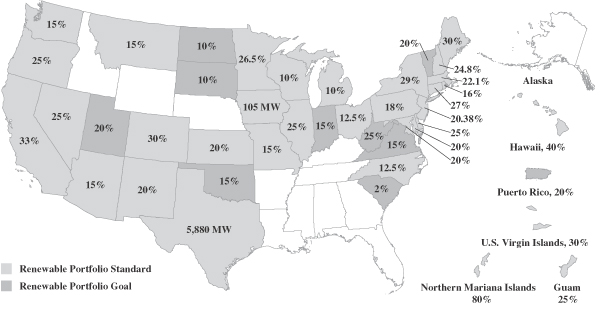
Source: Database of State Incentives on Renewables & Efficiency—Map of RPS Policies
Overview of Sources of Clean Electricity Generation
Solar
Solar PV power generating facilities consist of an array of solar panels. These solar panels are made up of smaller solar cells (often encased in glass to protect them from the elements), which convert electromagnetic radiation from the sun into electricity by means of semiconductors. The semiconductors use photons of light to knock electrons into a higher state of energy to create electricity (known as the photovoltaic effect). The electricity produced by solar PV generating facilities is in the form of direct current (“DC”) (unidirectional flow of electricity). An inverter is required to convert the direct current electricity to alternating current (“AC”), which is the type of current upon which most electricity distribution and transmission grids are based.
139
Solar power generation by solar PV farms is growing all over the world. Solar PV generation costs remain high in comparison to hydro or wind and in most situations still require government incentives for new projects
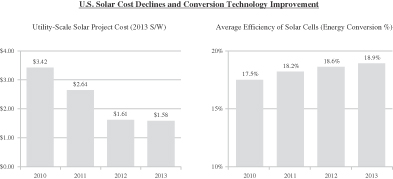
Source: Bloomberg New Energy Finance, “H1 2014 Levelised Cost of Electricity—PV” and “Q1 2014 PV Market Outlook,” February 2014
to be built. However, costs have been decreasing steadily due to efficiencies in the supply chain. The cost of solar PV modules is becoming more affordable for large scale projects, and their reliability has been proven for projects operating for more than 20 years. Since the start of 2010, the average total installed cost of utility-scale solar has declined over 50%, according to Bloomberg New Energy Finance.
Solar PV farms do not produce any GHG or acid rain, both of which have significant negative impacts on the environment. Solar energy generation does not result in thermal, chemical, radioactive, water, and air pollution associated with fossil fuel and nuclear generated power. The visual impact of solar projects is generally negligible and the lands occupied are fully rehabilitable without any negative impact after the end of the project and most of the equipment, such as racking and modules, can be fully removed and recycled. In addition, the sun’s availability, in both duration and intensity, is well documented and has generally been monitored for a long period of time. The yearly variation of the resource lies in the 3 to 4% range, which is much lower than the variations observed for hydro and wind resources.
Solar PV farms are relatively easy to build and all costs can be quantified in advance of construction. The construction of a solar farm project consists of standard foundation and racking systems, PV modules, wiring, and connection to the power grid. The civil structures are limited to maintenance access roads, fencing, and a small control building. The maintenance of a solar farm is quite simple considering the fact that there are no mechanical components, such as for turbines. Performance of the PV systems is controlled by a monitoring system and regular maintenance is limited to some cleaning, minor repairs and spare part changes.
Wind
Electricity generated from wind is becoming an increasingly important source of power globally. Wind generation is not subject to fuel price volatility and it produces no greenhouse gas or other emissions. Wind turbines can only generate electricity when the wind blows at speeds within a certain operating range.
Energy is produced from the wind power exerted on the blades of a wind turbine which are attached to a central shaft to rotate a generator. Wind turbines are equipped with a control system which optimizes electrical production and adjusts to varying wind speed and direction.
Wind farms are relatively simple to construct compared to more traditional electricity generating facilities. A typical wind farm can be constructed within a much shorter time frame than other power facilities, such as hydro, natural gas, nuclear, or coal facilities, which can take several years to complete. As a result, wind farms are less susceptible to risks associated with construction delays and cost overruns. Wind farms require only a small percentage of the land they occupy for road access and foundations. The rest of the project’s site is
140
available for other uses, such as agriculture, industry, and recreation. Wind farms do not have any fuel costs and use a remote monitoring system that allows for offsite operation and supervision. In addition, improvements to wind turbine technology have increased the efficiency and reliability of wind energy projects. As a result, operating expenses are low compared to many traditional methods of electricity generation.
Wind technology is improving as a result of taller towers, longer blades and more efficient energy conversion equipment, which allow wind projects to more efficiently capture wind resource and produce more energy. As shown in the table below, the IEA estimates that over the last ten years technology improvements have decreased the cost of wind energy in the U.S. between 24% and 39% depending on wind speed, with the greatest improvements seen at lower wind speeds.
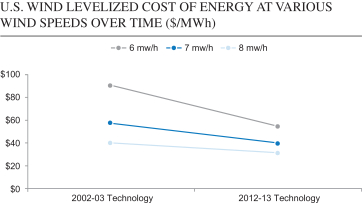
Source: TEA Wind Energy Technology Roundup 2013 Edition
Biomass
Biomass power production is the process of transforming elements of physical chemistry, such as wood residue or agricultural waste into thermal power, through controlled combustion. In order to do this, the combustible material is inserted into a boiler. The combustion is controlled based on the required quantity and the temperature of the air. The vapor that is produced in the boiler is then injected into a turbine, where the energy which it releases is transferred into mechanical energy. The mechanical energy produced by the turbine is then transformed into electricity by the generator.
Biomass combustion is low emissions as it produces negligible amounts of sulfur dioxide and nitrous oxide emissions relative to other fossil fuels. Biomass is a renewable resource that consumes carbon dioxide during its growing cycle. Sources of biomass such as wood waste would otherwise have to be disposed of by either incineration or dumping at a landfill site. As a result, a biomass facility contributes no additional carbon dioxide emissions from those that would otherwise have been produced at incineration facilities or from decay in landfill sites (in which leachates would also be produced). To the extent that energy produced at a biomass plant replaces energy that would have been required from a coal, oil or gas power facility, greenhouse gas emissions are lower.
Some forms of biomass have the added advantage of delivering base load electricity regardless of weather conditions or time of day. While the engineering required to design and construct biomass plants is well known, the cost of construction, operation and maintenance of a baseload biomass project can be greater than for an equivalent sized natural gas plant. When biomass is used to fuel a baseload thermal generation operation, the generator requires 24-hour staffing to handle those operations safely; some other renewable resources, such as solar and wind, do not require direct operator control to produce marketable electricity.
141
Biomass facilities have relatively low fuel costs since they constitute an alternative to landfilling for most biomass waste suppliers. The volatility of their cost structures is low compared to fossil fueled plants. However, because their fuel source is comprised of various types of burnable waste, sourcing and delivery of appropriate and adequate quantities of fuel to biomass facilities require a greater focus than for most other renewable generating resources. Additionally, the cost of accumulating and harvesting biomass in its raw form can be higher than the cost of extracting fossil fuels. Furthermore, for maximum efficiency, these plants typically require sufficient land around the generating plant to be able to store at least several days, if not weeks, worth of fuel on-site in order to maintain a continuous uninterrupted flow of fuel.
Moreover, California has enacted legislation to promote additional diversion of materials from landfills including AB341 (enacted in 2011), targeting 75% recycling, composting and diversion by 2020. As of 2011, including Chowchilla and El Nido, there were 22 biomass conversion facilities in California, with a total combined capacity of 545 MW.
142
About LightBeam Electric Company
We are a growth and yield oriented company formed to acquire and manage high quality clean and renewable electric generation projects with stable, long-term cash flow. Our primary business objective is to pay our stockholders a consistent and growing cash dividend that is sustainable on a long-term basis. Upon the completion of this offering, we will own a diversified portfolio of projects that are operational, under construction or in advanced development, with a total generating capacity of approximately 239 MW in the United Kingdom and the United States consisting primarily of solar, as well as wind and biomass power generation. The projects in our Initial Portfolio will sell substantially all of their electric generating output pursuant to PPAs with creditworthy counterparties, with a capacity-weighted, average remaining life of approximately 19 years. With these agreements and the addition of new electric generating capacity over time, we expect to generate stable and growing cash flow available for distribution to our stockholders.
A differentiated part of our growth strategy is our LDN. Through our LDN, we have developed mutually beneficial relationships with an international group of regional developers who operate in attractive, high growth markets. We have selected our initial Members based on their experience in identifying, developing and operating global clean and renewable power generation projects, the quality of their projects in operation and under construction, and their potential to contribute additional projects to us in the future. We believe that our initial Members are well-positioned to continue to take advantage of the rapid growth of the global clean and renewable power market because of their local knowledge, relationships and expertise.
Our initial Members are those developers from whom we will acquire our Initial Portfolio. We also have entered into Purchase Options to acquire certain additional projects from our initial Members and additional developers with a total generating capacity of approximately 104 MW, which would increase the size and breadth of our portfolio. Although we plan to primarily acquire projects in operation, we may also acquire projects that are under construction or in advanced development with minimal risk of delay or incompletion.
We believe that being part of our LDN will result in meaningful benefits to our Members that will enhance their competitive position in their respective markets and help drive their growth. Among other benefits, we believe that our relationships with global financial institutions and the cultivation of our relationships with leading vendors of services and equipment required in the electric generation industry will provide our Members with improved access to construction financing on more favorable terms, and increased purchasing power and reduced costs for their procurement of equipment and services. As a result, we expect that our Members will be able to execute their development activities on a more efficient and profitable basis, and that participation in our LDN will provide our Members with greater liquidity and diversification of their project investments as well as a high degree of visibility on our project requirements, while aligning their interests with ours.
We expect that this relationship with our initial Members, as well as the Purchase Options, will provide us with opportunities to add new electric generation capacity to our portfolio in the future. We believe that our initial Members will continue to contribute additional projects to us as we believe they would prefer to be a part of our strategic partnership rather than sell their projects to larger companies that compete with them. We also believe that the benefits of our LDN will attract other regional developers to become Members, which will provide us with additional growth opportunities. See “—Our LightBeam Developer Network.”
We were founded in 2008, but have conducted minimal operations and have not generated significant revenue to date. We will not conduct any significant operations and generate significant revenue unless we successfully complete the Acquisitions and this offering. We cannot assure you that we will successfully complete the Acquisitions, which will be a condition to the completion of this offering.
143
Current Operations
We expect to generate approximately $ million and $ million of cash available for distribution for the 12 months ended June 30, 2016 and December 31, 2016, respectively. We have established our initial quarterly dividend level based upon a targeted annual payout ratio of approximately % of projected annual cash available for distribution. Accordingly, we expect to set our initial quarterly dividend at $ per share of common stock, or $ per share on an annual basis. See “Cash Dividend Policy.”
We intend to target a % annualized growth rate in our cash available for distribution per share over the -year period following the completion of this offering.
The following chart provides an overview of our Initial Portfolio by counterparty credit rating, contract duration, technology and region, in each case based on MW capacity.
| Project Description |
Location | COD | Rated MW(1) |
# of Projects |
Counterparty | Counterparty Credit Rating |
Remaining Duration(2) |
|||||||||||||||||||
| Solar |
||||||||||||||||||||||||||
| Bradenstoke |
Wiltshire, U.K. | Q3 - 2015 | 70.4 | 1 | U.K. Structure(3) | U.K. Structure(4) | 20 | |||||||||||||||||||
| Owl’s Hatch |
Kent, U.K. | Q1 - 2015 | 51.9 | 1 | U.K. Structure(3) | U.K. Structure(4) | 20 | |||||||||||||||||||
| Hadlow |
Kent, U.K. | Q1 - 2015 | 18.9 | 1 | U.K. Structure(3) | U.K. Structure(4) | 20 | |||||||||||||||||||
| North Farm |
Dorset, U.K. | Q1 - 2015 | 11.5 | 1 | U.K. Structure(3) | U.K. Structure(4) | 20 | |||||||||||||||||||
| Southfield Farm |
Somerset, U.K. | Q3 - 2015 | 9.2 | 1 | U.K. Structure(3) | U.K. Structure(4) | 20 | |||||||||||||||||||
| Bake Farm |
Wiltshire, U.K. | Q3 - 2015 | 5.0 | 1 | U.K. Structure(3) | U.K. Structure(4) | 20 | |||||||||||||||||||
| Newlands |
Weymouth, U.K. | Q3 - 2015 | 5.0 | 1 | U.K. Structure(3) | U.K. Structure(4) | 20 | |||||||||||||||||||
| Crowpitts |
Devon, U.K. | Q3 - 2015 | 4.9 | 1 | U.K. Structure(3) | U.K. Structure(4) | 20 | |||||||||||||||||||
| North Carolina |
North Carolina, U.S. | 2011 | 5.2 | 6 | Tennessee Valley Authority | Aaa / AA+ | 17 | |||||||||||||||||||
| Massachusetts 1 |
Massachusetts, U.S. | 2014 | 4.4 | 1 | Town of Sandwich | A2 / AA+ | 20 | |||||||||||||||||||
| Massachusetts 2 |
Massachusetts, U.S. | 2014 | 3.8 | 1 | MA Dev Financial Agency | A3 / A+ | 20 | |||||||||||||||||||
| New Mexico 1 |
New Mexico, U.S. | 2011 | 2.9 | 3 | Southwestern Public Service Co. | Baa1 / A- | 17 | |||||||||||||||||||
| New Mexico 2 |
New Mexico, U.S. | 2013 | 2.5 | 1 | City of Roswell | Aa3 / AA | 19 | |||||||||||||||||||
|
|
|
|
|
|||||||||||||||||||||||
| 195.6 | 20 | |||||||||||||||||||||||||
|
|
|
|
|
|||||||||||||||||||||||
| Biomass |
||||||||||||||||||||||||||
| El Nido |
California, U.S. | 2011 | (5) | 12.5 | 1 | PG&E | Baa1 / BBB | 17 | ||||||||||||||||||
| Chowchilla |
California, U.S. | 2011 | (5) | 12.5 | 1 | PG&E | Baa1 / BBB | 17 | ||||||||||||||||||
|
|
|
|
|
|||||||||||||||||||||||
| 25.0 | 2 | |||||||||||||||||||||||||
|
|
|
|
|
|||||||||||||||||||||||
| Wind |
||||||||||||||||||||||||||
| CWE |
Multiple Locations, U.K. | 2012 -Q3-15 | 8.8 | 74 | Opus Energy Ltd.; Smartest Energy Ltd; EDF Energy |
U.K. Structure(4) | 18-20 | |||||||||||||||||||
| Huerfano |
Colorado, U.S. | 2013 | 8.0 | 1 | San Isabel Electric Authority | Not Rated(6) | 24 | |||||||||||||||||||
| Muirden Portfolio |
Multiple Locations, U.K. | 2014 - Q2-15 | 0.9 | 2 | U.K. Structure(3) | U.K. Structure(4) | 20 | |||||||||||||||||||
| Mosscliff Portfolio |
Multiple Locations, U.K. | 2013 -Q2-15 | 0.6 | 4 | U.K. Structure(3) | U.K. Structure(4) | 19-20 | |||||||||||||||||||
|
|
|
|
|
|||||||||||||||||||||||
| 18.3 | 81 | |||||||||||||||||||||||||
|
|
|
|
|
|||||||||||||||||||||||
| Total |
238.9 | 103 | ||||||||||||||||||||||||
|
|
|
|
|
|||||||||||||||||||||||
| (1) | With regard to solar projects, all references to rated capacity (e.g., MW) refer to measurements of direct current, or “DC,” except where otherwise noted. The rated capacities of our biomass, natural gas and wind projects are based on alternating current, or “AC,” output. |
| (2) | For U.K. projects, the expiration is shown as the year when the FIT or ROC incentive expires. For other projects, expiration is shown as the last year in which the primary power sales agreement expires. The remaining duration is as of December 31, 2014. |
| (3) | The U.K. projects that have not yet reached COD do not have FIT or ROC contracts in place. Nevertheless, U.K. energy suppliers are required to purchase FIT project output (which is intended to be less than the aggregate of all the suppliers’ renewable obligations) and those who participate in the ROC program are required to pay the ROC buyout price for requirements that are not met by the purchase of ROC project output, so the revenues for these projects when completed can be |
144
| reasonably estimated based on that assumption (see “—Our Initial Portfolio—Typical Project Agreements—Energy Sale Arrangements in the U.K.”). |
| (4) | U.K. Government Supported Renewable Contract Structure: Electricity suppliers in the U.K. are required to participate in the FIT program and, as a result of government policy, economically incentivized to participate in the ROC program (see “—Our Initial Portfolio—Typical Project Agreements—Energy Sale Arrangements in the U.K.”). While many electricity suppliers do not have credit ratings, the contracted cash flows are supported by the required participation of all electricity suppliers. We consider the cash flows from these projects to be as secure as projects with high credit counterparties. |
| (5) | Date of repowering is listed here instead of the original COD. |
| (6) | San Isabel is a rural electric cooperative, providing retail electric service in all or parts of seven counties in Southern Colorado. San Isabel is one of 44 member cooperatives in Tri-State, a taxable wholesale electric power generation and transmission cooperative operating on a not-for-profit basis. Tri-State has an issuer rating of Baa1 and A by Moody’s and S&P, respectively, and a senior unsecured rating of A- by Fitch. |
The following charts provide an overview of the fuel source, geographic and counterparty characteristics of our Initial Portfolio.
| (1) | See footnote 4 to the chart of projects in our Initial Portfolio above. |
Our Growth Strategy
We believe we are well-positioned to expand our ownership of global clean and renewable energy generation projects through our relationships with our initial Members and with additional developers that become Members of our LDN. Fragmentation within the global renewable power market has created inefficiency but also provides for opportunity. Energy policy and regulation tend to be regionalized, and regional developers often possess local knowledge, relationships and expertise that provide them with a competitive advantage in developing clean and renewable power projects. However, regional developers also face a number of competitive challenges because of their lack of purchasing power and economies of scale relative to larger energy companies. These challenges include a higher cost of capital and more difficulty obtaining financing, less favorable pricing on equipment and services, and uncertainty regarding the ability to monetize their projects. We have developed our LDN in order to address these challenges, enabling these developers to compete more effectively and to drive the ongoing growth of their businesses and, in turn, support our growth objectives. We believe our LDN will provide our Members with a series of benefits that will ultimately help them improve their competitiveness and enhance their overall economic returns, including monetization of assets, efficiencies of transaction replication, improved access to financing on more favorable terms, benefits of purchasing power, increased efficiency and alignment of interests. See “—Our LightBeam Developer Network.”
145
We believe that, as the benefits of our LDN to our initial Members become more widely known in the global clean and renewable power generation market, we will be able to expand our network of Members to increase the number of potential projects we may acquire in the future.
The table below provides information about the projects for which we have entered into Purchase Options. Upon commencing commercial operations, these projects are expected to have many of the characteristics of the projects in our Initial Portfolio, including long-term contracts with creditworthy counterparties and recently or newly constructed, long-lived projects that we believe will generate stable cash flow.
| Developer |
Project |
Type | Location | Expected COD |
Number of Projects |
Rated MW |
||||||||||
| RRAM |
Hook Valley | Solar | United Kingdom | 2014 | 1 | 15.30 | ||||||||||
| RRAM |
Burrowton / Saundercroft | Solar | United Kingdom | 2014 | 1 | 12.67 | ||||||||||
| RRAM |
Helios (Higher Hill & Park Wood) | Solar | United Kingdom | 2011 | 2 | 9.97 | ||||||||||
| RRAM |
Wyld M; Knockworthy | Solar | United Kingdom | 2012-2013 | 2 | 9.48 | ||||||||||
| RRAM |
Whitley | Solar | United Kingdom | 2014 | 1 | 7.57 | ||||||||||
| RRAM |
Blenches Mill | Solar | United Kingdom | 2014 | 1 | 6.08 | ||||||||||
| RRAM |
Raglington | Solar | United Kingdom | 2013 | 1 | 5.73 | ||||||||||
| RRAM |
Crossways | Solar | United Kingdom | 2012 | 1 | 5.00 | ||||||||||
| RRAM |
Chilton Cantelo | Solar | United Kingdom | 2012 | 1 | 5.00 | ||||||||||
|
|
|
|
|
|||||||||||||
| SUBTOTAL |
11 | 76.80 | ||||||||||||||
| Forum |
Ontario Solar |
Solar | Canada | 2014-2016 | Multiple | 6.7 | ||||||||||
|
|
|
|
|
|||||||||||||
| Tamra-Tacoma |
Pleasant Hill Wind Farm | Wind | United States | 2014 | 1 | 20.00 | ||||||||||
|
|
|
|
|
|||||||||||||
| TOTAL |
>12 | 103.50 | ||||||||||||||
| (1) | With regard to solar projects, all references to rated capacity (e.g., MW) refer to measurements of direct current, or “DC,” except where otherwise noted. The rated capacities of our biomass, natural gas and wind projects are based on alternating current, or “AC,” output. |
The acquisition of the projects in the table set forth above is subject to negotiation of definitive agreements, due diligence, achievement of development milestones in certain cases, our ability to secure the funds necessary to consummate the acquisitions through debt and/or equity financing, third-party consents, regulatory approvals, approval by our independent directors and other conditions.
Our Business Strategy
Our primary business objective is to pay our stockholders a consistent and growing cash dividend that is sustainable on a long-term basis. We expect to accomplish this in the following manner:
Secure Future Acquisitions from Current and Future Members of our LDN. We expect that our initial Members and additional developers that join our LDN will be our most significant source of future acquisitions. We believe that our highly differentiated strategy targeting an alternative means for regional developers to monetize their operating projects and projects under construction will attract additional high quality energy companies to join our LDN. We also believe that the Purchase Options we have entered into, together with additional ones we intend to secure following this offering, will help to ensure a strong pipeline of acquisition opportunities.
Focus Globally on High Quality Diversified Assets in Low Risk Environments. Our goal is to become a top-tier global clean and renewable independent power producer. Our Initial Portfolio consists of projects in the United Kingdom and the United States. We selected these jurisdictions because they have stable governments and highly-developed economies that are large consumers of electricity and that have a significant presence of high quality regional energy companies as well as regulatory climates that are favorable to producers of clean and renewable energy. We expect to acquire on a global basis additional high quality projects in stable markets from experienced, regional developers. Our Initial Portfolio is also diversified by fuel source, consisting primarily of solar, as well as wind and biomass. We expect that any additional projects we acquire will utilize
146
such fuel sources or other proven sources. We believe that such geographic and fuel source diversification will tend to reduce the magnitude of individual project risk or regional exposure to climactic, regulatory, political, economic and other geographic risks or risks related to a particular sector of the clean and renewable energy industry. We expect that this will provide a more stable cash flow profile over the long term than a non-diversified portfolio, while also providing us with access to opportunities in additional markets that are expected to experience significant growth in clean and renewable energy generation.
Maintain Sound Financial Practices and Prudent Leverage to Grow our Cash Dividend. We intend to maintain a commitment to disciplined financial practices and prudent leverage to enable us to pay a consistent and growing cash dividend to, and serve the long-term interests of, our stockholders. Our financial practices will include a risk and credit policy focused on transacting with creditworthy counterparties, a hedging policy designed to reduce interest rate and currency exchange risks and a dividend policy, which is based on distributing a significant portion of cash available for distribution each quarter. We intend to evaluate various alternatives for financing future acquisitions to use our leverage effectively and efficiently to maximize our cash available for distribution.
Our Competitive Strengths
We believe that we are well positioned to execute our business strategy because of the following competitive strengths.
Our LightBeam Developer Network. We believe that our LDN presents a compelling alternative for a diverse international group of regional developers to monetize their high quality clean and renewable generation projects and to enhance their regional competitiveness. We select Members with experience in developing and operating stable projects, possessing growing pipelines of future projects under construction and established relationships in their regional markets, presenting growth opportunities for them and us. Since we do not currently engage in development activities in the markets in which our Members are active, we believe that we do not compete with such activities and that participating in our LDN will present a more attractive alternative for developers than monetizing their assets through arrangements with competitors. We believe that the mutually beneficial relationships of our LDN create a valuable and durable alignment of interests to ensure we are working collaboratively toward a common set of objectives. As of the date of this prospectus, our LDN has no operating history. See “—Our LightBeam Developer Network.”
Contracted Projects with Stable Cash Flow from Creditworthy Counterparties. The contracted, diverse nature of our Initial Portfolio supports stable cash flow. Our projects sell electricity to a diverse set of creditworthy counterparties. These contracts have a capacity-weighted average remaining life of approximately 19 years.
New, Diverse Portfolio of High-Quality Generating Assets. We benefit from an Initial Portfolio that consists primarily of recently constructed projects and projects under construction. All of our completed projects were constructed with equipment produced by experienced manufacturers and have achieved a COD within the past four years. Our Initial Portfolio is composed of 103 high quality projects with approximately 239 MW of clean and renewable energy capacity. We expect the diversification of our Initial Portfolio geographically and by fuel source should reduce our exposure to risks specific to particular sectors of the clean and renewable energy industry. We believe that the modern and high quality nature of our Initial Portfolio will result in relatively low operating and maintenance costs and will help us to achieve our expected levels of availability and performance.
Experienced Strategic and Operational Management. Our executive management team has extensive experience in managing public companies, developing and financing projects, identifying and closing acquisitions, and understanding regulation and regulatory environments. The members of our board of directors also have experience with clean and renewable energy, project finance and acquisitions, including as executives of energy companies and other publicly-traded companies, regulatory officials, investment bankers and corporate attorneys. We believe that this blend of experience in our industry and with managing public companies will serve to support our efforts in identifying, acquiring and integrating profitable clean and renewable energy projects.
147
We believe that the experience of our executive management and board of directors in energy, project finance and acquisitions, as well as the management and operational expertise of our Members, will enable us to efficiently acquire and integrate profitable clean and renewable energy projects.
LightBeam Developer Network
Selection of Members
We have devoted over two years to researching, analyzing and canvassing the global clean and renewable energy market, with the assistance of several market specialists who provided advice and made introductions to suitable developers and financial sponsors of projects. Based upon these efforts and our management’s experience in developing, financing, owning and operating clean and renewable energy facilities, we believe that we are well-positioned to understand and address the challenges faced by independent, regional developers.
We selected participants to invite to join our LDN because they match a desirable profile—regional development firms that have competitive advantages in their markets, a demonstrated record of successfully executing project development activities, and strong management teams capable of leading their companies through rapid growth. At the same time, however, these developers share common challenges that we believe we can help to alleviate with the benefits of our LDN. First, they lack the ability to efficiently monetize their investments in project development, which severely restricts their ability to pursue rapidly growing opportunities in their markets. Second, they lack a competitive cost of capital to fund their projects, and are therefore faced with diluting their equity ownership by obtaining funding with a high cost of capital. Third, they lack access to financial institutions that provide the most attractive terms for development capital, construction and term financing, and tax equity because many of these institutions focus their resources on larger, more established clients. Finally, they find that the process of funding projects, such as legal and technical diligence, documentation and interaction with advisors to financial institutions, to be extremely time consuming. As a result of these impediments, we believe that the management teams of these developers are extremely frustrated by the amount of valuable time they spend seeking financing instead of developing projects.
The initial Members of our LDN are developers of projects in the global clean and renewable energy market who have agreed to contribute their clean and renewable generation assets to form our Initial Portfolio and who have granted us, or intend to grant to us, options to purchase future projects. We believe that these initial Members joined our LDN because they expect that the benefits they will derive as Members of our LDN will help them grow their businesses in ways that would not be possible without participating in our LDN.
Benefits
We have developed strong relationships with a variety of financial institutions in advance of this offering who have expressed an interest in fulfilling our funding needs. We selected these institutions based upon prior industry relationships with certain members of our management and because of the capabilities of these institutions to provide capital to owners of clean and renewable energy projects. We believe that the institutions collectively possess the ability to underwrite equity and debt offerings, provide construction and term debt financing, invest tax equity, and provide a range of other necessary products, such as cash management, letters of credit and interest rate and currency risk management products.
Several of these institutions have indicated that they would be willing to provide financing to Members of our LDN on customary terms and conditions offered to their other clients, provided that any projects financed are offered to us under a purchase agreement or purchase option. We believe that our Members do not independently have the scale or relationships to attract financing on this basis.
We also expect to utilize our purchasing power as a public company with suppliers to help reduce the cost of equipment procurement. There are many examples in which this benefit could be realized, including supporting
148
our Members with requirements for deposits or credit support for contract obligations, streamlining supply contracts by seeking consistent terms for all of our Members, or helping to prioritize our Members in times of increased demand for preferred equipment. As we increase the scale of our business, we expect to be able to positively influence interactions between our Members and suppliers on a global basis, and we will seek to do so whenever possible.
We have already been able to provide certain services to our initial Members, including legal, accounting and independent engineering related to project development activities, in advance of inclusion in our Initial Portfolio. We expect to continue to offer such professional services in the future. We believe that these services and the other benefits we will provide to our Members will reduce the cost and time required to develop projects.
Relationship Management
Our relationships with the Members of our LDN will be formally established through the acquisition and Purchase Option agreements described in this prospectus and any additional Purchase Options we enter into with such Members. These agreements typically provide for consideration through a mixture of cash and shares of our common stock. Most developers require the ability to redeploy capital in future development activities, necessitating cash to fund their business. However, our initial Members have also invested in our growth potential by agreeing to receive a considerable amount of the consideration in stock.
We intend to utilize the benefits of our LDN to secure ownership of additional projects in the future, and we will devote considerable resources to ensuring that Members take advantage of the range of benefits we offer as a way to enhance our ongoing business relationship. We have created a business unit responsible for implementing our LDN, which will manage all facets of our relationship with existing and prospective Members. We intend to maintain a standard of excellence, policies and procedures to ensure that the benefits of the LDN are achieved, and that our relationships with our Members will be deepened. We conducted extensive diligence on the initial Members and will conduct extensive diligence on any future Members of our LDN to ensure that they are qualified, including a legal and technical review of their operations and projects.
Organization of Our Business
Our business is organized to pursue the acquisition, integration and management of clean and renewable energy projects. In addition to our executive officers, upon the completion of this offering, we expect to employ approximately 30 personnel engaged in project acquisitions and development, as well as the management of our portfolio and supervision of our service providers. Our headquarters is in Sausalito, California, and we intend to maintain other offices in London and New York.
Project Acquisitions and Development
The primary duties of our employees are identifying potential regional developers for inclusion as Members of our LDN and additional projects for acquisition, performing extensive due diligence on such projects, negotiating the acquisition of such projects and integrating such projects into our portfolio upon their acquisition. In order to ensure the projects that we acquire through our LDN meet our standards, we carefully qualify the project development companies that become our Members. Our initial Members have gone through a rigorous review process. We evaluate the management teams of our Members and the quality of the counterparties to the long-term contracts under which they operate to assess the stable, predictable cash flow we expect such projects to generate. We consider the quality of equipment installed in these projects and believe that the equipment in our portfolio is manufactured and designed to support the operating profile that we expect. We also select Members with growing pipelines of future projects under construction and strong relationships in their regional markets, presenting growth opportunities for them and us. In connection with the acquisition of projects under construction to be included in our portfolio, our management team will work closely with prospective Members and potential sources of construction financing to optimize the cost of project capital.
Following the acquisition of projects, our employees will be responsible for integrating and protecting the long-term value of our projects. Our employees will oversee contract management, environmental management,
149
community relations, power marketing and finance of each of our projects and closely monitor the performance of each project in order to attempt to maximize financial performance and minimize risk. Our team will monitor each project’s compliance with its project agreements and applicable laws and regulations, including environmental regulations.
Asset Management
We will utilize the services of third-party asset managers to manage our generation assets, while directly monitoring the performance of all our generation assets. We have chosen asset managers who have proven experience in the regions where our generation assets are located. The chief responsibilities of the asset managers include oversight of O&M service providers, production monitoring and analysis, outage evaluation and improvement, generation dispatch where necessary, contract obligation compliance, and oversight of regulatory compliance and reporting. The vast majority of our U.S. and U.K. assets will be managed by either CAMS or BSR, as described below.
Consolidated Asset Management Services (“CAMS”), together with its affiliates, will manage our generation assets located in the U.S. CAMS is a privately held company headquartered in Houston, Texas providing asset management and other services to the Power Generation, Energy Exploration & Production and Midstream sectors of the Energy industry. Formed in 2007, CAMS manages power generation facilities representing over 8,000 MW, including renewable and conventional generation resources. CAMS team members have experience in the development, construction management, commissioning, startup and maintenance of clean and renewable generation assets in the U. S. and abroad. CAMS can also provide specific technical expertise, through an affiliate, in the areas of IT infrastructure design, maintenance and support.
We will enter into an agreement directly with CAMS for it to provide asset management services for our generating facilities located in the U.S. The services provided will include project administration, data acquisition, reporting, accounting and financial services. CAMS will be responsible for overseeing the operations and maintenance service providers that provide operation and maintenance services for our U.S. generating facilities, and will interact with the power purchasers for these projects. Compensation paid to CAMS will either be a fixed amount for a specified service, or a fixed amount based on the type of generating facility and the expected MW output. The term of the agreement is for two years following the date of this offering, or as extended upon agreement with CAMS. We can terminate the agreement at any time after the first year of the term by giving 90 days’ written notice to CAMS.
BSR, a privately held company headquartered near Glastonbury, England, will manage a majority of our United Kingdom assets, including each of the U.K. solar projects in our Initial Portfolio. The asset management services will include administrative, company secretarial, project management, financial and management accounting and technical reporting services. Each of the project-owning SPVs that we will acquire pursuant to our agreement to acquire the Solar Power Generation Portfolio will enter into an asset management agreement with BSR. BSR will be remunerated on a fixed and variable fee basis that reflects the MW output of each project. BSR is one of the initial Members of our LDN, and as one of the U.K.’s largest integrated solar photovoltaic companies, also provides asset management services. Its asset management team has in-depth knowledge and skills that have been honed by practical experience in generation projects it has constructed for its own portfolio as well as for others. The BSR team’s skill base covers a broad range of renewable energy platforms such as biomass, wind, anaerobic digestion, energy from waste and landfill gas. Formed in 2011, BSR manages power generation facilities totaling over 160 MW. BSR’s team members, together with its affiliate, have experience in the development, construction management, grid connection, commissioning, startup and maintenance of clean and renewable generation assets in the U.K. This asset management agreement may be terminated by either party on three months’ notice.
The remainder of our United Kingdom assets will be managed by other experienced asset managers.
150
Operations and Maintenance
The projects in our Initial Portfolio are currently operating under operations and maintenance (“O&M”) contracts with our initial Members, their affiliates, or third-party service providers and will continue to operate under such agreements following the completion of the Acquisitions and this offering. We expect the projects to continue operating under such agreements through their respective termination dates. The O&M contracts vary between one year and 20 years in duration and generally provide for payment of fixed fees for scheduled maintenance services, adjusted annually for inflation. We expect that any additional projects we acquire in the future will also operate at least initially under similar arrangements. Following the expiration of such contracts, we will have the flexibility to negotiate their renewal, provide such functions in-house or engage alternative third-party operator(s) at the lowest available cost. For example, BSR is one of the United Kingdom’s leading integrated solar power companies, having connected 200 MW of solar power plants since 2010 and is expected to continue to provide O&M services to the U.K. solar projects. In those instances where O&M services are being provided by third-party service providers, they have many years of experience with the specific resource type. In some cases, these providers are also owners of similar facilities, while in other cases they specialize in services such as plant design, modifications and performance improvement, in addition to facility operation and maintenance.
Our Initial Portfolio
Upon completion of this offering, we will own 20 solar projects comprised of 12 projects in the United States and eight projects in the United Kingdom. We will also own two biomass projects in the United States, 80 wind projects in the United Kingdom and one wind project in the United States. The projects in our Initial Portfolio sell their electric generating output pursuant to PPAs with creditworthy counterparties, with a capacity-weighted, average remaining life of approximately 19 years. We expect any project we acquire will be party to a similar arrangement, but we may acquire projects with greater levels of uncontracted capacity.
Typical Project Agreements
Our projects have entered into agreements that are customary for clean and renewable energy projects. These include agreements for energy sales, Engineering, Performance and Construction (“EPC”), O&M services, site leases and grid connection, which are described generally below, followed by additional information for each project.
Energy Sale Arrangements in the U.K.
Each of the U.K. projects in our Initial Portfolio sells its output under a PPA that is based on one of two key government programs: a FIT program or a ROC program. Certain renewable projects with installed capacity below 5 MW, including solar, can opt either for the FIT program or the ROC program.
Under the FIT program, projects receive either 25-year (if online prior to August 2012) or 20-year (if online after August 2012) fixed tariff rates. The initial FIT tariff rate is further dependent on the size of the project and the specific commercial operation date and consists of a generation tariff and an export tariff, each paid on a per MWh basis and adjusted annually for inflation using the U.K.’s Retail Price Index (“RPI”). The following tables show the current FIT generation tariff and export tariff rates for solar PV and wind projects in the Initial Portfolio, depending on the date they reached commercial operations:
Current Solar PV FIT Rates (Projects 250 kW+)
| COD | April 2010- Aug. 2011 |
Aug 2011- March 2012 |
April 2012- July 2012 |
Aug. 2012- Oct. 2012 |
Nov. 2012- April 2013 |
May 2013- Dec. 2013 |
Jan. 2014- June 2014 |
July 2014- March 2015 |
||||||||||||||||||||||||
| Generation |
£ | 341.00 | £ | 94.30 | £ | 94.30 | £ | 75.20 | £ | 72.90 | £ | 70.30 | £ | 66.10 | £ | 63.80 | ||||||||||||||||
| Export |
£ | 33.90 | £ | 33.90 | £ | 33.90 | £ | 47.70 | £ | 47.70 | £ | 47.70 | £ | 47.70 | £ | 47.70 | ||||||||||||||||
151
Current Wind FIT Rates (Project 15 kW—100 kW)
| COD | April 2010- March 2012 |
April 2012- Nov. 2012 |
Dec 2012- March 2014 |
April 2014- March 2015 |
||||||||||||
| Generation |
£ | 280.60 | £ | 269.00 | £ | 222.30 | £ | 177.80 | ||||||||
| Export |
£ | 33.90 | £ | 33.90 | £ | 47.70 | £ | 47.70 | ||||||||
Current Wind FIT Rates (Project 100 kW—500 kW)
| COD | April 2010- Nov. 2012 |
Dec. 2012- March 2014 |
April 2014- March 2015 |
|||||||||
| Generation |
£ | 218.10 | £ | 185.30 | £ | 80.40 | ||||||
| Export |
£ | 33.90 | £ | 47.70 | £ | 47.70 | ||||||
Source: Ofgem
The FIT rates are valid for 20 or 25 years, subject only to an annual adjustment for RPI. The following table shows historical and forecast RPI.
U.K. Retail Price Index—Historical and Forecast
| 2004 | 2005 | 2006 | 2007 | 2008 | 2009 | 2010 | 2011 | 2012 | 2013 | 2014 | ||||||||||||||||||||||||||||||
| 3.0% |
2.8 | % | 3.2 | % | 4.3 | % | 4.0 | % | -0.5 | % | 4.6 | % | 5.2 | % | 3.2 | % | 3.0 | % | 2.4 | % | ||||||||||||||||||||
| 10-yr Avg. 2004-2013 |
5-yr Avg. 2009-2013 |
3-yr Avg. 2011-2013 |
Forecast 2015e |
|||||||||
| 3.28% |
3.1 | % | 3.8 | % | 2.5 | % | ||||||
Sources:
Historical RPI data taken from U.K. Office for National Statistics.
Expected RPI taken from U.K. Treasury report that averages RPI forecasts from a variety of public and private sources.
The generation tariff represents payment for the renewable attributes of each megawatt hour of electricity generated, while the export tariff is payment for the actual electricity “commodity” generated. Generators may opt out of the FIT export tariff to sell their power directly to suppliers at a specified price or at the prevailing wholesale market price through short and long-term contractual arrangements. Generators can also opt back in to receiving the export tariff or from the export tariff back to a negotiated PPA contract once every 12 months. In essence, the export tariff becomes a floor price for the commodity and generators will access the option they believe will create the most revenue in a given time period. Currently, all of our FIT projects have opted out of the export tariff and sell the commodity portion of electricity to suppliers through alternate contractual arrangements, since the export tariff is typically below current market prices. In addition to the generation and export tariff-related revenues, the projects sell Levy Exemption Certificates (“LECs”) and various grid benefits to suppliers through the PPAs. LEC pricing is set annually by Her Majesty’s Revenue and Customs (“HMRC”) under the Climate Change Levy. The Climate Change Levy program is expected to run through 2023, but may be extended at a future date. Grid benefits are determined based on market pricing and project location. LEC and grid benefits do not represent a significant portion of project revenues.
Our U.K. wind projects, which total 10.9 MW, sell their output under the 20-year FIT contract structure. We also expect that the Newlands, Place Barton and Southern Counties solar projects under construction totaling 14.99 MW will sell their output under the 20-year FIT contract structure when they achieve commercial operations.
152
The remainder of our projects in the U.K., totaling approximately 162 MW, are solar PV projects that sell their output or are expected to sell their output under the ROC contract structure, whereby projects qualify for a fixed 20-year price for the renewable attributes of their generation, adjusted annually for RPI (but see “Industry—Overview of Core Power Markets” for the discussion of the proposed transition to “fixed price certificates”). Each project that qualifies for the ROC program is also assigned a “banding” level, depending on technology and the date the project was accredited. All of our U.K. ROC operating projects are solar PV projects and are assigned banding levels of 1.4x. The banding level determines the number of renewable certificates that a project has available to sell for each MWh of generation. Banding levels are determined in four-year increments and were established for solar PV projects in 2012. It is expected that certain of the projects will be operational at the offering date, while other projects will be either under construction or pending approval of permit applications, the construction of which will not have commenced. The U.K. government announced recently that it intends to close the RO to new solar PV generating stations of greater than 5 MW as of April 1, 2015 (subject to certain grace periods). The current levels of RO support for existing projects will not be changed. The grace periods are proposed to apply to projects in development and which are completed by March 31, 2016 although the details remain to be clarified. The consequence of the withdrawals of the RO is that new solar PV projects will have to bid for support under the new CFD regime. The U.K. government’s decision has been challenged by several solar companies. To date, we are not aware of any judgment being issued. All of the U.K. solar projects in our Initial Portfolio, certain of which are expected to sell output under ROC contracts, are under construction with scheduled completion in early 2015. The table below shows the banding levels, current ROC prices, and corresponding “realized price” per MWh of generation for ground-mounted solar PV, depending on the commercial operations date:
Current Ground Mounted Solar PV ROC Banding and Pricing
| COD | April 2013- March 2014 |
April 2014- March 2015 |
April 2015- March 2016 |
April 2016- March 2017 | ||||
| Banding |
1.6x | 1.4x | 1.3x | 1.2x | ||||
| Current ROC Price |
£43.03 | £43.30 | £44.33 | TBD | ||||
|
Realized Price (Banding x ROC Price |
£69.28 | £60.62 | £57.63 | TBD |
Source: U.K. Department of Energy & Climate Change.
As described above, the initial ROC banding level is valid for 20 years, as is the ROC price subject only to an annual adjustment for RPI. See “—U.K. Retail Price Index—Historical and Forecast.”
In actual practice, the price that is paid for each renewable certificate by the power purchaser may reflect a slight discount to the ROC price and results from negotiation between the generator and the purchaser. Projects under the ROC program do not have a “floor price” to fall back on for the commodity portion of revenues, and negotiate the commodity price with the power purchasers. The commodity price will reflect the marketplace and wholesale market prices, along with contract length. ROC projects also sell LECs and can receive payments for embedded benefits. As under the FIT program, LEC and embedded benefits do not represent a significant portion of project revenues.
On an annual basis, approximately 60% of the total U.K. revenues come from the renewable component of the FIT and ROC revenues. Approximately 30% of U.K. revenues come from the energy commodity prices, another 8% from energy prices supported by a regulatory floor, and the remaining revenues come from payments for LECs and grid benefits.
Under our U.K. project PPAs, each party typically has a right to terminate upon an occurrence of an event of default that has not been cured within 20 days of written notice. Following termination for default where the
153
project is the non-defaulting party, the project is entitled to receive a termination payment which is the sum of net liabilities suffered in connection with termination of the agreement. For FIT program agreements, although no termination payment is specified, the power purchaser is liable with respect to all its payment obligations up to a maximum liability cap of £500,000. Note that if the project does terminate any of its FIT, ROC, or power sales agreements for an event of purchaser default, the project would be expected to secure a replacement agreement on similar or identical terms with an alternative purchaser as U.K. regulations require major electricity suppliers to enter into such agreements with renewable generators. Under the PPAs, events of default typically include:
| • | Failure to pay amounts due; |
| • | Insolvency events; |
| • | Failure to maintain required government licenses and approvals; |
| • | Material breach of obligations under the contract; and |
| • | A force majeure event lasting longer than 3-months. |
The contracts do not contain availability or production requirements.
Energy Sale Arrangements in the U.S.
Each of our projects in the U.S. has agreed to sell its output under a PPA that is either a “bundled rate” whereby all attributes of the power are sold for one price, or energy output is sold for one price and the renewable attributes receive an amount that is additive to the energy price. The Chowchilla, El Nido and Huerfano projects sell their output under bundled rate structure contracts that originally had 20-year or 25-year terms. The North Carolina and Massachusetts 1&2 projects sell their energy output under contracts that originally had 20-year terms, and sell the renewable attributes of the power generally under 10-year contracts. The New Mexico 1&2 projects sell their energy output and renewable attributes under 10-year contracts, with the sale of energy output being extendable for an additional 10 years.
Under our U.S. project PPAs, each party typically has a right to terminate the agreement following the occurrence of an event of default that has not been cured within a specified time period. If a purchaser defaults the project may receive damages and termination payments as applicable. Events of default typically include:
| • | Failure to pay amounts due; |
| • | Bankruptcy events; |
| • | Failure to maintain required government licenses and approvals; |
| • | Failure to maintain required credit support; and |
| • | Material breach of obligations under the contract. |
Our PPAs have certain production requirements, which, if not met, may result in the payment of liquidated damages to the purchaser, and, in some cases, may result in the right of the purchaser to terminate the agreement. The agreements do contain provisions for force majeure, including that either party may terminate the PPA if a force majeure event extends longer than a given time period.
Engineering, Procurement, and Construction Arrangements
Our operating projects have entered into EPC agreements with leading contractors and equipment suppliers. As of , 2015, of the projects in our Initial Portfolio have commenced operations. BSR will provide such services for our U.K. solar projects under construction.
O&M Arrangements
Our operating projects have entered into O&M Agreements with qualified O&M operators, which in most cases are the on-site personnel who have most recently been performing the operations and maintenance. These
154
agreements vary between one year and 20 years in duration. In some cases, such as the Huerfano Wind Farm, O&M services are provided by the manufacturer of the installed equipment for a period of time following commercial operations. Under the terms of these agreements, the O&M operator typically agrees to provide operations, maintenance, and, in some cases, administrative services to our projects. These O&M contracts are generally for a fixed annual fee for scheduled maintenance services, adjusted annually for inflation. In most cases, unscheduled maintenance is billed separately based on actual work performed and is generally charged at pre-determined labor rates with cost of parts as a simple pass-through. O&M agreements with unrelated parties that have fixed terms typically have a shorter term of five years. Our O&M agreements with our subsidiaries and manufacturers generally have a fixed term and in some cases are subject to renewal. We benefit from a portfolio of relatively newly constructed assets, with most of our operating clean and renewable assets having achieved COD within the past three years. Given the modern nature of our portfolio, which includes a substantial number of relatively low operating and maintenance cost solar generation assets, we expect to achieve high fleet availability and expend modest maintenance-related capital expenditures. The notice periods vary and, in relation to the SPGL agreement, the period is two years with no such termination rights in the first three years.
Site Lease Arrangements
Our projects have entered into real estate property and easement rights that we believe will allow the projects in our portfolio to operate without material real estate claims until the end of each projects’ expected useful life. In the case where a project has entered into a long-term site lease or leases, these rights are typically for a period of 20-25 years with further extension rights available at the project’s discretion. The leases give our projects the right to develop, construct, and operate a facility for the duration of the lease in exchange for a lease payment typically structured as a fixed payment escalating either at a set rate or indexed to inflation. The leases often contain additional easement rights allowing for the construction of distribution or transmission lines to interconnect the project. In some cases the projects may enter into interconnection easement leases separate from the site lease. Leases typically include provisions insuring that the landowner does not interfere with the operation of the project, as well as provisions for decommissioning the project once it ceases to operate.
Grid Connection Arrangements
In each of the regions in which we operate, our projects have entered into interconnection agreements with the necessary utilities, distribution companies, independent system operators or electricity suppliers required to interconnect the project to the distribution or transmission system. These interconnection agreements define the cost to the project of interconnecting to the grid which could include interconnection facilities at the point-of-interconnection as well as other regional system upgrades required to maintain system reliability. In addition, these agreements set forth the interconnection construction schedule as well as any ongoing requirements the project must maintain in order to remain interconnected to the grid.
Individual Project Descriptions
The projects in our Initial Portfolio are currently owned by the Founding Companies and will be acquired by us in the Acquisitions. For information about the Founding Companies, see “Management’s Discussion and Analysis of Financial Condition and Results of Operations” and the audited financial statements contained elsewhere in this prospectus.
Solar
SPGP Projects
Bradenstoke
Overview. Bradenstoke is a 70.4 MW solar generation facility located in a rural area near Chippenham, Wiltshire, UK, which is expected to reach commercial operations in the third quarter 2015. Bradenstoke holds an option for a 30-year lease on a site that exceeds 213 acres. The facility will interconnect through a private wire off-grid solution via a 132 kV line constructed to connect the project to the SSE network.
155
ROC Contract. We expect Bradenstoke will qualify for the U.K. government mandated 20-year price for ROCs adjusted annually for inflation. Based on existing ROC projects, we would expect Bradenstoke to sign a PPA to sell 100% of its ROC and energy output to a U.K. energy supplier. In addition to the ROC price, we would expect the PPA terms to include more than 90% of the spot market price for power, which may fluctuate from time to time, and more than 80% of the U.K. government determined LEC price. We are seeking to obtain fixed price terms for a three to five year period.
Equipment. The facility will utilize polycrystalline modules manufactured by Jinko Solar, Hareon Solar, and Canadian Solar, as well as inverters manufactured by Power Electronics. The module manufacturers all offer a 25-year limited power output warranty, which provide protections associated with equipment nonperformance, requiring the manufacturer to repair or replace the applicable module or provide a supplemental module at its own expense. In addition, each of the manufacturers also provides a 10-year defect warranty. Inverters are subject to a base five-year initial warranty and a five year warranty extension can also be purchased from Power Electronics.
Owl’s Hatch
Overview. Owl’s Hatch is a 51.9 MW solar generation facility located in a rural area near Herne Bay, Kent, U.K., which became commercially operational in the first quarter of 2015. The facility will be located on a site that totals about 220 acres, which Owl’s Hatch has an option to lease under a 26-year lease arrangement with an additional option to extend for 15 years. The facility will interconnect via an underground 132 kV cable constructed to connect the project to the U.K. Power Networks (Distribution) plc. (“U.K. Power”) 132 kV network.
ROC Contract. We expect Owl’s Hatch will qualify for the U.K. government mandated 20-year price for ROCs adjusted annually for inflation. Based on existing ROC projects, we would expect Owl’s Hatch to sign a PPA to sell 100% of its ROC and energy output to a U.K. energy supplier. In addition to the ROC price, we would expect the PPA terms to include more than 90% of the spot market price for power and more than 80% of the U.K. government determined LEC price.
Equipment. The facility will utilize polycrystalline modules manufactured by Hareon as well as inverters manufactured by SMA. The module manufacturer offers a 25-year limited power output warranty, which provides protections associated with equipment nonperformance, requiring the manufacturer to repair or replace the applicable module or provide a supplemental module at its own expense. In addition, Hareon also provides a 10-year defect warranty. Inverters are subject to a base five-year initial warranty and a five-year warranty extension can also be purchased from SMA.
Hadlow
Overview. Hadlow is a 18.92 MW solar generation facility located in a rural area near Hadlow, Kent, U.K., which became commercially operational in the first quarter of 2015. Hadlow holds an option for a 26-year lease with an additional option to extend for 15 years on a site that exceeds 62 acres. The facility will interconnect via an overhead 33 kV distribution line constructed to connect the project to the South Eastern Power Networks Plc 33 kV network.
ROC Contract. Based on existing ROC projects, we would expect Hadlow to sign a PPA to sell 100% of its ROC and energy output to a U.K. energy supplier. In addition to the ROC price, we would expect the PPA terms to include more than 90% of the spot market price for power and more than 80% of the U.K. government determined LEC price.
Equipment. The facility will utilize polycrystalline modules manufactured by Jinko Solar as well as inverters manufactured by Gamesa Electric. The module manufacturer offers a 25-year limited power output
156
warranty, which provides protections associated with equipment nonperformance, requiring the manufacturer to repair or replace the applicable module or provide a supplemental module at its own expense. In addition, Jinko Solar also provides a 10-year defect warranty. Inverters are subject to a base five-year initial warranty and a five-year warranty extension can also be purchased from Gamesa Electric.
North Farm
Overview. North Farm is a 11.53 MW solar generation facility located in a rural area near Spetisbury, Dorset, U.K., which became commercially operational in the first quarter 2015. North Farm holds an option for a 25-year lease with an additional option to extend for 15 years on a site that exceeds 35 acres. The facility will interconnect via an overhead 33 kV distribution line constructed to connect the project to the SSE 33 kV network.
ROC Contract. We expect North Farm will qualify for the U.K. government mandated 20-year price for ROCs adjusted annually for inflation. Based on existing ROC projects, we would expect North Farm to sign a PPA to sell 100% of its ROC and energy output to a U.K. energy supplier. In addition to the ROC price, we would expect the PPA terms to include more than 90% of the spot market price for power and more than 80% of the U.K. government determined LEC price.
Equipment. The facility will utilize polycrystalline modules manufactured by Jinko Solar as well as inverters manufactured by Gamesa Electric. The module manufacturer offers a 25-year limited power output warranty, which provides protections associated with equipment nonperformance, requiring the manufacturer to repair or replace the applicable module or provide a supplemental module at its own expense. In addition, Jinko Solar also provides a 10-year defect warranty. Inverters are subject to a base five-year initial warranty and a five-year warranty extension can also be purchased from Gamesa Electric.
Southfield Farm
Overview. Southfield Farm is a 9.23 MW solar generation facility located in a rural area near Bridgehampton, Somerset, U.K., which is expected to reach commercial operations in the third quarter 2015. Southfield Farm holds an option for a 26-year lease with an additional option to extend for 15 years on a site of 70 acres. The facility will interconnect via an overhead 33 kV distribution line constructed to connect the project to the SSE Power Distribution Plc (“SSE”) 33 kV network.
ROC Contract. Southfield Farm has already met the requirements for the grace period that will extend beyond March 31, 2015 to achieve COD. Based on existing ROC projects, we would expect Southfield Farm to sign a PPA to sell 100% of its ROC and energy output to a U.K. energy supplier. In addition to the ROC price, we would expect the PPA terms to include more than 90% of the spot market price for power and more than 80% of the U.K. government determined LEC price.
Equipment. This project is currently sourcing and negotiating supply contracts for major equipment which we expect to be with the same or similar vendors and on substantially similar terms as our other U.K. solar projects.
Bake Farm
Overview. Bake Farm is a 5.0 MW solar generation facility located in a rural area near Salisbury, Wiltshire, U.K., which is expected to reach commercial operations in the third quarter of 2015. The facility will be located on a site that totals about 18 acres, which Bake Farm has optioned to lease under 25-year lease arrangements. The facility will interconnect via an overhead 33kV distribution line constructed to connect the project to the SSE network.
FIT Contract. Bake Farm will qualify for a U.K. government mandated 20-year price for FIT payments adjusted annually for inflation. Based on existing FIT projects, we would expect Bake Farm to sign a PPA to sell
157
100% of its renewable and energy output to a U.K. energy supplier. In addition to the renewable price, we would expect the PPA terms to include more than 90% of the spot market price for power and more than 80% of the U.K. government determined LEC price.
Equipment. This project is currently sourcing and negotiating supply contracts for major equipment which we expect to be with the same or similar vendors and on substantially similar terms as our other U.K. solar projects.
Newlands
Overview. Newlands is an 5.00 MW solar generation facility located in a rural area near Chickerell, Weymouth, U.K., which is expected to reach commercial operations in the third quarter of 2015. Newlands holds an option for a 25-year lease with an addition option to extend for 15 years on a site that totals about 18 acres. The facility will interconnect via an overhead 33 kV distribution line constructed to connect the project to the SSE 33 kV network.
FIT Contract. Newlands will qualify for U.K. government mandated 20-year FIT payments for electricity adjusted annually for inflation. Based on existing FIT projects, we would expect Newlands to sign a PPA to sell 100% of its renewable and commodity output to a U.K. energy supplier. In addition to the renewable price, we would expect the PPA terms to include more than 90% of the spot market price for power and at least 80% of the U.K. government determined LEC price.
Equipment. This project is currently sourcing and negotiating supply contracts for major equipment which we expect to be with the same or similar vendors and on substantially similar terms as our other U.K. solar projects.
Crowpitts
Overview. Crowpitts is a 4.9 MW solar generation facility located in a rural area near Sidmouth, Devon, U.K., which is expected to reach commercial operations in the third quarter of 2015. The facility will be located on a site that totals about 61 acres, which Crowpitts has optioned to lease under 26-year lease arrangements with an additional option to extend for 15-years. The facility will interconnect via an overhead 33kV distribution line constructed to connect the project to the WPD network.
FIT Contract. Crowpitts will qualify for a U.K. government mandated 20-year price for FIT payments adjusted annually for inflation. Based on existing FIT projects, we would expect Crowpitts to sign a PPA to sell 100% of its renewable and energy output to a U.K. energy supplier. In addition to the renewable price, we would expect the PPA terms to include more than 90% of the spot market price for power and more than 80% of the U.K. government determined LEC price.
Equipment. Crowpitts is currently sourcing and negotiating supply contracts for major equipment which we expect to be with the same or similar vendors and on substantially similar terms as our other U.K. solar projects.
GSE Projects
North Carolina
Overview. North Carolina is composed of six solar generation facilities totalling 5.16 MW located in eastern North Carolina, all of which commenced operations in December 2011. The facilities are located on six sites totaling approximately 40 acres, which are leased by the project under a 10-year lease arrangement, each with an option to extend the lease for 10 years at the project’s discretion. Each facility is interconnected on-site to the distribution grid.
PPA. The North Carolina facilities sell 100% of their power and environmental attributes (such as credits, benefits and emission reductions) to the Tennessee Valley Authority (“TVA”) through 20-year net-metering
158
PPAs that expire in 2031. The PPAs price power at the applicable TVA retail rate for the 20-year term and contain a fixed REC price for years 1-10.
Equipment. The facilities utilize polycrystalline modules manufactured by Suntech Power Holdings Co., Ltd., as well as inverters manufactured by Advanced Energy Industries. The module manufacturer offers a 25-year limited power output warranty, which provides protections associated with equipment nonperformance, requiring the manufacturer to repair or replace the applicable module or provide a supplemental module at its own expense. In addition, the modules are protected by a 10-year defect warranty. Inverters are protected by a five-year warranty.
Project-Level Financing. North Carolina is financed with an $8.9 million project-level term loan that will mature in 2024. The term loan will accrue interest at 6.5% annually in years one through seven, 6.75% annually in years eight through ten, and is subject to an amortization schedule with interest and principal amounts paid quarterly. The term loan is secured by the project and also guaranteed by us.
In addition, North Carolina monetized the available North Carolina State Tax Credit via a $7.1 million state tax credit equity financing which closed in December 2011, with Redstone Renewable Energy Fund LLC (“Redstone”) as the tax equity counterparty. Redstone receives 99% of the state and federal tax benefits generated by the facility and a preferred dividend of $180,000 per year until the earlier of January 1, 2017 or the date at which Redstone achieves a 25.73% IRR.
Massachusetts 1
Overview. Massachusetts 1 is a 4.36 MW solar generation facility located in eastern Massachusetts, which commenced operations in May 2014. The facility is located on a site that totals approximately 34 acres, which is leased by the project under a 20-year lease arrangement with 15 years of extension rights at the project’s discretion. The facility is interconnected via a 25 kV distribution line constructed to connect the project to the network.
PPAs. Massachusetts 1 sells 100% of its output, not including environmental attributes (such as credits, benefits and emissions reductions), to the Town of Sandwich through a 20-year net-metering PPA. The PPA prices power at the higher of either a certain percentage of Sandwich’s retail rates or a floor price. In addition, Massachusetts 1 sells 100% of its environmental attributes (such as credits, benefits and emissions reductions) in years 1-10 through a 10-year REC PPA expiring in 2023 with XE MA REC AV, LLC, an Xzerta Energy company, which is in turn a division of Auriga Holdings, LLC. The REC PPA contains a fixed price for the term of the PPA. To backstop payments under the contract, the buyer has posted collateral and Auriga Holdings, LLC has provided a parent guarantee.
Equipment. The facility utilizes polycrystalline modules manufactured by both Trina and Jinko Solar as well as inverters manufactured by Advanced Energy Industries. Both module manufacturers offer a 25-year limited power output warranty, which provides protections associated with equipment nonperformance, requiring the manufacturer to repair or replace the applicable module or provide a supplemental module at its own expense. In addition, the modules are protected by a 10-year defect warranty. Inverters are protected by a 10-year warranty.
Project-Level Financing. Massachusetts 1 is financed by a project-level term loan divided into two tranches, the Term Loan, and the SREC Term Loan. The Term Loan is in the amount of $5.2 million, matures on July 3, 2021 and accrues interest at a rate of 7% per year through July 3, 2020, after which the rate is 7.25% per year. The SREC Term Loan is in the amount of $5.6 million and matures on July 3, 2021 and accrues interest at a rate of 7.75% per year through July 3, 2020, after which the rate is 8% per year. As of December 31, 2014, the outstanding balance of the Section 1603 Term Loan was $2.1 million and the full amounts remained outstanding on the remainder of the loans. The loan is subject to an amortization schedule with interest and principal amounts
159
paid quarterly. The loan is secured by Massachusetts 1, and New Mexico 2, and is expected to be guaranteed by us. The project has received its 1603 Cash Grant refund.
Massachusetts 2
Overview. Massachusetts 2 is a 3.80 MW solar generation facility located in northern Massachusetts, which commenced operations in June 2014. The facility is located on a site that totals about 26 acres, which are leased by the project under a 20-year lease arrangement. The facility is interconnected via an overhead 13.8 kV distribution line constructed to connect the project to the network.
PPAs. Massachusetts 2 sells 100% of its output, not including environmental attributes (such as credits, benefits and emissions reductions), to the Massachusetts Development Finance Agency through a 20-year PPA. In addition, Massachusetts 2 sells 100% of its environmental attributes (such as credits, benefits and emissions reductions) in years 1-10 through a 9.5-year REC PPA expiring in 2021 with Devens SREC Funding, LLC. The REC PPA contains a fixed price for the term of the PPA. To backstop payments under the contract, the buyer has posted collateral and also insured the first seven years of payment with International Company of Hanover, Plc.
Equipment. The facility utilizes polycrystalline modules manufactured by both Trina Solar and Jinko Solar as well as inverters manufactured by Advanced Energy Industries. Both module manufacturers offer a 25-year limited power output warranty, which provides protections associated with equipment nonperformance, requiring the manufacturer to repair or replace the applicable module or provide a supplemental module at its own expense. In addition, the modules are protected by a 10-year defect warranty. Inverters are protected by a 10-year warranty.
Project-Level Financing. Massachusetts 2 is financed by a project-level term loan totaling $8 million. The loan is divided into two tranches, the Term Loan and the SREC Term Loan. The Term Loan is in the amount of $2.7 million, matures on October 16, 2021 and accrues interest at a rate of 6.25% per year through October 16, 2020, after which the rate is 6.5% per year. The SREC Term Loan is in the amount of $5.3 million and matures on October 16, 2021 and accrues interest at a rate of 7% per year through October 16, 2020, after which the rate is 7.25% per year. The loan is subject to an amortization schedule with interest and principal amounts paid quarterly. The loan is secured by Massachusetts 2, New Mexico 1, and also is expected to be guaranteed by us. The project has received its 1603 Cash Grant refund.
New Mexico 1
Overview. New Mexico 1 is a group of solar PV projects totaling 2.88 MW comprised of three distinct projects located at 16 different physical sites near Roswell in Chaves County, New Mexico. The projects commenced operations in January 2011 and are located on multiple sites totaling approximately 20 acres. The sites are leased from three landowners under 10-year leases expiring in 2021 with an option to extend another 10 years at our sole discretion.
PPA. New Mexico 1 sells 100% of the electricity generated to Southwestern Public Service Co. (“SPS”), a subsidiary of Xcel Energy, and the site owners, through 10-year net metering power agreements and ground lease agreements with the site owners. The agreements price power sold to each site owner at their standard SPS rates. Power not used by the landowners is sold to SPS at SPS’ Tariff Rate No. 4 for Qualifying Facilities, which is currently based on real-time prices in the Southwest Power Pool (“SPP”). The majority of the facility’s generation is sold directly to SPS. In addition, the agreements contain a fixed price for RECs which are sold directly to SPS and which comprise the majority of total revenues. After year 10, the site lease may be extended at our sole discretion, allowing the facility to sell net-metered power to the hosts and SPS for an additional 10 years. During the lease extension period, we are not expecting further REC sales.
Equipment. The facilities utilize photovoltaic solar power modules manufactured by REC ScanModule AB and inverters manufactured by SatCon Technology Corp. (“Satcon”). The modules are subject to a 10-year
160
minimum output warranty that provides protections associated with production, defects, workmanship, safety and operation, requiring REC ScanModule AB to repair the product, replace it or refund it at market price.
Project-Level Financing. New Mexico 1 is financed by a project-level term loan totaling $6.2 million of which $5.4 million remained outstanding as of December 31, 2014. The loan matures on February 12, 2018 and accrues interest at a rate of 8% per year. The term loan is subject to an amortization schedule with interest and principal amounts paid quarterly. The loan is secured by New Mexico 1, New Mexico 2, and also expected to be guaranteed by us.
New Mexico 1 has also issued two subordinated notes totaling $1.3 million as of December 31, 2014 due to Hunt, the EPC provider, and Sunrise Energy Ventures, the initial developer of the project. Both notes accrue interest at 9% and have a five-year amortization schedule with interest and principal amounts paid annually. The Hunt Note matures on September 1, 2018, and the Sunrise Note on September 1, 2018. The notes are expected to be guaranteed by us.
New Mexico 2
Overview. New Mexico 2 is a 2.50 MW solar PV project near Roswell in Chaves County, New Mexico. The project commenced operations in June 2013 and is located on a single tract containing approximately 20 acres. The site is leased from the City of Roswell under a 10-year lease with an option to extend another 10 years at our sole discretion.
PPA. New Mexico 2 sells 100% of the electricity generated to Southwestern Public Service Co., a subsidiary of SPS, and the City of Roswell, through 10-year net metering power sales agreements and a ground lease agreement with the City of Roswell. The agreements price power sold to Roswell at SPS Tariff Rate No. 4 for Qualifying Facilities, which is currently based on real-time prices in SPP. Power not used by Roswell is sold to SPS under the same rate structure. The majority of the facility’s generation is sold to SPS. In addition, the agreements contain a fixed price for RECs which are sold directly to SPS and which comprise the majority of total revenues. After year 10, the site lease may be extended at our sole discretion, allowing the facility to sell net-metered power to the host and SPS for an additional 10 years. During the lease extension period, we are not expecting further REC sales.
Equipment. The facility utilizes photovoltaic solar power modules manufactured by REC Modules Ptc Ltd. (“REC Solar”) and Renesola Jiangsu Ltd. (“Renesola”) and inverters manufactured by Solectria Renewables LLC (“Solectria”). The modules are subject to a 10-year minimum output warranty that provides protections associated with production, defects, workmanship, safety and operation, requiring REC Solar and Renesola to repair the product, replace it or refund it at market price. Inverters are subject to a five year warranty with an additional five-year extension purchased from Solectria that provides protections associated with defects and workmanship requiring Solectria to repair or replace the product.
Project-Level Financing. New Mexico 2 is financed by a project-level term loan totaling $6.2 million of which $5.8 million remained outstanding as of December 31, 2014. The loan matures on August 23, 2018 and accrues interest at a rate of 8% per year. The term loan is subject to an amortization schedule with interest and principal amounts paid quarterly. The term loan is secured by New Mexico 1 and New Mexico 2 and also expected to be guaranteed by us.
Biomass
Set forth below is an overview of our biomass projects. Such projects are owned by Global, one of our Founding Companies, or its affiliates.
Most of the biomass energy facilities in California were built in the 1980s or early 1990s, after PURPA began requiring utilities to purchase power provided by qualifying IPPs at relatively attractive rates. One
161
provision of PURPA was a requirement to increase use of energy from cogeneration facilities that produce electricity and steam. This led to a boom in the construction of new biomass conversion and cogeneration facilities. However, changes in California’s regulatory policies starting in 1994 resulted in a decrease in the market prices and financial incentives available for biomass conversion facilities, leading to a shutdown or conversion (to natural gas-fired designs) of many of these facilities. Renewed financial incentives and regulations from local and federal government sources (such as the Archaeological Resources Protection Act of 1979), heightened energy security concerns and better technologies led to a resurgence in new and refurbished biomass facilities in California.
Chowchilla
Overview. Chowchilla Biomass Facility (“Chowchilla”) is a 12.5 MW biomass electricity generating plant located on a 12.5-acre site in Madera County, in the Central Valley of California pursuant to a 16-year lease. Originally constructed and commissioned in February 1990 and operated for a period of five years, the plant was shut-down in 1995 and put into long-term storage. It was refurbished, restarted and placed in service in August 2011. Its sister plant, El Nido Biomass Facility (“El Nido”), is also located in Madera County and is almost identical to Chowchilla.
PPA. All energy, capacity and environmental attributes (such as credits, benefits and emissions reductions) from Chowchilla are sold to Pacific Gas and Electric Co. (“PG&E”) based on a bundled energy rate pursuant to a PPA that expires in 2031. The agreement is a 20-year off-take agreement for up to 11.25 MW of net capacity and energy.
Operations and Maintenance. Deltaway Operation Services, LLC (“Deltaway”) took over the operations and ongoing maintenance of both Chowchilla and El Nido in February 2013 under an O&M agreement that runs through 2023, with automatic two-year renewal extensions. Deltaway specializes in biomass and waste to energy facilities, has provided services to 30 power plants worldwide and has a track record of improving operations at biomass and waste-to-energy facilities. Deltaway has sole authority, control and responsibility for site personnel, all of whom are considered employees of Deltaway. The scope of services under the Deltaway contract also includes management of facility resources, capital modifications and improvements recommendations, budget, cost control, procurement, performance monitoring and maintenance optimization.
Fuel Supply. The fuel supply for Chowchilla and El Nido is a mix of agricultural and urban wood waste. Urban wood waste typically contains clean waste wood and debris from construction and demolition, dunnage, scrap lumber, pallets, millwork residue, stumps, tree trimmings, and other manufacturing waste. Agricultural fuel is sourced locally from orchards and other agricultural waste sources, and includes whole tree or orchard removal, annual prunings from fruit and nut trees, as well as nut shells and fruit pits obtained from food processers, which meet specifications for minimum size and maximum limits on moisture content and ash. Chowchilla and El Nido have entered into multiple one-year and short-term fuel purchase agreements covering the majority of their fuel requirements. The fuel supply agreements are fixed-price with provisions for penalties for excessive ash or moisture content and price adjustments for sizing and heat values. Over the past year, 87% of the two plants’ supply needs were secured by contracts, with 58% of those needs coming from three suppliers. Additionally, California has enacted legislation to promote additional diversion of materials from landfills including AB341 (enacted in 2014), targeting 75% recycling, composting and diversion by 2020. As of 2011, other than Chowchilla and El Nido, there were 23 biomass electric generation facilities in California. The total combined capacity of these plants is approximately 562 MW.
Project-Level Financing. Chowchilla and El Nido were acquired free of any debt. They are required to post and maintain a letter of credit under their PPAs with PG&E in the amount of $4.5 million. Construction and refurbishment of the plants was financed by the previous owner.
El Nido
Overview. El Nido is a 12.5 MW biomass electricity generating plant located on a 76-acre site in Madera County in the Central Valley of California. The site is owned by the project. Originally constructed and
162
commissioned in October 1988 and operated for a period of seven years, the plant was shut-down in 1995 and put into long-term storage. It was refurbished, restarted and placed in service in August 2011.
PPA. All energy, capacity and green attributes from El Nido are sold to PG&E based on a bundled energy rate pursuant to a PPA that expires in 2031. The agreement is a 20-year off-take agreement for up to 11.25 MW of net capacity and energy.
Operations and Maintenance. See discussion under “—Chowchilla—Operations and Maintenance.”
Fuel Supply. See discussion under Chowchilla Fuel Supply.
Wind
Set forth below is an overview of our wind projects.
Constantine Wind Energy Portfolio
Overview. The CWE Portfolio consists of 74 small wind project sites totaling 8.8 MW located in the U.K. with an average project size of 120 kW. Each site utilizes one or two turbines that supply electricity to the local distribution grid and receive FIT payments. The CWE Portfolio has 52 projects in operation totaling 5.8 MW, with the earliest commissioned in March 2012. An additional two sites totaling 0.63 MW are in construction with anticipated COD dates in Q3 2015. The remaining 20 projects have planning consents secured (with the exception of one project) and anticipated commercial operation by Q4 2015. Site control for most sites is secured under a 20- to 30-year lease arrangement, with five or 10-year renewal terms at the project owner’s discretion. Each facility is or will be interconnected on-site to the distribution grid or to the land owner’s electric supply connection point.
FIT Contracts. Each project has received or will be eligible to receive FIT accreditation from Ofgem, which provides a 20-year guaranteed payment stream to each project.
Equipment. The projects utilize distributed wind turbines with individual ratings between 50 kW and 500 kW manufactured by Northern Power Systems of Vermont, Endurance Wind of Canada and Enercon of Germany. The suppliers also provide EPC and O&M services for the projects in conjunction with standard two to five-year turbine and parts warranties under the supply agreements.
Huerfano
Overview. Huerfano Wind is an 8 MW wind generation facility located in a rural area in Huerfano County, Colorado, which commenced operations in October 2013. The facility is located on a site that totals approximately 50 acres, which are leased by Huerfano under a 30-year lease arrangement. The facility is interconnected to the 69 kV bus of the adjacent Huerfano Substation owned by San Isabel Electric Association, Inc. (“SIEA”). The facility is owned by TTCP Energy Finance Fund II, LLC, one of our Founding Companies.
PPA. Huerfano sells 100% of its power and environmental attributes (such as credits, benefits and emissions reductions) to SIEA pursuant to a 25-year PPA. Revenues consist of a fixed payment based on actual energy production and escalate over the life of the agreement. The PPA contains an energy cap that we believe is sufficiently high so as not to significantly impact the plant’s P50 production in the future and has not impacted energy sales to SIEA since the plant began operations.
Equipment. Huerfano was designed, engineered, constructed and commissioned pursuant to an EPC agreement with Ralls Corporation (“Ralls”), a U.S. subsidiary of Sany Heavy Industry, Co., Ltd. (“Sany”), and subcontracted to Wanzek Construction, Inc. The facility utilizes 2 MW wind turbines manufactured by Sany and purchased directly from Ralls. The turbine warranty and guarantee are provided by Ralls and backstopped by a parent guarantee from Sany. The turbines are subject to a five-year parts and defect warranty in which repairs must be made at Ralls’ expense.
Operations & Maintenance. During the five-year warranty period, Ralls will provide day-to-day operations and maintenance services. Pursuant to the terms of the agreement, Huerfano is not charged a fee for the first two years of O&M services. For the remaining three years, Ralls will be paid a fixed annual fee.
163
Muirden Portfolio
Overview. The Muirden Portfolio consists of two small wind project sites, Leylodge and South Nittanshead, with a combined capacity of 900kw located in Scotland, UK. Each site utilizes two turbines that are supplying or will supply electricity to the local distribution grid and receive FIT payments. Leylodge is operational, while South Nittanshead is expected to be operational by September 2015. Site control is secured by 25 year leases and each facility is connected on-site to the local distribution grid operated by Scottish Hydro Electric Power Distribution Ltd.
FIT Contracts. Each project has received or will be eligible to receive FIT accreditation from OFGEM, which will provide a 20 year guaranteed income stream for each project.
Equipment. The projects utilize wind turbines with individual ratings of 225kW manufactured by Wind Technik Nord (“WTN”). WTN and RM Energy, who is WTN’s UK Distributor, provide O&M services for the projects in conjunction with standard five year turbine and parts warranties under the supply agreements.
Mosscliff Portfolio
Overview. The Mosscliff Wind portfolio consists of four small wind project sites totaling 575 kW located in England and Scotland, U.K. The sites are South Uplaw (250 kW), Polkanuggo (225 kW), Ridings (50 kW) and Thurlibeer (50 kW). Each site utilizes one turbine that supplies electricity to the local distribution grid and receives or is eligible to receive FIT payments for 20 years. Ridings and Thurlibeer are in operation, and South Uplaw and Polkanuggo have all consents and are anticipated to come online by late January 2015. Site control for all sites is secured under lease arrangements ranging from 24 to 50 years, with renewal solely upon mutual agreement at term’s end. Each facility is or will be interconnected on-site to the distribution grid with either SP Power Networks or WPD (Southwest) plc.
FIT Contracts. Each project has received or will be eligible to receive FIT accreditation from Ofgem.
Equipment. The projects utilize distributed wind turbines with individual ratings between 50 kW and 250 kW manufactured by Endurance Wind of Canada, Wind Technik of Germany and Vestas of Denmark. The suppliers also provide EPC and O&M services for the projects in conjunction with standard five-year turbine and parts warranties under the supply agreements.
Government Incentives
U.S. Incentives
U.S. federal, state and local governments have established various incentives to support the development of renewable energy. These incentives include accelerated tax depreciation, ITCs, PTCs, and cash grants, well as mandates that regulated retail electric utilities procure a specified percentage of total delivered electricity from eligible renewable generation resources. These incentives help catalyze private sector investments in renewable generation. Our projects have benefited from these government incentives, which we believe improve and enhance our cash returns.
United Kingdom Incentives
In the U.K., the RO and FIT programs have been the primary support mechanism to date (with the CFD program to be introduced as part of the EMR). It places an obligation on energy suppliers to source a growing proportion of the electricity they supply to customers from eligible renewable sources. The EU and U.K. targets for reducing carbon emissions require investment in low carbon electricity generation and compared to other EU Member States, the U.K. generates a relatively low proportion of electricity from renewable sources.
164
Regulatory Framework
U.K. Regulation
In the U.K., the national government develops policy and regulates the renewable energy sector (both wind and solar). In addition, the national government regulates wholesale electricity markets and matters related to the cost of, and access, to transmission infrastructure.
There are three primary bodies which are responsible for the activities outlined above:
| • | The Department of Energy & Climate Change. The DECC is the U.K. Ministerial department with overall responsibility for the U.K.’s energy sector. As such, it is responsible for the development and implementation of government policy and legislation in relation to the electricity sector, including renewables and transmission. The policies are often in response to directives issued by the E.U., which are binding on the U.K. DECC is responsible for devising and implementing the support regime for the renewable sector, including FITs, ROs and the CCL. It also responsible for implementing the EMR (including CFDs). In addition, it has legislative and policy responsibility for the wholesale and retail electricity markets and transmission. |
| • | The Office of Gas and Electricity Markets. Ofgem is a non-Ministerial department and an independent National Regulatory Authority (and recognized as such under E.U. directives). It is the principal regulator of the U.K. electricity market with responsibility for the supervision and development of the electricity market and the regulation and delivery of government schemes (including support for the renewable energy sector). Of particular relevance to us is Ofgem’s role in accrediting generating facilities for the RO, FIT and CCL schemes. Ofgem will also play the primary regulatory role as the EMR is implemented. In addition to the roles outlined above, Ofgem is also responsible for regulating the U.K.’s transmission network, which is owned and maintained by Distribution Network Operators (“DNOs”) and operated at a system level by National Grid (in England and Wales). With respect to transmission, Ofgem’s role is to ensure grid access and pricing is provided on a fair and transparent basis and to ensure critical grid infrastructure (including for renewable generation) continues to be funded and developed. |
| • | National Grid plc and the DNOs. National Grid plc and the DNOs own and operate the U.K.’s transmission network. These entities are responsible for providing grid access and are entitled to recover certain costs in relation to both grid interconnection and transmission. These activities are regulated by Ofgem. The costs of operating the transmission network are recouped by National Grid Electricity Transmission through the levying of the Transmission Network Use of System charges on generators and suppliers. These charges are regulated by Ofgem. |
U.S. Regulation
Regulatory Framework in the United States
Electric power sales and markets in the United States are subject to regulation at both the federal and state levels. Federal law provides for the exclusive jurisdiction over the sale of electricity at wholesale (that is, for resale in interstate commerce) and the transmission of electricity in interstate commerce, and for the regulation of mergers, acquisitions, financings, and wholesale and transmission power markets. State regulators regulate the rates that retail utilities can charge and the terms under which they serve retail (end-use) electric and gas customers. State regulators review individual utilities’ electricity supply requirements and have oversight over the ability of public utilities to pass through to their ratepayers the costs associated with power purchases from independent generators. Federal regulatory filings are required for renewable energy projects in the United States that sell energy at wholesale. Even when a particular energy business is subject to federal energy regulation, state and local approvals (such as siting and permitting approvals) are often required. In addition, federal regulators specify the facilities location, operating characteristics, and rates and terms applicable to natural gas transportation, while state regulators specify the facilities location, operating characteristics, and rates and terms
165
applicable to local natural gas distribution and retail, or end-use, sales. Federal law also designated the FERC as the regulator of gas pipeline rights-of-way and hydropower dam safety and operation.
FERC
The FERC regulates the sale of electricity at wholesale (any sale for resale is a “wholesale” sale) and the transmission of electricity pursuant to its regulatory authority under the FPA. Non-governmental entities that engage in wholesale sales or transmission activities, or that control physical facilities or contracts under which those businesses are performed, are subject to FERC jurisdiction, and any such entity is a “public utility” under the FPA. As discussed above in “Notice to Investors,” FERC also regulates the transfer and sale of public utilities and direct and indirect voting interests in public utilities. FERC also regulates certain gas transportation and storage facilities, and regulates the rates and terms of gas transportation, in interstate commerce under the Natural Gas Act and the Natural Gas Policy Act.
With respect to electric transmission and sales, FERC’s jurisdiction includes, among other things, authority over the rates, charges and other terms for the sale of electricity at wholesale by public utilities (entities that own or operate projects subject to FERC jurisdiction) and for transmission services. In most cases, FERC does not set specific rates for the sale of electricity at wholesale by generating companies (such as our project companies) that qualify for MBR authority, enabling companies to price based upon negotiated rates reflecting market conditions. In order to be eligible for MBR authority, and to maintain exemptions from certain FERC regulations, our projects must request market based rate authorization from FERC. With respect to its regulation of the transmission of electricity, FERC requires transmission providers to provide open access transmission services, which supports the development of non-utility power generators and competitive power markets by assuring non-discriminatory access of non-utility generators to the transmission grid. FERC has also encouraged the formation of ISOs and RTOs to govern access to transmission services and to operate wholesale markets administered by ISOs/RTOs within geographic markets permitted by FERC.
In 2005, the U.S. federal government enacted EPACT 2005 conferring new authority for FERC to act to limit wholesale market power if required and strengthening FERC’s criminal and civil penalty authority (including the power to assess fines of up to $1 million per day per violation), and adding certain disclosure requirements. EPACT 2005 also directed FERC to develop regulations to promote the development of transmission infrastructure, which provides incentives for transmitting utilities to serve renewable energy projects and expanded and extended the availability of U.S. federal tax credits to a variety of renewable energy technologies, including wind power. EPAct 2005’s market conduct, penalty and enforcement provisions also apply to fraud and certain other misconduct in the gas sector.
In addition, the PUHCA provides FERC and state regulatory commissions with access to the books and records of holding companies and other companies in holding company systems, and it also provides for the review of certain costs. Companies that are holding companies under PUHCA solely with respect to one or more exempt wholesale generators, “qualifying facilities” or foreign utilities are exempt from these PUHCA books and records requirements.
Qualifying Small Power Producers. QFs are generating facilities that meet requirements established by FERC under PURPA and make filings with FERC to establish their QF status. Some QFs cogenerate electricity together with thermal energy. A cogeneration QF must produce a certain portion of its total energy output in the form of thermal energy that is used for a commercial purpose, and its fossil fuel input must be in a certain proportion to its electrical and thermal output. A small power QF must satisfy FERC requirements relating to facility size and fuel use, and proximity to other affiliated power facilities that use the same type of fuel. All of our current electric generating facilities are small power QFs.
PURPA requires utilities in some regions of the United States and permits utilities in other regions to purchase the electric output of QFs at negotiated rates or rates up to the incremental or “avoided” cost that the utility would
166
have incurred if it produced the electricity itself or purchased it from another source. State public utility commissions must approve the rates and, in some instances, other contract terms under which utilities purchase electricity from QFs. Since the enactment of the EPACT 2005, many utilities have been prospectively excused from PURPA’s “must-buy” requirements. State public utility commissions are responsible for determining the avoided cost rates for utilities subject to their jurisdiction, although QFs and utilities may negotiate outside of this framework. Some state public utility commissions require utilities to file their agreements under which utilities purchase electricity from QFs. Many QFs also make other sales of power, subject to FERC regulation. Under PURPA and FERC’s implementing regulations, QFs also are entitled to limited exemptions from the FPA, PUHCA and state utility regulation, but PURPA and FERC’s implementing regulations do not override state laws that can limit retail power sales to utilities holding franchises under state law.
Market-Based Rates. No person may sell wholesale electricity absent express, prior permission or exemption from FERC under the FPA, apart from certain governmental entities and governmentally-funded electric cooperatives. When a person or business (such as a generator or power marketer) wishes to sell wholesale electricity at any rate other than at traditional, FERC-approved cost-based rates, the person or business must apply to FERC for MBR authority prior to engaging in FERC-regulated power sales. Only some limited power sales from QFs smaller than 20 MW are immune from this requirement (including all of our currently-owned and operational U.S. electric generating facilities).
A person or business applying for MBR authority must demonstrate to FERC that it does not possess market power, as defined by FERC. Market power can exist by virtue of an MBR applicant being affiliated with 20% or more of the uncommitted generating capacity in its market or any adjacent market, or being a “pivotal” supplier affiliated with a greater quantity of generating capacity than the FERC-defined shortage or surplus of power in that market or any adjacent market. MBR authority is not a permanent award—an MBR-holding entity must continue to satisfy FERC market power caps, must make ongoing, public reports to FERC concerning all of its power sales, and is subject to FERC regulation of all of its direct and indirect mergers, acquisitions, divestitures and changes in control. An entity that holds MBR authority—like all other persons that engage in FERC-regulated activities—must comply with FERC prohibitions of market manipulation, fraud, and misconduct under power sales tariffs that are subject to FERC jurisdiction under the EP Act. At present, the power sales activities conducted by our U.S. electric generation subsidiaries do not require MBR authority. However, in the future, FERC could expand its MBR requirements, and separately we could acquire larger and/or non-QF generating assets that are required to obtain and hold MBR authority.
State Utility Regulation
While federal law provides the utility regulatory framework for our sales of electricity at wholesale in interstate commerce, there are also important areas in which state regulatory control over traditional public utilities that fall under state jurisdiction may have an effect on our U.S. projects. For example, the regulated electric utility buyers of electricity from QFs are often required to seek state public utility commission approval for the pass through in retail rates of costs associated with PPAs entered into with a wholesale seller. Certain states, such as New York, regulate the acquisition, divestiture, and transfer of some wholesale power projects and financing activities by the owners of such projects. California, which is one of our markets, requires compliance with certain operations, electrical output, thermal energy sales, and maintenance reporting requirements for some wholesale generators including QFs. In addition, states and other local agencies require a variety of environmental and other permits, licenses and approvals.
State law governs whether an entity is allowed to sell retail electricity in that state, and whether gas can be sold by an entity other than a traditional, state-franchised gas utility. Some states, such as Florida, prohibit most sales of retail electricity except by the state’s franchised utilities. In other states, such as New Jersey and Pennsylvania, an independent generator may sometimes sell retail electric power to a co-located or adjacent business customer, and a gas supplier can sometimes make on-premises or adjacent-premises gas deliveries to a single plant or customer. Some states, such as Massachusetts and New York, permit retail power and gas
167
marketers to use the facilities of the state’s franchised utilities to sell power and/or gas to retail customers as competitors of the utilities.
Independent System Operators and Regional Transmission Organizations
The bulk electric transmission system and the electricity markets in several geographic regions of the United States are operated by FERC-regulated ISOs and RTOs. Each of the ISOs/RTOs established the market design, market rules, tariffs, cost allocations, and bidding rules to which its market participants are subject. There is also a separate ISO in an entirely intrastate market in a portion of Texas that is not directly subject to FERC economic, corporate, financial or rate regulation under the FPA, but is subject to FERC’s national electric reliability authority.
ISO/RTO market participants include traditional utilities that own transmission and distribution facilities and sell power to retail customers; transmission and distribution utilities within an ISO/RTO market turn control over their facilities over to the ISO/RTO. ISO/RTO market participants also include independent generating companies that produce and sell electricity to other market participants who in turn typically re-sell the electricity; municipal and cooperative utilities that distribute and sell electricity to customers in their service territories; power management businesses that engage in load-reduction and provide power management contract services; and power marketers that engage in power trading and re-sales from generation assets owned or operated by others.
Each ISO/RTO has a monopoly on the provision of transmission service over the facilities of the ISO/RTO’s member utilities that the ISO/RTO controls but does not own, and on the management of the wholesale power sales market that relies on the same utilities’ facilities. The ISOs/RTOs themselves develop and determine their own market rules, market clearing practices, pricing rules including floors and ceilings on electricity prices, and establish eligibility requirements for market participation. Bulk power transmission within the ISO/RTO regional markets is only available from the ISOs/RTOs and not from transmission-owning utilities. Even though our QFs hold partial immunity from some direct rate regulation by FERC, any of our QFs that sells wholesale electricity in an ISO/RTO market, or is interconnected to a utility located in an ISO/RTO geographic territory, is subject to the applicable ISO/RTO tariff and rules and to that ISO/RTO’s market pricing practices, which in each case set variable, real-time prices for energy that undergo changes based on that particular ISO/RTO’s market practices.
Future Regulations
The regulations that are applicable to our current U.S. electric generation projects vary according to the type of energy being produced and the jurisdiction of the facility. As part of our growth strategy, we are looking to grow by pursuing development and acquisition opportunities. Such opportunities may exist in jurisdictions where we have no current operations and, as such, we may become exposed to different regulations for which we have no experience. Some states periodically revisit their regulation of electricity and gas sales. Other states, such as South Carolina and Florida, have adhered to traditional exclusive-franchise practices, and in these and other states most electricity and gas customers may receive retail service only from a utility that holds an exclusive geographic franchise to provide service at that customer’s location. In some states that have experienced energy price hikes or market volatility, such as New York and California, investments in expanding facilities or buying or building additional facilities may be subject to changing regulatory requirements that may encourage competitive market entry.
Seasonality
The volume of energy we generate and therefore the amount of cash flow we receive from our projects is affected by weather and seasonality. A significant portion of our solar projects’ annual output is produced from May through September, when solar resources tend to be most favorable. Our wind projects produce a significant
168
portion of their output from October through April, when wind resource tends to be most favorable. Contracted cash flow can also be impacted by PPAs that contain multipliers to incentivize output during periods characterized by high demand.
Competition
We operate in a capital-intensive industry that is currently highly fragmented and diverse, with numerous industry participants. We believe our primary competitors are investor-owned utilities, dividend-oriented investment vehicles, diversified energy IPPs, private equity funds, strategic investors and some solar and wind power companies or IPPs focused on renewable energy generation. We compete with these companies to acquire high quality projects with projected stable cash flows that can be built in a cost-effective manner, as well as for the related low-cost financing. Our projects compete on the basis of contract price and terms, as well as their location. There is a wide variation in terms of the capabilities, resources, scale and scope of our competitors, depending upon the particular fuel source or region. We believe, however, that our scale, purchasing power and relationships with global financial institutions and leading vendors of equipment and services required in the power generation industry provide us with competitive advantages. We also compete with other clean and renewable energy companies for the limited pool of personnel with requisite industry knowledge and experience.
Competitive conditions may also be substantially affected by various forms of energy legislation and regulation considered from time to time by federal, state, provincial and local legislatures and administrative agencies. Such laws and regulations may substantially increase the costs of acquiring, constructing and operating projects, and some of our competitors may be better able to adapt to and operate under such laws and regulations.
Customers
We sell or transfer our entire energy production and certain associated environmental attributes (such as credits, benefits, emission reductions and RECs) on a wholesale basis into various managed transmission systems subject to certain FIT Contracts, to investor-owned utilities, cooperatives, industrial companies and municipal owned entities under long-term PPAs and to provincial power agencies under RESOP Contracts and certain FIT Contracts.
Land Use, Environmental, Health and Safety Matters
Our operations are required to comply with various land use, environmental, health and safety laws and regulations in each of the jurisdictions in which we operate, including laws and regulations related to, among other matters, air and water quality and emissions, environmental impact studies, endangered, threatened and otherwise protected bird, bat and other animal and plant species and habitats, historic, archaeological, religious or cultural resources, noise, protection of human remains and the management, disposal, investigation and remediation of hazardous substances. We are also required to comply with local environmental and land use requirements, including county and municipal land use, zoning, building, water use, and transportation requirements, including obtaining special use or conditional use permits, demonstrating that the project is compatible with existing land uses and protects the natural and human environment, and/or implementing testing, modelling or mitigation measures. These existing and future laws and regulations may impact existing and new projects and require us to obtain and maintain permits and approvals, comply with all land use and environmental laws and regulations applicable within each jurisdiction and implement land use, environmental, health and safety programs and procedures to monitor and control risks associated with the construction, operation and decommissioning of regulated or permitted energy assets, all of which involve a significant investment of time and resources. Failure to obtain, maintain or comply with such requirements, licenses, permits or approvals could delay or suspend our operations or subject us to additional costs, fines or other sanctions.
In addition, renewable energy projects may be subject to federal, provincial, state, municipal, county, local or foreign environmental reviews, where a broad array of the project’s potential environmental impacts, such as
169
impacts on historic sites, aesthetics, air quality, wetlands and water resources, scenic areas, cultural, archaeological and paleontological resources, noise, endangered, threatened or otherwise protected bird, bat, other animal and plant species and communities, and human remains. Projects may be required to undergo an environmental impact assessment and/or statement (or the state equivalent) and submit such assessments and/or statements as part of their applications. An agency reviewing the project may require environmental mitigation measures to offset identified impacts, including commitment to ongoing monitoring or financial compensation as a condition of project approval. Such measures are often implemented during operations and may require significant costs, or compromise or even require temporary cessation or curtailment of operations under certain conditions.
We also incur costs in the ordinary course of business to comply with these laws, regulations and permit requirements. Land use, environmental, health and safety laws and regulations frequently change, and often become more stringent or subject to more stringent interpretation or enforcement. Such changes in land use, environmental, health and safety laws and regulations, or the interpretation or enforcement thereof, could require us to incur materially higher costs, or cause a costly interruption of operations due to delays in obtaining new or amended permits.
The failure of our operations to comply with land use, environmental, health and safety laws, regulations and permit requirements may result in administrative, civil and criminal penalties, imposition of investigatory, cleanup and site restoration costs and liens, denial or revocation of permits or other authorizations and issuance of injunctions to limit, suspend or cease operations. Merced Power, LLC (a subsidiary of Global) is a party to two consent decrees, each with both the U.S. Environmental Protection Agency (the “EPA”) and the San Joaquin Valley Unified Pollution Control District (the “District”), related to violations of emissions requirements at Chowchilla and El Nido. Pursuant to each consent decree, the District has assessed additional stipulated penalties of $272,312, which may be reduced following negotiations with Global and the implementation of supplemental environmental projects. Also, we have experienced, and could experience in the future, significant opposition from third parties with respect to our projects, including environmental non-governmental organizations, neighborhood groups, municipalities and First Nations.
In addition, claims by third parties for damages to persons or property, or for injunctive relief, have been brought in the past, and may be brought in the future as a result of alleged environmental, and health and safety impacts associated with our activities.
Environmental—U.K.
Projects in the EU (including the United Kingdom) that have the potential to harm the environment are required to undergo an Environmental Impact Assessment and submit an Environmental Impact Assessment or environmental statement as part of the relevant planning or permit application. In addition to this process, the EU requires competent authorities to carry out appropriate assessments in certain circumstances where a plan or project affects a Natura (sensitive European ecology) site. Most wind farm and solar PV projects are required to submit an Environmental Impact Assessment or environmental statement during their development, and some may affect Natura sites and be required to be assessed as such. Accordingly, in awarding development consent or approval for such a renewable energy project, the likelihood and significance of environmental impacts will usually have been assessed and determined by a competent authority to be acceptable. Any residual impacts will be required to be mitigated by planning conditions or obligations such as “Habitat Management Plans.”
The U.K. government has recently announced that new mid-size onshore wind projects (less than 50 MW) will require a compulsory consultation of local communities before a planning application is lodged. This change in planning law will only affect future projects.
Environmental—U.S.
To operate our U.S. projects, we are required to obtain from federal, state and local governmental authorities a range of environmental permits and other approvals, including those described below.
170
Federal Land Approvals. Our U.S. projects may be located, or partially located, on lands owned by the federal government and administered by the BLM or another federal agency. Therefore, we may be required to obtain and maintain BLM right-of-way grants, or the equivalent approval from other federal agencies such as the National Park Service or Bureau of Reclamation, for access to, or operations on, such lands. Obtaining and maintaining a grant requires that the project conduct environmental reviews and implement and demonstrate compliance with a permit such as a plan of development, including potentially expensive measures to protect resources, for example, biological, archeological and cultural resources significantly impacted by the grant.
Environmental Reviews. Our U.S. projects may be subject to federal, state, or local environmental reviews, where a broad array of the project’s potential environmental impacts is assessed and mitigated. An agency reviewing the project may require commitments to implement environmental mitigation measures to offset identified impacts as a condition of project approval. Such measures are often implemented during operations, and may require significant costs, or compromise or even require temporary cessation or curtailment of operations under certain conditions such as seasonal migrations.
Endangered, Threatened and Otherwise Protected Species. Federal agencies considering the permit applications for our U.S. projects are required to consult with the U.S. Fish and Wildlife Service (“USFWS”) to consider the impact on potentially affected endangered and threatened species and their habitats under the U.S. Endangered Species Act. Our U.S. projects are also required to comply with the Migratory Bird Treaty Act, the Bald and Golden Eagle Protection Act, and similar state legislation and regulations. Because the operation of our projects could result in injury or fatalities to endangered and protected birds, bats, and other animal and plant species, federal, state, and local agencies may require ongoing monitoring, mitigation activities, or financial compensation as a condition to issuing a permit for a project. In addition, the USFWS may subject a project to criminal or civil enforcement, including curtailment or shutdown, as a result of a violation of the above laws.
Historic Preservation. State, federal and local agencies may, under the National Historic Preservation Act or similar laws and regulations, require our U.S. projects to protect historic, archeological, or religious or cultural resources located or discovered near or on our project sites. Ongoing monitoring, mitigation activities, or financial compensation may be required as a condition of conducting project operations.
Protection of Human Remains. Federal, state and local agencies may, under the Native American Graves Protection and Repatriation Act, state health codes or similar laws and regulations, require our U.S. projects to protect human remains located or discovered near or on our U.S. project sites. The cessation or curtailment of construction or operations, ongoing monitoring, mitigation activities, or financial compensation may be required to achieve compliance and continue construction or operations.
Clean Air Act. Certain construction and operation activities may be subject to requirements under the Clean Air Act and analogous state and local laws and regulations, which regulate the emission of air pollutants, including GHGs, that may result in existing and/or increased capital, monitoring and compliance costs.
Clean Water Act. Certain construction and operation activities may be subject to requirements under the Clean Water Act and analogous state and local laws and regulations, which regulate the discharge of pollutants to jurisdictional waters, that may result in existing and/or increased capital, monitoring and compliance costs.
Local Regulations. Our U.S. projects are subject to local environmental and land use requirements, including county and municipal land use, zoning, building, water use, and transportation requirements. Permitting at the local municipal or county level often consists of obtaining a special use or conditional use permit under a land use ordinance or code, or, in some cases, rezoning in connection with the project. Obtaining or maintaining a permit often requires us to demonstrate that the project will conform to development standards specified under the ordinance so that the project is compatible with existing land uses and protects natural and human environments. Local or state regulatory agencies may require modeling, testing, and, where applicable, ongoing mitigation of sound levels, radar and other microwave interference, and/or shadow flicker in connection
171
with the permitting and approval process. Local or state agencies also may require that projects be constructed within a specific period following approval or require decommissioning plans and the establishment of financial assurance mechanisms for carrying out the decommissioning plan.
Management, Disposal and Remediation of Hazardous Substances—U.K. and U.S.
We own, operate and lease real property and may be subject to requirements regarding the storage, use, transportation, release and disposal of petroleum products and toxic or hazardous substances, including reporting, spill prevention, control and counter-measure requirements. In the U.K., the management and disposal of waste (including hazardous substances) is subject to a comprehensive set of legislation derived from the E.U. Waste Framework Directive. In the U.S., project properties and materials stored or disposed thereon may be subject to, among other laws, the federal Resource Conservation and Recovery Act, the Toxic Substances Control Act, the Comprehensive Environmental Response, Compensation and Liability Act and analogous state laws.
If our owned, operated or leased properties are contaminated, whether during or prior to our ownership, operation or lease, we could be responsible for the costs of investigation and cleanup and for any related liabilities, including certain penalties and claims for damage to property, persons or natural resources. That responsibility may arise even if we were not at fault and did not cause or were not aware of the contamination. In addition, waste we generate is at times sent to third party disposal facilities. If those facilities become contaminated, we and any other persons who arranged for the disposal or treatment of hazardous substances at those facilities may be jointly and severally responsible for the costs of investigation and remediation, as well as for any claims for damage to third parties, their property or natural resources. We may incur significant costs in the future if we become responsible for the investigation or remediation of hazardous substances at our owned, operated or leased properties or at third-party disposal facilities.
Employees
As of December 31, 2014, we had three employees. We have entered into employment agreements, effective upon the completion of this offering, with employees. We believe that our relations with our employees are good. Upon completion of this offering, the operation of the projects in our Initial Portfolio will be performed by third parties pursuant to the O&M and asset management agreements.
Properties
We believe we have obtained or will obtain sufficient third-party consents, permits, and authorizations and have provided or will provide sufficient notice, if and as required, for the transfer of the assets necessary for us to operate our business in all material respects as described in this prospectus. With respect to any consents, permits, or authorizations that have not been obtained, and any notice that has not been provided, we believe these consents, permits, or authorizations will be obtained and these noticed provided after the completion of this offering, or that the failure to obtain these consents, permits or authorizations or to provide these notices will not have a material adverse effect on the operation of our business.
We believe we will have satisfactory title to all of the projects that will be included in the Acquisitions. Record title to some of our projects may continue to be held by original owners until we have made the appropriate filings in the jurisdictions in which such projects are located and obtained any consents and approvals that are not obtained prior to transfer. We will make these filings and obtain these consents upon the completion of this offering. Although title to these properties is subject to encumbrances in some cases, such as customary interests generally retained in connection with acquisition of real property, liens that can be imposed in some jurisdictions for government-initiated action to clean up environmental contamination, liens for current taxes and other burdens and easements, restrictions and other encumbrances to which the underlying properties were subject at the time of acquisition by us, we believe that none of these burdens will materially detract from the
172
value of these properties or from our interest in these properties or materially interfere with their use in the operation of our business.
See “—Our Initial Portfolio—Individual Project Descriptions—Solar,” “—Our Initial Portfolio—Individual Project Descriptions—Biomass” and “—Our Initial Portfolio—Individual Project Descriptions—Wind” for a description of our principal properties as of the completion of this offering.
Insurance
Upon the closing of this offering, we will maintain insurance on terms generally carried by companies engaged in similar business and owning similar properties in the U.K. and the U.S. and whose projects are financed in a manner similar to our projects. As is common in the electric generation industries, however, we will not insure fully against all the risks associated with our business either because insurance will not be available or because the premiums for some coverage will be prohibitive. For example, we will not maintain transmission or distribution line insurance. We will maintain varying levels of insurance for the development, construction and operation phases of our projects, including property insurance, which, depending on the location of each project, may include catastrophic windstorm, flood and earthquake coverage; transportation insurance; advance loss of profits insurance; business interruption insurance; general liability and umbrella liability insurance; time element pollution liability insurance; auto liability insurance; worker’s compensation and employers’ liability insurance; and title insurance. The “all risk” property insurance coverage will be maintained in amounts based on the replacement value or maximum foreseeable loss of our projects (subject to certain sub-limits for windstorm, flood and earthquake risks) and the business interruption insurance will generally provide 12 months of coverage in amounts that vary from project to project based on the revenue generation potential of each project. All types of coverage will be subject to applicable deductibles. We generally will not maintain insurance for certain environmental risks, such as environmental contamination.
Safety and Maintenance
There are safety rules governing the conduct of operations at each of our projects. Employees at the projects are required to have the necessary U.K. Health and Safety at Work Act training or U.S. Occupational Safety and Health Administration training, as applicable, for certain tasks performed at our projects. We perform preventive and normal maintenance on all of our projects and make repairs and replacements when necessary or appropriate. We also conduct routine and required inspections of those projects in accordance with applicable regulation.
Legal Proceedings
We are not a party to any legal proceeding other than legal proceedings arising in the ordinary course of our business. We are a party to various administrative and regulatory proceedings that have arisen in the ordinary course of our business. In particular, Global has filed for Section 1603 Grants related to refurbishment of the Chowchilla and El Nido facilities in the aggregate amount of $24,582,257. As of December 31, 2014, the U.S. Department of Treasury has authorized payment for $2,272,726 of the total amount requested and has effectively denied payment on the remaining amounts based on the difference in the interpretation of the service dates of such projects. Global is currently contesting this position. Additionally, Merced Power, LLC (a subsidiary of Global) is a party to two consent decrees, each with both the EPA and the District, related to violations of emissions requirements at Chowchilla and El Nido and pursuant to which stipulated penalties of $272,312 have been assessed. Please see “—Land Use, Environmental, Health and Safety Matters.”
173
Executive Officers, Directors and Other Key Employees
Below is a list of names, ages, and a brief account of the business experience of the persons who currently are or who will be directors, executive officers and key employees of the Company upon the closing of this offering, each as of April 1, 2015.
| Name |
Age | Position with LightBeam Electric Company | ||
| Directors and Executive Officers |
||||
| James Lavelle |
63 | Chairman and Chief Executive Officer | ||
| Mary Lou Fiala |
63 | Director Nominee(1) | ||
| David J. Hayes |
55 | Director Nominee(1) | ||
| George R. Krouse, Jr. |
69 | Director Nominee(1) | ||
| Angus Macdonald |
50 | Director Nominee(1) | ||
| Carl Weatherley-White |
52 | President and Chief Financial Officer(2) | ||
| Dana Griffith |
60 | Chief Operating Officer(3) | ||
| Phil Andrews |
69 | Chief Accounting Officer and Corporate Controller(2) | ||
| Key Employees |
||||
| Ram Ambatipudi |
45 | Senior Vice President—Business Development(3) | ||
| Pablo Otin |
38 | Senior Vice President—LightBeam Developer Network(3) | ||
| Bruce Tang |
48 | Senior Vice President—Project Finance and Acquisitions(3) | ||
| (1) | To be appointed upon commencement of trading of our common stock on the New York Stock Exchange. |
| (2) | To be appointed effective , 2015. |
| (3) | To be appointed upon the closing of this offering. |
James Lavelle, Chairman and Chief Executive Officer
Mr. Lavelle has served as our Chairman and Chief Executive Officer since our formation in 2008. From 1991 through early 2007, Mr. Lavelle was founder, Chairman and Chief Executive Officer of Cotelligent Group, Inc., an information technology services and digital media consolidation company that was listed on the New York Stock Exchange. He has also served as advisor to the Chancellor of University of California Irvine, as a member of the Advisory Board of the Leavey School of Business at Santa Clara University and on the Steering Committee of Venture Greenhouse. His leadership experience enables Mr. Lavelle to play a key role in all matters involving our board of directors and act as a liaison between management and the independent members of our board or directors.
Mary Lou Fiala, Director
We intend to appoint Ms. Fiala to our board of directors effective upon the commencement of trading of our common stock on the New York Stock Exchange. Ms. Fiala has served on the Board of Directors of Regency Centers since 1998, where she was President and Chief Operating Officer from January 1999 to February 2009 and then Vice Chairman until December 2009. From 1994 to 1997, she was Senior Vice President and Director at Stores, New England for Macy’s East/Federated Department Stores. From 1976 to 1994, she served as a Senior Vice President and Regional Director at Macy’s/Federated Department Stores Burdine’s Division. Ms. Fiala has served as Non-Executive Chairman of Build-A-Bear Workshop Inc. since November 2011 and has been a member of its Board of Directors since January 2005. She has also been a Director of General Growth Properties Inc. since November 2013 and is a member of the Board of Trustees of International Council of Shopping Centers (ICSC). Ms. Fiala will serve as Chairwoman of the Compensation Committee of our board. Ms. Filala’s leadership and success building Regency Centers, a publicly traded real estate investment trust, involved mergers and acquisitions as well as entering into contracts with a variety of customers under long-term leases. We believe the similarity of these aspects of her experience to our business are complimentary and will be of value to our Board of Directors.
174
David J. Hayes, Director
We intend to appoint Mr. Hayes to our board of directors effective upon the commencement of trading of our common stock on the New York Stock Exchange. Mr. Hayes has been a Visiting Lecturer of Law at Stanford University since 2013. He is an energy and environmental expert who served as Deputy Secretary and Chief Operating Officer of the Department of the Interior from 2009 to 2013. Prior to serving as Deputy Secretary, Mr. Hayes led the energy and environmental agency review process for President Obama’s Transition Team, with responsibility for the Departments of Energy, Agriculture, and Interior and the Environmental Protection Agency. From 1997 to 2001, Mr. Hayes served as the Deputy Secretary and counselor to the Secretary of the Interior in the Clinton Administration. Prior to that, he worked for many years in the private sector as a partner at Latham and Watkins, where he was Global Chair of the firm’s Environment, Land and Resources Department. Mr. Hayes is also the former Chair of the Board of Visitors for Stanford Law School and the former Chair of the Board of the Environmental Law Institute. During Mr. Hayes’ tenure at the U.S. Department of the Interior, he was responsible for the facilitation and issuance of licenses for all renewable energy generation on public lands and offshore waters. His expertise in environmental law in the U.S. and international markets will also be valuable to our board of directors.
George R. Krouse, Jr., Director
We intend to appoint Mr. Krouse as our lead independent director effective upon the commencement of trading of our common stock on the New York Stock Exchange. Mr. Krouse retired in December 2007 after spending 37 years at the law firm of Simpson Thacher & Bartlett LLP, where he practiced in the corporate, capital markets and merger and acquisition areas. While there, Mr. Krouse served as Head of the Corporate Department and Senior Administrative Partner of the firm. Mr. Krouse has served as a director of SBA Communications Corp. since October 2009. Mr. Krouse also serves on the Board of Visitors at Duke University School of Law, and in 2006, he was appointed a Senior Lecturing Fellow at Duke University School of Law. In addition to serving as lead independent director, Mr. Krouse will serve as Chairman of the Nominating and Governance Committee of our board. We intend to nominate Mr. Krouse to serve as a director because of his experience as a securities and mergers and acquisitions partner at a major law firm, where he counseled large companies on matters of corporate governance, risk oversight, capital markets, general business matters and acquisition transactions, as well as his senior financial and business management experience at this same firm.
Angus Macdonald, Director
We intend to appoint Mr. Macdonald to our board of directors effective upon the commencement of trading of our common stock on the New York Stock Exchange. Mr. Macdonald is the founder, and has served as Chief Executive Officer, of British Renewables since its formation in 2012. Prior to the formation of BSR, he was active in property development in the U.K. Mr. Macdonald’s earlier career spanned 20 years in aviation, and ranged from flying military helicopters to piloting for British Airways. Given our focus on the global solar power market we believe Mr. MacDonald’s experience and success in building, owning and operating his solar development business in the United Kingdom will add considerable value to our board of directors.
Carl Weatherley-White, President and Chief Financial Officer
We intend to appoint Mr. Weatherley-White as our President and Chief Financial Officer effective . Mr. Weatherley-White has served as a consultant to the Company since November 2013. Prior to joining LightBeam, Mr. Weatherley-White served as the Chief Financial Officer of K Road Power Holdings, a privately held utility-scale solar power developer, from January 2012 to December 2013. From 2005 through 2011, Mr. Weatherley-White was Managing Director of Investment Banking and head of project finance at Lehman Brothers and Barclays Capital. Previously, he was group head of structured finance at Credit Suisse where he worked in various investment banking roles from 1990 to 2005. Mr. Weatherley-White holds a Sc.B. in Neuroscience from Brown University. He was a Rotary Graduate Scholar at the University of Cape Town, South Africa. He is also a Chartered Financial Analyst.
175
Dana Griffith, Chief Operating Officer
We intend to appoint Mr. Griffith as our Chief Operating Officer effective upon the closing of this offering. Mr. Griffith has served as a consultant to the Company since August 2013. Prior to joining LightBeam, Mr. Griffith served as Power Coordination and Planning Engineer with the Northern California Power Agency (“NCPA”) for more than 30 years. At the time of his departure from NCPA, he was responsible for all aspects of the Agency’s renewable generation acquisition and development activities. Mr. Griffith holds a B.S. in Electrical Engineering from California State University, Sacramento.
Phil Andrews, Chief Accounting Officer and Corporate Controller
We intend to appoint Mr. Andrews as our Senior Vice President—Chief Accounting Officer and Corporate Controller effective . Mr. Andrews has served as a consultant to the Company since September 2013. In his early career, Mr. Andrews was employed by the Internal Revenue Service (“IRS”) where he worked as a Revenue Agent, Appellate Conferee, and Instructor. Upon leaving the IRS, Mr. Andrews worked with the Big 8 accounting firm Touche Ross & Co., and for more than 30 years has been the managing partner and, since 1996, as the sole owner of his own public accounting firm where he has provided a wide range of accounting, tax, and financial advisory services to the firm’s individual and corporate clients. Mr. Andrews is licensed to practice public accounting in California and is a member of the American Institute of Certified Public Accountants and the California Society of CPAs. He holds a B.A. in Accounting from California State University, San Francisco and an M.B.A. in Taxation from Golden Gate University.
Key Employees
Ram Ambatipudi, Senior Vice President—Business Development
We intend to appoint Mr. Ambatipudi as our Senior Vice President—Business Development effective upon the closing of this offering. Mr. Ambatipudi has served as a consultant to the Company since August 2013. Prior to joining LightBeam, Mr. Ambatipudi served as Director, Large Scale Renewables for Chevron Energy Solutions from 2005 to May 2012. From 2003 to 2005, Mr. Ambatipudi was General Manager of SolSource Energy, and before that was Vice President, Business Development for MyHomeKey from 1999 to 2001. In his career, Mr. Ambatipudi has also worked in the regulated utility, un-regulated energy sector, internet and telecommunications sectors. He holds a B.A. in Economics/International Area Studies from UCLA, as well as an M.B.A from the UCLA Anderson School.
Pablo Otin, Senior Vice President—Investor Relations and Communications
We intend to appoint Mr. Otin as our Senior Vice President of the LightBeam Developer Network effective upon the closing of this offering. Mr. Otin served as Vice President Country Manager USA for Gestamp Asetym Solar SL from August 2009 through November 2014 and previously as Vice President Country Manager Italy and Head of International Business beginning in 2008. From July 2006 through December 2008, Mr. Otin worked for Allco Finance Group Ltd where he supported project finance, modeling, transaction management and contract negotiation activities in Germany, France and Luxembourg. He is a graduate of University of Central Lancashire with honors in electrical engineering and holds an executive Masters in Business degree from Universidad Complutense. Mr. Otin’s deep experience and knowledge of project development companies in North America, South America and the Eurozone are of significant importance to the growth of our LightBeam Developer Network.
Bruce Tang, Senior Vice President—Project Finance and Acquisitions
We intend to appoint Mr. Tang as our Senior Vice President—Project Finance and Acquisitions effective upon the closing of this offering. Mr. Tang has served as a consultant to the Company since June 2013. Mr. Tang has over 20 years of industry experience in financial and quantitative analysis, including as a Director in the
176
Project Finance group of Recurrent Energy, a leading solar project developer, and the group head of pricing and analysis from September 2008 to June 2012. While at Recurrent, Mr. Tang managed over $700 million of project debt and equity financings. Prior to his service at Recurrent, Mr. Tang spent 15 years as a senior financial analyst and principal of the global investment bank, Babcock & Brown, in its San Francisco office until 2008. While at Babcock, he specialized in asset-backed finance (leasing, partnerships and portfolio sales), real estate development and acquisitions, and project finance (in the alternative energy sector). Prior to his service at Babcock, Mr. Tang spent three years on the derivatives trading desk of Toyo Bank and Trust Co. in New York City. Mr. Tang holds a B.A. from Harvard University with a focus on European History.
Board Composition
Effective upon the closing of this offering, our board of directors will consist of members. We expect that Ms. Fiala and Messrs. Hayes and Krouse will each qualify as an “independent director,” as defined in the corporate governance rules of the New York Stock Exchange.
Our board of directors will be elected annually on a staggered basis, and each director will hold office for a three-year term or until his successor shall have been duly elected and qualified, except in the event of his death, resignation, removal or the earlier termination of his term of office. The initial term of office of each director will be as follows: our Class I directors, and , will serve for a term expiring at the 2016 annual meeting of stockholders, our Class II directors, and , will serve for a term expiring at the 2017 annual meeting of stockholders, and our Class III directors, Messrs. Lavelle and Macdonald, will serve for a term expiring at the 2018 annual meeting of stockholders.
Our board of directors will be responsible for, among other things, overseeing the conduct of our business, reviewing and, where appropriate, approving our long-term strategic, financial and organizational goals and plans, and reviewing the performance of our chief executive officer and other members of senior management. Following the end of each year, our board of directors will conduct an annual self-evaluation, which includes a review of any areas in which the board of directors or management believes the board of directors can make a better contribution to our corporate governance, as well as a review of the committee structure and an assessment of the board of directors’ compliance with corporate governance principles. In fulfilling the board of directors’ responsibilities, directors have full access to our management and independent advisors.
Our board of directors is primarily responsible for overseeing our risk management processes. Our board, as a whole, determines the appropriate level of risk for our company, assesses the specific risks that we face, and reviews management’s strategies for adequately mitigating and managing the identified risks. Although our board administers this risk management oversight function, our audit committee, compensation committee, and nominating and governance committee support our board in discharging its oversight duties and address risks inherent in their respective areas. We believe this division of responsibilities is an effective approach for addressing the risks we face and that our board leadership structure supports this approach.
Lead Independent Director
Our corporate governance guidelines will provide that one of our independent directors shall serve as a lead independent director at any time when an independent director is not serving as the chairman of our board of directors. Mr. Krouse will serve as our lead independent director. As lead independent director, Mr. Krouse will preside over periodic meetings of our independent directors, coordinate activities of the independent directors and perform such additional duties as our board of directors may otherwise determine.
Committees of the Board of Directors
Effective upon the closing of this offering, the standing committees of our board of directors will consist of an Audit Committee, a Compensation Committee and a Nominating and Governance Committee. Each of the
177
committees will report to the board of directors as they deem appropriate and as the board may request. The expected composition, duties and responsibilities of these committees are set forth below. Members will serve on these committees until their resignation or until otherwise determined by our board of directors.
Audit Committee
Effective upon the closing of this offering, our Audit Committee will consist of , and . We believe that , and will each qualify as independent directors according to the rules and regulations of the SEC and the New York Stock Exchange with respect to audit committee membership. We also believe that will qualify as our “audit committee financial expert,” as such term is defined in Item 401(h) of Regulation S-K. Our board of directors will adopt a written charter for the Audit Committee in connection with this offering, which will be available on our website upon the completion of this offering. The information on our website is not part of this prospectus.
The responsibilities of the Audit Committee, which will be set forth in the committee’s charter, will include, among other matters: (1) appointing, retaining and evaluating our independent registered public accounting firm and approving all audit and permissible non-audit services to be performed by them; (2) overseeing our independent registered public accounting firm’s qualifications, independence and performance; (3) monitoring the rotation of partners of our independent registered public accounting firm on our engagement team as required by law; (4) overseeing the financial reporting process and discussing with management and our independent registered public accounting firm the interim and annual financial statements that we file with the SEC; (5) reviewing and monitoring our accounting principles, accounting policies, financial and accounting controls and compliance with legal and regulatory requirements; (6) establishing procedures for the confidential anonymous submission of concerns regarding questionable accounting, internal controls or auditing matters; (7) reviewing and approving related person transactions; (8) preparing the audit committee report required by the SEC to be included in our annual proxy statement; and (9) conducting an annual assessment of the performance of the Audit Committee and its members, and the adequacy of its charter.
Compensation Committee
Effective upon the closing of this offering, our Compensation Committee will consist of Ms. Fiala, and . We believe that Ms. Fiala, and will each qualify as an “independent director,” as defined in the rules and regulations of the SEC and the New York Stock Exchange. Our board of directors will adopt a written charter for the Compensation Committee in connection with this offering, which will be available on our website effective upon the closing of this offering. The information on our website is not part of this prospectus.
The responsibilities of the Compensation Committee, which will be set forth in the Committee’s charter, will include, among other matters: (1) reviewing, modifying, and approving (or if it deems appropriate, recommending to the full board of directors regarding) our overall compensation strategy and policies; (2) reviewing (or if it deems appropriate, recommending to the full board of directors regarding) performance goals and objectives relevant to the compensation of our executive officers and assessing their performance against these goals and objectives; (3) evaluating, adapting and administering compensation, incentive-compensation and equity-based plans; (4) reviewing and recommending to the board of directors the compensation of our non-employee directors; (5) monitoring compliance by officers and directors with our stock ownership guidelines; (6) establishing policies with respect to equity compensation arrangements; (7) reviewing and discussing annually with management our “Compensation Discussion and Analysis” required by SEC rules; (8) preparing the Compensation Committee report required by the SEC to be included in our annual proxy statement; and (9) conducting an annual assessment of the performance of the Compensation Committee and its members, and the adequacy of its charter.
Nominating and Governance Committee
Effective upon the closing of this offering, our Nominating and Governance Committee will consist of Mr. Krouse, and . We believe that Mr. Krouse, and will each qualify as an
178
“independent director,” as defined in the rules and regulations of the SEC and the New York Stock Exchange. Our board of directors will adopt a written charter for the Nominating and Governance Committee in connection with this offering, which will be available on our website upon the completion of this offering. The information on our website is not part of this prospectus.
The responsibilities of the Nominating and Governance Committee, which will be set forth in the committee’s charter will include, among other matters: (1) identifying individuals qualified to become members of our board of directors, consistent with criteria approved by our board of directors; (2) reviewing periodically and evaluating director performance on our board of directors and its applicable committees, and recommending to our board of directors and management areas for improvement; (3) overseeing the organization of our board of directors to discharge the board’s duties and responsibilities properly and efficiently; (4) developing and recommending to our board of directors a set of corporate governance guidelines and principles applicable to us; and (5) reviewing and assessing, at least annually, the performance of the Nominating and Governance Committee and the adequacy of its charter.
Other Committees
Our board of directors may establish other committees as it deems necessary or appropriate from time to time.
Family Relationships
There are no family relationships among any of our executive officers.
Code of Conduct and Ethics
Our board of directors will adopt a code of conduct and ethics that applies to all of our employees, including those officers responsible for financial reporting, in connection with this offering, which will be available on our website upon completion of this offering. We intend to disclose any amendments to the code, or any waivers of its requirements, on our website to the extent required by applicable SEC or New York Stock Exchange rules. The information on our website is not part of this prospectus.
Compensation Committee Interlocks and Insider Participation
None of our executive officers currently serves, or in the past year has served, as a member of the board or compensation committee of any entity that has one or more executive officers serving on our board or Compensation Committee.
Executive Compensation
Summary Compensation Table
The following table presents information regarding the total compensation earned in 2014 by our Chairman and Chief Executive Officer. We did not have any executive officer other than our Chairman and Chief Executive Officer during 2014 or as of December 31, 2014.
179
SUMMARY COMPENSATION TABLE
| Name and Principal Position |
Year | Salary | Bonus | Stock awards |
Option awards |
Non-equity incentive plan compensation |
Non-qualified deferred compensation earnings |
All other compensation |
Total | |||||||||||||||||||||||||||
| James Lavelle |
2014 | $ | 231,843 | — | — | — | — | — | $ | 14,204 | (1) | $ | 246,047 | |||||||||||||||||||||||
| Chairman and Chief Executive Officer |
||||||||||||||||||||||||||||||||||||
| (1) | Consists of automobile lease payments and life insurance premiums. |
Employment and Consulting Agreements with Our Named Executive Officers
Employment Agreements
Prior to the completion of this offering, we will enter into employment agreements with our Chairman and Chief Executive Officer, our President and Chief Financial Officer, our Chief Operating Officer and our Chief Accounting Officer and Corporate Controller (collectively, our “named executive officers”), which agreements shall be effective upon the closing of this offering for a term expiring on the one-year anniversary of such closing date (three years in the case of Mr. Lavelle), subject to automatic renewal for successive one-year periods unless either we or the named executive officer provides notice of non-renewal at least 30 days (three months in the case of Mr. Lavelle) prior to the end of such term or renewal period.
Pursuant to the terms of the employment agreements, we will pay annual base salaries of $360,000 to Mr. Lavelle, $280,000 to Mr. Weatherley-White, $250,000 to Mr. Griffith and $240,000 to Mr. Andrews. The base salaries of each of our named executive officers other than Messrs. Lavelle and Weatherley-White may be adjusted from time to time by our Chief Executive Officer in his sole discretion. Mr. Weatherley-White’s base salary may be increased (but not decreased) by our Chief Executive Officer from time to time in his sole discretion.
Each employment agreement will provide that the named executive officer will be eligible to participate in any discretionary bonus, short-term and long-term cash incentive plans and other incentive programs or arrangements approved by our board of directors that are generally available to our senior executives. The maximum annual discretionary cash bonus is equal to 100% of the annual base salary of such named executive officer (125% in the case of Mr. Lavelle).
Each named executive officer shall be eligible to participate in our equity incentive plans, including the 2015 Incentive Plan, and receive such awards as the Compensation Committee may grant in its sole discretion. In addition to any shares to which such person is entitled under the consulting agreements described under “—Consulting Agreements” below, the Company has agreed to grant the number of shares of common stock (based upon shares outstanding immediately following the completion of the Acquisitions, but immediately prior to the completion of this offering) as set forth in the table below. The number of shares issuable to each named executive officer has been determined as a percentage of the total number of shares outstanding giving effect to the Acquisitions, but excluding the shares offered hereby, and the applicable percentages issuable upon the closing of this offering, the first anniversary thereof and the second anniversary thereof, respectively, are zero, 2.0% and 1.0% for Mr. Lavelle, 4.0%, 2.0% and 1.0% for Mr. Weatherley-White, 1.5%, 0.5% and zero for Mr. Griffith and 2.0%, 1.0% and zero for Mr. Andrews. The shares issuable upon the first and second anniversaries of the closing of this offering shall be issued only if the named executive officer is employed by us on such date and neither we nor such person has given notice of termination of his employment agreement.
180
| Name |
Shares Granted Upon the Closing of this Offering* |
Shares Granted Upon the this Offering |
Shares Granted Upon the Second Anniversary of the this Offering | |||
| James Lavelle |
||||||
| Carl Weatherley-White |
||||||
| Dana Griffith |
||||||
| Phil Andrews |
| * | We have agreed to issue at the completion of this offering shares of our common stock pursuant to employment agreements we have entered into with the named executive officers in the table above and with other employees. We intend to pay a cash bonus to such named executive officers and other employees in lieu of approximately 40% of such shares awarded shares in order to facilitate the payment of applicable taxes, resulting in the issuance pursuant to employment agreements of an aggregate of shares to our named executive officers and shares to other employees. The number of shares presented in this column is net of such expected cash bonus payments in lieu of shares. |
Each employment agreement will also provide vacation benefits, reimbursement for business expenses, and the right to participate in company-wide benefits, including insurance, retirement, and other plans and programs as are available to our named executive officers. Each employment agreement will contain a covenant not to solicit any of our employees, agents or customers for a period of 12 months (18 months in the case of Mr. Lavelle) immediately following termination of employment, subject to certain exceptions, as well as confidentiality, preservation of intellectual property and non-disparagement obligations.
We and each named executive officer may terminate the named executive officer’s employment at any time. If we terminate the individual’s employment with “cause” or he terminates his employment without “good reason,” the terminated individual will receive his base salary through the date of termination or resignation and any accrued but unpaid compensation and vested benefits under any of our plans and programs in accordance with the terms thereof and applicable law (the “Accrued Entitlements”).
If, during the term of the employment agreement, we terminate the individual’s employment without “cause,” he terminates his employment with “good reason” or we provide notice of non-renewal and the individual is willing and able to continue providing services to us on substantially the same terms, then, in addition to the Accrued Entitlements, and conditioned upon execution and delivery to us of a release of claims relating to payments of benefits and matters arising out of his employment, the named executive officer shall be entitled to receive periodic payments of one year’s annual base salary (doubled in the case of Mr. Lavelle) plus, in the case of Mr. Weatherley-White, the average of the bonuses paid to such individual for each of the two years prior to termination (or if there have not been two bonuses, the highest bonus he received prior to termination or, if none, his target bonus opportunity) and, in the case of Mr. Lavelle, twice the average of the bonuses paid to such individual for each of the two years prior to termination (or if there have not been two bonuses, the highest bonus he received prior to termination or, if none, his target bonus opportunity). In the case of Mr. Lavelle and Mr. Weatherley-White, the vesting of any outstanding time-based vesting equity award that has not yet vested shall be accelerated and fully vested, while any performance-based vesting equity awards shall vest, if at all, in accordance with their terms and all post-employment exercise periods for vested stock options will be extended for 12 months. The individual will also be entitled to continued health care coverage under COBRA, with reimbursement from the Company of any increase in premium required to maintain the same coverage.
If the named executive officer dies within the term of the employment agreement, his beneficiary or estate will be entitled to receive the Accrued Entitlements and, in the case of Mr. Lavelle and Mr. Weatherley-White, a pro-rata bonus for the year of termination based upon the number of days of employment during such year, with any personal goals deemed to be earned at 100% (a “Pro-Rata Bonus”). Subject to certain exceptions, if the named executive officer becomes disabled within the term of the employment agreement, he will be entitled to receive the Accrued Entitlements and, in the case of Mr. Lavelle and Mr. Weatherley-White, a Pro-Rata Bonus.
181
Consulting Agreements
Before becoming our employees, Mr. Weatherley-White and Mr. Griffith provided services to us under the consulting agreements in preparation for this offering. Pursuant to the consulting agreement, upon completion of this offering or a private sale of our portfolio of projects, each named executive officer will receive shares of our common stock with a value equal to the monthly amount set forth below from the date of such person’s consulting agreement through the closing date of this offering or private sale, based upon the public offering or private sale price. Such named executive officers do not receive any cash compensation for their services as consultants, but are entitled to reimbursement of documented expenses. Each consulting agreement may be terminated by either party upon 10 days’ prior written notice. In the event of an early termination, upon completion of this offering or a private sale, the named executive officer would be entitled to receive shares of our common stock accrued through the date of termination.
| Name |
Monthly Consulting Fee |
Agreement Date | ||
| Carl Weatherley-White |
$70,000 | November 8, 2013 | ||
| Dana Griffith |
$50,000 | August 11, 2013 | ||
| Phil Andrews |
$30,000 | August 20, 2013 |
In addition, we have agreed to issue at the completion of this offering shares of our common stock pursuant to consulting agreements we have entered into with the individuals named in the table above and with other consultants. We intend to pay cash to such person in lieu of approximately 40% of such shares in order to facilitate the payment of applicable taxes, resulting in the issuance pursuant to consulting agreements of shares to our named executive officers and shares to other consultants.
Post-IPO Share Awards
We will issue on the six-month anniversary of the closing of this offering the following number of shares of our common stock to each of James Lavelle, our Chairman and Chief Executive Officer, Troy Lavelle, an employee of LightBeam and the son of James Lavelle, William Barry Keane, an employee of LightBeam, and Matrix Advisors, a consultant to LightBeam, in consideration of services performed by each of them in connection with the Acquisitions and this offering:
| Name |
Number of Shares | |
| James Lavelle |
||
| Troy Lavelle |
||
| William Barry Keane |
||
| Matrix Advisors |
The issuance by us of such shares of our common stock to each such person is contingent on the completion of this offering and on such person not have given notice of termination of employment or service as a consultant to LightBeam on the six-month anniversary of the closing of this offering.
Payments Upon a Change in Control
If during the term of Mr. Lavelle’s employment, we terminate his employment without “cause,” he terminates his employment for “good reason” or we provide notice of non-renewal within six months prior to a change in control or upon or within 18 months following a change in control, he shall be entitled to the Accrued Entitlements and the accelerated vesting of equity awards and COBRA coverage described above, as well as three times the sum of (i) his annual base salary plus (ii) the greater of (x) the average of the bonuses paid to him for each of the two years prior to termination (or if there have not been two bonuses, the highest bonus he received prior to termination or, if none, his target bonus opportunity) and (y) his target bonus opportunity. Any
182
outstanding equity awards that are subject to performance-based vesting conditions shall vest upon termination of employment assuming the greater of (i) continued performance at the same levels as in effect for the portion of the performance period preceding termination of employment and or (ii) performance at target levels.
If during the term of Mr. Weatherley-White’s employment, we terminate his employment without “cause,” he terminates his employment with “good reason” or we provide notice of non-renewal within six months prior to a change in control or upon or within six months following a change in control, he shall be entitled to the Accrued Entitlements and the accelerated vesting of equity awards and COBRA coverage described above, as well as two times the sum of (i) his annual base salary plus (ii) the greater of (x) the average of the bonuses paid to him for each of the two years prior to termination (or if there have not been two bonuses, the highest bonus he received prior to termination or, if none, his target bonus opportunity) and (y) his target bonus opportunity. If such termination of either named executive officer occurs within six months prior to a change in control, the cash severance that would be due in the absence of the change in control shall be payable in periodic installments and the excess cash severance resulting from the change in control shall be payable in lump sum.
Outstanding Equity Awards at Fiscal Year-End
Our Chairman and Chief Executive Officer held no stock options or unvested equity awards as of December 31, 2014.
Director Compensation
We did not pay any compensation, reimburse any expense of, make any equity awards or non-equity awards to, or pay any other compensation to any of the non-employee members of our board of directors in 2014.
Upon the completion of this offering, we will grant to each of the non-employee members of our board of directors shares of common stock (with a value of $60,000, assuming a stock price of $ per share, the mid-point of the estimated offering price range on the cover page of this prospectus, vesting annually over a three-year period). Each non-employee member of our board of directors will also receive annual cash compensation of $60,000. In addition, the chairpersons of each of the committees of our board of directors will receive an additional $ in cash per annum for such service.
2015 Incentive Plan
Background
Our board of directors has adopted, and our equity holders have approved, the LightBeam Electric Company 2015 Long-Term Incentive Plan. The 2015 Incentive Plan will become effective upon the date of this prospectus. The 2015 Incentive Plan will enable us to formulate and implement a compensation program that will attract, motivate and retain experienced, highly-qualified employees who will contribute to our financial success, and will align the interests of our employees with those of our stockholders through the ability to grant a variety of stock-based and cash-based awards. The 2015 Incentive Plan will serve as the umbrella plan for our stock-based and cash-based incentive compensation programs for our directors, officers, directors and other employees.
Our board of directors has approved, effective upon the date of this prospectus, under the 2015 Incentive Plan to our officers, directors and employees restricted share awards relating to shares of common stock. No other awards have been made under the 2015 Incentive Plan or will be made in connection with this offering.
Potential Dilution
The aggregate number of shares of common stock that may be issued to officers, directors and employees under the 2015 Incentive Plan will not exceed . Shares subject to awards granted under the 2015 Incentive Plan which are subsequently forfeited, expire unexercised or are otherwise not issued will not be treated as having been issued for purposes of the share limitation.
183
Description of the 2015 Incentive Plan
The following is a brief description of the material features of the 2015 Incentive Plan. This description is qualified in its entirety by reference to the full text of the 2015 Incentive Plan, a copy of which is filed as an exhibit to the registration statement of which this prospectus forms a part.
Administration. The Compensation Committee (or another committee appointed by our board of directors and generally consisting of persons who are “non-employee directors,” as defined under Rule 16b-3 under the Exchange Act, “outside directors,” within the meaning of Code Section 162(m) and “independent directors” under the New York Stock Exchange’s rules, in either case, referred to as the “Committee”) will administer the 2015 Incentive Plan. The Committee will have the authority to select award recipients, determine the type, size and other terms and conditions of awards, and make all other decisions and determinations as may be required under the terms of the 2015 Incentive Plan or as the Committee may deem necessary or advisable for the administration of the 2015 Incentive Plan. The Committee will be permitted to delegate to one or more of our senior executives the authority to make grants of awards to officers (other than executive officers), employees or other individuals (other than non-employee directors) who provide services for us and such other administrative responsibilities as the Committee may deem necessary or advisable, to the extent such delegation is consistent with applicable law and the applicable stock exchange rules.
Eligibility. Officers, employees and non-employee directors of us and our subsidiaries and other individuals who provide services for us or any subsidiary are eligible to be selected as award recipients.
Type of Awards. The Committee is authorized to grant awards payable in either our shares or cash, including, without limitation, options to purchase shares, restricted shares, bonus shares, stock appreciation rights, restricted stock units, performance units and dividend equivalents. Awards may be granted alone or in combination with any other award granted under the 2015 Incentive Plan or any other plan based on the Committee’s discretion.
Terms and Conditions of Awards. The Committee will determine the size of each award to be granted (including, where applicable, the number of shares to which an award will relate), and all other terms and conditions of each award (including, without limitation, any exercise price, grant price, or purchase price, any restrictions or conditions relating to transferability, forfeiture, exercisability, or settlement of an award, and any schedule or performance conditions for the lapse of such restrictions or conditions, and accelerations or modifications of such restrictions or conditions); provided that (i) no award will expire more than ten years from the date of grant, (ii) except with respect to Substitute Awards (as defined below), awards granted as stock options or stock appreciation rights may not have an exercise price that is less than the fair market value of the shares on the date of grant, (iii) dividend equivalents will not be paid with respect to any unvested performance shares or performance units (provided that dividend equivalents may accrue on such unvested awards and be paid to the extent the shares vest), and (iv) any awards granted to non-employee directors will be granted to all non-employee directors on a non-discretionary basis based on a formula approved by the Committee. The types of awards that may be granted under the 2015 Incentive Plan include the following:
Stock Options and Stock Appreciation Rights. A stock option is a right to purchase a specified number of shares of our common stock at an exercise price established at the date of grant. Stock options granted may be either non-qualified stock options or incentive stock options (which are intended to qualify as “incentive stock options” within Section 422 of the Code). The exercise price of any stock option granted may not be less than the fair market value of our common stock on the date of grant. A stock appreciation right (referred to as a “SAR”) entitles the recipient to receive, upon surrender of the SAR, an amount of cash or number of shares of our common stock having a fair market value equal to the positive difference, if any, between the fair market value of one share of common stock on the date of exercise and the exercise price of the SAR (which exercise price shall not be less than the fair market value of our common stock on the date of grant). The Committee will specify at the time an option or SAR is granted, when, and in what proportions, an option or SAR becomes vested and exercisable.
184
Restricted Stock and Restricted Stock Units. An award of restricted stock is an issuance of shares of our common stock that is subject to certain restrictions established by the Committee and to forfeiture if the holder does not satisfy certain requirements (including, for example, continued employment with us for a specified period of time). Recipients of restricted stock do not receive the stock until the restrictions are satisfied, but may be entitled to vote the restricted stock and to exercise other shareholder rights. Thus, upon grant, the shares may be included in our total number of shares outstanding and accrue and pay dividends. An award of restricted stock units entitles the recipient to receive shares of our common stock at some later date once the holder has satisfied certain requirements. At that time (and not before), the shares will be delivered and the recipient will be entitled to all stockholder rights. Thus, upon grant, the shares of common stock covered by the restricted stock units are not considered issued and are not included in the total number of shares outstanding until all conditions have been satisfied. Dividend equivalents may accrue, or be paid, on restricted stock units at the discretion of the Committee.
Performance-Based Awards. The Committee may grant performance awards, which may be cash- or stock-based. Generally, performance awards require satisfaction of pre-established performance goals, consisting of one or more business criteria and a targeted performance level with respect to such criteria as a condition of awards being granted, becoming exercisable or settleable, or as a condition to accelerating the timing of such events. The Committee will set the performance goals used to determine the amount payable pursuant to a performance award.
Aggregate Limitation on Stock-Based Awards. The aggregate number of shares that may be issued under the 2015 Incentive Plan during the life of the 2015 Incentive Plan will not exceed . For each share that is actually delivered pursuant to a stock-based award, the aggregate share limit under the 2015 Incentive Plan will be reduced by one share. Additionally, upon the exercise of each stock-settled SAR, the aggregate share limit under the 2015 Incentive Plan will be reduced further by the number of shares having a fair market value equal to the base price or exercise price for the number of shares so exercised, and for each stock-based award, each share withheld to satisfy the exercise price or withholding taxes with respect to any such award will reduce the aggregate share limit by one share. To the extent that any shares are forfeited and returned to us for no consideration, or are repurchased by us for the price paid by the participant for such shares, the aggregate share limit under the 2015 Incentive Plan will be increased to the same extent that the aggregate share limit was decreased upon the issuance of the shares based on the ratios above. To the extent that any shares are tendered to us in satisfaction of the withholding obligations for any stock-based awards, the aggregate share limit under the 2015 Incentive Plan will be increased by each share so tendered. Shares delivered under the 2015 Incentive Plan may be newly issued shares or reacquired shares (including shares acquired on the market). In the event of our acquisition of any company, outstanding equity grants with respect to stock of the acquired company may be assumed or replaced with awards under the 2015 Incentive Plan. Outstanding awards that are assumed or replaced by awards under the 2015 Incentive Plan in connection with an acquisition (referred to as “Substitute Awards”) will not reduce the 2015 Incentive Plan’s aggregate share limit, subject to applicable stock exchange requirements. The terms of any such Substitute Award will be determined by the Committee and may include exercise prices or base prices on terms that are different from those otherwise described in the 2015 Incentive Plan. If we assume a stockholder approved equity plan from an acquired company, any shares of common stock available under the assumed plan (after appropriate adjustments, as required to reflect the transaction) may be issued pursuant to awards under the 2015 Incentive Plan and will not reduce the 2015 Incentive Plan’s aggregate share limit, subject to applicable stock exchange requirements.
Adjustments. In the event of a large, special or non-recurring dividend or distribution, recapitalization, stock dividend, reorganization, business combination, or other similar corporate transaction or event affecting our common stock, the Committee may adjust the number and kind of shares subject to the aggregate and individual share limitations described above. The Committee may also adjust outstanding awards upon occurrence of these events as the Committee deems it equitable in order to preserve, without enlarging, the rights of participants. These adjustments may include changes to the number of shares subject to an award, the exercise price or share price referenced in the award terms, and other terms of the award. The Committee will make such substitutions or adjustments, including as described above, as it deems fair and equitable as a result of any share dividend or split declared by us. The Committee is also authorized to adjust performance conditions and other terms of awards in response to these kinds of events or to changes in applicable laws, regulations, or accounting principles.
185
Restrictions on Repricing. The 2015 Incentive Plan includes a restriction that, except in the case of a corporate transaction involving the company (including, without limitation, any stock dividend, stock split, extraordinary cash dividend, recapitalization, reorganization, merger, consolidation, split-up, spin-off, combination or exchange of shares), outstanding stock options and SARs previously granted under the 2015 Incentive Plan may not be repriced without stockholder approval. The term “repricing” refers to amendments designed to reduce the exercise price of outstanding stock options or the base amount of outstanding SARs or the cancellation of outstanding stock options or SARs in exchange for cash, other awards or stock options or SARs with an exercise price or base amount, as applicable, that is less than the exercise price or base amount, as applicable, of the original award.
Clawback Policy. All awards made under the 2015 Incentive Plan shall be subject to the applicable provisions of any clawback or recoupment policies of ours, share trading policies and other policies that may be implemented and approved by our board of directors from time to time, including such policies that may be implemented after the date an award is granted.
Amendment; Termination. Our board of directors may amend, suspend, discontinue, or terminate the 2015 Incentive Plan or the Committee’s authority to grant awards under the 2015 Incentive Plan without stockholder approval or participant consent, provided that stockholder approval will be required for any amendment that will (i) materially modify the terms of the 2015 Incentive Plan or (ii) require stockholder approval as a matter of law or regulation or under the stock exchange rules. Unless earlier terminated by our board of directors, the 2015 Incentive Plan will terminate on the day before the tenth anniversary of the later of the effective date or the date of any subsequent stockholder approval of the 2015 Incentive Plan.
Federal Income Tax Implications of the 2015 Incentive Plan
The federal income tax consequences arising with respect to awards granted under the 2015 Incentive Plan will depend on the type of award. From the recipients’ standpoint, as a general rule, ordinary income will be recognized at the time of payment of cash, or delivery of actual shares. Future appreciation on shares held beyond the ordinary income recognition event will be taxable at capital gains rates when the shares are sold. We, as a general rule, will be entitled to a tax deduction that corresponds in time and amount to the ordinary income recognized by the recipient, and we will not be entitled to any tax deduction in respect of capital gain income recognized by the recipient. Exceptions to these general rules may arise under the following circumstances: (i) if shares, when delivered, are subject to a substantial risk of forfeiture by reason of failure to satisfy any employment or performance-related condition, ordinary income taxation and our tax deduction will be delayed until the risk of forfeiture lapses (unless the recipient makes a special election to ignore the risk of forfeiture); (ii) if an employee is granted a stock option that qualifies as an “incentive stock option,” no ordinary income will be recognized, and we will not be entitled to any tax deduction, if shares acquired upon exercise of such option are held longer than the later of one year from the date of exercise and two years from the date of grant; (iii) for awards granted after a specified transition period, we will not be entitled to a tax deduction for compensation attributable to awards granted to one of our covered employees, if and to the extent such compensation does not qualify as “performance-based” compensation under Code Section 162(m), and such compensation, along with any other non-performance-based compensation paid in the same calendar year, exceeds $1 million; and (iv) an award may be taxable at 20 percentage points above ordinary income tax rates at the time it becomes vested, even if that is prior to the delivery of the cash or stock in settlement of the award, if the award constitutes “deferred compensation” under Code Section 409A, and the requirements of Code Section 409A are not satisfied. The foregoing provides only a general description of the application of federal income tax laws to certain awards under the 2015 Incentive Plan, and is not intended as tax guidance to participants in the 2015 Incentive Plan, as the tax consequences may vary with the types of awards made, the identity of the recipients and the method of payment or settlement. This summary does not address the effects of other federal taxes (including possible “golden parachute” excise taxes) or taxes imposed under state, local, or foreign tax laws.
186
In order to acquire our Initial Portfolio of solar, wind and biomass power generation facilities, we have entered into agreements with our initial Members to acquire, concurrently with and as a condition to the closing of this offering, projects held by our Founding Companies. The Founding Companies, on a pro forma combined basis, had revenues of approximately $25.6 million for the year ended December 31, 2014.
The aggregate consideration being paid by us to acquire our Initial Portfolio from the initial Members of our LDN is estimated to be approximately $190.2 million, consisting of approximately $122.8 million in cash and contingent consideration and, $67.4 million in LightBeam common stock (representing shares, assuming a stock price of $ per share, the mid-point of the estimated offering price range on the cover page of this prospectus). We will also assume approximately $56.4 million in indebtedness (exclusive of prepayment penalties) relating to our Initial Portfolio, of which approximately $ will be prepaid at the completion of the Acquisitions and this offering. The total consideration excludes certain earn-out arrangements and is also subject to adjustment based upon the pricing terms of this offering. In addition, after the completion of the Acquisitions and this offering, we expect to pay additional consideration in excess of $230.0 million to the sellers of one of the Founding Companies contingent upon completion of certain projects under construction that we are acquiring. We will use the proceeds of this offering and a credit facility for approximately $ million that we will enter into to acquire the Initial Portfolio.
The purchase price for each Founding Company is based upon a fair market value approach, which takes into account each project’s economic characterization, technology type, size and location. Our valuations were based upon our collective understanding of the marketplace in each jurisdiction. We discussed our valuation approach with consultants, advisors and other market participants to derive our internal rate of return targets for each project type and for each project jurisdiction. We did not order appraisals for the projects, but rather we relied upon our own experiences in the markets, outside consultants and advisors to derive our respective valuations.
Acquisition Agreements
We have entered into a series of agreements with our initial Members pursuant to which we will acquire the projects in our Initial Portfolio. Set forth below is a description of the material terms of each agreement with our initial Members.
Green States Energy Inc.
We and GS Acquisition Corporation (“GS”), a wholly owned subsidiary of ours, have entered into an Agreement and Plan of Merger (the “GSE Merger Agreement”) with GSE and AEP Holdings LLC, in its capacity as a representative to its stockholders (the “GSE Representative”), pursuant to which GS will merge with and into GSE (the “GSE Merger”) in order for us to acquire five solar projects in the United States. The aggregate purchase price payable by us is approximately $ (the “GSE Merger Consideration”), consisting of approximately $ in cash, approximately shares of our common stock (based upon the mid-point of the estimated price range set forth on the cover page of this prospectus) and the retention of approximately $ in outstanding indebtedness relating to such projects.
At the consummation of the GSE Merger (the “GSE Closing”), we shall pay certain GSE lenders an amount equal to $ in cash order for GSE to repay certain agreed-upon GSE indebtedness, which shall be subtracted from the consideration payable to each stockholder and warrant holder (the “GSE securityholders”). Additionally, at the GSE Closing, we shall deliver to an escrow agent, as a contribution to the escrow fund, an amount equal to $ in cash and shares of our common stock (based upon the mid-point of the estimated price range set forth on the cover page of this prospectus), which shall be subtracted from the closing date consideration payable to the GSE securityholders.
187
The obligations of us and GS to effect the GSE Merger and related transactions are subject to the satisfaction or waiver of a number of conditions set forth in the GSE Merger Agreement, including the following: (i) the absence of governmental orders or any litigation challenging or seeking to prohibit the GSE Merger, (ii) we shall have received the third-party consents listed in the GSE Merger Agreement, (iii) the GSE Merger Agreement and GSE Merger shall have been approved by the required GSE stockholders, subject to certain limitations on dissenting shares, (iv) all existing intercompany agreements between GSE and the non-dissenting securityholders (the “Participating Securityholders”) shall have been terminated, (v) the registration statement of which this prospectus forms a part shall have been declared effective by the SEC, (vi) the closing of this offering shall have occurred simultaneously with the GSE Closing, (vii) GSE shall have delisted its capital stock from the Bermuda Stock Exchange, (viii) the amount of cash deliverable to non-accredited investors shall be below a certain threshold, (ix) GSE shall have delivered warrant cancellation agreements with respect to all of the outstanding GSE warrants, (x) GSE shall have delivered certain joinders executed by each Participating Securityholder, (xi) if requested by us, the equityholders of GSE Development Company, an affiliate of GSE, shall deliver their equity interests to us, and (xii) other customary conditions. Our obligations under the GSE Merger Agreement are not subject to any financing conditions.
The obligations of GSE to effect the GSE Merger and related transactions are subject to the satisfaction or waiver of a number of conditions set forth in the GSE Merger Agreement, including items (i), (iii), (v) and (xii) above.
The GSE Merger Agreement includes representations and warranties and covenants of the parties customary for a transaction of this nature. Additionally, the GSE Merger Agreement includes customary appraisal and dissenters’ rights and termination provisions for both us and GSE, including our right to terminate if GSE has not obtained requisite approvals from its stockholders.
Tamra-Tacoma
We have entered into a Membership Interest Purchase Agreement (the “Tamra MIPA”) with TTCP Energy Finance Fund II, LLC (“TT”) to acquire all of the outstanding membership interests (the “Huerfano Interests”) of its subsidiary, Huerfano River Wind, LLC (“Huerfano”), which owns and operates a wind-powered electric generating facility in the United States, for an aggregate purchase price of approximately $ , consisting of approximately $ in cash and shares of our common stock (based upon the mid-point of the estimated price range set forth on the cover page of this prospectus). We are not assuming any Huerfano debt.
Pursuant to the Tamra MIPA, and upon the terms and subject to the conditions thereof, we shall purchase the Huerfano Interests from TT (the “TT Acquisition”). At the closing of the TT Acquisition (the “TT Closing”), we shall pay certain TT lenders an amount equal to $ in cash in order to payoff certain agreed-upon TT indebtedness, which shall be subtracted from the cash consideration payable to TT. Additionally, at the TT Closing, we shall deliver to an escrow agent, as a contribution to the escrow fund, an amount equal to $ in cash, which shall be subtracted from the cash consideration payable to TT at the closing.
Our obligations to effect the TT Acquisition and related transactions are subject to the satisfaction or waiver of a number of conditions set forth in the TT MIPA, including the following: (i) the absence of governmental orders or any litigation challenging or seeking to prohibit the TT Acquisition, (ii) we shall have received the third-party consents listed in the TT MIPA, (iii) all existing intercompany agreements between TT or any affiliate, on one hand, and Huerfano or any affiliate, on the other hand, shall have been terminated, (iv) the registration statement of which this prospectus forms a part shall have been declared effective by the SEC, and (v) other customary conditions. Our obligations under the TT MIPA are not subject to any financing conditions.
The obligations of TT to effect the TT Acquisition and related transactions are subject to the satisfaction or waiver of a number of conditions set forth in the TT MIPA, including items (i), (iv), (v), and (vi) above.
The TT MIPA includes representations and warranties and covenants of the parties customary for a transaction of this nature. Additionally, the TT MIPA includes customary termination provisions for both us and TT.
188
Fifty ID Ltd.
We are in negotiations regarding a share purchase agreement (“FiftyID SPA”) with Jeremy Dyer, Peter Glenn, Adam Walker and Jonathan Slater (the “FiftyID Sellers”) to acquire all of the issued and outstanding share capital of Fifty ID Re Limited (“FiftyID”) in order to acquire the Mosscliff, CWE and Muirden Portfolios (each described below) for consideration of approximately $ which will be paid (i) 80% in cash and (ii) 20% in shares of our common stock, (approximately shares of our common stock, based upon the mid-point of the estimated range set forth on the cover page of this prospectus) (the “FID Stock Consideration”).
This is part of a series of back-to-back transactions whereby in connection with our entry into the FiftyID SPA. FiftyID has already entered into or will enter into share purchase agreements to acquire the Mosscliff, CWE and Muirden Portfolios from a number of sellers, as further described below. We shall acquire Fifty ID immediately prior to the closing of the transactions described below (the “Portfolio SPAs”).
Where a Portfolio SPA will not complete a project or a project under a Portfolio SPA will not be commissioned until after the closing of this offering, an amount of the FID Stock Consideration proportional to the consideration payable by FiftyID in respect of such Portfolio SPA or project under the relevant Portfolio SPA, will be deducted from the FID Stock Consideration payable at closing of the offering. Such amounts will become payable to the FiftyID Sellers when the relevant Portfolio SPA is completed or the relevant project is commissioned.
Pursuant to the FiftyID SPA, and upon the terms and subject to the conditions thereof, we shall purchase all of the issued and outstanding share capital of FiftyID from the FiftyID Sellers, free and clear of all liens (the “FiftyID Acquisition”). At the closing of the FiftyID Acquisition, we shall pay (i) certain lenders of companies being acquired under the Portfolio SPAs (the “Portfolio Companies”) an amount equal to certain agreed-upon indebtedness (in satisfaction of certain of FiftyID’s obligations under the Portfolio SPAs), and (ii) certain agreed upon expenses of FiftyID and the Portfolio Companies, which shall be subtracted from the cash consideration payable to FiftyID on the closing date. An additional amount of shares of our common stock is also payable to the sellers of FiftyID as payment for certain expenses related to the transaction.
The FiftyID Sellers’ obligations to effect the FiftyID Acquisition and related transactions are subject to the satisfaction or waiver of a number of conditions set forth in the FiftyID SPA, including the following: (i) the absence of governmental orders or any litigation challenging or seeking to prohibit the FiftyID Acquisition, (ii) the absence of a material adverse effect in respect of the target group, (iii) FiftyID shall have received the third-party consents listed in the FiftyID SPA, (iv) all existing related party agreements in respect of the target group shall have been terminated, (v) this registration statement of which this prospectus forms a part shall have been declared effective by the SEC, (vi) the closing of this offering shall have occurred simultaneously with closing under the FiftyID SPA, and (vii) other customary conditions. Our obligations under the FiftyID SPA are not subject to any other financing conditions.
Our obligations of to effect the FiftyID Acquisition and related transactions are subject to the satisfaction or waiver of a number of conditions set forth in the FiftyID SPA, including items (i), (v) and (vii) above.
The FiftyID SPA includes representations and warranties and covenants of the parties customary for a transaction of this nature. Until the earlier of the termination of the FiftyID SPA and the closing thereunder, the FiftyID Sellers. FiftyID and its subsidiaries have agreed to operate the business and the business of any subsidiary in the ordinary course and have agreed to certain other operating covenants, as set forth more fully in the FiftyID SPA. The FiftyID Sellers. FiftyID and its subsidiaries have agreed (i) not to solicit or initiate discussions with any third party regarding acquisition proposals and (ii) to notify us of any indication or interest that could lead to an acquisition offer. Additionally, the FiftyID SPA gives customary termination rights to us and FiftyID.
189
CWE Portfolio – Acquisition 1
FiftyID has entered into a share purchase agreement (the “CWE SPA 1”) with Constantine Wind Energy Limited (“CWE”) to acquire all of the issued and outstanding share capital of CWE Northwind Limited, CWE Endurance Limited and CWE DS Limited. FiftyID has entered into a share purchase agreement (the “CWE SPA 2”) with CWE and Wind Harvest Limited (“WHL”) to acquire all of the issued and outstanding share capital of CWE WH Limited (each such entity being acquired under CWE SPA 1 and CWE SPA 2, a “CWE Opco” and collectively, “CWE Opcos”, with all such shares constituting the “CWE Interests”), which own and operate, collectively, 51 wind projects in the U.K., for a purchase price of approximately £ (approximately $ based on the exchange rate as of , 2015) under CWE SPA1 and for a purchase price of approximately £ (approximately $ based on the exchange rate as of , 2015) under CWE SPA 2 in cash (including a deferred consideration component but subject to adjustment up or down based on the remeasurement). We are also a party to the CWE SPA 1 and CWE SPA 2 and have certain rights and obligations thereunder.
Pursuant to the CWE SPA 1 and CWE SPA 2, and upon the terms and subject to the conditions thereof, FiftyID shall purchase the CWE Interests from CWE, free and clear of all liens, except for permitted liens (the “CWE Acquisition 1”). At the closing of the CWE Acquisition 1, FiftyID shall pay (i) certain CWE Opco lenders an amount equal to certain agreed-upon CWE Opco indebtedness, and (ii) the CWE Opcos’ expenses in connection with the negotiation, execution, delivery and performance of the CWE SPA 1 and CWE SPA 2, which shall be subtracted from the cash consideration payable to CWE on the closing date. Additionally, a portion of the consideration payable by Fifty ID will be deducted from the cash consideration payable to CWE and WHL on the closing date if the wind projects at any of Gardrum, Jacobshall Farm, Rivestone, Fernibrae, Warren Farm and/or York Grounds are not commissioned and accredited at least five business days prior to the closing date. Any such heldback amount shall be paid by FiftyID to CWE and/or WHL, as applicable, if the relevant Projects are commissioned by December 31, 2015.
The cash consideration payable on the closing date is subject to a deferred consideration element and a post-closing adjustment to take account of the difference between the estimated and actual cash, assets and liabilities of the CWE Opcos at closing. In addition, the CWE SPA 1 and CWE SPA 2 contain a deferred consideration element and a mechanism for the remeasurement of the aggregate net income in respect of the wind projects being acquired. Depending on the results of such remeasurement, to be conducted by an independent expert, either FiftyID or CWE and/or WHL, as applicable, will pay the other the difference between the agreed initial value and the final value of the projects’ net income (calculated using the amount of the aggregate revised net income). The deferred consideration element, the remeasurement and the resulting payment shall take place and be payable by March 31, 2017.
Pursuant to each of the CWE SPA 1 and CWE SPA 2, we have provided a guarantee and indemnity to CWE and WHL in respect of certain of the payment obligations of FiftyID thereunder, subject to FiftyID becoming our direct or indirect subsidiary. These guarantees and indemnities will remain in force until all the guaranteed obligations of FiftyID shall have been performed or satisfied, subject to an earlier termination of the CWE SPA 1 and/or CWE SPA 2, in accordance with their respective terms.
FiftyID’s obligations to effect the CWE Acquisition 1 and related transactions are subject to the satisfaction or waiver of a number of conditions set forth in the CWE SPA 1 and the CWE SPA 2, including the following: (i) the absence of governmental orders or any litigation challenging or seeking to prohibit the CWE Acquisition 1, (ii) the absence of a material adverse effect in respect of the target group, (iii) CWE shall have received the third-party consents listed in the CWE SPA 1, (iv) all existing related party agreements in respect of CWE Opcos shall have been terminated, (v) this registration statement of which this prospectus forms a part shall have been declared effective by the SEC, (vi) the closing of this offering shall have occurred simultaneously with closing under the CWE SPA 1 and the CWE SPA 2, and (vii) other customary conditions. FiftyID’s obligations under the CWE SPA 1 are not subject to any other financing conditions.
The obligations of CWE and WHL to effect the CWE Acquisition 1 and related transactions are subject to the satisfaction or waiver of a number of conditions set forth in the CWE SPA 1, including items (i), (v), (vi) and (vii) above.
190
Each of the CWE SPA 1 and CWE SPA 2 includes representations and warranties and covenants of the parties customary for a transaction of this nature. Until the earlier of the termination of the CWE SPA 1 and the CWE SPA 2, and the respective closings thereunder, CWE, WHL and the CWE Opcos have agreed to operate the business and the business of any subsidiary in the ordinary course and have agreed to certain other operating covenants, as set forth more fully in CWE SPA 1 and CWE SPA 2. CWE and the CWE Opcos have agreed (i) not to solicit or initiate discussions with any third party regarding acquisition proposals and (ii) to notify FiftyID of any indication or interest that could lead to an acquisition offer. Additionally, each of the CWE SPA 1 and CWE SPA 2 gives customary termination rights to FiftyID and CWE.
CWE Portfolio – Acquisition 2
FiftyID has entered into a share purchase agreement (the “CWE SPA 3”) with Constantine Wind Energy Limited (“CWE”) to acquire all of the issued and outstanding share capital (the “CWE Norwin Shares”) of CWE Norwin Limited (“CWE Norwin”), which owns and operates 17 wind projects in the U.K., for an aggregate purchase price of approximately £ (approximately $ based on the exchange rate as of , 2015) in cash (including a deferred consideration component but subject to adjustment up or down based on the remeasurement). We are also a party to the CWE SPA 3 and have certain rights and obligations thereunder.
Pursuant to the CWE SPA 3, and upon the terms and subject to the conditions thereof, FiftyID shall purchase the CWE Norwin Shares from CWE, free and clear of all liens, except for permitted liens (the “CWE Acquisition 2”). The closing under the CWE SPA 3 will take place not earlier than September 10, 2015, by which date the majority of the wind projects owned by CWE Norwin will become operational. At the closing of the CWE Acquisition 2, FiftyID shall pay (i) CWE Norwin lenders an amount equal to the outstanding CWE Norwin indebtedness, if any, and (ii) CWE Norwin’s expenses in connection with the negotiation, execution, delivery and performance of the CWE SPA 3, which shall be subtracted from the cash consideration payable to CWE on the closing date.
The cash consideration payable on the closing date is subject to a deferred consideration element and a post-closing adjustment to take account of the difference between the estimated and actual cash, assets and liabilities of CWE Norwin at closing. In addition, the CWE SPA 3 contains a deferred consideration element and a mechanism for the remeasurement of the aggregate net income in respect of the wind projects being acquired under the CWE SPA 3. Depending on the results of such remeasurement, to be conducted by an independent expert, either FiftyID or CWE will pay the other the difference between the agreed initial value and the final value of the projects’ net income (calculated using the amount of the aggregate revised net income). The deferred consideration element, remeasurement and the resulting payment shall take place by and be payable before March 31, 2017.
Pursuant to the CWE SPA 3, we have provided a guarantee and indemnity to CWE in respect of the payment obligations of FiftyID thereunder, subject to FiftyID becoming our direct or indirect subsidiary. This guarantee and indemnity will remain in force until all the guaranteed obligations of FiftyID shall have been performed or satisfied, subject to an earlier termination of the CWE SPA 3 in accordance with its terms.
FiftyID’s obligations to effect the CWE Acquisition 2 and related transactions are subject to the satisfaction or waiver of a number of conditions set forth in the CWE SPA 3, including the following: (i) the absence of governmental orders or any litigation challenging or seeking to prohibit the CWE Acquisition 2, (ii) the absence of a material adverse effect in respect of the target group, (iii) CWE shall have received the third-party consents listed in the CWE SPA 3, (iv) all existing related party agreements in respect of CWE Norwin shall have been terminated, (v) this registration statement of which this prospectus forms a part shall have been declared effective by the SEC, (vi) the closing of this offering shall have occurred simultaneously with closing under the CWE SPA 3, (vii) the 17 projects subject to the CWE SPA 3 shall have been commissioned and (viii) other customary conditions. FiftyID’s obligations under the CWE SPA 3 are not subject to any other financing conditions.
191
The obligations of CWE to effect the CWE Acquisition 2 and related transactions are subject to the satisfaction or waiver of a number of conditions set forth in the CWE SPA 3, including items (i), (v), (vi), (vii) and (viii) above.
The CWE SPA 3 includes representations and warranties and covenants of the parties customary for a transaction of this nature. Until the earlier of the termination of the CWE SPA 3 and the closing thereunder, CWE and CWE Norwin have agreed to operate the business and the business of any subsidiary in the ordinary course and have agreed to certain other operating covenants, as set forth more fully in the CWE SPA 3. CWE and CWE Norwin have agreed (i) not to solicit or initiate discussions with any third party regarding acquisition proposals and (ii) to notify FiftyID of any indication or interest that could lead to an acquisition offer. Additionally, the CWE SPA 3 gives customary termination rights to FiftyID and CWE.
Mosscliff Portfolio
FiftyID has entered into two share purchase agreements (each a “Mosscliff SPA,” and collectively the “Mosscliff SPAs”) with Andrew McLintock, David Wyllie and Romana Wyllie (each a “Mosscliff Seller”, and collectively the “Mosscliff Sellers”) to acquire all of the issued and outstanding share capital of Mosscliff Power Limited, Mosscliff Power 2 Limited and Mosscliff Power 5 Limited (each such entity, a “Mosscliff Opco” and collectively, “Mosscliff Opcos,” with all such shares constituting the “Mosscliff Interests”), which own and operate, collectively, four wind projects in the U.K., for an aggregate purchase price of approximately £ (approximately $ based on the exchange rate as of , 2015) in cash.
Pursuant to the Mosscliff SPAs, and upon the terms and subject to the conditions thereof, FiftyID shall purchase the Mosscliff Interests from the Mosscliff Sellers, free and clear of all liens (the “Mosscliff Acquisition”). At the closing of the Mosscliff Acquisition, FiftyID shall pay (i) certain Mosscliff Opco lenders an amount equal to certain agreed-upon Mosscliff Opco indebtedness, and (ii) the Mosscliff Opcos’ expenses in connection with the negotiation, execution, delivery and performance of the Mosscliff SPAs, which shall be subtracted from the cash consideration payable to the Sellers on the closing date. Additionally, at the closing of the Mosscliff Acquisition, FiftyID shall deliver to an escrow agent, as a contribution to the escrow fund, an amount equal to £ (approximately $ based on the exchange rate as of , 2015) in cash, which shall be subtracted from the cash consideration payable to the Mosscliff Sellers on the closing date. The escrow will remain in place for 18 months after the closing date.
The cash consideration payable on the closing date is subject to a post-closing adjustment to take account of the difference between the estimated and actual assets and liabilities of the Mosscliff Opcos at closing.
FiftyID’s obligations to effect the Mosscliff Acquisition and related transactions are subject to the satisfaction or waiver of a number of conditions set forth in the Mosscliff SPAs, including the following: (i) the absence of governmental orders or any litigation challenging or seeking to prohibit the Mosscliff Acquisition (ii) the absence of a material adverse effect in respect of the Mosscliff Opcos and certain subsidiaries, (iii) the Mosscliff Sellers shall have received the third-party consents listed in the Mosscliff SPAs, (iv) all existing related party agreements in respect of the Mosscliff Opcos shall have been terminated, (v) the registration statement of which this prospectus forms a part shall have been declared effective by the SEC, (vi) the closing of this offering shall have occurred simultaneously with closing under the Mosscliff SPAs, and (vii) other customary conditions. FiftyID’s obligations under the Mosscliff SPAs are not subject to any other financing conditions.
The obligations of the Mosscliff Sellers to effect the Mosscliff Acquisition and related transactions are subject to the satisfaction or waiver of a number of conditions set forth in the Mosscliff SPAs, including items (i), (v), (vi) and (vii) above.
The Mosscliff SPAs include representations and warranties and covenants of the parties customary for a transaction of this nature. Until the earlier of the termination of the respective Mosscliff SPA and the closing thereunder, the Mosscliff Sellers and the Mosscliff Opcos have agreed to operate the business and the business of any subsidiary in the ordinary course and have agreed to certain other operating covenants, as set forth more fully
192
in the Mosscliff SPAs. The Mosscliff Sellers and the Mosscliff Opcos have agreed (i) not to solicit or initiate discussions with any third party regarding acquisition proposals and (ii) to notify FiftyID of any indication or interest that could lead to an acquisition offer. Additionally, the Mosscliff SPAs give customary termination rights to FiftyID and the Mosscliff Sellers.
Muirden Portfolio
FiftyID will enter into share purchase agreements with Alfred Duncan, Alex Fowlie and David Green (each a “Muirden Seller”, and collectively the “Muirden Sellers”) to acquire all of the partnership interests in Leylodge Renewables LLP (“Muirden SPA 1”) and South Nittanshead Renewables LLP (“Muirden SPA 2”, and together with Muirden SPA 1, the “Muirden SPAs”) (each such entity, a “Muirden Opco” and collectively, “Muirden Opcos”, with all such interests constituting the “Muirden Interests”), each owning and operating one wind project in the UK, for an aggregate purchase price of approximately £ (approximately $ based on the exchange rate as of , 2015) in cash.
Pursuant to the Muirden SPAs, and upon the terms and subject to the conditions thereof, FiftyID shall purchase the Muirden Interests from the Muirden Sellers, free and clear of all liens (the “Muirden Acquisition”). At the closing of the Muirden Acquisition, FiftyID shall pay (i) certain Muirden Opco lenders an amount equal to certain agreed-upon Muirden Opco indebtedness, and (ii) the Muirden Opcos’ expenses in connection with the negotiation, execution, delivery and performance of the Muirden SPAs, which shall be subtracted from the cash consideration payable to the Muirden Sellers on the closing date.
The cash consideration payable on the closing date is subject to a post-closing adjustment to take account of the difference between the estimated and actual assets and liabilities of the Muirden Opcos at closing.
FiftyID’s obligations to effect the Muirden Acquisition and related transactions are subject to the satisfaction or waiver of a number of conditions set forth in the Muirden SPAs, including the following: (i) the absence of governmental orders or any litigation challenging or seeking to prohibit the Muirden Acquisition, (ii) the absence of a material adverse effect in respect of the target group, (iii) the Muirden Sellers shall have received the third-party consents listed in the Muirden SPAs, (iv) all existing related party agreements in respect of the Muirden Opcos shall have been terminated, (v) this registration statement of which this prospectus forms a part shall have been declared effective by the SEC, (vi) the closing of this offering shall have occurred simultaneously with closing under the Muirden SPAs, and (vii) other customary conditions. In addition, in respect of Muirden SPA 2, the South Nittanshead wind project shall have been commissioned, subject to FiftyID’s right to waive this condition. FiftyID’s obligations under the Muirden SPAs are not subject to any other financing conditions.
The obligations of the Sellers to effect the Muirden Acquisition and related transactions are subject to the satisfaction or waiver of a number of conditions set forth in the Muirden SPAs, including items (i) and (vii) above, as well as the condition listed above in respect of the South Nittanshead wind project.
The Muirden SPAs include representations and warranties and covenants of the parties customary for a transaction of this nature. Until the earlier of the termination of the respective Muirden SPA and the closing thereunder, the Muirden Sellers and the Muirden Opcos have agreed to operate the business and the business of any subsidiary in the ordinary course and have agreed to certain other operating covenants, as set forth more fully in the Muirden SPAs. The Muirden Sellers and the Muirden Opcos have agreed (i) not to solicit or initiate discussions with any third party regarding acquisition proposals and (ii) to notify FiftyID of any indication or interest that could lead to an acquisition offer. Additionally, the Muirden SPAs give customary termination rights to FiftyID and the Muirden Sellers.
Other Acquisitions
We are currently in negotiations with our initial Members to acquire the stock of the entities owning or the assets comprising the other projects in our Initial Portfolio.
193
CERTAIN RELATIONSHIPS AND RELATED PARTY TRANSACTIONS
Organization of the Company
LightBeam Electric Company is a Delaware corporation formed in 2008 to acquire and manage high quality clean and renewable electric generation projects. We have entered into a series of agreements described under “The Acquisitions” to acquire, concurrently with and as a condition to the completion of this offering, the projects constituting our Initial Portfolio owned by the Founding Companies. Upon the completion of this offering and the Acquisitions, we will own a diversified portfolio of projects with a total generating capacity of approximately 305 MW in the United Kingdom and the United States. See “Business—Our Initial Portfolio.” In addition, we have entered into Purchase Options with certain of our initial Members and additional developers with respect to certain of their solar and other projects with a total generating capacity of approximately 104 MW that are at or in the process of achieving commercial operation. The operating projects in our Initial Portfolio are currently operating under long-term O&M contracts described under “Business—Our Initial Portfolio—Typical Project Agreements—O&M Arrangements,” which we expect to retain through their termination dates.
As described under “The Acquisitions,” our initial Members will own an aggregate of shares of our common stock after the completion of the Acquisitions, or % of the outstanding shares of our common stock after the completion of this offering. In addition, we expect to issue concurrently with the completion of this offering and on the six-month anniversary of the completion of this offering an aggregate of shares of our common stock to our officers and certain employees and consultants. See “Management—Employment and Consulting Agreements with Our Named Executive Officers” and “Management—Post-IPO Share Awards.”
Related Party Agreements
Certain of our U.K. solar projects are located on land leased from entities controlled by one of our directors, Angus Macdonald.
The asset management of certain of the U.K. projects in our Initial Portfolio will be performed by BSR, an entity controlled by Mr. Macdonald. We expect to pay approximately $ per year to BSR for such asset management services. See “Business—Organization of Our Business—Asset Management.” The operations and maintenance of the U.K. solar projects in our Initial Portfolio will be performed by BSR, as well. We expect to pay approximately $ per year to BSR for such operations and maintenance services. See “Business—Our Initial Portfolio—Typical Project Agreements—O&M Arrangements.” BSR will also provide us with engineering, procurement and construction services. We expect to pay approximately $ per year to BSR for such services.
In 2014, we transferred the development rights to prospective solar energy production sites at two BART stations in Lafayette, California and Orinda, California to LightBeam Development Company, LLC (“LDC”), an affiliate controlled by our Chairman and Chief Executive Officer, James Lavelle, and distributed all of the outstanding shares of LDC to its stockholders as a dividend.
In January 2015, we forgave loans in the aggregate amount of $374,563 made to Mr. Lavelle, and to his son, Troy Lavelle, who is one of our employees. In addition, we paid compensation to Troy Lavelle of $10,000, $120,000, $142,000 and $144,000 for each of 2011, 2012, 2013 and 2014, respectively.
Company Policy
It is the Company’s policy that any future transactions with directors, officers and affiliates will be approved by the Audit Committee and will be made on terms no less favorable to the Company than could be obtained from unaffiliated third parties.
194
The following table sets forth, after giving effect to the Acquisitions and this offering, certain information with respect to the beneficial ownership of our shares of common stock by:
| • | each person known by us to own beneficially more than 5% of our shares; |
| • | each director and each person who will become a director effective upon the date of this prospectus (collectively, “named directors”); |
| • | each of our named executive officers; and |
| • | all of our directors, named directors and executive officers as a group. |
The amounts and percentages of shares beneficially owned are reported on the basis of SEC regulations governing the determination of beneficial ownership of securities. Under SEC rules, a person is deemed to be a “beneficial” owner of a security if that person has or shares voting power or investment power, which includes the power to dispose of or to direct the disposition of such security. A person is also deemed to be a beneficial owner of any securities of which that person has a right to acquire beneficial ownership within 60 days. Securities that can be so acquired are not deemed to be outstanding for purposes of computing any other person’s percentage. Under these rules, more than one person may be deemed to be a beneficial owner of securities as to which such person has no economic interest.
The percentage of beneficial ownership upon consummation of this offering is based on shares of common stock outstanding immediately after this offering, assuming the underwriters’ option to purchase additional shares is not exercised, which number is calculated after giving effect to the issuance and sale of shares of common stock in this offering.
Except as otherwise indicated in these footnotes, each of the beneficial owners listed will have, to our knowledge, sole voting and investment power with respect to the shares of capital stock, and the business address of each such beneficial owner is c/o LightBeam Electric Company, 400 Harbor Drive, Suite B, Sausalito, California 94965.
| Name of Beneficial Owner |
Number of Shares to be Beneficially Owned After this Offering |
Percentage to be Beneficially Owned After this Offering | ||
| Directors, Named Directors and Named Executive Officers: |
||||
| James Lavelle |
||||
| Mary Lou Fiala |
||||
| David J. Hayes |
||||
| George R. Krouse |
||||
| Angus Macdonald |
||||
| Carl Weatherley-White |
||||
| Dana Griffith |
||||
| Phil Andrews |
||||
| All directors, named directors and executive officers as a group (8 persons) |
195
The following is a description of the material terms of our amended and restated certificate of incorporation and bylaws that will be in effect immediately prior to the consummation of this offering. Please see our forms of amended and restated certificate of incorporation and bylaws, copies of which have been filed as exhibits to the registration statement of which this prospectus forms a part.
General
Our amended and restated certificate of incorporation authorizes us to issue up to shares of common stock, $0.01 par value per share, and shares of preferred stock, $0.01 par value per share.
Following the completion of this offering and the Acquisitions, shares of common stock and no shares of preferred stock will be issued and outstanding.
The following description of our capital stock and provisions of our amended and restated certificate of incorporation and amended and restated bylaws are summaries and are qualified by reference to the amended and restated certificate of incorporation and the amended and restated bylaws as currently in effect. Copies of these documents have been filed with the Securities and Exchange Commission as exhibits to our registration statement, of which this prospectus forms a part.
Common Stock
Voting Rights
Each holder of our common stock is entitled to one vote for each share of common stock on all matters submitted to a vote of the stockholders, including the election of directors. There will be no cumulative voting rights, which means that holders of a majority of the outstanding shares of our common stock will be able to elect all of the directors and holders of less than a majority of such shares will be unable to elect any director.
Dividends
Subject to preferences that may be applicable to any then outstanding preferred stock, holders of our common stock are entitled to receive dividends, if any, as may be declared from time to time by our board of directors out of legally available funds.
Liquidation
In the event of our liquidation, dissolution or winding up, holders of our common stock will be entitled to share ratably in the net assets legally available for distribution to stockholders after the payment of all of our debts and other liabilities and the satisfaction of any liquidation preference granted to the holders of any then outstanding shares of preferred stock.
Rights and Preferences
Holders of our common stock have no preemptive, conversion, subscription or other rights, and there are no redemption or sinking fund provisions applicable to our common stock. The rights, preferences and privileges of the holders of our common stock are subject to and may be adversely affected by, the rights of the holders of shares of any series of our preferred stock that we may designate in the future. All outstanding shares of common stock are fully paid and nonassessable, and the shares of common stock to be issued under this prospectus, when they are paid for, will be fully paid and nonassessable.
196
Preferred Stock
Our board of directors has the authority, without further action by our stockholders, to issue up to shares of preferred stock in one or more series and to fix the rights, preferences, privileges and restrictions thereof. These rights, preferences and privileges could include dividend rights, conversion rights, voting rights, terms of redemption, liquidation preferences, sinking fund terms and the number of shares constituting any series or the designation of such series, any or all of which may be greater than the rights of common stock. The issuance of our preferred stock could adversely affect the voting power of holders of common stock and the likelihood that such holders will receive dividend payments and payments upon liquidation. In addition, the issuance of preferred stock could have the effect of delaying, deferring or preventing a change of control of our company or other corporate action. No shares of preferred stock are currently outstanding, and we have no present plan to issue any shares of preferred stock.
Forum
Our amended and restated bylaws provide that, unless we consent in writing to the selection of an alternative forum, the federal and state courts in the State of Delaware will be the sole and exclusive forum for any derivative action or proceeding brought on our behalf, any action asserting a claim of breach of a fiduciary duty owed by any director, officer or other employee of the company to us or our stockholders, any action asserting a claim arising pursuant to any provision of the DGCL, or any action asserting a claim governed by the internal affairs doctrine. Our amended and restated certificate of incorporation further provides that any person or entity purchasing or otherwise acquiring any interest in shares of our capital stock is deemed to have notice of and consented to the foregoing provision. Although our amended and restated certificate of incorporation includes these provisions, it is possible that a court could rule that such provisions are inapplicable or unenforceable.
Anti-Takeover Provisions
Amended and Restated Certificate of Incorporation and Bylaws
Our amended and restated certificate of incorporation provides for our board of directors to be divided into three classes, with staggered three-year terms. Only one class of directors will be elected at each annual meeting of our stockholders, with the other classes continuing for the remainder of their respective three-year terms. Because our stockholders do not have cumulative voting rights, our stockholders holding a majority of the shares of common stock outstanding will be able to elect all of our directors. Our directors may be removed only for cause by the affirmative vote of the holders of a majority of shares of common stock outstanding. Our amended and restated certificate of incorporation and amended and restated bylaws provide that all stockholder action must be effected at a duly called meeting of stockholders and not by a consent in writing, and that only our board of directors or chairman of the board may call a special meeting of stockholders. In addition, our bylaws establish advance notice procedures with respect to stockholder proposals and the nomination of candidates for election as directors, other than nominations made by or at the direction of our board of directors or a committee of our board of directors.
Our amended and restated certificate of incorporation requires a 66 2/3% stockholder vote for the amendment, repeal or modification of certain provisions of our amended and restated certificate of incorporation and amended and restated bylaws relating to the classification of our board of directors, the requirement that stockholder actions be effected at a duly called meeting, and the designated parties entitled to call a special meeting of the stockholders. Subject to the exceptions described above, our board of directors will be authorized to adopt, or to alter or repeal our bylaws. The combination of the classification of our board of directors, the lack of cumulative voting and the 66 2/3% stockholder voting requirements will make it more difficult for our existing stockholders to replace our board of directors as well as for another party to obtain control of us by replacing our board of directors. Since our board of directors has the power to retain and discharge our officers, these provisions could also make it more difficult for existing stockholders or another party to effect a change in
197
management. In addition, the authorization of undesignated preferred stock makes it possible for our board of directors to issue preferred stock with voting or other rights or preferences that could impede the success of any attempt to change control of our company.
Under some circumstances, a purchaser of our voting securities that is a treated by FERC as a “public utility” or as a “holding company” may be required to obtain FERC approval under the FPA before consummating the securities purchase or exercising the resulting voting rights. Our amended and restated certificate of incorporation prohibits any such acquisition of shares of our common stock if FERC approval is required and has not been obtained. If we develop or acquire an electric generating project that holds FERC MBR authority, which is commonly applicable to generating facilities larger than 20 MW, similar pre-consummation FERC approval requirements apply, even to any purchaser of our securities with ten percent (10%) or greater voting rights. FERC approval in any such case would require the preparation and filing of a formal application, the completion of a public notice period (during which we and any other interested member of the public may intervene, and may thereby delay FERC action), and the receipt of an order on the merits from FERC. This process can consume anywhere from six weeks to six months or longer, depending on the facts and the energy-related market presence of the purchaser.
These provisions may have the effect of deterring hostile takeovers or delaying changes in control of our company or management. These provisions are intended to enhance the likelihood of continued stability in the composition of our board of directors and its policies and to discourage certain types of transactions that may involve an actual or threatened acquisition of us. These provisions are designed to reduce our vulnerability to an unsolicited acquisition proposal. The provisions also are intended to discourage certain tactics that may be used in proxy fights. However, such provisions could have the effect of discouraging others from making tender offers for our shares and, as a consequence, they also may inhibit fluctuations in the market price of our shares that could result from actual or rumored takeover attempts. Such provisions may also have the effect of preventing changes in our management.
Section 203 of the Delaware General Corporation Law
We are subject to Section 203 of the DGCL, which prohibits a publicly-held Delaware corporation from engaging in any business combination with any interested stockholder for a period of three years after the date that such stockholder became an interested stockholder, with the following exceptions:
| • | before such date, the board of directors of the corporation approved either the business combination or the transaction that resulted in the stockholder becoming an interested holder; |
| • | upon completion of the transaction that resulted in the stockholder becoming an interested stockholder, the interested stockholder owned at least 85% of the voting stock of the corporation outstanding at the time the transaction began, excluding for purposes of determining the voting stock outstanding (but not the outstanding voting stock owned by the interested stockholder) those shares owned (i) by persons who are directors and also officers and (ii) employee stock plans in which employee participants do not have the right to determine confidentially whether shares held subject to the plan will be tendered in a tender or exchange offer; or |
| • | on or after such date, the business combination is approved by the board of directors and authorized at an annual or special meeting of the stockholders, and not by written consent, by the affirmative vote of at least 50% of the outstanding voting stock that is not owned by the interested stockholder. |
In general, Section 203 defines business combination to include the following:
| • | any merger or consolidation involving the corporation and the interested stockholder; |
| • | any sale, transfer, pledge or other disposition of 10% or more of the assets of the corporation involving the interested stockholder; |
198
| • | subject to certain exceptions, any transaction that results in the issuance or transfer by the corporation of any stock of the corporation to the interested stockholder; |
| • | any transaction involving the corporation that has the effect of increasing the proportionate share of the stock or any class or series of the corporation beneficially owned by the interested stockholder; or |
| • | the receipt by the interested stockholder of the benefit of any loss, advances, guarantees, pledges or other financial benefits by or through the corporation. |
In general, Section 203 defines an “interested stockholder” as an entity or person who, together with the person’s affiliates and associates, beneficially owns, or within three years prior to the time of determination of interested stockholder status did own, 15% or more of the outstanding voting stock of the corporation.
Limitations of Liability and Indemnification Matters
Our amended and restated certificate of incorporation and amended and restated bylaws provide that we will indemnify our directors and officers, and may indemnify our employees and other agents, to the fullest extent permitted by the DGCL, which prohibits our amended and restated certificate of incorporation from limiting the liability of our directors for the following:
| • | any breach of the director’s duty of loyalty to us or to our stockholders; |
| • | acts or omissions not in good faith or that involve intentional misconduct or a knowing violation of law; |
| • | unlawful payment of dividends or unlawful stock repurchases or redemptions; and |
| • | any transaction from which the director derived an improper personal benefit. |
If Delaware law is amended to authorize corporate action further eliminating or limiting the personal liability of a director, then the liability of our directors will be eliminated or limited to the fullest extent permitted by Delaware law, as so amended. Our amended and restated certificate of incorporation does not eliminate a director’s duty of care and, in appropriate circumstances, equitable remedies, such as injunctive or other forms of non-monetary relief, remain available under Delaware law. This provision also does not affect a director’s responsibilities under any other laws, such as the federal securities laws or other state or federal laws. Under our amended and restated bylaws, we will also be empowered to enter into indemnification agreements with our directors, officers, employees and other agents and to purchase insurance on behalf of any person whom we are required or permitted to indemnify.
In addition to the indemnification required in our amended and restated certificate of incorporation and amended and restated bylaws, we expect to enter into indemnification agreements with each of our current directors, officers, and some employees before the completion of this offering. These agreements provide for the indemnification of our directors, officers, and some employees for all reasonable expenses and liabilities incurred in connection with any action or proceeding brought against them by reason of the fact that they are or were our agents. We believe that these bylaw provisions and indemnification agreements are necessary to attract and retain qualified persons as directors, officers and employees. We also maintain directors’ and officers’ liability insurance.
The limitation of liability and indemnification provisions in our amended and restated certificate of incorporation and amended and restated bylaws may discourage stockholders from bringing a lawsuit against directors for breach of their fiduciary duties. They may also reduce the likelihood of derivative litigation against directors and officers, even though an action, if successful, might benefit us and our stockholders. A stockholder’s investment may be harmed to the extent we pay the costs of settlement and damage awards against directors and officers pursuant to these indemnification provisions. Insofar as indemnification for liabilities arising under the Securities Act may be permitted to our directors, officers and controlling persons pursuant to the foregoing provisions, or otherwise, we have been advised that, in the opinion of the SEC, such
199
indemnification is against public policy as expressed in the Securities Act, and is, therefore, unenforceable. There is no pending litigation or proceeding naming any of our directors or officers as to which indemnification is being sought, nor are we aware of any pending or threatened litigation that may result in claims for indemnification by any director or officer.
The New York Stock Exchange Listing
We intend to apply to list our common stock on the New York Stock Exchange under the symbol “LEC.”
Transfer Agent and Registrar
The transfer agent and registrar for our common stock is Computershare Trust Company, N.A.
200
SHARES ELIGIBLE FOR FUTURE SALE
Upon the completion of this offering, we will have outstanding shares of common stock. Of these shares, shares (or shares if the underwriters elect to exercise their over-allotment option in full) will be freely transferable without restriction or further registration under the Securities Act by persons other than “affiliates,” as that term is defined in Rule 144 under the Securities Act. Generally, the balance of our outstanding shares (other than as described below under “—Form S-8 Registration Statement” are “restricted securities” within the meaning of Rule 144 under the Securities Act, subject to the limitations and restrictions that are described below. Restricted securities may be sold in the public market only if registered or if they qualify for an exemption from registration under the Securities Act, such as Rule 144 or Rule 701 promulgated thereunder.
Lock-Up Agreements
In connection with this offering, we, our named directors, officers and certain of the stockholders of our initial Members have agreed, subject to certain exceptions, not to sell, transfer, offer, dispose of or hedge any shares of our common stock or securities convertible into or exchangeable for shares of our common stock, for the period from the date of this prospectus continuing through the date 180 days after the date of this prospectus, except with the prior written consent of the representative of the underwriters. See “Underwriting.”
Rule 144
In general, under Rule 144 as in effect on the date of this prospectus, beginning 90 days after the date of this prospectus, a person (or persons whose shares are required to be aggregated) who is an affiliate of ours is entitled to sell in any three-month period a number of shares that does not exceed the greater of:
| • | 1% of the number of shares then outstanding, which will equal approximately shares immediately after completion of this offering; or |
| • | the average weekly trading volume in our shares on the New York Stock Exchange during the four calendar weeks preceding the filing of a notice on Form 144 with respect to such a sale; |
provided that, in the case of restricted securities, at least six months have elapsed since the later of the date such shares were acquired from us or any of our affiliates.
Sales by our affiliates under Rule 144 are also subject to manner of sale provisions and notice requirements and to the availability of current public information about us. An “affiliate” of ours is a person that directly, or indirectly through one or more intermediaries, controls or is controlled by, or is under common control with us.
Under Rule 144, a person (or persons whose shares are required to be aggregated) who is not deemed to have been an affiliate of ours at any time during the 90 days preceding a sale, and who holds shares of our common stock that are restricted securities, may sell such shares provided that at least six months have elapsed since the later of the date such shares were acquired from us or from any of our affiliates and subject to the availability of current information about us. If at least one year has elapsed since the later of the date such shares were acquired from us or from any of our affiliates, a non-affiliate of ours may sell such shares without restriction under Rule 144.
Rule 701
In general, under Rule 701 as in effect on the date of this prospectus, any of our employees, directors, officers, consultants or advisors who purchased shares from us in reliance on Rule 701 in connection with a compensatory stock or option plan or other written agreement before the date of this prospectus, or who purchased shares from us after that date upon the exercise of options granted before that date, are eligible to
201
resell such shares 90 days after the date of this prospectus in reliance upon Rule 144. If such person is not an affiliate, such sale may be made subject only to the manner of sale provisions of Rule 144. If such a person is an affiliate, such sale may be made under Rule 144 without compliance with the holding period requirement, but subject to the other Rule 144 restrictions described above.
S-8 Registration Statement
In conjunction with this offering, we expect to file a registration statement on Form S-8 under the Securities Act that will register up to shares issuable pursuant to awards granted under the 2015 Incentive Plan or reserved for issuance under such Plan. That registration statement will become effective upon filing, and the shares covered by such registration statement will be eligible for sale in the public market immediately after the effective date of such registration statement, subject to Rule 144 limitations (other than with respect to the holding period requirement) applicable to affiliates.
202
MATERIAL U.S. FEDERAL INCOME TAX CONSIDERATIONS FOR NON-U.S. HOLDERS OF COMMON STOCK
The following is a general discussion of the material U.S. federal income tax considerations with respect to the acquisition, ownership and disposition of our common stock applicable to non-U.S. holders (as defined below) who purchase our common stock pursuant to this offering. This discussion is based on current provisions of the Code), existing and proposed U.S. Treasury regulations promulgated thereunder, and administrative rulings and court decisions in effect as of the date hereof, all of which are subject to change at any time, possibly with retroactive effect. No ruling has been or will be sought from the Internal Revenue Service, with respect to the matters discussed below, and there can be no assurance the IRS will not take a contrary position regarding the tax consequences of the acquisition, ownership or disposition of our common stock, or that any such contrary position would not be sustained by a court.
For the purposes of this discussion, the term “non-U.S. holder” means a beneficial owner of our common stock that is not for U.S. federal income tax purposes any of the following:
| • | an individual who is a citizen or resident of the United States; |
| • | a corporation, or other entity treated as a corporation for U.S. federal income tax purposes, created or organized in or under the laws of the United States, any state thereof or the District of Columbia; |
| • | an estate, the income of which is includible in gross income for U.S. federal income tax purposes regardless of its source; or |
| • | a trust if (1) a court within the United States is able to exercise primary supervision over the administration of the trust and one or more U.S. persons have the authority to control all substantial decisions of the trust, or (2) it has a valid election in effect under applicable U.S. Treasury regulations to be treated as a U.S. person. |
It is assumed in this discussion that a non-U.S. holder holds shares of our common stock as a capital asset within the meaning of Section 1221 of the Code (generally, property held for investment). This discussion does not address all aspects of U.S. federal income taxation that may be important to a non-U.S. holder in light of such holder’s particular circumstances or that may be applicable to holders subject to special treatment under U.S. federal income tax laws (including, for example, financial institutions, dealers in securities, traders in securities that elect mark-to-market treatment, insurance companies, tax-exempt entities, holders who acquired our common stock pursuant to the exercise of employee stock options or otherwise as compensation, controlled foreign corporations, passive foreign investment companies, entities or arrangements treated as partnerships for U.S. federal income tax purposes, holders subject to the alternative minimum tax, certain former citizens or former long-term residents of the United States, holders deemed to sell our common stock under the constructive sale provisions of the Code and holders who hold our common stock as part of a straddle, hedge, synthetic security or conversion transaction), nor does it address any aspects of the unearned income Medicare contribution tax enacted pursuant to the Health Care and Education Reconciliation Act of 2010. In addition, except to the extent provided below, this discussion does not address U.S. federal tax laws other than those pertaining to the U.S. federal income tax, nor does it address any aspects of U.S. state, local or non-U.S. taxes. Accordingly, prospective investors are encouraged to consult with their own tax advisors regarding the U.S. federal, state, local, non-U.S. income and other tax considerations of acquiring, holding and disposing of shares of our common stock.
If an entity or arrangement treated as a partnership for U.S. federal income tax purposes holds shares of our common stock, the tax treatment of a partner generally will depend on the status of the partner and the activities of the partnership. Partnerships holding our common stock and partners in such partnerships are urged to consult their tax advisors as to the particular U.S. federal income tax consequences of acquiring, holding and disposing of our common stock.
203
THIS SUMMARY IS NOT INTENDED TO CONSTITUTE A COMPLETE DESCRIPTION OF ALL TAX CONSEQUENCES RELATING TO THE ACQUISITION, OWNERSHIP AND DISPOSITION OF OUR COMMON STOCK. HOLDERS OF OUR COMMON STOCK ARE ENCOURAGED TO CONSULT WITH THEIR TAX ADVISORS REGARDING THE TAX CONSEQUENCES TO THEM (INCLUDING THE APPLICATION AND EFFECT OF ANY STATE, LOCAL, NON-U.S. INCOME AND OTHER TAX LAWS) OF THE ACQUISITION, OWNERSHIP AND DISPOSITION OF OUR COMMON STOCK.
Information Reporting and Backup Withholding
Generally we or certain financial middlemen must report annually to the IRS and to each non-U.S. holder the amount of dividends paid to, and the tax withheld with respect to, each non-U.S. holder. These reporting requirements apply regardless of whether withholding was reduced or eliminated. Copies of this information also may be made available under the provisions of a specific treaty or agreement with the tax authorities in the country in which the non-U.S. holder resides or is established.
U.S. backup withholding (currently at a rate of 28%) is imposed on certain payments to persons that fail to furnish the information required under the U.S. information reporting requirements. Dividends paid to a non-U.S. holder of our common stock generally will be exempt from backup withholding if the non-U.S. holder provides to us or our paying agent a properly executed IRS Form W-8BEN, W-8BEN-E or W-8ECI (as applicable) or otherwise establishes an exemption.
Under U.S. Treasury regulations, the payment of proceeds from the disposition of our common stock by a non-U.S. holder effected at a U.S. office of a broker generally will be subject to information reporting and backup withholding, unless the beneficial owner, under penalties of perjury, certifies, among other things, its status as a non-U.S. holder or otherwise establishes an exemption. The certification procedures described in the above paragraph will satisfy these certification requirements as well. The payment of proceeds from the disposition of our common stock by a non-U.S. holder effected at a non-U.S. office of a broker generally will not be subject to backup withholding and information reporting, except that information reporting (but generally not backup withholding) may apply to payments if the broker is:
| • | a U.S. person; |
| • | a “controlled foreign corporation” for U.S. federal income tax purposes; |
| • | a foreign person, 50% or more of whose gross income from certain periods is effectively connected with a U.S. trade or business; or |
| • | a foreign partnership if at any time during its tax year (a) one or more of its partners are U.S. persons who, in the aggregate, hold more than 50% of the income or capital interests of the partnership or (b) the foreign partnership is engaged in a U.S. trade or business. |
Backup withholding is not an additional tax. Any amounts withheld under the backup withholding rules from a payment to a non-U.S. holder can be credited against the non-U.S. holder’s U.S. federal income tax liability, if any, and any excess refunded, provided that the required information is furnished to the IRS in a timely manner.
Additional Withholding Tax on Payments Made to Foreign Accounts
Withholding taxes may be imposed under Sections 1471 to 1474 of the Code (such Sections commonly referred to as the Foreign Account Tax Compliance Act, or “FATCA”) on certain types of payments made to non-U.S. financial institutions and certain other non-U.S. entities. Specifically, a 30% withholding tax may be imposed on dividends paid on, or gross proceeds from the sale or other disposition of, our common stock paid to a “foreign financial institution” or a “non-financial foreign entity” (each as defined in the Code), unless (1) the foreign financial institution undertakes certain diligence and reporting obligations, (2) the non-financial foreign
204
entity either certifies it does not have any “substantial United States owners” (as defined in the Code) or furnishes identifying information regarding each substantial United States owner, or (3) the foreign financial institution or non-financial foreign entity otherwise qualifies for an exemption from these rules. If the payee is a foreign financial institution and is subject to the diligence and reporting requirements in (1) above, it must enter into an agreement with the U.S. Department of the Treasury requiring, among other things, that it undertake to identify accounts held by certain “specified United States persons” or “United States-owned foreign entities” (each as defined in the Code), annually report certain information about such accounts, and withhold 30% on certain payments to non-compliant foreign financial institutions and certain other account holders. Foreign financial institutions located in jurisdictions that have an intergovernmental agreement with the United States governing FATCA may be subject to different rules.
Under the applicable Treasury Regulations and IRS guidance, withholding under FATCA generally will apply to payments of dividends on our common stock, and on or after January 1, 2017 will apply to payments of gross proceeds from the sale or other disposition of such stock.
Prospective investors should consult their tax advisors regarding the potential application of withholding under FATCA to their investment in our common stock.
Dividends
Generally distributions will constitute dividends for U.S. federal income tax purposes to the extent paid from current and accumulated earnings and profits, as determined for U.S. federal income tax purposes. Amounts not treated as dividends for U.S. federal income tax purposes will constitute a return of capital and will first reduce a non-U.S. holder’s adjusted basis in our common stock, but not below zero. Any excess will be treated as capital gain from the sale of our common stock in the manner described under “—Gain on Sale or Other Disposition of Our Common Stock” below.
In general, dividends, if any, paid by us to a non-U.S. holder will be subject to U.S. withholding tax at a rate of 30% of the gross amount (or a reduced rate prescribed by an applicable income tax treaty). Notwithstanding the foregoing, dividends effectively connected with a U.S. trade or business, and, if required by an applicable income tax treaty, attributable to a permanent establishment of the non-U.S. holder, generally will not be subject to U.S. withholding tax if the non-U.S. holder provides the applicable withholding agent with certain forms, including IRS Form W-8ECI (or any successor form), and generally will be subject to U.S. federal income tax on a net income basis, in the same manner as if the non-U.S. holder were a U.S. person. A non-U.S. holder that is a corporation and receives effectively connected dividends may also be subject to an additional “branch profits tax” imposed at a 30% rate (or lower treaty rate), subject to certain adjustments.
Under applicable U.S. Treasury regulations, a non-U.S. holder is required to satisfy certain certification requirements in order to claim a reduced rate of withholding pursuant to an applicable income tax treaty (including providing the applicable withholding agent with an IRS Form W-8BEN, W-8BEN-E or other appropriate form, certifying such non-U.S. holder’s entitlement to benefits under a treaty). Non-U.S. holders that do not timely provide the required certification, but that qualify for a reduced treaty rate, may obtain a refund of any excess amounts withheld by timely filing an appropriate claim for refund with the IRS. Non-U.S. holders should consult their tax advisors regarding their entitlement to benefits under an applicable income tax treaty.
Gain on Sale or Other Disposition of Our Common Stock
In general, a non-U.S. holder will not be subject to U.S. federal income tax on any gain realized upon the sale or other disposition of our common stock unless:
| • | the gain is effectively connected with a trade or business carried on by the non-U.S. holder within the United States, and, if required by an applicable income tax treaty, the gain is attributable to a permanent establishment of the non-U.S. holder maintained in the United States; |
205
| • | the non-U.S. holder is an individual and is present in the United States for 183 days or more in the taxable year of disposition and certain other conditions are satisfied; or |
| • | we are or have been a U.S. real property holding corporation (referred to as a “USRPHC”) for U.S. federal income tax purposes at any time within the shorter of the five-year period preceding the disposition and the non-U.S. holder’s holding period. |
Gain described in the first bullet point above will be subject to U.S. federal income tax on a net income basis at the regular graduated U.S. federal income tax rates in much the same manner as if such holder were a resident of the United States. A non-U.S. holder that is a corporation may also be subject to an additional branch profits tax equal to 30% (or such lower rate specified by an applicable income tax treaty) of its effectively connected earnings and profits for the taxable year, as adjusted for certain items. Non-U.S. holders should consult any applicable income tax treaties that may provide for different rules.
Gain recognized by an individual described in the second bullet point above will be subject to U.S. federal income tax at a flat 30% rate (or such lower rate specified by an applicable income tax treaty), but may be offset by U.S.-source capital losses (even though the individual is not considered a resident of the United States), provided that the non-U.S. holder has timely filed U.S. federal income tax returns with respect to such losses.
With respect to the third bullet point above, we believe that we currently are not, and do not anticipate becoming, a USRPHC. Because the determination of whether we are a USRPHC depends on the fair market value of our interests in real property located within the United States relative to the fair market value of our interests in real property located outside the United States and our other business assets, however, there can be no assurance that we will not become a USRPHC in the future. Even if we were or were to become a USRPHC at any time during the shorter of the five-year period preceding a disposition and the non-U.S. holder’s holding period, generally gains realized upon a disposition of shares of our common stock by a non-U.S. holder that did not directly or indirectly own more than 5% of our common stock during this period would not be subject to U.S. federal income tax, provided that our common stock is “regularly traded on an established securities market” (within the meaning of Section 897(c)(3) of the Code). We expect our common stock to be “regularly traded” on an established securities market, although we cannot guarantee it will be so traded.
206
We and the underwriters named below have entered into an underwriting agreement with respect to the shares being offered. Subject to certain conditions, each underwriter has severally agreed to purchase the number of shares indicated in the following table. BMO Capital Markets Corp. is the representative of the underwriters.
| Underwriters |
Number of Shares | |
| BMO Capital Markets Corp. |
||
| Macquarie Capital (USA) Inc. |
||
| RBC Capital Markets, LLC |
||
| Roth Capital Partners, LLC |
||
|
| ||
| Total: |
The underwriters are committed to take and pay for all of the shares being offered, if any are taken, other than the shares covered by the option described below unless and until that option is exercised.
The underwriters have an option to buy up to an additional shares from us to cover sales by the underwriters of a greater number of shares than the total number set forth in the table above. They may exercise this option for 30 days after the date of this prospectus. If any shares are purchased pursuant to this option, the underwriters will severally purchase shares in approximately the same proportion as set forth in the table above, and the underwriters will offer the additional shares on the same terms as those on which the shares are being offered.
The underwriters propose to offer the shares of our common stock directly to the public at the initial public offering price set forth on the cover of this prospectus and to certain dealers at that price less a concession not in excess of $ per share. After the initial public offering of the shares, the offering price and the selling concession may be changed by the underwriters.
The following table shows the per share and total underwriting discounts and commissions to be paid to the underwriters assuming both no exercise and full exercise of the underwriters’ option to purchase additional shares.
| Per Share | Total | |||||||||||||||
| No Exercise | Full Exercise | No Exercise | Full Exercise | |||||||||||||
| Public offering price |
$ | $ | $ | $ | ||||||||||||
| Underwriting discounts and commissions |
$ | $ | $ | $ | ||||||||||||
| Total |
$ | $ | $ | $ | ||||||||||||
We estimate that the total expenses of the offering, including registration, filing and listing fees, printing fees and legal and accounting expenses, but excluding underwriting discounts and commissions, will be approximately $ , all of which will be paid by us. We have agreed to reimburse the underwriters for up to a maximum of $ relating to the clearance of this offering with the Financial Industry Regulatory Authority, Inc., as set forth in the underwriting agreement.
We, our named directors, officers and certain of the stockholders of our initial Members have agreed with the underwriters, subject to certain exceptions, not to sell, transfer, offer, dispose of or hedge any shares of our common stock or securities convertible into or exchangeable for shares of our common stock during the period from the date of this prospectus continuing through the date 180 days after the date of this prospectus, except with the prior written consent of BMO Capital Markets Corp. See “Shares Eligible for Future Sale” for a discussion of certain transfer restrictions.
Prior to the offering, there has been no public market for our common stock. The initial public offering price will be negotiated among us and the representative. Among the factors to be considered in determining the initial public offering price of the shares, in addition to prevailing market conditions, will be our historical performance, estimates of our business potential and earnings prospects, an assessment of our management and the consideration of the above factors in relation to market valuation of companies in related businesses.
207
In connection with the offering, the underwriters may purchase and sell shares of our common stock in the open market. These transactions may include short sales, stabilizing transactions and purchases to cover positions created by short sales. Short sales involve the sale by the underwriters of a greater number of shares than they are required to purchase in the offering, and a short position represents the amount of such sales that have not been covered by subsequent purchases. A “covered short position” is a short position that is not greater than the amount of additional shares for which the underwriters’ option described above may be exercised. The underwriters may cover any covered short position by either exercising their option to purchase additional shares or purchasing shares in the open market. In determining the source of shares to cover the covered short position, the underwriters will consider, among other things, the price of shares available for purchase in the open market as compared to the price at which they may purchase additional shares pursuant to the option described above. “Naked” short sales are any short sales that create a short position greater than the amount of additional shares for which the option described above may be exercised. The underwriters must cover any such naked short position by purchasing shares in the open market. A naked short position is more likely to be created if the underwriters are concerned that there may be downward pressure on the price of the common stock in the open market after pricing that could adversely affect investors who purchase in the offering. Stabilizing transactions consist of various bids for or purchases of common stock made by the underwriters in the open market prior to the completion of the offering.
The underwriters may also impose a penalty bid. This occurs when a particular underwriter repays to the underwriters a portion of the underwriting discount received by it because the representative has repurchased shares sold by or for the account of such underwriter in stabilizing or short covering transactions.
Purchases to cover a short position and stabilizing transactions, as well as other purchases by the underwriters for their own accounts, may have the effect of preventing or retarding a decline in the market price of our stock, and together with the imposition of the penalty bid, may stabilize, maintain or otherwise affect the market price of the common stock. As a result, the price of our common stock may be higher than the price that otherwise might exist in the open market. The underwriters are not required to engage in these activities and may end any of these activities at any time. These transactions may be effected on The New York Stock Exchange, in the over-the-counter market or otherwise.
The underwriters do not expect sales to discretionary accounts to exceed five percent of the total number of shares offered.
We have agreed to indemnify the several underwriters against certain liabilities, including liabilities under the Securities Act of 1933.
A prospectus in electronic format may be made available on websites maintained by one or more underwriters, or selling group members, if any, participating in this offering. The representative may agree to allocate a number of shares of our common stock to underwriters for sale to their online brokerage account holders. Internet distributions will be allocated by the representative to underwriters that may make Internet distributions on the same basis as other allocations.
The underwriters and their respective affiliates are full service financial institutions engaged in various activities, which may include sales and trading, commercial and investment banking, advisory, investment management, investment research, principal investment, hedging, market making, brokerage and other financial and non-financial activities and services. Certain of the underwriters and their respective affiliates have provided, and may in the future provide, a variety of these services to the issuer and to persons and entities with relationships with the issuer, for which they received or will receive customary fees and expenses.
In the ordinary course of their various business activities, the underwriters and their respective affiliates, officers, directors and employees may purchase, sell or hold a broad array of investments and actively trade securities, derivatives, loans, commodities, currencies, credit default swaps and other financial instruments for
208
their own account and for the accounts of their customers, and such investment and trading activities may involve or relate to assets, securities and/or instruments of the issuer (directly, as collateral securing other obligations or otherwise) and/or persons and entities with relationships with the issuer. The underwriters and their respective affiliates may also communicate independent investment recommendations, market color or trading ideas and/or publish or express independent research views in respect of such assets, securities or instruments and may at any time hold, or recommend to clients that they should acquire, long and/or short positions in such assets, securities and instruments.
Selling Restrictions
European Economic Area
In relation to each member state of the European Economic Area which has implemented the Prospectus Directive, each referred to herein as a “Relevant Member State,” with effect from and including the date on which the Prospectus Directive is implemented in that Relevant Member State, referred to herein as the “Relevant Implementation Date,” no offer of any securities which are the subject of the offering contemplated by this prospectus has been or will be made to the public in that Relevant Member State other than any offer where a prospectus has been or will be published in relation to such securities that has been approved by the competent authority in that Relevant Member State or, where appropriate, approved in another Relevant Member State and notified to the relevant competent authority in that Relevant Member State in accordance with the Prospectus Directive, except that with effect from and including the Relevant Implementation Date, an offer of such securities may be made to the public in that Relevant Member State:
| • | to any legal entity which is a “qualified investor” as defined in the Prospectus Directive; |
| • | to fewer than 100 or, if the Relevant Member State has implemented the relevant provision of the 2010 PD Amending Directive, 150, natural or legal persons (other than qualified investors as defined in the Prospectus Directive), as permitted under the Prospectus Directive, subject to obtaining the prior consent of the representative of the underwriters for any such offer; or |
| • | in any other circumstances falling within Article 3(2) of the Prospectus Directive, |
provided that no such offer of securities shall require us or any of the underwriters to publish a prospectus pursuant to Article 3 of the Prospectus Directive or supplement a prospectus pursuant to Article 16 of the Prospectus Directive.
For the purposes of this provision, the expression an “offer to the public” in relation to any securities in any Relevant Member State means the communication in any form and by any means of sufficient information on the terms of the offer and the securities to be offered so as to enable an investor to decide to purchase or subscribe for the securities, as the same may be varied in that Relevant Member State by any measure implementing the Prospectus Directive in that Relevant Member State and the expression “Prospectus Directive” means Directive 2003/71/EC (and amendments thereto, including the 2010 PD Amending Directive, to the extent implemented in the Relevant Member State), and includes any relevant implementing measure in the Relevant Member State and the expression “2010 PD Amending Directive” means Directive 2010/73/EU.
France
Neither this prospectus nor any other offering material relating to the shares described in this prospectus has been submitted to the clearance procedures of the Autorité des Marchés Financiers or of the competent authority of another member state of the European Economic Area and notified to the Autorité des Marchés Financiers. The shares have not been offered or sold and will not be offered or sold, directly or indirectly, to the public in France. Neither this prospectus nor any other offering material relating to the shares has been or will be:
| • | released, issued, distributed or caused to be released, issued or distributed to the public in France; or |
| • | used in connection with any offer for subscription or sale of the shares to the public in France. |
209
Such offers, sales and distributions will be made in France only:
| • | to qualified investors (investisseurs qualifiés) and/or to a restricted circle of investors (cercle restraint d’investisseurs), in each case investing for their own account, all as defined in, and in accordance with articles L.411-2, D.411-1, D.411-2, D.734-1, D.744-1, D.754-1 and D.764-1 of the French Code monétaire et financier; |
| • | to investment services providers authorized to engage in portfolio management on behalf of third parties; or |
| • | in a transaction that, in accordance with article L.411-2-II-1°-or-2°-or 3° of the French Code monétaire et financier and article 211-2 of the General Regulations (Règlement Général) of the Autorité des Marchés Financiers, does not constitute a public offer (appel public à l’épargne). |
The shares may be resold directly or indirectly, only in compliance with articles L.411-1, L.411-2, L.412-1 and L.621-8 through L.621-8-3 of the French Code monétaire et financier.
Switzerland
The securities may not be publicly offered in Switzerland and will not be listed on the SIX Swiss Exchange, or SIX, or on any other stock exchange or regulated trading facility in Switzerland. This prospectus has been prepared without regard to the disclosure standards for issuance prospectuses under art. 652a or art. 1156 of the Swiss Code of Obligations or the disclosure standards for listing prospectuses under art. 27 ff. of the SIX Listing Rules or the listing rules of any other stock exchange or regulated trading facility in Switzerland. Neither this prospectus nor any other offering or marketing material relating to the securities or the offering may be publicly distributed or otherwise made publicly available in Switzerland.
Neither this prospectus nor any other offering or marketing material relating to the offering, us or the securities have been or will be filed with or approved by any Swiss regulatory authority. In particular, this prospectus will not be filed with, and the offer of securities will not be supervised by, the Swiss Financial Market Supervisory Authority FINMA, and the offer of securities has not been and will not be authorized under the Swiss Federal Act on Collective Investment Schemes, or “CISA.” The investor protection afforded to acquirers of interests in collective investment schemes under the CISA does not extend to acquirers of securities.
United Kingdom
This prospectus is only being distributed to, and is only directed at, persons in the United Kingdom that are qualified investors within the meaning of Article 2(1)(e) of the Prospectus Directive that are also (i) investment professionals falling within Article 19(5) of the Financial Services and Markets Act 2000 (Financial Promotion) Order 2005, as amended, referred to herein as the Order, and/or (ii) high net worth entities falling within Article 49(2)(a) to (d) of the Order and other persons to whom it may lawfully be communicated. Each such person is referred to herein as a “Relevant Person.”
This prospectus and its contents are confidential and should not be distributed, published or reproduced (in whole or in part) or disclosed by recipients to any other persons in the United Kingdom. Any person in the United Kingdom that is not a Relevant Person should not act or rely on this document or any of its contents.
We have not authorized and do not authorize the making of any offer of securities through any financial intermediary on their behalf, other than offers made by the underwriters with a view to the final placement of the securities as contemplated in this prospectus. Accordingly, no purchaser of the securities, other than the underwriters, is authorized to make any further offer of the securities on behalf of us or the underwriters.
210
The validity of the shares of common stock offered hereby will be passed upon for us by Morgan, Lewis & Bockius LLP, New York, New York. Morgan, Lewis & Bockius LLP owns shares of our common stock representing less than 1% of the outstanding shares of our common stock. The underwriters are being represented by Davis Polk & Wardwell LLP, New York, New York, in connection with this offering.
The consolidated financial statements of LightBeam Electric Company (formerly LightBeam Energy, Inc.), included in this prospectus have been audited by Deloitte & Touche LLP, an independent registered public accounting firm, as stated in their report appearing herein (which report expresses an unqualified opinion on the consolidated financial statements and includes an explanatory paragraph referring to substantial doubt over going concern, as described in Note 2 and an explanatory paragraph referring to the restatement of the 2013 consolidated financial statements for the correction of misstatements, as described in Note 14). Such consolidated financial statements have been so included in reliance upon the report of such firm given upon their authority as experts in accounting and auditing.
The combined financial statements of Bake Farm Solar Park Limited, Crowpitts Solar Park Limited, Hadlow Solar Park Limited, Newlands Farm Solar Park Limited, North Farm Solar Farm Limited, Owl’s Hatch Solar Park Limited, and Southfield Farm Solar Park Limited (collectively, the Company, Solar Power Generation Portfolio) as of June 30, 2014 and 2013 and for the year ended June 30, 2014 and the period from February 13, 2013 (date of inception) through June 30, 2013, included in this prospectus have been audited by Deloitte LLP, an independent registered public accounting firm, as stated in their report appearing herein (which report expresses an unqualified opinion on the combined financial statements and includes an explanatory paragraph referring to substantial doubt over going concern, as described in Note 2). Such combined financial statements have been so included in reliance upon the report of such firm given upon their authority as experts in accounting and auditing.
The consolidated financial statements of Green States Energy, Inc. and Subsidiaries included in this prospectus have been audited by Deloitte & Touche LLP, an independent registered public accounting firm, as stated in their report appearing herein. Such consolidated financial statements have been so included in reliance upon the report of such firm given upon their authority as experts in accounting and auditing.
The consolidated financial statements of Global Ampersand LLC and Subsidiaries included in this prospectus have been audited by Deloitte & Touche LLP, an independent registered public accounting firm, as stated in their report appearing herein (which report expresses an unqualified opinion on the consolidated financial statements and includes an explanatory paragraph referring to substantial doubt over going concern, as described in Note 2 and an explanatory paragraph referring to the restatement of the 2013 consolidated financial statements for the correction of misstatements, as described in Note 10). Such consolidated financial statements have been so included in reliance upon the report of such firm given upon their authority as experts in accounting and auditing.
The combined financial statements of Constantine Wind Energy (CWE) North Limited, CWE Northwind 2 Limited, CWE Endurance Limited, CWE DS Limited, and CWE WH Limited and its wholly owned subsidiaries (collectively, the Constantine Wind Energy Portfolio) as of and for the years ended December 31, 2014 and 2013, included in this prospectus have been audited by Deloitte LLP, independent auditors, as stated in their report appearing herein (which report expresses an unmodified opinion and includes an emphasis-of-matter paragraph relating to substantial doubt over going concern, as described in Note 2), and are included in reliance upon the report of such firm given upon their authority as experts in accounting and auditing.
211
The combined financial statements of South Nittanshead Renewables LLP and Leylodge Renewables LLP (collectively, the Muirden Energy Portfolio) as of December 31, 2014 and 2013 and for the years ended December 31, 2014 and 2013, included in this prospectus have been audited by Deloitte LLP, independent auditors, as stated in their report appearing herein (which report expresses an unmodified opinion and includes an emphasis-of-matter paragraph relating to substantial doubt over going concern and the restatement of previously issued financial statements, as described in Note 2 and Note 10, respectively), and are included in reliance upon the report of such firm given upon their authority as experts in accounting and auditing.
The combined financial statements of Mosscliff Power Limited, Mosscliff Power 2 Limited, and Mosscliff Power 5 Limited (collectively, the Mosscliff Power Portfolio) as of December 31, 2014 and 2013 and for the years ended December 31, 2014 and 2013 included in this prospectus have been audited by Deloitte LLP, independent auditors, as stated in their report appearing herein (which report expresses an unmodified opinion and includes an emphasis-of-matter paragraph relating to substantial doubt over going concern and the restatement of previously issued financial statements, as described in Note 2 and Note 11, respectively), and are included in reliance upon the report of such firm given upon their authority as experts in accounting and auditing.
WHERE YOU CAN FIND MORE INFORMATION
We have filed with the SEC a registration statement on Form S-1 regarding the shares of our common stock to be sold in this offering. This prospectus, which constitutes part of this registration statement, does not contain all of the information found in the registration statement. For further information regarding us and the shares of common stock offered by this prospectus, you may desire to review the full registration statement, including its exhibits and schedules. Copies of the materials may also be obtained from the SEC without charge by writing to the public reference room maintained by the SEC at 100 F Street, N.E., Washington, D.C. 20549. You may obtain information on the operation of the public reference room by calling the SEC at 1-800-SEC-0330.
The SEC also maintains a web site on the Internet at http://www.sec.gov where you can find reports, proxy and information statements, and other information regarding issuers that file electronically with the SEC. Our registration statement, of which this prospectus forms a part, can be downloaded from the SEC’s web site and can also be inspected and copied at the offices of the New York Stock Exchange, 20 Broad Street, New York, New York 10005.
You should rely only on the information contained in this prospectus or in any free writing prospectus we may authorize to be delivered to you. We have not, and the underwriters have not, authorized any other person to provide you with different information. If anyone provides you with different or inconsistent information, you should not rely on it. We are not, and the underwriters are not, making an offer to sell these securities in any jurisdiction where an offer or sale is not permitted. You should assume that the information appearing in this prospectus is accurate as of the date on the front cover of this prospectus only. Our business, financial condition, results of operations and prospects, including our ability to pay distributions on the shares, may have changed since that date.
Upon the completion of this offering, we will file with or furnish to the SEC periodic reports and other information. These reports and other information may be inspected and copied at the public reference facilities maintained by the SEC or obtained from the SEC’s website as provided above. Our website is located at www.lightbeamelectric.com and we make our periodic reports and other information filed with or furnished to the SEC available, free of charge, through our website, as soon as reasonably practicable after those reports and other information are electronically filed with or furnished to the SEC. Information on our website or any other website is not incorporated by reference into this prospectus and does not constitute a part of this prospectus.
212
Index to Financial Statements
F-1
| Page | ||||
| Combined Statements of Comprehensive Loss for the years ended December 31, 2014 and 2013 |
F-114 | |||
| Combined Statements of Changes in Members’ Deficit for the years ended December 31, 2014 and 2013 |
F-115 | |||
| Combined Statements of Cash Flows for the years ended December 31, 2014 and 2013 |
F-116 | |||
| F-118 | ||||
| Mosscliff Power Portfolio |
||||
| F-129 | ||||
| F-131 | ||||
| Combined Statements of Operations for the years ended December 31, 2014 and 2013 |
F-132 | |||
| Combined Statements of Comprehensive Loss for the years ended December 31, 2014 and 2013 |
F-133 | |||
| Combined Statements of Shareholders’ Deficit for the years ended December 31, 2014 and 2013 |
F-134 | |||
| Combined Statements of Cash Flows for the years ended December 31, 2014 and 2013 |
F-135 | |||
| F-136 | ||||
| Solar Power Generation Portfolio |
||||
| Condensed Combined Balance Sheets at December 31, 2014 (unaudited) and June 30, 2014 |
F-151 | |||
| F-153 | ||||
| F-154 | ||||
| F-155 | ||||
| F-156 | ||||
| F-158 | ||||
F-2
LIGHTBEAM ELECTRIC COMPANY
AND SUBSIDIARIES
(FORMERLY LIGHTBEAM ENERGY, INC.)
CONSOLIDATED FINANCIAL STATEMENTS
FOR THE YEARS ENDED DECEMBER 31, 2014 AND 2013
AND REPORT OF INDEPENDENT REGISTERED
PUBLIC ACCOUNTING FIRM
LIGHTBEAM ELECTRIC COMPANY
AND SUBSIDIARIES
(FORMERLY LIGHTBEAM ENERGY, INC.)
CONTENTS
REPORT OF INDEPENDENT REGISTERED PUBLIC ACCOUNTING FIRM
To the Board of Directors and Stockholders of
LightBeam Electric Company
(Formerly LightBeam Energy, Inc.):
We have audited the accompanying consolidated balance sheets of LightBeam Electric Company and subsidiaries (formerly LightBeam Energy, Inc.) (the “Company”) as of December 31, 2014 and 2013, and the related consolidated statements of operations, changes in stockholders’ (deficit) equity, and cash flows for each of the years then ended. These consolidated financial statements are the responsibility of the Company’s management. Our responsibility is to express an opinion on these consolidated financial statements based on our audits.
We conducted our audits in accordance with the standards of the Public Company Accounting Oversight Board (United States). Those standards require that we plan and perform the audit to obtain reasonable assurance about whether the consolidated financial statements are free of material misstatement. The Company is not required to have, nor were we engaged to perform, an audit of its internal control over financial reporting. Our audit included consideration of internal control over financial reporting as a basis for designing audit procedures that are appropriate in the circumstances, but not for the purpose of expressing an opinion on the effectiveness of the Company’s internal control over financial reporting. Accordingly, we express no such opinion. An audit also includes examining, on a test basis, evidence supporting the amounts and disclosures in the consolidated financial statements, assessing the accounting principles used and significant estimates made by management, as well as evaluating the overall consolidated financial statement presentation. We believe that our audit provides a reasonable basis for our opinion.
In our opinion, such consolidated financial statements present fairly, in all material respects, the financial position of LightBeam Electric Company and subsidiaries (formerly LightBeam Energy, Inc.), as of December 31, 2014 and 2013, and the results of their operations and their cash flows for the years then ended in conformity with accounting principles generally accepted in the United States of America.
The accompanying consolidated financial statements have been prepared assuming that the Company will continue as a going concern. As discussed in Note 2 to the consolidated financial statements, the Company has incurred losses from operations, had no operating revenues, and is dependent upon obtaining adequate financing to meet its obligations. These factors raise substantial doubt about its ability to continue as a going concern. Management’s plans in regard to these matters are also described in Note 2. The consolidated financial statements do not include any adjustments that might result from the outcome of this uncertainty.
As discussed in Note 14 to the consolidated financial statements, the accompanying consolidated 2013 financial statements have been restated to correct certain misstatements.
/s/ DELOITTE & TOUCHE LLP
San Francisco, California
March 27, 2015 (April 13, 2015 as to Note 13)
F-5
AND SUBSIDIARIES
(FORMERLY LIGHTBEAM ENERGY, INC.)
CONSOLIDATED BALANCE SHEETS
DECEMBER 31, 2014 AND 2013
| 2014 | 2013 | |||||||
| (As Restated) | ||||||||
| Assets |
||||||||
| Current Assets |
||||||||
| Cash and cash equivalents |
$ | 407,343 | $ | 455,729 | ||||
| Deferred costs of initial public offering |
3,922,346 | — | ||||||
|
|
|
|
|
|||||
| Total Current Assets |
4,329,689 | 455,729 | ||||||
| Other Assets |
||||||||
| Software costs |
70,419 | — | ||||||
| Development projects |
322,733 | 503,480 | ||||||
|
|
|
|
|
|||||
| Total Other Assets |
393,152 | 503,480 | ||||||
|
|
|
|
|
|||||
| Total Assets |
$ | 4,722,841 | $ | 959,209 | ||||
|
|
|
|
|
|||||
The accompanying notes are an integral part of these consolidated financial statements.
F-6
LIGHTBEAM ELECTRIC COMPANY
AND SUBSIDIARIES
(FORMERLY LIGHTBEAM ENERGY, INC.)
CONSOLIDATED BALANCE SHEETS (CONTINUED)
DECEMBER 31, 2014 AND 2013
| 2014 | 2013 | |||||||
| (As Restated) | ||||||||
| Liabilities and Stockholders’ (Deficit) Equity |
||||||||
| Current Liabilities |
||||||||
| Accounts payable |
$ | 4,561,464 | $ | 357,880 | ||||
| Salaries and payroll taxes payable |
72,407 | — | ||||||
| Development costs under financing obligation |
29,091 | — | ||||||
| Common stock to be issued |
2,200,000 | — | ||||||
|
|
|
|
|
|||||
| Total Current Liabilities |
6,862,962 | 357,880 | ||||||
|
|
|
|
|
|||||
| Commitments and Contingencies (Note 12) |
||||||||
| Stockholders’ (Deficit) Equity |
||||||||
| Loans to officer and employee |
(374,565 | ) | (349,565 | ) | ||||
| Common stock: par value $0.01, 30,000 shares authorized, 16,728 and 15,587 shares issued and outstanding at December 31, 2014 and 2013, respectively |
167 | 156 | ||||||
| Additional paid-in capital |
7,065,693 | 2,957,596 | ||||||
| Accumulated deficit |
(8,831,416 | ) | (2,006,858 | ) | ||||
|
|
|
|
|
|||||
| Total Stockholders’ (Deficit) Equity |
(2,140,121 | ) | 601,329 | |||||
|
|
|
|
|
|||||
| Total Liabilities and Stockholders’ (Deficit) Equity |
$ | 4,722,841 | $ | 959,209 | ||||
|
|
|
|
|
|||||
The accompanying notes are an integral part of these consolidated financial statements.
F-7
AND SUBSIDIARIES
(FORMERLY LIGHTBEAM ENERGY, INC.)
CONSOLIDATED STATEMENTS OF OPERATIONS
FOR THE YEARS ENDED DECEMBER 31, 2014 AND 2013
| 2014 | 2013 | |||||||
| General and Administrative Expenses |
$ | 6,295,342 | $ | 1,075,215 | ||||
|
|
|
|
|
|||||
| Operating Loss |
(6,295,342 | ) | (1,075,215 | ) | ||||
| Other Income |
6 | 29 | ||||||
|
|
|
|
|
|||||
| Loss Before Provision for Income Taxes |
(6,295,336 | ) | (1,075,186 | ) | ||||
| Provision for Income Taxes |
— | — | ||||||
|
|
|
|
|
|||||
| Net Loss |
$ | (6,295,336 | ) | $ | (1,075,186 | ) | ||
|
|
|
|
|
|||||
| Net Loss per Share |
||||||||
| Basic and diluted |
$ | (396.83 | ) | $ | (71.46 | ) | ||
|
|
|
|
|
|||||
| Weighted Average Shares Used in Computing Net Loss per Share: |
||||||||
| Basic and diluted |
15,864 | 15,045 | ||||||
|
|
|
|
|
|||||
The accompanying notes are an integral part of these consolidated financial statements.
F-8
AND SUBSIDIARIES
(FORMERLY LIGHTBEAM ENERGY, INC.)
CONSOLIDATED STATEMENTS OF CHANGES IN STOCKHOLDERS’ (DEFICIT) EQUITY
FOR THE YEARS ENDED DECEMBER 31, 2014 AND 2013
| Loans to Officer and Employee |
Shares Capital | Additional Paid-in Capital |
Accumulated Deficit |
Total Stockholders’ (Deficit) Equity |
||||||||||||||||||||
| Outstanding | Amount | |||||||||||||||||||||||
| Balance—December 31, 2012 (As Restated) |
$ | (375,755 | ) | 14,234 | $ | 142 | $ | 1,194,608 | $ | (931,672 | ) | $ | (112,677 | ) | ||||||||||
| Loans to officer and employee |
(80,955 | ) | — | — | — | — | (80,955 | ) | ||||||||||||||||
| Repayments of officer and employee loans |
107,145 | — | — | — | — | 107,145 | ||||||||||||||||||
| Issuance of common stock |
— | 1,326 | 14 | 1,587,988 | — | 1,588,002 | ||||||||||||||||||
| Stock compensation |
— | 27 | — | 175,000 | — | 175,000 | ||||||||||||||||||
| Net loss |
— | — | — | — | (1,075,186 | ) | (1,075,186 | ) | ||||||||||||||||
|
|
|
|
|
|
|
|
|
|
|
|
|
|||||||||||||
| Balance—December 31, 2013 (As Restated) |
(349,565 | ) | 15,587 | 156 | 2,957,596 | (2,006,858 | ) | 601,329 | ||||||||||||||||
| Loans to officer and employee |
(25,000 | ) | — | — | — | — | (25,000 | ) | ||||||||||||||||
| Distribution of development project |
— | — | — | — | (529,222 | ) | (529,222 | ) | ||||||||||||||||
| Issuance of common stock |
— | 1,051 | 11 | 3,658,097 | — | 3,658,108 | ||||||||||||||||||
| Stock compensation |
— | 90 | — | 450,000 | — | 450,000 | ||||||||||||||||||
| Net loss |
— | — | — | — | (6,295,336 | ) | (6,295,336 | ) | ||||||||||||||||
|
|
|
|
|
|
|
|
|
|
|
|
|
|||||||||||||
| Balance—December 31, 2014 |
$ | (374,565 | ) | 16,728 | $ | 167 | $ | 7,065,693 | $ | (8,831,416 | ) | $ | (2,140,121 | ) | ||||||||||
|
|
|
|
|
|
|
|
|
|
|
|
|
|||||||||||||
The accompanying notes are an integral part of these consolidated financial statements.
F-9
AND SUBSIDIARIES
(FORMERLY LIGHTBEAM ENERGY, INC.)
CONSOLIDATED STATEMENTS OF CASH FLOWS
FOR THE YEARS ENDED DECEMBER 31, 2014 AND 2013
| 2014 | 2013 | |||||||
| (As Restated) | ||||||||
| Cash Flows from Operating Activities |
||||||||
| Net loss |
$ | (6,295,336 | ) | $ | (1,075,186 | ) | ||
| Adjustments to reconcile net loss to net cash used in operating activities: |
||||||||
| Stock compensation |
450,000 | 175,000 | ||||||
| Changes in operating assets and liabilities: |
||||||||
| Prepaid rent |
— | 3,098 | ||||||
| Accounts payable |
2,396,581 | 210,299 | ||||||
| Salaries and payroll taxes payable |
72,407 | — | ||||||
|
|
|
|
|
|||||
| Net Cash Used in Operating Activities |
(3,376,348 | ) | (686,789 | ) | ||||
|
|
|
|
|
|||||
| Cash Flows from Investing Activities |
||||||||
| Costs incurred for development projects |
(391,021 | ) | (563,827 | ) | ||||
|
|
|
|
|
|||||
| Net Cash Used in Investing Activities |
(391,021 | ) | (563,827 | ) | ||||
|
|
|
|
|
|||||
| Cash Flows from Financing Activities |
||||||||
| Loans to officer and employee |
(25,000 | ) | (80,955 | ) | ||||
| Repayments of officer and employee loans |
— | 107,145 | ||||||
| Referral fees |
(55,903 | ) | (42,000 | ) | ||||
| Deferred costs of initial public offering |
(2,114,125 | ) | — | |||||
| Common stock to be issued |
2,200,000 | — | ||||||
| Issuance of common stock |
3,714,011 | 1,630,002 | ||||||
|
|
|
|
|
|||||
| Net Cash Provided by Financing Activities |
3,718,983 | 1,614,192 | ||||||
|
|
|
|
|
|||||
| Net (Decrease) Increase in Cash and Cash Equivalents |
(48,386 | ) | 363,576 | |||||
| Cash and Cash Equivalents—Beginning |
455,729 | 92,153 | ||||||
|
|
|
|
|
|||||
| Cash and Cash Equivalents—Ending |
$ | 407,343 | $ | 455,729 | ||||
|
|
|
|
|
|||||
| Supplemental Schedule of Noncash Investing and Financing Activities |
||||||||
| Issuance of common stock for referral fees |
$ | 35,000 | $ | 20,000 | ||||
|
|
|
|
|
|||||
| Non-cash distribution of development projects |
$ | 529,222 | $ | — | ||||
|
|
|
|
|
|||||
| Accrued software costs |
$ | 70,419 | $ | — | ||||
|
|
|
|
|
|||||
| Cost incurred for development projects included in accounts payable |
$ | — | $ | 71,637 | ||||
|
|
|
|
|
|||||
| Development costs accrued under financing obligation |
$ | 29,091 | $ | — | ||||
|
|
|
|
|
|||||
| Deferred accrued costs of initial public offering |
$ | 1,808,221 | $ | — | ||||
|
|
|
|
|
|||||
The accompanying notes are an integral part of these consolidated financial statements.
F-10
AND SUBSIDIARIES
(FORMERLY LIGHTBEAM ENERGY, INC.)
NOTES TO CONSOLIDATED FINANCIAL STATEMENTS
AS OF AND FOR THE YEARS ENDED
DECEMBER 31, 2014 AND 2013 (AS RESTATED)
Note 1—Organization and Nature of the Business
LightBeam Electric Company, formerly LightBeam Energy, Inc. (the “Company”), was incorporated in the state of Delaware on September 22, 2008. Throughout the year ended December 31, 2013, the consolidated financial statements included the results of the Company and its subsidiaries, consisting of LightBeam Development Company (LDC) and Gridley WWTP LLC (collectively, the Company).
The Company’s initial business strategy involved identifying locations in northern California as prospective sites for the installation of solar power generating facilities and carrying out the permitting process for the development of these facilities. The Company had investments in three planned solar energy facilities in Gridley, California, Orinda, California and Lafayette, California at the Bay Area Rapid Transit (BART) stations. The Company has incurred legal, engineering, consulting and other costs related to acquiring power purchase agreements, leases, permits, authorizations, and other intangible assets.
In September 2013, the Company determined that it would separate its project development efforts from its operating projects. The Company assigned its interests in projects under development to LDC. In conjunction with this transaction, the Company issued a dividend to the stockholders of record as of September 13, 2013, in the form of a transfer of the Company’s ownership interests in LDC. The actual assignment of the rights in the development projects and the transfer of the shares in LDC took place in May 2014. On the date of the assignment, the Company transferred its shares in LDC to stockholders of record and recorded a charge to accumulated deficit in the amount of $529,222, which represents carrying value of the asset on the date of transfer. At the time of the transfer the stockholders of LDC held the same pro rata interests in LDC as they held in the Company as of September 13, 2013.
On September 3, 2014, the Company sold 100% of its membership interests in Gridley WWTP LLC to an unaffiliated third party. For further discussion refer to Note 6.
The following presents the components of changes in the development projects balance during the year ended 2014:
| Balance—January 1, 2014 |
$ | 503,480 | ||
| Additions to Gridley WWTP Project |
126,676 | |||
| Capitalized costs incurred by the legal owner post September 3, 2014 |
20,557 | |||
| Capitalized financing cost |
8,534 | |||
| Additions to BART Project |
192,708 | |||
| BART distribution |
(529,222 | ) | ||
|
|
|
|||
| Balance—December 31, 2014 |
$ | 322,733 | ||
|
|
|
During 2013 and 2014, the Company expanded its business strategy to include the planned identification, acquisition, and operation of existing renewable energy projects throughout the world. The Company has negotiated with several owners of renewable energy facilities in the United Kingdom and the United States who indicated their intent to sell their projects to the Company. The Company plans to consummate the acquisition of these projects concurrently with the completion of an initial public offering of its common stock in 2015.
F-11
LIGHTBEAM ELECTRIC COMPANY
AND SUBSIDIARIES
(FORMERLY LIGHTBEAM ENERGY, INC.)
NOTES TO CONSOLIDATED FINANCIAL STATEMENTS
AS OF AND FOR THE YEARS ENDED
DECEMBER 31, 2014 AND 2013 (AS RESTATED)
Note 2—Going Concern Considerations
These consolidated financial statements have been prepared on a going concern basis, which assumes the realization of assets and settlement of liabilities in the normal course of business.
As shown in the accompanying consolidated financial statements, the Company has had negative cash flows from operations for the years ended December 31, 2014 and 2013. The Company has not generated operating revenues during the years ended December 31, 2014 and 2013. Since its inception, the Company has been funded through proceeds from the issuance of common stock.
The Company’s ability to continue as a going concern is dependent on its ability to obtain equity financing through the further issuance of common stock and on the successful execution of an initial public offering of its common stock. There is no assurance that additional funding will be available when needed, or at all, which casts substantial doubt on the Company’s ability to continue as a going concern.
These consolidated financial statements do not include any adjustments to the carrying value or classification of recorded asset amounts and carrying value or classification of liabilities that might be necessary, should the Company be unable to continue as a going concern. Management’s plan is to obtain additional financing through an initial public offering of its common stock in 2015. However, there is no assurance that financing will be available when needed.
Note 3—Summary of Significant Accounting Policies
Basis of Presentation
The consolidated financial statements have been prepared in accordance with accounting principles generally accepted in the United States of America (U.S. GAAP) and pursuant to the rules and regulations of the Securities and Exchange Commission. These financial statements include the accounts of LightBeam Electric Company and entities controlled by the Company. The Company has eliminated intercompany transactions and balances in its financial statements.
Use of Estimates
The preparation of consolidated financial statements in conformity with generally accepted accounting principles requires management to make estimates and assumptions that affect certain reported amounts of assets and liabilities and the disclosures of contingent assets and liabilities at the date of the consolidated financial statements and the reported amounts of revenues and expenses during the reporting period. The most significant accounting estimates relate to impairment of long-lived assets, financing costs of Gridley WWTP and the valuation allowance for deferred tax assets. Actual results could differ from those estimates.
Cash and Cash Equivalents
Cash and cash equivalents consist of all cash balances and highly-liquid investments with original maturities of three months or less. The Company maintains cash and cash equivalents, which consist principally of demand deposits with high credit quality financial institutions. The Company periodically assesses the financial conditions of financial institutions and believes the risk of loss to be remote.
F-12
LIGHTBEAM ELECTRIC COMPANY
AND SUBSIDIARIES
(FORMERLY LIGHTBEAM ENERGY, INC.)
NOTES TO CONSOLIDATED FINANCIAL STATEMENTS
AS OF AND FOR THE YEARS ENDED
DECEMBER 31, 2014 AND 2013 (AS RESTATED)
Note 3—Summary of Significant Accounting Policies (Continued)
Deferred Costs of Initial Public Offering
Deferred costs of initial public offering, consisting of legal, accounting and other fees and costs relating to the initial public offering are deferred. The deferred offering costs will be offset against the proceeds received from the initial public offering. In the event the offering is terminated, all of the deferred offering costs will be charged to expense.
Software Costs
The Company capitalizes certain internal use software costs. Certain costs incurred by the Company’s personnel and outside consultants who are directly associated with software development are capitalized, as well as the cost of any purchased software. Once placed into service, these costs are then amortized over three years.
Fair Value Measurements
The Company believes that the carrying value of cash and cash equivalents, accounts payable and salaries and payroll taxes payable is a reasonable estimate of fair value.
Development Projects
The Company capitalizes all expenditures directly related to the pre-development of its projects. These expenditures include legal fees, consulting fees, costs related to acquiring power purchase agreements, permits and authorizations regarding installation and operation of the power generating facilities, related geotechnical and environmental site assessments fees and similar reports. The Company will start amortizing on a straight-line basis over the estimated useful life of the asset once placed in service.
The Company periodically evaluates its investments in long-lived assets for impairment to determine whether events have occurred that would trigger an evaluation of the recoverability of the recorded amounts.
Loans to Officer and Employee
The Company has presented loans to an officer and employee as a reduction of equity. Loans to officer and employee totaled $374,565 and $349,565 as of December 31, 2014 and 2013, respectively. In January 2015, the Company forgave $374,565 of outstanding loans to officer and employee, which represented the entire balance of the loans as of that date.
Referral Fees
Fees paid in cash or common stock to individuals for introducing prospective investors to the Company have been charged directly to additional paid-in capital upon issuance of common stock to the prospective investor. Fees paid for introducing prospective acquisitions to the Company have been charged to expense as incurred.
F-13
LIGHTBEAM ELECTRIC COMPANY
AND SUBSIDIARIES
(FORMERLY LIGHTBEAM ENERGY, INC.)
NOTES TO CONSOLIDATED FINANCIAL STATEMENTS
AS OF AND FOR THE YEARS ENDED
DECEMBER 31, 2014 AND 2013 (AS RESTATED)
Note 3—Summary of Significant Accounting Policies (Continued)
Stock Compensation
The Company issues common stock to individuals in exchange for consulting services. The fair value of common stock issued for consulting services has been charged to the general and administrative expenses classification within the accompanying consolidated statements of operations.
Accounting for Income Taxes
The Company accounts for income taxes under the liability method, which requires recognition of deferred tax assets, subject to valuation allowances, and liabilities for the expected future tax consequences of events that have been included in the consolidated financial statements or tax returns. Deferred income taxes reflect the net tax effects of temporary differences between the carrying amounts of assets and liabilities for financial reporting and income tax purposes. The Company considers many factors when assessing the likelihood of future realization of deferred tax assets, including recent cumulative earnings experience by taxing jurisdiction, expectations of future taxable income or loss, the carry-forward periods available for tax reporting purposes, and other relevant factors. A valuation allowance is established if it is more likely than not that all or a portion of the net deferred tax assets will not be realized. In assessing the adequacy of recorded valuation allowances, the Company considers a variety of factors including the scheduled reversal of deferred tax liabilities, future taxable income and prudent and feasible tax planning strategies. If substantial changes in the Company’s ownership should occur, as defined in Section 382 of the Internal Revenue Code, there could be significant limitations on the amount of net loss carry forwards that could be used to offset future taxable income.
The Company follows applicable authoritative guidance on accounting for uncertainty in income taxes, which, among other things, prescribes a recognition threshold and measurement attribute for the financial statement recognition and measurement of a tax position taken or expected to be taken in a tax return, and provides guidance on derecognition, classification, interest, and penalties, accounting in interim periods, disclosure and transition. The amount recognized is subject to estimate and management judgment with respect to the likely outcome of each uncertain tax position. The amount that is ultimately sustained for an individual uncertain tax position or for all uncertain tax positions in the aggregate could differ from the amount recognized. As of December 31, 2014 and 2013, the Company had no uncertain tax positions and no unrecognized tax benefits. Penalties and interest if assessed by income tax authorities are included in general and administrative expenses. For the years ended December 31, 2014 and 2013, the Company did not incur any penalties or interest.
Recently Issued Accounting Standards
In September 2014, the Financial Accounting Standards Board (FASB) issued Accounting Standards Update (ASU) 2014-12, Compensation—Stock Compensation (Topic 718): Accounting for Share-Based Payments When the Terms of an Award Provide That a Performance Target Could Be Achieved after the Requisite Service Period (a consensus of the FASB Emerging Issues Task Force), which amends current guidance for stock compensation tied to performance targets. The amendments require that a performance target that affects vesting and that could be achieved after the requisite service period be treated as a performance condition and apply existing guidance in Topic 718 as it relates to awards with performance conditions that affect vesting to account for such awards. ASU 2014-12 will be effective for interim and annual periods beginning after December 15, 2015 with early
F-14
LIGHTBEAM ELECTRIC COMPANY
AND SUBSIDIARIES
(FORMERLY LIGHTBEAM ENERGY, INC.)
NOTES TO CONSOLIDATED FINANCIAL STATEMENTS
AS OF AND FOR THE YEARS ENDED
DECEMBER 31, 2014 AND 2013 (AS RESTATED)
Note 3—Summary of Significant Accounting Policies (Continued)
Recently Issued Accounting Standards (Continued)
adoption permitted. The adoption of ASU 2014-12 is not expected to have a material impact on the Company’s financial position, results of operations or cash flows.
In August 2014, the FASB issued ASU 2014-15, Disclosure of Uncertainties about an Entity’s Ability to Continue as a Going Concern. The standard will explicitly require management to assess an entity’s ability to continue as a going concern, and to provide related footnote disclosures in certain circumstances.
Specifically, the new standard defines substantial doubt, requires assessments each annual and interim period, provides an assessment period of one year from the issuance date, and requires disclosures both when substantial doubt is alleviated by management’s plans and when substantial doubt remains unalleviated. ASU 2014-15 will be effective for annual periods ending after December 15, 2016, and for annual periods and interim periods thereafter. Early application is permitted. The Company is currently in the process of evaluating the impact of adoption of this ASU on the Company’s consolidated financial statements.
In May 2014, The FASB issued ASU No. 2014-09, Revenue from Contracts with Customers. This ASU supersedes the revenue recognition requirements in Accounting Standards Codification 605—Revenue Recognition and most industry-specific guidance throughout the Codification. The standard requires that an entity recognizes revenue to depict the transfer of promised goods or services to customers in an amount that reflects the consideration to which the company expects to be entitled in exchange for those goods or services.
In doing so, companies will need to use more judgment and make more estimates than under today’s guidance. These may include identifying performance obligations in the contract, estimating the amount of variable consideration to include in the transaction price and allocating the transaction price to each separate performance obligation. This ASU is effective on January 1, 2017 and should be applied retrospectively to each prior reporting period presented or retrospectively with the cumulative effect of initially applying the ASU recognized at the date of initial application. The Company is currently in the process of evaluating the impact of adoption of this ASU on the Company’s consolidated financial statements.
Note 4—Shareholders’ Equity
The Company’s authorized capital consists of 30,000 shares of common stock, par value of $0.01 per share.
On December 29, 2014, the Company received $2,200,000 from various investors for the future issuance of common stock. Subsequent to December 31, 2014, 416 shares of common stock have been issued to investors related to $2,100,000 of the $2,200,000 received. The $2,200,000 was reflected as a current liability on the consolidated balance sheet as of December 31, 2014.
Note 5—Leases
The Company is currently leasing its offices in Sausalito, California, on a month-to-month rental agreement at the rate of $3,152 per month. The Company is currently paying for the leasing of one automobile at a monthly rate of approximately $470 through June 2015.
F-15
LIGHTBEAM ELECTRIC COMPANY
AND SUBSIDIARIES
(FORMERLY LIGHTBEAM ENERGY, INC.)
NOTES TO CONSOLIDATED FINANCIAL STATEMENTS
AS OF AND FOR THE YEARS ENDED
DECEMBER 31, 2014 AND 2013 (AS RESTATED)
Note 6—Sale of Gridley WWTP Project
On September 3, 2014, the Company sold 100% of its membership interests in LightBeam Power Company Gridley WWTP LLC (Gridley WWTP LLC) to an unaffiliated third party, for a sales price of $50,000 which was financed entirely by the Company.
The Company has an option to repurchase Gridley WWTP LLC and, if exercised, the $50,000 will be applied against the repurchase price or, if LightBeam does not repurchase the facility, the receivable is due in 12 monthly installments beginning on the first day of the first calendar month after LightBeam’s repurchase option expires.
At the time of the sale, Gridley WWTP LLC’s assets consisted of deferred costs related to several agreements for a power generating project, including a power purchase agreement with the City of Gridley, California, a lease with the City of Gridley whereby Gridley WWTP LLC obtained the right to install and operate the generating facility on the site, an option agreement whereby the City of Gridley has the right to purchase the project upon the satisfaction of certain conditions, permits and authorizations regarding the installation and operation of the power generating facility, and related geotechnical, environmental site assessments and similar reports.
Under the September 3, 2014 agreement, the Company has the right, but not the obligation, to repurchase the membership interests of Gridley WWTP LLC following construction of the power generating facility for a purchase price of $1,053,445. The Company’s option to repurchase the membership interests of Gridley WWTP LLC will expire on the earlier of 120 days after the buyer’s written notice of Substantial Completion of the power generating facility, or June 30, 2015.
The Company has determined that the property in Gridley WWTP LLC represents in substance real estate. The transaction has been accounted for as a financing arrangement. The project costs incurred prior to the sale of $293,642 have been maintained on the Company’s balance sheet as an asset classified as development projects. Because the transaction has been accounted for as a financing, the Company has capitalized all the costs incurred by the legal owner to develop the property, including a portion of estimated profit margin of the legal owner. These capitalized costs have been included as part of development projects on the balance sheet and a corresponding development costs under financing obligation of $29,091 has been recorded.
Note 7—Employee Benefits
The Company provides health insurance coverage for its three employees and their dependents. There are no other Company funded or sponsored employee benefits.
Note 8—Consulting Agreements
Commencing in 2013, the Company has executed consulting agreements with several individuals who are providing various energy industry related and financial consulting services related to the Company’s planned initial public offering.
F-16
LIGHTBEAM ELECTRIC COMPANY
AND SUBSIDIARIES
(FORMERLY LIGHTBEAM ENERGY, INC.)
NOTES TO CONSOLIDATED FINANCIAL STATEMENTS
AS OF AND FOR THE YEARS ENDED
DECEMBER 31, 2014 AND 2013 (AS RESTATED)
Note 8—Consulting Agreements (Continued)
These agreements provide compensation of varying amounts that will be paid in common stock to the consultants, contingent upon the initial public offering. Due to the contingent nature of these agreements, no compensation expense has been recorded to date related to these arrangements.
At December 31, 2014, the amount of compensation to be paid to consultants for services pursuant to these agreements contingent upon the initial public offering was $7,262,613. The amount of monthly compensation to be paid to consultants for future services pursuant to these agreements contingent upon the initial public offering was $482,000 as of December 31, 2014.
The Company has executed an agreement with a mergers and acquisitions advisory firm to assist the Company in identifying potential acquisitions of renewable energy generating assets. Upon the closing of an acquisition transaction at the initial public offering, the Company will pay an amount equal to the greater of (a) $300,000 and (b) the sum of (i) 3.0% of the first $10 million in transaction value paid in any transaction, (ii) 1.0% of the amount of transaction value in any transaction in excess of $10 million, up to $25 million, and (iii) 0.5% of the amount of transaction value paid in any transaction in excess of $25 million.
Note 9—Employment Agreements
The Company has executed employment agreements with several individuals who will serve as employees of the Company. The terms of the agreements provide for employee service to commence as of the date of and contingent upon the planned initial public offering. In addition, certain share grants of common shares will be issued to employees contingent upon the initial public offering. Due to the contingent nature of these agreements, no compensation expense has been recorded to date related to these arrangements. The amounts of the share grants are dependent upon the market capitalization of the Company at the initial public offering and the number of common shares to be issued in connection with the acquisitions at the date of the initial public offering.
Note 10—Provision for Income Taxes
For tax purposes, income is sourced in the United States. Current tax expense is zero due to the losses incurred and a full valuation allowance recorded.
The following schedule reconciles the federal statutory rate in the United States to effective income tax rate.
| 2014 | 2013 | |||||||
| Federal statutory rate |
(34.00% | ) | (34.00% | ) | ||||
| State taxes, net of federal benefit |
(5.83% | ) | (5.83% | ) | ||||
| Disallowed transaction cost |
19.41% | —% | ||||||
| Meals and life insurance |
0.06% | 0.35% | ||||||
| Valuation allowance |
20.36% | 39.48% | ||||||
|
|
|
|
|
|||||
| Effective income tax rate |
—% | —% | ||||||
|
|
|
|
|
|||||
F-17
LIGHTBEAM ELECTRIC COMPANY
AND SUBSIDIARIES
(FORMERLY LIGHTBEAM ENERGY, INC.)
NOTES TO CONSOLIDATED FINANCIAL STATEMENTS
AS OF AND FOR THE YEARS ENDED
DECEMBER 31, 2014 AND 2013 (AS RESTATED)
Note 10—Provision for Income Taxes (Continued)
The following summarizes deferred income tax assets and liabilities:
| 2014 | 2013 | |||||||
| Deferred tax assets : |
||||||||
| Net operating loss carryforward |
$ | 1,765,213 | $ | 749,320 | ||||
| Deferred project acquisition cost |
265,966 | — | ||||||
| Charitable contribution |
797 | 797 | ||||||
|
|
|
|
|
|||||
| Gross deferred tax assets |
2,031,976 | 750,117 | ||||||
| Less: valuation allowance |
(2,031,976 | ) | (750,117 | ) | ||||
|
|
|
|
|
|||||
| Total net deferred tax assets |
$ | — | $ | — | ||||
|
|
|
|
|
|||||
The deferred tax assets resulted primarily from temporary differences between book and tax basis of assets and liabilities. The Company assesses the likelihood that future taxable income levels will be sufficient to ultimately realize the tax benefits of the deferred tax assets. Should the Company determine that future realization of the tax benefits is more likely than not, all or a portion of the valuation allowance established would be reversed, resulting in a reduction in the Company’s tax provision in the period of such determination. The Company estimates it is more likely than not that the benefit of the deferred tax assets will not be realized. Accordingly, a full valuation has been recorded as of December 31, 2014 and 2013.
As of December 31, 2014, the Company had net operating loss carryforwards of $4,431,738 (federal) and $4,429,290 (state). The federal and state loss carryforwards begin to expire in 2030. As of December 31, 2013, the Company had net operating loss carryforwards of $1,881,445 (federal) and $1,878,997 (state).
The Company is required to recognize in the consolidated financial statements the impact of a tax position, if that position is more likely than not of being sustained on audit, based on the technical merits of the position. As of December 31, 2014, the Company does not have any unrecognized tax benefits and does not have any tax positions for which it is reasonably possible that the amount of gross unrecognized tax benefits will increase or decrease within 12 months after the year ended December 31, 2014.
The Company files a U.S. federal income tax return and California income tax return. The Company’s federal and state tax returns through 2011 and 2010 are closed by statute for examination by the U.S. federal and state taxing authorities, respectively.
Note 11—Loss Per Share
The calculations of loss per share are as follows for the years ended December 31:
| 2014 | 2013 | |||||||
| Numerator: |
||||||||
| Net loss |
$ | (6,295,336 | ) | $ | (1,075,186 | ) | ||
|
|
|
|
|
|||||
| Denominator for basic and diluted earnings per share: |
||||||||
| Weighted average shares outstanding |
15,864 | 15,045 | ||||||
|
|
|
|
|
|||||
| Basic and diluted net loss per share |
$ | (396.83 | ) | $ | (71.46 | ) | ||
|
|
|
|
|
|||||
F-18
LIGHTBEAM ELECTRIC COMPANY
AND SUBSIDIARIES
(FORMERLY LIGHTBEAM ENERGY, INC.)
NOTES TO CONSOLIDATED FINANCIAL STATEMENTS
AS OF AND FOR THE YEARS ENDED
DECEMBER 31, 2014 AND 2013 (AS RESTATED)
Note 11—Loss Per Share (Continued)
On May 30, 2014, the Company declared a 10 for 1 stock split for stockholders of record as of September 13, 2013. The weighted average number of shares has been retrospectively applied for this stock split for all the periods presented.
Note 12—Commitments and Contingencies
Liabilities for loss contingencies arising from claims, assessments, litigation, fines and penalties, and other sources are recorded when it is probable that a liability has been incurred and the amount can be reasonably estimated.
During 2014, the Board of Directors approved a resolution to compensate certain stockholders of the Company for their investments in time and capital contingent upon the initial public offering in an amount equivalent to 11,680 shares of restricted common stock.
Note 13—Subsequent Events
The Company has evaluated subsequent events and transactions for potential recognition or disclosure in the consolidated financial statements through April 13, 2015, the date the consolidated financial statements were available to be issued. Except as described below, no other events have occurred that require adjustment to or disclosure in the consolidated financial statements.
In January 2015, the Company forgave $374,565 of outstanding loans to officers, which represented the entire balance of the loans as of that date.
A referral fee of $110,000 was paid in January 2015 to an individual for introducing prospective investors to the Company in 2014 for which the common shares were not issued to the investors until 2015.
In January 2015, LightBeam entered into an agreement with an accounting and consulting firm to assist in the preparation of financial disclosures and the implementation of a new accounting system in connection with this offering. In exchange for these services the firm is to receive cash and stock as compensation. The stock compensation of approximately $900,000 is contingent upon the completion of this offering and will be issued as restricted shares.
In March 2015, the Company entered into agreements to acquire the outstanding equity interests of Green States Energy Inc., through a subsidiary merger, the stock of Huerfano River Wind, LLC. The Company also entered into an agreement to acquire certain assets or stock of Fifty ID RE Ltd. Fifty ID RE Ltd. has entered into agreements to acquire the outstanding equity interests of the Mosscliff Power Portfolio and the Constantine Wind Energy Portfolio.
The Company intends to acquire the assets or stock of Fifty ID RE Ltd., Global Ampersand LLC, and certain of the assets of Solar Power Generation Limited. Fifty ID RE Ltd. intends to acquire the Muirden Energy Portfolio, contingent upon the sale of Fifty ID to the Company immediately thereafter. The Company is currently negotiating purchase agreements with these entities that are expected to be consummated on the date of the initial public offering of the Company’s stock.
On April 5, 2015, the Company entered into an Acquisition Framework Agreement with Forum Equity Partners Inc. relating to the potential acquisition of additional clean and renewable energy projects.
F-19
LIGHTBEAM ELECTRIC COMPANY
AND SUBSIDIARIES
(FORMERLY LIGHTBEAM ENERGY, INC.)
NOTES TO CONSOLIDATED FINANCIAL STATEMENTS
AS OF AND FOR THE YEARS ENDED
DECEMBER 31, 2014 AND 2013 (AS RESTATED)
Note 13—Subsequent Events (Continued)
On April 9, 2015, the Company entered into a Right of Purchase Agreement with the owners of RRAM Energy Limited (“RRAM”), a developer of clean and renewable energy projects, pursuant to which the Company has the right to acquire all of the outstanding shares of RRAM subsequent to the planned initial public offering.
On April 9, 2015, the Company entered into a Right of Purchase Agreement with Tamra-Tacoma Capital Partners, LLC pursuant to which the Company has the right to acquire a wind project in Texas subsequent to the planned initial public offering.
Note 14—Restatement of Previously Issued Financial Statements
Subsequent to the issuance of its 2013 financial statements, management determined that the amount of loans to officer and employee of $349,565 as of December 31, 2013 was erroneously netted in additional paid-in capital and not presented separately on the face of the balance sheet as required by accounting principles generally accepted in the United States of America.
Management also determined that certain noncash items related to accrued costs incurred for development projects were not presented properly. The amount of cash used in development projects for the year ended December 31, 2013 was understated by $272,295 and the reported noncash change in accounts payable for the year ended December 31, 2013 was misstated by $272,295.
In addition, the consolidated statement of cash flows for the year ended December 31, 2013 excluded stock compensation of $175,000 as a reconciling item between reported net loss and cash used in operating activities and the amount of reported issuance of common stock for the year ended December 31, 2013 was overstated by the same amount.
As a result, the consolidated statement of cash flows and the consolidated statement of changes in stockholders’ (deficit) equity for the year ended December 31, 2013 and the consolidated balance sheet as of December 31, 2013 have been restated to correct these misstatements. The effects of the restatement are summarized in the tables below.
| Consolidated Balance Sheets |
||||||||||||
| Balance as of December 31, 2013 (As originally reported) |
Adjustment | Balance as of December 31, 2013 (As Restated) |
||||||||||
| Loans to officer and employee |
$ | — | $ | (349,565 | ) | $ | (349,565 | ) | ||||
| Additional paid-in capital |
$ | 2,608,031 | $ | 349,565 | $ | 2,957,596 | ||||||
| Total Stockholders’ Equity |
$ | 601,329 | $ | — | $ | 601,329 | ||||||
| Consolidated Statements of Changes in Stockholders’ (Deficit) Equity |
||||||||||||
| Balance For the Year Ended December 31, 2013 (As originally reported) |
Adjustment | Balance For the Year Ended December 31, 2013 (As Restated) |
||||||||||
| Loans to officer and employee |
$ | — | $ | (349,565 | ) | $ | (349,565 | ) | ||||
| Additional paid-in capital |
$ | 2,608,031 | $ | 349,565 | $ | 2,957,596 | ||||||
F-20
LIGHTBEAM ELECTRIC COMPANY
AND SUBSIDIARIES
(FORMERLY LIGHTBEAM ENERGY, INC.)
NOTES TO CONSOLIDATED FINANCIAL STATEMENTS
AS OF AND FOR THE YEARS ENDED
DECEMBER 31, 2014 AND 2013 (AS RESTATED)
Note 14—Restatement of Previously Issued Financial Statements (Continued)
| December 31, 2013 (As originally reported) |
Adjustment | Year Ended December 31, 2013 (As Restated) |
||||||||||
| Cash Flows from Operating Activities: |
||||||||||||
| Stock compensation |
$ | — | $ | 175,000 | $ | 175,000 | ||||||
| Accounts payable |
$ | (61,996 | ) | $ | 272,295 | $ | 210,299 | |||||
| Net Cash Used in Operating Activities |
$ | (1,134,084 | ) | $ | 447,295 | $ | (686,789 | ) | ||||
| Cash Flows from Investing Activities: |
||||||||||||
| Costs incurred for development projects |
$ | (291,532 | ) | $ | (272,295 | ) | $ | (563,827 | ) | |||
| Net Cash Used in Investing Activities |
$ | (291,532 | ) | $ | (272,295 | ) | $ | (563,827 | ) | |||
| Cash Flows from Financing Activities: |
||||||||||||
| Issuance of common stock |
$ | 1,805,002 | $ | (175,000 | ) | $ | 1,630,002 | |||||
| Net Cash Provided by Financing Activities |
$ | 1,789,192 | $ | (175,000 | ) | $ | 1,614,192 | |||||
| Supplemental Schedule of Noncash Investing and Financing Activities: |
||||||||||||
| Costs incurred for development projects included in accounts payable |
$ | — | $ | 71,637 | $ | 71,637 | ||||||
F-21
SOLAR POWER GENERATION PORTFOLIO
COMBINED FINANCIAL STATEMENTS
FOR THE YEARS ENDED JUNE 30, 2014 AND 2013
AND REPORT OF INDEPENDENT REGISTERED
PUBLIC ACCOUNTING FIRM
SOLAR POWER GENERATION PORTFOLIO
CONTENTS
| F-24 | ||||
| Financial Statements |
||||
| F-25 | ||||
| F-26 | ||||
| F-27 | ||||
| F-28 | ||||
| F-29 – F-36 | ||||
REPORT OF INDEPENDENT REGISTERED
PUBLIC ACCOUNTING FIRM
To the Board of Director of the Solar Power Generation Portfolio
We have audited the accompanying combined balance sheets of Bake Farm Solar Park Limited, Crowpitts Solar Park Limited, Hadlow Solar Park Limited, Newlands Farm Solar Park Limited, North Farm Solar Park Limited, Owl’s Hatch Solar Park Limited, and Southfield Farm Solar Park Limited (collectively, the Company, Solar Power Generation Portfolio) which are under common control as of June 30, 2014 and 2013, and related combined statements of operations and comprehensive loss, changes in shareholder’s deficit, and the cash flows for the year ended June 30, 2014 and the period from February 13, 2013 (date of inception) through June 30, 2013. These combined financial statements are the responsibility of the Company’s management. Our responsibility is to express an opinion on these combined financial statements based on our audits.
We conducted our audits in accordance with standards of the Public Company Accounting Oversight Board (United States). Those standards require that we plan and perform the audit to obtain reasonable assurance about whether the financial statements are free of material misstatement. The Company is not required to have, nor were we engaged to perform, an audit of its internal control over financial reporting. Our audits included consideration of internal control over financial reporting as a basis for designing audit procedures that are appropriate in the circumstances, but not for the purpose of expressing an opinion on the Company’s internal control over financial reporting. Accordingly, we express no such opinion. An audit also includes examining, on a test basis, evidence supporting the amounts and disclosures in the financial statements, assessing the accounting principles used and significant estimates made by management, as well as evaluating the overall financial statement presentation. We believe that our audits provide a reasonable basis for our opinion.
In our opinion, such combined financial statements present fairly, in all material respects, the financial position of Solar Power Generation Portfolio at June 30, 2014 and 2013, and the results of their operations and their cash flows for the year ended June 30, 2014 and the period from February 13, 2013 (date of inception) through June 30, 2013, in conformity with accounting principles generally accepted in the United States of America.
The accompanying combined financial statements have been prepared assuming that the Company will continue as a going concern. As discussed in Note 2 to the combined financial statements, the Company’s recurring losses from operations and shareholder’s capital deficit raise substantial doubt about its ability to continue as a going concern. Management’s plans concerning these matters are also discussed in Note 2 to the combined financial statements. The combined financial statements do not include any adjustments that might result from the outcome of this uncertainty.
/s/ Deloitte LLP
London, England
March 27, 2015
F-24
SOLAR POWER GENERATION PORTFOLIO
COMBINED BALANCE SHEETS
JUNE 30, 2014 AND 2013
| 2014 | 2013 | |||||||
| Long-Term Assets |
||||||||
| Development in Progress |
$ | 2,873,643 | $ | 275,348 | ||||
|
|
|
|
|
|||||
| Total Long-Term Assets |
$ | 2,873,643 | $ | 275,348 | ||||
|
|
|
|
|
|||||
| Liabilities and Shareholder’s Deficit |
||||||||
| Current Liabilities |
||||||||
| Due to related party |
$ | 3,629,142 | $ | 395,070 | ||||
|
|
|
|
|
|||||
| Total Liabilities |
3,629,142 | 395,070 | ||||||
|
|
|
|
|
|||||
| Commitments and Contingencies (Note 5) |
||||||||
| Shareholder’s Deficit |
||||||||
| Combined share capital: $1.53 (£1.00) par value, 700 and 600 shares outstanding at June 30, 2014 and 2013, respectively. |
1,074 | 918 | ||||||
| Subscription receivable |
(1,074 | ) | (918 | ) | ||||
| Accumulated other comprehensive (loss) income |
(49,238) | 701 | ||||||
| Accumulated deficit |
(706,261 | ) | (120,423 | ) | ||||
|
|
|
|
|
|||||
| Total Shareholder’s Deficit |
(755,499 | ) | (119,722 | ) | ||||
|
|
|
|
|
|||||
| Total Liabilities and Shareholder’s Deficit |
$ | 2,873,643 | $ | 275,348 | ||||
|
|
|
|
|
|||||
The accompanying notes are an integral part of these combined financial statements.
F-25
SOLAR POWER GENERATION PORTFOLIO
COMBINED STATEMENTS OF OPERATIONS AND COMPREHENSIVE LOSS
FOR THE YEAR ENDED JUNE 30, 2014 AND THE PERIOD FROM
FEBRUARY 13, 2013 (DATE OF INCEPTION) THROUGH JUNE 30, 2013
| 2014 | 2013 | |||||||
| General and Administrative Expenses |
$ | 585,838 | $ | 120,423 | ||||
|
|
|
|
|
|||||
| Net Loss |
$ | (585,838 | ) | $ | (120,423 | ) | ||
|
|
|
|
|
|||||
| Loss per Share |
||||||||
| Basic |
$ | (855 | ) | $ | (482 | ) | ||
|
|
|
|
|
|||||
| Weighted Average Shares Used in Computing Loss per Share |
||||||||
| Basic |
685 | 250 | ||||||
|
|
|
|
|
|||||
| Other Comprehensive Loss |
||||||||
| Net loss |
$ | (585,838 | ) | $ | (120,423 | ) | ||
| Foreign currency translation adjustments, net of tax of $0 |
(49,939 | ) | 701 | |||||
|
|
|
|
|
|||||
| Comprehensive Loss |
$ | (635,777 | ) | $ | (119,722 | ) | ||
|
|
|
|
|
|||||
The accompanying notes are an integral part of these combined financial statements.
F-26
SOLAR POWER GENERATION PORTFOLIO
COMBINED STATEMENTS OF CHANGES IN SHAREHOLDER’S DEFICIT
FOR THE YEAR ENDED JUNE 30, 2014 AND THE PERIOD FROM
FEBRUARY 13, 2013 (DATE OF INCEPTION) THROUGH JUNE 30, 2013
|
Share Capital |
Subscription Receivable |
Accumulated Other Comprehensive Income |
Accumulated Deficit |
Total Shareholder’s Deficit |
||||||||||||||||||||
| Number | Amount | |||||||||||||||||||||||
| Shares issued |
600 | $ | 918 | $ | (918 | ) | $ | — | $ | — | $ | — | ||||||||||||
| Net loss |
— | — | — | — | (120,423 | ) | (120,423 | ) | ||||||||||||||||
| Foreign currency translation adjustments, net of tax |
— | — | — | 701 | — | 701 | ||||||||||||||||||
|
|
|
|
|
|
|
|
|
|
|
|
|
|||||||||||||
| Balance—June 30, 2013 |
600 | 918 | (918 | ) | 701 | (120,423 | ) | (119,722 | ) | |||||||||||||||
| Shares issued |
100 | 156 | (156 | ) | — | — | — | |||||||||||||||||
| Net loss |
— | — | — | — | (585,838 | ) | (585,838 | ) | ||||||||||||||||
| Foreign currency translation adjustments, net of tax |
— | — | — | (49,939 | ) | — | (49,939 | ) | ||||||||||||||||
|
|
|
|
|
|
|
|
|
|
|
|
|
|||||||||||||
| Balance—June 30, 2014 |
700 | $ | 1,074 | $ | (1,074 | ) | $ | (49,238 | ) | $ | (706,261 | ) | $ | (755,499 | ) | |||||||||
|
|
|
|
|
|
|
|
|
|
|
|
|
|||||||||||||
The accompanying notes are an integral part of these combined financial statements.
F-27
SOLAR POWER GENERATION PORTFOLIO
COMBINED STATEMENTS OF CASH FLOWS
FOR THE YEAR ENDED JUNE 30, 2014 AND THE PERIOD FROM
FEBRUARY 13, 2013 (DATE OF INCEPTION) THROUGH JUNE 30, 2013
| 2014 | 2013 | |||||||
| Cash Flows From Operating Activities |
||||||||
| Net loss |
$ | (585,838 | ) | $ | (120,423 | ) | ||
| Adjustments to reconcile net loss to net cash used in operating activities: |
||||||||
| Non-cash allocation of operating expense |
585,838 | 120,423 | ||||||
|
|
|
|
|
|||||
| Net Cash Provided by Operating Activities |
— | — | ||||||
|
|
|
|
|
|||||
| Net Change in Cash and Cash Equivalents |
— | — | ||||||
| Cash and Cash Equivalents—Beginning |
— | — | ||||||
|
|
|
|
|
|||||
| Cash and Cash Equivalents—Ending |
$ | — | $ | — | ||||
|
|
|
|
|
|||||
| Supplemental Disclosure of Non-Cash |
||||||||
| Investing and Financing Activities |
||||||||
| Development in progress financed through advances from related parties |
$ | 2,420,788 | $ | 276,960 | ||||
|
|
|
|
|
|||||
| Stock issued in exchange for a subscription receivable |
$ | 156 | $ | 918 | ||||
|
|
|
|
|
|||||
| Advances from related parties |
$ | 3,006,782 | $ | 398,301 | ||||
|
|
|
|
|
|||||
The accompanying notes are an integral part of these combined financial statements.
F-28
SOLAR POWER GENERATION PORTFOLIO
NOTES TO COMBINED FINANCIAL STATEMENTS
FOR THE YEAR ENDED JUNE 30, 2014 AND THE PERIOD FROM
FEBRUARY 13, 2013 (DATE OF INCEPTION) THROUGH JUNE 30, 2013
Note 1—Description of Business and Basis of Presentation
Description of Business
The Solar Power Generation Portfolio combined financial statements includes the results and financial position of several subsidiary undertakings (collectively, the Company) of Sustainable Power Generation Limited (Sustainable) and its wholly owned subsidiaries, Solar Power Generation Limited (SPGL) and Solar Power Investments Limited (SPIL). Each of these companies are incorporated in the United Kingdom. The subsidiaries were incorporated under the Companies Act 2006 in the United Kingdom (U.K.). The Company engages in the development of distributed generation and utility-scale solar photovoltaic sites in the U.K. Each site, under U.K. permitting regulations, is required to be housed in an individual special purpose vehicle (SPV), which is set up as a wholly-owned subsidiary under SPGL and SPIL.
Basis of Presentation
The accompanying combined financial statements have been prepared in accordance with accounting principles generally accepted in the United States (U.S. GAAP). They include the combined results of the following entities which are to be acquired by LightBeam Electric Company:
| • | Southfield Farm Solar Park Limited, incorporated on February 13, 2013, wholly owned subsidiary of SPGL. |
| • | Hadlow Solar Park Limited, incorporated on May 2, 2013, wholly owned subsidiary of SPIL. |
| • | Crowpitts Solar Park Limited, incorporated on May 2, 2013, wholly owned subsidiary of SPGL. |
| • | North Farm Solar Park Limited, incorporated on May 24, 2013, wholly owned subsidiary of SPIL. |
| • | Owl’s Hatch Solar Park Limited, incorporated on May 24, 2013, wholly owned subsidiary of SPGL. |
| • | Newlands Farm Solar Park Limited, incorporated on May 24, 2013, wholly owned subsidiary of SPGL. |
| • | Bake Farm Solar Park Limited, incorporated on August 22, 2013, wholly owned subsidiary of SPGL. |
Each entity has 100 shares of capital with a £1 par value per share. The combined entities are wholly owned by SPGL and SPIL, and accordingly, the SPVs are under common control. Intercompany transactions have been eliminated upon combination. The combined financial statements are not consolidated financial statements and do not combine other subsidiaries other than those listed above.
The accompanying combined financial statements also include allocation of costs incurred to develop the respective SPV that were incurred by British Solar Renewables Limited (BSR), a subsidiary of Sustainable and thus a related party under common control on behalf of the SPV. The allocation was determined by applying the portion of costs incurred by BSR applicable to the development of the respective SPV’s and allocating these costs based on the percentage of development in progress balances of the SPV’s to the total development progress balances of SPGL. Management believes the assumptions and methodologies used in the allocation of these costs are reasonable.
Note 2—Going Concern
These combined financial statements have been prepared on a going concern basis, which assumes the realization of assets and settlement of liabilities in the normal course of business. The Company is financed
F-29
SOLAR POWER GENERATION PORTFOLIO
NOTES TO COMBINED FINANCIAL STATEMENTS
FOR THE YEAR ENDED JUNE 30, 2014 AND THE PERIOD FROM
FEBRUARY 13, 2013 (DATE OF INCEPTION) THROUGH JUNE 30, 2013
Note 2—Going Concern (Continued)
substantially through related party advances and is dependent upon the continuing ability to obtain debt or related party financing to fund its operations until positive cash flow is generated from ongoing business operations. The Company’s management believes it will continue to be able to secure the additional financing it requires. In addition, subsequent to June 30, 2014, the Company has obtained additional funding for the construction of the Hadlow Solar Park Limited (Hadlow) and the North Farm Solar Park Limited (North Farm) facilities.
There is no assurance that continued related or third party financing will be available when needed on terms acceptable to the Company, or at all, which casts substantial doubt on the Company’s ability to continue as a going concern.
These combined financial statements do not include any adjustments to the carrying value or classification of recorded asset amounts and carrying value or classification of liabilities that might be necessary, should the Company be unable to continue as a going concern.
Note 3—Summary of Significant Accounting Policies
Use of Estimates
The preparation of financial statements in conformity with U.S. GAAP requires management to make estimates and assumptions that affect the reported amounts of assets and liabilities, disclosures of contingent assets and liabilities at the date of the financial statements, and the reported amounts of expenses during the reporting period. The most significant estimates with regard to these combined financial statements relate to the assumptions utilized within allocation of expenses and going concern assumptions. Actual results could differ from those estimates, and such differences may be material to the combined financial statements.
Revenue Recognition
The Company will not generate revenue until financing is obtained and construction of the sites is completed. Prior to or upon completion of construction, the Company will either sell the individual sites to related parties or third parties, or will sell electricity the site generates under the terms of a power purchase agreement (PPA) or at spot market prices. Revenue would then be recognized based upon the amount of electricity delivered at rates specified under the PPA contracts, assuming all other revenue recognition criteria are met.
Development in Progress
Development in progress represents the costs incurred on sites under development. The costs directly incurred in order to qualify the site for U.K. government approval and permitting that are directly identifiable to each solar energy site are capitalized under development in progress as incurred.
In addition, expenses in the amount of $1,352,926 for the year ended June 30, 2014 and $94,014 in the period from February 13, 2013 through June 30, 2013, were allocated and capitalized to the combined SPVs under Staff Accounting Bulletin Topic 1B, which represent costs incurred to develop the respective SPV that were incurred by BSR.
F-30
SOLAR POWER GENERATION PORTFOLIO
NOTES TO COMBINED FINANCIAL STATEMENTS
FOR THE YEAR ENDED JUNE 30, 2014 AND THE PERIOD FROM
FEBRUARY 13, 2013 (DATE OF INCEPTION) THROUGH JUNE 30, 2013
Note 3—Summary of Significant Accounting Policies (Continued)
Development in Progress (Continued)
If the sites have not been sold, upon achieving commercial operations, development in progress is transferred to property, plant and equipment and is depreciated over its estimated useful lives using the straight-line method. Development in progress is not depreciated.
Impairment of Long-Lived Assets
The Company reviews its investment in sites under development for impairment whenever events or changes in circumstances indicate that the carrying value of an asset may not be recoverable. When evaluating impairment, if the undiscounted cash flows estimated to be generated by a site is less than their carrying amount, management compares the carrying amount of the sites to their fair value in order to determine whether an impairment loss has occurred. The amount of the impairment loss is equal to the excess of the asset’s carrying value over its estimated fair value. No impairment loss was recognized during the year ended June 30, 2014 and the period from February 13, 2013 through June 30, 2013.
Asset Retirement Obligation
In connection with the development of solar energy sites, the Company may have the legal requirement to remove long-lived assets constructed on leased property and to restore the leased property to its condition prior to the construction of the long-lived assets. This legal requirement is referred to as an asset retirement obligation (ARO). If the Company determines that an ARO is required for a specific facility, the Company records the present value of the estimated liability when the facility is constructed. AROs recorded for a leasing arrangement are accounted for as a liability in the initial period recognized. Upon initial recognition of the ARO liability, an equal ARO asset is also recognized, which is amortized over the term of the related property, plant and equipment. After initial recognition of the liability, the Company accretes the ARO to its future value over the facility’s useful life or lease period. As assets owned by the Company have not entered the construction phase, no AROs have been established.
Income Taxes
Deferred tax assets and liabilities are recognized for the expected tax consequences of temporary differences arising between the tax basis of assets and liabilities and their reported amounts for financial reporting purposes.
The Company evaluates sources of positive and negative evidence and has recorded a valuation allowance to reduce deferred tax assets to the amount more likely than not to be realized. In assessing the adequacy of recorded valuation allowances, the Company considers a variety of factors including losses in recent years, the scheduled reversal of deferred tax liabilities, forecasted future taxable income and prudent and feasible tax planning strategies.
The Company follows Accounting Standards Codification (ASC) 740, Income Taxes, on accounting for uncertainty in income taxes, which, among other things, prescribes a recognition threshold and measurement attribute for the financial statement recognition and measurement of a tax position taken or expected to be taken in a tax return, and provides guidance on de-recognition, classification, interest, and penalties, accounting in
F-31
SOLAR POWER GENERATION PORTFOLIO
NOTES TO COMBINED FINANCIAL STATEMENTS
FOR THE YEAR ENDED JUNE 30, 2014 AND THE PERIOD FROM
FEBRUARY 13, 2013 (DATE OF INCEPTION) THROUGH JUNE 30, 2013
Note 3—Summary of Significant Accounting Policies (Continued)
Income Taxes (Continued)
interim periods, disclosure and transition. The amount recognized is subject to estimate and management judgment with respect to the likely outcome of each uncertain tax position. The amount that is ultimately sustained for an individual uncertain tax position or for all uncertain tax positions in the aggregate could differ from the amount recognized. As of June 30, 2014 and 2013, the Company had no uncertain tax positions and no unrecognized tax benefits. Penalties and interest assessed by income tax authorities would be included in interest expense. For the year ended June 30, 2014 and the period from February 13, 2013 through June 30, 2013, the Company did not incur any penalties and interest. All tax years are open at this time.
Recently Issued Accounting Standards
In February 2015, Financial Accounting Standards Board (FASB) issued Accounting Standards Update (ASU) 2015-02, Consolidation, which affects reporting entities that are required to evaluate whether they should consolidate certain legal entities. ASU 2015-15 will be effective for companies’ fiscal years and for interim periods within those fiscal years beginning after December 15, 2015, and for non-public companies beginning after December 16, 2016, early adoption is permitted. The Company is currently in the process of evaluating the impact of adoption of this ASU on the Company’s consolidated financial statements.
In January 2015, the FASB issued ASU 2015-01, Income Statement—Extraordinary and Unusual Items to simplify income statement presentation requirements by eliminating the concept of extraordinary items. ASU 2015-01 will be effective for fiscal years and interim periods within those fiscal years, beginning after December 15, 2015. The adoption of ASU 2015-01 will have no impact on the Company’s results of operations.
In August 2014, the FASB issued ASU 2014-15, Disclosure of Uncertainties about an Entity’s Ability to Continue as a Going Concern. The standard will explicitly require management to assess an entity’s ability to continue as a going concern, and to provide related disclosures in certain circumstances. The new standard incorporates and expands upon certain principles that are currently in the auditing standards. Specifically, the new standard defines substantial doubt, requires assessments each annual and interim period, provides an assessment period of one year from the issuance date, and requires disclosures both when substantial doubt is alleviated by management’s plans and when substantial doubt remains unalleviated. ASU 2014-15 will be effective for annual periods ending after December 15, 2016, and for annual periods and interim periods thereafter. Early application is permitted. The Company is currently in the process of evaluating the impact of adoption of this ASU on the Company’s combined financial statements.
In June 2014, the Financial Accounting Standards Board issued Accounting Standards Update (ASU) 2014-10, Development Stage Entities (Topic 915): Elimination of Certain Financial Reporting Requirements, Including an Amendment to Variable Interest Entities Guidance in Topic 810, Consolidation, which eliminates development stage entities from certain parts of U.S. generally accepted accounting principles. This guidance permits the company to eliminate the requirements for development stage companies to (1) present inception-to-date information on the statement of operations and members’ equity and cash flows, (2) label the financial statements as those of a development stage entity, (3) disclose a description of the development stage activities in which the entity is engaged and (4) disclose the first year in which the entity is no longer in the development stage. ASU 2014-10 is effective for years beginning after December 15, 2014, with early adoption permitted. The Company has early adopted ASU 2014-10, and as such, no longer is required to present the items noted above.
F-32
SOLAR POWER GENERATION PORTFOLIO
NOTES TO COMBINED FINANCIAL STATEMENTS
FOR THE YEAR ENDED JUNE 30, 2014 AND THE PERIOD FROM
FEBRUARY 13, 2013 (DATE OF INCEPTION) THROUGH JUNE 30, 2013
Note 3—Summary of Significant Accounting Policies (Continued)
Foreign Currency
The combined financial statements are presented in U.S. dollars. The Company is located and operates in the U.K, and thus utilizes the pound sterling as its functional currency. Assets and liabilities are translated at exchange rates prevailing on the balance sheet date. Revenues and expenses are translated at average exchange rates prevailing during the period. Any resulting translation gains or losses are reported in other comprehensive loss.
Note 4—Related Parties
The Company’s operations and development costs have been funded by BSR to complete the site planning, development, and permitting process for the various solar energy sites. Amounts due to the related party totaled $3,629,142 at June 30, 2014 and $395,070 at June 30, 2013.
Expenses in the amount of $585,838 in 2014 and $120,423 in the period from February 13, 2013 through June 30, 2013 were allocated and expensed to the combined SPVs under Staff Accounting Bulletin Topic 1B, which represent costs incurred to operate the respective SPV that were incurred by BSR.
During the period from February 13, 2013 through June 30, 2013, the combined SPVs were incorporated and share capital was established through a subscription receivable in the amount of $918. For the year ended June 30, 2014 an additional $156 of share capital was established through a subscription receivable.
Note 5—Commitments and Contingencies
Lease Commitments
The Company currently has no lease commitments. The Company has entered into various options to lease the land specified for each of the solar energy sites. The Company does not anticipate exiting any of the agreements and expects to exercise all open option agreements upon the permitting and approval of the sites and therefore does not believe it is probable that any termination penalty will be paid. There is no direct cost to the Company to enter into these lease options.
Contingencies
Liabilities for loss contingencies arising from claims, assessments, litigation, fines and penalties, and other sources are recorded when it is probable that a liability has been incurred.
F-33
SOLAR POWER GENERATION PORTFOLIO
NOTES TO COMBINED FINANCIAL STATEMENTS
FOR THE YEAR ENDED JUNE 30, 2014 AND THE PERIOD FROM
FEBRUARY 13, 2013 (DATE OF INCEPTION) THROUGH JUNE 30, 2013
Note 6—Income Taxes
All pretax activity is sourced in the U.K. Current taxes are zero due to the losses incurred. Net deferred taxes are zero due to the full valuation allowances recorded.
The following table presents a reconciliation of the statutory income tax rate to the Company’s effective tax rate, as a percentage of income before taxes for the year ended June 30, 2014 and the period from February 13, 2013 through June 30, 2013:
| 2014 | 2013 | |||||||
| United Kingdom tax rate |
(22.50 | %) | (23.75 | %) | ||||
| Effect of tax rate change |
3.11 | % | 0.75 | % | ||||
| Valuation allowance |
19.39 | % | 23.00 | % | ||||
|
|
|
|
|
|||||
| Effective income tax rate |
— | % | — | % | ||||
|
|
|
|
|
|||||
In July 2013, the U.K. tax rate decreased from 23% to 21% effective April 1, 2014 and 20% effective April 1, 2015.
The following table presents significant components of the Company’s deferred tax assets and deferred tax liabilities as of June 30, 2014 and 2013:
| 2014 | 2013 | |||||||
| Deferred tax assets (liabilities) |
||||||||
| Pre-trading general and administrative expenditure |
$ | 151,100 | $ | 27,536 | ||||
|
|
|
|
|
|||||
| Total gross deferred tax assets |
151,100 | 27,536 | ||||||
| Less: valuation allowance |
(151,100 | ) | (27,536 | ) | ||||
|
|
|
|
|
|||||
| Total net deferred tax assets (liabilities) |
$ | — | $ | — | ||||
|
|
|
|
|
|||||
The deferred tax assets resulted from temporary differences between book and tax basis of development in progress. The Company regularly assesses the likelihood that future taxable income levels will be sufficient to ultimately realize the tax benefits of the deferred tax assets. Existence of recent operating losses prohibits the Company from relying on estimates of future levels of profitability to realize the tax benefits of the deferred tax assets. Should the Company determine that future realization of the tax benefits is not more likely than not, additional valuation allowance would be established which would increase the Company’s tax provision in the period of such determination. The Company estimates it is more likely than not that the benefit of the deferred tax assets will not be realized. Accordingly, a full valuation has been recorded as of June 30, 2014 and 2013.
The Company is required to recognize in the financial statements the impact of a tax position, if that position is more likely than not of being sustained on audit, based on the technical merits of the position. As of June 30, 2014, the Company does not have any unrecognized tax benefits and does not have any tax positions for which it is reasonably possible that the amount of gross unrecognized tax benefits will increase or decrease within 12 months after the year ended June 30, 2014.
The Company will file income tax returns in the U.K. The Company’s U.K. income tax returns for June 30, 2013 and forward are subject to examination.
F-34
SOLAR POWER GENERATION PORTFOLIO
NOTES TO COMBINED FINANCIAL STATEMENTS
FOR THE YEAR ENDED JUNE 30, 2014 AND THE PERIOD FROM
FEBRUARY 13, 2013 (DATE OF INCEPTION) THROUGH JUNE 30, 2013
Note 7—Loss Per Share
Basic loss per share is calculated by dividing net loss by the average number of shares outstanding during each period. The Company does not have any potentially dilutive securities in issue.
The calculations of loss per share are as follows:
| 2014 | 2013 | |||||||
| Numerator: |
||||||||
| Net loss |
$ | (585,838 | ) | $ | (120,423 | ) | ||
|
|
|
|
|
|||||
| Denominator: |
||||||||
| Weighted average shares outstanding |
685 | 250 | ||||||
|
|
|
|
|
|||||
| Basic loss per share |
$ | (855 | ) | $ | (482 | ) | ||
|
|
|
|
|
|||||
Note 8—Subsequent Events
The Company has evaluated subsequent events and transactions for potential recognition or disclosure in the financial statements through March 27, 2015, the date the financials were available to be issued. Except as described below, no other events have occurred that require adjustment to or disclosure in the combined financial statements.
On January 21, 2015, SPGL entered into a share purchase agreement with Siem Europe S.á.r.l. (Siem) to sell 16.60% of the shares of Owl’s Hatch Solar Park Limited for a nominal amount.
On December 11, 2014, the Company, through its subsidiary Hadlow, entered into a £14,175,000 ($22,016,610 at December 31, 2014) facility agreement with Macquarie Bank Limited to fund the construction of the Hadlow facility. The loan bears interest at LIBOR plus 7.00% per annum. The Company also incurs a 3.50% commitment fee on the undrawn amount.
On December 19, 2014, the Company, through its subsidiary North Farm, entered into a £8,647,500 ($13,151,118 at December 31, 2014) facility agreement with Macquarie Bank Limited to fund the construction of the North Farm facility. The loan bears interest at LIBOR plus 7.00% per annum. The Company also incurs a 3.50% commitment fee on the undrawn amount.
On December 12, 2014, Hadlow entered into an unsecured shareholder loan agreement with SPIL for an aggregate facility amount of £2,500,000 ($3,883,000 at December 31, 2014). The loan bears interest at 9.00% per annum and interest is accrued within the principal balance. Principal and accrued interest is payable on demand, maturing on January 12, 2016.
On December 22, 2014, North Farm entered into an unsecured shareholder loan agreement with SPIL, for an aggregate facility amount of £2,500,000 ($3,883,000 at December 31, 2014). The loan bears interest at 9.00% per annum and interest is accrued within the principal balance. Principal and accrued interest is payable on demand, maturing on January 22, 2016.
In December 2014, Hadlow and North Farm have entered into EPC contracts with BSR for the construction of the solar facilities.
On December 12, 2014 and December 22, 2014, share capital of Hadlow and North Farm, respectively, £100 each was transferred from SPGL to SPIL.
F-35
SOLAR POWER GENERATION PORTFOLIO
NOTES TO COMBINED FINANCIAL STATEMENTS
FOR THE YEAR ENDED JUNE 30, 2014 AND THE PERIOD FROM
FEBRUARY 13, 2013 (DATE OF INCEPTION) THROUGH JUNE 30, 2013
Note 8—Subsequent Events (Continued)
On November 5, 2014, SPGL incorporated a SPV, Bradenstoke Solar Park Limited, for the development of a solar park facility. The SPV was incorporated with 100 shares of capital with a £1 par value per share.
On September 30, 2014, Sustainable entered into a share purchase agreement with Siem Europe S.á.r.l. (Siem) to purchase 40% of Sustainable.
The Company has entered into two power purchase agreements (PPAs) for the Hadlow and North Farm facilities in January 2015. The PPAs will be in effect at commencement of operations.
The owners of the Company are currently negotiating a purchase agreement with LightBeam Electric Company (LightBeam) to sell all ownership interests in the entities listed in Note 1, contingent upon LightBeam simultaneously closing on its initial public offering of LightBeam’s stock and will be included in the portfolio on the future combined financial statements.
F-36
GREEN STATES ENERGY, INC. AND SUBSIDIARIES
CONSOLIDATED FINANCIAL STATEMENTS
FOR THE YEARS ENDED DECEMBER 31, 2014 AND 2013
AND REPORT OF INDEPENDENT REGISTERED
PUBLIC ACCOUNTING FIRM
GREEN STATES ENERGY, INC. AND SUBSIDIARIES
CONTENTS
| F-39 | ||||
| Consolidated Financial Statements |
||||
| F-40 – F-41 | ||||
| F-42 | ||||
| F-43 | ||||
| F-44 – F-45 | ||||
| F-46 – F-64 | ||||
REPORT OF INDEPENDENT REGISTERED PUBLIC ACCOUNTING FIRM
To the Board of Directors and Stockholders of
Green States Energy, Inc.
Short Hills, New Jersey
We have audited the accompanying consolidated balance sheets of Green States Energy, Inc. and subsidiaries (the “Company”) as of December 31, 2014 and 2013, and the related consolidated statements of operations, changes in equity, and cash flows for the years then ended. These consolidated financial statements are the responsibility of the Company’s management. Our responsibility is to express an opinion on these consolidated financial statements based on our audits.
We conducted our audits in accordance with the standards of the Public Company Accounting Oversight Board (United States). Those standards require that we plan and perform the audit to obtain reasonable assurance about whether the consolidated financial statements are free of material misstatement. The Company is not required to have, nor were we engaged to perform, an audit of its internal control over financial reporting. Our audits included consideration of internal control over financial reporting as a basis for designing audit procedures that are appropriate in the circumstances, but not for the purpose of expressing an opinion on the effectiveness of the Company’s internal control over financial reporting. Accordingly, we express no such opinion. An audit also includes examining, on a test basis, evidence supporting the amounts and disclosures in the consolidated financial statements, assessing the accounting principles used and significant estimates made by management, as well as evaluating the overall consolidated financial statement presentation. We believe that our audits provide a reasonable basis for our opinion.
In our opinion, such consolidated financial statements present fairly, in all material respects, the financial position of Green States Energy, Inc. and subsidiaries as of December 31, 2014 and 2013, and the results of their operations and their cash flows for the years then ended in conformity with accounting principles generally accepted in the United States of America.
/s/ DELOITTE & TOUCHE LLP
San Francisco, California
March 27, 2015
F-39
GREEN STATES ENERGY, INC. AND SUBSIDIARIES
CONSOLIDATED BALANCE SHEETS
DECEMBER 31, 2014 AND 2013
| 2014 | 2013 | |||||||
| Assets |
||||||||
| Current Assets |
||||||||
| Cash and cash equivalents |
$ | 897,657 | $ | 906,154 | ||||
| Accounts receivable |
1,492,644 | 521,392 | ||||||
| Deferred tax asset |
444,942 | 376,754 | ||||||
| Prepaid expenses and other current assets |
29,625 | 7,125 | ||||||
| Grants receivable |
— | 2,083,824 | ||||||
| Deferred costs, net |
227,800 | 656,464 | ||||||
|
|
|
|
|
|||||
| Total Current Assets |
3,092,668 | 4,551,713 | ||||||
|
|
|
|
|
|||||
| Investment in Energy Property, net |
58,559,069 | 50,196,950 | ||||||
|
|
|
|
|
|||||
| Other Assets |
||||||||
| Intangible assets, net |
5,733,986 | 3,439,950 | ||||||
| Deferred costs, net |
1,086,652 | — | ||||||
| Restricted cash |
1,309,935 | 781,019 | ||||||
|
|
|
|
|
|||||
| Total Other Assets |
8,130,573 | 4,220,969 | ||||||
|
|
|
|
|
|||||
| Total Assets |
$ | 69,782,310 | $ | 58,969,632 | ||||
|
|
|
|
|
|||||
The accompanying notes are an integral part of these consolidated financial statements.
F-40
GREEN STATES ENERGY, INC. AND SUBSIDIARIES
CONSOLIDATED BALANCE SHEETS (CONTINUED)
DECEMBER 31, 2014 AND 2013
| 2014 | 2013 | |||||||
| Liabilities and Equity |
||||||||
| Current Liabilities |
||||||||
| Accounts payable |
$ | 986,231 | $ | 234,123 | ||||
| Accrued expenses |
849,551 | 1,724,489 | ||||||
| Construction contract payable |
— | 9,895,001 | ||||||
| Derivative liability—warrants |
1,315,618 | 849,679 | ||||||
| Development service fees payable, current portion |
120,000 | 144,000 | ||||||
| Notes payable, short-term |
2,499,904 | 10,533,068 | ||||||
| Deferred grant income, current |
518,124 | 331,217 | ||||||
|
|
|
|
|
|||||
| Total Current Liabilities |
6,289,428 | 23,711,577 | ||||||
|
|
|
|
|
|||||
| Long-Term Liabilities |
||||||||
| Notes payable, long-term |
37,628,752 | 13,175,516 | ||||||
| Development service fees payable, net of current portion |
600,000 | 1,853,360 | ||||||
| Deferred tax liability |
444,942 | 376,754 | ||||||
| Asset retirement obligation |
488,352 | 266,038 | ||||||
| Deferred grant income, net of current |
14,029,013 | 9,021,441 | ||||||
| Other accrued, long-term |
432,867 | — | ||||||
|
|
|
|
|
|||||
| Total Long-Term Liabilities |
53,623,926 | 24,693,109 | ||||||
|
|
|
|
|
|||||
| Total Liabilities |
59,913,354 | 48,404,686 | ||||||
|
|
|
|
|
|||||
| Commitments and Contingencies (Note 12) |
||||||||
| Equity |
||||||||
| Stockholder’s Deficit |
||||||||
| Preferred stock, par value $0.001, 40,000,000 shares authorized, 80,000 shares issued and outstanding |
80 | 80 | ||||||
| Common stock, par value $0.001, 100,000,000 shares authorized, 18,461,488 and 18,711,488 shares issued and outstanding in 2014 and 2013, respectively |
18,461 | 18,711 | ||||||
| Additional paid-in capital |
7,224,362 | 6,718,218 | ||||||
| Accumulated deficit |
(8,208,296 | ) | (7,650,219 | ) | ||||
|
|
|
|
|
|||||
| Total Stockholder’s Deficit |
(965,393 | ) | (913,210 | ) | ||||
| Noncontrolling interest |
10,834,349 | 11,478,156 | ||||||
|
|
|
|
|
|||||
| Total Equity |
9,868,956 | 10,564,946 | ||||||
|
|
|
|
|
|||||
| Total Liabilities and Equity |
$ | 69,782,310 | $ | 58,969,632 | ||||
|
|
|
|
|
|||||
The accompanying notes are an integral part of these consolidated financial statements.
F-41
GREEN STATES ENERGY, INC. AND SUBSIDIARIES
CONSOLIDATED STATEMENTS OF OPERATIONS
FOR THE YEARS ENDED DECEMBER 31, 2014 AND 2013
| 2014 | 2013 | |||||||
| Revenues |
||||||||
| Electricity |
$ | 1,984,657 | $ | 1,138,935 | ||||
| Solar renewable energy credits |
3,911,785 | 2,240,439 | ||||||
|
|
|
|
|
|||||
| Total Revenues |
5,896,442 | 3,379,374 | ||||||
|
|
|
|
|
|||||
| Operating Expenses |
||||||||
| Operations and maintenance expense |
2,804,348 | 3,156,265 | ||||||
| Depreciation, amortization and accretion |
2,405,292 | 2,008,295 | ||||||
|
|
|
|
|
|||||
| Total Operating Expense |
5,209,640 | 5,164,560 | ||||||
|
|
|
|
|
|||||
| Operating Income (Loss) |
686,802 | (1,785,186 | ) | |||||
|
|
|
|
|
|||||
| Other Income (Expense) |
||||||||
| Grant income |
412,730 | 305,718 | ||||||
| Bargain purchase gain |
— | 712,850 | ||||||
| Gain on NCST settlement |
1,283,360 | — | ||||||
| Change in fair value of derivative liability—warrants |
(465,939 | ) | (740,455 | ) | ||||
| Interest expense |
(2,941,741 | ) | (1,966,007 | ) | ||||
|
|
|
|
|
|||||
| Total Other Expense |
(1,711,590 | ) | (1,687,894 | ) | ||||
|
|
|
|
|
|||||
| Net Loss |
(1,024,788 | ) | (3,473,080 | ) | ||||
| Net (Loss) Income Attributable to Non-Controlling Interest |
(466,711 | ) | 1,771,439 | |||||
|
|
|
|
|
|||||
| Net Loss Attributable to Green States Energy, Inc. |
$ | (558,077 | ) | $ | (5,244,519 | ) | ||
|
|
|
|
|
|||||
| Earnings per Share |
||||||||
| Common Stock |
||||||||
| Basic and Diluted |
$ | (0.03 | ) | $ | (0.27 | ) | ||
|
|
|
|
|
|||||
The accompanying notes are an integral part of these consolidated financial statements.
F-42
GREEN STATES ENERGY, INC. AND SUBSIDIARIES
CONSOLIDATED STATEMENTS OF CHANGES IN EQUITY
FOR THE YEARS ENDED DECEMBER 31, 2014 AND 2013
| Preferred Stock |
Common Stock | Additional Paid-In Capital |
Accumulated Deficit |
Total Stockholder’s Equity (Deficit) |
Noncontrolling Interest |
Total Equity |
||||||||||||||||||||||||||||||
| Shares | Amount | Shares | Amount | |||||||||||||||||||||||||||||||||
| Balance—December 31, 2012 |
80,000 | $ | 80 | 20,645,224 | $ | 20,644 | $ | 3,813,186 | $ | (2,405,700 | ) | $ | 1,428,210 | $ | 9,883,813 | $ | 11,312,023 | |||||||||||||||||||
| Common stock issuances, net of offering costs of $26,732 |
— | — | 966,264 | 967 | 1,890,301 | — | 1,891,268 | — | 1,891,268 | |||||||||||||||||||||||||||
| Stock surrender and retirement |
— | — | (1,800,000 | ) | (1,800 | ) | 1,800 | — | — | — | — | |||||||||||||||||||||||||
| Share-based compensation —Directors |
300,000 | 300 | 63,731 | — | 64,031 | — | 64,031 | |||||||||||||||||||||||||||||
| Share-based compensation—non-employees |
— | — | 400,000 | 400 | 316,600 | — | 317,000 | — | 317,000 | |||||||||||||||||||||||||||
| Share-based compensation—employees |
— | — | — | — | 614,400 | — | 614,400 | — | 614,400 | |||||||||||||||||||||||||||
| Share-based compensation—issuance of warrants for services |
— | — | — | — | 16,400 | — | 16,400 | — | 16,400 | |||||||||||||||||||||||||||
| Share-based compensation |
(1,800,000 | ) | (1,800 | ) | 1,800 | — | — | — | — | |||||||||||||||||||||||||||
| Dividends declared |
— | — | — | — | — | — | — | (177,096 | ) | (177,096 | ) | |||||||||||||||||||||||||
| Net income (loss) |
— | — | — | — | — | (5,244,519 | ) | (5,244,519 | ) | 1,771,439 | (3,473,080 | ) | ||||||||||||||||||||||||
|
|
|
|
|
|
|
|
|
|
|
|
|
|
|
|
|
|
|
|||||||||||||||||||
| Balance—December 31, 2013 |
80,000 | 80 | 18,711,488 | 18,711 | 6,718,218 | (7,650,219 | ) | (913,210 | ) | 11,478,156 | 10,564,946 | |||||||||||||||||||||||||
| Common stock issuances, net of offering costs of $26,000 |
— | — | 150,000 | 150 | 273,850 | — | 274,000 | — | 274,000 | |||||||||||||||||||||||||||
| Share-based compensation—non-employees (converted to restricted shares) |
— | — | (400,000 | ) | (400 | ) | 400 | — | — | — | — | |||||||||||||||||||||||||
| Share-based compensation—employees |
— | — | — | — | 231,894 | — | 231,894 | — | 231,894 | |||||||||||||||||||||||||||
| Dividends declared |
— | — | — | — | — | — | — | (177,096 | ) | (177,096 | ) | |||||||||||||||||||||||||
| Net loss |
— | — | — | — | — | (558,077 | ) | (558,077 | ) | (466,711 | ) | (1,024,788 | ) | |||||||||||||||||||||||
|
|
|
|
|
|
|
|
|
|
|
|
|
|
|
|
|
|
|
|||||||||||||||||||
| Balance—December 31, 2014 |
80,000 | $ | 80 | 18,461,488 | $ | 18,461 | $ | 7,224,362 | $ | (8,208,296 | ) | $ | (965,393 | ) | $ | 10,834,349 | $ | 9,868,956 | ||||||||||||||||||
|
|
|
|
|
|
|
|
|
|
|
|
|
|
|
|
|
|
|
|||||||||||||||||||
The accompanying notes are an integral part of these consolidated financial statements.
F-43
GREEN STATES ENERGY, INC. AND SUBSIDIARIES
CONSOLIDATED STATEMENTS OF CASH FLOWS
FOR THE YEARS ENDED DECEMBER 31, 2014 AND 2013
| 2014 | 2013 | |||||||
| Cash Flows from Operating Activities |
||||||||
| Net loss |
$ | (1,024,788 | ) | $ | (3,473,080 | ) | ||
| Adjustments to reconcile net loss to net cash used in operating activities: |
||||||||
| Depreciation and amortization |
2,382,739 | 2,008,295 | ||||||
| Accretion expense |
22,553 | 13,235 | ||||||
| Amortization of grant income |
(412,730 | ) | (305,718 | ) | ||||
| Share-based compensation |
231,894 | 1,011,831 | ||||||
| Loss on sale of energy property, net of closing costs of $21,169 |
— | 56,718 | ||||||
| Change in fair value of warrants |
465,939 | 740,455 | ||||||
| Other |
— | 27,063 | ||||||
| Bargain purchase gain |
— | (712,850 | ) | |||||
| Changes in operating assets and liabilities: |
||||||||
| Accounts receivable |
(971,252 | ) | (186,229 | ) | ||||
| Prepaid expenses and other current assets |
(22,500 | ) | 36,283 | |||||
| Accounts payable and accrued expenses |
(937,725 | ) | 130,545 | |||||
|
|
|
|
|
|||||
| Net Cash Used in Operating Activities |
(265,870 | ) | (653,452 | ) | ||||
|
|
|
|
|
|||||
| Cash Flows from Investing Activities |
||||||||
| Proceeds from grants |
7,691,033 | — | ||||||
| Acquisition of business |
— | (6,700,000 | ) | |||||
| Purchase of energy property and equipment |
(12,606,854 | ) | (8,387,565 | ) | ||||
| Proceeds from sale of investment in energy property |
— | 525,000 | ||||||
| Restricted cash |
(528,916 | ) | (56,029 | ) | ||||
|
|
|
|
|
|||||
| Net Cash Used in Investing Activities |
(5,444,737 | ) | (14,618,594 | ) | ||||
|
|
|
|
|
|||||
The accompanying notes are an integral part of these consolidated financial statements.
F-44
GREEN STATES ENERGY, INC. AND SUBSIDIARIES
CONSOLIDATED STATEMENTS OF CASH FLOWS (CONTINUED)
FOR THE YEARS ENDED DECEMBER 31, 2014 AND 2013
| 2014 | 2013 | |||||||
| Cash Flows from Financing Activities |
||||||||
| Payments on deferred developer fee |
$ | (30,000 | ) | $ | (144,000 | ) | ||
| Payments of construction contract payable |
(9,895,001 | ) | — | |||||
| Proceeds from notes payable |
22,112,163 | 15,874,581 | ||||||
| Payments on notes payable |
(5,692,091 | ) | (594,133 | ) | ||||
| Payment of deferred costs |
(890,265 | ) | (1,031,169 | ) | ||||
| Issuances of common stock, net of offering costs |
274,400 | 1,891,268 | ||||||
| Dividends to noncontrolling interest |
(177,096 | ) | (177,096 | ) | ||||
|
|
|
|
|
|||||
| Net Cash Provided by Financing Activities |
5,702,110 | 15,819,451 | ||||||
|
|
|
|
|
|||||
| Net Change in Cash and Cash Equivalents |
(8,497 | ) | 547,405 | |||||
| Cash and Cash Equivalents—Beginning |
906,154 | 358,749 | ||||||
|
|
|
|
|
|||||
| Cash and Cash Equivalents—Ending |
$ | 897,657 | $ | 906,154 | ||||
|
|
|
|
|
|||||
| Supplemental Disclosures of Cash Flow Information |
||||||||
| Cash paid during the year for interest |
$ | 2,858,172 | $ | 1,302,059 | ||||
|
|
|
|
|
|||||
| Additions to energy property in construction contract payable |
$ | — | $ | 4,895,001 | ||||
|
|
|
|
|
|||||
| Non-cash investment activities—asset retirement obligation |
$ | 199,761 | $ | 124,729 | ||||
|
|
|
|
|
|||||
| Previously capitalized costs to development in progress written off |
$ | 149,328 | $ | — | ||||
|
|
|
|
|
|||||
The accompanying notes are an integral part of these consolidated financial statements.
F-45
GREEN STATES ENERGY, INC. AND SUBSIDIARIES
NOTES TO CONSOLIDATED FINANCIAL STATEMENTS
FOR THE YEARS ENDED DECEMBER 31, 2014 AND 2013
Note 1—Organization and Nature of Operations
Organization and Principles of Consolidation
Green States Energy, Inc. (GSE) was formed as a Florida corporation on June 3, 2010, and was re-incorporated in Delaware on December 9, 2011. The consolidated financial statements include the results of GSE, its consolidated subsidiaries, consisting of GSE Operations Company, LLC (GSEOPS), GSE NC1, LLC (GSENC), GSE NM1, LLC (GSENM1), GSE MA1, LLC (GSEMA1) and GSE MA2, LLC (GSEMA2), and its variable interest entity (VIE), GSE Development Company, LLC (GSEDEV) (collectively, the Company). All intercompany accounts and transactions have been eliminated in consolidation.
GSEOPS
GSEOPS was formed as a Delaware limited liability company on December 21, 2011. GSEOPS provides the operations and maintenance as well as the administrative functions for GSE operating assets. GSEOPS is wholly-owned by GSE.
GSENC
GSENC was formed as a Delaware limited liability company on December 23, 2011. GSENC conducts its business through its wholly-owned subsidiaries. GSE is the Managing Member and holds all control rights from GSENC and, accordingly, consolidates GSENC. GSENC’s wholly owned subsidiaries (collectively, the Subsidiaries) at December 31, 2014 and 2013, are as follows:
Sunrise NC Alexander Lessee, LLC (Alexander Project)
Sunrise NC Daughter Lessee, LLC (Daughter Project)
Sunrise NC Hindsman Lessee, LLC (Hindsman Project)
Sunrise NC Martin Lessee, LLC (Martin Project)
Sunrise NC RKAN Lessee, LLC (RKAN Project)
Sunrise NC Shields Lessee, LLC (Shields Project)
The Investor Member of GSENC is Red Stone Renewable Energy Fund, LLC. For the period from date of formation until the later of 61 months from the date the assets were placed in service or the last day of the quarter in which the Investor Member meets a targeted internal rate of return (the Flip Date), the allocation of income and losses of GSENC will be 99% to the Investor Member and 1% to the Managing Member. After the Flip Date, the allocation of income and losses will be 95% to the Managing Member and 5% to the Investor Member. As GSE is the Managing Member and holds all operational decision making authority, GSENC is consolidated by the Company.
GSENM1
GSENM1 was formed as a Delaware limited liability company in January 2013 for the purpose of acquiring certain investments in energy property in New Mexico (Note 3). GSENM1 conducts its business through its wholly-owned subsidiary, Sunrise Energy Ventures New Mexico, LLC (SEV NM). GSE is the managing member and holds all control rights for GSENM1 and, accordingly, consolidates GSENM1. GSENM1 is the Managing Member and owns 95% of SEV NM. The remaining 5% is owned by Krumland Solar Advantages, LLC (Krumland). On September 30, 2017, Krumland’s interest will be automatically reduced to 1% and GSENM1’s interest will be increased to 99%.
F-46
GREEN STATES ENERGY, INC. AND SUBSIDIARIES
NOTES TO CONSOLIDATED FINANCIAL STATEMENTS
FOR THE YEARS ENDED DECEMBER 31, 2014 AND 2013
Note 1—Organization and Nature of Operations (Continued)
GSENM1 (Continued)
Sunrise Energy Ventures New Mexico, LLC had the following consolidated subsidiaries at December 31, 2013:
Sunrise NM Bogle, LLC
Sunrise NM Kerr, LLC
Sunrise NM Lathrop, LLC
New Mexico Green Initiatives LLC
SEV NM Phase 2, LLC
SEV NM Phase 2, LLC (GSENM2) was formed as a Delaware limited liability company in December 2011. GSENM1 is the Managing Member and owns 95% of GSENM2. As of December 31, 2014, the remaining 5% is owned by Krumland. On March 31, 2018, Krumland’s interest will be automatically reduced to 1% and GSENM2’s interest increased to 99%.
GSEMA1
GSEMA1 was formed as a Delaware limited liability company in April 2013 for the purpose of developing energy producing assets in Massachusetts. GSEMA1 is the Managing Member and owns 100% of SLX Project 1170, LLC. GSEMA1 is 100% owned by GSE.
GSEMA2
GSEMA2 was formed as a Delaware limited liability company in January 2014 for the purpose of developing energy producing assets in Massachusetts. GSEMA2 is the Managing Member and owns 100% of SLX Project 1070, LLC. GSEMA1 is 100% owned by GSE.
GSEDEV
GSEDEV was formed in 2011 for the purpose of providing development services to GSE and its subsidiaries. It is owned by three individuals, consisting of two executives and one stockholder of GSE.
Nature of Operations
Through its consolidated subsidiaries, the Company engages in the development, construction, financing, ownership, operation, and acquisition of distributed generation and utility-scale solar photovoltaic (PV) facilities (solar energy facilities) in the United States. Financing of the acquisition or construction of solar energy facilities is done primarily through equity and third-party debt. The Company sells the solar energy generated by the solar energy facilities under pilot participation agreements (PPAs) to third-party customers, typically consisting of public utilities, energy cooperatives, municipalities, or private entities.
The cost of the facilities built in the United States of America may qualify for energy investment tax credits as provided under Section 48 of the Internal Revenue Code (IRC) (Section 48 Tax Credit) or alternatively, upon election, may be eligible for the United States Department of the Treasury (Treasury) grant payment for specified energy property in lieu of tax credits pursuant to Section 1603 of the American Recovery and Reinvestment Act of 2009 (Section 1603 Grant). The cost of the facilities built in the United States of America may also qualify for
F-47
GREEN STATES ENERGY, INC. AND SUBSIDIARIES
NOTES TO CONSOLIDATED FINANCIAL STATEMENTS
FOR THE YEARS ENDED DECEMBER 31, 2014 AND 2013
Note 1—Organization and Nature of Operations (Continued)
Nature of Operations (Continued)
various state tax incentives, including the energy investment tax credits as provided under North Carolina General Statute §105-129.16A. In addition, XCEL Energy Inc., as part of its Solar*Rewards program, purchases Renewable Energy Credits (RECs) from GSE through GSENM1 and GSENM 2.
Massachusetts’ renewables portfolio standard (RPS) requires each regulated electricity supplier/provider serving retail customers in the state to include in the electricity it sells 15% qualifying renewables by December 31, 2020. The RPS established a Renewable Energy Credit Program. Both the GSEMA1 and GSEMA2 projects sell RECs under this program.
Note 2—Summary of Significant Accounting Policies
Use of Estimates
The preparation of consolidated financial statements in conformity with accounting principles generally accepted in the United States of America (U.S. GAAP) requires management to make estimates and assumptions that affect the reported amounts of assets and liabilities and disclosure of contingent assets and liabilities at the date of the consolidated financial statements and reported amounts of revenues and expenses for the period presented. Actual results could differ from these estimates.
Cash and Cash Equivalents
The Company considers cash, demand deposits and highly liquid investments with original maturities of less than three months to be cash and cash equivalents. The Company maintains cash deposits with major banks, which may at times exceed federally insured limits. The Company periodically assesses the financial condition of the institutions and believes the risk of loss to be remote.
Restricted Cash
At December 31, 2014, restricted cash consisted of $45,108 related to the development of GSEMA1, $254,827 related to the development of GSEMA2 as part of the required collateral related to the power purchase agreement and lease agreement, $510,000 in debt service reserves at Bridge Bank for the financing of the New Mexico and Massachusetts Projects, and cash held in escrow at GSEDEV of $500,000, which was required as part of the tax equity investment.
At December 31, 2013, restricted cash consisted of $36,000 held in escrow related to the deferred development fee payable in conjunction with GSENC, $45,019 related to the development of GSEMA1, $200,000 in debt service reserves of Bridge Bank for the financing of the New Mexico Projects, and cash held in escrow at GSEDEV of $500,000 which was required as part of the tax equity investment.
Accounts Receivable
Accounts receivable are uncollateralized customer obligations due under normal trade terms requiring payment within that period.
Trade accounts receivable are stated at the amount management expects to collect from balances outstanding at year-end. Management establishes an allowance for doubtful customer accounts through a review of historical losses, specific customer balances, and industry economic conditions. Customer accounts are
F-48
GREEN STATES ENERGY, INC. AND SUBSIDIARIES
NOTES TO CONSOLIDATED FINANCIAL STATEMENTS
FOR THE YEARS ENDED DECEMBER 31, 2014 AND 2013
Note 2—Summary of Significant Accounting Policies (Continued)
Accounts Receivable (Continued)
charged off against the allowance for doubtful accounts when management determines that the likelihood of eventual collection is remote. At December 31, 2014 and 2013, management determined that no allowance for doubtful accounts was considered necessary.
The Company extends credit based on an evaluation of customers’ financial conditions and determines any additional collateral requirements. Exposure to losses on receivables is principally dependent on each customer’s financial condition. The Company considers invoices past due when they are outstanding longer than the stated term. Additionally, the Company monitors its exposure for credit losses and maintains allowances for anticipated losses.
Energy Property
Acquired energy property is recognized at fair value at the date of acquisition, less depreciation. Energy property constructed by the Company is recognized at its cost, less depreciation. The Company provides for depreciation utilizing the straight-line method by charges to operations over estimated useful lives of 30 years for solar energy facilities. Expenditures during the construction of new solar energy facilities are capitalized to development in progress as incurred until achievement of the commercial operation date (COD). Expenditures for maintenance and repairs are charged to expense as incurred. Upon retirement, sale or other disposition of equipment, the cost and accumulated depreciation are removed from the accounts and the related gain or loss, if any, is reflected in the year of disposal.
When the Company abandons the anticipated construction of a new solar energy facility during the development phase, costs previously capitalized to development in progress are written off.
Impairment of Long-Lived Assets
The Company reviews its investment in energy property and PPAs for impairment whenever events or changes in circumstances indicate that the carrying value of an asset may not be recoverable. When evaluating impairment, if the undiscounted cash flows estimated to be generated by the energy property are less than its carrying amount, the differential carrying amount is determined to be not recoverable. The amount of the impairment loss is equal to the excess of the asset’s carrying value over its estimated fair value. No impairment losses were recognized during the years ended December 31, 2014 and 2013.
Deferred Costs
Financing costs associated with the promissory note are amortized over the term of the loan. The Company utilized the straight-line method to amortize deferred costs. Accounting principles generally accepted in the United States of America require that the effective yield method be used to amortize financing costs; however, the effect of using the straight-line method is not materially different from the results that would have been obtained under the effective yield method. The following table summarizes deferred costs and accumulated amortization at December 31, 2014 and 2013:
| 2014 | 2013 | |||||||
| Deferred costs |
$ | 1,697,911 | $ | 807,646 | ||||
| Accumulated amortization |
(383,459 | ) | (151,182 | ) | ||||
|
|
|
|
|
|||||
| Total deferred costs, net |
$ | 1,314,452 | $ | 656,464 | ||||
|
|
|
|
|
|||||
F-49
GREEN STATES ENERGY, INC. AND SUBSIDIARIES
NOTES TO CONSOLIDATED FINANCIAL STATEMENTS
FOR THE YEARS ENDED DECEMBER 31, 2014 AND 2013
Note 2—Summary of Significant Accounting Policies (Continued)
Deferred Costs (Continued)
Amortization of deferred costs included in depreciation and amortization expense totaled $232,277 and $387,456 for the years ended December 31, 2014 and 2013, respectively. Included in the 2013 amortization expense was $318,640 of costs that were fully amortized and written off from gross deferred costs and accordingly are not reflected in the accumulated amortization balance.
Intangible Assets
Intangible assets consist of PPAs acquired through the acquisition of solar energy facilities. For business combinations, intangible assets are initially recognized at their fair value and are amortized over the term of the related PPAs using the straight-line method. For solar energy facilities that are purchased and then put into construction intangible assets are recorded at cost, which typically approximates fair value and are amortized over the term of the related PPAs using the straight-line method. In 2014, GSE added $1,550,000 of intangibles for GSEMA1 and $1,080,000 for GSEMA2. Amortization of these intangibles totaled $335,964 and $381,283 in the years ended December 31, 2014 and 2013, respectively.
The following table summarizes intangible assets at December 31, 2014 and 2013:
| 2014 | 2013 | |||||||
| Intangible assets |
||||||||
| Pilot participation agreements |
$ | 6,723,000 | $ | 4,093,000 | ||||
| Accumulated amortization |
(989,014 | ) | (653,050 | ) | ||||
|
|
|
|
|
|||||
| Total intangible assets, net |
$ | 5,733,986 | $ | 3,439,950 | ||||
|
|
|
|
|
|||||
Estimated amortization expense for each of the next five years and thereafter is as follows:
| 2015 |
$ | 395,251 | ||
| 2016 |
395,251 | |||
| 2017 |
395,251 | |||
| 2018 |
395,251 | |||
| 2019 |
395,251 | |||
| Thereafter |
3,757,731 | |||
|
|
|
|||
| $ | 5,733,986 | |||
|
|
|
Asset Retirement Obligation
In connection with the acquisition or development of solar energy facilities, the Company may have the legal requirement to remove long-lived assets constructed on leased property and to restore the leased property to its condition prior to the construction of the long-lived assets. This legal requirement is referred to as an asset retirement obligation (ARO). If the Company determines that an ARO is required for a specific solar energy facility, the Company records the present value of the estimated liability when the solar energy facility is placed in service. AROs recorded for owned facilities are recorded by increasing the carrying value of investment in energy property and depreciated over the solar energy facility’s useful life, while an ARO recorded for a leasing arrangement is accounted for as a liability in the initial period recognized and amortized over the term of the solar energy facility’s useful life. After initial recognition of the liability, the Company accretes the ARO to its future value over the solar energy facility’s useful life (Note 10).
F-50
GREEN STATES ENERGY, INC. AND SUBSIDIARIES
NOTES TO CONSOLIDATED FINANCIAL STATEMENTS
FOR THE YEARS ENDED DECEMBER 31, 2014 AND 2013
Note 2—Summary of Significant Accounting Policies (Continued)
Revenue Recognition and Grant Income
The Company derives revenues from the sale of electricity and sale of solar renewable energy credits (SREC). The Company also receives other income through receipt of grants from government entities.
Energy generation revenue and solar renewable energy credits revenue are recognized as electricity is generated by the solar energy facility, delivered to the customers and when collectability is reasonably assured. Revenues are based on actual output and contractual sale prices set forth in long-term PPAs. The Company has a limited number of customers, generally of high credit quality.
When the Company is eligible for Section 1603 Grants (Note 1), the Company recognizes a receivable and corresponding deferred income for the grants when the application for the grant is submitted by the Company to the US Treasury department. Eligibility and collectability is determined based upon an analysis of the related solar energy facility’s compliance with legal and regulatory requirements, and completion of related Section 1603 Grant applications. Deferred grant income is amortized using the straight-line method over the useful life of the related solar energy facility. These grants are based on the level of capital expenditures for qualifying projects. U.S. GAAP does not specifically address accounting for grants; hence International Accounting Standard (IAS) 20 is generally followed. IAS 20 allows two approaches—to reduce capitalized property, plant and equipment and recognize grant as reduced depreciation expense over useful life or record as deferred income and amortize using the straight-line method over the useful life of the asset.
Subsequent to its acquisition of the Subsidiaries and achievement of COD in December 2011, the Company became eligible and filed for the receipt of a Section 1603 Grant in the initial amount of $7,852,668 for the GSENC project, which was received in 2012. The Company has filed for a Section 1603 Grant related to the solar energy facility held by GSENM2 in the amount of $2,083,824, which it collected in April 2014. The Company filed and collected $2,817,654 from the Section 1603 Grant for the GSEMA1 project. The Company filed and collected $2,789,554 from the Section 1603 Grant for the GSEMA2 project. Income recognized from the amortization of deferred grants during the years ended December 31, 2014 and 2013 was $412,730 and $305,718, respectively.
Variable Interest Entity
The Company consolidates entities in which it has a controlling financial interest.
The Company follows the authoritative guidance included in generally accepted accounting principles on accounting for consolidation of VIEs. Such guidance applies to certain entities in which equity investors do not have the characteristics of a controlling financial interest or do not have sufficient equity at risk for the entity to finance its activities without additional subordinated financial support from other parties.
In the normal course of business, the Company enters into a variety of transactions with VIEs. The Company determines the primary beneficiary based on an evaluation of which party has both: (i) the power to direct the activities that most significantly impact the economic performance of the VIE; and (ii) has the obligation to absorb losses, or the right to receive benefits that potentially are significant to the VIE. The Company evaluates its relationships with other entities to identify whether those entities are VIEs and to assess whether it is the primary beneficiary of such entities. If the determination is made that the Company is the primary beneficiary, then that entity is consolidated in the consolidated financial statements. The Company is the primary beneficiary for such a VIE, GSEDEV (Note 9).
F-51
GREEN STATES ENERGY, INC. AND SUBSIDIARIES
NOTES TO CONSOLIDATED FINANCIAL STATEMENTS
FOR THE YEARS ENDED DECEMBER 31, 2014 AND 2013
Note 2—Summary of Significant Accounting Policies (Continued)
Stock Warrants
The Company accounts for warrants issued with a fixed exercise price as equity instruments. Warrants issued with exercise prices based on the greater of a multiple of a future financing event or a fixed amount are accounted for as liability instruments in the consolidated balance sheets (Note 6), with changes in the fair value recognized in other income.
Income Taxes
The Company accounts for income taxes using the liability method. Deferred tax assets and liabilities are recognized for the expected tax consequences of temporary differences arising between the tax bases of assets and liabilities and their reported amounts for financial reporting purposes (Note 11).
The Company records valuation allowances to reduce its deferred tax assets to the amount expected to be realized. In assessing the adequacy of recorded valuation allowances, the Company considers a variety of factors including the scheduled reversal of deferred tax liabilities, future taxable income and prudent and feasible tax planning strategies.
The Company follows applicable authoritative guidance on accounting for uncertainty in income taxes, which, among other things, prescribes a recognition threshold and measurement attribute for the financial statement recognition and measurement of a tax position taken or expected to be taken in a tax return, and provides guidance on derecognition, classification, interest, and penalties, accounting in interim periods, disclosure and transition. The amount recognized is subject to estimate and management judgment with respect to the likely outcome of each uncertain tax position. The amount that is ultimately sustained for an individual uncertain tax position or for all uncertain tax positions in the aggregate could differ from the amount recognized. As of December 31, 2014 and 2013, the Company had no uncertain tax positions and no unrecognized tax benefits. Penalties and interest assessed by income tax authorities are included in general and administrative expenses. For the years ended December 31, 2014 and 2013, the Company did not incur any penalties or interest.
Recently Issued Accounting Standards
In February 2015, the Financial Accounting Standards Board (FASB) issued Accounting Standards Update (ASU) 2015-02, Consolidation, which affects reporting entities that are required to evaluate whether they should consolidate certain legal entities. ASU 2015-15 will be effective for companies’ fiscal years and for interim periods within those fiscal years beginning after December 15, 2015 and for non-public companies beginning after December 16, 2016; early adoption is permitted. The Company is currently in the process of evaluating the impact of adoption of this ASU on the Company’s consolidated financial statements.
In January 2015, the FASB issued ASU 2015-01, Income Statement—Extraordinary and Unusual Items to simplify income statement presentation requirements by eliminating the concept of extraordinary items. ASU 2015-01 will be effective for fiscal years and interim periods within those fiscal years, beginning after December 15, 2015. The adoption of ASU 2015-01 will have no impact on the Company’s results of operations.
In May 2014, the FASB issued ASU 2014-09, Revenues from Contracts with Customers, which provides guidance for revenue recognition. The standard’s core principle is that a company will recognize revenue when it transfers promised goods or services to customers in an amount that reflects the consideration to which the company expects to be entitled in exchange for those goods or services. In doing so, companies will need to use
F-52
GREEN STATES ENERGY, INC. AND SUBSIDIARIES
NOTES TO CONSOLIDATED FINANCIAL STATEMENTS
FOR THE YEARS ENDED DECEMBER 31, 2014 AND 2013
Note 2—Summary of Significant Accounting Policies (Continued)
Recently Issued Accounting Standards (Continued)
more judgment and make more estimates than under today’s guidance. These may include identifying performance obligations in the contract, estimating the amount of variable consideration to include in the transaction price and allocating the transaction price to each separate performance obligation. This guidance will be effective for the Company in the first quarter of its fiscal year ending December 31, 2017. The Company is currently in the process of evaluating the impact of this adoption of this ASU on the Company’s consolidated financial statements.
Note 3—Acquisition
On February 23, 2013, the Company, through its subsidiary GSENM1, acquired a 95% interest in SEV NM, which owned a solar energy project with facilities located in and around Roswell, New Mexico. The acquired project consisted of two distinct and separate phases, with separate non-controlling interest holders in each phase. The purpose of the acquisition was to expand the Company’s production capacity.
Phase 1 consisted of a fully-operational 2.9MW ground-mounted solar PV project consisting of 16 sites located in Roswell and Dexter, New Mexico. Phase 2 consisted of a planned 2.5 MW ground-mounted solar PV project located in Roswell, New Mexico. Management determined that Phase 1 constituted an acquisition of a business and accounted for the transaction as such. Phase 2 consisted primarily of certain intangible assets, which management determined did not constitute a business and accounted for it as an asset acquisition. Of the total purchase price of $7,470,000 in cash, $6,700,000 was allocated to the acquisition of Phase 1, and the remaining $770,000 was allocated to the acquisition of Phase 2.
A summary of the purchase price allocation with respect to Phase 1 follows:
| 2013 | Estimated Useful Life | |||||
| Assets acquired |
||||||
| Cash |
$ | 42,851 | N/A | |||
| Energy property |
6,700,000 | 30 years | ||||
| Pilot participation agreements |
1,200,000 | 20 years | ||||
|
|
|
|||||
| 7,942,851 | ||||||
| Closing costs |
(530,001 | ) | ||||
| Cash purchase price |
(6,700,000 | ) | ||||
|
|
|
|||||
| Bargain purchase price |
$ | 712,850 | ||||
|
|
|
|||||
A bargain purchase gain in the amount of $712,850 was recognized at acquisition in 2013. The gain is the excess of the fair value of identifiable assets over total consideration. The gain was driven primarily by the financial distress of the seller and the Company’s ability to leverage preexisting relationships with the contractor involved in the project.
F-53
GREEN STATES ENERGY, INC. AND SUBSIDIARIES
NOTES TO CONSOLIDATED FINANCIAL STATEMENTS
FOR THE YEARS ENDED DECEMBER 31, 2014 AND 2013
Note 4—Investment in Energy Property
Investment in energy property consists of the following as of December 31, 2014 and 2013:
| 2014 | 2013 | |||||||
| Solar energy facilities—operating |
$ | 62,120,498 | $ | 42,106,933 | ||||
| Asset retirement costs |
445,014 | 245,253 | ||||||
| Development in progress |
— | 10,036,711 | ||||||
|
|
|
|
|
|||||
| 62,565,512 | 52,388,897 | |||||||
| Accumulated depreciation |
(4,006,443 | ) | (2,191,947 | ) | ||||
|
|
|
|
|
|||||
| $ | 58,559,069 | $ | 50,196,950 | |||||
|
|
|
|
|
|||||
In 2014, GSEMA1 and GSEMA2 were completed and the development in progress from prior year of $10,036,711 was reclassed to operating assets. Depreciation expense was $1,814,496 and $1,234,555 for the years ended December 31, 2014 and 2013, respectively.
Note 5—Notes Payable
The following is a summary of the Company’s indebtedness at December 31, 2014 and 2013:
| Maturity Date |
Interest Rate |
Original Principal |
December 31, | |||||||||||||||||
| 2014 | 2013 | |||||||||||||||||||
| Hunt Electric Corp.—NC1 |
3/15/2014 | 12.00 | % | $ | 16,629,676 | $ | 8,428,136 | $ | 8,428,136 | |||||||||||
| Hunt Electric Corp.—NM1 |
9/1/2018 | 9.00 | % | 1,271,795 | 1,134,650 | 1,134,650 | ||||||||||||||
| Sunrise Energy Ventures—NM1 |
9/30/2018 | 9.00 | % | 134,650 | 134,650 | 134,650 | ||||||||||||||
| Bridge Bank—NM1 Term Loan |
2/11/2018 | 8.00 | % | 6,197,797 | 5,419,052 | 5,846,054 | ||||||||||||||
| Bridge Bank—NM2 Term Loan |
6/12/2018 | 8.00 | % | 6,165,227 | 5,776,793 | 6,060,162 | ||||||||||||||
| Bridge Bank—NM2 1603 Loan |
4/1/2014 | 8.00 | % | 2,104,932 | — | 2,104,932 | ||||||||||||||
| Bridge Bank—MA1 PPA Loan |
7/3/2021 | 7.00 | % | 5,224,000 | 5,181,883 | — | ||||||||||||||
| Bridge Bank—MA1 SREC Loan |
7/3/2021 | 7.75 | % | 5,600,000 | 5,555,992 | — | ||||||||||||||
| Bridge Bank—MA2 PPA Loan |
10/15/2021 | 6.25 | % | 2,700,000 | 2,700,000 | — | ||||||||||||||
| Bridge Bank—MA2 SREC Loan |
10/15/2021 | 7.00 | % | 5,320,000 | 5,320,000 | — | ||||||||||||||
| Empower Note |
12/19/2019 | 3.00 | % | 240,000 | 240,000 | — | ||||||||||||||
| Altru Note |
6/1/2016 | 2.50 | % | 315,000 | 237,500 | — | ||||||||||||||
|
|
|
|
|
|||||||||||||||||
| 40,128,656 | 23,708,584 | |||||||||||||||||||
| Less current maturities |
(2,499,904 | ) | (10,533,068 | ) | ||||||||||||||||
|
|
|
|
|
|||||||||||||||||
| Long-term debt, net of current maturities |
$ | 37,628,752 | $ | 13,175,516 | ||||||||||||||||
|
|
|
|
|
|||||||||||||||||
Hunt Electric Corporation—GSENC Notes
On December 23, 2011, each of the Subsidiaries entered into a promissory note with Hunt Electric Corporation, which is collateralized by the assets of the Subsidiaries. The notes bear interest at the greater of the Prime rate plus two percent or six percent per annum. Beginning on January 30, 2012, interest only payments began and were to continue until the maturity date on March 30, 2012, at which time all outstanding principal and interest was due unless extended. During 2012, the Company paid the necessary extension fees and the
F-54
GREEN STATES ENERGY, INC. AND SUBSIDIARIES
NOTES TO CONSOLIDATED FINANCIAL STATEMENTS
FOR THE YEARS ENDED DECEMBER 31, 2014 AND 2013
Note 5—Notes Payable (Continued)
Hunt Electric Corporation—GSENC Notes (Continued)
maturity date of the loan was extended to January 4, 2013. In 2013, the Company amended the agreement again, extending the maturity date to March 15, 2014. The notes payable do not have any financial covenants; however, as of December 31, 2013 and 2014, the Company was in default on certain payment provisions, therefore the Company was required to pay a default rate of interest of 12.0%. As of December 31, 2014 and 2013, $8,428,136 remained outstanding on these notes payable.
At both December 31, 2014 and 2013, the GSENC notes consisted of the following:
| Daughter Project |
$ | 1,626,598 | ||
| Alexander Project |
1,599,620 | |||
| Hindsman Project |
1,589,707 | |||
| Martin Project |
1,595,660 | |||
| RKAN Project |
1,013,573 | |||
| Shields Project |
1,002,978 | |||
|
|
|
|||
| $ | 8,428,136 | |||
|
|
|
On February 5, 2015, the Company paid off the GSENC note payable to Hunt Electric Corporation through the issuance of a new loan with Bridge Bank. The new $8,900,000 loan is collateralized by certain assets of GSENC. This loan bears fixed interest at 6.35%, requires monthly interest payments and quarterly principal payments, and matures on February 5, 2025 (Note 16).
Hunt Electric Corporation—GSENM1
On February 12, 2013, the Company, through a subsidiary, entered into a promissory note arrangement with Hunt Electric Corporation, collateralized by certain assets of GSENM1 and subordinated to the Bridge Bank loans. The promissory note had an initial principal amount of $1,271,795 and bears fixed interest at 9.00% per annum. Interest is accrued monthly and paid annually; any unpaid principal and accrued interest is due September 1, 2018. Payments of principal are required prior to that date to the extent excess cash flows, as defined, exist after principal payments on the Bridge Bank loans are made.
Sunrise Energy Ventures—GSENM1
On February 12, 2013, the Company, through a subsidiary, entered into a promissory note arrangement with Sunrise Energy Ventures, LLC, collateralized by certain assets of GSENM1 and subordinated to the Bridge Bank loans. The promissory note had an original principal amount of $134,650 and bears fixed interest at 9.00% per annum. Interest is accrued monthly and paid annually; any unpaid principal and accrued interest is due September 30, 2018. Payments of principal are required prior to that date to the extent excess cash flows, as defined, exist after principal payments on the Bridge Bank loans are made.
GSENM1—Bridge Bank Loans
On February 12, 2013, the Company, through a subsidiary, entered into the Senior Loan with Bridge Bank, collateralized by certain assets of GSENM1. The promissory note had an original principal amount of $6,197,797 bears fixed interest at 8.00% per annum, and interest is paid monthly. The Loan requires quarterly principal payments and matures on February 12, 2018.
F-55
GREEN STATES ENERGY, INC. AND SUBSIDIARIES
NOTES TO CONSOLIDATED FINANCIAL STATEMENTS
FOR THE YEARS ENDED DECEMBER 31, 2014 AND 2013
Note 5—Notes Payable (Continued)
GSENM2—Bridge Bank Loans
On February 12, 2013, the Company, through a subsidiary, entered into the GSENM2 Term Loan and 1603 Loan with Bridge Bank, collateralized by certain assets of GSENM2. These loans had an original principal amount totaling $8,270,159, bear fixed interest at 8.00% per annum and interest is paid monthly. The GSENM2 Term Loan requires quarterly principal payments and mature on June 12, 2018. The 1603 Loan was repaid in April of 2014.
GSEMA1—Bridge Bank Loans
On July 3, 2014, the Company, through a subsidiary, entered into a PPA Loan, SREC Loan, and 1603 Loan with Bridge Bank, collateralized by certain assets of GSEMA1. These loans had an original principal amount totaling $13,537,164 and were used to retire the construction contract payable due for this project. The PPA and SREC Loan bear fixed interest at 7.00% and 7.75%, respectively; interest is paid monthly, require quarterly principal payments and mature on July 3, 2021. The 1603 Loan was repaid in November of 2014.
GSEMA2—Bridge Bank Loans
On October 15, 2014, the Company, through a subsidiary, entered into a PPA and SREC Loan with Bridge Bank, collateralized by certain assets of GSEMA2. These loans had an original principal amount totaling $8,020,000, bear fixed interest at 6.25% and 7.00%, respectively, require quarterly principal payments, and mature on October 15, 2021.
Future maturities of notes payable are as follows for the years ended December 31,
| Note Principal Payment |
2015 | 2016 | 2017 | 2018 | 2019 | Thereafter | Total | |||||||||||||||||||||
| Hunt Electric Corp.—NC1 |
$ | 349,288 | $ | — | $ | — | $ | — | $ | — | $ | — | $ | 8,078,848 | ||||||||||||||
| Bridge Bank—NM1 |
461,085 | 498,026 | 538,079 | 3,921,862 | — | — | 5,419,052 | |||||||||||||||||||||
| Hunt/Sunrise—NM1 |
— | — | — | 1,269,300 | — | — | 1,269,300 | |||||||||||||||||||||
| Bridge Bank—NM2 |
322,254 | 364,179 | 409,397 | 458,181 | 4,222,782 | — | 5,776,793 | |||||||||||||||||||||
| Bridge Bank—MA1 |
678,923 | 635,937 | 637,687 | 735,031 | 790,238 | 7,260,059 | 10,737,875 | |||||||||||||||||||||
| Briege Bank—MA2 |
481,864 | 515,594 | 551,686 | 590,304 | 631,625 | 5,248,927 | 8,020,000 | |||||||||||||||||||||
| Empower |
48,000 | 48,000 | 48,000 | 48,000 | 48,000 | — | 240,000 | |||||||||||||||||||||
| Altru |
158,490 | 79,010 | — | — | — | — | 237,500 | |||||||||||||||||||||
|
|
|
|
|
|
|
|
|
|
|
|
|
|
|
|||||||||||||||
| $ | 2,499,904 | $ | 2,140,746 | $ | 2,184,849 | $ | 7,022,678 | $ | 5,692,645 | $ | 12,508,986 | $ | 40,128,656 | |||||||||||||||
|
|
|
|
|
|
|
|
|
|
|
|
|
|
|
|||||||||||||||
Note 6—Stock Warrants
During 2010 the Company issued warrants for 4,583,370 shares of common stock. The warrants vested immediately and have a term of five years from the grant date with a weighted-average exercise price of $0.09. These warrants were accounted for as equity instruments.
During the year ended December 31, 2012, the Company issued warrants for 5,961,788 shares of the Company’s common stock. These warrants can be exercised at any time at the lower of $1.85 per share or 70%
F-56
GREEN STATES ENERGY, INC. AND SUBSIDIARIES
NOTES TO CONSOLIDATED FINANCIAL STATEMENTS
FOR THE YEARS ENDED DECEMBER 31, 2014 AND 2013
Note 6—Stock Warrants (Continued)
of the common stock offering price on an initial public offering. Because these warrants include a down-round provision, the fair value of the warrants is recognized as a liability at the balance sheet date. No warrants classified as liability instruments were issued during the year ended December 31, 2013 or 2014. The fair value of these warrants was estimated at the date of grant using the calculated-value method incorporating a Black-Scholes Option Pricing Model. Expected volatility is based on average volatilities of similar public entities. The risk-free interest rate for periods within the contractual life of the warrant is based on the U.S. Treasury yield curve in effect at the time of grant. The expected life represents an estimate of the length of time the warrants are expected to remain outstanding. The warrants have a term of no greater than five years from the grant date and vested immediately. At December 31, 2014 and 2013, the fair value of warrants recognized as liabilities was $1,315,618 and $849,679, respectively.
Changes in the year-over-year fair value of warrants are recognized in other income (expense) in the consolidated statements of operations amounting to $465,939 and $740,455 in years ended December 31, 2014 and 2013, respectively.
During the year ended December 31, 2013, the Company issued warrants for 628,070 shares of common stock at fixed exercise prices ranging from $3.00 to $3.70 per share. These warrants are classified as equity instruments. Included in these warrants are warrants for 99,460 shares of common stock in consideration for services, which resulted in share-based compensation expense of $16,400, which is included in operation and maintenance expense in the accompanying consolidated statements of operations.
During the year ended December 31, 2014, the Company issued warrants for 576,890 shares of common stock for three years at a fixed exercise price of $3.00 per share. These warrants are classified as equity instruments.
The following table presents the range of weighted-average assumptions used in the valuation of warrants accounted for as liability instruments:
| 2014 | 2013 | |||||||
| Risk-free interest rate |
0.12 | % | 0.22 | % | ||||
| Dividend yield |
— | — | ||||||
| Expected volatility |
60.60 | % | 52.00 | % | ||||
| Expected life (years) |
2.9 | 3.9 | ||||||
The table below summarizes warrant activity in 2014 and 2013:
| 2014 | 2013 | |||||||||||||||
| Warrants | Average Exercise Price |
Warrants | Average Exercise Price |
|||||||||||||
| Balance—beginning of the year |
11,669,022 | $ | 1.16 | 11,040,952 | $ | 1.05 | ||||||||||
| Granted during the year |
576,890 | 3.00 | 628,070 | 3.02 | ||||||||||||
|
|
|
|
|
|
|
|
|
|||||||||
| Balance—end of year |
12,245,912 | $ | 1.25 | 11,669,022 | $ | 1.16 | ||||||||||
|
|
|
|
|
|
|
|
|
|||||||||
| Exercisable—end of year |
12,245,912 | $ | 1.25 | 11,669,022 | $ | 1.16 | ||||||||||
|
|
|
|
|
|
|
|
|
|||||||||
None of the warrants were exercised or forfeited.
F-57
GREEN STATES ENERGY, INC. AND SUBSIDIARIES
NOTES TO CONSOLIDATED FINANCIAL STATEMENTS
FOR THE YEARS ENDED DECEMBER 31, 2014 AND 2013
Note 7—Fair Value Measurements
The accounting standard for fair value measurement and disclosures defines fair value, establishes a framework for measuring fair value, and provides for expanded disclosure about fair value measurements. Fair value is defined by the accounting standard for fair value measurement and disclosures as the exchange price that would be received for an asset or paid to transfer a liability (an exit price) in the principal or most advantageous market for the asset or liability in an orderly transaction between market participants on the measurement date. It also establishes a fair value hierarchy that prioritizes observable and unobservable inputs used to measure fair value into three levels. The following summarizes the three levels of inputs and hierarchy of fair value the Company uses when measuring fair value:
| Level 1 | Inputs utilize quoted prices (unadjusted) in active markets for identical assets or liabilities that the Company has the ability to access; | |
| Level 2 | Inputs may include quoted prices for similar assets and liabilities in active markets, as well as interest rates and yield curves that are observable at commonly quoted intervals; and | |
| Level 3 | Inputs are unobservable inputs for the asset or liability that are typically based on an entity’s own assumptions as there is little, if any, related market activity. | |
In instances where the determination of the fair value measurement is based on inputs from different levels of the fair value hierarchy, the fair value measurement will fall within the lowest level input that is significant to the fair value measurement in its entirety. Warrants are valued using option pricing models that utilize both observable and unobservable inputs such as the Company’s common stock price, interest rates and price volatilities. The following table presents the Company’s financial instruments measured at fair value on a recurring basis at December 31, 2014 and 2013:
| Fair value measurements | ||||||||||||||||
| Level 1 | Level 2 | Level 3 | Total | |||||||||||||
| December 31, 2014 |
||||||||||||||||
| Warrants |
$ | — | $ | — | $ | 1,315,618 | $ | 1,315,618 | ||||||||
|
|
|
|
|
|
|
|
|
|||||||||
| $ | — | $ | — | $ | 1,315,618 | $ | 1,315,618 | |||||||||
|
|
|
|
|
|
|
|
|
|||||||||
| December 31, 2013 |
||||||||||||||||
| Warrants |
$ | — | $ | — | $ | 849,679 | $ | 849,679 | ||||||||
|
|
|
|
|
|
|
|
|
|||||||||
| $ | — | $ | — | $ | 849,679 | $ | 849,679 | |||||||||
|
|
|
|
|
|
|
|
|
|||||||||
There were no transfers in or out of Level 3 for either of the years ended December 31, 2014 or 2013. All of the gains and losses related to the warrants are recorded in earnings.
F-58
GREEN STATES ENERGY, INC. AND SUBSIDIARIES
NOTES TO CONSOLIDATED FINANCIAL STATEMENTS
FOR THE YEARS ENDED DECEMBER 31, 2014 AND 2013
Note 7—Fair Value Measurements (Continued)
The following table provides information regarding significant unobservable inputs utilized to value warrants:
As of December 31, 2014:
| Significant Unobservable Input |
Range | Weighted Average |
||||||
| GSE common stock price |
$ | 0.61—$0.65 | $ | 0.63 | ||||
As of December 31, 2013:
| Significant Unobservable Input |
Range | Weighted Average |
||||||
| GSE common stock price |
$ | 0.91—$0.96 | $ | 0.94 | ||||
Price volatilities used in the valuation were 60.6% and 52.0% for December 31, 2014 and 2013, respectively.
The fair value of the assets and liabilities are included at the amount that would be received to sell an asset or paid to transfer a liability in an orderly transaction between market participants at the measurement date. The fair value of cash, restricted cash, account receivables, grants receivable and accounts payables approximate the carrying value of the respective assets and liabilities due to the short-term nature of those instruments.
The following table shows the comparison and fair values of the Company’s notes payable:
| 2014 | 2013 | |||||||||||||||
| Carrying Amount | Fair Value | Carrying Amount | Fair Value | |||||||||||||
| Notes Payable |
$ | 40,128,656 | $ | 40,330,188 | $ | 23,708,584 | $ | 33,746,264 | ||||||||
Note 8—Operating Leases
Site Leases
The Company, through its subsidiaries, has entered into various cancellable lease agreements for the sites where solar energy facilities have been constructed. Rent expense for GSENC is payable monthly based on a contractual rate per kilowatt-hour for each kilowatt-hour of electricity generated by the facilities. Rent expense for GSENM2 is payable monthly based on a contractual rate per kilowatt-hour for each kilowatt-hour of electricity generated by the facilities. Rent expense for GSENM1 is based on a stated rate, subject to offset for energy production used by the lessor. Rent expense totaled $352,186 and $204,479 for the years ended December 31, 2014 and 2013, respectively.
F-59
GREEN STATES ENERGY, INC. AND SUBSIDIARIES
NOTES TO CONSOLIDATED FINANCIAL STATEMENTS
FOR THE YEARS ENDED DECEMBER 31, 2014 AND 2013
Note 8—Operating Leases (Continued)
Site Leases (Continued)
Minimum rent payments for the next five years based on production estimates and thereafter, excluding potential offsets, are as follow:
| 2015 |
$ | 394,272 | ||
| 2016 |
395,233 | |||
| 2017 |
396,238 | |||
| 2018 |
397,287 | |||
| 2019 |
398,381 | |||
| Thereafter |
7,328,226 | |||
|
|
|
|||
| $ | 9,309,637 | |||
|
|
|
Note 9—Variable Interest Entity
GSEDEV
GSEDEV was formed in 2011 for the purpose of providing development services to GSE and its affiliates. GSEDEV is owned by three individuals, consisting of two executives and one stockholder of the Company.
The Company is the primary beneficiary of GSEDEV. As of December 31, 2014 and 2013, and for the years then ended, GSEDEV has been consolidated with the Company.
GSEDEV entered into an agreement with North Carolina Solar Trust (NCST) in December 2011 to pay NCST a finder’s fee for their participation in the GSENC1 acquisition. In December 2014, GSEINC executed a settlement agreement with NCST for a total amount of $750,000, resulting in a gain on forgiveness in the amount of $1,283,360. An outstanding amount of $720,000 was still due at December 31, 2014.
Note 10—Asset Retirement Obligation
The Company’s ARO relates to its owned solar energy facilities. The lease and associated PPAs require that, upon the end of the period, the solar energy facility be removed from the host customer’s site. The Company recognized an increase to investment in energy property and an asset retirement liability upon COD. Each period, the liability will be accreted to its future value while the aggregate capitalized cost of $445,014 is depreciated over the life of the related assets. During the years ended December 31, 2014 and 2013 the Company established asset retirement obligations for projects placed in service during the year of $199,761 and $124,749, respectively. As of December 31, 2014 and 2013, the asset retirement obligation was $488,352 and $266,038, respectively. Accretion expense was $22,553 and $13,235 for the years ended December 31, 2014 and 2013, respectively, and is included in operations and maintenance expenses in the accompanying consolidated statements of operations.
F-60
GREEN STATES ENERGY, INC. AND SUBSIDIARIES
NOTES TO CONSOLIDATED FINANCIAL STATEMENTS
FOR THE YEARS ENDED DECEMBER 31, 2014 AND 2013
Note 11—Income Taxes
Under the liability method, a deferred tax asset or liability is measured based on the difference between the financial statement and tax bases of assets and liabilities, as measured by the enacted tax rates.
The following table presents a reconciliation of the statutory income tax rate to the Company’s effective tax rate, as a percentage of income before taxes for the years ended December 31, 2014 and 2013:
| 2014 | 2013 | |||||||
| Federal tax rate |
(34.00 | %) | (34.00 | %) | ||||
| State tax rate |
(2.79 | %) | (4.55 | %) | ||||
| Tax exempt income |
(10.28 | %) | 0.16 | % | ||||
| Non-deductible expenses |
1.40 | % | 0.15 | % | ||||
| Preferred dividend |
— | % | 0.04 | % | ||||
| Tax credits |
(2.18 | %) | 0.35 | % | ||||
| Effective tax rate change |
13.69 | % | — | % | ||||
| Valuation allowance |
34.16 | % | 37.85 | % | ||||
|
|
|
|
|
|||||
| Effective income tax rate |
— | % | — | % | ||||
|
|
|
|
|
|||||
The Company’s deferred income tax assets (liabilities) are as follows:
| 2014 | 2013 | |||||||
| Current |
||||||||
| Accruals |
$ | 188,396 | $ | 278,358 | ||||
| Stock warrant liability |
483,297 | 327,585 | ||||||
| Valuation allowance |
(226,751 | ) | (229,189 | ) | ||||
|
|
|
|
|
|||||
| $ | 444,942 | $ | 376,754 | |||||
|
|
|
|
|
|||||
| Noncurrent |
||||||||
| Net operating losses |
$ | 9,389,837 | $ | 7,661,593 | ||||
| Property and equipment |
(1,181,363 | ) | 289,368 | |||||
| Investments in subsidiaries |
(5,972,461 | ) | (5,692,088 | ) | ||||
| Other |
745,545 | 597,823 | ||||||
| Valuation allowance |
(3,426,500 | ) | (3,233,450 | ) | ||||
|
|
|
|
|
|||||
| $ | (444,942 | ) | $ | (376,754 | ) | |||
|
|
|
|
|
|||||
The Company continues to evaluate unrecognized tax benefits as additional legislation and tax rulings are issued by the various tax authorities to which the Company is subject and as additional facts and circumstances develop.
The Company has federal and state net operating losses (pre-tax) of approximately $26,251,675 and $13,185,079, respectively, as of December 31, 2014. These net operating losses (NOLs) begin to expire in 2031.
Applicable authoritative accounting guidance requires that deferred tax assets be reduced by a valuation allowance if it is more-likely-than-not that some portion or all of a deferred tax asset will not be realized. The ultimate realization of deferred tax assets is dependent upon the generation of future taxable income during the periods in which those temporary differences are deductible. In making this determination, management
F-61
GREEN STATES ENERGY, INC. AND SUBSIDIARIES
NOTES TO CONSOLIDATED FINANCIAL STATEMENTS
FOR THE YEARS ENDED DECEMBER 31, 2014 AND 2013
Note 11—Income Taxes (Continued)
considers all available positive and negative evidence affecting specific deferred tax assets, including the Company’s past and anticipated future performance, the reversal of deferred tax liabilities, the length of carryback and carry forward periods and the implementation of tax planning strategies.
Objective positive evidence is necessary to support a conclusion that a valuation allowance is not needed for all or a portion of deferred tax assets when significant negative evidence exists. Allocations of income from GSENC and GSENM are expected to be sufficient to allow the Company to realize the benefit of a portion of its deferred tax assets, including NOLs. The Company has recognized a valuation allowance against the remaining deferred tax assets.
Management’s judgment is required in determining tax provisions and evaluating tax positions. Although management believes its tax positions and related provisions reflected in the consolidated financial statements are fully supportable, it recognizes that these tax positions and related provisions may be challenged by various tax authorities. These tax positions and related provisions are reviewed on an ongoing basis and are adjusted as additional facts and information become available, including progress on tax audits, changes in interpretation of tax laws, developments in case law and closing of statute of limitations. The Company’s tax provision includes the impact of recording reserves and any changes thereto. As of December 31, 2014, the Company has a number of open tax years with various taxing jurisdictions that range from 2010 to 2014.
Note 12—Commitments and Contingencies
As a condition to claiming Section 1603 Grants, the Company is required to maintain compliance with Section 48 of the IRC for a period of five years following COD. Failure to maintain compliance with the requirements of Section 48 could result in recapture of the amounts received, plus interest. The Company was in compliance with all relevant requirements of Section 48 at December 31, 2014 and 2013.
Note 13—Pilot Participation Agreements
The Company has entered into a 20-year PPA for the NC1 project with the Tennessee Valley authority, which provides for the receipt of payments in exchange for the sale of all solar-powered electric energy. The electricity payments are calculated based on the amount of electricity delivered at a designated delivery point at a fixed price equal to $0.12 per kilowatt hour sold plus a variable rate, which has both a residential and commercial component. At December 31, 2014 and 2013, the residential rate was $0.10357 and $0.1022, respectively, and the commercial rate was $0.12283 and $0.1214, respectively, per kilowatt hour. The Company is dependent on this arrangement. Should the arrangement with the Tennessee Valley Authority be terminated or expire, the Company would be financially dependent on the stockholders.
Energy produced by Phase 1 and Phase 2 of the New Mexico projects is sold to Xcel Energy, a local electric utility serving the Roswell, New Mexico area. Phase 1 and Phase 2 also sell all excess electricity and related attributes, such as SREC, to Southwestern Public Service Company, at a rate of $0.2000 and $0.1700 per kilowatt hour, respectively.
Energy produced from GSEMA1 is sold to the Town of Sandwich in Massachusetts. The renewable energy credits are sold to XE MA REC AV, LLC, at a rate of $195 per SREC.
Energy produced from GSEMA2 is sold to the Devens Utility in Shirley, MA. The renewable energy credits are sold to Devens SREC Funding, LLC, at a rate of $200 per SREC.
F-62
GREEN STATES ENERGY, INC. AND SUBSIDIARIES
NOTES TO CONSOLIDATED FINANCIAL STATEMENTS
FOR THE YEARS ENDED DECEMBER 31, 2014 AND 2013
Note 14—Share-Based Compensation Arrangement
In 2012, the Company granted 1,800,000 non-vested shares to employees. The shares vest quarterly over a 2 year period starting on June 1, 2012. The non-vested shares are accounted for as equity awards with compensation expense measured on the grant date at the fair value of the Company’s common shares. Compensation expense recorded in 2014 and 2013 was $231,494 and $614,400, respectively. This grant was modified in 2013 as disclosed below.
In 2013, the Company established a share-based compensation plan (the Plan) providing for restricted share awards to executives, board members and service providers. Awards under the plan include both a service condition, which is continuous employment over a four-year period, and a performance condition defined as a change in control or liquidity event, as defined. The Plan modified the 1,800,000 non-vested shares granted to employees in 2012, adding the vesting conditions. This modification did not result in incremental compensation expense as the modification changed the vesting of the shares to be not probable.
Additional restricted shares were issued to employees in 2013 under the Plan. As vesting of these shares is not probable, no compensation expense has been recognized for these awards. There was $192,094 and $67,876 of unrecognized compensation expense at December 31, 2014 and 2013, respectively, related to unvested restricted shares.
The following table is a summary of restricted shares granted to employees and the related grant date fair value:
| 2014 | 2013 | |||||||
| Restricted shares granted(a) |
3,601,653 | 3,601,653 | ||||||
| Grant date fair value |
$ | 0.77 | $ | 0.77 | ||||
| (a) | None of the restricted shares have vested or been forfeited. |
In 2013, the Company granted 300,000 restricted shares to directors as a consideration for each year of service. Accordingly, the Company recorded $63,731 as compensation expense in 2013.
In 2013, the Company granted 400,000 non-vested shares to non-employees in connection with the preliminary development of GSEMA1, a project in Sandwich, Massachusetts. Accordingly, the Company recorded $317,000 as compensation expense in 2013. In 2014, the Company modified the non-vested shares and converted to restricted shares. This modification did not result in incremental compensation expense as the modification changed the vesting of the shares to be not probable.
F-63
GREEN STATES ENERGY, INC. AND SUBSIDIARIES
NOTES TO CONSOLIDATED FINANCIAL STATEMENTS
FOR THE YEARS ENDED DECEMBER 31, 2014 AND 2013
Note 15—Loss Per Share
Basic and diluted earnings per share are calculated by dividing net loss by the average number of shares outstanding during each period.
The calculation of earnings per share is as follows:
| Common Stock | ||||||||
| 2014 | 2013 | |||||||
| Numerator: |
||||||||
| Net loss—Basic and Diluted |
$ | (558,077 | ) | $ | (5,244,519 | ) | ||
|
|
|
|
|
|||||
| Denominator: |
||||||||
| Weighted average shares outstanding—Basic and Diluted |
18,546,103 | 19,266,669 | ||||||
|
|
|
|
|
|||||
| Basic and Diluted loss per share |
$ | (0.03 | ) | $ | (0.27 | ) | ||
|
|
|
|
|
|||||
For 2014 and 2013, respectively, 878,412 and 301,052 warrants were excluded from diluted loss per share calculations because they would have been anti-dilutive in nature. All other warrants have been excluded from diluted loss per share calculations because due to the net losses they are anti-dilutive.
Note 16—Subsequent Events
Management evaluated the activity of the Company through March 27, 2015, the date the consolidated financial statements were available to be issued, and concluded that all subsequent events requiring recognition or disclosure in the consolidated financial statements have been recognized or disclosed in the consolidated financial statements or the notes to the consolidated financial statements.
On February 5, 2015, the Company paid off the GSENC note payable to Hunt Electric Corporation through the issuance of a new loan with Bridge Bank. The new $8,900,000 loan is collateralized by certain assets of GSENC. This loan bears fixed interest at 6.35%, requires monthly interest payments and quarterly principal payments, and matures on February 5, 2025.
In March 2015, the Company entered into a merger agreement with LightBeam Electric Company (LightBeam) pursuant to which LightBeam will acquire the Company immediately prior to the completion of LightBeam’s initial public offering.
F-64
GLOBAL AMPERSAND LLC AND SUBSIDIARIES
CONSOLIDATED FINANCIAL STATEMENTS
FOR THE YEARS ENDED DECEMBER 31, 2014 AND 2013
AND REPORT OF INDEPENDENT REGISTERED
PUBLIC ACCOUNTING FIRM
GLOBAL AMPERSAND LLC AND SUBSIDIARIES
CONTENTS
| F-67 | ||||
| Consolidated Financial Statements |
||||
| F-68 – F-69 | ||||
| F-70 | ||||
| F-71 | ||||
| F-72 | ||||
| F-73 – F-84 | ||||
REPORT OF INDEPENDENT REGISTERED
PUBLIC ACCOUNTING FIRM
To the Board of Directors and Member of
Global Ampersand LLC
Chowchilla, California
We have audited the accompanying consolidated balance sheets of Global Ampersand LLC and subsidiaries (the “Company”) as of December 31, 2014 and 2013, and the related consolidated statements of operations, member’s deficit, and cash flows for the years then ended. These consolidated financial statements are the responsibility of the Company’s management. Our responsibility is to express an opinion on these consolidated financial statements based on our audits.
We conducted our audits in accordance with the standards of the Public Company Accounting Oversight Board (United States). Those standards require that we plan and perform the audit to obtain reasonable assurance about whether the consolidated financial statements are free of material misstatement. The Company is not required to have, nor were we engaged to perform, an audit of its internal control over financial reporting. Our audits included consideration of internal control over financial reporting as a basis for designing audit procedures that are appropriate in the circumstances, but not for the purpose of expressing an opinion on the effectiveness of the Company’s internal control over financial reporting. Accordingly, we express no such opinion. An audit also includes examining, on a test basis, evidence supporting the amounts and disclosures in the consolidated financial statements, assessing the accounting principles used and significant estimates made by management, as well as evaluating the overall consolidated financial statement presentation. We believe that our audits provide a reasonable basis for our opinion.
In our opinion, such consolidated financial statements present fairly, in all material respects, the financial position of Global Ampersand LLC and subsidiaries as of December 31, 2014 and 2013, and the results of their operations and their cash flows for the years then ended in conformity with accounting principles generally accepted in the United States of America.
The accompanying consolidated financial statements have been prepared assuming that the Company will continue as a going concern. As discussed in Note 2 to the consolidated financial statements, the Company’s recurring losses from operations, current liabilities in excess of current assets and debt maturing in the current year raise substantial doubt about its ability to continue as a going concern. Management’s plans concerning these matters are also described in Note 2. The consolidated financial statements do not include any adjustments that might result from the outcome of this uncertainty.
As discussed in Note 10 to the consolidated financial statements, the accompanying consolidated 2013 financial statements have been restated to correct certain misstatements.
/s/ DELOITTE & TOUCHE LLP
San Francisco, California
March 27, 2015
F-67
GLOBAL AMPERSAND LLC AND SUBSIDIARIES
CONSOLIDATED BALANCE SHEETS
DECEMBER 31, 2014 AND 2013
| 2014 | 2013 | |||||||
| Assets |
||||||||
| Current Assets |
||||||||
| Cash |
$ | 313,199 | $ | 442,323 | ||||
| Accounts receivable |
1,251,840 | 1,527,047 | ||||||
| Inventory: |
||||||||
| Fuel |
172,648 | 346,705 | ||||||
| Parts and supplies |
212,913 | 216,432 | ||||||
|
|
|
|
|
|||||
| 385,561 | 563,137 | |||||||
|
|
|
|
|
|||||
| Prepaid expenses |
105,557 | — | ||||||
|
|
|
|
|
|||||
| Total Current Assets |
2,056,157 | 2,532,507 | ||||||
|
|
|
|
|
|||||
| Property, Plant and Equipment—net |
17,415,303 | 19,526,688 | ||||||
|
|
|
|
|
|||||
| Other Assets |
||||||||
| Security deposits |
1,696,620 | 1,507,152 | ||||||
| Intangibles—emission reduction credits |
2,492,609 | 2,492,609 | ||||||
|
|
|
|
|
|||||
| Total Other Assets |
4,189,229 | 3,999,761 | ||||||
|
|
|
|
|
|||||
| Total Assets |
$ | 23,660,689 | $ | 26,058,956 | ||||
|
|
|
|
|
|||||
The accompanying notes are an integral part of these consolidated financial statements.
F-68
GLOBAL AMPERSAND LLC AND SUBSIDIARIES
CONSOLIDATED BALANCE SHEETS (CONTINUED)
DECEMBER 31, 2014 AND 2013
| 2014 | 2013 | |||||||
| Liabilities and Member’s Deficit |
||||||||
| Current Liabilities |
||||||||
| Current portion of long-term debt and accrued interest |
$ | 55,104,255 | $ | 57,568,839 | ||||
| Accounts payable and other accrued liabilities |
2,371,763 | 2,456,070 | ||||||
| Deferred grant income, current portion |
121,234 | 121,234 | ||||||
| Due to related parties |
— | 3,428 | ||||||
|
|
|
|
|
|||||
| Total Current Liabilities |
57,597,252 | 60,149,571 | ||||||
|
|
|
|
|
|||||
| Long-Term Liabilities |
||||||||
| Deferred grant income, net of current portion |
1,892,262 | 2,013,497 | ||||||
|
|
|
|
|
|||||
| Total Liabilities |
59,489,514 | 62,163,068 | ||||||
|
|
|
|
|
|||||
| Commitments and Contingent Liabilities (Note 7) |
||||||||
| Member’s Deficit |
(35,828,825 | ) | (36,104,112 | ) | ||||
|
|
|
|
|
|||||
| Total Liabilities and Member’s Deficit |
$ | 23,660,689 | $ | 26,058,956 | ||||
|
|
|
|
|
|||||
The accompanying notes are an integral part of these consolidated financial statements.
F-69
GLOBAL AMPERSAND LLC AND SUBSIDIARIES
CONSOLIDATED STATEMENTS OF OPERATIONS
FOR THE YEARS ENDED DECEMBER 31, 2014 AND 2013
| 2014 | 2013 | |||||||
| Revenue |
$ | 16,021,576 | $ | 15,966,332 | ||||
| Operating Expenses |
||||||||
| Operations and maintenance |
10,136,196 | 12,082,711 | ||||||
| Cost of fuel |
5,560,548 | 5,755,817 | ||||||
| Depreciation |
2,111,385 | 2,150,562 | ||||||
|
|
|
|
|
|||||
| Total Operating Expenses |
17,808,129 | 19,989,090 | ||||||
|
|
|
|
|
|||||
| Loss from Operations |
(1,786,553 | ) | (4,022,758 | ) | ||||
|
|
|
|
|
|||||
| Other Income (Expense) |
||||||||
| Grant income |
121,234 | 119,559 | ||||||
| Interest expense |
(6,059,394 | ) | (5,732,231 | ) | ||||
|
|
|
|
|
|||||
| Total Other Expense |
(5,938,160 | ) | (5,612,672 | ) | ||||
|
|
|
|
|
|||||
| Net Loss |
$ | (7,724,713 | ) | $ | (9,635,430 | ) | ||
|
|
|
|
|
|||||
The accompanying notes are an integral part of these consolidated financial statements.
F-70
GLOBAL AMPERSAND LLC AND SUBSIDIARIES
CONSOLIDATED STATEMENTS OF MEMBER’S DEFICIT
FOR THE YEARS ENDED DECEMBER 31, 2014 AND 2013
| Member’s Deficit—January 1, 2013 |
$ | (42,968,682 | ) | |
| Debt Forgiveness |
16,500,000 | |||
| Net Loss |
(9,635,430 | ) | ||
|
|
|
|||
| Member’s Deficit—December 31, 2013 |
(36,104,112 | ) | ||
| Debt Forgiveness |
8,000,000 | |||
| Net Loss |
(7,724,713 | ) | ||
|
|
|
|||
| Member’s Deficit—December 31, 2014 |
$ | (35,828,825 | ) | |
|
|
|
|||
The accompanying notes are an integral part of these consolidated financial statements.
F-71
GLOBAL AMPERSAND LLC AND SUBSIDIARIES
CONSOLIDATED STATEMENTS OF CASH FLOWS
FOR THE YEARS ENDED DECEMBER 31, 2014 AND 2013 (AS RESTATED)
| 2014 | 2013 | |||||||
| As Restated | ||||||||
| Cash Flows From Operating Activities |
||||||||
| Net loss |
$ | (7,724,713 | ) | $ | (9,635,430 | ) | ||
| Adjustments to reconcile net loss to net cash used in operating activities: |
||||||||
| Depreciation |
2,111,385 | 2,150,562 | ||||||
| Interest accrued on long-term debt |
4,093,890 | 4,001,959 | ||||||
| Grant income |
(121,234 | ) | (119,559 | ) | ||||
| Changes in operating assets and liabilities: |
||||||||
| Accounts receivable |
275,207 | (434,006 | ) | |||||
| Inventory |
177,576 | 24,269 | ||||||
| Prepaid expenses |
(105,557 | ) | 501,405 | |||||
| Security deposits |
(189,468 | ) | (18,513 | ) | ||||
| Accounts payable and other accrued liabilities |
(84,308 | ) | (117,003 | ) | ||||
| Due to related parties |
(3,428 | ) | (42,109 | ) | ||||
|
|
|
|
|
|||||
| Net Cash Used in Operating Activities |
(1,570,650 | ) | (3,688,425 | ) | ||||
|
|
|
|
|
|||||
| Cash Flows From Investing Activities |
||||||||
| Proceeds from grants |
— | 1,136,207 | ||||||
|
|
|
|
|
|||||
| Cash Flows From Financing Activities |
||||||||
| Cash advances on debt |
— | 1,879,512 | ||||||
| Proceeds from notes payable |
1,450,000 | 483,343 | ||||||
| Cash payments made on financing agreements |
(8,474 | ) | (33,388 | ) | ||||
|
|
|
|
|
|||||
| Net Cash Provided by Financing Activities |
1,441,526 | 2,329,467 | ||||||
|
|
|
|
|
|||||
| Net Change in Cash |
(129,124 | ) | (222,751 | ) | ||||
| Cash—Beginning |
442,323 | 665,074 | ||||||
|
|
|
|
|
|||||
| Cash—Ending |
$ | 313,199 | $ | 442,323 | ||||
|
|
|
|
|
|||||
| Supplemental Disclosure |
||||||||
| Cash paid during the year for interest |
$ | 1,965,504 | $ | 1,554,527 | ||||
|
|
|
|
|
|||||
| Schedule of Non-Cash Activities |
||||||||
| Debt forgiveness |
$ | 8,000,000 | $ | 16,500,000 | ||||
|
|
|
|
|
|||||
The accompanying notes are an integral part of these consolidated financial statements.
F-72
GLOBAL AMPERSAND LLC AND SUBSIDIARIES
NOTES TO CONSOLIDATED FINANCIAL STATEMENTS
FOR THE YEARS ENDED DECEMBER 31, 2014 AND 2013
Note 1—Organization
Global Ampersand LLC (the Company), formed under the state laws of Delaware on August 26, 2006 and wholly-owned by ACM California LLC, engages in activities related to developing, owning, managing and operating biomass energy production facilities. Global Ampersand LLC owns a 100% capital interest in Merced Power, LLC (Merced) and Ampersand Chowchilla Biomass LLC (Chowchilla), respectively. Merced and Chowchilla each operate a 12.5MW biomass-fired electrical generation facility in Merced and Chowchilla, California, respectively (together, the Facilities). The Facilities use wood waste, construction waste, agricultural products, and other types of organic materials as fuel to generate electricity for sale to utility companies.
Nature of Operations
The cost of the facilities built in the United States of America may qualify for energy investment tax credits as provided under Section 48 of the Internal Revenue Code (IRC) (Section 48 Tax Credit) or alternatively, upon election, may be eligible for the United States Department of the Treasury (Treasury) grant payment for specified energy property in lieu of tax credits pursuant to Section 1603 of the American Recovery and Reinvestment Act of 2009 (Section 1603 Grant)
The Company is an exempt wholesale generator pursuant to Section 1262(6) of the Public Utility Holding Company Act of 2005 as determined by the Federal Energy Regulatory Commission. The Company sells electricity to Pacific Gas and Electric Company (PG&E) pursuant to two power purchase agreements (PPAs), each originally 15 years in term. On December 12, 2008, the Chowchilla facility’s commercial operation date was deemed and the term of the PPA began and will continue through February 3, 2031 per amendment VI. On February 21, 2009, the Merced facility achieved its commercial operation date, and the term of the PPA began and will continue through February 3, 2031, (collectively, the CODs).
Note 2—Going Concern
These consolidated financial statements have been prepared on a going concern basis, which assumes the realization of assets and settlement of liabilities in the normal course of business. To date, the Company has had negative operating cash flows, net losses, has had debt forgiveness and has debt that is currently due or in default. The Company’s ability to continue as a going concern is dependent upon its continuing ability to obtain debt or equity financing to fund its operations and generate positive cash flow from ongoing business operations. There is no assurance that debt or equity financing will be available when needed on terms acceptable to the Company, or at all, which casts substantial doubt on the Company’s ability to continue as a going concern.
These consolidated financial statements do not include any adjustments to the carrying value or classification of recorded asset amounts and carrying value or classification of liabilities that might be necessary, should the Company be unable to continue as a going concern. Management’s plan to remedy the doubt of a going concern is to sell the assets of the Company in the near future. Refer to the discussion within the subsequent event (Note 9). In the event that the sale of the operational assets of the Company does not close, management would seek to refinance its current debt to raise adequate capital to fund operations. However, as noted above, there is no assurance that financing will be available on terms acceptable to the Company.
F-73
GLOBAL AMPERSAND LLC AND SUBSIDIARIES
NOTES TO CONSOLIDATED FINANCIAL STATEMENTS
FOR THE YEARS ENDED DECEMBER 31, 2014 AND 2013
Note 3—Summary of Significant Accounting Policies
Principles of Consolidation
The accompanying consolidated financial statements include the accounts of Global Ampersand LLC and its wholly-owned subsidiaries, Merced and Chowchilla. All significant intercompany accounts and transactions have been eliminated in the consolidated financial statements.
Use of Estimates
The preparation of financial statements in conformity with accounting principles generally accepted in the United States of America requires management to make estimates and assumptions that affect the reported amounts of assets and liabilities, disclosures of contingent assets and liabilities at the date of the financial statements, and the reported amounts of revenues and expenses during the period presented. The most significant estimates with regard to these consolidated financial statements relate to impairment of long-lived assets and going concern assumptions. Actual results could differ from those estimates, and such differences may be material to the consolidated financial statements.
Cash
The Company maintains cash deposits with financial institutions, which may at times exceed federally insured limits. The Company periodically assesses the financial condition of the institutions and believes the risk of loss to be remote.
Accounts Receivable
Accounts receivable are stated at the amount the Company expects to collect from outstanding balances. The Company provides for probable uncollectible amounts through a charge to earnings and a credit to an allowance for doubtful accounts based on its assessment of the current status of individual accounts. Balances outstanding after the Company has used reasonable collection efforts are written off through a charge to the allowance for doubtful accounts and a credit to accounts receivable.
As of December 31, 2014 and 2013, the Company has reviewed and determined that all balances in accounts receivable are fully collectible and, accordingly, there is no allowance for doubtful accounts.
Concentrations of Credit Risk
The Company sells electricity primarily to its sole customer, Pacific Gas & Electric Company (PG&E). Total revenues for sales to PG&E represent 99.8% in 2014 and 99.3% in 2013 and 100% of accounts receivable in both 2014 and 2013.
Inventories
Inventories are stated at the lower of cost or market. Cost is determined by the first-in, first-out method. Market is generally based on net realizable values.
Property, Plant and Equipment
Property, plant and equipment represent the costs of completed and operational projects transferred from construction in progress as well as land, furniture and fixtures, vehicles and other equipment. Property, plant and
F-74
GLOBAL AMPERSAND LLC AND SUBSIDIARIES
NOTES TO CONSOLIDATED FINANCIAL STATEMENTS
FOR THE YEARS ENDED DECEMBER 31, 2014 AND 2013
Note 3—Summary of Significant Accounting Policies (Continued)
Property, Plant and Equipment (Continued)
equipment are stated at cost, less accumulated depreciation and impairment. Depreciation is calculated using the straight-line method over the assets’ useful lives. Biomass plants are depreciated over twenty years and the remaining assets are depreciated over five to ten years. Land is not depreciated. Improvements to property, plant and equipment deemed to extend the useful economic life of an asset are capitalized. Upon retirement, sale or other disposition of equipment, the cost of and accumulated depreciation are removed from accounts and the related gain or loss, if any, is reflected in the year of disposal in the consolidated statements of operations. Repair and maintenance costs are expensed as incurred. Impairment is recorded as incurred in the consolidated statements of operations.
Security Deposits
The Company records security deposits related to leased properties and security deposits with PG&E, as mandated within their PPA agreements.
Intangible Assets—Emission Reduction Credits
Emission reduction credits (ERC) are recorded at their cost at the date of acquisition and are classified as indefinite lived assets as the credits do not have a contractual life nor is there an identifiable consumption pattern. The Company evaluates the credits for impairment on an annual basis. The Company does not believe the ERCs are impaired as of December 31, 2014 and 2013.
Impairment of Long-Lived Assets
The Company periodically evaluates its investments in long-lived assets for impairment whether events have occurred that would require revision of the remaining useful life of equipment and improvements and purchased intangible assets or render them not recoverable. If such circumstances arise, the Company uses an estimate of the undiscounted value of expected future operating cash flows to determine whether the long-lived assets are impaired. If the aggregate undiscounted cash flows are less than the carrying amount of the assets, the resulting impairment charge to be recorded is calculated based on the excess of the carrying value of the assets over the fair value of such assets, with the fair value determined based on an estimate of discounted future cash flows. The Company does not believe any events have occurred that would indicate its long-lived assets were impaired at December 31, 2014 and 2013.
Income Taxes
The Company has elected to be treated as a partnership for federal and state income tax purposes. Accordingly, there is no provision for federal and state income taxes.
There are no uncertain tax positions that would require recognition in the financial statements. If the Company were to incur an income tax liability in the future, interest on any income tax liability would be reported as interest expense and penalties on any income tax would be reported as income taxes in the consolidated statement of operations. Management’s conclusions regarding uncertain tax positions may be subject to review and adjustment at a later date based upon ongoing analysis of or changes in tax laws,
F-75
GLOBAL AMPERSAND LLC AND SUBSIDIARIES
NOTES TO CONSOLIDATED FINANCIAL STATEMENTS
FOR THE YEARS ENDED DECEMBER 31, 2014 AND 2013
Note 3—Summary of Significant Accounting Policies (Continued)
Income Taxes (Continued)
regulations and interpretations thereof as well as other factors. Generally, federal, state and local authorities may examine the Company’s tax returns for three years from the filing date and the current and prior three years remain subject to examination.
Revenue Recognition and Grant Income
The Company derives revenue from the generation of energy. Energy generation revenue is recognized as electricity is generated and delivered to the grid from either the Chowchilla or Merced biomass power facilities, and collectability is reasonably assured. Revenues are based on actual output and contractual sale prices set forth in long-term PPAs, assuming all other revenue recognition criteria are met. The Company evaluates its PPAs to determine whether they are in substance leases or derivatives and, if applicable, recognizes revenue pursuant to ASC 840 Leases and ASC 815 Derivatives and Hedging, respectively. As of December 31, 2014 and 2013, there were no PPAs that were accounted for as derivatives. Revenue from the PPAs are accounted for as operating lease revenue.
When the Company is eligible for Section 1603 Grants, the Company recognizes a receivable and corresponding deferred income for the grants when the Facilities are placed in service and the Section 1603 Grant is awarded. Eligibility and collectability are determined based upon an analysis of the related Facilities’ compliance with legal and regulatory requirements, and completion of related Section 1603 Grant applications. Deferred grant income is amortized using the straight-line method over the useful life of the related Facilities.
The Company has filed for Section 1603 Grants related to refurbishment of the Facilities, held by the Company in the aggregate amount of $24,582,257. Between September 2012 and January 2013, the U.S. Department of Treasury has authorized payment for $2,272,726 of the total amount requested and has effectively denied payment on the remaining amounts based on the difference in the interpretation of the service dates of the Facilities. The Company is currently contesting this position. As such, the Company has not recorded the receivable and related deferred income for the denied portion of the section 1603 Grants.
Power Purchase Agreement
Power purchase agreements have been executed with Pacific Gas and Electric for the two biomass plants. The PPAs have a term of 20 years from the date of execution of the latest amendments to the PPA. The latest amendments to the PPA were dated as of February 8, 2011. Revenue from the PPAs are accounted for as operating lease revenue. Future minimum revenue required under the PPAs are payable to the Company as follows:
| For the year ending December 31, |
||||
| 2015 |
$ | 12,115,000 | ||
| 2016 |
12,115,000 | |||
| 2017 |
12,115,000 | |||
| 2018 |
12,115,000 | |||
| 2019 |
12,115,000 | |||
| Thereafter |
135,324,000 | |||
|
|
|
|||
| $ | 195,899,000 | |||
|
|
|
|||
F-76
GLOBAL AMPERSAND LLC AND SUBSIDIARIES
NOTES TO CONSOLIDATED FINANCIAL STATEMENTS
FOR THE YEARS ENDED DECEMBER 31, 2014 AND 2013
Note 3—Summary of Significant Accounting Policies (Continued)
Fair Value of Financial Instruments
Management has estimated the fair value of the Company’s financial instruments. Management believes that the estimated fair value of certain instruments, such as cash, accounts receivable, prepaid expense, accounts payable and other accrued liabilities, and due to related parties, approximated their carrying amounts as of December 31, 2014 and 2013, due to the short-term nature of these financial instruments. Due to the nature and condition of the Company’s debt arrangements, it is not practicable to estimate the fair value of the debt. Information pertinent to each debt arrangement is disclosed in Note 6.
Recently Issued Accounting Standards
In February 2015, Financial Accounting Standards Board (FASB) issued Accounting Standards Update (ASU) 2015-02, Consolidation, which affects reporting entities that are required to evaluate whether they should consolidate certain legal entities. ASU 2015-15 will be effective for companies’ fiscal years and for interim periods within those fiscal years beginning after December 15, 2015, and for non-public companies beginning after December 16, 2016, early adoption is permitted. The Company is currently in the process of evaluating the impact of adoption of this ASU on the Company’s consolidated financial statements.
In January 2015, the FASB issued ASU 2015-01, Income Statement—Extraordinary and Unusual Items to simplify income statement presentation requirements by eliminating the concept of extraordinary items. ASU 2015-01 will be effective for fiscal years and interim periods within those fiscal years, beginning after December 15, 2015. The adoption of ASU 2015-01 will have no impact on the Company’s results of operations.
In November 2014, the FASB issued ASU 2014-17, Pushdown Accounting, which gives an acquired entity the option of applying pushdown accounting in its stand-alone financial statements upon a change-in-control event. ASU 2014-17 is effective immediately and the Company has adopted ASU 2014-17. As discussed in Note 8, the Company was acquired on December 28, 2010. The Company has adopted ASU 2014-17 effective on the December 28, 2010 change-in-control date.
In August 2014, the FASB issued ASU 2014-15, Disclosure of Uncertainties about an Entity’s Ability to Continue as a Going Concern. The standard will explicitly require management to assess an entity’s ability to continue as a going concern, and to provide related disclosures in certain circumstances. The new standard incorporates and expands upon certain principles that are currently in the auditing standards. Specifically, the new standard defines substantial doubt, requires assessments each annual and interim period, provides an assessment period of one year from the issuance date, and requires disclosures both when substantial doubt is alleviated by management’s plans and when substantial doubt remains unalleviated. ASU 2014-15 will be effective for annual periods ending after December 15, 2016, and for annual periods and interim periods thereafter. Early application is permitted. The Company is currently in the process of evaluating the impact of adoption of this ASU on the Company’s consolidated financial statements.
In May 2014, the FASB issued ASU 2014-09, Revenues from Contracts with Customers, which provides guidance for revenue recognition. The standard’s core principle is that a company will recognize revenue when it transfers promised goods or services to customers in an amount that reflects the consideration to which the company expects to be entitled in exchange for those goods or services. In doing so, companies will need to use more judgment and make more estimates than under today’s guidance. These may include identifying performance obligations in the contract, estimating the amount of variable consideration to include in the
F-77
GLOBAL AMPERSAND LLC AND SUBSIDIARIES
NOTES TO CONSOLIDATED FINANCIAL STATEMENTS
FOR THE YEARS ENDED DECEMBER 31, 2014 AND 2013
Note 3—Summary of Significant Accounting Policies (Continued)
Recently Issued Accounting Standards (Continued)
transaction price and allocating the transaction price to each separate performance obligation. This guidance will be effective for the Company in the first quarter of its fiscal year ending December 31, 2017. The Company is currently in the process of evaluating the impact of this adoption of this ASU on the Company’s consolidated financial statements.
Earnings per Membership Interest
The Company, as a wholly-owned subsidiary of ACM California LLC, has a single membership interest and accordingly earnings per membership interest is the equivalent of earnings. Therefore, earnings per membership interest information has not been presented.
Note 4—Property, Plant and Equipment
The following presents the categories within property, plant and equipment:
| 2014 | 2013 | |||||||
| Biomass plants |
$ | 26,819,839 | $ | 26,819,839 | ||||
| Machinery and equipment |
2,934,750 | 3,075,750 | ||||||
| Land |
398,710 | 398,710 | ||||||
| Computer equipment |
314,711 | 320,566 | ||||||
| Transmission equipment |
198,869 | 198,869 | ||||||
| Vehicles |
61,748 | 61,748 | ||||||
| Furniture and fixtures |
35,390 | 35,390 | ||||||
|
|
|
|
|
|||||
| 30,764,017 | 30,910,872 | |||||||
| Less: accumulated depreciation |
(13,348,714 | ) | (11,384,184 | ) | ||||
|
|
|
|
|
|||||
| $ | 17,415,303 | $ | 19,526,688 | |||||
|
|
|
|
|
|||||
Depreciation expense amounted to $2,111,385 in 2014 and $2,150,562 in 2013.
Note 5—Intangible Assets—Emission Reduction Credits
State regulations require that the Company hold Emission Reduction Credits for the Chowchilla biomass plant. At the date of their acquisition, the cost of the emission reduction credits certificates was $2,492,609. While the Chowchilla biomass plant is in operation, these emission reduction credits have to be held at the San Joaquin Valley Air Pollution Control District as offsets to the estimated emissions from the plant. If operations cease at the Chowchilla biomass plant, the emission reduction credits, which are no longer required as part of the offsetting program, can be sold, leased, or retained for future use. The credits do not have a contractual life nor is there an identifiable consumption pattern. The Company has classified these as indefinite lived intangible assets.
In accordance with GAAP, the Company annually reviews the carrying value of intangible assets to determine whether impairment may exist. The Company does not believe any events have occurred that would indicate its emission reduction credits are impaired at December 31, 2014 and 2013, respectively.
F-78
GLOBAL AMPERSAND LLC AND SUBSIDIARIES
NOTES TO CONSOLIDATED FINANCIAL STATEMENTS
FOR THE YEARS ENDED DECEMBER 31, 2014 AND 2013
Note 6—Long-Term Debt
The following is a summary of the Company’s indebtedness at December 31:
| 2014 | 2013 | |||||||
| Convertible Senior Secured Note (A) |
$ | 7,500,000 | $ | 15,500,000 | ||||
| Term Note Agreement (B) |
33,329,472 | 33,329,472 | ||||||
| Long-Term Financing Agreements (C) |
— | 8,474 | ||||||
| Promissory Notes (D) |
1,933,334 | 483,334 | ||||||
| Accrued Interest |
12,341,449 | 8,247,559 | ||||||
|
|
|
|
|
|||||
| 55,104,255 | 57,568,839 | |||||||
| Less: current portion |
(55,104,255 | ) | (57,568,839 | ) | ||||
|
|
|
|
|
|||||
| $ | — | $ | — | |||||
|
|
|
|
|
|||||
All debt, as described below, is considered to be current either based on its maturity date or as a result of the Company’s non-compliance with certain financial and non-financial covenants, attached to the debt.
Convertible Senior Secured Note (A)
On June 29, 2007, the Company entered into a Convertible Senior Secured Note (the Note) with D.E. Shaw Synoptic Acquisition VII, LLC (D.E. Shaw). Under the terms of the Note, D.E. Shaw agreed to make advances of funds to the Company, from time to time, on or prior to the earlier of the closing of permanent financing, as defined in the Note, or the date of which acceptance of the Facilities occurs (the Maturity Date), in an aggregate principal amount of up to $26,500,000. The Company incurs a 15% per annum interest rate on all outstanding principal that compounds daily. All unpaid accrued interest is due and payable upon the maturity of the Note. In the event of default, interest shall be assessed at a rate of 18% per annum, compounding daily. The Note entered default in December 2007, at which point the default interest rate became effective.
From December 2007 through December 2010, the Company had subsequently amended the Note with D.E. Shaw (the Note Amendments) to:
| i. | Increase principal borrowings from $26,500,000 to a maximum of $38,900,000. |
| ii. | Extend the maturity date through the earlier of June 15, 2011 or the date of the closing of permanent financings, as defined in the Note. |
On December 15, 2010, ACM Corp. 6, a wholly-owned subsidiary of Akeida Environmental Master Fund (the Master Fund) (Note 8) acquired all of the debt from D.E. Shaw. The Note was subordinated on May 29, 2009 to the Term Note Agreement (B) described below.
Through the note amendment dated December 30, 2013, ACM Corp. 6 agreed to provide the Company debt forgiveness, of interest and principal, in the amount of $16,500,000. In addition, the interest rate was reduced to 0.1%. Through the note amendment dated December 30, 2014, ACM Corp. 6 agreed to provide the Company debt forgiveness, of interest and principal, in the amount of $8,000,000.
As ACM Corp. 6 is considered a related party (Note 8), the Company has recognized the debt forgiveness as a contribution to member’s equity within the statements of member’s deficit in the amounts of $8,000,000 and $16,500,000 for the years ended December 31, 2014 and 2013, respectively.
F-79
GLOBAL AMPERSAND LLC AND SUBSIDIARIES
NOTES TO CONSOLIDATED FINANCIAL STATEMENTS
FOR THE YEARS ENDED DECEMBER 31, 2014 AND 2013
Note 6—Long-Term Debt (Continued)
Convertible Senior Secured Note (A) (Continued)
The Note contains certain non-financial covenants. As of December 31, 2014 and 2013, the Company was not in compliance with certain covenants, which constitutes a default as defined within the Note. As a result of the default all outstanding principal and accrued interest has been presented as current liabilities on the accompanying consolidated balance sheets.
Under certain terms of the Note it may become mandatory for the Lender to convert the Convertible Amount of the principal into Class A Member’s interest. However, in December 2007, the Note entered default, effectively terminating the Lender’s mandatory conversion clause thereafter. As a result, when the Note was acquired by the Company in 2010 the mandatory conversion feature was already negated.
Principal outstanding and accrued interest, due and payable on the Note, amounted to $7,500,000 and $47,500, respectively, as of December 31, 2014. Principal outstanding and accrued interest, due and payable on the Note, amounted to $15,500,000 and $32,000, respectively, as of December 31, 2013.
Term Note Agreement (B)
On May 25, 2009, the Company entered into a Term Note Agreement (the Term Note) with ACM Corp. 4 (the Holder), which is a related party of the Company (Note 8). The Term Note was for a principal amount of $9,000,000, with interest assessed at an annual rate of 15%. Interest is due and payable, in arrears on the 1st of each month. In the event of default the assumed interest rate shall revert to 20% per annum. No principal payments were made on the Term Note. The Term Note originally matured on May 25, 2011.
The Company has subsequently amended the Term Note four times (the Amendments). Under the Amendments the maturity date of the Term Note has been extended through December 31, 2015.
The Term Note calls for the Holder to provide certain voluntary advances at its sole discretion. During the year ended December 31, 2014, the Holder did not advance to the Company. During the year ended December 31, 2013, the Holder advanced the Company $1,879,521. The Holder has advanced the Company a total of $24,329,472 over the duration of the Term Note.
The Term Note contains certain financial and non-financial covenants. As of December 31, 2014 and 2013, the Company was not in compliance with certain covenants, which constitute a default on the Term Note. Additionally, the Company was in breach of the ‘Cross Default Clause’ of the Term Note which specifies a default on the Note shall constitute a default on the Term Note. As a result of the default, all outstanding principal and accrued interest has been presented as current liabilities on the balance sheets.
Principal outstanding and accrued interest, due and payable on the Term Note, as of December 31, 2014, amounted to $33,329,472 and $12,067,249, respectively. Principal outstanding and accrued interest, due and payable on the Term Note, as of December 31, 2013, amounted to $33,329,472 and $8,148,892, respectively.
On May 25, 2009, a Subordination Agreement was entered into between the Holder and D.E. Shaw. The Subordination Agreement advanced the Term Note (B) to senior debt and the Note (A) to subordinate debt.
Long-Term Financing Agreements (C)
On March 4, 2011 and April 6, 2011, the Company entered into certain long-term financing agreements (the Financing Agreements) for the acquisition of heavy equipment. These Financing Agreements of $8,474 have been fully paid during the year ended December 31, 2014.
F-80
GLOBAL AMPERSAND LLC AND SUBSIDIARIES
NOTES TO CONSOLIDATED FINANCIAL STATEMENTS
FOR THE YEARS ENDED DECEMBER 31, 2014 AND 2013
Note 6—Long-Term Debt (Continued)
Promissory Notes (D)
On December 20, 2013, the Company entered into a promissory note with a lender in the principal amount of $500,000, with interest assessed at a rate of 10.71% per annum. The promissory note matured on April 30, 2014 is past due, and therefore all outstanding principal and accrued interest is currently payable.
Principal outstanding on the promissory note as of December 31, 2014 and 2013 amounted to $483,334.
On January 8, 2014, the Company entered into a promissory note with a lender, in the principal amount of $100,000, with interest assessed at a rate of 18% per annum. The promissory note matured on April 30, 2014, is past due and therefore all outstanding principal and accrued interest is currently payable.
On January 8, 2014, the Company entered into another promissory note with a lender, in the principal amount of $100,000, with interest assessed at a rate of 12% per annum. The promissory note matured on April 30, 2014, is past due, and therefore all outstanding principal and accrued interest is currently payable.
On January 10, 2014, the Company entered into another promissory note with a lender, in the principal amount of $200,000, with interest assessed at a rate of 18% per annum. The promissory note matured on April 30, 2014, is past due, and therefore all outstanding principal and accrued interest is currently payable.
On March 27, 2014, the Company entered into a promissory note with a lender, in the principal amount of $1,000,000, with interest assessed at a rate of 12% per annum. The promissory note matured on September 27, 2014, is past due, and therefore all outstanding principal and accrued interest is currently payable.
On August 14, 2014, the Company entered into a promissory note with a lender, in the principal amount of $50,000, with interest assessed at a rate of 12% per annum. The promissory note matures on December 31, 2015, at which time all outstanding principal and accrued interest is due and payable.
Principal outstanding and accrued interest, due and payable on all of the promissory notes, amounted to $1,933,334 and $160,033 respectively, in 2014. Principal outstanding and accrued interest, due and payable on the Note, amounted to $483,334 and $0, respectively, in 2013.
The lenders of the promissory notes are considered related parties (Note 8).
Letter of Credit
On July 2, 2012, the Company entered into a letter of credit agreement (the Letter Agreement) with a financer (the Financer). The Letter Agreement called for the Financer to make available to the Company up to $6,000,000 (the Line). The Company incurs 10% per annum, interest on all proceeds drawn and outstanding on the Line. The Letter Agreement shall terminate on June 30, 2015.
The Letter Agreement was subsequently amended in December 2012. Per the amendment the Financer increased the Line available to the Company by $2,000,000 for a total line of $8,000,000 (the Amended Line).
As of December 31, 2014 and 2013, the Company has not drawn from the Line. The procurement fee paid by the Company for the right of use of the Line is $66,667 per month. The Company has incurred procurement fees of $800,004 in each of the years ended December 31, 2014 and 2013, which are included as part of interest expense on the accompanying statements of operations. Accrued interest at December 31, 2014 and 2013 amounted to $66,667.
F-81
GLOBAL AMPERSAND LLC AND SUBSIDIARIES
NOTES TO CONSOLIDATED FINANCIAL STATEMENTS
FOR THE YEARS ENDED DECEMBER 31, 2014 AND 2013
Note 7—Commitments and Contingent Liabilities
Lease Commitment
The Company leases 12.5 acres of real property in Madera County, California. The Company leases the property for the purpose of construction, installation, operation, and maintenance of the Chowchilla biomass power generation facility. The initial term of the lease is for a period of one hundred ninety-six months (ten months for construction and start-up of the facility). The lease calls for a First Term Extension Option to extend the term for an additional five years. If the First Term Extension Option is exercised, the Company shall have a second term extension option to extend the lease for an additional five years. Rent under the lease is $15,000 per month for years one through five; $16,000 per month for years six through ten; and $17,000 per month for years eleven through fifteen. If the Company elects the First Term Extension Option, rent will be $18,000 per month for years sixteen through twenty. If the Company elects to extend the lease under the second option, monthly rent will be $19,000 per month for years twenty-one through twenty-five. Rental payments will be reduced by 50% of the rental payment in effect at the start of decommissioning. The lease agreement provides for the Company to be solely responsible for all utility charges, maintenance expenses, real estate taxes, and insurance.
Prior to the beginning of the lease term, the Company had to make payments to the lessor to be used to prepare the premises for the start of the term. In addition to the premises preparation payments, the Company made a $90,000 deposit which will be held by the lessor during the term of the lease. At the end of the term, the lessor shall use the deposit to repair any and all damages to the buildings, roads, fencing, gates, clean-up, or as the lessor sees fit, in order to return the lessor’s property to the same condition that the property was in when it was leased to the Company, excepting reasonable wear and tear as may be expected over the term of the lease. Any remaining portion of the deposit shall be returned to the Company.
Future minimum rental payments required under the non-cancellable real estate operating lease, excluding certain operating expense payable by the Company, are as follows:
| For the year ending December 31, |
||||
| 2015 |
$ | 192,000 | ||
| 2016 |
192,000 | |||
| 2017 |
204,000 | |||
| 2018 |
204,000 | |||
| 2019 |
204,000 | |||
| Thereafter |
408,000 | |||
|
|
|
|||
| $ | 1,404,000 | |||
|
|
|
|||
The total rental payments charged to expense by the Company amounted to $192,000 for the years ended December 31, 2014 and 2013, respectively.
Facilities Operating Commitment
On February 1, 2013, the Company entered into a cancellable operations and management agreement with Deltaway Operation Services, LLC (the Operator), (the O&M Agreement) for the operation and maintenance of the Facilities, through March 1, 2023.
As compensation for the services provided by the Operator, under the O&M Agreement the Company will pay all reasonable reimbursable cost and operating expenses incurred by the Operator. Additionally, the Company shall pay the Operator a management fee in the amount of $260,000 annually (the Management Fee).
F-82
GLOBAL AMPERSAND LLC AND SUBSIDIARIES
NOTES TO CONSOLIDATED FINANCIAL STATEMENTS
FOR THE YEARS ENDED DECEMBER 31, 2014 AND 2013
Note 7—Commitments and Contingent Liabilities (Continued)
Facilities Operating Commitment (Continued)
The Management Fee is subject to escalation adjustments, on an annual basis effective January 1st, of the lesser of 2.25% or the annual change in the consumer price index as defined in appendix C of the O&M Agreement.
Under the O&M Agreement, the Operator was paid $262,261 and $238,333 for the years ended December 31, 2014 and 2013, respectively, for operation and management services rendered. There was no escalation adjustment to the Management Fee.
On March 27, 2007, the Company entered into a cancellable operations and management agreement with NAES Corporation (the Prior Operator) for a five-year period commencing on December 31, 2007 through December 31, 2012. NAES remained the transitional period facility operator from January 1, 2013 through March 1, 2013, at which time the Operator assumed control of the facilities.
Future minimum facilities operation fees required under the agreement with the Operator, not including escalation cost, reimbursable or operating cost, are payable by the Company as follows:
| For the year ending December 31, |
||||
| 2015 |
$ | 260,000 | ||
| 2016 |
260,000 | |||
| 2017 |
260,000 | |||
| 2018 |
260,000 | |||
| 2019 |
260,000 | |||
| Thereafter |
1,040,000 | |||
|
|
|
|||
| $ | 2,340,000 | |||
|
|
|
|||
Note 8—Related Parties
On December 28, 2010, Global Ampersand was acquired by ACM California LLC. ACM California LLC is a sole member entity owned by the Akeida Environmental Fund LP (Akeida), which is one of two shareholders in the Akeida Environmental Master Fund Ltd. (the Master Fund).
Through its subsidiaries, the Master Fund manages the Company and the Facilities and holds the senior and subordinate debt. ACM Corp. 4 and ACM Corp. 6 are wholly-owned subsidiaries of the Master Fund and are the Company’s Lenders (Note 6).
As owner, lender and manager to the Company, there are a number of related party transactions between various Akeida entities and the Company. These related party transactions can be categorized as either lender transactions or management transactions. ACM Corp. 4 is the Company’s senior lender under the Term Note Agreement (B) (Note 6). ACM Corp. 6 is the Company’s subordinate lender under the Convertible Senior Secured Note Agreement (A) (Note 6). Pursuant to the Agreements, the Company is liable for all reasonable costs and expenses incurred to administer and monitor the notes, which includes legal fees, administration fees and taxes. The Company is also responsible for reimbursing Akeida Capital Management (an Akeida entity) for costs incurred to manage the Company, which includes travel expenses, taxes, insurance and professional fees.
F-83
GLOBAL AMPERSAND LLC AND SUBSIDIARIES
NOTES TO CONSOLIDATED FINANCIAL STATEMENTS
FOR THE YEARS ENDED DECEMBER 31, 2014 AND 2013
Note 8—Related Parties (Continued)
During the years ended December 31, 2014 and 2013, the Company incurred administration and monitoring costs related to the notes, with Akeida, in the amounts of $2,454 and $17,338, respectively. During the years ended December 31, 2014 and 2013, the Company incurred management cost, with Akeida, in the amounts of $19,715 and $121,520, respectively.
The Promissory Notes (D) (Note 6) have been entered into with management and directors of the Company and Akeida.
Note 9—Subsequent Events
The Company has evaluated subsequent events and transactions for potential recognition or disclosure in the consolidated financial statements through March 27, 2015, the date the financial statements were available to be issued. Except as described below, no other events have occurred that require adjustment to or disclosure in the consolidated financial statements.
The owners of the Company are currently negotiating purchase agreements with LightBeam Electric Company (LightBeam) to sell the Chowchilla and Merced operational assets of the Company, contingent upon LightBeam simultaneously closing on its initial public offering of LightBeam’s stock.
Note 10—Restatement of Previously Issued Financial Statements
Subsequent to the issuance of the Company’s 2013 financial statements, management determined that the cash received for a grant related to the construction of a plant in the amount of $1,136,207 which was incorrectly classified within operating activities and should have been classified within investing activities, given its nature. The consolidated statement of cash flows for the year ended December 31, 2013 has been restated to correct these misstatements. The effects of the restatement are summarized in the table below:
| Consolidated Statement of Cash Flows | ||||||||||||
| Balance for the
Year Ended December 31, 2013 (As originally reported) |
Adjustment | Balance for the Year Ended December 31, 2013 (As Restated) |
||||||||||
| Cash Flows from Operating Activities |
||||||||||||
| Adjustments to reconcile net loss to net cash used in operating activities: |
||||||||||||
| Grant Income |
$ | — | $ | (119,559 | ) | $ | (119,559 | ) | ||||
| Change in operating assets and liabilities: |
||||||||||||
| Deferred grant income |
1,016,648 | (1,016,648 | ) | — | ||||||||
|
|
|
|
|
|
|
|||||||
| Net Cash Used In Operating Activities |
$ | (2,552,218 | ) | $ | (1,136,207 | ) | $ | (3,688,425 | ) | |||
|
|
|
|
|
|
|
|||||||
| Cash Flows from Investing Activities |
||||||||||||
| Proceeds from grants |
$ | — | $ | 1,136,207 | $ | 1,136,207 | ||||||
|
|
|
|
|
|
|
|||||||
| Net Cash Provided by Investing Activities |
$ | — | $ | 1,136,207 | $ | 1,136,207 | ||||||
|
|
|
|
|
|
|
|||||||
F-84
CONSTANTINE WIND ENERGY PORTFOLIO
COMBINED FINANCIAL STATEMENTS
FOR THE YEARS ENDED DECEMBER 31, 2014 AND 2013
AND INDEPENDENT AUDITORS’ REPORT
CONSTANTINE WIND ENERGY PORTFOLIO
CONTENTS
To the Shareholders of Constantine Wind Energy Portfolio
We have audited the accompanying combined financial statements of CWE Northwind Limited, CWE Norwin Limited, CWE Endurance Limited, CWE DS Limited, and CWE WH Limited and its wholly owned subsidiaries (collectively, the Company, or the Constantine Wind Energy Portfolio), which are under common control, which comprise the combined balance sheets as of December 31, 2014 and 2013, and the related combined statements of operations, comprehensive loss, shareholders’ deficit, and cash flows for the years then ended, and the related notes to the combined financial statements.
Management’s Responsibility for the Combined Financial Statements
Management is responsible for the preparation and fair presentation of these combined financial statements in accordance with accounting principles generally accepted in the United States of America; this includes the design, implementation, and maintenance of internal control relevant to the preparation and fair presentation of combined financial statements that are free from material misstatement, whether due to fraud or error.
Auditors’ Responsibility
Our responsibility is to express an opinion on these combined financial statements based on our audits. We conducted our audits in accordance with auditing standards generally accepted in the United States of America. Those standards require that we plan and perform the audit to obtain reasonable assurance about whether the combined financial statements are free from material misstatement.
An audit involves performing procedures to obtain audit evidence about the amounts and disclosures in the combined financial statements. The procedures selected depend on the auditors’ judgment, including the assessment of the risks of material misstatement of the combined financial statements, whether due to fraud or error. In making those risk assessments, the auditor considers internal control relevant to the Company’s preparation and fair presentation of the combined financial statements in order to design audit procedures that are appropriate in the circumstances, but not for the purpose of expressing an opinion on the effectiveness of the Company’s internal control. Accordingly, we express no such opinion. An audit also includes evaluating the appropriateness of accounting policies used and the reasonableness of significant accounting estimates made by management, as well as evaluating the overall presentation of the combined financial statements.
We believe that the audit evidence we have obtained is sufficient and appropriate to provide a basis for our audit opinion.
Opinion
In our opinion, the combined financial statements referred to above present fairly, in all material respects, the financial position of Constantine Wind Energy Portfolio as of December 31, 2014 and 2013, and the results of their operations and their cash flows for the years then ended in accordance with accounting principles generally accepted in the United States of America.
Emphasis of Matter Regarding Going Concern
The accompanying combined financial statements have been prepared assuming the Company will continue as a going concern. As discussed in Note 2 to the combined financial statements, the Company has suffered recurring net losses and has a net capital deficiency that raise substantial doubt about its ability to continue as a going concern. Management’s plans in regards to these matters are also described in Note 2 to the combined financial statements. The combined financial statements do not include any adjustments that might result from the outcome of this uncertainty. Our opinion is not modified with respect to this matter.
/s/ DELOITTE LLP
London, England
April 13, 2015
F-87
CONSTANTINE WIND ENERGY PORTFOLIO
COMBINED BALANCE SHEETS
DECEMBER 31, 2014 AND 2013
| 2014 | 2013 | |||||||
| Assets |
||||||||
| Current Assets |
||||||||
| Cash |
$ | 5,033,319 | $ | 2,828,891 | ||||
| Accounts receivable |
1,294,437 | 1,053,220 | ||||||
| Accounts receivable—related party |
479,025 | — | ||||||
| Value-added tax receivable |
649,924 | 550,551 | ||||||
| Prepaid expenses and other current assets |
124,854 | 66,533 | ||||||
|
|
|
|
|
|||||
| Total Current Assets |
7,581,559 | 4,499,195 | ||||||
|
|
|
|
|
|||||
| Property, Plant and Equipment—net |
37,672,204 | 20,890,793 | ||||||
|
|
|
|
|
|||||
| Other Assets |
||||||||
| Restricted cash |
622,821 | 280,296 | ||||||
| Deferred financing costs—net |
861,960 | 705,705 | ||||||
|
|
|
|
|
|||||
| Total Other Assets |
1,484,781 | 986,001 | ||||||
|
|
|
|
|
|||||
| Total Assets |
$ | 46,738,544 | $ | 26,375,989 | ||||
|
|
|
|
|
|||||
The accompanying notes are an integral part of these combined financial statements.
F-88
CONSTANTINE WIND ENERGY PORTFOLIO
COMBINED BALANCE SHEETS (CONTINUED)
DECEMBER 31, 2014 AND 2013
| 2014 | 2013 | |||||||
| Liabilities and Shareholders’ Deficit |
||||||||
| Current Liabilities |
||||||||
| Accounts payable |
$ | 1,814,641 | $ | 280,011 | ||||
| Accrued expenses |
186,376 | 165,848 | ||||||
| Current portion of related party payable |
161,595 | 47,485 | ||||||
| Current portion of long-term debt |
2,529,793 | 388,547 | ||||||
|
|
|
|
|
|||||
| Total Current Liabilities |
4,692,405 | 881,891 | ||||||
|
|
|
|
|
|||||
| Long-Term Liabilities |
||||||||
| Asset retirement obligations |
343,229 | 225,606 | ||||||
| Long-term debt—less current maturities |
15,035,360 | 5,636,603 | ||||||
| Related party payable—less current maturities |
28,264,815 | 20,424,413 | ||||||
|
|
|
|
|
|||||
| Total Long-Term Liabilities |
43,643,404 | 26,286,622 | ||||||
|
|
|
|
|
|||||
| Total Liabilities |
48,335,809 | 27,168,513 | ||||||
|
|
|
|
|
|||||
| Commitments and Contingencies (Note 7) |
||||||||
| Shareholders’ Deficit |
||||||||
| Combined share capital; £1.00 par value, 104 shares outstanding at December 31, 2014 and 2013 |
168 | 168 | ||||||
| Accumulated deficit |
(1,656,223 | ) | (753,656 | ) | ||||
| Accumulated other comprehensive income (loss) |
58,790 | (39,036 | ) | |||||
|
|
|
|
|
|||||
| Total Shareholders’ Deficit |
(1,597,265 | ) | (792,524 | ) | ||||
|
|
|
|
|
|||||
| Total Liabilities and Shareholders’ Deficit |
$ | 46,738,544 | $ | 26,375,989 | ||||
|
|
|
|
|
|||||
The accompanying notes are an integral part of these combined financial statements.
F-89
CONSTANTINE WIND ENERGY PORTFOLIO
COMBINED STATEMENTS OF OPERATIONS
FOR THE YEARS ENDED DECEMBER 31, 2014 AND 2013
| 2014 | 2013 | |||||||
| Revenue |
$ | 3,471,278 | $ | 2,043,508 | ||||
| Costs of Revenue |
1,684,258 | 909,974 | ||||||
|
|
|
|
|
|||||
| Gross Margin |
1,787,020 | 1,133,534 | ||||||
| General and Administrative Expenses (including $551,223 (2013: $467,469) to related parties) |
693,692 | 615,501 | ||||||
|
|
|
|
|
|||||
| Operating Income |
1,093,328 | 518,033 | ||||||
|
|
|
|
|
|||||
| Other Income (Expense) |
||||||||
| Interest expense—related party |
(1,178,502 | ) | (1,048,162 | ) | ||||
| Interest expense |
(788,697 | ) | (130,705 | ) | ||||
| Gain on sale of property, plant and equipment |
40,153 | — | ||||||
| Foreign currency transaction (losses) gains |
(68,849 | ) | 18,096 | |||||
|
|
|
|
|
|||||
| Total Other Expense |
(1,995,895 | ) | (1,160,771 | ) | ||||
|
|
|
|
|
|||||
| Loss before Income Taxes |
(902,567 | ) | (642,738 | ) | ||||
| Income Taxes |
— | — | ||||||
|
|
|
|
|
|||||
| Net Loss |
$ | (902,567 | ) | $ | (642,738 | ) | ||
|
|
|
|
|
|||||
The accompanying notes are an integral part of these combined financial statements.
F-90
CONSTANTINE WIND ENERGY PORTFOLIO
COMBINED STATEMENTS OF COMPREHENSIVE LOSS
FOR THE YEARS ENDED DECEMBER 31, 2014 AND 2013
| 2014 | 2013 | |||||||
| Net Loss |
$ | (902,567 | ) | $ | (642,738 | ) | ||
| Other Comprehensive Income (Loss) |
||||||||
| Foreign currency translation adjustments, net of tax of $0 |
97,826 | (37,054 | ) | |||||
|
|
|
|
|
|||||
| Comprehensive Loss |
$ | (804,741 | ) | $ | (679,792 | ) | ||
|
|
|
|
|
|||||
The accompanying notes are an integral part of these combined financial statements.
F-91
CONSTANTINE WIND ENERGY PORTFOLIO
COMBINED STATEMENTS OF CHANGES IN
SHAREHOLDERS’ DEFICIT
FOR THE YEARS ENDED DECEMBER 31, 2014 AND 2013
| Accumulated Other Comprehensive Income (Loss) |
Accumulated Deficit |
Total Shareholders’ Deficit |
||||||||||||||||||
| Shares Capital | ||||||||||||||||||||
| Outstanding | Amount | |||||||||||||||||||
| Balance—January 1, 2013 |
103 | $ | 166 | $ | (1,982 | ) | $ | (110,918 | ) | $ | (112,734 | ) | ||||||||
| Share issued |
1 | 2 | — | — | 2 | |||||||||||||||
| Net loss |
— | — | — | (642,738 | ) | (642,738 | ) | |||||||||||||
| Foreign currency translation adjustments |
— | — | (37,054 | ) | — | (37,054 | ) | |||||||||||||
|
|
|
|
|
|
|
|
|
|
|
|||||||||||
| Balance—December 31, 2013 |
104 | 168 | (39,036 | ) | (753,656 | ) | (792,524 | ) | ||||||||||||
| Net loss |
— | — | — | (902,567 | ) | (902,567 | ) | |||||||||||||
| Foreign currency translation adjustments |
— | — | 97,826 | — | 97,826 | |||||||||||||||
|
|
|
|
|
|
|
|
|
|
|
|||||||||||
| Balance—December 31, 2014 |
104 | $ | 168 | $ | 58,790 | $ | (1,656,223 | ) | $ | (1,597,265 | ) | |||||||||
|
|
|
|
|
|
|
|
|
|
|
|||||||||||
The accompanying notes are an integral part of these combined financial statements.
F-92
CONSTANTINE WIND ENERGY PORTFOLIO
COMBINED STATEMENTS OF CASH FLOWS
FOR THE YEARS ENDED DECEMBER 31, 2014 AND 2013
| 2014 | 2013 | |||||||
| Cash Flows Provided by Operating Activities |
||||||||
| Net loss |
$ | (902,567 | ) | $ | (642,738 | ) | ||
| Adjustments to reconcile net loss to net cash provided by operating activities: |
||||||||
| Depreciation |
1,027,655 | 576,858 | ||||||
| Amortization of deferred financing costs |
85,661 | 15,264 | ||||||
| Accretion of asset retirement obligations |
8,922 | 9,872 | ||||||
| Interest accrued into related party payable |
1,178,502 | 1,048,162 | ||||||
| Gain on sale of property, plant and equipment |
(40,153 | ) | — | |||||
| Loss on abandonment of development in progress |
96,104 | 129,788 | ||||||
| Changes in operating assets and liabilities: |
||||||||
| Accounts receivable |
(320,714 | ) | (751,360 | ) | ||||
| Prepaid expenses and other current assets |
(42,099 | ) | 4,172 | |||||
| Accounts payable and accrued expenses |
4,782 | (170,895 | ) | |||||
|
|
|
|
|
|||||
| Net Cash Provided by Operating Activities |
1,096,093 | 219,123 | ||||||
|
|
|
|
|
|||||
| Cash Flows Used in Investing Activities |
||||||||
| Increase in restricted cash |
(380,652 | ) | (265,931 | ) | ||||
| Value-added tax receivable |
(139,300 | ) | (346,804 | ) | ||||
| Sale of property, plant and equipment |
376,918 | — | ||||||
| Accounts receivable—related party |
(508,232 | ) | — | |||||
| Purchases of property, plant and equipment |
(18,771,737 | ) | (7,993,817 | ) | ||||
|
|
|
|
|
|||||
| Net Cash Used in Investing Activities |
(19,423,003 | ) | (8,606,552 | ) | ||||
|
|
|
|
|
|||||
| Cash Flows Provided by Financing Activities |
||||||||
| Share capital issued |
— | 2 | ||||||
| Deferred financing costs |
(294,857 | ) | (721,794 | ) | ||||
| Advances from related parties |
8,520,368 | 5,510,015 | ||||||
| Proceeds from issuance of long-term debt |
13,330,171 | 5,956,105 | ||||||
| Payments on long-term debt |
(715,915 | ) | (239,740 | ) | ||||
|
|
|
|
|
|||||
| Net Cash Provided by Financing Activities |
20,839,767 | 10,504,588 | ||||||
|
|
|
|
|
|||||
| Effect of Foreign Exchange Rate on Cash |
(308,429 | ) | 164,691 | |||||
|
|
|
|
|
|||||
| Net Change in Cash |
2,204,428 | 2,281,850 | ||||||
| Cash—Beginning |
2,828,891 | 547,041 | ||||||
|
|
|
|
|
|||||
| Cash—Ending |
$ | 5,033,319 | $ | 2,828,891 | ||||
|
|
|
|
|
|||||
| Supplemental Disclosure |
||||||||
| Cash payments for interest (net of amount capitalized) |
$ | 400,064 | $ | 105,568 | ||||
|
|
|
|
|
|||||
| Cash payments for income taxes |
$ | — | $ | — | ||||
|
|
|
|
|
|||||
| Supplemental Disclosures of Noncash Investing and Financing Activities |
||||||||
| Asset retirement obligations |
$ | 129,752 | $ | 78,259 | ||||
|
|
|
|
|
|||||
| Cost incurred for property, plant and equipment in accounts payable |
$ | 1,672,628 | $ | 254,825 | ||||
|
|
|
|
|
|||||
| Other receivable for sale of property, plant and equipment |
$ | 23,871 | $ | — | ||||
|
|
|
|
|
|||||
The accompanying notes are an integral part of these combined financial statements.
F-93
CONSTANTINE WIND ENERGY PORTFOLIO
NOTES TO COMBINED FINANCIAL STATEMENTS
FOR THE YEARS ENDED DECEMBER 31, 2014 AND 2013
Note 1—Summary of Significant Accounting Policies
Description of Business
The Constantine Wind Energy Portfolio combined financial statements combine the results and position of several subsidiary undertakings (collectively, the Company) of Constantine Wind Energy Limited. Constantine Wind Energy Limited (CWE) is a company incorporated under the Companies Act 2006 in the United Kingdom (UK), registered number 07663015, and is owned: 42.5% by Constantine Group plc, registered number 00649369; 42.5% by JEMM Capital Limited, registered number 06937797; and 15% by Mr. Sean Notley, a private individual. The subsidiaries of CWE were also incorporated under the Companies Act 2006 in the United Kingdom. The Company engages in the development, construction, financing, ownership, and operation of wind turbine facilities in the UK. Financing of the acquisition or construction of facilities is done primarily through advances from CWE and its shareholders. The Company sells the electricity generated by the wind facilities under power purchase agreements (PPAs) to third-party customers, typically consisting of public utilities, energy co-operatives, municipalities, or private entities. It receives the majority of its income from Feed-In Tariffs (FITs), which are 20-year subsidies for energy generation payable at a fixed rate per kilowatt hour (kWh) underwritten by the government of the United Kingdom.
Basis of Presentation
The accompanying combined financial statements have been prepared in accordance with accounting principles generally accepted in the United States of America (U.S. GAAP). They include the combined results of the following entities:
CWE Northwind Limited, incorporated on June 9, 2011 with £1 of share capital
CWE Norwin Limited, incorporated on June 20, 2012 with £1 of share capital
CWE Endurance Limited, incorporated on November 7, 2011 with £1 of share capital
CWE DS Limited, incorporated on December 12, 2013 with £1 of share capital
CWE WH Limited, incorporated on November 2, 2012 with £100 of share capital, and its wholly-owned subsidiaries:
CWE Struan Limited
CWE Meikle Float Limited
CWE Airdrie Limited
CWE Jacobshall Limited
CWE Gardrum Limited
The combined entities are under the common control of Constantine Wind Energy Limited. Intercompany transactions have been eliminated upon combination. Constantine Wind Energy Limited owns 100% of the share capital of CWE Northwind Limited, CWE Norwin Limited, CWE Endurance Limited and CWE DS Limited, and 80% of the equity of CWE WH Limited. The combined financial statements combine 100% of the results and position of these companies (and the wholly-owned subsidiaries of CWE WH Limited), presented to reflect the assets or shares to be acquired by Fifty ID RE Limited, a company incorporated under the Companies Act 2006 in the UK, registered number 09158616, for immediate resale to LightBeam Electric Company (LightBeam), a company incorporated in the State of Delaware in the United States of America (see Note 10).
F-94
CONSTANTINE WIND ENERGY PORTFOLIO
NOTES TO COMBINED FINANCIAL STATEMENTS
FOR THE YEARS ENDED DECEMBER 31, 2014 AND 2013
Note 1—Summary of Significant Accounting Policies (Continued)
Basis of Presentation (Continued)
Certain reclassifications have been made within the combined statements of cash flows related to the 2013 financial statements in order to conform to the presentation used in the 2014 financial statements. The impact on each of the cash flows from operating activities, investing activities and financing activities was not material.
Use of Estimates
The preparation of combined financial statements in conformity with U.S. GAAP requires management to make estimates and assumptions that affect the reported amounts of assets and liabilities, disclosures of contingent assets and liabilities at the date of the combined financial statements, and the reported amounts of revenues and expenses during the reporting period. The most significant estimates with regard to these combined financial statements relate to the assumptions utilized within the asset retirement obligation calculations, estimated lives of property, plant and equipment, deferred tax and going concern assumption. Actual results could differ from those estimates and such differences may be material to the combined financial statements.
Cash
The Company maintains cash, which consists principally of demand deposits with high credit quality financial institutions. The Company periodically assesses the financial condition of the institutions and believes the risk of loss to be remote.
Restricted Cash
The Company classifies cash as restricted when it is unavailable for withdrawal or usage for general operations. During 2013, the Company entered into debt agreements with various lenders that specify certain amounts of loan proceeds be deposited into debt service reserve accounts. The balance of cash held in such accounts totaled $622,821 and $280,296 at December 31, 2014 and 2013, respectively. The release of restricted cash is dependent upon timely repayment of the debt and compliance with financial covenants.
Revenue Recognition
The Company derives revenue from the sale of electricity and the related renewable energy FITs and levy exemption certificates (LECs), net of sales tax, collectively energy generation. Energy generation is recognized as delivered to the customers. Revenues are recorded on an accrual basis and are based on actual output and contractual sales prices set forth in the PPAs.
Accounts Receivable
The Company’s receivables are uncollateralized customer obligations from energy generation. The Company maintains an allowance for doubtful accounts for the estimated probable losses on uncollectible accounts. The allowance is based upon the creditworthiness of the Company’s customers, historical experience, the age of the receivable and current market and economic conditions. Uncollectible amounts are charged against the allowance. The Company believes all amounts are collectible and an allowance for doubtful accounts is not required as of December 31, 2014 and 2013. Unbilled amounts included in accounts receivable were $ 1,249,369 at December 31, 2014 and $446,170 at December 31, 2013.
F-95
CONSTANTINE WIND ENERGY PORTFOLIO
NOTES TO COMBINED FINANCIAL STATEMENTS
FOR THE YEARS ENDED DECEMBER 31, 2014 AND 2013
Note 1—Summary of Significant Accounting Policies (Continued)
Concentrations of Credit Risk
Financial instruments that potentially subject the Company to concentrations of credit risk consist primarily of cash and accounts receivable. The Company places its cash with high quality institutions to mitigate the potential risk of loss.
The Company sells electricity primarily to creditworthy utilities under long-term, fixed priced PPAs. The Company had three customers that accounted for 99% of the combined revenues and receivables in 2014. The Company had two customers that accounted for approximately 95% of the combined revenues and receivables in 2013. The majority of the Company’s revenue from energy generation derives from FITs which are 20-year U.K. subsidies for renewable energy generation underwritten by the government, payable at a fixed rate per kWh, but responsibility for paying these FITs to the Company rests with the utility companies.
Property, Plant and Equipment
Property, plant and equipment represent the costs of completed and operational projects and development in progress. Property, plant and equipment are stated at cost, less accumulated depreciation. Depreciation is calculated using the straight-line method over the assets’ useful lives of twenty years. Improvements to property, plant and equipment deemed to extend the useful economic life of an asset are capitalized. Repair and maintenance costs are expensed as incurred.
Costs incurred related to the developing, permitting, preconstruction, construction, and direct administrative costs are capitalized as development in progress. Interest costs incurred on debt during the construction phase and all deferred financing costs amortized during the construction phase are also capitalized in development in progress. The Company capitalizes interest on long-term projects using a rate that approximates the weighted average cost of borrowing. Upon achieving commercial operations, development in progress is transferred to wind turbine facilities, which are depreciated over its estimated useful lives using the straight-line method.
Impairment of Long-Lived Assets
The Company reviews its investment in property, plant and equipment for impairment whenever events or changes in circumstances indicate that the carrying value of an asset may not be recoverable. When evaluating impairment, if the undiscounted cash flows estimated to be generated by the property, plant and equipment are less than its carrying amount, management compares the carrying amount of the property, plant and equipment to its fair value in order to determine whether an impairment loss has occurred. The amount of the impairment loss is equal to the excess of the asset’s carrying value over its estimated fair value.
Asset Retirement Obligation
In connection with the acquisition or development of wind turbine facilities, the Company may have the legal requirement to remove long-lived assets constructed on leased property and to restore the leased property to its condition prior to the construction of the long-lived assets. This legal requirement is referred to as an asset retirement obligation (ARO). If the Company determines that an ARO is required for a specific facility, the Company records the present value of the estimated liability when the facility is constructed. AROs recorded for
F-96
CONSTANTINE WIND ENERGY PORTFOLIO
NOTES TO COMBINED FINANCIAL STATEMENTS
FOR THE YEARS ENDED DECEMBER 31, 2014 AND 2013
Note 1—Summary of Significant Accounting Policies (Continued)
Asset Retirement Obligation (Continued)
a leasing arrangement are accounted for as a liability in the initial period recognized. Upon initial recognition of the ARO liability, an equal ARO asset is also recognized, which is amortized over the term of the lease. After initial recognition of the liability, the Company accretes the ARO to its future value over the facility’s useful life or lease period.
Deferred Financing Costs
Financing costs incurred in connection with obtaining construction and term financing are deferred and amortized over the lives of the respective loans using the straight line method, which approximates the effective-interest method. Amortization of deferred financing costs is recorded as interest expense in the combined statements of operations and is subject to the Company’s capitalized interest policy.
Income Taxes
Deferred tax assets and liabilities are recognized for the expected tax consequences of temporary differences arising between the tax bases of assets and liabilities and their reported amounts for financial reporting purposes.
The Company records valuation allowances to reduce deferred tax assets to the amount expected to be realized. In assessing the adequacy of recorded valuation allowances, the Company considers a variety of factors including losses in recent years, the scheduled reversal of deferred tax liabilities, future taxable income and prudent and feasible tax planning strategies.
The Company follows Accounting Standards Codification (ASC) 740, Income Taxes, on accounting for uncertainty in income taxes, which, among other things, prescribes a recognition threshold and measurement attribute for the financial statement recognition and measurement of a tax position taken or expected to be taken in a tax return, and provides guidance on derecognition, classification, interest and penalties, accounting in interim periods, disclosure and transition. The amount recognized is subject to estimate with respect to the likely outcome of each uncertain tax position. The amount that is ultimately sustained for an individual uncertain tax position or for all uncertain tax positions in the aggregate could differ from the amount recognized. As of December 31, 2014 and 2013, the Company did not recognize any uncertain tax positions and no unrecognized tax benefits. Penalties and interest assessed by income tax authorities would be included in interest expenses. For the years ended December 31, 2014 and 2013, the Company did not incur any penalties and interest. The Company files income tax returns in the U.K. The Company’s U.K. income tax returns for August 31, 2013 and forward are subject to examination.
Value-Added Tax
The Company records value-added tax (VAT) as either a receivable or a payable on the accompanying combined balance sheets when net amounts are either due from or due to, respectively, related to the construction and operations of wind turbine facilities.
Comprehensive Income (Loss)
Comprehensive income (loss) consists of net loss and other gains and losses affecting equity that, under U.S. GAAP, are excluded from net loss. Significant components of other comprehensive income (loss), net of provision for income taxes, include foreign currency translation adjustments.
F-97
CONSTANTINE WIND ENERGY PORTFOLIO
NOTES TO COMBINED FINANCIAL STATEMENTS
FOR THE YEARS ENDED DECEMBER 31, 2014 AND 2013
Note 1—Summary of Significant Accounting Policies (Continued)
Foreign Currency
The combined financial statements are presented in U.S. dollars. The Company is located and operates in the U.K., and thus utilizes the pound sterling as its functional currency. Assets and liabilities are translated at exchange rates prevailing on the balance sheet date. Revenues and expenses are translated at average exchange rates prevailing during the period. Any resulting translation gains or losses are reported in other comprehensive income (loss).
Risks and Uncertainties
The Company is subject to a variety of factors, including the economy, the regulatory environment, the electricity markets, and the availability of capital resources. As with any power generation facility, operation of the Company’s wind turbine facilities involves risk, including the performance of the facilities below expected levels of efficiency and output, shut downs due to breakdown or failure of equipment or processes, violation of permit requirements, operator error, labor disputes, weather interferences, or catastrophic events such as fires, earthquakes, floods, explosions, or other similar occurrences affecting a power generation facility or its power purchasers. The occurrence of any of these events could significantly reduce or eliminate revenues generated by these facilities or significantly increase the expenses of each of the facilities, adversely impacting the Company’s ability to make payments of principal and interest on its debt or finance lease obligations when due.
Recently Issued Accounting Standards
In May 2014, the FASB issued ASU 2014-09, Revenue from Contracts with Customers. This ASU supersedes the revenue recognition requirements in Accounting Standards Codification 605—Revenue Recognition and most industry-specific guidance throughout the Codification. The standard requires that an entity recognizes revenue to depict the transfer of promised goods or services to customers in an amount that reflects the consideration to which the company expects to be entitled in exchange for those goods or services.
In doing so, companies will need to use more judgment and make more estimates than under today’s guidance. These may include identifying performance obligations in the contract, estimating the amount of variable consideration to include in the transaction price and allocating the transaction price to each separate performance obligation. This ASU is effective on January 1, 2017 and should be applied retrospectively to each prior reporting period presented or retrospectively with the cumulative effect of initially applying the ASU recognized at the date of initial application. The Company is currently in the process of evaluating the impact of adoption of this ASU on the Company’s combined financial statements.
In August 2014, the FASB issued ASU 2014-15, Disclosure of Uncertainties about an Entity’s Ability to Continue as a Going Concern. The standard will explicitly require management to assess an entity’s ability to continue as a going concern, and to provide related disclosures in certain circumstances. The new standard incorporates and expands upon certain principles that are currently in the auditing standards. Specifically, the new standard defines substantial doubt, requires assessments each annual and interim period, provides an assessment period of one year from the issuance date, and requires disclosures both when substantial doubt is alleviated by management’s plans and when substantial doubt remains unalleviated. ASU 2014-15 will be effective for annual periods ending after December 15, 2016, and for annual periods and interim periods thereafter. Early application is permitted. The Company is currently in the process of evaluating the impact of adoption of this ASU on the Company’s combined financial statements.
F-98
CONSTANTINE WIND ENERGY PORTFOLIO
NOTES TO COMBINED FINANCIAL STATEMENTS
FOR THE YEARS ENDED DECEMBER 31, 2014 AND 2013
Note 1—Summary of Significant Accounting Policies (Continued)
Recently Issued Accounting Standards (Continued)
In April 2015, the FASB issued ASU 2015-03, Interest—Imputation of Interest. The standard will require debt issuance costs to be presented in the balance sheet as a direct deduction from the related debt liability rather than as an asset. Amortization of the costs will be reported as interest expense. Entities will be required to apply the new guidance retrospectively to all prior periods presented. ASU 2015-03 will be effective for annual periods ending after December 15, 2015, and interim periods within those fiscal years. Early application is permitted. The Company is currently in the process of evaluating the impact of adoption of this ASU on the Company’s combined financial statements.
Note 2—Going Concern
These combined financial statements have been prepared on a going concern basis, which assumes the realization of assets and settlement of liabilities in the normal course of business. As shown in the accompanying combined financial statements, the Company has net losses, an accumulated deficit and liabilities in excess of assets. Whilst the Company has positive operating cash flows, the Company is financed substantially through related party advances from its shareholders and is dependent upon the continuing ability to obtain debt or related party financing to fund its operations.
The Company’s parent company, Constantine Wind Energy Limited, and its shareholders have provided the Company with an undertaking that they will support the Company for the foreseeable time, or for so long as Constantine Wind Energy Limited retains control of the Company. However, as disclosed in Note 10, the owners of the Company have entered into a purchase agreement with Fifty ID RE Limited (Fifty ID) to sell all ownership interest in the Company, contingent upon its immediate resale. Fifty ID has entered into a purchase agreement with LightBeam to immediately resell its acquired interest in the Company, contingent upon LightBeam simultaneously closing on its initial public offering of LightBeam’s stock. Whilst management would expect a new owner to continue to support the Company, the inherent uncertainty in respect of the initial public offering and their future plans and ability to support the Company, raises substantial doubt about the Company’s ability to continue as a going concern.
These combined financial statements do not include any adjustments to the carrying value or classification of recorded asset amounts and carrying value or classification of liabilities that might be necessary, should the Company be unable to continue as a going concern.
Note 3—Property, Plant and Equipment
The following presents the categories within property, plant and equipment at December 31, 2014 and 2013:
| 2014 | 2013 | |||||||
| Wind turbine facilities |
$ | 36,745,091 | $ | 17,382,288 | ||||
| Less: accumulated depreciation |
(1,666,071 | ) | (740,403 | ) | ||||
|
|
|
|
|
|||||
| 35,079,020 | 16,641,885 | |||||||
| Development in progress |
2,593,184 | 4,248,908 | ||||||
|
|
|
|
|
|||||
| $ | 37,672,204 | $ | 20,890,793 | |||||
|
|
|
|
|
|||||
F-99
CONSTANTINE WIND ENERGY PORTFOLIO
NOTES TO COMBINED FINANCIAL STATEMENTS
FOR THE YEARS ENDED DECEMBER 31, 2014 AND 2013
Note 3—Property, Plant and Equipment (Continued)
The Company recorded depreciation expense related to property, plant and equipment of $1,027,655 in 2014 and $576,858 in 2013.
Interest incurred to fund the construction of wind turbine facilities has been capitalized during each facilities development. Interest capitalized totaled $679,031 in 2014 and $186,326 in 2013.
During 2014, the Company incurred losses related to the abandonment of development in progress in the amount of $96,104 ($129,788 in 2013), which is included within the costs of revenue line of the accompanying combined statements of operations.
Note 4—Deferred Financing Costs
Deferred financing costs consist of certain legal and bank fees related to the issuance of various debt instruments described in Note 5. Deferred financing costs consist of the following at December 31, 2014 and 2013:
| 2014 | 2013 | |||||||
| Deferred costs |
$ | 957,855 | $ | 721,794 | ||||
| Accumulated amortization |
(95,895 | ) | (16,089 | ) | ||||
|
|
|
|
|
|||||
| Deferred financing costs—net |
$ | 861,960 | $ | 705,705 | ||||
|
|
|
|
|
|||||
The Company recorded amortization expense related to deferred financing costs of $85,661 and $15,264 in 2014 and 2013, respectively.
Note 5—Long Term Debt
The following is a summary of the Company’s indebtedness at December 31, 2014 and 2013:
| 2014 | 2013 | |||||||
| Bank term loans |
$ | 13,970,547 | $ | 1,956,794 | ||||
| Credit facility |
3,594,606 | 4,068,356 | ||||||
|
|
|
|
|
|||||
| 17,565,153 | 6,025,150 | |||||||
| Less: current portion |
(2,529,793 | ) | (388,547 | ) | ||||
|
|
|
|
|
|||||
| $ | 15,035,360 | $ | 5,636,603 | |||||
|
|
|
|
|
|||||
Bank Term Loans
On September 13, 2013, the Company, through CWE Endurance Limited, entered into a loan arrangement with Close Leasing Limited to provide funding of up to £2,000,000. The loan was amended to increase funding to £4,000,000 as of July 31, 2014. The loan has up to four draw periods allowable and £2,374,260 ($3,687,700) had been drawn as of December 31, 2014. The advances bear interest at fluctuating fixed and variable rates on a daily basis. The principal and interest on the fixed interest portion is repayable in equal quarterly installments for
F-100
CONSTANTINE WIND ENERGY PORTFOLIO
NOTES TO COMBINED FINANCIAL STATEMENTS
FOR THE YEARS ENDED DECEMBER 31, 2014 AND 2013
Note 5—Long Term Debt (Continued)
Bank Term Loans (Continued)
57% of the advanced amount, with the remaining balance payable in September 2019 for the draws made in 2014 and September 2018 for draws made in 2013. The repayments on the variable interest portion are interest only, payable quarterly, with the principal repayable in September 2019 and 2018 for portions drawn in 2014 and 2013 respectively.
The first advances of £592,445 ($920,186) bear interest at the fixed rate of 8.53% and £253,905 ($394,365) bear interest at the 3 month LIBOR rate plus 6.93%. The second advances of £1,069,537 ($1,661,205) bear interest at the fixed rate range of 8.14%—8.48% and £458,373 ($711,945) bear interest at the 3 month LIBOR rate plus 6.45%-6.95%. At December 31, 2014, £2,224,780 ($3,455,528) remained outstanding from the amounts originally drawn.
The debt includes various financial and non-financial covenants, including debt-service coverage. CWE Endurance Limited was in compliance with all financial covenants at December 31, 2014.
On February 3, 2014, the Company, through CWE Struan Limited, entered into a construction loan agreement totaling £1,200,000 ($1,863,840) from Triodos Bank NV, bearing interest at variable rates. On December 31, 2014, £1,159,907 ($1,801,567) remained outstanding from the amount originally drawn. The principal and interest for this loan is repayable in 180 monthly installments starting in March 2014, with interest and principal due at varying amounts throughout the term of the loan. During the first five years of the repayment period interest and principal will be due on the first tranche of £275,000 ($427,130) with an interest rate of 6.25% and combined monthly payments of interest and principal of £5,349 ($8,308). These payments will conclude in February 2019, at which point the first tranche is expected to be paid. Interest will be paid on the second tranche of £460,000 ($714,472) for the first five years of the loan at a rate of 8.54% with monthly interest payments of £3,234 ($5023). The final tranche of £465,000 ($722,238) will accrue interest, payable monthly, for the first 10 years at a rate of 8.89% with monthly interest payments of £3,445 ($5,351). In the period starting March 2019, interest and principal will be due on the second tranche with an interest rate of 8.54% and monthly combined interest and principal payments of £9,446 ($14,672). Payments will conclude on this portion of the loan in February 2024. Principal and interest payments will be due on the final tranche of £465,000 ($722,238) beginning March 2024 and will conclude in February 2029 at which the point the entire loan is expected to be paid in full. The combined monthly interest and principal payments for this tranche is £9,628 ($14,954). At December 31, 2014 the Company is in compliance with the loan covenants related to this loan.
On November 5, 2014, the Company, through CWE DS Limited, received a loan of £3,400,000 from Assetz SME Capital Limited, bearing interest at fixed rate of 9.50%. On December 31, 2014 £3,400,000 ($5,280,880) remained outstanding from the amount originally drawn. Interest is accrued monthly over the term of the loan principal and interest is due monthly with an initial balloon payment of principal due in October 2015 of the amount of £136,000 ($211,235). Starting in November 2015 principal payments of £11,334 ($17,604) are due monthly for the subsequent 24 months. The final payment on the loan is due in October 2017 and totals £408,016 ($633,730) in principal payments.
On December 10, 2014, the Company, through CWE WH Limited, entered into a loan agreement of £1,000,000 from Triodos Bank NV, bearing interest at a fixed rate of 5.50%. On December 31, 2014 £1,000,000 ($1,553,200) remained outstanding from the amount originally drawn. The balance of the loan is due in full by June 30, 2015. At December 31, 2014 the Company is in compliance with the loan covenants related to this loan.
F-101
CONSTANTINE WIND ENERGY PORTFOLIO
NOTES TO COMBINED FINANCIAL STATEMENTS
FOR THE YEARS ENDED DECEMBER 31, 2014 AND 2013
Note 5—Long Term Debt (Continued)
Bank Term Loans (Continued)
On December 19, 2014, the Company, through CWE Meikle Float Limited, entered into a loan agreement of £1,210,000 from Triodos Bank NV, bearing interest at variable rates. On December 31, 2014 £1,210,000 ($1,879,372) remained outstanding from the amount originally drawn. The principal and interest for this loan is repayable in 84 monthly installments starting in December 2014, with interest and principal due at varying amounts throughout the term of the loan. During the first two years of the repayment period interest and principal will be due on first tranche of £175,000 ($271,810) of the loan with an interest rate of 4.75% and combined monthly payments of interest and principal of £7,630 ($11,851). These payments will conclude in November 2016, at which point first tranche of £175,000 ($271,810) is expected to be paid. Interest will be paid on the second tranche of £300,000 ($465,960) for the first two years of the loan at a rate of 5.30% with monthly interest payments of £1,325 ($2,058). Interest will be paid on the third tranche of £260,000 ($403,832) for the first five years at a rate of 5.52% with monthly interest payments of 1,196.($1,828) Interest will be paid on final tranche £475,000 ($737,770) for seven years at a rate of 5.52% with monthly interest payments of 2,185. In the period starting in January 2017, interest and principal will be due on the second tranche of £300,000 ($465,960). The interest rate on this tranche is 5.30% and payments of £9,032 ($14,029) for interest and principal will be due monthly for the next 36 months. Payments will conclude on the second tranche in December 2019. Starting in January 2020, interest and principal will be due monthly for the next 24 months the combined interest and principal amount for the third tranche is £11,467 ($17,811) concluding December 2021. Principal on the final tranche of £475,000 ($737,770) will be due in one lump sum in January 2022. At December 31, 2014 the Company is in compliance with the loan covenants related to this loan.
Credit Facility
On August 13, 2013, the Company, through CWE Northwind Limited, entered into a credit facility with Raiffeisen Bank International (RBI) to provide up to £7,224,137 ($10,475,000). The loan has up to five draw periods allowable and $4,047,410 had been originally drawn as of December 31, 2014. The advances bear interest at fluctuating fixed and variable interest rates with repayments due in quarterly installments of interest and principal through 2025.
The first advance totaled $2,176,546 and bears interest at a fixed rate of 6.175%. The second advance totaled $2,119,983 and bears interest at a fixed rate of 6.025%. At December 31, 2014, $3,594,606 remained outstanding from the amount originally drawn.
The loan includes various financial and non-financial covenants, including debt-service coverage. CWE Northwind Limited was in compliance with all financial covenants at December 31, 2014.
The bank term loans and credit facility detailed above are secured by fixed and floating charges over the assets and shares of the respective entities.
In addition, the Company has an agreement with 3RE Power Limited that provides 3RE Power Limited with a lien over property at Blairmains Bankhead Farm and Greenburn Farm, which is provided as security for future payments owed by the Company to 3RE Power Limited.
F-102
CONSTANTINE WIND ENERGY PORTFOLIO
NOTES TO COMBINED FINANCIAL STATEMENTS
FOR THE YEARS ENDED DECEMBER 31, 2014 AND 2013
Note 5—Long Term Debt (Continued)
Credit Facility (Continued)
The following are amounts due for long-term debt as of December 31, 2014:
| For the years ending December 31, |
||||
| 2015 |
$ | 2,529,793 | ||
| 2016 |
974,481 | |||
| 2017 |
5,677,507 | |||
| 2018 |
1,956,083 | |||
| 2019 |
1,781,736 | |||
| Remaining |
4,645,553 | |||
|
|
|
|||
| $ | 17,565,153 | |||
|
|
|
|||
Note 6—Related Party
Related Party Receivable
The Company has an outstanding receivables balance from its parent company, Constantine Wind Energy Limited. This amount bears no interest. The Company has $479,025 at December 31, 2014 outstanding and nil at December 31, 2013.
Related Party Payable
The Company receives significant funding from its parent company, Constantine Wind Energy Limited. The funding advanced from Constantine Wind Energy bears interest at 8%, calculated quarterly with all outstanding principal and interest due on June 30, 2028. The Company had $28,264,815 at December 31, 2014 and $20,424,413 at December 31, 2013 outstanding.
The Company is also a creditor of Constantine Group plc, an associated company. The Company had $161,595 at December 31, 2014 and $47,485 at December 31, 2013 outstanding.
There is no official agreement between the Company and Constantine Group plc. Advances received from Constantine Group plc do no bear interest and do not have set repayment terms.
The Company incurred interest (net of capitalized interest) and similar charges of $1,178,502 in 2014 and $1,048,162 in 2013 on amounts advanced by Constantine Wind Energy Limited.
The Company paid $551,223 in 2014 and $467,469 in 2013 for management fees to Constantine Group plc for administrative and technical support.
Other Related Party Transactions
The Company made purchases of property, plant and equipment from TGC Renewables Limited (TGC), an associated company in which Constantine Group plc (a 42.5% shareholder in CWE) has held a controlling interest. Effective August 5, 2013, TGC ceased to be controlled by the Constantine Group. Property, plant and equipment purchased from TGC totaled $3,029,580 in 2013.
F-103
CONSTANTINE WIND ENERGY PORTFOLIO
NOTES TO COMBINED FINANCIAL STATEMENTS
FOR THE YEARS ENDED DECEMBER 31, 2014 AND 2013
Note 7—Commitments and Contingencies
Contingencies
Liabilities for loss contingencies arising from claims, assessments, litigation, fines and penalties, and other sources are recorded when it is probable that a liability has been incurred.
Lease Commitments
The Company has entered into various land lease agreements for the sites where wind turbine facilities have been constructed or are in the process of being constructed. All such leases are treated as operating leases. The Company has annual commitments under these operating leases with payments, including certain leases with contingent rental payments, ranging from £4,000 to £13,500 ($6,213 to $20,968) at December 31, 2014 with terms expiring at various times through May 2049. Certain lease arrangements provide for contingent rental payments based on a percentage of revenue or facility performance. Terms of the leases generally contain indexation of rent based on the Retail Price Index (RPI) and certain landlord premiums and incentives. Rent expense totaled $370,407 in 2014 and $149,657 in 2013.
Future minimum rental payments required under non-cancellable operating leases, excluding certain operating expense payable by the Company are as follows:
| For the years ending December 31, |
||||
| 2015 |
$ | 443,081 | ||
| 2016 |
443,081 | |||
| 2017 |
443,081 | |||
| 2018 |
443,081 | |||
| 2019 |
443,081 | |||
| Thereafter |
7,008,472 | |||
|
|
|
|||
| $ | 9,223,877 | |||
|
|
|
|||
Note 8—Asset Retirement Obligations
The Company has a contractual obligation to remove the wind turbine facilities and restore the land site to its original state at the end of the lease term. The Company estimates the fair value of the ARO using the expected present value techniques in which it makes various assumptions including the estimates of the amounts and timing of future cash flows, credit-adjusted risk free rates (9.82% and 7.65% at December 31, 2014 and 2013, respectively) and cost escalation rates (2% at December 31, 2014 and 2013). The Company recognizes an increase to investment in property, plant and equipment and an asset retirement liability at the time the assets are constructed. Each period, the liability will be accreted to its future value while the aggregate capitalized cost of $325,018 is depreciated over the life of the related assets. The asset retirement obligation was $343,229 at December 31, 2014 and $225,606 at December 31, 2013. Accretion expense was $8,922 in 2014 and $9,872 in 2013, and is included in costs of revenue in the accompanying combined statements of operations.
Note 9—Income Taxes
All pretax income (loss) is sourced in the U.K. Current taxes are zero due to the losses incurred. Net deferred taxes are zero due to the full valuation allowance recorded.
F-104
CONSTANTINE WIND ENERGY PORTFOLIO
NOTES TO COMBINED FINANCIAL STATEMENTS
FOR THE YEARS ENDED DECEMBER 31, 2014 AND 2013
Note 9—Income Taxes (Continued)
The following table presents a reconciliation of the statutory income tax rate to the Company’s effective tax rate, as a percentage of income before taxes for the years ended December 31, 2014 and 2013:
| 2014 | 2013 | |||||||
| United Kingdom tax rate |
(21.50 | %) | (23.25 | %) | ||||
| Non-deductible expense |
4.53 | % | 5.19 | % | ||||
| Effect of tax rate change |
1.31 | % | 2.76 | % | ||||
| Increase to valuation allowance |
15.66 | % | 15.30 | % | ||||
|
|
|
|
|
|||||
| Effective income tax rate |
— | % | — | % | ||||
|
|
|
|
|
|||||
In July 2013, the U.K. tax rate decreased from 23% to 21% effective April 1, 2014 and was further lowered to 20% effective April 1, 2015.
The following table presents significant components of the Company’s deferred tax assets and deferred tax liabilities as of December 31, 2014 and 2013:
| 2014 | 2013 | |||||||
| Deferred tax assets (liabilities) |
||||||||
| Tax loss carryforward |
$ | 212,931 | $ | 113,498 | ||||
| Property, plant and equipment |
43,217 | 2,755 | ||||||
|
|
|
|
|
|||||
| Net deferred tax assets |
256,148 | 116,253 | ||||||
| Less: valuation allowance |
(256,148 | ) | (116,253 | ) | ||||
|
|
|
|
|
|||||
| Net deferred taxes |
$ | — | $ | — | ||||
|
|
|
|
|
|||||
The deferred tax assets, other than tax loss carryforwards, resulted primarily from temporary differences between book and tax basis of property, plant, and equipment. The Company regularly assesses the likelihood that future taxable income levels will be sufficient to ultimately realize the tax benefits of the deferred tax assets. Existence of recent net losses prohibits the Company from relying on estimates of future levels of profitability to realize the tax benefits of the deferred tax assets. Should the Company determine that future realization of the tax benefits is not more likely than not, additional valuation allowance would be established which would increase the Company’s tax provision in the period of such determination. The Company estimates it is more likely than not that the benefit of the deferred tax assets will not be realized. Accordingly, a full valuation has been recorded as of December 31, 2014 and 2013.
The Company had U.K. Corporation trading loss carryforwards of approximately $1,064,655 at December 31, 2014 and $566,988 at December 31, 2013. These carryforwards are available indefinitely within each operating company to reduce future taxable income in that operating company.
The Company is required to recognize in the combined financial statements the impact of a tax position, if that position is more likely than not of being sustained on audit, based on the technical merits of the position. As of December 31, 2014, the Company does not have any unrecognized tax benefits and does not have any tax positions for which it is reasonably possible that the amount of gross unrecognized tax benefits will increase or decrease within 12 months after the year ended December 31, 2014.
F-105
CONSTANTINE WIND ENERGY PORTFOLIO
NOTES TO COMBINED FINANCIAL STATEMENTS
FOR THE YEARS ENDED DECEMBER 31, 2014 AND 2013
Note 9—Income Taxes (Continued)
The Company files income tax returns in the U.K. The Company’s U.K. income tax returns for August 31, 2013 and forward are subject to examination.
Note 10—Subsequent Events
The Company has evaluated subsequent events and transactions for potential recognition or disclosure in the combined financial statements through April 13, 2015, the date the financials were available to be issued. Except as described below, no other events have occurred that require adjustment to or disclosure in the combined financial statements.
Subsequent to December 31, 2014, the Company has drawn down an additional £1,362,356 ($2,116,012) from its credit facility with RBI.
Subsequent to December 31, 2014 the Company raised additional financing from the following lenders:
| • | A loan of £ 300,000 from JEMM Capital, received on March 23, 2015 bearing interest at 10%; and |
| • | A loan of £ 2,618,000 from Clean Earth Energy Investments Limited on March 23, 2015, bearing interest at 10%, of which £ 1,318,000 has since been repaid. |
In March 2015, the owners of the Company entered into a purchase agreement with Fifty ID to sell all ownership interest in the Company, contingent upon its immediate resale. Fifty ID has entered into a purchase agreement with LightBeam to immediately resell its acquired interest in the Company, contingent upon LightBeam simultaneously closing on its initial public offering of LightBeam’s stock.
F-106
MUIRDEN ENERGY PORTFOLIO
COMBINED FINANCIAL STATEMENTS
FOR THE YEARS ENDED DECEMBER 31, 2014 AND 2013
AND INDEPENDENT AUDITORS’ REPORT
MUIRDEN ENERGY PORTFOLIO
CONTENTS
| F-109 | ||||
| Financial Statements |
||||
| F-111 - F-112 | ||||
| F-113 | ||||
| F-114 | ||||
| F-115 | ||||
| F-116-F-117 | ||||
| F-118 – F-126 | ||||
TO THE MEMBERS OF THE MUIRDEN ENERGY PORTFOLIO
We have audited the accompanying combined financial statements of South Nittanshead Renewables LLP (a partnership) and Leylodge Renewables LLP (an affiliated partnership) (collectively, the Company or the Muirden Energy Portfolio), both of which are under common control, which comprise the combined balance sheets as of December 31, 2014 and 2013, and the related combined statements of operations, comprehensive loss, members’ deficit, and cash flows for the years then ended, and the related notes to the combined financial statements.
Management’s Responsibility for the Combined Financial Statements
Management is responsible for the preparation and fair presentation of these combined financial statements in accordance with accounting principles generally accepted in the United States of America; this includes the design, implementation, and maintenance of internal control relevant to the preparation and fair presentation of combined financial statements that are free from material misstatement, whether due to fraud or error.
Auditors’ Responsibility
Our responsibility is to express an opinion on these combined financial statements based on our audits. We conducted our audits in accordance with auditing standards generally accepted in the United States of America. Those standards require that we plan and perform the audit to obtain reasonable assurance about whether the combined financial statements are free from material misstatement.
An audit involves performing procedures to obtain audit evidence about the amounts and disclosures in the combined financial statements. The procedures selected depend on the auditor’s judgment, including the assessment of the risks of material misstatement of the combined financial statements, whether due to fraud or error. In making those risk assessments, the auditor considers internal control relevant to the Company’s preparation and fair presentation of the combined financial statements in order to design audit procedures that are appropriate in the circumstances, but not for the purpose of expressing an opinion on the effectiveness of the Company’s internal control. Accordingly, we express no such opinion. An audit also includes evaluating the appropriateness of accounting policies used and the reasonableness of significant accounting estimates made by management, as well as evaluating the overall presentation of the combined financial statements.
We believe that the audit evidence we have obtained is sufficient and appropriate to provide a basis for our audit opinion.
Opinion
In our opinion, the combined financial statements referred to above present fairly, in all material respects, the combined financial position of South Nittanshead Renewables LLP and Leylodge Renewables LLP as of December 31, 2014 and 2013, and the combined results of their operations and their cash flows for the years then ended in accordance with accounting principles generally accepted in the United States of America.
Emphasis of Matter Regarding Restatement of Previously Issued Financial Statements
As discussed in Note 10 to the financial statements, the accompanying 2013 financial statements have been restated to correct certain misstatements. Our opinion is not modified with respect to this matter.
Emphasis of Matter Regarding Going Concern
The accompanying combined financial statements have been prepared assuming South Nittanshead Renewables LLP and Leylodge Renewables LLP will continue as a going concern. As discussed in Note 2 to the combined financial statements, South Nittanshead Renewables LLP and Leylodge Renewables LLP have
F-109
suffered recurring losses from operations and have a net capital deficiency that raises substantial doubt about their ability to continue as a going concern. Management’s plans in regards to these matters are also described in Note 2 to the combined financial statements. The combined financial statements do not include any adjustments that might result from the outcome of this uncertainty. Our opinion is not modified with respect to this matter.
/s/ DELOITTE LLP
London, England
April 13, 2015
F-110
COMBINED BALANCE SHEETS
DECEMBER 31, 2014 AND 2013
| 2014 | 2013 | |||||||
| (As Restated) | ||||||||
| Assets |
||||||||
| Current Assets |
||||||||
| Cash |
$ | 684,981 | $ | 28,732 | ||||
| Accounts receivable |
40,315 | — | ||||||
| Value-added tax receivable |
— | 53,248 | ||||||
|
|
|
|
|
|||||
| Total Current Assets |
725,296 | 81,980 | ||||||
| Property, Plant and Equipment—net |
2,057,787 | 408,448 | ||||||
|
|
|
|
|
|||||
| Other Assets |
||||||||
| Deferred financing costs—net |
46,826 | — | ||||||
|
|
|
|
|
|||||
| Total Assets |
$ | 2,829,909 | $ | 490,428 | ||||
|
|
|
|
|
|||||
The accompanying notes are an integral part of these combined financial statements.
F-111
MUIRDEN ENERGY PORTFOLIO
COMBINED BALANCE SHEETS (CONTINUED)
DECEMBER 31, 2014 AND 2013
| 2014 | 2013 | |||||||
| (As Restated) | ||||||||
| Liabilities and Members’ Deficit |
||||||||
| Current Liabilities |
||||||||
| Accounts payable |
$ | 292,610 | $ | 45,655 | ||||
| Accrued expenses |
7,944 | — | ||||||
| Value-added tax payable |
329 | — | ||||||
| Current portion of long-term debt |
110,021 | — | ||||||
| Due to member |
1,200,171 | 49,558 | ||||||
| Related party payable |
46,740 | 413,700 | ||||||
|
|
|
|
|
|||||
| Total Current Liabilities |
1,657,815 | 508,913 | ||||||
|
|
|
|
|
|||||
| Long-Term Liabilities |
||||||||
| Asset retirement obligation |
7,350 | — | ||||||
| Long-term debt, less current portion |
1,381,051 | — | ||||||
|
|
|
|
|
|||||
| Total Long-Term Liabilities |
1,388,401 | — | ||||||
|
|
|
|
|
|||||
| Total Liabilities |
3,046,216 | 508,913 | ||||||
|
|
|
|
|
|||||
| Contingencies and Commitments (Note 7) |
||||||||
| Members’ Deficit |
||||||||
| Accumulated deficit |
(228,892 | ) | (17,541 | ) | ||||
| Accumulated other comprehensive income (loss) |
12,585 | (944 | ) | |||||
|
|
|
|
|
|||||
| Total Members’ Deficit |
(216,307 | ) | (18,485 | ) | ||||
|
|
|
|
|
|||||
| Total Liabilities and Members’ Deficit |
$ | 2,829,909 | $ | 490,428 | ||||
|
|
|
|
|
|||||
The accompanying notes are an integral part of these combined financial statements.
F-112
COMBINED STATEMENTS OF OPERATIONS
FOR THE YEARS ENDED DECEMBER 31, 2014 AND 2013
| 2014 | 2013 | |||||||
| (As Restated) | ||||||||
| Revenue |
$ | 43,812 | $ | — | ||||
| Cost of Revenue |
46,848 | — | ||||||
|
|
|
|
|
|||||
| Gross Profit (Loss) |
(3,036 | ) | — | |||||
| General and Administrative Expenses |
152,072 | 17,412 | ||||||
|
|
|
|
|
|||||
| Loss from Operations |
(155,108 | ) | (17,412 | ) | ||||
|
|
|
|
|
|||||
| Other Expenses |
||||||||
| Foreign currency transaction loss |
4,394 | — | ||||||
| Interest expense |
51,849 | — | ||||||
|
|
|
|
|
|||||
| Total Other Expenses |
56,243 | — | ||||||
|
|
|
|
|
|||||
| Net Loss |
$ | (211,351 | ) | $ | (17,412 | ) | ||
|
|
|
|
|
|||||
The accompanying notes are an integral part of these combined financial statements.
F-113
COMBINED STATEMENTS OF COMPREHENSIVE LOSS
FOR THE YEARS ENDED DECEMBER 31, 2014 AND 2013
| 2014 | 2013 | |||||||
| (As Restated) | ||||||||
| Net Loss |
$ | (211,351 | ) | $ | (17,412 | ) | ||
| Other Comprehensive Gain (Loss) |
||||||||
| Foreign currency translation adjustments |
13,529 | (944 | ) | |||||
|
|
|
|
|
|||||
| Comprehensive Loss |
$ | (197,822 | ) | $ | (18,356 | ) | ||
|
|
|
|
|
|||||
The accompanying notes are an integral part of these combined financial statements.
F-114
COMBINED STATEMENTS OF CHANGES IN MEMBERS’ DEFICIT
FOR THE YEARS ENDED DECEMBER 31, 2014 AND 2013
| Accumulated Other Comprehensive Income (Loss) |
Accumulated Deficit |
Total Members’ Deficit |
||||||||||
| Balance—January 1, 2013 |
$ | — | $ | (129 | ) | $ | (129 | ) | ||||
| Net loss |
— | (17,412 | ) | (17,412 | ) | |||||||
| Foreign currency translation adjustments |
(944 | ) | — | (944 | ) | |||||||
|
|
|
|
|
|
|
|||||||
| Balance—December 31, 2013 (As Restated) |
(944 | ) | (17,541 | ) | (18,485 | ) | ||||||
| Net loss |
— | (211,351 | ) | (211,351 | ) | |||||||
| Foreign currency translation adjustments |
13,529 | — | 13,529 | |||||||||
|
|
|
|
|
|
|
|||||||
| Balance—December 31, 2014 |
$ | 12,585 | $ | (228,892 | ) | $ | (216,307 | ) | ||||
|
|
|
|
|
|
|
|||||||
The accompanying notes are an integral part of these combined financial statements.
F-115
COMBINED STATEMENTS OF CASH FLOWS
FOR THE YEARS ENDED DECEMBER 31, 2014 AND 2013
| 2014 | 2013 | |||||||
| (As Restated) | ||||||||
| Cash Flows Used in Operating Activities |
||||||||
| Net loss |
$ | (211,351 | ) | $ | (17,412 | ) | ||
| Adjustments to reconcile net loss to net cash used in operating activities: |
||||||||
| Depreciation of property, plant and equipment |
33,350 | — | ||||||
| Amortization of deferred financing costs |
6,018 | — | ||||||
| Changes in operating assets and liabilities: |
||||||||
| Accounts receivable |
(42,773 | ) | — | |||||
| Accounts payable |
(8,350 | ) | 17,246 | |||||
| Accrued expenses |
8,429 | — | ||||||
|
|
|
|
|
|||||
| Net Cash Used in Operating Activities |
(214,677 | ) | (166 | ) | ||||
|
|
|
|
|
|||||
| Cash Flows Used in Investing Activities |
||||||||
| Purchase of property, plant and equipment |
(1,477,972 | ) | (242,147 | ) | ||||
| Change in value-added tax |
53,568 | (50,519 | ) | |||||
|
|
|
|
|
|||||
| Net Cash Used in Investing Activities |
(1,424,404 | ) | (292,666 | ) | ||||
|
|
|
|
|
|||||
| Cash Flows Provided by Financing Activities |
||||||||
| Proceeds from long-term debt |
1,526,285 | — | ||||||
| Advances from member |
2,410,632 | 47,018 | ||||||
| Payments to member |
(1,186,488 | ) | — | |||||
| Advances from related party |
— | 273,074 | ||||||
| Payments to related party |
(413,321 | ) | — | |||||
|
|
|
|
|
|||||
| Net Cash Provided by Financing Activities |
2,337,108 | 320,092 | ||||||
|
|
|
|
|
|||||
| Effect of Foreign Exchange Rate on Cash |
(41,778 | ) | 1,472 | |||||
|
|
|
|
|
|||||
The accompanying notes are an integral part of these combined financial statements.
F-116
MUIRDEN ENERGY PORTFOLIO
COMBINED STATEMENTS OF CASH FLOWS (CONTINUED)
FOR THE YEARS ENDED DECEMBER 31, 2014 AND 2013
| 2014 | 2013 | |||||||
| (As Restated) | ||||||||
| Net Change in Cash |
$ | 656,249 | $ | 28,732 | ||||
| Cash—Beginning |
28,732 | — | ||||||
|
|
|
|
|
|||||
| Cash—Ending |
$ | 684,981 | $ | 28,732 | ||||
|
|
|
|
|
|||||
| Supplemental Disclosure |
||||||||
| Cash Payments for: |
||||||||
| Interest |
$ | 69,212 | $ | — | ||||
|
|
|
|
|
|||||
| Supplemental Disclosure of Noncash Investing Activities |
||||||||
| Asset retirement obligations |
$ | 7,798 | $ | — | ||||
|
|
|
|
|
|||||
| Deferred financing costs incurred through long-term debt |
$ | 55,699 | $ | — | ||||
|
|
|
|
|
|||||
| Purchase of property, plant and equipment financed through accounts payable |
$ | 273,171 | $ | 26,068 | ||||
|
|
|
|
|
|||||
| Purchase of property, plant and equipment financed through related party |
$ | 49,437 | $ | — | ||||
|
|
|
|
|
|||||
The accompanying notes are an integral part of these combined financial statements.
F-117
NOTES TO COMBINED FINANCIAL STATEMENTS
AS OF AND FOR THE YEARS ENDED DECEMBER 31, 2014 AND 2013 (AS RESTATED)
Note 1—Summary of Significant Accounting Policies
Description of Business
The Muirden Energy Portfolio combined financial statements includes the combined operations of South Nittanshead Renewables LLP and Leylodge Renewables LLP (collectively, the Company or combined entities). The combined entities were formed under Section 2 of the Limited Liability Partnerships Act 2000 in the United Kingdom (U.K.). South Nittanshead Renewables LLP was formed on October 29, 2012. Leylodge Renewables LLP was formed on August 16, 2012.
The Company engages in the development, construction, financing, ownership, and operation of wind turbine facilities in the U.K. Financing of the acquisition or construction of facilities is done primarily through advances from members and related parties. The Company will sell the electricity generated by the wind facilities, once completed, under power purchase agreements (PPAs) to third-party customers, typically consisting of public utilities, energy cooperatives, municipalities, or private entities.
Basis of Presentation
The accompanying combined financial statements have been prepared in accordance with accounting principles generally accepted in the United States of America (U.S. GAAP). They include the combined results of the combined entities. The combined entities are under common control. All intercompany transactions have been eliminated upon combination.
Use of Estimates
The preparation of combined financial statements in conformity with U.S. GAAP requires management to make estimates and assumptions that affect the reported amounts of assets and liabilities, disclosures of contingent assets and liabilities at the date of the financial statements, and the reported amounts of revenues and expenses during the reporting period. The most significant estimates with regards to these combined financial statements relate to the assumptions utilized within the asset retirement obligation calculation, estimated lives of property, plant and equipment and going concern assumption. Actual results could differ from those estimates and such differences may be material to the combined financial statements.
Cash
Cash consists of balances in depository accounts at high credit quality financial institutions. The Company periodically assesses the financial condition of institutions and believes the risk of loss to be remote.
Concentrations of Credit Risk
Financial instruments that potentially subject the Company to concentrations of credit risk consist primarily of cash. The Company places its cash with high quality institutions to mitigate the potential risk of loss.
The company sells electricity primarily to credit-worthy utilities under long term fixed price PPA’s. In 2014 the company had one customer that amounted to approximately 100% of combined revenues and approximately 100% of combined accounts receivable.
F-118
MUIRDEN ENERGY PORTFOLIO
NOTES TO COMBINED FINANCIAL STATEMENTS
AS OF AND FOR THE YEARS ENDED DECEMBER 31, 2014 AND 2013 (AS RESTATED)
Note 1—Summary of Significant Accounting Policies (Continued)
Accounts Receivable
The Company’s receivables are uncollateralized customer obligations generated by selling energy in the U.K. energy markets under PPAs. The Company maintains an allowance for doubtful accounts for the estimated probable losses on uncollectible accounts. The allowance is based upon the creditworthiness of the Company’s customers, historical experience, the age of the receivable and current market and economic conditions. Uncollectible amounts are charged against the allowance. The Company believes that all amounts are collectible and an allowance for doubtful accounts is not required as of December 31, 2014. Unbilled amounts included in accounts receivable were $40,315 and $0 at December 31, 2014 and December 31, 2013, respectively.
Property, Plant and Equipment
Property, plant and equipment represent the costs of wind turbine facilities—operating and development in progress. Property, plant and equipment are stated at cost, less accumulated depreciation. Depreciation is calculated using the straight-line method over the assets’ useful lives of twenty years. Improvements to property, plant and equipment deemed to extend the useful economic life of an asset are capitalized. Repair and maintenance costs are expensed as incurred.
Costs incurred related to the developing, permitting, preconstruction, construction, and direct administrative costs are capitalized as development in progress. Development in progress is not depreciated until it achieves commercial operations, at which time the development in progress is transferred to wind turbine facilities—operating. Interest incurred on construction financing during the development of facilities is capitalized within development in progress. Interest in the amount of $16,798 and $0 was capitalized during the year ended December 31, 2014 and 2013, respectively.
Impairment of Long-Lived Assets
The Company reviews its investment in energy property for impairment whenever events or changes in circumstances indicate that the carrying value of an asset may not be recoverable. When evaluating impairment, if the undiscounted cash flows estimated to be generated by the energy property are less than its carrying amount, management compares the carrying amount of the energy property to its fair value in order to determine whether an impairment loss has occurred. The amount of the impairment loss is equal to the excess of the asset’s carrying value over its estimated fair value. No impairment loss was recognized during the years ended December 31, 2014 and 2013.
Deferred Financing Costs
Financing costs incurred in connection with obtaining construction and term financing are deferred and amortized over the lives of the respective loans using the effective-interest method. Amortization of deferred financing costs is recorded as interest expense in the combined statements of operations and is subjected to the Company’s capitalized interest policy.
Asset Retirement Obligation
In connection with the acquisition or development of wind turbine facilities, the Company may have the legal requirement to remove long-lived assets constructed on leased property and to restore the leased property to its condition prior to the construction of the long-lived assets. This legal requirement is referred to as an asset
F-119
MUIRDEN ENERGY PORTFOLIO
NOTES TO COMBINED FINANCIAL STATEMENTS
AS OF AND FOR THE YEARS ENDED DECEMBER 31, 2014 AND 2013 (AS RESTATED)
Note 1—Summary of Significant Accounting Policies (Continued)
Asset Retirement Obligation (Continued)
retirement obligation (ARO). If the Company determines that an ARO is required for a specific facility, the Company records the present value of the estimated liability when the facility is constructed. AROs recorded for a leasing arrangement are accounted for as a liability in the initial period recognized. Upon initial recognition of the ARO liability, an equal ARO asset is also recognized, which is amortized over the term of the lease. After initial recognition of the liability, the Company accretes the ARO to its future value over the facility’s useful life or lease period.
Revenue Recognition
The Company derives revenue from the sale of electricity and the related renewable energy feed-in tariffs (FITs), renewable obligation certificates (ROCs) and levy exemption certificates (LECs), net of tax, collectively energy generation. Energy generation is recognized as electricity is generated by the wind turbine facilities and delivered to the customers. Revenues are recorded on an accrual basis and are based on actual output and contractual sales prices set forth in the PPAs.
Value-Added Tax
The Company records value-added tax (VAT) as either a receivable or a payable on the accompanying combined balance sheets when net amounts are either due from or due to the tax constituent.
Income Taxes
The Company operates as a limited liability partnership in the U.K. Under U.K. legislation, the Company is treated as a pass-through entity for tax purposes and each member will be assessed to tax on their proportionate share of the Company’s income or gains as if they were members of a general partnership governed by the Partnership Act 1890. Therefore, no provision or liability for income taxes has been included in the accompanying financial statements.
Although the Company is a partnership and is not directly subject to income taxes, the Company is required to follow applicable authoritative guidance with respect to accounting for uncertainty in income taxes. The Company regularly assesses its tax positions for uncertainty, which requires management judgment with respect to the technical merits and likely outcome of each position. As of December 31, 2014 and 2013, the Company had no uncertain tax positions and no unrecognized tax benefits. It is our policy to record tax related penalties and interest within interest expense. For the years ended December 31, 2014 and 2013, the Company did not accrue any penalties or interest. All tax years remain open at this time.
Comprehensive Loss
Comprehensive loss consists of net loss and other gains and losses affecting equity that, under U.S. GAAP, are excluded from net loss. Significant components of other comprehensive loss include foreign currency translation adjustments.
Foreign Currency
The combined financial statements are presented in U.S. dollars. The Company is located and operates in the U.K., and thus utilizes the pound sterling as its functional currency. Assets and liabilities are translated at
F-120
MUIRDEN ENERGY PORTFOLIO
NOTES TO COMBINED FINANCIAL STATEMENTS
AS OF AND FOR THE YEARS ENDED DECEMBER 31, 2014 AND 2013 (AS RESTATED)
Note 1—Summary of Significant Accounting Policies (Continued)
Foreign Currency (Continued)
exchange rates prevailing on the balance sheet date. Revenues and expenses are translated at average exchange rates prevailing during the period. Any resulting translation gains or losses are reported in other comprehensive loss.
Risks and Uncertainties
The Company is subject to a variety of factors, including the economy, the regulatory environment, the electricity markets, and the availability of capital resources. As with any power generation facility, operation of the Company’s wind turbine facilities involves risk, including the performance of the facilities below expected levels of efficiency and output, shut downs due to breakdown or failure of equipment or processes, violation of permit requirements, operator error, labor disputes, weather interferences, or catastrophic events such as fires, earthquakes, floods, explosions, or other similar occurrences affecting a power generation facility or its power purchasers. The occurrence of any of these events could significantly reduce or eliminate revenues generated by these facilities or significantly increase the expenses of each of the facilities, adversely impacting the Company’s ability to make payments of principal and interest on its debt or finance lease obligations when due.
Recently Issued Accounting Standards
In May 2014, the FASB issued ASU 2014-09, Revenue from Contracts with Customers. This ASU supersedes the revenue recognition requirements in Accounting Standards Codification 605—Revenue Recognition and most industry-specific guidance throughout the Codification. The standard requires that an entity recognizes revenue to depict the transfer of promised goods or services to customers in an amount that reflects the consideration to which the company expects to be entitled in exchange for those goods or services.
In doing so, companies will need to use more judgment and make more estimates than under today’s guidance. These may include identifying performance obligations in the contract, estimating the amount of variable consideration to include in the transaction price and allocating the transaction price to each separate performance obligation. This ASU is effective on January 1, 2017 and should be applied retrospectively to each prior reporting period presented or retrospectively with the cumulative effect of initially applying the ASU recognized at the date of initial application. The Company is currently in the process of evaluating the impact of adoption of this ASU on the Company’s combined financial statements.
In August 2014, the FASB issued ASU 2014-15, Disclosure of Uncertainties about an Entity’s Ability to Continue as a Going Concern. The standard will explicitly require management to assess an entity’s ability to continue as a going concern, and to provide related disclosures in certain circumstances. The new standard incorporates and expands upon certain principles that are currently in the auditing standards. Specifically, the new standard defines substantial doubt, requires assessments each annual and interim period, provides an assessment period of one year from the issuance date, and requires disclosures both when substantial doubt is alleviated by management’s plans and when substantial doubt remains unalleviated. ASU 2014-15 will be effective for annual periods ending after December 15, 2016, and for annual periods and interim periods thereafter. Early application is permitted. The Company is currently in the process of evaluating the impact of adoption of this ASU on the Company’s combined financial statements.
F-121
MUIRDEN ENERGY PORTFOLIO
NOTES TO COMBINED FINANCIAL STATEMENTS
AS OF AND FOR THE YEARS ENDED DECEMBER 31, 2014 AND 2013 (AS RESTATED)
Note 1—Summary of Significant Accounting Policies (Continued)
Recently Issued Accounting Standards (Continued)
In April 2015, the FASB issued ASU 2015-03, Interest—Imputation of Interest. The standard will require debt issuance costs to be presented in the balance sheet as a direct deduction from the related debt liability rather than as an asset. Amortization of the costs will be reported as interest expense. Entities will be required to apply the new guidance retrospectively to all prior periods presented. ASU 2015-03 will be effective for annual periods ending after December 15, 2015, and interim periods within those fiscal years. Early application is permitted. The Company is currently in the process of evaluating the impact of adoption of this ASU on the Company’s combined financial statements.
Note 2—Going Concern
These combined financial statements have been prepared on a going concern basis, which assumes the realization of assets and settlement of liabilities in the normal course of business. As shown in the accompanying financial statements, the Company has losses from operations and liabilities in excess of assets. The Company is financed substantially through related party advances and is dependent upon the continuing ability to obtain debt or related party financing to fund its operations until positive cash flow is generated from ongoing business operations. The Company’s management believes it will continue to be able to secure the additional financing it requires. There is no assurance that continued related or third party financing will be available when needed or on terms acceptable to the Company, or at all, which casts substantial doubt on the Company’s ability to continue as a going concern.
These combined financial statements do not include any adjustments to the carrying value or classification of recorded asset amounts and carrying value or classification of liabilities that might be necessary, should the Company be unable to continue as a going concern.
Note 3—Property, Plant and Equipment
The following presents the categories within property, plant and equipment at December 31, 2014 and 2013:
| 2014 | 2013 | |||||||
| Wind turbine facilities—operating |
$ | 1,823,122 | $ | — | ||||
| Less: accumulated depreciation |
(31,434 | ) | — | |||||
|
|
|
|
|
|||||
| 1,791,688 | — | |||||||
| Development in progress |
266,099 | 408,448 | ||||||
|
|
|
|
|
|||||
| $ | 2,057,787 | $ | 408,448 | |||||
|
|
|
|
|
|||||
Development in progress at December 31, 2013, of $408,448, which related to the wind turbine facility in Leylodge Renewables LLP, was transferred into property, plant, and equipment upon commencement of operations in 2014. The development in progress balance of $266,099 at December 31, 2014 relates to the construction of facilities in South Nittanshead LLP, which is expected to begin operations in 2015.
The Company recorded depreciation expense related to property, plant and equipment of $33,350 in 2014. There was no depreciation expense recorded during the year ended December 31, 2013.
F-122
MUIRDEN ENERGY PORTFOLIO
NOTES TO COMBINED FINANCIAL STATEMENTS
AS OF AND FOR THE YEARS ENDED DECEMBER 31, 2014 AND 2013 (AS RESTATED)
Note 4—Deferred Financing Costs
Deferred financing costs consist of certain legal and bank fees related to the issuance of various debt instruments described in Note 5, which were entered into during 2014. Deferred financing costs consist of the following at December 31, 2014:
| Deferred costs |
$ | 52,498 | ||
| Accumulated amortization |
(5,672 | ) | ||
|
|
|
|||
| $ | 46,826 | |||
|
|
|
There were no deferred financing costs as of or during the year ended December 31, 2013. The Company recorded amortization expense related to deferred financing costs of $6,018 in 2014.
Note 5—Long Term Debt
Leylodge Renewables LLP entered into a loan facility with Assetz SME Capital Limited on August 9, 2014 of an amount up to £960,000 ($1,491,072 at December 31, 2014). The loan bears interest at 10.5% charged on the daily outstanding balance. The facility is to be used only to finance the development of two 250 kw Wind Turbines and associated works. The facility is for a term of 36 months, with £50,004 ($77,666 at December 31, 2014) payable at the end of month 12 and £4,167 ($6,472 at December 31, 2014) per month through August 2017, at which time all remaining principal and unpaid interest is due. The loan is secured by fixed and floating charges over the assets of Leylodge Renewables. The fair value of the debt approximates its carrying value.
The following are amounts due for long-term debt as of December 31, 2014:
| 2015 |
$ | 110,021 | ||
| 2016 |
77,666 | |||
| 2017 |
1,303,385 | |||
|
|
|
|||
| $ | 1,491,072 | |||
|
|
|
Note 6—Related Party Transactions
The Company engages with Muirden Energy LLP, a related company under common control, to provide financing, develop, construct, operate, and maintain its various wind turbine facilities.
There is no official agreement between the Company and Muirden Energy LLP. Advances received from Muirden Energy LLP do not bear interest and have no set repayment terms. The Company owed Muirden Energy LLP $46,740 at December 31, 2014 and $413,700 at December 31, 2013.
Due to member represents amounts advanced to the Company, such advances do not bear interest and have no set repayment terms. The Company owed a member $1,200,171 and $49,558 at December 31, 2014 and 2013, respectively.
F-123
MUIRDEN ENERGY PORTFOLIO
NOTES TO COMBINED FINANCIAL STATEMENTS
AS OF AND FOR THE YEARS ENDED DECEMBER 31, 2014 AND 2013 (AS RESTATED)
Note 7—Contingencies and Commitments
Contingencies
Liabilities for loss contingencies arising from claims, assessments, litigation, fines and penalties, and other sources are recorded when it is probable that a liability has been incurred.
Lease Commitments
The Company has entered into various land lease agreements for the sites where wind turbine facilities are being constructed. All such leases are treated as operating leases. The first lease was entered in August 2013, and in March 2014, the Company entered into another operating lease. The Company has annual commitments under these non-cancellable operating leases with annual payments of approximately $93,192 (£60,000), subject to annual indexation by the Retail Price Index (RPI). The leases expire at various times through March 2039. Rent expense totaled $87,879 in 2014 and $17,246 in 2013.
Future minimum rental payments required under non-cancellable operating leases, excluding certain operating expense payable by the Company are as follows:
| For the Year ending December 31, |
||||
| 2015 |
$ | 93,192 | ||
| 2016 |
93,192 | |||
| 2017 |
93,192 | |||
| 2018 |
93,192 | |||
| 2019 |
93,192 | |||
| Thereafter |
1,747,350 | |||
|
|
|
|||
| $ | 2,213,310 | |||
|
|
|
|||
Note 8—Asset Retirement Obligation
The Company has a contractual obligation to remove the wind turbine facilities and restore the land site to its original state at the end of the lease term. The Company estimates the fair value of the ARO using expected present value techniques in which it makes various assumptions including the estimates of the amounts and timing of future cash flows, credit-adjusted risk free rates (9.82% at December 31, 2014) and cost escalation rates (2% at December 31, 2014). The Company recognized an increase in property, plant and equipment and an asset retirement liability at the time the assets were constructed. Each period, the liability is accreted to its future value while the aggregate capitalized cost of $7,350 is depreciated over the life of the related assets. The asset retirement obligation was $7,350 at December 31, 2014 and there was no accretion expense. As of December 31, 2013, all development in progress related to planning activities of the wind turbine facilities, and therefore, no ARO was recorded.
Note 9—Subsequent Events
The Company has evaluated subsequent events and transactions for potential recognition or disclosure in the financial statements through April 13, 2015, the date the financial statements were available to be issued. Except as described below, no other events have occurred that require adjustment to or disclosure in the combined financial statements.
F-124
MUIRDEN ENERGY PORTFOLIO
NOTES TO COMBINED FINANCIAL STATEMENTS
AS OF AND FOR THE YEARS ENDED DECEMBER 31, 2014 AND 2013 (AS RESTATED)
Note 9—Subsequent Events (Continued)
The owners of the Company are currently negotiating a purchase agreement with Fifty ID RE Limited (Fifty ID) to sell all ownership interests in the Company, contingent upon its immediate resale. Fifty ID is currently negotiating a purchase agreement with LightBeam Electric Company (LightBeam) to immediately resell its acquired interest in the Company, contingent upon LightBeam simultaneously closing on its initial public offering of LightBeam’s stock.
Note 10—Restatement of Previously Issued Financial Statements
Subsequent to the issuance of its 2013 financial statements, certain misstatements in the 2013 financial statements were identified. These included the following:
| • | Rent expense as a part of general and administrative expenses was understated by $7,469, leading to an understatement of accounts payable by $7,873 after adjusting for foreign currency translation impact. |
| • | Purchases of property plant and equipment were understated by $9,777 on the statement of cash flows, leading to an overstatement of noncash purchases of property, plant and equipment financed through accounts payable of $9,777. |
As a result, the combined balance sheet as of December 31, 2013 and combined statement of changes in shareholder’ deficit and combined statement of operations for the year ended December 31, 2013 have been restated to correct these misstatements. The effects of the restatements are summarized in the tables below.
| Combined balance sheets |
Balance as of December 31, 2013 (As Originally Reported) |
Adjustment | Balance as of December 31, 2013 (As Restated) |
|||||||||
| Accounts payable |
$ | 37,782 | $ | 7,873 | $ | 45,655 | ||||||
| Total members’ deficit |
(10,612 | ) | (7,873 | ) | (18,485 | ) | ||||||
| Combined statement of operations |
Balance as of December 31, 2013 (As Originally Reported) |
Adjustment | Balance as of December 31, 2013 (As Restated) |
|||||||||
| General and administrative expenses |
$ | 9,943 | $ | 7,469 | $ | 17,412 | ||||||
| Net loss |
(9,943 | ) | (7,469 | ) | (17,412 | ) | ||||||
F-125
MUIRDEN ENERGY PORTFOLIO
NOTES TO COMBINED FINANCIAL STATEMENTS
AS OF AND FOR THE YEARS ENDED DECEMBER 31, 2014 AND 2013 (AS RESTATED)
Note 10—Restatement of Previously Issued Financial Statements (Continued)
| Combined statement of cash flows |
Balance for the year ended December 31, 2013 (As Originally Reported) |
Adjustment | Balance for the year ended December 31, 2013 (As Restated) |
|||||||||
| Cash flows from operating activities: |
||||||||||||
| Net loss |
$ | (9,943 | ) | $ | (7,469 | ) | $ | (17,412 | ) | |||
| Accounts payable |
— | 17,246 | 17,246 | |||||||||
| Net cash used in operating activities |
(9,943 | ) | 9,777 | (166 | ) | |||||||
| Cash flows from investing activities: |
||||||||||||
| Purchase of property, plant and equipment |
(232,370 | ) | (9,777 | ) | (242,147 | ) | ||||||
| Net cash used in investing activities |
(282,889 | ) | (9,777 | ) | (292,666 | ) | ||||||
| Supplemental disclosure of noncash investing activities: |
||||||||||||
| Purchase of property, plant and equipment financed through accounts payable |
35,845 | (9,777 | ) | 26,068 | ||||||||
F-126
MOSSCLIFF POWER PORTFOLIO
COMBINED FINANCIAL STATEMENTS
FOR THE YEARS ENDED DECEMBER 31, 2014 AND 2013
AND INDEPENDENT AUDITORS’ REPORT
MOSSCLIFF POWER PORTFOLIO
CONTENTS
| F-129 | ||||
| Combined Financial Statements |
||||
| F-131 | ||||
| F-132 | ||||
| F-133 | ||||
| F-134 | ||||
| F-135 | ||||
| F-136 – F148 | ||||
TO THE SHAREHOLDERS OF THE MOSSCLIFF POWER PORTFOLIO
We have audited the accompanying combined financial statements of Mosscliff Power Limited, Mosscliff Power 2 Limited and Mosscliff Power 5 Limited (collectively, the Company or the Mosscliff Power Portfolio), which are under common control, which comprise the combined balance sheets as of December 31, 2014 and 2013, and the related combined statements of operations, comprehensive loss, shareholders’ deficit, and cash flows for the year ended December 31, 2014 and 2013, and the related notes to the combined financial statements.
Management’s Responsibility for the Combined Financial Statements
Management is responsible for the preparation and fair presentation of these combined financial statements in accordance with accounting principles generally accepted in the United States of America; this includes the design, implementation, and maintenance of internal control relevant to the preparation and fair presentation of combined financial statements that are free from material misstatement, whether due to fraud or error.
Auditors’ Responsibility
Our responsibility is to express an opinion on these combined financial statements based on our audits. We conducted our audits in accordance with auditing standards generally accepted in the United States of America. Those standards require that we plan and perform the audit to obtain reasonable assurance about whether the combined financial statements are free from material misstatement.
An audit involves performing procedures to obtain audit evidence about the amounts and disclosures in the combined financial statements. The procedures selected depend on the auditor’s judgment, including the assessment of the risks of material misstatement of the combined financial statements, whether due to fraud or error. In making those risk assessments, the auditor considers internal control relevant to the Company’s preparation and fair presentation of the combined financial statements in order to design audit procedures that are appropriate in the circumstances, but not for the purpose of expressing an opinion on the effectiveness of the Company’s internal control. Accordingly, we express no such opinion. An audit also includes evaluating the appropriateness of accounting policies used and the reasonableness of significant accounting estimates made by management, as well as evaluating the overall presentation of the combined financial statements.
We believe that the audit evidence we have obtained is sufficient and appropriate to provide a basis for our audit opinion.
Opinion
In our opinion, the combined financial statements referred to above present fairly, in all material respects, the financial position of Mosscliff Power Limited, Mosscliff Power 2 Limited and Mosscliff Power 5 Limited as of December 31, 2014 and 2013, and the results of their operations and their cash flows for the years ended December 31, 2014 and 2013, in accordance with accounting principles generally accepted in the United States of America.
Emphasis of Matter Regarding Restatement of Previously Issued Financial Statements
As discussed in Note 11 to the financial statements, the accompanying 2013 financial statements have been restated to correct certain misstatements. Our opinion is not modified with respect to this matter
Emphasis of Matter Regarding Going Concern
The accompanying combined financial statements for the year ended December 31, 2014 have been prepared assuming Mosscliff Power Limited, Mosscliff Power 2 Limited and Mosscliff Power 5 Limited will continue as a
F-129
going concern. As discussed in Note 2 to the combined financial statements, Mosscliff Power Limited, Mosscliff Power 2 Limited and Mosscliff Power 5 Limited have suffered recurring losses from operations and have a net capital deficiency that raises substantial doubt about their ability to continue as a going concern. Management’s plans in regards to these matters are also described in Note 2 to the combined financial statements. The combined financial statements do not include any adjustments that might result from the outcome of this uncertainty. Our opinion is not modified with respect to this matter.
/s/ DELOITTE LLP
London, England
April 13, 2015
F-130
COMBINED BALANCE SHEETS
DECEMBER 31, 2014 AND 2013
| 2014 | 2013 | |||||||
| (As Restated) | ||||||||
| Assets |
||||||||
| Current Assets |
||||||||
| Cash |
$ | 21,055 | $ | 452,957 | ||||
| Accounts receivable |
33,835 | 14,889 | ||||||
| Value-added tax receivable |
61,282 | 201,663 | ||||||
| Prepaid expenses and other current assets |
22,700 | 14,694 | ||||||
| Due from related party |
777 | 127,714 | ||||||
|
|
|
|
|
|||||
| Total Current Assets |
139,649 | 811,917 | ||||||
|
|
|
|
|
|||||
| Property, Plant and Equipment—net |
2,364,987 | 483,451 | ||||||
|
|
|
|
|
|||||
| Other Assets |
||||||||
| Prepaid rent |
226,062 | 238,924 | ||||||
| Deferred financing costs—net |
54,682 | 37,640 | ||||||
|
|
|
|
|
|||||
| Total Other Assets |
280,744 | 276,564 | ||||||
|
|
|
|
|
|||||
| Total Assets |
$ | 2,785,380 | $ | 1,571,932 | ||||
|
|
|
|
|
|||||
| Liabilities and Shareholders’ Deficit |
||||||||
| Current Liabilities |
||||||||
| Accounts payable and other accrued expenses |
$ | 112,412 | $ | 11,171 | ||||
| Current portion of long-term debt |
109,486 | 34,021 | ||||||
| Due to related party |
1,337,388 | 765,301 | ||||||
|
|
|
|
|
|||||
| Total Current Liabilities |
1,559,286 | 810,493 | ||||||
|
|
|
|
|
|||||
| Long-Term Liabilities |
||||||||
| Asset retirement obligations |
16,451 | 12,600 | ||||||
| Long-term debt, less current portion |
1,340,387 | 823,355 | ||||||
|
|
|
|
|
|||||
| Total Long-Term Liabilities |
1,356,838 | 835,955 | ||||||
|
|
|
|
|
|||||
| Total Liabilities |
2,916,124 | 1,646,448 | ||||||
|
|
|
|
|
|||||
| Commitments and Contingencies (Note 7) |
||||||||
| Shareholders’ Deficit |
||||||||
| Combined share capital; $1.63 (£1.00) par value, 500 shares outstanding at December 31, 2014 and 2013 |
816 | 816 | ||||||
| Accumulated deficit |
(135,707 | ) | (71,477 | ) | ||||
| Accumulated other comprehensive income (loss) |
4,147 | (3,855 | ) | |||||
|
|
|
|
|
|||||
| Total Shareholders’ Deficit |
(130,744 | ) | (74,516 | ) | ||||
|
|
|
|
|
|||||
| Total Liabilities and Shareholders’ Deficit |
$ | 2,785,380 | $ | 1,571,932 | ||||
|
|
|
|
|
|||||
The accompanying notes are an integral part of these combined financial statements.
F-131
COMBINED STATEMENTS OF OPERATIONS
FOR THE YEARS ENDED DECEMBER 31, 2014 AND 2013
| 2014 | 2013 | |||||||
| (As Restated) | ||||||||
| Revenue |
$ | 109,615 | $ | 15,949 | ||||
| Costs of Revenue |
99,904 | 20,201 | ||||||
|
|
|
|
|
|||||
| Gross Profit (Loss) |
9,711 | (4,252 | ) | |||||
| General and Administrative Expenses |
22,813 | 41,388 | ||||||
|
|
|
|
|
|||||
| Loss from Operations |
(13,102 | ) | (45,640 | ) | ||||
| Other Expense |
||||||||
| Interest expense |
51,128 | 25,837 | ||||||
|
|
|
|
|
|||||
| Net Loss before |
||||||||
| Provision for Income Taxes |
(64,230 | ) | (71,477 | ) | ||||
| Provision for Income Taxes |
— | — | ||||||
|
|
|
|
|
|||||
| Net Loss |
$ | (64,230 | ) | $ | (71,477 | ) | ||
|
|
|
|
|
|||||
The accompanying notes are an integral part of these combined financial statements.
F-132
COMBINED STATEMENTS OF COMPREHENSIVE LOSS
FOR THE YEARS ENDED DECEMBER 31, 2014 AND 2013
| 2014 | 2013 | |||||||
| (As Restated) | ||||||||
| Net Loss |
$ | (64,230 | ) | $ | (71,477 | ) | ||
| Other Comprehensive Income (Loss) |
||||||||
| Foreign currency translation adjustments, net of tax of $0 |
8,002 | (3,855 | ) | |||||
|
|
|
|
|
|||||
| Comprehensive Loss |
$ | (56,228 | ) | $ | (75,332 | ) | ||
|
|
|
|
|
|||||
The accompanying notes are an integral part of these combined financial statements.
F-133
COMBINED STATEMENTS OF CHANGES IN SHAREHOLDERS’ DEFICIT
FOR THE YEARS ENDED DECEMBER 31, 2014 AND 2013
| Shares Capital | Accumulated Other Comprehensive Income (Loss) |
Accumulated Deficit |
Subscription Receivable |
Total Shareholders’ Deficit |
||||||||||||||||||||
| Outstanding | Amount | |||||||||||||||||||||||
| Balance—January 1, 2013 |
250 | $ | 404 | $ | — | $ | — | $ | (404 | ) | $ | — | ||||||||||||
| Shares issued |
250 | 412 | — | — | — | 412 | ||||||||||||||||||
| Proceeds received |
— | — | — | — | 404 | 404 | ||||||||||||||||||
| Net loss |
— | — | — | (71,477 | ) | — | (71,477 | ) | ||||||||||||||||
| Foreign currency translation adjustments |
— | — | (3,855 | ) | — | — | (3,855 | ) | ||||||||||||||||
|
|
|
|
|
|
|
|
|
|
|
|
|
|||||||||||||
| Balance—December 31, 2013 (As Restated) |
500 | 816 | (3,855 | ) | (71,477 | ) | — | (74,516 | ) | |||||||||||||||
| Net loss |
— | — | — | (64,230 | ) | — | (64,230 | ) | ||||||||||||||||
| Foreign currency translation adjustments |
— | — | 8,002 | — | — | 8,002 | ||||||||||||||||||
|
|
|
|
|
|
|
|
|
|
|
|
|
|||||||||||||
| Balance—December 31, 2014 |
500 | $ | 816 | $ | 4,147 | $ | (135,707 | ) | $ | — | $ | (130,744 | ) | |||||||||||
|
|
|
|
|
|
|
|
|
|
|
|
|
|||||||||||||
The accompanying notes are an integral part of these combined financial statements.
F-134
COMBINED STATEMENTS OF CASH FLOWS
FOR THE YEARS ENDED DECEMBER 31, 2014 AND 2013
| 2014 | 2013 | |||||||
| (As Restated) | ||||||||
| Cash Flows from Operating Activities |
||||||||
| Net loss |
$ | (64,230 | ) | $ | (71,477 | ) | ||
| Adjustments to reconcile net loss to net cash provided by (used in) operating activities: |
||||||||
| Depreciation of property, plant and equipment |
32,540 | 2,775 | ||||||
| Amortization of deferred financing costs |
6,613 | 2,379 | ||||||
| Accretion of asset retirement obligations |
962 | — | ||||||
| Changes in operating assets and liabilities: |
||||||||
| Accounts receivable |
(21,208 | ) | (13,942 | ) | ||||
| Prepaid expenses and other current assets |
(9,202 | ) | (14,126 | ) | ||||
| Prepaid rent |
(1,051 | ) | (106,055 | ) | ||||
| Accounts payable and other accrued expenses |
81,225 | — | ||||||
|
|
|
|
|
|||||
| Net Cash Provided by (Used in) Operating Activities |
25,649 | (200,446 | ) | |||||
|
|
|
|
|
|||||
| Cash Flows from Investing Activities |
||||||||
| Value-added tax receivable |
136,509 | (191,328 | ) | |||||
| Advances to related parties |
126,798 | (241,794 | ) | |||||
| Purchases of property, plant and equipment |
— | (438,897 | ) | |||||
|
|
|
|
|
|||||
| Net Cash Provided by (Used in) Investing Activities |
263,307 | (872,019 | ) | |||||
|
|
|
|
|
|||||
| Cash Flows from Financing Activities |
||||||||
| Proceeds from the issue of share capital |
— | 816 | ||||||
| Deferred financing costs incurred |
(27,006 | ) | (30,213 | ) | ||||
| Proceeds from issuance of long-term debt |
694,020 | 808,860 | ||||||
| Payments on long-term debt |
(12,779 | ) | — | |||||
| Payments to related parties |
(1,385,264 | ) | — | |||||
| Advances from related parties |
11,780 | 726,079 | ||||||
|
|
|
|
|
|||||
| Net Cash (Used in) Provided by Financing Activities |
(719,249 | ) | 1,505,542 | |||||
|
|
|
|
|
|||||
| Effect of Foreign Exchange Rate on Cash |
(1,609 | ) | 19,880 | |||||
|
|
|
|
|
|||||
| Net Change in Cash |
(431,902 | ) | 452,957 | |||||
| Cash—Beginning |
452,957 | — | ||||||
|
|
|
|
|
|||||
| Cash—Ending |
$ | 21,055 | $ | 452,957 | ||||
|
|
|
|
|
|||||
| Supplemental Disclosure |
||||||||
| Cash payments for: |
||||||||
| Interest (net of amount capitalized) |
$ | 44,515 | $ | 23,061 | ||||
|
|
|
|
|
|||||
| Income taxes |
$ | — | $ | — | ||||
|
|
|
|
|
|||||
| Supplemental Disclosure of Non-Cash |
||||||||
| Investing and Financing Activities |
||||||||
| Asset retirement obligations |
$ | 3,675 | $ | 11,954 | ||||
|
|
|
|
|
|||||
| Prepaid rent financed through related parties |
$ | — | $ | 120,625 | ||||
|
|
|
|
|
|||||
| Property, plant and equipment acquired through related party financing |
$ | 2,027,411 | $ | — | ||||
|
|
|
|
|
|||||
| Property, plant and equipment acquired through accounts payable |
$ | 26,856 | $ | 10,598 | ||||
|
|
|
|
|
|||||
The accompanying notes are an integral part of these combined financial statements.
F-135
NOTES TO COMBINED FINANCIAL STATEMENTS
AS OF AND FOR THE YEARS ENDED
DECEMBER 31, 2014 AND 2013 (AS RESTATED)
Note 1—Summary of Significant Accounting Policies
Description of Business
The Mosscliff Power Portfolio combined financial statements include the combined operations of Mosscliff Power Limited, Mosscliff Power 2 Limited and Mosscliff Power 5 Limited (collectively, the Company or the Mosscliff Power Portfolio). The Company was incorporated under the Companies Act 2006 in the United Kingdom (U.K.). Mosscliff Power Limited was incorporated on November 27, 2012 with £250 of share capital. Mosscliff Power 2 Limited was incorporated on May 17, 2013 with £150 of share capital. Mosscliff Power 5 Limited was incorporated on June 7, 2013 with £100 of share capital.
The Company engages in the development, construction, financing, ownership, and operation of wind turbine facilities in the U.K. Financing of the acquisition or construction of facilities is done primarily through advances from Mosscliff Environmental Limited and through third party debt. The Company sells the electricity generated by the wind facilities under feed in tariffs (FITs) and power purchase agreements (PPAs) to third-party customers, typically consisting of public utilities, energy cooperatives, municipalities, or private entities.
Basis of Presentation
The accompanying combined financial statements have been prepared in accordance with accounting principles generally accepted in the United States of America (U.S. GAAP). They include the combined results of the Mosscliff Power Portfolio entities since their respective incorporation dates. The Mosscliff Power Portfolio are under common control. All intercompany transactions have been eliminated upon combination.
Use of Estimates
The preparation of combined financial statements in conformity with U.S. GAAP requires management to make estimates and assumptions that affect the reported amounts of assets and liabilities, disclosures of contingent assets and liabilities at the date of the financial statements, and the reported amounts of revenues and expenses during the reporting period. The most significant estimates with regard to these combined financial statements relate to the assumptions utilized within the asset retirement obligation calculation, estimated lives of property, plant and equipment and going concern assumption. Actual results could differ from those estimates and such differences may be material to the combined financial statements.
Cash
Cash consists of balances in depository accounts at high credit quality financial institutions. The Company periodically assesses the financial condition of institutions and believes the risk of loss to be remote.
Accounts Receivable
The Company’s receivables are uncollateralized customer obligations generated by selling energy in the U.K. energy markets under Power Purchase Agreements (PPAs) and FITs. The Company maintains an allowance for doubtful accounts for the estimated probable losses on uncollectible accounts. The allowance is based upon the creditworthiness of the Company’s customers, historical experience, the age of the receivable and current market and economic conditions. Uncollectible amounts are charged against the allowance. The Company
F-136
MOSSCLIFF POWER PORTFOLIO
NOTES TO COMBINED FINANCIAL STATEMENTS
AS OF AND FOR THE YEARS ENDED
DECEMBER 31, 2014 AND 2013 (AS RESTATED)
Note 1—Summary of Significant Accounting Policies (Continued)
Accounts Receivable (Continued)
believes that all amounts are collectible and an allowance for doubtful accounts is not required as of December 31, 2014 and 2013. Unbilled amounts included in accounts receivable were $33,835 at December 31, 2014 and $14,889 at December 31, 2013.
Concentrations of Credit Risk
Financial instruments that potentially subject the Company to concentrations of credit risk consist primarily of cash and accounts receivables. The Company places its cash with high quality institutions to mitigate the potential risk of loss.
The Company sells electricity primarily to creditworthy utilities under long-term, fixed priced PPAs. In 2014 and 2013, the Company had one customer that amounted to approximately 100% of combined revenues and approximately 100% of combined accounts receivable. The Company also receives a FIT for electricity generated which is covered by U.K. law.
Property, Plant and Equipment
Property, plant and equipment represents the costs of completed and operational projects and developments in progress. Property, plant and equipment are stated at cost, less accumulated depreciation. Depreciation is calculated using the straight-line method over the assets’ useful lives of twenty five years. Improvements to property, plant and equipment deemed to extend the useful economic life of an asset are capitalized. Repair and maintenance costs are expensed as incurred.
Costs incurred related to developing, permitting, preconstruction, construction, and direct administrative costs are capitalized as development in progress. Development in progress is not depreciated until it achieves commercial operations, at which time the development in progress is transferred to wind turbine facilities—operating. Interest incurred on construction financing during the development of facilities is capitalized within development in progress.
Impairment of Long-Lived Assets
The Company reviews its investment in energy property for impairment whenever events or changes in circumstances indicate that the carrying value of an asset may not be recoverable. When evaluating impairment, if the undiscounted cash flows estimated to be generated by the energy property are less than its carrying amount, management compares the carrying amount of the energy property to its fair value in order to determine whether an impairment loss has occurred. The amount of the impairment loss is equal to the excess of the asset’s carrying value over its estimated fair value. No impairment loss was recognized during the years ended December 31, 2014 and 2013.
Deferred Financing Costs
Financing costs incurred in connection with obtaining construction and term financing are deferred and amortized over the lives of the respective loans using the effective-interest method. Amortization of deferred financing costs is recorded as interest expense in the combined statements of operations and is subjected to the Company’s capitalized interest policy.
F-137
MOSSCLIFF POWER PORTFOLIO
NOTES TO COMBINED FINANCIAL STATEMENTS
AS OF AND FOR THE YEARS ENDED
DECEMBER 31, 2014 AND 2013 (AS RESTATED)
Note 1—Summary of Significant Accounting Policies (Continued)
Asset Retirement Obligation
In connection with the acquisition or development of wind turbine facilities, the Company may have the legal requirement to remove long-lived assets constructed on leased property and to restore the leased property to its condition prior to the construction of the long-lived assets. This legal requirement is referred to as an asset retirement obligation (ARO). If the Company determines that an ARO is required for a specific facility, the Company records the present value of the estimated liability when the facility is constructed. AROs recorded for a leasing arrangement are accounted for as a liability in the initial period recognized. Upon initial recognition of the ARO liability, an equal ARO asset is also recognized, which is amortized over the term of the lease. After initial recognition of the liability, the Company accretes the ARO to its future value over the facility’s lease period.
Revenue Recognition
The Company derives revenue from the sale of electricity and the related renewable energy feed-in tariffs (FITs), renewable obligation certificates (ROCs), and levy exemption certificates (LECs), net of sales tax, collectively energy generation. Energy generation is recognized as electricity is delivered to the customers. Revenues are recorded on an accrual basis and are based on actual output and contractual sales prices set forth in the PPAs.
Income Taxes
Deferred tax assets and liabilities are recognized for the expected tax consequences of temporary differences arising between the tax basis of assets and liabilities and their reported amounts for financial reporting purposes.
The Company records valuation allowances to reduce its deferred tax assets to the amount expected to be realized. In assessing the adequacy of recorded valuation allowances, the Company considers a variety of factors including losses in recent years, the scheduled reversal of deferred tax liabilities, future taxable income and prudent and feasible tax planning strategies.
The Company follows Accounting Standards Codification (ASC) 740, Income Taxes, on accounting for uncertainty in income taxes, which, among other things, prescribes a recognition threshold and measurement attribute for the financial statement recognition and measurement of a tax position taken or expected to be taken in a tax return, and provides guidance on derecognition, classification, interest, and penalties, accounting in interim periods, disclosure and transition. The amount recognized is subject to estimate and management judgment with respect to the likely outcome of each uncertain tax position. The amount that is ultimately sustained for an individual uncertain tax position or for all uncertain tax positions in the aggregate could differ from the amount recognized. As of December 31, 2014 and 2013, the Company had no uncertain tax positions and no unrecognized tax benefits. Penalties and interest assessed by income tax authorities would be included in interest expenses. For the years ended December 31, 2014 and 2013, the Company did not incur any penalties and interest. All tax years from March 31, 2014 onwards are open at this time.
F-138
MOSSCLIFF POWER PORTFOLIO
NOTES TO COMBINED FINANCIAL STATEMENTS
AS OF AND FOR THE YEARS ENDED
DECEMBER 31, 2014 AND 2013 (AS RESTATED)
Note 1—Summary of Significant Accounting Policies (Continued)
Value-Added Tax
The Company records value-added tax (VAT) as either a receivable or a payable on the accompanying combined balance sheets when net amounts are either due from or due to, respectively, related to the construction and operations of wind turbine facilities.
Comprehensive Loss
Comprehensive loss consists of net loss and other gains and losses affecting equity that, under U.S. GAAP, are excluded from net income. Significant components of other comprehensive loss, net of provision for income taxes, include foreign currency translation adjustments.
Foreign Currency
The combined financial statements are presented in U.S. dollars. The Company is located and operates in the U.K., and thus utilizes the pound sterling as its functional currency. Assets and liabilities are translated at exchange rates prevailing on the balance sheet date. Revenues and expenses are translated at average exchange rates prevailing during the period. Any resulting translation gains or losses are reported in other comprehensive income (loss).
Risks and Uncertainties
The Company is subject to a variety of factors, including the economy, the regulatory environment, the electricity markets, and the availability of capital resources. As with any power generation facility, operation of the Company’s wind turbine facilities involves risk, including the performance of the facilities below expected levels of efficiency and output, shut downs due to breakdown or failure of equipment or processes, violation of permit requirements, operator error, labor disputes, weather interferences, or catastrophic events such as fires, earthquakes, floods, explosions, or other similar occurrences affecting a power generation facility or its power purchasers. The occurrence of any of these events could significantly reduce or eliminate revenues generated by these facilities or significantly increase the expenses of each of the facilities, adversely impacting the Company’s ability to make payments of principal and interest on its debt or finance lease obligations when due. The Company receives a FIT for electricity generated. As this FIT is covered by U.K. law, the credit risk is considered to be low.
Recently Issued Accounting Standards
In May 2014, the FASB issued ASU 2014-09, Revenue from Contracts with Customers. This ASU supersedes the revenue recognition requirements in Accounting Standards Codification 605—Revenue Recognition and most industry-specific guidance throughout the Codification. The standard requires that an entity recognizes revenue to depict the transfer of promised goods or services to customers in an amount that reflects the consideration to which the company expects to be entitled in exchange for those goods or services.
In doing so, companies will need to use more judgment and make more estimates than under today’s guidance. These may include identifying performance obligations in the contract, estimating the amount of variable consideration to include in the transaction price and allocating the transaction price to each separate performance obligation. This ASU is effective on January 1, 2017 and should be applied retrospectively to each
F-139
MOSSCLIFF POWER PORTFOLIO
NOTES TO COMBINED FINANCIAL STATEMENTS
AS OF AND FOR THE YEARS ENDED
DECEMBER 31, 2014 AND 2013 (AS RESTATED)
Note 1—Summary of Significant Accounting Policies (Continued)
Recently Issued Accounting Standards (Continued)
prior reporting period presented or retrospectively with the cumulative effect of initially applying the ASU recognized at the date of initial application. The Company is currently in the process of evaluating the impact of adoption of this ASU on the Company’s combined financial statements.
In August 2014, the FASB issued ASU 2014-15, Disclosure of Uncertainties about an Entity’s Ability to Continue as a Going Concern. The standard will explicitly require management to assess an entity’s ability to continue as a going concern, and to provide related disclosures in certain circumstances. The new standard incorporates and expands upon certain principles that are currently in the auditing standards. Specifically, the new standard defines substantial doubt, requires assessments each annual and interim period, provides an assessment period of one year from the issuance date, and requires disclosures both when substantial doubt is alleviated by management’s plans and when substantial doubt remains unalleviated. ASU 2014-15 will be effective for annual periods ending after December 15, 2016, and for annual periods and interim periods thereafter. Early application is permitted. The Company is currently in the process of evaluating the impact of adoption of this ASU on the Company’s combined financial statements.
In April 2015, the FASB issued ASU 2015-03, Interest—Imputation of Interest. The standard will require debt issuance costs to be presented in the balance sheet as a direct deduction from the related debt liability rather than as an asset. Amortization of the costs will be reported as interest expense. Entities will be required to apply the new guidance retrospectively to all prior periods presented. ASU 2015-03 will be effective for annual periods ending after December 15, 2015, and interim periods within those fiscal years. Early application is permitted. The Company is currently in the process of evaluating the impact of adoption of this ASU on the Company’s combined financial statements.
Note 2—Going Concern
These combined financial statements have been prepared on a going concern basis, which assumes the realization of assets and settlement of liabilities in the normal course of business. As shown in the accompanying combined financial statements, the Company has had losses from operations and the Company’s current liabilities exceed its current assets. The Company is financed substantially through related party advances and debt and is dependent upon the continuing ability to obtain debt or related party financing to fund its operations until positive cash flow is generated from ongoing business operations. The Company’s management believes it will continue to be able to secure the additional financing it requires. There is no assurance that continued related or third party financing will be available when needed or on terms acceptable to the Company, or at all, which casts substantial doubt on the Company’s ability to continue as a going concern.
These combined financial statements do not include any adjustments to the carrying value or classification of recorded asset amounts and carrying value or classification of liabilities that might be necessary, should the Company be unable to continue as a going concern.
F-140
MOSSCLIFF POWER PORTFOLIO
NOTES TO COMBINED FINANCIAL STATEMENTS
AS OF AND FOR THE YEARS ENDED
DECEMBER 31, 2014 AND 2013 (AS RESTATED)
Note 3—Property, Plant and Equipment
The following presents the categories within property, plant and equipment at December 31, 2014 and 2013:
| 2014 | 2013 | |||||||
| Wind turbine facilities—operating |
$ | 1,763,981 | $ | 465,766 | ||||
| Less: accumulated depreciation |
(33,521 | ) | (2,925 | ) | ||||
|
|
|
|
|
|||||
| 1,730,460 | 462,841 | |||||||
| Development in progress |
634,527 | 20,610 | ||||||
|
|
|
|
|
|||||
| $ | 2,364,987 | $ | 483,451 | |||||
|
|
|
|
|
|||||
Interest incurred to fund the construction of wind turbine facilities has been capitalized during each facilities development. Interest capitalized totaled $31,443 in 2014 and $0 in 2013.
The Company recorded depreciation expense related to property, plant and equipment of $32,540 in 2014 and $2,775 in 2013.
Note 4—Deferred Financing Costs
Deferred financing costs consist of certain legal and bank fees related to the issuance of various debt instruments described in Note 5. Deferred financing costs consist of the following at December 31, 2014 and 2013:
| 2014 | 2013 | |||||||
| Deferred costs |
$ | 63,279 | $ | 40,148 | ||||
| Accumulated amortization |
(8,597 | ) | (2,508 | ) | ||||
|
|
|
|
|
|||||
| $ | 54,682 | $ | 37,640 | |||||
|
|
|
|
|
|||||
The Company recorded amortization expense related to deferred financing costs of $6,613 in 2014, and $2,379 in 2013.
Note 5—Long-Term Debt
The following is a summary of the Company’s indebtedness at December 31, 2014 and 2013:
| 2014 | 2013 | |||||||
| Credit Facility |
$ | 795,617 | $ | 857,376 | ||||
| Term Loan Facility |
654,256 | — | ||||||
|
|
|
|
|
|||||
| 1,449,873 | 857,376 | |||||||
| Less: current portion of long-term debt |
(109,486 | ) | (34,021 | ) | ||||
|
|
|
|
|
|||||
| $ | 1,340,387 | $ | 823,355 | |||||
|
|
|
|
|
|||||
F-141
MOSSCLIFF POWER PORTFOLIO
NOTES TO COMBINED FINANCIAL STATEMENTS
AS OF AND FOR THE YEARS ENDED
DECEMBER 31, 2014 AND 2013 (AS RESTATED)
Note 5—Long-Term Debt (Continued)
Credit Facility
In June 2013, the Company, through Mosscliff Power Limited, entered into a loan facility arrangement with Thin Cats Loan Syndicates Limited (TLS) to provide for up to £520,000 ($807,644 at December 31, 2014). The loan bears interest at 10.00%, or a lesser rate as determined by TLS per annum, indexed annually by the retail price index (RPI) (7.5% at December 31, 2014 and 2013). Interest is payable monthly with monthly principal installments beginning on the first anniversary of the loan through June 2023. The debt is secured through fixed and floating charges over the assets and shares of Mosscliff Power Limited. The fair value of the debt approximates its carrying amount.
Term Loan Facility
In October 2014, the Company, through Mosscliff Power 2 Limited, entered into a term loan facility with Assetz SME Capital Ltd. for £460,000 ($714,472). The loan balance outstanding at December 31, 2014 was £421,231 ($654,256). The loan bears interest at 10.75%. Principal installments begin on the first anniversary of the loan with a one-time payment of £23,000 ($35,724 at December 31, 2014) followed by monthly installments of £1,917 ($2,977 at December 31, 2014) through October 2017, at which time all remaining principal and unpaid interest is due. The debt is secured through assignment of the property, plant and equipment of Mosscliff Power 2 Limited. Additionally, all income shall be assigned to Assetz SME Capital Ltd. until six months of interest is paid. The fair value of the debt approximates its carrying amount.
Future maturities of long term debt are as follows:
| For the year ending December 31, |
||||
| 2015 |
$ | 109,486 | ||
| 2016 |
108,802 | |||
| 2017 |
655,592 | |||
| 2018 |
84,858 | |||
| 2019 |
98,545 | |||
| Thereafter |
392,590 | |||
|
|
|
|||
| $ | 1,449,873 | |||
|
|
|
|||
Note 6—Related Party Transactions
Due From Related Parties
The Company contracts with Mosscliff Environmental Ltd (Mosscliff Environmental), a related company under common ownership, to develop, construct, operate, and maintain its various wind turbine facilities. Each wind turbine facility is contracted with installments due to Mosscliff Environmental at various points throughout the development and construction stages of the contract. The payment terms do not generally exceed one year and amounts under the contract do not bear interest. The Company had a receivable from Mosscliff Environmental of $0 at December 31, 2014 and $126,890 at December 31, 2013. The Company had a receivable from shareholders of $777 at December 31, 2014 and $824 at December 31, 2013.
F-142
MOSSCLIFF POWER PORTFOLIO
NOTES TO COMBINED FINANCIAL STATEMENTS
AS OF AND FOR THE YEARS ENDED
DECEMBER 31, 2014 AND 2013 (AS RESTATED)
Note 6—Related Party Transactions (Continued)
Due To Related Parties
The Company had a payable to Mosscliff Environmental of $642,554 at December 31, 2014 and $44,775 at December 31, 2013.
The Company, through Mosscliff Power 5 Limited, received advances from its directors to fund initial operations and the development and construction of a wind turbine facility. The advances received do not bear interest and are repayable on demand by the directors of the Company. The Company had outstanding loans from shareholders of $689,854 at December 31, 2014, and $720,526 at December 31, 2013.
The Company, through Mosscliff Power Limited, received funds from Mosscliff Power 6 Limited, a related company under common ownership. The payment terms do not generally exceed one year and do not bear interest. The Company had a payable to Mosscliff Power 6 Limited of $4,980 at December 31, 2014 and $0 at December 31, 2013.
Other Related Party Transactions
During the year ended December 31, 2014 and 2013, the Company incurred costs of $1,517,222 and $564,955 respectively in relation to the development, construction, and operations of its wind turbine facilities through its contracts with Mosscliff Environmental.
Note 7—Commitments and Contingencies
Lease Commitments
The Company has entered into various land lease agreements for the sites where wind turbine facilities are constructed or will be constructed. All such leases are treated as operating leases. The Company has annual commitments under these non-cancellable operating leases with payments, including certain leases with contingent rental payments, ranging from £6,500 to £25,000 ($10,095 to $38,830 as of December 31, 2014) with terms expiring at various times through December 2063. Certain lease arrangements provide for contingent rental payments based on a percentage of revenue or facility performance. Terms of the leases generally contain escalations, indexation of rent based on the RPI, and certain landlord premiums and incentives. Rent expense for non-cancellable operating leases is recognized on a straight-line basis over the respective lease terms. The difference in straight line rent expense over scheduled payment amounts is recorded as a prepaid rent.
Rent expense totaled $70,128 in 2014 and $4,411 in 2013, none of which related to contingent rental charges. Prepaid rent totaled $243,511 at December 31, 2014 and $243,105 at December 31, 2013, of which $17,449 in 2014 and $4,181 in 2013 is included in prepaid expenses and other current assets on the accompanying combined balance sheet.
F-143
MOSSCLIFF POWER PORTFOLIO
NOTES TO COMBINED FINANCIAL STATEMENTS
AS OF AND FOR THE YEARS ENDED
DECEMBER 31, 2014 AND 2013 (AS RESTATED)
Note 7—Commitments and Contingencies (Continued)
Lease Commitments (Continued)
Future minimum rental payments required under non-cancellable operating leases, excluding certain operating expense payable by the Company are as follows:
| For the year ending December 31, |
||||
| 2015 |
$ | 48,926 | ||
| 2016 |
48,926 | |||
| 2017 |
48,926 | |||
| 2018 |
48,926 | |||
| 2019 |
48,926 | |||
| Thereafter |
1,952,613 | |||
|
|
|
|||
| $ | 2,197,243 | |||
|
|
|
|||
Contingencies
Liabilities for loss contingencies arising from claims, assessments, litigation, fines and penalties, and other sources are recorded when it is probable that a liability has been incurred.
Note 8—Asset Retirement Obligations
The Company accounts for its Asset Retirement Obligation (ARO) in accordance with ASC 410, Asset Retirement and Environmental Obligations. The Company has a contractual obligation to remove the wind turbine facilities and restore the land site to its original state at the end of the lease term. The Company estimates the fair value of the ARO using expected present value techniques in which it makes various assumptions including the estimates of the amounts and timing of future cash flows, credit-adjusted risk free rates (9.82% at December 31, 2014 and 7.65% at December 31, 2013) and cost escalation rates (2% at December 31, 2014 and 2013). The Company recognized an increase in property, plant and equipment and an asset retirement liability at the time the assets were constructed. Each period, the liability will be accreted to its future value while the aggregate capitalized cost is depreciated over the life of the related assets. Additions to the asset obligations were £2,366 ($3,675) and £7,642 ($12,600) for the years ended December 31, 2014 and 2013 respectively. Accretion expense was $962 in 2014 and $0 in 2013 and is included in costs of revenue on the accompanying combined statements of operations.
Note 9—Income Taxes
All pretax loss is sourced in the U.K. Current taxes are zero due to the losses incurred. Net deferred taxes are zero due to the full valuation allowance recorded.
F-144
MOSSCLIFF POWER PORTFOLIO
NOTES TO COMBINED FINANCIAL STATEMENTS
AS OF AND FOR THE YEARS ENDED
DECEMBER 31, 2014 AND 2013 (AS RESTATED)
Note 9—Income Taxes (Continued)
The following table presents a reconciliation of the statutory income tax rate to the Company’s effective tax rate, as a percentage of income before taxes for the year ended December 31, 2014 and 2013:
| 2014 | 2013 | |||||||
| United Kingdom tax rate |
(21.50 | %) | (23.25 | %) | ||||
| Non-deductible legal costs |
1.59 | % | 9.91 | % | ||||
| Other permanent differences |
— | % | (3.74 | %) | ||||
| Effect of tax rate change |
1.39 | % | 2.39 | % | ||||
| Valuation allowance |
18.52 | % | 14.69 | % | ||||
|
|
|
|
|
|||||
| Effective income tax rate |
— | % | — | % | ||||
|
|
|
|
|
|||||
In July 2013, the U.K. tax rate decreased from 23% to 21% effective April 1, 2014 and was further lowered to 20% effective April 1, 2015.
The following table presents significant components of the Company’s deferred tax assets and deferred tax liabilities as of December 31, 2014 and 2013:
| 2014 | 2013 | |||||||
| Deferred tax assets (liabilities) |
||||||||
| Property, plant and equipment |
$ | (41,856 | ) | $ | (23,333 | ) | ||
| Capitalized interest and financing fees |
(26,826 | ) | (11,574 | ) | ||||
| Other temporary differences |
19,440 | 9,263 | ||||||
| Tax loss carryforward |
70,883 | 36,714 | ||||||
|
|
|
|
|
|||||
| Total deferred tax assets |
21,641 | 11,070 | ||||||
| Less valuation allowance |
(21,641 | ) | (11,070 | ) | ||||
|
|
|
|
|
|||||
| Total net deferred tax assets (liabilities) |
$ | — | $ | — | ||||
|
|
|
|
|
|||||
Other temporary differences relate to U.S. GAAP adjustments for reclassifications on imputed interest on loans and accrued rental expenses.
The Company regularly assesses the likelihood that future taxable income levels will be sufficient to ultimately realize the tax benefits of the deferred tax assets. Should the Company determine that future realization of the tax benefits is not more likely than not, an additional valuation allowance would be established which would increase the Company’s tax provision in the period of such determination. The Company estimates it is more likely than not that the benefit of the deferred tax assets will not be realized. Accordingly, a full valuation has been recorded as of December 31, 2014 and December 31, 2013.
The Company had U.K. Corporation trading loss carryforwards of approximately $354,416 at December 31, 2014 and $183,570 at December 31, 2013. These carryforwards are available indefinitely to reduce future taxable income.
The Company is required to recognize in the financial statements the impact of a tax position, if that position is more likely than not of being sustained on audit, based on the technical merits of the position. As of
F-145
MOSSCLIFF POWER PORTFOLIO
NOTES TO COMBINED FINANCIAL STATEMENTS
AS OF AND FOR THE YEARS ENDED
DECEMBER 31, 2014 AND 2013 (AS RESTATED)
Note 9—Income Taxes (Continued)
December 31, 2014, the Company does not have any unrecognized tax benefits and does not have any tax positions for which it is reasonably possible that the amount of gross unrecognized tax benefits will increase or decrease within 12 months after the year ended December 31, 2014.
The Company files income tax returns in the U.K. The Company’s U.K. income tax returns for March 31, 2014 and forward are subject to examination.
Note 10—Subsequent Events
The Company has evaluated subsequent events and transactions for potential recognition or disclosure in the financial statements through April 13, 2015 the date the financials were available to be issued. Except as described below, no other events have occurred that require adjustment to or disclosure in the combined financial statements.
In March 2015, the owners of the Company entered into an agreement with Fifty ID RE Limited (Fifty ID) to sell all ownership interests in the Company, contingent upon its immediate resale. Fifty ID is currently negotiating a purchase agreement with LightBeam Electric Company (LightBeam) to immediately resell its acquired interest in the Company, contingent upon LightBeam simultaneously closing on its initial public offering of LightBeam’s stock.
Note 11—Restatement of Previously Issued Financial Statements
Subsequent to the issuance of its 2013 financial statements, certain misstatements in the 2013 financial statements were identified. These included the following:
| • | Amounts due to related parties were understated by $16,488. This had the further impact of understating prepaid rent on the combined balance sheet by $16,158 after adjusting for amortization of prepaid rent for the period. |
| • | Prepaid expenses and other current assets were overstated by $7,914, with the impact of understating deferred financing costs on the combined balance sheet by $7,420 after adjusting for amortization in the period. |
| • | Revenue was overstated by $2,419 leading to an overstatement of accounts receivable by $2,549. |
| • | An amount of $5,443 was capitalised to property, plant, and equipment that had been previously recorded to general and administrative expenses. |
| • | Rent as a part of general and administrative expenses was overstated by $2,369 leading to an overstatement of accounts payable and accrued expenses by $2,497. |
| • | Professional fees as a part of general and administrative expenses were overstated by $6,648 leading to an understatement of deferred financing costs on the combined balance sheet by $6,568 after adjusting for amortization for the period. |
| • | Professional fees as a part of general and administrative expense were overstated by $6,335 leading to an overstatement of accounts payable and other accrued expenses by $6,677. |
F-146
MOSSCLIFF POWER PORTFOLIO
NOTES TO COMBINED FINANCIAL STATEMENTS
AS OF AND FOR THE YEARS ENDED
DECEMBER 31, 2014 AND 2013 (AS RESTATED)
Note 11—Restatement of Previously Issued Financial Statements (Continued)
| • | Amounts due to related party were further understated by $28,287, resulting in a reclassification to due from related party. |
| • | Value-added tax receivable was understated by $4,986 with the impact of over stating deferred finance costs by $4,472 after adjusting for amortization in the period. |
The above entries also adjusted foreign currency translation adjustments, for which the total adjustment is shown in the tables below.
As a result, the combined balance sheet as of December 31, 2013 and combined statement of changes in shareholder’ deficit and combined statement of operations for the year ended December 31, 2013 have been restated to correct these misstatements. The effects of the restatements are summarized in the tables below.
| Combined balance sheets |
Balance as of December 31, 2013 (As Originally Reported) |
Adjustment | Balance as of December 31, 2013 (As Restated) |
|||||||||
| Accounts receivable |
$ | 17,438 | $ | (2,549 | ) | $ | 14,889 | |||||
| Value-added tax receivable |
196,677 | 4,986 | 201,663 | |||||||||
| Prepaid expenses and other current assets |
22,608 | (7,914 | ) | 14,694 | ||||||||
| Due from related party |
99,427 | 28,287 | 127,714 | |||||||||
| Property, plant and equipment |
478,008 | 5,443 | 483,451 | |||||||||
| Prepaid rent |
222,766 | 16,158 | 238,924 | |||||||||
| Deferred finance costs |
28,124 | 9,516 | 37,640 | |||||||||
| Accounts payable and other accrued expenses |
20,345 | (9,174 | ) | 11,171 | ||||||||
| Due to related party |
720,526 | 44,775 | 765,301 | |||||||||
| Total shareholders’ deficit |
(92,842 | ) | 18,326 | (74,516 | ) | |||||||
| Combined statement of operations |
Balance for the year ended December 31, 2013 (As Originally Reported) |
Adjustment | Balance for the year ended December 31, 2013 (As Restated) |
|||||||||
| Revenue |
$ | 18,368 | $ | (2,419 | ) | $ | 15,949 | |||||
| Costs of revenue |
22,257 | (2,056 | ) | 20,201 | ||||||||
| General and administrative expenses |
59,536 | (18,148 | ) | 41,388 | ||||||||
| Interest expense |
25,440 | 397 | 25,837 | |||||||||
| Net loss before provision for income taxes |
(88,865 | ) | 17,388 | (71,477 | ) | |||||||
| Combined statement of comprehensive loss |
Balance for the year ended December 31, 2013 (As Originally Reported) |
Adjustment | Balance for the year ended December 31, 2013 (As Restated) |
|||||||||
| Foreign currency translation adjustments, net of tax of $0 |
$ | (4,793 | ) | $ | 938 | $ | (3,855 | ) | ||||
F-147
MOSSCLIFF POWER PORTFOLIO
NOTES TO COMBINED FINANCIAL STATEMENTS
AS OF AND FOR THE YEARS ENDED
DECEMBER 31, 2014 AND 2013 (AS RESTATED)
Note 11—Restatement of Previously Issued Financial Statements (Continued)
| Combined statement of cash flows |
Balance for the year ended December 31, 2013 (As Originally Reported) |
Adjustment | Balance for the year ended December 31, 2013 (As Restated) |
|||||||||
| Cash flows from operating activities: |
||||||||||||
| Net loss |
$ | (88,865 | ) | $ | 17,388 | $ | (71,477 | ) | ||||
| Amortization of deferred financing costs |
1,982 | 397 | 2,379 | |||||||||
| Accounts receivable |
(16,544 | ) | 2,602 | (13,942 | ) | |||||||
| Prepaid expenses and other current assets |
(21,450 | ) | 7,324 | (14,126 | ) | |||||||
| Prepaid rent |
(211,349 | ) | 105,294 | (106,055 | ) | |||||||
| Net cash used in operating activities |
(333,451 | ) | 133,005 | (200,446 | ) | |||||||
| Cash flows from investing activities: |
||||||||||||
| Value-added tax receivable |
(186,598 | ) | (4,730 | ) | (191,328 | ) | ||||||
| Advances to related parties |
(214,957 | ) | (26,837 | ) | (241,794 | ) | ||||||
| Purchases of property, plant and equipment |
(304,405 | ) | (134,492 | ) | (438,897 | ) | ||||||
| Net cash used in investing activities |
(705,960 | ) | (166,059 | ) | (872,019 | ) | ||||||
| Cash flows from financing activities: |
||||||||||||
| Advances from related parties |
683,599 | 42,480 | 726,079 | |||||||||
| Net cash provided by financing activities |
1,463,062 | 42,480 | 1,505,542 | |||||||||
| Effect of foreign exchange rate on cash |
29,306 | (9,426 | ) | 19,880 | ||||||||
| Cash payments for interest |
23,458 | (397 | ) | 23,061 | ||||||||
| Supplemental disclosure of non-cash investing and financing activities: |
||||||||||||
| Prepaid rent financed through related parties |
— | 120,625 | 120,625 | |||||||||
| Property, plant and equipment acquired through related party financing |
120,625 | (120,625 | ) | — | ||||||||
| Property, plant and equipment acquired through accounts payable |
19,302 | (8,704 | ) | 10,598 | ||||||||
F-148
SOLAR POWER GENERATION PORTFOLIO
INTERIM UNAUDITED CONDENSED
COMBINED FINANCIAL STATEMENTS
FOR THE SIX MONTHS ENDED DECEMBER 31, 2014 AND 2013
SOLAR POWER GENERATION PORTFOLIO
CONTENTS
| Interim Unaudited Condensed Combined Financial Statements |
||||
| Condensed Combined Balance Sheets (unaudited) as of December 31, 2014 and June 30, 2014 |
F-151 - F-152 | |||
| F-153 | ||||
| F-154 | ||||
| F-155 | ||||
| F-156 - F-157 | ||||
| F-158 - F-164 | ||||
SOLAR POWER GENERATION PORTFOLIO
CONDENSED COMBINED BALANCE SHEETS
(UNAUDITED)
DECEMBER 31, 2014 AND JUNE 30, 2014
| December 31, 2014 |
June 30, 2014 |
|||||||
| Assets |
||||||||
| Current Assets |
||||||||
| Cash |
$ | 932,198 | $ | — | ||||
| Restricted cash |
15,030,140 | — | ||||||
| Prepaid expenses |
31,206 | — | ||||||
| Deferred financing costs—net |
677,471 | — | ||||||
|
|
|
|
|
|||||
| Total Current Assets |
16,671,015 | — | ||||||
| Development in Progress |
33,952,219 | 2,873,643 | ||||||
|
|
|
|
|
|||||
| Total Assets |
$ | 50,623,234 | $ | 2,873,643 | ||||
|
|
|
|
|
|||||
See notes to condensed combined financial statements.
F-151
SOLAR POWER GENERATION PORTFOLIO
CONDENSED COMBINED BALANCE SHEETS (Continued)
(UNAUDITED)
DECEMBER 31, 2014 AND JUNE 30, 2014
| December 31, 2014 |
June 30, 2014 |
|||||||
| Liabilities and Shareholder’s Deficit |
||||||||
| Current Liabilities |
||||||||
| Accounts payable |
$ | 16,626,829 | $ | — | ||||
| Facility agreements |
15,818,119 | — | ||||||
| Due to related parties |
12,683,403 | 3,629,142 | ||||||
| Related party loans |
6,539,663 | — | ||||||
|
|
|
|
|
|||||
| Total Current Liabilities |
51,668,014 | 3,629,142 | ||||||
|
|
|
|
|
|||||
| Long-Term Liabilities |
||||||||
| Asset retirement obligations |
105,748 | — | ||||||
|
|
|
|
|
|||||
| Total Liabilities |
51,773,762 | 3,629,142 | ||||||
|
|
|
|
|
|||||
| Commitments and Contingencies (Note 8) |
||||||||
| Shareholder’s Deficit |
||||||||
| Combined share capital: $1.55 (£1.00) par value, 800 and 700 shares outstanding at December 31, 2014 and June 30, 2014, respectively. |
1,234 | 1,074 | ||||||
| Subscription receivable |
(922 | ) | (1,074 | ) | ||||
| Accumulated other comprehensive income (loss) |
46,595 | (49,238 | ) | |||||
| Accumulated deficit |
(1,197,435 | ) | (706,261 | ) | ||||
|
|
|
|
|
|||||
| Total Shareholder’s Deficit |
(1,150,528 | ) | (755,499 | ) | ||||
|
|
|
|
|
|||||
| Total Liabilities and Shareholder’s Deficit |
$ | 50,623,234 | $ | 2,873,643 | ||||
|
|
|
|
|
|||||
See notes to condensed combined financial statements.
F-152
SOLAR POWER GENERATION PORTFOLIO
CONDENSED COMBINED STATEMENTS OF
OPERATIONS AND COMPREHENSIVE LOSS
(UNAUDITED)
FOR THE SIX MONTHS ENDED DECEMBER 31, 2014 AND 2013
| 2014 | 2013 | |||||||
| General and Administrative Expenses |
$ | 491,174 | $ | 236,940 | ||||
|
|
|
|
|
|||||
| Net Loss |
$ | (491,174 | ) | $ | (236,940 | ) | ||
|
|
|
|
|
|||||
| Loss per Share |
||||||||
| Basic |
$ | (674 | ) | $ | (353 | ) | ||
|
|
|
|
|
|||||
| Weighted Average Shares Used in Computing Loss per Share |
||||||||
| Basic |
729 | 671 | ||||||
|
|
|
|
|
|||||
| Other Comprehensive Loss |
||||||||
| Net loss |
$ | (491,174 | ) | $ | (236,940 | ) | ||
| Foreign currency translation adjustments, net of tax of $0 |
95,833 | (19,786 | ) | |||||
|
|
|
|
|
|||||
| Comprehensive Loss |
$ | (395,341 | ) | $ | (256,726 | ) | ||
|
|
|
|
|
|||||
See notes to condensed combined financial statements.
F-153
SOLAR POWER GENERATION PORTFOLIO
CONDENSED COMBINED STATEMENTS OF CHANGES IN SHAREHOLDER’S DEFICIT
(UNAUDITED)
FOR THE SIX MONTHS ENDED DECEMBER 31, 2014
| Subscription Receivable |
Accumulated Other Comprehensive (Loss) Income |
Accumulated Deficit |
Total Shareholder’s Deficit |
|||||||||||||||||||||
| Share Capital | ||||||||||||||||||||||||
| Number | Amount | |||||||||||||||||||||||
| Balance—July 1, 2014 |
700 | $ | 1,074 | $ | (1,074 | ) | $ | (49,238 | ) | $ | (706,261 | ) | $ | (755,499 | ) | |||||||||
| Shares issued |
100 | 160 | (160 | ) | — | — | — | |||||||||||||||||
| Proceeds from subscription receivable |
— | — | 312 | — | — | 312 | ||||||||||||||||||
| Net loss |
— | — | — | — | (491,174 | ) | (491,174 | ) | ||||||||||||||||
| Foreign currency translation adjustments, net of tax |
— | — | — | 95,833 | — | 95,833 | ||||||||||||||||||
|
|
|
|
|
|
|
|
|
|
|
|
|
|||||||||||||
| Balance—December 31, 2014 |
800 | $ | 1,234 | $ | (922 | ) | $ | 46,595 | $ | (1,197,435 | ) | $ | (1,150,528 | ) | ||||||||||
|
|
|
|
|
|
|
|
|
|
|
|
|
|||||||||||||
See notes to condensed combined financial statements.
F-154
SOLAR POWER GENERATION PORTFOLIO
CONDENSED COMBINED STATEMENTS OF CHANGES IN SHAREHOLDER’S DEFICIT
(UNAUDITED)
FOR THE SIX MONTHS ENDED DECEMBER 31, 2013
| Subscription Receivable |
Accumulated Other Comprehensive Income (Loss) |
Accumulated Deficit |
Total Shareholder’s Deficit |
|||||||||||||||||||||
| Share Capital | ||||||||||||||||||||||||
| Number | Amount | |||||||||||||||||||||||
| Balance—July 1, 2013 |
600 | $ | 918 | $ | (918 | ) | $ | 701 | $ | (120,423 | ) | $ | (119,722 | ) | ||||||||||
| Shares issued |
100 | 156 | (156 | ) | — | — | — | |||||||||||||||||
| Net loss |
— | — | — | — | (236,940 | ) | (236,940 | ) | ||||||||||||||||
| Foreign currency translation adjustments, net of tax |
— | — | — | (19,786 | ) | — | (19,786 | ) | ||||||||||||||||
|
|
|
|
|
|
|
|
|
|
|
|
|
|||||||||||||
| Balance—December 31, 2013 |
700 | $ | 1,074 | $ | (1,074 | ) | $ | (19,085 | ) | $ | (357,363 | ) | $ | (376,448 | ) | |||||||||
|
|
|
|
|
|
|
|
|
|
|
|
|
|||||||||||||
See notes to condensed combined financial statements.
F-155
SOLAR POWER GENERATION PORTFOLIO
CONDENSED COMBINED STATEMENTS OF CASH FLOWS (UNAUDITED)
FOR THE SIX MONTHS ENDED DECEMBER 31, 2014 AND 2013
| 2014 | 2013 | |||||||
| Cash Flows from Operating Activities |
||||||||
| Net loss |
$ | (491,174 | ) | $ | (236,940 | ) | ||
| Adjustments to reconcile net loss to net cash used in operating activities: |
||||||||
| Non-cash allocation of operating expense |
491,174 | 236,940 | ||||||
| Changes in operating assets and liabilities: Prepaid expenses |
(32,689 | ) | — | |||||
|
|
|
|
|
|||||
| Net Cash Used in Operating Activities |
(32,689 | ) | — | |||||
|
|
|
|
|
|||||
| Cash Flows from Investing Activities |
||||||||
| Purchases of development in progress |
(6,513,445 | ) | — | |||||
| Increase in restricted cash |
(15,095,942 | ) | — | |||||
|
|
|
|
|
|||||
| Net Cash Used in Investing Activities |
(21,609,387 | ) | — | |||||
|
|
|
|
|
|||||
| Cash Flows from Financing Activities |
||||||||
| Advances from related parties |
936,279 | — | ||||||
| Proceeds from subscription receivable |
312 | — | ||||||
| Proceeds from issuance of facility agreements |
15,095,942 | — | ||||||
| Proceeds from related party loans |
6,544,478 | — | ||||||
|
|
|
|
|
|||||
| Net Cash Provided by Financing Activities |
22,577,011 | — | ||||||
|
|
|
|
|
|||||
| Effect of Foreign Exchange Rate on Cash |
(2,737 | ) | — | |||||
|
|
|
|
|
|||||
| Net Change in Cash |
932,198 | — | ||||||
| Cash—Beginning |
— | — | ||||||
|
|
|
|
|
|||||
| Cash—Ending |
$ | 932,198 | $ | — | ||||
|
|
|
|
|
|||||
See notes to condensed combined financial statements.
F-156
SOLAR POWER GENERATION PORTFOLIO
CONDENSED COMBINED STATEMENTS OF CASH FLOWS (UNAUDITED) (Continued)
FOR THE SIX MONTHS ENDED DECEMBER 31, 2014 AND 2013
| 2014 | 2013 | |||||||
| Supplemental Disclosure |
||||||||
| Cash payments for: |
||||||||
| Interest |
$ | — | $ | — | ||||
|
|
|
|
|
|||||
| Income taxes |
$ | — | $ | — | ||||
|
|
|
|
|
|||||
| Supplemental Disclosure of Non-Cash |
||||||||
| Investing Activities |
||||||||
| Development in progress financed through advances and loans from related parties |
$ | 8,041,660 | $ | 1,284,368 | ||||
|
|
|
|
|
|||||
| Development in progress financed through accounts payable and other accrued expenses |
$ | 16,699,622 | $ | — | ||||
|
|
|
|
|
|||||
| Asset retirement obligations |
$ | 105,748 | $ | — | ||||
|
|
|
|
|
|||||
| Capitalized interest |
$ | 134,811 | $ | — | ||||
|
|
|
|
|
|||||
| Supplemental Disclosure of Non-Cash |
||||||||
| Financing Activities |
||||||||
| Advances and loans from related parties |
$ | 8,532,944 | $ | 1,521,464 | ||||
|
|
|
|
|
|||||
| Deferred financing costs incurred through facility agreements |
$ | 712,060 | $ | — | ||||
|
|
|
|
|
|||||
| Stock issued in exchange for a subscription receivable |
$ | 160 | $ | 156 | ||||
|
|
|
|
|
|||||
See notes to condensed combined financial statements.
F-157
SOLAR POWER GENERATION PORTFOLIO
NOTES TO CONDENSED COMBINED FINANCIAL STATEMENTS
(UNAUDITED)
FOR THE SIX MONTHS ENDED DECEMBER 31, 2014 AND 2013
Note 1—Basis of Presentation
In the opinion of management, the accompanying condensed combined financial statements include all adjustments necessary to present fairly the financial position, results of operations, comprehensive loss, and cash flows of the Solar Power Generation Portfolio (the Company). These adjustments are of a normal, recurring nature. However, the financial statements do not include all of the disclosures normally required by accounting principles generally accepted in the United States of America or those normally made in the Company’s annual audited combined financial statements. Please refer to the Company’s annual audited combined financial statements for the year ended June 30, 2014 for such disclosures.
The combined special purpose vehicles (SPV) are wholly owned subsidiaries of Solar Power Generation Limited (SPGL) and Solar Power Investments Limited (SPIL), which are wholly owned subsidiaries of Sustainable Power Generation Limited (Sustainable).
The Company’s condensed combined financial statements include the results of the following SPV which are to be acquired by LightBeam Electric Company:
| • | Southfield Farm Solar Park Limited, incorporated on February 13, 2013, wholly owned subsidiary of SPGL. |
| • | Hadlow Solar Park Limited, incorporated on May 2, 2013, wholly owned subsidiary of SPIL. |
| • | Crowpitts Solar Park Limited, incorporated on May 2, 2013, wholly owned subsidiary of SPGL. |
| • | North Farm Solar Park Limited, incorporated on May 24, 2013, wholly owned subsidiary of SPIL. |
| • | Owl’s Hatch Solar Park Limited, incorporated on May 24, 2013, wholly owned subsidiary of SPGL. |
| • | Newlands Farm Solar Park Limited, incorporated on May 24, 2013, wholly owned subsidiary of SPGL. |
| • | Bake Farm Solar Park Limited, incorporated on August 22, 2013, wholly owned subsidiary of SPGL. |
| • | Bradenstoke Solar Park Limited, incorporated on November 5, 2014, wholly owned subsidiary of SPGL. |
Each entity has 100 shares of capital with a £1 par value per share. On December 12, 2014 and December 22, 2014, Hadlow Solar Park Limited (Hadlow) and North Farm Solar Park Limited (North Farm), respectively, transferred their share of capital of £100 each from SPGL to SPIL. The combined entities are wholly owned by SPGL and SPIL, and accordingly, the SPVs are under common control. Intercompany transactions have been eliminated upon combination. The condensed combined financial statements are not consolidated financial statements and do not combine the other subsidiaries other than those listed above.
The accompanying condensed combined financial statements also include allocations of costs incurred to develop the respective SPV that were incurred by British Solar Renewables Limited (BSR), a subsidiary of Sustainable and thus a related party under common control on behalf of the SPV. The allocation was determined by applying the portion of costs incurred by BSR applicable to the development of the respective SPV’s and allocating these costs based on the percentage of development in progress of total SPGL. Management believes the assumptions and methodologies used in the allocation of these costs are reasonable.
Note 2—Going Concern
These condensed combined financial statements have been prepared on a going concern basis, which assumes the realization of assets and settlement of liabilities in the normal course of business. The Company is
F-158
SOLAR POWER GENERATION PORTFOLIO
NOTES TO CONDENSED COMBINED FINANCIAL STATEMENTS
(UNAUDITED)
FOR THE SIX MONTHS ENDED DECEMBER 31, 2014 AND 2013
Note 2—Going Concern (Continued)
financed substantially through related party advances and third party financing for specific development projects and is dependent upon the continuing ability to obtain debt or related party financing to fund its operations until positive cash flow is generated from ongoing business operations. The Company’s management believes it will continue as a going concern and will be able to fund its operations through additional financing or its own operations in the near term as necessary. There is no assurance that continued related or third party financing will be available when needed on terms acceptable to the Company, or at all, which casts substantial doubt on the Company’s ability to continue as a going concern.
These condensed combined financial statements do not include any adjustments to the carrying value or classification of recorded asset amounts and carrying value or classification of liabilities that might be necessary, should the Company be unable to continue as a going concern.
Note 3—Summary of Significant Accounting Policies
Cash
The Company maintains cash deposits with high credit quality financial institutions. The Company periodically assesses the financial condition of institutions and believes the risk of loss to be remote.
Restricted Cash
The Company segregates certain cash balances in accordance with lending arrangements and classified restricted cash between current and non-current assets based on the length of time of the restricted use cash. During 2014, the Company entered into debt agreements with a lender that specify restricted use of loan proceeds. These funds must be spent for the construction of the Hadlow and North Farm facilities and are held awaiting the release to a supplier. The balance of cash held in such accounts totaled $15,030,140 at December 31, 2014.
Deferred Financing Costs
Financing costs incurred in connection with obtaining construction financing are deferred and amortized over the lives of the respective loans using the effective-interest method. Amortization of deferred financing costs is recorded as interest expense in the condensed combined statements of operations and comprehensive loss and is subject to the Company’s capitalized interest policy. Deferred financing costs consist of certain legal and bank fees related to the issuance of various debt instruments and amounted to $677,471 (net of accumulated amortization of $31,486) at December 31, 2014. The Company recorded amortization related to deferred financing costs of $31,624 for the six months ended December 31, 2014, which has been included as capitalized interest within the Hadlow and North Farm facilities.
Asset Retirement Obligations
The Company has a contractual obligation to remove the solar energy facilities and restore the land site to its original state at the end of the lease term. The Company estimates the fair value of the ARO using the expected present value techniques in which it makes various assumptions including the estimates of the amounts and timing of future cash flows, credit-adjusted risk free rates (9.82% at December 31, 2014) and cost escalation rates (2% at December 31, 2014). The Company recognized an increase to property, plant and equipment and an
F-159
SOLAR POWER GENERATION PORTFOLIO
NOTES TO CONDENSED COMBINED FINANCIAL STATEMENTS
(UNAUDITED)
FOR THE SIX MONTHS ENDED DECEMBER 31, 2014 AND 2013
Note 3—Summary of Significant Accounting Policies (Continued)
Asset Retirement Obligations (Continued)
asset retirement liability at the time the Hadlow and North Farm facilities began construction. Each period, the liability will be accreted to its future value while the aggregate capitalized cost of $105,748 is depreciated over the life of the related assets. As of December 31, 2014, the asset retirement obligation was $105,748. No accretion expense was incurred for the six months ended December 31, 2014.
Concentrations
The Company obtains supplies and materials for the construction of facilities primarily from an engineering, procurement and construction (EPC) contract with BSR, a related party, and a third party vendor. One third party vendor accounts for approximate 96% of combined accounts payable at December 31, 2014.
Note 4—Development in Progress
| December 31, 2014 |
June 30, 2014 |
|||||||
| Development in progress |
$ | 33,952,219 | $ | 2,873,643 | ||||
In November 2014, the Company began construction on the Hadlow and North Farm facilities. As of December 31, 2014, total capitalized costs for construction of $28,558,240 were attributable to these facilities.
All remaining costs are attributable to the costs incurred on sites under development. The costs directly incurred in order to qualify the site for U.K. government approval and permitting that are directly identifiable to each solar energy site are capitalized under development in progress as incurred.
In addition, expenses in the amount of $945,756 and $571,010 for the six months ended December 31, 2014 and 2013, respectively, were allocated and capitalized to the combined SPVs under Staff Accounting Bulletin Topic 1B, which represent costs incurred to develop the respective SPV that were incurred by BSR.
If the sites have not been sold, upon achieving commercial operations, development in progress is transferred to property, plant and equipment and is depreciated over its estimated useful lives using the straight-line method. Development in progress is not depreciated.
Interest incurred to fund the construction of the Hadlow and North Farm facilities has been capitalized during each facility’s development. Interest capitalized totaled $134,811 for the six months ended December 31, 2014.
F-160
SOLAR POWER GENERATION PORTFOLIO
NOTES TO CONDENSED COMBINED FINANCIAL STATEMENTS
(UNAUDITED)
FOR THE SIX MONTHS ENDED DECEMBER 31, 2014 AND 2013
Note 5—Facility Agreements
The following is a summary of the Company’s indebtedness at:
| December 31, 2014 |
June 30, 2014 |
|||||||
| Macquarie Loan No. 1 |
$ | 9,867,226 | $ | — | ||||
| Macquarie Loan No. 2 |
5,950,893 | — | ||||||
|
|
|
|
|
|||||
| 15,818,119 | — | |||||||
| Less current portion |
(15,818,119 | ) | — | |||||
|
|
|
|
|
|||||
| Total long-term debt |
$ | — | $ | — | ||||
|
|
|
|
|
|||||
Macquarie Loan No. 1
On December 11, 2014, the Company, through its subsidiary Hadlow, entered into a £14,175,000 ($22,016,610 at December 31, 2014) facility agreement with Macquarie Bank Limited to fund the construction of the Hadlow facility. The loan bears interest at LIBOR plus 7.00% (7.50% at December 31, 2014) per annum. The Company also incurs a 3.50% commitment fee on the undrawn amount. Interest and the commitment fee are accrued daily and are included within principal as defined within the facility agreement. All unpaid principal and interest is due on December 12, 2015. During 2014, the total amount outstanding on the facility agreement amounted to £6,352,837 ($9,867,226 at December 30, 2014), which includes an accrued interest and commitment fee in the amount of £39,493 ($61,340 at December 31, 2014) and an arrangement fee in the amount of £283,500 ($440,332 at December 31, 2014). The loan is guaranteed by Sustainable for any amounts not paid or in default by Hadlow and will be payable on demand by Sustainable. The fair value of the debt approximates its carrying value.
Macquarie Loan No. 2
On December 19, 2014, the Company, through its subsidiary North Farm, entered into a £8,647,500 ($13,151,118 at December 31, 2014) facility agreement with Macquarie Bank Limited to fund the construction of the North Farm facility. The loan bears interest at LIBOR plus 7.00% (7.50% at December 31, 2014) per annum. The Company also incurs a 3.50% commitment fee on the undrawn amount. Interest and the commitment fee are accrued daily and are included within principal as defined within the facility agreement. All unpaid principal and interest is due on December 20, 2015. During 2014, the total amount outstanding on the facility agreement amounted to £3,831,276 ($5,950,893 at December 30, 2014), which includes an accrued interest and commitment fee in the amount of £11,383 ($17,680 at December 31, 2014) and an arrangement fee in the amount of £172,950 ($268,626 at December 31, 2014). The loan is guaranteed by Sustainable for any amounts not paid or in default by North Farm and will be payable on demand by Sustainable. The fair value of the debt approximates its carrying value.
F-161
SOLAR POWER GENERATION PORTFOLIO
NOTES TO CONDENSED COMBINED FINANCIAL STATEMENTS
(UNAUDITED)
FOR THE SIX MONTHS ENDED DECEMBER 31, 2014 AND 2013
Note 6—Due to Related Parties
The following is a summary of the related parties borrowings at:
| December 31, 2014 |
June 30, 2014 |
|||||||
| Due to BSR(1) |
$ | 6,940,934 | $ | 3,629,142 | ||||
| Due to BSR(2) |
3,241,234 | — | ||||||
| Due to SPGL |
2,501,235 | — | ||||||
|
|
|
|
|
|||||
| $ | 12,683,403 | $ | 3,629,142 | |||||
|
|
|
|
|
|||||
Due to BSR (1) consists of the Company’s operations and development costs, which has been funded by BSR, to complete the site planning, development and permitting process of the facilities.
Due to BSR (2) and SPGL consists of funding for costs incurred for the construction of the Hadlow and North Farm facilities.
Due to related parties do not bear interest and are repayable on demand.
Expenses in the amount of $491,174 and $236,940 for the six months ended December 31, 2014 and 2013, respectively, were allocated and expensed to the combined SPVs under Staff Accounting Bulletin Topic 1B, which represent costs incurred to operate the respective SPV that were incurred by BSR.
In December 2014, Hadlow and North Farm entered into EPC contracts with BSR for the construction of the facilities. Costs incurred under the EPC contracts amounted to $7,310,012 for the six months ended December 31, 2014.
During the six months ended December 31, 2014, one SPV was incorporated and share capital was established through a subscription receivable in the amount of $160. During the six months ended December 31, 2013, one SPV was incorporated and share capital was established through a subscription receivable in the amount of $156.
Note 7—Related Party Loans
On December 12, 2014, Hadlow entered into an unsecured shareholder loan agreement with SPIL for an aggregate facility amount of £2,500,000 ($3,883,000 at December 31, 2014). The loan bears interest at 9.00% per annum and interest is accrued within the principal balance. All principal and accrued interest is payable on demand maturing, January 12, 2016. Principal and accrued interest amounted to $3,293,242 and $15,428, respectively, at December 31, 2014. The fair value of the loan approximates its carrying value.
On December 22, 2014, North Farm entered into an unsecured shareholder loan agreement with SPIL for an aggregate facility amount of £2,500,000 ($3,883,000 at December 31, 2014). The loan bears interest at 9.00% per annum and interest is accrued within the principal balance. All principal and accrued interest is payable on demand, maturing on January 22, 2016. Principal and accrued interest amounted to $3,222,708 and $8,285, respectively, at December 31, 2014. The fair value of the loan approximates its carrying value.
F-162
SOLAR POWER GENERATION PORTFOLIO
NOTES TO CONDENSED COMBINED FINANCIAL STATEMENTS
(UNAUDITED)
FOR THE SIX MONTHS ENDED DECEMBER 31, 2014 AND 2013
Note 8—Contingencies and Commitments
Contingencies
Liabilities for loss contingencies arising from claims, assessments, litigation, fines and penalties, and other sources are recorded when it is probable that a liability has been incurred.
Lease Commitments
The Company, through its subsidiary Hadlow, has entered into a land lease agreement for the site where the solar facility will be constructed. The lease is treated as an operating lease and has a 26 year term, which begins the earlier of when the facility becomes operational or June 2015. Payments are due on a quarterly basis in the approximate amount of £16,250 (adjusted for the retail price index) ($25,240 at December 31, 2014) or 5% of gross income during the fiscal year, whichever is greater.
The Company, through its subsidiary North Farm, has entered into a land lease agreement for the site where the solar facility will be constructed. The lease is treated as an operating lease and has a 25 year term, which begins the earlier of when the facility becomes operational or December 2015. Payments are due on a quarterly basis in the approximate amount of £11,513 (adjusted for the retail price index) ($17,881 at December 31, 2014) or 5% of gross income during the fiscal year, whichever is greater.
Future minimum rental payments required under non-cancellable operating leases are as follows:
| For the years ending December 31, |
||||
| 2015 |
$ | 129,362 | ||
| 2016 |
172,483 | |||
| 2017 |
172,483 | |||
| 2018 |
172,483 | |||
| 2019 |
172,483 | |||
| Thereafter |
3,614,785 | |||
|
|
|
|||
| $ | 4,434,079 | |||
|
|
|
|||
Note 9—Income Taxes
The income tax expense is zero for the six months ended December 31, 2014 and 2013. As the Company continues to incur pretax losses through operations it has continued to conclude that it is more likely than not that the benefit of deferred tax assets will not be realized. The Company continues to maintain a full valuation allowance offsetting any change in deferred taxes.
F-163
SOLAR POWER GENERATION PORTFOLIO
NOTES TO CONDENSED COMBINED FINANCIAL STATEMENTS
(UNAUDITED)
FOR THE SIX MONTHS ENDED DECEMBER 31, 2014 AND 2013
Note 10—Loss Per Share
Basic and diluted loss per share is calculated by dividing net loss by the average number of shares outstanding during each period. The Company does not have any potentially dilutive securities in issue.
The calculations of loss per share are as follows:
| 2014 | 2013 | |||||||
| Numerator: |
||||||||
| Net loss |
$ | (491,174 | ) | $ | (236,940 | ) | ||
|
|
|
|
|
|||||
| Denominator: |
||||||||
| Weighted average shares outstanding |
729 | 671 | ||||||
|
|
|
|
|
|||||
| Basic loss per share |
$ | (674 | ) | $ | (353 | ) | ||
|
|
|
|
|
|||||
Note 11—Subsequent Events
The Company has evaluated subsequent events and transactions for potential recognition or disclosure in the financial statements through March 27, 2015, the date the financial statements were available to be issued. Except as described below, no other events have occurred that require adjustment to or disclosure in the combined financial statements.
The Company has entered into two power purchase agreements (PPAs) for the Hadlow and North Farm facilities in January 2015. The PPAs will be in effect at commencement of operations.
On January 21, 2015, SPGL entered into a share purchase agreement with Siem to sell 16.60% of the shares of Owl’s Hatch Solar Park Limited (Owl’s Hatch) for a nominal amount.
On March 9, 2015, SPGL entered into a share purchase agreement with Siem Europe S.á r.l. (Siem) to sell the shares of Bradenstoke Solar Park Limited (Bradenstoke) for a nominal amount. In addition, after the successful completion of construction and upon achieving the anticipated installed capacity, the Company will receive a minimum deferred payment estimated to be approximately £1,800,000 ($2,800,000) from Siem.
The owners of the Company are currently negotiating a purchase agreement with LightBeam Electric Company (LightBeam) to sell all ownership interests in the entities listed in Note 1, contingent upon LightBeam simultaneously closing on its initial public offering of LightBeam’s stock and will be included in the portfolio on the future combined financial statements. Further, LightBeam has the unilateral right to acquire Owl’s Hatch and Bradenstoke.
F-164
Shares
LightBeam Electric Company
Common Stock
PRELIMINARY PROSPECTUS
BMO Capital Markets
Macquarie Capital
RBC Capital Markets
Roth Capital Partners
, 2015
Through and including , 2015 (the 25th day after the date of this prospectus), all dealers that effect transactions in these securities, whether or not participating in this offering, may be required to deliver a prospectus when acting as underwriters and with respect to their unsold allotments or subscriptions.
PART II
INFORMATION NOT REQUIRED IN PROSPECTUS
Item 13. Other Expenses of Issuance and Distribution
The following table sets forth the costs and expenses, other than estimated underwriting discounts and commissions, payable by us in connection with the sale and distribution of the common stock being registered. All amounts are estimates except for the SEC registration fee, the FINRA filing fee, and the New York Stock Exchange listing fee.
| SEC registration fee |
$ | * | ||
| FINRA filing fee |
$ | * | ||
| New York Stock Exchange listing fee |
$ | * | ||
| Legal fees and expenses |
$ | * | ||
| Accounting fees and expenses |
$ | * | ||
| Printing and engraving expenses |
$ | * | ||
| Transfer agent and registrar fees and expenses |
$ | * | ||
| Miscellaneous |
$ | * | ||
| Total |
$ | * |
| * | To be completed by amendment. |
Item 14. Indemnification of Directors and Officers
The Delaware General Corporation Law (the “DGCL”) provides in Section 145 thereof (“Section 145”) that a Delaware corporation may indemnify any person who was or is or is threatened to be made a party to any threatened, pending or completed action, suit or proceeding, whether civil, criminal, administrative or investigative (other than an action by or in the right of such corporation) by reason of the fact that such person is or was a director, officer, employee or agent of such corporation, or is or was serving at the request of such corporation as a director, officer, employee or agent of another corporation or enterprise. The indemnity may include expenses (including attorneys’ fees), judgments, fines and amounts paid in settlement actually and reasonably incurred by such person in connection with such action, suit or proceeding, provided such person acted in good faith and in a manner he or she reasonably believed to be in or not opposed to the corporation’s best interests and, with respect to any criminal action or proceeding, had no reasonable cause to believe that his or her conduct was unlawful. A Delaware corporation may indemnify any person who was or is a party or is threatened to be made a party to any threatened, pending or completed action or suit by or in the right of the corporation to procure a judgment in its favor by reason of the fact that such person is or was a director, officer, employee or agent of such corporation, or is or was serving at the request of such corporation as a director, officer, employee or agent of another corporation or enterprise. The indemnity may include expenses (including attorneys’ fees) actually and reasonably incurred by such person in connection with the defense or settlement of such action or suit, provided such person acted in good faith and in a manner he or she reasonably believed to be in or not opposed to the corporation’s best interests, provided that no indemnification is permitted without judicial approval if the director, officer, employee or agent is adjudged to be liable to the corporation. Where a director or officer is successful on the merits or otherwise in the defense of any action referred to above, the corporation must indemnify him or her against the expenses which such director or officer has actually and reasonably incurred.
Section 145 further authorizes a corporation to purchase and maintain insurance on behalf of any person who is or was a director, officer, employee or agent of the corporation, or is or was serving at the request of the corporation as a director, officer, employee or agent of another corporation or enterprise, against any liability asserted against him or her and incurred by him or her in any such capacity, or arising out of his or her status as such, whether or not the corporation would otherwise have the power to indemnify him or her under Section 145.
II-1
Our Amended and Restated Bylaws provide for indemnification of our directors and officers to the maximum extent permitted by the DGCL, and our Amended and Restated Bylaws provide for indemnification of employees and agents to the extent authorized by our Board of Directors.
Section 102(b)(7) of the DGLC allows a corporation to provide in its certificate of incorporation that a director of the corporation will not be personally liable to the corporation or its stockholders for monetary damages for breach of fiduciary duty as a director, except where the director breached the duty of loyalty, failed to act in good faith, engaged in intentional misconduct or knowingly violated a law, authorized the payment of a dividend or approved a stock repurchase in violation of the DGCL or derived an improper personal benefit. Our Amended and Restated Certificate of Incorporation provides for such elimination of liability to the fullest extent permitted by the DGCL.
In addition, we intend to enter into indemnification agreements with our directors and officers containing provisions that are in some respects broader than the specific indemnification provisions contained in the DGCL and in our Amended and Restated Bylaws. The indemnification agreements will require us, among other things, to indemnify our directors and officers against certain liabilities that may arise by reason of their status or service as directors or officers and to advance their expenses incurred as a result of any proceeding against them as to which they could be indemnified.
We intend to maintain insurance policies covering our directors and officers against various liabilities arising under the Securities Act and the Exchange Act that might be incurred by any director or officer in his or her capacity as such.
Item 15. Recent Sales of Unregistered Securities
Since January 1, 2011, we have issued the following unregistered securities:
From March 9, 2011 through November 15, 2013, we issued an aggregate of 84.25 shares to six individuals for services rendered.
From June 12, 2012 through May 6, 2014, we sold an aggregate of 436.085 shares to 35 investors for an aggregate of $2,843,000.
On May 30, 2014, our board of directors issued to our stockholders two dividends of one share and nine shares, respectively, per share outstanding, or an aggregate of 13,943.6 shares.
From July 16, 2014 through September 17, 2014, we issued an aggregate of 95 shares to two individuals for services rendered.
From June 10, 2014 through January 6, 2015, we sold an aggregate of 1,321.33 shares to 17 investors for an aggregate of $5,322,000.
None of the foregoing transactions involved any underwriters, underwriting discounts or commissions. We believe the offers, sales and issuances of the above securities were exempt from registration under the Securities Act by virtue of Section 4(a)(2) of the Securities Act, and/or Regulation D thereunder as transactions not involving a public offering and/or Regulation S thereunder as transactions conducted outside of the United States in accordance with the conditions of such Regulation and/or Rule 701 promulgated thereunder because the transactions were pursuant to compensatory benefit plans or contracts relating to compensation as provided under such rule. The recipients of the securities in each of these transactions represented their intentions to acquire the securities for investment only and not with a view to or for sale in connection with any distribution thereof, and appropriate legends were placed upon the stock certificates issued in these transactions. All recipients had adequate access, through their relationships with us, to information about us. The sales of these securities were made without any general solicitation or advertising.
II-2
Item 16. Exhibits and Financial Statement Schedules
(a) Exhibits
| Exhibit No. | Description of Exhibit | |
| 1.1* | Form of Underwriting Agreement | |
| 2.1 | Agreement and Plan of Merger by and among LightBeam Electric Company, GS Acquisition Corporation, Green States Energy, Inc. and AEP Holdings LLC, as the Stockholders’ Representative, dated as of March 18, 2015 | |
| 2.2 | Membership Interest Purchase Agreement by and between LightBeam Electric Company and TTCP Energy Finance Fund II, LLC, dated as of March 27, 2015 | |
| 2.3 | Share Purchase Agreement by and among Fifty ID RE Limited and Constantine Wind Energy Limited and LightBeam Electric Company, dated as of March 27, 2015, relating to CWE Northwind Limited, CWE Endurance Limited and CWE DS Limited | |
| 2.4 | Share Purchase Agreement by and among Fifty ID RE Limited and Constantine Wind Energy Limited and Wind Harvest Limited and LightBeam Electric Company, dated as of March 27, 2015, relating to CWE WH Limited | |
| 2.5 | Share Purchase Agreement by and among Fifty ID RE Limited and Constantine Wind Energy Limited and LightBeam Electric Company, dated as of March 27, 2015, relating to CWE Norwin Limited | |
| 2.6 | Share Purchase Agreement by and among Fifty ID RE Limited, Andrew McLintock, David Wyllie and Roman Wyllie, dated as of March 25, 2015, relating to Mosscliff Power 5 Limited | |
| 2.7 | Share Purchase Agreement by and among Fifty ID RE Limited, Andrew McLintock, David Wyllie and Roman Wyllie, dated as of March 25, 2015, relating to Mosscliff Power Limited and Mosscliff Power 2 Limited | |
| 3.1* | Form of Amended and Restated Certificate of Incorporation of the Registrant | |
| 3.2* | Form of Amended and Restated Bylaws of the Registrant | |
| 5.1* | Opinion of Morgan, Lewis & Bockius LLP | |
| 10.1*† | LightBeam Electric Company 2015 Incentive Plan | |
| 10.2*† | Employment Agreement by and between LightBeam Electric Company and James Lavelle | |
| 10.3† | Employment Agreement by and between LightBeam Electric Company and Carl Weatherley-White, dated as of December 13, 2014 | |
| 10.4† | Amended and Restated Employment Agreement by and between LightBeam Electric Company and Dana Griffith, dated as of March 30, 2015 | |
| 10.5*† | Employment Agreement by and between LightBeam Electric Company and Phil Andrews, dated as of November 7, 2014 | |
| 10.6† | Consulting Agreement by and between LightBeam Electric Company and Carl Weatherley-White, dated as of November 8, 2013 | |
| 10.7† | Consulting Agreement by and between LightBeam Electric Company and Dana Griffith, dated as of August 11, 2013 | |
| 10.8*† | Consulting Agreement by and between LightBeam Electric Company and Phil Andrews, dated as of August 20, 2013 | |
II-3
| Exhibit No. | Description of Exhibit | |
| 21.1* | Subsidiaries | |
| 23.1 | Consent of Deloitte & Touche LLP re: LightBeam Electric Company | |
| 23.2 | Consent of Deloitte LLP (U.K.) re: Solar Power Generation Portfolio | |
| 23.3 | Consent of Deloitte & Touche LLP re: Green States Energy, Inc. | |
| 23.4 | Consent of Deloitte & Touche LLP re: Global Ampersand LLC | |
| 23.5 | Consent of Deloitte LLP (U.K.) re: Constantine Wind Energy Portfolio | |
| 23.6 | Consent of Deloitte LLP (U.K.) re: Muirden Energy Portfolio | |
| 23.7 | Consent of Deloitte LLP (U.K.) re: Mosscliff Power Portfolio | |
| 23.8* | Consent of Morgan, Lewis & Bockius LLP (included in Exhibit 5.1) | |
| 23.9 | Consent of Mary Lou Fiala | |
| 23.10 | Consent of David J. Hayes | |
| 23.11 | Consent of George R. Krouse | |
| 23.12 | Consent of Angus Macdonald | |
| 24.1 | Power of Attorney (included on signature page) | |
| * | To be filed by amendment |
| † | Indicates a management contract or compensatory plan |
(b) Financial Statement Schedules
Schedules have been omitted because the information required to be set forth therein is not applicable or is included in the financial statements.
Item 17. Undertakings
For the purpose of determining liability of the registrant under the Securities Act to any purchaser in the initial distribution of the securities, the undersigned registrant undertakes that in a primary offering of securities of the undersigned registrant pursuant to this registration statement, regardless of the underwriting method used to sell the securities to the purchaser, if the securities are offered or sold to such purchaser by means of any of the following communications, the undersigned registrant will be a seller to the purchaser and will be considered to offer or sell such securities to such purchaser:
| (1) | Any preliminary prospectus or prospectus of the undersigned registrant relating to the offering required to be filed pursuant to Rule 424; |
| (2) | Any free writing prospectus relating to the offering prepared by or on behalf of the undersigned registrant or used or referred to by the undersigned registrant; |
| (3) | The portion of any other free writing prospectus relating to the offering containing material information about the undersigned registrant or its securities provided by or on behalf of the undersigned registrant; and |
| (4) | Any other communication that is an offer in the offering made by the undersigned registrant to the purchaser. |
II-4
The undersigned registrant hereby undertakes to provide to the underwriters at the closing specified in the underwriting agreement, certificates in such denominations and registered in such names as required by the underwriters to permit prompt delivery to each purchaser.
Insofar as indemnification for liabilities arising under the Securities Act may be permitted to directors, officers and controlling persons of the registrant pursuant to the foregoing provisions, or otherwise, the registrant has been advised that in the opinion of the Securities and Exchange Commission such indemnification is against public policy as expressed in the Securities Act and is, therefore, unenforceable. In the event that a claim for indemnification against such liabilities (other than the payment by the registrant of expenses incurred or paid by a director, officer or controlling person of the registrant in the successful defense of any action, suit or proceeding) is asserted by such director, officer or controlling person in connection with the securities being registered, the registrant will, unless in the opinion of its counsel the matter has been settled by controlling precedent, submit to a court of appropriate jurisdiction the question whether such indemnification by it is against public policy as expressed in the Securities Act and will be governed by the final adjudication of such issue.
The undersigned registrant hereby undertakes that:
| (1) | for purposes of determining any liability under the Securities Act, the information omitted from the form of prospectus filed as part of this registration statement in reliance upon Rule 430A and contained in a form of prospectus filed by the registrant pursuant to Rule 424(b)(1) or (4) or 497(h) under the Securities Act shall be deemed to be part of this registration statement as of the time it was declared effective; and |
| (2) | for the purpose of determining any liability under the Securities Act, each post-effective amendment that contains a form of prospectus shall be deemed to be a new registration statement relating to the securities offered therein, and the offering of such securities at that time shall be deemed to be the initial bona fide offering thereof. |
II-5
SIGNATURES
Pursuant to the requirements of the Securities Act of 1933, as amended, the registrant has duly caused this registration statement to be signed on its behalf by the undersigned, thereunto duly authorized, in the city of Sausalito, State of California, on April 13, 2015.
| LIGHTBEAM ELECTRIC COMPANY | ||
| By: | /s/ James Lavelle | |
| James Lavelle Chairman and Chief Executive Officer | ||
POWER OF ATTORNEY
KNOW ALL PERSONS BY THESE PRESENTS, that each person whose signature appears below constitutes and appoints Carl Weatherley-White as his true and lawful attorney in fact and agent, with full power of substitution and resubstitution, for him and in his name, place, and stead, in any and all capacities, to sign any and all amendments (including post-effective amendments) to this Registration Statement, and to sign any Registration Statement for the same offering covered by this Registration Statement that is to be effective upon filing pursuant to Rule 462(b) under the Securities Act, and all post-effective amendments thereto, and to file the same, with all exhibits thereto and other documents in connection therewith, with the Securities and Exchange Commission, granting unto said attorney in fact and agent, full power and authority to do and perform each and every act and thing requisite and necessary to be done in connection therewith, as fully to all intents and purposes as he might or could do in person, hereby ratifying and confirming all that said attorney in fact and agent, or his substitute, may lawfully do or cause to be done by virtue hereof.
Pursuant to the requirements of the Securities Act of 1933, as amended, this Registration Statement has been signed by the following person in the capacities and on the date indicated.
| Signature |
Title |
Date | ||
| /s/ James Lavelle James Lavelle |
Chairman and Chief Executive Officer (Principal Executive, Financial and Accounting Officer) | April 13, 2015 | ||
II-6
EXHIBIT INDEX
| Exhibit No. | Description of Exhibit | |
| 1.1* | Form of Underwriting Agreement | |
| 2.1 | Agreement and Plan of Merger by and among LightBeam Electric Company, GS Acquisition Corporation, Green States Energy, Inc. and AEP Holdings LLC, as the Stockholders’ Representative, dated as of March 18, 2015 | |
| 2.2 | Membership Interest Purchase Agreement by and between LightBeam Electric Company and TTCP Energy Finance Fund II, LLC, dated as of March 27, 2015 | |
| 2.3 | Share Purchase Agreement by and among Fifty ID RE Limited and Constantine Wind Energy Limited and LightBeam Electric Company, dated as of March 27, 2015, relating to CWE Northwind Limited, CWE Endurance Limited and CWE DS Limited | |
| 2.4 | Share Purchase Agreement by and among Fifty ID RE Limited and Constantine Wind Energy Limited and Wind Harvest Limited and LightBeam Electric Company, dated as of March 27, 2015, relating to CWE WH Limited | |
| 2.5 | Share Purchase Agreement by and among Fifty ID RE Limited and Constantine Wind Energy Limited and LightBeam Electric Company, dated as of March 27, 2015, relating to CWE Norwin Limited | |
| 2.6 | Share Purchase Agreement by and among Fifty ID RE Limited, Andrew McLintock, David Wyllie and Roman Wyllie, dated as of March 25, 2015, relating to Mosscliff Power 5 Limited | |
| 2.7 | Share Purchase Agreement by and among Fifty ID RE Limited, Andrew McLintock, David Wyllie and Roman Wyllie, dated as of March 25, 2015, relating to Mosscliff Power Limited and Mosscliff Power 2 Limited | |
| 3.1* | Form of Amended and Restated Certificate of Incorporation of the Registrant | |
| 3.2* | Form of Amended and Restated Bylaws of the Registrant | |
| 5.1* | Opinion of Morgan, Lewis & Bockius LLP | |
| 10.1*† | LightBeam Electric Company 2015 Incentive Plan | |
| 10.2*† | Employment Agreement by and between LightBeam Electric Company and James Lavelle | |
| 10.3† | Employment Agreement by and between LightBeam Electric Company and Carl Weatherley-White, dated as of December 13, 2014 | |
| 10.4† | Amended and Restated Employment Agreement by and between LightBeam Electric Company and Dana Griffith, dated as of March 30, 2014 | |
| 10.5*† | Employment Agreement by and between LightBeam Electric Company and Phil Andrews, dated as of November 7, 2014 | |
| 10.6† | Consulting Agreement by and between LightBeam Electric Company and Carl Weatherley-White, dated as of November 8, 2013 | |
| 10.7† | Consulting Agreement by and between LightBeam Electric Company and Dana Griffith, dated as of August 11, 2013 | |
| 10.8*† | Consulting Agreement by and between LightBeam Electric Company and Phil Andrews, dated as of August 20, 2013 | |
| 21.1* | Subsidiaries | |
II-7
| Exhibit No. | Description of Exhibit | |
| 23.1 | Consent of Deloitte & Touche LLP re: LightBeam Electric Company | |
| 23.2 | Consent of Deloitte LLP (U.K.) re: Solar Power Generation Portfolio | |
| 23.3 | Consent of Deloitte & Touche LLP re: Green States Energy, Inc. | |
| 23.4 | Consent of Deloitte & Touche LLP re: Global Ampersand LLC | |
| 23.5 | Consent of Deloitte LLP (U.K.) re: Constantine Wind Energy Portfolio | |
| 23.6 | Consent of Deloitte LLP (U.K.) re: Muirden Energy Portfolio | |
| 23.7 | Consent of Deloitte LLP (U.K.) re: Mosscliff Power Portfolio | |
| 23.8* | Consent of Morgan, Lewis & Bockius LLP (included in Exhibit 5.1) | |
| 23.9 | Consent of Mary Lou Fiala | |
| 23.10 | Consent of David J. Hayes | |
| 23.11 | Consent of George R. Krouse | |
| 23.12 | Consent of Angus Macdonald | |
| 24.1 | Power of Attorney (included on signature page) | |
| * | To be filed by amendment |
| † | Indicates a management contract or compensatory plan |
II-8