The primary investment objective of the Longboard Alternative Growth Fund (the “Fund”) is to seek long-term capital appreciation.
This table describes the fees and expenses that you may pay if you buy and hold shares of the Fund. More information about these and other discounts is available from your financial professional and under “Shareholder Information – More About Class A Shares” beginning on page 17 of this Prospectus. Sales loads and waivers may vary by financial intermediary. For more information on specific financial intermediary sales loads and waivers, see Appendix A to the statutory Prospectus.
Shareholder Fees - Longboard Alternative Growth Fund |
Longboard Alternative Growth Fund Class A |
Longboard Alternative Growth Fund Class I |
|
|---|---|---|---|
| Maximum Sales Charge (Load) Imposed on Purchases (as a percentage of offering price) | 5.75% | none | |
| Maximum Deferred Sales Charge (Load) (as a % of the lesser of the original offering price or NAV at redemption) | 1.00% | [1] | none |
| Redemption Fee | none | none | |
| [1] | A maximum contingent deferred sales charge (“CDSC”) of 1.00% may apply to certain redemptions of Class A shares made within the first 12 months of their purchase when an initial sales charge was not paid on the purchase. |
Annual Fund Operating Expenses - Longboard Alternative Growth Fund |
Longboard Alternative Growth Fund Class A |
Longboard Alternative Growth Fund Class I |
|
|---|---|---|---|
| Management (Unitary) Fees | [1] | 1.99% | 1.99% |
| Distribution and Service (Rule 12b-1) Fees | 0.25% | none | |
| Other Expenses | none | none | |
| Total Annual Fund Operating Expenses | 2.24% | 1.99% | |
| [1] | The Fund’s Adviser, Longboard Asset Management, LP, provides investment advisory service and pays most of the Fund’s operating expenses (with certain exceptions) in return for a “unitary fee” (exclusive of any interest expenses, distribution fees or expenses, brokerage expenses, taxes and extraordinary expenses not incurred in the ordinary course of the Fund’s business. Acquired fund fees, expenses related to investments in short positions, and dividends, if any, will be borne by the Fund and will not be included in the unitary management fee). Other expenses do not reflect the cost of investing in swaps or options. The costs of investing in swaps for the fiscal year ended May 31, 2022 was 0.52% of the Fund’s average daily net assets. |
This Example is intended to help you compare the cost of investing in the Fund with the cost of investing in other mutual funds.
Expense Example - Longboard Alternative Growth Fund - USD ($) |
Expense Example, with Redemption, 1 Year |
Expense Example, with Redemption, 3 Years |
Expense Example, with Redemption, 5 Years |
Expense Example, with Redemption, 10 Years |
|---|---|---|---|---|
| Longboard Alternative Growth Fund Class A | 789 | 1,235 | 1,706 | 3,002 |
| Longboard Alternative Growth Fund Class I | 202 | 624 | 1,073 | 2,317 |
The Fund pays transaction costs, such as commissions, when it buys and sells securities (or “turns over” its portfolio). A higher portfolio turnover rate may indicate higher transaction costs and may result in higher taxes when Fund shares are held in a taxable account. These costs, which are not reflected in Total Annual Fund Operating Expenses or in the Example, affect the Fund’s performance. During the Fund’s fiscal year ended May 31, 2022, the Fund’s portfolio turnover rate was 0% of the average value of the portfolio.
The Fund pursues its investment objective using three principal strategies: an Equity Strategy, a Futures Strategy and a Fixed Income Strategy. Under normal market conditions, the Fund’s assets are allocated among the three strategies according to the Fund’s asset allocation model which, consistent with the Fund’s benchmark, the Morningstar Moderate Target Risk Index, targets exposures generally equivalent to 60% stocks/40% bonds although exposures may vary at the Adviser’s discretion. Under normal market conditions, the typical Notional Exposure allocation range (as a percent of the Fund’s total assets) is 40%-90% to the Equity Strategy, and 0%-10% to the Futures Strategy. Assets allocated to the Equity or Futures Strategy not used to purchase or provide collateral for derivative instruments, such as swaps or futures contracts, but required to cover the exposure of such instruments, may, in turn, be invested pursuant to the Fixed Income Strategy to generate additional income, which, together with Fund assets directly allocated to such strategy, typically results in 10%-90% of Fund assets invested pursuant to the Fixed Income Strategy. These asset allocation ranges are targets. The Adviser has discretion to reallocate the Fund’s assets among the strategies and allowable investments described below. Additionally, as a result of market gains or losses, the percentage of the Fund’s assets invested in each strategy at any given time may be different from the asset allocation target ranges shown above.
Equity Strategy. Under normal market conditions, the Fund pursues its investment objective by investing in domestic equity securities and equity-related derivative instruments. The Fund defines equity securities as (1) common stocks, (2) preferred stocks, (3) stock warrants, (4) stock rights, (5) debt securities that are convertible into stock, (6) American depository receipts, (7) exchange-traded limited partnerships, (8) exchange-traded funds (“ETFs”), and (9) real estate investment trusts (“REITs”) (“Equity Instruments”). Equity-related derivative instruments are investments that provide exposure to the performance of Equity Instruments, including total return swaps on a basket of Equity Securities managed by the Adviser, equity swaps (both single-name and index swaps) and similar pooled investment vehicles (collectively, “Equity Derivative Instruments” and together with Equity Instruments, “Instruments”). The Fund may obtain up to 100% of its exposure to Equity Securities through Equity Derivative Instruments.
The Fund will seek positive long-term capital appreciation through the use of a diversified alternative equity strategy. The Fund, when taking a “long” equity position, will purchase a security that will benefit from an increase in the price of that security. When taking a “short” equity position, the Fund borrows the security from a third party and sells it at the then current market price. A “short” equity position will benefit from a decrease in price of the security and will lose value if the price of the security increases. Similarly, the Fund may also take “long” and “short” positions in an Equity Derivative Instrument. Simultaneously engaging in long investing and short selling is designed to reduce the net exposure of the overall portfolio to general market movements. The Fund may allocate up to 100% of its assets to the Equity Strategy.
The Fund invests in the securities of, and/or derivatives instruments providing exposure to, issuers of any capitalization and in any style including individual company issuers, sector ETFs, index ETFs & commodity linked ETFs. Short positions may be taken in Equity Derivative Instruments, including but not limited to, futures and/or ETFs that represent equity indices, including, but not limited to the S&P 500 (large cap), S&P 400 (mid cap), and Russell 2000 (small cap) indices. The Adviser seeks to reduce risk by using a combination of tactical investment strategies and active hedging comprised of short positions in index futures contracts or ETFs. The degree to which the long portfolio is hedged is governed by factors such as targeted risk level, target beta exposures, the number of security positions in the portfolio and market volatility.
Futures Strategy. The Futures Strategy employs a trend following strategy (identifying opportunities as prices trend up and down) similar in general concept to the managed futures industry at large. The strategy is systematic and rules based. The Adviser will consider a variety of exchange traded futures contracts and forward contracts. The Fund’s holdings, either direct or held through a wholly-owned and controlled subsidiary (the “Subsidiary”), will generally be diversified across the equities, energies, interest rates, grains, meats, soft commodities (such as sugar, coffee, and cocoa), currencies, and metals sectors; and will also be diversified across North America, Asia, Europe, Australia, and potentially Africa and South America. Through its investment in futures contracts and forward contracts, the Adviser seeks to capture long term trends in the global financial markets and commodities. Futures and forward contracts are contractual agreements to buy or sell a particular currency, commodity or financial instrument at a pre-determined price in the future.
While the Fund typically invests 0 to 10% of its total assets pursuant to the Futures Strategy, the Fund may invest up to 30% of its assets (whether directly or through the Subsidiary) pursuant to the Futures Strategy. In furtherance of the Futures Strategy, the Fund may invest up to 25% of its total assets in the Subsidiary. Assets in the Fund’s Subsidiary will be invested in commodity-related derivatives. The Fund may also invest directly in such instruments and certain financial-related derivatives. Additionally, the Fund will, at times, purchase options on futures contracts, to cover the potential obligation regarding delivery of assets specified in the contracts.
The Subsidiary is a wholly-owned and controlled subsidiary of the Fund, organized under the laws of the Cayman Islands as an exempted company. Generally, the Subsidiary will invest primarily in commodity futures and swaps on commodity futures but it may also invest in financial futures, option and swap contracts, fixed income securities, pooled investment vehicles, including those that are not registered pursuant to the 1940 Act, and other investments intended to serve as margin or collateral for the Subsidiary’s derivative positions.
Fixed Income Strategy. Under normal market conditions, the Adviser generally allocates the Fund’s assets not invested in derivative instruments, such as swaps or futures contracts, pursuant to the Equity or Futures strategies, or used as margin, to the Fixed Income Strategy in order to generate interest income by capturing the yield on excess cash. The Fixed Income Strategy is designed to generate absolute returns from interest income with less volatility than equity markets by investing primarily in (i) U.S. Dollar-denominated fixed income securities, including: (1) obligations issued or guaranteed by the United States Government, its agencies or instrumentalities, (2) bonds, notes, or similar debt obligations issued by U.S. or foreign corporations, (3) U.S. asset-backed securities (“ABS”) and (4) U.S. structured notes; and (ii) cash and cash equivalents. The Fund restricts fixed income securities to those having a short-term rating of prime (highest short-term debt category) and/or a long-term rating of investment grade (BBB- or higher). The fixed income portion of the Fund’s portfolio will be invested without restriction as to individual security maturity, but the average duration (a measure of interest rate risk similar to maturity) of the fixed income portfolio will not exceed 5 years.
The Fund is non-diversified.
Remember that in addition to possibly not achieving your investment goals, you could lose money by investing in the Fund. The principal risks of investing in the Fund are:
| ● | Commodities Risk: Investing in the commodities markets (directly or indirectly) may subject the Fund to greater volatility than investments in traditional securities. Commodity prices may be influenced by unfavorable weather, animal and plant disease, geologic and environmental factors as well as changes in government regulation such as tariffs, embargoes or burdensome production rules and restrictions. |
| ● | Counterparty Risk: The Fund may enter into various types of derivative contracts including futures and swap contracts. Some of these derivative contracts will be privately negotiated in the over-the-counter market. These contracts also involve exposure to credit risk, since contract performance depends in part on the financial condition of the counterparty. If a privately negotiated over-the-counter contract calls for payments by the Fund, the Fund must be prepared to make such payments when due. In addition, if a counterparty’s creditworthiness declines, the Fund may not receive payments owed under the contract, or such payments may be delayed under such circumstances and the value of agreements with such counterparty can be expected to decline, potentially resulting in losses by the Fund. |
| ● | Credit Risk: There is a risk that issuers and counterparties will not make payments on securities and other investments held by the Fund, resulting in losses to the Fund. In addition, the credit quality of securities held by the Fund may be lowered if an issuer’s financial condition changes. |
| ● | Derivatives Risk: The Fund may use derivatives (including futures contracts and swap agreements) to enhance returns or hedge against market declines. The Fund’s indirect use of derivative instruments involves risks different from, or possibly greater than, the risks associated with investing directly in securities including leverage risk, counterparty default risk and tracking risk. |
| - | Futures Contracts Risk: Futures contracts are typically exchange traded contracts that call for the future delivery of an asset at a certain price and date, or cash settlement of the terms of the contract. Risks of futures contracts may be caused by an imperfect correlation between movements in the price of the instruments and the price of the underlying securities. In addition, there is the risk that the Fund may not be able to enter into a closing transaction because of an illiquid market. Exchanges can limit the number of positions that can be held or controlled by the Fund, thus limiting the ability to implement the Fund’s strategies. Futures markets are highly volatile and the use of futures may increase the volatility of the Fund’s NAV. Futures are also subject to leverage risks and to liquidity risk. |
| - | Swap Agreements Risk: Swap agreements relate to a contract among the Fund and a counterparty to exchange the return of the pre-determined underlying investment (such as the rate of return of the underlying index). Risks associated with the use of swap agreements are different from those associated with ordinary portfolio securities transactions, due in part to the fact they could be considered illiquid and currently usually trade on the over-the-counter market, which is an unregulated market. Swaps are particularly subject to counterparty credit, correlation, valuation, liquidity and leveraging risks. Certain standardized swaps are subject to mandatory central clearing. Central clearing is expected to reduce counterparty credit risk and increase liquidity, but central clearing does not make swap transactions risk-free. |
| ● | Distribution Policy Risk. Shareholders receiving periodic payments from the Fund may be under the impression that they are receiving net profits. However, all or a portion of a distribution may consist of a return of capital (i.e., from your original investment). Shareholders should not assume that the source of a distribution from the Fund is net profit. Shareholders should note that return of capital will reduce the tax basis of their shares and potentially increase the taxable gain, if any, upon disposition of their shares. |
| ● | Exchange-Traded Funds Risk: Investments in exchange-traded funds (“ETFs”) carry security specific risks and market risk. Also, if the area of the market representing the underlying index or benchmark does not perform as expected for any reason, the value of the investment in the ETF may decline. In addition, due to transactions via market prices rather than at net asset value, the performance of an ETF may not completely replicate the performance of the underlying index. Investments in ETFs also add an extra layer of expenses. |
| ● | Equity Securities Risk: Stock markets are volatile. The price of an equity security fluctuates based on changes in a company’s financial condition and overall market and economic conditions. |
| ● | Fixed Income Securities Risks: Fixed income securities are subject to the risk that securities could lose value because of interest rate changes. Fixed income securities are also subject to prepayment and credit risks. |
| ● | Foreign Risk: To the extent the Fund invests in foreign commodities and American Depository Receipts (“ADRs”) directly, the Fund may be subject to risks not usually associated with owning securities of U.S. issuers. These risks can include fluctuations in foreign currencies, foreign currency exchange controls, political and economic instability, differences in financial reporting, differences in securities regulation and trading, and taxation issues. |
| ● | Forward and Futures Contract Risk: The successful use of forward and futures contracts draws upon the Adviser’s skill and experience with respect to such instruments and are subject to special risk considerations. The primary risks associated with the use of futures contracts are (a) the imperfect correlation between the change in market value of the instruments held by the Fund and the price of the forward or futures contract; (b) possible lack of a liquid secondary market for a forward or futures contract and the resulting inability to close a forward or futures contract when desired; (c) losses caused by unanticipated market movements, which are potentially unlimited; (d) the Adviser’s inability to predict correctly the direction of securities prices, interest rates, currency exchange rates and other economic factors; (e) the possibility that the counterparty will default in the performance of its obligations; and (f) if the Fund has insufficient cash, it may have to sell securities from its portfolio to meet daily variation margin requirements, and the Fund may have to sell securities at a time when it may be disadvantageous to do so. |
| ● | General Market Risk: The risk that the value of the Fund’s shares will fluctuate based on the performance of the Fund’s investments and other factors affecting the securities markets generally. Overall securities and derivatives market risks may affect the value of individual instruments in which the Fund invests. There is also the risk that common stocks are susceptible to general stock market fluctuations and to volatile increases and decreases in value as market confidence in and perceptions of their issuers change. Foreign and domestic economic growth and market conditions, interest rate levels, political events, terrorism, war, natural disasters, disease/virus epidemics and other events are among the factors affecting the securities and derivative markets in which the Fund invests. There is risk that these and other factors may adversely affect the Fund’s performance. You could lose money by investing in the Fund. |
| ● | Hedging Transactions Risk: The Adviser, from time to time, employs various hedging techniques by taking short positions in futures contracts or ETFs to offset a portion of the Fund’s portfolio. The success of a Fund’s hedging strategy will be subject to the Adviser’s ability to correctly assess the degree of correlation between the performance of the instruments used in the hedging strategy and the performance of the investments in the portfolio being hedged. Since the characteristics of many securities change as markets change or time passes, the success of a Fund’s hedging strategy will also be subject to the Adviser’s ability to continually recalculate, readjust, and execute hedges in an efficient and timely manner. |
| ● | High Portfolio Turnover Risk: In accordance with industry practice, derivative instruments and instruments with a maturity of one year or less at the time of acquisition are excluded from the calculation of the portfolio turnover rate, resulting in an expected portfolio turnover rate of 0% for the Fund. However, if these instruments were included in the calculation, the Fund’s strategy would result in frequent portfolio trading and a high portfolio turnover rate (typically greater than 300%). |
| ● | Issuer-Specific Risk: The value of a specific security can be more volatile than the market as a whole and can perform differently from the value of the market as a whole. The value of securities of smaller issuers can be more volatile than those of larger issuers. The value of certain types of securities can be more volatile due to increased sensitivity to adverse issuer, political, regulatory, market, or economic developments. |
| ● | Large-Cap Company Risk: The risk that larger, more established companies may be unable to respond quickly to new competitive challenges such as changes in consumer tastes or innovative smaller competitors. |
| ● | Leverage Risk: Using derivatives like futures, options and swaps to increase the Fund’s combined long and short exposure creates leverage, which can magnify the Fund’s potential for gain or loss and, therefore, amplify the effects of market volatility on the Fund’s share price. |
| ● | Liquidity Risk: Liquidity risk exists when particular investments of the Fund would be difficult to purchase or sell, possibly preventing the Fund from selling such illiquid securities at an advantageous time or price, or possibly requiring the Fund to dispose of other investments at unfavorable times or prices in order to satisfy its obligations. |
| ● | Management Risk: The risk that investment strategies employed by the Adviser in selecting investments and asset allocations for the Fund may not result in an increase in the value of your investment or in overall performance equal to other similar investment vehicles having similar investment strategies. |
| ● | Mid-Cap Company Risk: The risk that the mid-cap companies in which the Fund may invest may be more vulnerable to adverse business or economic events than larger, more established companies. In particular, these mid-sized companies may pose additional risks, including liquidity risk, because these companies tend to have limited product lines, markets and financial resources, and may depend upon a relatively small management group. Therefore, mid-cap stocks may be more volatile than those of larger companies. |
| ● | Non-Diversified Portfolio Risk: The Fund is “non-diversified,” and thus may invest its assets in a smaller number of companies or instruments than many other funds. As a result, an investment in the Fund has the risk that changes in the value of a single security may have a significant effect on the Fund’s value. |
| ● | REIT Risk: The value of the Fund’s REIT securities may be adversely affected by changes in the value of the REIT’s underlying property or the property secured by mortgages the REIT holds, or loss of REIT status. In addition, the Fund may experience a decline in its income from REIT securities due to falling interest rates or decreasing dividend payments. |
| ● | Regulatory Change Risk: The Adviser has, on behalf of the Fund, filed a notice with the National Futures Association claiming an exemption from certain of the CFTC’s reporting and disclosure requirements in accordance with Part 4 of the CFTC regulations. If, in the future, the Adviser determines that it is not eligible for this exemption or other relief from CFTC regulation, the Fund will be required to comply with CFTC regulations regarding disclosure and reporting. Compliance with such requirements will likely increase the costs associated with an investment in the Fund. |
| ● | Short Position Risk: The Fund will incur a loss as a result of a short position if the price of the short position instrument increases in value between the date of the short position sale and the date on which an offsetting position is purchased. Short positions may be considered speculative transactions and involve special risks, including greater reliance on the Adviser’s ability to anticipate accurately the future value of a security or instrument. The Fund’s losses are potentially unlimited in a short position transaction. |
| ● | Small- and Micro-Cap Company Risk: The risk that the securities of small-cap and micro-cap companies may be more volatile and less liquid than the securities of companies with larger market capitalizations. These small-cap companies may not have the management experience, financial resources, product diversification and competitive strengths of large- or mid-cap companies, and, therefore, their securities tend to be more volatile than the securities of larger, more established companies. |
| ● | Strategy Risk: The risk that investment strategies employed by the Adviser in selecting investments and asset allocations for the Fund may not result in an increase in the value of your investment or in overall performance equal to other investments. |
| ● | Swap Agreements Risk: Swap agreements involve the risk that the party with whom the Fund has entered into the swap will default on its obligation to pay the Fund and the risk that the Fund will not be able to meet its obligations to pay the other party to the agreement. |
| ● | Tax Risk: Certain of the Fund’s investment strategies, including transactions in options, futures contracts, forward contracts, swap contracts and hedging transactions, may be subject to the special tax rules, the effect of which may have adverse tax consequences for the Fund. Also, while investing in commodities indirectly through the Subsidiary, will permit the Fund to obtain exposure to the commodities markets, because the Subsidiary is a controlled foreign corporation, any income received from its investments will be passed through to the Fund as ordinary income, which may be taxed at less favorable rates than capital gains. Additionally, the Internal Revenue Service (“IRS”) has issued a number of private letter rulings to other mutual funds (unrelated to the Fund), which indicate that certain income from a fund’s investment in a wholly-owned foreign subsidiary would constitute “qualifying income” for purposes of Subchapter M of the Internal Revenue Code of 1986, as amended (the “Code”). However, the IRS has suspended issuance of any further letters on this issue in 2011, and in 2016 added this issue to its list of issues on which it would not provide private letter ruling guidance to taxpayers. In connection with this ‘no rule’ decision, the Internal Revenue Service revoked many of these prior letter rulings as being inconsistent with its current ‘no-rule’ private letter ruling policy, but did not otherwise appear to repudiate the actual technical analysis it applied in the prior rulings. If the IRS were to change its position with respect to the technical analysis and conclusions reached in those revoked private letter rulings (which change in position might be applied to the Fund retroactively), the income from the Fund’s investment in the Subsidiary might not be qualifying income, and the Fund might not qualify as a regulated investment company for one or more years. |
| ● | Wholly-Owned Subsidiary Risk: The Subsidiary will not be registered under the 1940 Act and, unless otherwise noted in this Prospectus, will not be subject to all of the investor protections of the 1940 Act. The Adviser has, on behalf of the Subsidiary, filed a notice with the National Futures Association claiming exemption from the CFTC’s reporting requirements in accordance with Part 4 of the CFTC Regulations pursuant to no-action relief for certain subsidiaries of registered investment companies. Under this no-action letter guidance, the CFTC provides relief relating to CFTC disclosure requirements for commodity pools, such as the Subsidiary, that are wholly-owned subsidiaries of registered investment companies (such as the Fund). The Adviser also claims exemption from the CFTC’s disclosure requirements in accordance with Part 4 of the CFTC Regulations, which provide relief relating to CFTC disclosure and reporting requirements for commodity pools, such as the Subsidiary, that are operated by a CPO that is the same as, controls, is controlled by or is under common control with the CPO of an offered pool (such as the Fund). Changes in the laws or regulations of the United States and/or the Cayman Islands, under which the Fund and the Subsidiary, respectively, are organized, could result in the inability of the Fund and/or Subsidiary to operate as described in this Prospectus and could negatively affect the Fund and its shareholders. Your cost of investing in the Fund will be higher because you indirectly bear the expenses of the Subsidiary. |
Although only 25% of the Fund’s assets may be invested in the Subsidiary, that portion of the Fund’s assets may be highly leveraged, which can magnify the Fund’s potential for gain or loss and, therefore, amplify the effects of market volatility on the Fund’s share price.
| ● | Volatility Risk: The Fund may have investments that appreciate or decrease significantly in value over short periods of time. This may cause the Fund’s net asset value per share to experience significant appreciations or decreases in value over short periods of time. |
The bar chart and Average Annual Total Returns table give some indication of the risks of investing in the Fund. The bar chart shows the performance of Class I shares of the Fund for each full calendar year since the Fund’s inception. The Average Annual Total Returns table shows how the Fund’s average annual returns compare with those of a broad measure of market performance. Remember, the Fund’s past performance, before and after taxes, is not necessarily an indication of how the Fund will perform in the future. Updated performance information will be available at no cost by calling the Fund toll-free at 855-294-7540.
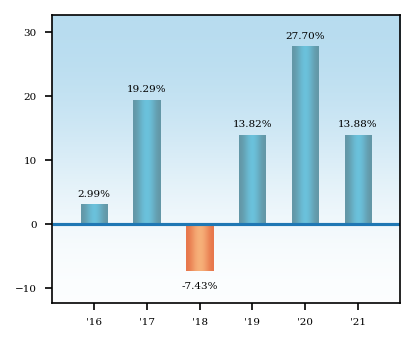
| [1] | The return shown in the bar chart is for Class I shares. The performance of Class A shares will differ due to differences in expenses. |
The calendar year-to-date return for the Fund’s Class I shares as of June 30, 2022 was -13.56%.
During the period shown in the bar chart, the best performance for a quarter was 9.85% (for the quarter ended June 30, 2020). The worst performance was -10.40% (for the quarter ended December 31, 2018).
Average Annual Total Returns - Longboard Alternative Growth Fund |
Label |
1 Year |
5 Years |
Since Inception |
Inception Date |
|
|---|---|---|---|---|---|---|
| Longboard Alternative Growth Fund Class I | Return Before Taxes | 13.88% | 12.82% | 9.85% | [1] | Mar. 20, 2015 |
| Longboard Alternative Growth Fund Class I | Return After Taxes on Distributions | 13.07% | 4.21% | 2.23% | |||
| Longboard Alternative Growth Fund Class I | Return After Taxes on Distributions and Sale of Fund Shares | 8.20% | 5.38% | 3.56% | |||
| Longboard Alternative Growth Fund Class A | Return Before Taxes | 7.04% | 11.13% | 9.37% | [2] | Dec. 09, 2015 |
| Morningstar Moderate Target Risk TR USD Index (reflects no deduction for fees, expenses or taxes) | 10.19% | 10.07% | 8.14% | |||
| [1] | Class I shares of the Longboard Alternative Growth Fund commenced operations on . |
| [2] | Class A shares of the Longboard Alternative Growth Fund commenced operations on . |
After-tax returns are based on the highest historical individual federal marginal income tax rates, and do not reflect the impact of state and local taxes; actual after-tax returns depend on an individual investor’s tax situation and may differ from those shown. If you own shares of the Fund in a tax-deferred account, such as an individual retirement account or a 401(k) plan, this information is not applicable to your investment. A higher after-tax return results when a capital loss occurs upon redemption and translates into an assumed tax deduction that benefits the shareholder. After tax returns are shown for only Class I Shares. After tax returns for Class A shares will vary.
The Morningstar Target Risk Index family is designed to meet the needs of investors who would like to maintain a target level of equity exposure through a portfolio diversified across equities, bonds and inflation-hedged instruments. The Morningstar Moderate Target Risk Index seeks approximately 60% exposure to global equity markets.
The primary investment objective of the Longboard Managed Futures Strategy Fund (the “Fund”) is to seek positive absolute returns.
This table describes the fees and expenses that you may pay if you buy and hold shares of the Fund. More information about these and other discounts is available from your financial professional and under “Shareholder Information – More About Class A Shares” beginning on page 14 of this Prospectus. Sales loads and waivers may vary by financial intermediary. For more information on specific financial intermediary sales loads and waivers, see Appendix A to the statutory Prospectus.
Shareholder Fees - Longboard Managed Futures Strategy Fund |
Longboard Managed Futures Strategy Fund Class A Shares |
Longboard Managed Futures Strategy Fund Class I Shares |
|
|---|---|---|---|
| Maximum Sales Charge (Load) Imposed on Purchases (as a percentage of offering price) | 5.75% | none | |
| Maximum Deferred Sales Charge (Load) (as a % of the lesser of the original offering price or NAV at redemption) | 1.00% | [1] | none |
| Redemption Fee | none | none | |
| [1] | A maximum contingent deferred sales charge (“CDSC”) of 1.00% may apply to certain redemptions of Class A shares made within the first 12 months of their purchase when an initial sales charge was not paid on the purchase. |
Annual Fund Operating Expenses - Longboard Managed Futures Strategy Fund |
Longboard Managed Futures Strategy Fund Class A Shares |
Longboard Managed Futures Strategy Fund Class I Shares |
|
|---|---|---|---|
| Management (Unitary) Fees | [1] | 2.99% | 2.99% |
| Distribution and Service (Rule 12b-1) Fees | 0.25% | none | |
| Other Expenses | none | none | |
| Total Annual Fund Operating Expenses | 3.24% | 2.99% | |
| [1] | The Fund’s Adviser, Longboard Asset Management, LP, provides investment advisory service and pays most of the Fund’s operating expenses (with certain exceptions) in return for a “unitary fee” (exclusive of any interest expenses, distribution fees or expenses, brokerage expenses, taxes and extraordinary expenses not incurred in the ordinary course of the Fund’s business.; Acquired fund fees, expenses related to investments in short positions, and dividends, if any, will be borne by the Fund and will not be included in the unitary management fee). |
This Example is intended to help you compare the cost of investing in the Fund with the cost of investing in other mutual funds.
Expense Example - Longboard Managed Futures Strategy Fund - USD ($) |
Expense Example, with Redemption, 1 Year |
Expense Example, with Redemption, 3 Years |
Expense Example, with Redemption, 5 Years |
Expense Example, with Redemption, 10 Years |
|---|---|---|---|---|
| Longboard Managed Futures Strategy Fund Class A Shares | 883 | 1,516 | 2,170 | 3,911 |
| Longboard Managed Futures Strategy Fund Class I Shares | 302 | 924 | 1,572 | 3,308 |
The Fund pays transaction costs, such as commissions, when it buys and sells securities (or “turns over” its portfolio). A higher portfolio turnover rate may indicate higher transaction costs and may result in higher taxes when Fund shares are held in a taxable account. These costs, which are not reflected in Total Annual Fund Operating Expenses or in the Example, affect the Fund’s performance. During the Fund’s fiscal year ended May 31, 2021, the Fund’s portfolio turnover rate was 0.00% of the average value of the portfolio.
The Fund seeks to achieve its investment objectives using two principal strategies, a Futures Strategy and a Fixed Income Strategy:
Futures Strategy. The Fund pursues its investment objective by employing a trend following strategy (identifying opportunities as prices trend up and down) similar in general concept to the managed futures industry at large. The strategy is systematic and rules based. The Adviser will consider a variety of exchange traded futures contracts and forward contracts. The Fund’s holdings, either direct or held through a wholly-owned and controlled subsidiary, Longboard Fund Limited (the “Subsidiary”), will generally be diversified across the equities, energies, interest rates, grains, meats, soft commodities (such as sugar, coffee, and cocoa), currencies, and metals sectors; and will also be diversified across North America, Asia, Europe, Australia, and potentially Africa and South America. Through its investment in futures contracts and forward contracts, the Adviser seeks to capture long term trends in the global financial markets and commodities. Futures and forward contracts are contractual agreements to buy or sell a particular currency, commodity or financial instrument at a pre-determined price in the future.
To pursue the Fund’s Futures Strategy, the Fund intends to invest up to 25% of its total assets in the Subsidiary. Assets in the Fund’s Subsidiary will be invested in commodity-related derivatives pursuant to the Futures Strategy. The Fund may also invest directly in certain financial-related derivatives with a portion of its assets pursuant to the Futures Strategy. Additionally, the Fund will, at times, purchase options on futures contracts, to cover the potential obligation regarding delivery of assets specified in the contracts. The Fund anticipates that it will generally invest between 5-30% of its assets (whether directly or through the Subsidiary) pursuant to the Futures Strategy.
The Subsidiary is a wholly-owned and controlled subsidiary of the Fund, organized under the laws of the Cayman Islands as an exempted company. Generally, the Subsidiary will invest primarily in commodity futures and swaps on commodity futures but it may also invest in financial futures, option and swap contracts, fixed income securities, pooled investment vehicles, including those that are not registered pursuant to the 1940 Act, and other investments intended to serve as margin or collateral for the Subsidiary’s derivative positions.
Fixed Income Strategy. The Fixed Income strategy is designed to generate absolute returns from interest income with less volatility than equity markets by investing primarily in U.S. Dollar-denominated fixed income securities including: (1) obligations issued or guaranteed by the United States Government, its agencies or instrumentalities, (2) bonds, notes, or similar debt obligations issued by U.S. or foreign corporations, (3) U.S. asset-backed securities (“ABS”) and (4) U.S. structured notes. The Fund restricts fixed income securities to those having a short-term rating of prime (highest short-term debt category) and/or a long-term rating of investment grade (BBB- or higher). The fixed income portion of the Fund’s portfolio will be invested without restriction as to individual security maturity, but the average duration (a measure of interest rate risk similar to maturity) of the fixed income portfolio will not exceed 5 years. The Fund generally invests between 70-95% of its assets pursuant to the Fixed Income Strategy and/or in cash and cash equivalents, although it reserves the right to invest up to 100% of its assets pursuant to the Fixed Income Strategy and/or in cash and cash equivalents.
The Adviser acts as the adviser to both the Fund and the Subsidiary.
Remember that in addition to possibly not achieving your investment goals, you could lose money by investing in the Fund. The principal risks of investing in the Fund are:
| ● | Asset-Backed Securities (“ABS”) Risk: ABS are subject to credit risk because underlying loan borrowers or obligors may default. Additionally, these securities are subject to prepayment risk because the underlying loans or assets held by the issuers may be paid off prior to maturity. The value of these securities may go down as a result of changes in prepayment rates on the underlying loans or assets. During periods of declining interest rates, prepayment rates usually increases and the Fund may have to reinvest prepayment proceeds at a lower interest rate. |
| ● | Cash or Cash Equivalents Risk: At any time, the Fund may have significant investments in cash or cash equivalents. When a substantial portion of a portfolio is held in cash or cash equivalents, there is the risk that the value of the cash account, including interest, will not keep pace with inflation, thus reducing purchasing power over time. |
| ● | Commodities Risk: Investing in the commodities markets (directly or indirectly) may subject the Fund to greater volatility than investments in traditional securities. Commodity prices may be influenced by unfavorable weather, animal and plant disease, geologic and environmental factors as well as changes in government regulation such as tariffs, embargoes or burdensome production rules and restrictions. |
| ● | Credit Risk: There is a risk that issuers and counterparties will not make payments on securities and other investments held by the Fund, resulting in losses to the Fund. In addition, the credit quality of securities held by the Fund may be lowered if an issuer’s financial condition changes. |
| ● | Derivatives Risk: The Fund may use derivatives (including commodity futures, options on futures and swap agreements) to enhance returns or hedge against market declines. The Fund’s indirect use of derivative instruments involves risks different from, or possibly greater than, the risks associated with investing directly in securities including leverage risk, counterparty default risk and tracking risk. The value of a commodity-linked derivative investment typically is based upon the price movements of a physical commodity (such as heating oil, livestock, or agricultural products), a commodity futures contract or commodity index, or some other readily measurable economic variable dependent upon changes in the value of commodities or the commodities markets. The value of these securities will rise or fall in response to changes in the underlying commodity or related benchmark or investment. These securities expose the Fund economically to movements in commodity prices |
| ● | Fixed Income Securities Risk: Fixed income securities are subject to the risk that securities could lose value because of interest rate changes. Generally, as interest rates increase, prices decrease. Fixed income securities with longer maturities are subject to greater price shifts as a result of interest rate changes than fixed income securities with shorter maturities. Fixed income securities are also subject to prepayment and credit risks. |
| ● | Foreign Investment Risk: Foreign investments involve certain risks not generally associated with investments in the securities of U.S. companies, including changes in currency exchange rates, unstable political, social and economic conditions, a lack of adequate or accurate company information, differences in the way securities markets operate, less secure international banks or securities depositories than those in the U.S. and foreign controls on investment. In addition, individual international country economies may differ favorably or unfavorably from the U.S. economy in such respects as growth of gross domestic product, rates of inflation, capital reinvestment, resources, self-sufficiency and balance of payments position. These risks may be greater in emerging markets and in less developed countries. |
| ● | Foreign Exchanges Risk: A portion of the derivatives trades made by the Fund may take place on foreign markets. Neither existing CFTC regulations nor regulations of any other U.S. governmental agency apply to transactions on foreign markets. Some of these foreign markets, in contrast to U.S. exchanges, are so-called principals’ markets in which performance is the responsibility only of the individual counterparty with whom the trader has entered into a commodity interest transaction and not of the exchange or clearing corporation. In these kinds of markets, there is risk of bankruptcy or other failure or refusal to perform by the counterparty. |
| ● | Forward and Futures Contract Risk: The successful use of forward and futures contracts draws upon the Adviser’s skill and experience with respect to such instruments and are subject to special risk considerations. The primary risks associated with the use of futures contracts are (a) the imperfect correlation between the change in market value of the instruments held by the Fund and the price of the forward or futures contract; (b) possible lack of a liquid secondary market for a forward or futures contract and the resulting inability to close a forward or futures contract when desired; (c) losses caused by unanticipated market movements, which are potentially unlimited; (d) the Adviser’s inability to predict correctly the direction of securities prices, interest rates, currency exchange rates and other economic factors; (e) the possibility that the counterparty will default in the performance of its obligations; and (f) if the Fund has insufficient cash, it may have to sell securities from its portfolio to meet daily variation margin requirements, and the Fund may have to sell securities at a time when it may be disadvantageous to do so. |
| ● | General Market Risk: Overall securities and derivatives market risks may affect the value of individual instruments in which the Fund invests. Foreign and domestic economic growth and market conditions, interest rate levels, political events, terrorism, war, natural disasters, disease/virus epidemics and other events are among the factors affecting the securities markets in which the Fund invests. There is risk that these and other factors may adversely affect the Fund’s performance. You could lose money by investing in the Fund. |
| ● | High Portfolio Turnover Risk: In accordance with industry practice, derivative instruments and instruments with a maturity of one year or less at the time of acquisition are excluded from the calculation of the portfolio turnover rate, resulting in an expected portfolio turnover rate of 0% for the Fund. However, if these instruments were included in the calculation, the Fund’s strategy would result in frequent portfolio trading and a high portfolio turnover rate (typically greater than 300%). By investing on a shorter-term basis, the Subsidiary may trade more frequently and incur higher levels of brokerage fees and commissions, and cause higher levels of current tax liabilities to shareholders in the Fund. |
| ● | Interest Rate Risk: Certain tax requirements dictate that only 25% of the Fund’s assets can be invested in the Subsidiary in order to gain exposure to commodities. As a result, a significant portion of the Fund’s assets will be invested in short-term interest rate instruments or securities to increase returns. If interest rates increase, the Fund may earn interest at rates below prevailing market rates. |
| ● | Issuer-Specific Risk: The value of a specific security can be more volatile than the market as a whole and can perform differently from the value of the market as a whole. The value of securities of smaller issuers can be more volatile than those of larger issuers. The value of certain types of securities can be more volatile due to increased sensitivity to adverse issuer, political, regulatory, market, or economic developments. |
| ● | Leverage Risk: Using derivatives like commodity futures and options to increase the Fund’s combined long and short exposure creates leverage, which can magnify the Fund’s potential for gain or loss and, therefore, amplify the effects of market volatility on the Fund’s share price. |
| ● | Liquidity Risk: Liquidity risk exists when particular investments of the Fund would be difficult to purchase or sell, possibly preventing the Fund from selling such illiquid securities at an advantageous time or price, or possibly requiring the Fund to dispose of other investments at unfavorable times or prices in order to satisfy its obligations. |
| ● | Management Risk: The risk that investment strategies employed by the Adviser in selecting investments and asset allocations for the Fund may not result in an increase in the value of your investment or in overall performance equal to other similar investment vehicles having similar investment strategies. |
| ● | Options Risk: Options are subject to sudden price movements and are highly leveraged, in that payment of a relatively small purchase price, called a premium, gives the buyer the right to acquire an underlying futures contract, forward contract or commodity that has a face value substantially greater than the premium paid. The buyer of an option risks losing the entire purchase price of the option. The writer, or seller, of an option risks losing the difference between the purchase price received for the option and the price of the futures contract, forward contract or commodity underlying the option that the writer must purchase or deliver upon exercise of the option. There is no limit on the potential loss. |
| ● | Regulatory Change Risk: The Adviser has, on behalf of the Fund, filed a notice with the National Futures Association claiming an exemption from certain of the CFTC’s reporting and disclosure requirements in accordance with Part 4 of the CFTC regulations. If, in the future, the Adviser determines that it is not eligible for this exemption or other relief from CFTC regulation, the Fund will be required to comply with CFTC regulations regarding disclosure and reporting. Compliance with such requirements will likely increase the costs associated with an investment in the Fund. |
| ● | Short Position Risk: The Fund will incur a loss as a result of a short position if the price of the short position instrument increases in value between the date of the short position sale and the date on which an offsetting position is purchased. Short positions may be considered speculative transactions and involve special risks, including greater reliance on the Adviser’s ability to anticipate accurately the future value of a security or instrument. The Fund’s losses are potentially unlimited in a short position transaction. |
| ● | Strategy Risk: The risk that investment strategies employed by the Adviser in selecting investments and asset allocations for the Fund may not result in an increase in the value of your investment or in overall performance equal to other investments. |
| ● | Structured Notes Risk: Structured notes involve leverage risk, tracking risk and issuer default risk. |
| ● | Tax Risk: Certain of the Fund’s investment strategies, including transactions in options, futures contracts, forward contracts, swap contracts and hedging transactions, may be subject to the special tax rules, the effect of which may have adverse tax consequences for the Fund. Also, while investing in commodities indirectly through the Subsidiary, will permit the Fund to obtain exposure to the commodities markets, because the Subsidiary is a controlled foreign corporation, any income received from its investments will be passed through to the Fund as ordinary income, which may be taxed at less favorable rates than capital gains. Additionally, the Internal Revenue Service (“IRS”) has issued a number of private letter rulings to other mutual funds (unrelated to the Fund), which indicate that certain income from a fund’s investment in a wholly-owned foreign subsidiary would constitute “qualifying income” for purposes of Subchapter M of the Internal Revenue Code of 1986, as amended (the “Code”). However, the IRS has suspended issuance of any further letters on this issue in 2011, and in 2016 added this issue to its list of issues on which it would not provide private letter ruling guidance to taxpayers. In connection with this ‘no rule’ decision, the Internal Revenue Service revoked many of these prior letter rulings as being inconsistent with its current ‘no-rule’ private letter ruling policy, but did not otherwise appear to repudiate the actual technical analysis it applied in the prior rulings. If the IRS were to change its position with respect to the technical analysis and conclusions reached in those revoked private letter rulings (which change in position might be applied to the Fund retroactively), the income from the Fund’s investment in the Subsidiary might not be qualifying income, and the Fund might not qualify as a regulated investment company for one or more years. |
| ● | Volatility Risk: The Fund may have investments that appreciate or decrease significantly in value over short periods of time. This may cause the Fund’s net asset value per share to experience significant appreciations or decreases in value over short periods of time. |
| ● | Wholly-Owned Subsidiary Risk: The Subsidiary, Longboard Fund Limited, will not be registered under the 1940 Act and, unless otherwise noted in this Prospectus, will not be subject to all of the investor protections of the 1940 Act. The Adviser has, on behalf of the Subsidiary, filed a notice with the National Futures Association claiming exemption from the CFTC’s reporting requirements in accordance with Part 4 of the CFTC Regulations pursuant to no-action relief for certain subsidiaries of registered investment companies. Under this no-action letter guidance, the CFTC provides relief relating to CFTC disclosure requirements for commodity pools, such as the Subsidiary, that are wholly-owned subsidiaries of registered investment companies (such as the Fund). The Adviser also claims exemption from the CFTC’s disclosure requirements in accordance with Part 4 of the CFTC Regulations, which provide relief relating to CFTC disclosure and reporting requirements for commodity pools, such as the Subsidiary, that are operated by a CPO that is the same as, controls, is controlled by or is under common control with the CPO of an offered pool (such as the Fund). Changes in the laws or regulations of the United States and/or the Cayman Islands, under which the Fund and the Subsidiary, respectively, are organized, could result in the inability of the Fund and/or Subsidiary to operate as described in this Prospectus and could negatively affect the Fund and its shareholders. Your cost of investing in the Fund will be higher because you indirectly bear the expenses of the Subsidiary. |
Although only 25% of the Fund’s assets may be invested in the Subsidiary, that portion of the Fund’s assets may be highly leveraged, which can magnify the Fund’s potential for gain or loss and, therefore, amplify the effects of market volatility on the Fund’s share price.
The bar chart and Average Annual Total Returns table give some indication of the risks of investing in the Fund. The bar chart shows the performance of Class I shares of the Fund for each full calendar year since the Fund’s inception. The Average Annual Total Returns table shows how the Fund’s average annual returns compare with those of a broad measure of market performance. Remember, the Fund’s past performance, before and after taxes, is not necessarily an indication of how the Fund will perform in the future. Updated performance information will be available at no cost by calling the Fund toll-free at 855-294-7540.
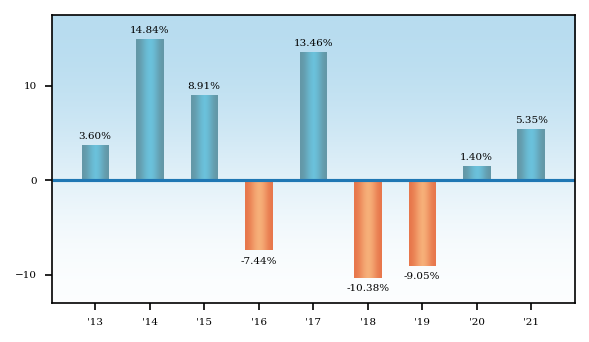
| [1] | The return shown in the bar chart is for Class I shares. The performance of Class A shares will differ due to differences in expenses. |
The calendar year-to-date return for the Fund’s Class I shares as of June 30, 2022 was 12.04%.
During the period shown in the bar chart, the best performance for a quarter was 12.53% (for the quarter ended March 31, 2015). The worst performance was -11.62% (for the quarter ended March 31, 2019).
Average Annual Total Returns - Longboard Managed Futures Strategy Fund |
Label |
1 Year |
5 Years |
Since Inception |
Inception Date |
|
|---|---|---|---|---|---|---|
| Longboard Managed Futures Strategy Fund Class I Shares | Return Before Taxes | 5.35% | (0.24%) | 1.64% | [1] | Jun. 27, 2012 |
| Longboard Managed Futures Strategy Fund Class I Shares | Return After Taxes on Distributions | 3.77% | (0.77%) | 0.82% | |||
| Longboard Managed Futures Strategy Fund Class I Shares | Return After Taxes on Distributions and Sale of Fund Shares | 3.15% | (0.41%) | 0.95% | |||
| Longboard Managed Futures Strategy Fund Class A Shares | Return Before Taxes | (0.90%) | (1.67%) | 0.46% | [2] | Mar. 22, 2013 |
| BofAML 3 Month Treasury Bill (reflects no deduction for fees, expenses or taxes) | 0.05% | 1.14% | 0.66% | |||
| SG Trend Index (reflects no deduction for fees, expenses or taxes) | 8.18% | 3.53% | 2.83% | |||
| [1] | Class I shares of the Longboard Managed Futures Strategy Fund commenced operations on . |
| [2] | Class A shares of the Longboard Managed Futures Strategy Fund commenced operations on . |
After-tax returns are based on the highest historical individual federal marginal income tax rates, and do not reflect the impact of state and local taxes; actual after-tax returns depend on an individual investor’s tax situation and may differ from those shown. If you own shares of the Fund in a tax-deferred account, such as an individual retirement account or a 401(k) plan, this information is not applicable to your investment. A higher after-tax return results when a capital loss occurs upon redemption and translates into an assumed tax deduction that benefits the shareholder. After tax returns are shown for only Class I Shares. After tax returns for Class A shares will vary.
The Bank of America Merrill Lynch 3-month U.S. Treasury Bill Index is an index of short-term U.S. Government securities with a remaining term to final maturity of less than three months.
The SG Trend Index is designed to track the 10 largest (by AUM) trend following commodity trading advisors (“CTAs”) and is equal-weighted and reconstituted annually. The index calculates the net daily rate of return for a pool of trend following based hedge fund managers.