The fund’s investment objective is to provide a high level of current income.
This table describes the fees and expenses that you may pay if you buy, hold and sell shares of the fund. You may pay other fees, such as brokerage commissions and other fees to financial intermediaries, which are not reflected in the tables and examples below. For example, in addition to the fees and expenses described below, you may also be required to pay brokerage commissions on purchases and sales of Class F-2, F-3, 529-F-2 or 529-F-3 shares of the fund. You may qualify for sales charge discounts if you and your family invest, or agree to invest in the future, at least $100,000 in American Funds. More information about these and other discounts is available from your financial professional, in the “Sales charge reductions and waivers” sections on page 40 of the prospectus and on page 88 of the fund’s statement of additional information, and in the sales charge waiver appendix to the prospectus.
Shareholder Fees - American Funds Multi-Sector Income Fund |
Class A |
Class 529-A |
Class C |
Class 529-C |
Class 529-E |
Class T |
Class 529-T |
Class F-1 |
Class F-2 |
Class F-3 |
Class 529-F-1 |
Class 529-F-2 |
Class 529-F-3 |
Class R-1 |
Class R-2 |
Class R-2E |
Class R-3 |
Class R-4 |
Class R-5 |
Class R-5E |
Class R-6 |
||
|---|---|---|---|---|---|---|---|---|---|---|---|---|---|---|---|---|---|---|---|---|---|---|---|
| Maximum sales charge (load) imposed on purchases (as a percentage of offering price) | 3.75% | 3.50% | none | none | none | 2.50% | 2.50% | none | none | none | none | none | none | none | none | none | none | none | none | none | none | ||
| Maximum deferred sales charge (load) (as a percentage of the amount redeemed) | 1.00% | [1] | 1.00% | [1] | 1.00% | 1.00% | none | none | none | none | none | none | none | none | none | none | none | none | none | none | none | none | none |
| Maximum sales charge (load) imposed on reinvested dividends | none | none | none | none | none | none | none | none | none | none | none | none | none | none | none | none | none | none | none | none | none | ||
| Redemption or exchange fees | none | none | none | none | none | none | none | none | none | none | none | none | none | none | none | none | none | none | none | none | none | ||
| [1] | A contingent deferred sales charge of 1.00% applies on certain redemptions made within 18 months following purchases of $1 million or more made without an initial sales charge. Contingent deferred sales charge is calculated based on the lesser of the offering price and market value of shares being sold. |
Annual Fund Operating Expenses - American Funds Multi-Sector Income Fund |
Class A |
Class C |
Class T |
Class F-1 |
Class F-2 |
Class F-3 |
Class 529-A |
Class 529-C |
Class 529-E |
Class 529-T |
Class 529-F-1 |
Class 529-F-2 |
Class 529-F-3 |
Class R-1 |
Class R-2 |
Class R-2E |
Class R-3 |
Class R-4 |
Class R-5E |
Class R-5 |
Class R-6 |
|
|---|---|---|---|---|---|---|---|---|---|---|---|---|---|---|---|---|---|---|---|---|---|---|
| Management fees | [1] | 0.33% | 0.33% | 0.33% | 0.33% | 0.33% | 0.33% | 0.33% | 0.33% | 0.33% | 0.33% | 0.33% | 0.33% | 0.33% | 0.33% | 0.33% | 0.33% | 0.33% | 0.33% | 0.33% | 0.33% | 0.33% |
| Distribution and/or service (12b-1) fees | 0.30% | 1.00% | 0.25% | 0.25% | none | none | 0.22% | 1.00% | 0.50% | 0.25% | 0.25% | none | none | 1.00% | 0.75% | 0.60% | 0.50% | 0.25% | none | none | none | |
| Other expenses | [1] | 0.13% | 0.13% | 0.12% | 0.17% | 0.14% | 0.05% | 0.18% | 0.18% | 0.13% | 0.18% | 0.23% | 0.14% | 0.11% | 0.15% | 0.40% | 0.25% | 0.19% | 0.15% | 0.20% | 0.10% | 0.05% |
| Total annual fund operating expenses | 0.76% | 1.46% | 0.70% | 0.75% | 0.47% | 0.38% | 0.73% | 1.51% | 0.96% | 0.76% | 0.81% | 0.47% | 0.44% | 1.48% | 1.48% | 1.18% | 1.02% | 0.73% | 0.53% | 0.43% | 0.38% | |
| [1] | Restated to reflect current fees. |
This example is intended to help you compare the cost of investing in the fund with the cost of investing in other mutual funds.
The example assumes that you invest $10,000 in the fund for the time periods indicated and then redeem all of your shares at the end of those periods. The example also assumes that your investment has a 5% return each year and that the fund’s operating expenses remain the same. You may be required to pay brokerage commissions on your purchases and sales of Class F-2, F-3, 529-F-2 or 529-F-3 shares of the fund, which are not reflected in the example.
Expense Example - American Funds Multi-Sector Income Fund - USD ($) |
Class A |
Class C |
Class T |
Class F-1 |
Class F-2 |
Class F-3 |
Class 529-A |
Class 529-C |
Class 529-E |
Class 529-T |
Class 529-F-1 |
Class 529-F-2 |
Class 529-F-3 |
Class R-1 |
Class R-2 |
Class R-2E |
Class R-3 |
Class R-4 |
Class R-5E |
Class R-5 |
Class R-6 |
|---|---|---|---|---|---|---|---|---|---|---|---|---|---|---|---|---|---|---|---|---|---|
| 1 year | $ 450 | $ 249 | $ 320 | $ 77 | $ 48 | $ 39 | $ 422 | $ 254 | $ 98 | $ 326 | $ 83 | $ 48 | $ 45 | $ 151 | $ 151 | $ 120 | $ 104 | $ 75 | $ 54 | $ 44 | $ 39 |
| 3 years | 609 | 462 | 468 | 240 | 151 | 122 | 575 | 477 | 306 | 487 | 259 | 151 | 141 | 468 | 468 | 375 | 325 | 233 | 170 | 138 | 122 |
| 5 years | 782 | 797 | 630 | 417 | 263 | 213 | 742 | 824 | 531 | 662 | 450 | 263 | 246 | 808 | 808 | 649 | 563 | 406 | 296 | 241 | 213 |
| 10 years | $ 1,282 | $ 1,556 | $ 1,099 | $ 930 | $ 591 | $ 480 | $ 1,225 | $ 1,306 | $ 1,178 | $ 1,169 | $ 1,002 | $ 591 | $ 555 | $ 1,768 | $ 1,768 | $ 1,432 | $ 1,248 | $ 906 | $ 665 | $ 542 | $ 480 |
Expense Example No Redemption - American Funds Multi-Sector Income Fund - USD ($) |
Class C |
Class 529-C |
|---|---|---|
| 1 year | $ 149 | $ 154 |
| 3 years | 462 | 477 |
| 5 years | 797 | 824 |
| 10 years | $ 1,556 | $ 1,306 |
The fund pays transaction costs, such as commissions, when it buys and sells securities (or “turns over” its portfolio). A higher portfolio turnover rate may indicate higher transaction costs and may result in higher taxes when fund shares are held in a taxable account. These costs, which are not reflected in annual fund operating expenses or in the example, affect the fund’s investment results. During the most recent fiscal year, the fund’s portfolio turnover rate was 40% of the average value of its portfolio.
The fund invests primarily in bonds and other debt instruments, which may be represented by derivatives. In seeking to achieve a high level of current income, the fund invests in a broad range of debt securities across the credit spectrum. Normally, the fund will invest its assets across four primary sectors: high-yield corporate debt, investment grade corporate debt, debt instruments of emerging market issuers and securitized debt. The proportion of securities held by the fund within each of these credit sectors will vary with market conditions and the investment adviser’s assessment of their relative attractiveness as investment opportunities. The fund may opportunistically invest in other sectors, including U.S. government debt, municipal debt and non-corporate credit, in response to market conditions. The fund will normally seek to limit its foreign currency exposure.
The fund may invest substantially in securities rated Ba1 or below and BB+ or below by Nationally Recognized Statistical Ratings Organizations designated by the fund’s investment adviser, or in securities that are unrated but determined to be of equivalent quality by the fund’s investment adviser. Such securities are sometimes referred to as “junk bonds.” The fund may also invest a significant portion of its assets in securities of issuers domiciled outside the United States.
The fund may invest in futures contracts and swaps, which are types of derivatives. A derivative is a financial contract, the value of which is based on the value of an underlying financial asset (such as a stock, bond or currency), a reference rate or a market index.
The investment adviser uses a system of multiple portfolio managers in managing the fund’s assets. Under this approach, the portfolio of the fund is divided into segments managed by individual managers.
The fund relies on the professional judgment of its investment adviser to make decisions about the fund’s portfolio investments. The basic investment philosophy of the investment adviser is to seek to invest in attractively priced securities that, in its opinion, represent good investment opportunities. Securities may be sold when the investment adviser believes that they no longer represent relatively attractive investment opportunities.
This section describes the principal risks associated with investing in the fund. You may lose money by investing in the fund. The likelihood of loss may be greater if you invest for a shorter period of time.
Market conditions — The prices of, and the income generated by, the securities held by the fund may decline – sometimes rapidly or unpredictably – due to various factors, including events or conditions affecting the general economy or particular industries or companies; overall market changes; local, regional or global political, social or economic instability; governmental, governmental agency or central bank responses to economic conditions; and currency exchange rate, interest rate and commodity price fluctuations.
Economies and financial markets throughout the world are highly interconnected. Economic, financial or political events, trading and tariff arrangements, wars, terrorism, cybersecurity events, natural disasters, public health emergencies (such as the spread of infectious disease) and other circumstances in one country or region, including actions taken by governmental or quasi-governmental authorities in response to any of the foregoing, could have impacts on global economies or markets. As a result, whether or not the fund invests in securities of issuers located in or with significant exposure to the countries affected, the value and liquidity of the fund’s investments may be negatively affected by developments in other countries and regions.
Issuer risks — The prices of, and the income generated by, securities held by the fund may decline in response to various factors directly related to the issuers of such securities, including reduced demand for an issuer’s goods or services, poor management performance, major litigation, investigations or other controversies related to the issuer, changes in the issuer’s financial condition or credit rating, changes in government regulations affecting the issuer or its competitive environment and strategic initiatives such as mergers, acquisitions or dispositions and the market response to any such initiatives.
Investing in debt instruments — The prices of, and the income generated by, bonds and other debt securities held by the fund may be affected by factors such as the interest rates, maturities and credit quality of these securities.
Rising interest rates will generally cause the prices of bonds and other debt securities to fall. Also, when interest rates rise, issuers are less likely to refinance existing debt securities, causing the average life of such securities to extend. A general rise in interest rates may cause investors to sell debt securities on a large scale, which could also adversely affect the price and liquidity of debt securities and could also result in increased redemptions from the fund. Falling interest rates may cause an issuer to redeem, call or refinance a debt security before its stated maturity, which may result in the fund failing to recoup the full amount of its initial investment and having to reinvest the proceeds in lower yielding securities. Longer maturity debt securities generally have greater sensitivity to changes in interest rates and may be subject to greater price fluctuations than shorter maturity debt securities.
Bonds and other debt securities are also subject to credit risk, which is the possibility that the credit strength of an issuer or guarantor will weaken or be perceived to be weaker, and/or an issuer of a debt security will fail to make timely payments of principal or interest and the security will go into default. Changes in actual or perceived creditworthiness may occur quickly. A downgrade or default affecting any of the fund’s securities could cause the value of the fund’s shares to decrease. Lower quality debt
securities generally have higher rates of interest and may be subject to greater price fluctuations than higher quality debt securities. Credit risk is gauged, in part, by the credit ratings of the debt securities in which the fund invests. However, ratings are only the opinions of the rating agencies issuing them and are not guarantees as to credit quality or an evaluation of market risk. The fund’s investment adviser relies on its own credit analysts to research issuers and issues in assessing credit and default risks.
Investing in lower rated debt instruments — Lower rated bonds and other lower rated debt securities generally have higher rates of interest and involve greater risk of default or price declines due to changes in the issuer’s creditworthiness than those of higher quality debt securities. The market prices of these securities may fluctuate more than the prices of higher quality debt securities and may decline significantly in periods of general economic difficulty. These risks may be increased with respect to investments in junk bonds.
Investing outside the United States — Securities of issuers domiciled outside the United States, or with significant operations or revenues outside the United States, may lose value because of adverse political, social, economic or market developments (including social instability, regional conflicts, terrorism and war) in the countries or regions in which the issuers operate or generate revenue. These securities may also lose value due to changes in foreign currency exchange rates against the U.S. dollar and/or currencies of other countries. Issuers of these securities may be more susceptible to actions of foreign governments, such as nationalization, currency blockage or the imposition of price controls, sanctions, or punitive taxes, each of which could adversely impact the value of these securities. Securities markets in certain countries may be more volatile and/or less liquid than those in the United States. Investments outside the United States may also be subject to different regulatory, legal, accounting, auditing, financial reporting and recordkeeping requirements, and may be more difficult to value, than those in the United States. In addition, the value of investments outside the United States may be reduced by foreign taxes, including foreign withholding taxes on interest and dividends. Further, there may be increased risks of delayed settlement of securities purchased or sold by the fund, which could impact the liquidity of the fund’s portfolio. The risks of investing outside the United States may be heightened in connection with investments in emerging markets.
Investing in emerging markets — Investing in emerging markets may involve risks in addition to and greater than those generally associated with investing in the securities markets of developed countries. For instance, emerging market countries tend to have less developed political, economic and legal systems than those in developed countries. Accordingly, the governments of these countries may be less stable and more likely to intervene in the market economy, for example, by imposing capital controls, nationalizing a company or industry, placing restrictions on foreign ownership and on withdrawing sale proceeds of securities from the country, and/or imposing punitive taxes that could adversely affect the prices of securities. Information regarding issuers in emerging markets may be limited, incomplete or inaccurate, and such issuers may not be subject to regulatory, accounting, auditing, and financial reporting and recordkeeping standards comparable to those to which issuers in more developed markets are subject. The fund’s rights with respect to its investments in emerging markets, if any, will generally be governed by local law, which may make it difficult or impossible for the fund to pursue legal remedies or to obtain and enforce judgments in
local courts. In addition, the economies of these countries may be dependent on relatively few industries, may have limited access to capital and may be more susceptible to changes in local and global trade conditions and downturns in the world economy. Securities markets in these countries can also be relatively small and have substantially lower trading volumes. As a result, securities issued in these countries may be more volatile and less liquid, and may be more difficult to value, than securities issued in countries with more developed economies and/or markets. Less certainty with respect to security valuations may lead to additional challenges and risks in calculating the fund’s net asset value. Additionally, emerging markets are more likely to experience problems with the clearing and settling of trades and the holding of securities by banks, agents and depositories that are less established than those in developed countries.
Investing in mortgage-related and other asset-backed securities — Mortgage-related securities, such as mortgage-backed securities, and other asset-backed securities, include debt obligations that represent interests in pools of mortgages or other income-bearing assets, such as consumer loans or receivables. While such securities are subject to the risks associated with investments in debt instruments generally (for example, credit, extension and interest rate risks), they are also subject to other and different risks. Mortgage-backed and other asset-backed securities are subject to changes in the payment patterns of borrowers of the underlying debt, potentially increasing the volatility of the securities and the fund’s net asset value. When interest rates fall, borrowers are more likely to refinance or prepay their debt before its stated maturity. This may result in the fund having to reinvest the proceeds in lower yielding securities, effectively reducing the fund’s income. Conversely, if interest rates rise and borrowers repay their debt more slowly than expected, the time in which the mortgage-backed and other asset-backed securities are paid off could be extended, reducing the fund’s cash available for reinvestment in higher yielding securities. Mortgage-backed securities are also subject to the risk that underlying borrowers will be unable to meet their obligations and the value of property that secures the mortgages may decline in value and be insufficient, upon foreclosure, to repay the associated loans. Investments in asset-backed securities are subject to similar risks.
Investing in derivatives — The use of derivatives involves a variety of risks, which may be different from, or greater than, the risks associated with investing in traditional securities, such as stocks and bonds. Changes in the value of a derivative may not correlate perfectly with, and may be more sensitive to market events than, the underlying asset, rate or index, and a derivative instrument may cause the fund to lose significantly more than its initial investment. Derivatives may be difficult to value, difficult for the fund to buy or sell at an opportune time or price and difficult, or even impossible, to terminate or otherwise offset. The fund’s use of derivatives may result in losses to the fund, and investing in derivatives may reduce the fund’s returns and increase the fund’s price volatility. The fund’s counterparty to a derivative transaction (including, if applicable, the fund’s clearing broker, the derivatives exchange or the clearinghouse) may be unable or unwilling to honor its financial obligations in respect of the transaction. In certain cases, the fund may be hindered or delayed in exercising remedies against or closing out derivative instruments with a counterparty, which may result in additional losses. Derivatives are also subject to operational risk (such as documentation issues, settlement issues and systems failures) and legal risk (such as insufficient documentation, insufficient capacity or authority of a counterparty, and issues with the legality or enforceability of a contract).
Currency — The prices of, and the income generated by, many debt securities held by the fund may also be affected by changes in relative currency values. If the U.S. dollar appreciates against foreign currencies, the value in U.S. dollars of the fund’s securities denominated in such currencies would generally fall and vice versa.
Liquidity risk — Certain fund holdings may be or may become difficult or impossible to sell, particularly during times of market turmoil. Liquidity may be impacted by the lack of an active market for a holding, legal or contractual restrictions on resale, or the reduced number and capacity of market participants to make a market in such holding. Market prices for less liquid or illiquid holdings may be volatile or difficult to determine, and reduced liquidity may have an adverse impact on the market price of such holdings. Additionally, the sale of less liquid or illiquid holdings may involve substantial delays (including delays in settlement) and additional costs and the fund may be unable to sell such holdings when necessary to meet its liquidity needs, or to try to limit losses, or may be forced to sell at a loss.
Management — The investment adviser to the fund actively manages the fund’s investments. Consequently, the fund is subject to the risk that the methods and analyses, including models, tools and data, employed by the investment adviser in this process may be flawed or incorrect and may not produce the desired results. This could cause the fund to lose value or its investment results to lag relevant benchmarks or other funds with similar objectives.
Your investment in the fund is not a bank deposit and is not insured or guaranteed by the Federal Deposit Insurance Corporation or any other governmental agency, entity or person. You should consider how this fund fits into your overall investment program.
The following bar chart shows how the fund’s investment results have varied from year to year, and the following table shows how the fund’s average annual total returns for various periods compare with a broad measure of securities market results and other applicable measures of market results. This information provides some indication of the risks of investing in the fund.The Lipper Multi-Income Funds Average includes the fund and other funds that disclose investment objectives and/or strategies reasonably comparable to those of the fund. The MSI Custom Index is a composite blend of 45% of the Bloomberg U.S. Corporate High Yield 2% Issuer Capped Index, 30% of the Bloomberg U.S. Corporate Index, 15% of the J.P. Morgan EMBI Global Diversified Index, 8% of the Bloomberg CMBS Ex AAA Index, and 2% of the Bloomberg ABS Ex AAA Index and represents a broad measure of the bond market, including sectors in which the fund may invest. Past investment results (before and after taxes) are not predictive of future investment results. Prior to October 30, 2020, certain fees, such as 12b-1 fees, were not charged on Class 529-F-1 shares. If these expenses had been deducted, results would have been lower. Updated information on the fund’s investment results can be obtained by visiting capitalgroup.com.
The following bar chart shows the fund’s investment results for its first full calendar year of operations, and the following table shows how the fund’s average annual total returns for various periods compare with a broad measure of securities market results and other applicable measures of market results.
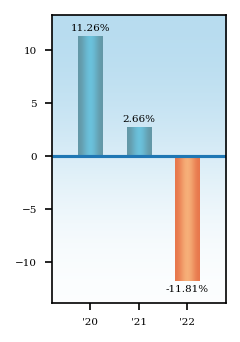
Highest/Lowest quarterly results during this period were:
Highest 8.60% (quarter ended June 30, 2020)
Lowest -8.15% (quarter ended June 30, 2022)
Average Annual Returns - American Funds Multi-Sector Income Fund |
Average Annual Returns, 1 Year |
Average Annual Returns, Since Inception |
Average Annual Returns, Inception Date |
|---|---|---|---|
| Class F-2 | (11.81%) | 2.19% | Mar. 22, 2019 |
| Class A | (15.32%) | 0.97% | Mar. 22, 2019 |
| Class C | (13.51%) | 0.71% | May 01, 2020 |
| Class F-1 | (12.06%) | 1.40% | May 01, 2020 |
| Class F-3 | (11.72%) | 2.24% | Mar. 22, 2019 |
| Class 529-A | (15.11%) | 0.07% | May 01, 2020 |
| Class 529-C | (13.52%) | 0.77% | May 01, 2020 |
| Class 529-E | (12.18%) | 1.34% | May 01, 2020 |
| Class 529-F-1 | (11.88%) | 1.60% | May 01, 2020 |
| Class 529-F-2 | (11.81%) | (2.35%) | Oct. 30, 2020 |
| Class 529-F-3 | (11.79%) | (2.31%) | Oct. 30, 2020 |
| Class R-1 | (12.34%) | 1.08% | May 01, 2020 |
| Class R-2 | (12.55%) | 0.96% | May 01, 2020 |
| Class R-2E | (11.79%) | 1.69% | May 01, 2020 |
| Class R-3 | (12.30%) | 1.20% | May 01, 2020 |
| Class R-4 | (12.02%) | 1.48% | May 01, 2020 |
| Class R-5E | (11.88%) | 1.62% | May 01, 2020 |
| Class R-5 | (11.77%) | 1.72% | May 01, 2020 |
| Class R-6 | (11.72%) | 2.25% | Mar. 22, 2019 |
| After Taxes on Distributions | Class F-2 | (13.46%) | 0.10% | |
| After Taxes on Distributions and Sale of Fund Shares | Class F-2 | (6.97%) | 0.85% | |
| Bloomberg U.S. Aggregate Index (reflects no deductions for sales charges, account fees, expenses or U.S. federal income taxes) | (13.01%) | (0.65%) | Mar. 22, 2019 |
| American Funds Multi-Sector Income Fund Custom Index (reflects no deductions for sales charges, account fees, expenses or U.S. federal income taxes) | (13.55%) | 0.55% | Mar. 22, 2019 |
| Lipper Multi-Sector Income Funds Average (reflects no deductions for sales charges, account fees, expenses or U.S. federal income taxes) | (10.43%) | 0.42% | Mar. 22, 2019 |
After-tax returns are shown only for Class F-2 shares; after-tax returns for other share classes will vary.After-tax returns are calculated using the highest individual federal income tax rates in effect during each year of the periods shown and do not reflect the impact of state and local taxes. Your actual after-tax returns depend on your individual tax situation and likely will differ from the results shown above. In addition, after-tax returns are not relevant if you hold your fund shares through a tax-favored arrangement, such as a 401(k) plan, individual retirement account (IRA) or 529 college savings plan.