The fund’s investment objective is to provide inflation protection and income consistent with investment in inflation-linked securities.
This table describes the fees and expenses that you may pay if you buy, hold and sell shares of the fund. You may pay other fees, such as brokerage commissions and other fees to financial intermediaries, which are not reflected in the tables and examples below. For example, in addition to the fees and expenses described below, you may also be required to pay brokerage commissions on purchases and sales of Class F-2, F-3, 529-F-2 or 529-F-3 shares of the fund. You may qualify for sales charge discounts if you and your family invest, or agree to invest in the future, at least $500,000 in American Funds. More information about these and other discounts is available from your financial professional, in the “Sales charge reductions and waivers” sections on page 39 of the prospectus and on page 83 of the fund’s statement of additional information, and in the sales charge waiver appendix to the prospectus.
Shareholder Fees - AMERICAN FUNDS INFLATION LINKED BOND FUND |
Class A |
Class 529-A |
Class C |
Class 529-C |
Class 529-E |
Class 529-T |
Class T |
Class F-1 |
Class F-2 |
Class F-3 |
Class 529-F-1 |
Class 529-F-2 |
Class 529-F-3 |
Class R-1 |
Class R-2 |
Class R-3 |
Class R-4 |
Class R-5 |
Class R-6 |
Class R-2E |
Class R-5E |
||
|---|---|---|---|---|---|---|---|---|---|---|---|---|---|---|---|---|---|---|---|---|---|---|---|
| Maximum sales charge (load) imposed on purchases (as a percentage of offering price) | 2.50% | 2.50% | none | none | none | 2.50% | 2.50% | none | none | none | none | none | none | none | none | none | none | none | none | none | none | ||
| Maximum deferred sales charge (load) (as a percentage of the amount redeemed) | 0.75% | [1] | 1.00% | [1] | 1.00% | 1.00% | none | none | none | none | none | none | none | none | none | none | none | none | none | none | none | none | none |
| Maximum sales charge (load) imposed on reinvested dividends | none | none | none | none | none | none | none | none | none | none | none | none | none | none | none | none | none | none | none | none | none | ||
| Redemption or exchange fees | none | none | none | none | none | none | none | none | none | none | none | none | none | none | none | none | none | none | none | none | none | ||
| [1] | A contingent deferred sales charge of 0.75% for Class A shares and 1.00% for Class 529-A shares applies on certain redemptions made within 18 months following purchases of $250,000 or more for Class A and $1 million or more for Class 529-A made without an initial sales charge. Contingent deferred sales charge is calculated based on the lesser of the offering price and market value of shares being sold. |
Annual Fund Operating Expenses - AMERICAN FUNDS INFLATION LINKED BOND FUND |
Class A |
Class C |
Class T |
Class F-1 |
Class F-2 |
Class F-3 |
Class 529-A |
Class 529-C |
Class 529-E |
Class 529-T |
Class 529-F-1 |
Class 529-F-2 |
Class 529-F-3 |
Class R-1 |
Class R-2 |
Class R-2E |
Class R-3 |
Class R-4 |
Class R-5E |
Class R-5 |
Class R-6 |
||
|---|---|---|---|---|---|---|---|---|---|---|---|---|---|---|---|---|---|---|---|---|---|---|---|
| Management fees | 0.25% | 0.25% | 0.25% | 0.25% | 0.25% | 0.25% | 0.25% | 0.25% | 0.25% | 0.25% | 0.25% | 0.25% | 0.25% | 0.25% | 0.25% | 0.25% | 0.25% | 0.25% | 0.25% | 0.25% | 0.25% | ||
| Distribution and/or service (12b-1) fees | 0.30% | 1.00% | 0.25% | 0.25% | none | none | 0.22% | 1.00% | 0.50% | 0.25% | 0.25% | none | none | 1.00% | 0.75% | 0.60% | 0.50% | 0.25% | none | none | none | ||
| Other expenses | 0.14% | 0.14% | 0.13% | [1] | 0.17% | 0.14% | 0.04% | 0.19% | 0.19% | 0.14% | 0.19% | [1] | 0.22% | 0.13% | 0.10% | 0.15% | 0.35% | 0.25% | 0.19% | 0.14% | 0.19% | 0.09% | 0.04% |
| Total annual fund operating expenses | 0.69% | 1.39% | 0.63% | 0.67% | 0.39% | 0.29% | 0.66% | 1.44% | 0.89% | 0.69% | 0.72% | 0.38% | 0.35% | 1.40% | 1.35% | 1.10% | 0.94% | 0.64% | 0.44% | 0.34% | 0.29% | ||
| [1] | Restated to reflect current fees. |
This example is intended to help you compare the cost of investing in the fund with the cost of investing in other mutual funds.
The example assumes that you invest $10,000 in the fund for the time periods indicated and then redeem or hold all of your shares at the end of those periods. The example also assumes that your investment has a 5% return each year and that the fund’s operating expenses remain the same. You may be required to pay brokerage commissions on your purchases and sales of Class F-2, F-3, 529-F-2 or 529-F-3 shares of the fund, which are not reflected in the example.
Expense Example - AMERICAN FUNDS INFLATION LINKED BOND FUND - USD ($) |
Class A |
Class C |
Class T |
Class F-1 |
Class F-2 |
Class F-3 |
Class 529-A |
Class 529-C |
Class 529-E |
Class 529-T |
Class 529-F-1 |
Class 529-F-2 |
Class 529-F-3 |
Class R-1 |
Class R-2 |
Class R-2E |
Class R-3 |
Class R-4 |
Class R-5E |
Class R-5 |
Class R-6 |
|---|---|---|---|---|---|---|---|---|---|---|---|---|---|---|---|---|---|---|---|---|---|
| 1 year | $ 319 | $ 242 | $ 313 | $ 68 | $ 40 | $ 30 | $ 316 | $ 247 | $ 91 | $ 319 | $ 74 | $ 39 | $ 36 | $ 143 | $ 137 | $ 112 | $ 96 | $ 65 | $ 45 | $ 35 | $ 30 |
| 3 years | 465 | 440 | 447 | 214 | 125 | 93 | 456 | 456 | 284 | 465 | 230 | 122 | 113 | 443 | 428 | 350 | 300 | 205 | 141 | 109 | 93 |
| 5 years | 625 | 761 | 592 | 373 | 219 | 163 | 609 | 787 | 493 | 625 | 401 | 213 | 197 | 766 | 739 | 606 | 520 | 357 | 246 | 191 | 163 |
| 10 years | $ 1,087 | $ 1,477 | $ 1,017 | $ 835 | $ 493 | $ 368 | $ 1,052 | $ 1,225 | $ 1,096 | $ 1,087 | $ 894 | $ 480 | $ 443 | $ 1,680 | $ 1,624 | $ 1,340 | $ 1,155 | $ 798 | $ 555 | $ 431 | $ 368 |
Expense Example No Redemption - AMERICAN FUNDS INFLATION LINKED BOND FUND - USD ($) |
Class C |
Class 529-C |
|---|---|---|
| 1 year | $ 142 | $ 147 |
| 3 years | 440 | 456 |
| 5 years | 761 | 787 |
| 10 years | $ 1,477 | $ 1,225 |
The fund pays transaction costs, such as commissions, when it buys and sells securities (or “turns over” its portfolio). A higher portfolio turnover rate may indicate higher transaction costs and may result in higher taxes when fund shares are held in a taxable account. These costs, which are not reflected in annual fund operating expenses or in the example, affect the fund’s investment results. During the most recent fiscal year, the fund’s portfolio turnover rate was 8% of the average value of its portfolio.
The fund seeks to provide inflation protection and income by investing primarily in inflation-linked securities. Normally, at least 80% of the fund’s assets will be invested in inflation-linked bonds issued by U.S. and non-U.S. governments, their agencies or instrumentalities, and corporations. Inflation-linked bonds are structured to protect against inflation by linking the bond’s principal and interest payments to an inflation index so that principal and interest adjust to reflect changes in the index. For example, U.S. Treasury Inflation-Protected Securities (TIPS) are linked to the Consumer Price Index for Urban Consumers (CPURNSA). Other sovereign governments and corporations also issue inflation-linked securities that are tied to their own local consumer price index or the CPURNSA.
Under normal market conditions, the fund will invest at least 80% of its assets in securities guaranteed or sponsored by the U.S. government without regard to the quality rating assigned to the U.S. government by a Nationally Recognized Statistical Rating Organization (NRSRO). To the extent the fund invests in other debt securities, the fund will invest in debt securities with quality ratings of Baa3 or better or BBB- or better by NRSROs designated by the fund’s investment adviser or in debt securities that are unrated but determined to be of equivalent quality by the fund’s investment adviser. The fund may invest in debt securities with a wide range of maturities.
The fund may also invest in forward currency contracts, futures contracts and swaps, which are types of derivatives. A derivative is a financial contract, the value of which is based on the value of an underlying financial asset (such as a stock, bond or currency), a reference rate or a market index.
The investment adviser uses a system of multiple portfolio managers in managing the fund’s assets. Under this approach, the portfolio of the fund is divided into segments managed by individual managers.
The fund relies on the professional judgment of its investment adviser to make decisions about the fund’s portfolio investments. The basic investment philosophy of the investment adviser is to seek to invest in attractively priced securities that, in its opinion, represent good, long-term investment opportunities. Securities may be sold when the investment adviser believes that they no longer represent relatively attractive investment opportunities.
The following bar chart shows how the fund’s investment results have varied from year to year, and the following table shows how the fund’s average annual total returns for various periods compare with a broad measure of securities market results and other applicable measures of market results. This information provides some indication of the risks of investing in the fund. The Lipper Inflation-Protected Bond Funds Average includes other funds that disclose investment objectives and/or strategies reasonably comparable to those of the fund. Past investment results (before and after taxes) are not predictive of future investment results. Prior to October 30, 2020, certain fees, such as 12b-1 fees, were not charged on Class 529-F-1 shares. If these expenses had been deducted, results would have been lower. Updated information on the fund’s investment results can be obtained by visiting capitalgroup.com.
The following bar chart shows how the fund’s investment results have varied from year to year, and the following table shows how the fund’s average annual total returns for various periods compare with a broad measure of securities market results and other applicable measures of market results.
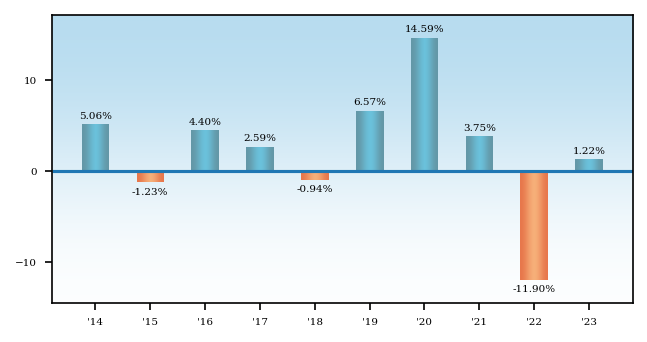
Highest/Lowest quarterly results during this period were:
Highest 5.17% (quarter ended June 30, 2020)
Lowest -6.20% (quarter ended June 30, 2022)
Average Annual Returns - AMERICAN FUNDS INFLATION LINKED BOND FUND |
Average Annual Returns, 1 Year |
Average Annual Returns, 5 Years |
Average Annual Returns, 10 Years |
Average Annual Returns, Since Inception |
Average Annual Returns, Inception Date |
|---|---|---|---|---|---|
| Class A | (1.29%) | 1.95% | 1.95% | 0.95% | Dec. 14, 2012 |
| Class C | (0.44%) | 1.77% | 1.05% | Jan. 23, 2015 | |
| Class F-1 | 1.26% | 2.51% | 1.71% | Jan. 23, 2015 | |
| Class F-2 | 1.46% | 2.78% | 1.97% | Jan. 23, 2015 | |
| Class F-3 | 1.71% | 2.89% | 2.29% | Jan. 27, 2017 | |
| Class 529-A | (1.28%) | 1.98% | 1.44% | Jan. 23, 2015 | |
| Class 529-C | (0.45%) | 1.76% | 1.29% | Jan. 23, 2015 | |
| Class 529-E | 1.07% | 2.28% | 1.48% | Jan. 23, 2015 | |
| Class 529-F-1 | 1.41% | 2.70% | 1.90% | Jan. 23, 2015 | |
| Class 529-F-2 | 1.62% | (1.38%) | Oct. 30, 2020 | ||
| Class 529-F-3 | 1.55% | (1.35%) | Oct. 30, 2020 | ||
| Class R-1 | 0.51% | 1.75% | 0.98% | Jan. 23, 2015 | |
| Class R-2 | 0.57% | 1.78% | 1.01% | Jan. 23, 2015 | |
| Class R-2E | 0.90% | 2.05% | 1.36% | Jan. 23, 2015 | |
| Class R-3 | 0.99% | 2.22% | 1.43% | Jan. 23, 2015 | |
| Class R-4 | 1.22% | 2.51% | 1.73% | Jan. 23, 2015 | |
| Class R-5E | 1.44% | 2.72% | 2.42% | Nov. 20, 2015 | |
| Class R-5 | 1.53% | 2.81% | 202.00% | Jan. 23, 2015 | |
| Class R-6 | 1.71% | 2.88% | 2.54% | 2.32% | Nov. 01, 2013 |
| After Taxes on Distributions | Class A | (1.59%) | 0.76% | 1.04% | ||
| After Taxes on Distributions and Sale of Fund Shares | Class A | (0.76%) | 1.03% | 1.12% | ||
| Bloomberg U.S. Treasury Inflation-Protected Securities (TIPS) Index (reflects no deductions for sales charges, account fees, expenses or U.S. federal income taxes) | 3.90% | 3.15% | 2.42% | 1.31% | Dec. 14, 2012 |
| Lipper Inflation-Protected Bond Funds Average (reflects no deductions for sales charges, account fees or U.S. federal income taxes) | 3.47% | 2.90% | 1.85% | 0.93% | Dec. 14, 2012 |
After-tax returns are shown only for Class A shares; after-tax returns for other share classes will vary. After-tax returns are calculated using the highest individual federal income tax rates in effect during each year of the periods shown and do not reflect the impact of state and local taxes. Your actual after-tax returns depend on your individual tax situation and likely will differ from the results shown above. In addition, after-tax returns are not relevant if you hold your fund shares through a tax-favored arrangement, such as a 401(k) plan, individual retirement account (IRA) or 529 college savings plan.