Putnam Core Bond Fund seeks high current income consistent with what Putnam Investment Management, LLC (Putnam Management) believes to be prudent risk.
The following tables describe the fees and expenses you may pay if you buy, hold and sell shares of the fund. You may pay other fees, such as brokerage commissions and other fees to financial intermediaries, which are not reflected in the tables and examples below. You may qualify for sales charge discounts if you and your family invest, or agree to invest in the future, at least $100,000 in class A shares of Putnam funds. More information about these and other discounts is available from your financial professional and in How do I buy fund shares? beginning on page 20 of the fund’s prospectus, in the Appendix to the fund’s prospectus, and in How to buy shares beginning on page II-1 of the fund’s statement of additional information (SAI).
Shareholder Fees - Putnam Core Bond Fund |
Class A C000071714 |
Class B C000071715 |
Class C C000071716 |
Class R C000071712 |
Class R6 C000118006 |
Class Y C000071713 |
|||
|---|---|---|---|---|---|---|---|---|---|
| Maximum Sales Charge Imposed on Purchases (as a percentage of Offering Price) | 4.00% | none | none | none | none | none | |||
| Maximum Deferred Sales Charge (as a percentage) | 1.00% | [1] | 1.00% | [2] | 1.00% | [3] | none | none | none |
| [1] | Applies only to certain redemptions of shares bought with no initial sales charge. |
| [2] | This charge is phased out over two years. |
| [3] | This charge is eliminated after one year. |
Annual Fund Operating Expenses - Putnam Core Bond Fund |
Class A C000071714 |
Class B C000071715 |
Class C C000071716 |
Class R C000071712 |
Class R6 C000118006 |
Class Y C000071713 |
|
|---|---|---|---|---|---|---|---|
| Management Fees (as a percentage of Assets) | [1] | 0.39% | 0.39% | 0.39% | 0.39% | 0.39% | 0.39% |
| Distribution and Service (12b-1) Fees | 0.25% | 0.45% | 1.00% | 0.50% | none | none | |
| Other Expenses (as a percentage of Assets): | [2] | none | none | none | none | none | none |
| Expenses (as a percentage of Assets) | 0.64% | 0.84% | 1.39% | 0.89% | 0.39% | 0.39% | |
| [1] | Restated to reflect the management fee under the fund’s new management contract, which took effect on March 1, 2023. |
| [2] | Other expenses are less than 0.01%. |
The following hypothetical example is intended to help you compare the cost of investing in the fund with the cost of investing in other funds. It assumes that you invest $10,000 in the fund for the time periods indicated and then, except as indicated, redeem all your shares at the end of those periods. It assumes a 5% return on your investment each year and that the fund’s operating expenses remain the same. Your actual costs may be higher or lower.
Expense Example - Putnam Core Bond Fund - USD ($) |
Expense Example, with Redemption, 1 Year |
Expense Example, with Redemption, 3 Years |
Expense Example, with Redemption, 5 Years |
Expense Example, with Redemption, 10 Years |
Expense Example, No Redemption, 1 Year |
Expense Example, No Redemption, 3 Years |
Expense Example, No Redemption, 5 Years |
Expense Example, No Redemption, 10 Years |
|---|---|---|---|---|---|---|---|---|
| Class A C000071714 | 463 | 597 | 742 | 1,166 | ||||
| Class B C000071715 | 186 | 268 | 466 | 980 | 86 | 268 | 466 | 980 |
| Class C C000071716 | 242 | 440 | 761 | 1,463 | 142 | 440 | 761 | 1,463 |
| Class R C000071712 | 91 | 284 | 493 | 1,096 | ||||
| Class R6 C000118006 | 40 | 125 | 219 | 493 | ||||
| Class Y C000071713 | 40 | 125 | 219 | 493 |
The fund pays transaction-related costs, such as commissions, when it buys and sells securities (or “turns over” its portfolio). A higher turnover rate may indicate higher transaction costs and may result in higher taxes when the fund’s shares are held in a taxable account. These costs, which are not reflected in annual fund operating expenses or the above example, affect fund performance. The fund’s turnover rate in the most recent fiscal year was 967%.
Investments
The fund invests mainly in a diversified portfolio of investment-grade fixed-income securities. The fund invests mainly in bonds of governments and private companies that are investment-grade in quality with intermediate- to long-term maturities (three years or longer). Investment-grade securities are rated at least BBB or its equivalent at the time of purchase by a nationally recognized securities rating organization, or are unrated investments that Putnam Management believes are of comparable quality.
The fund may invest in below-investment-grade investments. However, the fund will not invest in securities that are rated lower than B or its equivalent by each rating agency rating the investment, or are unrated securities that Putnam Management believes are of comparable quality. The fund will not necessarily sell an investment if its rating is reduced (or increased) after purchase.
The fund may consider, among other factors, a company’s or issuer’s credit, interest rate, liquidity and prepayment risks, as well as general market conditions, when deciding whether to buy or sell investments.
Under normal circumstances, the fund will invest at least 80% of its net assets in bonds (bonds include any debt instrument, and may be represented by other investment instruments, including derivatives). This policy may be changed only after 60 days’ notice to shareholders. In addition to bonds, the fund may also invest in other fixed-income instruments. The fund may also use derivatives, such as futures, options, certain foreign currency transactions and swap contracts, for both hedging and non-hedging purposes.
It is important to understand that you can lose money by investing in the fund.
The value of investments in the fund’s portfolio may fall or fail to rise over extended periods of time (including periods of one year or more) for a variety of reasons, including general economic, political or financial market conditions, investor sentiment and market perceptions, government actions, geopolitical events or changes, outbreaks of infectious illnesses or other widespread public health issues, and factors related to a specific issuer, geography, industry or sector. These and other factors may lead to increased volatility and reduced liquidity in the fund’s portfolio holdings, may negatively impact the fund’s performance and may exacerbate other risks to which the fund is subject.
Bond investments are subject to interest rate risk, which is the risk that the value of the fund’s bond investments is likely to fall if interest rates rise. Bond investments also are subject to credit risk, which is the risk that the issuer of the bond may default on payment of interest or principal. Bond investments may be more susceptible to downgrades or defaults during economic downturns or other periods of economic stress. Interest rate risk is generally greater for longer-term bonds, and credit risk is generally greater for below-investment-grade bonds (sometimes referred to as “junk bonds”), which can be more sensitive to changes in markets, credit conditions, and interest rates and which may be considered speculative. Mortgage-backed investments, unlike traditional debt investments, are also subject to prepayment risk, which means that they may increase in value less than other bonds when interest rates decline and decline in value more than other bonds when interest rates rise. We may have to invest the proceeds from prepaid investments, including mortgage-backed investments, in other investments with less attractive terms and yields.
The fund’s investments in mortgage-backed securities, and in certain other securities and derivatives, may be or become illiquid. The fund’s investments in mortgage-backed securities may make the fund’s net asset value more susceptible to economic, market, political and other developments affecting the residential and commercial real estate markets and the servicing of mortgage loans secured by real estate properties. During periods of difficult economic conditions, delinquencies and losses on commercial mortgage-backed investments in particular generally increase, including as a result of the effects of those conditions on commercial real estate markets, the ability of commercial tenants to make loan payments, and the ability of a property to attract and retain commercial tenants.
Our use of derivatives may increase the risks of investing in the fund by increasing investment exposure (which may be considered leverage and magnify or otherwise increase investment losses to the fund) or, in the case of many over-the-counter instruments, because of the potential inability to terminate or sell derivative positions and the potential failure of the other party to the instrument to meet its obligations. The risk of a party failing to meet its obligations may increase if the fund has significant exposure to that counterparty. The value of derivatives may move in unexpected ways due to unanticipated market movements, the use of leverage, imperfect correlation between the derivative instrument and the reference asset or other factors, especially in unusual market conditions, and volatility in the value of derivatives could adversely impact the fund’s returns, obligations and exposures. Derivatives are also subject to other risks, including liquidity risk (e.g., liquidity demands arising from the requirement to make payments to a derivative counterparty), operational risk (e.g., settlement issues or system failures) and legal risk (e.g., insufficient legal documentation or contract enforceability issues).
There is no guarantee that the investment techniques, analyses, or judgments that we apply in making investment decisions for the fund will produce the intended outcome or that the investments we select for the fund will perform as well as other securities that were not selected for the fund. If the quantitative models or data that are used in managing the fund prove to be incorrect or incomplete, investment decisions made in reliance on the models or data may not produce the desired results and the fund may realize losses. We, or the fund’s other service providers, may experience disruptions or operating errors that could negatively impact the fund.
The fund may not achieve its goal, and it is not intended to be a complete investment program. An investment in the fund is not insured or guaranteed by the Federal Deposit Insurance Corporation or any other government agency.
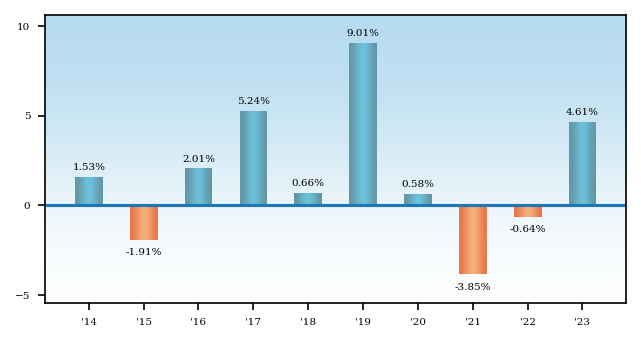
The performance information below gives some indication of the risks associated with an investment in the fund by showing the fund’s performance year to year and over time. Before February 28, 2023, the fund was managed with a materially different investment strategy and may have achieved materially different performance results under its current investment strategy from that shown for periods before this date. The bar chart does not reflect the impact of sales charges. If it did, performance would be lower. Please remember that past performance is not necessarily an indication of future results. Monthly performance figures for the fund are available at putnam.com.
Average Annual Total Returns - Putnam Core Bond Fund |
1 Year |
5 Years |
10 Years |
|
|---|---|---|---|---|
| Class A C000071714 | 0.42% | 1.02% | 1.25% | |
| Class A C000071714 | After Taxes on Distributions | (1.45%) | (0.70%) | (0.41%) | |
| Class A C000071714 | After Taxes on Distributions and Sales | 0.21% | 0.05% | 0.22% | |
| Class B C000071715 | 3.28% | 1.63% | 1.50% | |
| Class C C000071716 | 2.72% | 1.09% | 1.06% | |
| Class R C000071712 | 4.27% | 1.61% | 1.41% | |
| Class R6 C000118006 | 4.77% | 2.11% | 1.92% | |
| Class Y C000071713 | 4.79% | 2.11% | 1.92% | |
| Bloomberg U.S. Aggregate Bond Index (no deduction for fees, expenses or taxes) | [1] | 5.53% | 1.10% | 1.81% |
| Putnam Core Bond Linked Benchmark (no deductions for fees, expenses or taxes) | [2] | 5.84% | 2.04% | 1.34% |
| [1] | The Bloomberg U.S. Aggregate Bond Index is a broad measure of market performance. Securities in the fund do not match those in the Index and the performance of the fund will differ. |
| [2] | The Putnam Core Bond Linked Benchmark represents the performance of the ICE BofA U.S. Treasury Bill Index through February 27, 2023, and the performance of the Bloomberg U.S. Aggregate Bond Index through the current period. |
| All Bloomberg indices are provided by Bloomberg Index Services Limited. |
| BLOOMBERG® is a trademark and service mark of Bloomberg Finance L.P. and its affiliates (collectively “Bloomberg”). Bloomberg or Bloomberg’s licensors, own all proprietary rights in the Bloomberg Indices. Neither Bloomberg nor Bloomberg’s licensors approve or endorse this material, or guarantee the accuracy or completeness of any information herein, or make any warranty, express or implied, as to the results to be obtained therefrom, and to the maximum extent allowed by law, neither shall have any liability or responsibility for injury or damages arising in connection therewith. |
| ICE BofA Indexes: ICE Data Indices, LLC (“ICE BofA”), used with permission. ICE BofA permits use of the ICE BofA indices and related data on an “as is” basis; makes no warranties regarding same; does not guarantee the suitability, quality, accuracy, timeliness, and/or completeness of the ICE BofA indices or any data included in, related to, or derived therefrom; assumes no liability in connection with the use of the foregoing; and does not sponsor, endorse, or recommend Putnam Investments, or any of its products or services. |
| After-tax returns reflect the historical highest individual federal marginal income tax rates and do not reflect state and local taxes. Actual after-tax returns depend on an investor’s tax situation and may differ from those shown. After-tax returns are shown for class A shares only and will vary for other classes. These after-tax returns do not apply if you hold your fund shares through a 401(k) plan, an IRA, or another tax-advantaged arrangement. |
| Class B and C share performance reflects conversion to class A shares after eight years. |
Putnam Short Duration Bond Fund seeks as high a rate of current income as Putnam Investment Management, LLC (Putnam Management) believes is consistent with preservation of capital.
The following tables describe the fees and expenses you may pay if you buy, hold and sell shares of the fund. You may pay other fees, such as brokerage commissions and other fees to financial intermediaries, which are not reflected in the tables and examples below. You may qualify for sales charge discounts if you and your family invest, or agree to invest in the future, at least $100,000 in class A shares of Putnam funds. More information about these and other discounts is available from your financial professional and in How do I buy fund shares? beginning on page 18 of the fund’s prospectus, in the Appendix to the fund’s prospectus, and in How to buy shares beginning on page II-1 of the fund’s statement of additional information (SAI).
Shareholder Fees - Putnam Short Duration Bond Fund |
Class A C000071705 |
Class B C000071706 |
Class C C000071707 |
Class R C000071709 |
Class R6 C000118004 |
Class Y C000071710 |
|||
|---|---|---|---|---|---|---|---|---|---|
| Maximum Sales Charge Imposed on Purchases (as a percentage of Offering Price) | 2.25% | none | none | none | none | none | |||
| Maximum Deferred Sales Charge (as a percentage) | 0.75% | [1] | 1.00% | [2] | 1.00% | [3] | none | none | none |
| [1] | Applies only to certain redemptions of shares bought with no initial sales charge. |
| [2] | This charge is phased out over two years. |
| [3] | This charge is eliminated after one year. |
Annual Fund Operating Expenses - Putnam Short Duration Bond Fund |
Class A C000071705 |
Class B C000071706 |
Class C C000071707 |
Class R C000071709 |
Class R6 C000118004 |
Class Y C000071710 |
|
|---|---|---|---|---|---|---|---|
| Management Fees (as a percentage of Assets) | 0.37% | 0.37% | 0.37% | 0.37% | 0.37% | 0.37% | |
| Distribution and Service (12b-1) Fees | 0.25% | 0.45% | 1.00% | 0.50% | none | none | |
| Other Expenses (as a percentage of Assets): | [1] | none | none | none | none | none | none |
| Expenses (as a percentage of Assets) | 0.62% | 0.82% | 1.37% | 0.87% | 0.37% | 0.37% | |
| [1] | Other expenses are less than 0.01%. |
The following hypothetical example is intended to help you compare the cost of investing in the fund with the cost of investing in other funds. It assumes that you invest $10,000 in the fund for the time periods indicated and then, except as indicated, redeem all your shares at the end of those periods. It assumes a 5% return on your investment each year and that the fund’s operating expenses remain the same. Your actual costs may be higher or lower.
Expense Example - Putnam Short Duration Bond Fund - USD ($) |
Expense Example, with Redemption, 1 Year |
Expense Example, with Redemption, 3 Years |
Expense Example, with Redemption, 5 Years |
Expense Example, with Redemption, 10 Years |
Expense Example, No Redemption, 1 Year |
Expense Example, No Redemption, 3 Years |
Expense Example, No Redemption, 5 Years |
Expense Example, No Redemption, 10 Years |
|---|---|---|---|---|---|---|---|---|
| Class A C000071705 | 287 | 419 | 563 | 982 | ||||
| Class B C000071706 | 184 | 262 | 455 | 956 | 84 | 262 | 455 | 956 |
| Class C C000071707 | 239 | 434 | 750 | 1,441 | 139 | 434 | 750 | 1,441 |
| Class R C000071709 | 89 | 278 | 482 | 1,073 | ||||
| Class R6 C000118004 | 38 | 119 | 208 | 468 | ||||
| Class Y C000071710 | 38 | 119 | 208 | 468 |
The fund pays transaction-related costs, such as commissions, when it buys and sells securities (or “turns over” its portfolio). A higher turnover rate may indicate higher transaction costs and may result in higher taxes when the fund’s shares are held in a taxable account. These costs, which are not reflected in annual fund operating expenses or the above example, affect fund performance. The fund’s turnover rate in the most recent fiscal year was 20%.
Investments
We invest in a diversified portfolio of fixed income securities. The fund’s investments may include corporate credit, including investment-grade debt, below-investment-grade debt (sometimes referred to as “junk bonds”), bank loans and structured credit; sovereign debt, including obligations of governments in developed and emerging markets; and securitized assets, including asset-backed securities, residential mortgage-backed securities (which may be backed by non-qualified or “sub-prime” mortgages), commercial mortgage-backed securities and collateralized mortgage obligations.
Under normal circumstances, the fund will invest at least 80% of its net assets in bonds (bonds include any debt instrument, and may be represented by other investment instruments, including derivatives). This policy may be changed only after 60 days’ notice to shareholders. We normally maintain an effective duration of three years or less. Effective duration provides a measure of a fund’s interest-rate sensitivity. The longer a fund’s duration, the more sensitive the fund is to shifts in interest rates.
We may consider, among other factors, credit, interest rate and prepayment risks, as well as general market conditions, when deciding whether to buy or sell investments. We may also use derivatives, such as futures, options, certain foreign currency transactions and credit default, total return and interest rate swap contracts, for both hedging and non-hedging purposes.
We may invest in securities that are purchased in private placements, which may be illiquid because they are subject to restrictions on resale.
It is important to understand that you can lose money by investing in the fund.
The effects of inflation may erode the value of your investment over time. The value of investments in the fund’s portfolio may fall or fail to rise over extended periods of time for a variety of reasons, including general economic, political or financial market conditions, investor sentiment and market perceptions, government actions, geopolitical events or changes, outbreaks of infectious illnesses or other widespread public health issues, and factors related to a specific issuer, geography, industry or sector. These and other factors may lead to increased volatility and reduced liquidity in the fund’s portfolio holdings, may negatively impact the fund’s performance, and may exacerbate other risks to which the fund is subject.
The risks associated with fixed income investments include interest rate risk, which is the risk that the value of the fund’s investments is likely to fall if interest rates rise. Fixed income investments are also subject to credit risk, which is the risk that the issuer of a fixed income investment may default on payment of interest or principal. Fixed income investments may be more susceptible to downgrades or defaults during economic downturns or other periods of economic stress. Interest rate risk is generally greater for longer-term bonds, and credit risk is generally greater for below-investment-grade bonds, which can be more sensitive to changes in markets, credit conditions, and interest rates, and may be considered speculative. Mortgage- and asset-backed investments, unlike traditional debt investments, are also subject to prepayment risk, which means that they may increase in value less than other bonds when interest rates decline and decline in value more than other bonds when interest rates rise. We may have to invest the proceeds from prepaid investments, including mortgage- and asset-backed investments, in other investments with less attractive terms and yields. The fund’s investments in mortgage-backed securities and asset-backed securities, and in certain other securities and derivatives, may be or become illiquid. The fund’s investments in mortgage-backed securities may make the fund’s net asset value more susceptible to economic, market, political and other developments affecting the residential and commercial real estate markets and the servicing of mortgage loans secured by real estate properties. During periods of difficult economic conditions, delinquencies and losses on commercial mortgage-backed investments in particular generally increase, including as a result of the effects of those conditions on commercial real estate markets, the ability of commercial tenants to make loan payments, and the ability of a property to attract and retain commercial tenants.
The value of international investments traded in foreign currencies may be adversely impacted by fluctuations in exchange rates. International investments, particularly investments in emerging markets, may carry risks associated with potentially less stable economies or governments (such as the risk of seizure by a foreign government, the imposition of currency or other restrictions, or high levels of inflation or deflation), and may be or become illiquid.
Our use of derivatives may increase the risks of investing in the fund by increasing investment exposure (which may be considered leverage) or, in the case of many over-the-counter instruments, because of the potential inability to terminate or sell derivatives positions and the potential failure of the other party to the instrument to meet its obligations. The risk of a party failing to meet its obligations may increase if the fund has significant exposure to that counterparty. The value of derivatives may move in unexpected ways due to unanticipated market movements, the use of leverage, imperfect correlation between the derivative instrument and the reference asset, or other factors, especially in unusual market conditions, and volatility in the value of derivatives could adversely impact the fund’s returns, obligations and exposures. Derivatives are also subject to other risks, including liquidity risk (e.g., liquidity demands arising from the requirement to make payments to a derivative counterparty), operational risk (e.g., settlement issues or system failures) and legal risk (e.g., insufficient legal documentation or contract enforceability issues).
There is no guarantee that the investment techniques, analyses, or judgments that we apply in making investment decisions for the fund will produce the intended outcome or that the investments we select for the fund will perform as well as other securities that were not selected for the fund. We, or the fund’s other service providers, may experience disruptions or operating errors that could negatively impact the fund.
The fund may not achieve its goal, and it is not intended to be a complete investment program. An investment in the fund is not insured or guaranteed by the Federal Deposit Insurance Corporation or any other government agency.
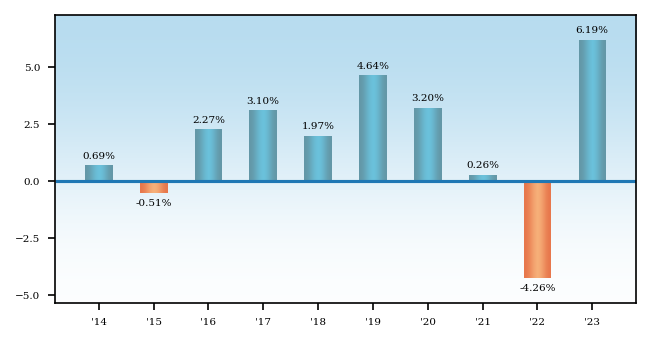
The performance information below gives some indication of the risks associated with an investment in the fund by showing the fund’s performance year to year and over time. Before June 1, 2018, the fund was managed with a materially different investment strategy and may have achieved materially different performance results under its current investment strategy from that shown for periods before this date. The bar chart does not reflect the impact of sales charges. If it did, performance would be lower. Please remember that past performance is not necessarily an indication of future results. Monthly performance figures for the fund are available at putnam.com.
Average Annual Total Returns - Putnam Short Duration Bond Fund |
1 Year |
5 Years |
10 Years |
|
|---|---|---|---|---|
| Class A C000071705 | 3.80% | 1.47% | 1.48% | |
| Class A C000071705 | After Taxes on Distributions | 2.24% | 0.50% | 0.59% | |
| Class A C000071705 | After Taxes on Distributions and Sales | 2.24% | 0.72% | 0.74% | |
| Class B C000071706 | 4.99% | 1.73% | 1.55% | |
| Class C C000071707 | 4.52% | 1.17% | 1.11% | |
| Class R C000071709 | 5.91% | 1.68% | 1.46% | |
| Class R6 C000118004 | 6.44% | 2.19% | 1.97% | |
| Class Y C000071710 | 6.57% | 2.19% | 1.98% | |
| ICE BofA 1-3 Year U.S. Corporate Index (no deduction for fees, expenses or taxes) | 5.61% | 2.16% | 1.89% | |
| Putnam Short Duration Bond Linked Benchmark (no deduction for fees, expenses or taxes) | [1] | 5.61% | 2.16% | 1.42% |
| [1] | The Putnam Short Duration Bond Linked Benchmark represents the performance of the ICE BofA U.S. Treasury Bill Index through May 31, 2018, and the performance of the ICE BofA 1-3 Year U.S. Corporate Index thereafter. |
| ICE BofA Indexes: ICE Data Indices, LLC (“ICE BofA”), used with permission. ICE BofA permits use of the ICE BofA indices and related data on an “as is” basis; makes no warranties regarding same; does not guarantee the suitability, quality, accuracy, timeliness, and/or completeness of the ICE BofA indices or any data included in, related to, or derived therefrom; assumes no liability in connection with the use of the foregoing; and does not sponsor, endorse, or recommend Putnam Investments or Franklin Templeton, or any of its products or services. |
| After-tax returns reflect the historical highest individual federal marginal income tax rates and do not reflect state and local taxes. Actual after-tax returns depend on an investor’s tax situation and may differ from those shown. After-tax returns are shown for class A shares only and will vary for other classes. These after-tax returns do not apply if you hold your fund shares through a 401(k) plan, an IRA, or another tax-advantaged arrangement. |
| Class B and C share performance reflects conversion to class A shares after eight years. |