Long-term capital growth.
The table describes the fees and expenses that you may pay if you buy and hold shares of the Fund. You may pay other fees, such as brokerage commissions and other fees to financial intermediaries, which are not reflected in the tables and examples below.
Annual Fund Operating Expenses - International Equity Series |
Primary Shares |
Service Shares |
||
|---|---|---|---|---|
| Management fees | 0.78% | 0.78% | ||
| Other expenses | 0.14% | 0.30% | [1] | |
| Acquired fund fees and expenses | 0.01% | 0.01% | ||
| Total annual Fund operating expenses | [2] | 0.93% | 1.09% | |
| Fee waiver and/or expense reimbursement | [3] | (0.05%) | (0.05%) | |
| Total annual Fund operating expenses after fee waiver and/or expense reimbursement | 0.88% | 1.04% | ||
| [1] | Other expenses have been restated to reflect fees and expenses for the current fiscal year. Consequently, the total annual Fund operating expenses differ from the ratio of expenses to average net assets shown in the Financial Highlights. |
| [2] | Total annual Fund operating expenses differ from the ratio of expenses to average net assets shown in the Financial Highlights, which reflect the operating expenses of the Fund and do not include acquired fund fees and expenses. |
| [3] | The investment manager has contractually agreed to waive its fee so that the management fee for the Fund does not exceed 0.74%. The investment manager has also contractually agreed to reduce its fees to reflect reduced services resulting from the Fund’s investments in Franklin Templeton affiliated funds. These arrangements are expected to continue until April 30, 2025. During the terms, the fee waiver and expense reimbursement agreements may not be terminated or amended without approval of the board of trustees except to add series or classes, to reflect the extension of termination dates or to lower the waiver and expense limitation (which would result in lower fees for shareholders). |
This Example is intended to help you compare the cost of investing in the Fund with the cost of investing in other mutual funds. The Example assumes that you invest $10,000 in the Fund for the time periods indicated and then redeem all of your shares at the end of the period. The Example also assumes that your investment has a 5% return each year and that the Fund's operating expenses remain the same. The Example reflects adjustments made to the Fund's operating expenses due to the fee waivers and/or expense reimbursements by management for the 1 Year numbers only. Although your actual costs may be higher or lower, based on these assumptions your costs would be:
Expense Example - International Equity Series - USD ($) |
Primary Shares |
Service Shares |
|---|---|---|
| 1 Year | $ 90 | $ 106 |
| 3 Years | 292 | 342 |
| 5 Years | 510 | 597 |
| 10 Years | $ 1,140 | $ 1,325 |
The Fund pays transaction costs, such as commissions, when it buys and sells securities (or "turns over" its portfolio). A higher portfolio turnover rate may indicate higher transaction costs and may result in higher taxes when Fund shares are held in a taxable account. These costs, which are not reflected in annual Fund operating expenses or in the Example, affect the Fund's performance. During the most recent fiscal year, the Fund's portfolio turnover rate was 18.18% of the average value of its portfolio.
Under normal market conditions, the Fund invests at least 80% of its net assets in foreign (non-U.S.) equity securities. The Fund predominantly invests in companies located outside the U.S. including companies located in developing market countries.
The Fund may invest in equity securities of any size company, across the entire market capitalization spectrum, including smaller and midsize companies. The equity securities in which the Fund primarily invests are common stock. From time to time, based on economic conditions, the Fund may have significant investments in one or more countries or in particular sectors, such as the financial services sector.
For purposes of pursuing its investment goal, the Fund intends to enter into equity derivative instruments, including equity index futures contracts. The Fund uses these derivative instruments for investment purposes, including for cash management purposes and to generate income, to increase liquidity and/or to adjust the Fund’s exposure to certain equity markets in a more efficient or less expensive way.
When choosing equity investments for the Fund, the investment manager applies a “bottom-up,” value-oriented, long-term approach, focusing on the market price of a company’s securities relative to the investment manager’s evaluation of the company’s long-term earnings, asset value and cash flow potential. The investment manager also considers a company’s price/earnings ratio, profit margins and liquidation value.
In selecting securities for the Fund, the investment manager attempts to identify those companies that offer above-average opportunities for capital appreciation in
various countries and industries where economic and political factors, including currency movements, are favorable to capital growth.
The investment manager may consider selling an equity security when it believes the security has become overvalued due to either its price appreciation or changes in the company's fundamentals, or when the investment manager believes another security is a more attractive investment opportunity.
Risk Table - International Equity Series |
Risk [Text Block] |
|---|---|
| Risk Lose Money [Member] | You could lose money by investing in the Fund. |
| Risk Not Insured [Member] | Mutual fund shares are not deposits or obligations of, or guaranteed or endorsed by, any bank, and are not insured by the Federal Deposit Insurance Corporation, the Federal Reserve Board, or any other agency of the U.S. government. |
| Market | Market: The market values of securities or other investments owned by the Fund will go up or down, sometimes rapidly or unpredictably. The market value of a security or other investment may be reduced by market activity or other results of supply and demand unrelated to the issuer. This is a basic risk associated with all investments. When there are more sellers than buyers, prices tend to fall. Likewise, when there are more buyers than sellers, prices tend to rise. Stock prices tend to go up and down more dramatically than those of debt securities. A slower-growth or recessionary economic environment could have an adverse effect on the prices of the various stocks held by the Fund. |
| Foreign Securities (non-U.S.) | Foreign Securities (non-U.S.): Investing in foreign securities typically involves more risks than investing in U.S. securities, and includes risks associated with: (i) internal and external political and economic developments – e.g., the political, economic and social policies and structures of some foreign countries may be less stable and more volatile than those in the U.S. or some foreign countries may be subject to trading restrictions or economic sanctions; diplomatic and political developments could affect the economies, industries, and securities and currency markets of the countries in which the Fund is invested, which can include rapid and adverse political changes; social instability; regional conflicts; sanctions imposed by the United States, other nations or other governmental entities, including supranational entities; terrorism; and war; (ii) trading practices – e.g., government supervision and regulation of foreign securities and currency markets, trading systems and brokers may be less than in the U.S.; (iii) availability of information – e.g., foreign issuers may not be subject to the same disclosure, accounting and financial reporting standards and practices as U.S. issuers; (iv) limited markets – e.g., the securities of certain foreign issuers may be less liquid (harder to sell) and more volatile; and (v) currency exchange rate fluctuations and policies – e.g., fluctuations may negatively affect investments denominated in foreign currencies and any income received or expenses paid by the Fund in that foreign currency. The risks of foreign investments may be greater in developing or emerging market countries. |
| Regional | Regional: To the extent that the Fund invests a significant portion of its assets in a specific geographic region or a particular country, including Europe and Japan, the Fund will generally have more exposure to the specific regional or country risks. In the event of economic or political turmoil or a deterioration of diplomatic relations in a region or country where a substantial portion of the Fund’s assets are invested, the Fund may experience substantial illiquidity or reduction in the value of the Fund’s investments. Adverse conditions in a certain region or country can adversely affect securities of issuers in other countries whose economies appear to be unrelated. Current uncertainty concerning the economic consequences of Russia’s military invasion of Ukraine in February 2022 has increased market volatility. |
| Developing Market Countries | Developing Market Countries: The Fund’s investments in securities of issuers in developing market countries are subject to all of the risks of foreign investing generally, and have additional heightened risks due to a lack of established legal, political, business and social frameworks to support securities markets, including: delays in settling portfolio securities transactions; currency and capital controls; greater sensitivity to interest rate changes; pervasiveness of corruption and crime; currency exchange rate volatility; and inflation, deflation or currency devaluation. |
| Value Style Investing | Value Style Investing: A value stock may not increase in price as anticipated by the investment manager if other investors fail to recognize the company's value and bid up the price, the markets favor faster-growing companies, or the factors that the investment manager believes will increase the price of the security do not occur or do not have the anticipated effect. |
| Focus | Focus: To the extent that the Fund focuses on particular countries, regions, industries, sectors or types of investments from time to time, the Fund may be subject to greater risks of adverse developments in such areas of focus than a fund that invests in a wider variety of countries, regions, industries, sectors or investments. |
| Small and Mid Capitalization Companies | Small and Mid Capitalization Companies: Securities issued by small and mid capitalization companies may be more volatile in price than those of larger companies and may involve substantial risks. Such risks may include greater sensitivity to economic conditions, less certain growth prospects, lack of depth of management and funds for growth and development, and limited or less developed product lines and markets. In addition, small and mid capitalization companies may be particularly affected by interest rate increases, as they may find it more difficult to borrow money to continue or expand operations, or may have difficulty in repaying any loans. The markets for securities issued by small and mid capitalization companies also tend to be less liquid than the markets for securities issued by larger companies. |
| Derivative Instruments | Derivative Instruments: The performance of derivative instruments depends largely on the performance of an underlying security, interest rate or index, and such derivatives often have risks similar to the underlying instrument, in addition to other risks. Derivatives involve costs and can create economic leverage in the Fund’s portfolio which may result in significant volatility and cause the Fund to participate in losses (as well as gains) in an amount that significantly exceeds the Fund’s initial investment. Other risks include illiquidity, mispricing or improper valuation of the derivative, and imperfect correlation between the value of the derivative and the underlying instrument so that the Fund may not realize the intended benefits. Their successful use will usually depend on the investment manager’s ability to accurately forecast movements in the market relating to the underlying instrument. Should a market or markets, or prices of particular classes of investments move in an unexpected manner, especially in unusual or extreme market conditions, the Fund may not achieve the anticipated benefits of the transaction, and it may realize losses, which could be significant. If the investment manager is not successful in using such derivative instruments, the Fund’s performance may be worse than if the investment manager did not use such derivatives at all. |
| Large Redemptions | Large Redemptions: The Fund may experience adverse effects when shareholders make large redemptions from the Fund that equate to a large percentage of the Fund’s assets. In order to meet such redemption requests, the Fund may need to sell securities at times when it would not otherwise do so, which could result in losses to the Fund, increase the Fund’s transaction costs and expense ratios, and accelerate the realization of taxable income, if any, to shareholders. When experiencing a large redemption, the Fund may seek to delay payment of the redemption request up to seven days for a variety of reasons including to provide the investment manager with time to orderly process the request. If, however, the Fund is unable to delay the redemption request, for example, due to various automated processes that can occur with respect to certain large redemptions, there is a risk of additional detriment to the Fund and its remaining shareholders. |
| Management | Management: The Fund is subject to management risk because it is an actively managed investment portfolio. The Fund's investment manager applies investment techniques and risk analyses in making investment decisions for the Fund, but there can be no guarantee that these decisions will produce the desired results. |
| Cybersecurity | Cybersecurity: Cybersecurity incidents, both intentional and unintentional, may allow an unauthorized party to gain access to Fund assets, Fund or customer data (including private shareholder information), or proprietary information, cause the Fund, the investment manager, and/or their service providers (including, but not limited to, Fund accountants, custodians, sub-custodians, transfer agents and financial intermediaries) to suffer data breaches, data corruption or loss of operational functionality or prevent Fund investors from purchasing, redeeming or exchanging shares or receiving distributions. The investment manager has limited ability to prevent or mitigate cybersecurity incidents affecting third party service providers, and such third party service providers may have limited indemnification obligations to the Fund or the investment manager. Cybersecurity incidents may result in financial losses to the Fund and its shareholders, and substantial costs may be incurred in an effort to prevent or mitigate future cybersecurity incidents. Issuers of securities in which the Fund invests are also subject to cybersecurity risks, and the value of these securities could decline if the issuers experience cybersecurity incidents. Because technology is frequently changing, new ways to carry out cyber attacks are always developing. Therefore, there is a chance that some risks have not been identified or prepared for, or that an attack may not be detected, which puts limitations on the Fund's ability to plan for or respond to a cyber attack. Like other funds and business enterprises, the Fund, the investment manager, and their service providers are subject to the risk of cyber incidents occurring from time to time. |
The following bar chart and table provide some indication of the risks of investing in the Fund. The bar chart shows changes in the Fund's performance from year to year for Primary Shares. The table shows how the Fund's average annual returns for 1 year, 5 years, 10 years or since inception, as applicable, compared with those of a broad measure of market performance. The Fund's past performance (before and after taxes) is not necessarily an indication of how the Fund will perform in the future. You can obtain updated performance information at www.ftinstitutional.com or by calling (800) 321-8563.
The additional index MSCI EAFE Index-NR in the table below shows how the Fund's performance compares to an additional leading developed markets index.
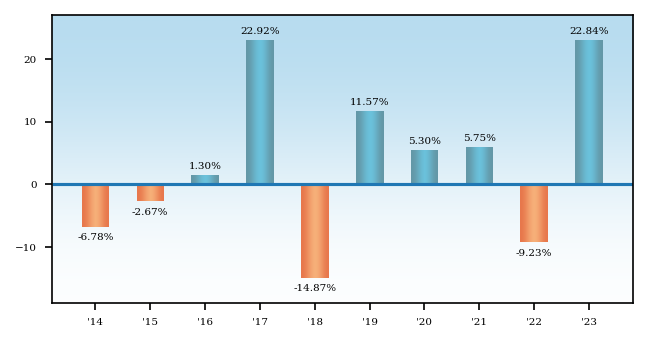
Best Quarter: | 2020, Q4 | 22.67% |
Worst Quarter: | 2020, Q1 | -24.71% |
Average Annual Total Returns - International Equity Series |
Label |
1 Year |
5 Years |
10 Years |
|---|---|---|---|---|
| Primary Shares | Return before taxes | 22.84% | 6.73% | 2.91% |
| Primary Shares | After Taxes on Distributions | Return after taxes on distributions | 18.13% | 3.18% | 0.37% |
| Primary Shares | After Taxes on Distributions and Sales | Return after taxes on distributions and sale of Fund shares | 15.11% | 4.48% | 1.80% |
| Service Shares | 22.80% | 6.61% | 2.77% | |
| MSCI All Country World ex-US Index-NR | MSCI All Country World ex-US Index-NR | 15.62% | 7.08% | 3.83% |
| MSCI EAFE Index-NR | MSCI EAFE Index-NR | 18.24% | 8.17% | 4.28% |