The fund’s investment objective is to provide you, over the long term, with a high level of total return consistent with prudent investment management. Total return comprises the income generated by the fund and the changes in the market value of the fund’s investments.
This table describes the fees and expenses that you may pay if you buy, hold and sell an interest in Class 4 shares of the fund. You may pay other fees, such as insurance contract fees and expenses, which are not reflected in the tables and examples below. If insurance contract fees and expenses were reflected, expenses shown would be higher.
Annual Fund Operating Expenses |
Class 4 Shares Prospectus
Capital World Bond Fund
Class 4
|
|---|---|
| Management fee | 0.43% |
| Distribution (12b-1) fees | 0.25% |
| Other expenses | 0.30% |
| Total annual fund operating expenses | 0.98% |
This example is intended to help you compare the cost of investing in Class 4 shares of the fund with the cost of investing in other mutual funds.
The example assumes that you invest $10,000 in the fund for the time periods indicated and then redeem or hold all of your shares at the end of those periods. The example also assumes that your investment has a 5% return each year and that the fund’s operating expenses remain the same. The example does not reflect insurance contract expenses. If insurance contract expenses were reflected, expenses shown would be higher. No sales charge (load) or other fees are charged by the fund upon redemption, so you would incur these hypothetical costs whether or not you were to redeem your shares at the end of the given period.
Expense Example |
1 year |
3 years |
5 years |
10 years |
|---|---|---|---|---|
| Class 4 Shares Prospectus | Capital World Bond Fund | Class 4 | USD ($) | 100 | 312 | 542 | 1,201 |
The fund pays transaction costs, such as commissions, when it buys and sells securities (or “turns over” its portfolio). A higher portfolio turnover rate may indicate higher transaction costs. These costs, which are not reflected in annual fund operating expenses or in the example, affect the fund’s investment results. During the most recent fiscal year, the fund’s portfolio turnover rate was 286% of the average value of its portfolio.
Under normal market circumstances, the fund invests at least 80% of its assets in bonds and other debt securities, which may be represented by derivatives. The fund invests primarily in debt securities, including asset-backed and mortgage-backed securities and securities of governmental, supranational and corporate issuers denominated in various currencies, including U.S. dollars. The fund will invest substantially in securities tied economically to a number of countries outside the United States, and such investments may include securities tied economically to developing countries. Normally, the fund invests substantially in investment-grade bonds (rated Baa3 or better or BBB– or better by Nationally Recognized Statistical Rating Organizations designated by the fund’s investment adviser or unrated but determined to be of equivalent quality by the fund’s investment adviser). The fund may also invest up to 25% of its assets in lower quality, higher yielding debt securities (rated Ba1 or below and BB+ or below by Nationally Recognized Statistical Rating Organizations designated by the fund’s investment adviser or unrated but determined to be of equivalent quality by the fund’s investment adviser). Such securities are sometimes referred to as “junk bonds.” The total return of the fund will be the result of interest income, changes in the market value of the fund’s investments and changes in the values of other currencies relative to the U.S. dollar.
The fund may invest in forward currency contracts, futures contracts and swaps, which are types of derivatives. A derivative is a financial contract, the value of which is based on the value of an underlying financial asset (such as a stock, bond or currency), a reference rate or a market index.
The investment adviser uses a system of multiple portfolio managers in managing the fund’s assets. Under this approach, the portfolio of the fund is divided into segments managed by individual managers.
The fund relies on the professional judgment of its investment adviser to make decisions about the fund’s portfolio investments. The basic investment philosophy of the investment adviser is to seek to invest in attractively priced securities that, in its opinion, represent good, long-term investment opportunities. Securities may be sold when the investment adviser believes that they no longer represent relatively attractive investment opportunities.
The following bar chart shows how the investment results of the Class 4 shares of the fund have varied from year to year, and the following table shows how the fund’s average annual total returns for various periods compare with a broad measure of securities market results and other applicable measures of market results. This information provides some indication of the risks of investing in the fund. The Lipper Global Income Funds Average includes funds that disclose investment objectives and/or strategies reasonably comparable to those of the fund. The Consumer Price Index provides a comparison of the fund's results to inflation. Past investment results (before and after taxes) are not predictive of future investment results. Figures shown reflect fees and expenses associated with an investment in the fund, but do not reflect insurance contract fees and expenses. If insurance contract fees and expenses were included, results would have been lower. Updated information on the fund’s investment results can be obtained by visiting capitalgroup.com/afis.
The following bar chart shows how the investment results of the Class 4 shares of the fund have varied from year to year, and the following table shows how the fund’s average annual total returns for various periods compare with a broad measure of securities market results and other applicable measures of market results.
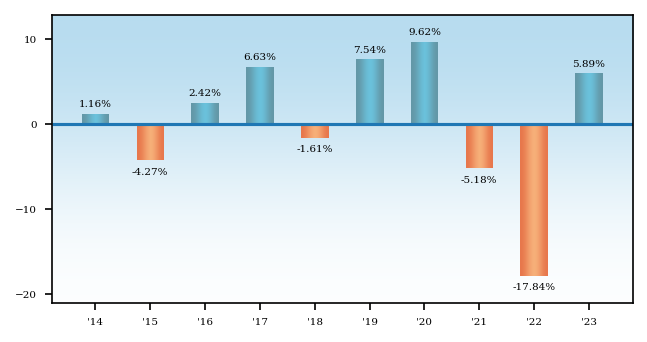
* Lifetime returns are from October 4, 2006, the date the fund began investment operations. Class 4 shares began investment operations on December 14, 2012; therefore, returns for the fund prior to that date assume a hypothetical investment in Class 1 shares, but reflect the .50% annual expense that applies to Class 4 shares, .25% of which is described in the “Plan of distribution” section of this prospectus and .25% of which is described in the “Fund expenses” section of this prospectus. Returns for Class 1 shares are comparable to those of Class 4 shares because both classes invest in the same portfolio of securities.
Highest/Lowest quarterly results during this period were:
Highest 8.93% (quarter ended December 31, 2023)
Lowest -8.56% (quarter ended March 31, 2022)
Average Annual Returns - Class 4 Shares Prospectus - Capital World Bond Fund |
Average Annual Returns, 1 Year |
Average Annual Returns, 5 Years |
Average Annual Returns, 10 Years |
[1] | Average Annual Returns, Since Inception |
[1] | Average Annual Returns, Inception Date |
|---|---|---|---|---|---|---|---|
| Class 4 | 5.89% | (0.56%) | 0.12% | 2.14% | Dec. 14, 2012 | ||
| Bloomberg Global Aggregate Index (reflects no deduction for sales charges, account fees, expenses or U.S. federal income taxes) | 3.38% | (0.24%) | 0.29% | 1.79% | |||
| Lipper Global Income Funds Average (reflects no deduction for sales charges, account fees or U.S. federal income taxes) | 6.60% | 0.64% | 1.06% | 2.72% | |||
| Consumer Price Index | 3.35% | 4.07% | 2.79% | 2.43% | |||
| [1] | Lifetime returns are from October 4, 2006, the date the fund began investment operations. Class 4 shares began investment operations on December 14, 2012; therefore, returns for the fund prior to that date assume a hypothetical investment in Class 1 shares, but reflect the .50% annual expense that applies to Class 4 shares, .25% of which is described in the “Plan of distribution” section of this prospectus and .25% of which is described in the “Fund expenses” section of this prospectus. Returns for Class 1 shares are comparable to those of Class 4 shares because both classes invest in the same portfolio of securities. |