The investment objective of the fund is to provide current income, consistent with the maturity and quality standards applicable to the fund, and preservation of capital and liquidity.
This table describes the fees and expenses that you may pay if you buy, hold and sell an interest in Class 4 shares of the fund. You may pay other fees, such as insurance contract fees and expenses, which are not reflected in the tables and examples below. If insurance contract fees and expenses were reflected, expenses shown would be higher.
Annual Fund Operating Expenses |
Class 4 Shares Prospectus
Ultra-Short Bond Fund
Class 4
|
|---|---|
| Management fee | 0.26% |
| Distribution (12b-1) fees | 0.25% |
| Other expenses | 0.30% |
| Total annual fund operating expenses | 0.81% |
This example is intended to help you compare the cost of investing in Class 4 shares of the fund with the cost of investing in other mutual funds.
The example assumes that you invest $10,000 in the fund for the time periods indicated and then redeem or hold all of your shares at the end of those periods. The example also assumes that your investment has a 5% return each year and that the fund’s operating expenses remain the same. The example does not reflect insurance contract expenses. If insurance contract expenses were reflected, expenses shown would be higher. No sales charge (load) or other fees are charged by the fund upon redemption, so you would incur these hypothetical costs whether or not you were to redeem your shares at the end of the given period.
Expense Example |
1 year |
3 years |
5 years |
10 years |
|---|---|---|---|---|
| Class 4 Shares Prospectus | Ultra-Short Bond Fund | Class 4 | USD ($) | 83 | 259 | 450 | 1,002 |
The fund pays transaction costs, such as commissions, when it buys and sells securities (or “turns over” its portfolio). A higher portfolio turnover rate may indicate higher transaction costs. These costs, which are not reflected in annual fund operating expenses or in the example, affect the fund’s investment results. During the most recent fiscal year, the fund’s portfolio turnover rate was either less than 1% of the average value of its portfolio or there was no turnover. However, calculation of the fund's portfolio turnover rate excludes securities whose maturities or expiration dates at the time of acquisition were one year or less.
Normally, the fund invests at least 80% of its assets in bonds and other debt securities. The fund invests substantially in short-term government securities and high-quality money market instruments, such as commercial paper, commercial bank obligations and ultra-short-term debt securities. The fund maintains a dollar-weighted average portfolio maturity of 60 days or less.
The fund may enter into repurchase agreements that are fully collateralized by cash or government securities. When it enters into a repurchase agreement, the fund purchases a security from a bank or broker-dealer and obtains a simultaneous commitment from the seller to repurchase the security at a specified time and price. Because the security purchased by the fund constitutes collateral for the seller’s repurchase obligation, a repurchase agreement is effectively a loan by the fund that is collateralized by the security purchased. The fund will only enter into repurchase agreements involving securities of the type (excluding any maturity limitations) in which it could otherwise invest.
The fund may invest in securities issued by entities domiciled outside the United States and securities with credit and liquidity support features provided by entities domiciled outside the United States. The fund may also invest in securities of U.S. issuers with substantial operations outside the United States.
The fund relies on the professional judgment of its investment adviser to make decisions about the fund’s portfolio investments. The basic investment philosophy of the investment adviser is to seek to provide current income while preserving capital and maintaining liquidity.
The following bar chart shows how the investment results of the Class 4 shares of the fund have varied from year to year, and the following table shows how the fund’s average annual total returns for various periods compare with a broad measure of securities market results and other applicable measures of market results. This information provides some indication of the risks of investing in the fund. The Lipper Ultra Short Obligation Funds Average and the Lipper Money Market Funds Average include mutual funds that disclose investment objectives and/or strategies reasonably comparable to those of the fund. Past investment results (before and after taxes) are not predictive of future investment results. Figures shown reflect fees and expenses associated with an investment in the fund, but do not reflect insurance contract fees and expenses. If insurance contract fees and expenses were included, results would have been lower. The results for certain of the years shown reflect the operation of the fund as a cash management fund prior to its conversion to an ultra-short-term bond fund on May 1, 2016. Accordingly, results for such periods may not be representative of the fund's results had the fund been operated as an ultra-short-term bond fund during the entire period. Updated information on the fund’s investment results can be obtained by visiting capitalgroup.com/afis.
The following bar chart shows how the investment results of the Class 4 shares of the fund have varied from year to year, and the following table shows how the fund’s average annual total returns for various periods compare with a broad measure of securities market results and other applicable measures of market results.
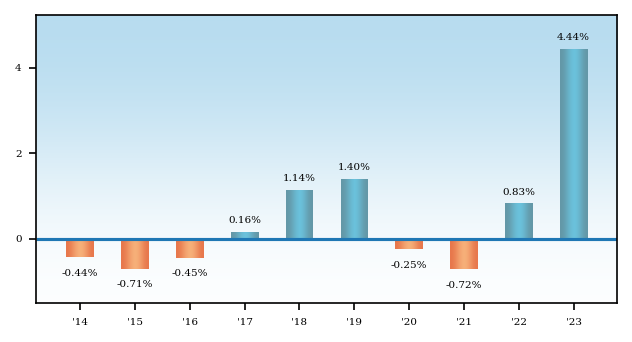
* Lifetime returns are from February 8, 1984, the date the fund began investment operations. Class 4 shares began investment operations on December 14, 2012; therefore, returns for the fund prior to that date assume a hypothetical investment in Class 1 shares, but reflect the .50% annual expense that applies to Class 4 shares, .25% of which is described in the “Plan of distribution” section of this prospectus and .25% of which is described in the “Fund expenses” section of this prospectus. Returns for Class 1 shares are comparable to those of Class 4 shares because both classes invest in the same portfolio of securities.
Highest/Lowest quarterly results during this period were:
Highest 1.16% (quarter ended September 30, 2023)
Lowest -0.27% (quarter ended December 31, 2014)
Average Annual Returns - Class 4 Shares Prospectus - Ultra-Short Bond Fund |
Average Annual Returns, 1 Year |
Average Annual Returns, 5 Years |
Average Annual Returns, 10 Years |
[1] | Average Annual Returns, Since Inception |
[1] | Average Annual Returns, Inception Date |
|---|---|---|---|---|---|---|---|
| Class 4 | 4.44% | 1.12% | 0.53% | 2.71% | Dec. 14, 2012 | ||
| Bloomberg Short-Term Government/Corporate Index (reflects no deduction for sales charges, account fees, expenses or U.S. federal income taxes) | 5.19% | 1.98% | 1.41% | ||||
| Lipper Ultra-Short Obligation Funds Average (reflects no deduction for sales charges, account fees or U.S. federal income taxes) | 5.83% | 2.08% | 1.54% | 4.04% | |||
| Lipper Money Market Funds Average (reflects no deduction for sales charges, account fees or U.S. federal income taxes) | 4.80% | 1.67% | 1.07% | 3.35% | |||
| [1] | Lifetime returns are from February 8, 1984, the date the fund began investment operations. Class 4 shares began investment operations on December 14, 2012; therefore, returns for the fund prior to that date assume a hypothetical investment in Class 1 shares, but reflect the .50% annual expense that applies to Class 4 shares, .25% of which is described in the “Plan of distribution” section of this prospectus and .25% of which is described in the “Fund expenses” section of this prospectus. Returns for Class 1 shares are comparable to those of Class 4 shares because both classes invest in the same portfolio of securities. |