The fund’s investment objective is to provide long-term growth of capital while seeking to manage volatility and provide downside protection.
This table describes the fees and expenses that you may pay if you buy, hold and sell an interest in Class P2 shares of the fund. You may pay other fees, such as insurance contract fees and expenses, which are not reflected in the tables and examples below. If insurance contract fees and expenses were reflected, expenses shown would be higher.
Annual Fund Operating Expenses |
Class P2 Shares Prospectus
Portfolio Series - American Funds Managed Risk Growth Portfolio
Class P2
|
|
|---|---|---|
| Management fees | 0.15% | |
| Distribution (12b-1) fees | 0.25% | |
| Other expenses | 0.26% | |
| Acquired (underlying) fund fees and expenses | 0.33% | |
| Total annual fund operating expenses | 0.99% | |
| Fee waiver | 0.05% | [1] |
| Total annual fund operating expenses after fee waiver | 0.94% | |
| [1] | The investment adviser is currently waiving a portion of its management fee equal to .05% of the fund’s net assets. This waiver will be in effect through at least May 1, 2025. The waiver may only be modified or terminated with the approval of the fund’s board. |
This example is intended to help you compare the cost of investing in Class P2 shares of the fund with the cost of investing in other mutual funds.
The example assumes that you invest $10,000 in the fund for the time periods indicated and then redeem or hold all of your shares at the end of those periods. The example also assumes that your investment has a 5% return each year and that the fund’s operating expenses remain the same. The example does not reflect insurance contract expenses. If insurance contract expenses were reflected, expenses shown would be higher. The example reflects the fee waiver described above through the expiration date of such waiver and total annual fund operating expenses thereafter. No sales charge (load) or other fees are charged by the fund upon redemption, so you would incur these hypothetical costs whether or not you were to redeem your shares at the end of the given period.
Expense Example |
1 year |
3 years |
5 years |
10 years |
|---|---|---|---|---|
| Class P2 Shares Prospectus | Portfolio Series - American Funds Managed Risk Growth Portfolio | Class P2 | USD ($) | 96 | 310 | 542 | 1,208 |
The fund pays transaction costs, such as commissions, when it buys and sells securities (or “turns over” its portfolio). A higher portfolio turnover rate may indicate higher transaction costs. These costs, which are not reflected in annual fund operating expenses or in the example, affect the fund’s investment results. During the most recent fiscal year, the fund’s portfolio turnover rate was 35% of the average value of its portfolio.
The fund will attempt to achieve its investment objective by investing in a mix of American Funds Insurance Series (AFIS) funds in different combinations and weightings, while seeking to manage portfolio volatility and to provide downside protection primarily through the use of exchange-traded options and futures contracts. The underlying AFIS funds will substantially consist of growth funds. The fund may also invest in growth-and-income and fixed income funds. A portion of the fund’s assets may also be held in cash and/or U.S. Treasury futures.
Through its investments in the underlying funds, the fund will have significant exposure to growth-oriented common stocks. The fund will typically have significant exposure to investments outside the United States. The fund may also have exposure to smaller capitalization issuers and investments in emerging markets. The investment adviser believes that exposure to investments outside the United States can help provide diversification when seeking long-term growth of capital.
With respect to its fixed income investments, the underlying funds in which the fund invests may hold debt securities with a wide range of quality and maturities. The fund may invest in underlying funds with significant exposure to debt securities rated BB+ or below and Ba1 or below by Nationally Recognized Statistical Rating Organizations designated by the fund’s investment adviser, or unrated but determined by the fund’s investment adviser to be of equivalent quality. Debt securities rated BB+ or below and Ba1 or below are sometimes referred to as “junk bonds.”
The fund’s investment adviser seeks to create combinations of underlying funds that complement each other with a goal of achieving the fund’s investment objective of providing long-term growth of capital. In making this determination, the fund’s investment adviser considers the historical volatility and returns of the underlying funds and how various combinations would have behaved in past market environments. It also considers, among other topics, current market conditions and the investment positions of the underlying funds.
The fund employs a risk-management overlay referred to in this prospectus as the managed risk strategy. The managed risk strategy consists of using hedge instruments — primarily exchange-traded futures contracts and/or exchange-traded put options — to attempt to stabilize the volatility of the fund around a target volatility level and to seek to reduce the downside exposure of the fund. The fund employs a subadviser to select individual put options and futures contracts on equity indexes of U.S. markets and markets outside the United States that the subadviser believes are correlated to the underlying funds’ equity exposure. These instruments are selected based on the subadviser’s analysis of the relation of various equity indexes to the underlying funds’ portfolios, taking into consideration each underlying fund’s allocation within the fund. In addition, the subadviser will monitor liquidity levels of relevant options and futures contracts and transparency provided by exchanges as the counterparties in hedging transactions. The target volatility level will be set from time to time by the investment adviser and the subadviser and may be adjusted if deemed advisable in the judgment of the investment adviser and the subadviser. The subadviser may also seek to hedge the fund’s currency risk related to its exposure to equity index options and futures denominated in currencies other than the U.S. dollar.
A futures contract on an index is an agreement pursuant to which two parties agree to take or make delivery of an amount of cash linked to the value of the index at the close of the last trading day of the contract. Though similar, an option on an index gives one party the contractual right (but not the obligation) to take or make delivery of an amount of cash linked to the value of the underlying index. Because such instruments derive their respective values from the price of an underlying index, both options and futures contracts are considered derivatives. A long position in an equity index put option and a short position in an equity index futures contract are both expected to gain in value when the underlying index declines, and lose value when the underlying index rises.
The fund’s investment adviser periodically reviews the investment strategies and asset mix of the underlying funds. The investment adviser will also consider whether overall market conditions and the effect of the managed risk strategy would favor a change in the exposure of the fund to various asset types or geographic regions. Based on these considerations, the investment adviser may make adjustments to underlying fund holdings by adjusting the percentage of individual underlying funds within the fund, or adding or removing underlying funds. The investment adviser may also determine not to change the underlying fund allocations, particularly in response to short-term market movements, if in its opinion the combination of underlying funds is appropriate to meet the fund’s investment objective.
The subadviser regularly adjusts the level of exchange-traded options and futures contracts held by the fund to seek to manage the fund’s overall net risk level. In situations of extreme market volatility, the subadviser will tend to use exchange-traded equity index options and/or futures more heavily, as such investments could significantly reduce the fund’s net economic exposure to equity securities. Even in periods of low volatility in the equity markets, however, the subadviser will continue to employ exchange-traded equity index put options to seek to preserve gains after favorable market conditions and to reduce losses in adverse market conditions. During such periods of low equity market volatility, the subadviser may also continue to use exchange-traded equity index futures contracts for hedging purposes, though it need not necessarily do so. In certain market conditions, the fund may also purchase exchange-traded equity index call options, write or sell exchange-traded equity index put and call options and/or take net long positions in exchange-traded equity index futures contracts.
The fund is nondiversified, which allows it to invest a greater percentage of its assets in any one issuer than would otherwise be the case. However, through the underlying funds, the fund owns a diversified mix of securities.
The following bar chart shows how the investment results of the Class P2 shares of the fund have varied from year to year, and the following table shows how the fund’s average annual total returns for various periods compare with a broad measure of securities market results. This information provides some indication of the risks of investing in the fund. Past investment results (before and after taxes) are not predictive of future investment results. Figures shown reflect fees and expenses associated with an investment in the fund, but do not reflect insurance contract fees and expenses. If insurance contract fees and expenses were included, results would have been lower. Updated information on the fund’s investment results can be obtained by visiting capitalgroup.com/afis.
The following bar chart shows how the investment results of the Class P2 shares of the fund have varied from year to year, and the following table shows how the fund’s average annual total returns for various periods compare with a broad measure of securities market results.
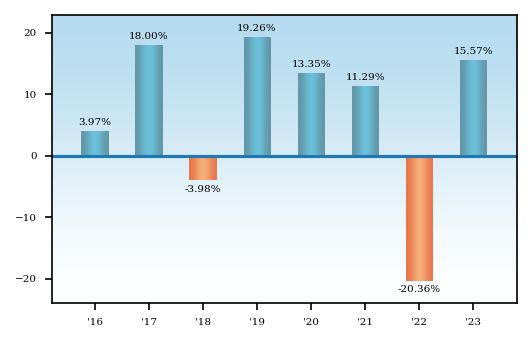
Highest/Lowest quarterly results during this period were:
Highest 9.94% (quarter ended December 31, 2023)
Lowest -10.79% (quarter ended June 30, 2022)
Average Annual Returns - Class P2 Shares Prospectus - Portfolio Series - American Funds Managed Risk Growth Portfolio |
Average Annual Returns, 1 Year |
Average Annual Returns, 5 Years |
Average Annual Returns, Since Inception |
Average Annual Returns, Inception Date |
|---|---|---|---|---|
| Class P2 | 15.57% | 6.73% | 5.16% | May 01, 2015 |
| S&P 500 Managed Risk Index – Moderate (reflects no deduction for sales charges, account fees, expenses or U.S. federal income taxes) | 16.81% | 8.77% | 6.94% |
Additionally, because no funds, private accounts or commodity pools that are managed by the fund’s investment adviser have investment objectives, policies and strategies substantially similar to those of the fund, information regarding investment results of any such other funds, accounts or pools is not provided herein.