Depending on the proximity to its target date, which we define as the year that corresponds roughly to the year in which the investor expects to retire, the fund will seek to achieve the following objectives to varying degrees: growth, income and conservation of capital. The fund will increasingly emphasize income and conservation of capital by investing a greater portion of its assets in fixed income, equity-income and balanced funds as it continues past its target date. In this way, the fund seeks to balance total return and stability over time.
This table describes the fees and expenses that you may pay if you buy, hold and sell an interest in Class 1A or Class 2 shares of the fund. You may pay other fees, such as insurance contract fees and expenses, which are not reflected in the tables and examples below. If insurance contract fees and expenses were reflected, expenses shown would be higher.
Annual Fund Operating Expenses - Class 1A & 2 Shares Prospectus - American Funds IS 2015 Target Date Fund |
Class 1A |
Class 2 |
|---|---|---|
| Management fees | none | none |
| Distribution (12b-1) fees | none | 0.25% |
| Other expenses | 0.29% | 0.04% |
| Acquired (underlying) fund fees and expenses | 0.29% | 0.29% |
| Total annual fund operating expenses | 0.58% | 0.58% |
This example is intended to help you compare the cost of investing in Class 1A and Class 2 shares of the fund with the cost of investing in other mutual funds.
The example assumes that you invest $10,000 in the fund for the time periods indicated and then redeem or hold all of your shares at the end of those periods. The example also assumes that your investment has a 5% return each year and that the fund’s operating expenses remain the same. The example does not reflect insurance contract fees and expenses. If insurance contract fees and expenses were reflected, expenses shown would be higher. No sales charge (load) or other fees are charged by the fund upon redemption, so you would incur these hypothetical costs whether or not you were to redeem your shares at the end of the given period.
Expense Example - Class 1A & 2 Shares Prospectus - American Funds IS 2015 Target Date Fund - USD ($) |
1 year |
3 years |
5 years |
10 years |
|---|---|---|---|---|
| Class 1A | 59 | 186 | 324 | 726 |
| Class 2 | 59 | 186 | 324 | 726 |
The fund pays transaction costs, such as commissions, when it buys and sells securities (or “turns over” its portfolio). A higher portfolio turnover rate may indicate higher transaction costs. These costs, which are not reflected in annual fund operating expenses or in the example, affect the fund’s investment results. During the most recent fiscal year, the fund’s portfolio turnover rate was 6% of the average value of its portfolio.
The fund will attempt to achieve its investment objectives by investing in a mix of American Funds in different combinations and weightings. The underlying American Funds represent a variety of fund categories, including growth-and-income funds, equity-income funds, balanced funds and fixed income funds. The fund categories represent differing investment objectives. For example, growth-and-income funds seek long-term growth and income primarily through investments in stocks. Equity-income and balanced funds generally strive for income and growth through stocks and/or fixed income investments, while fixed income funds seek current income through investments in bonds or in other fixed income instruments.
The fund is designed for investors who plan to retire in, or close to, the fund’s target date — that is, the year designated in the fund’s name. However, investors may purchase shares of the fund throughout the life of the fund, including after the target date. In an effort to achieve the fund’s overall investment objective, the fund will continue to provide equity exposure after the target date has passed.
The fund’s investment adviser periodically reviews the investment strategies and asset mix of the underlying funds and may, from time to time, rebalance or modify the asset mix of the funds and change the underlying fund investments. The investment adviser may also determine not to change the underlying fund allocations, particularly in response to short-term market movements, if in its opinion the combination of underlying funds is appropriate to meet the fund’s investment objective.
According to its current investment approach, the investment adviser will continue to manage the fund for approximately thirty years after the fund reaches its target date. As reflected in the glide path below, the fund’s asset allocations will change throughout this period. Thirty years after its target date, the fund may be combined with other funds in a single portfolio with an investment allocation that will not evolve beyond that which is in effect at that time.
The following glide path chart illustrates the investment approach of the fund by showing how its investment in the various fund categories will change over time. The glide path represents the shifting of asset classes over time and shows how the fund’s asset mix becomes relatively more conservative — both prior to and after retirement — as time elapses. Although the glide path is meant to dampen the fund’s potential volatility as retirement approaches, the fund is not designed for a lump sum redemption at the retirement date. The fund’s asset allocation strategy promotes asset accumulation prior to retirement, but it is also intended to provide equity exposure throughout retirement to deliver capital growth potential. The fund will seek dividend income to help dampen risk while maintaining equity exposure, and will invest in fixed income securities to help provide current income, capital preservation and inflation protection. The allocations shown reflect the target allocations as of May 1, 2024.
Investment approach
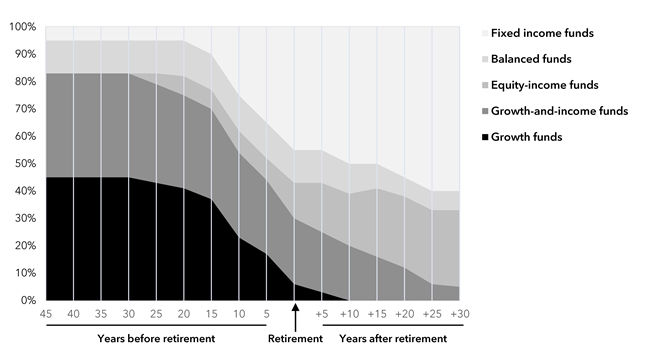
The investment adviser anticipates that the fund will invest its assets within a range that deviates no more than 10% above or below the investment approach set forth above. For example, a 40% target allocation to growth funds is not expected to be greater than 50% nor less than 30%. The investment adviser will monitor the fund on an ongoing basis and may make modifications to either the investment approach or the underlying fund allocations that the investment adviser believes could benefit shareholders.
Because the fund has not yet begun investment operations of its Class 1A and Class 2 shares, information regarding investment results is not available as of the date of this prospectus.