The ARK Space Exploration & Innovation ETF’s (“Fund”) investment objective is long-term growth of capital.
The table below describes the fees and expenses that you pay if you buy, hold and sell shares of the Fund (“Shares”). Investors may pay other fees, such as brokerage commissions and other fees to financial intermediaries on their purchases and sales of Shares, which are not reflected in the tables and examples below.
Shareholder Fees |
ARK Space Exploration & Innovation ETF
ARK Space Exploration & Innovation ETF
USD ($)
|
|---|---|
| Shareholder Fees (fees paid directly from your investment) | none |
Annual Fund Operating Expenses |
ARK Space Exploration & Innovation ETF
ARK Space Exploration & Innovation ETF
|
|
|---|---|---|
| Management Fee | 0.75% | |
| Distribution and/or Service (12b-1) Fees | none | |
| Other Expenses | none | [1] |
| Acquired Funds Fees and Expenses | 0.03% | [2] |
| Total Annual Fund Operating Expenses | 0.78% | |
| Fee Waiver | (0.03%) | [3] |
| Total Annual Fund Operating Expenses After Fee Waiver | 0.75% | |
| [1] | Pursuant to a Supervision Agreement, ARK Investment Management LLC (“ARK” or “Adviser”) pays all other expenses of the Fund (other than acquired fund fees and expenses (except where attributable to management fees of affiliated underlying exchange-traded funds (“ETFs”) in which the Fund invests), taxes and governmental fees, brokerage fees, commissions and other transaction expenses, certain foreign custodial fees and expenses, costs of borrowing money, including interest expenses, and extraordinary expenses (such as litigation and indemnification expenses)). |
| [2] | The Total Annual Fund Operating Expenses may not correlate to the ratio of expenses to average net assets as reported in the “Financial Highlights” section of the Prospectus, which reflects the operating expenses of the Fund and does not include Acquired Fund Fees and Expenses. Acquired Fund Fees and Expenses represent the Fund’s pro rata share of fees and expenses incurred indirectly as a result of investing in other funds, including ETFs and money market funds. |
| [3] | The Adviser has voluntarily agreed to waive a portion of its management fee payable by the Fund in an amount equal to any management fees it earns as an investment adviser to the affiliated fund(s) in which the Fund invests. The fee waiver arrangement will continue for at least one year from the date of this Prospectus. |
This example is intended to help you compare the cost of investing in the Fund with the cost of investing in other funds. This example does not take into account brokerage commissions that you pay when purchasing or selling Shares.
The example assumes that you invest $10,000 in the Fund for the time periods indicated and then redeem all of your Shares at the end of those periods. The example also assumes that your investment has a 5% annual return and that the Fund’s operating expenses remain the same. Although your actual costs may be higher or lower, based on these assumptions, your costs would be:
Expense Example |
ARK Space Exploration & Innovation ETF
ARK Space Exploration & Innovation ETF
USD ($)
|
|---|---|
| 1 | $ 77 |
| 3 | 246 |
| 5 | 430 |
| 10 | $ 963 |
The Fund pays transaction costs, such as commissions, when it purchases and sells securities (or “turns over” its portfolio). A higher portfolio turnover rate may result in higher transaction costs and higher taxes when Shares are held in a taxable account. These costs, which are not reflected in annual fund operating expenses or in the example, may affect the Fund’s performance. During the most recent fiscal year, the Fund’s portfolio turnover rate was 18% of the average value of its portfolio.
The Fund is an actively-managed exchange-traded fund (“ETF”) that will invest under normal circumstances primarily (at least 80% of its assets) in domestic and foreign equity securities of companies that are engaged in the Fund’s investment theme of Space Exploration and Innovation. The Adviser defines “Space Exploration” as leading, enabling, or benefitting from technologically enabled products and/or services that occur beyond the surface of the Earth. The Adviser defines Innovation, including the investment theme of “disruptive innovation,” as the introduction of a technologically enabled new product or service that the Adviser expects to change an industry landscape. The Adviser’s internal research and analysis leverages insights from diverse sources, including external research, to develop and refine its investment themes and identify and take advantage of trends that have ramifications for individual companies or entire industries.
In selecting companies that the Adviser believes are engaged in the theme of Space Exploration, the Adviser seeks to identify, using its own internal research and analysis, companies capitalizing on disruptive innovation. The Adviser believes that Space Exploration related companies can be grouped into four overarching categories, each of which contains relevant sub-elements. Orbital Aerospace Companies are companies that launch, make, service, or operate platforms in the orbital space, including satellites and launch vehicles. Suborbital Aerospace Companies are companies that launch, make, service, or operate platforms in the suborbital space, but do not reach a velocity needed to remain in orbit around a planet. Enabling Technologies Companies are companies that develop technologies used by Space Exploration related companies for successful value-add aerospace operations. These operations include artificial intelligence, robotics, 3D printing, materials and energy storage. For example, 3D printing companies create value-add for space and aerospace exploration related companies by accelerating innovation thanks to low-costs and rapid prototyping, and by lowering the weight of low volume, highly complex parts. Aerospace Beneficiary Companies are companies whose operations stand to benefit from aerospace activities, including agriculture, internet access, global positioning system (GPS), construction, imaging, drones, air taxis and electric aviation vehicles. For example, agriculture companies utilize technologies advanced by
space exploration and innovation, such as satellite imagery. Space exploration is possible due to the convergence of a number of themes. Many of the companies the Fund invests in may only have an indirect and not a substantial involvement in the space industry. A Space Exploration related company may not currently derive any revenue, and there is no assurance that such company will derive any revenue from innovative technologies in the future.
The Adviser will select investments for the Fund that represent the Adviser’s highest-conviction investment ideas within the theme of Space Exploration, i.e., investment decisions regarded with confidence, in constructing the Fund’s portfolio. The Adviser will analyze potential investments by using both “top down” information (e.g., economy-wide analysis of facts such as rate of growth, cost declines, unit economics, sizing of markets, and price levels as well as business and technology cycle trends) and “bottom up” criteria (e.g., fundamental and quantitative metrics for individual companies such as their revenue growth, profitability and return on invested capital). Based upon its research and analysis, the Adviser will select a portfolio company that it believes presents the best risk-reward opportunities. In both the Adviser’s “top down” and “bottom up” approaches, the Adviser evaluates environmental, social, and governance (“ESG”) considerations. In its “top down” approach, the Adviser uses the framework of the United Nations Sustainable Development Goals to integrate ESG considerations into its research and investment process. The Adviser, however, does not use ESG considerations to limit, restrict or otherwise exclude companies or sectors from the Fund’s investment universe. In its “bottom up” approach, the Adviser makes its investment decisions primarily based on its analysis of the potential of individual companies, while integrating ESG considerations into that process. The Adviser’s highest-conviction investment ideas are those that it believes present the best risk-reward opportunities.
Under normal circumstances, substantially all of the Fund’s assets will be invested in equity securities, including common stocks, partnership interests, business trust shares and other equity investments or ownership interests in business enterprises. The Fund’s investments will include micro-, small-, medium- and large-capitalization companies. The Fund’s investments in foreign equity securities will be in both developed and emerging markets. The Fund may invest in foreign securities listed on foreign exchanges as well as American Depositary Receipts (“ADRs”) and Global Depositary Receipts (“GDRs”).
The Fund is classified as a “non-diversified” investment company under the Investment Company Act of 1940, as amended (the “1940 Act”), which means that it may invest a high percentage of its assets in a limited number of issuers. The Fund’s portfolio is expected to contain 40 to 55 common stocks (domestic and foreign) that are conviction weighted. The Fund will concentrate (i.e., invest more than 25% of the value of the Fund’s assets) in securities of issuers having their principal business activities in groups of industries in the information technology and industrials sectors. This concentration limit does not apply to securities issued or guaranteed by the U.S. Government, its agencies or instrumentalities.
The following bar chart and table provide some indication of the risks of investing in the Fund. The bar chart shows changes in the Fund’s performance from year to year. The table shows how the Fund’s average annual returns for 1 year and since the Fund’s inception compare with those of the S&P 500 Index and the MSCI World Index. The S&P 500 Index is a widely recognized capitalization-weighted index that measures the performance of the large-capitalization sector of the U.S. stock market. The MSCI World Index represents large and mid-cap equity performance across 23 developed markets countries. Returns shown for the MSCI World Index are net of foreign withholding taxes applicable to U.S. investors. The Fund’s past performance (before and after taxes) is not necessarily an indication of how the Fund will perform in the future. Updated performance information is available at no cost by visiting http://ark-funds.com or by calling (727) 810-8160.
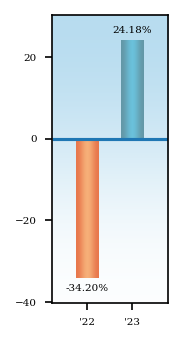
The Fund’s year-to-date total return as of October 31, 2024 was 5.19%.
| Best and Worst Quarter Returns (for the period reflected in the bar chart above) | Return | Quarter/Year | |||
| Highest Return | 12.85 | % | 3/31/2023 | ||
| Lowest Return | -25.07 | % | 6/30/2022 | ||
Average Annual Returns - ARK Space Exploration & Innovation ETF |
Label |
1 Year |
Since Inception |
[1] | Inception Date |
|
|---|---|---|---|---|---|---|
| ARK Space Exploration & Innovation ETF | Returns Before Taxes | 24.18% | (9.01%) | Mar. 30, 2021 | ||
| ARK Space Exploration & Innovation ETF | Returns After Taxes on Distributions | Returns After Taxes on Distributions | 24.18% | [2] | (9.01%) | [2] | Mar. 30, 2021 |
| ARK Space Exploration & Innovation ETF | Returns After Taxes on Distributions and Sale of Fund Shares | Returns After Taxes on Distributions and Sale of Fund Shares | 14.31% | [2] | (6.73%) | [2] | Mar. 30, 2021 |
| S&P 500 Index (reflects no deduction for fees, expenses or taxes) | S&P 500 Index (reflects no deduction for fees, expenses or taxes) | 26.29% | 8.56% | Mar. 30, 2021 | ||
| MSCI World Index (reflects no deduction for fees, expenses or taxes) | MSCI World Index (reflects no deduction for fees, expenses or taxes) | 23.79% | 6.10% | Mar. 30, 2021 | ||
| [1] | The Fund commenced operations on March 30, 2021. |
| [2] | After-tax returns are calculated using the highest historical individual federal marginal income tax rates and do not reflect the impact of state and local taxes. Actual after-tax returns depend on your tax situation and may differ from those shown and are not relevant if you hold your shares through tax-deferred arrangements, such as 401(k) plans or individual retirement accounts. |