The ARK Next Generation Internet ETF’s (“Fund”) investment objective is long-term growth of capital.
The table below describes the fees and expenses that you pay if you buy, hold and sell shares of the Fund (“Shares”). Investors may pay other fees, such as brokerage commissions and other fees to financial intermediaries on their purchases and sales of Shares, which are not reflected in the tables and examples below.
Shareholder Fees |
ARK Next Generation Internet ETF
ARK Next Generation Internet ETF
USD ($)
|
|---|---|
| Shareholder Fees (fees paid directly from your investment) | none |
Annual Fund Operating Expenses |
ARK Next Generation Internet ETF
ARK Next Generation Internet ETF
|
|
|---|---|---|
| Management Fee | 0.75% | [1] |
| Distribution and/or Service (12b-1) Fees | none | |
| Other Expenses | none | [2] |
| Acquired Fund Fees and Expenses | 0.07% | [3] |
| Total Annual Fund Operating Expenses | 0.82% | [3] |
| [1] | “Management Fee” includes the advisory fee of a wholly-owned subsidiary of the Fund organized as an exempted company under the laws of the Cayman Islands (the “Subsidiary”). The Fund’s “Adviser,” ARK Investment Management LLC (the “Adviser”), has agreed to waive or credit a portion of the advisory fee in an amount equal to any net fees received by the Adviser with respect to other investments in which the Subsidiary invests. |
| [2] | Pursuant to a Supervision Agreement, the Adviser pays all other expenses of the Fund (other than acquired fund fees and expenses, taxes and governmental fees, brokerage fees, commissions and other transaction expenses, certain foreign custodial fees and expenses, costs of borrowing money, including interest expenses, and extraordinary expenses (such as litigation and indemnification expenses)). |
| [3] | The Total Annual Fund Operating Expenses may not correlate to the ratio of expenses to average net assets as reported in the “Financial Highlights” section of the Prospectus, which reflects the operating expenses of the Fund and does not include Acquired Fund Fees and Expenses. Acquired Fund Fees and Expenses represent the Fund’s pro rata share of fees and expenses incurred indirectly as a result of investing in other funds, including ETFs and money market funds. |
This example is intended to help you compare the cost of investing in the Fund with the cost of investing in other funds. This example does not take into account brokerage commissions that you pay when purchasing or selling Shares.
The example assumes that you invest $10,000 in the Fund for the time periods indicated and then redeem all of your Shares at the end of those periods. The example also assumes that your investment has a 5% annual return and that the Fund’s operating expenses remain the same. Although your actual costs may be higher or lower, based on these assumptions, your costs would be:
Expense Example |
ARK Next Generation Internet ETF
ARK Next Generation Internet ETF
USD ($)
|
|---|---|
| 1 | $ 84 |
| 3 | 262 |
| 5 | 455 |
| 10 | $ 1,014 |
The Fund pays transaction costs, such as commissions, when it purchases and sells securities (or “turns over” its portfolio). A higher portfolio turnover rate may result in higher transaction costs and higher taxes when Shares are held in a taxable account. These costs, which are not reflected in annual fund operating expenses or in the example, may affect the Fund’s performance. During the most recent fiscal year, the Fund’s portfolio turnover rate was 54% of the average value of its portfolio.
The Fund is an actively-managed exchange-traded fund (“ETF”) that will invest under normal circumstances primarily (at least 80% of its assets) in domestic and foreign equity securities of companies that are relevant to the Fund’s investment theme of next generation internet.
Next generation internet companies are companies that the Adviser believes are focused on and expected to benefit from shifting the bases of technology infrastructure from hardware and software to the cloud, enabling mobile and local services, such as companies that rely on or benefit from the increased use of shared technology, infrastructure and services. These companies may include mail order houses which generate the entirety of their business through websites and which offer internet-based products and services, such as streaming media or cloud storage in addition to traditional physical goods. These companies may also include ones that develop, use or rely on innovative payment methodologies, big data, the “internet of things*,” social distribution and media, and technologies that make financial services more efficient (“Fintech Innovation Companies”).
In selecting companies that the Adviser believes are relevant to a particular investment theme, the Adviser seeks to identify, using its own internal research and analysis, companies capitalizing on disruptive innovation or that are enabling the further development of a theme in the markets in which they operate. The Adviser’s internal research and analysis leverages insights from diverse sources, including external research, to develop and refine its investment themes and identify and take advantage of trends that have ramifications for individual companies or entire industries. The types of companies that the Adviser believes are relevant to this theme are those that are focused on shifting the bases of technology infrastructure from hardware and software to the cloud, enabling mobile and local services, among others. The Adviser believes Fintech Innovation Companies are companies that are focused on and expected to benefit from the shifting of the financial sector and economic transactions to technology infrastructure platforms, and technological intermediaries. Fintech Innovation Companies may also develop, use or rely on innovative payment platforms and methodologies, point of sale providers, transactional innovations, business analytics, fraud reduction, frictionless funding platforms, peer-to-peer lending, blockchain technologies,** intermediary exchanges, asset allocation technology, cryptocurrency,*** mobile payments, and risk pricing and pooling aggregators. The Fund may have exposure to cryptocurrency, such as bitcoin and Ether, indirectly through an investment in a grantor trust or in other pooled investment vehicles, such as exchange-traded funds.
* The Adviser defines the “internet of things” as a system of interrelated computing devices, mechanical and digital machines, or physical objects that are provided unique identifiers and the ability to transfer data over a network without requiring human-to-human or human-to-computer interaction.
** The term “blockchain” refers to a peer-to-peer distributed ledger that is secured using cryptography. A distributed ledger is a shared electronic database where information is recorded and stored across multiple computers; a blockchain is one type of distributed ledger. A blockchain may be open and permissionless or private and permissioned. The Bitcoin and Ethereum blockchains are examples of open, public, permissionless blockchains. Blockchain derives its name from the way it stores transaction data in “blocks” that are linked together to form a chain. As the number of transactions grows, so does the blockchain. Blocks record and confirm the time and sequence of transactions, which are then logged into the blockchain network, which is, with respect to public blockchains, governed by rules agreed on by the network participants.
*** Cryptocurrencies (also referred to as “virtual currencies” and “digital currencies”) are digital assets designed to act as a medium of exchange. There are thousands of cryptocurrencies, the most well-known of which is bitcoin.
The Fund gains exposure to cryptocurrency through investments in the ARK Next Generation Internet (Cayman) Fund, a wholly-owned subsidiary of the Fund organized under the laws of the Cayman Islands (the “Subsidiary”). In order to comply with certain issuer diversification limits imposed by the Internal Revenue Code, the Fund may invest up to 25% of its total assets in the Subsidiary. The Subsidiary is advised by the Adviser, and has the same investment objective as the Fund. The Subsidiary may invest in pooled investment vehicles and exchange-traded products that invest in cryptocurrencies. Investments in the Subsidiary are intended to provide the Fund with exposure to cryptocurrency while meeting the federal tax requirements that apply to regulated investment companies, like the Fund.
The Fund’s exposure to cryptocurrency may change over time and, accordingly, such exposure may not always be represented in the Fund’s portfolio.
The Adviser’s process for identifying Next Generation Internet Companies uses both “top down” (thematic research sizing the potential total available market, and surfacing the prime beneficiaries) and “bottom up” (valuation, fundamental and quantitative measures) approaches. In both the Adviser’s “top down” and “bottom up” approaches, the Adviser evaluates environmental, social, and governance (“ESG”) considerations. In its “top down” approach, the Adviser uses the framework of the United Nations Sustainable Development Goals to integrate ESG considerations into its research and investment process. The Adviser, however, does not use ESG considerations to limit, restrict or otherwise exclude companies or sectors from the Fund’s investment universe. In its “bottom up” approach, the Adviser makes its investment decisions primarily based on its analysis of the potential of individual companies, while integrating ESG considerations into that process. The Adviser’s highest-conviction investment ideas are those that it believes present the best risk-reward opportunities.
Under normal circumstances, substantially all of the Fund’s assets will be invested in equity securities, including common stocks, partnership interests, business trust shares and other equity investments or ownership interests in business enterprises. The Fund’s investments will include micro-, small-, medium- and large-capitalization companies. The Fund’s investments in foreign equity securities will be in both developed and emerging markets.
The Fund will be concentrated (i.e., more than 25% of the value of the Fund’s assets) in securities of issuers having their principal business activities in the Internet information provider and catalog and mail order house industry. This concentration limit does not apply to securities issued or guaranteed by the U.S. Government, its agencies or instrumentalities. The Fund may invest in foreign securities listed on foreign exchanges as well as American Depositary Receipts (“ADRs”) and Global Depositary Receipts (“GDRs”).
The Fund is classified as a “non-diversified” investment company under the Investment Company Act of 1940, as amended (the “1940 Act”), which means that it may invest a high percentage of its assets in a limited number of issuers.
The following bar chart and table provide some indication of the risks of investing in the Fund. The bar chart shows changes in the Fund’s performance from year to year. The table shows how the Fund’s average annual returns for 1 year, 5 years and since the Fund’s inception compare with those of the S&P 500 Index and the MSCI World Index. The S&P 500 Index is a widely recognized capitalization-weighted index that measures the performance of the large-capitalization sector of the U.S. stock market. The MSCI World Index represents large and mid-cap equity performance across 23 developed markets countries. Returns shown for the MSCI World Index are net of foreign withholding taxes applicable to U.S. investors. The Fund’s past performance (before and after taxes) is not necessarily an indication of how the Fund will perform in the future. Updated performance information is available at no cost by visiting http://ark-funds.com or by calling (727) 810-8160.
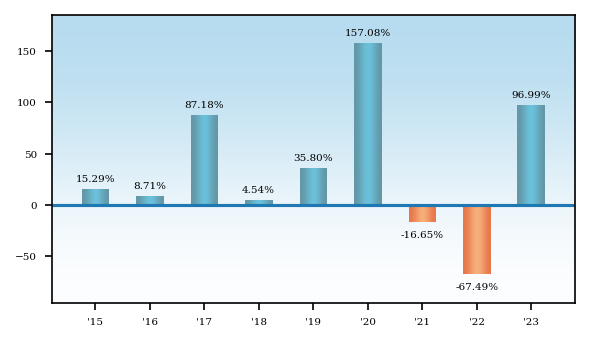
The Fund’s year-to-date total return as of October 31, 2024 was 14.41%.
| Best and Worst Quarter Returns (for the period reflected in the bar chart above) | Return | Quarter/Year | |||
| Highest Return | 60.37 | % | 6/30/2020 | ||
| Lowest Return | -43.78 | % | 6/30/2022 | ||
Average Annual Returns - ARK Next Generation Internet ETF |
Label |
1 Year |
5 Years |
Since Inception |
[1] | Inception Date |
||
|---|---|---|---|---|---|---|---|---|
| ARK Next Generation Internet ETF | Returns Before Taxes | 96.99% | 13.25% | 18.12% | Sep. 30, 2014 | |||
| ARK Next Generation Internet ETF | Returns After Taxes on Distributions | Returns After Taxes on Distributions | 96.99% | [2] | 12.98% | [2] | 17.19% | [2] | Sep. 30, 2014 |
| ARK Next Generation Internet ETF | Returns After Taxes on Distributions and Sale of Fund Shares | Returns After Taxes on Distributions and Sale of Fund Shares | 57.42% | [2] | 10.69% | [2] | 15.01% | [2] | Sep. 30, 2014 |
| S&P 500 Index (reflects no deduction for fees, expenses or taxes) | S&P 500 Index (reflects no deduction for fees, expenses or taxes) | 26.29% | 15.69% | 12.02% | Sep. 30, 2014 | |||
| MSCI World Index (reflects no deduction for fees, expenses or taxes) | MSCI World Index (reflects no deduction for fees, expenses or taxes) | 23.79% | 12.80% | 8.81% | Sep. 30, 2014 | |||
| [1] | The Fund commenced operations on September 30, 2014. |
| [2] | After-tax returns are calculated using the highest historical individual federal marginal income tax rates and do not reflect the impact of state and local taxes. Actual after-tax returns depend on your tax situation and may differ from those shown and are not relevant if you hold your shares through tax-deferred arrangements, such as 401(k) plans or individual retirement accounts. |