The Fund seeks total return through a combination of capital appreciation and income.
This table describes the fees and expenses that you may pay if you buy, hold and sell shares of the Fund. You may pay other fees, such as brokerage commissions and other fees to financial intermediaries, which are not reflected in the tables and examples below. More information is available from your financial professional and in the section entitled How to Purchase Shares on page 19 of the Fund’s Prospectus and in Purchase, Redemption and Pricing of Shares on page 42 of the Statement of Additional Information.
Shareholder Fees - Astor Dynamic Allocation Fund |
Astor Dynamic Allocation Fund Class A shares |
Astor Dynamic Allocation Fund Class C shares |
Astor Dynamic Allocation Fund Class I shares |
|---|---|---|---|
| Maximum Sales Charge (Load) Imposed on Purchases (as a % of offering price) | 4.75% | none | none |
| Maximum Deferred Sales Charge (Load) (as a % of the lower of original purchase price or redemption proceeds) | none | none | none |
| Maximum Sales Charge (Load) Imposed on Reinvested Dividends and other Distributions | none | none | none |
| Redemption Fee | none | none | none |
Annual Fund Operating Expenses - Astor Dynamic Allocation Fund |
Astor Dynamic Allocation Fund Class A shares |
Astor Dynamic Allocation Fund Class C shares |
Astor Dynamic Allocation Fund Class I shares |
|
|---|---|---|---|---|
| Management Fees | [1] | 0.95% | 0.95% | 0.95% |
| Distribution and/or Service (12b-1) Fees | 0.25% | 1.00% | none | |
| Interest Expense | 0.01% | 0.01% | 0.01% | |
| Remaining Other Expenses | 0.46% | 0.46% | 0.46% | |
| Other Expenses | 0.47% | 0.47% | 0.47% | |
| Acquired Fund Fees and Expenses | [1] | 0.23% | 0.23% | 0.23% |
| Total Annual Fund Operating Expenses | 1.90% | 2.65% | 1.65% | |
| Fee Waiver and Reimbursement | [2] | (0.26%) | (0.26%) | (0.26%) |
| Total Annual Fund Operating Expenses After Fee Waiver and Reimbursement | [1],[2] | 1.64% | 2.39% | 1.39% |
| [1] | Acquired Fund Fees and Expenses are the indirect costs of investing in other investment companies. |
| [2] | The Adviser has contractually agreed to waive its management fees and to make payments to limit Fund expenses, until November 30, 2025 so that the total annual operating expenses excluding (i) any front-end or contingent deferred loads; (ii) brokerage fees and commissions; (iii) acquired fund fees and expenses; (iv) fees and expenses associated with investments in other collective investment vehicles or derivative instruments (including for example options and swap fees and expenses); (v) borrowing costs (such as interest and dividend expense on securities sold short); (vi) taxes; and (vii) extraordinary expenses, such as litigation expenses (which may include indemnification of Fund officers and Trustees, contractual indemnification of Fund service providers (other than the Adviser)) of the Fund do not exceed 1.40%, 2.15% and 1.15% for Class A, Class C and Class I shares, respectively. These fee waivers and expense reimbursements are subject to possible recoupment from the Fund in future years (within the three years from the date when the amount is waived or reimbursed) if such recoupment can be achieved within the lesser of the foregoing expense limits or the then-current expense limits. This agreement may be terminated only by the Trust’s Board of Trustees, on 60 days’ written notice to the Adviser. |
This Example is intended to help you compare the cost of investing in the Fund with the cost of investing in other mutual funds.
Expense Example - Astor Dynamic Allocation Fund - USD ($) |
Expense Example, with Redemption, 1 Year |
Expense Example, with Redemption, 3 Years |
Expense Example, with Redemption, 5 Years |
Expense Example, with Redemption, 10 Years |
|---|---|---|---|---|
| Astor Dynamic Allocation Fund Class A shares | 634 | 1,021 | 1,432 | 2,575 |
| Astor Dynamic Allocation Fund Class C shares | 243 | 800 | 1,384 | 2,968 |
| Astor Dynamic Allocation Fund Class I shares | 142 | 496 | 875 | 1,937 |
The Fund pays transaction costs, such as commissions, when it buys and sells securities (or “turns over” its portfolio). A higher portfolio turnover may indicate higher transaction costs and may result in higher taxes when Fund shares are held in a taxable account. These costs, which are not reflected in annual fund operating expenses or in the Example, affect the Fund’s performance. During the most recent fiscal year, the Fund’s portfolio turnover rate was 151% of the average value of its portfolio.
The Fund invests predominantly in exchange-traded funds (“ETFs”) that each invest primarily in domestic or foreign (1) equity securities, (2) fixed-income securities, (3) alternative/specialty securities or (4) cash equivalents. The Fund defines equity securities to include ETFs that invest primarily in equity securities, such as common and preferred stocks. The Fund defines fixed-income securities to include ETFs that invest primarily in fixed-income securities, such as bonds, notes and debentures. The Fund defines alternative and specialty securities to include ETFs that invest in commodities, foreign currencies and real estate investment trusts (“REITs”), as well as inverse ETFs (ETFs designed to produce returns that are opposite to those of the index to which they are linked). Pursuant to the Fund’s principal investment strategies, the Fund invests its assets across multiple asset classes by investing in ETFs that each invest primarily in securities of domestic issuers of varying market capitalizations. While the percentage invested in each asset class will change over time, the Fund invests primarily in equity securities and fixed income securities (as defined above). With respect to fixed income securities, the Fund invests primarily in those rated BBB- or higher by Standard and Poor’s Rating Group or similarly rated by another nationally recognized statistical rating organization (“NRSRO”). The Fund may invest in fixed income securities of any credit quality (including high yield or “junk” bonds) and any maturity. Under normal market conditions, the Fund invests at least 80% of its assets (defined as net assets plus any borrowing for investment purposes) measured at the time of purchase in ETFs.
Astor Investment Management, LLC the Fund’s investment adviser, uses a tactical asset allocation strategy based on a proprietary macroeconomic model and investment philosophy to select assets that it believes have the potential to generate the most appropriate risk-adjusted returns in the given economic environment. In managing the Fund’s portfolio, the adviser may engage in frequent trading of securities, resulting in a high portfolio turnover rate.
The model is based upon the Astor Economic Index® which takes economic data points focused on: (1) employment and (2) output to determine what the adviser believes is the current level of the economy. Additional indicators such as market conditions and price momentum are also used. The adviser uses these outputs to allocate assets and rebalance the Fund’s investment portfolio at an appropriate level for the economic and market risk environment with the goal of achieving positive returns throughout economic cycles. The adviser seeks to use macroeconomic analysis as a risk control in order to mitigate the impact of large negative returns (commonly referred to as drawdowns) typically experienced during periods of weak economic activity.
The adviser anticipates rebalancing the Fund’s portfolio based upon the adviser’s determination of changes in the economic cycle as well as other proprietary indicators. By using economic cycle-driven rebalancing, the adviser seeks to provide positive returns during economic expansions by increasing the portfolio allocation to long equity ETFs linked to broad market indices, such as the S&P 500 Index. During economic contractions, the adviser will utilize defensive positioning, by increasing portfolio allocations to cash, fixed-income ETFs and alternative/specialty ETFs including those providing inverse market exposure. Inverse ETFs are designed to hedge portfolio investments by producing results opposite to market trends. Inverse ETFs seek daily investment results, before fees and expenses, which correspond to the inverse (opposite) of the daily performance of a specific benchmark, such as the S&P 500 Index. Alternative or specialty ETFs are selected to provide positive returns and diversification. These may include ETFs linked to commodities, such as oil or gold, as well as ETFs focused on specific industries such as real estate, or focused on economic segments such as foreign currencies.
As with all mutual funds, there is the risk that you could lose money through your investment in the Fund. The Fund is not intended to be a complete investment program. Many factors affect the Fund’s net asset value and performance.
The following describes the risks the Fund may bear directly and indirectly through ETFs.
| (1) | Alternative and Specialty Assets Risk: The Fund may purchase ETFs that invest in “alternative asset” or “specialty” market segments. The risks and volatility of these investments are linked to narrow segments of the economy such as commodities, real estate, or currencies. Inverse ETFs limit the Fund’s participation in certain market gains. |
| (2) | Commodity Risk: Investing in the commodities markets may subject the Fund to greater volatility than investments in traditional securities. Commodity prices may be influenced by unfavorable weather, animal and plant disease, geologic and environmental factors as well as changes in government regulation such as tariffs, embargoes or burdensome production rules and restrictions. |
| (3) | Credit Risk: Debt issuers may not make interest or principal payments, resulting in losses to the Fund. In addition, the credit quality of securities held by an ETF may be lowered if an issuer’s financial condition changes. These risks are more pronounced for securities at the lower end of the investment grade credit quality spectrum, such as those rated BBB- or lower by Standard & Poor’s Ratings Group or another NRSRO. |
| (4) | Currency Risk (Domestic and Foreign): The risk that material changes in currency exchange rates will negatively affect securities denominated in, and/or receiving revenues in, foreign and domestic currencies. Currency trading risks include market risk, credit risk and country risk. Market risk results from adverse changes in exchange rates in the currencies the Fund is long or short. Credit risk results because a currency-trade issuer may default. Country risk arises because a government may interfere with transactions in its currency. |
| (5) | Emerging Market Risk: Investing in emerging markets involves not only the risks described below with respect to investing in foreign securities, but also other risks, including exposure to economic structures that are generally less diverse and mature, limited availability and reliability of information material to an investment decision, and exposure to political systems that can be expected to have less stability than those of developed countries. The market for the securities of issuers in emerging market typically is small, and a low or nonexistent trading volume in those securities may result in a lack of liquidity and price volatility. |
| (6) | Equity Risk: The net asset value of the Fund will fluctuate based on changes in the value of the equity securities in which it invests through ETFs. Equity prices can fall rapidly in response to developments affecting a specific company or industry, or to changing economic, political or market conditions. |
| (7) | ETF Risk: ETFs are subject to investment advisory fees and other expenses, which will be indirectly paid by the Fund. As a result, your cost of investing in the Fund will be higher than the cost of investing directly in ETFs and may be higher than other mutual funds that invest directly in bonds. Each ETF is subject to specific risks, depending on its investments. ETF shares may trade at a discount or a premium in market price if there is a limited market in such shares. ETFs are also subject to brokerage and other trading costs, which could result in greater expenses to the Fund. If the Fund invests a significant portion of its assets in ETFs offered by one ETF sponsor, the Fund could be exposed to additional risks and losses if the sponsor’s ETFs fall out of favor in the marketplace and trading volumes cause the ETF’s market prices to decline. |
| (8) | Fixed-Income Risk: When the Fund invests in fixed-income ETFs, the value of your investment in the Fund will fluctuate with changes in interest rates. Rising interest rates will cause a bond’s value to decline. Defaults by fixed income issuers will also harm performance. Other risk factors impacting fixed-income securities include credit risk, maturity risk, market risk, extension or prepayment risk, illiquid security risks, investment-grade securities risk. These risks could affect the value of a particular investment by the Funds possibly causing the Funds’ share price and total return to be reduced and fluctuate more than other types of investments. |
| (9) | Foreign Investment Risk: Foreign investing involves risks not typically associated with U.S. investments, including adverse fluctuations in foreign currency values, adverse political, social and economic developments, less liquidity, greater volatility, less developed or less efficient trading markets, political instability and differing auditing and legal standards. |
| (10) | High Yield or Junk Bond Risk: Lower-quality bonds and other debt securities, known as “high yield” or “junk” bonds, are considered speculative and present greater risk than bonds of higher quality, including an increased risk of default. An economic downturn or period of rising interest rates could adversely affect the market for these bonds and reduce the Fund’s ability to sell its bonds. The lack of a liquid market for these bonds could decrease the Fund’s share price. |
| (11) | Inverse ETF Risk: Inverse ETFs are designed to rise in price when stock prices are falling. Inverse ETFs may employ leverage, which magnifies tend to limit the changes in the Fund’s participation in overall market-wide gains. Accordingly, their performance over longer terms can perform very differently than underlying stock index upon which they are based assets and benchmarks, and volatile markets can amplify this effect. Any strategy that includes inverse securities could cause the Fund to suffer significant losses. |
| (12) | Management Risk: The adviser’s dependence on its proprietary macroeconomic analysis and judgments about the attractiveness, value and potential appreciation of particular asset classes in which the Fund invests (long or short via inverse ETFs) may prove to be incorrect and may not produce the desired results. |
| (13) | Market and Geopolitical Risk: The increasing interconnectivity between global economies and financial markets increases the likelihood that events or conditions in one region or financial market may adversely impact issuers in a different country, region or financial market. Securities in the Fund may underperform due to inflation (or expectations for inflation), interest rates, global demand for particular products or resources, natural disasters, pandemics, epidemics, terrorism, international conflicts, regulatory events and governmental or quasi-governmental actions. The occurrence of global events similar to those in recent years, such as a worldwide pandemic, terrorist attacks, natural disasters, social and political discord or debt crises and downgrades, among others, may result in market volatility and may have long term effects on both the U.S. and global financial markets. It is difficult to predict when similar events affecting the U.S. or global financial markets may occur, the effects that such events may have and the duration of those effects. Any such event(s) could have a significant adverse impact on the value and risk profile of the Fund. The COVID-19 global pandemic had negative impacts, and in many cases severe negative impacts, on markets worldwide. It is not known how long such impacts, or any future impacts of other significant events described above, will or would last, but there could be a prolonged period of global economic slowdown, which may impact your investment. Therefore, the Fund could lose money over short periods due to short-term market movements and over longer periods during more prolonged market downturns. During a general market downturn, multiple asset classes may be negatively affected. Changes in market conditions and interest rates can have the same impact on all types of securities and instruments. In times of severe market disruptions you could lose your entire investment. |
| (14) | Portfolio Turnover Risk: A higher portfolio turnover may result in higher transactional and brokerage costs associated with the turnover which may reduce the Fund’s return, unless the securities traded can be bought and sold without corresponding commission costs. Active trading of securities may also increase the Fund’s realized capital gains or losses, which may affect the taxes you pay as a Fund shareholder. The Fund’s portfolio turnover rate is expected to be above 100% annually. |
| (15) | Real Estate Investment Trust (REIT) Risk: Investing in REITs, involves certain unique risks in addition to those associated with the real estate sector generally. REITs whose underlying properties are concentrated in a particular industry or region are also subject to risks affecting such industries and regions. REITs (especially mortgage REITs) are also subject to interest rate risks. By investing in REITs through the Fund, a shareholder will bear expenses of the REITs in addition to Fund expenses. |
| (16) | Small and Medium Capitalization Company Risk: Securities of small and medium capitalization companies may be subject to more abrupt or erratic market movements than those of larger, more established companies or the market averages in general. |
| (17) | Sovereign Debt Risk: These investments are subject to the risk that a governmental entity may delay or refuse to pay interest or repay principal on its sovereign debt. There is no legal process for collecting sovereign debt that a government does not pay nor are there bankruptcy proceedings through which all or part of the sovereign debt that a governmental entity has not repaid may be collected. |
The bar chart and table set out below help show the returns and risks of investing in the Fund. The bar chart shows the annual returns of the Fund’s Class I shares for each full calendar year for the past ten years. The performance table compares the performance of the Fund’s shares over time to the performance of a broad-based marker index and a supplemental index. You should be aware that the Fund’s past performance (before and after taxes) may not be an indication of how the Fund will perform in the future. Updated performance information is available at no cost by visiting www.astorimfunds.com or by calling (877) 738-0333.
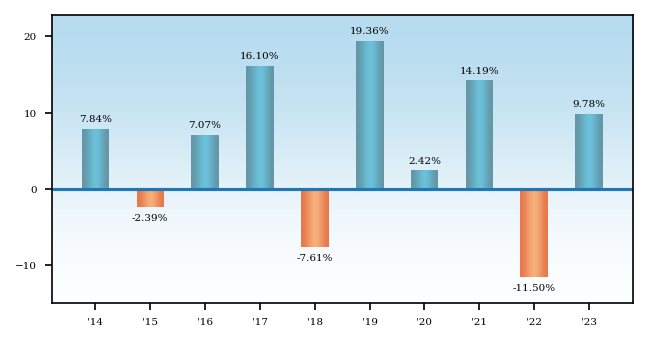
| Best Quarter | 3/31/19 | 11.15% |
| Worst Quarter | 12/31/18 | (13.21)% |
The Fund’s year-to-date return for Class I Shares as of September 30, 2024 was 10.06%
Average Annual Total Returns - Astor Dynamic Allocation Fund |
Label |
1 Year |
5 Years |
10 Years |
Inception Date |
|
|---|---|---|---|---|---|---|
| Astor Dynamic Allocation Fund Class I shares | [1] | Return before taxes | 9.78% | 6.28% | 5.07% | Oct. 19, 2009 |
| Astor Dynamic Allocation Fund Class I shares | Return after taxes on distributions | 8.94% | 4.74% | 3.98% | |||
| Astor Dynamic Allocation Fund Class I shares | Return after taxes on distributions and sale of Fund shares | 5.76% | 4.42% | 3.73% | |||
| Astor Dynamic Allocation Fund Class A shares | [2] | Return before taxes | 4.33% | 5.00% | 4.30% | Nov. 30, 2011 |
| Astor Dynamic Allocation Fund Class C shares | [3] | Return before taxes | 8.70% | 5.23% | 4.03% | Mar. 12, 2010 |
| S&P 500 Total Return Index | [4] | 26.29% | 15.69% | 12.03% | ||
| S&P 500/40% Bloomberg U.S. Aggregate Bond Index | [5] | 17.67% | 9.98% | 8.09% | ||
| [1] | Class I shares commence operations on . |
| [2] | Class A shares commenced operations on . |
| [3] | Class C shares commenced operations on . |
| [4] | The S&P 500® Total Return Index is an unmanaged market capitalization-weighted index of 500 of the largest capitalized U.S. domiciled companies. Index returns assume reinvestment of dividends. Unlike the Fund’s returns, however, they do not reflect any fees or expenses. Investors cannot directly invest in an index. |
| [5] | S&P 500/40% Bloomberg U.S. Aggregate Bond Index is a custom benchmark consisting of the summed returns of 60% of the S&P 500 Total Return Index and 40% of the Bloomberg U.S. Aggregate Bond Index on a monthly basis. Index returns are calculated with dividends reinvested. This custom benchmark is often used for comparison purposes as it represents a “balanced” portfolio of equities and fixed income. |
After-tax returns were calculated using the historical highest individual federal marginal income tax rates and do not reflect the impact of state and local taxes. Actual after-tax returns depend on an investor’s tax situation and may differ from those shown, and after-tax returns shown are not relevant to investors who hold shares of the Fund through tax-deferred arrangements, such as 401(k) plans or individual retirement accounts. After-tax returns are shown for only Class I shares, and after-tax returns for other classes will vary.
| (1) | Alternative and Specialty Assets Risk: The Fund may purchase ETFs that invest in “alternative asset” or “specialty” market segments. The risks and volatility of these investments are linked to narrow segments of the economy such as commodities, real estate, or currencies. Inverse ETFs limit the Fund’s participation in certain market gains. |
| (2) | Commodity Risk: Investing in the commodities markets may subject the Fund to greater volatility than investments in traditional securities. Commodity prices may be influenced by unfavorable weather, animal and plant disease, geologic and environmental factors as well as changes in government regulation such as tariffs, embargoes or burdensome production rules and restrictions. |
| (3) | Credit Risk: Debt issuers may not make interest or principal payments, resulting in losses to the Fund. In addition, the credit quality of securities held by an ETF may be lowered if an issuer’s financial condition changes. These risks are more pronounced for securities at the lower end of the investment grade credit quality spectrum, such as those rated BBB- or lower by Standard & Poor’s Ratings Group or another NRSRO. |
| (4) | Currency Risk (Domestic and Foreign): The risk that material changes in currency exchange rates will negatively affect securities denominated in, and/or receiving revenues in, foreign and domestic currencies. Currency trading risks include market risk, credit risk and country risk. Market risk results from adverse changes in exchange rates in the currencies the Fund is long or short. Credit risk results because a currency-trade issuer may default. Country risk arises because a government may interfere with transactions in its currency. |
| (5) | Emerging Market Risk: Investing in emerging markets involves not only the risks described below with respect to investing in foreign securities, but also other risks, including exposure to economic structures that are generally less diverse and mature, limited availability and reliability of information material to an investment decision, and exposure to political systems that can be expected to have less stability than those of developed countries. The market for the securities of issuers in emerging market typically is small, and a low or nonexistent trading volume in those securities may result in a lack of liquidity and price volatility. |
| (6) | Equity Risk: The net asset value of the Fund will fluctuate based on changes in the value of the equity securities in which it invests through ETFs. Equity prices can fall rapidly in response to developments affecting a specific company or industry, or to changing economic, political or market conditions. |
| (7) | ETF Risk: ETFs are subject to investment advisory fees and other expenses, which will be indirectly paid by the Fund. As a result, your cost of investing in the Fund will be higher than the cost of investing directly in ETFs and may be higher than other mutual funds that invest directly in bonds. Each ETF is subject to specific risks, depending on its investments. ETF shares may trade at a discount or a premium in market price if there is a limited market in such shares. ETFs are also subject to brokerage and other trading costs, which could result in greater expenses to the Fund. If the Fund invests a significant portion of its assets in ETFs offered by one ETF sponsor, the Fund could be exposed to additional risks and losses if the sponsor’s ETFs fall out of favor in the marketplace and trading volumes cause the ETF’s market prices to decline. |
| (8) | Fixed-Income Risk: When the Fund invests in fixed-income ETFs, the value of your investment in the Fund will fluctuate with changes in interest rates. Rising interest rates will cause a bond’s value to decline. Defaults by fixed income issuers will also harm performance. Other risk factors impacting fixed-income securities include credit risk, maturity risk, market risk, extension or prepayment risk, illiquid security risks, investment-grade securities risk. These risks could affect the value of a particular investment by the Funds possibly causing the Funds’ share price and total return to be reduced and fluctuate more than other types of investments. |
| (9) | Foreign Investment Risk: Foreign investing involves risks not typically associated with U.S. investments, including adverse fluctuations in foreign currency values, adverse political, social and economic developments, less liquidity, greater volatility, less developed or less efficient trading markets, political instability and differing auditing and legal standards. |
| (10) | High Yield or Junk Bond Risk: Lower-quality bonds and other debt securities, known as “high yield” or “junk” bonds, are considered speculative and present greater risk than bonds of higher quality, including an increased risk of default. An economic downturn or period of rising interest rates could adversely affect the market for these bonds and reduce the Fund’s ability to sell its bonds. The lack of a liquid market for these bonds could decrease the Fund’s share price. |
| (11) | Inverse ETF Risk: Inverse ETFs are designed to rise in price when stock prices are falling. Inverse ETFs may employ leverage, which magnifies tend to limit the changes in the Fund’s participation in overall market-wide gains. Accordingly, their performance over longer terms can perform very differently than underlying stock index upon which they are based assets and benchmarks, and volatile markets can amplify this effect. Any strategy that includes inverse securities could cause the Fund to suffer significant losses. |
| (12) | Management Risk: The adviser’s dependence on its proprietary macroeconomic analysis and judgments about the attractiveness, value and potential appreciation of particular asset classes in which the Fund invests (long or short via inverse ETFs) may prove to be incorrect and may not produce the desired results. |
| (13) | Market and Geopolitical Risk: The increasing interconnectivity between global economies and financial markets increases the likelihood that events or conditions in one region or financial market may adversely impact issuers in a different country, region or financial market. Securities in the Fund may underperform due to inflation (or expectations for inflation), interest rates, global demand for particular products or resources, natural disasters, pandemics, epidemics, terrorism, international conflicts, regulatory events and governmental or quasi-governmental actions. The occurrence of global events similar to those in recent years, such as a worldwide pandemic, terrorist attacks, natural disasters, social and political discord or debt crises and downgrades, among others, may result in market volatility and may have long term effects on both the U.S. and global financial markets. It is difficult to predict when similar events affecting the U.S. or global financial markets may occur, the effects that such events may have and the duration of those effects. Any such event(s) could have a significant adverse impact on the value and risk profile of the Fund. The COVID-19 global pandemic had negative impacts, and in many cases severe negative impacts, on markets worldwide. It is not known how long such impacts, or any future impacts of other significant events described above, will or would last, but there could be a prolonged period of global economic slowdown, which may impact your investment. Therefore, the Fund could lose money over short periods due to short-term market movements and over longer periods during more prolonged market downturns. During a general market downturn, multiple asset classes may be negatively affected. Changes in market conditions and interest rates can have the same impact on all types of securities and instruments. In times of severe market disruptions you could lose your entire investment. |
| (14) | Portfolio Turnover Risk: A higher portfolio turnover may result in higher transactional and brokerage costs associated with the turnover which may reduce the Fund’s return, unless the securities traded can be bought and sold without corresponding commission costs. Active trading of securities may also increase the Fund’s realized capital gains or losses, which may affect the taxes you pay as a Fund shareholder. The Fund’s portfolio turnover rate is expected to be above 100% annually. |
| (15) | Real Estate Investment Trust (REIT) Risk: Investing in REITs, involves certain unique risks in addition to those associated with the real estate sector generally. REITs whose underlying properties are concentrated in a particular industry or region are also subject to risks affecting such industries and regions. REITs (especially mortgage REITs) are also subject to interest rate risks. By investing in REITs through the Fund, a shareholder will bear expenses of the REITs in addition to Fund expenses. |
| (16) | Small and Medium Capitalization Company Risk: Securities of small and medium capitalization companies may be subject to more abrupt or erratic market movements than those of larger, more established companies or the market averages in general. |
| (17) | Sovereign Debt Risk: These investments are subject to the risk that a governmental entity may delay or refuse to pay interest or repay principal on its sovereign debt. There is no legal process for collecting sovereign debt that a government does not pay nor are there bankruptcy proceedings through which all or part of the sovereign debt that a governmental entity has not repaid may be collected. |
The Fund seeks capital appreciation.
This table describes the fees and expenses that you may pay if you buy, hold and sell shares of the Fund. More information is available from your financial professional and in the section entitled How to Purchase Shares on page 19 of the Fund’s Prospectus and in Purchase, Redemption and Pricing of Shares on page 42 of the Statement of Additional Information.
Shareholder Fees - Astor Sector Allocation Fund |
Astor Sector Allocation Fund Class A Shares |
Astor Sector Allocation Fund Class C Shares |
Astor Sector Allocation Fund Class I Shares |
|---|---|---|---|
| Maximum Sales Charge (Load) Imposed on Purchases (as a % of offering price) | 4.75% | none | none |
| Maximum Deferred Sales Charge (Load) (as a % of the lower of original purchase price or redemption proceeds) | none | none | none |
| Maximum Sales Charge (Load) Imposed on Reinvested Dividends and other Distributions | none | none | none |
| Redemption Fee | none | none | none |
Annual Fund Operating Expenses - Astor Sector Allocation Fund |
Astor Sector Allocation Fund Class A Shares |
Astor Sector Allocation Fund Class C Shares |
Astor Sector Allocation Fund Class I Shares |
|
|---|---|---|---|---|
| Management Fees | 0.95% | 0.95% | 0.95% | |
| Distribution and/or Service (12b-1) Fees | 0.25% | 1.00% | none | |
| Other Expenses | 1.33% | 1.33% | 1.33% | |
| Acquired Fund Fees and Expenses | [1] | 0.12% | 0.12% | 0.12% |
| Total Annual Fund Operating Expenses | 2.65% | 3.40% | 2.40% | |
| Fee Waiver and Reimbursement | [2] | (1.13%) | (1.13%) | (1.13%) |
| Total Annual Fund Operating Expenses After Fee Waiver and Reimbursement | [1],[2] | 1.52% | 2.27% | 1.27% |
| [1] | Acquired Fund Fees and Expenses are the indirect costs of investing in other investment companies. |
| [2] | The Adviser has contractually agreed to waive its management fees and to make payments to limit Fund expenses, until November 30, 2025 so that the total annual operating expenses, excluding (i) any front-end or contingent deferred loads; (ii) brokerage fees and commissions; (iii) acquired fund fees and expenses; (iv) fees and expenses associated with investments in other collective investment vehicles or derivative instruments (including for example options and swap fees and expenses); (v) borrowing costs (such as interest and dividend expense on securities sold short); (vi) taxes; and (vii) extraordinary expenses, such as litigation expenses (which may include indemnification of Fund officers and Trustees, contractual indemnification of Fund service providers (other than the Adviser)) of the Fund do not exceed 1.40%, 2.15% and 1.15%, for Class A, Class C, Class I shares, respectively. These fee waivers and expense reimbursements are subject to possible recoupment from the Fund in future years (within the three years from the date when the amount is waived or reimbursed) if such recoupment can be achieved within the lesser of the foregoing expense limits or the then-current expense limits. This agreement may be terminated only by the Trust’s Board of Trustees, on 60 days’ written notice to the Adviser. |
This Example is intended to help you compare the cost of investing in the Fund with the cost of investing in other mutual funds.
Expense Example - Astor Sector Allocation Fund - USD ($) |
Expense Example, with Redemption, 1 Year |
Expense Example, with Redemption, 3 Years |
Expense Example, with Redemption, 5 Years |
Expense Example, with Redemption, 10 Years |
|---|---|---|---|---|
| Astor Sector Allocation Fund Class A Shares | 622 | 1,157 | 1,718 | 3,238 |
| Astor Sector Allocation Fund Class C Shares | 230 | 940 | 1,673 | 3,611 |
| Astor Sector Allocation Fund Class I Shares | 130 | 641 | 1,179 | 2,651 |
The Fund pays transaction costs, such as commissions, when it buys and sells securities (or “turns over” its portfolio). A higher portfolio turnover may indicate higher transaction costs and may result in higher taxes when Fund shares are held in a taxable account. These costs, which are not reflected in annual fund operating expenses or in the Example, affect the Fund’s performance. During the most recent fiscal year, the Fund’s portfolio turnover rate was 81% of the average value of its portfolio.
The Fund invests predominantly in exchange-traded funds (“ETFs”) that each invest primarily in (1) equity securities, (2) fixed-income securities, or (3) cash equivalents. The Fund defines equity securities to include ETFs that invest primarily in equity securities, such as common and preferred stocks. The Fund defines fixed-income securities to include ETFs that invest primarily in fixed-income securities, such as bonds, notes and debentures. Pursuant to the Fund’s principal investment strategies, the Fund invests its assets in equity and fixed income ETFs that each invest primarily in domestic issuers of varying market capitalizations. While the Fund expects to primarily hold equity securities, it may reduce its equity security exposure and may, from time to time, not have any investment exposure to equity securities, depending on market conditions. With respect to fixed income securities, the Fund invests primarily in those rated BBB- or higher by Standard and Poor’s Rating Group or similarly rated by another nationally recognized statistical rating organization (“NRSRO”). The Fund may invest in fixed income securities of any credit quality (including high yield or “junk” bonds) and any maturity. Under normal market conditions, the Fund invests at least 80% of its assets (defined as net assets plus any borrowing for investment purposes) measured at the time of purchase in ETFs.
The Fund is named to reflect its investment strategy – “sector allocation.” The Fund’s adviser seeks capital appreciation through a tactical asset allocation strategy based on its proprietary macroeconomic model and investment philosophy that it believes have the potential to generate positive returns and manage risk in the given economic environment.
The adviser’s investment model, which looks at the GICS universe of sectors to measure quantitative data, focuses on identifying the relative strength of various market sectors by analyzing data inputs including: (1) employment, (2) economic output (through gross domestic product or GDP), as well as (3) overall market conditions (such as price momentum). Based upon the inputs, the adviser seeks to overweight the sectors with the strongest economic and market signals while holding underweight allocations for the weaker sectors. The adviser tactically allocates assets among various sectors and market segments to rebalance the Fund’s investment portfolio according to the economic environment with the goal of achieving capital appreciation and lower drawdowns throughout full economic cycles.
The adviser anticipates rebalancing the Fund’s portfolio based upon the adviser’s determination of changes in the economic cycle as well as other proprietary indicators. By balancing the Fund’s portfolio based on economic cycles, the adviser seeks to invest in those sectors and market categories with the highest potential for positive returns during periods of relative economic strength while de-allocating from equities and utilizing defensive positioning such as allocations to cash and fixed-income ETFs when economic and market environments weaken. In managing the Fund’s portfolio, the adviser may engage in frequent portfolio transactions, resulting in a high portfolio turnover rate.
As with all mutual funds, there is the risk that you could lose money through your investment in the Fund. The Fund is not intended to be a complete investment program. Many factors affect the Fund’s net asset value and performance.
The following describes the risks the Fund may bear directly and indirectly through ETFs.
| (1) | Credit Risk: Debt issuers may not make interest or principal payments, resulting in losses to the Fund. In addition, the credit quality of securities held by an ETF may be lowered if an issuer’s financial condition changes. |
| (2) | Equity Risk: The net asset value of the Fund will fluctuate based on changes in the value of the equity securities in which it invests through ETFs. Equity prices can fall rapidly in response to developments affecting a specific company or industry, or to changing economic, political or market conditions. |
| (3) | ETF Risk: ETFs are subject to investment advisory fees and other expenses, which will be indirectly paid by the Fund. As a result, your cost of investing in the Fund will be higher than the cost of investing directly in ETFs and may be higher than other mutual funds that invest directly in bonds. Each ETF is subject to specific risks, depending on its investments. ETF shares may trade at a discount or a premium in market price if there is a limited market in such shares. ETFs are also subject to brokerage and other trading costs, which could result in greater expenses to the Fund. If the Fund invests a significant portion of its assets in ETFs offered by one ETF sponsor, the Fund could be exposed to additional risks and losses if the sponsor’s ETFs fall out of favor in the marketplace and trading volumes cause the ETF’s market prices to decline. |
| (4) | Fixed-Income Risk: When the Fund invests in fixed-income ETFs the value of your investment in the Fund will fluctuate with changes in interest rates. Rising interest rates will cause a bond’s value to decline. Defaults by fixed income issuers will also harm performance. Other risk factors impacting fixed-income securities include credit risk, maturity risk, market risk, extension or prepayment risk, illiquid security risks, investment-grade securities risk. These risks could affect the value of a particular investment by the Funds possibly causing the Funds’ share price and total return to be reduced and fluctuate more than other types of investments. |
| (5) | Futures Risk: The Fund’s use of futures contracts involves risks different from, or possibly greater than, the risks associated with investing directly in securities and other traditional investments. These risks include (i) leverage risk; (ii) correlation or tracking risk and (iii) liquidity risk. Because futures require only a small initial investment in the form of a deposit or margin, they involve a high degree of leverage. Accordingly, the fluctuation of the value of futures in relation to the underlying assets upon which they are based is magnified. Thus, the Fund may experience losses that exceed losses experienced by funds that do not use futures contracts. |
| (6) | High Yield or Junk Bond Risk: Lower-quality bonds and other debt securities, known as “high yield” or “junk” bonds, are considered speculative and present greater risk than bonds of higher quality, including an increased risk of default. An economic downturn or period of rising interest rates could adversely affect the market for these bonds and reduce the Fund’s ability to sell its bonds. The lack of a liquid market for these bonds could decrease the Fund’s share price. |
| (7) | Large Capitalization Company Risk: Large-capitalization companies may be less able than smaller capitalization companies to adapt to changing market conditions. Large-capitalization companies may be more mature and subject to more limited growth potential compared with smaller capitalization companies. During different market cycles, the performance of large capitalization companies has trailed the overall performance of the broader securities markets. |
| (8) | Management Risk: The adviser’s dependence on its proprietary macroeconomic analysis and judgments about the attractiveness, value and potential appreciation of particular asset classes in which the Fund invests may prove to be incorrect and may not produce the desired results. |
| (9) | Market and Geopolitical Risk: The increasing interconnectivity between global economies and financial markets increases the likelihood that events or conditions in one region or financial market may adversely impact issuers in a different country, region or financial market. Securities in the Fund may underperform due to inflation (or expectations for inflation), interest rates, global demand for particular products or resources, natural disasters, pandemics, epidemics, terrorism, international conflicts, regulatory events and governmental or quasi-governmental actions. The occurrence of global events similar to those in recent years, such as a worldwide pandemic, terrorist attacks around the world, natural disasters, social and political discord or debt crises and downgrades, among others, may result in market volatility and may have long term effects on both the U.S. and global financial markets. It is difficult to predict when similar events affecting the U.S. or global financial markets may occur, the effects that such events may have and the duration of those effects. Any such event(s) could have a significant adverse impact on the value and risk profile of the Fund. The COVID-19 global pandemic had negative impacts, and in many cases severe negative impacts, on markets worldwide. It is not known how long such impacts, or any future impacts of other significant events described above, will or would last, but there could be a prolonged period of global economic slowdown, which may impact your investment. Therefore, the Fund could lose money over short periods due to short-term market movements and over longer periods during more prolonged market downturns. During a general market downturn, multiple asset classes may be negatively affected. Changes in market conditions and interest rates can have the same impact on all types of securities and instruments. In times of severe market disruptions, you could lose your entire investment. |
| (10) | Portfolio Turnover Risk: A higher portfolio turnover may result in higher transactional and brokerage costs associated with the turnover which may reduce the Fund’s return, unless the securities traded can be bought and sold without corresponding commission costs. Active trading of securities may also increase the Fund’s realized capital gains or losses, which may affect the taxes you pay as a Fund shareholder. The Fund’s portfolio turnover rate is expected to be above 100% annually. |
| (11) | Sector Risk: The Fund may focus its investments in securities of a particular sector. Economic, legislative or regulatory developments may occur that significantly affect the sector. This may cause the Fund’s net asset value to fluctuate more than that of a fund that does not focus in a particular sector. |
| (12) | Small and Medium Capitalization Company Risk: Securities of small and medium capitalization companies may be subject to more abrupt or erratic market movements than those of larger, more established companies or the market averages in general. |
The bar chart and performance table below show the variability of the Fund’s returns, which is some indication of the risks of investing in the Fund. The bar chart shows performance of the Fund’s Class A shares for each full calendar year since the Fund’s inception. The performance table compares the performance of the Fund’s Class A, Class C, and Class I shares over time to the performance of a broad-based market index. You should be aware that the Fund’s past performance (before and after taxes) may not be an indication of how the Fund will perform in the future. Updated performance information is available at no cost by visiting www.astorimfunds.com or by calling (877) 738-0333.
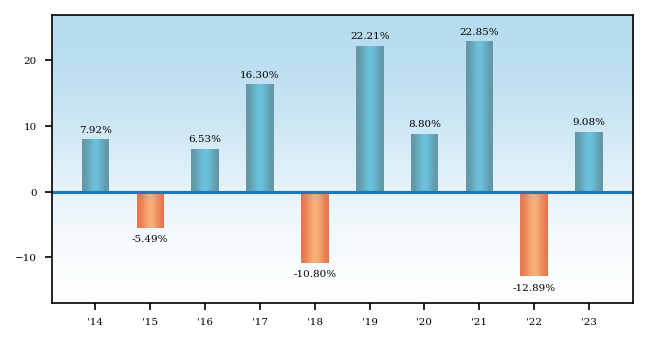
| Best Quarter: | 12/31/20 | 13.87% |
| Worst Quarter: | 12/31/18 | (16.20)% |
The Fund’s year-to-date return for Class A shares as of September 30, 2024 was 12.42%.
Average Annual Total Returns - Astor Sector Allocation Fund |
Label |
1 Year |
5 Years |
10 Years |
Inception Date |
||
|---|---|---|---|---|---|---|---|
| Astor Sector Allocation Fund Class A Shares | [1] | Return before taxes | 3.93% | 8.13% | 5.24% | Nov. 30, 2011 | |
| Astor Sector Allocation Fund Class A Shares | Return after taxes on distributions | 1.66% | 5.73% | 3.65% | ||||
| Astor Sector Allocation Fund Class A Shares | Return after taxes on distributions and sale of Fund shares | 3.45% | 5.80% | 3.76% | ||||
| Astor Sector Allocation Fund Class C Shares | [1] | Return before taxes | 8.26% | 8.37% | 4.95% | Nov. 30, 2011 | |
| Astor Sector Allocation Fund Class I Shares | [2] | Return before taxes | 9.33% | 9.47% | 6.14% | [3] | Jan. 06, 2014 |
| S&P 500 Total Return Index (reflects no deduction for fees, expenses or taxes) | [4] | 26.29% | 15.69% | 12.03% | |||
| [1] | Class A and Class C shares commenced operations on . |
| [2] | Class I shares commenced operations on . |
| [3] | Class I returns reflect life of the fund. |
| [4] | The S&P 500 Total Return Index is an unmanaged composite of 500 large capitalization companies. This index is widely used by professional investors as a performance benchmark for large-cap stocks. Index returns assume reinvestment of dividends. Unlike the Fund’s returns, the S&P 500® Index does not reflect any fees or expenses. You cannot invest directly in an index and unmanaged index. |
After-tax returns were calculated using the historical highest individual federal marginal income tax rates and do not reflect the impact of state and local taxes. Actual after-tax returns depend on an investor’s tax situation and may differ from those shown, and after-tax returns shown are not relevant to investors who hold shares of the Fund through tax-deferred arrangements, such as 401(k) plans or individual retirement accounts. After-tax returns are only shown for Class A shares and after-tax returns for other classes will vary.
| (1) | Credit Risk: Debt issuers may not make interest or principal payments, resulting in losses to the Fund. In addition, the credit quality of securities held by an ETF may be lowered if an issuer’s financial condition changes. |
| (2) | Equity Risk: The net asset value of the Fund will fluctuate based on changes in the value of the equity securities in which it invests through ETFs. Equity prices can fall rapidly in response to developments affecting a specific company or industry, or to changing economic, political or market conditions. |
| (3) | ETF Risk: ETFs are subject to investment advisory fees and other expenses, which will be indirectly paid by the Fund. As a result, your cost of investing in the Fund will be higher than the cost of investing directly in ETFs and may be higher than other mutual funds that invest directly in bonds. Each ETF is subject to specific risks, depending on its investments. ETF shares may trade at a discount or a premium in market price if there is a limited market in such shares. ETFs are also subject to brokerage and other trading costs, which could result in greater expenses to the Fund. If the Fund invests a significant portion of its assets in ETFs offered by one ETF sponsor, the Fund could be exposed to additional risks and losses if the sponsor’s ETFs fall out of favor in the marketplace and trading volumes cause the ETF’s market prices to decline. |
| (4) | Fixed-Income Risk: When the Fund invests in fixed-income ETFs the value of your investment in the Fund will fluctuate with changes in interest rates. Rising interest rates will cause a bond’s value to decline. Defaults by fixed income issuers will also harm performance. Other risk factors impacting fixed-income securities include credit risk, maturity risk, market risk, extension or prepayment risk, illiquid security risks, investment-grade securities risk. These risks could affect the value of a particular investment by the Funds possibly causing the Funds’ share price and total return to be reduced and fluctuate more than other types of investments. |
| (6) | High Yield or Junk Bond Risk: Lower-quality bonds and other debt securities, known as “high yield” or “junk” bonds, are considered speculative and present greater risk than bonds of higher quality, including an increased risk of default. An economic downturn or period of rising interest rates could adversely affect the market for these bonds and reduce the Fund’s ability to sell its bonds. The lack of a liquid market for these bonds could decrease the Fund’s share price. |
| (8) | Management Risk: The adviser’s dependence on its proprietary macroeconomic analysis and judgments about the attractiveness, value and potential appreciation of particular asset classes in which the Fund invests may prove to be incorrect and may not produce the desired results. |
| (9) | Market and Geopolitical Risk: The increasing interconnectivity between global economies and financial markets increases the likelihood that events or conditions in one region or financial market may adversely impact issuers in a different country, region or financial market. Securities in the Fund may underperform due to inflation (or expectations for inflation), interest rates, global demand for particular products or resources, natural disasters, pandemics, epidemics, terrorism, international conflicts, regulatory events and governmental or quasi-governmental actions. The occurrence of global events similar to those in recent years, such as a worldwide pandemic, terrorist attacks around the world, natural disasters, social and political discord or debt crises and downgrades, among others, may result in market volatility and may have long term effects on both the U.S. and global financial markets. It is difficult to predict when similar events affecting the U.S. or global financial markets may occur, the effects that such events may have and the duration of those effects. Any such event(s) could have a significant adverse impact on the value and risk profile of the Fund. The COVID-19 global pandemic had negative impacts, and in many cases severe negative impacts, on markets worldwide. It is not known how long such impacts, or any future impacts of other significant events described above, will or would last, but there could be a prolonged period of global economic slowdown, which may impact your investment. Therefore, the Fund could lose money over short periods due to short-term market movements and over longer periods during more prolonged market downturns. During a general market downturn, multiple asset classes may be negatively affected. Changes in market conditions and interest rates can have the same impact on all types of securities and instruments. In times of severe market disruptions, you could lose your entire investment. |
| (10) | Portfolio Turnover Risk: A higher portfolio turnover may result in higher transactional and brokerage costs associated with the turnover which may reduce the Fund’s return, unless the securities traded can be bought and sold without corresponding commission costs. Active trading of securities may also increase the Fund’s realized capital gains or losses, which may affect the taxes you pay as a Fund shareholder. The Fund’s portfolio turnover rate is expected to be above 100% annually. |
| (12) | Small and Medium Capitalization Company Risk: Securities of small and medium capitalization companies may be subject to more abrupt or erratic market movements than those of larger, more established companies or the market averages in general. |
| (5) | Futures Risk: The Fund’s use of futures contracts involves risks different from, or possibly greater than, the risks associated with investing directly in securities and other traditional investments. These risks include (i) leverage risk; (ii) correlation or tracking risk and (iii) liquidity risk. Because futures require only a small initial investment in the form of a deposit or margin, they involve a high degree of leverage. Accordingly, the fluctuation of the value of futures in relation to the underlying assets upon which they are based is magnified. Thus, the Fund may experience losses that exceed losses experienced by funds that do not use futures contracts. |
| (7) | Large Capitalization Company Risk: Large-capitalization companies may be less able than smaller capitalization companies to adapt to changing market conditions. Large-capitalization companies may be more mature and subject to more limited growth potential compared with smaller capitalization companies. During different market cycles, the performance of large capitalization companies has trailed the overall performance of the broader securities markets. |
| (11) | Sector Risk: The Fund may focus its investments in securities of a particular sector. Economic, legislative or regulatory developments may occur that significantly affect the sector. This may cause the Fund’s net asset value to fluctuate more than that of a fund that does not focus in a particular sector. |