The fund seeks to maximize total return, consisting of capital appreciation and current income.
This table describes the fees and expenses that you may pay if you buy, hold and sell shares of the fund. You may pay other fees, such as brokerage commissions and other fees to financial intermediaries, which are not reflected in the table and examples below. You may qualify for sales charge discounts if you and your family invest, or agree to invest in the future, at least $100,000 in the fund or shares of other funds in the BNY Mellon Family of Funds that are subject to a sales charge. More information about sales charges, including these and other discounts and waivers, is available from your financial professional and in the Shareholder Guide section beginning on page 17 of the prospectus, in the Appendix on page A-1 of the prospectus and in the How to Buy Shares section and the Additional Information About How to Buy Shares section beginning on page II-1 and page III-1, respectively, of the fund's Statement of Additional Information.
|
Shareholder Fees (fees paid directly from your investment) | |||||
|
Class A |
Class D |
Class I |
Class Y | ||
|
Maximum sales charge (load) imposed on purchases (as a percentage of offering price) |
2.50 |
none |
none |
none | |
|
Maximum deferred sales charge (load) (as a percentage of lower of purchase or sale price) |
|
none |
none |
none | |
|
Annual Fund Operating Expenses (expenses that you pay each year as a percentage of the value of your investment) | |||||||||
|
Class A |
Class D |
Class I |
Class Y | ||||||
|
Management fees |
.30 |
.30 |
.30 |
.30 | |||||
|
Other expenses: |
|||||||||
|
Shareholder services fees |
.25 |
.20 |
none |
none | |||||
|
Miscellaneous other expenses |
.44 |
.41 |
.37 |
.38 | |||||
|
Total other expenses |
.69 |
.61 |
.37 |
.38 | |||||
|
Total annual fund operating expenses |
.99 |
.91 |
.67 |
.68 | |||||
|
Fee waiver and/or expense reimbursement** |
(.34) |
(.31) |
(.27) |
(.28) | |||||
|
Total
annual fund operating expenses |
|
.60 |
.40 |
.40 | |||||
* Class A shares bought without an initial sales charge as part of an investment of $250,000 or more may be charged a deferred sales charge of 1.00% if redeemed within one year.
** The fund's investment adviser, BNY Mellon Investment Adviser, Inc., has contractually agreed, until November 29, 2025, to waive receipt of its fees and/or assume the direct expenses of the fund so that the direct expenses of none of the fund's share classes (excluding shareholder services fees, taxes, interest expense, brokerage commissions, commitment fees on borrowings and extraordinary expenses) exceed .40%. On or after November 29, 2025, BNY Mellon Investment Adviser, Inc. may terminate this expense limitation agreement at any time.
The Example is intended to help you compare the cost of investing in the fund with the cost of investing in other mutual funds. The Example assumes that you invest $10,000 in the fund for the time periods indicated and then hold or redeem all of your shares at the end of those periods. The Example also assumes that your investment has a 5% return each year and that the fund's operating expenses remain the same. The one-year example and the first year of the three-, five- and ten-years examples are based on net operating expenses, which reflect the expense limitation agreement by BNY Mellon Investment Adviser, Inc. Although your actual costs may be higher or lower, based on these assumptions your costs would be:
|
1 Year |
3 Years |
5 Years |
10 Years | ||
|
Class A |
$315 |
$524 |
$751 |
$1,403 | |
|
Class D |
$61 |
$259 |
$474 |
$1,091 | |
|
Class I |
$41 |
$187 |
$346 |
$809 | |
|
Class Y |
$41 |
$189 |
$351 |
$820 |
The fund pays transaction costs, such as commissions, when it buys and sells securities (or "turns over" its portfolio). A higher portfolio turnover may indicate higher transaction costs and may result in higher taxes when fund shares are held in a taxable account. These costs, which are not reflected in annual fund operating expenses or in the Example, affect the fund's performance. During the most recent fiscal year, the fund's portfolio turnover rate was 68.59% of the average value of its portfolio.
To pursue its goal, the fund normally invests principally in fixed-income securities of U.S. and foreign issuers. These securities include: U.S. government bonds and notes, corporate bonds, municipal securities (limited to up to 25% of the fund's net assets), convertible securities, preferred stocks, inflation-indexed securities, asset-backed securities, mortgage-related securities (including CMOs), floating rate loans (limited to up to 20% of the fund's net assets) and other floating rate securities and foreign bonds. Typically, the fund's portfolio can be expected to have a dollar-weighted average maturity and an average effective duration of three years or less. The maturity of a security is generally the period remaining until the principal amount must be paid, or in the case of a security called for redemption, the date on which the redemption payment must be made. Dollar-weighted average portfolio maturity is an average of the final maturities of the fixed-income securities held by the fund, based on their dollar-weighted proportions in the fund. Duration is an indication of an investment's "interest rate risk," or how sensitive a fixed-income security or the fund's portfolio may be to changes in interest rates.
The fund invests primarily in fixed-income securities rated, at the time of purchase, investment grade or the unrated equivalent as determined by the fund's sub-adviser. For additional yield, the fund may invest up to 35% of its net assets in fixed-income securities rated, at the time of purchase, below investment grade ("high yield" or "junk" bonds) to as low as Caa/CCC or the unrated equivalent as determined by the fund's sub-adviser. The fund focuses on U.S. securities, but may invest up to 30% of its total assets in fixed-income securities of foreign issuers (i.e., securities issued by companies organized under the laws of countries other than the U.S. or securities issued by foreign governments), including those securities denominated in foreign currencies and of issuers in emerging markets.
The fund may use derivative instruments as a substitute for investing directly in an underlying asset, to increase returns, to manage interest rate risk, to manage the effective duration or maturity of the fund's portfolio, or as part of a hedging strategy. The derivative instruments in which the fund may invest include typically options, futures and options on futures (including those relating to securities, foreign currencies, indices and interest rates), forward contracts and swaps (including interest rate and credit default swaps).
In constructing the fund's portfolio, the sub-adviser buys and sells fixed-income securities based on credit quality, financial outlook and yield potential. The fund may sell securities when the sub-adviser anticipates market declines or credit downgrades. In addition, the fund may sell securities when the sub-adviser identifies new investment opportunities.
The fund does not have any limitations regarding portfolio turnover and, at times, the fund may engage in active and frequent trading, which will increase portfolio turnover.
The following bar chart and table provide some indication of the risks of investing in the fund. The bar chart shows changes in the performance of the fund's Class D shares from year to year. The table compares the average annual total returns of the fund's shares to those of broad measures of market performance. The fund's past performance (before and after taxes) is not necessarily an indication of how the fund will perform in the future. Performance for each share class will vary due to differences in expenses. More recent performance information may be available at www.bny.com/investments.
|
Year-by-Year Total Returns as of 12/31 each year (%) Class D | |
|
|
During
the periods shown in the chart: Worst
Quarter |
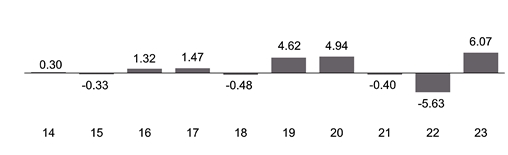
During the periods shown in the chart:
Best Quarter
Q2, 2020: 5.19%
Worst Quarter
Q1, 2022: -3.23%
The year-to-date total return of the fund's Class D shares as of September 30, 2024 was 5.19%.
After-tax performance is shown only for Class D shares. After-tax performance of the fund's other share classes will vary. After-tax returns are calculated using the historical highest individual federal marginal income tax rates, and do not reflect the impact of state and local taxes. Actual after-tax returns depend on the investor's tax situation and may differ from those shown, and the after-tax returns shown are not relevant to investors who hold their shares through U.S. tax-deferred arrangements such as 401(k) plans or individual retirement accounts. Returns after taxes on distributions and sale of fund shares may be higher than returns before taxes or returns after taxes on distributions due to an assumed tax benefit from losses on a sale of the fund's shares at the end of the period.
Prior to May 6, 2022, the fund offered Class P shares, which, as of such date, were converted into Class D shares. Consequently, no performance for Class P shares is shown in the prospectus.
For the fund's Class A, I and Y shares, periods prior to the inception date reflect the performance of the fund's Class D shares. Such performance figures have not been adjusted to reflect applicable class fees and expenses of Class A, I or Y shares; if these expenses had been reflected, the performance shown for Class A shares would have been lower. The performance figures for Class A shares have been adjusted to reflect the front-end sales load applicable to Class A shares. Each share class is invested in the same portfolio of securities, and the annual returns would have differed only to the extent that the classes have different expenses.
|
Average Annual Total Returns (as of 12/31/23) | |||
|
Class (Inception Date) |
1 Year |
5 Years |
10 Years |
|
Class D returns before taxes |
6.07% |
1.83% |
1.14% |
|
Class D returns after taxes on distributions |
4.58% |
0.84% |
0.26% |
|
Class D returns after taxes on distributions and sale of fund shares |
3.56% |
0.98% |
0.48% |
|
Class A (5/6/22) returns before taxes |
2.89% |
1.22% |
0.83% |
|
Class I (5/6/22) returns before taxes |
6.17% |
1.89% |
1.17% |
|
Class Y (5/6/22) returns before taxes |
6.28% |
1.89% |
1.17% |
|
ICE
BofA Merrill Lynch 1-5 Year U.S. Corporate/Government Index |
4.89% |
1.55% |
1.46% |
|
Bloomberg
U.S. Aggregate Bond Index |
5.53% |
1.10% |
1.81% |