The Nebraska Municipal Fund (the “Fund”) seeks the highest level of current income that is exempt from federal and Nebraska personal income taxes and is consistent with preservation of capital.
This table describes the fees and expenses that you may pay if you buy, hold, and sell shares of the Fund. You may pay other fees, such as brokerage commissions and other fees to financial intermediaries, which are not reflected in the tables and examples below. You may qualify for sales charge discounts with respect to purchases of Class A shares of the Fund if you and your family invest, or agree to invest in the future, at least $50,000 in the Fund or in other funds in the Integrity/Viking family of funds. More information about these and other discounts is available from your financial professional and in “The Shares Offered; Class A Shares” and “How to Buy Shares; Investor Services” on pages 44 and 50, respectively, of the Fund’s prospectus, Appendix A of the Fund’s prospectus, and “Buying and Selling Shares” on page B-28 of the Fund’s statement of additional information.
Shareholder Fees - Nebraska Municipal Fund - USD ($) |
Class A |
Class I |
|---|---|---|
| Maximum Sales Charge (Load) Imposed on Purchases (as a percentage of offering price) | 2.50% | none |
| Maximum Deferred Sales Charge (Load) (as a percentage of the lesser of purchase price or redemption proceeds) | 1.00% | none |
| Maximum Sales Charge (Load) Imposed on Reinvested Dividends | none | none |
| Redemption Fee Imposed (as a percentage of amount redeemed, if applicable) | none | none |
| Exchange Fee | none | none |
Annual Fund Operating Expenses - Nebraska Municipal Fund |
Class A |
Class I |
|
|---|---|---|---|
| Management Fees | 0.50% | 0.50% | |
| Distribution and Service (12b-1) Fees | 0.25% | none | |
| Other Expenses | 0.49% | 0.49% | |
| Total Annual Fund Operating Expenses | 1.24% | 0.99% | |
| Fee Waivers and Expense Reimbursements | [1] | (0.26%) | (0.26%) |
| Total Annual Fund Operating Expenses After Fee Waivers and Expense Reimbursements | [1] | 0.98% | 0.73% |
| [1] | The Fund’s investment adviser, Viking Fund Management, LLC (“Viking Management,” “investment manager,” or the “Adviser”), has contractually agreed to waive fees and reimburse expenses through November 29, 2025 so that Total Annual Fund Operating Expenses After Fee Waivers and Expense Reimbursements (excluding taxes, brokerage fees, commissions, extraordinary and non-recurring expenses, and acquired fund fees and expenses) do not exceed 0.98% for Class A Shares and 0.73% for Class I Shares of average daily net assets. This expense limitation agreement may only be terminated or modified prior to November 29, 2025 with the approval of the Fund’s Board of Trustees. The terms of the expense limitation agreement provide that Viking Management is entitled to recoup such amounts waived or reimbursed for a period of up to three years from the date on which Viking Management waived fees or reimbursed expenses for the Fund. The Fund will make repayments to the Adviser only if such repayment does not cause the annual Fund operating expenses (after the repayment is taken into account) to exceed both (1) the expense limitation in place when such amounts were waived and (2) the Fund’s current expense limitation. |
This Example is intended to help you compare the cost of investing in the Fund with the costs of investing in other mutual funds. The Example assumes that you invest $10,000 in the Fund for the time periods indicated and then redeem all of your shares at the end of those periods. The Example also assumes that your investment has a 5% return each year, that the Fund’s operating expenses remain the same, and that the contractual expense limitation agreement remains in place for the first year. Although your actual costs may be higher or lower, based on these assumptions your costs would be:
Expense Example - Nebraska Municipal Fund - USD ($) |
1 Year |
3 Years |
5 Years |
10 Years |
|---|---|---|---|---|
| Class A | 347 | 609 | 890 | 1,690 |
| Class I | 75 | 289 | 522 | 1,189 |
The Fund pays transaction costs, such as commissions, when it buys and sells securities (or “turns over” its portfolio). A higher portfolio turnover rate may indicate higher transaction costs and may result in higher taxes when Fund shares are held in a taxable account. These costs, which are not reflected in annual fund operating expenses or in the Example, affect the Fund’s performance. During the most recent fiscal period, the Fund’s portfolio turnover rate was 79.45% of the average value of its portfolio.
To pursue its objective, the Fund normally invests at least 80% of its net assets (including any borrowings for investment purposes) in municipal securities that pay interest free from (a) federal income taxes, including the federal alternative minimum tax, and (b) Nebraska personal income taxes.
Municipal bonds are debt securities issued by or on behalf of states, territories, and possessions of the United States and their political subdivisions, agencies, authorities, and instrumentalities. The two general classifications of municipal bonds are “general obligation” and “revenue” bonds. General obligation bonds are secured by the issuer’s pledge of its faith, credit, and taxing power for the payment of principal and interest. Revenue bonds are payable only from the revenues derived from a particular facility or class of facilities or, in some cases, from the proceeds of a special excise tax or other specific revenue source.
The investment manager actively manages the Fund’s portfolio by selecting securities that it believes will provide the best balance between risk and return within the Fund’s range of allowable investments. The investment manager will consider selling a security with deteriorating credit or limited upside potential compared to other available bonds.
The Fund may invest up to 30% of its net assets in U.S. territorial obligations (including qualifying obligations of Puerto Rico, the U.S. Virgin Islands, and Guam), the interest on which is exempt from federal and Nebraska personal income taxes. The Fund may invest up to 20% of its net assets in private activity bonds (which are revenue bonds that finance privately operated facilities), the interest on which is a tax preference item for purposes of the federal alternative minimum tax.
The Fund may invest more than 25% of its net assets in municipal securities that finance similar types of projects, such as education, healthcare, housing, industrial development, transportation, utilities, or pollution control. Economic, business, political, or other changes can affect all securities of a similar type.
All of the municipal securities in which the Fund invests are rated investment grade (BBB- or higher) at the time of purchase by a nationally recognized statistical rating service such as S&P Global Ratings or Moody’s Investors Service, Inc. or are of comparable quality as determined by the Fund’s investment manager. If, subsequent to the purchase of a municipal security, the rating of a municipal security falls below investment grade, the Fund will not be required to dispose of the security.
Under normal circumstances, the Fund will maintain an average stated maturity at between five and twenty-five years.
The Fund is non-diversified and therefore may invest a greater percentage of its assets in securities of a more limited number of issuers compared to a diversified mutual fund.
The following bar chart and table provide some indication of the risks of investing in the Fund. The Fund’s past performance (before and after taxes) is not necessarily an indication of how the Fund will perform in the future. Updated performance information is available at www.integrityvikingfunds.com or by calling 800-276-1262.
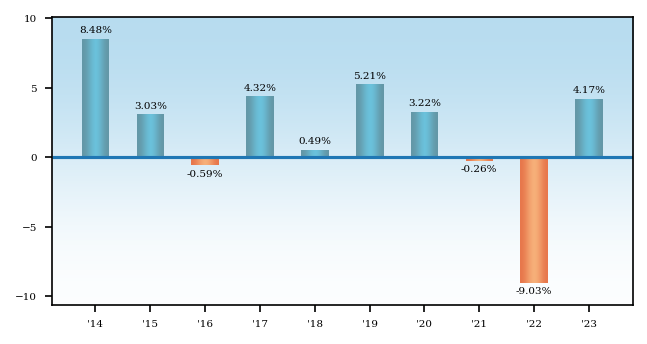
During the ten-year period shown in the bar chart, the highest return for a quarter was 6.82% (quarter ended December 31, 2023) and the lowest return for a quarter was -5.08% (quarter ended March 31, 2022). The Fund’s calendar year-to-date total return as of September 30, 2024 was 0.96%.
The table below shows the Fund’s average annual total returns for 1, 5, and 10 years for Class A shares, and 1 year and since inception for Class I shares, and how they compare with those of a broad measure of market performance. The return information below reflects applicable sales charges. After-tax returns are calculated using the historical highest individual federal marginal income tax rates and do not reflect the impact of state and local taxes. After-tax returns are shown for Class A shares of the Fund only; after-tax returns for Class I shares will vary. Actual after-tax returns depend on an investor’s tax situation and may differ from those shown, and after-tax returns shown are not relevant to investors who hold their Fund shares through tax-advantaged arrangements, such as 401(k) plans or individual retirement accounts (“IRAs”).
Average Annual Returns - Nebraska Municipal Fund |
Label |
1 Year |
5 Years |
10 Years |
Since Inception |
Inception Date |
||||
|---|---|---|---|---|---|---|---|---|---|---|
| Class A | Return Before Taxes | 1.59% | 0.02% | 1.54% | Nov. 17, 1993 | |||||
| Class A | Return After Taxes on Distributions | Return After Taxes on Distributions | 1.59% | 0.02% | 1.54% | Nov. 17, 1993 | |||||
| Class A | Return After Taxes on Distributions and Sale of Fund Shares | Return After Taxes on Distributions and Sale of Fund Shares | 1.86% | 0.46% | 1.71% | Nov. 17, 1993 | |||||
| Class I | Return Before Taxes | 4.54% | 0.79% | 0.91% | Nov. 01, 2017 | |||||
| Bloomberg U.S. Municipal Bond Index(1) (reflects no deduction for fees, expenses, or taxes) | Bloomberg U.S. Municipal Bond Index(1) (reflects no deduction for fees, expenses, or taxes) | 6.40% | [1] | 2.25% | [1] | 3.03% | [1] | 2.12% | [1] | |
| [1] | The Bloomberg U.S. Municipal Bond Index is an unmanaged index that includes investment-grade, tax-exempt, and fixed-rate bonds with maturities greater than two years selected from issues larger than $75 million. |