The investment objective of The Investment House Growth Fund (the “Fund”) is long term capital appreciation.
These tables describe the fees and expenses that you may pay if you buy, hold, and sell shares of the Fund. You may pay other fees, such as brokerage commissions and other fees to financial intermediaries, which are not reflected in the table and example below.
Shareholder Fees |
The Investment House Growth Fund
The Investment House Growth Fund
USD ($)
|
|---|---|
| Maximum Sales Charge (Load) Imposed on Purchases | none |
| Maximum Contingent Deferred Sales Charge (Load) | none |
| Redemption Fee | none |
| Wire Redemption Fee | $ 15 |
Annual Fund Operating Expenses |
The Investment House Growth Fund
The Investment House Growth Fund
|
|---|---|
| Management Fee | 1.40% |
| Distribution and/or Service (12b-1) Fees | none |
| Other Expenses (includes borrowing costs) | 0.05% |
| Total Annual Fund Operating Expenses | 1.45% |
This Example is intended to help you compare the cost of investing in the Fund with the cost of investing in other mutual funds.
Expense Example |
Expense Example, with Redemption, 1 Year |
Expense Example, with Redemption, 3 Years |
Expense Example, with Redemption, 5 Years |
Expense Example, with Redemption, 10 Years |
|---|---|---|---|---|
| The Investment House Growth Fund | The Investment House Growth Fund | USD ($) | 148 | 459 | 792 | 1,735 |
The Fund pays transaction costs, such as commissions, when it buys and sells securities (or “turns over” its portfolio). A higher portfolio turnover rate may indicate higher transaction costs and may result in higher taxes when Fund shares are held in a taxable account. These costs, which are not reflected in Total Annual Fund Operating Expenses or in the Example, affect the Fund’s performance. During the most recent fiscal year, the Fund’s portfolio turnover rate was 1% of the average value of its portfolio.
The central premise of the Fund’s investment style is “growth at a reasonable price” or “GARP.” The Fund usually invests in a diversified portfolio of common stocks from small, medium and large capitalization companies. These are chosen through in-depth fundamental analysis of a company’s financial reports and other public records. The Investment House LLC (the “Adviser”) looks for stocks having all or some of the following characteristics:
| ● | Strong earnings growth |
| ● | Reasonable valuations |
| ● | Quality management |
| ● | Financial strength and stability |
Under normal circumstances, the Fund will invest primarily in common stocks. While it is anticipated that the Fund will invest across a range of industries, certain sectors are likely to be overweighted compared to others because the Adviser seeks best investment opportunities regardless of sector. The sectors in which the Fund may be overweighted will vary at different points in the economic cycle.
When the Adviser believes market conditions are appropriate, the Fund may borrow money from banks to make additional portfolio investments. These loans may be structured as secured or unsecured loans, and may have fixed or variable interest rates. The Fund may borrow an amount equal to as much as one-third of the value of its total assets (which includes the amount borrowed). The Fund will only engage in borrowing when the Adviser believes the return from the additional investments will be greater than the costs associated with the borrowing.
| ● | Risks of Investing in Common Stocks. The Fund invests in common stocks, which subjects the Fund and its shareholders to the risks associated with common stock investing. These risks include the financial risk of selecting individual companies that do not perform as anticipated, the risk that the stock markets in which the Fund invests may experience periods of turbulence and instability, and the general risk that domestic and global economies may go through periods of decline and cyclical change. Many factors affect the performance of each company that the Fund invests in, including the strength of the company’s management or the demand for its products or services. You should be aware that a company’s share price may decline as a result of poor decisions made by management or lower demand for the company’s products or services. In addition, a company’s share price may also decline as a result of national and global events such as recession, war, epidemics or pandemics, terrorism, natural disasters and other events which may have a significant impact on markets generally. |
| ● | Management Risk. The Adviser’s strategy may fail to produce the intended results. |
| ● | Company Risk. The value of the Fund may decrease in response to the activities and financial prospects of an individual company in the Fund’s portfolio. If the prices of securities owned by the Fund fall, so will the value of the Fund. |
| ● | Volatility Risk. Equity securities tend to be more volatile than other investment choices. The value of an individual company can be more volatile than the market as a whole. This volatility affects the value of the Fund’s shares. |
| ● | Market Risk. Overall stock market risks may also affect the value of the Fund. Factors such as domestic economic growth and market conditions, interest rate levels and political events affect the securities markets. In addition, as with any mutual fund investments, the Fund’s returns will vary and you could lose money. An investment in the Fund is not a deposit in any bank and is not insured or guaranteed by the Federal Deposit Insurance Corporation or any other government agency. |
| ● | Style Risk. The Fund invests primarily in “growth stocks.” The earnings growth rate of the companies in the Fund’s portfolio may not meet the Adviser’s expectations, and the stock price may not increase as the Adviser anticipates. |
| ● | Smaller Company Risk. To the extent the Fund invests in smaller capitalization companies, the Fund will be subject to additional risks. These include: |
| ● | The earnings and prospects of smaller companies are more volatile than larger companies. |
| ● | Smaller companies may experience higher failure rates than do larger companies. |
| ● | The trading volume of securities of smaller companies is normally less than that of larger companies and, therefore, may disproportionately affect their market price, tending to make them fall more in response to selling pressure than is the case with larger companies. |
| ● | Smaller companies may have limited markets, product lines or financial resources and may lack management experience. |
| ● | Sector Risk. If the Fund’s portfolio is overweighted in a certain sector, any negative development affecting that sector will have a greater impact on the Fund than on a fund that is not overweighted in that sector. To the extent the Fund is overweighted in the Technology sector, it will be affected by developments affecting that sector. Companies in this sector may be significantly affected by intense competition. In addition, technology products may be subject to rapid obsolescence. |
| ● | Borrowing Risk. Borrowing magnifies the potential for gain or loss of the Fund, and therefore increases the possibility of fluctuation in the Fund’s net asset value (“NAV”). This is the speculative factor known as leverage. Because the Fund’s investments will fluctuate in value, whereas the interest obligations on borrowed funds may be fixed, during times of borrowing, the Fund’s NAV may tend to increase more when its investments increase in value, and decrease more when its investments decrease in value. In addition, interest costs on borrowings may fluctuate with changing market interest rates and may partially offset or exceed the return earned on the borrowed funds. Also, during times of borrowing under adverse market conditions, the Fund might have to sell portfolio securities to meet interest or principal payments at a time when fundamental investment considerations would not favor such sales. Unless profits on assets acquired with borrowed funds exceed the costs of borrowing, the use of borrowing will diminish the investment performance of the Fund compared with what it would have been without borrowing. |
| ● | Cybersecurity Risk. The Fund and its service providers may be subject, directly or indirectly, to operational and information security risks resulting from breaches in cybersecurity that may cause the Fund to lose or compromise confidential information, suffer data corruption or lose operational capacity. Similar types of cybersecurity risks are also present for issuers of securities in which the Fund may invest, which may cause the Fund’s investments in such companies to lose value. There is no guarantee the Fund will be successful in protecting against cybersecurity breaches. |
The bar chart and performance table shown below provide some indication of the risks and variability of investing in the Fund by showing the changes in the Fund’s performance from year to year for the last ten years, and by showing how the Fund’s average annual total returns for 1 year, 5 years and 10 years compare with those of a broad measure of market performance. How the Fund has performed in the past (before and after taxes) is not necessarily an indication of how the Fund will perform in the future. Updated performance information, current through the most recent month end, is available by calling 1-888-456-9518.
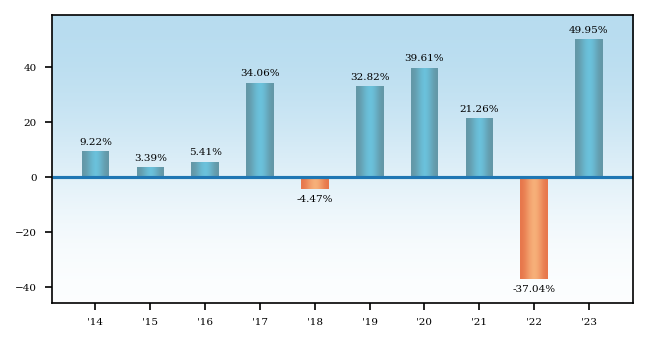
The Fund’s year-to-date return through September 30, 2024 was 26.63%
During the period shown in the bar chart, the highest return for a quarter was 30.61% during the quarter ended June 30, 2020 and the lowest return for a quarter was -23.29% during the quarter ended June 30, 2022.
After-tax returns are calculated using the historical highest individual federal marginal income tax rates and do not reflect the impact of state and local taxes. Actual after-tax returns depend on an investor’s tax situation and may differ from those shown, and after-tax returns shown are not relevant to investors who hold their Fund shares through tax-deferred arrangements, such as 401(k) plans or individual retirement accounts.
Average Annual Total Returns - The Investment House Growth Fund |
Label |
1 Year |
5 Years |
10 Years |
|---|---|---|---|---|
| The Investment House Growth Fund | Return Before Taxes | 49.95% | 16.25% | 12.46% |
| The Investment House Growth Fund | Return After Taxes on Distributions | 49.78% | 16.22% | 12.09% | |
| The Investment House Growth Fund | Return After Taxes on Distributions and Sale of Fund Shares | 29.67% | 13.16% | 10.25% | |
| STANDARD & POOR’S 500 INDEX (reflects no deduction for fees, expenses, or taxes) | 26.29% | 15.69% | 12.03% |
| ● | Risks of Investing in Common Stocks. The Fund invests in common stocks, which subjects the Fund and its shareholders to the risks associated with common stock investing. These risks include the financial risk of selecting individual companies that do not perform as anticipated, the risk that the stock markets in which the Fund invests may experience periods of turbulence and instability, and the general risk that domestic and global economies may go through periods of decline and cyclical change. Many factors affect the performance of each company that the Fund invests in, including the strength of the company’s management or the demand for its products or services. You should be aware that a company’s share price may decline as a result of poor decisions made by management or lower demand for the company’s products or services. In addition, a company’s share price may also decline as a result of national and global events such as recession, war, epidemics or pandemics, terrorism, natural disasters and other events which may have a significant impact on markets generally. |
| ● | Management Risk. The Adviser’s strategy may fail to produce the intended results. |
| ● | Company Risk. The value of the Fund may decrease in response to the activities and financial prospects of an individual company in the Fund’s portfolio. If the prices of securities owned by the Fund fall, so will the value of the Fund. |
| ● | Volatility Risk. Equity securities tend to be more volatile than other investment choices. The value of an individual company can be more volatile than the market as a whole. This volatility affects the value of the Fund’s shares. |
| ● | Market Risk. Overall stock market risks may also affect the value of the Fund. Factors such as domestic economic growth and market conditions, interest rate levels and political events affect the securities markets. In addition, as with any mutual fund investments, the Fund’s returns will vary and you could lose money. An investment in the Fund is not a deposit in any bank and is not insured or guaranteed by the Federal Deposit Insurance Corporation or any other government agency. |
| ● | Style Risk. The Fund invests primarily in “growth stocks.” The earnings growth rate of the companies in the Fund’s portfolio may not meet the Adviser’s expectations, and the stock price may not increase as the Adviser anticipates. |
| ● | Smaller Company Risk. To the extent the Fund invests in smaller capitalization companies, the Fund will be subject to additional risks. These include: |
| ● | The earnings and prospects of smaller companies are more volatile than larger companies. |
| ● | Smaller companies may experience higher failure rates than do larger companies. |
| ● | The trading volume of securities of smaller companies is normally less than that of larger companies and, therefore, may disproportionately affect their market price, tending to make them fall more in response to selling pressure than is the case with larger companies. |
| ● | Smaller companies may have limited markets, product lines or financial resources and may lack management experience. |
| ● | Sector Risk. If the Fund’s portfolio is overweighted in a certain sector, any negative development affecting that sector will have a greater impact on the Fund than on a fund that is not overweighted in that sector. To the extent the Fund is overweighted in the Technology sector, it will be affected by developments affecting that sector. Companies in this sector may be significantly affected by intense competition. In addition, technology products may be subject to rapid obsolescence. |
| ● | Borrowing Risk. Borrowing magnifies the potential for gain or loss of the Fund, and therefore increases the possibility of fluctuation in the Fund’s net asset value (“NAV”). This is the speculative factor known as leverage. Because the Fund’s investments will fluctuate in value, whereas the interest obligations on borrowed funds may be fixed, during times of borrowing, the Fund’s NAV may tend to increase more when its investments increase in value, and decrease more when its investments decrease in value. In addition, interest costs on borrowings may fluctuate with changing market interest rates and may partially offset or exceed the return earned on the borrowed funds. Also, during times of borrowing under adverse market conditions, the Fund might have to sell portfolio securities to meet interest or principal payments at a time when fundamental investment considerations would not favor such sales. Unless profits on assets acquired with borrowed funds exceed the costs of borrowing, the use of borrowing will diminish the investment performance of the Fund compared with what it would have been without borrowing. |
| ● | Cybersecurity Risk. The Fund and its service providers may be subject, directly or indirectly, to operational and information security risks resulting from breaches in cybersecurity that may cause the Fund to lose or compromise confidential information, suffer data corruption or lose operational capacity. Similar types of cybersecurity risks are also present for issuers of securities in which the Fund may invest, which may cause the Fund’s investments in such companies to lose value. There is no guarantee the Fund will be successful in protecting against cybersecurity breaches. |