The Eubel Brady & Suttman Income and Appreciation Fund (the “EBS Income & Appreciation Fund” or the “Fund”) seeks to provide total return through a combination of current income and capital appreciation.
This table describes the fees and expenses that you may pay if you buy, hold, and sell shares of the EBS Income & Appreciation Fund. You may pay other fees, such as brokerage commissions and other fees to financial intermediaries, which are not reflected in the table and example below.
Shareholder Fees |
Eubel Brady & Suttman Income and Appreciation Fund
Eubel Brady & Suttman Income and Appreciation Fund
USD ($)
|
|---|---|
| Shareholder Fees (fees paid directly from your investment)............................................................................................................. | none |
| [1] | This Fund represents one of the investment strategies offered by Eubel Brady & Suttman Asset Management, Inc. (the “Adviser”). Shareholders in the Fund do not pay “Management Fees” directly to the Fund. Clients of the Adviser must enter into a discretionary investment advisory agreement with the Adviser prior to investing in the Fund and pay a management fee under the terms of the discretionary investment advisory agreement. The Adviser’s fee schedule is included in Part 2A of the Adviser’s Form ADV, which is available for download at www.ebsinvests.com and on the SEC’s website. In addition, shareholders may incur brokerage and/or other transaction-based fees for maintaining custody/trading accounts with a broker/dealer or financial intermediary. These fees, if any, will be disclosed to shareholders at the time they enter into a discretionary investment advisory agreement with the Adviser. |
| [2] | The Fund has adopted a Shareholder Servicing Plan under which the Fund may make payments to financial organizations for providing account administration and account maintenance services to Fund shareholders. The annual limitation for payment of such expenses is 0.25% of the Fund’s average daily net assets. |
| [3] | “Total Annual Fund Operating Expenses” will not correlate to the Fund’s ratio of total expenses to average net assets in the Fund’s Financial Highlights, which reflects the operating expenses of the Fund but does not include “Acquired Fund Fees and Expenses.” |
This Example is intended to help you compare the cost of investing in the EBS Income & Appreciation Fund with the cost of investing in other mutual funds.
Expense Example |
Expense Example, with Redemption, 1 Year |
Expense Example, with Redemption, 3 Years |
Expense Example, with Redemption, 5 Years |
Expense Example, with Redemption, 10 Years |
|---|---|---|---|---|
| Eubel Brady & Suttman Income and Appreciation Fund | Eubel Brady & Suttman Income and Appreciation Fund | USD ($) | 23 | 71 | 124 | 280 |
The EBS Income & Appreciation Fund pays transaction costs, such as commissions, when it buys and sells securities (or “turns over” its portfolio). A higher portfolio turnover rate may indicate higher transaction costs and may result in higher taxes when Fund shares are held in a taxable account. These costs, which are not reflected in Annual Fund Operating Expenses or in the Example, affect the Fund’s performance. During the most recent fiscal year, the Fund’s portfolio turnover rate was 22% of the average value of its portfolio.
Under normal circumstances, the EBS Income & Appreciation Fund invests primarily in a diversified portfolio of non-convertible fixed income securities and convertible securities. The allocation among these securities will vary based on the Adviser’s assessment of market conditions and it is possible that the Fund may not own all of these securities at the same time. The Fund may invest in securities of any maturity, credit quality or market capitalization. This may include securities that are rated below investment grade (below the four highest ratings by Moody’s Investors Service, Inc., Standard & Poor’s Global Ratings (“S&P”) or Fitch Ratings, commonly known as “high yield” or “junk” securities) and those with smaller market capitalizations. The Fund invests primarily in domestic securities and foreign securities that are U.S. dollar denominated.
The Fund’s investments in convertible securities may include convertible bonds, convertible preferred stocks, “synthetic” convertible positions and warrants. Convertible bonds pay interest and are convertible into common stocks or their equivalent value. In general, a convertible bond performs more like a stock when the price of the underlying stock is high (because it is assumed that it will be converted into the stock) and more like a bond when the price of the underlying stock is low (because it is assumed that it will mature without being converted) relative to its conversion price. The Fund may invest in convertible securities of any maturity, credit quality or market capitalization.
The Fund may invest up to 20% of its net assets in common stock and preferred stock. Such exposure could come from conversion or direct purchases. At times, the Fund may emphasize investments in one or more particular business sectors of the market.
The Fund may invest in illiquid or thinly traded convertible and non-convertible securities and those that are privately placed but eligible for purchase and sale by certain qualified institutional buyers, as defined under Rule 144A of the Securities Act of 1933. Illiquid securities are investments that cannot reasonably be expected to be sold or disposed within seven calendar days in current market conditions without impacting the market value of the investment. The Fund will not invest more than 15% of the value of its net assets in securities or other investments that are illiquid. The Fund may also purchase indebtedness and participations in commercial loans. Such investments may be secured or unsecured.
The Fund may invest in registered investment companies (“RICs”), such as open-end mutual funds, exchange-traded funds (“ETFs”) and closed-end funds, primarily when it receives a large inflow of cash through shareholder purchases to gain prompt exposure to the markets. The Fund may also invest in money market instruments (including commercial paper) at any time to maintain liquidity or pending selection of investments in accordance with its strategies.
In selecting investments for the Fund, the Adviser will attempt to identify a security that is trading at an attractive yield relative to the Adviser’s evaluation of the issuer’s creditworthiness. The Adviser may consider such factors as the conversion price, conversion premium, option adjusted yield, maturity and the potential price appreciation of the issuer’s common stock. In assessing a company’s creditworthiness and appreciation potential, the Adviser will typically focus on fundamentals such as: its balance sheet, debt coverage, contingent liabilities, capital structure, access to capital, ability or potential to generate cash flow, earnings, ability to sustain profit margins, and other factors.
As with any mutual fund investment, the Fund’s returns will vary and you could lose money on your investment in the EBS Income & Appreciation Fund over short or long periods. There is no guarantee that the Fund will achieve its investment objective and the Fund may not be appropriate for use as a complete investment program. The Fund is subject to certain other risks, including the following:
Fixed Income Securities. Any fixed income securities held by the Fund may be subject to certain risks, such as credit risk, interest rate risk and liquidity risk. At times there may be an imbalance of supply and demand in the markets which could result in greater price volatility, less liquidity, wider trading spreads and a lack of price transparency. Decisions by the Federal Reserve on interest rate policy can have a significant effect on the value of fixed-income securities. The decision by the Federal Reserve to increase interest rates in 2022 and to sell some of the U.S. Government securities on its balance sheet (i.e., quantitative tightening) in an effort to control inflation, resulted in market volatility, due in part to the prolonged period of unusually low interest rates preceding the rate hike.
| · | Interest Rate Risk. The price of a fixed income security is generally expected to decline during periods of rising interest rates. The magnitude of these fluctuations will generally be greater if the Fund holds securities with longer maturities and/or lower quality ratings. Interest rate changes can be sudden and unpredictable and are driven by a wide variety of factors, including central bank monetary policies, inflation rates, supply and demand and general economic conditions. |
| · | Credit Risk. Credit risk is the risk that the issuer of a security will not be able to make payments of interest and principal when due. Deterioration in the financial condition of an issuer or deterioration in general economic conditions could cause an issuer to fail to make timely payments of principal and interest, when due. Changes in an issuer’s credit rating or the market’s perception of an issuer’s creditworthiness may affect the value of the Fund’s investments in that issuer. Lower rated securities (commonly known as “high yield” or “junk” securities), are considered primarily speculative with respect to an issuer’s continuing ability to make principal and interest payments, when due. | |
| While not a principal investment strategy, the Fund may invest in securities issued by or guaranteed by the U.S. Government or its agencies and instrumentalities (such as the Government National Mortgage Association (Ginnie Mae), the Federal National Mortgage Association (Fannie Mae) or the Federal Home Loan Mortgage Corporation (Freddie Mac). U.S. Government securities are subject to varying degrees of credit risk, depending upon whether the securities are supported by the full faith and credit of the U.S. Government, the ability to borrow from the U.S. Treasury, or only by the credit of the issuing U.S. Government agency, instrumentality or corporation. No assurance can be given that the U.S. Government will provide financial support to U.S. Government agencies, instrumentalities or sponsored enterprises if it is not obligated to do so by law. |
| · | Call Risk. Some of the securities that the Fund may own may be “callable,” which means the issuer can redeem the security prior to its maturity. When interest rates are low, an issuer will often redeem its callable securities early. In such a circumstance, the Fund may have to invest its investment proceeds from the callable security in another security offering a lower yield. |
| · | Liquidity Risk. Liquidity risk is the risk that a security cannot be sold at an advantageous time and/or price in the secondary market, which could prevent the Fund from selling an investment at the approximate price that it is valued or the time it desires to sell. If a fixed income security is downgraded or drops in price, the market demand may be limited, potentially making that security difficult to sell. Additionally, the market for certain securities may become illiquid under adverse market or economic conditions, independent of any specific adverse changes in the conditions of a particular issuer. There is a risk that monetary policy actions by the U.S. Government to stimulate or stabilize the economy could result in less liquidity. Liquidity risk may be magnified in a rising interest rate environment or in other circumstances where investor redemptions may be higher than normal. Lower rated securities can be subject to greater levels of liquidity risk. |
Convertible Security Risk. Convertible securities are hybrid securities and subject to the risks associated with both fixed income and equity investments. The price of convertible securities may fluctuate in response to price changes in the underlying stock. Companies issuing convertible securities often are smaller capitalization companies, which may lack the management experience, financial resources, product diversification and competitive strengths often present in larger corporations.
| • | Credit Risk. Convertible securities are normally considered “junior” to secured securities, meaning the company must pay interest on its nonconvertible secured debt before it can make payments on its convertible securities. Therefore, the credit rating of a company’s convertible securities is generally lower than on its secured nonconvertible debt securities. |
| · | Liquidity Risk. Certain convertible securities are issued and sold through transactions under Rule 144A of the Securities Act of 1933 and the Adviser will determine whether these securities are liquid. If any Rule 144A or non-Rule 144A security held by the Fund should become illiquid, the value of the security may be reduced and it may be more difficult to sell the security. |
| • | Interest Rate Risk. The price of a fixed income security is generally expected to decline during periods of rising interest rates. The magnitude of these fluctuations will generally be greater if the Fund holds securities with longer maturities and/or lower quality ratings. Interest rate changes can be sudden and unpredictable and are driven by a wide variety of factors, including central bank monetary policies, inflation rates, supply and demand and general economic conditions. |
| • | Availability Risk. Depending upon market conditions, convertible securities that meet the Fund’s investment criteria may not be widely available and/or may be highly concentrated in only a few market sectors. This may limit the ability of the Fund to produce current income and capital appreciation while remaining fully diversified. |
| • | Call Risk. Some of the convertible securities that the Fund may own may be “callable,” which means the issuer can redeem the security prior to its maturity. When interest rates are low, an issuer will often redeem its callable securities early. In such a circumstance, the Fund may have to invest its investment proceeds from the callable security in another security offering a lower yield. |
| • | Synthetic Convertible Risk. The value of a synthetic convertible will respond differently to market fluctuations than a convertible security because a synthetic convertible is composed of an income producing security and a warrant, each with its own market value. In addition, if the value of the underlying common stock or the level of the index involved in the convertible component falls below the exercise price of the warrant, the warrant may lose all value. |
Equity Security Risk. The return on and value of an equity security will fluctuate in response to stock market movements. Stocks tend to move in cycles and may decline in tandem with a drop in the overall value of the markets based on negative developments in the U.S. or global economies. Common and preferred stocks are subject to market risks, such as a rapid increase or decrease in a stock’s value or liquidity, and fluctuations in price due to earnings, economic conditions and other factors beyond the control of the Adviser. The value of preferred stocks also will fluctuate with changes in interest rates. Preferred stocks also are subject to credit risk and the prices of preferred stock tend to move more slowly upwards than common stock prices. Local, regional or global events such as war, acts of terrorism, market manipulation, government defaults, government shutdowns, natural or environmental disasters, widespread disease, including pandemics and epidemics, high inflation, recessions, or other events could also have a significant impact on the Fund and its investments and potentially increase the risks described herein. Armed conflicts, the responses and sanctions by other countries, and the potential for wider conflicts, can have adverse effects on regional and global economies.
| · | Significant Market Events. Periods of volatility may occur in response to market events and other economic, political and global macro factors. Decisions by the Federal Reserve on interest rate policy, the spread of infectious disease or other public health issues, armed conflicts, and higher inflation could have adverse effects on regional and global economies and negatively affect global growth and inflation. Large expansion of government deficits and debt as a result of government actions to mitigate the effects of these events, as well as political events within the U.S. and abroad, may affect investor and consumer confidence and adversely impact the financial markets. Investor perceptions may be based on unpredictable factors such as economic, fiscal policy or political expectations. |
Risks of Investments in RICs. Investments by the Fund in other investment companies, including ETFs, will expose investors to the risk that the underlying fund manager may change objectives which may or may not parallel the investment direction of the Fund. When the Fund invests in shares of RICs, there will be some duplication of expenses because it will indirectly pay a proportion of the RIC’s operating expenses.
Indebtedness Risk. Indebtedness is different from traditional debt securities in that debt securities are part of a large issue of securities to the public and indebtedness may not be a security, but may represent a specific commercial loan to a borrower. Loan participations typically represent direct participation, together with other parties, in a loan to a corporate borrower, and generally are offered by banks or other financial institutions or lending syndicates. The Fund may participate in such syndications, or can buy part of a loan, becoming a part lender. In addition, the Fund, or an agent of the Fund, may act as agent for the loan and be responsible for the collection of principal and interest payments from the corporate borrower.
If the Fund enters into a lending arrangement, this type of investment may be considered an illiquid investment and may be difficult to sell or unwind in a timely manner. The Fund’s investments in indebtedness involve the risk of loss in case of default or insolvency of the borrower and the possibility of less legal protection in the event of fraud or misrepresentation.
The Fund’s investments in indebtedness, loan participations and assignments may subject the Fund to losses from casualty or condemnation, and changes in local and general economic conditions, supply and demand, interest rates, zoning laws, regulatory limitations on rents, property taxes and operating expenses.
Tax Risk. The federal income tax treatment of convertible securities or other securities in which the Fund may invest may not be clear or may be subject to re-characterization by the Internal Revenue Service (“IRS”).
Foreign Investment Risk. Investments in foreign securities are subject to the risk that world events, such as political upheaval or financial problems will adversely affect the value of securities issued in foreign countries or regions. The risks associated with changes in diplomatic relations, tensions or open conflict between nations, or political dysfunction with some nations that are global economic powers could affect the economies of many nations, including the U.S. The value of foreign investments may be affected by the imposition of new government regulations, political and economic instability, the imposition or tightening of exchange controls, increased taxation and confiscation of investor assets. Foreign economies may be less stable than the U.S. economy and foreign securities may not be subject to uniform audit or disclosure standards.
Sector Risk. An emphasis in one or more particular business sectors may cause the Fund’s share price to be more susceptible to the financial, market or economic events affecting issuers and industries within those sectors than would be the case for a mutual fund that does not emphasize investment in particular sectors. The sectors that the Fund may emphasize will vary from time to time.
Management Risk. The Adviser’s method of security selection may not be successful and the Fund may underperform relative to other mutual funds that employ similar investment strategies.
Cybersecurity Risk. Corporate issuers, counterparties with which the Fund engages in transactions, exchange and other financial market operators, banks, brokers, dealers and other financial institutions may experience cybersecurity breaches. These breaches may result in harmful disruptions to their operations and negatively impact their financial condition. The Fund and its shareholders could be negatively impacted as a result.
The bar chart and performance table that follow provide some indication of the risks and variability of investing in the EBS Income & Appreciation Fund. The bar chart shows the Fund’s performance for each full calendar year of the Fund’s operations. The performance table shows how the Fund’s average annual total returns for 1 year, 5 years and the period since its inception compare with those of the Bloomberg U.S. Aggregate Bond Index. On July 31, 2024, the Fund changed its primary benchmark from the ICE BofA U.S. Yield Alternatives Index to the Bloomberg U.S. Aggregate Bond Index in order to comply with the regulation that requires the Fund’s primary benchmark index to represent the overall applicable market. The ICE BofA U.S. Yield Alternatives Index and the ICE BofA 1-10 Year Corporate Index are included as additional comparative indices because they are representative of fixed income securities that may be held by the Fund. How the Fund has performed in the past (before and after taxes) is not necessarily an indication of how the Fund will perform in the future. Updated performance information, current through the most recent month end, is available by calling 1-800-391-1223.
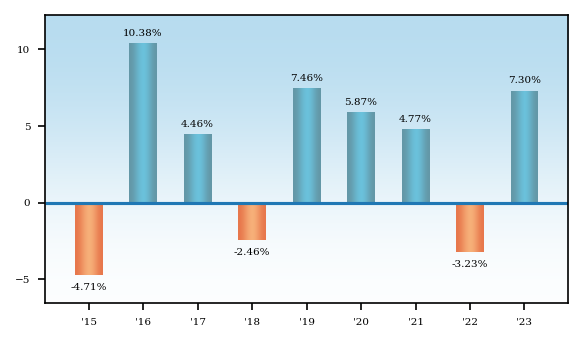
The Fund’s 2024 year-to-date return through September 30, 2024 is 6.37%.
During the periods shown in the bar chart, the highest return for a quarter was 7.19% during the quarter ended June 30, 2020 and the lowest return for a quarter was -7.11% during the quarter ended March 31, 2020.
After-tax returns are calculated using the historical highest individual federal marginal income tax rates and do not reflect the impact of state and local taxes. Actual after-tax returns depend on an investor’s tax situation and may differ from those shown, and after-tax returns shown are not relevant to investors who hold their Fund shares through tax-deferred arrangements, such as 401(k) plans or individual retirement accounts.
Average Annual Total Returns - Eubel Brady & Suttman Income and Appreciation Fund |
Label |
1 Year |
5 Years |
Since Inception |
Inception Date |
|---|---|---|---|---|---|
| Eubel Brady & Suttman Income and Appreciation Fund | Return Before Taxes | 7.30% | 4.36% | 3.19% | Sep. 30, 2014 |
| Eubel Brady & Suttman Income and Appreciation Fund | Return After Taxes on Distributions | 5.15% | 2.73% | 1.73% | ||
| Eubel Brady & Suttman Income and Appreciation Fund | Return After Taxes on Distributions and Sale of Fund Shares | 4.30% | 2.68% | 1.82% | ||
| Bloomberg U.S. Aggregate Bond Index (reflects no deduction for fees, expenses, or taxes) | 5.53% | 1.10% | 1.52% | ||
| ICE BofA U.S. Yield Alternatives Index (reflects no deduction for fees, expenses, or taxes) | 13.23% | 5.54% | 3.78% | ||
| ICE BofA 1-10 Year Corporate Index (reflects no deduction for fees, expenses, or taxes) | 7.37% | 2.69% | 2.50% |
Fixed Income Securities. Any fixed income securities held by the Fund may be subject to certain risks, such as credit risk, interest rate risk and liquidity risk. At times there may be an imbalance of supply and demand in the markets which could result in greater price volatility, less liquidity, wider trading spreads and a lack of price transparency. Decisions by the Federal Reserve on interest rate policy can have a significant effect on the value of fixed-income securities. The decision by the Federal Reserve to increase interest rates in 2022 and to sell some of the U.S. Government securities on its balance sheet (i.e., quantitative tightening) in an effort to control inflation, resulted in market volatility, due in part to the prolonged period of unusually low interest rates preceding the rate hike.
| · | Interest Rate Risk. The price of a fixed income security is generally expected to decline during periods of rising interest rates. The magnitude of these fluctuations will generally be greater if the Fund holds securities with longer maturities and/or lower quality ratings. Interest rate changes can be sudden and unpredictable and are driven by a wide variety of factors, including central bank monetary policies, inflation rates, supply and demand and general economic conditions. |
| · | Credit Risk. Credit risk is the risk that the issuer of a security will not be able to make payments of interest and principal when due. Deterioration in the financial condition of an issuer or deterioration in general economic conditions could cause an issuer to fail to make timely payments of principal and interest, when due. Changes in an issuer’s credit rating or the market’s perception of an issuer’s creditworthiness may affect the value of the Fund’s investments in that issuer. Lower rated securities (commonly known as “high yield” or “junk” securities), are considered primarily speculative with respect to an issuer’s continuing ability to make principal and interest payments, when due. | |
| While not a principal investment strategy, the Fund may invest in securities issued by or guaranteed by the U.S. Government or its agencies and instrumentalities (such as the Government National Mortgage Association (Ginnie Mae), the Federal National Mortgage Association (Fannie Mae) or the Federal Home Loan Mortgage Corporation (Freddie Mac). U.S. Government securities are subject to varying degrees of credit risk, depending upon whether the securities are supported by the full faith and credit of the U.S. Government, the ability to borrow from the U.S. Treasury, or only by the credit of the issuing U.S. Government agency, instrumentality or corporation. No assurance can be given that the U.S. Government will provide financial support to U.S. Government agencies, instrumentalities or sponsored enterprises if it is not obligated to do so by law. |
| · | Call Risk. Some of the securities that the Fund may own may be “callable,” which means the issuer can redeem the security prior to its maturity. When interest rates are low, an issuer will often redeem its callable securities early. In such a circumstance, the Fund may have to invest its investment proceeds from the callable security in another security offering a lower yield. |
| · | Liquidity Risk. Liquidity risk is the risk that a security cannot be sold at an advantageous time and/or price in the secondary market, which could prevent the Fund from selling an investment at the approximate price that it is valued or the time it desires to sell. If a fixed income security is downgraded or drops in price, the market demand may be limited, potentially making that security difficult to sell. Additionally, the market for certain securities may become illiquid under adverse market or economic conditions, independent of any specific adverse changes in the conditions of a particular issuer. There is a risk that monetary policy actions by the U.S. Government to stimulate or stabilize the economy could result in less liquidity. Liquidity risk may be magnified in a rising interest rate environment or in other circumstances where investor redemptions may be higher than normal. Lower rated securities can be subject to greater levels of liquidity risk. |
Convertible Security Risk. Convertible securities are hybrid securities and subject to the risks associated with both fixed income and equity investments. The price of convertible securities may fluctuate in response to price changes in the underlying stock. Companies issuing convertible securities often are smaller capitalization companies, which may lack the management experience, financial resources, product diversification and competitive strengths often present in larger corporations.
| • | Credit Risk. Convertible securities are normally considered “junior” to secured securities, meaning the company must pay interest on its nonconvertible secured debt before it can make payments on its convertible securities. Therefore, the credit rating of a company’s convertible securities is generally lower than on its secured nonconvertible debt securities. |
| · | Liquidity Risk. Certain convertible securities are issued and sold through transactions under Rule 144A of the Securities Act of 1933 and the Adviser will determine whether these securities are liquid. If any Rule 144A or non-Rule 144A security held by the Fund should become illiquid, the value of the security may be reduced and it may be more difficult to sell the security. |
| • | Interest Rate Risk. The price of a fixed income security is generally expected to decline during periods of rising interest rates. The magnitude of these fluctuations will generally be greater if the Fund holds securities with longer maturities and/or lower quality ratings. Interest rate changes can be sudden and unpredictable and are driven by a wide variety of factors, including central bank monetary policies, inflation rates, supply and demand and general economic conditions. |
| • | Availability Risk. Depending upon market conditions, convertible securities that meet the Fund’s investment criteria may not be widely available and/or may be highly concentrated in only a few market sectors. This may limit the ability of the Fund to produce current income and capital appreciation while remaining fully diversified. |
| • | Call Risk. Some of the convertible securities that the Fund may own may be “callable,” which means the issuer can redeem the security prior to its maturity. When interest rates are low, an issuer will often redeem its callable securities early. In such a circumstance, the Fund may have to invest its investment proceeds from the callable security in another security offering a lower yield. |
| • | Synthetic Convertible Risk. The value of a synthetic convertible will respond differently to market fluctuations than a convertible security because a synthetic convertible is composed of an income producing security and a warrant, each with its own market value. In addition, if the value of the underlying common stock or the level of the index involved in the convertible component falls below the exercise price of the warrant, the warrant may lose all value. |
Equity Security Risk. The return on and value of an equity security will fluctuate in response to stock market movements. Stocks tend to move in cycles and may decline in tandem with a drop in the overall value of the markets based on negative developments in the U.S. or global economies. Common and preferred stocks are subject to market risks, such as a rapid increase or decrease in a stock’s value or liquidity, and fluctuations in price due to earnings, economic conditions and other factors beyond the control of the Adviser. The value of preferred stocks also will fluctuate with changes in interest rates. Preferred stocks also are subject to credit risk and the prices of preferred stock tend to move more slowly upwards than common stock prices. Local, regional or global events such as war, acts of terrorism, market manipulation, government defaults, government shutdowns, natural or environmental disasters, widespread disease, including pandemics and epidemics, high inflation, recessions, or other events could also have a significant impact on the Fund and its investments and potentially increase the risks described herein. Armed conflicts, the responses and sanctions by other countries, and the potential for wider conflicts, can have adverse effects on regional and global economies.
| · | Significant Market Events. Periods of volatility may occur in response to market events and other economic, political and global macro factors. Decisions by the Federal Reserve on interest rate policy, the spread of infectious disease or other public health issues, armed conflicts, and higher inflation could have adverse effects on regional and global economies and negatively affect global growth and inflation. Large expansion of government deficits and debt as a result of government actions to mitigate the effects of these events, as well as political events within the U.S. and abroad, may affect investor and consumer confidence and adversely impact the financial markets. Investor perceptions may be based on unpredictable factors such as economic, fiscal policy or political expectations. |
| · | Significant Market Events. Periods of volatility may occur in response to market events and other economic, political and global macro factors. Decisions by the Federal Reserve on interest rate policy, the spread of infectious disease or other public health issues, armed conflicts, and higher inflation could have adverse effects on regional and global economies and negatively affect global growth and inflation. Large expansion of government deficits and debt as a result of government actions to mitigate the effects of these events, as well as political events within the U.S. and abroad, may affect investor and consumer confidence and adversely impact the financial markets. Investor perceptions may be based on unpredictable factors such as economic, fiscal policy or political expectations. |
Risks of Investments in RICs. Investments by the Fund in other investment companies, including ETFs, will expose investors to the risk that the underlying fund manager may change objectives which may or may not parallel the investment direction of the Fund. When the Fund invests in shares of RICs, there will be some duplication of expenses because it will indirectly pay a proportion of the RIC’s operating expenses.
Indebtedness Risk. Indebtedness is different from traditional debt securities in that debt securities are part of a large issue of securities to the public and indebtedness may not be a security, but may represent a specific commercial loan to a borrower. Loan participations typically represent direct participation, together with other parties, in a loan to a corporate borrower, and generally are offered by banks or other financial institutions or lending syndicates. The Fund may participate in such syndications, or can buy part of a loan, becoming a part lender. In addition, the Fund, or an agent of the Fund, may act as agent for the loan and be responsible for the collection of principal and interest payments from the corporate borrower.
Tax Risk. The federal income tax treatment of convertible securities or other securities in which the Fund may invest may not be clear or may be subject to re-characterization by the Internal Revenue Service (“IRS”).
Foreign Investment Risk. Investments in foreign securities are subject to the risk that world events, such as political upheaval or financial problems will adversely affect the value of securities issued in foreign countries or regions. The risks associated with changes in diplomatic relations, tensions or open conflict between nations, or political dysfunction with some nations that are global economic powers could affect the economies of many nations, including the U.S. The value of foreign investments may be affected by the imposition of new government regulations, political and economic instability, the imposition or tightening of exchange controls, increased taxation and confiscation of investor assets. Foreign economies may be less stable than the U.S. economy and foreign securities may not be subject to uniform audit or disclosure standards.
Sector Risk. An emphasis in one or more particular business sectors may cause the Fund’s share price to be more susceptible to the financial, market or economic events affecting issuers and industries within those sectors than would be the case for a mutual fund that does not emphasize investment in particular sectors. The sectors that the Fund may emphasize will vary from time to time.
Management Risk. The Adviser’s method of security selection may not be successful and the Fund may underperform relative to other mutual funds that employ similar investment strategies.
Cybersecurity Risk. Corporate issuers, counterparties with which the Fund engages in transactions, exchange and other financial market operators, banks, brokers, dealers and other financial institutions may experience cybersecurity breaches. These breaches may result in harmful disruptions to their operations and negatively impact their financial condition. The Fund and its shareholders could be negatively impacted as a result.
The Eubel Brady & Suttman Income Fund (the “EBS Income Fund” or the “Fund”) seeks to preserve capital, produce income and maximize total return.
This table describes the fees and expenses that you may pay if you buy, hold, and sell shares of the EBS Income Fund. You may pay other fees, such as brokerage commissions and other fees to financial intermediaries, which are not reflected in the table and example below.
Shareholder Fees |
Eubel Brady & Suttman Income Fund
Eubel Brady & Suttman Income Fund
USD ($)
|
|---|---|
| Shareholder Fees (fees paid directly from your investment)............................................................................................................. | none |
| [1] | This Fund represents one of the investment strategies offered by the Adviser. Shareholders in the Fund do not pay “Management Fees” directly to the Fund. Clients of the Adviser must enter into a discretionary investment advisory agreement with the Adviser prior to investing in the Fund and pay a management fee under the terms of the discretionary investment advisory agreement. The Adviser’s fee schedule is included in Part 2A of the Adviser’s Form ADV, which is available for download at www.ebsinvests.com and on the SEC’s website. In addition, shareholders may incur brokerage and/or other transaction-based fees for maintaining custody/trading accounts with a broker/dealer or financial intermediary. These fees, if any, will be disclosed to shareholders at the time they enter into a discretionary investment advisory agreement with the Adviser. |
| [2] | The Fund has adopted a Shareholder Servicing Plan under which the Fund may make payments to financial organizations for providing account administration and account maintenance services to Fund shareholders. The annual limitation for payment of such expenses is 0.25% of the Fund’s average daily net assets. |
| [3] | “ |
This Example is intended to help you compare the cost of investing in the EBS Income Fund with the cost of investing in other mutual funds.
Expense Example |
Expense Example, with Redemption, 1 Year |
Expense Example, with Redemption, 3 Years |
Expense Example, with Redemption, 5 Years |
Expense Example, with Redemption, 10 Years |
|---|---|---|---|---|
| Eubel Brady & Suttman Income Fund | Eubel Brady & Suttman Income Fund | USD ($) | 18 | 58 | 101 | 230 |
The EBS Income Fund pays transaction costs, such as commissions, when it buys and sells securities (or “turns over” its portfolio). A higher portfolio turnover rate may indicate higher transaction costs and may result in higher taxes when Fund shares are held in a taxable account. These costs, which are not reflected in Annual Fund Operating Expenses or in the Example, affect the Fund’s performance. During the most recent fiscal year, the Fund’s portfolio turnover rate was 19% of the average value of its portfolio.
Under normal circumstances, the EBS Income Fund invests in a diversified portfolio of income producing securities. These securities may include, but are not limited to, corporate and municipal bonds, securities issued by the U.S. Government, its agencies and instrumentalities, mortgage and asset-backed securities, collateralized mortgage obligations, convertible bonds, floating rate and inverse floating rate securities, zero coupon bonds, loans, money market instruments (including commercial paper) and shares of other RICs. The Fund may invest in securities of any maturity, credit quality or market capitalization. This may include securities that are rated below investment grade (below the four highest ratings by Moody’s Investors Service, Inc., S&P Global Ratings, or Fitch Ratings, commonly known as “high yield” or “junk” securities) and those with smaller market capitalizations. The Fund will invest primarily in domestic securities or foreign securities that are U.S. dollar denominated. The Fund may also invest in individual fixed and variable rate interest income producing secured notes and secured notes with a fixed or variable rate and shared appreciation component. Each note would represent a loan made to an individual or entity. Such notes would be acquired by the Fund through direct origination with the borrower.
The EBS Income Fund may seek modest capital appreciation by investing up to 10% of its net assets in equities, including common stock, preferred stock, and convertible preferred stock. The Fund may invest in money market instruments at any time to maintain liquidity or pending selection of investments.
The Fund may invest in illiquid or thinly traded fixed income securities and those that are privately placed but eligible for purchase and sale by certain qualified institutional buyers, as defined under Rule 144A of the Securities Act of 1933. Illiquid securities are investments that cannot reasonably be expected to be sold or disposed within seven calendar days in current market conditions without impacting the market value of the investment. The Fund will not invest more than 15% of the value of its net assets in securities or other investments that are illiquid. The Fund may also purchase indebtedness and participations in commercial loans. Such investments may be secured or unsecured.
In selecting investments for the Fund, the Adviser will attempt to identify securities that it believes offer an attractive yield and total return relative to the Adviser’s evaluation of the issuer’s creditworthiness. Using fundamental security analysis, the Adviser seeks to identify securities that may have a comparatively higher yield than another security of similar credit quality or duration, securities whose price may increase in anticipation of an interest rate decline, securities that have potential for a credit upgrade, and securities of companies that have the ability or potential to generate adequate cash flow and earnings to meet interest and principal payments when due. The Adviser’s credit and equity analysis typically contemplates, among other factors, a company’s balance sheet, capital structure, access to capital, ability to sustain and/or grow its business, its competition, and the global environment in which the company operates.
As with any mutual fund investment, the Fund’s returns will vary and you could lose money on your investment in the EBS Income Fund over short or long periods. There is no guarantee that the Fund will achieve its investment objective and the Fund may not be appropriate for use as a complete investment program. The EBS Income Fund is subject to certain other risks, including the following:
Fixed Income Securities. Any fixed income securities held by the Fund may be subject to certain risks, such as credit risk, interest rate risk and liquidity risk. At times there may be an imbalance of supply and demand in the markets which could result in greater price volatility, less liquidity, wider trading spreads and a lack of price transparency. Decisions by the Federal Reserve on interest rate policy can have a significant effect on the value of fixed-income securities. The decision by the Federal Reserve to increase interest rates in 2022 and to sell some of the U.S. Government securities on its balance sheet (i.e., quantitative tightening) in an effort to control inflation, resulted in market volatility, due in part to the prolonged period of unusually low interest rates preceding the rate hike.
| • | Interest Rate Risk. The price of a fixed income security is generally expected to decline during periods of rising interest rates. The magnitude of these fluctuations will generally be greater if the Fund holds securities with longer maturities and/or lower quality ratings. Interest rate changes can be sudden and unpredictable and are driven by a wide variety of factors, including central bank monetary policies, inflation rates, supply and demand and general economic conditions. |
| · | Credit Risk. Credit risk is the risk that the issuer of a security will not be able to make payments of interest and principal when due. Deterioration in the financial condition of an issuer or deterioration in general economic conditions could cause an issuer to fail to make timely payments of principal and interest, when due. Changes in an issuer’s credit rating or the market’s perception of an issuer’s creditworthiness may affect the value of the Fund’s investments in that issuer. Lower rated securities (commonly known as “high yield” or “junk” securities) are considered primarily speculative with respect to an issuer’s continuing ability to make principal and interest payments, when due. |
| U.S. Government securities are subject to varying degrees of credit risk, depending upon whether the securities are supported by the full faith and credit of the U.S. Government, the ability to borrow from the U.S. Treasury, or only by the credit of the issuing U.S. Government agency, instrumentality or corporation. See U.S. Government Securities Risk below. |
| · | Call Risk. Some of the securities that the Fund may own may be “callable”, which means the issuer can redeem the security prior to its maturity. When interest rates are low, an issuer will often redeem its callable securities early. In such a circumstance, the Fund may have to invest its investment proceeds from the callable security in another security offering a lower yield. |
| · | Senior Floating Rate Securities Risk. Investments in these types of securities may expose the Fund to a greater degree of credit risk (including default and bankruptcy), liquidity risk, and valuation risk than other investments. Investments in inverse floating rate securities typically involve greater risk than investments in municipal bonds of comparable maturity and credit quality and their values are more volatile than municipal bonds due to the leverage they entail. |
| · | Liquidity Risk. Liquidity risk is the risk that a security cannot be sold at an advantageous time and/or price in the secondary market, which could prevent the Fund from selling an investment at the approximate price that it is valued or the time it desires to sell. If a fixed income security is downgraded or drops in price, the market demand may be limited, potentially making that security difficult to sell. Additionally, the market for certain securities may become illiquid under adverse market or economic conditions, independent of any specific adverse changes in the conditions of a particular issuer. There is a risk that monetary policy actions by the U.S. Government to stimulate or stabilize the economy could result in less liquidity. Liquidity risk may be magnified in a rising interest rate environment or in other circumstances where investor redemptions may be higher than normal. Lower rated securities can be subject to greater levels of liquidity risk. |
| · | U.S. Government Securities Risk. The Fund may invest in securities issued by or guaranteed by the U.S. Government or its agencies and instrumentalities (such as the Government National Mortgage Association (Ginnie Mae), the Federal National Mortgage Association (Fannie Mae) or the Federal Home Loan Mortgage Corporation (Freddie Mac). U.S. Government securities are subject to varying degrees of credit risk, depending upon whether the securities are supported by the full faith and credit of the U.S. Government, the ability to borrow from the U.S. Treasury, or only by the credit of the issuing U.S. Government agency, instrumentality or corporation. No assurance can be given that the U.S. Government will provide financial support to U.S. Government agencies, instrumentalities, or sponsored enterprises if not required to do so by law. |
Sector Risk. An emphasis in one or more particular business sectors may cause the Fund’s share price to be more susceptible to the financial, market or economic events affecting issuers and industries within those sectors than would be the case for a mutual fund that does not emphasize investment in particular sectors. As of July 31, 2024, the Fund had 26.4% of the value of its net assets invested in securities within the financials sector. Companies in the financials sector are subject to certain risks, including the risk of corporate and consumer debt defaults, price competition, decreased liquidity in credit markets and the availability and cost of capital. Companies in the financials sector are also subject to extensive government regulations that may limit the amount and type of loans and other financial commitments, and impact interest rates.
Indebtedness Risk. Indebtedness is different from traditional debt securities in that debt securities are part of a large issue of securities to the public and indebtedness may not be a security, but may represent a specific commercial loan to a borrower. Loan participations typically represent direct participation, together with other parties, in a loan to a corporate borrower, and generally are offered by banks or other financial institutions or lending syndicates. The Fund may participate in such syndications, or can buy part of a loan, becoming a part lender. In addition, the Fund, or an agent of the Fund, may act as agent for the loan and be responsible for the collection of principal and interest payments from the corporate borrower. If the Fund enters into a lending arrangement, this type of investment may be considered an illiquid investment and may be difficult to sell or unwind in a timely manner. The Fund’s investments in indebtedness involve the risk of loss in case of default or insolvency of the borrower and the possibility of less legal protection in the event of fraud or misrepresentation.
The Fund’s investments in indebtedness, loan participations and assignments may subject the Fund to losses from casualty or condemnation, and changes in local and general economic conditions, supply and demand, interest rates, zoning laws, regulatory limitations on rents, property taxes and operating expenses.
Risks of Investments in RICs. Investments by the Fund in other investment companies, including ETFs, will expose investors to the risk that the underlying fund manager may change objectives which may or may not parallel the investment direction of the Fund. When the Fund invests in shares of RICs, there will be some duplication of expenses because it will indirectly pay a proportion of the RIC’s operating expenses.
Equity Security Risk. The return on and value of an equity security will fluctuate in response to stock market movements. Stocks tend to move in cycles and may decline in tandem with a drop in the overall value of the markets based on negative developments in the U.S. or global economies. Common and preferred stocks are subject to market risks, such as a rapid increase or decrease in a stock’s value or liquidity, and fluctuations in price due to earnings, economic conditions, and other factors beyond the control of the Adviser. The value of preferred stocks also will fluctuate with changes in interest rates. Preferred stocks also are subject to credit risk and the prices of preferred stock tend to move more slowly upwards than common stock prices. Local, regional or global events such as war, acts of terrorism, market manipulation, government defaults, government shutdowns, natural or environmental disasters, widespread disease, including pandemics and epidemics, high inflation, recessions, or other events could also have a significant impact on the Fund and its investments and potentially increase the risks described herein. Armed conflicts, the responses and sanctions by other countries, and the potential for wider conflicts can have adverse effects on regional and global economies.
| · | Significant Market Events. Periods of volatility may occur in response to market events and other economic, political and global macro factors. Decisions by the Federal Reserve on interest rate policy, the spread of infectious disease or other public health issues, armed conflicts, and higher inflation could have adverse effects on regional and global economies and negatively affect global growth and inflation. Large expansion of government deficits and debt as a result of government actions to mitigate the effects of these events, as well as political events within the U.S. and abroad, may affect investor and consumer confidence and adversely impact the financial markets. Investor perceptions may be based on unpredictable factors such as economic, fiscal policy, or political expectations. |
Foreign Investment Risk. Investments in foreign securities are subject to the risk that world events, such as political upheaval or financial problems will adversely affect the value of securities issued in foreign countries or regions. The risks associated with changes in diplomatic relations, tensions or open conflict between nations, or political dysfunction with some nations that are global economic powers could affect the economies of many nations, including the U.S. The value of foreign investments may be affected by the imposition of new government regulations, political and economic instability, the imposition or tightening of exchange controls, increased taxation and confiscation of investor assets. Foreign economies may be less stable than the U.S. economy and foreign securities may not be subject to uniform audit or disclosure standards.
Management Risk. The Adviser’s method of security selection may not be successful and the Fund may underperform relative to other mutual funds that employ similar investment strategies.
Mortgage-Backed Securities Risk. Mortgage-backed securities are subject to credit risk depending on whether they are issued by agencies and instrumentalities of the U.S. Government and risks unique to the housing industry, including defaults, foreclosures and changes in real estate values. Mortgage-backed securities also are subject to prepayment risk, especially when interest rates decline.
Asset-Backed Securities Risk. The value of asset-backed securities may be significantly affected by changes in interest rates, the market’s perception of issuers and the creditworthiness of the parties involved. These securities are subject to prepayment risk. As interest rates rise, there may be fewer prepayments, which would cause the average bond maturity to rise, increasing the potential for the Fund to lose money.
Municipal Securities. The value of municipal bonds may fluctuate as a result of changes in the cash flows, or the ability to receive the cash flows, generated by the revenue source(s). In addition, changes in federal tax laws or the activity of an issuer may adversely affect the tax-exempt status of municipal bonds. The value of municipal securities in which the Fund invests may be affected by economic, regulatory, political and social developments. For example, downgrades or defaults during economic downturns or similar periods of economic stress, could affect the market values and marketability of many or all municipal obligations of issuers in a state, U.S. territory, or possession.
Cybersecurity Risk. Municipalities and corporations issuing securities in which the Fund invests, counterparties with which the Fund engages in transactions, exchange and other financial market operators, banks, brokers, dealers and other financial institutions may experience cybersecurity breaches. These breaches may result in harmful disruptions to their operations and negatively impact their financial condition. The Fund and its shareholders could be negatively impacted as a result.
The bar chart and performance table that follow provide some indication of the risks and variability of investing in the EBS Income Fund. The bar chart shows the Fund’s performance for each full calendar year of the Fund’s operations. The performance table shows how the Fund’s average annual total returns for 1 year, 5 years and the period since its inception compare with those of the Bloomberg U.S. Aggregate Bond Index. On July 31, 2024, the Fund changed its primary benchmark from the ICE BofA U.S. Corporate & Government Master Index to the Bloomberg U.S. Aggregate Bond Index in order to comply with the regulation that requires the Fund’s primary benchmark index to represent the overall applicable market. The ICE BofA U.S. Corporate & Government 1-10 Year Index is included as an additional comparative index because it is they are representative of fixed income securities that may be held by the Fund. How the Fund has performed in the past (before and after taxes) is not necessarily an indication of how the Fund will perform in the future. Updated performance information, current through the most recent month end, is available by calling 1-800-391-1223.
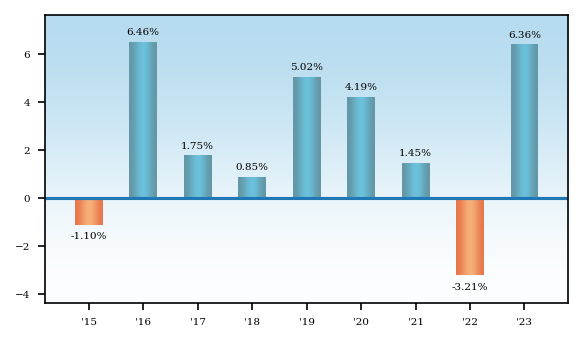
The Fund’s 2024 year-to-date return through September 30, 2024 is 5.41%.
During the periods shown in the bar chart, the highest return for a quarter was 4.83% during the quarter ended June 30, 2020 and the lowest return for a quarter was -3.12% during the quarter ended March 31, 2020.
After-tax returns are calculated using the historical highest individual federal marginal income tax rates and do not reflect the impact of state and local taxes. Actual after-tax returns depend on an investor’s tax situation and may differ from those shown, and after-tax returns shown are not relevant to investors who hold their Fund shares through tax-deferred arrangements, such as 401(k) plans or individual retirement accounts.
Average Annual Total Returns - Eubel Brady & Suttman Income Fund |
Label |
1 Year |
5 Years |
Since Inception |
Inception Date |
|---|---|---|---|---|---|
| Eubel Brady & Suttman Income Fund | Return Before Taxes | 6.36% | 2.71% | 2.27% | Sep. 30, 2014 |
| Eubel Brady & Suttman Income Fund | Return After Taxes on Distributions | 4.53% | 1.44% | 1.10% | ||
| Eubel Brady & Suttman Income Fund | Return After Taxes on Distributions and Sale of Fund Shares | 3.73% | 1.53% | 1.22% | ||
| Bloomberg U.S. Aggregate Bond Index (reflects no deduction for fees, expenses, or taxes) | 5.53% | 1.10% | 1.52% | ||
| ICE BofA U.S. Corporate & Government | 5.23% | 1.59% | 1.64% |
Fixed Income Securities. Any fixed income securities held by the Fund may be subject to certain risks, such as credit risk, interest rate risk and liquidity risk. At times there may be an imbalance of supply and demand in the markets which could result in greater price volatility, less liquidity, wider trading spreads and a lack of price transparency. Decisions by the Federal Reserve on interest rate policy can have a significant effect on the value of fixed-income securities. The decision by the Federal Reserve to increase interest rates in 2022 and to sell some of the U.S. Government securities on its balance sheet (i.e., quantitative tightening) in an effort to control inflation, resulted in market volatility, due in part to the prolonged period of unusually low interest rates preceding the rate hike.
| • | Interest Rate Risk. The price of a fixed income security is generally expected to decline during periods of rising interest rates. The magnitude of these fluctuations will generally be greater if the Fund holds securities with longer maturities and/or lower quality ratings. Interest rate changes can be sudden and unpredictable and are driven by a wide variety of factors, including central bank monetary policies, inflation rates, supply and demand and general economic conditions. |
| · | Credit Risk. Credit risk is the risk that the issuer of a security will not be able to make payments of interest and principal when due. Deterioration in the financial condition of an issuer or deterioration in general economic conditions could cause an issuer to fail to make timely payments of principal and interest, when due. Changes in an issuer’s credit rating or the market’s perception of an issuer’s creditworthiness may affect the value of the Fund’s investments in that issuer. Lower rated securities (commonly known as “high yield” or “junk” securities) are considered primarily speculative with respect to an issuer’s continuing ability to make principal and interest payments, when due. |
| U.S. Government securities are subject to varying degrees of credit risk, depending upon whether the securities are supported by the full faith and credit of the U.S. Government, the ability to borrow from the U.S. Treasury, or only by the credit of the issuing U.S. Government agency, instrumentality or corporation. See U.S. Government Securities Risk below. |
| · | Call Risk. Some of the securities that the Fund may own may be “callable”, which means the issuer can redeem the security prior to its maturity. When interest rates are low, an issuer will often redeem its callable securities early. In such a circumstance, the Fund may have to invest its investment proceeds from the callable security in another security offering a lower yield. |
| · | Senior Floating Rate Securities Risk. Investments in these types of securities may expose the Fund to a greater degree of credit risk (including default and bankruptcy), liquidity risk, and valuation risk than other investments. Investments in inverse floating rate securities typically involve greater risk than investments in municipal bonds of comparable maturity and credit quality and their values are more volatile than municipal bonds due to the leverage they entail. |
| · | Liquidity Risk. Liquidity risk is the risk that a security cannot be sold at an advantageous time and/or price in the secondary market, which could prevent the Fund from selling an investment at the approximate price that it is valued or the time it desires to sell. If a fixed income security is downgraded or drops in price, the market demand may be limited, potentially making that security difficult to sell. Additionally, the market for certain securities may become illiquid under adverse market or economic conditions, independent of any specific adverse changes in the conditions of a particular issuer. There is a risk that monetary policy actions by the U.S. Government to stimulate or stabilize the economy could result in less liquidity. Liquidity risk may be magnified in a rising interest rate environment or in other circumstances where investor redemptions may be higher than normal. Lower rated securities can be subject to greater levels of liquidity risk. |
| · | U.S. Government Securities Risk. The Fund may invest in securities issued by or guaranteed by the U.S. Government or its agencies and instrumentalities (such as the Government National Mortgage Association (Ginnie Mae), the Federal National Mortgage Association (Fannie Mae) or the Federal Home Loan Mortgage Corporation (Freddie Mac). U.S. Government securities are subject to varying degrees of credit risk, depending upon whether the securities are supported by the full faith and credit of the U.S. Government, the ability to borrow from the U.S. Treasury, or only by the credit of the issuing U.S. Government agency, instrumentality or corporation. No assurance can be given that the U.S. Government will provide financial support to U.S. Government agencies, instrumentalities, or sponsored enterprises if not required to do so by law. |
| · | Credit Risk. Credit risk is the risk that the issuer of a security will not be able to make payments of interest and principal when due. Deterioration in the financial condition of an issuer or deterioration in general economic conditions could cause an issuer to fail to make timely payments of principal and interest, when due. Changes in an issuer’s credit rating or the market’s perception of an issuer’s creditworthiness may affect the value of the Fund’s investments in that issuer. Lower rated securities (commonly known as “high yield” or “junk” securities) are considered primarily speculative with respect to an issuer’s continuing ability to make principal and interest payments, when due. |
| · | Liquidity Risk. Liquidity risk is the risk that a security cannot be sold at an advantageous time and/or price in the secondary market, which could prevent the Fund from selling an investment at the approximate price that it is valued or the time it desires to sell. If a fixed income security is downgraded or drops in price, the market demand may be limited, potentially making that security difficult to sell. Additionally, the market for certain securities may become illiquid under adverse market or economic conditions, independent of any specific adverse changes in the conditions of a particular issuer. There is a risk that monetary policy actions by the U.S. Government to stimulate or stabilize the economy could result in less liquidity. Liquidity risk may be magnified in a rising interest rate environment or in other circumstances where investor redemptions may be higher than normal. Lower rated securities can be subject to greater levels of liquidity risk. |
| • | Interest Rate Risk. The price of a fixed income security is generally expected to decline during periods of rising interest rates. The magnitude of these fluctuations will generally be greater if the Fund holds securities with longer maturities and/or lower quality ratings. Interest rate changes can be sudden and unpredictable and are driven by a wide variety of factors, including central bank monetary policies, inflation rates, supply and demand and general economic conditions. |
| · | Call Risk. Some of the securities that the Fund may own may be “callable”, which means the issuer can redeem the security prior to its maturity. When interest rates are low, an issuer will often redeem its callable securities early. In such a circumstance, the Fund may have to invest its investment proceeds from the callable security in another security offering a lower yield. |
Equity Security Risk. The return on and value of an equity security will fluctuate in response to stock market movements. Stocks tend to move in cycles and may decline in tandem with a drop in the overall value of the markets based on negative developments in the U.S. or global economies. Common and preferred stocks are subject to market risks, such as a rapid increase or decrease in a stock’s value or liquidity, and fluctuations in price due to earnings, economic conditions, and other factors beyond the control of the Adviser. The value of preferred stocks also will fluctuate with changes in interest rates. Preferred stocks also are subject to credit risk and the prices of preferred stock tend to move more slowly upwards than common stock prices. Local, regional or global events such as war, acts of terrorism, market manipulation, government defaults, government shutdowns, natural or environmental disasters, widespread disease, including pandemics and epidemics, high inflation, recessions, or other events could also have a significant impact on the Fund and its investments and potentially increase the risks described herein. Armed conflicts, the responses and sanctions by other countries, and the potential for wider conflicts can have adverse effects on regional and global economies.
| · | Significant Market Events. Periods of volatility may occur in response to market events and other economic, political and global macro factors. Decisions by the Federal Reserve on interest rate policy, the spread of infectious disease or other public health issues, armed conflicts, and higher inflation could have adverse effects on regional and global economies and negatively affect global growth and inflation. Large expansion of government deficits and debt as a result of government actions to mitigate the effects of these events, as well as political events within the U.S. and abroad, may affect investor and consumer confidence and adversely impact the financial markets. Investor perceptions may be based on unpredictable factors such as economic, fiscal policy, or political expectations. |
| · | Significant Market Events. Periods of volatility may occur in response to market events and other economic, political and global macro factors. Decisions by the Federal Reserve on interest rate policy, the spread of infectious disease or other public health issues, armed conflicts, and higher inflation could have adverse effects on regional and global economies and negatively affect global growth and inflation. Large expansion of government deficits and debt as a result of government actions to mitigate the effects of these events, as well as political events within the U.S. and abroad, may affect investor and consumer confidence and adversely impact the financial markets. Investor perceptions may be based on unpredictable factors such as economic, fiscal policy, or political expectations. |
Risks of Investments in RICs. Investments by the Fund in other investment companies, including ETFs, will expose investors to the risk that the underlying fund manager may change objectives which may or may not parallel the investment direction of the Fund. When the Fund invests in shares of RICs, there will be some duplication of expenses because it will indirectly pay a proportion of the RIC’s operating expenses.
Indebtedness Risk. Indebtedness is different from traditional debt securities in that debt securities are part of a large issue of securities to the public and indebtedness may not be a security, but may represent a specific commercial loan to a borrower. Loan participations typically represent direct participation, together with other parties, in a loan to a corporate borrower, and generally are offered by banks or other financial institutions or lending syndicates. The Fund may participate in such syndications, or can buy part of a loan, becoming a part lender. In addition, the Fund, or an agent of the Fund, may act as agent for the loan and be responsible for the collection of principal and interest payments from the corporate borrower. If the Fund enters into a lending arrangement, this type of investment may be considered an illiquid investment and may be difficult to sell or unwind in a timely manner. The Fund’s investments in indebtedness involve the risk of loss in case of default or insolvency of the borrower and the possibility of less legal protection in the event of fraud or misrepresentation.
The Fund’s investments in indebtedness, loan participations and assignments may subject the Fund to losses from casualty or condemnation, and changes in local and general economic conditions, supply and demand, interest rates, zoning laws, regulatory limitations on rents, property taxes and operating expenses.
Foreign Investment Risk. Investments in foreign securities are subject to the risk that world events, such as political upheaval or financial problems will adversely affect the value of securities issued in foreign countries or regions. The risks associated with changes in diplomatic relations, tensions or open conflict between nations, or political dysfunction with some nations that are global economic powers could affect the economies of many nations, including the U.S. The value of foreign investments may be affected by the imposition of new government regulations, political and economic instability, the imposition or tightening of exchange controls, increased taxation and confiscation of investor assets. Foreign economies may be less stable than the U.S. economy and foreign securities may not be subject to uniform audit or disclosure standards.
Sector Risk. An emphasis in one or more particular business sectors may cause the Fund’s share price to be more susceptible to the financial, market or economic events affecting issuers and industries within those sectors than would be the case for a mutual fund that does not emphasize investment in particular sectors. As of July 31, 2024, the Fund had 26.4% of the value of its net assets invested in securities within the financials sector. Companies in the financials sector are subject to certain risks, including the risk of corporate and consumer debt defaults, price competition, decreased liquidity in credit markets and the availability and cost of capital. Companies in the financials sector are also subject to extensive government regulations that may limit the amount and type of loans and other financial commitments, and impact interest rates.
Management Risk. The Adviser’s method of security selection may not be successful and the Fund may underperform relative to other mutual funds that employ similar investment strategies.
Cybersecurity Risk. Municipalities and corporations issuing securities in which the Fund invests, counterparties with which the Fund engages in transactions, exchange and other financial market operators, banks, brokers, dealers and other financial institutions may experience cybersecurity breaches. These breaches may result in harmful disruptions to their operations and negatively impact their financial condition. The Fund and its shareholders could be negatively impacted as a result.
| · | Senior Floating Rate Securities Risk. Investments in these types of securities may expose the Fund to a greater degree of credit risk (including default and bankruptcy), liquidity risk, and valuation risk than other investments. Investments in inverse floating rate securities typically involve greater risk than investments in municipal bonds of comparable maturity and credit quality and their values are more volatile than municipal bonds due to the leverage they entail. |
| · | U.S. Government Securities Risk. The Fund may invest in securities issued by or guaranteed by the U.S. Government or its agencies and instrumentalities (such as the Government National Mortgage Association (Ginnie Mae), the Federal National Mortgage Association (Fannie Mae) or the Federal Home Loan Mortgage Corporation (Freddie Mac). U.S. Government securities are subject to varying degrees of credit risk, depending upon whether the securities are supported by the full faith and credit of the U.S. Government, the ability to borrow from the U.S. Treasury, or only by the credit of the issuing U.S. Government agency, instrumentality or corporation. No assurance can be given that the U.S. Government will provide financial support to U.S. Government agencies, instrumentalities, or sponsored enterprises if not required to do so by law. |
Mortgage-Backed Securities Risk. Mortgage-backed securities are subject to credit risk depending on whether they are issued by agencies and instrumentalities of the U.S. Government and risks unique to the housing industry, including defaults, foreclosures and changes in real estate values. Mortgage-backed securities also are subject to prepayment risk, especially when interest rates decline.
Asset-Backed Securities Risk. The value of asset-backed securities may be significantly affected by changes in interest rates, the market’s perception of issuers and the creditworthiness of the parties involved. These securities are subject to prepayment risk. As interest rates rise, there may be fewer prepayments, which would cause the average bond maturity to rise, increasing the potential for the Fund to lose money.
Municipal Securities. The value of municipal bonds may fluctuate as a result of changes in the cash flows, or the ability to receive the cash flows, generated by the revenue source(s). In addition, changes in federal tax laws or the activity of an issuer may adversely affect the tax-exempt status of municipal bonds. The value of municipal securities in which the Fund invests may be affected by economic, regulatory, political and social developments. For example, downgrades or defaults during economic downturns or similar periods of economic stress, could affect the market values and marketability of many or all municipal obligations of issuers in a state, U.S. territory, or possession.