The Arrow DWA Tactical: Macro ETF (the “Fund”) seeks to achieve long-term capital appreciation
with capital preservation as a secondary objective.
The table below describes the fees and expenses you may pay if you buy, hold, and sell shares of the Fund. Investors may pay other fees, such as brokerage commissions and other fees to financial intermediaries, on their purchases and sales of shares in the secondary market, which are not reflected in the table or the example below.
Shareholder Fees |
Arrow DWA Tactical: Macro ETF
Arrow DWA Tactical: Macro ETF
USD ($)
|
|---|---|
| Shareholder Fees (fees paid directly from your investment) | none |
Annual Fund Operating Expenses |
Arrow DWA Tactical: Macro ETF
Arrow DWA Tactical: Macro ETF
|
|
|---|---|---|
| Management Fees | 0.90% | |
| Distribution and/or Service (12b-1) Fees | none | |
| Other Expenses | 4.43% | |
| Acquired Fund Fees and Expenses | 0.23% | [1] |
| Total Annual Fund Operating Expenses | 5.56% | |
| Fee Waiver | (3.73%) | [2] |
| Total Annual Fund Operating Expenses After Fee Waiver | 1.83% | |
| [1] | Acquired Fund Fees and Expenses are the indirect costs of investing in other investment companies. |
| [2] | Arrow Investment Advisors, LLC (the “Advisor”) has contractually agreed to waive its fees and/or reimburse expenses of the Fund, at least until December 31, 2025 to ensure that Total Annual Fund Operating Expenses After Fee Waiver and/or Reimbursement (exclusive of any front-end or contingent deferred loads, taxes, leverage interest, brokerage commissions, expenses incurred in connection with any merger or reorganization, dividend expense on securities sold short, underlying fund fees and expenses, foreign custody transaction costs and foreign account set-up fees and extraordinary expenses such as litigation) do not exceed 1.60% of the Fund’s average daily net assets. These fee waivers and expense reimbursements are subject to possible recoupment from the Fund in future years on a rolling three-year basis (within the three years after the fees have been waived or reimbursed) if such recoupment can be achieved within the lesser of the foregoing expense limit or the expense limit that was in place at the time of waiver. This agreement may be terminated only by the Trust’s Board of Trustees on 60 days written notice to the Advisor. |
This Example is intended to help you compare the cost of investing in the Fund with the cost of investing in other funds.
Expense Example |
Expense Example, with Redemption, 1 Year |
Expense Example, with Redemption, 3 Years |
Expense Example, with Redemption, 5 Years |
Expense Example, with Redemption, 10 Years |
|---|---|---|---|---|
| Arrow DWA Tactical: Macro ETF | Arrow DWA Tactical: Macro ETF | USD ($) | 186 | 1,327 | 2,455 | 5,220 |
The Fund pays transaction costs, such as commissions, when it buys and sells securities (or “turns over” its portfolio). A higher portfolio turnover rate may indicate higher transaction costs and may result in higher taxes when Fund shares are held in a taxable account. These costs, which are not reflected in Annual Fund Operating Expenses or in the Example, affect the Fund’s performance. During the most recent fiscal year, the Fund’s portfolio turnover rate was 193% of the average value of its portfolio.
The Fund primarily invests in other exchange traded funds (“ETFs”) that invest primarily in domestic and foreign (including emerging markets) (i) equity securities of any market capitalization, (ii) fixed-income securities of any credit quality, or (iii) alternative assets. In addition, the Fund may invest in commodity futures through a wholly-owned and controlled Cayman subsidiary (the “Tactical Subsidiary”).
The Fund defines equity securities to be exchange traded common and preferred stocks; defines fixed-income securities to be bonds, notes, debentures or similar instruments; and defines alternative assets to be investments that are historically uncorrelated to either equity or fixed income investments. Alternative assets include, commodity futures, commodities, exchange traded master limited partnerships (“MLPs”), real estate-related securities (including foreign and domestic exchange traded real estate investment trusts (“REITs”), exchange traded real estate operating companies (“REOCs”) or similar instruments), and U.S. exchange traded funds that invest in bitcoin futures (collectively, “Bitcoin ETFs”). The Fund does not make direct investments in bitcoin and limits its investments in bitcoin to ETFs that invest in bitcoin futures. The Fund may invest up to 10% of its assets in such Bitcoin ETFs.
The Fund’s fixed income securities may be rated below investment grade (rated BB+ or lower by Standard & Poor’s Ratings Services (“S&P”) or comparably rated by another nationally recognized statistical rating organization (“NRSRO”)), also known as “high-yield” or “junk” bonds, and in unrated debt securities determined by the Advisor to be of comparable quality.
The Fund is a “fund of funds,” which means that it primarily invests in ETFs; however, when appropriate, the Advisor may elect to invest directly in the types of securities described above (other than commodities). The Fund may also invest in other investment companies (including affiliated funds).
The Advisor allocates the Fund’s portfolio using research from Dorsey Wright & Associates (“DWA”), which comes from the DWA Global Macro investment model (the “DWA Global Macro model”), as well as the Advisor’s proprietary methodology. The DWA Global Macro model is based on a technical analysis of historical price and return forecasts. Technical analysis is the method of evaluating securities by analyzing statistics generated by market activity, such as past prices and trading volume, in an effort to determine probable future prices. The Advisor buys securities and derivatives that it believes will produce returns that are highly correlated to the returns of the components of the DWA Global Macro model. The Advisor sells securities and derivatives to purchase other securities and derivatives that it believes will have higher returns or more closely correlate to the returns of the components of the DWA Global Macro model. The Fund invests in securities without restriction as to capitalization, credit quality or country.
Under normal market conditions, the Fund invests:
| ● | From 0% to 100% of its assets in ETFs that invest in equity securities; |
| ● | From 0% to 100% of its assets in ETFs that invest in fixed-income securities; and |
| ● | From 0% up to 90% of its assets in ETFs that invest in alternative assets. |
The Fund may invest up to 25% of its total assets in the Tactical Subsidiary. The Tactical Subsidiary invests primarily in commodity futures, as well as fixed-income securities and cash equivalents, which are intended to serve as margin or collateral for the Tactical Subsidiary’s investments in commodity futures. When viewed on a consolidated basis, the Tactical Subsidiary is subject to the same investment restrictions as the Fund. The Fund consolidates the Tactical Subsidiary for purposes of financial statements, leverage and concentration. The Advisor is solely responsible for managing the assets of the Tactical Subsidiary.
The Fund invests in ETFs within specific asset classes when the research provided by DWA indicates a high probability that the applicable asset classes and ETFs are likely to outperform the applicable universe. The Fund sells interests or reduces investment exposure among an asset class or ETF when the research provided by DWA indicates that such asset class or ETF is likely to underperform the applicable universe. The Fund may invest more heavily in fixed-income ETFs, cash positions and similar securities when the research provided by DWA indicates these assets should significantly outperform the equity and/or alternative asset classes.
In general, the Fund’s investments in equity securities are intended to achieve the capital appreciation component of the Fund’s investment objectives. At times, the Fund may invest in fixed-income securities in order to achieve the capital preservation component of the Fund’s investment objectives. The Fund’s investments in alternative assets are intended to enable the portfolio to be less reliant on fixed-income investments for reducing volatility and equities for increasing returns. The Advisor may engage in frequent buying and selling of portfolio securities to achieve the Fund’s investment objectives.
As with all funds, there is the risk that you could lose money through your investment in the Fund. Many factors affect the Fund’s net asset value, price of shares, and performance. The following describes the principal risks the Fund bears with respect to its direct investments as well as indirectly through investments in ETFs and the Tactical Subsidiary. As with any fund, there is no guarantee that the Fund will achieve its objective.
| ● | Affiliated Investment Company Risk: The Fund invests in affiliated underlying funds (the “Arrow Advised Funds”), unaffiliated underlying funds, or a combination of both. The Advisor, therefore, is subject to conflicts of interest in allocating the Fund’s assets among the underlying funds. The Advisor will receive more revenue to the extent it selects an Arrow Advised Fund rather than an unaffiliated fund for inclusion in the Fund’s portfolio. |
In addition, the Advisor may have an incentive to allocate the Fund’s assets to those Arrow Advised Funds for which the net advisory fees payable to the Advisor are higher than the fees payable by other Arrow Advised Funds. The Arrow Advised Funds in which the Fund may invest are not money market funds and are riskier than a money market fund.
| ● | Bitcoin Risk: Bitcoin is a type of cryptocurrency. Cryptocurrencies (also referred to as “virtual currencies” and “digital currencies”) are digital assets designed to act as a medium of exchange. Cryptocurrency is an emerging asset class. There are thousands of cryptocurrencies, the most well-known of which is bitcoin. The Fund may have exposure to bitcoin indirectly through investments in U.S. bitcoin ETFs. Cryptocurrency generally operates without central authority (such as a bank) and is not backed by any government, corporation, or other entity. Cryptocurrency is not generally accepted as legal tender. Regulation of cryptocurrency is still developing. Federal, state and/or foreign governments may restrict the development, use, or exchange of cryptocurrency. The market price of bitcoin has been subject to extreme fluctuations. The price of bitcoin could fall sharply (potentially to zero) for various reasons, including, but not limited to, regulatory changes, issues impacting the Bitcoin network, events involving entities that facilitate transactions in bitcoin, or changes in user preferences in favor of alternative cryptocurrencies. Furthermore, events that impact one cryptocurrency may lead to a decline in the value of other cryptocurrencies, including bitcoin. Cryptocurrency exchanges and other trading venues on which cryptocurrencies trade are relatively new and, in most cases, largely unregulated. |
Therefore, cryptocurrency exchanges may be more exposed to fraud and failure than established, regulated exchanges for securities, derivatives and other currencies. Cryptocurrency exchanges may not have the same features as traditional exchanges to enhance the stability of trading on the exchange, such as measures designed to prevent sudden price swings such as “flash crashes.” As a result, the prices of cryptocurrencies on exchanges, and bitcoin futures, may be subject to more volatility than traditional assets traded on regulated exchanges. Cryptocurrency exchanges are also subject to cyber security risks. Cryptocurrency exchanges have experienced cyber security breaches in the past and may be breached in the future, which could result in the theft and/or loss of bitcoin and other cryptocurrencies and impact the value of bitcoin and bitcoin futures. Furthermore, cyber security events, legal or regulatory actions, fraud, and technical glitches, may cause a cryptocurrency exchange to shut down temporarily or permanently, which may also affect the value of bitcoin and bitcoin futures. The Fund’s investments in Bitcoin ETFs expose the Fund to all of the risks related to cryptocurrencies described above and also expose the Fund to risks related to Bitcoin ETFs directly. Shares of Bitcoin ETFs may trade at a significant premium or discount to NAV. To the extent a Bitcoin ETF trades at a discount to NAV, the value of the Fund’s investment in that Bitcoin ETF would typically decrease. Furthermore, because there is no guarantee that an active trading market for Bitcoin ETFs will exist at any time, the Fund’s investments in Bitcoin ETFs may also be subject to liquidity risk, which can impair the value of the Fund’s investments in Bitcoin ETFs. Investors may experience losses if the value of the Fund’s investments in Bitcoin ETFs decline.
| ● | Bitcoin Tax Risk: Many significant aspects of the U.S. federal income tax treatment of investments in bitcoin (whether direct or indirect) are uncertain, and a direct or indirect investment in bitcoin may produce income that is not treated as qualifying income for purposes of the income test applicable to regulated investment companies, such as the Fund. |
| ● | Commodity Risk: ETFs investing in the commodities markets and investments in the Tactical Subsidiary may subject the Fund to greater volatility than investments in traditional securities. |
| ● | Credit Risk: There is a risk that issuers and counterparties will not make payments on securities and other investments held by the Fund or through an ETF, resulting in losses to the Fund. In addition, the credit quality of securities held by the Fund may be lowered if an issuer’s financial condition changes. Lower credit quality may lead to greater volatility in the price of a security and in shares of the Fund. Lower credit quality also may affect liquidity and make it difficult for the Fund to sell the security. The Fund may invest, directly or indirectly, in “junk bonds.” Such securities are speculative investments that carry greater risks than higher quality debt securities. |
| ● | Emerging Markets Risk: Investing in emerging markets involves not only the risks described below with respect to investing in foreign securities, but also other risks, including exposure to economic structures that are generally less diverse and mature, and to political systems that can be expected to have less stability, than those of developed countries. The typically small size of the markets of securities of issuers located in emerging markets and the possibility of a low or nonexistent volume of trading in those securities may also result in a lack of liquidity and in price volatility of those securities. |
| ● | Equity Securities Risk: Equity securities are susceptible to general stock market fluctuations and to volatile increases and decreases in value. The equity securities held by the Fund may experience sudden, unpredictable drops in value or long periods of decline in value. This may occur because of factors affecting securities markets generally, the equity securities of a particular sector, or a particular company. |
| ● | ETF Investment Risk: ETFs are subject to investment advisory and other expenses, which will be indirectly paid by the Fund. As a result, the cost of investing in the Fund will be higher than the cost of investing directly in ETFs and may be higher than other mutual funds that invest directly in stocks and bonds. The ETFs in which the Fund invests will not be able to replicate exactly the performance of the indices they track, and the market value of ETF shares may differ from their net asset value. Each ETF is subject to specific risks, depending on the nature of the ETF and ETFs that invest in the “Alternative Asset” market segment may be more volatile than other Fund investments. |
| ● | ETF Structure Risk: The Fund is structured as an ETF and as a result is subject to the special risks, including: |
| ○ | Not Individually Redeemable. Shares of the Fund (“Shares”) are not individually redeemable and may be redeemed by the Fund at net asset value (“NAV”) only in large blocks known as “Creation Units.” There can be no assurance that there will be sufficient liquidity in Shares in the secondary market to permit assembly of a Creation Unit. In addition, investors may incur brokerage and other costs in connection with assembling a Creation Unit. |
| ○ | Trading Issues. Trading in Shares on Cboe may be halted due to market conditions or for reasons that, in the view of Cboe, make trading in Shares inadvisable, such as extraordinary market volatility. There can be no assurance that Shares will continue to meet the listing requirements of Cboe which may result in the Shares being delisted. An active trading market for the Shares may not be developed or maintained. If the securities in the Fund’s portfolio are traded outside a collateralized settlement system, the number of financial institutions that can act as authorized participants (“Authorized Participants”) that can post collateral on an agency basis is limited, which may limit the market for the Shares. |
| ● | Fixed Income Risk: When the Fund invests in ETFs that own bonds, or in this type of security directly, the value of your investment in the Fund will fluctuate with changes in interest rates. Typically, a rise in interest rates causes a decline in the value of bond funds owned by the Fund. On the other hand, if rates fall, the value of the fixed income securities generally increases. Your investment will decline in value if the value of the Fund’s investments decreases. |
| ● | Foreign Investment Risk: Although the Fund does not invest in the securities of foreign companies directly other than the Tactical Subsidiary, it may invest in ETFs that invest in foreign international equity securities. Foreign investing involves risks not typically associated with U.S. investments, including adverse fluctuations in foreign currency values, adverse political, social and economic developments, less liquidity, greater volatility, less developed or less efficient trading markets, political instability and differing auditing and legal standards. |
Investing in emerging markets imposes risks different from, or greater than, risks of investing in foreign developed countries.
| ● | Futures Risk: The Fund’s use of futures involves risks different from, or possibly greater than, the risks associated with investing directly in securities and other traditional investments. These risks include (i) leverage risk (ii) risk of mispricing or improper valuation; and (iii) the risk that changes in the value of the futures contract may not correlate perfectly with the underlying asset. Investments in futures involve leverage, which means a small percentage of assets invested in futures can have a disproportionately large impact on the Fund. This risk could cause the Fund to lose more than the principal amount invested. Futures contracts may become mispriced or improperly valued when compared to the Advisor’s expectation and may not produce the desired investment results. Additionally, changes in the value of futures contracts may not track or correlate perfectly with the underlying asset because of temporary, or even long-term, supply and demand imbalances and because futures do not pay dividends unlike the securities upon which they are based. |
| ● | Issuer-Specific Risk: The value of a specific security or ETF can be more volatile than the market as a whole and can perform differently from the value of the market as a whole. The value of securities of smaller issuers can be more volatile than that of larger issuers. The value of certain types of securities can be more volatile due to increased sensitivity to adverse issuer, political, regulatory, market, or economic developments. The value of a debt security may decline for a number of reasons directly related to the issuer of such security, such as management performance, financial leverage and reduced demand for the issuer’s goods or services. |
| ● | Junk Bond Risk: Lower-quality bonds, known as “high yield” or “junk” bonds, present greater risk than bonds of higher quality, including an increased risk of default. An economic downturn or period of rising interest rates could adversely affect the market for these bonds and reduce the Fund’s ability to sell its bonds. The lack of a liquid market for these bonds could decrease the Fund’s share price. |
| ● | Leverage Risk: Using derivatives to increase the Fund’s exposure creates leverage, which can magnify the Fund’s potential for gain or loss and, therefore, amplify the effects of market volatility on the Fund’s share price. |
| ● | Management Risk: The Advisor’s investment decisions about individual securities and derivatives as well as ETFs impact the Fund’s ability to achieve its investment objective. The Advisor’s judgments about the attractiveness and potential appreciation of particular investments in which the Fund invests may prove to be incorrect and there is no guarantee that the Advisor’s investment strategy will produce the desired results. |
| ● | Market and Geopolitical Risk: The increasing interconnectivity between global economies and financial markets increases the likelihood that events or conditions in one region or financial market may adversely impact issuers in a different country, region or financial market. Securities in the Fund’s portfolio may underperform due to inflation (or expectations for inflation), interest rates, global demand for particular products or resources, natural disasters, climate change and climate related events, pandemics, epidemics, terrorism, international conflicts, regulatory events and governmental or quasi-governmental actions. The occurrence of global events similar to those in recent years may result in market volatility and may have long term effects on both the U.S. and global financial markets. |
| ● | Market Price Variance Risk: The market prices of Shares will fluctuate in response to changes in NAV and supply and demand for Shares and will include a “bid-ask spread” charged by the exchange specialists, market makers or other participants that trade the particular security. There may be times when the market price and the NAV vary significantly. This means that Shares may trade at a discount to NAV. |
| ○ | In times of market stress, market makers may step away from their role of market making in shares of ETFs and in executing trades, which can lead to differences between the market value of Shares and the Fund’s NAV. |
| ○ | The market price for the Shares may deviate from the Fund’s NAV, particularly during times of market stress, with the result that investors may pay significantly more or significantly less for Shares than the Fund’s NAV, which is reflected in the bid and ask price for Shares or in the closing price. |
| ○ | When all or a portion of an ETF’s underlying securities trade in a market that is closed when the market for the Shares is open, there may be changes from the last quote of the closed market and the quote from the Fund’s domestic trading day, which could lead to differences between the market value of the Shares and the Fund’s NAV. |
| ○ | In stressed market conditions, the market for the Shares may become less liquid in response to the deteriorating liquidity of the Fund’s portfolio. This adverse effect on the liquidity of the Fund’s shares may, in turn, lead to differences between the market value of the Shares and the Fund’s NAV. |
| ● | Portfolio Turnover Risk: Portfolio turnover refers to the rate at which the securities held by the Fund are replaced. The higher the rate, the higher the transactional and brokerage costs associated with the turnover, which may reduce the Fund’s return unless the securities traded can be bought and sold without corresponding commission costs. Active trading of securities may also increase the Fund’s realized capital gains or losses, which may affect the taxes you pay as the Fund shareholder. |
| ● | Real Estate Risk: ETFs that invest in real estate are subject to the risks associated with investing in real estate. The value of these securities will rise and fall in response to many factors, including economic conditions, the demand for rental property and changes in interest rates. |
| ● | Regulatory Risk: Regulatory authorities in the United States or other countries may restrict the ability of the Fund to fully implement its strategy, either generally, or with respect to certain securities, industries or countries, which may impact the Fund’s ability to fully implement its investment strategies. |
| ● | Sector Risk: The Fund may focus its investments in securities of a particular sector or in ETFs that focus investments in securities of a particular sector. Economic, legislative or regulatory developments may occur, which significantly affect the entire sector. This may cause the Fund’s NAV to fluctuate more than that of the Fund that does not focus in a particular sector. |
| ● | Small and Medium Capitalization Stock Risk: The value of a small or medium capitalization company stocks or ETFs that invests in stocks of small and medium capitalization companies may be subject to more abrupt or erratic market movements than those of larger, more established companies or the market averages in general. |
| ● | Taxation Risk: By investing in commodities indirectly through the Tactical Subsidiary, the Fund obtains exposure to the commodities markets within the federal tax requirements that apply to the Fund. However, because the Tactical Subsidiary is a controlled foreign corporation, any income received from the Tactical Subsidiary is passed through to the Fund as ordinary income, which may be taxed at less favorable rates than capital gains. |
| ● | Wholly Owned Subsidiary Risk: The Tactical Subsidiary is not registered under the Investment Company Act of 1940, as amended (“1940 Act”) and, unless otherwise noted in this Prospectus, is not subject to all of the investor protections of the 1940 Act. Changes in the laws of the United States and/or the Cayman Islands, under which the Fund and Tactical Subsidiary, respectively, are or will be organized, could result in the inability of the Fund and/or Subsidiary to operate as described in this Prospectus and could negatively affect the Fund and its shareholders. Your cost of investing in the Fund will be higher because you indirectly bear the expenses of the Tactical Subsidiary. |
The bar chart and performance table below show the variability of the Fund’s return, which is some indication of the risks of investing in the Fund. The bar chart shows performance of the Fund’s shares for each full calendar year since the Fund’s inception. The performance table compares the performance of the Fund’s shares over time to the performance of a broad-based securities market index and supplementary indexes. You should be aware that the Fund’s past performance (before and after taxes) may not be an indication of how the Fund will perform in the future. Updated performance information and daily NAV per share information is available at no cost by visiting www.ArrowFunds.com or by calling 1-877-277-6933 (1-877-ARROW-FD).
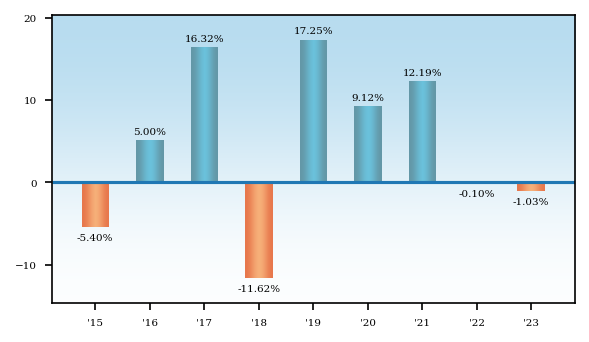
| Best Quarter | 6/30/2020 | 14.52% |
| Worst Quarter | 3/31/2020 | (19.56)% |
The year-to-date return as of the most recent calendar quarter, which ended September 30, 2024, was 12.93%.
Average Annual Total Returns - Arrow DWA Tactical: Macro ETF |
Label |
1 Year |
5 Years |
Since Inception |
[1] | Inception Date |
|
|---|---|---|---|---|---|---|---|
| Arrow DWA Tactical: Macro ETF | Return Before Taxes | (1.03%) | 7.25% | 4.83% | Sep. 30, 2014 | ||
| Arrow DWA Tactical: Macro ETF | Return after Taxes on Distributions | (1.15%) | 5.47% | 3.65% | ||||
| Arrow DWA Tactical: Macro ETF | Return after Taxes on Distributions and Sale of Fund Shares | (0.52%) | 5.42% | 3.61% | ||||
| Barclay Global Macro Index (reflects no deduction for fees, expenses or taxes) | 4.84% | 7.42% | 4.34% | ||||
| Morningstar Global Flexible Allocation EW Index (reflects no deduction for fees, expenses or taxes) | [2] | 9.17% | 4.99% | 3.27% | |||
| PCM Global Macro Index (reflects no deduction for fees, expenses or taxes) | [3] | 4.33% | 1.71% | 1.55% | |||
| Wilshire Liquid Alternative Global Macro Index (reflects no deduction for fees, expenses or taxes) | [4] | (1.71%) | 3.56% | 1.24% | |||
| [1] | Commencement of trading was |
| [2] | The Morningstar Global Flexible EW Index offers exposure to all of the major asset classes globally, but do not have a specific target asset allocation, thus may invest in variable proportions of stocks, bond or cash. Investors cannot invest directly in an index. |
| [3] | The PCM Global Macro Index is an actively managed quantitative index that has an absolute, total-return approach which offers exposure to broad based equities, fixed income, currencies and commodities. Investors cannot invest directly in an index. |
| [4] | The Wilshire Liquid Alternative Global Macro Index measures the performance of the global macro strategy component of the Wilshire Liquid Alternative IndexSM. Global macro strategies predominantly invest in situations driven by the macro-economic environment across the capital structure as well as currencies and commodities. The Wilshire Liquid Alternative Global Macro Index is designed to provide a broad measure of the liquid alternative global macro market. Investors cannot invest directly in an index. |
After-tax returns are calculated using the historical highest individual federal marginal income tax rates during the period covered by the table above and do not reflect the impact of state and local taxes. Actual after-tax returns depend on an investor’s tax situation and may differ from those shown. After-tax returns shown are not relevant to investors who hold their Shares through tax-deferred arrangements such as an individual retirement account (“IRA”) or other tax-advantaged accounts.
| ● | Affiliated Investment Company Risk: The Fund invests in affiliated underlying funds (the “Arrow Advised Funds”), unaffiliated underlying funds, or a combination of both. The Advisor, therefore, is subject to conflicts of interest in allocating the Fund’s assets among the underlying funds. The Advisor will receive more revenue to the extent it selects an Arrow Advised Fund rather than an unaffiliated fund for inclusion in the Fund’s portfolio. |
In addition, the Advisor may have an incentive to allocate the Fund’s assets to those Arrow Advised Funds for which the net advisory fees payable to the Advisor are higher than the fees payable by other Arrow Advised Funds. The Arrow Advised Funds in which the Fund may invest are not money market funds and are riskier than a money market fund.
| ● | Bitcoin Risk: Bitcoin is a type of cryptocurrency. Cryptocurrencies (also referred to as “virtual currencies” and “digital currencies”) are digital assets designed to act as a medium of exchange. Cryptocurrency is an emerging asset class. There are thousands of cryptocurrencies, the most well-known of which is bitcoin. The Fund may have exposure to bitcoin indirectly through investments in U.S. bitcoin ETFs. Cryptocurrency generally operates without central authority (such as a bank) and is not backed by any government, corporation, or other entity. Cryptocurrency is not generally accepted as legal tender. Regulation of cryptocurrency is still developing. Federal, state and/or foreign governments may restrict the development, use, or exchange of cryptocurrency. The market price of bitcoin has been subject to extreme fluctuations. The price of bitcoin could fall sharply (potentially to zero) for various reasons, including, but not limited to, regulatory changes, issues impacting the Bitcoin network, events involving entities that facilitate transactions in bitcoin, or changes in user preferences in favor of alternative cryptocurrencies. Furthermore, events that impact one cryptocurrency may lead to a decline in the value of other cryptocurrencies, including bitcoin. Cryptocurrency exchanges and other trading venues on which cryptocurrencies trade are relatively new and, in most cases, largely unregulated. |
Therefore, cryptocurrency exchanges may be more exposed to fraud and failure than established, regulated exchanges for securities, derivatives and other currencies. Cryptocurrency exchanges may not have the same features as traditional exchanges to enhance the stability of trading on the exchange, such as measures designed to prevent sudden price swings such as “flash crashes.” As a result, the prices of cryptocurrencies on exchanges, and bitcoin futures, may be subject to more volatility than traditional assets traded on regulated exchanges. Cryptocurrency exchanges are also subject to cyber security risks. Cryptocurrency exchanges have experienced cyber security breaches in the past and may be breached in the future, which could result in the theft and/or loss of bitcoin and other cryptocurrencies and impact the value of bitcoin and bitcoin futures. Furthermore, cyber security events, legal or regulatory actions, fraud, and technical glitches, may cause a cryptocurrency exchange to shut down temporarily or permanently, which may also affect the value of bitcoin and bitcoin futures. The Fund’s investments in Bitcoin ETFs expose the Fund to all of the risks related to cryptocurrencies described above and also expose the Fund to risks related to Bitcoin ETFs directly. Shares of Bitcoin ETFs may trade at a significant premium or discount to NAV. To the extent a Bitcoin ETF trades at a discount to NAV, the value of the Fund’s investment in that Bitcoin ETF would typically decrease. Furthermore, because there is no guarantee that an active trading market for Bitcoin ETFs will exist at any time, the Fund’s investments in Bitcoin ETFs may also be subject to liquidity risk, which can impair the value of the Fund’s investments in Bitcoin ETFs. Investors may experience losses if the value of the Fund’s investments in Bitcoin ETFs decline.
| ● | Bitcoin Tax Risk: Many significant aspects of the U.S. federal income tax treatment of investments in bitcoin (whether direct or indirect) are uncertain, and a direct or indirect investment in bitcoin may produce income that is not treated as qualifying income for purposes of the income test applicable to regulated investment companies, such as the Fund. |
| ● | Commodity Risk: ETFs investing in the commodities markets and investments in the Tactical Subsidiary may subject the Fund to greater volatility than investments in traditional securities. |
| ● | Credit Risk: There is a risk that issuers and counterparties will not make payments on securities and other investments held by the Fund or through an ETF, resulting in losses to the Fund. In addition, the credit quality of securities held by the Fund may be lowered if an issuer’s financial condition changes. Lower credit quality may lead to greater volatility in the price of a security and in shares of the Fund. Lower credit quality also may affect liquidity and make it difficult for the Fund to sell the security. The Fund may invest, directly or indirectly, in “junk bonds.” Such securities are speculative investments that carry greater risks than higher quality debt securities. |
| ● | Emerging Markets Risk: Investing in emerging markets involves not only the risks described below with respect to investing in foreign securities, but also other risks, including exposure to economic structures that are generally less diverse and mature, and to political systems that can be expected to have less stability, than those of developed countries. The typically small size of the markets of securities of issuers located in emerging markets and the possibility of a low or nonexistent volume of trading in those securities may also result in a lack of liquidity and in price volatility of those securities. |
| ● | Equity Securities Risk: Equity securities are susceptible to general stock market fluctuations and to volatile increases and decreases in value. The equity securities held by the Fund may experience sudden, unpredictable drops in value or long periods of decline in value. This may occur because of factors affecting securities markets generally, the equity securities of a particular sector, or a particular company. |
| ● | ETF Investment Risk: ETFs are subject to investment advisory and other expenses, which will be indirectly paid by the Fund. As a result, the cost of investing in the Fund will be higher than the cost of investing directly in ETFs and may be higher than other mutual funds that invest directly in stocks and bonds. The ETFs in which the Fund invests will not be able to replicate exactly the performance of the indices they track, and the market value of ETF shares may differ from their net asset value. Each ETF is subject to specific risks, depending on the nature of the ETF and ETFs that invest in the “Alternative Asset” market segment may be more volatile than other Fund investments. |
| ● | ETF Structure Risk: The Fund is structured as an ETF and as a result is subject to the special risks, including: |
| ○ | Not Individually Redeemable. Shares of the Fund (“Shares”) are not individually redeemable and may be redeemed by the Fund at net asset value (“NAV”) only in large blocks known as “Creation Units.” There can be no assurance that there will be sufficient liquidity in Shares in the secondary market to permit assembly of a Creation Unit. In addition, investors may incur brokerage and other costs in connection with assembling a Creation Unit. |
| ○ | Trading Issues. Trading in Shares on Cboe may be halted due to market conditions or for reasons that, in the view of Cboe, make trading in Shares inadvisable, such as extraordinary market volatility. There can be no assurance that Shares will continue to meet the listing requirements of Cboe which may result in the Shares being delisted. An active trading market for the Shares may not be developed or maintained. If the securities in the Fund’s portfolio are traded outside a collateralized settlement system, the number of financial institutions that can act as authorized participants (“Authorized Participants”) that can post collateral on an agency basis is limited, which may limit the market for the Shares. |
| ● | Fixed Income Risk: When the Fund invests in ETFs that own bonds, or in this type of security directly, the value of your investment in the Fund will fluctuate with changes in interest rates. Typically, a rise in interest rates causes a decline in the value of bond funds owned by the Fund. On the other hand, if rates fall, the value of the fixed income securities generally increases. Your investment will decline in value if the value of the Fund’s investments decreases. |
| ● | Foreign Investment Risk: Although the Fund does not invest in the securities of foreign companies directly other than the Tactical Subsidiary, it may invest in ETFs that invest in foreign international equity securities. Foreign investing involves risks not typically associated with U.S. investments, including adverse fluctuations in foreign currency values, adverse political, social and economic developments, less liquidity, greater volatility, less developed or less efficient trading markets, political instability and differing auditing and legal standards. |
Investing in emerging markets imposes risks different from, or greater than, risks of investing in foreign developed countries.
| ● | Futures Risk: The Fund’s use of futures involves risks different from, or possibly greater than, the risks associated with investing directly in securities and other traditional investments. These risks include (i) leverage risk (ii) risk of mispricing or improper valuation; and (iii) the risk that changes in the value of the futures contract may not correlate perfectly with the underlying asset. Investments in futures involve leverage, which means a small percentage of assets invested in futures can have a disproportionately large impact on the Fund. This risk could cause the Fund to lose more than the principal amount invested. Futures contracts may become mispriced or improperly valued when compared to the Advisor’s expectation and may not produce the desired investment results. Additionally, changes in the value of futures contracts may not track or correlate perfectly with the underlying asset because of temporary, or even long-term, supply and demand imbalances and because futures do not pay dividends unlike the securities upon which they are based. |
| ● | Issuer-Specific Risk: The value of a specific security or ETF can be more volatile than the market as a whole and can perform differently from the value of the market as a whole. The value of securities of smaller issuers can be more volatile than that of larger issuers. The value of certain types of securities can be more volatile due to increased sensitivity to adverse issuer, political, regulatory, market, or economic developments. The value of a debt security may decline for a number of reasons directly related to the issuer of such security, such as management performance, financial leverage and reduced demand for the issuer’s goods or services. |
| ● | Junk Bond Risk: Lower-quality bonds, known as “high yield” or “junk” bonds, present greater risk than bonds of higher quality, including an increased risk of default. An economic downturn or period of rising interest rates could adversely affect the market for these bonds and reduce the Fund’s ability to sell its bonds. The lack of a liquid market for these bonds could decrease the Fund’s share price. |
| ● | Leverage Risk: Using derivatives to increase the Fund’s exposure creates leverage, which can magnify the Fund’s potential for gain or loss and, therefore, amplify the effects of market volatility on the Fund’s share price. |
| ● | Management Risk: The Advisor’s investment decisions about individual securities and derivatives as well as ETFs impact the Fund’s ability to achieve its investment objective. The Advisor’s judgments about the attractiveness and potential appreciation of particular investments in which the Fund invests may prove to be incorrect and there is no guarantee that the Advisor’s investment strategy will produce the desired results. |
| ● | Market and Geopolitical Risk: The increasing interconnectivity between global economies and financial markets increases the likelihood that events or conditions in one region or financial market may adversely impact issuers in a different country, region or financial market. Securities in the Fund’s portfolio may underperform due to inflation (or expectations for inflation), interest rates, global demand for particular products or resources, natural disasters, climate change and climate related events, pandemics, epidemics, terrorism, international conflicts, regulatory events and governmental or quasi-governmental actions. The occurrence of global events similar to those in recent years may result in market volatility and may have long term effects on both the U.S. and global financial markets. |
| ● | Market Price Variance Risk: The market prices of Shares will fluctuate in response to changes in NAV and supply and demand for Shares and will include a “bid-ask spread” charged by the exchange specialists, market makers or other participants that trade the particular security. There may be times when the market price and the NAV vary significantly. This means that Shares may trade at a discount to NAV. |
| ○ | In times of market stress, market makers may step away from their role of market making in shares of ETFs and in executing trades, which can lead to differences between the market value of Shares and the Fund’s NAV. |
| ○ | The market price for the Shares may deviate from the Fund’s NAV, particularly during times of market stress, with the result that investors may pay significantly more or significantly less for Shares than the Fund’s NAV, which is reflected in the bid and ask price for Shares or in the closing price. |
| ○ | When all or a portion of an ETF’s underlying securities trade in a market that is closed when the market for the Shares is open, there may be changes from the last quote of the closed market and the quote from the Fund’s domestic trading day, which could lead to differences between the market value of the Shares and the Fund’s NAV. |
| ○ | In stressed market conditions, the market for the Shares may become less liquid in response to the deteriorating liquidity of the Fund’s portfolio. This adverse effect on the liquidity of the Fund’s shares may, in turn, lead to differences between the market value of the Shares and the Fund’s NAV. |
| ● | Portfolio Turnover Risk: Portfolio turnover refers to the rate at which the securities held by the Fund are replaced. The higher the rate, the higher the transactional and brokerage costs associated with the turnover, which may reduce the Fund’s return unless the securities traded can be bought and sold without corresponding commission costs. Active trading of securities may also increase the Fund’s realized capital gains or losses, which may affect the taxes you pay as the Fund shareholder. |
| ● | Real Estate Risk: ETFs that invest in real estate are subject to the risks associated with investing in real estate. The value of these securities will rise and fall in response to many factors, including economic conditions, the demand for rental property and changes in interest rates. |
| ● | Regulatory Risk: Regulatory authorities in the United States or other countries may restrict the ability of the Fund to fully implement its strategy, either generally, or with respect to certain securities, industries or countries, which may impact the Fund’s ability to fully implement its investment strategies. |
| ● | Sector Risk: The Fund may focus its investments in securities of a particular sector or in ETFs that focus investments in securities of a particular sector. Economic, legislative or regulatory developments may occur, which significantly affect the entire sector. This may cause the Fund’s NAV to fluctuate more than that of the Fund that does not focus in a particular sector. |
| ● | Small and Medium Capitalization Stock Risk: The value of a small or medium capitalization company stocks or ETFs that invests in stocks of small and medium capitalization companies may be subject to more abrupt or erratic market movements than those of larger, more established companies or the market averages in general. |
| ● | Taxation Risk: By investing in commodities indirectly through the Tactical Subsidiary, the Fund obtains exposure to the commodities markets within the federal tax requirements that apply to the Fund. However, because the Tactical Subsidiary is a controlled foreign corporation, any income received from the Tactical Subsidiary is passed through to the Fund as ordinary income, which may be taxed at less favorable rates than capital gains. |
| ● | Wholly Owned Subsidiary Risk: The Tactical Subsidiary is not registered under the Investment Company Act of 1940, as amended (“1940 Act”) and, unless otherwise noted in this Prospectus, is not subject to all of the investor protections of the 1940 Act. Changes in the laws of the United States and/or the Cayman Islands, under which the Fund and Tactical Subsidiary, respectively, are or will be organized, could result in the inability of the Fund and/or Subsidiary to operate as described in this Prospectus and could negatively affect the Fund and its shareholders. Your cost of investing in the Fund will be higher because you indirectly bear the expenses of the Tactical Subsidiary. |
The Arrow DWA Tactical: International ETF (the “Fund”) seeks long-term capital appreciation by tracking the investment results of the Dorsey Wright Country and Stock Momentum Index (the “Index”).
The table below describes the fees and expenses that you may pay if you buy, hold, and sell shares of the Fund. Investors may pay other fees, such as brokerage commissions and other fees to financial intermediaries, on their purchases and sales of shares in the secondary market, which are not reflected in the table or the example below.
Shareholder Fees |
Arrow DWA Tactical: International ETF
Arrow DWA Tactical: International ETF
USD ($)
|
|---|---|
| Shareholder Fees (fees paid directly from your investment) | none |
Annual Fund Operating Expenses |
Arrow DWA Tactical: International ETF
Arrow DWA Tactical: International ETF
|
|
|---|---|---|
| Management Fees | 0.70% | |
| Distribution and/or Service (12b-1) Fees | none | |
| Foreign Custody Transaction Expense | 0.07% | |
| Remaining Other Expenses | 2.28% | |
| Other Expenses | 2.35% | |
| Acquired Fund Fees and Expenses | 0.34% | [1] |
| Total Annual Fund Operating Expenses | 3.39% | |
| Fee Waiver | (1.73%) | [2] |
| Total Annual Fund Operating Expenses After Fee Waiver | 1.66% | |
| [1] | Acquired Fund Fees and Expenses are the indirect costs of investing in other investment companies. |
| [2] | Arrow Investment Advisors, LLC (the Advisor”) has contractually agreed to waive its fees and/or reimburse expenses of the Fund until December 31, 2025 to ensure that the Fund’s Total Annual Fund Operating Expenses After Fee Waiver and/or Reimbursement (exclusive of any front-end or contingent deferred sales loads, taxes, leverage interest, brokerage commissions, expenses incurred in connection with any merger or reorganization, dividend expense on securities sold short, underlying fund fees and expenses, foreign custody transaction costs and foreign account set up fees and extraordinary expenses such as litigation) will not exceed 1.25%. These fee waivers and expense reimbursements are subject to possible recoupment from the Fund in future years on a rolling three-year basis (within the three years after the fees have been waived or reimbursed) if such recoupment can be achieved within the lesser of the foregoing expense limit or the expense limit in place at the time of waiver. This agreement may be terminated by the Fund’s Board of Trustees on 60 days’ written notice. |
This Example is intended to help you compare the cost of investing in the Fund with the cost of investing in other funds.
Expense Example |
Expense Example, with Redemption, 1 Year |
Expense Example, with Redemption, 3 Years |
Expense Example, with Redemption, 5 Years |
Expense Example, with Redemption, 10 Years |
|---|---|---|---|---|
| Arrow DWA Tactical: International ETF | Arrow DWA Tactical: International ETF | USD ($) | 169 | 881 | 1,616 | 3,560 |
The Fund pays transaction costs, such as commissions, when it purchases and sells securities (or “turns over” its portfolio). A higher portfolio turnover will cause the Fund to incur additional transaction costs and may result in higher taxes when shares are held in a taxable account. These costs, which are not reflected in Total Annual Fund Operating Expenses or in the Example, may affect the Fund’s performance. During the most recent fiscal year, the Fund’s portfolio turnover rate was 138% of the average value of its portfolio.
Under normal circumstances, substantially all of the Fund’s total assets is invested in the component securities of the Index and investments that have economic characteristics that are substantially identical to the economic characteristics of such component securities (e.g., depositary receipts, exchange traded instruments). Strictly in accordance with its guidelines and mandated procedures of the index provider, the index selection methodology consists of long positions in the equity markets of foreign countries exhibiting relatively strong momentum characteristics among the foreign universe. The foreign universe will be composed of countries from the developed and emerging markets, excluding the United States. There is no consideration given to the allocation among developed and emerging markets; the strategy of the Index will allocate among them depending on global price trends.
In general, momentum is the tendency of an investment to exhibit persistence in its relative performance; a “momentum style” of investing emphasizes investing in securities that have had better performance compared to other securities. The Index selects at least ten countries with the highest relative strength among the universe of 41 foreign countries on a quarterly basis. The countries identified are given equal weight. For each country identified, between five to ten equity securities with the highest relative strength within that country are selected. The securities identified are equally weighted.
The Index looks at a company’s location and economic ties in determining its country designation. Relative strength investing involves buying securities that have appreciated in price more than the other securities in the country universe and holding those securities until they underperform. The strategy is entirely based on market movement of the countries and relative strength of the securities within those countries, and there is no company fundamental data involved in the analysis. The process is systematic and is repeated quarterly.
The Advisor expects that, over time, the correlation between the Fund’s performance and that of the Index, before fees and expenses, will be 95% or higher. The Fund may concentrate its investments in a particular industry or group of industries to the extent that the Index concentrates in an industry or group of industries.
The Fund generally uses a “replication” strategy to seek to achieve its investment objective, meaning the Fund invests in all of the component securities of the Index in the same approximate proportions as in the Index, but may, when the Advisor believes it is in the best interests of the Fund, use a “representative sampling” strategy, meaning the Fund may invest in a sample of the securities in the Index whose risk, return and other characteristics closely resemble the risk, return and other characteristics of the Index as a whole. The Fund may also invest its assets in cash and cash equivalents, other investment companies, as well as securities and other instruments not included in the Index but which the Advisor believes will help the Fund track the Index. For example, the Fund may invest in securities that are not components of the Index to reflect various corporate actions and other changes to the Index (such as reconstitutions, additions and deletions).
As with all funds, there is the risk that you could lose money through your investment in the Fund. Many factors affect the Fund’s net asset value, price of shares, and performance. The following describes the principal risks the Fund bears with respect to its investments. As with any fund, there is no guarantee that the Fund will achieve its objective.
| ● | Asset Class Risk: Securities in the Index or in the Fund’s portfolio may underperform in comparison to the general securities markets or other asset classes. |
| ● | Concentration Risk: The Fund may focus its investments in securities of a particular industry to the extent the Index does. Economic, legislative or regulatory developments may occur that significantly affect the industry. This may cause the Fund’s net asset value (“NAV”) to fluctuate more than that of a fund that does not focus in a particular industry. |
| ● | Early Close/Trading Halt Risk: An exchange or market may close or issue trading halts on specific securities, or the ability to buy or sell certain securities or financial instruments may be restricted, which may prevent the Fund from buying or selling certain securities or financial instruments. In these circumstances, the Fund may be unable to rebalance its portfolio, may be unable to accurately price its investments and may incur substantial trading losses. |
| ● | Emerging Markets Risk: In addition to all of the risks of investing in foreign developed markets and emerging market securities involve risks attendant to less mature and stable governments and economies, such as lower trading volume, trading suspension, security price volatility, repatriation restrictions, government confiscation, inflation, deflation, currency devaluation and adverse government regulations of industries or markets. As a result of these risks, the prices of emerging market securities tend to be more volatile than the securities of issuers located in developed markets. |
| ● | Equity Securities Risk: Equity securities are susceptible to general stock market fluctuations and to volatile increases and decreases in value. The equity securities held by the Fund may experience sudden, unpredictable drops in value or long periods of decline in value. This may occur because of factors affecting securities markets generally, the equity securities of a particular sector, or a particular company. |
| ● | ETF Structure Risks: The Fund is structured as an exchange traded fund (“ETF”) and as a result is subject to the special risks, including: |
| ○ | Not Individually Redeemable. Shares of the Fund (“Shares”) are not individually redeemable and may be redeemed by the Fund at NAV only in large blocks known as “Creation Units.” There can be no assurance that there will be sufficient liquidity in Shares in the secondary market to permit assembly of a Creation Unit. In addition, investors may incur brokerage and other costs in connection with assembling a Creation Unit. |
| ○ | Trading Issues. Trading in Shares on Cboe may be halted due to market conditions or for reasons that, in the view of Cboe, make trading in Shares inadvisable, such as extraordinary market volatility. There can be no assurance that Shares will continue to meet the listing requirements of Cboe. An active trading market for the Fund’s shares may not be developed or maintained. If the securities in the Fund’s portfolio are traded outside a collateralized settlement system, the number of financial institutions that can act as authorized participants (“Authorized Participants”) that can post collateral on an agency basis is limited, which may limit the market for the Fund’s shares. |
| ● | Foreign Investment Risk: Returns on investments in foreign securities could be more volatile than, or trail the returns on, investments in U.S. securities. Exposures to foreign securities entail special risks, including risks due to: (i) differences in information available about foreign issuers; (ii) differences in investor protection standards in other jurisdictions; (iii) capital controls risks, including the risk of a foreign jurisdiction imposing restrictions on the ability to repatriate or transfer currency or other assets; (iv) political, diplomatic and economic risks; (v) regulatory risks; and (vi) foreign market and trading risks, including the costs of trading and risks of settlement in foreign jurisdictions. In addition, the Fund’s investments in securities denominated in other currencies could decline due to changes in local currency relative to the value of the U.S. dollar, which may affect the Fund’s returns. |
| ● | Geographic Concentration Risk: To the extent the Fund invests a significant portion of its assets in the securities of companies of a single country or region, it is more likely to be impacted by events or conditions affecting that country or region. |
| ● | Index Risk: Unlike many investment companies, the Fund does not utilize an investing strategy that seeks returns in excess of the Index. Therefore, it would not necessarily sell a security unless that security is removed from the Index, even if that security generally is underperforming. |
| ● | Management Risk: As the Fund may not fully replicate the Index, it is subject to the risk that investment management strategy may not produce the intended results. |
| ● | Market and Geopolitical Risk: The increasing interconnectivity between global economies and financial markets increases the likelihood that events or conditions in one region or financial market may adversely impact issuers in a different country, region or financial market. Securities in the Fund’s portfolio may underperform due to inflation (or expectations for inflation), interest rates, global demand for particular products or resources, natural disasters, climate change and climate related events, pandemics, epidemics, terrorism, international conflicts, regulatory events and governmental or quasi-governmental actions. The occurrence of global events similar to those in recent years may result in market volatility and may have long term effects on both the U.S. and global financial markets. |
| ● | Market Price Variance Risk: The market prices of Shares will fluctuate in response to changes in NAV and supply and demand for Shares and will include a “bid-ask spread” charged by the exchange specialists, market makers or other participants that trade the particular security. There may be times when the market price and the NAV vary significantly. This means that Shares may trade at a discount to NAV. |
| ○ | In times of market stress, market makers may step away from their role of market making in shares of ETFs and in executing trades, which can lead to differences between the market value of Shares and the Fund’s NAV. |
| ○ | The market price for the Shares may deviate from the Fund’s NAV, particularly during times of market stress, with the result that investors may pay significantly more or significantly less for Fund Shares than the Fund’s NAV, which is reflected in the bid and ask price for Fund shares or in the closing price. |
| ○ | When all or a portion of an ETF’s underlying securities trade in a market that is closed when the market for the Fund’s shares is open, there may be changes from the last quote of the closed market and the quote from the Fund’s domestic trading day, which could lead to differences between the market value of the Shares and the Fund’s NAV. |
| ○ | In stressed market conditions, the market for the Shares may become less liquid in response to the deteriorating liquidity of the Fund’s portfolio. This adverse effect on the liquidity of the Shares may, in turn, lead to differences between the market value of the Shares and the Fund’s NAV. |
| ● | Momentum Risk: The price and performance momentum of a security can change or may not continue, and securities with high relative performance may not continue to have such relative performance. |
| ● | Non-Correlation Risk: The Fund’s return may not match the return of the Index for a number of reasons, including: the Fund incurs operating expenses not applicable to the Index, and incurs costs in buying and selling securities; the Fund may not be fully invested at times; the performance of the Fund and the Index may vary due to asset valuation differences and differences between the Fund’s portfolio and the Index resulting from legal restrictions, cost or liquidity constraints and; if used, representative sampling may cause the Fund’s tracking error to be higher than would be the case if the Fund purchased all of the securities in the Index. |
| ● | Passive Investment Risk: The Fund is not actively managed and may be affected by a general decline in market segments related to the Index. The Fund invests in securities included in, or representative of securities included in, the Index, regardless of their investment merits. The Fund does not take defensive positions under any market conditions, including conditions that are adverse to the performance of the Fund, unless such defensive positions are also taken by the Index. |
| ● | Portfolio Turnover Risk: Portfolio turnover refers to the rate at which the securities held by the Fund are replaced. The higher the rate, the higher the transactional and brokerage costs associated with the turnover, which may reduce the Fund’s return unless the securities traded can be bought and sold without corresponding commission costs. Active trading of securities may also increase the Fund’s realized capital gains or losses, which may affect the taxes you pay as the Fund shareholder. |
| ● | Sampling Risk: The Fund’s use of a representative sampling approach, if used, could result in its holding a smaller number of securities than are in the Index. As a result, an adverse development with an issuer of securities held by the Fund could result in a greater decline in NAV than would be the case if the Fund held all of the securities in the Index. To the extent the assets in the Fund are smaller, these risks will be greater. |
| ● | Small and Medium Capitalization Stock Risk: The value of a small or medium capitalization company stocks or ETFs that invests in stocks of small and medium capitalization companies may be subject to more abrupt or erratic market movements than those of larger, more established companies or the market averages in general. |
| ● | Tracking Error Risk: Tracking error is the divergence of the Fund’s performance from that of the Index. Tracking error may occur because of imperfect correlation between the Fund’s holdings of portfolio securities and those in the Index, pricing differences, the Fund’s holding of cash, differences on timing of the accrual of dividends, changes to the Index or the need to meet various regulatory requirements. This risk may be heightened during times of increased market volatility or other unusual market conditions. Tracking error also may result because the Fund incurs fees and expenses, while the Index does not. |
The bar chart and performance table below show the variability of the Fund’s return, which is some indication of the risks of investing in the Fund. The bar chart shows performance of the Fund’s shares for each full calendar year since the Fund’s inception. The performance table compares the performance of the Fund’s shares over time to the performance of a broad-based securities market index and supplementary indexes. You should be aware that the Fund’s past performance (before and after taxes) may not be an indication of how the Fund will perform in the future. Updated performance information will be available at no cost by visiting www.ArrowFunds.com or by calling 1-877-277-6933 (1-877-ARROW-FD).
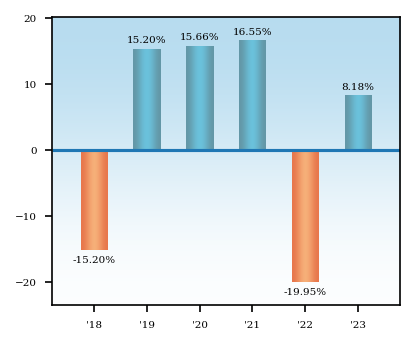
| Best Quarter | 6/30/2020 | 22.72% |
| Worst Quarter | 3/31/2020 | (26.35)% |
The year-to-date return as of the most recent calendar quarter, which ended September 30, 2024, was 7.30%.
Average Annual Total Returns - Arrow DWA Tactical: International ETF |
1 Year |
5 Years |
Since Inception |
[1] | Inception Date |
|
|---|---|---|---|---|---|---|
| Arrow DWA Tactical: International ETF | 8.18% | 6.10% | 2.25% | Dec. 28, 2017 | ||
| Arrow DWA Tactical: International ETF | Return after Taxes on Distributions | 7.90% | 5.66% | 1.79% | |||
| Arrow DWA Tactical: International ETF | Return after Taxes on Distributions and Sale of Fund Shares | 5.56% | 4.92% | 1.82% | |||
| Dorsey Wright Country and Stock Momentum Index (reflects no deduction for fees, expenses or taxes) | [2] | 9.28% | 8.73% | 5.09% | ||
| MSCI ACWI Ex US Index (reflects no deduction for fees, expenses or taxes) | [3] | 15.62% | 7.08% | 3.26% | ||
| MSCI Emerging Markets Investable Market Index (reflects no deduction for fees, expenses or taxes) | [4] | 12.13% | 4.86% | 1.38% | ||
| [1] | Commencement of trading was |
| [2] | Dorsey Wright Country and Stock Momentum Index is constructed pursuant to Dorsey, Wright & Associates proprietary methodology. The index has a relative strength focus that looks for the 10 strongest performing countries among a universe of 41 countries. Once the country is identified, the index methodology is designed to identify 10 companies that demonstrate powerful relative strength characteristics within that country. The Fund and the index are equally weighted and rebalanced and reconstituted quarterly. Investors cannot invest directly in an index. |
| [3] | The MSCI ACWI ex USA Index captures large and mid cap representation across 22 of 23 Developed Markets countries (excluding the US) and 26 Emerging Markets countries. The index covers approximately 85% of the global equity opportunity set outside the U.S. Investors cannot invest directly in an index. |
| [4] | The MSCI Emerging Markets Investable Market Index captures large, mid and small cap representation across 27 Emerging Markets countries. The index covers approximately 99% of the free float-adjusted market capitalization in each country. Investors cannot invest directly in an index. |
After-tax returns are calculated using the historical highest individual federal marginal income tax rates during the period covered by the table above and do not reflect the impact of state and local taxes. Actual after-tax returns depend on an investor’s tax situation and may differ from those shown. After-tax returns shown are not relevant to investors who hold their Shares through tax-deferred arrangements such as an individual retirement account (“IRA”) or other tax-advantaged accounts.
| ● | Emerging Markets Risk: In addition to all of the risks of investing in foreign developed markets and emerging market securities involve risks attendant to less mature and stable governments and economies, such as lower trading volume, trading suspension, security price volatility, repatriation restrictions, government confiscation, inflation, deflation, currency devaluation and adverse government regulations of industries or markets. As a result of these risks, the prices of emerging market securities tend to be more volatile than the securities of issuers located in developed markets. |
| ● | Equity Securities Risk: Equity securities are susceptible to general stock market fluctuations and to volatile increases and decreases in value. The equity securities held by the Fund may experience sudden, unpredictable drops in value or long periods of decline in value. This may occur because of factors affecting securities markets generally, the equity securities of a particular sector, or a particular company. |
| ○ | Not Individually Redeemable. Shares of the Fund (“Shares”) are not individually redeemable and may be redeemed by the Fund at NAV only in large blocks known as “Creation Units.” There can be no assurance that there will be sufficient liquidity in Shares in the secondary market to permit assembly of a Creation Unit. In addition, investors may incur brokerage and other costs in connection with assembling a Creation Unit. |
| ○ | Trading Issues. Trading in Shares on Cboe may be halted due to market conditions or for reasons that, in the view of Cboe, make trading in Shares inadvisable, such as extraordinary market volatility. There can be no assurance that Shares will continue to meet the listing requirements of Cboe. An active trading market for the Fund’s shares may not be developed or maintained. If the securities in the Fund’s portfolio are traded outside a collateralized settlement system, the number of financial institutions that can act as authorized participants (“Authorized Participants”) that can post collateral on an agency basis is limited, which may limit the market for the Fund’s shares. |
| ● | Foreign Investment Risk: Returns on investments in foreign securities could be more volatile than, or trail the returns on, investments in U.S. securities. Exposures to foreign securities entail special risks, including risks due to: (i) differences in information available about foreign issuers; (ii) differences in investor protection standards in other jurisdictions; (iii) capital controls risks, including the risk of a foreign jurisdiction imposing restrictions on the ability to repatriate or transfer currency or other assets; (iv) political, diplomatic and economic risks; (v) regulatory risks; and (vi) foreign market and trading risks, including the costs of trading and risks of settlement in foreign jurisdictions. In addition, the Fund’s investments in securities denominated in other currencies could decline due to changes in local currency relative to the value of the U.S. dollar, which may affect the Fund’s returns. |
| ● | Management Risk: As the Fund may not fully replicate the Index, it is subject to the risk that investment management strategy may not produce the intended results. |
| ● | Market and Geopolitical Risk: The increasing interconnectivity between global economies and financial markets increases the likelihood that events or conditions in one region or financial market may adversely impact issuers in a different country, region or financial market. Securities in the Fund’s portfolio may underperform due to inflation (or expectations for inflation), interest rates, global demand for particular products or resources, natural disasters, climate change and climate related events, pandemics, epidemics, terrorism, international conflicts, regulatory events and governmental or quasi-governmental actions. The occurrence of global events similar to those in recent years may result in market volatility and may have long term effects on both the U.S. and global financial markets. |
| ● | Market Price Variance Risk: The market prices of Shares will fluctuate in response to changes in NAV and supply and demand for Shares and will include a “bid-ask spread” charged by the exchange specialists, market makers or other participants that trade the particular security. There may be times when the market price and the NAV vary significantly. This means that Shares may trade at a discount to NAV. |
| ○ | In times of market stress, market makers may step away from their role of market making in shares of ETFs and in executing trades, which can lead to differences between the market value of Shares and the Fund’s NAV. |
| ○ | The market price for the Shares may deviate from the Fund’s NAV, particularly during times of market stress, with the result that investors may pay significantly more or significantly less for Fund Shares than the Fund’s NAV, which is reflected in the bid and ask price for Fund shares or in the closing price. |
| ○ | When all or a portion of an ETF’s underlying securities trade in a market that is closed when the market for the Fund’s shares is open, there may be changes from the last quote of the closed market and the quote from the Fund’s domestic trading day, which could lead to differences between the market value of the Shares and the Fund’s NAV. |
| ○ | In stressed market conditions, the market for the Shares may become less liquid in response to the deteriorating liquidity of the Fund’s portfolio. This adverse effect on the liquidity of the Shares may, in turn, lead to differences between the market value of the Shares and the Fund’s NAV. |
| ● | Portfolio Turnover Risk: Portfolio turnover refers to the rate at which the securities held by the Fund are replaced. The higher the rate, the higher the transactional and brokerage costs associated with the turnover, which may reduce the Fund’s return unless the securities traded can be bought and sold without corresponding commission costs. Active trading of securities may also increase the Fund’s realized capital gains or losses, which may affect the taxes you pay as the Fund shareholder. |
| ● | Small and Medium Capitalization Stock Risk: The value of a small or medium capitalization company stocks or ETFs that invests in stocks of small and medium capitalization companies may be subject to more abrupt or erratic market movements than those of larger, more established companies or the market averages in general. |
| ● | Asset Class Risk: Securities in the Index or in the Fund’s portfolio may underperform in comparison to the general securities markets or other asset classes. |
| ● | Concentration Risk: The Fund may focus its investments in securities of a particular industry to the extent the Index does. Economic, legislative or regulatory developments may occur that significantly affect the industry. This may cause the Fund’s net asset value (“NAV”) to fluctuate more than that of a fund that does not focus in a particular industry. |
| ● | Early Close/Trading Halt Risk: An exchange or market may close or issue trading halts on specific securities, or the ability to buy or sell certain securities or financial instruments may be restricted, which may prevent the Fund from buying or selling certain securities or financial instruments. In these circumstances, the Fund may be unable to rebalance its portfolio, may be unable to accurately price its investments and may incur substantial trading losses. |
| ● | ETF Structure Risks: The Fund is structured as an exchange traded fund (“ETF”) and as a result is subject to the special risks, including: |
| ○ | Not Individually Redeemable. Shares of the Fund (“Shares”) are not individually redeemable and may be redeemed by the Fund at NAV only in large blocks known as “Creation Units.” There can be no assurance that there will be sufficient liquidity in Shares in the secondary market to permit assembly of a Creation Unit. In addition, investors may incur brokerage and other costs in connection with assembling a Creation Unit. |
| ○ | Trading Issues. Trading in Shares on Cboe may be halted due to market conditions or for reasons that, in the view of Cboe, make trading in Shares inadvisable, such as extraordinary market volatility. There can be no assurance that Shares will continue to meet the listing requirements of Cboe. An active trading market for the Fund’s shares may not be developed or maintained. If the securities in the Fund’s portfolio are traded outside a collateralized settlement system, the number of financial institutions that can act as authorized participants (“Authorized Participants”) that can post collateral on an agency basis is limited, which may limit the market for the Fund’s shares. |
| ● | Geographic Concentration Risk: To the extent the Fund invests a significant portion of its assets in the securities of companies of a single country or region, it is more likely to be impacted by events or conditions affecting that country or region. |
| ● | Index Risk: Unlike many investment companies, the Fund does not utilize an investing strategy that seeks returns in excess of the Index. Therefore, it would not necessarily sell a security unless that security is removed from the Index, even if that security generally is underperforming. |
| ● | Momentum Risk: The price and performance momentum of a security can change or may not continue, and securities with high relative performance may not continue to have such relative performance. |
| ● | Non-Correlation Risk: The Fund’s return may not match the return of the Index for a number of reasons, including: the Fund incurs operating expenses not applicable to the Index, and incurs costs in buying and selling securities; the Fund may not be fully invested at times; the performance of the Fund and the Index may vary due to asset valuation differences and differences between the Fund’s portfolio and the Index resulting from legal restrictions, cost or liquidity constraints and; if used, representative sampling may cause the Fund’s tracking error to be higher than would be the case if the Fund purchased all of the securities in the Index. |
| ● | Passive Investment Risk: The Fund is not actively managed and may be affected by a general decline in market segments related to the Index. The Fund invests in securities included in, or representative of securities included in, the Index, regardless of their investment merits. The Fund does not take defensive positions under any market conditions, including conditions that are adverse to the performance of the Fund, unless such defensive positions are also taken by the Index. |
| ● | Sampling Risk: The Fund’s use of a representative sampling approach, if used, could result in its holding a smaller number of securities than are in the Index. As a result, an adverse development with an issuer of securities held by the Fund could result in a greater decline in NAV than would be the case if the Fund held all of the securities in the Index. To the extent the assets in the Fund are smaller, these risks will be greater. |
| ● | Tracking Error Risk: Tracking error is the divergence of the Fund’s performance from that of the Index. Tracking error may occur because of imperfect correlation between the Fund’s holdings of portfolio securities and those in the Index, pricing differences, the Fund’s holding of cash, differences on timing of the accrual of dividends, changes to the Index or the need to meet various regulatory requirements. This risk may be heightened during times of increased market volatility or other unusual market conditions. Tracking error also may result because the Fund incurs fees and expenses, while the Index does not. |
The Arrow DWA Tactical: Balanced Fund (the “Fund”) seeks to achieve an appropriate balance between long-term capital appreciation and capital preservation.
This table describes the fees and expenses that you may pay if you buy, hold, and sell shares of the Fund. Investors may pay other fees, such as brokerage commissions and other fees to financial intermediaries, which are not reflected in the tables and examples below. More information about these and other discounts is available from your financial professional and in Information About Shares on page 37 and Appendix A of the Fund’s Prospectus.
Shareholder Fees - Arrow DWA Tactical: Balanced Fund |
Arrow DWA Tactical: Balanced Fund Class A Shares |
Arrow DWA Tactical: Balanced Fund Class C Shares |
Arrow DWA Tactical: Balanced Fund Institutional Class Shares |
|---|---|---|---|
| Maximum Sales Charge (Load) Imposed on Purchases (as a% of offering price) | 5.75% | none | none |
| Maximum Deferred Sales Charge (Load) (as a % of redemption proceeds) | 1.00% | none | none |
| Redemption Fee (as a % of amount redeemed, if shares are held less than 30 days) | 1.00% | 1.00% | 1.00% |
Annual Fund Operating Expenses - Arrow DWA Tactical: Balanced Fund |
Arrow DWA Tactical: Balanced Fund Class A Shares |
Arrow DWA Tactical: Balanced Fund Class C Shares |
Arrow DWA Tactical: Balanced Fund Institutional Class Shares |
|
|---|---|---|---|---|
| Management Fees | 0.90% | 0.90% | 0.90% | |
| Distribution and/or Service (12b-1) Fees | 0.25% | 1.00% | none | |
| Other Expenses | [1] | 0.78% | 0.78% | 0.78% |
| Acquired Fund Fees and Expenses | [2] | 0.33% | 0.33% | 0.33% |
| Total Annual Fund Operating Expenses | [3] | 2.26% | 3.01% | 2.01% |
| [1] | Other Expenses include the expenses of the Fund’s consolidated wholly-owned subsidiary. Other Expenses do not include the fees paid to the counterparties to the Fund’s swaps (the “Swaps”), or the management fees, performance fees, and expenses of the trading vehicles or commodity pools (the “Underlying Asset”) that serve as the reference asset of the Swaps. These fees and expenses, which are not reflected in the Annual Fund Operating Expenses table, are embedded in the return of the Swap and represent an indirect cost of investing in the Fund. Generally, the Swap counterparties charge 0.60% of the notional value of the Swap, and the performance fees of the Underlying Asset, which are paid to the commodity trading adviser (“CTA”), range up to 25% of the net new trading profits. |
| [2] | Acquired Fund Fees and Expenses are the indirect costs of investing in other investment companies. |
| [3] | Swap fees amounted to 0.07% of the Fund’s assets |
This Example is intended to help you compare the cost of investing in the Fund with the cost of investing in other mutual funds.
Expense Example - Arrow DWA Tactical: Balanced Fund - USD ($) |
Expense Example, with Redemption, 1 Year |
Expense Example, with Redemption, 3 Years |
Expense Example, with Redemption, 5 Years |
Expense Example, with Redemption, 10 Years |
|---|---|---|---|---|
| Arrow DWA Tactical: Balanced Fund Class A Shares | 891 | 1,241 | 1,715 | 3,021 |
| Arrow DWA Tactical: Balanced Fund Class C Shares | 304 | 930 | 1,582 | 3,327 |
| Arrow DWA Tactical: Balanced Fund Institutional Class Shares | 204 | 630 | 1,083 | 2,338 |
Expense Example, No Redemption - Arrow DWA Tactical: Balanced Fund - USD ($) |
Expense Example, No Redemption, 1 Year |
Expense Example, No Redemption, 3 Years |
Expense Example, No Redemption, 5 Years |
Expense Example, No Redemption, 10 Years |
|---|---|---|---|---|
| Arrow DWA Tactical: Balanced Fund Class A Shares | 791 | 1,241 | 1,715 | 3,021 |
| Arrow DWA Tactical: Balanced Fund Class C Shares | 304 | 930 | 1,582 | 3,327 |
| Arrow DWA Tactical: Balanced Fund Institutional Class Shares | 204 | 630 | 1,083 | 2,338 |
The Fund pays transaction costs, such as commissions, when it buys and sells securities (or “turns over” its portfolio). A higher portfolio turnover may indicate higher transaction costs and may result in higher taxes when Fund shares are held in a taxable account. These costs, which are not reflected in annual fund operating expenses or in the Example, affect the Fund’s performance. During the most recent fiscal year, the Fund’s portfolio turnover rate was 135% of the average value of its portfolio.
The Fund primarily invests, either directly or indirectly through investments in exchange traded funds (“ETFs”) or other investment companies (including affiliated funds), in (i) equity securities, (ii) fixed income securities, or (iii) alternative assets. The Fund defines equity securities to include common and preferred stocks; and defines fixed income securities to include bonds, notes, debentures and bond futures; and defines alternative assets to include currency; options on currency, equity and commodity futures; derivative instruments, such as swap contracts, structured notes or other securities or derivatives, that provide exposure to managed futures programs employed by limited partnerships, corporations operating as investment funds, and limited liability companies (“Underlying Funds”); commodities; master limited partnerships (“MLPs”); and real estate-related securities. The Fund may invest up to 25% of its total assets in a wholly-owned and controlled subsidiary (the “DWA Balanced Subsidiary”).
The DWA Balanced Subsidiary will invest primarily in long commodity futures and options, Underlying Funds, and swap contracts, as well as fixed income securities and other investments intended to serve as margin or collateral for the DWA Balanced Subsidiary’s derivative positions. When viewed on a consolidated basis, the DWA Balanced Subsidiary is subject to the same investment restrictions as the Fund. The Fund will consolidate the DWA Balanced Subsidiary for purposes of financial statements, leverage and concentration.
Arrow Investment Advisors, LLC (the “Advisor”) allocates the Fund’s portfolio among four market segments:
| ● | U.S. Equity, including sectors such as consumer goods, energy and healthcare as well as styles such as large cap growth and small cap value; |
| ● | International Equity, including developed market countries such as Japan and emerging market countries such as Malaysia; |
| ● | Fixed Income, such as U.S. Treasury or corporate bonds of any credit quality; and |
| ● | Alternative Assets, such as commodities, futures, swaps, MLPs and real estate. |
The Advisor allocates the Fund’s portfolio using research from Dorsey Wright & Associates (“DWA”), which comes from the DWA Balanced investment model (the “DWA Balanced model”), as well as the Advisor’s proprietary methodology. The DWA Balanced model is based on a technical analysis of historical price and return forecasts. Technical analysis is the method of evaluating securities by analyzing statistics generated by market activity, such as past prices and trading volume, in an effort to determine probable future prices. The Advisor buys securities and derivatives that it believes will produce returns that are highly correlated to the returns of the components of the DWA Balanced model. The Advisor sells securities and derivatives to purchase other securities and derivatives that it believes will have higher returns or more closely correlate to the returns of the components of the DWA Balanced model. The Fund invests in securities without restriction as to capitalization, credit quality or country.
To maintain a balanced portfolio, the Fund will, under normal circumstances, invest:
| ● | from 25% to 70% in equity securities, including international and domestic equity securities; |
| ● | from 25% to 60% in fixed income securities of any maturity and credit quality; and |
| ● | from 10% to 50% in alternative assets, including through the DWA Balanced Subsidiary. |
The Fund will invest within specific market segments when the research indicates a high probability that the applicable market segments are likely to outperform the applicable universe. The Fund will sell interests or reduce investment exposure among a market segment when the research indicates that such markets are likely to underperform the applicable universe. The Fund may be heavily invested in fixed-income securities, cash positions and similar securities when the research indicates these assets should significantly outperform the equity and/or alternative market segments. The Fund’s fixed income securities may be rated below investment grade (rated BB+ or lower by S&P or comparably rated by another nationally recognized statistical rating organization (“NRSRO”)), also known as “high-yield” or “junk” bonds, and in unrated debt securities determined by the Advisor to be of comparable quality. The alternative asset market segment refers to investments that are historically non-correlated to either equity or fixed income investments such as commodities, MLPs or real estate.
In general, the Fund’s investments in equity securities are intended to achieve the capital appreciation component of its investment objective and the Fund’s investments in fixed income securities are intended to achieve the capital preservation component of its investment objective. Under normal circumstances, the Advisor expects that the Fund will invest a combined minimum of 35% in fixed income securities and in alternative investments. The Fund’s investments in alternative assets are intended to enable the portfolio to be less reliant on fixed income investments for reducing volatility and equities for increasing returns. The Advisor may engage in frequent buying and selling of portfolio securities to achieve the Fund’s investment objective.
As with all mutual funds, there is the risk that you could lose money through your investment in the Fund. Many factors affect the Fund’s net asset value and performance. The following describes the principal risks the Fund bears with respect to its investments. The risks apply to the Fund through its direct investments in securities as well as indirectly through investments in ETFs and the DWA Balanced Subsidiary. As with any fund, there is no guarantee that the Fund will achieve its objective.
| ● | Affiliated Investment Company Risk: The Fund invests in affiliated underlying funds (the “Arrow Advised Funds”), unaffiliated underlying funds, or a combination of both. The Advisor, therefore, is subject to conflicts of interest in allocating the Fund’s assets among the underlying funds. The Advisor will receive more revenue to the extent it selects an Arrow Advised Fund rather than an unaffiliated fund for inclusion in the Fund’s portfolio. In addition, the Advisor may have an incentive to allocate the Fund’s assets to those Arrow Advised Funds for which the net advisory fees payable to the Advisor are higher than the fees payable by other Arrow Advised Funds. The Arrow Advised Funds in which the Fund may invest are not money market funds and are more risky than a money market fund. |
| ● | Commodity Risk: ETFs investing in the commodities markets and investments in the DWA Balanced Subsidiary may subject the Fund to greater volatility than investments in traditional securities. |
| ● | Counterparty Risk: A counterparty (the other party to a transaction or an agreement or the party with whom the Fund executes transactions) to a transaction with the Fund may be unable or unwilling to make timely principal, interest or settlement payments, or otherwise honor its obligations. |
| ● | Credit Risk: There is a risk that issuers and counterparties will not make payments on securities and other investments held by the Fund or through an ETF, resulting in losses to the Fund. In addition, the credit quality of securities held by the Fund may be lowered if an issuer’s financial condition changes. Lower credit quality may lead to greater volatility in the price of a security and in shares of the Fund. Lower credit quality also may affect liquidity and make it difficult for the Fund to sell the security. The Fund may invest, directly or indirectly, in “junk bonds.” Such securities are speculative investments that carry greater risks than higher quality debt securities. |
| ● | Emerging Markets Risk: Investing in emerging market securities imposes risks different from, or greater than, risks of investing in foreign developed countries. These risks include: smaller market capitalization of securities markets, which may suffer periods of relative illiquidity; significant price volatility; restrictions on foreign investment; possible repatriation of investment income and capital. In addition, foreign investors may be required to register the proceeds of sales; future economic or political crises could lead to price controls, forced mergers, expropriation or confiscatory taxation, seizure, nationalization, or creation of government monopolies. The currencies of emerging market countries may experience significant declines against the U.S. dollar, and devaluation may occur subsequent to investments in these currencies by a Fund. Inflation and rapid fluctuations in inflation rates have had, and may continue to have, negative effects on the economies and securities markets of certain emerging market countries. |
| ● | ETF Risk: ETFs are subject to investment advisory and other expenses, which will be indirectly paid by the Fund. As a result, the cost of investing in the Fund will be higher than the cost of investing directly in ETFs and may be higher than other mutual funds that invest directly in stocks and bonds. |
The ETFs in which the Fund invests will not be able to replicate exactly the performance of the indices they track and the market value of ETF shares may differ from their net asset value. Each ETF is subject to specific risks, depending on the nature of the ETF and ETFs that invest in the “Alternative Asset” market segment may be more volatile than other Fund investments.
| ● | Fixed Income Risk: When the Fund invests in ETFs that own bonds, or in this type of security directly, the value of your investment in the Fund will fluctuate with changes in interest rates. Typically, a rise in interest rates causes a decline in the value of bond funds owned by the Fund. On the other hand, if rates fall, the value of the fixed income securities generally increases. Your investment will decline in value if the value of the Fund’s investments decreases. |
| ● | Foreign Investment Risk: Although the Fund will not invest in the securities of foreign companies directly other than the DWA Balanced Subsidiary, it may invest in ETFs that invest in foreign international equity securities. Foreign investing involves risks not typically associated with U.S. investments, including adverse fluctuations in foreign currency values, adverse political, social and economic developments, less liquidity, greater volatility, less developed or less efficient trading markets, political instability and differing auditing and legal standards. Investing in emerging markets imposes risks different from, or greater than, risks of investing in foreign developed countries. |
| ● | Futures Risk: The Fund’s use of futures involves risks different from, or possibly greater than, the risks associated with investing directly in securities and other traditional investments. These risks include (i) leverage risk (ii) risk of mispricing or improper valuation; and (iii) the risk that changes in the value of the futures contract may not correlate perfectly with the underlying index. Investments in futures involve leverage, which means a small percentage of assets invested in futures can have a disproportionately large impact on the Fund. This risk could cause the Fund to lose more than the principal amount invested. Futures contracts may become mispriced or improperly valued when compared to the Advisor’s expectation and may not produce the desired investment results. Additionally, changes in the value of futures contracts may not track or correlate perfectly with the underlying index because of temporary, or even long-term, supply and demand imbalances and because futures do not pay dividends unlike the stocks upon which they are based. |
| ● | Issuer-Specific Risk: The value of a specific security or ETF can be more volatile than the market as a whole and can perform differently from the value of the market as a whole. The value of securities of smaller issuers can be more volatile than that of larger issuers. The value of certain types of securities can be more volatile due to increased sensitivity to adverse issuer, political, regulatory, market, or economic developments. |
| ● | Junk Bond Risk: Lower-quality bonds, known as “high yield” or “junk” bonds, present greater risk than bonds of higher quality, including an increased risk of default. An economic downturn or period of rising interest rates could adversely affect the market for these bonds and reduce the Fund’s ability to sell its bonds. The lack of a liquid market for these bonds could decrease the Fund’s share price. |
| ● | Leverage Risk: Using derivatives to increase the Fund’s exposure creates leverage, which can magnify the Fund’s potential for gain or loss and, therefore, amplify the effects of market volatility on the Fund’s share price. |
| ● | Management Risk: The Advisor’s investment decisions about individual securities and derivatives as well as ETFs impact the Fund’s ability to achieve its investment objective. The Advisor’s judgments about the attractiveness and potential appreciation of particular investments in which the Fund invests may prove to be incorrect and there is no guarantee that the Advisor’s investment strategy will produce the desired results. |
| ● | Market and Geopolitical Risk: The increasing interconnectivity between global economies and financial markets increases the likelihood that events or conditions in one region or financial market may adversely impact issuers in a different country, region or financial market. Securities in the Fund’s portfolio may underperform due to inflation (or expectations for inflation), interest rates, global demand for particular products or resources, natural disasters, climate change and climate related events, pandemics, epidemics, terrorism, international conflicts, regulatory events and governmental or quasi-governmental actions. The occurrence of global events similar to those in recent years may result in market volatility and may have long term effects on both the U.S. and global financial markets. |
| ● | MLP Risk: Investments in MLPs and MLP-related securities involve risks different from those of investing in common stock including risks related to limited control and limited rights to vote on matters affecting the MLP or MLP-related security, risks related to potential conflicts of interest between an MLP and the MLP’s general partner, cash flow risks, dilution risks and risks related to the general partner’s limited call right. MLPs and MLP-related securities are generally considered interest-rate sensitive investments. During periods of interest rate volatility, these investments may not provide attractive returns. Depending on the state of interest rates in general, the use of MLPs or MLP-related securities could enhance or harm the overall performance of the Fund. |
| ○ | MLP Tax Risk. MLPs, typically, do not pay U.S. federal income tax at the partnership level. Instead, each partner is allocated a share of the partnership’s income, gains, losses, deductions and expenses. A change in current tax law or in the underlying business mix of a given MLP could result in an MLP being treated as a corporation for U.S. federal income tax purposes, which would result in such MLP being required to pay U.S. federal income tax on its taxable income. The classification of an MLP as a corporation for U.S. federal income tax purposes would have the effect of reducing the amount of cash available for distribution by the MLP. Thus, if any of the MLPs owned by the Fund were treated as corporations for U.S. federal income tax purposes, it could result in a reduction of the value of your investment in the Fund and lower income, as compared to an MLP that is not taxed as a corporation. |
| ● | Options Risk: There are risks associated with the sale and purchase of options. As a seller (writer) of a put option, the Fund will tend to lose money if the value of the reference index or security falls below the strike price. As the seller (writer) of a call option, the Fund will tend to lose money if the value of the reference index or security rises above the strike price. As the buyer of a put or call option, the Fund risks losing the entire premium invested in the option if the Fund does not exercise the option. |
| ● | Portfolio Turnover Risk: Portfolio turnover refers to the rate at which the securities held by the Fund are replaced. The higher the rate, the higher the transactional and brokerage costs associated with the turnover, which may reduce the Fund’s return unless the securities traded can be bought and sold without corresponding commission costs. Active trading of securities may also increase a Fund’s realized capital gains or losses, which may affect the taxes you pay as a Fund shareholder. |
| ● | Real Estate Risk: ETFs that invest in real estate are subject to the risks associated with investing in real estate. The value of these securities will rise and fall in response to many factors, including economic conditions, the demand for rental property and changes in interest rates. |
| ● | Regulatory Risk: Regulatory authorities in the United States or other countries may restrict the ability of the Fund to fully implement its strategy, either generally, or with respect to certain securities, industries or countries, which may impact the Fund’s ability to fully implement its investment strategies. |
| ● | Sector Risk: The Fund may focus its investments in securities of a particular sector or in ETFs that focus investments in securities of a particular sector. Economic, legislative or regulatory developments may occur, which significantly affect the entire sector. This may cause the Fund’s net asset value to fluctuate more than that of a fund that does not focus in a particular sector. |
| ● | Short Position Risk: The Fund will incur a loss as a result of a short position if the price of the short position instrument increases in value between the date of the short position sale and the date on which the Fund purchases an offsetting position. Short positions may be considered speculative transactions and involve special risks, including greater reliance on the Advisor’s ability to accurately anticipate the future value of a security or instrument. The Fund’s losses are potentially unlimited in a short position transaction. |
| ● | Small and Medium Capitalization Stock Risk: The value of a small or medium capitalization company stocks or ETFs that invests in stocks of small and medium capitalization companies may be subject to more abrupt or erratic market movements than those of larger, more established companies or the market averages in general. |
| ● | Swaps Risk: Swaps are subject to tracking risk because they may not be perfect substitutes for the instruments they are intended to hedge or replace. Over the counter swaps are subject to counterparty default. Leverage inherent in derivatives will tend to magnify the Fund’s losses. The Fund is also subject to credit risk on the amount the Fund expects to receive from swap agreement counterparties. If a swap counterparty defaults on its payment obligations to the Fund, this default will cause the value of your investment in the Fund to decrease. |
| ● | Taxation Risk: By investing in commodities indirectly through the DWA Balanced Subsidiary, the Fund will obtain exposure to the commodities markets within the federal tax requirements that apply to the Fund. However, because the DWA Balanced Subsidiary is a controlled foreign corporation, any income received from the DWA Balanced Subsidiary will be passed through to the Fund as ordinary income, which may be taxed at less favorable rates than capital gains. |
| ● | Wholly-Owned Subsidiary Risk: The DWA Balanced Subsidiary will not be registered under the Investment Company Act of 1940 (“1940 Act”) and, unless otherwise noted in this Prospectus, will not be subject to all of the investor protections of the 1940 Act. Changes in the laws of the United States and/or the Cayman Islands, under which the Fund and DWA Balanced Subsidiary, respectively, are organized, could result in the inability of the Fund and/or Subsidiary to operate as described in this Prospectus and could negatively affect the Fund and its shareholders. Your cost of investing in the Fund will be higher because you indirectly bear the expenses of the DWA Balanced Subsidiary. |
The bar chart and performance table below show the variability of the Fund’s returns, which is some indication of the risks of investing in the Fund. The bar chart shows performance of the Fund’s Class A shares for the past ten calendar years. The performance table compares the performance of the Fund’s Class A shares over time to the performance of a broad-based securities market index. The Fund was reorganized on March 1, 2012 from a series of Northern Lights Fund Trust, a Delaware statutory trust, (the “Predecessor Fund”) to a series of Arrow Investments Trust, a Delaware statutory trust (the “Reorganization”). The Fund is a continuation of the Predecessor Fund and, therefore, the performance of the Fund prior to March 1, 2012, represents the performance of the Predecessor Fund. You should be aware that the Fund’s past performance (before and after taxes) may not be an indication of how the Fund will perform in the future. Although Class C shares (formerly known as Advisor Class shares) and Institutional Class shares would have similar annual returns to Class A shares because the classes are invested in the same portfolio of securities, the returns for Class C and Institutional Class shares would be different from Class A shares because Class C and Institutional Class shares have different expenses than Class A shares. Updated performance information and daily net asset value per share information is available at no cost by visiting www.ArrowFunds.com or by calling 1-877-277-6933 (1-877-ARROW-FD).
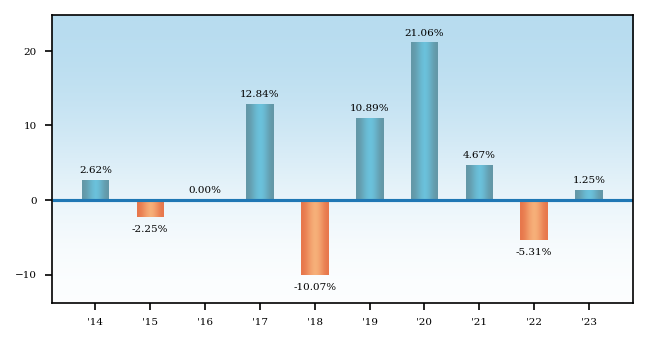
| Best Quarter | 3/31/2019 | 8.93% |
| Worst Quarter | 12/31/2018 | (11.37)% |
The year-to-date return as of the most recent calendar quarter, which ended September 30, 2024, was 10.56%
Average Annual Total Returns - Arrow DWA Tactical: Balanced Fund |
Label |
1 Year |
5 Years |
10 Years |
Since Inception |
Since Inception |
Inception Date |
|||
|---|---|---|---|---|---|---|---|---|---|---|
| Arrow DWA Tactical: Balanced Fund Class A Shares | Return Before Taxes | (4.57%) | 4.89% | 2.60% | 3.99% | Aug. 07, 2006 | ||||
| Arrow DWA Tactical: Balanced Fund Class A Shares | Return after Taxes on Distributions | (6.08%) | 3.06% | 0.88% | 2.92% | ||||||
| Arrow DWA Tactical: Balanced Fund Class A Shares | Return after Taxes on Distributions and Sale of Fund Shares | (2.55%) | 3.32% | 1.62% | 2.97% | ||||||
| Arrow DWA Tactical: Balanced Fund Class C Shares | Return Before Taxes | 0.46% | 5.35% | 2.44% | 3.57% | Aug. 07, 2006 | ||||
| Arrow DWA Tactical: Balanced Fund Institutional Class Shares | Return Before Taxes | 1.49% | 6.40% | 3.47% | 4.38% | Mar. 21, 2012 | ||||
| Morningstar Global Flexible Allocation EW Index (reflects no deduction for fees, expenses or taxes) | [1] | 9.16% | 4.99% | 3.16% | 3.58% | [2] | 3.65% | [3] | ||
| [1] | The Morningstar Global Flexible Allocation EW Index offers exposure to all of the major asset classes globally, but does not have a specific target asset allocation, thus may invest in variable proportions of stocks, bonds or cash. Investors cannot invest directly in an index. |
| [2] | Since 8/07/06 |
| [3] | Since 3/21/12 |
After-tax returns are calculated using the highest historical individual federal marginal income tax rate and do not reflect the impact of state and local taxes. Actual after-tax returns depend on a shareholder’s tax situation and may differ from those shown. After-tax returns for Class C and Institutional Class shares will differ from those of Class A shares. The after-tax returns are not relevant if you hold your Fund shares in tax-deferred arrangements, such as 401(k) plans or individual retirement accounts (“IRA”).
| ● | Affiliated Investment Company Risk: The Fund invests in affiliated underlying funds (the “Arrow Advised Funds”), unaffiliated underlying funds, or a combination of both. The Advisor, therefore, is subject to conflicts of interest in allocating the Fund’s assets among the underlying funds. The Advisor will receive more revenue to the extent it selects an Arrow Advised Fund rather than an unaffiliated fund for inclusion in the Fund’s portfolio. In addition, the Advisor may have an incentive to allocate the Fund’s assets to those Arrow Advised Funds for which the net advisory fees payable to the Advisor are higher than the fees payable by other Arrow Advised Funds. The Arrow Advised Funds in which the Fund may invest are not money market funds and are more risky than a money market fund. |
| ● | Commodity Risk: ETFs investing in the commodities markets and investments in the DWA Balanced Subsidiary may subject the Fund to greater volatility than investments in traditional securities. |
| ● | Credit Risk: There is a risk that issuers and counterparties will not make payments on securities and other investments held by the Fund or through an ETF, resulting in losses to the Fund. In addition, the credit quality of securities held by the Fund may be lowered if an issuer’s financial condition changes. Lower credit quality may lead to greater volatility in the price of a security and in shares of the Fund. Lower credit quality also may affect liquidity and make it difficult for the Fund to sell the security. The Fund may invest, directly or indirectly, in “junk bonds.” Such securities are speculative investments that carry greater risks than higher quality debt securities. |
| ● | Emerging Markets Risk: Investing in emerging market securities imposes risks different from, or greater than, risks of investing in foreign developed countries. These risks include: smaller market capitalization of securities markets, which may suffer periods of relative illiquidity; significant price volatility; restrictions on foreign investment; possible repatriation of investment income and capital. In addition, foreign investors may be required to register the proceeds of sales; future economic or political crises could lead to price controls, forced mergers, expropriation or confiscatory taxation, seizure, nationalization, or creation of government monopolies. The currencies of emerging market countries may experience significant declines against the U.S. dollar, and devaluation may occur subsequent to investments in these currencies by a Fund. Inflation and rapid fluctuations in inflation rates have had, and may continue to have, negative effects on the economies and securities markets of certain emerging market countries. |
| ● | Fixed Income Risk: When the Fund invests in ETFs that own bonds, or in this type of security directly, the value of your investment in the Fund will fluctuate with changes in interest rates. Typically, a rise in interest rates causes a decline in the value of bond funds owned by the Fund. On the other hand, if rates fall, the value of the fixed income securities generally increases. Your investment will decline in value if the value of the Fund’s investments decreases. |
| ● | Foreign Investment Risk: Although the Fund will not invest in the securities of foreign companies directly other than the DWA Balanced Subsidiary, it may invest in ETFs that invest in foreign international equity securities. Foreign investing involves risks not typically associated with U.S. investments, including adverse fluctuations in foreign currency values, adverse political, social and economic developments, less liquidity, greater volatility, less developed or less efficient trading markets, political instability and differing auditing and legal standards. Investing in emerging markets imposes risks different from, or greater than, risks of investing in foreign developed countries. |
| ● | Futures Risk: The Fund’s use of futures involves risks different from, or possibly greater than, the risks associated with investing directly in securities and other traditional investments. These risks include (i) leverage risk (ii) risk of mispricing or improper valuation; and (iii) the risk that changes in the value of the futures contract may not correlate perfectly with the underlying index. Investments in futures involve leverage, which means a small percentage of assets invested in futures can have a disproportionately large impact on the Fund. This risk could cause the Fund to lose more than the principal amount invested. Futures contracts may become mispriced or improperly valued when compared to the Advisor’s expectation and may not produce the desired investment results. Additionally, changes in the value of futures contracts may not track or correlate perfectly with the underlying index because of temporary, or even long-term, supply and demand imbalances and because futures do not pay dividends unlike the stocks upon which they are based. |
| ● | Issuer-Specific Risk: The value of a specific security or ETF can be more volatile than the market as a whole and can perform differently from the value of the market as a whole. The value of securities of smaller issuers can be more volatile than that of larger issuers. The value of certain types of securities can be more volatile due to increased sensitivity to adverse issuer, political, regulatory, market, or economic developments. |
| ● | Junk Bond Risk: Lower-quality bonds, known as “high yield” or “junk” bonds, present greater risk than bonds of higher quality, including an increased risk of default. An economic downturn or period of rising interest rates could adversely affect the market for these bonds and reduce the Fund’s ability to sell its bonds. The lack of a liquid market for these bonds could decrease the Fund’s share price. |
| ● | Leverage Risk: Using derivatives to increase the Fund’s exposure creates leverage, which can magnify the Fund’s potential for gain or loss and, therefore, amplify the effects of market volatility on the Fund’s share price. |
| ● | Management Risk: The Advisor’s investment decisions about individual securities and derivatives as well as ETFs impact the Fund’s ability to achieve its investment objective. The Advisor’s judgments about the attractiveness and potential appreciation of particular investments in which the Fund invests may prove to be incorrect and there is no guarantee that the Advisor’s investment strategy will produce the desired results. |
| ● | Market and Geopolitical Risk: The increasing interconnectivity between global economies and financial markets increases the likelihood that events or conditions in one region or financial market may adversely impact issuers in a different country, region or financial market. Securities in the Fund’s portfolio may underperform due to inflation (or expectations for inflation), interest rates, global demand for particular products or resources, natural disasters, climate change and climate related events, pandemics, epidemics, terrorism, international conflicts, regulatory events and governmental or quasi-governmental actions. The occurrence of global events similar to those in recent years may result in market volatility and may have long term effects on both the U.S. and global financial markets. |
| ● | Portfolio Turnover Risk: Portfolio turnover refers to the rate at which the securities held by the Fund are replaced. The higher the rate, the higher the transactional and brokerage costs associated with the turnover, which may reduce the Fund’s return unless the securities traded can be bought and sold without corresponding commission costs. Active trading of securities may also increase a Fund’s realized capital gains or losses, which may affect the taxes you pay as a Fund shareholder. |
| ● | Real Estate Risk: ETFs that invest in real estate are subject to the risks associated with investing in real estate. The value of these securities will rise and fall in response to many factors, including economic conditions, the demand for rental property and changes in interest rates. |
| ● | Regulatory Risk: Regulatory authorities in the United States or other countries may restrict the ability of the Fund to fully implement its strategy, either generally, or with respect to certain securities, industries or countries, which may impact the Fund’s ability to fully implement its investment strategies. |
| ● | Sector Risk: The Fund may focus its investments in securities of a particular sector or in ETFs that focus investments in securities of a particular sector. Economic, legislative or regulatory developments may occur, which significantly affect the entire sector. This may cause the Fund’s net asset value to fluctuate more than that of a fund that does not focus in a particular sector. |
| ● | Small and Medium Capitalization Stock Risk: The value of a small or medium capitalization company stocks or ETFs that invests in stocks of small and medium capitalization companies may be subject to more abrupt or erratic market movements than those of larger, more established companies or the market averages in general. |
| ● | Taxation Risk: By investing in commodities indirectly through the DWA Balanced Subsidiary, the Fund will obtain exposure to the commodities markets within the federal tax requirements that apply to the Fund. However, because the DWA Balanced Subsidiary is a controlled foreign corporation, any income received from the DWA Balanced Subsidiary will be passed through to the Fund as ordinary income, which may be taxed at less favorable rates than capital gains. |
| ● | Wholly-Owned Subsidiary Risk: The DWA Balanced Subsidiary will not be registered under the Investment Company Act of 1940 (“1940 Act”) and, unless otherwise noted in this Prospectus, will not be subject to all of the investor protections of the 1940 Act. Changes in the laws of the United States and/or the Cayman Islands, under which the Fund and DWA Balanced Subsidiary, respectively, are organized, could result in the inability of the Fund and/or Subsidiary to operate as described in this Prospectus and could negatively affect the Fund and its shareholders. Your cost of investing in the Fund will be higher because you indirectly bear the expenses of the DWA Balanced Subsidiary. |
| ● | Counterparty Risk: A counterparty (the other party to a transaction or an agreement or the party with whom the Fund executes transactions) to a transaction with the Fund may be unable or unwilling to make timely principal, interest or settlement payments, or otherwise honor its obligations. |
| ● | ETF Risk: ETFs are subject to investment advisory and other expenses, which will be indirectly paid by the Fund. As a result, the cost of investing in the Fund will be higher than the cost of investing directly in ETFs and may be higher than other mutual funds that invest directly in stocks and bonds. |
The ETFs in which the Fund invests will not be able to replicate exactly the performance of the indices they track and the market value of ETF shares may differ from their net asset value. Each ETF is subject to specific risks, depending on the nature of the ETF and ETFs that invest in the “Alternative Asset” market segment may be more volatile than other Fund investments.
| ● | MLP Risk: Investments in MLPs and MLP-related securities involve risks different from those of investing in common stock including risks related to limited control and limited rights to vote on matters affecting the MLP or MLP-related security, risks related to potential conflicts of interest between an MLP and the MLP’s general partner, cash flow risks, dilution risks and risks related to the general partner’s limited call right. MLPs and MLP-related securities are generally considered interest-rate sensitive investments. During periods of interest rate volatility, these investments may not provide attractive returns. Depending on the state of interest rates in general, the use of MLPs or MLP-related securities could enhance or harm the overall performance of the Fund. |
| ○ | MLP Tax Risk. MLPs, typically, do not pay U.S. federal income tax at the partnership level. Instead, each partner is allocated a share of the partnership’s income, gains, losses, deductions and expenses. A change in current tax law or in the underlying business mix of a given MLP could result in an MLP being treated as a corporation for U.S. federal income tax purposes, which would result in such MLP being required to pay U.S. federal income tax on its taxable income. The classification of an MLP as a corporation for U.S. federal income tax purposes would have the effect of reducing the amount of cash available for distribution by the MLP. Thus, if any of the MLPs owned by the Fund were treated as corporations for U.S. federal income tax purposes, it could result in a reduction of the value of your investment in the Fund and lower income, as compared to an MLP that is not taxed as a corporation. |
| ○ | MLP Tax Risk. MLPs, typically, do not pay U.S. federal income tax at the partnership level. Instead, each partner is allocated a share of the partnership’s income, gains, losses, deductions and expenses. A change in current tax law or in the underlying business mix of a given MLP could result in an MLP being treated as a corporation for U.S. federal income tax purposes, which would result in such MLP being required to pay U.S. federal income tax on its taxable income. The classification of an MLP as a corporation for U.S. federal income tax purposes would have the effect of reducing the amount of cash available for distribution by the MLP. Thus, if any of the MLPs owned by the Fund were treated as corporations for U.S. federal income tax purposes, it could result in a reduction of the value of your investment in the Fund and lower income, as compared to an MLP that is not taxed as a corporation. |
| ● | Options Risk: There are risks associated with the sale and purchase of options. As a seller (writer) of a put option, the Fund will tend to lose money if the value of the reference index or security falls below the strike price. As the seller (writer) of a call option, the Fund will tend to lose money if the value of the reference index or security rises above the strike price. As the buyer of a put or call option, the Fund risks losing the entire premium invested in the option if the Fund does not exercise the option. |
| ● | Short Position Risk: The Fund will incur a loss as a result of a short position if the price of the short position instrument increases in value between the date of the short position sale and the date on which the Fund purchases an offsetting position. Short positions may be considered speculative transactions and involve special risks, including greater reliance on the Advisor’s ability to accurately anticipate the future value of a security or instrument. The Fund’s losses are potentially unlimited in a short position transaction. |
| ● | Swaps Risk: Swaps are subject to tracking risk because they may not be perfect substitutes for the instruments they are intended to hedge or replace. Over the counter swaps are subject to counterparty default. Leverage inherent in derivatives will tend to magnify the Fund’s losses. The Fund is also subject to credit risk on the amount the Fund expects to receive from swap agreement counterparties. If a swap counterparty defaults on its payment obligations to the Fund, this default will cause the value of your investment in the Fund to decrease. |
The Arrow DWA Tactical: Macro Fund (the “Fund”) seeks to achieve long-term capital appreciation with capital preservation as a secondary objective.
This table describes the fees and expenses that you may pay if you buy, hold, and sell shares of the Fund. Investors may pay other fees, such as brokerage commissions and other fees to financial intermediaries, which are not reflected in the tables and examples below. More information about these and other discounts is available from your financial professional and in Information About Shares on page 37 and Appendix A of the Fund’s Prospectus.
Shareholder Fees - Arrow DWA Tactical: Macro Fund |
Arrow DWA Tactical: Macro Fund Class A Shares |
Arrow DWA Tactical: Macro Fund Class C Shares |
Arrow DWA Tactical: Macro Fund Institutional Class Shares |
|---|---|---|---|
| Maximum Sales Charge (Load) Imposed on Purchases (as a% of offering price) | 5.75% | none | none |
| Maximum Deferred Sales Charge (Load) (as a % of redemption proceeds) | 1.00% | none | none |
| Redemption Fee (as a % of amount redeemed, if shares are held less than 30 days) | 1.00% | 1.00% | 1.00% |
Annual Fund Operating Expenses - Arrow DWA Tactical: Macro Fund |
Arrow DWA Tactical: Macro Fund Class A Shares |
Arrow DWA Tactical: Macro Fund Class C Shares |
Arrow DWA Tactical: Macro Fund Institutional Class Shares |
|
|---|---|---|---|---|
| Management Fees | 0.90% | 0.90% | 0.90% | |
| Distribution and/or Service (12b-1) Fees | 0.25% | 1.00% | none | |
| Other Expenses | 0.69% | 0.69% | 0.69% | |
| Acquired Fund Fees and Expenses | [1] | 0.22% | 0.22% | 0.22% |
| Total Annual Fund Operating Expenses | 2.06% | 2.81% | 1.81% | |
| [1] | Acquired Fund Fees and Expenses are the indirect costs of investing in other investment companies. |
This Example is intended to help you compare the cost of investing in the Fund with the cost of investing in other mutual funds.
Expense Example - Arrow DWA Tactical: Macro Fund - USD ($) |
Expense Example, with Redemption, 1 Year |
Expense Example, with Redemption, 3 Years |
Expense Example, with Redemption, 5 Years |
Expense Example, with Redemption, 10 Years |
|---|---|---|---|---|
| Arrow DWA Tactical: Macro Fund Class A Shares | 872 | 1,184 | 1,620 | 2,827 |
| Arrow DWA Tactical: Macro Fund Class C Shares | 284 | 871 | 1,484 | 3,138 |
| Arrow DWA Tactical: Macro Fund Institutional Class Shares | 184 | 569 | 980 | 2,127 |
Expense Example, No Redemption - Arrow DWA Tactical: Macro Fund - USD ($) |
Expense Example, No Redemption, 1 Year |
Expense Example, No Redemption, 3 Years |
Expense Example, No Redemption, 5 Years |
Expense Example, No Redemption, 10 Years |
|---|---|---|---|---|
| Arrow DWA Tactical: Macro Fund Class A Shares | 772 | 1,184 | 1,620 | 2,827 |
| Arrow DWA Tactical: Macro Fund Class C Shares | 284 | 871 | 1,484 | 3,138 |
| Arrow DWA Tactical: Macro Fund Institutional Class Shares | 184 | 569 | 980 | 2,127 |
The Fund pays transaction costs, such as commissions, when it buys and sells securities (or “turns over” its portfolio). A higher portfolio turnover may indicate higher transaction costs and may result in higher taxes when Fund shares are held in a taxable account. These costs, which are not reflected in annual fund operating expenses or in the Example, affect the Fund’s performance. During the most recent fiscal year, the Fund’s portfolio turnover rate was 76% of the average value of its portfolio.
The Fund primarily invests, either directly or indirectly through investments in exchange traded funds (“ETFs”) and other investment companies (including affiliated funds), in (i) equity securities, (ii) fixed income securities, or (iii) alternative assets.
The Fund defines equity securities to include common and preferred stocks; and defines fixed income securities to include bonds, notes and debentures; and defines alternative assets to include currency, options on currency, equity and commodity futures, commodities, master limited partnerships (“MLPs”) and real estate-related securities. When appropriate, Arrow Investment Advisors, LLC (the “Advisor”), the Fund’s investment advisor may elect to invest in the underlying securities of a particular ETF. The Fund may invest up to 25% of its total assets in a wholly-owned and controlled subsidiary (the “DWA Tactical Subsidiary”). The DWA Tactical Subsidiary will invest primarily in long commodity futures and options, as well as fixed income securities and other investments intended to serve as margin or collateral for the DWA Tactical Subsidiary’s derivative positions.
When viewed on a consolidated basis, the DWA Tactical Subsidiary is subject to the same investment restrictions as the Fund. The Fund will consolidate the DWA Tactical Subsidiary for purposes of financial statements, leverage and concentration.
Under normal circumstances, the Fund will invest:
| ● | From 0% to 100% of its assets in domestic and international (including emerging markets) equity securities; |
| ● | From 0% to 100% of its assets in fixed income securities of any maturity and credit quality; and |
| ● | From 0% up to 90% of its assets in alternative assets, including through the DWA Tactical Subsidiary. |
The Advisor allocates the Fund’s portfolio using research from Dorsey Wright & Associates (“DWA”), which comes from the DWA Global Macro investment model (the “DWA Global Macro model”), as well as the Advisor’s proprietary methodology. The DWA Global Macro model is based on a technical analysis of historical price and return forecasts. Technical analysis is the method of evaluating securities by analyzing statistics generated by market activity, such as past prices and trading volume, in an effort to determine probable future prices. The Advisor buys securities and derivatives that it believes will produce returns that are highly correlated to the returns of the components of the DWA Global Macro model. The Advisor sells securities and derivatives to purchase other securities and derivatives that it believes will have higher returns or more closely correlate to the returns of the components of the DWA Global Macro model. The Fund invests in securities without restriction as to capitalization, credit quality or country.
The Fund will invest within specific market segments when the research indicates a high probability that the applicable market segments are likely to outperform the applicable universe. The Fund will sell interests or reduce investment exposure among a market segment when the research indicates that such markets are likely to underperform the applicable universe. The Fund may invest heavily in fixed-income securities, cash positions and similar securities when the research indicates these assets should significantly outperform the equity and/or alternative market segments. The Fund’s fixed income securities may be rated below investment grade (rated BB+ or lower by S&P or comparably rated by another nationally recognized statistical rating organization (“NRSRO”)), also known as “high-yield” or “junk” bonds, and in unrated debt securities determined by the Advisor to be of comparable quality. The alternative asset market segment refers to investments that are historically non-correlated to either equity or fixed income investments such as commodities, MLPs or real estate. In order to gain inverse exposure to the equity markets, the Fund may use the derivatives and futures described above. The Fund also may use currency futures.
In general, the Fund’s investments in equity securities are intended to achieve the capital appreciation component of the Fund’s investment objectives. At times, the Fund invests in fixed income securities in order to achieve the capital preservation component of the Fund’s investment objectives. The Fund’s investments in alternative assets are intended to enable the portfolio to be less reliant on fixed income investments for reducing volatility and equities for increasing returns. The Advisor may engage in frequent buying and selling of portfolio securities to achieve the Fund’s investment objectives.
As with all mutual funds, there is the risk that you could lose money through your investment in the Fund. Many factors affect the Fund’s net asset value and performance. The following describes the principal risks the Fund bears with respect to its investments. The risks apply to the Fund through its direct investments in securities as well as indirectly through investments in ETFs and the DWA Tactical Subsidiary. As with any fund, there is no guarantee that the Fund will achieve its objective.
| ● | Affiliated Investment Company Risk: The Fund invests in affiliated underlying funds (the “Arrow Advised Funds”), unaffiliated underlying funds, or a combination of both. The Advisor, therefore, is subject to conflicts of interest in allocating the Fund’s assets among the underlying funds. The Advisor will receive more revenue to the extent it selects an Arrow Advised Fund rather than an unaffiliated fund for inclusion in the Fund’s portfolio. In addition, the Advisor may have an incentive to allocate the Fund’s assets to those Arrow Advised Funds for which the net advisory fees payable to the Advisor are higher than the fees payable by other Arrow Advised Funds. The Arrow Advised Funds in which the Fund may invest are not money market funds and are more risky than a money market fund. |
| ● | Commodity Risk: ETFs investing in the commodities markets and investments in the DWA Tactical Subsidiary may subject the Fund to greater volatility than investments in traditional securities. |
| ● | Credit Risk: There is a risk that issuers and counterparties will not make payments on securities and other investments held by the Fund directly or through an ETF, resulting in losses to the Fund. In addition, the credit quality of securities held by the Fund may be lowered if an issuer’s financial condition changes. Lower credit quality may lead to greater volatility in the price of a security and in shares of the Fund. Lower credit quality also may affect liquidity and make it difficult for the Fund to sell the security. The Fund may invest, directly or indirectly, in “junk bonds.” Such securities are speculative investments that carry greater risks than higher quality debt securities. |
| ● | Emerging Markets Risk: Investing in emerging market securities imposes risks different from, or greater than, risks of investing in foreign developed countries. These risks include: smaller market capitalization of securities markets, which may suffer periods of relative illiquidity; significant price volatility; restrictions on foreign investment; possible repatriation of investment income and capital. In addition, foreign investors may be required to register the proceeds of sales; future economic or political crises could lead to price controls, forced mergers, expropriation or confiscatory taxation, seizure, nationalization, or creation of government monopolies. The currencies of emerging market countries may experience significant declines against the U.S. dollar, and devaluation may occur subsequent to investments in these currencies by a Fund. Inflation and rapid fluctuations in inflation rates have had, and may continue to have, negative effects on the economies and securities markets of certain emerging market countries. |
| ● | ETF Risk: ETFs are subject to investment advisory and other expenses, which will be indirectly paid by the Fund. As a result, the cost of investing in the Fund will be higher than the cost of investing directly in ETFs and may be higher than other mutual funds that invest directly in stocks and bonds. The ETFs in which the Fund invests will not be able to replicate exactly the performance of the indices they track and the market value of ETF shares may differ from their net asset value. Each ETF is subject to specific risks, depending on the nature of the ETF and ETFs that invest in the “Alternative Asset” market segment may be more volatile than other Fund investments. |
| ● | Fixed Income Risk: When the Fund invests in ETFs that own bonds, or in this type of security directly, the value of your investment in the Fund will fluctuate with changes in interest rates. Typically, a rise in interest rates causes a decline in the value of bond funds owned by the Fund. On the other hand, if rates fall, the value of the fixed income securities generally increases. Your investment will decline in value if the value of the Fund’s investments decreases. |
| ● | Foreign Investment Risk: Although the Fund will not invest in the securities of foreign companies directly other than the DWA Tactical Subsidiary, it may invest in ETFs that invest in foreign international equity securities. Foreign investing involves risks not typically associated with U.S. investments, including adverse fluctuations in foreign currency values, adverse political, social and economic developments, less liquidity, greater volatility, less developed or less efficient trading markets, political instability and differing auditing and legal standards. Investing in emerging markets imposes risks different from, or greater than, risks of investing in foreign developed countries. |
| ● | Futures Risk: The Fund’s use of futures involves risks different from, or possibly greater than, the risks associated with investing directly in securities and other traditional investments. These risks include (i) leverage risk (ii) risk of mispricing or improper valuation; and (iii) the risk that changes in the value of the futures contract may not correlate perfectly with the underlying index. Investments in futures involve leverage, which means a small percentage of assets invested in futures can have a disproportionately large impact on the Fund. |
This risk could cause the Fund to lose more than the principal amount invested. Futures contracts may become mispriced or improperly valued when compared to the Advisor’s expectation and may not produce the desired investment results. Additionally, changes in the value of futures contracts may not track or correlate perfectly with the underlying index because of temporary, or even long-term, supply and demand imbalances and because futures do not pay dividends unlike the stocks upon which they are based.
| ● | Issuer-Specific Risk: The value of a specific security or ETF can be more volatile than the market as a whole and can perform differently from the value of the market as a whole. The value of securities of smaller issuers can be more volatile than that of larger issuers. The value of certain types of securities can be more volatile due to increased sensitivity to adverse issuer, political, regulatory, market, or economic developments. |
| ● | Junk Bond Risk: Lower-quality bonds, known as “high yield” or “junk” bonds, present greater risk than bonds of higher quality, including an increased risk of default. An economic downturn or period of rising interest rates could adversely affect the market for these bonds and reduce the Fund’s ability to sell its bonds. The lack of a liquid market for these bonds could decrease the Fund’s share price. |
| ● | Leverage Risk: Using derivatives to increase the Fund’s exposure creates leverage, which can magnify the Fund’s potential for gain or loss and, therefore, amplify the effects of market volatility on the Fund’s share price. |
| ● | Management Risk: The Advisor’s investment decisions about individual securities and derivatives as well as ETFs impact the Fund’s ability to achieve its investment objective. The Advisor’s judgments about the attractiveness and potential appreciation of particular investments in which the Fund invests may prove to be incorrect and there is no guarantee that the Advisor’s investment strategy will produce the desired results. |
| ● | Market and Geopolitical Risk: The increasing interconnectivity between global economies and financial markets increases the likelihood that events or conditions in one region or financial market may adversely impact issuers in a different country, region or financial market. Securities in the Fund’s portfolio may underperform due to inflation (or expectations for inflation), interest rates, global demand for particular products or resources, natural disasters, climate change and climate related events, pandemics, epidemics, terrorism, international conflicts, regulatory events and governmental or quasi-governmental actions. The occurrence of global events similar to those in recent years may result in market volatility and may have long term effects on both the U.S. and global financial markets. |
| ● | MLP Risk: Investments in MLPs and MLP-related securities involve risks different from those of investing in common stock including risks related to limited control and limited rights to vote on matters affecting the MLP or MLP-related security, risks related to potential conflicts of interest between an MLP and the MLP’s general partner, cash flow risks, dilution risks and risks related to the general partner’s limited call right. MLPs and MLP-related securities are generally considered interest-rate sensitive investments. During periods of interest rate volatility, these investments may not provide attractive returns. Depending on the state of interest rates in general, the use of MLPs or MLP-related securities could enhance or harm the overall performance of the Fund. |
| ○ | MLP Tax Risk. MLPs, typically, do not pay U.S. federal income tax at the partnership level. Instead, each partner is allocated a share of the partnership’s income, gains, losses, deductions and expenses. A change in current tax law or in the underlying business mix of a given MLP could result in an MLP being treated as a corporation for U.S. federal income tax purposes, which would result in such MLP being required to pay U.S. federal income tax on its taxable income. The classification of an MLP as a corporation for U.S. federal income tax purposes would have the effect of reducing the amount of cash available for distribution by the MLP. Thus, if any of the MLPs owned by the Fund were treated as corporations for U.S. federal income tax purposes, it could result in a reduction of the value of your investment in the Fund and lower income, as compared to an MLP that is not taxed as a corporation. |
| ● | Options Risk: There are risks associated with the sale and purchase of options. As a seller (writer) of a put option, the Fund will tend to lose money if the value of the reference index or security falls below the strike price. As the seller (writer) of a call option, the Fund will tend to lose money if the value of the reference index or security rises above the strike price. As the buyer of a put or call option, the Fund risks losing the entire premium invested in the option if the Fund does not exercise the option. |
| ● | Portfolio Turnover Risk: Portfolio turnover refers to the rate at which the securities held by the Fund are replaced. The higher the rate, the higher the transactional and brokerage costs associated with the turnover, which may reduce the Fund’s return unless the securities traded can be bought and sold without corresponding commission costs. Active trading of securities may also increase a Fund’s realized capital gains or losses, which may affect the taxes you pay as a Fund shareholder. |
| ● | Real Estate Risk: ETFs that invest in real estate are subject to the risks associated with investing in real estate. The value of these securities will rise and fall in response to many factors, including economic conditions, the demand for rental property and changes in interest rates. |
| ● | Regulatory Risk: Regulatory authorities in the United States or other countries may restrict the ability of the Fund to fully implement its strategy, either generally, or with respect to certain securities, industries or countries, which may impact the Fund’s ability to fully implement its investment strategies. |
| ● | Sector Risk: The Fund may focus its investments in securities of a particular sector or in ETFs that focus investments in securities of a particular sector. Economic, legislative or regulatory developments may occur, which significantly affect the entire sector. This may cause the Fund’s net asset value to fluctuate more than that of a fund that does not focus in a particular sector. |
| ● | Small and Medium Capitalization Stock Risk: The value of small or medium capitalization company stocks or ETFs that invests in stocks of small and medium capitalization companies may be subject to more abrupt or erratic market movements than those of larger, more established companies or the market averages in general. |
| ● | Taxation Risk: By investing in commodities indirectly through the DWA Tactical Subsidiary, the Fund will obtain exposure to the commodities markets within the federal tax requirements that apply to the Fund. However, because the DWA Tactical Subsidiary is a controlled foreign corporation, any income received from the DWA Tactical Subsidiary will be passed through to the Fund as ordinary income, which may be taxed at less favorable rates than capital gains. |
| ● | Wholly-Owned Subsidiary Risk: The DWA Tactical Subsidiary will not be registered under the Investment Company Act of 1940 (“1940 Act”) and, unless otherwise noted in this Prospectus, will not be subject to all of the investor protections of the 1940 Act. Changes in the laws of the United States and/or the Cayman Islands, under which the Fund and DWA Tactical Subsidiary, respectively, are organized, could result in the inability of the Fund and/or DWA Tactical Subsidiary to operate as described in this Prospectus and could negatively affect the Fund and its shareholders. Your cost of investing in the Fund will be higher because you indirectly bear the expenses of the DWA Tactical Subsidiary. |
The bar chart and performance table below show the variability of the Fund’s returns, which is some indication of the risks of investing in the Fund. The bar chart shows performance of the Fund’s Class A shares for the past ten calendar years. The performance table compares the performance of the Fund’s Class A shares over time to the performance of a broad-based securities market index and supplemental index. The Fund was reorganized on March 1, 2012 from a series of Northern Lights Fund Trust, a Delaware statutory trust, (the “Predecessor Fund”) to a series of Arrow Investments Trust, a Delaware statutory trust (the “Reorganization”). The Fund is a continuation of the Predecessor Fund and, therefore, the performance of the Fund prior to March 1, 2012, represents the performance of the Predecessor Fund. You should be aware that the Fund’s past performance (before and after taxes) may not be an indication of how the Fund will perform in the future. Although Class C shares (formerly known as Advisor Class shares) and Institutional Class shares would have similar annual returns to Class A shares because the classes are invested in the same portfolio of securities, the returns for Class C and Institutional Class shares would be different from Class A shares because Class C and Institutional Class shares have different expenses than Class A shares. Updated performance information and daily net asset value per share information is available at no cost by visiting www.ArrowFunds.com or by calling 1-877-277-6933 (1-877-ARROW-FD).
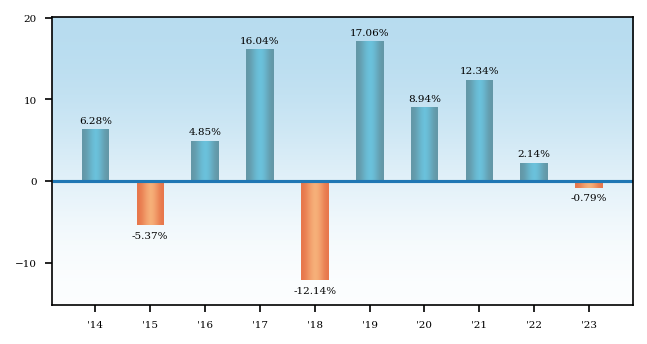
| Best Quarter | 6/30/2020 | 14.49% |
| Worst Quarter | 3/31/2020 | (19.59)% |
The year-to-date return as of the most recent calendar quarter, which ended September 30, 2024, was 12.74%
Average Annual Total Returns - Arrow DWA Tactical: Macro Fund |
Label |
1 Year |
5 Years |
10 Years |
Since Inception |
Since Inception |
Inception Date |
|||
|---|---|---|---|---|---|---|---|---|---|---|
| Arrow DWA Tactical: Macro Fund Class A Shares | Return Before Taxes | (6.46%) | 6.47% | 3.93% | 3.32% | May 30, 2008 | ||||
| Arrow DWA Tactical: Macro Fund Class A Shares | Return after Taxes on Distributions | (6.74%) | 3.85% | 1.98% | 1.92% | ||||||
| Arrow DWA Tactical: Macro Fund Class A Shares | Return after Taxes on Distributions and Sale of Fund Shares | (3.60%) | 4.40% | 2.53% | 2.22% | ||||||
| Arrow DWA Tactical: Macro Fund Class C Shares | Return Before Taxes | (1.53%) | 6.91% | 3.76% | 2.93% | May 30, 2008 | ||||
| Arrow DWA Tactical: Macro Fund Institutional Class Shares | Return Before Taxes | (0.61%) | 8.01% | 4.81% | 6.37% | Mar. 21, 2012 | ||||
| Barclay Global Macro Index (reflects no deduction for fees, expenses or taxes) | 4.84% | 7.42% | 4.27% | 3.60% | 3.87% | |||||
| PCM Global Macro Index (reflects no deduction for fees, expenses or taxes) | [1] | 4.33% | 1.71% | 1.37% | 3.91% | [2] | 0.63% | [3] | ||
| [1] | The objective of the PCM Global Macro Index is total return through broad asset classes including global equities, fixed income, major currencies, precious metals, and commodity ETFs. By using inverse ETFs, PCM’s Risk Management Overlay may allow the capture of positive returns in periods of falling markets. The index may hold long and inverse (short) positions simultaneously. This creates a multi -directional strategy, making it possible to have gains when markets decline. This index may rotate on a monthly basis. Investors cannot invest directly in an index. |
| [2] | Since 5/30/08 |
| [3] | Since 3/21/12 |
After-tax returns are calculated using the highest historical individual federal marginal income tax rate and do not reflect the impact of state and local taxes. Actual after-tax returns depend on a shareholder’s tax situation and may differ from those shown. After-tax returns for Class C and Institutional Class shares will differ from those of Class A shares. The after-tax returns are not relevant if you hold your Fund shares in tax-deferred arrangements, such as 401(k) plans or individual retirement accounts (“IRA”).
| ● | Affiliated Investment Company Risk: The Fund invests in affiliated underlying funds (the “Arrow Advised Funds”), unaffiliated underlying funds, or a combination of both. The Advisor, therefore, is subject to conflicts of interest in allocating the Fund’s assets among the underlying funds. The Advisor will receive more revenue to the extent it selects an Arrow Advised Fund rather than an unaffiliated fund for inclusion in the Fund’s portfolio. In addition, the Advisor may have an incentive to allocate the Fund’s assets to those Arrow Advised Funds for which the net advisory fees payable to the Advisor are higher than the fees payable by other Arrow Advised Funds. The Arrow Advised Funds in which the Fund may invest are not money market funds and are more risky than a money market fund. |
| ● | Commodity Risk: ETFs investing in the commodities markets and investments in the DWA Tactical Subsidiary may subject the Fund to greater volatility than investments in traditional securities. |
| ● | Credit Risk: There is a risk that issuers and counterparties will not make payments on securities and other investments held by the Fund directly or through an ETF, resulting in losses to the Fund. In addition, the credit quality of securities held by the Fund may be lowered if an issuer’s financial condition changes. Lower credit quality may lead to greater volatility in the price of a security and in shares of the Fund. Lower credit quality also may affect liquidity and make it difficult for the Fund to sell the security. The Fund may invest, directly or indirectly, in “junk bonds.” Such securities are speculative investments that carry greater risks than higher quality debt securities. |
| ● | Emerging Markets Risk: Investing in emerging market securities imposes risks different from, or greater than, risks of investing in foreign developed countries. These risks include: smaller market capitalization of securities markets, which may suffer periods of relative illiquidity; significant price volatility; restrictions on foreign investment; possible repatriation of investment income and capital. In addition, foreign investors may be required to register the proceeds of sales; future economic or political crises could lead to price controls, forced mergers, expropriation or confiscatory taxation, seizure, nationalization, or creation of government monopolies. The currencies of emerging market countries may experience significant declines against the U.S. dollar, and devaluation may occur subsequent to investments in these currencies by a Fund. Inflation and rapid fluctuations in inflation rates have had, and may continue to have, negative effects on the economies and securities markets of certain emerging market countries. |
| ● | Fixed Income Risk: When the Fund invests in ETFs that own bonds, or in this type of security directly, the value of your investment in the Fund will fluctuate with changes in interest rates. Typically, a rise in interest rates causes a decline in the value of bond funds owned by the Fund. On the other hand, if rates fall, the value of the fixed income securities generally increases. Your investment will decline in value if the value of the Fund’s investments decreases. |
| ● | Foreign Investment Risk: Although the Fund will not invest in the securities of foreign companies directly other than the DWA Tactical Subsidiary, it may invest in ETFs that invest in foreign international equity securities. Foreign investing involves risks not typically associated with U.S. investments, including adverse fluctuations in foreign currency values, adverse political, social and economic developments, less liquidity, greater volatility, less developed or less efficient trading markets, political instability and differing auditing and legal standards. Investing in emerging markets imposes risks different from, or greater than, risks of investing in foreign developed countries. |
| ● | Futures Risk: The Fund’s use of futures involves risks different from, or possibly greater than, the risks associated with investing directly in securities and other traditional investments. These risks include (i) leverage risk (ii) risk of mispricing or improper valuation; and (iii) the risk that changes in the value of the futures contract may not correlate perfectly with the underlying index. Investments in futures involve leverage, which means a small percentage of assets invested in futures can have a disproportionately large impact on the Fund. |
This risk could cause the Fund to lose more than the principal amount invested. Futures contracts may become mispriced or improperly valued when compared to the Advisor’s expectation and may not produce the desired investment results. Additionally, changes in the value of futures contracts may not track or correlate perfectly with the underlying index because of temporary, or even long-term, supply and demand imbalances and because futures do not pay dividends unlike the stocks upon which they are based.
| ● | Issuer-Specific Risk: The value of a specific security or ETF can be more volatile than the market as a whole and can perform differently from the value of the market as a whole. The value of securities of smaller issuers can be more volatile than that of larger issuers. The value of certain types of securities can be more volatile due to increased sensitivity to adverse issuer, political, regulatory, market, or economic developments. |
| ● | Junk Bond Risk: Lower-quality bonds, known as “high yield” or “junk” bonds, present greater risk than bonds of higher quality, including an increased risk of default. An economic downturn or period of rising interest rates could adversely affect the market for these bonds and reduce the Fund’s ability to sell its bonds. The lack of a liquid market for these bonds could decrease the Fund’s share price. |
| ● | Leverage Risk: Using derivatives to increase the Fund’s exposure creates leverage, which can magnify the Fund’s potential for gain or loss and, therefore, amplify the effects of market volatility on the Fund’s share price. |
| ● | Management Risk: The Advisor’s investment decisions about individual securities and derivatives as well as ETFs impact the Fund’s ability to achieve its investment objective. The Advisor’s judgments about the attractiveness and potential appreciation of particular investments in which the Fund invests may prove to be incorrect and there is no guarantee that the Advisor’s investment strategy will produce the desired results. |
| ● | Market and Geopolitical Risk: The increasing interconnectivity between global economies and financial markets increases the likelihood that events or conditions in one region or financial market may adversely impact issuers in a different country, region or financial market. Securities in the Fund’s portfolio may underperform due to inflation (or expectations for inflation), interest rates, global demand for particular products or resources, natural disasters, climate change and climate related events, pandemics, epidemics, terrorism, international conflicts, regulatory events and governmental or quasi-governmental actions. The occurrence of global events similar to those in recent years may result in market volatility and may have long term effects on both the U.S. and global financial markets. |
| ● | Portfolio Turnover Risk: Portfolio turnover refers to the rate at which the securities held by the Fund are replaced. The higher the rate, the higher the transactional and brokerage costs associated with the turnover, which may reduce the Fund’s return unless the securities traded can be bought and sold without corresponding commission costs. Active trading of securities may also increase a Fund’s realized capital gains or losses, which may affect the taxes you pay as a Fund shareholder. |
| ● | Real Estate Risk: ETFs that invest in real estate are subject to the risks associated with investing in real estate. The value of these securities will rise and fall in response to many factors, including economic conditions, the demand for rental property and changes in interest rates. |
| ● | Regulatory Risk: Regulatory authorities in the United States or other countries may restrict the ability of the Fund to fully implement its strategy, either generally, or with respect to certain securities, industries or countries, which may impact the Fund’s ability to fully implement its investment strategies. |
| ● | Sector Risk: The Fund may focus its investments in securities of a particular sector or in ETFs that focus investments in securities of a particular sector. Economic, legislative or regulatory developments may occur, which significantly affect the entire sector. This may cause the Fund’s net asset value to fluctuate more than that of a fund that does not focus in a particular sector. |
| ● | Small and Medium Capitalization Stock Risk: The value of small or medium capitalization company stocks or ETFs that invests in stocks of small and medium capitalization companies may be subject to more abrupt or erratic market movements than those of larger, more established companies or the market averages in general. |
| ● | Taxation Risk: By investing in commodities indirectly through the DWA Tactical Subsidiary, the Fund will obtain exposure to the commodities markets within the federal tax requirements that apply to the Fund. However, because the DWA Tactical Subsidiary is a controlled foreign corporation, any income received from the DWA Tactical Subsidiary will be passed through to the Fund as ordinary income, which may be taxed at less favorable rates than capital gains. |
| ● | Wholly-Owned Subsidiary Risk: The DWA Tactical Subsidiary will not be registered under the Investment Company Act of 1940 (“1940 Act”) and, unless otherwise noted in this Prospectus, will not be subject to all of the investor protections of the 1940 Act. Changes in the laws of the United States and/or the Cayman Islands, under which the Fund and DWA Tactical Subsidiary, respectively, are organized, could result in the inability of the Fund and/or DWA Tactical Subsidiary to operate as described in this Prospectus and could negatively affect the Fund and its shareholders. Your cost of investing in the Fund will be higher because you indirectly bear the expenses of the DWA Tactical Subsidiary. |
| ● | ETF Risk: ETFs are subject to investment advisory and other expenses, which will be indirectly paid by the Fund. As a result, the cost of investing in the Fund will be higher than the cost of investing directly in ETFs and may be higher than other mutual funds that invest directly in stocks and bonds. The ETFs in which the Fund invests will not be able to replicate exactly the performance of the indices they track and the market value of ETF shares may differ from their net asset value. Each ETF is subject to specific risks, depending on the nature of the ETF and ETFs that invest in the “Alternative Asset” market segment may be more volatile than other Fund investments. |
| ● | MLP Risk: Investments in MLPs and MLP-related securities involve risks different from those of investing in common stock including risks related to limited control and limited rights to vote on matters affecting the MLP or MLP-related security, risks related to potential conflicts of interest between an MLP and the MLP’s general partner, cash flow risks, dilution risks and risks related to the general partner’s limited call right. MLPs and MLP-related securities are generally considered interest-rate sensitive investments. During periods of interest rate volatility, these investments may not provide attractive returns. Depending on the state of interest rates in general, the use of MLPs or MLP-related securities could enhance or harm the overall performance of the Fund. |
| ○ | MLP Tax Risk. MLPs, typically, do not pay U.S. federal income tax at the partnership level. Instead, each partner is allocated a share of the partnership’s income, gains, losses, deductions and expenses. A change in current tax law or in the underlying business mix of a given MLP could result in an MLP being treated as a corporation for U.S. federal income tax purposes, which would result in such MLP being required to pay U.S. federal income tax on its taxable income. The classification of an MLP as a corporation for U.S. federal income tax purposes would have the effect of reducing the amount of cash available for distribution by the MLP. Thus, if any of the MLPs owned by the Fund were treated as corporations for U.S. federal income tax purposes, it could result in a reduction of the value of your investment in the Fund and lower income, as compared to an MLP that is not taxed as a corporation. |
| ○ | MLP Tax Risk. MLPs, typically, do not pay U.S. federal income tax at the partnership level. Instead, each partner is allocated a share of the partnership’s income, gains, losses, deductions and expenses. A change in current tax law or in the underlying business mix of a given MLP could result in an MLP being treated as a corporation for U.S. federal income tax purposes, which would result in such MLP being required to pay U.S. federal income tax on its taxable income. The classification of an MLP as a corporation for U.S. federal income tax purposes would have the effect of reducing the amount of cash available for distribution by the MLP. Thus, if any of the MLPs owned by the Fund were treated as corporations for U.S. federal income tax purposes, it could result in a reduction of the value of your investment in the Fund and lower income, as compared to an MLP that is not taxed as a corporation. |
| ● | Options Risk: There are risks associated with the sale and purchase of options. As a seller (writer) of a put option, the Fund will tend to lose money if the value of the reference index or security falls below the strike price. As the seller (writer) of a call option, the Fund will tend to lose money if the value of the reference index or security rises above the strike price. As the buyer of a put or call option, the Fund risks losing the entire premium invested in the option if the Fund does not exercise the option. |
The Arrow Managed Futures Strategy Fund (the “Fund”) seeks long-term capital appreciation and to achieve absolute returns.
This table describes the fees and expenses that you may pay if you buy, hold, and sell shares of the Fund. Investors may pay other fees, such as brokerage commissions and other fees to financial intermediaries, which are not reflected in the tables and examples below. More information about these and other discounts is available from your financial professional and in Information About Shares on page 37 and Appendix A of the Fund’s Prospectus.
Shareholder Fees - Arrow Managed Futures Strategy Fund |
Arrow Managed Futures Strategy Fund Class A Shares |
Arrow Managed Futures Strategy Fund Class C Shares |
Arrow Managed Futures Strategy Fund Institutional Class Shares |
|---|---|---|---|
| Maximum Sales Charge (Load) Imposed on Purchases (as a% of offering price) | 5.75% | none | none |
| Maximum Deferred Sales Charge (Load) (as a % of redemption proceeds) | 1.00% | none | none |
| Redemption Fee (as a % of amount redeemed, if shares are held less than 30 days) | 1.00% | 1.00% | 1.00% |
Annual Fund Operating Expenses - Arrow Managed Futures Strategy Fund |
Arrow Managed Futures Strategy Fund Class A Shares |
Arrow Managed Futures Strategy Fund Class C Shares |
Arrow Managed Futures Strategy Fund Institutional Class Shares |
|
|---|---|---|---|---|
| Management Fees | 0.85% | 0.85% | 0.85% | |
| Distribution and/or Service (12b-1) Fees | 0.25% | 1.00% | none | |
| Other Expenses | [1] | 0.39% | 0.39% | 0.39% |
| Acquired Fund Fees and Expenses | [2] | 0.22% | 0.22% | 0.22% |
| Total Annual Fund Operating Expenses | [3] | 1.71% | 2.46% | 1.46% |
| [1] | Other Expenses include the expenses of the Fund’s consolidated wholly-owned subsidiary. Other Expenses do not include the fees paid to the counterparties to the Fund’s Swap (defined below), or the management fees, performance fees, and expenses of the trading vehicles or commodity pools (the “Underlying Asset”) that serve as the reference asset of the Swap. These fees and expenses, which are not reflected in the Annual Fund Operating Expenses table, are embedded in the return of the Swap and represent an indirect cost of investing in the Fund. Generally, the Swap counterparties charge 0.60% of the notional value of the Swap, and the performance fees of the Underlying Asset, which are paid to the commodity trading adviser (“CTA”), range up to 25% of the net new trading profits. |
| [2] | Acquired Fund Fees and Expenses are the indirect costs of investing in other investment companies. |
| [3] | Swap fees amounted to 0.44% of the Fund’s assets |
This Example is intended to help you compare the cost of investing in the Fund with the cost of investing in other mutual funds.
Expense Example - Arrow Managed Futures Strategy Fund - USD ($) |
Expense Example, with Redemption, 1 Year |
Expense Example, with Redemption, 3 Years |
Expense Example, with Redemption, 5 Years |
Expense Example, with Redemption, 10 Years |
|---|---|---|---|---|
| Arrow Managed Futures Strategy Fund Class A Shares | 839 | 1,083 | 1,450 | 2,478 |
| Arrow Managed Futures Strategy Fund Class C Shares | 249 | 767 | 1,311 | 2,796 |
| Arrow Managed Futures Strategy Fund Institutional Class Shares | 149 | 462 | 797 | 1,746 |
Expense Example, No Redemption - Arrow Managed Futures Strategy Fund - USD ($) |
Expense Example, No Redemption, 1 Year |
Expense Example, No Redemption, 3 Years |
Expense Example, No Redemption, 5 Years |
Expense Example, No Redemption, 10 Years |
|---|---|---|---|---|
| Arrow Managed Futures Strategy Fund Class A Shares | 739 | 1,083 | 1,450 | 2,478 |
| Arrow Managed Futures Strategy Fund Class C Shares | 249 | 767 | 1,311 | 2,796 |
| Arrow Managed Futures Strategy Fund Institutional Class Shares | 149 | 462 | 797 | 1,746 |
The Fund pays transaction costs, such as commissions, when it buys and sells securities (or “turns over” its portfolio). A higher portfolio turnover may indicate higher transaction costs and may result in higher taxes when Fund shares are held in a taxable account. These costs, which are not reflected in annual fund operating expenses or in the Example, affect the Fund’s performance. During the most recent fiscal year, the Fund’s portfolio turnover rate was 12% of the average value of its portfolio.
The Fund pursues its investment objective by implementing a fixed income strategy and a managed futures strategy. The managed futures strategy generates capital appreciation by investing in limited partnerships, corporations operating as investment funds, and limited liability companies that employ the managed futures program of DUNN Capital Management, LLC (“Dunn”), a CTA registered with the U.S. Commodity Futures Trading Commission (collectively, “Underlying Funds”) and in derivative instruments, such as swap contracts, structured notes or other securities or derivatives, that provide exposure to Dunn’s World Monetary and Agriculture Program (the “WMA Program”).
Dunn was founded in 1974 and started to implement the WMA Program in 1984. The WMA Program uses quantitative modeling to develop and maintain systematic trading strategies driven by data across financial (such as foreign and domestic equity and debt futures and foreign currency futures) and commodity markets.
The WMA Program was designed to analyze market data to identify trends and relationships occurring within and across markets and asset classes. The WMA Program is constructed to identify price trends (both up and down) in physical commodities and financial futures markets. The WMA Program allocates assets across a blend of financial and commodity futures (including, interest rates, equity indices, and currencies, and physical commodities, such as, energy, metals and agriculture). The financial futures and physical commodity components are positioned either long, flat or short based on the systematic trading strategy. A future is a financial contract obligating the buyer to purchase an asset (or the seller to sell an asset), such as a physical commodity or a financial instrument, at a predetermined future date and price. The WMA Program consists of trend following and other quantitative strategies that aim for low correlation to traditional asset classes such as equities and fixed income and are diversified by investment style, information source, investment holding period and instrument.
The Fund executes its managed futures strategy primarily by investing up to 25% of its total assets in a wholly-owned and controlled subsidiary (the “Arrow MFT Subsidiary”). The Arrow MFT Subsidiary will invest the majority of its assets in one or more Underlying Funds, swap contracts, structured notes and other investments intended to serve as margin or collateral for derivative positions. The Arrow MFT Subsidiary is subject to the same investment restrictions as the Fund, when viewed on a consolidated basis.
To the extent Arrow Investment Advisors, LLC (the “Advisor”) is utilizing derivatives to gain exposure to the WMA Program, it is anticipated that the Fund will use a swap (the “Swap”), which is a type of derivative instrument based on an Underlying Asset, designed to replicate the aggregate returns of the WMA Program. The Swap is based on a notional amount agreed upon by the Advisor and the counterparty. The Advisor may add or remove managers from the Swap or adjust the notional exposure between the managers within the Swap. Generally, the fees and expenses of the Swap are based on the notional value. The Underlying Asset is calculated by the counterparty to the Swap and includes a deduction for fees of the counterparty as well as management and performance fees of the managers.
Prospective investors should note that Dunn is not responsible for the formation or the operation of, and does not act as an adviser to, the Fund or the Arrow MFT Subsidiary and does not make recommendations or representations with respect to the Fund or the Arrow MFT Subsidiary. Other than reviewing the description of the WMA Program, Dunn has not had any involvement in the preparation of this Prospectus and is not responsible or liable for the contents hereof. Prospective investors will not be investing their funds with Dunn, will not have voting rights or a direct interest in any Dunn fund, and will have no standing or recourse against Dunn with respect to the Fund, its operations or performance.
In addition, while the Fund and the Arrow MFT Subsidiary may gain exposure to the WMA Program through one or more trading companies that employ the WMA Program and/or derivative instruments such as swap agreements that provide exposure to the WMA Program, neither the Fund nor the Arrow MFT Subsidiary will have a direct interest in any Dunn fund.
The Fund executes its fixed income strategy primarily by investing directly or indirectly through other funds (including affiliated funds) in U.S. government securities, short-term, high quality fixed-income securities, money market instruments, overnight and fixed-term repurchase agreements, cash, and other cash equivalents with maturities of one year or less. The Fund’s fixed income strategy is primarily used to collateralize its derivative positions. The Fund’s strategy aims to achieve capital appreciation and absolute returns over the long-term. The Advisor may engage in frequent buying and selling of portfolio securities to achieve the Fund’s investment objective.
As with all mutual funds, there is the risk that you could lose money through your investment in the Fund. Many factors affect the Fund’s net asset value and performance. The following describes the principal risks the Fund bears with respect to its investments. The risks apply to the Fund through its direct investments in securities and derivatives as well as indirectly through investments in other funds, structured notes and the Arrow MFT Subsidiary. As with any fund, there is no guarantee that the Fund will achieve its objective.
| ● | Affiliated Investment Company Risk: The Fund invests in affiliated underlying funds (the “Arrow Advised Funds”), unaffiliated underlying funds, or a combination of both. The Advisor, therefore, is subject to conflicts of interest in allocating the Fund’s assets among the underlying funds. The Advisor will receive more revenue to the extent it selects an Arrow Advised Fund rather than an unaffiliated fund for inclusion in the Fund’s portfolio. In addition, the Advisor may have an incentive to allocate the Fund’s assets to those Arrow Advised Funds for which the net advisory fees payable to the Advisor are higher than the fees payable by other Arrow Advised Funds. The Arrow Advised Funds in which a Fund may invest are not money market funds and are more risky than a money market fund. |
| ● | Commodity Risk: Investing in the commodities markets will subject the Fund to greater volatility than investments in traditional securities. Commodity prices are influenced by unfavorable weather, animal and plant disease, geologic and environmental factors as well as changes in government regulation such as tariffs, embargoes or burdensome production rules and restrictions. |
| ● | Counterparty Risk: A counterparty (the other party to a transaction or an agreement or the party with whom the Fund executes transactions) to a transaction with the Fund may be unable or unwilling to make timely principal, interest or settlement payments, or otherwise honor its obligations. |
| ● | Credit Risk: There is a risk that issuers and counterparties will not make payments on securities and other investments held by the Fund, resulting in losses to the Fund. In addition, the credit quality of securities held by the Fund may be lowered if an issuer’s financial condition changes. Lower credit quality will lead to greater volatility in the price of a security and in shares of the Fund. Lower credit quality also will affect liquidity and make it difficult for the Fund to sell the security. |
| ● | Derivatives Risk: The Fund may use derivatives (including swaps, structured notes, options, futures and options on futures) to enhance returns or hedge against market declines. The Fund’s use of derivative instruments involves risks different from, or possibly greater than, the risks associated with investing directly in securities and other traditional investments. These risks include (i) the risk that the counterparty to a derivative transaction may not fulfill its contractual obligations; (ii) risk of mispricing or improper valuation; and (iii) the risk that changes in the value of the derivative may not correlate perfectly with the underlying asset, rate or index. These risks could cause the Fund to lose more than the principal amount invested. In addition, investments in derivatives may involve leverage, which means a small percentage of assets invested in derivatives can have a disproportionately large impact on the Fund. |
| ● | ETF Risk: ETFs are subject to investment advisory and other expenses, which will be indirectly paid by the Fund. As a result, the cost of investing in the Fund will be higher than the cost of investing directly in ETFs and may be higher than other mutual funds that invest directly in stocks and bonds. The ETFs in which the Fund invests will not be able to replicate exactly the performance of the indices they track and the market value of ETF shares may differ from their net asset value. Each ETF is subject to specific risks, depending on the nature of the ETF and ETFs that invest in the “Alternative Asset” market segment may be more volatile than other Fund investments. |
| ● | Fixed Income Risk: The value of the Fund’s investments in fixed income securities and derivatives will fluctuate with changes in interest rates. Typically, a rise in interest rates causes a decline in the value of fixed income securities and derivatives owned by the Fund. On the other hand, if rates fall, the value of the fixed income securities and derivatives generally increases. Your investment will decline in value if the value of the Fund’s investments decreases. |
| ● | Foreign Currency Risk: Currency trading risks include market risk, credit risk and country risk. Market risk results from adverse changes in exchange rates in the currencies the Fund are long or short. Credit risk results because a currency-trade counterparty may default. Country risk arises because a government may interfere with transactions in its currency. |
| ● | Foreign Investment Risk: The Fund is subject to risks beyond those associated with investing in domestic securities. Foreign companies are generally not subject to the same regulatory requirements of U.S. companies thereby resulting in less publicly available information about these companies. In addition, foreign accounting, auditing and financial reporting standards generally differ from those applicable to U.S. companies. |
| ● | Futures Risk: The Fund’s use of futures involves risks different from, or possibly greater than, the risks associated with investing directly in securities and other traditional investments. These risks include (i) leverage risk (ii) risk of mispricing or improper valuation; and (iii) the risk that changes in the value of the futures contract may not correlate perfectly with the underlying index. Investments in futures involve leverage, which means a small percentage of assets invested in futures can have a disproportionately large impact on the Fund. This risk could cause the Fund to lose more than the principal amount invested. Futures contracts may become mispriced or improperly valued when compared to the Advisor’s expectation and may not produce the desired investment results. Additionally, changes in the value of futures contracts may not track or correlate perfectly with the underlying index because of temporary, or even long-term, supply and demand imbalances and because futures do not pay dividends unlike the stocks upon which they are based. |
| ● | Government Securities Risk: The Fund may invest in securities issued or guaranteed by the U.S. government or its agencies and instrumentalities. These securities may be backed by the credit of the government as a whole or only by the issuing agency. No assurance can be given that the U.S. government would provide financial support to its agencies and instrumentalities if not required to do so by law. Neither the U.S. government nor its agencies guarantee the market value of their securities, and interest rate changes, prepayments and other factors may affect the value of government securities. |
| ● | Issuer-Specific Risk: The value of a specific security can be more volatile than the market as a whole and can perform differently from the value of the market as a whole. The value of securities of smaller issuers can be more volatile than that of larger issuers. The value of certain types of securities can be more volatile due to increased sensitivity to adverse issuer, political, regulatory, market, or economic developments. |
| ● | Leverage Risk: Using derivatives to increase the Fund’s combined long and short exposure creates leverage, which can magnify the Fund’s potential for gain or loss and, therefore, amplify the effects of market volatility on the Fund’s share price. |
| ● | Management Risk: The Advisor’s investment decisions about individual securities impact the Fund’s ability to achieve its investment objective. The Advisor’s judgments about the attractiveness and potential appreciation of particular investments in which the Fund invests may prove to be incorrect and there is no guarantee that the Advisor’s investment strategy will produce the desired results. |
| ● | Market and Geopolitical Risk: The increasing interconnectivity between global economies and financial markets increases the likelihood that events or conditions in one region or financial market may adversely impact issuers in a different country, region or financial market. Securities in the Fund’s portfolio may underperform due to inflation (or expectations for inflation), interest rates, global demand for particular products or resources, natural disasters, climate change and climate related events, pandemics, epidemics, terrorism, international conflicts, regulatory events and governmental or quasi-governmental actions. The occurrence of global events similar to those in recent years may result in market volatility and may have long term effects on both the U.S. and global financial markets. |
| ● | Options Risk: There are risks associated with the sale and purchase of options. As a seller (writer) of a put option, the Fund will tend to lose money if the value of the reference index or security falls below the strike price. As the seller (writer) of a call option, the Fund will tend to lose money if the value of the reference index or security rises above the strike price. As the buyer of a put or call option, the Fund risks losing the entire premium invested in the option if the Fund does not exercise the option. |
| ● | Other Investment Company Risk: Other investment companies are subject to investment advisory and other expenses, which will be indirectly paid by the Fund. As a result, the cost of investing in the Fund will be higher than the cost of investing directly those other investment companies and may be higher than other mutual funds that invest directly in stocks and bonds. Other investment companies are subject to specific risks, depending on the nature of the fund. |
| ● | Regulatory Risk: Regulatory authorities in the United States or other countries may restrict the ability of the Fund to fully implement its strategy, either generally, or with respect to certain securities, industries or countries, which may impact the Fund’s ability to fully implement its investment strategies. |
| ● | Repurchase Agreement Risk: A repurchase agreement involves the purchase by the Fund of securities with the agreement that, after a stated period of time, the original seller will buy back the same securities at an agreed upon price or yield. However, if the seller defaults on its obligation to repurchase the securities, the fund may incur costs in disposing of the collateral and may experience losses if there is any delay in its ability to do so. |
| ● | Short Position Risk: The Fund will incur a loss as a result of a short position if the price of the short position instrument increases in value between the date of the short position sale and the date on which the Fund purchases an offsetting position. Short positions may be considered speculative transactions and involve special risks, including greater reliance on the Advisor’s ability to accurately anticipate the future value of a security or instrument. The Fund’s losses are potentially unlimited in a short position transaction. |
| ● | Structured Note Risk: The value of a structured note will be influenced by time to maturity, level of supply and demand for this type of note, interest rate and commodity market volatility, changes in the issuer’s credit quality rating, and economic, legal, political, or geographic events that affect the referenced commodity. These notes are typically issued by banks or brokerage firms, and have interest and/or principal payments which are linked to changes in the price level of certain assets or to the price performance of certain indices. There may be a lag between a change in the value of the Underlying Asset and the value of the structured note. The Fund may also be exposed to increased transaction costs. |
| ● | Swap Risk: Swaps are subject to tracking risk because they may not be perfect substitutes for the instruments they are intended to hedge or replace. Over the counter swaps are subject to counterparty default. Leverage inherent in derivatives will tend to magnify the Fund’s losses. The Fund is also subject to credit risk on the amount the Fund expects to receive from swap agreement counterparties. If a swap counterparty defaults on its payment obligations to the Fund, this default will cause the value of your investment in the Fund to decrease. |
| ● | Taxation Risk: By investing in commodities indirectly through the Arrow MFT Subsidiary, the Fund will obtain exposure to the commodities markets within the federal tax requirements that apply to the Fund. However, because the Arrow MFT Subsidiary is a controlled foreign corporation, any income received from the Arrow MFT Subsidiary will be passed through to the Fund as ordinary income, which may be taxed at less favorable rates than capital gains. |
| ● | Volatility Risk: The Fund may have investments that appreciate or decrease significantly in value of short periods of time. This may cause the Fund’s net asset value per share to experience significant increases or declines in value over short periods of time, however, all investments long- or short-term are subject to risk of loss. |
| ● | Wholly-Owned Subsidiary Risk: The Arrow MFT Subsidiary will not be registered under the Investment Company Act of 1940 (“1940 Act”) and, unless otherwise noted in this Prospectus, will not be subject to all of the investor protections of the 1940 Act. Changes in the laws of the United States and/or the Cayman Islands, under which the Fund and Arrow MFT Subsidiary, respectively, are organized, could result in the inability of the Fund and/or Subsidiary to operate as described in this Prospectus and could negatively affect the Fund and its shareholders. Your cost of investing in the Fund will be higher because you indirectly bear the expenses of the Arrow MFT Subsidiary. |
The bar chart and performance table below show the variability of the Fund’s returns, which is some indication of the risks of investing in the Fund. The bar chart shows performance of the Fund’s Class A shares for each full calendar year since the Fund’s inception. The performance table compares the performance of the Fund’s Class A shares over time to the performance of a broad-based securities market index and supplemental index. The Fund was reorganized on March 1, 2012 from a series of Northern Lights Fund Trust, a Delaware statutory trust, (the “Predecessor Fund”) to a series of Arrow Investments Trust, a Delaware statutory trust (the “Reorganization”). The Fund is a continuation of the Predecessor Fund and, therefore, the performance of the Fund to March 1, 2012, represents the performance of the Predecessor Fund. You should be aware that the Fund’s past performance (before and after taxes) may not be an indication of how the Fund will perform in the future. On October 1, 2015, the Fund changed its strategy from being an index fund to being an actively managed fund.
Although Class C shares (formerly known as Advisor Class shares) and Institutional Class shares would have similar annual returns to Class A shares because the classes are invested in the same portfolio of securities, the returns for Class C and Institutional Class shares would be different from Class A shares because Class C and Institutional Class shares have different expenses than Class A shares. Updated performance information and daily net asset value per share information is available at no cost by visiting www.ArrowFunds.com or by calling 1-877-277-6933 (1-877-ARROW-FD).
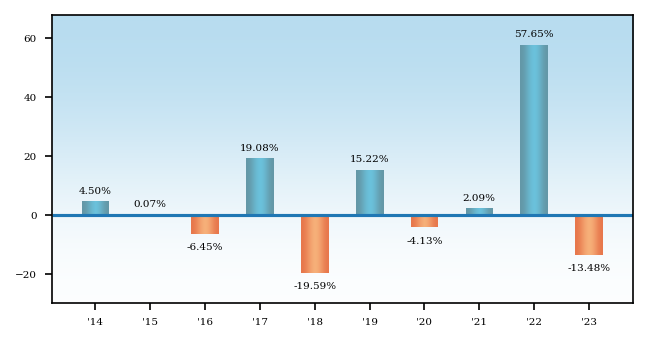
| Best Quarter | 3/31/2022 | 32.84% |
| Worst Quarter | 12/31/2023 | (17.55)% |
The year-to-date return as of the most recent calendar quarter, which ended September 30, 2024, was 9.35%
| [1] | The S&P 500 Index is a widely accepted, unmanaged index of U.S. stock market performance which does not take into account charges, fees and other expenses. Investors cannot invest directly in an index. |
| [2] | Since 4/30/10 |
| [3] | Since 3/21/12 |
| [4] | The Credit Suisse Managed Futures Liquid Index seeks to gain broad exposure to the Credit Suisse Managed Futures Strategy using a pre-defined quantitative methodology to invest in a range of asset classes including: equities, fixed income, commodities and currencies. The Credit Suisse Managed Futures Liquid Index is also a factor within the Credit Suisse Global Strategies Liquid Index. Investors cannot invest directly in an index. |
After-tax returns are calculated using the highest historical individual federal marginal income tax rate and do not reflect the impact of state and local taxes. Actual after-tax returns depend on a shareholder’s tax situation and may differ from those shown. After-tax returns for Class C and Institutional Class shares will differ from those of Class A shares. The after-tax returns are not relevant if you hold your Fund shares in tax-deferred arrangements, such as 401(k) plans or individual retirement accounts (“IRA”).
| ● | Affiliated Investment Company Risk: The Fund invests in affiliated underlying funds (the “Arrow Advised Funds”), unaffiliated underlying funds, or a combination of both. The Advisor, therefore, is subject to conflicts of interest in allocating the Fund’s assets among the underlying funds. The Advisor will receive more revenue to the extent it selects an Arrow Advised Fund rather than an unaffiliated fund for inclusion in the Fund’s portfolio. In addition, the Advisor may have an incentive to allocate the Fund’s assets to those Arrow Advised Funds for which the net advisory fees payable to the Advisor are higher than the fees payable by other Arrow Advised Funds. The Arrow Advised Funds in which a Fund may invest are not money market funds and are more risky than a money market fund. |
| ● | Commodity Risk: Investing in the commodities markets will subject the Fund to greater volatility than investments in traditional securities. Commodity prices are influenced by unfavorable weather, animal and plant disease, geologic and environmental factors as well as changes in government regulation such as tariffs, embargoes or burdensome production rules and restrictions. |
| ● | Credit Risk: There is a risk that issuers and counterparties will not make payments on securities and other investments held by the Fund, resulting in losses to the Fund. In addition, the credit quality of securities held by the Fund may be lowered if an issuer’s financial condition changes. Lower credit quality will lead to greater volatility in the price of a security and in shares of the Fund. Lower credit quality also will affect liquidity and make it difficult for the Fund to sell the security. |
| ● | Fixed Income Risk: The value of the Fund’s investments in fixed income securities and derivatives will fluctuate with changes in interest rates. Typically, a rise in interest rates causes a decline in the value of fixed income securities and derivatives owned by the Fund. On the other hand, if rates fall, the value of the fixed income securities and derivatives generally increases. Your investment will decline in value if the value of the Fund’s investments decreases. |
| ● | Foreign Investment Risk: The Fund is subject to risks beyond those associated with investing in domestic securities. Foreign companies are generally not subject to the same regulatory requirements of U.S. companies thereby resulting in less publicly available information about these companies. In addition, foreign accounting, auditing and financial reporting standards generally differ from those applicable to U.S. companies. |
| ● | Futures Risk: The Fund’s use of futures involves risks different from, or possibly greater than, the risks associated with investing directly in securities and other traditional investments. These risks include (i) leverage risk (ii) risk of mispricing or improper valuation; and (iii) the risk that changes in the value of the futures contract may not correlate perfectly with the underlying index. Investments in futures involve leverage, which means a small percentage of assets invested in futures can have a disproportionately large impact on the Fund. This risk could cause the Fund to lose more than the principal amount invested. Futures contracts may become mispriced or improperly valued when compared to the Advisor’s expectation and may not produce the desired investment results. Additionally, changes in the value of futures contracts may not track or correlate perfectly with the underlying index because of temporary, or even long-term, supply and demand imbalances and because futures do not pay dividends unlike the stocks upon which they are based. |
| ● | Issuer-Specific Risk: The value of a specific security can be more volatile than the market as a whole and can perform differently from the value of the market as a whole. The value of securities of smaller issuers can be more volatile than that of larger issuers. The value of certain types of securities can be more volatile due to increased sensitivity to adverse issuer, political, regulatory, market, or economic developments. |
| ● | Leverage Risk: Using derivatives to increase the Fund’s combined long and short exposure creates leverage, which can magnify the Fund’s potential for gain or loss and, therefore, amplify the effects of market volatility on the Fund’s share price. |
| ● | Management Risk: The Advisor’s investment decisions about individual securities impact the Fund’s ability to achieve its investment objective. The Advisor’s judgments about the attractiveness and potential appreciation of particular investments in which the Fund invests may prove to be incorrect and there is no guarantee that the Advisor’s investment strategy will produce the desired results. |
| ● | Market and Geopolitical Risk: The increasing interconnectivity between global economies and financial markets increases the likelihood that events or conditions in one region or financial market may adversely impact issuers in a different country, region or financial market. Securities in the Fund’s portfolio may underperform due to inflation (or expectations for inflation), interest rates, global demand for particular products or resources, natural disasters, climate change and climate related events, pandemics, epidemics, terrorism, international conflicts, regulatory events and governmental or quasi-governmental actions. The occurrence of global events similar to those in recent years may result in market volatility and may have long term effects on both the U.S. and global financial markets. |
| ● | Regulatory Risk: Regulatory authorities in the United States or other countries may restrict the ability of the Fund to fully implement its strategy, either generally, or with respect to certain securities, industries or countries, which may impact the Fund’s ability to fully implement its investment strategies. |
| ● | Taxation Risk: By investing in commodities indirectly through the Arrow MFT Subsidiary, the Fund will obtain exposure to the commodities markets within the federal tax requirements that apply to the Fund. However, because the Arrow MFT Subsidiary is a controlled foreign corporation, any income received from the Arrow MFT Subsidiary will be passed through to the Fund as ordinary income, which may be taxed at less favorable rates than capital gains. |
| ● | Wholly-Owned Subsidiary Risk: The Arrow MFT Subsidiary will not be registered under the Investment Company Act of 1940 (“1940 Act”) and, unless otherwise noted in this Prospectus, will not be subject to all of the investor protections of the 1940 Act. Changes in the laws of the United States and/or the Cayman Islands, under which the Fund and Arrow MFT Subsidiary, respectively, are organized, could result in the inability of the Fund and/or Subsidiary to operate as described in this Prospectus and could negatively affect the Fund and its shareholders. Your cost of investing in the Fund will be higher because you indirectly bear the expenses of the Arrow MFT Subsidiary. |
| ● | Counterparty Risk: A counterparty (the other party to a transaction or an agreement or the party with whom the Fund executes transactions) to a transaction with the Fund may be unable or unwilling to make timely principal, interest or settlement payments, or otherwise honor its obligations. |
| ● | ETF Risk: ETFs are subject to investment advisory and other expenses, which will be indirectly paid by the Fund. As a result, the cost of investing in the Fund will be higher than the cost of investing directly in ETFs and may be higher than other mutual funds that invest directly in stocks and bonds. The ETFs in which the Fund invests will not be able to replicate exactly the performance of the indices they track and the market value of ETF shares may differ from their net asset value. Each ETF is subject to specific risks, depending on the nature of the ETF and ETFs that invest in the “Alternative Asset” market segment may be more volatile than other Fund investments. |
| ● | Options Risk: There are risks associated with the sale and purchase of options. As a seller (writer) of a put option, the Fund will tend to lose money if the value of the reference index or security falls below the strike price. As the seller (writer) of a call option, the Fund will tend to lose money if the value of the reference index or security rises above the strike price. As the buyer of a put or call option, the Fund risks losing the entire premium invested in the option if the Fund does not exercise the option. |
| ● | Short Position Risk: The Fund will incur a loss as a result of a short position if the price of the short position instrument increases in value between the date of the short position sale and the date on which the Fund purchases an offsetting position. Short positions may be considered speculative transactions and involve special risks, including greater reliance on the Advisor’s ability to accurately anticipate the future value of a security or instrument. The Fund’s losses are potentially unlimited in a short position transaction. |
| ● | Derivatives Risk: The Fund may use derivatives (including swaps, structured notes, options, futures and options on futures) to enhance returns or hedge against market declines. The Fund’s use of derivative instruments involves risks different from, or possibly greater than, the risks associated with investing directly in securities and other traditional investments. These risks include (i) the risk that the counterparty to a derivative transaction may not fulfill its contractual obligations; (ii) risk of mispricing or improper valuation; and (iii) the risk that changes in the value of the derivative may not correlate perfectly with the underlying asset, rate or index. These risks could cause the Fund to lose more than the principal amount invested. In addition, investments in derivatives may involve leverage, which means a small percentage of assets invested in derivatives can have a disproportionately large impact on the Fund. |
| ● | Foreign Currency Risk: Currency trading risks include market risk, credit risk and country risk. Market risk results from adverse changes in exchange rates in the currencies the Fund are long or short. Credit risk results because a currency-trade counterparty may default. Country risk arises because a government may interfere with transactions in its currency. |
| ● | Government Securities Risk: The Fund may invest in securities issued or guaranteed by the U.S. government or its agencies and instrumentalities. These securities may be backed by the credit of the government as a whole or only by the issuing agency. No assurance can be given that the U.S. government would provide financial support to its agencies and instrumentalities if not required to do so by law. Neither the U.S. government nor its agencies guarantee the market value of their securities, and interest rate changes, prepayments and other factors may affect the value of government securities. |
| ● | Other Investment Company Risk: Other investment companies are subject to investment advisory and other expenses, which will be indirectly paid by the Fund. As a result, the cost of investing in the Fund will be higher than the cost of investing directly those other investment companies and may be higher than other mutual funds that invest directly in stocks and bonds. Other investment companies are subject to specific risks, depending on the nature of the fund. |
| ● | Repurchase Agreement Risk: A repurchase agreement involves the purchase by the Fund of securities with the agreement that, after a stated period of time, the original seller will buy back the same securities at an agreed upon price or yield. However, if the seller defaults on its obligation to repurchase the securities, the fund may incur costs in disposing of the collateral and may experience losses if there is any delay in its ability to do so. |
| ● | Structured Note Risk: The value of a structured note will be influenced by time to maturity, level of supply and demand for this type of note, interest rate and commodity market volatility, changes in the issuer’s credit quality rating, and economic, legal, political, or geographic events that affect the referenced commodity. These notes are typically issued by banks or brokerage firms, and have interest and/or principal payments which are linked to changes in the price level of certain assets or to the price performance of certain indices. There may be a lag between a change in the value of the Underlying Asset and the value of the structured note. The Fund may also be exposed to increased transaction costs. |
| ● | Swap Risk: Swaps are subject to tracking risk because they may not be perfect substitutes for the instruments they are intended to hedge or replace. Over the counter swaps are subject to counterparty default. Leverage inherent in derivatives will tend to magnify the Fund’s losses. The Fund is also subject to credit risk on the amount the Fund expects to receive from swap agreement counterparties. If a swap counterparty defaults on its payment obligations to the Fund, this default will cause the value of your investment in the Fund to decrease. |
| ● | Volatility Risk: The Fund may have investments that appreciate or decrease significantly in value of short periods of time. This may cause the Fund’s net asset value per share to experience significant increases or declines in value over short periods of time, however, all investments long- or short-term are subject to risk of loss. |