The Cultivar ETF (the “Fund”) seeks long-term capital appreciation.
This table describes the fees and expenses that you may pay if you buy, hold and sell shares of the Fund. Investors purchasing shares on a national securities exchange, national securities association, or over-the-counter trading system where shares may trade from time to time (each, a “secondary market”) may be subject to customary brokerage commissions charged by their broker that are not reflected in the table and example set forth below.
Annual Fund Operating Expenses |
Cultivar ETF
Cultivar ETF
|
|
|---|---|---|
| Management Fee | 0.87% | [1] |
| Other Expenses | none | |
| Total Annual Fund Operating Expenses | 0.87% | |
| [1] | Under the Investment Advisory Agreement, Cultivar Capital, Inc., at its own expense and without reimbursement from the Fund, pays all of the expenses of the Fund, excluding the advisory fees, interest expenses, taxes, acquired fund fees and expenses, brokerage commissions and any other portfolio transaction related expenses and fees arising out of transactions effected on behalf of the Fund, credit facility fees and expenses, including interest expenses, and litigation and indemnification expenses and other extraordinary expenses not incurred in the ordinary course of the Fund’s business. |
This example is intended to help you compare the cost of investing in the Fund with the cost of investing in other funds. The example assumes that you invest $10,000 in the Fund for the time periods indicated and then redeem all of your shares at the end of those periods. The example also assumes that your investment has a 5% return each year and that the Fund’s operating expenses remain the same. Although your actual costs may be higher or lower, based on these assumptions your costs would be:
Expense Example |
Expense Example, with Redemption, 1 Year |
Expense Example, with Redemption, 3 Years |
Expense Example, with Redemption, 5 Years |
Expense Example, with Redemption, 10 Years |
|---|---|---|---|---|
| Cultivar ETF | Cultivar ETF | USD ($) | 89 | 278 | 482 | 1,073 |
The Fund pays transaction costs, such as commissions, when it buys and sells securities (or “turns over” its portfolio). A higher portfolio turnover rate may indicate higher transaction costs and may result in higher taxes when Fund shares are held in a taxable account. These costs, which are not reflected in annual fund operating expenses or in the example, affect the Fund’s performance. During the most recent fiscal period ended July 31, 2024, the Fund’s portfolio turnover rate was 42.57% of the average value of its portfolio.
The Fund is an actively managed exchange traded fund (“ETF”) that seeks to build a portfolio of approximately 50 to 100 securities across a broad spectrum of market capitalizations and sectors.
The Fund may at times take larger positions (greater than 5%) in certain holdings and/or sectors when its research and valuation models indicate that such investments are appropriate. As a result, the Fund will operate as a “non-diversified” fund, which means it can invest in fewer securities at any one time than a diversified fund.
To achieve its investment objective, the Fund invests primarily in equity securities traded on U.S. exchanges of any size that the Fund’s investment adviser, Cultivar Capital, Inc. (the “Adviser”), believes are under-valued, or under-appreciated, by other participants in the broader equity market. In selecting securities for the Fund, the Adviser screens on an ongoing basis the Fund’s investment universe seeking such securities using an initial valuation assessment that is primarily quantitative, based on cash flow. The Adviser’s discounted cash flow model uses several key inputs to assess each security’s estimated intrinsic value. The key inputs include a conservative annual cash flow assumption, a desired rate of return, and an average growth rate for the security as implied by the market historically. Intrinsic value is a concept that refers to what the Adviser estimates a company is “really” worth. The Adviser generally purchases companies when they are at a 20 to 40 percent discount to their calculated intrinsic value. The securities considered in the Fund’s investment universe include common stock, depositary receipts traded on U.S. exchanges that represent ownership of a foreign company but offer the liquidity and ease of accessibility provided by a U.S. exchange, and real estate investment trusts (“REITs”).
Following the initial quantitative process, individual securities that appear to have discounted valuations go through a multi-layered review within the Adviser’s portfolio management team, first by an Investment Sub-Committee and then the full Investment Committee, which each makes a fuller assessment of the company’s valuation and thus its future investment return prospects. This process sets a buy and sell target for each security. The buy target price will be set at some discount to the assessed intrinsic value for each security based on the portfolio management team’s overall analysis. In setting this discounted buy price, an assessment is made of the security’s relative risk and uncertainty of its future cash flows.
The sell target price for a security may be at the higher end of this range because the Adviser expects the calculated quantitative value of such companies to move higher as more current financial information becomes available. Conversely, the sell target price for a security may be set to the lower end of the quantitative fair value range because it is deemed more volatile, less certain in its financial outcome, or was purchased at a more significant discount initially, all of which might call for an earlier exit upon reaching a reasonable rate of return on the security.
Once the buy and sell target prices are set on securities by the portfolio management team, they are monitored on an ongoing basis and inform the individual security acquisition and divestiture process. The Adviser will seek to identify for the Fund’s portfolio a broad group of securities with sufficient discounted valuation to offer good upside appreciation potential and/or dividend yield. The above process outlines the core of the bottom-up portion of the Adviser’s process.
Consideration is also given by the Adviser to top-down, macro valuation factors, including sector diversification. The Adviser maintains several fundamental market valuation metrics and investment sentiment metrics that it looks to in order to make its assessment of the overall macro outlook for equity markets. If the Adviser deems there to be broader risk of a market downturn, then it may overweight sectors or securities it deems to be less exposed to such risk, including maintaining additional cash or cash equivalents. Alternatively, if the Adviser feels the equity market is discounted at the macro level, then it may increase exposure to areas expected to rebound more quickly and would likely hold less cash and cash equivalents.
In addition to the above macro assessment, the Adviser will seek to invest in various sectors when building the Fund’s portfolio and endeavor to maintain exposure to multiple sectors during most market environments. However, the Fund may over or under weight particular sectors or securities depending on the Adviser’s assessment of valuation of the overall market at a particular point in time based on its broad macro market analysis discussed above.
Generally, the Adviser expects to exercise patience in its decision to add or exit individual security positions. The Adviser will add to an individual position when it declines within range of the Adviser’s desired discounted valuation. Once an individual position is in the portfolio, the Adviser anticipates holding the position until it appreciates to its desired sell target, which is grounded in its quantitative analysis and investment committee decision-making process. In most instances, the appreciation of an individual position to its sell target can take some time to occur as market participants recognize, over time, the under-valued nature of the position and drive up its price. Therefore, the Adviser anticipates that the portfolio will have fairly low to moderate turnover in its individual positions.
In summary, the Adviser’s investment approach is a blend of both bottom-up and top-down analysis: the bottom-up approach informs the individual security selection, while top-down factors guide the sector tilts and the potential need to retain additional cash or cash equivalents.
The bar chart and table below provide some indication of the risks of investing in the Fund. The bar chart shows the Fund’s changes in performance from year to year, and the table shows how the Fund’s average annual returns for the time periods indicated compare with those of a broad measure of market performance. Investors should be aware that past performance (before and after taxes) is not necessarily an indication of how the Fund will perform in the future.
Updated performance information for the Fund, including its current NAV per share, is available by calling toll-free 833-930-2229.
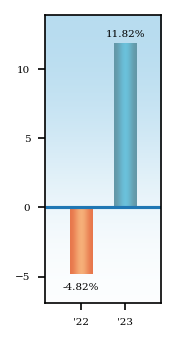
During the period shown, the was (quarter ended ) and the was (quarter ended ).
The as of was .
Average Annual Total Returns - Cultivar ETF |
1 Year |
Since Inception |
[1] | Inception Date |
|---|---|---|---|---|
| Cultivar ETF | 11.82% | 3.80% | Dec. 22, 2021 | |
| Cultivar ETF | After Taxes on Distributions | 11.46% | 2.71% | Dec. 22, 2021 | |
| Cultivar ETF | After Taxes on Distributions and Sales | 7.27% | 2.58% | Dec. 22, 2021 | |
| Russell 3000 Index (reflects no deduction for fees, expenses or taxes) | 2.05% | 25.96% | Dec. 22, 2021 | |
| [1] | The Fund commenced operations on . |
Equity Securities Risk. Since it purchases equity securities, the Fund is subject to the risk that equity prices will fall over short or extended periods of time. Historically, the equity markets have moved in cycles, and the value of the Fund’s equity securities may fluctuate from day to day. Individual companies may report poor results or be negatively affected by industry and/or economic trends and developments. The prices of securities issued by such companies may suffer a decline in response. These factors contribute to price volatility, which is a principal risk of investing in the Fund.
Market Risk. The value of securities in the Fund’s overall portfolio will fluctuate and, as a result, the Fund’s share price may decline suddenly or over a sustained period.
Active Management Risk. The Fund's investment success depends on the skill of the Adviser in evaluating, selecting, and monitoring the Fund’s assets and the strategies used by the Adviser may fail to produce the intended result. The Fund will be actively managed and could experience losses (realized and unrealized) if the Adviser’s judgment about markets, or the attractiveness, relative values, or potential appreciation of particular investments made for the Fund’s portfolio prove to be incorrect.
Large Capitalization Securities Risk. Larger, more established companies may be unable to attain the high growth rates of successful, smaller companies during periods of economic expansion. Large cap companies may be less able than mid and small capitalization companies to adapt to changing market conditions.
Mid and Small Capitalization Securities Risk. The value of mid and small capitalization company securities may be subject to more abrupt or erratic market movements than those of larger, more established companies or the market averages in general.
Depositary Receipts Risk. Depositary receipts are generally subject to the same risks as the foreign securities that they evidence or into which they may be converted, including the risk that there is often less publicly available information about foreign issuers, and the possibility of negative governmental actions and of political and social unrest.
REITs Risk. Investing in REITs involves unique risks. When the Fund invests in REITs, it is subject to risks generally associated with investing in real estate. A REIT’s performance depends on the types and locations of the properties it owns, how well it manages those properties and cash flow. REITs may have limited financial resources, may trade less frequently and in limited volume, may engage in dilutive offerings, and may be subject to more abrupt or erratic price movements than the overall securities markets.
Non-Diversification Risk. The Fund is a non-diversified portfolio, which means that it has the ability to take larger positions in a smaller number of securities than a portfolio that is “diversified.” Non-diversification increases the risk that the value of the Fund could go down because of the poor performance of a single investment or limited number of investments.
Sector Risk. Sector risk is the possibility that securities within the same group of industries will decline in price due to sector-specific market or economic developments. If the Fund invests more heavily in a sector, the value of its shares may be especially sensitive to factors and economic risks that specifically affect that sector.
Value Style Risk. Value stocks present the risk that the securities may never reach what the Adviser believes are their full market values, either because the market fails to recognize what the Adviser considers to be the security’s true value or because the Adviser misjudged that value. If the Adviser's assessment of a company's value or prospects for exceeding earnings expectations or market conditions is wrong, the Fund could suffer losses or produce poor performance relative to other funds. In addition, value stocks can continue to be undervalued by the market for long periods of time. Undervalued securities are, by definition, out of favor with investors (meaning they have lost investors’ attention), and there is no way to predict when, if ever, the securities may return to favor.
Exchange-Traded Fund (“ETF”) Structure Risks. The Fund is structured as an ETF and as a result is subject to special risks, including:
| ● | Trading Issues Risk. Although it is expected that shares of the Fund will remain listed for trading on Cboe BZX Exchange, Inc. (the “Exchange”), trading in Fund shares on the Exchange may be halted due to market conditions or for reasons that, in the view of the Exchange, make trading in Fund shares inadvisable, such as extraordinary market volatility. There can be no assurance that shares of the Fund will continue to meet the listing requirements of the Exchange or will trade with any volume. There is no guarantee that an active secondary market will develop for shares of the Fund. |
| ● | Market Price Variance Risk. The market prices of shares of the Fund will fluctuate in response to changes in net asset value (“NAV”) and supply and demand for Fund shares and will include a “bid-ask spread” charged by the exchange specialists, market makers or other participants that trade the particular security. There may be times when the market price and the NAV vary significantly. This means that shares of the Fund may trade at a discount to NAV. The market price of Fund shares may deviate from the value of the Fund’s underlying portfolio holdings, particularly in times of market stress, with the result that investors may pay significantly more or receive significantly less than the underlying value of the shares of the Fund bought or sold. |
| ● | Authorized Participants (“Aps”), Market Makers, and Liquidity Providers Risk. The Fund has a limited number of financial institutions that may act as Aps. In addition, there may be a limited number of market makers and/or liquidity providers in the marketplace. To the extent either of the following events occur, shares of the Fund may trade at a material discount to NAV and possibly face delisting: (i) Aps exit the business or otherwise become unable to process creation and/or redemption orders and no other Aps step forward to perform these services, or (ii) market makers and/or liquidity providers exit the business or significantly reduce their business activities and no other entities step forward to perform their functions. |
| ● | Costs of Buying or Selling Shares of the Fund. Due to the costs of buying or selling shares of the Fund, including brokerage commissions imposed by brokers and bid/ask spreads, frequent trading of shares of the Fund may significantly reduce investment results and an investment in shares of the Fund may not be advisable for investors who anticipate regularly making small investments. |