USD ($) |
|---|
|
|
| LEADER
CAPITAL SHORT TERM HIGH YIELD BOND FUND SUMMARY
|
| Investment
Objectives:
|
The primary investment objective of the Leader Capital Short Term High Yield Bond Fund (“High Yield Fund”
or the “Fund”) is to deliver a high level of current income,
|
with a secondary objective of capital appreciation.
|
| Fees
and Expenses of the Fund:
|
This
table describes the fees and expenses that you may pay if you buy, hold, and sell shares of the Fund. You
may pay other fees, such as brokerage commissions and other fees to financial intermediaries, which are not reflected in the tables and
examples below. You may qualify for sales charge discounts if you and your family invest, or agree to
invest in the future, at least $50,000
in
the Fund. More information about
these and other discounts is available from your financial intermediary and in How to Purchase Shares on page 26 of the Fund’s
prospectus and in Sales Charge Deduction and Waivers on page 60 of the Fund’s statement of additional information.
|
| $ 50,000
|
| in
the Fund.
|
| Shareholder
Fees
(fees paid directly from your investment)
|
|
|
| Annual
Fund Operating Expenses
(expenses that you pay each year as a
percentage of the value of your investment)
|
|
|
| Example:
|
This Example is intended to help you compare the cost of investing in the Fund with the cost of investing in other mutual
funds.
The
Example assumes that you invest $10,000 in the Fund for the time periods indicated and then redeem all of your shares at the end
of those periods. The Example also assumes that your investment has a 5% return each year and that the Fund’s operating
expenses remain the same. Although your actual costs may be higher or lower, based upon these assumptions, your costs would be:
|
Expense Example - Leader Capital Short Term High Yield Bond Fund - USD ($)
|
Expense Example, with Redemption, 1 Year |
Expense Example, with Redemption, 3 Years |
Expense Example, with Redemption, 5 Years |
Expense Example, with Redemption, 10 Years |
| Leader Capital Short Term High Yield Bond Fund Class A |
638
|
930
|
1,243
|
2,127
|
| Leader Capital Short Term High Yield Bond Fund Class C |
244
|
548
|
874
|
1,796
|
| Leader Capital Short Term High Yield Bond Fund Institutional Class |
146
|
452
|
782
|
1,713
|
| Leader Capital Short Term High Yield Bond Fund Investor Class |
196
|
606
|
1,042
|
2,254
|
|
| Portfolio
Turnover:
|
The Fund pays transaction costs, such as commissions, when it buys and sells securities (or “turns over”
its portfolio). A higher portfolio turnover may indicate higher transaction costs and may result in higher taxes when Fund shares
are held in a taxable account. These costs, which are not reflected in annual fund operating expenses or in the Example, affect
the Fund’s performance. During the most recent fiscal year, the portfolio turnover rate of the Fund was 226% of the average
value of its portfolio.
|
| Principal
Investment Strategies:
|
Under normal circumstances, the Fund invests at least 80% of its net assets (including any borrowings
for investment purposes) in non-investment grade bonds (also known as “junk bonds” or “high yield bonds”),
which the Fund defines as securities rated lower than Baa3 by Moody’s Investors Service, Inc. (“Moody’s”),
BBB- by Standard & Poor’s Ratings Group (“S&P”) or Fitch Ratings Inc. (“Fitch”), or, if
unrated, as determined by the Advisor to be of comparable quality. Fixed-income securities in which the Fund may invest include:
| ● | foreign
(including emerging markets) and domestic bonds, notes, corporate debt, convertible debt
securities, and preferred securities; |
| ● | U.S.
and foreign government securities and domestic municipal securities; |
| ● | asset-backed
securities, including agency and non-agency commercial mortgage-backed securities (“CMBS”)
and residential mortgage-backed securities (“RMBS”) and credit-backed securities; |
| ● | collateralized
loan obligations (“CLOs”) that are backed by domestic and foreign debt obligations; |
| ● | collateralized
debt obligations (“CDOs”) that are backed by domestic and foreign debt obligations; |
| ● | STRIPS
(Separate Trading of Registered Interest and Principal of Securities, a type of zero-coupon
debt instrument); and |
The
Fund’s effective average duration of its portfolio investments will normally be three years or less. The Fund considers
emerging markets countries to be those countries included in the Dow Jones Emerging Markets Index.
CMBS,
RMBS, CLOs, and CDOs are single-purpose investment vehicles that hold baskets of loans and issue securities that are paid from
the cash flows of the underlying loans. Normally, CMBS, RMBS, CLOs, and CDOs have multiple tranches, with investors in the bottom
tranches having the last priority to receive payment. By investing in high yield debt tranches, the Fund will be lower than third
in priority for payment. Loans and loan participations may be unsecured, which means that any specific assets of the borrower
do not collateralize them. The Fund allocates assets across security types without restriction, subject to its 80% investment
policy.
Leader
Capital Corp. (the “Advisor”) utilizes a fundamental top-down analysis, meaning it analyzes the economy, interest
rate cycles, the supply and demand for credit, and the characteristics of individual securities in making investment selections.
The Advisor will consider a floating or variable-rate security to have a maturity equal to its stated maturity (or redemption
date if it has been called for redemption), except that it may consider (1) variable-rate securities to have a maturity equal
to the period remaining until the next readjustment in the interest rate, unless subject to a demand feature; (2) variable-rate
securities subject to a demand feature to have a remaining maturity equal to the longer of (a) the next readjustment in the interest
rate or (b) the period remaining until the principal can be recovered through demand; and (3) floating-rate securities subject
to a demand feature to have a maturity equal to the period remaining until the principal can be recovered through demand.
The
Fund may also invest up to 10% of its assets in equity securities, including securities of other investment companies such as
exchange-traded funds (“ETFs”), mutual funds, closed-end funds, and private funds such as hedge funds, private equity
funds, and fund-of-funds. Additionally, the Fund may invest in credit default swaps for hedging purposes, as well as various derivatives,
including options. It may also engage in foreign currency transactions. The Fund may invest up to 15% of its assets in illiquid
securities, including private credit. The Advisor may invest in these securities to hedge against portfolio or market risk, gain
market or asset exposure, or for speculative purposes.
The
Advisor may sell a security if its value becomes unattractive, such as when its fundamentals deteriorate or when other investment
opportunities exist with more attractive yields. As a result of its trading strategy, the Fund expects to engage in frequent portfolio
transactions that will likely result in higher portfolio turnover and commissions than many investment companies.
|
| Principal
Investment Risks:
|
| Performance:
|
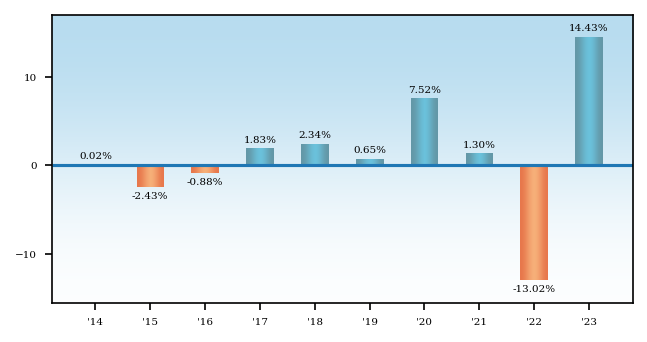
The
Fund was reorganized on July 15, 2019, from a series of Northern Lights Fund Trust (the “Predecessor Short
Duration Fund”) to a series of Leader Funds Trust (the “Reorganization”). As a result of the
Reorganization, the Fund is the accounting successor of the Predecessor Short Duration Fund. The bar chart and table below
provide some indication of the risks of investing in the Fund. The bar chart shows the annual returns of the Predecessor
Short Duration Fund’s Investor Class shares performance for each calendar year since the Predecessor Short Duration
Fund’s inception, as well as the performance of the Fund’s Investor Class after the Reorganization. Returns for
the Fund’s other Classes of shares would be substantially similar because the shares are invested in the same portfolio
of securities and the annual returns would differ only to the extent that the Classes do not have the same expenses. The
Fund’s past performance, before and after taxes, is not necessarily an indication of how the Fund will perform in the
future. Updated performance information is available at no cost by visiting www.leadercapital.com
or by calling (800) 711-9164.
|
| Investor
Class
Calendar
Year Returns as of December 31
|
|
| Best
Quarter: |
12/31/2020 |
15.28% |
| Worst
Quarter: |
03/31/2020 |
(18.67)% |
The
Fund’s Investor Class shares had a total return of 14.10% during the period January 1, 2024 to September 30, 2024.
|
| Average
Annual Total Returns
(For
the periods ended December 31, 2023)
|
|
|
After
tax returns are calculated using the historical highest individual federal marginal income tax rates and do not reflect the effect
of state and local taxes. Actual after-tax returns depend on an investor’s tax situation and may differ from those shown,
and after-tax returns shown are not relevant to investors who hold shares of the Fund through tax-deferred arrangements, such
as 401(k) plans or individual retirement accounts (“IRAs”). After-tax returns are shown for only Investor Class shares,
and after-tax returns for other classes will vary.
|
|
|
| As with all mutual funds, there is the risk that you could lose money through your investment in the Fund.
|
|
|
| High-Yield
Bond Risk. Lower-quality bonds, known as high-yield bonds or “junk bonds,”
present a significant risk for loss of principal and interest. Generally, the lower the
credit rating of a security, the greater the risk is that the issuer will default on
its obligation. These bonds offer the potential for higher return, but also involve greater
risk than bonds of higher quality, including an increased possibility that the bond’s
issuer, obligor, or guarantor may not be able to make its payments of interest and principal
(credit quality risk). If that happens, the value of the bond may decrease, and the Fund’s
share price may decrease, and its income distribution may be reduced.
|
|
|
| CLO
and CDO Risk. CLO and CDO securities may be riskier and less transparent than direct
investments in the underlying loans and debt obligations. The risks of investing in CLOs
and CDOs depend largely on the tranche invested in and the type of underlying debts and
loans in the tranche of the CLO or CDO, respectively, in which the Fund invests. The
junior tranches are relatively riskier because they have later or last priority on the
collateral in the event of default. As a result, the junior tranches of a CLO or CDO
generally have a lower credit rating and offer higher coupon rates than the senior tranches,
which offer lower coupon rates but have a lower default risk. The CLOs and CDOs in which
the Fund may invest may incur, or may have already incurred, debt that is senior to the
Fund’s investment. CLOs and CDOs also carry risks including, but not limited to,
interest rate risk and credit risk. The junior tranches of certain CLOs and CDOs in which
the Fund invests may be concentrated in a limited number of industries or borrowers,
which may subject those CLOs and CDOs, and in turn the Fund, to the risk of significant
loss if there is a downturn in a particular industry in which the CLO or CDO is concentrated.
|
|
|
| Interest
Rate Risk. The value of the Fund may fluctuate based on changes in interest rates
and market conditions. As interest rates rise, the value of income producing instruments
may decrease. This risk increases as the term of the note increases. Income earned on
floating- or variable-rate securities will vary as interest rates decrease or increase.
However, the interest rates on variable-rate securities, as well as certain floating-rate
securities whose interest rates are reset only periodically, can fluctuate in value because
of interest rate changes when there is an imperfect correlation between the interest
rates on the securities and prevailing market interest rates. Recently, there have been
inflationary price movements, which have caused the fixed income securities markets to
experience heightened levels of interest rate volatility and liquidity risk. The risks
associated with rising interest rates are heightened under current market conditions
given that the U.S. Federal Reserve has begun to raise interest rates from historically
low levels and may continue to do so. Further, in market environments where interest
rates are rising, issuers may be less willing or able to make principal and interest
payments on fixed-income investments when due.
|
|
|
| Liquidity
Risk. Some securities may have few market-makers and low trading volume, which tends
to increase transaction costs and may make it difficult for the Fund to dispose of a
security at all or at a price which represents current or fair market value.
|
|
|
| Derivatives
Risk. The Fund’s use of options, credit default swaps, and other derivative
instruments may result in losses, including due to adverse market movements. These instruments,
which may pose risks in addition to and greater than those associated with investing
directly in securities, currencies or other assets and instruments, may increase market
exposure and be illiquid or less liquid, volatile, difficult to price, and leveraged
so that small changes in the value of the underlying assets or instruments may produce
disproportionate losses to the Fund. Certain derivatives are also subject to counterparty
risk, which is the risk that the other party in the transaction will not fulfill its
contractual obligations. The use of derivatives is a highly specialized activity that
involves investment techniques and risks different from those associated with investments
in more traditional securities and instruments.
|
|
|
| Counterparty
Risk. Derivatives are also subject to counterparty risk, which is the risk that the other party in the transaction will be
unable or unwilling to fulfill its contractual obligation, and the related risks of having concentrated exposure to such a counterparty.
|
|
|
| Options
Risk. Options and options on futures contracts give the holder of the option the right, but not the obligation, to buy (or
sell) a position in a security or contract to the writer of the option at a specific price. Options are subject to correlation
risk because there may be an imperfect correlation between the options and the markets for underlying instruments that could cause
a given transaction to fail to achieve its objectives. The successful use of options depends on the Adviser’s ability to
predict correctly future price fluctuations and the degree of correlation between the markets for options and the underlying instruments.
Exchanges can limit the number of positions held or controlled by the Fund or the Adviser, thus limiting the ability to implement
the Fund’s strategies. Options are also particularly subject to leverage risk and can be subject to liquidity risk.
|
|
|
| Credit
Default Swaps. Credit default swaps may have as reference obligations one or more securities that are not currently held by
the Fund. The protection “buyer” may be obligated to pay the protection “seller” an up-front payment or
a periodic stream of payments over the term of the contract, provided generally that no credit event on a reference obligation
has occurred. Credit default swaps involve special risks because they are difficult to value, are highly susceptible to illiquid
investments risk and credit risk, and generally pay a return to the party that has paid the premium only in the event of an actual
default by the issuer of the underlying obligation (as opposed to a credit downgrade or other indication of financial difficulty).
|
|
|
| Hedging
Risk. Hedges are sometimes subject to imperfect matching between the derivative and the underlying security, and there can
be no assurance that the Fund’s hedging transactions will be effective. The use of hedging may result in certain adverse
tax consequences.
|
|
|
| Variable
and Floating Rate Securities Risk. Variable and floating rate securities provide
for periodic adjustment in the interest rate paid on the securities. These securities
may be subject to greater illiquidity risk than other fixed income securities, meaning
the absence of an active market for these securities could make it difficult for the
Fund to dispose of them at any given time.
|
|
|
| Mortgage-Backed
and Asset-Backed Securities Risk. The default rate on underlying mortgage loans or
asset loans may be higher than anticipated, potentially reducing payments to the Fund.
Default rates are sensitive to overall economic conditions such as unemployment, wage
levels and economic growth rates. Mortgage-backed securities are susceptible to maturity
risk because issuers of securities held by the Fund can prepay principal due on these
securities, particularly during periods of declining interest rates.
|
|
|
| Foreign
Risk. Foreign investments involve additional risks not typically associated with
investing in U.S. Government securities and/or securities of domestic companies, including
currency rate fluctuations, political and economic instability, differences in financial
reporting standards and less strict regulation of securities markets. Securities subject
to these risks may be less liquid than those that are not subject to these risks.
|
|
|
| Currency
Risk. Currency trading risks include market risk, credit risk and country risk. Market
risk results from adverse changes in exchange rates in the currencies the Fund is long
or short. Credit risk results because a currency-trade counterparty may default. Country
risk arises because a government may interfere with transactions in its currency.
|
|
|
| Emerging
Markets Risk. Foreign markets, particularly emerging markets, can be more volatile
than the U.S. market due to increased risks of adverse issuer, political, regulatory,
market, or economic developments and can perform differently from the U.S. market. Emerging
markets can be subject to greater social, economic, regulatory, and political uncertainties
and can be extremely volatile.
|
|
|
| Foreign
Government Securities Risk. The risk involves the possibility that a government may
be unable or unwilling to repay its debt due to political or economic factors, including
cash flow issues or insufficient foreign reserves. Governments may default on debt securities,
potentially leading to debt rescheduling for bondholders. Additionally, there may be
no legal recourse or bankruptcy process to collect defaulted government debt.
|
|
|
| Management
Risk. The strategy used by the Advisor may fail to produce the intended results.
The ability of the Fund to meet its investment objectives is directly related to the
Advisor’s investment strategies for the Fund. Your investment in the Fund varies
with the effectiveness of the Advisor’s research, analysis, and asset allocation
among portfolio securities. If the Advisor’s investment strategies do not produce
the expected results, your investment could be diminished or even lost.
|
|
|
| Convertible
Debt Securities Risk. Convertible debt securities subject the Fund to the risks associated
with both fixed-income securities and equity securities. If a convertible debt security’s
investment value is greater than its conversion value, its price will likely increase
when interest rates fall and decrease when interest rates rise. If the conversion value
exceeds the investment value, the price of the convertible debt security will tend to
fluctuate directly with the price of the underlying equity security.
|
|
|
| U.S.
Government Securities Risk. It is possible that the U.S. Government would not provide
financial support to its agencies or instrumentalities if it is not required to do so
by law. If a U.S. Government agency or instrumentality in which the Fund invests defaults
and the U.S. Government does not stand behind the obligation, the Fund’s share
price or yield could fall. Securities of U.S. Government sponsored entities, such as
Freddie Mac or Fannie Mae, are neither issued nor guaranteed by the U.S. Government.
The U.S. Government’s guarantee of ultimate payment of principal and timely payment
of interest of the U.S. Government securities owned by the Fund does not imply that the
Fund’s shares are guaranteed by the Federal Deposit Insurance Corporation or any
other government agency, or that the price of the Fund’s shares will not fluctuate.
|
|
|
| Municipal
Securities Risk. The value of municipal bonds that depend on a specific revenue source
or general revenue source to fund their payment obligations may fluctuate because of
changes in the cash flows generated by the revenue source(s) or changes in the priority
of the municipal obligation to receive the cash flows generated by the revenue source(s).
In addition, changes in federal tax laws or the activity of an issuer may adversely affect
the tax-exempt status of municipal bonds. Investments in inverse floating rate securities
typically involve greater risk than investments in municipal bonds of comparable maturity
and credit quality and their values are more volatile than municipal bonds due to the
leverage they entail. Municipal securities are subject to the risk that legislative changes
and local and business developments may adversely affect the yield or value of the Fund’s
investments in such securities.
|
|
|
| Preferred
Security Risk. The value of preferred securities will fluctuate with changes in interest
rates. Typically, a rise in interest rates causes a decline in the value of preferred
stock. Preferred securities are also subject to credit risk, which is the possibility
that an issuer of preferred stock will fail to make its dividend payments.
|
|
|
| Repurchase
Agreement Risk. The Fund may enter into repurchase agreements in which it purchases
a security (known as the “underlying security”) from a securities dealer
or bank. In the event of a bankruptcy or other default by the seller of a repurchase
agreement, the Fund could experience delays in liquidating the underlying security and
losses in the event of a decline in the value of the underlying security while the Fund
is seeking to enforce its rights under the repurchase agreement.
|
|
|
| STRIPS
Risk. STRIPS are a type of zero-coupon bond. Zero coupon bonds do not make periodic
interest payments. Instead, they are sold at a discount from their face value and can
be redeemed at face value when they mature. The market value of a zero-coupon bond is
generally more volatile than the market value of other fixed income securities with similar
maturities that make periodic interest payments. Zero coupon bonds may also respond to
changes in interest rates to a greater degree than other fixed income securities with
similar maturities and credit quality.
|
|
|
| Portfolio
Turnover Risk. The frequency of the Fund’s transactions will vary from year
to year. Increased portfolio turnover may result in higher brokerage commissions, dealer
mark-ups and other transaction costs and may result in taxable capital gains. Higher
costs associated with increased portfolio turnover may offset gains in the Fund’s
performance. Turnover
increased as the Fund made strategic changes to portfolio allocation to take advantage
of the changing interest rate landscape and to address an increase in capital share activity.
The Fund’s portfolio turnover is expected to be
over 100% annually, as the Fund’s holdings are frequently traded.
|
|
|
| Equity
Securities Risk. Stock markets are volatile. The price of an equity security fluctuates
based on changes in a company’s financial condition and overall market and economic
conditions.
|
|
|
| Other
Investment Companies Risk. The main risk of investing in other investment companies
(including open-end, closed-end, and ETFs) is that the value of the securities underlying
an investment company might decrease. Because the Fund may invest in other investment
companies, you will pay a proportionate share of the expenses of that other investment
company (including management fees, administration fees, and custodial fees) in addition
to the expenses of the Fund.
|
|
|
| ETF
Risk. ETF investments carry security-specific and market risks. Also, if the area
of the market representing the underlying index or benchmark does not perform as expected
for any reason, the value of the investment in the ETF may decline. In addition, due
to transactions via market prices rather than net asset value, the performance of an
ETF may not completely replicate the performance of the underlying index.
|
|
|
| Private
Investment Fund Risk. Investments in private investment funds, such as hedge funds,
private equity funds, and fund-of-funds, carry various risks, including that some fund
products use leverage and other speculative investment practices that may increase the
risk of investment loss; are not required to provide periodic pricing or valuation information
to investors; may involve complex tax structures and delays in distributing important
tax information; are not subject to the same regulatory requirements as mutual funds;
often charge high fees; and in many cases the underlying investments are not transparent.
For purposes of the Fund’s liquidity risk management program, the Fund considers
investments in private funds to be illiquid.
|
|
|
| LEADER
CAPITAL HIGH QUALITY INCOME FUND SUMMARY
|
| Investment
Objective:
|
The investment objective of the Leader Capital High Quality Income Fund (the “High Quality Fund” or
the “Fund”) is to deliver a high level of current income,
|
with a secondary objective of capital appreciation.
|
| Fees
and Expenses of the Fund:
|
This
table describes the fees and expenses that you may pay if you buy, hold, and sell shares of the Fund. You
may pay other fees, such as brokerage commissions and other fees to financial intermediaries, which are not reflected in the tables and
examples below. You may qualify for sales charge discounts if you and your family invest, or agree to
invest in the future, at least $50,000
in
the Fund. More information about
these and other discounts is available from your financial intermediary and in How to Purchase Shares on page 26 of the Fund’s
prospectus and in Sales Charge Deduction and Waivers on page 60 of the Fund’s statement of additional information.
|
| $ 50,000
|
| in
the Fund.
|
| Shareholder
Fees
(fees paid directly from your investment)
|
|
|
| Annual
Fund Operating Expenses
(expenses that you pay each year as a
percentage of the value of your investment)
|
|
|
| Example:
|
This Example is intended to help you compare the cost of investing in the Fund with the cost of investing in other mutual
funds.
The
Example assumes that you invest $10,000 in the Fund for the time periods indicated and then redeem all your shares at the end
of those periods. The Example also assumes that your investment has a 5% return each year and that the Fund’s operating
expenses remain the same. Although your actual costs may be higher or lower, based upon these assumptions your costs would be:
|
Expense Example - Leader Capital High Quality Income Fund - USD ($)
|
Expense Example, with Redemption, 1 Year |
Expense Example, with Redemption, 3 Years |
Expense Example, with Redemption, 5 Years |
Expense Example, with Redemption, 10 Years |
| Leader Capital High Quality Income Fund Class A |
614
|
856
|
1,117
|
1,860
|
| Leader Capital High Quality Income Fund Class C |
298
|
712
|
1,152
|
2,373
|
| Leader Capital High Quality Income Fund Investor Class |
137
|
428
|
739
|
1,624
|
| Leader Capital High Quality Income Fund Institutional Class |
99
|
309
|
536
|
1,190
|
|
| Portfolio
Turnover:
|
The Fund pays transaction costs, such as commissions, when it buys and sells securities (or “turns over”
its portfolio). A higher portfolio turnover may indicate higher transaction costs and may result in higher taxes when Fund shares
are held in a taxable account. These costs, which are not reflected in annual fund operating expenses or in the Example, affect
the Fund’s performance. During the most recent fiscal year, the portfolio turnover rate of the Fund was 113% of the average
value of its portfolio.
|
| Principal
Investment Strategies:
|
Under normal circumstances, the Fund invests at least 80% of its net assets, plus any amount of borrowings
for investment purposes, in high-quality income-producing debt securities. For the purposes of the Fund’s 80% investment
policy, the Fund defines high-quality as being rated at the time of purchase as no lower than Baa3 by Moody’s Investors
Service (“Moody’s”), BBB- by Standard & Poor’s Ratings Group (“S&P”), or Fitch Ratings,
Inc. (“Fitch”), or, if unrated, as determined by the Advisor to be of comparable quality. The debt securities in which
the Fund invests include the following U.S. dollar-denominated domestic and foreign securities:
| |
● |
foreign
(including emerging markets) and domestic bonds, notes, corporate debt, convertible debt securities, and preferred securities;
|
| |
|
|
| |
● |
bank
loans and bank loan participations; |
| |
● |
asset-backed
securities, including agency and non-agency commercial mortgage-backed securities (“CMBS”) and residential mortgage-backed
securities (“RMBS”) and credit-backed securities; |
| |
● |
collateralized
loan obligations (“CLOs”) that are backed by domestic and foreign debt obligations; |
| |
● |
collateralized
debt obligations (“CDOs”) that are backed by domestic and foreign debt obligations; and |
| |
● |
U.S.
government securities. |
The
Fund normally invests in debt securities with an interest rate that resets quarterly based on the Secured Overnight Financing
Rate (“SOFR”), Effective Federal Funds Rate (“EFFR”), or Overnight Bank Fund Rate (“OBFR”).
The Fund allocates assets across debt security types without restriction, subject to its 80% investment policy. The Fund considers
emerging markets countries to be those countries included in the Dow Jones Emerging Markets Index.
The
Fund invests without restriction on the maturity of any single debt security and its portfolio average effective duration (a measure
of a security’s sensitivity to changes in prevailing interest rates). Generally, the Fund’s average effective duration
will be 75% to 125% of the three-year average effective duration of the Morningstar® Core Bond Index, although the Fund’s
average effective duration will change depending on market conditions and could be up to 15 years depending on prevailing interest
rates. The Fund uses effective duration to measure the sensitivity of a debt security’s price to changes in interest rates.
The longer a debt security’s duration, the more sensitive it will be to changes in interest rates. For example, when the
level of interest rates increases by 1.00%, the price of a debt security or a portfolio of such securities having a duration of
5 years will decrease by about 5.00%. Conversely, when interest rates decrease by 1.00%, the price of a debt security or a portfolio
of such securities with a duration of 5 years will generally increase by about 5.00%.
CMBS,
RMBS, CLOs, and CDOs are single-purpose investment vehicles that hold baskets of loans and issue securities that are paid from
the cash flows of the underlying loans. Normally, CMBS, RMBS, CLOs, and CDOs have multiple tranches, with investors in the bottom
tranches having the last priority to receive payment. By investing in investment-grade debt tranches, the Fund will not be less
than third in priority for payment. Loans and loan participations may be unsecured, which means that any specific assets of the
borrower do not collateralize them. The Fund allocates assets across security types without restriction, subject to its 80% investment
policy.
The
Advisor utilizes a fundamental top-down analysis, meaning the Advisor analyzes the economy, interest rate cycles, the supply and
demand for credit and the characteristics of individual securities in making investment selections for the Fund. The Advisor may
sell a security if its value becomes unattractive, such as when its fundamentals deteriorate, its credit rating is downgraded
(including, as described above, sales required when a security is downgraded to below investment grade ratings) or when other
investment opportunities exist that may have more attractive yields. In making purchase decisions, if the expected term premium
is greater for longer-term securities in the eligible maturity range, the Advisor will focus investment in the longer-term area;
otherwise, the Fund will focus investment in the shorter-term area of the eligible maturity range.
The
Fund may also invest up to 10% of its assets in equity securities, including securities of other investment companies such as
exchange-traded funds (“ETFs”), mutual funds (including affiliated mutual funds), closed-end funds, and private funds
such as hedge funds, private equity funds, and fund-of-funds. The Fund may also invest up to 20% of its portfolio in non-investment
grade bonds (also known as “junk bonds” or “high yield bonds”), which the Fund defines as securities rated
lower than Baa3 by Moody’s, BBB- by S&P or Fitch, or, if unrated, as determined by the Advisor to be of comparable quality.
The Fund may also invest in various derivatives, including options and credit default swaps, foreign currency transactions, and
private credit, including securities that may be illiquid up to the maximum amount permitted under the law. The Advisor may invest
in these securities to hedge against portfolio or market risk, gain market or asset exposure, or for speculative purposes.
The
Advisor may sell a security if its value becomes unattractive, such as when its fundamentals deteriorate or when other investment
opportunities exist with more attractive yields. As a result of its trading strategy, the Fund expects to engage in frequent portfolio
transactions that will likely result in higher portfolio turnover and commissions than many investment companies.
|
| Principal
Investment Risks:
|
| Performance:
|
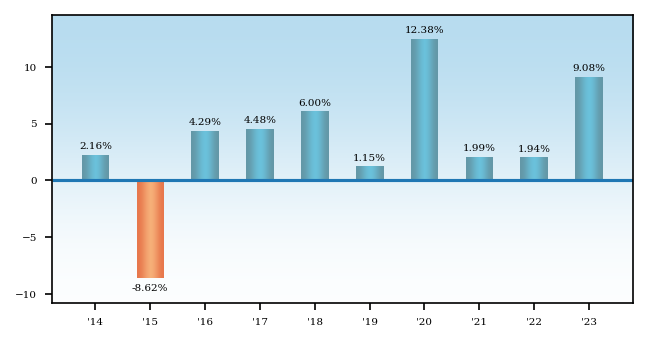
The Fund was reorganized on July 15, 2019, from a series of Northern Lights Fund Trust (the “Predecessor Fund”)
to a series of Leader Funds Trust (the “Reorganization”). As a result of the Reorganization, the Fund is the accounting
successor of the Predecessor Fund. The bar chart and table below provide some indication of the risks of investing in the Fund.
The bar chart shows the annual returns of the Predecessor Fund’s Investor Class shares performance for each calendar year
since the Predecessor Fund’s inception, as well as the performance of the Fund’s Investor Class shares after the Reorganization.
Returns for the Fund’s other Classes of shares would be substantially similar because the shares are invested in the same
portfolio of securities and the annual returns would differ only to the extent that the Classes do not have the same expenses.
The performance table compares the performance of the Fund’s shares over time to the performance of the ICE BofA 1-3 Year
US Corporate/Government Bond Index. The Fund’s past performance, before and after taxes, is not necessarily an indication
of how the Fund will perform in the future. Updated performance information is available at no cost by visiting www.leadercapital.com
or by calling (800) 711-9164.
|
| Investor
Class
Calendar
Year Returns as of December 31
|
|
| Best
Quarter: |
12/31/2020 |
13.38% |
| Worst
Quarter: |
3/31/2020 |
(13.92)% |
The
Fund’s Investor Class shares had a total return of
5.18% during the period January 1, 2024 to September
30, 2024.
|
| Average
Annual Total Returns
(For
the periods ended December 31, 2023)
|
|
|
After
tax returns are calculated using the historical highest individual federal marginal income tax rates and do not reflect the effect
of state and local taxes. Actual after-tax returns depend on an investor’s tax situation and may differ from those shown,
and after-tax returns shown are not relevant to investors who hold shares of the Fund through tax-deferred arrangements, such
as 401(k) plans or IRAs. After-tax returns are shown for only Investor Class shares, and after-tax returns for other classes will
vary.
|
|
|
| As with all mutual funds, you could lose money on your investment in the Fund.
|
|
|
| CLO
and CDO Risk. CLO and CDO securities may be riskier and less transparent than direct
investments in the underlying loans and debt obligations. The risks of investing in CLOs
and CDOs depend largely on the tranche invested in and the type of underlying debts and
loans in the tranche of the CLO or CDO, respectively, in which the Fund invests. The
senior tranches are relatively safer because they have first priority on the collateral
in the event of default. As a result, the senior tranches of a CLO or CDO generally have
a higher credit rating and offer lower coupon rates than the junior tranches, which offer
higher coupon rates to compensate for their higher default risk. The CLOs and CDOs in
which the Fund may invest may incur, or may have already incurred, debt that is senior
to the Fund’s investment. CLOs and CDOs also carry risks including, but not limited
to, interest rate risk and credit risk. The senior tranches of certain CLOs and CDOs
in which the Fund invests may be concentrated in a limited number of industries or borrowers,
which may subject those CLOs and CDOs, and in turn the Fund, to the risk of significant
loss if there is a downturn in a particular industry in which the CLO or CDO is concentrated.
|
|
|
| Interest
Rate Risk. The value of the Fund may fluctuate based on changes in interest rates
and market conditions. As interest rates rise, the value of income producing instruments
may decrease. This risk increases as the term of the note increases. Income earned on
floating- or variable-rate securities will vary as interest rates decrease or increase.
However, the interest rates on variable-rate securities, as well as certain securities
whose interest rates are reset only periodically, can fluctuate in value because of interest
rate changes when there is an imperfect correlation between the interest rates on the
securities and prevailing market interest rates. Recently, there have been inflationary
price movements, which have caused the fixed income securities markets to experience
heightened levels of interest rate volatility and liquidity risk. The risks associated
with rising interest rates are heightened under current market conditions given that
the U.S. Federal Reserve has begun to raise interest rates from historically low levels
and may continue to do so. Further, in market environments where interest rates are rising,
issuers may be less willing or able to make principal and interest payments on fixed-income
investments when due.
|
|
|
| Liquidity
Risk. Some securities may have few market-makers and low trading volume, which tends
to increase transaction costs and may make it difficult for the Fund to dispose of a
security at all or at a price which represents current or fair market value.
|
|
|
| Derivatives
Risk. The Fund’s use of options, credit default swaps, and other derivative
instruments may result in losses, including due to adverse market movements. These instruments,
which may pose risks in addition to and greater than those associated with investing
directly in securities, currencies or other assets and instruments, may increase market
exposure and be illiquid or less liquid, volatile, difficult to price, and leveraged
so that small changes in the value of the underlying assets or instruments may produce
disproportionate losses to the Fund. Certain derivatives are also subject to counterparty
risk, which is the risk that the other party in the transaction will not fulfill its
contractual obligations. The use of derivatives is a highly specialized activity that
involves investment techniques and risks different from those associated with investments
in more traditional securities and instruments.
|
|
|
| Counterparty
Risk. Derivatives are also subject to counterparty risk, which is the risk that the
other party in the transaction will be unable or unwilling to fulfill its contractual
obligation, and the related risks of having concentrated exposure to such a counterparty.
|
|
|
| Options
Risk. Options and options on futures contracts give the holder of the option the
right, but not the obligation, to buy (or sell) a position in a security or contract
to the writer of the option at a specific price. Options are subject to correlation risk
because there may be an imperfect correlation between the options and the markets for
underlying instruments that could cause a given transaction to fail to achieve its objectives.
The successful use of options depends on the Adviser’s ability to predict correctly
future price fluctuations and the degree of correlation between the markets for options
and the underlying instruments. Exchanges can limit the number of positions held or controlled
by the Fund or the Adviser, thus limiting the ability to implement the Fund’s strategies.
Options are also particularly subject to leverage risk and can be subject to liquidity
risk.
|
|
|
| Credit
Default Swaps. Credit default swaps may have as reference obligations one or more
securities that are not currently held by the Fund. The protection “buyer”
may be obligated to pay the protection “seller” an up-front payment or a
periodic stream of payments over the term of the contract, provided generally that no
credit event on a reference obligation has occurred. Credit default swaps involve special
risks because they are difficult to value, are highly susceptible to illiquid investments
risk and credit risk, and generally pay a return to the party that has paid the premium
only in the event of an actual default by the issuer of the underlying obligation (as
opposed to a credit downgrade or other indication of financial difficulty).
|
|
|
| Hedging
Risk. Hedges are sometimes subject to imperfect matching between the derivative and
the underlying security, and there can be no assurance that the Fund’s hedging
transactions will be effective. The use of hedging may result in certain adverse tax
consequences.
|
|
|
| Variable
and Floating Rate Securities Risk. Variable and floating rate securities provide
for periodic adjustment in the interest rate paid on the securities. These securities
may be subject to greater illiquidity risk than other fixed income securities, meaning
the absence of an active market for these securities could make it difficult for the
Fund to dispose of them at any given time.
|
|
|
| Mortgage-Backed
and Asset-Backed Securities Risk. The default rate on underlying mortgage loans or
asset loans may be higher than anticipated, potentially reducing payments to the Fund.
Default rates are sensitive to overall economic conditions such as unemployment, wage
levels and economic growth rates. Mortgage-backed securities are susceptible to maturity
risk because issuers of securities held by the Fund can prepay principal due on these
securities, particularly during periods of declining interest rates.
|
|
|
| Foreign
Risk. Foreign investments involve additional risks not typically associated with
investing in U.S. Government securities and/or securities of domestic companies, including
currency rate fluctuations, political and economic instability, differences in financial
reporting standards and less strict regulation of securities markets. The withdrawal
of the United Kingdom from the European Union (so-called Brexit) may create greater economic
uncertainty for European debt issuers and negatively impact their credit quality. Securities
subject to these risks may be less liquid than those that are not subject to these risks.
|
|
|
| Currency
Risk. Currency trading risks include market risk, credit risk and country risk. Market
risk results from adverse changes in exchange rates in the currencies the Fund is long
or short. Credit risk results because a currency-trade counterparty may default. Country
risk arises because a government may interfere with transactions in its currency.
|
|
|
| Emerging
Markets Risk. The Fund may invest in countries with newly organized or less developed
securities markets. Generally, economic structures in these countries are less diverse
and mature than those in developed countries and their political systems tend to be less
stable. Emerging market economies may be based on only a few industries, therefore security
issuers, including governments, may be more susceptible to economic weakness and more
likely to default. Emerging market countries also may have relatively unstable governments,
weaker economies, and less-developed legal systems with fewer security holder rights.
|
|
|
| Foreign
Government Securities Risk. The risk involves the possibility that a government may
be unable or unwilling to repay its debt due to political or economic factors, including
cash flow issues or insufficient foreign reserves. Governments may default on debt securities,
potentially leading to debt rescheduling for bondholders. Additionally, there may be
no legal recourse or bankruptcy process to collect defaulted government debt.
|
|
|
| Management
Risk. The strategy used by the Advisor may fail to produce the intended results.
The ability of the Fund to meet its investment objectives is directly related to the
Advisor’s investment strategies for the Fund. Your investment in the Fund varies
with the effectiveness of the Advisor’s research, analysis, and asset allocation
among portfolio securities. If the Advisor’s investment strategies do not produce
the expected results, your investment could be diminished or even lost.
|
|
|
| U.S.
Government Securities Risk. It is possible that the U.S. Government would not provide
financial support to its agencies or instrumentalities if it is not required to do so
by law. If a U.S. Government agency or instrumentality in which the Fund invests defaults
and the U.S. Government does not stand behind the obligation, the Fund’s share
price or yield could fall. Securities of U.S. Government sponsored entities, such as
Freddie Mac or Fannie Mae, are neither issued nor guaranteed by the U.S. Government.
The U.S. Government’s guarantee of ultimate payment of principal and timely payment
of interest of the U.S. Government securities owned by the Fund does not imply that the
Fund’s shares are guaranteed by the Federal Deposit Insurance Corporation or any
other government agency, or that the price of the Fund’s shares will not fluctuate.
|
|
|
| Portfolio
Turnover Risk. The frequency of the Fund’s transactions will vary from year
to year. Increased portfolio turnover may result in higher brokerage commissions, dealer
mark-ups and other transaction costs and may result in taxable capital gains. Turnover
increased as the Fund made strategic changes to portfolio allocation to take advantage
of the changing interest rate landscape and to address an increase in capital share activity.
The Fund’s portfolio turnover is expected to be over 100% annually, as the Fund’s
holdings are frequently traded.
|
|
|
| Equity
Securities Risk. Stock markets are volatile. The price of an equity security fluctuates
based on changes in a company’s financial condition and overall market and economic
conditions.
|
|
|
| Other
Investment Companies Risk, The main risk of investing in other investment companies
(including open-end, closed-end, and ETFs) is that the value of the securities underlying
an investment company might decrease. Because the Fund may invest in other investment
companies, you will pay a proportionate share of the expenses of that other investment
company (including management fees, administration fees, and custodial fees) in addition
to the expenses of the Fund.
|
|
|
| ETF
Risk. ETF investments carry security-specific and market risks. Also, if the area
of the market representing the underlying index or benchmark does not perform as expected
for any reason, the value of the investment in the ETF may decline. In addition, due
to transactions via market prices rather than net asset value, the performance of an
ETF may not completely replicate the performance of the underlying index.
|
|
|
| Private
Investment Fund Risk. Investments in private investment funds, such as hedge funds,
private equity funds, and fund-of-funds, carry various risks, including that some fund
products use leverage and other speculative investment practices that may increase the
risk of investment loss; are not required to provide periodic pricing or valuation information
to investors; may involve complex tax structures and delays in distributing important
tax information; are not subject to the same regulatory requirements as mutual funds;
often charge high fees; and in many cases the underlying investments are not transparent.
For purposes of the Fund’s liquidity risk management program, the Fund considers
investments in private funds to be illiquid.
|
|
|
| Credit
Risk. Issuers may not make interest and principal payments on securities held by
the Fund, resulting in losses to the Fund. In addition, the credit quality of securities
held by the Fund may be lowered if an issuer’s financial condition changes. Lower
credit quality may lead to greater volatility in the price of a security and lower liquidity
making it difficult for the Fund to sell the security.
|
|
|
| Loan
and Loan Participation Risk. The secondary market for loans and loan participations
is a private, unregulated inter-dealer or inter-bank resale market. Purchases and sales
of loans and loan participations are generally subject to contractual restrictions that
must be satisfied before a loan or loan participations can be bought or sold. These restrictions
may impede the Fund’s ability to buy or sell loans and loan participations and
may negatively impact the transaction price. It may take longer than seven days for transactions
in loans and loan participations to settle. The Fund may hold cash, sell investments,
or temporarily borrow from banks or other lenders to meet short-term liquidity needs
due to the extended loan settlement process, such as to satisfy redemption requests from
Fund shareholders. Loan participations are indirectly subject to default risk of the
bank granting the participation. Such a default will likely delay the Fund’s access
to the cash flows from underlying loan. Loans and loan participations may be unsecured
which means that they are not collateralized by any specific assets of the borrower.
|
|
|
| Private
Credit Risk: The Fund intends to obtain exposure to select less liquid or illiquid
private credit investments, generally involving corporate borrowers, through its investments
in pooled investment vehicles or direct loans. Typically, private credit investments
are not traded in public markets and are illiquid. Additionally, private credit investments
can range in credit quality depending on security-specific factors, including total leverage,
amount of leverage senior to the security in question, variability in the issuer’s
cash flows, the size of the issuer, the quality of assets securing debt and the degree
to which such assets cover the subject company’s debt obligations.
|