The Reaves Infrastructure Fund (the “Fund”) seeks total return from income and capital growth.
This table describes the fees and expenses that you may pay if you buy and hold Institutional Class Shares of the Fund. You may pay other fees, such as brokerage commissions and other fees to financial intermediaries, which are not reflected in the table or the example below.
Annual Fund Operating Expenses |
Reaves Infrastructure Fund
Institutional Class Shares
|
|---|---|
| Management Fees | 0.75% |
| Other Expenses | 1.33% |
| Total Annual Fund Operating Expenses | 2.08% |
This Example is intended to help you compare the cost of investing in the Fund with the cost of investing in other mutual funds.
The Example assumes that you invest $10,000 in the Fund for the time periods indicated and then redeem all of your shares at the end of those periods. The Example also assumes that your investment has a 5% return each year and that the Fund’s operating expenses remain the same. Although your actual costs may be higher or lower, based on these assumptions your costs would be:
Expense Example |
Expense Example, with Redemption, 1 Year |
Expense Example, with Redemption, 3 Years |
Expense Example, with Redemption, 5 Years |
Expense Example, with Redemption, 10 Years |
|---|---|---|---|---|
| Reaves Infrastructure Fund | Institutional Class Shares | USD ($) | 211 | 652 | 1,119 | 2,410 |
The Fund pays transaction costs, such as commissions, when it buys and sells securities (or “turns over” its portfolio). A higher portfolio turnover rate may indicate higher transaction costs and may result in higher taxes when Fund shares are held in a taxable account. These costs, which are not reflected in Total Annual Fund Operating Expenses or in the Example, affect the Fund’s performance. During its most recent fiscal year, the Fund’s portfolio turnover rate was 45% of the average value of its portfolio.
Under normal circumstances, the Fund invests at least 80% of its net assets, plus any borrowings for investment purposes, in securities of domestic and foreign public infrastructure companies. This investment policy may be changed by the Fund upon 60 days’ prior written notice to shareholders. For purposes of this policy, public infrastructure companies are defined as companies that are listed on a public stock exchange and have at least 50% of assets committed to, or gross income or profits derived from, the following activities: (a) providing infrastructure products, services or equipment for (i) the generation, transmission, or distribution of electricity, gas, or water; or (ii) telecommunications
activities, including fixed line and wireless voice, data and video services, and broadband internet access such as high-speed internet, and the fiber optic and coaxial cable networks that enable such services (together, “Utilities” or “Utilities Industry”); (b) truck and rail transportation companies along with other companies involved in supply chain management and the products and infrastructure required to support such services; (c) wireless tower, data center, logistics, and other real estate infrastructure companies organized as real estate investment trusts (“REITs”) which provide data centers that house computer systems and associated components, as well as communication towers and warehouses that, particularly when located close to densely populated regions, may enable more efficient and faster delivery of goods; and (d) the discovery, development, production, generation, transmission, refinement, storage, and measurement or distribution of energy, including nuclear, renewable energy, biofuels, hydrogen, and battery storage (“Energy” or “Energy Industry”). Examples of infrastructure companies in which the Fund invests may include, but are not limited to, companies in the Utilities and Energy Industries, companies involved in transportation services such as truck and rail transportation, wireless tower companies, data center companies and industrial logistics companies.
In selecting investments for the Fund, Reaves Asset Management (the “Adviser”) utilizes fundamental research and a bottom-up stock selection approach to identify securities that offer the potential for positive total return during a three- to five-year period, based on, among other factors, a company’s market capitalization, balance sheet strength, expected dividends, and current and anticipated earnings and cash flow. The Adviser may sell a holding if its prospects for growth and income decline or when the Adviser deems it to be an unattractive investment.
The Fund has adopted a policy to concentrate its investments (invest at least 25% of its assets) in companies involved to a significant extent in the Utilities and/or Energy Industries. The Fund considers a company to be involved to a significant extent in the Utilities and/or the Energy Industry, as applicable, if at least 50% of its assets, gross income or profits are committed to or derived from Utilities or Energy. While the Fund primarily invests in equity securities of large and mid capitalization companies, it may also invest in securities of small capitalization companies.
The bar chart and the performance table below illustrate the risks and volatility of an investment in the Fund by showing changes in the Fund’s Institutional Class Shares’ performance from year to year and by showing how the Fund’s average annual total returns for 1, 5 and 10 years compare with those of a broad measure of market performance and a more narrowly based index with characteristics relevant to the Fund’s investment strategies. Of course, the Fund’s past performance (before and after taxes) does not necessarily indicate how the Fund will perform in the future. Updated performance information is available by calling 1-866-342-7058.
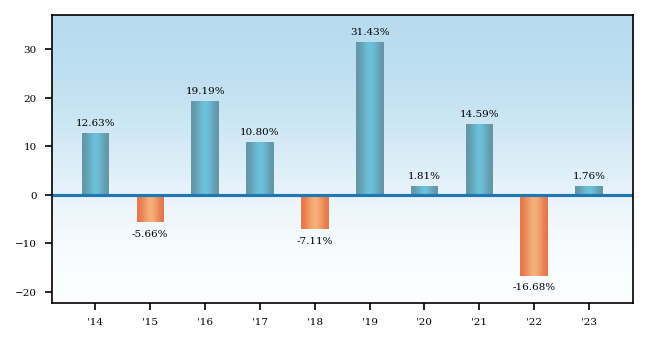
The performance information shown above is based on a calendar year. The Fund’s Institutional Class Shares’ was .
This table compares the Fund’s average annual total returns for the periods ended December 31, 2023 to those of an appropriate broad-based index and a more narrowly based index with characteristics relevant to the Fund’s investment strategies.
After-tax returns are calculated using the historical highest individual federal marginal income tax rates and do not reflect the impact of state and local taxes. Actual after-tax returns depend on an investor’s tax situation and may differ from those shown. After-tax returns shown are not relevant
to investors who hold their Fund shares through tax-deferred arrangements, such as 401(k) plans or individual retirement accounts (“IRAs”).
Average Annual Total Returns - Reaves Infrastructure Fund |
1 Year |
5 Years |
10 Years |
|
|---|---|---|---|---|
| Institutional Class Shares | 1.76% | 5.39% | 5.42% | |
| Institutional Class Shares | After Taxes on Distributions | 1.02% | 4.02% | 3.61% | |
| Institutional Class Shares | After Taxes on Distributions and Sales | 1.54% | 4.20% | 4.06% | |
| S&P 500 Index (reflects no deduction for fees, expenses or taxes) | [1] | 26.29% | 15.69% | 12.03% |
| MSCI USA Infrastructure Index (reflects no deduction for fees, expenses or taxes) | [1] | (2.02%) | 6.00% | 6.25% |
| [1] | Pursuant to new regulatory requirements, the Fund’s broad-based securities market index has changed from the MSCI USA Infrastructure Index to the S&P 500 Index. |
Equity Risk – Since it purchases equity securities, the Fund is subject to the risk that stock prices will fall over short or extended periods of time. Historically, the equity markets have moved in cycles, and the value of the Fund’s equity securities may fluctuate drastically from day to day. Individual companies may report poor results or be negatively affected by industry and/or economic trends and developments. The prices of securities issued by such companies may suffer a decline in response. In addition, the impact of any epidemic, pandemic or natural disaster, or widespread fear that such events may occur, could negatively affect the global economy, as well as the economies of individual countries, the financial performance of individual companies and sectors, and the markets in general in significant and unforeseen ways. Any such impact could adversely affect the prices and liquidity of the securities and other instruments in which the Fund invests, which in turn could negatively impact the Fund’s performance and cause losses on your investment in the Fund. These factors contribute to price volatility, which is the principal risk of investing in the Fund.
Infrastructure Company Risk – Infrastructure companies are subject to a variety of factors that may adversely affect their business or operations, including high interest costs in connection with capital construction programs, costs associated with environmental and other regulations, difficulty
in raising capital in adequate amounts on reasonable terms in periods of high inflation or unsettled capital markets, the effects of economic slowdown and surplus capacity, increased competition from other providers of services, uncertainties concerning the availability of fuel at reasonable prices, the effects of energy conservation policies, service interruption due to environmental, operational or other mishaps, and other factors. Additionally, infrastructure entities may be subject to regulation by various governmental authorities and may also be affected by governmental regulation of rates charged to customers; the imposition of special tariffs and changes in tax laws, regulatory policies and accounting standards; nationalization; and general changes in market sentiment towards infrastructure assets.
Industry Focus Risk – To the extent that the Fund’s investments are focused in issuers conducting business in the Utilities Industry and/or the Energy Industry, the Fund is subject to the risk that legislative or regulatory changes, adverse market conditions and/or increased competition will negatively affect these industries. Fluctuations in the value of securities of companies in the Utilities Industry and/or the Energy Industry depend to a large extent on the price and supply of energy fuels. Many utility companies historically have been subject to risks of increases in fuel, power and other operating costs, high interest costs on borrowings needed for capital improvement programs and costs associated with compliance with and changes in environmental and other governmental regulations.
REITs Risk – REITs are pooled investment vehicles that own, and usually operate, income-producing real estate. REITs are susceptible to the risks associated with direct ownership of real estate, such as the following: declines in property values; increases in property taxes, operating expenses, interest rates or competition; overbuilding; zoning changes; and losses from casualty or condemnation. REITs typically incur fees that are separate from those of the Fund. Accordingly, the Fund’s investments in REITs will result in the layering of expenses such that shareholders will indirectly bear a proportionate share of the REITs’ operating expenses, in addition to paying Fund expenses. REIT operating expenses are not reflected in the fee table and example in this prospectus.
Focused Portfolio Risk – Although the Fund is diversified, its investment strategy often results in a relatively focused portfolio of stocks of companies that the Adviser believes hold the most total return potential. As a result, poor performance or adverse economic events affecting one or more of these companies could have a greater impact on the Fund than it would on another mutual fund with a broader range of investments.
Small and Medium Capitalization Company Risk – The small- and medium-sized companies the Fund invests in may be more vulnerable to adverse business or economic events than larger, more established companies. In particular, investments in these small- and medium-sized companies may pose additional risks, including liquidity risk, because these companies tend to have limited product lines, markets and financial resources, and may depend upon a relatively small management group. Therefore, small- and mid-cap stocks may be more volatile than those of larger companies. These securities may be traded over-the-counter or listed on an exchange.
Foreign Security Risk – Investing in foreign companies poses additional risks since political and economic events unique to a country or region will affect those markets and their issuers. These events will not necessarily affect the U.S. economy or similar issuers located in the United States. Securities of foreign companies may not be registered with the U.S. Securities and Exchange Commission (the “SEC”) and foreign companies are generally not subject to the regulatory controls imposed on U.S. issuers and, as a consequence, there is generally less publicly available information about foreign securities than is available about domestic securities. Income from foreign securities owned by the Fund may be reduced by a withholding tax at the source, which tax would reduce income received from the securities comprising the Fund’s portfolio. Foreign securities may also be more difficult to value than securities of U.S. issuers. In addition, investments in foreign companies are generally denominated in a foreign currency. As a result, changes in the value of those currencies
compared to the U.S. dollar may affect (positively or negatively) the value of the Fund’s investments. These currency movements may occur separately from and in response to events that do not otherwise affect the value of the security in the issuer’s home country. In addition, periodic U.S. Government restrictions on investments in issuers from certain foreign countries may require the Fund to sell such investments at inopportune times, which could result in losses to the Fund.