The Tactical Dividend and Momentum Fund (the “Fund”) seeks to provide capital appreciation and current income.
This table describes the fees and expenses that you may pay if you buy, hold and sell shares of the Fund. You may pay other fees, such as brokerage commissions and other fees to financial intermediaries, which are not reflected in the table and Example below. More information about these and other discounts is available from your financial intermediary and in the section entitled How to Purchase Shares on page 15 of this Fund’s Prospectus and in the Statement of Additional Information (“SAI”).
Shareholder Fees - Tactical Dividend and Momentum Fund |
Tactical Dividend and Momentum Fund Class A Shares |
Tactical Dividend and Momentum Fund Class C Shares |
Tactical Dividend and Momentum Fund Class I Shares |
Tactical Dividend and Momentum Fund Class R Shares |
|
|---|---|---|---|---|---|
| Maximum Sales Charge (Load) Imposed on Purchases (as a % of offering price) | 5.75% | none | none | none | |
| Maximum Deferred Sales Charge (Load) for Shares Held Less Than One Year (as a % of original purchase price) | none | [1] | 1.00% | none | none |
| [1] | There is a 1.00% contingent deferred sales charge (“CDSC”) for investments of $1 million or more (see “How to Purchase Shares” below) on shares sold within 1-year of purchase, unless you are otherwise eligible to purchase Class A shares without an initial sales charge or are eligible for a waiver of the CDSC (see “Waiver of Contingent Deferred Sales Charges” below). |
Annual Fund Operating Expenses - Tactical Dividend and Momentum Fund |
Tactical Dividend and Momentum Fund Class A Shares |
Tactical Dividend and Momentum Fund Class C Shares |
Tactical Dividend and Momentum Fund Class I Shares |
Tactical Dividend and Momentum Fund Class R Shares |
|
|---|---|---|---|---|---|
| Management Fees | 1.00% | 1.00% | 1.00% | 1.00% | |
| Distribution (12b-1) and Service Fees | 0.25% | 1.00% | none | 0.40% | |
| Other Expenses | 0.52% | 0.52% | 0.52% | 0.52% | |
| Acquired Fund Fees and Expenses | [1] | 0.13% | 0.13% | 0.13% | 0.13% |
| Total Annual Fund Operating Expenses | 1.90% | 2.65% | 1.65% | 2.05% | |
| [1] | Acquired Fund Fees and Expenses are the indirect costs of investing in other investment companies. |
This Example is intended to help you compare the cost of investing in the Fund with the cost of investing in other mutual funds.
Expense Example - Tactical Dividend and Momentum Fund - USD ($) |
Expense Example, with Redemption, 1 Year |
Expense Example, with Redemption, 3 Years |
Expense Example, with Redemption, 5 Years |
Expense Example, with Redemption, 10 Years |
|---|---|---|---|---|
| Tactical Dividend and Momentum Fund Class A Shares | 757 | 1,138 | 1,542 | 2,669 |
| Tactical Dividend and Momentum Fund Class C Shares | 268 | 823 | 1,405 | 2,983 |
| Tactical Dividend and Momentum Fund Class I Shares | 168 | 520 | 897 | 1,955 |
| Tactical Dividend and Momentum Fund Class R Shares | 208 | 643 | 1,103 | 2,379 |
The Fund pays transaction costs, such as commissions, when it buys and sells securities (or “turns over” its portfolio). A higher portfolio turnover may indicate higher transaction costs and may result in higher taxes when Fund shares are held in a taxable account. These costs, which are not reflected in annual fund operating expenses or in the Example, affect the Fund’s performance. For the fiscal year ended July 31, 2024, the Fund’s portfolio turnover rate was 226% of the average value of its portfolio.
The Fund follows, when appropriate, a rules-based investment strategy, that includes both a sector tactical overlay and ranking selection strategy among the eleven major economic sectors in the U.S. economy. The Adviser may also exercise its discretion in applying the rules-based investment strategy, when, in its opinion, a discretionary management approach would be more appropriate. These eleven sectors include: communications services; consumer discretionary; consumer staples; energy; financials; health care; industrials; information technology; materials; real estate and utilities.
When the tactical algorithms determine that a sector is on a “buy,” the Fund may invest in any number of the highest dividend yielding and highest momentum stocks from that particular sector. Dividend yield is determined as the total of all trailing 12-month regular dividends, divided by the current market price for each stock. A ranking by dividend yield of all stocks in the sector is made and the highest dividend stocks may be selected. Momentum is determined by a proprietary factor calculation of the rate of change for each stock over the prior 64-day and prior 18-day time periods. A ranking by momentum of all stocks in the sector is made and the top momentum-based stocks may be selected. The Adviser selects the stocks as of the date of the initial investment or tactical reinvestment in the sector. The Adviser may also elect to remove or replace any number of the stocks at any time. The Adviser may also choose to invest into the entire sector by buying an exchange-traded fund (“ETF”) representing all constituent stocks of that sector that are in the S&P 500 Index or in one or more ETFs representing a portion of a sector. When a sector is on a buy, the Adviser may invest all or a portion of the allocation into that sector, up to its market cap weighting, into any combination and weighting of individual stocks or ETFs. When all eleven sectors are on a buy, the Fund may be fully invested in a combination of stocks and ETFs in each sector. Under these circumstances, the Fund will invest up to a market cap weighted amount of its assets in each of the eleven sectors. The market cap weight amount of each sector shall be determined by the percentage that the individual sector is represented in the S&P 500 Index as of the end of the previous calendar month. Under certain circumstances, the Fund may be over weighted in one or more sectors because of market appreciation or if the Adviser believes that different weightings are appropriate.
When the tactical algorithms indicate and the Adviser, in its discretion, determines that a sector is not on a “buy,” the Fund will invest those assets in other types of investments, including cash and cash equivalents, fixed income investments (including high yield bond ETFs), preferred stocks and closed-end funds, instead of investing in stocks or ETFs from the sector. When none of the sectors is on a buy, the Fund will be fully invested in such other types of investments, meaning that all of the Fund's assets could be invested in cash and cash equivalents, fixed income investments (including high yield bond ETFs), preferred stocks and/or closed-end funds. Accordingly, the Fund may invest all or a substantial portion of its assets in cash and cash equivalents, fixed income investments (such as high yield bond ETFs), preferred stocks and/or investments in closed-end funds and may invest in a smaller number of holdings. The Fund may invest in such investments directly or indirectly through underlying funds such as ETFs. The Fund may also seek to increase its income by lending portfolio securities to certain institutions.
As with all mutual funds, there is the risk that you could lose money through your investment in the Fund. An investment in the Fund is not guaranteed to achieve its investment objective; is not a deposit with a bank; is not insured, endorsed or guaranteed by the Federal Deposit Insurance Corporation or any other government agency; and is subject to investment risks. As with any fund, there is no guarantee that the Fund will achieve its goal. The value of your investment in the Fund, as well as the amount of return you receive on your investment, may fluctuate significantly. You may lose part or all of your investment in the Fund or your investment may not perform as well as other similar investments. The Fund is not intended to be a complete investment program but rather one component of a diversified investment portfolio. Many factors affect the Fund’s net asset value and performance. Each risk summarized below is a principal risk of investing in the Fund and different risks may be more significant at different times depending upon market conditions or other factors.
The following describes the risks that the Fund bears directly or indirectly through its investments in ETFs.
| · | Market Risk. Overall market risk may affect the value of individual instruments in which the Fund invests. The Fund is subject to the risk that the securities markets will move down, sometimes rapidly and unpredictably, based on overall economic conditions and other factors, which may negatively affect the Fund’s performance. Factors such as domestic and foreign (non-U.S.) economic growth and market conditions, real or perceived adverse economic or political conditions, military conflict, acts of terrorism, social unrest, natural disasters, recessions, inflation, changes in interest rate levels, supply chain disruptions, sanctions, the spread of infectious illness or other public health threats, lack of liquidity in the bond or other markets, volatility in the securities markets or adverse investor sentiment and political events affect the securities markets. U.S. and foreign stock markets have experienced periods of substantial price volatility in the past and may do so again in the future. Securities markets also may experience long periods of decline in value. A change in financial condition or other event affecting a single issuer or market may adversely impact securities markets as a whole. Rates of inflation have recently risen. The value of assets or income from an investment may be worth less in the future as inflation decreases the value of money. As inflation increases, the real value of the Fund’s assets can decline as can the value of the Fund’s distributions. When the value of the Fund’s investments goes down, your investment in the Fund decreases in value and you could lose money. |
Local, state, regional, national or global events such as war, acts of terrorism, the spread of infectious illness or other public health issues, recessions, or other events could have a significant impact on the Fund and its investments and could result in decreases to the Fund’s net asset value. Political, geopolitical, natural and other events, including war, terrorism, trade
disputes, government shutdowns, market closures, natural and environmental disasters, epidemics, pandemics and other public health crises and related events and governments’ reactions to such events have led, and in the future may lead, to economic uncertainty, decreased economic activity, increased market volatility and other disruptive effects on U.S. and global economies and markets. Such events may have significant adverse direct or indirect effects on the Fund and its investments. For example, a widespread health crisis such as a global pandemic could cause substantial market volatility, exchange trading suspensions and closures, impact the ability to complete redemptions, and affect Fund performance. A health crisis may exacerbate other pre-existing political, social and economic risks. In addition, the increasing interconnectedness of markets around the world may result in many markets being affected by events or conditions in a single country or region or events affecting a single or small number of issuers.
| · | Management Risk. The Fund’s investment strategies may not result in an increase in the value of your investment in the Fund or in overall performance equal to other similar investment vehicles having investment strategies that are similar to those of the Fund. The Adviser determines the intrinsic value of the securities the Fund holds and its assessment may be incorrect, which may result in a decline in the value of Fund shares and failure to achieve its investment objective. The Fund’s portfolio managers use qualitative analyses and/or models. Any imperfections or limitations in such analyses or models could affect the ability of the portfolio managers to implement strategies particularly in volatile markets. In addition, the Fund’s tactical asset allocation strategy may be unsuccessful and may cause the Fund to miss attractive investment opportunities while in a defensive position. |
| · | Rules-Based Strategy Risk. A rules-based investment strategy may not be successful on an ongoing basis or could contain unknown errors. In addition, the data used may be inaccurate. or the computer programming used to create a rules-based investment strategy might contain one or more errors. Moreover, during periods of increased volatility or changing market conditions the commonality of portfolio holdings and similarities between strategies of rules-based managers may amplify losses. |
| · | Sector Risk. The risk that if the Fund invests a significant portion of its total assets in certain issuers within the same economic sector, an adverse economic, business or political development or natural or other event, including war, terrorism, natural and environmental disasters, epidemics, pandemics and other public health crises, affecting that sector may affect the value of the Fund’s investments more than if the Fund’s investments were not so concentrated. Economic, legislative or regulatory developments may occur that significantly affect an entire sector. This may cause the Fund’s NAV to fluctuate more than that of a fund that does not focus in a particular sector. While the Fund may not concentrate in any one industry, the Fund may invest without limitation in a particular sector. |
| · | Cash Positions Risk. The Fund may hold a significant position in cash and/or cash equivalent securities. When the Fund’s investment in cash or cash equivalent securities increases, the Fund may not participate in market advances or declines to the same extent that it would if the Fund were more fully invested. |
| · | Cybersecurity Risk. There is risk to the Fund of an unauthorized breach and access to fund assets, customer data (including private shareholder information), or proprietary information, or the risk of an incident occurring that causes the Fund, the Fund’s investment adviser, custodian, transfer agent, distributor and other service providers and financial intermediaries (the “Service Providers”) to suffer data breaches, data corruption or lose operational functionality. Successful cyber-attacks or other cyber-failures or events affecting the Fund, or its Service Providers may adversely impact the Fund or its shareholders. |
| · | Equity Risk. Equity securities are susceptible to general market fluctuations and volatile increases and decreases in value as market confidence in and perceptions of their issuers change. Factors that may influence the price of equity securities include developments affecting a specific company or industry, or the changing economic, political or market conditions. |
| o | Dividend-Yielding Companies Risk. A company that has historically paid regular dividends to shareholders may decrease or eliminate dividend payments in the future, which could result in a decrease in the value of the company’s stock and lower performance of the Fund. |
| o | Momentum Investing Risk. An investment in securities with positive momentum entails investing in securities that have had above-average recent returns. These securities may experience greater price volatility than other equity securities, which may negatively impact the investment performance of the Fund. |
| · | Fixed Income Securities Risk. Fixed income securities are subject to interest rate risk, call risk, prepayment and extension risk, credit risk, duration risk, and liquidity risk. In addition, current market conditions may pose heightened risks for fixed income securities. When the Fund invests in fixed income securities, the value of your investment in the Fund will fluctuate with changes in interest rates. Typically, a rise in interest rates causes a decline in the value of fixed income securities owned by the Fund. In general, the market price of fixed income securities with longer maturities or durations will increase or decrease more in response to changes in interest rates than shorter-term securities. Other risk factors include credit risk (the debtor may default) and prepayment risk (the debtor may pay its obligation early, reducing the amount of interest payments). These risks could affect the value of a particular investment by the Fund, possibly causing the Fund’s share price and total return to be reduced and fluctuate more than other types of investments. Moreover, new regulations applicable to and changing business practices of financial intermediaries that make markets in fixed income securities have resulted in less market making activity for certain fixed income securities, which has reduced the liquidity and may increase |
the volatility for such fixed income securities. The fixed-income securities market can be susceptible to increases in volatility and decreases in liquidity. Liquidity may decline unpredictably in response to overall economic conditions or credit tightening. For example, a general rise in interest rates may cause investors to move out of fixed income securities on a large scale, which could adversely affect the price and liquidity of fixed income securities and could also result in increased redemptions for the Fund. Duration risk arises when holding long duration and long maturity investments, which will magnify certain risks, including interest rate risk and credit risk. Longer-term securities may be more sensitive to interest rate changes. Given the recent, historically low interest rates and the potential for increases in those rates, a heightened risk is posed by rising interest rates to longer-term fixed income securities. Effective duration estimates price changes for relatively small changes in rates. If rates rise significantly, effective duration may tend to understate the drop in a security’s price. If rates drop significantly, effective duration may tend to overstate the rise in a security’s price.
· Focus Risk. To the extent the Fund invests a greater proportion of its assets in the securities of a smaller number of issuers, the Fund may be subject to greater volatility with respect to its investments than a fund that invests in a larger number of securities.
| · | Healthcare Sector Risk. The Fund may invest a substantial portion of its assets directly or indirectly in securities issued by healthcare companies and, as a result, the performance of the Fund will be impacted by economic, political and regulatory risks or other occurrences associated with the healthcare industry. Healthcare companies may be significantly affected by product obsolescence, thin capitalization, limited product lines and markets, civil liability claims and legislative or regulatory activities, among other factors. |
| · | High Yield Risk. Investment in or exposure to high yield (lower rated or below investment grade) debt instruments (also known as “junk bonds”) may involve greater levels of interest rate, credit, liquidity and valuation risk than for higher rated instruments. High yield debt instruments are considered predominantly speculative and are higher risk than investment grade instruments with respect to the issuer’s continuing ability to make principal and interest payments and, therefore, such instruments generally involve greater risk of default or price changes than higher rated debt instruments. An economic downturn or period of rising interest rates could adversely affect the value of these securities and market for these securities and reduce market liquidity (liquidity risk). |
| · | Information Technology Sector Risk. Companies in the information technology sector face intense competition, both domestically and internationally, which may have an adverse effect on their profit margins. Like other technology companies, information technology companies may have limited product lines, markets, financial resources or personnel. Companies in the information technology sector may face obsolescence and are heavily dependent on patent and intellectual property rights. The loss or impairment of these rights may adversely affect the profitability of these companies. |
| · | Investment Companies/Exchange-Traded Funds Risk. When the Fund invests in other investment companies, including ETFs and closed-end funds, it will bear additional expenses based on its pro rata share of the other investment company’s operating expenses, including management fees in addition to those paid by the Fund. The risk of owning an investment company (including a closed-end fund or ETF) generally reflects the risks of owning the underlying investments held by the investment company (including a closed-end fund or ETF). The Fund may also will incur brokerage costs when it purchases and sells shares of investment companies. An exchange-traded closed-end fund’s or an ETF’s shares could trade at a significant premium or discount to its net asset value. |
| · | Issuer-Specific Risk. The value of a specific security can be more volatile than the market as a whole and may perform worse than the market as a whole. |
| · | Large Capitalization Risk. The risk that large cap companies may be unable to respond as quickly as smaller companies to new competitive challenges, such as changes in technology and consumer tastes, and also may not be able to attain the high growth rate of successful smaller companies, especially during extended periods of economic expansion. |
| · | Liquidity Risk. Liquidity risk exists when particular investments of the Fund would be difficult to purchase or sell, possibly preventing the Fund from selling such illiquid securities at an advantageous time or price, or possibly requiring the Fund to dispose of other investments at unfavorable times or prices in order to satisfy its obligations. In the past, in stressed markets, certain types of securities suffered periods of illiquidity if disfavored by the market. These risks may increase during periods of market turmoil, such as that experienced in 2020 with COVID-19 and could have a negative effect on the Fund’s performance. |
· Market Events Risk. There has been increased volatility, depressed valuations, decreased liquidity and heightened uncertainty in the financial markets during the past several years, including what was experienced in 2020. These conditions may continue, recur, worsen or spread. The U.S. government and the Federal Reserve, as well as certain foreign governments and central banks, have taken steps to support financial markets, including by lowering interest rates to historically low levels. This and other government intervention may not work as intended, particularly if the efforts are perceived by investors as being unlikely to achieve the desired results. The U.S. government and the Federal Reserve have recently reduced market support activities, including by beginning to increase interest rates. Such reduction, including interest rate increases, could negatively affect financial markets generally, increase market volatility and reduce the value and liquidity of securities in which the Fund invests. Policy and legislative changes in the United States and in other countries may also continue to contribute to decreased liquidity
and increased volatility in the financial markets. The impact of these changes on the markets, and the practical implications for market participants, may not be fully known for some time.
| · | Portfolio Turnover Risk. The Fund may experience high portfolio turnover, including investments made on a shorter-term basis, which may lead to increased Fund expenses that may result in lower investment returns. A higher portfolio turnover may result in higher transactional and brokerage costs. High portfolio turnover may also result in higher short-term capital gains taxable to shareholders. |
| · | Preferred Stock Risk. The value of preferred stocks will fluctuate with changes in interest rates. Typically, a rise in interest rates causes a decline in the value of preferred stock. Preferred stocks are also subject to credit risk, which is the possibility that an issuer of preferred stock will fail to make its dividend payments. Preferred stock prices tend to move more slowly upwards than common stock prices. Convertible preferred stock tends to be more volatile than non-convertible preferred stock, because its value is related to the price of the issuer’s common stock as well as the dividends payable on the preferred stock. The value of preferred stocks will usually react more strongly than bonds and other debt securities to actual or perceived changes in issuer’s financial condition or prospects and may be less liquid than common stocks. |
| · | Real Estate Securities Risk. Investments in securities of real estate companies will make the Fund more susceptible to risks associated with the ownership of real estate and with the real estate industry in general. Real estate companies may have lower trading volumes and may be subject to more abrupt or erratic price movements than the overall securities markets. The value of real estate securities may underperform other sectors of the economy or broader equity markets. Certain investments in real estate-related investments were negatively affected by the COVID-19 pandemic. |
| · | Securities Lending Risk. The Fund may lend portfolio securities to institutions, such as banks and certain broker-dealers. The risks associated with lending portfolio securities, as with other extensions of secured credit, include, but are not limited to, possible delays in receiving additional collateral or in the recovery of the securities loaned, possible loss of rights in the collateral should the borrower fail financially, as well as risk of loss in the value of the collateral or the value of the investments made with the collateral. In certain market conditions, the portfolio of the Fund’s securities on loan may be significant and may magnify the risk of such a loss or delay. |
| · | Technology Securities Risk. The Fund may invest a substantial portion of its assets directly or indirectly in securities issued by technology companies. Securities of technology companies may be subject to greater price volatility than securities of companies in other sectors. These securities may fall in and out of favor with investors rapidly, which may cause sudden selling and dramatically lower market prices. Technology securities also may be affected adversely by changes in technology, consumer and business purchasing patterns, government regulation and/or obsolete products or services. In addition, a rising interest rate environment tends to negatively affect technology companies. |
| · | Volatility Risk. The Fund’s investments may appreciate or decrease significantly in value over short periods of time. The value of an investment in the Fund’s portfolio may fluctuate due to events or factors that affect markets generally or that affect a particular investment, industry or sector. The value of an investment in the Fund’s portfolio may also be more volatile than the market as a whole. This volatility may affect the Fund’s net asset value per share, including by causing it to experience significant increases or declines in value over short periods of time. Events or financial circumstances affecting individual investments, industries or sectors may increase the volatility of the Fund. |
| · | Underlying Fund Risk. The risk that the Fund’s investment performance and its ability to achieve its investment objective are directly related to the performance of the underlying funds in which it invests. There can be no assurance that the underlying funds will achieve their respective investment objectives. The Fund is subject to the risks of the underlying funds in direct proportion to their allocation of its assets among the underlying funds. Additionally, the fund will be indirectly exposed to the risks of the portfolio assets held by an underlying fund in which the Fund invests. |
The bar chart and performance table below show the variability of the Fund’s returns, which is some indication of the risks of investing in the Fund. The bar chart shows performance of the Fund’s Class I shares for each calendar year since the Fund’s inception. Class A, Class C, and Class R shares, which are not presented in the bar chart, would have similar returns to Class I shares because the classes are invested in the same portfolio of securities and would differ only to the extent that Class A, Class C, and Class R shares have different expenses than Class I shares. Sales loads or account fees are not reflected in the bar chart. If these amounts were reflected, returns would be less than those shown. The performance table compares the performance of the Fund over time to the performance of a broad-based market index. You should be aware that the Fund’s past performance (before and after taxes) may not be an indication of how the Fund will perform in the future. Updated performance information will be available at no cost by visiting www.HanlonFunds.com or by calling 1-844-828-3212.
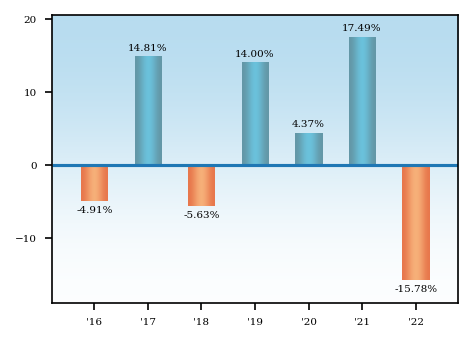
| Highest Quarter: | 12/31/2020 | 10.06% |
| Lowest Quarter: | 12/31/2018 | -12.75% |
The Fund’s year to date return for the period ended September 30, 2024 was: 16.35%
Average Annual Total Returns - Tactical Dividend and Momentum Fund |
Label |
1 Year |
5 Years |
Since Inception |
[1] | Inception Date |
|
|---|---|---|---|---|---|---|---|
| Tactical Dividend and Momentum Fund Class I Shares | Return before taxes | 12.51% | 5.78% | 3.65% | Sep. 09, 2015 | ||
| Tactical Dividend and Momentum Fund Class I Shares | Return after taxes on Distributions | 11.63% | 4.92% | 3.07% | ||||
| Tactical Dividend and Momentum Fund Class I Shares | Return after taxes on Distributions and Sale of Fund Shares | 7.40% | 4.44% | 2.80% | ||||
| Tactical Dividend and Momentum Fund Class A Shares | Return before taxes | 5.80% | 4.30% | 2.70% | Sep. 09, 2015 | ||
| Tactical Dividend and Momentum Fund Class C Shares | Return before taxes | 11.25% | 4.71% | 2.66% | Sep. 09, 2015 | ||
| Tactical Dividend and Momentum Fund Class R Shares | Return before taxes | 11.92% | 5.36% | 3.22% | Sep. 09, 2015 | ||
| S&P 500 Total Return Index (reflects no deduction for fees, expenses or taxes) | [2] | 26.29% | 15.69% | 13.50% | |||
| [1] | The inception date of the Fund is . |
| [2] | The S&P 500 Total Return Index is an unmanaged free-float capitalization-weighted index which measures the performance of 500 large-cap common stocks actively traded in the United States. Unlike a mutual fund, an index does not reflect any trading costs or management fees. Investors cannot directly invest in an index. |
| · | Market Risk. Overall market risk may affect the value of individual instruments in which the Fund invests. The Fund is subject to the risk that the securities markets will move down, sometimes rapidly and unpredictably, based on overall economic conditions and other factors, which may negatively affect the Fund’s performance. Factors such as domestic and foreign (non-U.S.) economic growth and market conditions, real or perceived adverse economic or political conditions, military conflict, acts of terrorism, social unrest, natural disasters, recessions, inflation, changes in interest rate levels, supply chain disruptions, sanctions, the spread of infectious illness or other public health threats, lack of liquidity in the bond or other markets, volatility in the securities markets or adverse investor sentiment and political events affect the securities markets. U.S. and foreign stock markets have experienced periods of substantial price volatility in the past and may do so again in the future. Securities markets also may experience long periods of decline in value. A change in financial condition or other event affecting a single issuer or market may adversely impact securities markets as a whole. Rates of inflation have recently risen. The value of assets or income from an investment may be worth less in the future as inflation decreases the value of money. As inflation increases, the real value of the Fund’s assets can decline as can the value of the Fund’s distributions. When the value of the Fund’s investments goes down, your investment in the Fund decreases in value and you could lose money. |
Local, state, regional, national or global events such as war, acts of terrorism, the spread of infectious illness or other public health issues, recessions, or other events could have a significant impact on the Fund and its investments and could result in decreases to the Fund’s net asset value. Political, geopolitical, natural and other events, including war, terrorism, trade
| · | Management Risk. The Fund’s investment strategies may not result in an increase in the value of your investment in the Fund or in overall performance equal to other similar investment vehicles having investment strategies that are similar to those of the Fund. The Adviser determines the intrinsic value of the securities the Fund holds and its assessment may be incorrect, which may result in a decline in the value of Fund shares and failure to achieve its investment objective. The Fund’s portfolio managers use qualitative analyses and/or models. Any imperfections or limitations in such analyses or models could affect the ability of the portfolio managers to implement strategies particularly in volatile markets. In addition, the Fund’s tactical asset allocation strategy may be unsuccessful and may cause the Fund to miss attractive investment opportunities while in a defensive position. |
| · | Rules-Based Strategy Risk. A rules-based investment strategy may not be successful on an ongoing basis or could contain unknown errors. In addition, the data used may be inaccurate. or the computer programming used to create a rules-based investment strategy might contain one or more errors. Moreover, during periods of increased volatility or changing market conditions the commonality of portfolio holdings and similarities between strategies of rules-based managers may amplify losses. |
| · | Sector Risk. The risk that if the Fund invests a significant portion of its total assets in certain issuers within the same economic sector, an adverse economic, business or political development or natural or other event, including war, terrorism, natural and environmental disasters, epidemics, pandemics and other public health crises, affecting that sector may affect the value of the Fund’s investments more than if the Fund’s investments were not so concentrated. Economic, legislative or regulatory developments may occur that significantly affect an entire sector. This may cause the Fund’s NAV to fluctuate more than that of a fund that does not focus in a particular sector. While the Fund may not concentrate in any one industry, the Fund may invest without limitation in a particular sector. |
| · | Cash Positions Risk. The Fund may hold a significant position in cash and/or cash equivalent securities. When the Fund’s investment in cash or cash equivalent securities increases, the Fund may not participate in market advances or declines to the same extent that it would if the Fund were more fully invested. |
| · | Cybersecurity Risk. There is risk to the Fund of an unauthorized breach and access to fund assets, customer data (including private shareholder information), or proprietary information, or the risk of an incident occurring that causes the Fund, the Fund’s investment adviser, custodian, transfer agent, distributor and other service providers and financial intermediaries (the “Service Providers”) to suffer data breaches, data corruption or lose operational functionality. Successful cyber-attacks or other cyber-failures or events affecting the Fund, or its Service Providers may adversely impact the Fund or its shareholders. |
| · | Equity Risk. Equity securities are susceptible to general market fluctuations and volatile increases and decreases in value as market confidence in and perceptions of their issuers change. Factors that may influence the price of equity securities include developments affecting a specific company or industry, or the changing economic, political or market conditions. |
| o | Dividend-Yielding Companies Risk. A company that has historically paid regular dividends to shareholders may decrease or eliminate dividend payments in the future, which could result in a decrease in the value of the company’s stock and lower performance of the Fund. |
| o | Momentum Investing Risk. An investment in securities with positive momentum entails investing in securities that have had above-average recent returns. These securities may experience greater price volatility than other equity securities, which may negatively impact the investment performance of the Fund. |
| · | Fixed Income Securities Risk. Fixed income securities are subject to interest rate risk, call risk, prepayment and extension risk, credit risk, duration risk, and liquidity risk. In addition, current market conditions may pose heightened risks for fixed income securities. When the Fund invests in fixed income securities, the value of your investment in the Fund will fluctuate with changes in interest rates. Typically, a rise in interest rates causes a decline in the value of fixed income securities owned by the Fund. In general, the market price of fixed income securities with longer maturities or durations will increase or decrease more in response to changes in interest rates than shorter-term securities. Other risk factors include credit risk (the debtor may default) and prepayment risk (the debtor may pay its obligation early, reducing the amount of interest payments). These risks could affect the value of a particular investment by the Fund, possibly causing the Fund’s share price and total return to be reduced and fluctuate more than other types of investments. Moreover, new regulations applicable to and changing business practices of financial intermediaries that make markets in fixed income securities have resulted in less market making activity for certain fixed income securities, which has reduced the liquidity and may increase |
· Focus Risk. To the extent the Fund invests a greater proportion of its assets in the securities of a smaller number of issuers, the Fund may be subject to greater volatility with respect to its investments than a fund that invests in a larger number of securities.
| · | Healthcare Sector Risk. The Fund may invest a substantial portion of its assets directly or indirectly in securities issued by healthcare companies and, as a result, the performance of the Fund will be impacted by economic, political and regulatory risks or other occurrences associated with the healthcare industry. Healthcare companies may be significantly affected by product obsolescence, thin capitalization, limited product lines and markets, civil liability claims and legislative or regulatory activities, among other factors. |
| · | High Yield Risk. Investment in or exposure to high yield (lower rated or below investment grade) debt instruments (also known as “junk bonds”) may involve greater levels of interest rate, credit, liquidity and valuation risk than for higher rated instruments. High yield debt instruments are considered predominantly speculative and are higher risk than investment grade instruments with respect to the issuer’s continuing ability to make principal and interest payments and, therefore, such instruments generally involve greater risk of default or price changes than higher rated debt instruments. An economic downturn or period of rising interest rates could adversely affect the value of these securities and market for these securities and reduce market liquidity (liquidity risk). |
| · | Information Technology Sector Risk. Companies in the information technology sector face intense competition, both domestically and internationally, which may have an adverse effect on their profit margins. Like other technology companies, information technology companies may have limited product lines, markets, financial resources or personnel. Companies in the information technology sector may face obsolescence and are heavily dependent on patent and intellectual property rights. The loss or impairment of these rights may adversely affect the profitability of these companies. |
| · | Investment Companies/Exchange-Traded Funds Risk. When the Fund invests in other investment companies, including ETFs and closed-end funds, it will bear additional expenses based on its pro rata share of the other investment company’s operating expenses, including management fees in addition to those paid by the Fund. The risk of owning an investment company (including a closed-end fund or ETF) generally reflects the risks of owning the underlying investments held by the investment company (including a closed-end fund or ETF). The Fund may also will incur brokerage costs when it purchases and sells shares of investment companies. An exchange-traded closed-end fund’s or an ETF’s shares could trade at a significant premium or discount to its net asset value. |
| · | Issuer-Specific Risk. The value of a specific security can be more volatile than the market as a whole and may perform worse than the market as a whole. |
| · | Large Capitalization Risk. The risk that large cap companies may be unable to respond as quickly as smaller companies to new competitive challenges, such as changes in technology and consumer tastes, and also may not be able to attain the high growth rate of successful smaller companies, especially during extended periods of economic expansion. |
| · | Liquidity Risk. Liquidity risk exists when particular investments of the Fund would be difficult to purchase or sell, possibly preventing the Fund from selling such illiquid securities at an advantageous time or price, or possibly requiring the Fund to dispose of other investments at unfavorable times or prices in order to satisfy its obligations. In the past, in stressed markets, certain types of securities suffered periods of illiquidity if disfavored by the market. These risks may increase during periods of market turmoil, such as that experienced in 2020 with COVID-19 and could have a negative effect on the Fund’s performance. |
· Market Events Risk. There has been increased volatility, depressed valuations, decreased liquidity and heightened uncertainty in the financial markets during the past several years, including what was experienced in 2020. These conditions may continue, recur, worsen or spread. The U.S. government and the Federal Reserve, as well as certain foreign governments and central banks, have taken steps to support financial markets, including by lowering interest rates to historically low levels. This and other government intervention may not work as intended, particularly if the efforts are perceived by investors as being unlikely to achieve the desired results. The U.S. government and the Federal Reserve have recently reduced market support activities, including by beginning to increase interest rates. Such reduction, including interest rate increases, could negatively affect financial markets generally, increase market volatility and reduce the value and liquidity of securities in which the Fund invests. Policy and legislative changes in the United States and in other countries may also continue to contribute to decreased liquidity
| · | Portfolio Turnover Risk. The Fund may experience high portfolio turnover, including investments made on a shorter-term basis, which may lead to increased Fund expenses that may result in lower investment returns. A higher portfolio turnover may result in higher transactional and brokerage costs. High portfolio turnover may also result in higher short-term capital gains taxable to shareholders. |
| · | Preferred Stock Risk. The value of preferred stocks will fluctuate with changes in interest rates. Typically, a rise in interest rates causes a decline in the value of preferred stock. Preferred stocks are also subject to credit risk, which is the possibility that an issuer of preferred stock will fail to make its dividend payments. Preferred stock prices tend to move more slowly upwards than common stock prices. Convertible preferred stock tends to be more volatile than non-convertible preferred stock, because its value is related to the price of the issuer’s common stock as well as the dividends payable on the preferred stock. The value of preferred stocks will usually react more strongly than bonds and other debt securities to actual or perceived changes in issuer’s financial condition or prospects and may be less liquid than common stocks. |
| · | Real Estate Securities Risk. Investments in securities of real estate companies will make the Fund more susceptible to risks associated with the ownership of real estate and with the real estate industry in general. Real estate companies may have lower trading volumes and may be subject to more abrupt or erratic price movements than the overall securities markets. The value of real estate securities may underperform other sectors of the economy or broader equity markets. Certain investments in real estate-related investments were negatively affected by the COVID-19 pandemic. |
| · | Securities Lending Risk. The Fund may lend portfolio securities to institutions, such as banks and certain broker-dealers. The risks associated with lending portfolio securities, as with other extensions of secured credit, include, but are not limited to, possible delays in receiving additional collateral or in the recovery of the securities loaned, possible loss of rights in the collateral should the borrower fail financially, as well as risk of loss in the value of the collateral or the value of the investments made with the collateral. In certain market conditions, the portfolio of the Fund’s securities on loan may be significant and may magnify the risk of such a loss or delay. |
| · | Technology Securities Risk. The Fund may invest a substantial portion of its assets directly or indirectly in securities issued by technology companies. Securities of technology companies may be subject to greater price volatility than securities of companies in other sectors. These securities may fall in and out of favor with investors rapidly, which may cause sudden selling and dramatically lower market prices. Technology securities also may be affected adversely by changes in technology, consumer and business purchasing patterns, government regulation and/or obsolete products or services. In addition, a rising interest rate environment tends to negatively affect technology companies. |
| · | Volatility Risk. The Fund’s investments may appreciate or decrease significantly in value over short periods of time. The value of an investment in the Fund’s portfolio may fluctuate due to events or factors that affect markets generally or that affect a particular investment, industry or sector. The value of an investment in the Fund’s portfolio may also be more volatile than the market as a whole. This volatility may affect the Fund’s net asset value per share, including by causing it to experience significant increases or declines in value over short periods of time. Events or financial circumstances affecting individual investments, industries or sectors may increase the volatility of the Fund. |
| · | Underlying Fund Risk. The risk that the Fund’s investment performance and its ability to achieve its investment objective are directly related to the performance of the underlying funds in which it invests. There can be no assurance that the underlying funds will achieve their respective investment objectives. The Fund is subject to the risks of the underlying funds in direct proportion to their allocation of its assets among the underlying funds. Additionally, the fund will be indirectly exposed to the risks of the portfolio assets held by an underlying fund in which the Fund invests. |