Capital appreciation.
This table describes the fees and expenses that you may pay if you buy, hold, and sell Fund shares. You may pay other fees, such as brokerage commissions and other fees to financial intermediaries, which are not reflected in this table and examples below.
|
(expenses that you pay each year as a percentage of the value of your investment) |
|||||||
|
Management Fees |
0.20 |
% |
|||||
|
Distribution (12b-1) Fees |
None |
||||||
|
Other Expenses |
0.55 |
% |
|||||
|
Total Annual Fund Operating Expenses1 |
0.75 |
% |
|||||
1 The Fund is an integral part of the Adviser Managed Strategy, as discussed further below, of the Financial Adviser (defined below). As a result, shareholders in the Fund may also pay a fee to the Financial Adviser for participating in the Adviser Managed Strategy, and such fee is not reflected in this fee table or the Example numbers below. You should consult with the Financial Adviser regarding the fees charged for participating in the Adviser Managed Strategy.
This Example is intended to help you compare the cost of investing in the Fund with the cost of investing in other mutual funds. The Example assumes that you invest $10,000 in the Fund for the time periods indicated and then redeem or hold all of your shares at the end of those periods. The Example also assumes that your investment has a 5% return each year and that the Fund's operating expenses remain the same.
|
1 Year |
3 Years |
5 Years |
10 Years |
||||||||||||||||
|
Diversified Equity Fund |
$ |
77 |
$ |
240 |
$ |
417 |
$ |
930 |
|||||||||||
The Fund pays transaction costs, such as commissions, when it buys and sells securities (or "turns over" its portfolio). A higher portfolio turnover rate may indicate higher transaction costs and may result in higher taxes when Fund shares are held in a taxable account. These costs, which are not reflected in annual fund operating expenses or in the example, affect the Fund's performance. During the most recent fiscal year, the Fund's portfolio turnover rate was 2% of the average value of its portfolio.
Adviser Managed Strategy Component
Only persons who are clients of the Financial Adviser (as defined below) and who participate in the Adviser Managed Strategy should invest in the Fund. The Fund may not be purchased by any other investor. The Fund is designed to be a component of a broader strategy employed by a third party investment manager (Financial Adviser) for the benefit of its clients. The Financial Adviser seeks to take advantage of broad market changes by tactically shifting its clients' assets among the Fund, the Core Fixed Income Fund, the Enhanced Fixed Income Fund and a money market fund affiliated with the Fund, depending on the Financial Adviser's evaluation of current market conditions (Adviser Managed Strategy). The Financial Adviser is not the adviser to the Fund and is not affiliated with SEI Investments Management Corporation (SIMC), the adviser to the Fund.
When the Financial Adviser determines to reallocate its clients' assets to one or more of the other funds that compose the Adviser Managed Strategy, the Financial Adviser may request the redemption of a substantial portion of or all of the shares for which the Financial Adviser exercises investment discretion. In such an instance, the Financial Adviser's notice of its intent to redeem or formal redemption request (collectively, "Redemption Request") will cause the Fund to liquidate a substantial portion of or substantially all of its assets in order to fulfill the Redemption Request. If the Financial Adviser's Redemption Request includes all of the shares for which it exercises investment discretion, the Fund will no longer be an active component of the Adviser Managed Strategy. When the Fund is not an active component of the Adviser Managed Strategy, the Fund may invest up to 100% of its remaining assets in cash, money market instruments, repurchase agreements and other short-term obligations pending the Financial Adviser's formal redemption request; and exchange-traded funds (ETFs) that are designed to track the performance of the broad U.S. equity market. The Fund could be invested in these types of investments for extended periods of time. At such times, SIMC will manage the assets of the Fund. SIMC, the Financial Adviser or one or more of their affiliates will be the only investors in the Fund following the Financial Adviser's redemption of all of its clients' shares from the Fund. Due to this strategy, the Fund may buy and sell securities and other instruments frequently.
Investment Strategy
Under normal circumstances, and when the Fund is an active component of the Adviser Managed Strategy, the Fund will invest at least 80% of its net assets, plus the amount of any borrowings for investment purposes, in equity securities of U.S. and non-U.S. issuers of various market capitalizations and industries. Due to its investment strategy, the Fund may buy and sell securities and other instruments frequently.
It is expected that the Fund will invest: (i) at least 50% of its assets in a portfolio of securities designed to track, before fees and expenses, the performance of one or more indexes that represent broad exposure to the U.S. equity market (U.S. Equity Index); (ii) up to 40% of its assets in a portfolio of securities designed to track, before fees and expenses, the performance of one or more indexes that represent broad exposure to equity securities of issuers located in developed market countries outside of the U.S. (Developed Foreign Market Equity Index); and (iii) up to 20% of its assets in a portfolio of securities designed to track, before fees and expenses, the performance of one or more indexes that represent broad exposure to equity securities of issuers located in emerging market countries (Emerging Market Equity Index). Although SIMC will actively determine the percentage of the Fund that will be allocated to each of the U.S. Equity, Developed Foreign Market Equity and Emerging Market Equity Indexes (each, an Index, and collectively, the Indexes), the assets
allocated to each Index will be managed using a passive approach. SIMC may adjust the Fund's allocation of assets among the Indexes over time on the basis of its long-term capital market assumptions.
The Fund's investment performance will depend on SIMC's allocation decisions with respect to the Indexes, the Fund's tracking of the Indexes and the performance of the Indexes. The Fund's ability to track the performance of each Index will be affected by the size and timing of cash flows into and out of the Fund, changes in SIMC's allocation of assets among the Indexes, and the Fund's fees and expenses.
The Fund generally will attempt to invest in securities composing an Index in approximately the same proportions as they are represented in the Index. It may not be possible or practicable to purchase all of the securities composing an Index or to hold them in the same weightings as they are represented in the Index. In those cases, the Fund's sub-adviser (the Sub-Adviser) may employ a representative sampling or index optimization technique to replicate the Index. In seeking to track the performance of each Index, the Fund may invest in the following securities, not all of which may be constituents of an Index: common stocks, preferred stocks, depositary receipts, rights, warrants, ETFs, real estate investment trusts (REITs), and futures contracts. The Fund may use ETFs or futures contracts in lieu of investing directly in the securities making up the Index to obtain exposure to the equity markets, including during high volume periods of activity in the Fund, and may invest in certain fixed income instruments, such as Treasury bills, to serve as margin or collateral for such futures positions.
The Sub-Adviser selects the Fund's securities under the general supervision of SIMC. The Sub-Adviser's passive investment strategy seeks to track an index return, and therefore differs from an "active" investment strategy where an investment manager buys and sells securities based on its own economic, financial, and market analysis. The market capitalization and composition of the Indexes are subject to change. SIMC or the Sub-Adviser may sell securities that are represented in an Index or purchase securities that are not represented in an Index, prior to or after their removal or addition to the Index.
When the Fund is not an active component of the Adviser Managed Strategy, SIMC will act as the sole manager to the Fund, and a sub-adviser will not be used.
The bar chart and the performance table below provide some indication of the risks of investing in the Fund by showing the Fund's performance for the past calendar year and by showing how the Fund's average annual returns for 1 year and since the Fund's inception, compare with those of a broad measure of market performance. The Fund's past performance (before and after taxes) is not necessarily an indication of how the Fund will perform in the future. For current performance information, please call 1-800-DIAL-SEI.
|
|
Best Quarter: 11.59% (12/31/2023) Worst Quarter: -3.53% (9/30/2023) The Fund's total return (pre-tax) from January 1, 2024 to September 30, 2024 was 18.94%. |
||||||
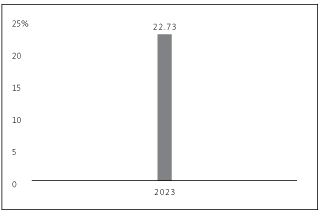
Best Quarter: 11.59% (12/31/2023)
Worst Quarter: -3.53% (9/30/2023)
The Fund's total return (pre-tax) from January 1, 2024 to September 30, 2024 was 18.94%.
After-tax returns are calculated using the historical highest individual federal marginal income tax rates and do not reflect the impact of state and local taxes. Your actual after-tax returns will depend on your tax situation and may differ from those shown. After-tax returns shown are not relevant to investors who hold their Fund shares through tax-deferred arrangements, such as 401(k) plans or individual retirement accounts. In some cases, the Fund's return after taxes may exceed the Fund's return before taxes due to an assumed tax benefit from any losses on a sale of Fund shares at the end of the measurement period.
|
Diversified Equity Fund |
1 Year |
Since Inception (3/30/2022) |
|||||||||
|
Return Before Taxes |
22.73 |
% |
0.44 |
% |
|||||||
|
Return After Taxes on Distributions |
21.73 |
% |
-0.03 |
% |
|||||||
|
Return After Taxes on Distributions and Sale of Fund Shares |
13.73 |
% |
0.22 |
% |
|||||||
|
S&P 500 Index (reflects no deduction for fees, expenses or taxes) |
26.29 |
% |
3.77 |
% |
|||||||