| • | The Alpha Fiduciary Quantitative Strategy Fund seeks long-term capital appreciation. |
The following table describes the expenses and fees that you may pay if you buy, hold, and sell shares of the Fund. You may pay other
fees, such as brokerage commissions and other fees to financial intermediaries, which are not reflected in the table and example below.
Shareholder Fees |
Alpha Fiduciary Quantitative Strategy Fund
Alpha Fiduciary Quantitative Strategy Fund Shares
USD ($)
|
|---|---|
| Redemption Fees | none |
Annual Fund Operating Expenses |
Alpha Fiduciary Quantitative Strategy Fund
Alpha Fiduciary Quantitative Strategy Fund Shares
|
|---|---|
| Management Fees | 1.00% |
| Distribution 12b-1 Fees | none |
| Other Expenses | 0.70% |
| Acquired Fund Fees and Expenses | 0.04% |
| Total Annual Fund Operating Expenses | 1.74% |
The following example is intended to help you compare the cost of investing in the Fund with the cost of investing in other mutual funds. The example assumes that you invest $10,000 in the Fund for the time periods indicated and then redeem all of your shares at the end of those periods. The example also assumes that your investment has a 5% annual return each year and that the Fund's operating expenses remain the same each year. Although your actual costs may be higher or lower, based on these assumptions your costs would be:
Expense Example |
Expense Example, with Redemption, 1 Year |
Expense Example, with Redemption, 3 Years |
Expense Example, with Redemption, 5 Years |
Expense Example, with Redemption, 10 Years |
|---|---|---|---|---|
| Alpha Fiduciary Quantitative Strategy Fund | Alpha Fiduciary Quantitative Strategy Fund Shares | USD ($) | 177 | 548 | 944 | 2,052 |
The Fund pays transaction costs, such as commissions, when it buys and sells securities (or "turns over" its portfolio). A higher portfolio turnover may indicate higher transaction costs and may result in higher taxes when Fund shares are held in a taxable account. These costs, which are not reflected in annual fund operating expenses or in the example, affect the Fund's performance. During the most recent fiscal year, the Fund’s portfolio turnover rate was 0.00% of the average value of its portfolio.
The Fund seeks to achieve its investment objective by investing primarily in a portfolio of exchange-traded funds (“ETFs”) and equity index futures. The Fund implements a quantitative trend-following strategy by generally holding long positions in S&P 500® Index ETF(s) and equity index futures that provide either long and/or short exposure to the equity markets. The Fund’s ETF investments will typically consist of ETFs that have the S&P 500® Index as the reference index. The reference index and corresponding ETF investment(s) may be market cap or equal weighted. Alpha Fiduciary, Inc., the Fund’s investment adviser (the “Adviser”), has developed a quantitative trend-following strategy that is designed to determine the Fund’s exposure to the equity markets, adjusting that exposure from approximately -105% to 165% at the time of purchase or sale. The exposure to the equity markets may move outside the range of -105% to 165% due to market changes and shareholder transactions. The Adviser will use one or more sets of data inputs in its model as well as the corresponding ETF(s) which they believe most appropriate for the prevailing market conditions. As a result of the Fund’s use of derivatives, the Fund may also hold significant amounts of U.S. Treasuries or short-term investments, including money market funds, cash and time deposits.
The Adviser’s quantitative strategy seeks to identify price trends in the equity markets as indicated by the S&P 500® reference index. The quantitative investment model uses past asset prices and other market information to seek to determine the direction of the price trend in the S&P 500® reference index. The investment model tends to overweight the equity markets as the market moves towards the upper end of its intermediate trading range and underweight the equity markets when the market trades toward the lower end of its intermediate trading range. For certain months where market events produce large upward or downward price patterns, the quantitative model is designed to adjust the Fund’s exposure to the equity markets accordingly (i.e., greater exposure when market is moving up and less exposure when market is moving down).
Based on the signals being received from the quantitative investment model, the Fund will generally take a long or short position in S&P 500® equity index futures. Stock index futures are contracts based on the future value of the basket of securities that comprise the underlying stock index (e.g. S&P 500® Index). The Fund’s long positions will benefit from an increase in price of the S&P 500®, while short positions benefit from a decrease in price of the S&P 500®. The Fund adjusts its equity index futures exposure based on the strength of signals from the quantitative investment model. The Adviser may, in its discretion, override or modify its quantitative investment model and rely solely on its own proprietary research.
The Fund is a "non-diversified" fund, which means it can invest in fewer securities at any one time than a diversified fund and can invest more of its assets in securities of a single issuer than a diversified fund. The Fund may invest a significant percentage of its assets in a limited number of securities. Also, the Fund may invest in a limited number of sectors but has no intention to concentrate its investments in any particular
industry. The investment strategy may result in significant short-term trading in the Fund’s portfolio.
The bar chart and performance table shown below provide some indication of the risks of investing in the Fund and the variability of its returns. The bar chart shows performance of the Fund for each full calendar year since the Fund's inception. The performance table shows how the Fund's average annual total returns for 1 year and since inception compare with those of a broad measure of market performance. The Fund's past performance (before and after taxes) is not necessarily an indication of how the Fund will perform in the future. Updated performance information is available on the Fund's website at www.alphafiduciaryfunds.com or by calling 1-888-266-3996.
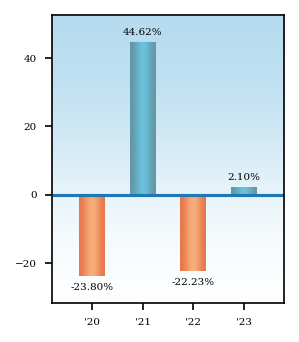
For the period January 1, 2024 through , the was .
() ()
Average Annual Total Returns - Alpha Fiduciary Quantitative Strategy Fund |
1 Year |
Since Inception |
Inception Date |
|---|---|---|---|
| Alpha Fiduciary Quantitative Strategy Fund Shares | 2.10% | (3.28%) | Dec. 31, 2019 |
| Alpha Fiduciary Quantitative Strategy Fund Shares | After Taxes on Distributions | 2.10% | (3.28%) | Dec. 31, 2019 |
| Alpha Fiduciary Quantitative Strategy Fund Shares | After Taxes on Distributions and Sales | 1.24% | (2.47%) | Dec. 31, 2019 |
| S&P 500® Index (does not reflect deductions for fees, expenses or taxes) | 26.29% | 12.04% | Dec. 31, 2019 |
After-tax returns are calculated using the historical highest marginal individual U.S. federal income tax rates and do not reflect the impact of state and local taxes. Actual after-tax returns depend on an investor’s tax situation and may differ from those shown, and after-tax returns shown are not relevant to investors who hold their Fund shares through tax-deferred arrangements, such as 401(k) plans or individual retirement accounts.
Past performance (before and after taxes) of the Fund is no guarantee of how it will perform in the future. Past performance provides some indication of the risks of investing in the Fund. There is no performance information for the Fund since the Fund has not completed one full calendar year of operation as of the date of this prospectus. Performance data current to the most recent month end may be obtained by calling 1-888-266-3996.
Risks in General. Domestic economic growth and market conditions, interest rate levels, and political events are among the factors
affecting the securities markets in which the Fund invests. There is risk that these and other factors may adversely affect the Fund's
performance. You could lose money by investing in the Fund.
Additionally, unexpected local, regional or global events, such as war; acts of terrorism; financial, political or social disruptions; natural, environmental or man-made disasters; the spread of infectious illnesses or other public health issues (such as COVID-19); and recessions and depressions could have a significant impact on the Fund and its investments and may impair market liquidity. Such events can cause investor fear, which can adversely affect the economies of nations, regions and the market in general, in ways that cannot necessarily be foreseen.
Futures Contract Risk. The successful use of futures contracts draws upon the Adviser’s skill and experience with respect to such instruments and is subject to special risk considerations. The primary risks associated with the use of futures contracts, which may adversely affect the Fund’s net asset value and total return, are the imperfect correlation between the change in market value of the futures contract held by the Fund and the price of the futures contract; (b) possible lack of a liquid secondary market for a futures contract and the resulting inability to close a futures contract when desired; (c) losses caused by unanticipated market movements, which are potentially unlimited; (d) the Adviser’s inability to predict correctly the direction of securities prices; (e) the possibility that the counterparty will default in the performance of its obligations; and (f) if the Fund has insufficient cash, it may have to sell securities from its portfolio to meet daily variation margin requirements, and the Fund may have to sell securities at a time when it may be disadvantageous to do so. The Fund’s use of futures contracts for the purpose of increasing the Fund’s long and/or short exposure creates leverage, which can magnify the Fund’s potential for gain or loss and therefore amplify the effect of market volatility on the Fund’s share price (see “Leveraging Risk”).
Leveraging Risk. The Fund’s use of futures contracts will have the economic effect of financial leverage. Financial leverage magnifies exposure to the swings in prices of an asset class underlying an instrument and results in increased volatility, which means the Fund will have the potential for greater gains, as well as the potential for greater losses, than if the Fund does not use instruments that have a leveraging effect. Leveraging tends to magnify, sometimes significantly, the effect of any increase or decrease in the Fund’s exposure to an asset class and may cause the Fund’s net asset value to be volatile.
Short Exposure Risk. Consistent with its investment strategy, the Fund will take short positions in equity index futures contracts. A short position in an equity index futures contract will profit from a decline in the equity index. The Fund may lose significant value quite rapidly in a rising market if the equity index increases in value. This is the opposite of traditional “long” investments where the value of the Fund increases as the value of a portfolio security or instrument increases. The risk of loss on a short
position is potentially unlimited unlike the risk of loss on a long position, which is limited to the amount paid for the investment plus transaction costs.
Risks of Exchange Traded Funds. Investment in an exchange traded fund (ETF) carries security specific risk and the market risk. Also, if the area of the market representing the underlying index or benchmark does not perform as expected for any reason, the value of the investment in the ETF may decline. In addition, due to transactions via market prices rather than at net asset value, the performance of an ETF may not completely replicate the performance of the underlying index. In addition, the Fund will indirectly bear a proportionate share of expenses, including any management fees, paid by each ETF in which the Fund invests. Such expenses are in addition to the operating expenses of the Fund, which are borne directly by shareholders of the Fund.
Risks of Equity Securities. The risks associated with investing in equity securities of companies include the financial and operational risks faced by individual companies, the risk that the stock markets, sectors and industries in which the Fund invests may experience periods of turbulence and instability, and the general risk that domestic and global economies may go through periods of decline and cyclical change.
Sector Risk. Sector risk is the possibility that all stocks within the same group of industries will decline in price due to sector-specific market or economic developments. The Fund may emphasize certain sectors at various times including, among others, information technology. To the extent the Fund is overweighted in the information technology sector, it will be affected by such things as government regulation, intense competition and/or rapid obsolescence.
Portfolio Turnover Risk. The Fund may engage in short-term trading to try to achieve its objective and may have portfolio turnover rates significantly in excess of 100%. Increased portfolio turnover may cause the Fund to incur higher brokerage costs, which may adversely affect the Fund's performance, and may produce increased taxable distributions.
Transaction Cost Risk – Transaction costs refer to the charges that are associated with buying and selling securities for the Fund. As a result of the Fund’s expected high rate of portfolio turnover, the Fund will likely incur higher brokerage and custody charges than those associated with an average equity fund.
Risk of Non-Diversification. The Fund is a non-diversified fund, which means that it has the ability to take larger positions in a smaller number of securities than a fund that is "diversified.” Non-diversification increases the risk that the value of the Fund could go down because of the poor performance of a single investment. Because the Fund may invest a significant percentage of its assets in a single ETF and/or money market fund, and at times may hold only one such position along with a cash or cash equivalent position, there is a risk that events negatively affecting these fewer positions will have a greater negative impact on the Fund’s performance.
Management Risks. The Adviser's implementation of the Fund's strategy may fail to produce the intended results. The Fund is actively managed using proprietary investment strategies and processes. There can be no guarantee that these strategies and processes will be successful or that the Fund will achieve its investment objective. Although a member of the portfolio management team has experience managing mutual funds, this is the first mutual fund the Adviser has managed.
Quantitative/Trend Model Risk. The risk that investments selected using quantitative models to identify market trends may perform differently from the market as a whole or from their expected performance. There can be no assurance that use of a quantitative trend model will enable the Fund to achieve positive returns or outperform the market. The Adviser may utilize technical as well as other factors in overriding or modifying the quantitative investment model. Those decisions may positively or adversely affect the Fund’s performance relative to the Adviser’s quantitative investment model.
Risks of Fixed Income Securities. Fixed income securities fluctuate with changes in interest rates. Typically, a rise in interest rates causes a decline in the value of fixed income securities. In general, the market price of fixed income securities with longer maturities will increase or decrease more in response to changes in interest rates than the market price of shorter-term securities.