The fund seeks preservation of capital and liquidity and, consistent with these, the highest possible current income.
This table describes the fees and expenses that you may pay if you buy, hold, and sell shares of the fund. You may also incur brokerage commissions and other charges when buying or selling shares of the fund, which are not reflected in the table or example below.
Shareholder Fees |
T. Rowe Price Cash Reserves Fund
Cash Reserves Fund
USD ($)
|
|
|---|---|---|
| Maximum account fee | $ 20 | [1] |
| [1] | Subject to certain exceptions and account minimums, accounts are charged an annual $20 fee. |
Annual Fund Operating Expenses |
T. Rowe Price Cash Reserves Fund
Cash Reserves Fund
|
|---|---|
| Management fees | 0.40% |
| Distribution and service (12b-1) fees | none |
| Other expenses | none |
| Total annual fund operating expenses | 0.40% |
Expense Example |
T. Rowe Price Cash Reserves Fund
Cash Reserves Fund
USD ($)
|
|---|---|
| 1 Year | $ 41 |
| 3 Years | 128 |
| 5 Years | 224 |
| 10 Years | $ 505 |
The fund is a retail money market fund managed in compliance with Rule 2a-7 under the Investment Company Act of 1940.
The securities purchased by the fund are subject to the maturity, quality, diversification, liquidity, and other requirements of Rule 2a-7. All securities purchased by the fund present minimal credit risk in the opinion of T. Rowe Price. The fund is managed to provide a stable share price of $1.00 by investing in high-quality, U.S. dollar-denominated money market securities. Money market securities are generally high-quality, short-term obligations issued by companies or governmental
entities. The fund’s weighted average maturity will not exceed 60 calendar days, the fund’s weighted average life will not exceed 120 calendar days, and the fund will not purchase any security with a remaining maturity longer than 397 calendar days (unless otherwise permitted by Rule 2a-7, such as certain variable and floating rate instruments).
In addition to investing in money market securities issued by corporations and financial institutions, the fund may also invest in U.S. Treasury securities and other U.S. government securities, and repurchase agreements on those securities; municipal money market securities issued by state and local governments; and money market securities issued by foreign companies and financial institutions, which include U.S. dollar-denominated money market securities traded outside of the U.S. and U.S. dollar-denominated money market securities of foreign issuers traded in the U.S. There is no limit to the fund’s investments in U.S. dollar-denominated money market securities of foreign issuers.
A repurchase agreement is a contract under which the fund (buyer) purchases a security, usually a U.S. government or agency security, from a bank or well established securities dealer (seller) that requires the seller to repurchase the securities from the fund at a specific price on a designated date (which is often the next business day).
As a retail money market fund, the fund has adopted policies and procedures reasonably designed to limit all beneficial owners of the fund to natural persons. In addition, like other retail money market funds, the fund is subject to the possible imposition of liquidity fees if the fund’s Board of Directors (or its delegate) determines that such fee is in the best interests of the fund.
Risk Table - T. Rowe Price Cash Reserves Fund |
Risk [Text Block] |
|---|---|
| Risk Lose Money [Member] | You could lose money by investing in the fund. |
| Risk Not Insured [Member] | An investment in the fund is not a bank account and is not insured or guaranteed by the Federal Deposit Insurance Corporation or any other government agency. |
| Risk Money Market Fund May Not Preserve Dollar [Member] | Although the fund seeks to preserve the value of your investment at $1.00 per share, it cannot guarantee it will do so. |
| Risk Money Market Fund May Impose Fees or Suspend Sales [Member] | The fund may impose a fee upon the sale of your shares. |
| Market conditions | Market conditions: The value of the fund’s investments may decrease, sometimes rapidly or unexpectedly, due to factors affecting an issuer held by the fund, particular industries, or the overall securities markets. A variety of factors can increase the volatility of the fund’s holdings and markets generally, including economic, political, or regulatory developments, recessions, inflation, rapid interest rate changes, war, military conflict, acts of terrorism, natural disasters, and outbreaks of infectious illnesses or other widespread public health issues (such as the coronavirus pandemic) and related governmental and public responses (including sanctions). Certain events may cause instability across global markets, including reduced liquidity and disruptions in trading markets, while some events may affect certain geographic regions, countries, sectors, and industries more significantly than others. Government intervention in markets may impact interest rates, market volatility, and security pricing. These adverse developments may cause broad declines in market value due to short-term market movements or for significantly longer periods during more prolonged market downturns. |
| Stable net asset value | Stable net asset value: The fund may not be able to maintain a stable $1.00 share price at all times. The fund’s shareholders should not rely on or expect the fund’s investment adviser or an affiliate to purchase distressed assets from the fund, enter into capital support agreements with the fund, make capital infusions into the fund, or take other actions to help the fund maintain a stable $1.00 share price. |
| Interest rates | Interest rates: A decline in interest rates may lower the fund’s yield, or a rise in the overall level of interest rates may cause a decline in the prices of fixed income securities held by the fund. The fund’s yield will vary; it is not fixed for a specific period like the yield on a bank certificate of deposit. This is a disadvantage when interest rates are falling because the fund would have to reinvest proceeds of maturing securities at lower interest rates. In addition, the adoption of more stringent regulations governing the management of money market funds could have a negative effect on the fund’s yield. |
| Credit quality | Credit quality: An issuer of a debt instrument or a provider of credit support could suffer an adverse change in financial condition that results in a payment default (failure to make scheduled interest or principal payments), a rating downgrade, or an inability to meet a financial obligation. Although the fund only purchases securities that present minimal credit risk in the opinion of T. Rowe Price, the credit quality of the fund’s holdings could change rapidly during periods of market stress. |
| Liquidity | Liquidity: The fund may not be able to sell a holding in a timely manner at its current carrying value. Periods of reduced liquidity in money markets could require the fund to liquidate its assets at inopportune times or at a depressed value, cause the fund to be unable to meet redemption requests without dilution of the remaining shareholders’ interests in the fund, and potentially affect the fund’s ability to maintain a $1.00 share price. In addition, the fund’s Board of Directors (or its delegate) has discretion to impose a liquidity fee if it determines that doing so is in the best interest of the fund. |
| Redemptions | Redemptions: The fund may be subject to periods of increased redemptions that could cause the fund to sell its assets at disadvantageous times or at a depressed value or loss, particularly during periods of declining or illiquid markets, and that could affect the fund’s ability to maintain a stable $1.00 share price. |
| Municipal securities | Municipal securities: Investments in municipal securities may be adversely affected by changes in the financial condition of certain municipal securities issuers and the economy, as well as by events such as unfavorable legislative or political developments that impact the overall municipal securities market or certain sectors of the municipal securities market. Tax reform, including a lowering of individual or corporate tax rates, could reduce the attractiveness and overall demand for municipal bonds. The secondary market for certain municipal securities tends to be less developed and less liquid than many other securities markets. |
| Repurchase agreements | Repurchase agreements: A counterparty to a repurchase agreement may become insolvent or fail to repurchase securities from the fund as required, which could increase the fund’s costs or prevent the fund from immediately accessing its collateral. |
| Foreign investing | Foreign investing: The fund’s investments in foreign holdings may be adversely affected by local, political, social, and economic conditions overseas; greater volatility; reduced liquidity; or differences in settlement and regulatory standards. |
| Cybersecurity breaches | Cybersecurity breaches: The fund could be harmed by intentional cyberattacks and other cybersecurity breaches, including unauthorized access to the fund’s assets, confidential information, or other proprietary information. In addition, a cybersecurity breach could cause one of the fund’s service providers or financial intermediaries to suffer unauthorized data access, data corruption, or loss of operational functionality. |
The following performance information provides some indication of the risks of investing in the fund. The fund’s performance information represents only past performance and is not necessarily an indication of future results.
The following bar chart illustrates how much returns can differ from year to year by showing calendar year returns and the best and worst calendar quarter returns during those years for the fund.
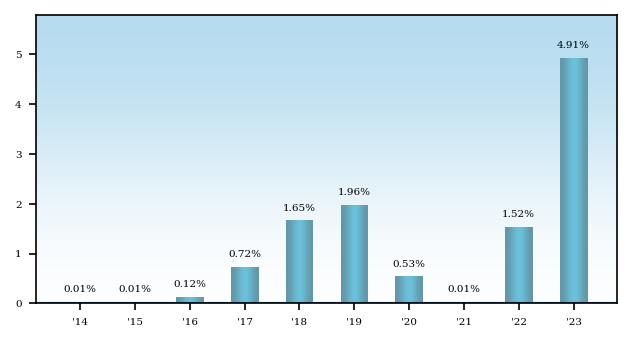
The fund’s return for the nine months ended 9/30/24 was 3.88%.
Quarter Ended | Total Return | Quarter Ended | Total Return | |||||
Best Quarter | 12/31/23 | 1.31% | Worst Quarter | 6/30/15 | 0.00% |
The following table shows the average annual total returns for the fund. In addition, the table also includes a comparative index that has investment characteristics similar to those of the fund (Strategy Benchmark(s)).
Average Annual Total Returns - T. Rowe Price Cash Reserves Fund |
Label |
1 Year |
5 Years |
10 Years |
Inception Date |
|---|---|---|---|---|---|
| Cash Reserves Fund | 4.91% | 1.77% | 1.13% | Oct. 29, 1993 | |
| Lipper Money Market Funds Index | Lipper Money Market Funds Index | ||||
| Lipper Money Market Funds Index | 5.01% | 1.77% | 1.12% |