The fund seeks to provide long-term capital growth.
This table describes the fees and expenses that you may pay if you buy, hold, and sell shares of the fund. You may also incur brokerage commissions and other charges when buying or selling shares of the fund, which are not reflected in the table or example below.
Shareholder Fees - T. Rowe Price International Equity Index Fund - USD ($) |
Investor Class |
Z Class |
|
|---|---|---|---|
| Maximum account fee | $ 20 | [1] | none |
| [1] | Subject to certain exceptions and account minimums, accounts are charged an annual $20 fee. |
Annual Fund Operating Expenses - T. Rowe Price International Equity Index Fund |
Investor Class |
Z Class |
|
|---|---|---|---|
| Management fees | 0.09% | 0.09% | |
| Other expenses | 0.17% | 0.06% | |
| Total annual fund operating expenses | 0.26% | 0.15% | |
| Fee waiver/expense reimbursement | none | (0.15%) | [1] |
| Total annual fund operating expenses after fee waiver/expense reimbursement | 0.26% | none | [1] |
| [1] | T. Rowe Price Associates, Inc., has contractually agreed to waive and/or bear all the Z Class’ expenses (excluding interest; expenses related to borrowings, taxes, and brokerage; nonrecurring, extraordinary expenses; and acquired fund fees and expenses) in their entirety. T. Rowe Price Associates, Inc., expects this fee waiver and/or expense reimbursement arrangement to remain in place indefinitely, and the agreement may only be amended or terminated with approval by the fund’s Board of Directors. |
Expense Example - T. Rowe Price International Equity Index Fund - USD ($) |
Investor Class |
Z Class |
|---|---|---|
| 1 Year | $ 27 | none |
| 3 Years | 84 | none |
| 5 Years | 146 | none |
| 10 Years | $ 331 | none |
Portfolio Turnover The fund pays transaction costs, such as commissions, when it buys and sells securities (or “turns over” its portfolio). A higher portfolio turnover rate may indicate higher transaction costs and may result in higher taxes when the fund’s shares are held in a taxable account. These costs, which are not reflected in annual fund operating expenses or in the example, affect the fund’s performance. During the most recent fiscal year, the fund’s portfolio turnover rate was 4.6% of the average value of its portfolio.
Under normal conditions, the fund invests at least 80% of its net assets (plus any borrowings for investment purposes) in stocks that are held in its benchmark index. The fund uses a full replication strategy, which involves investing substantially all of its assets in all of the stocks in the benchmark index, the MSCI EAFE Index Net (Index), in proportion to each stock’s weight in the Index. T. Rowe Price compares the composition of the fund to that of the Index. If a material misweighting develops, the portfolio manager seeks to rebalance the portfolio in an effort to realign it with the Index. Any derivatives that provide exposure to the investment focus suggested by the fund’s name, or to one or more market risk factors associated with the investment focus suggested by the fund’s name, are counted (as applicable) toward compliance with the fund’s 80% investment policy.
The fund attempts to track the performance of stocks in developed non-U.S. markets by seeking to match the performance of the Index. The Index is a broadly diversified stock index designed to represent the performance of large- and mid-cap securities across developed markets, including countries in Europe, Australasia and the Far East, and excluding the U.S. and Canada. The Index assumes the reinvestment of dividends after the deduction of withholding taxes applicable to the country where the dividend is paid. The Index is weighted by market capitalization and the composition of the Index is rebalanced semi-annually. As of October 31, 2024, the Index consisted of 731 securities.
Because the fund typically holds securities in proportion to their weight in the Index, the fund may become nondiversified, as defined under the Investment Company Act of 1940, solely as a result of changes in the composition of the Index.
While most assets are invested in common stocks, the fund may also purchase exchange-traded funds in an effort to minimize any deviations in performance from the Index. Exchange-traded funds would typically be used to help realign the fund’s portfolio with the Index, gain broad market or sector exposure, or to reduce cash balances in the fund and increase the level of fund assets exposed to common stocks.
Risk Table - T. Rowe Price International Equity Index Fund |
Risk [Text Block] |
|---|---|
| Risk Lose Money [Member] | The fund’s share price fluctuates, which means you could lose money by investing in the fund. |
| Index investing | Index investing: Because the fund is passively managed and seeks to match the performance of its benchmark index, holdings are generally not reallocated based on changes in market conditions or outlook for a specific security, industry, or market sector. As a result, the fund’s performance may lag the performance of actively managed funds. |
| Tracking error | Tracking error: The returns of the fund may deviate from the returns of its benchmark index (referred to as “tracking error”) because the fund incurs fees and transaction expenses while the index has no fees or expenses. The risk of tracking error is increased to the extent the fund is unable to fully replicate its benchmark index, which could result from changes in the composition of the index or the timing of purchases and redemptions of fund shares. Tracking error may increase if the fund needs to fair value any of its portfolio holdings since the index does not need to apply fair valuation to its underlying securities. |
| International investing | International investing: Non-U.S. securities tend to be more volatile and have lower overall liquidity than investments in U.S. securities and may lose value because of adverse local, political, social, or economic developments overseas, or due to changes in the exchange rates between foreign currencies and the U.S. dollar. In addition, investments outside the U.S. are subject to settlement practices and regulatory and financial reporting standards that differ from those of the U.S. The risks of investing outside the U.S. are heightened for any investments in emerging markets, which are susceptible to greater volatility than investments in developed markets. |
| Market conditions | Market conditions: The value of the fund’s investments may decrease, sometimes rapidly or unexpectedly, due to factors affecting an issuer held by the fund, particular industries, or the overall securities markets. A variety of factors can increase the volatility of the fund’s holdings and markets generally, including economic, political, or regulatory developments, recessions, inflation, rapid interest rate changes, war, military conflict, acts of terrorism, natural disasters, and outbreaks of infectious illnesses or other widespread public health issues (such as the coronavirus pandemic) and related governmental and public responses (including sanctions). Certain events may cause instability across global markets, including reduced liquidity and disruptions in trading markets, while some events may affect certain geographic regions, countries, sectors, and industries more significantly than others. Government intervention in markets may impact interest rates, market volatility, and security pricing. These adverse developments may cause broad declines in market value due to short-term market movements or for significantly longer periods during more prolonged market downturns. |
| Stock investing | Stock investing: Stocks generally fluctuate in value more than bonds and may decline significantly over short time periods. There is a chance that stock prices overall will decline because stock markets tend to move in cycles, with periods of rising and falling prices. The value of stocks held by the fund may decline due to general weakness or volatility in the stock markets in which the fund invests or because of factors that affect a particular company or industry. |
| Investing in Europe | Investing in Europe: The European financial markets have experienced increased volatility due to concerns about economic downturns, political unrest, war, military conflict, economic sanctions, rising government debt levels, inflation, energy crises, and public health pandemics, and these events may continue to significantly affect all of Europe. The economies and markets of European countries are often connected and interdependent, and events in one country in Europe can have an adverse impact on other European countries. European economies could be significantly affected by, among other things, rising unemployment, the imposition or unexpected elimination of fiscal and monetary controls by member countries of the European Economic and Monetary Union, uncertainty surrounding the euro, the success of governmental actions to reduce budget deficits, and Russia’s ongoing military conflict in Ukraine. |
| Investing in Japan | Investing in Japan: The Japanese economy has at times been negatively affected by government intervention and protectionism, excessive regulation, an unstable financial services sector, a heavy reliance on international trade, and natural disasters. Some of these factors, as well as a low economic growth rate relative to other advanced economies, other adverse political developments, increases in government debt, and changes in fiscal, monetary, or trade policies, may affect the Japanese economy. |
| Large- and mid-cap stocks | Large- and mid-cap stocks: Securities issued by large- and mid-cap companies tend to be less volatile than securities issued by small-cap companies. However, large-cap companies may not be able to attain the high growth rates of successful small-cap companies, especially during strong economic periods, and may be unable to respond as quickly to competitive challenges. The fund’s share price could fluctuate more than the share price of a fund that invests only in large-cap companies as stocks of mid-cap companies entail greater risk and are usually more volatile than stocks of large-cap companies. |
| Exchange-traded funds | Exchange-traded funds: An investment in an exchange-traded fund involves substantially the same risks as investing directly in the exchange-traded fund’s underlying assets, although an exchange-traded fund may trade at a premium or discount to the actual net asset value of its portfolio securities, may have greater price volatility than its underlying assets, and its shares may have lower overall liquidity. The fund will bear its proportionate share of the fees and expenses of each exchange-traded fund in which it invests. |
| Sector exposure | Sector exposure: To the extent the fund invests in specific industries or sectors, it may be more susceptible to developments affecting those industries and sectors. |
| Risk Nondiversified Status [Member] | Nondiversification: The fund may become nondiversified due to the composition of its benchmark index, and thus invest a large percentage of its assets in securities issued by or representing a small number of issuers. As a result, the fund’s performance may be adversely affected; the fund’s shares may experience greater price volatility; and the fund may be more susceptible to the risks associated with these particular issuers or to a single economic, political, or regulatory occurrence affecting these issuers. |
| Cybersecurity breaches | Cybersecurity breaches: The fund could be harmed by intentional cyberattacks and other cybersecurity breaches, including unauthorized access to the fund’s assets, confidential information, or other proprietary information. In addition, a cybersecurity breach could cause one of the fund’s service providers or financial intermediaries to suffer unauthorized data access, data corruption, or loss of operational functionality. |
The following performance information provides some indication of the risks of investing in the fund. The fund’s performance information represents only past performance (before and after taxes) and is not necessarily an indication of future results.
The following bar chart illustrates how much returns can differ from year to year by showing calendar year returns and the best and worst calendar quarter returns during those years for the fund’s Investor Class. Returns for other share classes vary since they have different expenses.
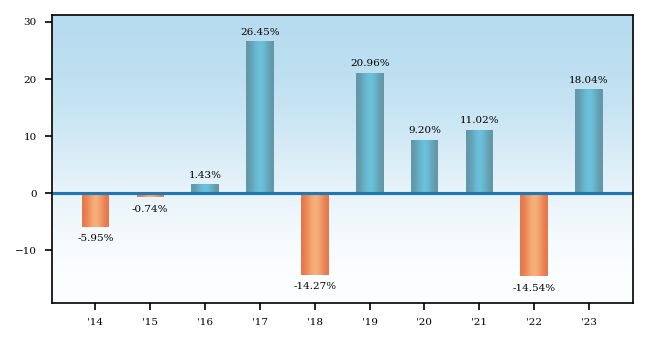
The fund’s return for the nine months ended 9/30/24 was 12.95%.
Quarter Ended | Total Return | Quarter Ended | Total Return | |||||
Best Quarter | 12/31/22 | 18.11% | Worst Quarter | 3/31/20 | -23.31% |
The following table shows the average annual total returns for each class of the fund that has been in operation for at least one full calendar year. The fund’s performance information included in the table is compared with a regulatory required index that represents an overall securities market (Regulatory Benchmark). In addition, the table may also include one or more indexes that more closely aligns to the fund’s investment strategy (Strategy Benchmark(s)).
In addition, the table shows hypothetical after-tax returns to demonstrate how taxes paid by a shareholder may influence returns. After-tax returns are calculated using the historical highest individual federal marginal income tax rates and do not reflect the impact of state and local taxes. Actual after-tax returns depend on an investor’s tax situation and may differ from those shown.
After-tax returns shown are not relevant to investors who hold their fund shares through tax-deferred arrangements, such as a 401(k) account or an IRA.
Average Annual Total Returns - T. Rowe Price International Equity Index Fund |
Label |
1 Year |
5 Years |
10 Years |
Since Inception |
Inception Date |
||
|---|---|---|---|---|---|---|---|---|
| Investor Class | 18.04% | 8.15% | 4.27% | Nov. 30, 2000 | ||||
| Investor Class | After Taxes on Distributions | 17.29% | 7.55% | 3.64% | |||||
| Investor Class | After Taxes on Distributions and Sales | 11.34% | 6.45% | 3.31% | |||||
| Z Class | 18.29% | 9.83% | Nov. 02, 2020 | |||||
| MSCI EAFE Index Net | [1] | MSCI EAFE Index Net | ||||||
| MSCI EAFE Index Net | 18.24% | 8.16% | 4.28% | 9.72% | [2] | |||
| [1] | Due to new SEC Rules on shareholder reporting, the fund adopted a new broad-based securities market index, referred to as the Regulatory Benchmark. |
| [2] | Return since 11/2/20. |