Aug. 31, 2024
The Fund’s investment objective is to seek income.
This table describes the fees and expenses that you may pay if you buy, hold and sell shares of the Fund.
The table and Examples below do not reflect any transaction fees that may be charged by financial intermediaries or commissions that a shareholder may be required to pay directly to its financial intermediary when buying or selling Class Y or Class R6 shares. You may qualify for sales charge discounts if you and your family invest, or agree to invest in the future, at least $100,000 in the Invesco Funds. More information about these and other discounts is available from your financial professional and in the section “Shareholder Account Information – Initial Sales Charges (Class A Shares Only)” on page A-3 of the prospectus and the section “Purchase, Redemption and Pricing of Shares-Purchase and Redemption of Shares” on page L-1 of the statement of additional information (SAI).
| Shareholder Fees (fees paid directly from your investment) | ||||||
| Class: | A | C | R | Y | R5 | R6 |
| Maximum Sales Charge (Load) Imposed on Purchases (as a percentage of offering price) | 3.25 % | None | None | None | None | None |
| | ||||||
| Maximum Deferred Sales Charge (Load) (as a percentage of original purchase price or redemption proceeds, whichever is less) | None1 | 1.00 % | None | None | None | None |
| | ||||||
| Annual Fund Operating Expenses (expenses that you pay each year as a percentage of the value of your investment) | ||||||
| Class: | A | C | R | Y | R5 | R6 |
| Management Fees | 0.61 % | 0.61 % | 0.61 % | 0.61 % | 0.61 % | 0.61 % |
| | ||||||
| Distribution and/or Service (12b-1) Fees | 0.25 | 1.00 | 0.50 | None | None | None |
| | ||||||
| Other Expenses2 | 0.18 | 0.18 | 0.18 | 0.18 | 0.12 | 0.09 |
| | ||||||
| Interest Expense | 0.05 | 0.05 | 0.05 | 0.05 | 0.05 | 0.05 |
| | ||||||
| Total Other Expenses | 0.23 | 0.23 | 0.23 | 0.23 | 0.17 | 0.14 |
| | ||||||
| Total Annual Fund Operating Expenses | 1.09 | 1.84 | 1.34 | 0.84 | 0.78 | 0.75 |
| | ||||||
| Fee Waiver and/or Expense Reimbursement3 | None | None | None | None | None | None |
| | ||||||
| Total Annual Fund Operating Expenses After Fee Waiver and/or Expense Reimbursement | 1.09 | 1.84 | 1.34 | 0.84 | 0.78 | 0.75 |
| | ||||||
| 1 | A contingent deferred sales charge may apply in some cases. See “Shareholder Account Information-Contingent Deferred Sales Charges (CDSCs).” |
| 2 | “Other Expenses” have been restated to reflect current fees. |
| 3 | Invesco Advisers, Inc. (Invesco or the Adviser) has contractually agreed, through December 31, 2024, to waive advisory fees and/or reimburse expenses to the extent necessary to limit Total Annual Fund Operating Expenses After Fee Waiver and/or Expense Reimbursement (excluding certain items discussed in the SAI) of Class A, Class C, Class R, Class Y, Class R5 and Class R6 shares to 1.02%, 1.77%, 1.27%, 0.77%, 0.77% and 0.77%, respectively, of the Fund’s average daily net assets (the “expense limits”). Effective January 1, 2025, the Adviser has contractually agreed to waive advisory fees and/or reimburse expenses to the extent necessary to limit Total Annual Fund Operating Expenses After Fee Waiver and/or Expense Reimbursement (excluding certain items discussed in the SAI) of Class A, Class C, Class R Class Y, Class R5 and Class R6 shares to 1.03%, 1.78%, 1.28%, 0.78%, 0.78% and 0.78%, respectively, of the Fund’s average daily net assets. Unless Invesco continues the fee waiver agreement, it will terminate on December 31, 2025. During its term, the fee waiver agreement cannot be terminated or amended to increase the expense limits without approval of the Board of Trustees. |
This Example is intended to help you compare the cost of investing in the Fund with the cost of investing in other mutual funds.
The Example assumes that you invest $10,000 in the Fund for the time periods indicated and then redeem all of your shares at the end of those periods. This Example does not include commissions and/or other forms of compensation that investors may pay on transactions in Class Y and Class
R6 shares. The Example also assumes that your investment has a 5% return each year and that the Fund’s operating expenses remain equal to the Total Annual Fund Operating Expenses After Fee Waiver and/or Expense Reimbursement in the first year and the Total Annual Fund Operating Expenses thereafter.
Although your actual costs may be higher or lower, based on these assumptions, your costs would be:
| | 1 Year | 3 Years | 5 Years | 10 Years |
| Class A | $433 | $660 | $906 | $1,611 |
| | ||||
| Class C | $287 | $579 | $996 | $1,963 |
| | ||||
| Class R | $136 | $425 | $734 | $1,613 |
| | ||||
| Class Y | $86 | $268 | $466 | $1,037 |
| | ||||
| Class R5 | $80 | $249 | $433 | $966 |
| | ||||
| Class R6 | $77 | $240 | $417 | $930 |
| | ||||
You would pay the following expenses if you did not redeem your shares:
|
|
1 Year
|
3 Years
|
5 Years
|
10 Years
|
|
Class A
|
$433 |
$660 |
$906 |
$1,611 |
|
|
||||
|
Class C
|
$187 |
$579 |
$996 |
$1,963 |
|
|
||||
|
Class R
|
$136 |
$425 |
$734 |
$1,613 |
|
|
||||
|
Class Y
|
$86 |
$268 |
$466 |
$1,037 |
|
|
||||
|
Class R5
|
$80 |
$249 |
$433 |
$966 |
|
|
||||
|
Class R6
|
$77 |
$240 |
$417 |
$930 |
|
|
||||
The Fund pays transaction costs, such as commissions, when it buys and sells securities (or “turns over” its portfolio). A higher portfolio turnover rate may indicate higher transaction costs and may result in higher taxes when Fund shares are held in a taxable account. These costs, which are not reflected in annual fund operating expenses or in the Example, affect the Fund’s performance. During the most recent fiscal year, the Fund’s portfolio turnover rate was 48% of the average value of its portfolio.
The Fund invests mainly in floating rate loans (sometimes referred to as “adjustable rate loans”) that hold (or in the judgment of the investment adviser, hold) a senior position in the capital structure of U.S. and foreign corporations, partnerships or other business entities that, under normal circumstances, allow them to have priority of claim ahead of (or at least as high as) other obligations of a borrower in the event of liquidation. These investments are referred to as “Senior Loans.” Senior Loans may be collateralized or uncollateralized. They typically pay interest at rates that float above, or are adjusted periodically based on, a benchmark that reflects current interest rates.
Under normal market conditions, the Fund will invest at least 80% of its net assets (plus the amount of any borrowings for investment purposes) in Senior Loans, and in derivatives and other instruments that have economic characteristics similar to such securities. The Fund may invest in Senior Loans directly as an original lender, or by assignment from a lender, or it may invest indirectly through loan participation agreements. While most of these Senior Loans will be collateralized, the Fund can also invest up to 10% of its net assets (plus the amount of borrowings for investment purposes) in uncollateralized Senior Loans.
The Fund can invest up to 20% of its total assets in cash (whether U.S. dollars or a foreign currency) or cash equivalents, or in other loans, securities and other investments, including but not limited to: secured or unsecured fixed-rate loans, fixed or floating rate notes or bonds, securities issued or guaranteed by the U.S. government or its agencies or
instrumentalities, investment-grade short-term debt obligations, equity securities (including common stocks, preferred stocks, rights, warrants, and securities convertible into common stock) and derivatives. The Fund also may invest in Senior Loans made in connection with highly leveraged transactions, including but not limited to, operating loans, leveraged buyout loans, and leveraged capitalization loans. The Fund will invest 25% or more of its total assets in instruments of the group of industries in the financial securities sector.
The Fund can invest in investment-grade or below-investment-grade debt instruments (sometimes referred to as “high yield” or “junk” securities). The Fund can invest up to 100% of its assets in debt instruments rated below-investment-grade, and will normally invest a substantial portion of its assets in those securities. “Investment-grade” debt instruments are rated in one of the four highest rating categories by nationally recognized statistical rating organizations such as Moody’s or S&P Global Ratings (or, in the case of unrated securities, determined by the Adviser to be comparable to securities rated investment-grade). The Fund may also invest in unrated instruments, in which case the Fund’s Adviser may assign ratings to those instruments, after assessing their credit quality and other factors, in investment-grade or below-investment-grade categories similar to those of nationally recognized statistical rating organizations. The Fund may invest in defaulted or distressed loans and loans to bankrupt companies.
The Fund may invest in securities of U.S. and foreign issuers. The Fund can invest in Senior Loans or other investments (such as subordinated debt and fixed-rate loans) issued by foreign entities.
The Fund has no requirements as to the range of maturities of the debt instruments it can buy or as to the market capitalization of the issuers of those instruments. The Fund can borrow up to one-third of the Fund’s assets (including the amount borrowed) and use other techniques to manage its cash flow, to redeem shares, or to purchase assets, a technique referred to as “leverage.” The Fund may also use certain types of derivative investments to try to enhance income or to seek to manage (hedge) investment risks, including, but not limited to, options, futures contracts, swaps, and “structured” notes.
The Fund can engage in foreign currency transactions either on a spot basis (i.e. for prompt delivery and settlement at the rate prevailing in the currency exchange market at the time) or through forward foreign currency contracts to seek to hedge against adverse movements in the foreign currencies in which portfolio securities are denominated. The Fund can use currency futures and currency swaps to seek to hedge its exposure to foreign currencies.
The Fund may invest without limitation in obligations for which there is no readily available trading market or which are otherwise illiquid, including securities restricted as to resale such as those contained in Rule 144A promulgated under the Securities Act of 1933, as amended, and other types of exempt securities.
In selecting investments for the Fund, the portfolio managers evaluate overall investment opportunities and risks among the types of investments the Fund can hold. They analyze the credit standing and risks of borrowers whose loans or debt securities they are considering for the Fund’s portfolio. They evaluate information about borrowers from their own research or research supplied by rating organizations, agent banks or other sources and select only those loans that they believe are likely to pay the interest and repay the principal when it becomes due. The portfolio managers consider many factors, including, among others,
■
the borrower’s past and expected future financial performance
■
the experience and depth of the borrower’s management
■
the status of the borrower’s industry and its position in that industry
■
the collateral for the loan or other debt security
■
the borrower’s assets and cash flows
■
the credit quality of the debt obligations of the bank servicing the loan and other intermediaries imposed between the borrower and the Fund. The credit research process utilized by the Fund to implement its investment strategy in pursuit of its investment objective considers
factors that may include, but are not limited to, an issuer’s operations, capital structure and environmental, social and governance (“ESG”) considerations. Credit quality analysis for certain issuers therefore may consider whether any ESG factors pose a material financial risk or opportunity to an issuer. The Adviser may determine that ESG considerations are not material to certain issuers or types of investments held by the Fund. In addition, not all issuers or Fund investments may undergo a credit quality analysis that considers ESG factors, and not all investments held by the Fund will rate strongly on ESG criteria.
There can be no assurance that the portfolio managers’ analysis will identify all of the factors that may impair the value of a Senior Loan or other investment.
The bar chart and performance table provide an indication of the risks of investing in the Fund. The Fund has adopted the performance of the Oppenheimer Senior Floating Rate Fund (the predecessor fund) as the result of a reorganization consummated after the close of business on May 24, 2019 (the “Reorganization”). Prior to the Reorganization, the Fund had not yet commenced operations. The bar chart shows changes in the performance of the predecessor fund and the Fund from year to year as of December 31. The performance table compares the predecessor fund’s and the Fund’s performance to that of a broad measure of market performance and an additional index with characteristics relevant to the Fund. The Fund’s (and the predecessor fund’s) past performance (before and after taxes) is not necessarily an indication of how the Fund will perform in the future.
The returns shown for periods ending on or prior to May 24, 2019 are those of the Class A, Class C, Class R, Class Y and Class I shares of the predecessor fund. Class A, Class C, Class R, Class Y and Class I shares of the predecessor fund were reorganized into Class A, Class C, Class R, Class Y and Class R6 shares, respectively, of the Fund after the close of business on May 24, 2019. Class A, Class C, Class R, Class Y and Class R6 shares’ returns of the Fund will be different from the returns of the predecessor fund as they have different expenses.
Fund performance reflects any applicable fee waivers and expense reimbursements. Performance returns would be lower without applicable fee waivers and expense reimbursements.
All Fund performance shown assumes the reinvestment of dividends and capital gains and the effect of the Fund’s expenses.
Updated performance information is available on the Fund’s website at www.invesco.com/us.
The bar chart does not reflect sales loads. If it did, the annual total returns shown would be lower.
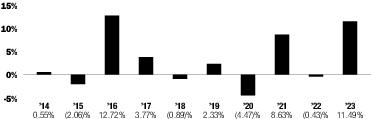
| Class A | Period Ended | Returns |
| Year-to-date | September 30, 2024 | 6.49% |
| Best Quarter | June 30, 2020 | 5.09% |
| Worst Quarter | March 31, 2020 | -15.83% |
| | Inception Date | 1 Year | 5 Years | 10 Years |
| Class A | | | | |
| Return Before Taxes | 9/8/1999 | 7.85 % | 2.66 % | 2.68 % |
| Return After Taxes on Distributions | | 4.30 | 0.16 | 0.46 |
| Return After Taxes on Distributions and Sale of Fund Shares | | 4.60 | 0.92 | 1.03 |
| | ||||
| Class C | 9/8/1999 | 9.50 | 2.55 | 2.40 |
| | ||||
| Class R | 10/26/2012 | 11.22 | 3.09 | 2.76 |
| | ||||
| Class Y | 11/28/2005 | 11.78 | 3.63 | 3.28 |
| | ||||
| Class R5 | 5/24/2019 | 11.81 | 3.66 1 | 3.17 1 |
| | ||||
| Class R6 | 10/26/2012 | 11.86 | 3.72 | 3.37 |
| | ||||
| JP Morgan Leveraged Loan Index (reflects no deduction for fees, expenses or taxes) | | 13.17 | 6.01 | 4.74 |
| | ||||
| Custom Invesco Senior Floating Rate Index (reflects no deduction for fees, expenses or taxes)2 | | 13.17 | 6.01 | 4.78 |
| | ||||
| Bloomberg U.S. Aggregate Bond Index (reflects no deduction for fees, expenses or taxes) | | 5.53 | 1.10 | 1.81 |
| | ||||
1
Performance shown prior to the inception date is that of the predecessor fund’s Class A shares at net asset value and includes the 12b-1 fees applicable to that class. Although invested in the same portfolio of securities, Class R5 shares' returns of the Fund will be different from Class A shares' returns of the predecessor fund as they have different expenses.
2
The “Custom Invesco Senior Floating Rate Index” reflects the performance of the Credit Suisse Leveraged Loan Index through September 30, 2014 and the J.P. Morgan Leveraged Loan Index from October 1, 2014.
After-tax returns are calculated using the historical highest individual federal marginal income tax rates and do not reflect the impact of state and local taxes. Actual after-tax returns depend on an investor's tax situation and may differ from those shown, and after-tax returns shown are not relevant to investors who hold their Fund shares through tax-advantaged arrangements, such as 401(k) plans, 529 college savings plans or individual retirement accounts. After-tax returns are shown for Class A shares only and after-tax returns for other classes will vary.