Aug. 31, 2024
The Fund's investment objective is to provide capital preservation and current income while maintaining liquidity.
This table describes the fees and expenses that you may pay if you buy, hold and sell shares of the Fund.
| Shareholder Fees (fees paid directly from your investment) | |
| Class: | Institutional |
| Maximum Sales Charge (Load) Imposed on Purchases (as a percentage of offering price) | None |
| | |
| Maximum Deferred Sales Charge (Load) (as a percentage of original purchase price or redemption proceeds, whichever is less) | None |
| | |
| Annual Fund Operating Expenses (expenses that you pay each year as a percentage of the value of your investment) | |
| Class: | Institutional |
| Management Fees | 0.24 % |
| | |
| Distribution and/or Service (12b-1) Fees | None |
| | |
| Other Expenses1 | 0.04 |
| | |
| Total Annual Fund Operating Expenses | 0.28 |
| | |
| 1 | “Other Expenses” have been restated to reflect current fees. |
This Example is intended to help you compare the cost of investing in the Fund with the cost of investing in other mutual funds.
The Example assumes that you invest $10,000 in the Fund for the time periods indicated and then redeem all of your shares at the end of those periods. The Example also assumes that your investment has a 5% return each year and that the Fund’s operating expenses remain the same.
Although your actual costs may be higher or lower, based on these assumptions, your costs would be:
|
|
1 Year
|
3 Years
|
5 Years
|
10 Years
|
|
Institutional Class
|
$29 |
$90 |
$157 |
$356 |
|
|
||||
The Fund pays transaction costs, such as commissions, when it buys and sells securities (or “turns over” its portfolio). A higher portfolio turnover rate may indicate higher transaction costs and may result in higher taxes when Fund shares are held in a taxable account. These costs, which are not reflected in annual Fund operating expenses or in the Example, affect the Fund’s performance. During the most recent fiscal year, the Fund’s portfolio turnover rate was 75% of the average value of its portfolio.
The Fund invests primarily in money market and fixed income securities.
The Fund invests in a diversified portfolio of short duration, investment grade money market and fixed income securities, including: (i) securities issued by the U.S. Government or its agencies; (ii) certificates of deposit and time deposits from U.S. and foreign banks; (iii) repurchase agreements; (iv) commercial paper; (v) municipal securities; (vi) domestic and foreign corporate debt obligations; (vii) sovereign debt and obligations of supra-national entities; and (viii) money market funds. Fixed income securities may include instruments with a fixed or floating rate of interest.
The Fund may invest in debt securities of foreign issuers denominated in U.S. dollars.
The Fund may engage in repurchase agreement transactions that are collateralized by cash or government securities. In addition, it may engage in repurchase agreement transactions that are collateralized by
nongovernment securities such as equity securities or fixed income securities that are rated investment grade and below investment grade by nationally recognized statistical rating organizations (NRSROs) or unrated securities of comparable quality.
The Fund may purchase asset-backed securities.
The Fund may also invest in new debt offerings and securities that are subject to resale restrictions such as those contained in Rule 144A promulgated under the Securities Act of 1933, as amended, which securities may be illiquid or thinly traded. The Fund’s investments may include securities that do not produce immediate cash income, such as zero coupon securities and payment-in-kind securities.
The Fund may purchase and sell securities on a when-issued and delayed delivery basis, which means that the Fund buys or sells a security with payment and delivery taking place in the future. The Fund may also engage in “to be announced” (TBA) transactions, which are transactions in which a fund buys or sells mortgage-backed securities on a forward commitment basis.
The Fund can invest in derivative instruments including futures contracts and swap contracts.
The Fund can use futures contracts, including Treasury and interest rate futures, to increase or reduce its exposure to interest rate changes.
The Fund can use swap contracts, including interest rate swaps, to hedge or adjust its exposure to interest rates. The Fund can also use swap contracts, including credit default swaps, to create long or short exposure to corporate or sovereign debt securities.
The Fund will invest more than 25% of its net assets in the financial services sector.
The Fund will attempt to maintain a dollar-weighted average portfolio duration of less than one year.
The portfolio managers collaborate with teams of market-specific specialists to implement the Fund’s strategy. Although these specialists provide input in the management of the Fund, the portfolio managers retain responsibility for ensuring the Fund is positioned appropriately in terms of risk exposures and portfolio structure.
In general, the portfolio managers will look for attractive risk-reward opportunities and securities that best enable the Fund to achieve its objectives. Decisions to purchase or sell securities are primarily determined by relative value considerations along with economic and credit-related fundamentals, market supply and demand, market dislocations and situation-specific opportunities. The purchase or sale of securities may also be related to a decision to alter the Fund’s risk exposures (such as duration, yield curve positioning, and sector exposure), a need to limit or reduce the Fund’s exposure to a particular security or issuer, degradation of an issuer’s credit quality, or general liquidity needs of the Fund.
The bar chart and performance table provide an indication of the risks of investing in the Fund. The bar chart shows changes in the performance of the Fund from year to year as of December 31. The performance table compares the Fund's performance to that of a style-specific benchmark and a broad-based securities market benchmark (in that order). The Fund's past performance (before and after taxes) is not necessarily an indication of its future performance.
Fund performance reflects any applicable fee waivers and expense reimbursements. Performance returns would be lower without applicable fee waivers and expense reimbursements.
All Fund performance shown assumes the reinvestment of dividends and capital gains and the effect of the Fund’s expenses.
Updated performance information is available on the Fund's website at www.invesco.com/us.
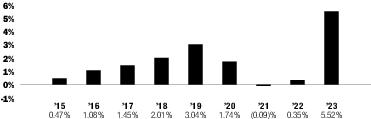
| Institutional | Period Ended | Returns |
| Year-to-date | September 30, 2024 | 4.66% |
| Best Quarter | June 30, 2020 | 1.99% |
| Worst Quarter | March 31, 2022 | -0.71% |
| | Inception Date | 1 Year | 5 Years | Since Inception |
| Institutional Class | | | | |
| Return Before Taxes | 7/1/2014 | 5.52 % | 2.09 % | 1.63 % |
| Return After Taxes on Distributions | | 3.70 | 1.28 | 0.98 |
| Return After Taxes on Distributions and Sale of Fund Shares | | 3.24 | 1.25 | 0.97 |
| | ||||
| ICE BofA US Treasury Bill Index (reflects no deduction for fees, expenses or taxes)1 | | 5.08 | 1.90 | 1.33 |
| | ||||
| Bloomberg U.S. Aggregate Bond Index (reflects no deduction for fees, expenses or taxes) | | 5.53 | 1.10 | 1.52 |
| | ||||
1
Prior to July 1, 2022, index returns reflect no deduction for fees, expenses or taxes. Effective July 1, 2022, index returns reflect no deduction for taxes, but include transaction costs, which may be higher or lower than the actual transaction costs incurred by the Fund.
After-tax returns are calculated using the historical highest individual federal marginal income tax rates and do not reflect the impact of state and local taxes. Actual after-tax returns depend on an investor’s tax situation and may differ from those shown, and after-tax returns shown are not relevant to investors who hold their Fund shares through tax-advantaged arrangements, such as 401(k) plans, 529 college savings plans or individual retirement accounts.