The objective of the MAI Managed Volatility Fund (the “Fund”) is income and long term capital appreciation.
This table describes the fees and expenses that you may pay if you buy, hold, and sell shares of the Fund. You may pay other fees, such as brokerage commissions and other fees to financial intermediaries, which are not reflected in the tables and examples below.
Shareholder Fees - MAI Managed Volatility Fund |
Investor Class |
Institutional Class |
|---|---|---|
| Maximum Sales Charge Imposed On Purchases Over Offering Price | none | none |
| Maximum Deferred Sales Charge (Load) (as a percentage of the offering price) | none | none |
| Maximum Sales Charge (Load) Imposed on Reinvested Dividends and Distributions (as a percentage of the offering price) | none | none |
| Redemption Fee (as a percentage of amount redeemed, if applicable) | none | none |
Annual Fund Operating Expenses - MAI Managed Volatility Fund |
Investor Class |
Institutional Class |
|
|---|---|---|---|
| Management Fees | 0.75% | 0.75% | |
| Distribution and/or Service (12b-1) Fees | 0.25% | none | |
| Other Expenses | 3.82% | 0.30% | |
| Acquired Fund Fees and Expenses | 0.03% | 0.03% | |
| Total Annual Fund Operating Expenses | [1] | 4.85% | 1.08% |
| Fee Waiver and/or Expense Reimbursement | [2] | (3.58%) | (0.06%) |
| Total Annual Fund Operating Expenses After Fee Waiver and/or Expense Reimbursement | 1.27% | 1.02% | |
| [1] | |
| [2] | MAI Capital Management, LLC (the “Adviser”) has contractually agreed to waive its fee and/or reimburse Fund expenses to limit Total Annual Fund Operating Expenses After Fee Waiver and/or Expense Reimbursement (excluding all taxes, interest, dividends on short sales, acquired fund fees and expenses, brokerage costs, and extraordinary expenses) of Investor Class and Institutional Class to 1.24% and 0.99%, respectively, through January 1, 2026 (the “Expense Cap”). The Expense Cap may only be raised or eliminated with the consent of the Board of Trustees. The Adviser may recoup from the Fund fees waived and expenses reimbursed by the Adviser pursuant to the Expense Cap if such recoupment is made within three years of the fee waiver or expense reimbursement and does not cause the Total Annual Fund Operating Expenses of a class (after the recoupment has been taken into account) to exceed the lesser of (i) the then-current expense cap, and (ii) the expense cap in place at the time the fees/expenses were waived/reimbursed. |
Example. This Example is intended to help you compare the cost of investing in the Fund with the cost of investing in other mutual funds. The Example assumes that you invest $10,000 in the Fund for the time periods indicated and then hold or redeem all of your shares at the end of those periods. The
Example also assumes that your investment has a 5% return each year and that the Fund’s operating expenses remain the same, except that it reflects the Expense Cap through the time periods described above. Although your actual costs may be higher or lower, based on these assumptions, whether you do or do not redeem your shares at the end of each period described below, your costs would be:
Expense Example - MAI Managed Volatility Fund - USD ($) |
Expense Example, with Redemption, 1 Year |
Expense Example, with Redemption, 3 Years |
Expense Example, with Redemption, 5 Years |
Expense Example, with Redemption, 10 Years |
|---|---|---|---|---|
| Investor Class | 129 | 786 | 1,833 | 4,464 |
| Institutional Class | 104 | 331 | 584 | 1,306 |
Portfolio Turnover. The Fund pays transaction costs, such as commissions, when it buys and sells securities (or “turns over” its portfolio). A higher portfolio turnover rate may indicate higher transaction costs and may result in higher taxes when Fund shares are held in a taxable account. These costs, which are not reflected in annual fund operating expenses or in the Example, affect the Fund’s performance. During the most recent fiscal year, the Fund’s portfolio turnover rate was 6% of the average value of its portfolio.
The Fund will seek to achieve its investment objective principally by (1) investing in a diversified portfolio of equity securities, with a focus on those paying dividends, and (2) selling exchange listed options. The Fund’s equity portfolio is designed to appreciate for long-term capital gains, and the Fund’s option overlay strategy is designed to generate gains, which are largely short-term capital gains. This strategy generally requires the Fund to hold a substantial amount of its assets in cash or cash equivalents, which may include U.S. Treasury securities, shares of money market funds and/or other short-term cash investments, which may pay interest that will contribute to Fund performance. The Fund may invest in fixed-income securities, which primarily will be investment grade, meaning that they are rated by a nationally recognized statistical rating organization (for example, Moody’s Investors Service or S&P Global Ratings) as Baa3 or BBB- (or the equivalent) or better or determined by the Adviser to be of comparable quality. Although the Fund may invest in fixed-income securities of any maturity or duration, the Adviser generally expects that the Fund’s investments in fixed-income securities will carry a maturity and duration of less than two years.
Under normal market conditions, the Fund’s investments in domestic equity securities are primarily in companies with mega-, large- and mid-sized market capitalizations or exchange-traded funds (“ETFs”) that invest in such securities. The Adviser defines these ranges as mega-cap: market value of $200 billion or more; large-cap: market value between $10 billion and $200 billion and mid-cap: market value between $2 billion and $10 billion. Such domestic equity securities include common stock and sponsored and unsponsored American Depositary Receipts (“ADRs”). The Fund may also invest in domestic equity securities of companies with small market capitalizations (defined by the Adviser as those companies with market capitalizations of less than $2 billion).
The Adviser’s focus on mega-. large- and mid-cap total return-oriented stocks and a target equity weighting of 45-55% of total assets under normal circumstances may limit the Fund’s ability to fully participate in sharply rising stock markets. However, these investments, as well as the option premium generated by selling options, are intended to provide significant downside protection in falling markets. When price change, dividends and interest income are coupled with the premium generated from the option writing activity, the Adviser believes the Fund can pursue its objective with less downside deviation than traditional equity investment strategies by, in effect, managing volatility. Volatility is a statistical measure of the magnitude of changes in the Fund’s returns without regard to the direction of those changes. Higher volatility is generally associated with higher risk, as often reflected by frequent (and sometimes significant) movements up and down in value.
The Fund may use cash-secured index options to achieve the desired market exposure and address volatility under changing market conditions. The Fund may write put or call options on ETFs that seek
to track the performance of an underlying index. In addition, the Fund may buy call options, or sell put options seeking to initiate positions and buy put index options that are designed to create a hedge for the Fund’s portfolio.
The Adviser uses a total return approach to select the Fund’s investments. The Adviser’s investment process consists of conducting proprietary research, analyzing company filings, communicating with company management and industry analysts and reviewing third-party research. Once an investment is made, the holding is continuously monitored to ensure that the initial rationale for investment remains. If it is determined that the initial reason for investment is no longer valid, the security’s price exceeds its target, or if other investments with a better risk-return profile become available, the Adviser may sell the holding.
The bar chart and table that follow provide some indication of the risks of investing in the Fund by showing changes in the performance of the Fund's Investor Class from year to year and by showing how the Fund’s average annual returns compare with those of a broad measure of market performance. Because the Investor Class has higher expenses than the Institutional Class, the performance of the Investor Class would be lower than the performance that the Institutional Class realized for the same period. Updated performance information is available at www.maifunds.com or by calling (877) 414- 7884 (toll free).
Performance information (before and after taxes) represents only past performance and does not necessarily indicate future results.
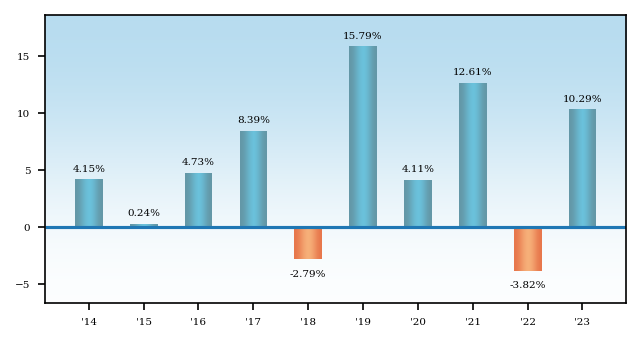
During the period shown, the was % for the quarter ended , and the was % for the quarter ended .
The calendar as of was %.
Average Annual Total Returns - MAI Managed Volatility Fund |
1 Year |
5 Years |
10 Years |
|---|---|---|---|
| Institutional Class | 10.58% | 7.83% | 5.44% |
| Investor Class | 10.29% | 7.57% | 5.17% |
| Investor Class | After Taxes on Distributions | 9.13% | 7.21% | 4.45% |
| Investor Class | After Taxes on Distributions and Sales | 6.41% | 5.87% | 3.80% |
| S&P 500® Index (reflects no deduction for fees, expenses or taxes) | 26.29% | 15.69% | 12.03% |
| CBOE S&P 500 BUYWRITE INDEX - BXM (reflects no deduction for fees, expenses or taxes) | 11.82% | 6.08% | 5.58% |
S&P 500® Index is a broad-based, unmanaged measure of changes in stock market conditions based on the average performance of stocks of 500 large U.S. companies.
The CBOE S&P 500 BuyWrite Index (“BXM”) is a benchmark index designed to track the performance of a hypothetical buy-write strategy on the S&P 500 Index. The BXM is a passive total return index based on (i) buying an S&P 500 stock index portfolio, and (ii) writing (or selling) the near-term S&P 500 Index “covered” call option, generally on the third Friday of each month.
After-tax returns are calculated using the historical highest individual federal marginal income tax rates and do not reflect the impact of state and local taxes. Actual after-tax returns depend on an investor’s tax situation and may differ from those shown. After-tax returns shown are not relevant to investors who hold their Fund shares through tax-advantaged arrangements, such as 401(k) plans
or individual retirement accounts. After-tax returns are shown only for the Fund's Investor Class and after-tax returns for other share classes will vary.
The return after taxes on distributions and sale of Fund shares may exceed the return before taxes due to an assumed tax benefit from any losses on a sale of Fund shares at the end of the measurement period.
Market Events Risk. Disruptive events with geopolitical consequences, including pandemics, may destabilize various countries’ economies and markets, which may experience increased volatility and reduced liquidity. Policy changes by the Federal Reserve and/or other government actors could similarly cause increased volatility in financial markets. Trade barriers and other protectionist trade policies (including those in the U.S.) may also result in market turbulence. Market volatility and reductions in market liquidity may negatively affect issuers worldwide, including issuers in which the Fund invests. Under such circumstances, the Fund may have difficulty liquidating portfolio holdings, particularly at favorable prices. To the extent that the Fund experiences higher levels of redemptions, the Fund may be required to sell portfolio holdings, which may negatively impact the Fund’s NAV.
Equity Risk. Equity securities, which include common stocks and sponsored and unsponsored ADRs, may decline in value because of changes in the price of a particular holding or a broad stock market decline. Common stock ranks below preferred stock and debt securities in claims for dividends and for assets of the company in a liquidation or bankruptcy. The value of a security may decline for a number of reasons that directly relate to the issuer of a security or broader economic or market events including changes in interest rates.
Mega and Large Capitalization Company Risk. The Fund’s investments in larger capitalization companies may underperform other segments of the market because they may be less responsive to competitive challenges and opportunities and unable to attain high growth rates during periods of economic expansion.
Options Risk. The price of an option, which is a function of interest rates, volatility, dividends, the exercise price, stock price and other market factors, may change rapidly over time. There may be an imperfect correlation between the prices of options and movements in the price of the securities (or indices) hedged or used for cover which may cause a given hedge not to achieve its objective.
Options on Securities Indices Risk. Options on securities indices bear substantially the same risks as options on securities included in the index. Additionally, the hours of trading for options on an index may not conform to the hours during which the underlying securities are traded. To
the extent that hours for the option markets differ from the markets for the underlying securities, significant price and rate movements can take place in the underlying securities markets that cannot be reflected in the option markets. It is impossible to predict the volume of trading that may exist in such options, and there can be no assurance that viable exchange markets will develop or continue. Options on securities indices require settlement in cash. Therefore, the Fund may be forced to liquidate portfolio securities to meet settlement obligations. Because the value of an index option depends upon movements in the level of the index rather than the price of a particular stock, whether the Fund will realize a gain or loss from the purchase or writing of options on an index depends upon movements in the level of stock prices in the stock market generally or, in the case of certain indices, in an industry or market segment, rather than movements in the price of a particular stock.
Call Options Risk. As a result of selling covered call options, the Fund may be required to deliver a portfolio security to the owner of the call option. Under such circumstance, the Fund would not participate in additional increases in the stock price. In addition, selling options generates gains, which are largely short-term capital gains that are distributed to shareholders as dividends or lower the cost basis of the Fund’s portfolio. The Fund’s losses are potentially unlimited in an uncovered, written call transaction. As the buyer of a call option, the Fund risks losing the premium invested in the option if the underlying reference instrument does not rise above the strike price, which means the option will expire worthless.
Put Options Risk. The Fund may sell put options and may be required to buy the underlying security at the exercise price. When this occurs, the Fund will incur a loss equal to the difference between the exercise price less the premium received from the sale of the option and the security’s current market value. The Fund’s losses are potentially large in a written put transaction. In addition, selling options generates gains, which are largely short-term capital gains and distributed to shareholders as dividends or lower the cost basis of the Fund’s portfolio. As the buyer of a put option, a Fund risks losing the premium invested in the option if the underlying reference instrument does not fall below the strike price, which means the option will expire worthless.
Cash and Cash Equivalents Holdings Risk. When investing in cash and cash equivalents, the Fund risks achieving lower returns and potential lost opportunities to participate in market appreciation, which could negatively impact the Fund’s performance and ability to achieve its investment objective. This is particularly true when the market for other investments in which the Fund may invest is rapidly rising.
Management Risk. The Fund is actively managed, and its performance will reflect the Adviser’s ability to make investment decisions that are suited to achieving the Fund’s investment objective.
Fixed-Income Securities Risk. The Fund may invest in fixed-income (debt) securities, which are generally subject to the following risks:
Credit Risk. The financial condition of an issuer of a fixed-income security may cause the issuer to default. A decline in an issuer’s credit rating may cause a decrease in the value of the security and an increase in investment risk and price volatility.
Interest Rate Risk. An increase in interest rates typically causes a decrease in the value of fixed-income securities in which the Fund may invest. Fixed-income securities with longer durations tend to be more sensitive to changes in interest rates, generally making them more volatile than fixed-income securities with shorter durations. The Fund may face a heightened level of interest rate risk due to changes in monetary policy.
ADR Risk. The Fund may invest in ADRs. ADR risks include, but are not limited to, foreign investment risks, such as political and financial instability, less liquidity, lack of uniform accounting, auditing and financial reporting standards and increased price volatility. In addition, ADRs may not track the price of the underlying foreign securities, and their value may change materially at times when U.S. markets are not open for trading. Unsponsored ADRs may involve additional risks, and their prices may be more volatile than the prices of sponsored ADRs.
Small and Mid-Sized Capitalization Company Risk. Investments in small and mid-sized capitalization companies may be less liquid, and the prices of such securities may fluctuate more than those of larger, more established companies. These factors could adversely affect the Fund’s ability to sell such securities at a desirable time and price.
Hedging Risk. Hedging against a decline in the value of a Fund position does not eliminate fluctuations in the values of those Fund positions or prevent losses if the values of those positions decline. Such hedging transactions also limit the opportunity for gain if the value of the Fund position should increase. If the Fund uses a hedging instrument at the wrong time or judges the market conditions incorrectly, the hedge might be unsuccessful, reduce the Fund’s return, or create a loss.
Exchange-Traded Funds Risk. An ETF is subject to the risk that the market price of the ETF’s shares may trade at a discount to its NAV or an active trading market for its shares may not develop or be maintained. Additionally, an index ETF may not replicate the performance of a benchmark index it seeks to track. ETFs have management and other fees, which the Fund would have to pay as an investor in an ETF.
Information Technology Sector Risk. The information technology sector includes, for example, internet, semiconductor, software, hardware and technology equipment companies. This sector can be affected by, among other things, the supply and demand for specific products and services, the pace of technological development and government regulation.