The NEOS Nasdaq-100 ® Hedged Equity Income ETF (the “Fund”) seeks high monthly income in a tax efficient manner with a measure of downside protection.
The following table describes the fees and expenses you may pay if you buy, hold, and sell shares of the Fund (“Shares”). You may pay other fees, such as brokerage commissions and other fees to financial intermediaries, which are not reflected in the table and example below.
Annual Fund Operating Expenses |
NEOS Nasdaq-100(R) Hedged Equity Income ETF
NEOS Nasdaq-100(R) Hedged Equity Income ETF
|
|---|---|
| Management Fees | 0.68% |
| Distribution and/or Service (12b-1) Fees | none |
| Other Expenses | none |
| Total Annual Fund Operating Expenses | 0.68% |
This Example is intended to help you compare the cost of investing in the Fund with the cost of investing in other funds. The Example assumes that you invest $10,000 in the Fund for the time periods indicated and then continue to hold or redeem all of your Shares at the end of those periods. The Example also assumes that your investment has a 5% return each year and that the Fund’s operating expenses remain the same. The Example does not take into account brokerage commissions that you may pay on your purchases and sales of Shares. Although your actual costs may be higher or lower, based on these assumptions your costs would be:
Expense Example |
Expense Example, with Redemption, 1 Year |
Expense Example, with Redemption, 3 Years |
Expense Example, with Redemption, 5 Years |
Expense Example, with Redemption, 10 Years |
|---|---|---|---|---|
| NEOS Nasdaq-100(R) Hedged Equity Income ETF | NEOS Nasdaq-100(R) Hedged Equity Income ETF | USD ($) | 69 | 218 | 379 | 847 |
The Fund pays transaction costs, such as commissions, when it buys and sells securities (or “turns over” its portfolio). A higher portfolio turnover rate may indicate higher transaction costs and may result in higher taxes when Shares are held in a taxable account. These costs, which are not reflected in annual fund operating expenses or in the Example, affect the Fund’s performance. This rate excludes the value of portfolio securities received or delivered as a result of in-kind creations or redemptions of the Fund’s Shares and securities, including options, whose maturities or expiration dates at the time of acquisition were one year or less. For the fiscal year ended August 31, 2024, the predecessor fund of the Fund portfolio turnover rate was 8% of the average value of its portfolio.
The Fund is an actively-managed exchange-traded fund (“ETF”) that seeks to achieve its investment objective principally by investing in a portfolio of the stocks included in the Nasdaq-100® Index (the “Nasdaq-100®” or the “Reference Index”) and a put spread options collar (i.e., a mix of written (sold) call options, long (bought) put options, and written (sold) put options) on the Nasdaq-100. The Fund seeks to generate tax efficient monthly income from a combination of the dividends received from the Fund’s equity holdings and the premiums earned from the put spread options collar. The put spread options collar seeks to generate a net-credit by receiving premium from the sale of the call and put options that is greater than the cost of buying the protective put options. The put spread options collar is designed to reduce the Fund’s volatility and provide a measure of downside protection, but upside gains will be limited.
The Nasdaq-100® is a market capitalization weighted index comprised of the securities of 100 of the largest non-financial companies listed on The Nasdaq Stock Market LLC based on their market capitalization. Such securities may include companies domiciled domestically or internationally (including in emerging markets), and may include common stocks, ordinary shares, depositary receipts representing interests in non-U.S. companies, and tracking stocks. As of August 31, 2024, the Nasdaq-100® had significant exposure to companies in the information technology sector. The Fund will concentrate its investments (i.e., hold more than 25% of its total assets) in a particular industry or group of industries to approximately the same extent that the Reference Index concentrates in an industry or group of industries.
The Fund will generally use a “replication” strategy to invest in the Nasdaq-100®, meaning the Fund will generally invest in all of the component securities of the Nasdaq-100® in the same approximate proportions as in the Nasdaq-100®. However, the Fund may use a “representative sampling” strategy, meaning it may invest in a sample of the securities in the Nasdaq-100® whose risk, return, and other characteristics closely resemble the risk, return, and other characteristics of the Nasdaq-100 as a whole, when NEOS Investment Management, LLC, the Fund’s investment adviser (the “Adviser”) believes it is in the best interests of the Fund (e.g., when replicating the Nasdaq-100® involves practical difficulties or substantial costs, a Nasdaq-100® constituent becomes temporarily illiquid, unavailable, or less liquid, or as a result of legal restrictions or limitations that apply to the Fund but not to the Nasdaq-100®). The Fund rebalances the equity positions of its investment portfolio to correspond to the extent reasonably possible each time the Nasdaq-100® Index reconstitutes. The Nasdaq-100® reconstitutes annually and often reconstitutes quarterly. In some cases, there are special reconstitutions of the Nasdaq-100®.
The Adviser generally utilizes a proprietary, systematic rules-based model to manage the Fund’s options positions in an objective manner, which may signal the written call options should be closed prior to expiration to potentially capture gains and minimize losses due to the movement of the Nasdaq-100® (e.g., after an increase in the Nasdaq-100®, the model may indicate that the short call should be closed so the Fund can capture more upside potential in the reference asset, or the model may determine most of the premium derived from the sale of the call has been captured due to a falling market).
The Fund’s put spread options collar strategy typically consists of three components: (i) selling call options on the Nasdaq-100® or another reference asset representing U.S. equity securities on up to 100% of the value of the equity securities held by the Fund to generate premium from such options, while (ii) simultaneously reinvesting a portion of such premium to buy put options on the same reference asset(s) to “hedge” or mitigate the downside risk associated with owning equity securities and (iii) selling put options on the Nasdaq-100® to generate additional premium.
| ● | Call Options. A written (sold) call option gives the seller the obligation to sell shares of the reference asset at a specified price (“strike price”) until a specified date (“expiration date”). The writer (seller) of the call option receives an amount (premium) for writing (selling) the option. In the event the reference asset appreciates above the strike price and the holder exercises the call option, the Fund will have to pay the difference between the value of the reference asset and the strike price or deliver the reference asset (which loss is offset by the premium initially received), and in the event the reference asset declines in value, the call option may end up worthless and the Fund retains the premium. The call options written by the Fund will be collateralized by the Fund’s equity holdings at the time the Fund sells the options. |
| ● | Put Options. When the Fund purchases a put option, the Fund pays an amount (premium) to acquire the right to sell shares of a reference asset at a strike price until the expiration date. In the event the reference asset declines in value below the strike price and the Fund exercises its put option, the Fund will be entitled to receive the difference between the value of the reference asset and the strike price (which gain is offset by the premium originally paid by the Fund), and in the event the reference asset closes above the strike price as of the expiration date, the put option may end up worthless and the Fund’s loss is limited to the amount of premium it paid. A written (sold) put option gives the seller the obligation to buy shares of the reference asset at a specified price (“strike price”) until a specified date (“expiration date”). The writer (seller) of the put option receives an amount (premium) for writing (selling) the option. In the event the reference asset depreciates below the strike price and the holder exercises the put option, the Fund will have to pay the difference between the value of the reference asset and the strike price. In the event the reference asset appreciates and does not fall below the strike prices, the put option may end up worthless and the Fund retains the premium. |
The options purchased or sold by the Fund will typically have an expiration date approximately 6 weeks from the time of purchase or sale. Options are rolled at the end of the month. The written calls and puts along with purchased puts for the new put spread collar are reset to current market levels. The Fund expects the total value of the call options and the total value of the put options to each be up to 100% of the Fund’s net assets. The Fund will use a portion of the premium received from writing call and put options to purchase put options. Call options written by the Fund will typically have a strike price that is at, near, or higher than the current price of the reference asset, and put options purchased by the Fund will typically have a strike price that is lower (in some cases, significantly lower) than the current price of the reference asset. Put options written will typically have a strike price that is lower than the long put option. In addition, both the call and put options will be traded on a national securities exchange and be settled in cash.
The Fund seeks tax efficient returns by utilizing index options that qualify as “Section 1256 Contracts.” If such options are held at year end, the Fund will receive favorable tax treatment on such investments. Under Internal Revenue Code rules, they will be deemed as if they were sold at fair market value on the last business day of the tax year. If the Section 1256 contracts produce capital gain or loss, such gain or loss on the Contracts open at the end of the year, or terminated during the year, will be treated as 60% long term and 40% short term, instead of 100% short term gains. The Fund may seek to take advantage of tax loss harvesting opportunities by taking investment losses from certain equity and/or options positions. This can be accomplished by taking investment losses from certain equity to offset realized and/or options positions to offset realized taxable gains of equities and/or options positions.
The Fund is considered to be non-diversified, which means that it may invest more of its assets in the securities of a single issuer or a smaller number of issuers than if it were a diversified fund. Additionally, the Fund’s investment strategies may involve active and frequent trading resulting in high portfolio turnover.
Under normal circumstances, at least 80% of the Fund’s net assets, plus borrowings for investment purposes, will be invested in securities, or derivative instruments linked to securities, of companies that are included in the Fund’s Reference Index. The remaining 20% may hold cash or cash items under certain market conditions.
The Fund will commence operations and acquire the assets and liabilities of the Nationwide Nasdaq-100® Risk-Managed Income ETF, a series of the ETF Series Solutions (the “Predecessor Fund”), resulting from a reorganization of the Predecessor that took place on November 11, 2024. The Fund adopted the financial statements of the Predecessor Fund, the accounting successor of the Reorganization. Performance results shown in the bar chart and the performance table below reflect the performance of the Predecessor Fund. Note that while the investment strategy of the Fund and the Predecessor Fund both include an options strategy designed to reduce volatility and provide a measure of downside protection, the options strategy employed for the Fund has been modified.
The following performance information indicates some of the risks of investing in the Predecessor Fund. The bar chart shows the Predecessor Fund’s performance for the calendar year ended December 31. The table illustrates how the Predecessor Fund’s average annual returns for the 1-year and since inception periods compared with those of a broad measure of market performance as well as an additional index that represents the asset classes in which the Fund invests. The Predecessor Fund’s past performance, before and after taxes, does not necessarily indicate how it will perform in the future. Updated performance information is also available on the Fund’s website at www.neosfunds.com.
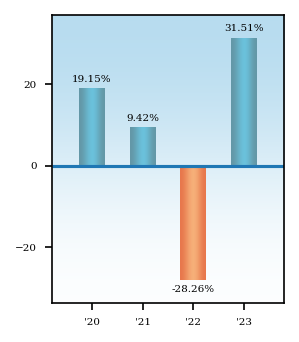
The Fund's calendar as of was .
During the period shown in the bar chart, the Predecessor Fund’s was for the quarter ended and the was for the quarter ended .
Average Annual Total Returns - NEOS Nasdaq-100(R) Hedged Equity Income ETF |
1 Year |
Since Inception |
Inception Date |
|---|---|---|---|
| NEOS Nasdaq-100(R) Hedged Equity Income ETF | 31.51% | 5.41% | Dec. 19, 2019 |
| NEOS Nasdaq-100(R) Hedged Equity Income ETF | After Taxes on Distributions | 31.43% | 5.33% | Dec. 19, 2019 |
| NEOS Nasdaq-100(R) Hedged Equity Income ETF | After Taxes on Distributions and Sales | 18.70% | 4.15% | Dec. 19, 2019 |
| CBOE S&P 500 Zero-Cost Put Spread Collar Index (reflects no deduction for fees, expenses, or taxes) | 22.66% | 8.03% | Dec. 19, 2019 |
| NASDAQ 100 Total Return (reflects no deduction for fees, expenses, or taxes) | 55.13% | 18.94% | Dec. 19, 2019 |
After-tax returns are calculated using the historical highest individual federal marginal income tax rates during the period covered by the table above and do not reflect the impact of state and local taxes. Actual after-tax returns depend on an investor’s tax situation and may differ from those shown. After-tax returns shown are not relevant to investors who hold their Shares through tax-deferred arrangements such as an individual retirement account (“IRA”) or other tax-advantaged accounts.
| ● | Equity Market Risk. The equity securities held in the Fund’s portfolio may experience sudden, unpredictable drops in value or long periods of decline in value. This may occur because of factors that affect securities markets generally or factors affecting specific issuers, industries, or sectors in which the Fund invests. Common stocks are generally exposed to greater risk than other types of securities, such as preferred stock and debt obligations, because common stockholders generally have inferior rights to receive payment from issuers. In addition, local, regional or global events such as war, including Russia’s invasion of Ukraine, acts of terrorism, spread of infectious diseases or other public health issues, recessions, rising inflation, or other events could have a significant negative impact on the Fund and its investments. For example, the global pandemic caused by COVID-19, a novel coronavirus, and the aggressive responses taken by many governments, including closing borders, restricting international and domestic travel, and the imposition of prolonged quarantines or similar restrictions, has had negative impacts, and in many cases severe impacts, on markets worldwide. The COVID-19 pandemic has caused prolonged disruptions to the normal business operations of companies around the world and the impact of such disruptions is hard to predict. Such events may affect certain geographic regions, countries, sectors and industries more significantly than others. Such events could adversely affect the prices and liquidity of the Fund’s portfolio securities or other instruments and could result in disruptions in the trading markets. |
| ● | ETF Risks. The Fund is an ETF, and, as a result of an ETF’s structure, it is exposed to the following risks: |
| ○ | Authorized Participants, Market Makers, and Liquidity Providers Limitation Risk. The Fund has a limited number of financial institutions that may act as Authorized Participants (“APs”). In addition, there may be a limited number of market makers and/or liquidity providers in the marketplace. To the extent either of the following events occur, Shares may trade at a material discount to NAV and possibly face delisting: (i) APs exit the business or otherwise become unable to process creation and/or redemption orders and no other APs step forward to perform these services, or (ii) market makers and/or liquidity providers exit the business or significantly reduce their business activities and no other entities step forward to perform their functions. |
| ○ | Cash Redemption Risk. The Fund’s investment strategy may require it to effect redemptions, in whole or in part, for cash. As a result, the Fund may be required to sell portfolio securities to obtain the cash needed to distribute redemption proceeds. This may cause the Fund to recognize investment income and/or capital gains or losses that it might not have recognized if it had completely satisfied the redemption in-kind. As a result, the Fund may be less tax efficient if it includes such a cash payment than if the in-kind redemption process was used exclusively. In addition, with cash redemptions, the Fund may incur brokerage costs and taxable gains losses it would not incur if utilizing a redemption in-kind. These costs could decrease the NAV if they are imposed on the Fund. |
| ○ | Costs of Buying or Selling Shares. Due to the costs of buying or selling Shares, including brokerage commissions imposed by brokers and bid-ask spreads, frequent trading of Shares may significantly reduce investment results and an investment in Shares may not be advisable for investors who anticipate regularly making small investments. |
| ○ | Shares May Trade at Prices Other Than NAV. As with all ETFs, Shares may be bought and sold in the secondary market at market prices. Although it is expected that the market price of Shares will approximate the Fund’s NAV, there may be times when the market price of Shares is more than the NAV intra-day (premium) or less than the NAV intra-day (discount) due to supply and demand of Shares or during periods of market volatility. This risk is heightened in times of market volatility, periods of steep market declines, and periods when there is limited trading activity for Shares in the secondary market, in which case such premiums or discounts may be significant. |
| ○ | Trading. Although Shares are listed for trading on a national securities exchange, the Nasdaq Stock Market LLC (the “Exchange”), and may be traded on U.S. exchanges other than the Exchange, there can be no assurance that Shares will trade with any volume, or at all, on any stock exchange. In stressed market conditions, the liquidity of Shares may begin to mirror the liquidity of the Fund’s underlying portfolio holdings, which can be significantly less liquid than Shares. |
| ● | Collared Options Strategy Risk. Writing and buying options are speculative activities and entail greater than ordinary investment risks. The Fund’s use of call and put options can lead to losses because of adverse movements in the price or value of the reference asset, which may be magnified by certain features of the options. |
| ○ | Call options may limit the Fund’s upside capture in rising markets and put options may not protect the Fund from losses in declining markets. |
| ○ | In a rising market, the upside capture may be limited by the strike price of the short call position. Conversely, the downside protection offered by the put may be limited due to the difference between the current market value of the reference asset and the strike price of the long put. |
| ○ | When selling a call option, the Fund will receive a premium; however, this premium may not be enough to offset a loss incurred by the Fund if the price of the reference asset is above the strike price by an amount equal to or greater than the premium. |
| ○ | If the model indicates a written call option should be closed prior to its expiration date (e.g., because the market price for the reference asset is above the strike price), and the value of the reference asset increases after the written call option is closed, the Fund may nevertheless underperform the reference asset. |
| ○ | Options are rolled at the end of each month. If you purchase Fund shares on any day other than the roll date or hold shares for more or less than the roll period, the value of your investment in the Fund may not be protected against a decline in the value of the reference asset and may not benefit from a gain in the value of the reference asset. |
| ○ | The value of an option may be adversely affected if the market for the option becomes less liquid, and will be affected by changes in the value or yield of the option’s reference asset, an increase in interest rates, a change in the actual or perceived volatility of the stock market or the reference asset and the remaining time to expiration. Additionally, the value of an option does not increase or decrease at the same rate as the reference asset. The price of an option reflects the time value of the option, which decreases over time as the option gets closer to its expiration date. |
| ○ | As a seller (writer) of a put option, the Fund will tend to lose money if the value of the reference index or security falls below the strike price. As the buyer of a put option, the Fund risks losing the entire premium invested in the option if the Fund does not exercise the option. |
The Fund’s use of options may reduce the Fund’s ability to profit from increases in the value of the Fund’s equity holdings. If the price of the reference asset of a written call option rises above its strike price, the value of the option and, consequently, the Fund may decline significantly more than if the Fund invested solely in the reference asset instead of using options. Similarly, if the price of the reference asset of a purchased put option remains above its strike price, the option may become worthless, and, consequently the value of the Fund may decline significantly more than if the Fund invested solely in the reference asset instead of using options.
| ● | Derivatives Risk. The Fund invests in options that derive their performance from the performance of an underlying reference asset. Derivatives, such as the options in which the Fund invests, can be volatile and involve various types and degrees of risks, depending upon the characteristics of a particular derivative. Derivatives may have investment exposures that are greater than their cost would suggest, meaning that a small investment in a derivative could have a substantial impact on the performance of the Fund. The Fund could experience a loss if its derivatives do not perform as anticipated, the derivatives are not correlated with the performance of their reference asset, or if the Fund is unable to purchase or liquidate a position because of an illiquid secondary market. The market for many derivatives is, or suddenly can become, illiquid. Changes in liquidity may result in significant, rapid, and unpredictable changes in the prices for derivatives. |
| ● | Sector Risk. To the extent the Fund invests more heavily in particular sectors of the economy, its performance will be especially sensitive to developments that significantly affect those sectors. |
| ○ | Information Technology Sector Risk. Market or economic factors impacting information technology companies and companies that rely heavily on technological advances could have a significant effect on the value of the Fund’s investments. The value of stocks of information technology companies and companies that rely heavily on technology is particularly vulnerable to rapid changes in technology product cycles, rapid product obsolescence, government regulation and competition, both domestically and internationally, including competition from foreign competitors with lower production costs. Information technology companies are heavily dependent on patent and intellectual property rights, the loss or impairment of which may adversely affect profitability. |
| ● | Tax Risk. The Fund expects to generate premiums from its sale of call options. These options are expected to result in capital gains or losses for federal income tax purposes and may be subject to mark-to-market rules. These gains or losses will be wholly or partly long-term or short-term depending on the nature of the options sold by the Fund and will take into account premiums generated. In addition, stocks that are hedged with options may not be eligible for long-term capital gains tax treatment. If positions held by the Fund were treated as “straddles” for federal income tax purposes, or the Fund’s risk of loss with respect to a position was otherwise diminished as set forth in Treasury Regulations, dividends on stocks that are a part of such positions would not constitute qualified dividend income subject to such favorable income tax treatment and would not be eligible for the dividends received deduction for corporate shareholders. In addition, generally, straddles are subject to certain rules that may affect the amount, character and timing of the Fund’s gains and losses with respect to straddle positions. The Fund is not designed for investors seeking a tax efficient investment. |
| ● | Tracking Stock Risk. Tracking stock is a separate class of common stock designed to “track” the performance of a specific unit or operating division within a larger company. As a result, a tracking stock’s value may decline even if the common stock of the larger company increases in value. Tracking stocks share many of the same investing risks as common stocks, but the holders of tracking stock may not share the same rights as holders of a company’s common stock. |
| ● | Correlation Risk. The Fund expects to invest a portion of its assets to replicate the holdings of the Nasdaq-100®, and the Fund’s Adviser does not expect to sell shares of an equity security due to current or projected underperformance of a security, industry, or sector, unless that security is removed from the Nasdaq-100®. Although the Fund expects to invest a portion of its assets to replicate the holdings of the Nasdaq-100®, the performance of such portion of the Fund and the Nasdaq-100® may differ from each other for a variety of reasons. For example, the Fund incurs operating expenses and portfolio transaction costs not incurred by the Nasdaq-100®. In addition, the Fund may not be fully invested in the securities of the Nasdaq-100® at all times or may hold securities not included in the Nasdaq-100®. |
| ● | Currency Exchange Rate Risk. The Fund may invest in investments denominated in non-U.S. currencies or in securities that provide exposure to such currencies. Changes in currency exchange rates and the relative value of non-U.S. currencies will affect the value of the Fund’s investment and the value of your Shares. Currency exchange rates can be very volatile and can change quickly and unpredictably. As a result, the value of an investment in the Fund may change quickly and without warning and you may lose money. |
| ● | Depositary Receipt Risk. American Depositary Receipts (“ADRs”) involve risks similar to those associated with investments in foreign securities and certain additional risks. ADRs listed on U.S. exchanges are issued by banks or trust companies, and entitle the holder to all dividends and capital gains that are paid out on the underlying foreign shares. When the Fund invests in ADRs as a substitute for a direct investment in the underlying foreign shares, the Fund is exposed to the risk that the ADRs may not provide a return that corresponds precisely with that of the underlying foreign shares. |
| ● | Emerging Markets Risk. The Fund may have exposure to companies domiciled or doing business in emerging markets. Emerging markets are riskier than more developed markets because they tend to develop unevenly and may never fully develop. Emerging markets may be more prone to political and economic risks, civil conflicts and war, greater volatility, expropriation and nationalization risks, sanctions or other measures by the United States or other governments, currency fluctuations, higher transaction costs, delayed settlement, possible foreign controls on investments, and less stringent investor protection and disclosure standards of foreign markets. In addition, many emerging securities markets have far lower trading volumes and less liquidity than developed markets. |
| ● | Foreign Investment Risk. Because of the Fund’s investment in non-U.S. companies, changes in foreign economies and political climates are more likely to affect the Fund than a fund that invests exclusively in U.S. companies. There may be less government supervision of foreign markets, resulting in non-uniform accounting practices and less publicly available information. The value of foreign investments may be affected by changes in exchange control regulations, application of foreign tax laws (including withholding tax), changes in governmental administration or economic or monetary policy (in this country or abroad) or changed circumstances in dealings between nations. |
| ● | High Portfolio Turnover Risk. The Fund may frequently buy and sell portfolio securities and other assets to rebalance the Fund’s exposure to various market sectors. Higher portfolio turnover may result in the Fund paying higher levels of transaction costs and generating greater tax liabilities for shareholders. Portfolio turnover risk may cause the Fund’s performance to be less than you expect. |
| ● | Industry Exposure Risk. From time to time, the Fund may invest a significant percentage of its assets in issuers in a single industry (or the same group of industries). To the extent the Fund’s investments are concentrated in or have significant exposure to a particular issuer, industry, or group of industries, the Fund may be more vulnerable to adverse events affecting such issuer, industry, or group of industries than if the Fund’s investments were more broadly diversified. The Fund’s industry exposure is expected to vary over time based on the composition of the Reference Index. |
| ● | Management Risk. The Fund is actively-managed and may or may not meet its investment objective based on the portfolio managers’ success or failure to implement investment strategies for the Fund. |
| ● | Market Capitalization Risk. |
| ○ | Large-Capitalization Investing. The securities of large-capitalization companies may be relatively mature compared to smaller companies and therefore subject to slower growth during times of economic expansion. Large-capitalization companies may also be unable to respond quickly to new competitive challenges, such as changes in technology and consumer tastes. |
| ● | Model and Data Risk. The Adviser will make use of quantitative models and information and data supplied by third parties to, among other things, help determine the strike prices of, or when to close, the Fund’s written put positions. To the extent the models used by the Adviser or the information and data supplied by third parties are incorrect or incomplete, the decisions made by the Adviser in reliance thereon will expose the Fund to potential risks and could lead to the Fund incurring losses or missing gains on its investments. |
| ● | Non-Diversification Risk. Although the Fund intends to invest in a variety of securities and instruments, the Fund will be considered to be non-diversified, which means that it may invest more of its assets in the securities of a single issuer or a smaller number of issuers than if it were a diversified fund. As a result, the Fund may be more exposed to the risks associated with and developments affecting an individual issuer or a smaller number of issuers than a fund that invests more widely. This may increase the Fund’s volatility and cause the performance of a relatively smaller number of issuers to have a greater impact on the Fund’s performance. However, the Fund intends to satisfy the diversification requirements for qualifying as a regulated investment company (a “RIC”) under Subchapter M of the Internal Revenue Code of 1986, as amended (the “Code”). |
| ● | Return of Capital Risk. The Fund expects to make monthly distributions regardless of its performance. All or a portion of such distributions may represent a return of capital. A return of capital is the portion of the distribution representing the return of your investment in the Fund. A return of capital is generally tax-free to the extent of a shareholder’s basis in the Fund’s shares and reduces the shareholder’s basis in their shares and results in a higher capital gain or lower capital loss when the shares on which the return of capital distribution was received are sold. After a shareholder’s basis in the shares has been reduced to zero, return of capital distributions will be treated as gain from the sale of the shareholder’s shares. |