Aug. 31, 2024
The fund seeks to generate interest income that is not subject to federal income tax.
This table describes the fees and expenses you may pay if you buy, hold and sell shares of the fund. You may pay other fees, such as brokerage commissions and other fees to financial intermediaries, which are not reflected in the table and Example below.
| Shareholder Fees (fees paid directly from your investment) | | |||
| | | | None | |
| Annual Fund Operating Expenses (expenses that you pay each year as a % of the value of your investment) | | |||
| Management fees | | | 0.40 | |
| Distribution (12b-1) fees | | | None | |
| Other expenses | | | 0.20 | |
| Total annual fund operating expenses | | | 0.60 | |
| Less expense reduction | | | (0.10) | |
| Total annual fund operating expenses after expense reduction(1) | | | 0.50 | |
(1)
The investment adviser and its affiliates have agreed to limit the total annual fund operating expenses (excluding interest, taxes and certain non-routine expenses) of the fund to 0.50% for so long as the investment adviser serves as the adviser to the fund. This agreement may only be amended or terminated with the approval of the fund’s Board of Trustees.
This example is intended to help you compare the cost of investing in the fund with the cost of investing in other funds. The example assumes that you invest $10,000 in the fund for the time periods indicated and then redeem all of your shares at the end of those time periods. The example also assumes that your investment has a 5% return each year and that the fund’s operating expenses remain the same. The figures are based on total annual fund operating expenses after any expense reduction. Your actual costs may be higher or lower.
| | Expenses on a $10,000 Investment | | |||||||||||||||||||||
| | 1 Year | | | 3 Years | | | 5 Years | | | 10 Years | | ||||||||||||
| | | $ | 51 | | | | | $ | 160 | | | | | $ | 280 | | | | | $ | 628 | | |
The fund pays transaction costs, such as commissions, when it buys and sells securities (or “turns over” its portfolio). A higher portfolio turnover may indicate higher transaction costs and may result in higher taxes when fund shares are held in a taxable account. These costs, which are not reflected in the annual fund operating
expenses or in the example, affect the fund’s performance. During the most recent fiscal year, the fund’s portfolio turnover rate was 181% of the average value of its portfolio.
Under normal market conditions, the fund invests at least 80% of its net assets (including, for this purpose, any borrowings for investment purposes) in municipal securities that pay interest not subject to regular federal income tax. Some of these investments in municipal securities may pay interest that is not exempt from the federal alternative minimum tax (AMT). Municipal securities may include debt obligations of U.S. states, territories, counties, cities, political subdivisions, government agencies and instrumentalities. The fund also invests in non-governmental municipal issuers, including, but not limited to, healthcare organizations, corporate issuers of municipal debt, and various project finance bond issues. The fund primarily invests in general obligation and revenue obligation securities, including fixed and variable rate securities, municipal notes and private placements, auction-rate securities, variable rate demand notes, lease-backed obligations and certificates of participation.
The fund may from time to time invest temporarily up to 20% of its net assets in taxable securities of at least comparable quality to the municipal securities in which the Fund invests. The fund may also invest up to 25% of its net assets in municipal securities that are subject to the AMT. The fund has no policy limiting its investments in municipal securities whose issuers are located in the same state or territory. However, the fund currently intends to invest no more than 25% of the fund’s net assets in issuers located in the same state. The fund may hold up to 15% of its net assets in illiquid or thinly traded securities, which may include securities that are subject to resale restrictions such as those issued pursuant to Rule 144A of the Securities Act of 1933, as amended. The fund may invest in securities that do not produce immediate cash income, such as zero coupon securities and securities that are in payment default.
The fund invests at least 80% of its net assets in investment grade municipal securities, as determined by a nationally recognized rating organization (NRSRO) (e.g., Baa3 or higher by Moody’s Investors Service, Inc. (Moody’s)) or if unrated, determined to be of comparable quality by the investment adviser. The fund may also invest in municipal securities that are less-than-investment grade, as determined by an NRSRO (e.g., Ba1 or lower by Moody’s) or by the investment adviser.
In choosing securities, the fund’s investment adviser seeks to maximize current income by utilizing a flexible investment process that identifies opportunities in the municipal bond market of any maturity, duration and credit quality, including below investment grade securities. The investment adviser’s credit research department analyzes and monitors the securities that the fund owns or is considering buying.
Under normal market conditions, the fund anticipates investing substantially in municipal bonds with remaining maturities of 5- to 30-years. The fund does not target a specific level of portfolio turnover as purchases and sales are made if the investment adviser determines the transactions will be advantageous to the fund.
The fund may also invest in derivative instruments, principally futures contracts. The fund typically uses futures as a substitute for taking a position in the underlying asset or as a part of a strategy designed to reduce exposure to other risks. During unusual market conditions, the fund may invest entirely in taxable securities as a temporary defensive measure. When the fund engages in such activities, the fund would not be pursuing its investment strategy and, as a result, it may not achieve its investment objective.
The bar chart below shows how the fund’s investment results have varied from year to year, and the following table shows how the fund’s average annual total returns for various periods compared to that of one or more indices. This information provides some indication of the risks of investing in the fund. All figures assume distributions were reinvested. Keep in mind that future performance (both before and after taxes) may differ from past performance. For current performance information, please see
www.schwabassetmanagement.com/prospectus. The fund is the successor to the investment performance of the Wasmer Schroeder High Yield Municipal Fund (Predecessor Fund) as a result of the reorganization of the Predecessor Fund into the fund on August 10, 2020. Accordingly, the performance information shown below prior to August 10, 2020 is that of the Predecessor Fund. The fund has an investment objective, strategies and policies that are substantially similar to those of the Predecessor Fund.
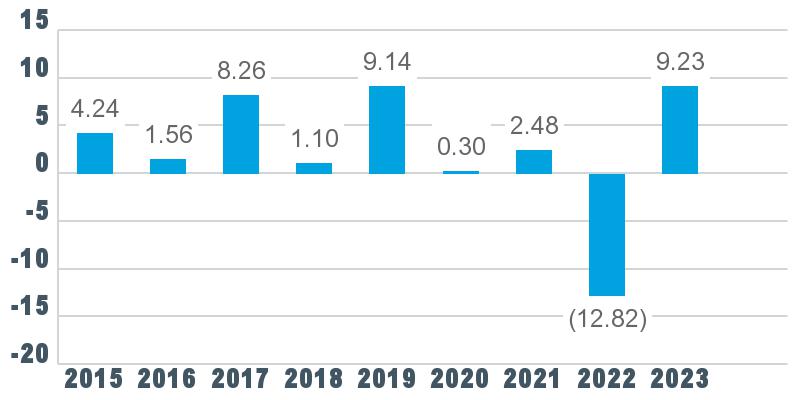
Best Quarter: 8.28% Q4 2023
Worst Quarter: (7.28%) Q1 2020
Year-to-date performance (before taxes) as of 9/30/2024: 3.36%
| Average Annual Total Returns as of 12/31/23 | | ||||||||||||||||||
| | | | 1 Year | | | 5 Years | | | Since Inception (3/31/14)(1) | | |||||||||
| Before taxes | | | | | 9.23% | | | | | | 1.33% | | | | | | 3.43% | | |
| After taxes on distributions | | | | | 9.23% | | | | | | 1.25% | | | | | | 3.24% | | |
| After taxes on distributions and sale of shares | | | | | 8.23% | | | | | | 1.90% | | | | | | 3.50% | | |
| Comparative Indices (reflect no deduction for fees, expenses, or taxes) | | | | | | | | | | | | | | | | | | | |
| Bloomberg Municipal Bond Index | | | | | 6.40% | | | | | | 2.25% | | | | | | 2.77% | | |
(1)
Inception of the Predecessor Fund.
The after-tax figures reflect the highest individual federal income tax rates in effect during the period and do not reflect the impact of state and local taxes. Your actual after-tax returns depend on your individual tax situation. In addition, after-tax returns are not relevant if you hold your fund shares through a tax-deferred arrangement, such as a 401(k) plan, an individual retirement account (IRA) or other tax-advantaged account. In some cases, the return after taxes on distributions and sale of shares may exceed the fund’s other returns due to an assumed benefit from any losses on a sale of shares at the end of the measurement period.