Putnam Global Health Care Fund seeks capital appreciation.
The following tables describe the fees and expenses you may pay if you buy, hold and sell shares of the fund. You may pay other fees, such as brokerage commissions and other fees to financial intermediaries, which are not reflected in the tables and examples below. You may qualify for sales charge discounts if you and your family invest, or agree to invest in the future, at least $50,000 in Putnam funds. More information about these and other discounts is available from your financial professional and in How do I buy fund shares? beginning on page 18 of the fund’s prospectus, in the Appendix to the fund’s prospectus, and in How to buy shares beginning on page II-1 of the fund’s statement of additional information (SAI).
Shareholder Fees - Putnam Global Health Care Fund |
Class A |
Class C |
Class R |
Class R6 |
Class Y |
||
|---|---|---|---|---|---|---|---|
| Maximum Sales Charge Imposed on Purchases (as a percentage of Offering Price) | 5.75% | none | none | none | none | ||
| Maximum Deferred Sales Charge (as a percentage) | 1.00% | [1] | 1.00% | [2] | none | none | none |
| [1] | Applies only to certain redemptions of shares bought with no initial sales charge. |
| [2] | This charge is eliminated after one year. |
Annual Fund Operating Expenses - Putnam Global Health Care Fund |
Class A |
Class C |
Class R |
Class R6 |
Class Y |
|---|---|---|---|---|---|
| Management Fees (as a percentage of Assets) | 0.61% | 0.61% | 0.61% | 0.61% | 0.61% |
| Distribution and Service (12b-1) Fees | 0.25% | 1.00% | 0.50% | none | none |
| Other Expenses (as a percentage of Assets): | 0.19% | 0.19% | 0.19% | 0.10% | 0.19% |
| Expenses (as a percentage of Assets) | 1.05% | 1.80% | 1.30% | 0.71% | 0.80% |
The following hypothetical example is intended to help you compare the cost of investing in the fund with the cost of investing in other funds. It assumes that you invest $10,000 in the fund for the time periods indicated and then, except as indicated, redeem all your shares at the end of those periods. It assumes a 5% return
on your investment each year and that the fund’s operating expenses remain the same. Your actual costs may be higher or lower.
Expense Example - Putnam Global Health Care Fund - USD ($) |
Expense Example, with Redemption, 1 Year |
Expense Example, with Redemption, 3 Years |
Expense Example, with Redemption, 5 Years |
Expense Example, with Redemption, 10 Years |
Expense Example, No Redemption, 1 Year |
Expense Example, No Redemption, 3 Years |
Expense Example, No Redemption, 5 Years |
Expense Example, No Redemption, 10 Years |
|---|---|---|---|---|---|---|---|---|
| Class A | 676 | 890 | 1,121 | 1,784 | ||||
| Class C | 283 | 566 | 975 | 1,919 | 183 | 566 | 975 | 1,919 |
| Class R | 132 | 412 | 713 | 1,568 | ||||
| Class R6 | 73 | 227 | 395 | 883 | ||||
| Class Y | 82 | 255 | 444 | 990 |
The fund pays transaction-related costs, such as commissions, when it buys and sells securities (or “turns over” its portfolio). A higher turnover rate may indicate higher transaction costs and may result in higher taxes when the fund’s shares are held in a taxable account. These costs, which are not reflected in annual fund operating expenses or the above example, affect fund performance. The fund’s turnover rate in the most recent fiscal year was 36%.
Investments
For this non-diversified fund concentrating in the health care industries, we invest mainly in common stocks (growth or value stocks or both) of large and midsize companies worldwide that we believe have favorable investment potential. Under normal circumstances, we invest at least 80% of the fund’s net assets in securities of companies in the health care industries. This policy may be changed only after 60 days’ notice to shareholders. Potential investments include companies that manufacture health care supplies or provide health care-related services, and companies in the research, development, production and marketing of pharmaceuticals and biotechnology products. We may purchase stocks of companies with stock prices that reflect a value lower than that which we place on the company. We may consider, among other factors, a company’s valuation, financial strength, growth potential, competitive position in its industry, projected future earnings, cash flows and dividends when deciding whether to buy or sell investments. We may also consider other factors that we believe will cause the stock price to rise. We may also use derivatives, such as certain foreign currency transactions, futures, options, warrants and swap contracts, for both hedging and non-hedging purposes, and may engage in short sales of securities. For example, we typically use foreign currency forward contracts in connection with the fund’s investments in foreign securities in order to hedge the fund’s currency exposure relative to the fund’s benchmark index.
The use of the term “global” in the fund’s name is meant to emphasize that we look for investment opportunities on a worldwide basis and that our investment strategies are not constrained by the countries or regions in which companies are located. Under normal market conditions, the fund intends to invest in at least five different countries
and at least 40% of its net assets in securities of foreign companies (or, if less, at least the percentage of net assets that is ten percentage points less than the percentage of the fund’s benchmark represented by foreign companies, as determined by the providers of the benchmark).
It is important to understand that you can lose money by investing in the fund.
The value of investments in the fund’s portfolio may fall or fail to rise over extended periods of time for a variety of reasons, including general economic, political or financial market conditions, investor sentiment and market perceptions, government actions, geopolitical events or changes, outbreaks of infectious illnesses or other widespread public health issues, and factors related to a specific issuer, geography, industry or sector. These and other factors may lead to increased volatility and reduced liquidity in the fund’s portfolio holdings, may negatively impact the fund’s performance, and may exacerbate other risks to which the fund is subject. Growth stocks may be more susceptible to earnings disappointments, and value stocks may fail to rebound. These risks are generally greater for small and midsize companies. The health care industries may be affected by product obsolescence, dependence on patents and intellectual property rights, expenses and losses from product liability and similar claims, changes in government programs or regulatory requirements (including approval policies for drugs, medical devices or procedures), and pricing pressures (including as a result of increased competition, changes in governmental and private reimbursement rates and payment systems, or other reforms).
Our policy of concentrating on a limited group of industries and the fund’s “non-diversified” status, which means the fund may invest a greater percentage of its assets in fewer issuers than a “diversified fund,” can increase the fund’s vulnerability to adverse developments affecting a single industry or issuer, which may result in greater losses and volatility for the fund. The value of international investments traded in foreign currencies may be adversely impacted by fluctuations in exchange rates. International investments, particularly investments in emerging markets, may carry risks associated with potentially less stable economies or governments (such as the risk of seizure by a foreign government, the imposition of currency or other restrictions, or high levels of inflation), and may be or become illiquid.
Our use of derivatives may increase the risks of investing in the fund by increasing investment exposure (which may be considered leverage) or, in the case of many over-the-counter instruments, because of the potential inability to terminate or sell derivative positions and the potential failure of the other party to the instrument to meet its obligations. The risk of a party failing to meet its obligations may increase if the fund has significant exposure to that counterparty. The value of derivatives may move in unexpected ways due to unanticipated market movements, the use of leverage, imperfect correlation between the derivative instrument and the reference asset or other factors, especially in unusual market conditions, and volatility in the value of derivatives could adversely impact the fund’s returns, obligations and exposures. Derivatives are also subject to other risks, including liquidity risk (e.g.,
liquidity demands arising from the requirement to make payments to a derivative counterparty), operational risk (e.g., settlement issues or system failures), and legal risk (e.g., insufficient legal documentation or contract enforceability issues). Our use of short selling may result in losses if the securities appreciate in value.
The fund may be an investment option for mutual funds that are managed by Franklin Resources, Inc. (“Franklin Templeton”) and its affiliates as “funds of funds.” Additionally, other investors from time to time may make substantial investments in the fund. Such shareholders may at times be considered to control the fund. Dispositions of a large number of shares by these shareholders may adversely affect the fund’s liquidity and net assets. These redemptions may also force the fund to sell securities, which may increase the fund’s brokerage costs.
There is no guarantee that the investment techniques, analyses, or judgments that we apply in making investment decisions for the fund will produce the intended outcome or that the investments we select for the fund will perform as well as other securities that were not selected for the fund. We, or the fund’s other service providers, may experience disruptions or operating errors that could negatively impact the fund.
The fund may not achieve its goal, and it is not intended to be a complete investment program. An investment in the fund is not insured or guaranteed by the Federal Deposit Insurance Corporation or any other government agency.
The performance information below gives some indication of the risks associated with an investment in the fund by showing the fund’s performance year to year and over time. The bar chart does not reflect the impact of sales charges. If it did, performance would be lower. Please remember that past performance is not necessarily an indication of future results. Monthly performance figures for the fund are available at www.franklintempleton.com.
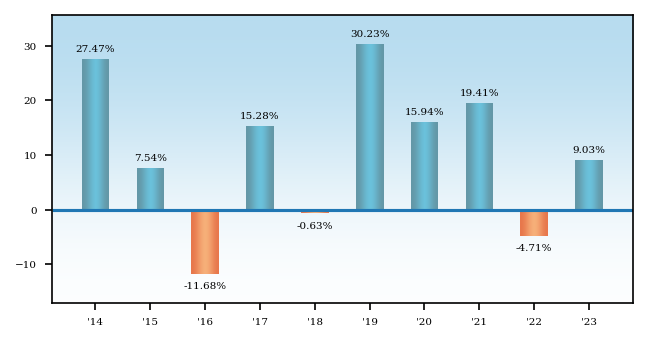
Average Annual Total Returns - Putnam Global Health Care Fund |
1 Year |
5 Years |
10 Years |
|
|---|---|---|---|---|
| Class A | 2.76% | 12.04% | 9.37% | |
| Class A | After Taxes on Distributions | 1.43% | 9.81% | 6.91% | |
| Class A | After Taxes on Distributions and Sales | 2.55% | 9.21% | 6.93% | |
| Class C | 7.23% | 12.53% | 9.36% | |
| Class R | 8.75% | 13.10% | 9.74% | |
| Class R6 | [1] | 9.40% | 13.74% | 10.33% |
| Class Y | 9.31% | 13.66% | 10.29% | |
| MSCI ACWI Index-NR (no deduction for fees, expenses or taxes, other than withholding taxes on reinvested dividends) | 22.20% | 11.72% | 7.93% | |
| MSCI World Health Care Index (ND) (no deduction for fees, expenses or taxes, other than withholding taxes on reinvested dividends) | 3.76% | 10.47% | 9.01% | |
| [1] | Performance for class R6 shares prior to their inception (6/1/2020) is derived from the historical performance of class Y shares and has not been adjusted for the lower investor servicing fees applicable to class R6 shares; had it, returns would have been higher. |
| After-tax returns reflect the historical highest individual federal marginal income tax rates and do not reflect state and local taxes. Actual after-tax returns depend on an investor’s tax situation and may differ from those shown. After-tax returns are shown for class A shares only and will vary for other classes. These after-tax returns do not apply if you hold your fund shares through a 401(k) plan, an IRA, or another tax-advantaged arrangement. |
| Class C share performance reflects conversion to class A shares after eight years. |
| All MSCI indices are provided by MSCI. |
| MSCI makes no warranties and shall have no liability with respect to any MSCI data reproduced herein. No further redistribution or use is permitted. This report is not prepared or endorsed by MSCI. Important data provider notices and terms available at www.franklintempletondatasources.com. You cannot invest directly in an index. |