The fund has an investment objective of providing a high level of current income that is exempt from federal income tax.
The tables below illustrate the fees and expenses that you may pay if you buy, hold and sell shares of the fund. You may pay other fees, such as brokerage commissions and other fees to financial intermediaries, which are not reflected in the tables and examples below. You may qualify for sales charge discounts in Class A Shares if you and your family invest, or agree to invest in the future, at least $50,000 in Virtus Funds. More information on these and other discounts is available: (i) from your financial professional or other financial intermediary; (ii) under “Sales Charges” on page 108 of the fund’s prospectus; and (iii) with respect to purchase of shares through specific intermediaries, in Appendix A to the fund’s prospectus, entitled “Intermediary Sales Charge Discounts and Waivers.”
Shareholder Fees - Virtus Seix Tax-Exempt Bond Fund |
Class A Shares |
Class C Shares |
Class I Shares |
|
|---|---|---|---|---|
| Maximum Sales Charge Imposed on Purchases (as a percentage of Offering Price) | 2.75% | none | none | |
| Maximum Deferred Sales Charge (as a percentage of Offering Price) | none | 1.00% | [1] | none |
| [1] | The deferred sales charge is imposed on Class C Shares redeemed during the first year only. |
Annual Fund Operating Expenses - Virtus Seix Tax-Exempt Bond Fund |
Class A Shares |
Class C Shares |
Class I Shares |
|
|---|---|---|---|---|
| Management Fees | 0.45% | 0.45% | 0.45% | |
| Distribution and Shareholder Servicing (12b-1) Fees | 0.25% | 1.00% | none | |
| Other Expenses | 0.41% | 0.40% | 0.42% | |
| Total Annual Fund Operating Expenses | 1.11% | 1.85% | 0.87% | |
| Less: Fee Waiver and/or Expense Reimbursement | [1] | (0.28%) | (0.27%) | (0.29%) |
| Total Annual Fund Operating Expenses After Fee Waiver and/or Expense Reimbursement | [1] | 0.83% | 1.58% | 0.58% |
| [1] | The fund’s investment adviser has contractually agreed to limit the fund’s total operating expenses (excluding certain expenses, such as front-end or contingent deferred sales charges, taxes, leverage and borrowing expenses (such as commitment, amendment and renewal expenses on credit or redemption facilities), interest, brokerage commissions, expenses incurred in connection with any merger or reorganization, unusual or infrequently occurring expenses (such as litigation), acquired fund fees and expenses, and dividend expenses, if any) so that such expenses do not exceed 0.83% for Class A Shares, 1.58% for Class C Shares and 0.58% for Class I Shares through January 31, 2026. Prior to January 31, 2026, only the fund’s Board may modify or terminate the expense limitation agreement. Following the contractual period, the adviser may discontinue these expense reimbursement arrangements at any time. Under certain conditions, the adviser may recapture operating expenses reimbursed and/or fees waived under these arrangements for a period of three years following the date such waiver or reimbursement occurred, provided that the recapture does not cause the fund to exceed its expense limit in effect at the time of the waiver or reimbursement, and any in effect at the time of recapture, after repayment is taken into account. |
This example is intended to help you compare the cost of investing in the fund with the cost of investing in other mutual funds. The example assumes that you invest $10,000 in the fund for the time periods indicated and then redeem all of your shares at the end of those periods or continued to hold them. The example also assumes that your investment has a 5% return each year, that the fund’s operating expenses remain the same and that the expense reimbursement agreement remains in place for the contractual period. Although your actual costs may be higher or lower, based on these assumptions your costs would be:
Expense Example - Virtus Seix Tax-Exempt Bond Fund - USD ($) |
Class A Shares |
Class C Shares |
Class I Shares |
|---|---|---|---|
| 1 Year | $ 357 | $ 261 | $ 59 |
| 3 Years | 591 | 556 | 249 |
| 5 Years | 843 | 976 | 454 |
| 10 Years | $ 1,565 | $ 2,147 | $ 1,046 |
Expense Example, No Redemption - Virtus Seix Tax-Exempt Bond Fund - USD ($) |
Class A Shares |
Class C Shares |
Class I Shares |
|---|---|---|---|
| 1 Year | $ 357 | $ 161 | $ 59 |
| 3 Years | 591 | 556 | 249 |
| 5 Years | 843 | 976 | 454 |
| 10 Years | $ 1,565 | $ 2,147 | $ 1,046 |
The fund pays transaction costs, such as commissions, when it buys and sells securities (or “turns over” its portfolio). A higher portfolio turnover rate may indicate higher transaction costs and may result in higher taxes when fund shares are held in a taxable account. These costs, which are not reflected in annual fund operating expenses or in the example, affect the fund’s performance. During the most recent fiscal year, the fund’s portfolio turnover rate was 31% of the average value of its portfolio.
The fund seeks to generate current income exempt from federal income taxes by investing in a diversified portfolio with municipal bonds of varying maturities. The management team focuses on higher quality tax-exempt municipal bonds, gauging the value of a security by issue type, credit quality, and bond structure;
however, the fund may invest up to 20% of its net assets in below investment grade tax-exempt municipal bonds. Below investment grade tax-exempt municipal bonds are considered high-yield/high-risk fixed income securities (so-called “junk bonds”).
Under normal circumstances, as a matter of fundamental policy, the fund invests at least 80% of its assets in municipal bonds, the income from which is exempt from federal income taxes. The portion of the fund’s assets not invested in tax-exempt securities may be invested in taxable fixed income securities. Income from these taxable investments may be subject to federal, state, and local taxes.
Risk Table - Virtus Seix Tax-Exempt Bond Fund |
Risk [Text Block] |
|---|---|
| Risk Lose Money [Member] | If between the time you purchase shares and the time you sell shares the value of the fund’s investments decreases, you will lose money. |
| Credit Risk | > Credit Risk: If the issuer of a debt instrument fails to pay interest or principal in a timely manner, or negative perceptions exist in the market of the issuer’s ability to make such payments, the price of the security may decline. |
| Interest Rate Risk | > Interest Rate Risk: The values of debt instruments may rise or fall in response to changes in interest rates, and this risk may be enhanced for securities with longer maturities. |
| Municipal Securities Risk | > Municipal Securities Risk: Events negatively impacting a municipality, municipal security, or the municipal bond market in general, may cause the fund to decrease in value, perhaps significantly. |
| High-Yield/High-Risk Fixed Income Securities (Junk Bonds) Risk | > High-Yield/High-Risk Fixed Income Securities (Junk Bonds) Risk: There is a greater risk of issuer default, less liquidity, and increased price volatility related to high-yield/high-risk securities than investment grade securities, and high-yield/high-risk securities are generally considered to be speculative. |
| Market Volatility Risk | > Market Volatility Risk: The value of the securities in the fund may go up or down in response to the prospects of individual companies and/or general economic conditions. Price changes may be short- or long-term. Local, regional or global events such as war or military conflict (e.g., Russia’s invasion of Ukraine), acts of terrorism, the spread of infectious illness or other public health issue, recessions, or other events could have a significant impact on the fund and its investments, including hampering the ability of the fund’s portfolio manager(s) to invest the fund’s assets as intended. |
| Income Risk | > Income Risk: Income received from the fund may vary widely over the short- and long-term and/or be less than anticipated if the proceeds from maturing securities in the fund are reinvested in lower-yielding securities. |
| Prepayment/Call Risk | > Prepayment/Call Risk: Issuers may prepay or call their fixed rate obligations when interest rates fall, forcing the fund to reinvest in obligations with lower interest rates and the fund may not benefit fully from the increase in value that other fixed income investments experience when interest rates decline. |
| Redemption Risk | > Redemption Risk: One or more large shareholders or groups of shareholders may redeem their holdings in the fund, resulting in an adverse impact on remaining shareholders in the fund by causing the fund to take actions it would not otherwise have taken. |
| Tax-Exempt Securities Risk | > Tax-Exempt Securities Risk: Tax-exempt securities may not provide a higher after-tax return than taxable securities, and/or the tax-exempt status may be lost or limited. |
| Tax Liability Risk | > Tax Liability Risk: Noncompliant conduct by a municipal bond issuer, or certain adverse interpretations or actions by a government or tax authority, could cause interest from a security to become taxable, possibly retroactively, subjecting shareholders to increased tax liability. |
The Virtus Seix Tax-Exempt Bond Fund, a series of Virtus Opportunities Trust (“Successor Fund”), is the successor of the Virtus Tax-Exempt Bond Fund, a series of Virtus Insight Trust (“Predecessor Fund”), resulting from a reorganization of the Predecessor Fund with and into the Successor Fund on September 23, 2016. The Predecessor Fund and the Successor Fund have identical investment objectives and strategies. The Successor Fund has adopted the past performance of the Predecessor Fund as its own. Therefore, the performance tables below include the performance of the shares of the Predecessor Fund prior to the Successor Fund’s commencement date.
The bar chart and table below provide some indication of the potential risks of investing in the fund. The fund’s past performance, before and after taxes, is not necessarily an indication of how the fund will perform in the future.
The bar chart shows changes in the fund’s performance from year to year over a 10-year period. The table shows how the fund’s average annual returns compare to those of a broad-based securities market index, and a style-specific index and more narrowly-based benchmark that reflect the market sectors in which the fund invests. Updated performance information is available at virtus.com or by calling 800-243-1574.
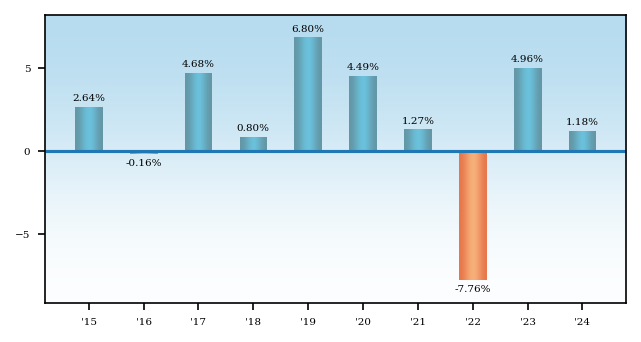
Best Quarter: | 2023, Q4: | 5.74% | Worst Quarter: | 2022, Q1: | -5.57% |
Average Annual Total Returns - Virtus Seix Tax-Exempt Bond Fund |
Label |
1 Year |
5 Years |
10 Years |
|---|---|---|---|---|
| Class A Shares | Return Before Taxes | (1.85%) | (0.09%) | 1.28% |
| Class C Shares | Return Before Taxes | 0.17% | (0.28%) | 0.80% |
| Class I Shares | Return Before Taxes | 1.18% | 0.72% | 1.81% |
| Class I Shares | After Taxes on Distributions | Return After Taxes on Distributions | 1.18% | 0.66% | 1.75% |
| Class I Shares | After Taxes on Distributions and Sales | Return After Taxes on Distributions and Sale of Fund Shares | 1.89% | 1.15% | 2.02% |
| Bloomberg Municipal Bond Index | Bloomberg Municipal Bond Index | 1.05% | 0.99% | 2.25% |
| Bloomberg U.S. Aggregate Bond Index | Bloomberg U.S. Aggregate Bond Index | 1.25% | (0.33%) | 1.35% |
| ICE BofA 1-22 Year U.S. Municipal Securities Index | ICE BofA 1-22 Year U.S. Municipal Securities Index | 1.44% | 1.17% | 2.18% |
Effective March 22, 2024, the Fund’s broad-based benchmark is the Bloomberg Municipal Bond Index replacing the Bloomberg U.S. Aggregate Bond Index. The subadviser believes that the Bloomberg Municipal Bond Index is more closely matched to the Fund’s principal investment strategy. The Bloomberg Municipal Bond Index is a market capitalization-weighted index that measures the long-term tax-exempt bond market. The index is calculated on a total return basis. The index is unmanaged and not available for direct investment.
The ICE BofA 1-22 Year US Municipal Securities Index is a subset of the ICE BofA US Municipal Securities Index including all securities with a remaining term to final maturity less than 22 years, calculated on a total return basis. The index is unmanaged and not available for direct investment.
After-tax returns are calculated using the historical highest individual federal marginal income tax rates and do not reflect the impact of state and local taxes. After-tax returns are shown only for Class I Shares; after-tax returns for other classes will vary. Actual after-tax returns depend on the investor’s tax situation and may differ from those shown. After-tax returns are not relevant to investors who hold fund shares in tax-deferred accounts or to shares held by non-taxable entities. In certain cases, the Return After Taxes on Distributions and Sale of Fund Shares for a period may be higher than other return figures for the same period. This will occur when a capital loss is realized upon the sale of fund shares and provides an assumed tax benefit that increases the return.