The fund has an investment objective of capital appreciation.
The tables below illustrate the fees and expenses that you may pay if you buy, hold and sell shares of the fund. You may pay other fees, such as brokerage commissions and other fees to financial intermediaries, which are not reflected in the tables and examples below. You may qualify for sales charge discounts in Class A Shares if you and your family invest, or agree to invest in the future, at least $50,000 in Virtus Funds. More information on these and other discounts is available: (i) from your financial professional or other financial intermediary; (ii) under “Sales Charges” on page 108 of the fund’s prospectus; and (iii) with respect to purchase of shares through specific intermediaries, in Appendix A to the fund’s prospectus, entitled “Intermediary Sales Charge Discounts and Waivers.”
Shareholder Fees - Virtus KAR Developing Markets Fund |
Class A Shares |
Class C Shares |
Class I Shares |
Class R6 Shares |
|
|---|---|---|---|---|---|
| Maximum Sales Charge Imposed on Purchases (as a percentage of Offering Price) | 5.50% | none | none | none | |
| Maximum Deferred Sales Charge (as a percentage of Offering Price) | none | 1.00% | [1] | none | none |
| [1] | The deferred sales charge is imposed on Class C Shares redeemed during the first year only. |
Annual Fund Operating Expenses - Virtus KAR Developing Markets Fund |
Class A Shares |
Class C Shares |
Class I Shares |
Class R6 Shares |
|
|---|---|---|---|---|---|
| Management Fees | 1.00% | 1.00% | 1.00% | 1.00% | |
| Distribution and Shareholder Servicing (12b-1) Fees | 0.25% | 1.00% | none | none | |
| Other Expenses | 3.52% | 3.44% | 3.50% | 3.42% | |
| Total Annual Fund Operating Expenses | 4.77% | 5.44% | 4.50% | 4.42% | |
| Less: Fee Waiver and/or Expense Reimbursement | [1] | (3.44%) | (3.36%) | (3.42%) | (3.39%) |
| Total Annual Fund Operating Expenses After Fee Waiver and/or Expense Reimbursement | [1] | 1.33% | 2.08% | 1.08% | 1.03% |
| [1] | The fund’s investment adviser has contractually agreed to limit the fund’s total operating expenses (excluding certain expenses, such as front-end or contingent deferred sales charges, taxes, leverage and borrowing expenses (such as commitment, amendment and renewal expenses on credit or redemption facilities), interest, brokerage commissions, expenses incurred in connection with any merger or reorganization, unusual or infrequently occurring expenses (such as litigation), acquired fund fees and expenses, and dividend expenses, if any) so that such expenses do not exceed 1.33% for Class A Shares, 2.08% for Class C Shares, 1.08% for Class I Shares and 1.03% for Class R6 Shares through January 31, 2026. Prior to January 31, 2026, only the fund’s Board may modify or terminate the expense limitation agreement. Following the contractual period, the adviser may discontinue these expense reimbursement arrangements at any time. Under certain conditions, the adviser may recapture operating expenses reimbursed and/or fees waived under these arrangements for a period of three years following the date such waiver or reimbursement occurred, provided that the recapture does not cause the fund to exceed its expense limit in effect at the time of the waiver or reimbursement, and any in effect at the time of recapture, after repayment is taken into account. |
This example is intended to help you compare the cost of investing in the fund with the cost of investing in other mutual funds. The example assumes that you invest $10,000 in the fund for the time periods indicated and then redeem all of your shares at the end of those periods or continued to hold them. The example also assumes that your investment has a 5% return each year, that the fund’s operating expenses remain the same and that the expense reimbursement agreement remains in place for the contractual period. Although your actual costs may be higher or lower, based on these assumptions your costs would be:
Expense Example - Virtus KAR Developing Markets Fund - USD ($) |
Class A Shares |
Class C Shares |
Class I Shares |
Class R6 Shares |
|---|---|---|---|---|
| 1 Year | $ 678 | $ 311 | $ 110 | $ 105 |
| 3 Years | 1,615 | 1,326 | 1,050 | 1,029 |
| 5 Years | 2,556 | 2,431 | 1,999 | 1,965 |
| 10 Years | $ 4,928 | $ 5,151 | $ 4,415 | $ 4,351 |
Expense Example, No Redemption - Virtus KAR Developing Markets Fund - USD ($) |
Class A Shares |
Class C Shares |
Class I Shares |
Class R6 Shares |
|---|---|---|---|---|
| 1 Year | $ 678 | $ 211 | $ 110 | $ 105 |
| 3 Years | 1,615 | 1,326 | 1,050 | 1,029 |
| 5 Years | 2,556 | 2,431 | 1,999 | 1,965 |
| 10 Years | $ 4,928 | $ 5,151 | $ 4,415 | $ 4,351 |
The fund pays transaction costs, such as commissions, when it buys and sells securities (or “turns over” its portfolio). A higher portfolio turnover rate may indicate higher transaction costs and may result in higher taxes when fund shares are held in a taxable account. These costs, which are not reflected in annual fund operating expenses or in the example, affect the fund’s performance. During the most recent fiscal year, the fund’s portfolio turnover rate was 25% of the average value of its portfolio.
The fund pursues capital appreciation in developing markets equities. The fund invests in a select group of developing markets companies believed by the subadviser to be undervalued relative to their future market growth potential. The investment strategy emphasizes companies that the subadviser believes to have a sustainable competitive advantage, strong management and low financial risk and to be able to grow over market cycles.
Under normal circumstances, the fund invests at least 80% of its assets in equity securities or equity-linked instruments of developing markets companies. Developing markets countries include emerging markets and frontier markets. The fund defines an “emerging market” primarily as any of the countries or markets represented in the MSCI Emerging Markets Index, and secondarily as any other country or market classified as an emerging economy by any supranational organization such as the World Bank, International Finance Corporation or the United Nations. In limited circumstances, the fund may consider to be an emerging market any country or market with similar emerging characteristics to the countries or markets represented in the MSCI Emerging Markets Index or classified as emerging by a supranational organization. The fund defines a “frontier market” primarily as any of the countries or markets represented in the MSCI Frontier Markets Index, and in limited circumstances the fund may consider to be a frontier market any other country or market with similar frontier market characteristics to those countries or markets represented in the MSCI Emerging Markets Index.
The fund intends to invest in various types of issuers and industries, and in a number of different countries. In determining whether an issuer is economically tied to a developing market, the subadviser primarily considers: (i) whether at least 50% of the issuer’s revenues or profits are attributable to goods produced or sold, investments made, or services performed in, a developing market; (ii) whether the issuer has at least 50% of its assets in a developing market; and (iii) whether the principal exchange listing for the issuer’s securities or the issuer’s headquarters is in a developing market. As of the date of this prospectus, the fund’s subadviser expects the fund to have significant investments in China, Brazil, India, Indonesia,Taiwan and South Korea. The particular countries in which the fund is invested may change over time.
Equity securities in which the fund invests include common stocks, preferred stocks, American Depositary Receipts (“ADRs”) and Global Depositary Receipts (“GDRs”). Additionally, the fund may invest in certain eligible Chinese securities (“China A Shares”) listed and traded on either the Shanghai Stock Exchange or the Shenzhen Stock Exchange. The fund expects to access China A Shares through the Shanghai-Hong Kong Stock Connect program or the Shenzhen-Hong Kong Stock Connect program (each a “Stock Connect”), as applicable. Equity-linked instruments are designed to perform generally the same as a specified stock index or “basket” of stocks, or a single stock. As of the date of this prospectus the equity-linked instruments in which the fund is expected to invest are participatory notes (“P-notes”). P-notes are equity-linked instruments used by investors to obtain exposure to non-U.S. equity investments without trading directly in the local market.
The fund may invest in companies of all market capitalizations. The subadviser does not use allocation models to restrict the fund’s investments to certain regions, countries or industries within the universe of developing market companies. Generally, the fund invests in approximately 30-60 securities at any given time. The fund seeks to dispose of holdings that, among other things, are the subject of negative developments individually or as an industry, or as necessary to provide funding for new holdings the subadviser deems more attractive. The fund is non-diversified under federal securities laws.
Risk Table - Virtus KAR Developing Markets Fund |
Risk [Text Block] |
|---|---|
| Risk Lose Money [Member] | If between the time you purchase shares and the time you sell shares the value of the fund’s investments decreases, you will lose money. |
| Equity Securities Risk | > Equity Securities Risk: The value of the stocks held by the fund may be negatively affected by the financial market, industries in which the fund invests, or issuer-specific events. Focus on a particular style or in small or medium-sized companies may enhance that risk. |
| Foreign Investing Risk | > Foreign Investing Risk: Investing in foreign securities subjects the fund to additional risks such as increased volatility; currency fluctuations; less liquidity; less publicly available information about the foreign investment; and political, regulatory, economic, and market risk. |
| Emerging Market Risk | > Emerging Market Risk: Emerging markets securities may be more volatile, or more greatly affected by negative conditions, than those of their counterparts in more established foreign markets. Such securities may also be subject to Sanctions Risk. |
| Sanctions Risk | > Sanctions Risk: The imposition of sanctions and other similar measures could cause a decline in the value and/or liquidity of securities issued by or tied to the sanctioned country and increase market volatility and disruption in the sanctioned country and throughout the world. Sanctions and other similar measures could limit or prevent the fund from buying and selling securities (in the sanctioned country and other markets), significantly delay or prevent the settlement of transactions, and negatively impact the fund’s liquidity and performance. |
| Risk Nondiversified Status [Member] | > Non-Diversification Risk: The fund is not diversified and may be more susceptible to factors negatively impacting its holdings to the extent the fund invests more of its assets in the securities of fewer issuers than would a diversified fund. |
| Market Volatility Risk | > Market Volatility Risk: The value of the securities in the fund may go up or down in response to the prospects of individual companies and/or general economic conditions. Price changes may be short- or long-term. Local, regional or global events such as war or military conflict (e.g., Russia’s invasion of Ukraine), acts of terrorism, the spread of infectious illness or other public health issue, recessions, or other events could have a significant impact on the fund and its investments, including hampering the ability of the fund’s portfolio manager(s) to invest the fund’s assets as intended. |
| Developing Market Risk | > Developing Market Risk: Developing markets securities may be more volatile, or more greatly affected by negative conditions, than those of their counterparts in more established foreign markets. |
| Small and Medium Market Capitalization Companies Risk | > Small and Medium Market Capitalization Companies Risk: The fund’s investments in small and medium market capitalization companies may increase the volatility and risk of loss to the fund, as compared with investments in larger, more established companies. |
| Large Market Capitalization Companies Risk | > Large Market Capitalization Companies Risk: The value of investments in larger companies may not rise as much as smaller companies, or larger companies may be unable to respond quickly to competitive challenges, such as changes in technology and consumer tastes. |
| Limited Number of Investments Risk | > Limited Number of Investments Risk: Because the fund may have a limited number of securities, it may be more susceptible to factors adversely affecting its securities than a fund with a greater number of securities. |
| Depositary Receipts Risk | > Depositary Receipts Risk: Investments in foreign companies through depositary receipts may expose the fund to the same risks as direct investments in securities of foreign issuers. |
| Currency Rate Risk | > Currency Rate Risk: Fluctuations in the exchange rates between the U.S. dollar and foreign currencies may negatively affect the value of the fund’s shares. |
| Geographic Investment Risk | > Geographic Investment Risk: To the extent the fund invests a significant portion of its assets in the securities of companies of a single country or region, it is more likely to be impacted by events or conditions affecting that country or region. |
| Geopolitical Risk | > Geopolitical Risk: Some countries and regions in which the fund invests have experienced security concerns, war or threats of war and aggression, terrorism, economic uncertainty, natural and environmental disasters and/or systemic market dislocations that have led, and in the future may lead, to increased short-term market volatility and may have adverse long-term effects on the U.S.and world economies and markets generally, each of which may negatively impact the fund’s investments. |
| Investing in China Risk | > Investing in China Risk: The government of China maintains strict currency controls in order to achieve economic, trade and political objectives and regularly intervenes in the currency market. The Chinese government also plays a major role in the country’s economic policies regarding foreign investments. Foreign investors are subject to the risk of loss from expropriation or nationalization of their investment assets and property, governmental restrictions on foreign investments and the repatriation of capital invested. In addition, the rapid growth rate of the Chinese economy over the past several years may not continue, and the trend toward economic liberalization and disparities in wealth may result in social disorder, including violence and labor unrest. These and other factors could have a negative impact on the fund’s performance and increase the volatility of an investment in the fund. Certain securities issued by companies located or operating in China, such as China A-shares, are also subject to trading restrictions, quota limitations and less market liquidity, which could pose risks to the fund. |
| Investing in Taiwan Risk | > Investing in Taiwan Risk: Taiwan’s geographic proximity and history of political contention with China have resulted in ongoing tensions between the two countries. These tensions may materially affect the Taiwanese economy and its securities market. Taiwan’s economy is export-oriented, so it depends on an open world trade regime and remains vulnerable to fluctuations in the world economy. Rising labor costs and increasing environmental consciousness have led some labor-intensive industries to relocate to countries with cheaper work forces, and continued labor outsourcing may adversely affect the Taiwanese economy. |
| Investing in South Korea Risk | > Investing in South Korea Risk: Investing in South Korean securities has special risks, including political, economic and social instability, and the potential for increasing militarization in North Korea. South Korea’s financial sector has shown certain signs of systemic weakness and illiquidity, which, if exacerbated, could prove to be a material risk for any investments in South Korea. South Korea is dependent on foreign sources for its energy needs. A significant increase in energy prices could have an adverse impact on South Korea’s economy. The South Korean government has historically exercised and continues to exercise substantial influence over many aspects of the private sector. |
| Investing in Brazil Risk | > Investing in Brazil Risk: Investment in Brazilian issuers involves risks that are specific to Brazil, including legal, regulatory, political, currency and economic risks. The Brazilian economy has historically been exposed to high rates of inflation and a high level of debt, each of which may reduce and/or prevent economic growth. |
| Investing in India Risk | > Investing in India Risk: Investments in Indian issuers involve risks that are specific to India, including legal, regulatory, political and economic risks. Political and legal uncertainty, greater government control over the economy, currency fluctuations or blockage, and the risk of nationalization or expropriation of assets may result in higher potential for losses. The securities markets in India are relatively underdeveloped and may subject the fund to higher transaction costs or greater uncertainty than investments in more developed securities markets. |
| Investing in Indonesia Risk | > Investing in Indonesia Risk: Investments in Indonesian issuers involve risks that are specific to Indonesia, including legal, regulatory, political, economic, currency, security,and natural disaster risks. Political and legal uncertainty, greater government control over the economy, currency fluctuations or blockage, and the risk of disruption to business operations due to national security events and/or natural disasters may result in higher potential for losses. The securities markets in Indonesia are relatively underdeveloped and may subject the fund to higher transaction costs or greater uncertainty than investments in more developed securities markets. In addition, the Indonesian economy is heavily dependent on trading relationships with certain key trading partners, including China, Japan, Singapore and the U.S. |
| Investing in Poland Risk | > Investing in Poland Risk: Investments in Polish issuers involve risks that are specific to Poland, including legal, regulatory, political, currency and economic risks. Among other things, Poland’s economy is still relatively undeveloped and is heavily dependent on relationships with certain key trading partners, including Germany and other European Union (“EU”) countries. As a result, Poland’s continued growth is dependent on the growth of these economies. |
| Equity-Linked Instruments Risk | > Equity-Linked Instruments Risk: The performance of equity-linked instruments is subject to similar risks to those of the referenced equity security, in addition to the risk that the equity-linked instruments fail to replicate the performance of the referenced equity security. Equity-linked instruments also expose the fund to counterparty risk, which could result in a loss of all or part of the fund’s investment. |
| Participatory Notes Risk | > Participatory Notes Risk: The performance of participatory notes (“P-notes”) will not replicate exactly the performance of the issuers that they seek to replicate due to transaction costs and other expenses, and P-notes are also subject to counterparty risk and liquidity risk. |
| Liquidity Risk | > Liquidity Risk: Certain instruments may be difficult or impossible to sell at a time and price beneficial to the fund. |
| Frontier Market Risk | > Frontier Market Risk: Frontier market countries generally have smaller economies and less developed capital markets or legal, regulatory and political systems than traditional emerging market countries. As a result, the risks of investing in emerging market countries are magnified in frontier market countries. |
| Redemption Risk | > Redemption Risk: One or more large shareholders or groups of shareholders may redeem their holdings in the fund, resulting in an adverse impact on remaining shareholders in the fund by causing the fund to take actions it would not otherwise have taken. |
| Preferred Stocks Risk | > Preferred Stocks Risk: Preferred stocks may decline in price, fail to pay dividends when expected, or be illiquid. |
The bar chart and table below provide some indication of the potential risks of investing in the fund. The fund’s past performance, before and after taxes, is not necessarily an indication of how the fund will perform in the future.
The bar chart shows changes in the fund’s performance from year to year over the life of the fund. The table shows how the fund’s average annual returns compare to those of a broad-based securities market index. Updated performance information is available at virtus.com or by calling 800-243-1574.
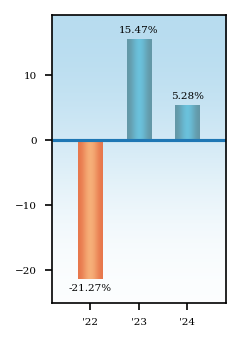
Best Quarter: | 2023, Q4: | 9.75% | Worst Quarter: | 2022, Q2: | -11.68% |
Average Annual Total Returns - Virtus KAR Developing Markets Fund |
Label |
1 Year |
Since Inception |
Inception Date |
|---|---|---|---|---|
| Class A Shares | Return Before Taxes | (0.62%) | (4.62%) | Jun. 22, 2021 |
| Class C Shares | Return Before Taxes | 4.27% | (3.83%) | Jun. 22, 2021 |
| Class I Shares | Return Before Taxes | 5.28% | (2.86%) | Jun. 22, 2021 |
| Class I Shares | After Taxes on Distributions | Return After Taxes on Distributions | 5.30% | (3.01%) | Jun. 22, 2021 |
| Class I Shares | After Taxes on Distributions and Sales | Return After Taxes on Distributions and Sale of Fund Shares | 3.96% | (1.94%) | Jun. 22, 2021 |
| Class R6 Shares | Return Before Taxes | 5.41% | (2.78%) | Jun. 22, 2021 |
| MSCI Emerging Markets Index (net) | MSCI Emerging Markets Index (net) | 7.50% | (3.73%) | Jun. 22, 2021 |
The MSCI Emerging Markets Index (net) is a free float-adjusted market capitalization-weighted index designed to measure equity market performance in the global emerging markets. The index is calculated on a total return basis with net dividends reinvested. The index is unmanaged and not available for direct investment.
After-tax returns are calculated using the historical highest individual federal marginal income tax rates and do not reflect the impact of state and local taxes. After-tax returns are shown only for Class I Shares; after-tax returns for other classes will vary. Actual after-tax returns depend on the investor’s tax situation and may differ from those shown. After-tax returns are not relevant to investors who hold fund shares in tax-deferred accounts or to shares held by non-taxable entities. In certain cases, the Return After Taxes on Distributions and Sale of Fund Shares for a period may be higher than other return figures for the same period. This will occur when a capital loss is realized upon the sale of fund shares and provides an assumed tax benefit that increases the return.