The Fund’s investment objective is capital appreciation.
This table describes the fees and expenses that you may pay if you buy, hold and sell shares of the Fund. You may pay other fees, such as brokerage commissions and other fees to financial intermediaries, which are not reflected in the tables and examples below. More information about these and other discounts is available from your financial intermediary and in How to Purchase Shares on page 10 of the Fund’s Prospectus.
Shareholder Fees - 13D Activist Fund |
13D Activist Fund Class A |
13D Activist Fund Class C |
13D Activist Fund Class I |
|---|---|---|---|
| Maximum Sales Charge (Load) Imposed on Purchases (as a % of offering price) | 5.75% | none | none |
| Maximum Deferred Sales Charge (Load) (as a % of original purchase price) | 1.00% | 1.00% | none |
| Maximum Sales Charge (Load) Imposed on Reinvested Dividends and other Distributions | none | none | none |
| Redemption Fee (as a % of amount redeemed, if sold within 30 days) | none | none | none |
Annual Fund Operating Expenses - 13D Activist Fund |
13D Activist Fund Class A |
13D Activist Fund Class C |
13D Activist Fund Class I |
|
|---|---|---|---|---|
| Management Fees | 1.50% | 1.50% | 1.50% | |
| Distribution and/or Service (12b-1) Fees | 0.25% | 1.00% | none | |
| Other Expenses | none | none | none | |
| Acquired Fund Fees and Expenses | [1] | 0.01% | 0.01% | 0.01% |
| Total Annual Fund Operating Expenses | [2] | 1.76% | 2.51% | 1.51% |
| [1] | Acquired Fund Fees and Expenses are the indirect costs of investing in other investment companies. This is the amount indirectly paid by the Fund to an unaffiliated money market fund to manage the Fund’s cash. |
| [2] | Total annual fund operating expenses do not correspond to the ratios of expenses to average net assets provided in the Fund’s most recent annual report, which do not include acquired fund fees and expenses. |
This Example is intended to help you compare the cost of investing in the Fund with the cost of investing in other mutual funds.
Expense Example - 13D Activist Fund - USD ($) |
Expense Example, with Redemption, 1 Year |
Expense Example, with Redemption, 3 Years |
Expense Example, with Redemption, 5 Years |
Expense Example, with Redemption, 10 Years |
|---|---|---|---|---|
| 13D Activist Fund Class A | 744 | 1,097 | 1,474 | 2,529 |
| 13D Activist Fund Class C | 254 | 782 | 1,335 | 2,846 |
| 13D Activist Fund Class I | 154 | 477 | 824 | 1,802 |
The Fund pays transaction costs, such as commissions, when it buys and sells securities (or “turns over” its portfolio). A higher portfolio turnover may indicate higher transaction costs and may result in higher taxes when Fund shares are held in a taxable account. These costs, which are not reflected in annual fund operating expenses or in the Example, affect the Fund’s performance. During the most recent fiscal year, the Fund’s portfolio turnover rate was 104% of the average value of its portfolio.
13D Management LLC (the “Adviser”), seeks to achieve the Fund’s investment objective by investing primarily in common stocks of U.S. companies of any market capitalization that are the target of shareholder activism. The Adviser defines an activist as an investor who holds or takes a long position in a company’s shares and either (A) has a history of activist investing and/or (B) has publicly disclosed a catalyst for change such as seeking board seats, improving operations and/or corporate governance practices, spinning-off an operating division or selling a significant amount of company assets (such an investor being referred to herein as an “activist”). The Adviser reviews all material activist situations and makes investment decisions based on its knowledge of the activist investor involved, the industry, the shareholder base, the activist’s average cost, its strategy and the Adviser’s determination of the chance of success and potential impact on share price. The Adviser only selects situations where the shareholder will be improving or participating in corporate governance or otherwise influencing management. Accordingly, approximately 75% of the Fund’s portfolio positions has historically had a shareholder representative on the board of directors who advocates for best-in-class corporate governance practices and a shareholder focused mentality. The Adviser does not only select companies with good corporate governance, because it believes there is more of a social and economic benefit in identifying poor corporate governance companies and supporting a transition to good corporate governance. Implementing best corporate governance practices can range from completely changing corporate culture to replacing entrenched, conflicted and self-dealing management teams. It is the Adviser’s experience that it is the governance element that also leads to environmental and social improvements in the business practices of the Fund’s portfolio companies. Every portfolio position contains an engaged investor and most contain a shareholder representative on the board of directors.
The Adviser uses the following selection guidelines to create and manage the Fund’s investment portfolio:
| Selecting Investment Universe: | Identify companies where an activist investor is involved. | |
| Weighting Investments: | Different weights will be given to each investment depending on the (i) type of activist intent stated, (ii) the activist involved, (iii) the industry involved, and (iv) the Adviser’s determination as to the chance of activist success. | |
| Exiting Investments: | Exiting an investment is an integral part of the investment strategy. The Adviser will exit a position when the activist indicates that it is exiting the investment, the activist becomes a passive investor, or in the Adviser’s opinion, the activist catalyst has changed or weakened. | |
While these guidelines will define the trading horizon, this horizon may change based on other events. For example, an early exit may be warranted after the activist has attained most of its goals, there has been a sufficient return on the investment, and there are other activist opportunities that the Adviser believes offer a better return. The Fund is non-diversified, which means that it may invest in fewer issuers than a diversified fund. The Adviser may engage in frequent buying and selling of securities in managing the Fund’s portfolio.
As with all mutual funds, there is the risk that you could lose money through your investment in the Fund. Many factors affect the Fund’s net asset value and performance.
| ● | Market and Geopolitical Risk: The increasing interconnectivity between global economies and financial markets increases the likelihood that events or conditions in one region or financial market may adversely impact issuers in a different country, region or financial market. Securities in the Fund’s portfolio may underperform due to inflation (or expectations for inflation), interest rates, global demand for particular products or resources, natural disasters, pandemics, epidemics, terrorism, international conflicts, regulatory events and governmental or quasi-governmental actions. The occurrence of global events similar to those in recent years, such as worldwide pandemic, terrorist attacks, natural disasters, social and political discord or debt crises and downgrades, among others, may result in market volatility and may have long term effects on both the U.S. and global financial markets. It is difficult to predict when similar events affecting the U.S. or global financial markets may occur, the effects that such events may have and the duration of those effects. Any such event(s) could have a significant adverse impact on the value and risk profile of the Fund. For example, COVID-19 global pandemic had negative impacts, and in many cases severe negative impacts, on markets worldwide. It is not known how long the impacts of the significant events described above, will last, but there could be a prolonged period of global economic slowdown, which may impact your Fund investment. Therefore, the Fund could lose money over short periods due to short-term market movements and over longer periods during more prolonged market downturns. During a general market downturn, multiple asset classes may be negatively affected. Changes in market conditions and interest rates can have the same impact on all types of securities and instruments. In times of severe market disruptions, you could lose your entire investment. The Adviser’s specialized research helps to mitigate this risk. In the event, activists have a period of significant underperformance, the Funds may also experience a period of underperformance. The Adviser endeavors to address this risk through diversification across several activists, activist styles, and strategies. |
| ● | Equity Securities Risk: The prices of equity and preferred securities fluctuate based on changes in a company’s financial condition and overall market and economic conditions. The value of equity securities purchased by the Fund could decline if the financial condition of the companies the Fund invests in decline or if overall market and economic conditions deteriorate. |
| ● | Non-Diversification Risk: The Fund is a non-diversified investment company, which makes the value of the Fund’s shares more susceptible to certain risks than shares of a diversified investment company. The Fund has a greater potential to realize losses upon the occurrence of adverse events affecting a particular issuer. |
| ● | Small and Medium Capitalization Company Risk: The value of small or medium capitalization company stocks may be subject to more abrupt or erratic market movements than those of larger, more established companies or the market averages in general. |
| ● | Conflicts of Interest Risk: The Adviser have conflicts of interest that could interfere with their management of the Fund. These conflicts, which are described in more detail in the Fund’s Statement of Additional Information (“SAI”). The principal owner of the Adviser also operates an institutional research firm which is under common control of the Adviser. The Adviser’s affiliate publishes reports on all material Fund filings to subscribers. The affiliate is not a registered investment adviser and the information contained in the reports is not organized or presented in a manner that suggests the holding, purchase or sale of any security. The subscribers to the reports are a variety of organizations including investment banks and law firms, many long/short hedge funds, large institutional investors, activist hedge funds, investor relations companies and proxy solicitors. Although the securities of companies described in the reports may be eligible for the Fund’s portfolio, the reports do not indicate whether or not securities of such companies will be bought or sold by the Fund. In addition, subscribers receive no nonpublic information regarding holdings of the Fund’s portfolio. However, subscribers may make their own investment decisions using information contained in the reports. If subscribers buy or sell securities that are described in the reports, this could negatively impact the price of securities bought or sold by the Fund. |
| ● | Management Risk: The Adviser’s dependence on its activist strategy and objective judgments about the attractiveness, value and potential appreciation of particular securities in which the Fund invests may prove to be incorrect as there is no guarantee that the Adviser’s investment strategy will produce the desired results. |
| ● | Regulatory Risk: Legal, tax, and regulatory developments may adversely affect the Fund. The regulatory environment for the Fund is evolving, and changes in the regulation of investment funds and other financial institutions or products, and their trading activities and capital markets, or a regulator’s disagreement with the Fund’s interpretation of the application of certain regulations, may adversely affect the ability of the Fund to pursue its investment strategy. |
The bar chart and performance table below show the variability of the Fund’s returns, which is some indication of the risks of investing in the Fund. The bar chart shows performance of the Fund’s Class I shares for each of the last ten full calendar years. Class A and Class C shares will be similar because they invest in the same portfolio of securities and underlying funds, but their performance will vary due to differences in fees. The performance table compares the performance of the Fund’s Class I, Class A and Class C shares over time to the performance of a broad-based securities market index and a supplement index. You should be aware that the Fund’s past performance (before and after taxes) may not be an indication of how the Fund will perform in the future. Updated performance information is available at no cost by visiting www.13DActivistFund.com or by calling 1-877-413-3228.
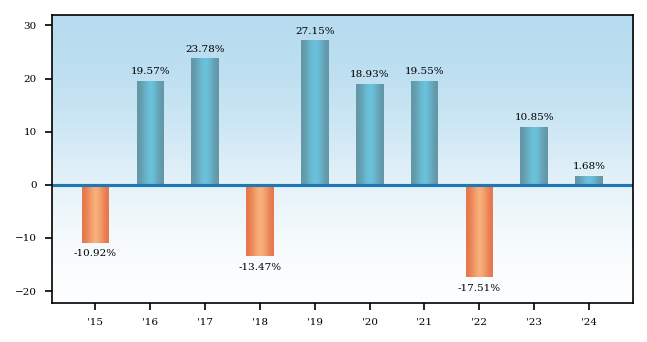
| Best Quarter | 2nd Quarter 2020 | 29.98% |
| Worst Quarter | 1st Quarter 2020 | (30.25)% |
Average Annual Total Returns - 13D Activist Fund |
Label |
1 Year |
5 Years |
10 Years |
|
|---|---|---|---|---|---|
| 13D Activist Fund Class I | return before taxes | 1.68% | 5.74% | 6.73% | |
| 13D Activist Fund Class I | return after taxes on distributions | 0.56% | 4.07% | 5.60% | ||
| 13D Activist Fund Class I | return after taxes on distributions and sale of Fund shares | 1.89% | 4.41% | 5.30% | ||
| 13D Activist Fund Class A | return before taxes with sales load | (4.42%) | 4.25% | 5.84% | |
| 13D Activist Fund Class C | return before taxes | 0.63% | 4.70% | 5.67% | |
| Russell 2500 Total Return Index | [1] | 11.99% | 8.77% | 8.85% | |
| Russell 2000Total Return Index | [2] | 11.54% | 7.40% | 7.82% | |
| [1] | The Russell 2500 Index is a broad index, featuring 2,500 stocks that cover the small- and mid-cap market capitalizations. It is a market cap- weighted index that includes the smallest 2,500 companies covered in the Russell 3000 universe of US-based listed equities. Investors cannot invest directly into the index. |
| [2] | The Russell 2000 Total Return Index is a broad index, featuring 2,000 stocks that cover the small market capitalizations. It is a market cap-weighted index that includes the smallest 2,000 companies covered in the Russell 3000 universe of US-based listed equities. This index has been selected as the Fund’s primary benchmark because it is more reflective of the Fund’s portfolio holdings. Investors cannot invest directly in an index or benchmark. |
After-tax returns were calculated using the historical highest individual federal marginal income tax rates and do not reflect the impact of state and local taxes. Actual after-tax returns depend on an investor’s tax situation and may differ from those shown, and after-tax returns shown are not relevant to investors who hold shares of the Fund through tax-deferred arrangements, such as 401(k) plans or Individual Retirement Accounts (IRAs). After tax returns for Class A and Class C shares, which are not shown, will vary from Class I shares.
| ● | Market and Geopolitical Risk: The increasing interconnectivity between global economies and financial markets increases the likelihood that events or conditions in one region or financial market may adversely impact issuers in a different country, region or financial market. Securities in the Fund’s portfolio may underperform due to inflation (or expectations for inflation), interest rates, global demand for particular products or resources, natural disasters, pandemics, epidemics, terrorism, international conflicts, regulatory events and governmental or quasi-governmental actions. The occurrence of global events similar to those in recent years, such as worldwide pandemic, terrorist attacks, natural disasters, social and political discord or debt crises and downgrades, among others, may result in market volatility and may have long term effects on both the U.S. and global financial markets. It is difficult to predict when similar events affecting the U.S. or global financial markets may occur, the effects that such events may have and the duration of those effects. Any such event(s) could have a significant adverse impact on the value and risk profile of the Fund. For example, COVID-19 global pandemic had negative impacts, and in many cases severe negative impacts, on markets worldwide. It is not known how long the impacts of the significant events described above, will last, but there could be a prolonged period of global economic slowdown, which may impact your Fund investment. Therefore, the Fund could lose money over short periods due to short-term market movements and over longer periods during more prolonged market downturns. During a general market downturn, multiple asset classes may be negatively affected. Changes in market conditions and interest rates can have the same impact on all types of securities and instruments. In times of severe market disruptions, you could lose your entire investment. The Adviser’s specialized research helps to mitigate this risk. In the event, activists have a period of significant underperformance, the Funds may also experience a period of underperformance. The Adviser endeavors to address this risk through diversification across several activists, activist styles, and strategies. |
| ● | Equity Securities Risk: The prices of equity and preferred securities fluctuate based on changes in a company’s financial condition and overall market and economic conditions. The value of equity securities purchased by the Fund could decline if the financial condition of the companies the Fund invests in decline or if overall market and economic conditions deteriorate. |
| ● | Non-Diversification Risk: The Fund is a non-diversified investment company, which makes the value of the Fund’s shares more susceptible to certain risks than shares of a diversified investment company. The Fund has a greater potential to realize losses upon the occurrence of adverse events affecting a particular issuer. |
| ● | Small and Medium Capitalization Company Risk: The value of small or medium capitalization company stocks may be subject to more abrupt or erratic market movements than those of larger, more established companies or the market averages in general. |
| ● | Conflicts of Interest Risk: The Adviser have conflicts of interest that could interfere with their management of the Fund. These conflicts, which are described in more detail in the Fund’s Statement of Additional Information (“SAI”). The principal owner of the Adviser also operates an institutional research firm which is under common control of the Adviser. The Adviser’s affiliate publishes reports on all material Fund filings to subscribers. The affiliate is not a registered investment adviser and the information contained in the reports is not organized or presented in a manner that suggests the holding, purchase or sale of any security. The subscribers to the reports are a variety of organizations including investment banks and law firms, many long/short hedge funds, large institutional investors, activist hedge funds, investor relations companies and proxy solicitors. Although the securities of companies described in the reports may be eligible for the Fund’s portfolio, the reports do not indicate whether or not securities of such companies will be bought or sold by the Fund. In addition, subscribers receive no nonpublic information regarding holdings of the Fund’s portfolio. However, subscribers may make their own investment decisions using information contained in the reports. If subscribers buy or sell securities that are described in the reports, this could negatively impact the price of securities bought or sold by the Fund. |
| ● | Management Risk: The Adviser’s dependence on its activist strategy and objective judgments about the attractiveness, value and potential appreciation of particular securities in which the Fund invests may prove to be incorrect as there is no guarantee that the Adviser’s investment strategy will produce the desired results. |
| ● | Regulatory Risk: Legal, tax, and regulatory developments may adversely affect the Fund. The regulatory environment for the Fund is evolving, and changes in the regulation of investment funds and other financial institutions or products, and their trading activities and capital markets, or a regulator’s disagreement with the Fund’s interpretation of the application of certain regulations, may adversely affect the ability of the Fund to pursue its investment strategy. |