Northeast Investors Trust is a no load high yield bond fund whose primary objective is the production of income. Capital appreciation is also an objective of the Trust but its achievement must be compatible with the primary objective.
These tables describe the fees and expenses that you may pay if you buy and hold shares of the Trust.
Shareholder Fees |
NORTHEAST INVESTORS TRUST
NORTHEAST INVESTORS TRUST SHARES
USD ($)
|
|---|---|
| Maximum Sales Charge (Load) Imposed on Purchases | none |
| Maximum Deferred Sales Charge (Load) | none |
| Maximum Sales Charge (Load) Imposed on Reinvested Dividends | none |
| Redemption Fee | none |
Annual Fund Operating Expenses |
NORTHEAST INVESTORS TRUST
NORTHEAST INVESTORS TRUST SHARES
|
|
|---|---|---|
| Trustees’ Fees | 0.50% | [1] |
| Distribution (12b-1) Fees | none | |
| Interest Expense | 0.06% | |
| Operating Expense | 1.58% | |
| Other Expenses | 1.64% | |
| Total Annual Trust Operating Expenses | 2.14% | |
| [1] | The Trustees are responsible for the portfolio management of the Trust. |
This example is intended to help you compare the cost of investing in the Trust with the cost of investing in other mutual funds. The example assumes that you invest $10,000 in the Trust for the time periods indicated and redeem at the end of the period. The example also assumes that your investment has a 5% return each year, including reinvested dividends and capital gains distributions, and that the Trust’s operating expenses remain the same. Although your actual costs may be higher or lower, based on these assumptions your costs would be:
Expense Example |
Expense Example, with Redemption, 1 Year |
Expense Example, with Redemption, 3 Years |
Expense Example, with Redemption, 5 Years |
Expense Example, with Redemption, 10 Years |
|---|---|---|---|---|
| NORTHEAST INVESTORS TRUST | NORTHEAST INVESTORS TRUST SHARES | USD ($) | 217 | 670 | 1,149 | 2,472 |
The Trust pays transaction costs, such as commissions, when it buys or sells securities (or ‘turns over’ its portfolio). A higher portfolio turnover rate may result in higher transaction costs. These costs, which are not reflected in annual Trust operating expenses or in the example, may affect the Trust’s investment performance. Also, a higher portfolio turnover rate may result in an elevated level of capital gains. During the most recent fiscal year, the Trust’s portfolio turnover rate was 27.83% of the average value of its portfolio.
The Trust invests primarily in marketable securities of established companies which the Trust’s portfolio managers believe provide income and which, where consistent with the objective, may have potential for capital appreciation. These investments may include bonds which may be purchased at a discount or premium, preferred securities, common stocks, convertible securities and securities with warrants attached. The Trust’s portfolio emphasizes high yield corporate bonds (sometimes referred to as ‘junk bonds’) which are unrated or rated as lower than investment grade by either of the two principal rating services. Equity investments, which are generally acquired via corporate debt restructurings, are considered for their potential for appreciation.
The following performance related information provides some indication of the risks of investing in the Trust. The table shows the average annual returns (including operating expenses) compared with those of a relevant market index for the periods indicated. The table also presents the impact of taxes on the Trust’s returns. After-tax returns are calculated using the historical highest individual federal marginal income tax rates and do not reflect the impact of state or local income taxes. Return after taxes on distributions and sale of Trust shares may be higher than other returns for the same period due to the tax benefit of realizing a capital loss on the sale of Trust shares. Actual after-tax returns depend on the individual investor’s tax situation and may differ from those shown below. The bar chart illustrates how the Trust’s performance (including operating expenses) varied from one calendar year to another over the past ten years.
The after-tax returns shown below are not relevant to investors who own the Trust in a tax-deferred account, such as an individual retirement account (IRA) or a 401(k) plan, because such accounts are subject to taxes only upon distribution. Keep in mind that past performance – whether before taxes or after taxes – does not guarantee future results.
The following bar chart shows the change in value of the Trust’s shares over the past 10 years. It illustrates how the returns can differ from one year to the next. The Trust may experience short-term swings of performance as suggested by the best and worst calendar quarter returns shown below.
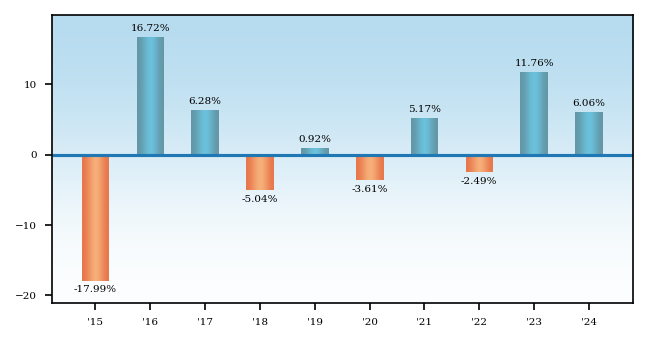
| : 2nd quarter 2016, up | : 1st quarter 2016, down 10.32% |
Average Annual Total Returns - NORTHEAST INVESTORS TRUST |
1 Year |
5 Years |
10 Years |
|
|---|---|---|---|---|
| NORTHEAST INVESTORS TRUST SHARES | 6.06% | 3.22% | 1.34% | |
| NORTHEAST INVESTORS TRUST SHARES | After Taxes on Distributions | 3.67% | 0.91% | (1.07%) | |
| NORTHEAST INVESTORS TRUST SHARES | After Taxes on Distributions and Sales | 3.55% | 1.40% | (0.08%) | |
| ICE Bank of America Merrill Lynch U.S. High Yield Index | [1] | 8.20% | 4.04% | 5.08% |
| [1] | The ICE Bank of America Merrill Lynch U.S. High Yield Index is an unmanaged market capitalization-weighted index comprised of all domestic and yankee high-yield bonds, including deferred interest bonds and payment-in-kind securities. Bonds included in the index have maturities of one year or more and have a below investment grade rating, but are not in default. It is shown for comparative purposes only and reflects no deductions for fees, expenses or taxes. |
Risks of Lower Rated or Unrated Debt Securities: Lower rated or unrated debt securities (sometimes referred to as “high yield” or “junk” bonds) may be subject to more market volatility than higher rated debt securities, which can present an increased risk of investment loss. Prices of high yield bonds are generally more negatively sensitive to a decline of domestic and global economic activity, which may adversely affect the issuer’s perceived or actual ability to make current interest or principal (maturity) payments.
Equity Risk: To the extent the Trust holds equity securities, it runs the risk that general deterioration in equity markets or in a particular holding may result in the Trust’s stock holdings to decline and its net asset value per share to fall.
Income Risk: Falling interest rates and bond defaults may negatively impact the Trust’s distributable income. In addition, during periods of declining interest rates, higher yielding securities may be called and the Trust may be unable to reinvest those proceeds in similar yielding securities. Therefore, shareholders should expect the Trust’s quarterly dividend distributions to decline under these circumstances.
Indemnification Risk: Under the Trust’s Declaration of Trust, its officers and trustees are indemnified against certain liabilities arising out of the performance of their duties to the Trust.
In addition, in the normal course of business, the Trust enters into contracts that provide general indemnifications to other parties. The Trust’s maximum exposure under these contractual arrangements is unknown as this would involve future claims that may be made against the Trust that have not yet occurred. However, based on experience, the Trust expects the risk of loss from these third party service contracts with indemnification clauses to be minimal.
Interest Rate Risk: The value of debt securities, generally, moves inversely to the rise and fall of interest rates. Longer-term debt securities are more sensitive to changes in interest rates than those with shorter maturities. Therefore, shareholders should generally expect the Trust’s net asset value per share to decline during periods of rising interest rates.
Issuer Risk: The value of a specific security may decline for reasons directly related to the issuer, such as management performance, financial leverage or a reduced demand for its products or services.
Liquidity Risk: The market for high yield debt securities is generally less liquid than markets for higher rated fixed income instruments, which may present more difficulty in valuing or selling these securities timely at a desired price, especially during times of elevated market volatility. General market volatility can lead to an unexpected rise in investor redemptions from the Trust and across the asset class which in turn may contribute to the illiquidity of high yield debt markets and an increase to liquidity risk. The Trust may have difficulty in the timely disposal of securities at current prices during periods of elevated market illiquidity leading to a decline of its net asset value.
Market Risk: There is the risk that the value of the securities owned by the Trust may go up or down, sometimes sharply or unpredictably, due to factors, both domestic and foreign, affecting securities markets in general or affecting particular sectors. There is a risk that you could lose money by investing in the Trust, and there is no assurance that it will achieve its investment objectives. The Trust is generally for investors with longer-term investment horizons, and should not be used for short term trading purposes. An investment in the Trust involves risk and should be part of a balanced investment program.