The fund seeks to provide high income and capital appreciation.
This table describes the fees and expenses that you may pay if you buy, hold, and sell shares of the fund. You may also incur brokerage commissions and other charges when buying or selling shares of the fund, which are not reflected in the table or example below.
Shareholder Fees - T. Rowe Price Emerging Markets Local Currency Bond Fund - USD ($) |
Investor Class |
I Class |
Advisor Class |
Z Class |
|
|---|---|---|---|---|---|
| Maximum account fee | $ 20 | [1] | none | none | none |
| [1] | Subject to certain exceptions and account minimums, accounts are charged an annual $20 fee. |
Annual Fund Operating Expenses - T. Rowe Price Emerging Markets Local Currency Bond Fund |
Investor Class |
I Class |
Advisor Class |
Z Class |
||||
|---|---|---|---|---|---|---|---|---|
| Management fees | 0.64% | 0.64% | 0.64% | 0.64% | ||||
| Distribution and service (12b-1) fees | none | none | 0.25% | none | ||||
| Other expenses | 0.43% | 0.14% | [1] | 19.61% | 0.13% | |||
| Total annual fund operating expenses | 1.07% | 0.78% | 20.50% | 0.77% | ||||
| Fee waiver/expense reimbursement | (0.05%) | [2] | (0.09%) | [1] | (19.40%) | [3] | (0.77%) | [4] |
| Total annual fund operating expenses after fee waiver/expense reimbursement | 1.02% | [2] | 0.69% | [1] | 1.10% | [3] | none | [4] |
| [1] | T. Rowe Price Associates, Inc., has contractually agreed (through April 30, 2026) to pay the operating expenses of the fund’s I Class excluding management fees; interest; expenses related to borrowings, taxes, and brokerage; nonrecurring, extraordinary expenses; and acquired fund fees and expenses (I Class Operating Expenses), to the extent the I Class Operating Expenses exceed 0.05% of the class’ average daily net assets. The agreement may only be terminated at any time after April 30, 2026, with approval by the fund’s Board of Directors. Any expenses paid under this agreement (and any applicable prior limitations) are subject to reimbursement to T. Rowe Price Associates, Inc., by the class whenever the I Class Operating Expenses are below 0.05%. However, the class will not reimburse T. Rowe Price Associates, Inc., more than three years from the date such amounts were initially waived or paid. The class may only reimburse T. Rowe Price Associates, Inc., if the reimbursement does not cause the I Class Operating Expenses (after the reimbursement is taken into account) to exceed the current expense limitation on I Class Operating Expenses (or the expense limitation in place at the time the amounts were waived or paid). |
| [2] | T. Rowe Price Associates, Inc., has contractually agreed (through April 30, 2026) to waive its fees and/or bear any expenses (excluding interest; expenses related to borrowings, taxes, and brokerage; nonrecurring, extraordinary expenses; and acquired fund fees and expenses) that would cause the class’ ratio of expenses to average daily net assets to exceed 1.02%. The agreement may only be terminated at any time after April 30, 2026, with approval by the fund’s Board of Directors. Fees waived and expenses paid under this agreement (and any applicable prior limitations) are subject to reimbursement to T. Rowe Price Associates, Inc., by the class whenever the class’ expense ratio is below 1.02%. However, the class will not reimburse T. Rowe Price Associates, Inc., more than three years from the date such amounts were initially waived or paid. The class may only reimburse T. Rowe Price Associates, Inc., if the reimbursement does not cause the class’ expense ratio (after the reimbursement is taken into account) to exceed the class’ current expense limitation (or the expense limitation in place at the time the amounts were waived or paid). |
| [3] | T. Rowe Price Associates, Inc., has contractually agreed (through April 30, 2026) to waive its fees and/or bear any expenses (excluding interest; expenses related to borrowings, taxes, and brokerage; nonrecurring, extraordinary expenses; and acquired fund fees and expenses) that would cause the class’ ratio of expenses to average daily net assets to exceed 1.10%. The agreement may only be terminated at any time after April 30, 2026, with approval by the fund’s Board of Directors. Fees waived and expenses paid under this agreement (and any applicable prior limitations) are subject to reimbursement to T. Rowe Price Associates, Inc., by the class whenever the class’ expense ratio is below 1.10%. However, the class will not reimburse T. Rowe Price Associates, Inc., more than three years from the date such amounts were initially waived or paid. The class may only reimburse T. Rowe Price Associates, Inc., if the reimbursement does not cause the class’ expense ratio (after the reimbursement is taken into account) to exceed the class’ current expense limitation (or the expense limitation in place at the time the amounts were waived or paid). |
| [4] | T. Rowe Price Associates, Inc., has contractually agreed to waive and/or bear all the Z Class’ expenses (excluding interest; expenses related to borrowings, taxes, and brokerage; nonrecurring, extraordinary expenses; and acquired fund fees and expenses) in their entirety. T. Rowe Price Associates, Inc., expects this fee waiver and/or expense reimbursement arrangement to remain in place indefinitely, and the agreement may only be amended or terminated with approval by the fund’s Board of Directors. |
Expense Example - T. Rowe Price Emerging Markets Local Currency Bond Fund - USD ($) |
Investor Class |
I Class |
Advisor Class |
Z Class |
|---|---|---|---|---|
| 1 Year | $ 104 | $ 70 | $ 112 | none |
| 3 Years | 335 | 239 | 3,519 | none |
| 5 Years | 584 | 423 | 6,207 | none |
| 10 Years | $ 1,300 | $ 956 | $ 10,027 | none |
Portfolio Turnover The fund pays transaction costs, such as commissions, when it buys and sells securities (or “turns over” its portfolio). A higher portfolio turnover rate may indicate higher transaction costs and may result in higher taxes when the fund’s shares are held in a taxable account. These costs, which are not reflected in annual fund operating expenses or in the example, affect the fund’s performance. During the most recent fiscal year, the fund’s portfolio turnover rate was 75.2% of the average value of its portfolio.
Under normal conditions, at least 80% of the fund’s net assets (plus any borrowings for investment purposes) are invested in bonds that are denominated in emerging markets currencies, and in derivative instruments that provide investment exposure to such securities. Emerging market bonds include fixed rate and floating rate bonds that are issued by governments, government agencies, and supranational organizations of, and corporate issuers located in or conducting the predominant part of their business activities in, the emerging market countries of Latin America, Asia, Europe, Africa, and the Middle East. The fund considers frontier markets to be a subset of emerging markets and any investments in frontier markets are counted toward the fund’s 80% investment policy. For purposes of the fund’s 80% investment policy, the fund relies on a classification by either JPMorgan or the International Monetary Fund to determine which countries are considered emerging markets, and the fund relies on Bloomberg or another unaffiliated data provider to determine the country assigned to a security. Any derivatives that provide exposure to the investment focus suggested by the fund’s name, or to one or more market risk factors associated with the investment focus suggested by the fund’s name, are counted (as applicable) toward compliance with the fund’s 80% investment policy.
Investment decisions are based on fundamental research as well as market factors, such as yield and credit quality differences among bonds as well as supply and demand trends and currency values. The fund generally invests in securities where the combination of fixed-income returns and currency exchange rates appears attractive or, if the currency trend is unfavorable, where the adviser believes the currency risk can be minimized through hedging. The fund may purchase bonds of any credit quality and there are no overall limits on the fund’s investments in bonds that are unrated or rated below investment-grade (also known as “junk” bonds).
The fund may use a variety of derivatives, such as futures, forwards, and swaps for a number of purposes such as for exposure or hedging. Specifically, the fund uses forward currency exchange contracts, currency options, interest rate swaps, interest rate futures, credit default swaps, credit default swap indexes (CDX), and inflation swaps.
Through the use of currency derivative instruments such as forward currency exchange contracts, currency swaps, foreign currency options, and currency futures, the fund has wide flexibility to purchase and sell currencies independently of whether the fund owns bonds in those currencies and to engage in currency hedging transactions. The fund’s currency positions will vary with its outlook on the strength or weakness of one foreign currency compared to another foreign currency and the relative value of various foreign currencies to one another. Currency
hedging is permitted, but not required, and the fund will normally be heavily exposed to foreign currencies. The fund may take a short position in a currency, which allows the fund to sell a currency in excess of the value of its holdings denominated in that currency or sell a currency even if it does not hold any assets denominated in the currency. In addition, the fund may use interest rate swaps and futures in order to take long or short positions with respect to its exposure to a particular country or bond market, subject to the investment restrictions applicable to futures and swaps.
The fund may use credit default swaps to buy or sell credit protection on individual bond issuers or sectors of the bond markets. Credit default swaps may be used to replicate the exposure of a bond or portfolio of bonds and as a hedge against a default or other credit event involving one of the fund’s holdings. A CDX is a swap on an index of credit default swaps. CDXs allow the fund to manage credit risk or take a position on a basket of credit entities (such as credit default swaps or a reference index) rather than transacting in a single-name credit default swap. Inflation swaps, which are tied to a designated inflation index such as the Consumer Price Index (CPI), would typically be used to manage the fund’s inflation risk.
The fund is nondiversified, which means it may invest a greater percentage of its assets in a particular issuer than is permissible for a diversified fund.
Risk Table - T. Rowe Price Emerging Markets Local Currency Bond Fund |
Risk [Text Block] |
|---|---|
| Risk Lose Money [Member] | The fund’s share price fluctuates, which means you could lose money by investing in the fund. |
| Emerging markets | Emerging markets: Investments in emerging market countries are subject to greater risk and overall volatility than investments in the U.S. and other developed markets. Emerging market countries tend to have economic structures that are less diverse and mature, less developed legal and regulatory regimes, and political systems that are less stable, than those of developed countries. In addition to the risks associated with investing outside the U.S., emerging markets are more susceptible to governmental interference, political and economic uncertainty, local taxes and restrictions on the fund’s investments, less efficient trading markets with lower overall liquidity, and more volatile currency exchange rates. |
| Currency exposure | Currency exposure: Because the fund invests in holdings denominated in foreign currencies, the fund is subject to the significant risk that it could experience losses based solely on the weakness of foreign currencies versus the U.S. dollar and changes in the exchange rates between such currencies and the U.S. dollar. |
| Market conditions | Market conditions: The value of the fund’s investments may decrease, sometimes rapidly or unexpectedly, due to factors affecting an issuer held by the fund, particular industries, or the overall securities markets. A variety of factors can increase the volatility of the fund’s holdings and markets generally, including economic, political, or regulatory developments, recessions, inflation, rapid interest rate changes, war, military conflict, acts of terrorism, natural disasters, and outbreaks of infectious illnesses or other widespread public health issues (such as the coronavirus pandemic) and related governmental and public responses (including sanctions). Certain events may cause instability across global markets, including reduced liquidity and disruptions in trading markets, while some events may affect certain geographic regions, countries, sectors, and industries more significantly than others. Government intervention in markets may impact interest rates, market volatility, and security pricing. These adverse developments may cause broad declines in market value due to short-term market movements or for significantly longer periods during more prolonged market downturns. |
| Foreign investing | Foreign investing: Non-U.S. securities tend to be more volatile and have lower overall liquidity and trading volume than investments in U.S. securities and may lose value because of adverse local, political, social, or economic developments overseas, or due to changes in the exchange rates between foreign currencies and the U.S. dollar. Further, securities of non-U.S. issuers are subject to trading markets with potential governmental interference, varying regulatory, auditing, and accounting standards, and settlement and clearance practices that differ from those of U.S. issuers. Investment in non-U.S. securities also carries currency risk. Any attempts to hedge currency risk could be unsuccessful. Such investments may have higher transaction costs compared with U.S. markets. The fund’s overall foreign investing risk is increased to the extent it has exposure to emerging markets. |
| Fixed income markets | Fixed income markets: Economic and other market developments can adversely affect the fixed income securities markets. At times, participants in these markets may develop concerns about the ability of certain issuers of debt instruments to make timely principal and interest payments, or they may develop concerns about the ability of financial institutions that make markets in certain debt instruments to facilitate an orderly market. Those concerns could cause increased volatility and reduced liquidity in particular securities or in the overall fixed income markets and the related derivatives markets. A lack of liquidity or other adverse credit market conditions may hamper the fund’s ability to sell the debt instruments in which it invests or to find and purchase suitable debt instruments. |
| Credit quality | Credit quality: An issuer of a debt instrument could suffer an adverse change in financial condition that results in a payment default (failure to make scheduled interest or principal payments), rating downgrade, or inability to meet a financial obligation. Securities that are rated below investment grade carry greater risk of default and should be considered speculative. |
| Junk investing | Junk investing: Investments in bonds that are rated below investment grade, commonly referred to as junk bonds, expose the fund to greater volatility and credit risk than investments in bonds that are rated investment grade. As a result, bonds rated below investment grade carry a higher risk of default and should be considered speculative. |
| Interest rates | Interest rates: A rise in interest rates typically causes the price of a fixed rate debt instrument to fall and its yield to rise. Conversely, a decline in interest rates typically causes the price of a fixed rate debt instrument to rise and the yield to fall. The prices and yields of inflation-linked bonds are directly impacted by the rate of inflation as well as changes in interest rates. Generally, funds with longer weighted average maturities and durations carry greater interest rate risk. Changes in monetary policy made by central banks and/or governments are likely to affect the interest rates or yields of the securities in which the fund invests. |
| Liquidity | Liquidity: The fund may not be able to meet requests to redeem shares issued by the fund without significant dilution of the remaining shareholders’ interests in the fund. In addition, the fund may not be able to sell a holding in a timely manner at a desired price. Reduced liquidity in the bond markets can result from a number of events, such as limited trading activity, reductions in bond inventory, and rapid or unexpected changes in interest rates. Markets with lower overall liquidity could lead to greater price volatility and limit the fund’s ability to sell a holding at a suitable price. |
| Derivatives | Derivatives: The use of derivatives exposes the fund to additional volatility and potential losses. A derivative involves risks different from, and possibly greater than, the risks associated with investing directly in the assets on which the derivative is based, including liquidity risk, valuation risk, correlation risk, market risk, interest rate risk, leverage risk, counterparty and credit risk, operational risk, management risk, legal risk, and regulatory risk. Derivatives can be highly volatile, illiquid, and difficult to value, and changes in the value of a derivative may not properly correlate with changes in the value of the underlying asset, reference rate, or index. The fund could be exposed to significant losses if it is unable to close a derivatives position due to the lack of a liquid secondary trading market. The prices of derivatives may move in unexpected ways, especially in abnormal market conditions. Certain derivatives are also subject to counterparty risk, which is the risk that the derivative counterparty will not fulfill its contractual obligations. The use of derivatives includes the risk of potential operational issues, such as settlement issues. Derivatives are exposed to legal risks, such as the legality or enforceability of a contract. The adviser may not be able to accurately predict the direction of prices, economic factors, or other associated risks which could cause loss in value or impair the fund’s efforts to reduce overall volatility. New regulations may make derivatives more costly, limit availability, or otherwise affect their value or performance. |
| Hedging | Hedging: The fund’s attempts at hedging and taking long and short positions in currencies may not be successful and could cause the fund to lose money or fail to get the benefit of a gain on a hedged position. If expected changes to securities prices, interest rates, currency values and exchange rates, or the creditworthiness of an issuer are not accurately predicted, the fund could be in a worse position than if it had not entered into such transactions. |
| Frontier markets | Frontier markets: Frontier markets generally have smaller economies and less mature capital markets than emerging markets. As a result, the risks associated with investing in emerging market countries are magnified in frontier market countries. Frontier markets are more susceptible to abrupt changes in currency values, have less mature markets and settlement practices, and can have lower trading volumes that could lead to greater price volatility and illiquidity. Investor protections in frontier market countries may be limited and settlement procedures and custody services may prove inadequate in certain markets. |
| Investing in Asia | Investing in Asia: Many Asian economies have at various times been negatively affected by inflation, currency devaluations, an over-reliance on international trade and exports, particularly for certain commodities, political and social instability, and less developed financial systems and securities trading markets. Trade restrictions, unexpected decreases in exports, changes in government policies, expropriation and/or nationalization of assets, confiscatory taxation, or natural disasters could have a significant impact on companies doing business in Asia. The Asian region may be significantly affected by political unrest, military conflict, economic sanctions, and less demand for Asian products and services. |
| Risk Nondiversified Status [Member] | Nondiversification: As a nondiversified fund, the fund has the ability to invest a larger percentage of its assets in the securities of a smaller number of issuers than a diversified fund. As a result, poor performance by a single issuer could adversely affect fund performance more than if the fund were invested in a larger number of issuers. The fund’s share price can be expected to fluctuate more than that of a similar fund that is more broadly diversified. |
| Active management | Active management: The fund’s overall investment program and holdings selected by the fund’s investment adviser may underperform the broad markets, relevant indices, or other funds with similar objectives and investment strategies. |
| Cybersecurity breaches | Cybersecurity breaches: The fund could be harmed by intentional cyberattacks and other cybersecurity breaches, including unauthorized access to the fund’s assets, confidential information, or other proprietary information. In addition, a cybersecurity breach could cause one of the fund’s service providers or financial intermediaries to suffer unauthorized data access, data corruption, or loss of operational functionality. |
The following performance information provides some indication of the risks of investing in the fund. The fund’s performance information represents only past performance (before and after taxes) and is not necessarily an indication of future results.
The following bar chart illustrates how much returns can differ from year to year by showing calendar year returns and the best and worst calendar quarter returns during those years for the fund’s Investor Class. Returns for other share classes vary since they have different expenses.
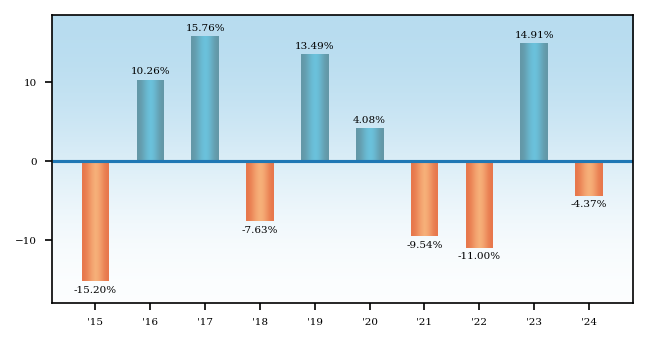
Quarter Ended | Total Return | Quarter Ended | Total Return | |||||
Best Quarter | 6/30/20 | 11.49% | Worst Quarter | 3/31/20 | -16.55% |
The following table shows the average annual total returns for each class of the fund that has been in operation for at least one full calendar year. The fund’s performance information included in the table is compared with a regulatory required index that represents an overall securities market (Regulatory Benchmark). In addition, the table may also include one or more indexes that more closely aligns to the fund’s investment strategy (Strategy Benchmark(s)).
In addition, the table shows hypothetical after-tax returns to demonstrate how taxes paid by a shareholder may influence returns. After-tax returns are calculated using the historical highest individual federal marginal income tax rates and do not reflect the impact of state and local taxes. Actual after-tax returns depend on an investor’s tax situation and may differ from those shown. After-tax returns shown are not relevant to investors who hold their fund shares through tax-deferred arrangements, such as a 401(k) account or an IRA. After-tax returns are shown only for the Investor Class and will differ for other share classes.
Average Annual Total Returns - T. Rowe Price Emerging Markets Local Currency Bond Fund |
Label |
1 Year |
5 Years |
10 Years |
Since Inception |
Inception Date |
||
|---|---|---|---|---|---|---|---|---|
| Investor Class | (4.37%) | (1.64%) | 0.44% | May 26, 2011 | ||||
| Investor Class | After Taxes on Distributions | (5.54%) | (2.50%) | (0.38%) | |||||
| Investor Class | After Taxes on Distributions and Sales | (2.57%) | (1.55%) | 0.03% | |||||
| I Class | (4.06%) | (1.39%) | 2.63% | Dec. 17, 2015 | ||||
| Advisor Class | (4.46%) | (1.81%) | 0.23% | May 26, 2011 | ||||
| Z Class | (3.39%) | (1.55%) | Feb. 22, 2021 | |||||
| Bloomberg Global Aggregate Bond Index | [1] | Bloomberg Global Aggregate Bond Index | ||||||
| Bloomberg Global Aggregate Bond Index | [2] | 0.56% | ||||||
| Bloomberg Global Aggregate Bond Index | (1.69%) | (1.96%) | 0.15% | (4.25%) | [3] | |||
| J.P. Morgan GBI - EM Global Diversified | J.P. Morgan GBI - EM Global Diversified | |||||||
| J.P. Morgan GBI - EM Global Diversified | [2] | 2.31% | ||||||
| J.P. Morgan GBI - EM Global Diversified | (2.38%) | (1.86%) | 0.43% | (2.45%) | [3] | |||
| Lipper Emerging Market Local Currency Debt Funds Average | Lipper Emerging Market Local Currency Debt Funds Average | |||||||
| Lipper Emerging Market Local Currency Debt Funds Average | [4] | 2.39% | ||||||
| Lipper Emerging Market Local Currency Debt Funds Average | (1.45%) | (1.20%) | 0.53% | (1.24%) | [5] | |||
| [1] | Due to new SEC Rules on shareholder reporting, the fund adopted a new broad-based securities market index, referred to as the Regulatory Benchmark. |
| [2] | Return since 12/17/15. |
| [3] | Return since 2/22/21. |
| [4] | Return since 12/31/15. |
| [5] | Return since 02/28/21. |