This table describes the fees and expenses that you may pay if you buy, hold, and sell shares of the Fund. You may pay other fees, such as brokerage commissions and other fees to financial intermediaries, which are not reflected in the tables and examples below. You may qualify for sales charge discounts if you and certain members of your family invest, or agree to invest in the future, at least $50,000 in the Lord Abbett Family of Funds. More information about these and other discounts is available from your financial intermediary and in “Sales Charge Reductions and Waivers” on page 231 of the prospectus, Appendix A to the prospectus, titled “Intermediary-Specific Sales Charge Reductions and Waivers,” and “Purchases, Redemptions, Pricing, and Payments to Dealers” on page 9-1 of Part II of the statement of additional information (“SAI”).
Shareholder Fees - Prospectus Summary - Lord Abbett Health Care Fund |
Class A Shares |
Class C Shares |
Class F Shares |
Class F3 Shares |
Class I Shares |
Class R2 Shares |
Class R3 Shares |
Class R4 Shares |
Class R5 Shares |
Class R6 Shares |
|||
|---|---|---|---|---|---|---|---|---|---|---|---|---|---|
| Maximum Sales Charge Imposed on Purchases (as a percentage of Offering Price) | [1] | 5.75% | none | none | none | none | none | none | none | none | none | ||
| Maximum Deferred Sales Charge (as a percentage of Offering Price) | [1] | none | [2] | 1.00% | [3] | none | none | none | none | none | none | none | none |
| [1] | A shareholder transacting in share classes without a front-end sales charge may be required to pay a commission to its financial intermediary. Please contact your financial intermediary for more information about whether such a commission may apply to your transaction. |
| [2] | A contingent deferred sales charge (“CDSC”) of 1.00% may be assessed on certain Class A shares purchased or acquired without a sales charge if they are redeemed before the first day of the month in which the one-year anniversary of the purchase falls. |
| [3] | A CDSC of 1.00% may be assessed on Class C shares if they are redeemed before the first anniversary of their purchase. |
Annual Fund Operating Expenses - Prospectus Summary - Lord Abbett Health Care Fund |
Class A Shares |
Class C Shares |
Class F Shares |
Class F3 Shares |
Class I Shares |
Class R2 Shares |
Class R3 Shares |
Class R4 Shares |
Class R5 Shares |
Class R6 Shares |
|||||
|---|---|---|---|---|---|---|---|---|---|---|---|---|---|---|---|
| Management Fees | 0.62% | 0.62% | 0.62% | 0.62% | 0.62% | 0.62% | 0.62% | 0.62% | 0.62% | 0.62% | |||||
| Distribution and Service (12b-1) Fees | 0.25% | 1.00% | 0.10% | none | none | 0.60% | 0.50% | 0.25% | none | none | |||||
| Other Expenses | 2.47% | 2.47% | 2.47% | 2.37% | 2.47% | 2.47% | 2.47% | 2.47% | 2.47% | 2.37% | |||||
| Total Annual Fund Operating Expenses | 3.34% | 4.09% | 3.19% | 2.99% | [1] | 3.09% | 3.69% | 3.59% | 3.34% | [1] | 3.09% | 2.99% | [1] | ||
| Fee Waiver and/or Expense Reimbursement | [2] | (2.31%) | (2.31%) | (2.41%) | [3] | (2.31%) | (2.31%) | (2.31%) | (2.31%) | (2.31%) | (2.31%) | (2.31%) | |||
| Total Annual Fund Operating Expenses After Fee Waiver and/or Expense Reimbursement | [2] | 1.03% | 1.78% | 0.78% | 0.68% | [1] | 0.78% | 1.38% | 1.28% | 1.03% | 0.78% | 0.68% | [1] | ||
| [1] | These amounts have been updated from fiscal year amounts to reflect current fees and expenses. |
| [2] | For the period from March 1, 2025 through February 28, 2026, Lord, Abbett & Co. LLC (“Lord Abbett”) has contractually agreed to waive its fees and reimburse expenses to the extent necessary to limit total net annual operating expenses, excluding any applicable 12b-1 fees, acquired fund fees and expenses, interest-related expenses, taxes, expenses related to litigation and potential litigation, and extraordinary expenses, to an annual rate of 0.68% for each of Class F3 and R6 shares and to an annual rate of 0.78% for each other class. This agreement may be terminated only by the Fund’s Board of Trustees. |
| [3] | For the period from March 1, 2025 through February 28, 2026, Lord Abbett Distributor LLC (“Lord Abbett Distributor”) has contractually agreed to waive the Fund’s 0.10% Rule 12b-1 fee for Class F shares. This agreement may be terminated only by the Fund’s Board of Trustees. |
This Example is intended to help you compare the cost of investing in the Fund with the cost of investing in other mutual funds. The Example assumes that you invest $10,000 in the Fund for the time periods indicated and then redeem all of your shares at the end of those periods. The Example also assumes that your investment has a 5% return each year and that the Fund’s operating expenses remain the same, giving effect to the fee waiver and expense reimbursement arrangement described above. Class C shares automatically convert to Class A shares after eight years. The expense example for Class C shares for the ten-year period reflects the conversion to Class A shares. Although your actual costs may be higher or lower, based on these assumptions your costs would be:
Expense Example - Prospectus Summary - Lord Abbett Health Care Fund - USD ($) |
Class A Shares |
Class C Shares |
Class F Shares |
Class F3 Shares |
Class I Shares |
Class R2 Shares |
Class R3 Shares |
Class R4 Shares |
Class R5 Shares |
Class R6 Shares |
|---|---|---|---|---|---|---|---|---|---|---|
| 1 Year | $ 674 | $ 281 | $ 80 | $ 69 | $ 80 | $ 140 | $ 130 | $ 105 | $ 80 | $ 69 |
| 3 Years | 1,340 | 1,033 | 757 | 706 | 736 | 915 | 886 | 811 | 736 | 706 |
| 5 Years | 2,027 | 1,901 | 1,458 | 1,368 | 1,418 | 1,710 | 1,662 | 1,541 | 1,418 | 1,368 |
| 10 Years | $ 3,849 | $ 3,979 | $ 3,327 | $ 3,144 | $ 3,239 | $ 3,791 | $ 3,702 | $ 3,474 | $ 3,239 | $ 3,144 |
Expense Example, No Redemption - Prospectus Summary - Lord Abbett Health Care Fund - USD ($) |
Class A Shares |
Class C Shares |
Class F Shares |
Class F3 Shares |
Class I Shares |
Class R2 Shares |
Class R3 Shares |
Class R4 Shares |
Class R5 Shares |
Class R6 Shares |
|---|---|---|---|---|---|---|---|---|---|---|
| 1 Year | $ 674 | $ 181 | $ 80 | $ 69 | $ 80 | $ 140 | $ 130 | $ 105 | $ 80 | $ 69 |
| 3 Years | 1,340 | 1,033 | 757 | 706 | 736 | 915 | 886 | 811 | 736 | 706 |
| 5 Years | 2,027 | 1,901 | 1,458 | 1,368 | 1,418 | 1,710 | 1,662 | 1,541 | 1,418 | 1,368 |
| 10 Years | $ 3,849 | $ 3,979 | $ 3,327 | $ 3,144 | $ 3,239 | $ 3,791 | $ 3,702 | $ 3,474 | $ 3,239 | $ 3,144 |
Under normal conditions, the Fund invests at least 80% of its net assets, plus the amount of any borrowings for investment purposes, in equity and equity-related securities of health care-related companies. The Fund considers health care-related companies to be those companies that operate in, or are related to, the major subsectors of the health care sector, including pharmaceuticals, biotechnology, health care technology, life sciences tools and services, health care equipment and supplies, and health care providers and services. The Fund’s allocation among these areas will vary based on the portfolio management team’s outlook for the particular subsector and the health care sector overall. The Fund normally invests at least 25% of its total assets, in the aggregate, in the following industry groups: health care equipment and services and pharmaceuticals, biotechnology, and life sciences. The Fund may invest in the securities of issuers of different countries throughout the world, including the United States.
The Fund’s portfolio management team utilizes bottom-up fundamental research to identify health care-related companies where the long term earnings growth potential is underestimated. In identifying investments for the Fund, the portfolio management team evaluates the health care industry and regulatory conditions and seeks to invest in securities the portfolio management team believes have favorable reward-to-risk characteristics. In making investment decisions, the portfolio management team utilizes the information provided by, and the expertise of, Lord Abbett’s equity research analysts in combination with insights from Lord Abbett’s
credit research analysts. The investment team may also consider the risks and return potential presented by environmental, social, and governance (“ESG”) factors in investment decisions. The Fund may engage in active and frequent trading of its portfolio securities.
Equity securities in which the Fund may invest include common stocks, preferred stocks, equity interests in trusts (including real estate investment trusts and privately offered trusts), partnerships, joint ventures, limited liability companies and vehicles with similar legal structures, other instruments convertible or exercisable into the foregoing, and other investments with similar economic characteristics.
The Fund may invest in U.S. and non-U.S. (including emerging market) companies, the securities of which may be traded on U.S. or non-U.S. securities exchanges (or may not be traded on any securities exchange), may be denominated in the U.S. dollar or other currencies, and may include American Depositary Receipts (“ADRs”) and other similar depositary receipts. The Fund also may invest in supranational organizations. The Fund has no geographical limitations on investments or any limit on the amount of assets that may be invested in any single country.
The Fund may invest in corporate debt securities of U.S. issuers and non-U.S. (including emerging market) issuers. The Fund also may invest in various types of structured securities, including, but not limited to, participation notes and structured notes to gain exposure to certain securities, currencies, or markets.
Consistent with its investment objective and policies, the Fund may invest in derivatives. The Fund may use derivatives for risk management purposes, including to hedge against a decline in the value of certain investments and to adjust the investment characteristics of its portfolio. The Fund also may invest in derivatives for non-hedging purposes to increase its investment return or income. For example, the Fund may manage cash by investing in futures or other derivatives that provide efficient short-term investment exposure to broad equity markets. Some examples of the types of derivatives in which the Fund may invest are forward contracts, futures, options, and swap agreements.
The Fund may sell a security when the Fund believes the security is less likely to benefit from the current market and economic environment, or shows signs of deteriorating fundamentals, among other reasons. The Fund may deviate from the investment strategy described above for temporary defensive purposes. The Fund may miss certain investment opportunities if defensive strategies are used and thus may not achieve its investment objective.
Risk Table - Prospectus Summary - Lord Abbett Health Care Fund |
Risk [Text Block] |
|---|---|
| Risk Lose Money [Member] | As with any investment in a mutual fund, investing in the Fund involves risk, including the risk that you may receive little or no return on your investment. When you redeem your shares, they may be worth more or less than what you paid for them, which means that you may lose a portion or all of the money you invested in the Fund. |
| Risk Not Insured [Member] | An investment in the Fund is not a deposit of any bank and is not insured or guaranteed by the Federal Deposit Insurance Corporation or any other government agency. |
| · Portfolio Management Risk | · Portfolio Management Risk: If the strategies used and investments selected by the Fund’s portfolio management team fail to produce the intended result, the Fund may suffer losses or underperform other funds with the same investment objective or strategies, even in a favorable market. |
| · Market Risk | · Market Risk: The market values of securities will fluctuate, sometimes sharply and unpredictably, based on overall economic conditions, governmental actions or intervention, market disruptions caused by trade disputes or other factors, political developments, and other factors. Prices of equity securities tend to rise and fall more dramatically than those of debt securities. |
| · Health Care Sector Risk | · Health Care Sector Risk: The Fund is subject to the risks faced by companies in the health care sector, including companies in the health care equipment and services industry and the pharmaceuticals, biotechnology, and life sciences industry. Investments in companies in the health care sector are subject to the general risks associated with the health care sector, including, among others, changes in government regulations, dependence on patents and intellectual property rights, industry and pricing competition, long and costly processes for obtaining new product approval by the U.S. Food and Drug Administration (the “FDA”), and extensive research and development, marketing, and sales costs. In addition, the Fund is subject to specific risks associated with its investments in companies in the health care equipment and services industry and the pharmaceuticals, biotechnology, and life science industry, which are discussed in more detail below. · Health Care Equipment and Services Industry Risk – Companies in the health care equipment and services industry, including health care providers, may have difficulty obtaining staff to deliver services and may be subject to an increased emphasis on the delivery of health care through outpatient services. Competition is high among health care equipment companies and can be significantly affected by extensive government regulation or government reimbursement for medical expenses. · Pharmaceuticals, Biotechnology and Life Sciences Industry Risk – Companies in the pharmaceuticals, biotechnology, and life sciences industry face the risks of new technologies and competitive pressures and regulations and restrictions imposed by the FDA, the U.S. Environmental Protection Agency, state and local governments, and foreign regulatory authorities. Stock prices of biotechnology companies may be volatile, particularly when their products are up for regulatory approval or under regulatory scrutiny. |
| · Concentration Risk | · Concentration Risk: Because the Fund invests a significant portion of its assets in securities issued by health care-related companies, developments affecting the health care industry will likely have a disproportionate impact on the Fund. |
| · Equity Securities Risk | · Equity Securities Risk: Equity securities, as well as equity-like securities such as convertible debt securities, may experience significant volatility. Such securities may fall sharply in response to adverse events affecting overall markets, a particular industry or sector, or an individual company’s financial condition. |
| · Foreign and Emerging Market Company Risk | · Foreign and Emerging Market Company Risk: Investments in foreign companies and in U.S. companies with economic ties to foreign markets generally involve special risks. These companies may be more vulnerable to economic, political, and social instability and subject to less government supervision, lack of transparency, inadequate regulatory and accounting standards, and foreign taxes. Foreign company securities also include ADRs, which may be less liquid than the underlying shares in their primary trading market. Foreign securities also may subject the Fund’s investments to changes in currency exchange rates. Emerging market securities generally are more volatile than other foreign securities, and are subject to greater liquidity, regulatory, and political risks. Investments in emerging markets may be considered speculative and generally are riskier than investments in more developed markets. Emerging markets are more likely to experience hyperinflation and currency devaluations. Securities of emerging market companies may have far lower trading volumes and less liquidity than securities of issuers in developed markets. In certain emerging market countries, governments participate to a significant degree in their respective economies. Action by these governments could have a significant adverse effect on market prices of securities and payment of dividends. Companies with economic ties to emerging markets may be susceptible to the same risks as companies organized in emerging markets. |
| · Foreign Currency Risk | · Foreign Currency Risk: Investments in securities that are denominated or receiving revenues in foreign currencies are subject to the risk that those currencies will decline in value relative to the U.S. dollar, or, in the case of hedged positions, that the U.S. dollar will decline in value relative to the currency being hedged. Foreign currency exchange rates may fluctuate significantly over short periods of time. |
| · Structured Securities Risk | · Structured Securities Risk: Investments in structured securities, which are a type of instrument designed to offer a return linked to particular underlying securities, currencies, or markets, involve the same risks associated with direct investments in the underlying securities or instruments they seek to replicate, as well as additional risks. For example, among others, the Fund is subject to the risk that the issuer or the counterparty of the structured security may be unable to perform under the terms of the instrument. In addition, there can be no assurance that the structured securities will trade at the same price or have the same value as the underlying securities or instruments. The secondary markets on which the structured securities are traded may be less liquid than the market for other securities, or may be completely illiquid. Therefore, the Fund may be exposed to the risks of mispricing or improper valuation. |
| · Fixed Income Securities Risk | · Fixed Income Securities Risk: The Fund is subject to the general risks and considerations associated with investing in debt securities, including the risk that issuers will fail to make timely payments of principal or interest or default altogether. Lower-rated securities in which the Fund may invest may be more volatile and may decline more in price in response to negative issuer developments or general economic news due to their increased credit risk relative to other fixed-income investments. In addition, as interest rates rise, the Fund’s investments typically will lose value. |
| · Credit Risk | · Credit Risk: Debt securities are subject to the risk that the issuer or guarantor of a security may not make interest and principal payments as they become due or may default altogether. In addition, if the market perceives a deterioration in the creditworthiness of an issuer, the value and liquidity of securities issued by that issuer may decline. To the extent that the Fund holds below investment grade securities, these risks may be heightened. Insured debt securities have the credit risk of the insurer in addition to the credit risk of the underlying investment being insured. |
| · Interest Rate Risk | · Interest Rate Risk: As interest rates rise, prices of bonds (including tax-exempt bonds) generally fall, typically causing the Fund’s investments to lose value. Additionally, rising interest rates or lack of market participants may lead to decreased liquidity in fixed income markets. Interest rate changes generally have a more pronounced effect on the market value of fixed-rate instruments, such as corporate bonds, than they have on floating rate instruments, and typically have a greater effect on the price of fixed income securities with longer durations. A wide variety of market factors can cause interest rates to rise, including central bank monetary policy, rising inflation, and changes in general economic conditions. |
| · Derivatives Risk | · Derivatives Risk: The risks associated with derivatives may be different from and greater than the risks associated with directly investing in securities and other investments. Derivatives may increase the Fund’s volatility and reduce its returns. Derivatives may not perform as expected and the Fund may not realize the intended benefits. Whether the Fund’s use of derivatives is successful may depend on, among other things, the portfolio managers’ ability to correctly forecast market movements, company and industry valuation levels and trends, changes in foreign exchange and interest rates, and other factors. If the portfolio managers incorrectly forecast these and other factors, the Fund’s performance could suffer. In addition, given their complexity, derivatives are subject to the risk that improper or misunderstood documentation may expose the Fund to losses. |
| · Liquidity/Redemption Risk | · Liquidity/Redemption Risk: The Fund may lose money when selling securities at inopportune times to fulfill shareholder redemption requests. The risk of loss may increase depending on the size and frequency of redemption requests, whether the redemption requests occur in times of overall market turmoil or declining prices, and whether the securities the Fund intends to sell have decreased in value or are illiquid. The Fund may be less able to sell illiquid securities at its desired time or price. It may be more difficult for the Fund to value its investments in illiquid securities than more liquid securities. |
| · High Portfolio Turnover Risk | · High Portfolio Turnover Risk: High portfolio turnover may result in increased transaction costs, reduced investment performance, and higher taxes resulting from increased realized capital gains, including short-term capital gains taxable as ordinary income when distributed to shareholders. |
The bar chart and table below provide some indication of the risks of investing in the Fund by illustrating the variability of the Fund’s returns. Each assumes reinvestment of dividends and distributions. The Fund’s past performance, before and after taxes, is not necessarily an indication of how the Fund will perform in the future. No performance is shown for Class R2 shares because the Fund has no Class R2 shares outstanding.
The bar chart shows changes in the performance of the Fund’s Class A shares from calendar year to calendar year. This chart does not reflect the sales charge applicable to Class A shares. If the sales charge were reflected, returns would be lower. Performance for the Fund’s other share classes will vary due to the different expenses each class bears. Updated performance information is available at www.lordabbett.com or by calling 888-522-2388.
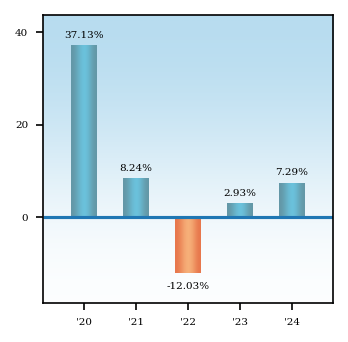
Best Quarter 2nd Q 2020 +21.46% Worst Quarter 1st Q 2020 -11.37%
The table below shows how the Fund’s average annual total returns compare to the returns of securities market indices with investment characteristics similar to those of the Fund as well as to a broad-based securities market index.1 The Fund’s average annual total returns include applicable sales charges.
The after-tax returns of Class A shares included in the table below are calculated using the historical highest individual federal marginal income tax rates and do not reflect the impact of state and local taxes. In some cases, the return after taxes on distributions and sale of Fund shares may exceed the return before taxes due to a tax benefit resulting from realized losses on a sale of Fund shares at the end of the period that is used to offset other gains. Actual after-tax returns depend on an investor’s tax situation and may differ from those shown. The after-tax returns shown are not relevant to investors who hold their Fund shares through tax-advantaged arrangements such as 401(k) plans or Individual Retirement Accounts (“IRAs”). After-tax returns for other share classes are not shown in the table and will vary from those shown for Class A shares.
1 The Fund has adopted the MSCI ACWI Net Index as its broad-based securities market index.
Average Annual Total Returns - Prospectus Summary - Lord Abbett Health Care Fund |
Label |
1 Year |
5 Years |
Since Inception |
Inception Date |
|
|---|---|---|---|---|---|---|
| Class A Shares | 1.14% | 6.33% | 7.32% | Jul. 31, 2019 | ||
| Class A Shares | After Taxes on Distributions | 1.06% | 4.92% | 6.01% | |||
| Class A Shares | After Taxes on Distributions and Sales | 0.72% | 4.44% | 5.29% | |||
| Class C Shares | [1] | 5.48% | 6.79% | 7.69% | Jul. 31, 2019 | |
| Class F Shares | 7.52% | 7.85% | 8.76% | Jul. 31, 2019 | ||
| Class F3 Shares | 7.74% | 7.99% | 8.90% | Jul. 31, 2019 | ||
| Class I Shares | 7.59% | 7.86% | 8.77% | Jul. 31, 2019 | ||
| Class R3 Shares | 7.01% | 7.33% | 8.23% | Jul. 31, 2019 | ||
| Class R4 Shares | 7.24% | 7.58% | 8.50% | Jul. 31, 2019 | ||
| Class R5 Shares | 7.54% | 7.85% | 8.77% | Jul. 31, 2019 | ||
| Class R6 Shares | 7.74% | 8.00% | 8.91% | Jul. 31, 2019 | ||
| MSCI ACWI Health Care Index with Net Dividends | MSCI ACWI Health Care Index with Net Dividends | 1.07% | 5.81% | 7.83% | Jul. 31, 2019 | |
| MSCI ACWI Health Care Index with Gross Dividends | MSCI ACWI Health Care Index with Gross Dividends | 1.53% | 6.30% | 8.32% | Jul. 31, 2019 | |
| MSCI All Country World Index with Net Dividends | MSCI All Country World Index with Net Dividends | 17.49% | 10.06% | 10.93% | Jul. 31, 2019 | |
| [1] | Class C shares convert to Class A shares eight years after purchase. Class C share performance does not reflect the impact of such conversion to Class A shares. |