The fund seeks to provide monthly income.
This table describes the fees and expenses that you may pay if you buy, hold, and sell shares of the fund. You may also incur brokerage commissions and other charges when buying or selling shares of the fund, which are not reflected in the table or example below.
Portfolio Turnover The fund pays transaction costs, such as commissions, when it buys and sells securities (or “turns over” its portfolio). A higher portfolio turnover rate may indicate higher transaction costs and may result in higher taxes when the fund’s shares are held in a taxable account. These costs, which are not reflected in annual fund operating expenses or in the example, affect the fund’s performance. During the most
recent fiscal year, the fund’s portfolio turnover rate was 39.6% of the average value of its portfolio.
The fund pursues its objective(s) by investing in a diversified portfolio of other T. Rowe Price stock and bond mutual funds that represent various asset classes and sectors. The fund’s allocation among T. Rowe Price mutual funds will change over time in relation to its target retirement date.
The fund is managed based on the specific retirement year (target date 2025) included in its name and assumes a retirement age of 65. The target date refers to the approximate year an investor in the fund would plan to retire and likely stop making new investments in the fund. The fund is designed for an investor who retired at or about the target date and who plans to withdraw the value of the account in the fund gradually after retirement while taking regular monthly cash distributions throughout retirement using a managed payout program. However, if an investor retires earlier or later than age 65, the fund may not be an appropriate investment even if the investor retires on or near the fund’s target date.
While the fund employs an asset allocation strategy based on an investor retiring near the target date, the fund also employs a managed payout program designed to distribute a consistent amount of cash once per month throughout each calendar year, excluding any additional distributions required to comply with applicable law. The managed payout program targets making twelve equal monthly payments that are expected to produce an annual payout of approximately 5% of the fund’s average net asset value over the trailing five years (or, until the fund has five years of operating history, the historical monthly performance of the applicable share class of the T. Rowe Price Retirement 2025 Fund which is a similarly managed fund). The monthly payment amount per share is expected to remain constant from month to month for a particular calendar year. The amount of the fund’s scheduled monthly distribution amount per share for a particular calendar year will generally increase or decrease each January based on the fund’s historical monthly performance over the previous five years. The twelve monthly payments that are distributed to shareholders are generally not eligible to be reinvested.
The fund’s managed payout program is designed to provide a higher level of income earlier in retirement, although a tradeoff of targeting a higher level of income earlier in retirement is that the income stream ultimately may not keep pace with inflation. While the fund will continue to target a 5% distribution rate, the income stream received from the fund later in retirement may decrease at a time when the overall costs of goods and services could continue to increase. Although the fund is designed for shareholders who are at or nearing retirement age, all fund shareholders will receive the monthly cash distributions regardless of age and retirement status. The fund’s Board of Directors may change the managed payout program without a shareholder vote if the Board of Directors determines such a change would be in the best interest of shareholders.
Over time, the allocation to asset classes and funds will change according to a predetermined “glide path” shown in the following chart (the left axis indicates the overall neutral allocation to
stocks with the remainder of the allocation to bonds). The glide path represents the shifting of asset classes over time and shows how the fund’s asset mix becomes more conservative–both prior to and after retirement–as time elapses. This reflects the need for reduced market risks as retirement approaches and the need for lower portfolio volatility after retiring. Although the glide path is meant to dampen the fund’s potential volatility as retirement approaches, the fund is not designed for a lump sum redemption at the retirement date. The fund pursues an asset allocation strategy that promotes asset accumulation prior to retirement, but it is intended to also serve as a post-retirement investment vehicle with allocations designed to support an income stream made up of regular distributions throughout retirement along with some portfolio growth. After the target date, the fund is designed to balance longevity and inflation risks along with the need for income, although it does not guarantee a particular level of income.
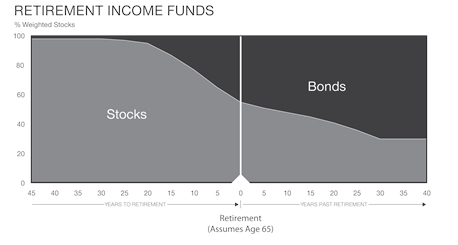
The glide path provides for a neutral allocation to stocks at the target date of 55%. The fund’s overall exposure to stocks will continue to decline until approximately 30 years after its target date, when its neutral allocations to stocks and bonds will remain unchanged. There are no maturity restrictions within the fund’s overall allocation to bonds, although the underlying bond funds in which the fund invests may impose specific limits on maturity or credit quality. The allocations are referred to as “neutral” allocations because they do not reflect any tactical decisions made by T. Rowe Price to overweight or underweight a particular asset class or sector based on its market outlook. The target allocations assigned to the broad asset classes (Stocks and Bonds), which reflect these tactical decisions resulting from market outlook, are not expected to vary from the neutral allocations set forth in the glide path by more than plus or minus 5%. The target allocations and actual allocations may differ due to significant market movements or cash flows.
The following table illustrates how the portfolio is generally expected to be allocated between the asset classes and the underlying T. Rowe Price mutual funds that are used to represent the broad asset classes and specific sectors. The fund invests in the Z Class of each of its
underlying funds. T. Rowe Price is contractually obligated to waive and/or bear all of the Z Class’ expenses, with certain limited exceptions. The fund’s overall allocation to stocks is represented by a diversified mix of U.S. and international stock funds that employ both growth and value investment approaches and consist of large-cap, mid-cap, and small-cap stocks. The fund’s overall allocation to bonds is represented by a “core” fixed income component designed to have lower overall volatility and a “diversifying” fixed income component designed to respond to a variety of market conditions and improve risk adjusted returns. The information in the table represents the neutral allocations for the fund as of March 1, 2025. The numbers may not add to 100% due to rounding. Updated allocations between stock funds and bond funds, and actual allocations to the individual T. Rowe Price mutual funds, are available through troweprice.com. T. Rowe Price may periodically rebalance or modify the asset mix of the underlying funds and change the underlying fund allocations.
Retirement Income 2025 Fund | |||||||
Asset Class |
| Sector(s) | Neutral Allocation | Underlying Fund(s) | |||
|
|
|
|
|
|
|
|
Stocks | 55.51 | % | Hedged Equity | 5.41 | % | Hedged Equity | |
|
|
| Inflation Focused | 2.78 |
| Real Assets | |
|
|
| International Developed Market | 12.07 |
| International Stock, | |
|
|
|
|
|
| International Value Equity, and/or | |
|
|
|
|
|
| Overseas Stock | |
|
|
| International Emerging Market | 2.13 |
| Emerging Markets Discovery Stock and/or | |
|
|
|
|
|
| Emerging Markets Stock | |
|
|
| U.S. Large-Cap | 26.50 |
| Equity Index 500, | |
|
|
|
|
|
| Growth Stock, | |
|
|
|
|
|
| U.S. Large-Cap Core, and/or | |
|
|
|
|
|
| Value | |
|
|
| U.S. Mid-Cap | 3.31 |
| Mid-Cap Growth, | |
|
|
|
|
|
| Mid-Cap Index, and/or | |
|
|
|
|
|
| Mid-Cap Value | |
|
|
| U.S. Small-Cap | 3.31 |
| New Horizons, | |
|
|
|
|
|
| Small-Cap Index, | |
|
|
|
|
|
| Small-Cap Stock, and/or | |
|
|
|
|
|
| Small-Cap Value | |
Bonds | 44.51 |
| Core Fixed Income | 24.33 |
| Dynamic Global Bond, | |
|
|
|
|
|
| International Bond (USD Hedged), and/or | |
|
|
|
|
|
| New Income | |
|
|
| Diversifying Fixed Income | 20.18 |
| Dynamic Credit, | |
|
|
|
|
|
| Emerging Markets Bond, | |
|
|
|
|
|
| Floating Rate, | |
|
|
|
|
|
| High Yield, | |
|
|
|
|
|
| Limited Duration Inflation Focused Bond, | |
|
|
|
|
|
| U.S. Treasury Long-Term Index, and/or | |
|
|
|
|
|
| U.S. Treasury Money | |
|
|
|
|
|
|
|
|
Because the fund commenced operations in 2024, there is no historical performance information shown here. Performance history will be presented after the fund has been in operation for one full calendar year.
Managed payout program: The level of monthly income provided by the managed payout program is not guaranteed, will generally vary from year to year, and may not keep pace with the rate of inflation. It is possible that the fund’s monthly distribution amount will substantially increase or decrease from one year to the next because the scheduled monthly distributions during any calendar year are based on market performance from the previous five years. While monthly distributions within a calendar year are expected to remain constant, there is no assurance or guarantee that the fund will be able to provide a fixed level of cash distributions at any time or over any particular period. It is anticipated that the fund will continue to make monthly distributions under its managed payout program regardless of the fund’s investment performance. Since these distributions will be made from fund assets and shareholders are generally not expected to reinvest monthly distributions in additional fund shares, the fund’s monthly distributions will reduce the amount of assets available for investment by the fund, which could make it difficult for the fund to maintain its targeted annual distribution rate, particularly if the fund experiences significant investment losses at the same time its assets are decreasing. Even if the fund’s assets do not decrease, it is possible the fund will be unable to maintain the amount of its scheduled distributions without returning capital to shareholders.
Active management/Asset allocation: The fund’s overall level of risk will directly correspond to the risks of the underlying funds in which it invests. By investing in many underlying funds, the fund has partial exposure to the risks of different areas of the market. However, the selection of the underlying funds and the allocation of the fund’s assets among the various asset classes, market sectors, and investment styles represented by those underlying funds could cause the fund to underperform other funds with a similar benchmark or investment objective(s).
Investments in other funds: The fund bears the risk that its underlying funds will fail to successfully employ their investment strategies. One or more underlying fund’s underperformance or failure to meet its investment objective(s) as intended could cause the fund to underperform similarly managed funds.
Market conditions: The value of the fund’s investments may decrease, sometimes rapidly or unexpectedly, due to factors affecting an issuer held by an underlying fund, particular industries, or the overall securities markets. A variety of factors can increase the volatility of an underlying fund’s holdings and markets generally, including economic, political, or regulatory developments, recessions, inflation, rapid interest rate changes, war, military conflict, acts of terrorism, natural disasters, and outbreaks of infectious illnesses or other widespread public health issues (such as the coronavirus pandemic) and related governmental and public responses (including sanctions). Certain events may cause instability across global markets, including reduced liquidity and
disruptions in trading markets, while some events may affect certain geographic regions, countries, sectors, and industries more significantly than others. Government intervention in markets may impact interest rates, market volatility, and security pricing. These adverse developments may cause broad declines in market value due to short-term market movements or for significantly longer periods during more prolonged market downturns.
Bond exposure: An underlying bond fund’s share price can fall because of various factors affecting bonds or due to general weakness in the overall bond markets. The fund invests in underlying funds with varying levels of credit risk, interest rate risk, inflation risk, and liquidity risk. At times, participants in bond markets may develop concerns about the ability of certain issuers to make timely principal and interest payments, or they may develop concerns about the ability of financial institutions that make markets in certain debt instruments to facilitate an orderly market. Those concerns could cause increased volatility and reduced liquidity in particular securities or in the overall bond markets and the related derivatives markets, which could hamper an underlying fund’s ability to sell the bonds in which it invests or to find and purchase suitable investments.
Stock exposure: An underlying stock fund’s share price can fall because of weakness in the overall stock markets, a particular industry, or specific holdings. Stocks generally fluctuate in value more than bonds and may decline significantly over short time periods. There is a chance that stock prices overall will decline because stock markets tend to move in cycles, with periods of rising and falling prices. The value of an underlying stock fund may decline due to general weakness or volatility in the stock markets, adverse conditions impacting a particular industry or market sector, or factors affecting an investment style or market capitalization targeted by the fund.
Foreign investing: Underlying funds with exposure to foreign investments carry greater risk because non-U.S. securities tend to be more volatile and have lower overall liquidity and trading volume than investments in U.S. securities and may lose value because of adverse local, political, social, or economic developments overseas, or due to changes in the exchange rates between foreign currencies and the U.S. dollar. Further, securities of non-U.S. issuers are subject to trading markets with potential governmental interference, varying regulatory, auditing, and accounting standards, and settlement and clearance practices that differ from those of U.S. issuers. Investment in non-U.S. securities also carries currency risk. Any attempts to hedge currency risk could be unsuccessful. Such investments may have higher transaction costs compared with U.S. markets. The fund’s overall foreign investing risk is increased to the extent it has exposure to emerging markets.
Emerging markets: Investing in underlying funds that hold securities of issuers in emerging market countries involves greater risk and overall volatility than investing in underlying funds that hold securities of issuers in the U.S. and other developed markets. Emerging market countries tend to have economic structures that are less diverse and mature, less developed legal and regulatory regimes, and political systems that are less stable, than those of developed countries. In addition to the risks normally associated with investing outside the U.S., emerging markets are more susceptible to governmental interference, political and economic uncertainty, local taxes
and restrictions on an underlying fund’s investments, less efficient trading markets with lower overall liquidity, and more volatile currency exchange rates.
Interest rates: A rise in interest rates typically causes the price of a fixed rate debt instrument to fall and its yield to rise. Conversely, a decline in interest rates typically causes the price of a fixed rate debt instrument to rise and the yield to fall. The prices and yields of inflation-linked bonds are directly impacted by the rate of inflation as well as changes in interest rates. Generally, underlying bond funds with longer weighted average maturities and durations carry greater interest rate risk. Duration, which is expressed in years, is a calculation that estimates the price sensitivity of a bond or bond fund to changes in interest rates (for example, if interest rates were to rise 1%, a bond or bond fund with a duration of five years would be expected to lose approximately 5% of its value). Changes in monetary policy made by central banks and/or governments are likely to affect the interest rates or yields of securities in which an underlying fund invests.
Prepayments and extensions: Underlying funds that invest in mortgage-backed securities, certain asset-backed securities, or any debt instrument with an embedded call option are subject to prepayment risks because the principal on the security may be prepaid at any time, which could reduce the security’s yield and market value. The rate of prepayments tends to increase as interest rates fall, which could cause the average maturity of the underlying fund’s portfolio to shorten. Extension risk may result from a rise in interest rates, which tends to make mortgage-backed securities, asset-backed securities, and other callable debt instruments more volatile.
Credit quality: An issuer of a debt instrument held by an underlying fund could suffer an adverse change in financial condition that results in a payment default (failure to make scheduled interest or principal payments), rating downgrade, or inability to meet a financial obligation. The fund’s exposure to credit risk is increased to the extent the fund invests in underlying funds that hold securities that are not considered investment-grade. Holdings that are rated below investment grade carry greater risk of default and erratic price swings due, in part, to potentially adverse changes in the credit quality of the issuer.
Market capitalization: Because the fund invests in certain underlying funds that focus on a particular market capitalization, its share price may be negatively affected if investing in that market capitalization falls out of favor. Small- and mid-cap companies often have less experienced management, more limited financial resources, and less publicly available information than large-cap companies, and tend to be more sensitive to changes in overall economic conditions. As a result, investments in small-cap and mid-cap companies are likely to be more volatile than investments in large-cap companies. However, large-cap companies may not be able to attain the high growth rates of successful smaller companies, especially during strong economic periods, and they may be less capable of responding quickly to competitive challenges and industry changes.
Investment style: Because the fund invests in certain underlying funds that focus on growth stocks and certain underlying funds that focus on value stocks, its share price may be negatively affected if either investing approach falls out of favor. Growth stocks tend to be more volatile than the overall stock market and are more sensitive to changes in current or expected earnings.
Value stocks carry the risk that investors will not recognize their intrinsic value for a long time (or at all) or that they are actually appropriately priced at a low level.
Inflation: To the extent the fund invests in underlying funds that are designed to provide protection against the impact of inflation, those investments could adversely affect the fund’s performance when inflation or expectations of inflation are low. During such periods, the values of an underlying fund’s investments in inflation-linked securities or stocks designed to outperform the overall stock market during periods of high or rising inflation could fall and result in losses for the fund, causing the fund to lag the performance of similarly managed funds.
Liquidity: An underlying fund may not be able to meet requests to redeem shares without significant dilution of the remaining shareholders’ interests in the fund. A particular investment or an entire market segment may become less liquid or even illiquid, sometimes abruptly, which could limit a fund’s ability to purchase or sell holdings in a timely manner at a desired price. Reduced liquidity can result from a number of events, such as limited trading activity, reductions in bond inventory, and rapid or unexpected changes in interest rates. Large redemptions may also have a negative impact on an underlying fund’s overall liquidity.
Bank loans: Underlying funds that invest in bank loans expose the fund to additional risks beyond those normally associated with more traditional debt instruments. An underlying fund’s ability to receive payments in connection with a loan depends primarily on the financial condition of the borrower and whether or not a loan is secured by collateral, although there is no assurance that the collateral securing a loan will be sufficient to satisfy the loan obligation. In addition, bank loans often have contractual restrictions on resale, which can delay the sale and adversely impact the sale price and they have significantly longer settlement periods than more traditional investments. Bank loans often involve borrowers whose financial condition is troubled or highly leveraged, which increases an underlying fund’s risk that the fund may not receive its proceeds in a timely manner or that the fund may incur losses in order to pay redemption proceeds to its shareholders.
Cybersecurity breaches: The fund could be harmed by intentional cyberattacks and other cybersecurity breaches, including unauthorized access to the fund’s assets, confidential information, or other proprietary information. In addition, a cybersecurity breach could cause one of the fund’s service providers or financial intermediaries to suffer unauthorized data access, data corruption, or loss of operational functionality.
| [1] | Subject to certain exceptions and account minimums, accounts are charged an annual $20 fee. |
| [2] | The management fee will decline over time in accordance with a predetermined contractual fee schedule, which is set forth under “The Management Fee” in section 2 of the fund’s prospectus, with any annual decrease occurring after the end of the fund’s fiscal year. The fee schedule can only be changed with approval by the fund’s Board of Directors, and, if required by SEC rules, the fund’s shareholders. |