The investment objective of the Genter Dividend Income Fund (the “Fund”) is to seek long-term capital appreciation and current income.
This table describes the fees and expenses that you may pay if you buy, hold, and sell shares of the Fund. You may pay other fees, such as brokerage commissions and other fees to financial intermediaries, which are not reflected in the table and example below.
Shareholder Fees |
Genter Dividend Income Fund
Genter Dividend Income Fund Shares
USD ($)
|
|---|---|
| Maximum sales charge (load) imposed on purchases as a percentage of amount of offering price | none |
| Maximum deferred sales charge (load) | none |
| Redemption fee if redeemed within 30 days of purchase (as a percentage of amount redeemed) | 2.00% |
| Wire fee | $ 20 |
| Overnight check delivery fee | 25 |
| Retirement account fees (annual maintenance fee) | $ 15 |
Annual Fund Operating Expenses |
Genter Dividend Income Fund
Genter Dividend Income Fund Shares
|
|
|---|---|---|
| Management fees | 0.90% | |
| Distribution (Rule 12b-1) fees | 0.25% | |
| Other expenses | 0.74% | |
| Total annual fund operating expenses | 1.89% | |
| Fees waived and/or expenses reimbursed | (0.64%) | [1] |
| Total annual fund operating expenses after waiving fees and/or reimbursing expenses | 1.25% | [1] |
| [1] | The Advisor has contractually agreed to waive its fees and/or pay for operating expenses of the Fund to ensure that total annual fund operating expenses (excluding any taxes, leverage interest, brokerage commissions, dividend and interest expenses on short sales, acquired fund fees and expenses, as determined in accordance with Form N-1A, expenses incurred in connection with any merger or reorganization and extraordinary expenses such as litigation expenses) do not exceed 1.25% of the average daily net assets of the Fund. This agreement is in effect through February 29, 2028, and it may be terminated before that date only by the Trust’s Board of Trustees. The Advisor is permitted to seek reimbursement from the Fund, subject to certain limitations, of fees waived or payments made to the Fund for a period ending three full fiscal years after the date of the waiver or payment. This reimbursement may be requested from the Fund if the reimbursement will not cause the Fund’s annual expense ratio to exceed the lesser of (a) the expense limitation in effect at the time such fees were waived or payments made, or (b) the expense limitation in effect at the time of the reimbursement. |
This example is intended to help you compare the cost of investing in the Fund with the cost of investing in other mutual funds.
The example assumes that you invest $10,000 in the Fund for the time periods indicated and then redeem all of your shares at the end of those periods. The example also assumes that your investment has a 5% return each year and that the Fund’s operating expenses remain the same. The example reflects the Fund’s contractual fee waiver and/or expense reimbursement only for the term of the contractual fee waiver and/or expense reimbursement.
Although your actual costs may be higher or lower, based on these assumptions your costs would be:
Expense Example |
Expense Example, with Redemption, 1 Year |
Expense Example, with Redemption, 3 Years |
Expense Example, with Redemption, 5 Years |
Expense Example, with Redemption, 10 Years |
|---|---|---|---|---|
| Genter Dividend Income Fund | Genter Dividend Income Fund Shares | USD ($) | 127 | 397 | 832 | 2,044 |
The Fund pays transaction costs, such as commissions, when it buys and sells securities (or “turns over” its portfolio). A higher portfolio turnover may indicate higher transaction costs and may result in higher taxes when Fund shares are held in a taxable account. These costs, which are not reflected in annual fund operating expenses or in the example, affect the Fund’s performance. During the most recent fiscal year, the Fund’s portfolio turnover rate was 41% of the average value of its portfolio.
Under normal market conditions, the Fund will invest at least 80% of its net assets plus borrowings for investment purposes in equity securities that have records of paying dividends. The Fund will invest primarily in companies with market capitalizations of $10 billion or higher at the time of initial purchase. In addition, the Fund will generally invest in a diversified portfolio of 25 to 50 securities typically spread across many economic sectors. Investments in and weightings of individual sectors will vary based on the Advisor’s assessment of valuation and the economic outlook. The Fund may invest up to 20% of its assets in foreign securities, including in American Depositary Receipts (“ADRs”), which are receipts that represent interests in foreign securities held on deposit by U.S. banks. The Fund may also invest in exchange-traded funds (“ETFs”) to manage the Fund’s cash holdings and gain exposure to the types of securities in which the Fund primarily invests. ETFs are investment companies that invest in portfolios of securities that are typically designed to track particular market segments or indices, the shares of which are bought and sold on a securities exchange.
The bar chart and table below provide some indication of the risks of investing in the Fund by showing changes in the Fund’s performance from year to year and by showing how the average annual total returns of the Fund compare with the average annual total returns of the S&P 500 Index, the MSCI US Investable Market high Dividend Yield Index, and the S&P 500 Value Index. The S&P 500 Index has been included as the primary broad-based securities market index in order to satisfy a change in regulatory requirements. The Fund also compares its performance with the returns of the MSCI US Investable Market High Dividend Yield Index and the S&P 500 Value Index, which the Advisor believes are better performance benchmarks for comparison to the Fund’s performance in light of the Fund’s investment strategies. Updated performance information is available by calling the Fund at 1-877-5GENTER. The Fund’s past performance, before and after taxes, is not necessarily an indication of how the Fund will perform in the future.
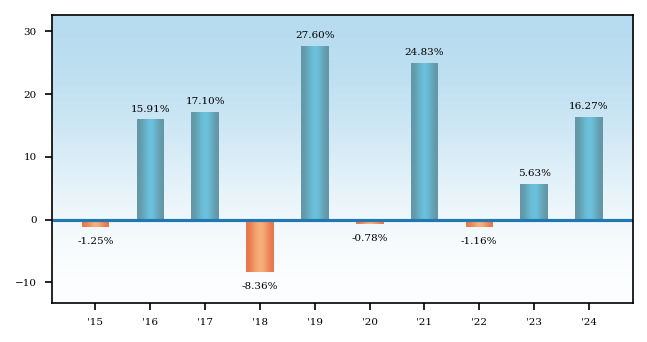
Quarter Ended |
||
Quarter Ended |
Average Annual Total Returns - Genter Dividend Income Fund |
1 Year |
5 Years |
10 Years |
|
|---|---|---|---|---|
| Genter Dividend Income Fund Shares | 16.27% | 8.50% | 8.95% | |
| Genter Dividend Income Fund Shares | After Taxes on Distributions | [1] | 13.76% | 7.28% | 7.44% |
| Genter Dividend Income Fund Shares | After Taxes on Distributions and Sales | [1] | 11.35% | 6.56% | 6.93% |
| S&P 500 Value Index (reflects no deduction for fees, expenses or taxes) | [2] | 12.29% | 10.49% | 10.01% |
| MSCI US Investable Market High Dividend Yield Index (reflects no deduction for fees, expenses or taxes) | [2] | 15.32% | 8.25% | 9.22% |
| S&P 500 Index (reflects no deduction for fees, expenses or taxes) | [2] | 25.02% | 14.53% | 13.10% |
| [1] | After-tax returns are calculated using the historical highest individual federal marginal income tax rates and do not reflect the impact of state and local taxes. Actual after-tax returns depend on an investor’s tax situation and may differ from those shown. After-tax returns shown are not relevant to investors who hold their Fund shares through tax-deferred arrangements, such as 401(k) plans or individual retirement accounts. |
| [2] | The S&P 500 Value Index is a performance benchmark that reflects the market sectors in which the Fund primarily invests. The MSCI US Investable Market High Dividend Yield Index is a performance benchmark reflecting returns of companies with high dividend yields similar to those companies held by the Fund. The S&P 500 Index is a market-cap-weighted index that includes 500 of the top companies in leading industries of the U.S. economy and assumes any dividends are reinvested back into the index. |
Market Risk. The market price of a security or instrument may decline, sometimes rapidly or unpredictably, due to general market conditions that are not specifically related to a particular company, such as real or perceived adverse economic, political, or geopolitical conditions throughout the world, changes in the general outlook for corporate earnings, changes in interest or currency rates, or adverse investor sentiment generally. The market value of a security or instrument also may decline because of factors that affect a particular industry or industries, such as tariffs, labor shortages or increased production costs and competitive conditions within an industry. In addition, local, regional or global events such as war, acts of terrorism, international conflicts, trade disputes, supply chain disruptions, cybersecurity events, the spread of infectious illness or other public health issues, natural disasters or climate events, or other events could have a significant impact on a security or instrument. The increasing interconnectivity between global economies and financial markets increases the likelihood that events or conditions in one region or financial market may adversely impact issuers in a different country, region or financial market.
Equity Risk. The value of the equity securities held by the Fund may fall due to general market and economic conditions, perceptions regarding the industries in which the issuers of securities held by the Fund participate, or factors relating to specific companies in which the Fund invests.
Sector Focus Risk. The Fund may invest a larger portion of its assets in one or more sectors than many other mutual funds and thus will be more susceptible to negative events affecting those sectors. For example, as of October 31, 2024, 26.9% of the Fund’s assets were invested in the consumer, non-cyclical sector. Consumer, non-cyclical companies are companies that provide consumer staples, for example, food and drug retailers and companies the
primary lines of business of which are food, beverage and other household items, including agricultural products. This sector can be significantly affected by, among other things, changes in price and availability of underlying commodities, rising energy prices and global and economic conditions.
Management and Strategy Risk. The value of your investment depends on the judgment of the Advisor about the quality, relative yield, value or market trends affecting a particular security, industry, sector or region, which may prove to be incorrect.
Recent Market Events. Periods of market volatility may occur in response to market events, public health emergencies, natural disasters or climate events, and other economic, political, and global macro factors. For example, in recent years the large expansion of government deficits and debt as a result of government actions to mitigate the effects of the COVID-19 pandemic and inflation have resulted in extreme volatility in the global economy and in global financial markets. In addition, military conflicts and wars, such as Russia’s invasion of Ukraine and the war among Israel, Hamas and other militant groups in the Middle East, have increased tensions in Europe and the Middle East and have caused and could continue to cause market disruptions in the regions and globally. These and other similar events could be prolonged and could adversely affect the value and liquidity of the Fund’s investments, impair the Fund’s ability to satisfy redemption requests, and negatively impact the Fund’s performance.
Foreign Investment Risk. The prices of foreign securities may be more volatile than the prices of securities of U.S. issuers because of economic and social conditions abroad, political developments, and changes in the regulatory environments of foreign countries. Changes in exchange rates and interest rates, and the imposition of sanctions, confiscations, trade restrictions (including tariffs) and other government restrictions by the United States and/or other governments may adversely affect the values of the Fund’s foreign investments. Foreign companies are generally subject to different legal and accounting standards than U.S. companies, and foreign financial intermediaries may be subject to less supervision and regulation than U.S. financial firms. Foreign securities include American Depositary Receipts (“ADRs”) and Global Depositary Receipts (“GDRs”). Unsponsored ADRs and GDRs are organized independently and without the cooperation of the foreign issuer of the underlying securities, and involve additional risks because U.S. reporting requirements do not apply. In addition, the issuing bank may deduct shareholder distribution, custody, foreign currency exchange, and other fees from the payment of dividends. Emerging markets tend to be more volatile than the markets of more mature economies and generally have less diverse and less mature economic structures and less stable political systems than those of developed countries.
ETF Risk. Investing in an ETF will provide the Fund with exposure to the securities comprising the index on which the ETF is based and will expose the Fund to risks similar to those of investing directly in those securities. Shares of ETFs typically trade on securities exchanges and may at times trade at a premium or discount to their net asset values. In addition, an ETF may not replicate exactly the performance of the benchmark index it seeks to track for a number of reasons, including transaction costs incurred by the ETF, the temporary unavailability of certain index securities in the secondary market or discrepancies between the ETF and the index with respect to the weighting of securities or the number of securities held. Investing in ETFs, which are investment companies, involves duplication of advisory fees and certain other expenses. The Fund will pay brokerage commissions in connection with the purchase and sale of shares of ETFs.
Cybersecurity Risk. Cybersecurity incidents may allow an unauthorized party to gain access to Fund assets, customer data (including private shareholder information), or proprietary information, or cause the Fund, the Advisor, and/or other service providers (including custodians, sub-custodians, transfer agents and financial intermediaries) to suffer data breaches, data corruption or loss of operational functionality. In an extreme case, a shareholder’s ability to exchange or redeem Fund shares may be affected. Issuers of securities in which the Fund invests are also subject to cybersecurity risks, and the value of those securities could decline if the issuers experience cybersecurity incidents.