The fund seeks long-term capital appreciation.
This table describes the fees and expenses that you may pay if you buy, hold, and sell shares of the fund. You may also incur brokerage commissions and other charges when buying or selling shares of the fund, which are not reflected in the table or example below.
Shareholder Fees - T. Rowe Price Health Sciences Fund, Inc. - USD ($) |
Investor Class |
I Class |
|
|---|---|---|---|
| Maximum account fee | $ 20 | [1] | none |
| [1] | Subject to certain exceptions and account minimums, accounts are charged an annual $20 fee. |
Annual Fund Operating Expenses - T. Rowe Price Health Sciences Fund, Inc. |
Investor Class |
I Class |
|---|---|---|
| Management fees | 0.63% | 0.63% |
| Other expenses | 0.17% | 0.04% |
| Total annual fund operating expenses | 0.80% | 0.67% |
Expense Example - T. Rowe Price Health Sciences Fund, Inc. - USD ($) |
Investor Class |
I Class |
|---|---|---|
| 1 Year | $ 82 | $ 68 |
| 3 Years | 255 | 214 |
| 5 Years | 444 | 373 |
| 10 Years | $ 990 | $ 835 |
Portfolio Turnover The fund pays transaction costs, such as commissions, when it buys and sells securities (or “turns over” its portfolio). A higher portfolio turnover rate may indicate higher transaction costs and may result in higher taxes when the fund’s shares are held in a taxable account. These costs, which are not reflected in annual fund operating expenses or in the example, affect the fund’s performance. During the most recent fiscal year, the fund’s portfolio turnover rate was 52.4% of the average value of its portfolio.
The fund normally invests at least 80% of its net assets (plus any borrowings for investment purposes) in the common stocks of companies engaged in the research, development, production, or distribution of products or services related to health care, medicine, or the life sciences (collectively termed “health sciences”). Any derivatives that provide exposure to the investment focus suggested by the fund’s name, or to one or more market risk factors associated with the investment focus suggested by the fund’s name, are counted (as applicable) toward compliance with the fund’s 80% investment policy.
While the fund can invest in companies of any size, the majority of fund assets are expected to be invested in large- and mid-cap companies. The fund defines the health sciences industry broadly and divides it into four main areas: pharmaceutical companies; health care services companies; medical products and devices providers; and biotechnology firms. The fund’s allocation among these four areas will vary depending on the relative potential the adviser sees within each area and the outlook for the overall health sciences sector.
The fund uses fundamental, bottom-up analysis that seeks to identify high-quality companies and the most compelling investment opportunities. In general, the fund follows a growth investment strategy, seeking companies whose earnings are expected to grow faster than inflation and the economy in general. When stock valuations seem unusually high, however, a “value” approach, which gives preference to seemingly undervalued companies, may be emphasized. The fund generally seeks investments in companies that are developing new and effective medicines, as well as companies whose business models reduce costs or improve quality in health care systems.
While most assets are typically invested in U.S. common stocks, the fund may invest in foreign stocks in keeping with its objective(s). The fund’s investments may include holdings in privately held companies and companies that only recently began to trade publicly.
Risk Table - T. Rowe Price Health Sciences Fund, Inc. |
Risk [Text Block] |
|---|---|
| Risk Lose Money [Member] | The fund’s share price fluctuates, which means you could lose money by investing in the fund. |
| Health sciences companies | Health sciences companies: A fund that focuses its investments in specific industries or sectors is more susceptible to adverse developments affecting those industries and sectors than a more broadly diversified fund. Because the fund invests significantly in health sciences companies, the fund may perform poorly during a downturn in the health sciences industry. Health care and other health sciences companies can be adversely affected by, among other things, legislative or regulatory changes, intense competitive challenges, the need for government approval to offer products and services, increases or decreases in the cost of or demand for medical products and services, product liability claims, an increased emphasis on outpatient services, pricing pressure (including price discounting), and product obsolescence. Health care and other health sciences companies are also heavily dependent on patent protections, and the expiration of a company’s patent may adversely affect that company’s profitability. |
| Market conditions | Market conditions: The value of the fund’s investments may decrease, sometimes rapidly or unexpectedly, due to factors affecting an issuer held by the fund, particular industries, or the overall securities markets. A variety of factors can increase the volatility of the fund’s holdings and markets generally, including economic, political, or regulatory developments, recessions, inflation, rapid interest rate changes, war, military conflict, acts of terrorism, natural disasters, and outbreaks of infectious illnesses or other widespread public health issues (such as the coronavirus pandemic) and related governmental and public responses (including sanctions). Certain events may cause instability across global markets, including reduced liquidity and disruptions in trading markets, while some events may affect certain geographic regions, countries, sectors, and industries more significantly than others. Government intervention in markets may impact interest rates, market volatility, and security pricing. These adverse developments may cause broad declines in market value due to short-term market movements or for significantly longer periods during more prolonged market downturns. |
| Large- and mid-cap stocks | Large- and mid-cap stocks: Securities issued by large- and mid-cap companies tend to be less volatile than securities issued by small-cap companies. However, large-cap companies may not be able to attain the high growth rates of successful small-cap companies, especially during strong economic periods, and may be unable to respond as quickly to competitive challenges. The fund’s share price could fluctuate more than the share price of a fund that invests only in large-cap companies as stocks of mid-cap companies entail greater risk and are usually more volatile than stocks of large-cap companies. |
| Investing style | Investing style: Because the fund may hold stocks with either growth or value characteristics, it could underperform other funds that take a strictly growth or value approach to investing when one style is currently in favor. Growth stocks tend to be more volatile than the overall stock market and can have sharp price declines as a result of earnings disappointments. Value stocks carry the risk that the market will not recognize their intrinsic value for a long time (or at all) or that they are actually appropriately priced at a low level. |
| Foreign investing | Foreign investing: Non-U.S. securities tend to be more volatile and have lower overall liquidity and trading volume than investments in U.S. securities and may lose value because of adverse local, political, social, or economic developments overseas, or due to changes in the exchange rates between foreign currencies and the U.S. dollar. Further, securities of non-U.S. issuers are subject to trading markets with potential governmental interference, varying regulatory, auditing, and accounting standards, and settlement and clearance practices that differ from those of U.S. issuers. Investment in non-U.S. securities also carries currency risk. Any attempts to hedge currency risk could be unsuccessful. Such investments may have higher transaction costs compared with U.S. markets. The fund’s overall foreign investing risk is increased to the extent it has exposure to emerging markets. |
| Private placements and IPOs | Private placements and IPOs: Investments in the stocks of privately held companies and in companies that only recently began to publicly trade, such as initial public offerings or IPOs, involve greater risks than investments in stocks of companies that have traded publicly on an exchange for extended time periods. There is significantly less information available about these companies’ business models, quality of management, earnings growth potential, and other criteria that are normally considered when evaluating the investment prospects of a company. Private placements and other restricted securities held by the fund are typically considered to be illiquid and tend to be difficult to value since there are no market prices and less overall financial information available. The adviser evaluates a variety of factors when assigning a value to these holdings, but the determination involves some degree of subjectivity and the value assigned for the fund may differ from the value assigned by other mutual funds holding the same security. |
| Liquidity | Liquidity: A particular investment or an entire market segment may become less liquid or even illiquid, sometimes abruptly, which could limit the fund’s ability to purchase or sell holdings in a timely manner at a desired price. An inability to sell a portfolio holding can adversely affect the fund’s overall value or prevent the fund from being able to take advantage of other investment opportunities. Liquidity risk may be magnified during periods of substantial market volatility and unexpected episodes of illiquidity may limit the fund’s ability to pay redemption proceeds without selling holdings at an unfavorable time or at a suitable price. Large redemptions may also have a negative impact on the fund’s overall liquidity. |
| Active management | Active management: The fund’s overall investment program and holdings selected by the fund’s investment adviser may underperform the broad markets, relevant indices, or other funds with similar objectives and investment strategies. |
| Stock investing | Stock investing: Stocks generally fluctuate in value more than bonds and may decline significantly over short time periods. There is a chance that stock prices overall will decline because stock markets tend to move in cycles, with periods of rising and falling prices. The value of stocks held by the fund may decline due to general weakness or volatility in the stock markets in which the fund invests or because of factors that affect a particular company or industry. |
| Cybersecurity breaches | Cybersecurity breaches: The fund could be harmed by intentional cyberattacks and other cybersecurity breaches, including unauthorized access to the fund’s assets, confidential information, or other proprietary information. In addition, a cybersecurity breach could cause one of the fund’s service providers or financial intermediaries to suffer unauthorized data access, data corruption, or loss of operational functionality. |
The following performance information provides some indication of the risks of investing in the fund. The fund’s performance information represents only past performance (before and after taxes) and is not necessarily an indication of future results.
The following bar chart illustrates how much returns can differ from year to year by showing calendar year returns and the best and worst calendar quarter returns during those years for the fund’s Investor Class. Returns for other share classes vary since they have different expenses.
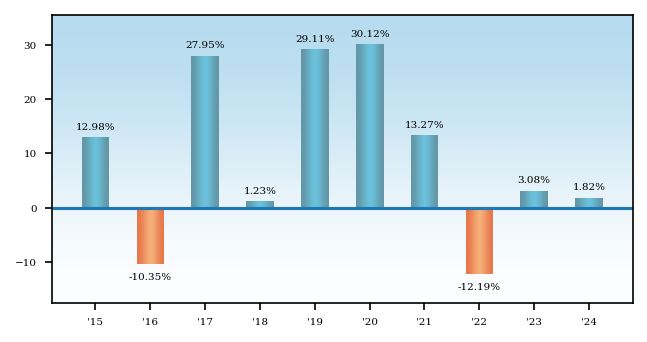
Quarter Ended | Total Return | Quarter Ended | Total Return | |||||
Best Quarter | 6/30/20 | 23.49% | Worst Quarter | 12/31/18 | -15.81% |
The following table shows the average annual total returns for each class of the fund that has been in operation for at least one full calendar year. The fund’s performance information included in the table is compared with a regulatory required index that represents an overall securities market (Regulatory Benchmark). In addition, the table may also include one or more indexes that more closely aligns to the fund’s investment strategy (Strategy Benchmark(s)).
In addition, the table shows hypothetical after-tax returns to demonstrate how taxes paid by a shareholder may influence returns. After-tax returns are calculated using the historical highest individual federal marginal income tax rates and do not reflect the impact of state and local taxes. Actual after-tax returns depend on an investor’s tax situation and may differ from those shown. After-tax returns shown are not relevant to investors who hold their fund shares through tax-deferred arrangements, such as a 401(k) account or an IRA. After-tax returns are shown only for the Investor Class and will differ for other share classes.
Average Annual Total Returns - T. Rowe Price Health Sciences Fund, Inc. |
Label |
1 Year |
5 Years |
10 Years |
Since Inception |
Inception Date |
||
|---|---|---|---|---|---|---|---|---|
| Investor Class | 1.82% | 6.32% | 8.69% | Dec. 29, 1995 | ||||
| Investor Class | After Taxes on Distributions | (0.88%) | 4.66% | 6.93% | |||||
| Investor Class | After Taxes on Distributions and Sales | 3.10% | 4.91% | 6.73% | |||||
| I Class | 1.94% | 6.45% | 10.36% | Mar. 23, 2016 | ||||
| Russell 3000® Index | [1] | Russell 3000® Index | ||||||
| Russell 3000® Index | Russell 3000® Index | |||||||
| Russell 3000® Index | 23.81% | 13.86% | 12.55% | 14.42% | [2] | |||
| Russell 3000® Health Care Index | Russell 3000® Health Care Index | |||||||
| Russell 3000® Health Care Index | 3.48% | 7.18% | 8.81% | 10.28% | [2] | |||
| Lipper Health/Biotechnology Funds Index | Lipper Health/Biotechnology Funds Index | |||||||
| Lipper Health/Biotechnology Funds Index | 1.70% | 4.24% | 6.92% | 9.25% | [2] | |||
| [1] | Due to new SEC Rules on shareholder reporting, the fund adopted a new broad-based securities market index, referred to as the Regulatory Benchmark. |
| [2] | Return since 3/23/16. |