The Taylor Frigon Core Growth Fund seeks long-term capital appreciation.
The following table describes the expenses and fees that you may pay if you buy, hold, and sell shares of the Fund. You may pay other fees, such as brokerage commissions and other fees to financial intermediaries, which are not reflected in the table and example below.
Shareholder Fees |
Taylor Frigon Core Growth Fund
Taylor Frigon Core Growth Fund Shares
|
|---|---|
| Redemption Fees (on shares sold after holding them for 90 days or less as a percentage of the amount redeemed) | 2.00% |
Annual Fund Operating Expenses |
Taylor Frigon Core Growth Fund
Taylor Frigon Core Growth Fund Shares
|
|---|---|
| Management Fees | 1.00% |
| Distribution 12b-1 Fees | none |
| Other Expenses | 0.45% |
| Total Annual Fund Operating Expenses | 1.45% |
The following example is intended to help you compare the cost of investing in the Fund with the cost of investing in other mutual funds. The example assumes that you invest $10,000 in the Fund for the time periods indicated and then redeem all of your shares at the end of those periods. The example also assumes that your investment has a 5% annual return each year and that the Fund’s operating expenses remain the same each year. Although your actual costs may be higher or lower, based on these assumptions your costs would be:
Expense Example |
Expense Example, with Redemption, 1 Year |
Expense Example, with Redemption, 3 Years |
Expense Example, with Redemption, 5 Years |
Expense Example, with Redemption, 10 Years |
|---|---|---|---|---|
| Taylor Frigon Core Growth Fund | Taylor Frigon Core Growth Fund Shares | USD ($) | 148 | 459 | 792 | 1,735 |
The Fund pays transaction costs, such as commissions, when it buys and sells securities (or “turns over” its portfolio). A higher portfolio turnover may indicate higher transaction costs and may result in higher taxes when Fund shares are held in a taxable account. These costs, which are not reflected in annual fund operating expenses or in the example, affect the Fund’s performance. During the most recent fiscal year, the Fund’s portfolio turnover rate was 30.28% of the average value of its portfolio.
The Taylor Frigon Core Growth Fund (the “Fund”), under normal market conditions, invests primarily in common stocks of companies of all sizes, including small and micro-capitalization companies that Taylor Frigon Capital Management, LLC (the “Adviser”), the Fund’s investment adviser, believes have excellent growth prospects. The Fund may invest in foreign securities, including American Depositary Receipts (ADRs). The Adviser applies a proprietary selection process called the TFCM Core Growth Strategy when selecting investments for the Fund.
In applying its TFCM Core Growth Strategy, the Adviser identifies growth companies using a rigorous analytical approach that employs both qualitative and quantitative research techniques. Growth companies are those that the Adviser believes will have revenue and earnings that grow faster than the economy as a whole and offering above-average prospects for capital appreciation and little or no emphasis on dividend income.
The Adviser considers a company to be a growth company if it has the following characteristics:
| • | Proven, capable management in growth industries; |
| • | Innovation that solves problems, creates new markets, and improves the world; |
| • | Financially strong businesses at the leading edge of global economic trends. Companies with demonstrated growth in earnings and sales, high returns on equity and assets, among other strong financial indicators; and |
| • | Promising revenue and earnings growth that are not yet well recognized or fully valued, i.e., companies the Adviser believes are financially strong and are selling at attractive prices in relation to their intrinsic values. |
The Adviser’s investment selection process includes a review of global economic trends, themes and paradigm shifts in combination with the Adviser’s proprietary quantitative metrics analysis. A key part of the investment process is identifying where innovations in business create paradigm shifts that can result in the opening of new markets in which well-run, financially strong companies can benefit.
Companies that meet the Adviser’s macro and quantitative criteria are then analyzed with rigorous qualitative research to determine a company’s prospects in light of market position, potential for leadership and possible disruptive aspects of their products and/or services. The ultimate decision to purchase a company is based on the Adviser’s assessment of potential returns that a company can produce.
The Fund may invest a large percentage of its assets in a few sectors, including but not limited to information technology, industrials, health care, consumer discretionary, and financials.
The Adviser may sell or reduce the Fund's position in a security (1) when it approaches and/or exceeds the Adviser's estimate of its intrinsic value, (2) when its macro-economic factors or quantitative characteristics have changed, or (3) when the facts or the analysis surrounding the reason to originally invest in the security has changed.
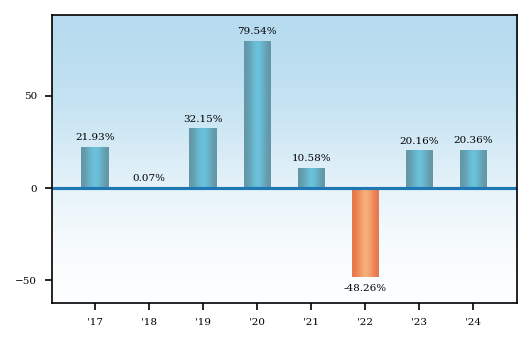
The bar chart and performance table shown below provide some indication of the risks of investing in the Fund and the variability of its returns. The bar chart shows performance of the Fund for each full calendar year since the Fund's inception. The performance table shows how the Fund's average annual total returns for 1 year, 5 years, and since inception compare with those of a broad measure of market performance. The Fund's past performance (before and after taxes) is not necessarily an indication of how the Fund will perform in the future. Updated performance information is available on the Fund's website at www.taylorfrigonfunds.com or by calling 1-888-897-4821.
() ()
Average Annual Total Returns - Taylor Frigon Core Growth Fund |
1 Year |
5 Years |
Since Inception |
Inception Date |
|---|---|---|---|---|
| Taylor Frigon Core Growth Fund Shares | 20.36% | 8.24% | 11.44% | Dec. 27, 2016 |
| Taylor Frigon Core Growth Fund Shares | After Taxes on Distributions | 20.36% | 7.50% | 10.85% | Dec. 27, 2016 |
| Taylor Frigon Core Growth Fund Shares | After Taxes on Distributions and Sales | 12.06% | 6.67% | 9.46% | Dec. 27, 2016 |
| S&P 500® Index (does not reflect deductions for fees, expenses, or taxes) | 25.02% | 14.53% | 14.60% | Dec. 27, 2016 |
| S&P Mid Cap 400® Index (does not reflect deductions for fees, expenses, or taxes) | 13.93% | 10.34% | 9.76% | Dec. 27, 2016 |
After-tax returns are calculated using the historical highest marginal individual U.S. federal income tax rates and do not reflect the
impact of state and local income taxes. Actual after-tax returns depend on an investor’s tax situation and may differ from those
shown, and after-tax returns shown are not relevant to investors who hold their Fund shares through tax-deferred accounts, such as 401(k)
plans or IRAs.
Risks of Investing in Common Stocks. The Fund invests primarily in common stocks, which subjects the Fund and its shareholders to the risks associated with common stock investing. These risks include the financial risk of selecting individual companies that do not perform as anticipated, the risk that the stock markets in which the Fund invests may experience periods of turbulence and instability, and the general risk that domestic and global economies may go through periods of decline and cyclical change including being affected by interest rate levels and political events.
Additionally, unexpected local, regional, or global events, such as war; acts of terrorism; financial, political, or social disruptions; natural, environmental, or man-made disasters; the spread of infectious illnesses or other public health issues (such as COVID-19); and recessions and depressions could have a significant impact on the Fund and its investments and may impair market liquidity. Such events can cause investor fear, which can adversely affect the economies of nations, regions, and the market in general, in ways that cannot necessarily be foreseen.
Growth Risk. If the Adviser's perceptions of a company's growth potential are wrong, the securities purchased may not perform as expected, reducing the Fund's return.
Risks of Small and Medium Sized Companies. Small and medium capitalization companies may be subject to additional risks. The earnings and prospects of these companies are more volatile than larger companies. Small and medium sized companies may experience higher failure rates than do larger companies.
Risks of Micro-Cap Companies. The prices of micro-cap stocks are generally more volatile, and their markets are less liquid relative to larger companies. Therefore, the Fund may experience considerably more risk of loss and its returns may differ significantly from funds investing in larger companies or other asset classes.
Sector Risk. Sector risk is the possibility that all stocks within the same sector will decline in price due to sector-specific market or economic developments. The Fund may emphasize certain sectors at various times including, among others,
information technology, industrials, health care, consumer discretionary and financials.
Risks associated with investments in companies in the information technology sector include that their technology may become obsolete, short product cycles, falling prices and profits, competition from new market entrants and general market conditions.
Risks associated with investments in companies in the industrials sector include consumer sentiment and spending, commodity prices, legislation, government regulation and spending, import controls, and worldwide competition. Companies in this sector may also be affected by liability for environmental damage, depletion of resources, and mandated expenditures for safety and pollution control.
Risks associated with investments in companies in the health care sector may include government regulation and reimbursement rates, as well as government approval of products and services. Further, types of products or services produced or provided by health care companies quickly can become obsolete. Pharmaceutical companies and other companies can be affected by patent expirations.
Risks associated with investments in companies in the consumer discretionary sector include the overall economy, interest rates, competition and consumer confidence. Success of companies in this sector can depend heavily on disposable household income and consumer spending. Changes in demographics and consumer tastes may also affect companies in this sector.
Risks associated with investments in the financial sector are subject to government regulation limiting both the types of loans and other financial commitments such companies can make, and the interest rates and fees they can charge. Certain companies in this sector may be subject to price competition. The financial services industry can be subject to relatively rapid change as distinctions between financial services segments become increasingly blurred.
Foreign Risk. Foreign securities and American Depository Receipts ("ADRs") have risks not usually associated with securities of U.S. issuers. These risks can include fluctuations in foreign currencies, foreign currency exchange controls, political and economic instability, differences in financial reporting, differences in securities regulation and trading, and taxation issues.
Management Risks. The Adviser's implementation of the Fund's strategy may fail to produce the intended results.