The investment objective of the ACR Equity International Fund is to protect capital from permanent impairment while providing a return above both the Fund’s cost of capital and the Fund’s benchmark over a full market cycle.
This table describes the fees and expenses that you may pay if you buy, hold, and sell shares of the Fund. You may pay other fees, such as brokerage commissions and other fees to financial intermediaries, which are not reflected in the table and example below.
Shareholder Fees |
ACR Equity International Fund
Class I Shares
USD ($)
|
|---|---|
| Maximum sales charge (load) imposed on purchases (as a percentage of offering price) | none |
| Maximum deferred sales charge (load) | none |
| Redemption fee if redeemed within 90 days of purchase (as a percentage of amount redeemed) | 2.00% |
| Wire fee | $ 20 |
| Overnight check delivery fee | 25 |
| Retirement account fees (annual maintenance fee) | $ 15 |
Annual Fund Operating Expenses |
ACR Equity International Fund
Class I Shares
|
|
|---|---|---|
| Management fees | 1.00% | |
| Distribution and service (Rule 12b-1) fees | none | |
| Other expenses | 0.46% | |
| Shareholder service fee | 0.09% | |
| Tax reclaim fees | 0.01% | |
| All other expenses | 0.36% | |
| Total annual fund operating expenses | 1.46% | |
| Fees waived and/or expenses reimbursed | (0.35%) | [1] |
| Total annual fund operating expenses after waiving fees and/or reimbursing expenses | 1.11% | [1] |
| [1] | The Fund’s advisor has contractually agreed to waive its fees and/or pay for operating expenses of the Fund to ensure that total annual fund operating expenses (excluding any taxes, leverage interest, brokerage commissions, dividend and interest expenses on short sales, acquired fund fees and expenses (as determined in accordance with SEC Form N-1A), professional fees related to services for the collection of foreign tax reclaims, expenses incurred in connection with any merger or reorganization, and extraordinary expenses such as litigation expenses) do not exceed 1.10% of the Fund’s average daily net assets. This agreement is in effect through March 31, 2026, and it may be terminated before that date only by the Trust’s Board of Trustees. The Fund’s advisor is permitted to seek reimbursement from the Fund, subject to certain limitations, of fees waived or payments made to the Fund for a period ending three full fiscal years after the date of the waiver or payment. This reimbursement may be requested from the Fund if the reimbursement will not cause the Fund’s annual expense ratio to exceed the lesser of (a) the expense limitation in effect at the time such fees were waived or payments made, or (b) the expense limitation in effect at the time of the reimbursement. |
This example is intended to help you compare the cost of investing in the Fund with the cost of investing in other mutual funds.
The example assumes that you invest $10,000 in the Fund for the time periods indicated and then redeem all of your shares at the end of those periods. The example also assumes that your investment has a 5% return each year and that the Fund’s operating expenses remain the same. The example reflects the Fund’s contractual fee waiver and/or expense reimbursement only for the term of the contractual fee waiver and/or expense reimbursement.
Although your actual costs may be higher or lower, based on these assumptions your costs would be:
Expense Example |
One Year |
Three Years |
Five Years |
Ten Years |
|---|---|---|---|---|
| ACR Equity International Fund | Class I Shares | USD ($) | 113 | 427 | 764 | 1,716 |
The Fund pays transaction costs, such as commissions, when it buys and sells securities (or “turns over” its portfolio). A higher portfolio turnover may indicate higher transaction costs and may result in higher taxes when Fund shares are held in a taxable account. These costs, which are not reflected in annual fund operating expenses or in the example, affect the Fund’s performance. During the most recent fiscal year, the Fund’s portfolio turnover rate was 48% of the average value of its portfolio.
Under normal circumstances, the Fund will invest at least 80% of its net assets (including amounts borrowed for investment purposes) in equity securities. The Fund will invest primarily in equity securities, including common stock, preferred stock, American Depositary Receipts (“ADRs”), European Depositary Receipts (“EDRs”) and Global Depositary Receipts (“GDRs”). ADRs are receipts that represent interests in foreign securities held on deposit by U.S. banks. EDRs and GDRs are similar to ADRs, except that they may be traded in international trading markets. The Fund may invest in shares of other registered investment companies and exchange-traded funds (“ETFs”) that invest substantially all of their assets in equity securities of companies located outside of the United States.
The Fund will invest primarily in the equity securities of companies: (i) that are organized under the laws of a foreign country or maintain principal offices or headquarters in a foreign country; (ii) the securities of which are principally traded in a foreign country; or (iii) that derive at least 50% of their revenues or profits from goods produced or sold, investments made, or services performed in a foreign country, or have at least 50% of their assets in a foreign country. The Fund will allocate its assets among various regions and countries and will normally invest its assets in issuers representing at least three different countries outside of the United States. The Fund may, from time to time, have significant exposure to certain geographic regions and countries, including Europe and the United Kingdom. ACR Alpine Capital Research, LLC (“ACR Alpine Capital Research”, “ACR” or the “Advisor”) does not expect, under normal circumstances, to invest more than 35% of the Fund’s net assets in securities of companies located in emerging markets; however, the Fund’s investments in emerging markets may exceed this amount from time to time depending on market opportunities. The Fund may invest in companies of any market capitalization. The Fund’s investments may be denominated in foreign currencies.
The Advisor adheres to a bottom-up due diligence and a fundamental valuation process in which each prospective investment is analyzed from an operating quality perspective, a financial quality perspective and a valuation perspective. The Advisor considers a company with high operating quality to have an understandable business model, a solid competitive position, long term staying power, sufficient returns on capital, a management team that allocates capital appropriately, and competitive dynamics that can be reasonably forecasted and will not be significantly impacted by technological developments or foreign competition. The Advisor considers a company with high financial quality to have understandable financial statements, appropriate accounting judgment, a conservative balance sheet, an appropriate capital structure for the cyclicality and profit profile of the business, a sustainable debt maturity schedule, and understandable cash flow dynamics. The Advisor’s fundamental valuation process considers the long term cash flows
a company generates and the manners in which the company may distribute those cash flows. In seeking to generate “quality returns,” the Fund will attempt to limit its investments to those with reasonable and sustainable returns for full market cycles — i.e., returns from companies that the Advisor believes are well positioned to be in business over the long term, have a high likelihood of generating sufficient returns on capital, and are capitalized conservatively so that the company should remain solvent during, and be able to overcome, any near to medium term recessions or market headwinds.
With respect to the Fund’s objective, the Advisor defines certain terms as follows:
• “Permanent impairment” means a loss of value on the purchase price of an investment that the Advisor, believes will not be recovered together with a reasonable return on the purchase price.
• “Cost of capital” refers to the opportunity cost of making a specific investment. It is the rate of return that an investor believes, at the time of an investment, could have been earned by putting the same money into a different investment with equal risk. The Fund’s cost of capital at any time is the weighted average of the cost of capital of the securities that comprise the Fund’s portfolio, as estimated by the Advisor.
• “Fund’s benchmark” means the MSCI All Country World (Net) Index Ex-U.S. (“MSCI ACWI ex USA (Net) Index”). The Advisor has selected the MSCI ACWI ex USA (Net) Index as the Fund’s benchmark because it is a broad proxy for the world equity market excluding U.S.-based companies.
• “Full market cycle” means a period of time that includes both an up and down equity market. A down market is characterized with a peak to trough decline of 20% or greater. A full market cycle can be measured from a prior equity market peak to the next equity market peak. Full market cycles are usually measured in years.
When fully invested, the Fund’s portfolio will generally consist of approximately 20 holdings and will not be limited by security type, issuer size or geographic location. The Fund may hold a significant amount in cash or cash equivalents in markets where the Advisor cannot find enough securities that meet its risk and return thresholds. For example, the cash allocation may be larger during times of high security prices with relatively few investment opportunities and may also be significantly lower, or zero, during periods of ample investment opportunities that adhere to the Fund’s investment criteria. The Fund will generally invest 3-5% of its net assets in any new investment. The Advisor will consider specific risk factors of the individual companies that comprise the Fund’s portfolio (e.g., currency exposure, interest rate sensitivity, end market exposure, customer concentration, commodity prices), in addition to the Fund’s industry exposure, in an effort to prevent the Fund’s portfolio from being overly exposed to a specific factor or industry that could impair the portfolio’s return.
Investments are sold for five general reasons: (1) an unanticipated change at the company, (2) an error in the analysis of the company, (3) an ability to invest in a superior investment opportunity that requires the sale of a current portfolio holding that has a relatively inferior prospective return, (4) a share price approaching/reaching/exceeding the estimate of intrinsic value, or (5) the Fund requires cash to meet redemption requests.
The Fund is “non-diversified” under the Investment Company Act of 1940, as amended (the “1940 Act”) which means that it may invest more of its assets in fewer issuers than “diversified” mutual funds.
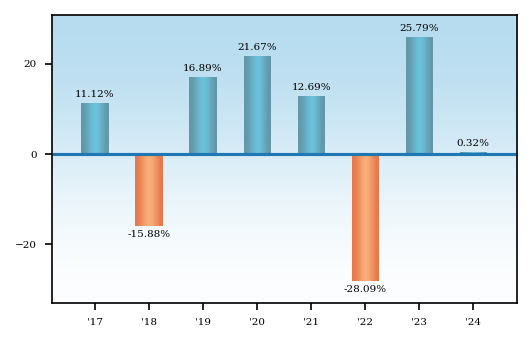
The bar chart and table below provide some indication of the risks of investing in the Fund by showing changes in the Fund’s performance from year to year for Class I shares and by showing how the average annual total returns of the Fund compare with the average annual total returns of the MSCI ACWI ex USA (Net) Index, a broad-based market index. Updated performance information is available at the Fund’s website, www.acr-investfunds.com, or by calling the Fund at 1-855-955-9552. The Fund’s past performance, before and after taxes, is not necessarily an indication of how the Fund will perform in the future.
|
Class I Shares |
||
|
Highest Calendar Quarter Return at NAV |
27.47% |
Quarter Ended 12/31/2020 |
|
Lowest Calendar Quarter Return at NAV |
(28.75)% |
Quarter Ended 03/31/2020 |
Average Annual Returns - ACR Equity International Fund |
Label |
One Year |
Five Years |
Since Inception |
Inception Date |
||||
|---|---|---|---|---|---|---|---|---|---|
| Class I Shares | Class I Shares – Return Before Taxes | 0.32% | 4.47% | 3.91% | Dec. 30, 2016 | ||||
| Class I Shares | Return After Taxes on Distributions | Class I Shares – Return After Taxes on Distributions | (1.10%) | [1] | 3.66% | [1] | 3.29% | [1] | Dec. 30, 2016 | [1] |
| Class I Shares | Return After Taxes on Distributions and Sale of Fund Shares | Class I Shares – Return After Taxes on Distributions and Sale of Fund Shares | 1.26% | [1] | 3.44% | [1] | 3.02% | [1] | Dec. 30, 2016 | [1] |
| MSCI ACWI ex USA (Net) Index (reflects no deduction for fees or expenses) | MSCI ACWI ex USA (Net) Index (reflects no deduction for fees or expenses) | 5.53% | 4.10% | 6.23% | Dec. 30, 2016 | ||||
| [1] | After-tax returns are calculated using the historical highest individual federal marginal income tax rates and do not reflect the impact of state and local taxes. Actual after-tax returns depend on an investor’s tax situation and may differ from those shown. After-tax returns shown are not relevant to investors who hold their Fund shares through tax-deferred arrangements, such as 401(k) plans or individual retirement accounts. |