Investment Objective. The investment objective of the All-Cap Fund is to seek capital appreciation.
Fees and Expenses of the Fund. This table describes the fees and expenses that you may pay if you buy, hold, and sell shares of the All-Cap Fund. You may pay other fees, such as brokerage commissions and other fees to financial intermediaries, which are not reflected in the table and example below.
Shareholder Fees |
Wellington Shields All-Cap Fund
Institutional Shares
|
|---|---|
| Maximum Sales Charge (Load) Imposed on Purchases (as a percentage of offering price) | none |
| Redemption Fee (as a percentage of the amount redeemed, if applicable). | none |
Annual Fund Operating Expenses |
Wellington Shields All-Cap Fund
Institutional Shares
|
|---|---|
| Management Fees | 1.00% |
| Distribution (12b-1) Fees | none |
| Other Expenses | 0.31% |
| Acquired Fund Fees and Expenses | 0.03% |
| Total Annual Fund Operating Expenses | 1.34% |
Expense Example. This Example is intended to help you compare the cost of investing in the All-Cap Fund with the cost of investing in other mutual funds. This expense example assumes that you invest $10,000 in the All-Cap Fund for the time periods indicated and then redeem all of your shares at the end of those periods. The expense example also assumes that your investment has a 5% return each year and the All-Cap Fund’s operating expenses remain the same. Although your actual costs may be higher or lower, based on the assumptions your cost would be:
Expense Example |
Expense Example, with Redemption, 1 Year |
Expense Example, with Redemption, 3 Years |
Expense Example, with Redemption, 5 Years |
Expense Example, with Redemption, 10 Years |
|---|---|---|---|---|
| Wellington Shields All-Cap Fund | Institutional Shares | USD ($) | 133 | 415 | 718 | 1,579 |
Portfolio Turnover. The All-Cap Fund pays transaction
costs, such as commissions, when it buys and sells securities (or “turns over” its portfolio). A higher portfolio turnover
rate may indicate higher transaction costs and may result in higher taxes when All-Cap Fund shares are held in a taxable account. These
costs, which are not reflected in annual fund operating expenses or in the example, affect the All-Cap Fund’s performance. During
the fiscal year ended November 30, 2024, the All-Cap Fund’s portfolio turnover rate was 45.77% of the average value of its portfolio.
Principal Investment Strategies of the Fund. The All-Cap Fund pursues its investment objective by investing primarily in equity securities of all market capitalizations.
The All-Cap Fund’s investments will be primarily in equity securities, such as common and preferred stock, securities convertible into common stock, exchange traded funds (“ETFs”) that focus their investments in equity securities, and short sales. Under normal market conditions, the All-Cap Fund will invest at least 80% of its total assets in equity securities.
While the All-Cap Fund’s primary focus is investment in equity securities, the All-Cap Fund has flexibility to invest in other types of securities when the Advisor believes they offer opportunities that are more attractive. Accordingly, the All-Cap Fund may invest in derivative instruments, including put and call options. The All-Cap Fund will generally invest in derivative instruments for hedging and income generation purposes. The All-Cap Fund may also sell a security short (i.e., sell a security borrowed from a broker) if the Advisor expects the market price for the security to drop in the future. When the All-Cap Fund makes a short sale of a security, the All-Cap Fund will have to replace the security in the future, whether
or not the price declines. The All-Cap Fund may hold up to 20% of its net assets in derivative instruments and short positions at any time.
In selecting portfolio securities, Capital Management Associates, Inc. (“CMA” or the “Advisor”) uses various screens and models to produce a potential universe of companies. Then through fundamental research, the Advisor selects from that universe companies whose current share price is relatively undervalued. The Advisor considers selling or reducing the All-Cap Fund’s holding in a security if the security no longer meets the Advisor’s investment criteria or the Advisor believes a more attractive investment alternative is available. Final investment decisions are made by the All-Cap Fund’s portfolio managers.
Performance. The bar chart and table shown below provide some indication of the risks of investing in the All-Cap Fund by showing changes in the performance of the All-Cap Fund’s Institutional Shares from year to year and by showing how the All-Cap Fund’s average annual returns for 1, 5 and 10 years compare with those of a broad-based securities market index. The Fund’s past performance (before and after taxes) is not necessarily an indication of how the All-Cap Fund will perform in the future.
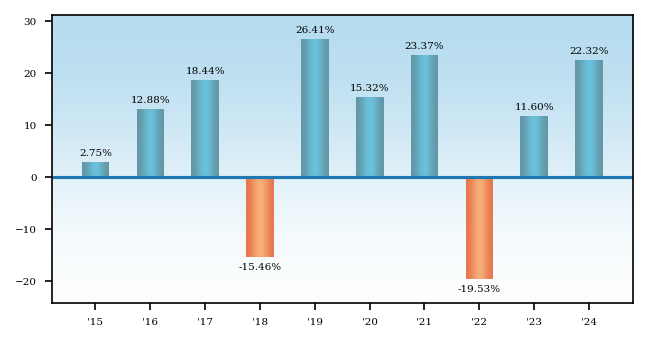
Quarterly Returns During This Time Period
(quarter ended )
(quarter ended )
Average Annual Total Returns - Wellington Shields All-Cap Fund |
1 Year |
5 Years |
10 Years |
|---|---|---|---|
| Institutional Shares | 22.32% | 9.34% | 8.66% |
| Institutional Shares | After Taxes on Distributions | 21.14% | 8.11% | 7.06% |
| Institutional Shares | After Taxes on Distributions and Sales | 14.08% | 7.22% | 6.64% |
| Russell 1000 Index (reflects no deduction for fees, expenses or taxes) | 24.51% | 14.28% | 12.87% |
| S&P 500 Index (reflects no deduction for fees, expenses or taxes) | 25.02% | 14.53% | 13.10% |
After-tax returns are calculated using the historical highest marginal individual U.S. federal income tax rates and do not reflect the impact of state and local taxes. Actual after-tax returns depend on an investor’s tax situation and may differ from those shown and are not applicable to investors who hold All-Cap Fund shares through tax-deferred arrangements, such as an individual retirement account (“IRA”) or 401(k) plan. After-tax returns are shown for only one class of shares and after-tax returns will vary for other classes.
• Market Risk. Securities markets are volatile and prices of all securities may decline when markets decline generally. Accordingly, the price of and the income generated by the All-Cap Fund’s securities may decline in response to, among other things, adverse changes in investor sentiment, general economic and market conditions, regional or global instability, interest rate fluctuations or other factors that may cause the securities markets to decline generally. Additionally, unexpected local, regional or global events, such as war; acts of terrorism; financial, political or social disruptions; natural, environmental or man-made disasters; the spread of infectious illnesses or other public health issues (such as COVID-19); and recessions and depressions could have a significant impact on the Fund and its investments and may impair market liquidity. Such events can cause investor fear, which can adversely affect the economies of nations, regions and the market in general, in ways that cannot necessarily be foreseen.
| • | Risks Related to Other Equity Securities. In addition to common stocks, the equity securities in the All-Cap Fund’s portfolio may include preferred stock and convertible securities. Like common stocks, the value of these equity securities may fluctuate in response to many factors, including the activities of the issuer, general market and economic conditions, interest rates, and specific industry changes. Also, regardless of any one company’s particular prospects, a declining stock market may produce a decline in prices for all equity securities, which could also result in losses for the All-Cap Fund. |
Convertible Securities Risk. Convertible securities are securities that are convertible into or exchangeable for common or preferred stock. The values of convertible securities may be affected by changes in interest rates, the creditworthiness of their issuer, and the ability of the issuer to repay principal and to make interest payments. A convertible security tends to perform more like a stock when the underlying stock price is high and more like a debt security when the underlying stock price is low. A convertible security is not as sensitive to interest rate changes as a similar non-convertible debt security and generally has less potential for gain or loss than the underlying stock. Convertible securities are subject to the risks and price fluctuations of the underlying stock. Convertible securities entitle the holder to receive interest payments or a dividend preference until the security matures, is redeemed, or the conversion feature is exercised. They may be subject to the risk that the issuer will not be able to pay interest or dividends when due and their market value may change based on changes in the issuer’s credit rating or the market’s perception of the issuer’s creditworthiness. Some convertible preferred stocks have a conversion or call feature that allows the issuer to redeem the stock before the conversion date, which could diminish the potential for capital appreciation on the investment. As a result of the conversion feature, the interest rate or dividend preference is generally less than if the securities were non-convertible.
Preferred Stock Risk. Preferred stock represents an equity interest in a company that generally entitles the holder to receive, in preference to the holders of other stocks such as common stocks, dividends and a fixed share of the proceeds resulting from a liquidation of the company. Preferred stocks may pay fixed or adjustable rates of return. The market value of preferred stock is subject to issuer-specific and market risks applicable generally to equity securities and is sensitive to changes in the issuer’s creditworthiness, the ability of the issuer to make payments on the preferred stock and changes in interest rates, typically declining in value if interest rates rise. In addition, a company’s preferred stock generally pays dividends only after the company makes required
payments to holders of its bonds and other debt. Therefore, the value of preferred stock will usually react more strongly than bonds and other debt to actual or perceived changes in the company’s financial condition or prospects.
• Large-Cap Securities Risk. The All-Cap Fund will invest in larger, more established companies, which may be unable to respond quickly to new competitive challenges such as changes in consumer tastes or innovative smaller competitors. Also, large companies are sometimes unable to attain the high growth rates of successful, smaller companies, especially during extended periods of economic expansions.
• Mid-Cap Securities Risk. Investing in the securities of medium capitalization (“mid-cap”) companies generally involves greater risk than investing in larger, more established companies. This greater risk is, in part, attributable to the fact that mid-cap companies may have limited product lines, operating history, markets or financial resources and their securities may therefore be more volatile than securities of larger, more established companies or market averages in general. In addition, the market for mid-cap securities may be more limited than the market for larger companies.
• Small-Cap Securities Risk. The All-Cap Fund will invest in small companies, which generally have less experienced management teams, serve smaller markets, and find it more difficult to find financing for growth or potential development than larger companies.
• Portfolio Management Risk. The strategies used and securities selected by the Advisor may fail to produce the intended result and the All-Cap Fund may not achieve its objective. The securities selected for the All-Cap Fund may not perform as well as other securities that were consistent with the All-Cap Fund’s investment strategy, but were not selected for the All-Cap Fund. As a result, the All-Cap Fund may suffer losses or underperform other funds with the same investment objective or strategies, even in a rising market. The performance of the All-Cap Fund may be better or worse than the performance of equity funds that focus on other types of equities or have a broader investment style.
• Derivative Instruments Risk. Derivative instruments such as option contracts are generally investments the value of which depends on (or is derived from) the value of the underlying assets, interest rate, or index. Derivative instruments involve risks different from direct investments in the underlying securities, including: imperfect correlation between the value of the derivative instrument and the underlying assets; risks of default by the other party to the derivative instrument; risks that the transactions may result in the loss of the entire value of any portfolio positions; and risks that the derivative instrument may not be liquid.
Call Option Risk. A call option is an option to buy assets at an agreed-upon price on or before a particular date. The buyer of a call option assumes the risk of losing its entire investment (i.e., the premium paid) in the call option. However, if the buyer of the call sells short the underlying security, the loss on the call will be offset in whole or in part by gain on the short sale of the underlying security.
Put Option Risk. A put option is an option to sell assets at an agreed price on or before a particular date. The buyer of a put option assumes the risk of losing its entire investment (i.e., the premium paid) in the put option. However, if the buyer of the put holds the underlying security, the loss on the put will be offset in whole or in part by any gain on the underlying security.
• Short Sales Risk. The All-Cap Fund may establish a short position in a stock by selling borrowed shares of the stock. When the price of any stock that the All-Cap Fund has sold short rises above the price at which the All-Cap Fund borrowed and sold the stock, then the All-Cap Fund may lose money on the short sale. Accordingly, the All-Cap Fund is likely to lose value on its short sales in a rising market. If the broker from whom the stock was borrowed requires that the stock be repaid, then the All-Cap Fund could be forced to cover short positions earlier than the All-Cap Fund otherwise would. If the All-Cap Fund does not have the assets to cover a short sale, then the All-Cap Fund’s potential losses on the short will be unlimited because the security’s price may appreciate indefinitely.
• Shares of Other Investment Companies and ETF Risk. You will indirectly bear fees and expenses charged
by the underlying funds in which the All-Cap Fund may invest in addition to the All-Cap Fund’s direct fees and expenses and, as a result, your cost of investing in the All-Cap Fund will generally be higher than the cost of investing directly in the underlying fund shares. Investments in ETFs bear the risk that the market price of the ETF’s shares may trade at a discount to their net asset value or that an active trading market for an ETF’s shares may not develop or be maintained. The All-Cap Fund may place otherwise un-invested cash in money market mutual funds.