The Fund seeks current income and capital appreciation. In seeking current income, the Fund intends to pay current cash distributions to shareholders, regardless of the character of such distributions for tax or accounting purposes.
The table below describes the fees and expenses that you may pay if you buy, hold and sell shares of the Fund. You may pay other fees, such as brokerage commissions and other fees to financial intermediaries, which are not reflected in the table and example below. You may qualify for sales charge discounts if you and your family invest, or agree to invest in the future, at least $50,000 in the Fund. In addition, different financial intermediary firms and financial professionals may impose different sales loads and waivers. More information about these and other discounts or waivers is available from your financial professional, in the "Information on Sales Charges" section starting on page 37 of the Prospectus and Appendix A – Intermediary-Specific Sales Charge Waivers and Discounts, and in the "Alternative Sales Arrangements" section on page 146 of the Statement of Additional Information.
Shareholder Fees - Prospectus Summary - NYLI Cushing MLP Premier Fund |
Class A |
Investor Class |
Class C |
Class I |
||
|---|---|---|---|---|---|---|
| Maximum Sales Charge Imposed on Purchases (as a percentage of Offering Price) | 5.50% | 5.00% | none | none | ||
| Maximum Deferred Sales Charge (as a percentage) | none | [1] | none | [1] | 1.00% | none |
| [1] | No initial sales charge applies on investments of $1 million or more (and certain other qualified purchases referenced within “Information on Sales Charges” in the Shareholder Guide). However, a contingent deferred sales charge of 1.00% may be imposed on certain redemptions made within 18 months of the date of purchase on shares that were purchased without an initial sales charge. For more information on contingent deferred sales charges, see “Sales Charges” in the Shareholder Guide. |
Annual Fund Operating Expenses - Prospectus Summary - NYLI Cushing MLP Premier Fund |
Class A |
Investor Class |
Class C |
Class I |
|
|---|---|---|---|---|---|
| Management Fees (as an annual percentage of the Fund's average daily net assets) | [1] | 1.10% | 1.10% | 1.10% | 1.10% |
| Distribution and/or Service (12b-1) Fees | 0.25% | 0.25% | 1.00% | none | |
| Other Expenses | 0.14% | 0.13% | 0.13% | 0.14% | |
| Acquired (Underlying) Fund Fees and Expenses | 0.01% | 0.01% | 0.01% | 0.01% | |
| Total Annual Fund Operating Expenses | 1.50% | 1.49% | 2.24% | 1.25% | |
| [1] | The management fee is as follows: 1.10% on assets up to $3 billion and 1.05% on assets over $3 billion. |
Expense Example - Prospectus Summary - NYLI Cushing MLP Premier Fund - USD ($) |
Class A |
Investor Class |
Class C |
Class I |
|---|---|---|---|---|
| 1 Year | $ 694 | $ 644 | $ 327 | $ 127 |
| 3 Years | 998 | 947 | 700 | 397 |
| 5 Years | 1,323 | 1,273 | 1,200 | 686 |
| 10 Years | $ 2,242 | $ 2,191 | $ 2,575 | $ 1,511 |
Expense Example, No Redemption |
Prospectus Summary
NYLI Cushing MLP Premier Fund
Class C
USD ($)
|
|---|---|
| 1 Year | $ 227 |
| 3 Years | 700 |
| 5 Years | 1,200 |
| 10 Years | $ 2,575 |
The Fund pays transaction costs, such as commissions, when it buys and sells securities (or "turns over" its portfolio). A higher portfolio turnover rate may indicate higher transaction costs and may result in higher taxes when Fund shares are held in a taxable account. These costs, which are not reflected in annual fund operating expenses or in the Example, affect the Fund's performance. During the most recent fiscal year, the Fund's portfolio turnover rate was 25% of the average value of its portfolio.
The Fund, under normal market conditions, invests at least 80% of its assets (net assets plus any borrowings for investment purposes) in a portfolio of master limited partnerships (“MLPs”) and MLP-related investments (together, “MLP Investments”). The Fund’s MLP Investments may include, but are not limited to, investments that offer economic exposure to MLPs in the form of common or subordinated units issued by MLPs,
securities of entities holding primarily general partner or managing member interests in MLPs, debt securities of MLPs, securities that are derivatives of interests in MLPs, including indirect ownership interests in an MLP issued by an MLP affiliate (“I-Shares”) and businesses that operate like MLP Investments and have the economic characteristics of MLP Investments but are organized and taxed as “C”corporations or as limited liability companies. The Fund is non-diversified, which means it may invest a greater percentage of its assets in a limited number of issuers than a diversified fund, and it may invest in companies of any market capitalization size.
The Fund focuses primarily on midstream MLP Investments (“Midstream MLPs”) whose business models are often referred to as “toll road” businesses. Midstream MLPs collect, gather, transport and store natural resources and their byproducts (primarily crude oil, natural gas and refined petroleum products), generally without taking ownership of the physical commodity. Midstream MLPs may also operate ancillary businesses including the marketing of the products and logistical services. The Fund may also invest in MLPs involved in other segments of the natural resources sector, including propane, coal and shipping MLPs, as well as upstream MLPs focused on exploration and production of natural resources.
Cushing® Asset Management, LP, the Fund’s Subadvisor, seeks MLP Investments that have distributions that, in the Subadvisor’s view, are attractive relative to comparable MLP Investments and available unit pricing. The Subadvisor also focuses on MLP Investments with operations in the development, production, processing, refining, transportation, storage and marketing of natural resources. Among other things, the Subadvisor uses fundamental, proprietary research to seek to identify the most attractive MLP Investments with favorable distribution yields and distribution growth prospects. Distributions made by the Fund to shareholders may be considered dividend income, non-taxable returns of capital, capital gain or a combination thereof.
MLPs are generally treated as partnerships for U.S. federal income tax purposes and are generally organized under state law as limited partnerships or limited liability companies. To be treated as a partnership for U.S. federal income tax purposes, an MLP must derive at least 90% of its gross income for each taxable year from qualifying sources, including natural resources-based activities such as the exploration, development, mining, production, processing, refining, transportation, storage and certain marketing of mineral or natural resources. Currently, most MLPs operate in the natural resources, shipping or real estate sectors. Therefore, the Fund will, in normal circumstances, invest more than 25% of its assets (or concentrate its investments) in the natural resources industry, including MLPs operating in such industry.
The Fund may also invest in foreign securities, including among other things, Canadian royalty trusts and Canadian exploration and production companies. A Canadian royalty trust is an oil, gas or mineral company that is organized as a trust rather than as a traditional corporation and holds commodity producing properties. Canadian exploration and production companies are energy companies which focus on searching for and extracting oil and gas. An issuer of a security is considered to be a U.S. or foreign issuer based on the issuer's "country of risk" (or similar designation) as determined by a third party such as Bloomberg.
Risk Table - Prospectus Summary - NYLI Cushing MLP Premier Fund |
Risk [Text Block] |
|---|---|
| Principal Risks | Principal Risks You can lose money by investing in the Fund. An investment in the Fund is not a bank deposit and is not insured or guaranteed by the Federal Deposit Insurance Corporation or any other governmental agency. The investments selected by the Subadvisor may underperform the market in which the Fund invests or other investments. The Fund may receive large purchase or redemption orders which may have adverse effects on performance if the Fund were required to sell securities, invest cash or hold a relatively large amount of cash at times when it would not otherwise do so. The principal risks of investing in the Fund are summarized below. The relative significance of each principal risk summarized below may change over time. |
| Risk Lose Money [Member] | You can lose money by investing in the Fund. |
| Risk Not Insured Depository Institution [Member] | An investment in the Fund is not a bank deposit and is not insured or guaranteed by the Federal Deposit Insurance Corporation or any other governmental agency. |
| Market Risk | Market Risk: Changes in markets may cause the value of investments to fluctuate, which could cause the Fund to underperform other funds with similar investment objectives and strategies. Such changes may be rapid and unpredictable. From time to time, markets may experience periods of stress as a result of various market, economic and geopolitical factors (including responses to government actions or interventions) for potentially prolonged periods that may result in: (i) increased market volatility; (ii) reduced market liquidity; and (iii) increased redemptions of shares. Certain securities may be difficult to value under such conditions, and such conditions may add significantly to the risk of volatility in the net asset value of the Fund's shares and adversely affect the Fund and its investments. The energy markets have experienced significant volatility in recent periods, including a historic drop in the price of crude oil and natural gas prices, and may continue to experience relatively high volatility for a prolonged period. Such conditions may negatively impact the Fund and its shareholders. The Subadvisor will take measures intended to effectively navigate the conditions of the energy markets. There is no guarantee that such efforts will be effective or that the Fund's performance will correlate with any increase in oil and gas prices. |
| Portfolio Management Risk | Portfolio Management Risk: The investment strategies, practices and risk analyses used by the Subadvisor may not produce the desired results or expected returns. |
| Cash Flow Risk | Cash Flow Risk: The Fund will derive substantially all of its cash flow from MLP Investments. The amount of cash that the Fund has available to distribute to shareholders will depend on the ability of the MLP Investments in which the Fund has an interest to make distributions or pay dividends to their investors and the tax character of those distributions or dividends. |
| Concentration Risk | Concentration Risk: Because the Fund will be concentrated in the natural resources industry, it will be more susceptible to the risks associated with the industry and sector than if it were more broadly diversified over numerous industries and sectors. General changes in market sentiment towards MLP Investments may adversely affect the Fund, and the performance of MLP Investments may lag behind the broader market as a whole. |
| MLPs and Other Natural Resources Sector Companies Risks | MLPs and Other Natural Resources Sector Companies Risks: MLPs and other natural resources sector companies are subject to certain risks, including, but not limited to, the following: · MLPs and other companies operating in the natural resources sector are affected by fluctuations in the prices of energy commodities; · the highly cyclical nature of the natural resources sector may adversely affect the earnings or operating cash flows of MLPs or the ability of an MLP to borrow money or raise capital needed to fund its continued operations; · a significant decrease in the production of energy commodities would reduce the revenue, operating income and operating cash flows of MLPs and other natural resources sector companies and, therefore, their ability to make distributions or pay dividends; · a sustained decline in demand for energy commodities could adversely affect the revenues and cash flows of MLPs and other natural resources sector companies; · MLPs and other natural resources sector companies may be subject to construction risk, development risk, acquisition risk or other risks arising from their specific business strategies; · the natural resources sector is highly competitive; · extreme weather or other conditions could result in substantial damage to the facilities of certain MLPs and other natural resources sector companies and significant volatility in the supply of natural resources, commodity prices and the earnings of such companies, and could therefore adversely affect their securities; · the amount of cash that the Fund has available to distribute to shareholders will depend on the ability of the companies in which the Fund has an interest to make distributions or pay dividends to their investors; · the profitability of MLPs and other natural resources sector companies is subject to significant foreign, federal, state and local regulation in virtually every aspect of their operations and could be adversely affected by changes in the regulatory environment; · there is an inherent risk that MLPs may incur environmental costs and liabilities due to the nature of their businesses and the substances they handle and the possibility exists that stricter laws, regulations or enforcement policies could significantly increase the compliance costs of MLPs, and the cost of any remediation that may become necessary, which MLPs may not be able to recover from insurance; · certain MLPs and other natural resources sector companies are dependent on their parents or sponsors for a majority of their revenues and any failure by the parents or sponsors to satisfy their payments or obligations would impact the companies’ revenues, cash flows and ability to make distributions; · the operations of MLPs and other natural resources sector companies are subject to many hazards inherent in their businesses and energy assets, specifically infrastructure and certain other assets, may be targeted in future terrorist attacks; · securities issued by MLPs are generally considered interest rate sensitive and may not provide attractive returns in periods of interest rate volatility; and · securities issued by MLPs may experience limited trading volumes and, thus, may be relatively illiquid. |
| Industry Specific Risk | Industry Specific Risk: MLPs and other natural resources sector companies are also subject to risks that are specific to the particular industry in which they operate, including companies that operate in the pipeline, gathering and processing, exploration and production, oil, propane, coal, and marine shipping industries. |
| MLP Structure Risk | MLP Structure Risk: Holders of MLP units are subject to certain risks inherent in the structure of MLPs, including (i) tax risks; (ii) the limited ability to elect or remove management or the general partner or managing member; (iii) limited voting rights, except with respect to extraordinary transactions; and (iv) conflicts of interest between the general partner or managing member and its affiliates, on the one hand, and the limited partners or members, on the other hand, including those arising from incentive distribution payments or corporate opportunities. |
| Tax Risks | Tax Risks: An investment in the Fund will involve tax risks, including, but not limited to: · MLPs generally are not subject to U.S. federal income tax at the partnership level. Rather, each partner is allocated a share of the partnership's income, gains, losses, credits, deductions and expenses. A change in current tax law, a change in the underlying business mix of a given MLP, or an elective change by an MLP itself could result in an MLP being treated, after a taxable conversion, as a corporation for U.S. federal income tax purposes, which would result in such MLP being subject to U.S. federal income tax on its taxable income as well as additional state and local taxes. The treatment of an MLP as a corporation for U.S. federal income tax purposes would, among other consequences, have the effect of reducing the amount of cash available for distribution by the MLP. Thus, to the extent the MLPs owned by the Fund are treated as corporations for U.S. federal income tax purposes and to the extent the Fund invests in MLP-related investments or other non-partnership entities, this could result in a reduction of the value of your investment in the Fund and lower income. · The portion, if any, of a distribution received by the Fund as the holder of an MLP equity security that is offset by the MLP's tax deductions or losses generally will be treated as a return of capital to the extent of the Fund's tax basis in the MLP equity security, which will cause income or realized gain to be higher, or realized losses to be lower, upon the sale of the MLP security by the Fund. The actual portion of the distributions received by the Fund that are considered return of capital will not be known until the Fund receives a Form 1065, Schedule K-1 with respect to each of its MLP investments. Distributions received by shareholders from the Fund that are treated as return of capital would not be subject to U.S. federal income tax, but would have the effect of reducing a shareholder's basis in the shares of the Fund, which would cause gains to be higher, or losses to be lower, upon the sale of shares by such shareholder. · Individuals and certain other noncorporate entities are generally eligible for a 20% deduction with respect to net taxable income from MLPs through 2025. The Fund will not be eligible for the 20% deduction and as of yet does not have regulatory authority to pass through the 20% deduction for MLP net taxable income, if any, to Fund shareholders. As a result, in comparison, investors investing directly in MLPs generally would be eligible for the 20% deduction for any such taxable income from these investments while investors investing in MLPs held indirectly, if any, through the Fund (unless applicable regulatory authority is released) would not be eligible for the 20% deduction for their share of such taxable income. · Changes in tax laws, regulations or interpretations of those laws or regulations in the future could adversely affect the Fund or the MLPs in which the Fund will invest. |
| Canadian Investment Risks | Canadian Investment Risks: The Fund may invest in the securities of Canadian issuers, including Canadian royalty trusts and Canadian exploration and production companies. The Canadian economy is very dependent on the demand for, and supply and price of, natural resources. The Canadian market is relatively concentrated in issuers involved in the production and distribution of natural resources. There is a risk that any changes in these sectors could have an adverse impact on the Canadian economy. The Canadian economy may be significantly affected by the U.S. economy, given that the United States is Canada’s largest trading partner and foreign investor. Reduction in spending on Canadian products and services or the United States’ withdrawal from, or renegotiation of, its trade agreements with Canada may cause an impact in the Canadian economy. |
| Canadian Royalty Trusts Risks | Canadian Royalty Trusts Risks: A Canadian royalty trust is an oil, gas or mineral company that is organized as a trust rather than as a traditional corporation and holds commodity producing properties. Potential growth in a Canadian royalty trust may be sacrificed because revenue is passed on to a royalty trust’s unit holders, rather than reinvested in the business. Canadian royalty trusts generally do not guarantee minimum distributions or even return of capital, and if the assets underlying a Canadian royalty trust do not perform as expected, the royalty trust may reduce or eliminate distributions. |
| Equity Securities Risk | Equity Securities Risk: MLP common units and other equity securities may be affected by macroeconomic, political, global and other factors affecting the stock market in general, expectations concerning interest rate movements, investor sentiment towards MLPs or the natural resources sector, changes in a particular issuer’s financial condition, or unfavorable or unanticipated poor performance of a particular issuer (in the case of MLPs, may be measured in terms of distributable cash flow or other factors). Prices of common units of individual MLPs and other equity securities can also be affected by fundamentals unique to the partnership or company, including earnings power and coverage ratios. |
| Debt Securities Risk | Debt Securities Risk: The risks of investing in debt or fixed-income securities include (without limitation): (i) credit risk, e.g., the issuer or guarantor of a debt security may be unable or unwilling (or be perceived by market participants, rating agencies, pricing services or otherwise as unable or unwilling) to make timely principal and/or interest payments or otherwise honor its obligations, or changes in an issuer’s credit rating or the market’s perception of an issuer’s creditworthiness may affect the value of the Fund’s investments; (ii) maturity risk, e.g., a debt security with a longer maturity may fluctuate in value more than one with a shorter maturity; (iii) market risk, e.g., low demand for debt securities may negatively impact their price; (iv) interest rate risk, e.g., when interest rates go up, the value of a debt security generally goes down, and when interest rates go down, the value of a debt security generally goes up (long-term debt securities are generally more susceptible to interest rate risk than short-term debt securities); and (v) call or prepayment risk, e.g., during a period of falling interest rates, the issuer may redeem a security by repaying it early, which may reduce the Fund’s income if the proceeds are reinvested at lower interest rates. Interest rate risk is the risk that the value of the Fund’s investments in fixed-income or debt securities will change because of changes in interest rates. There is a risk that interest rates across the financial system may change, possibly significantly and/or rapidly. Changes in interest rates (or the expectation of such changes) or a lack of market participants may lead to decreased liquidity and increased volatility in the fixed-income or debt markets, making it more difficult for the Fund to sell its fixed-income or debt holdings. Decreased liquidity in the fixed-income or debt markets also may make it more difficult to value some or all of the Fund’s fixed-income or debt holdings. For most fixed-income investments, when market interest rates fall, prices of previously-issued fixed-rate debt securities rise. However, when market interest rates fall, prices of certain variable and fixed-rate debt securities may be adversely affected (i.e., falling interest rates bring the possibility of prepayment risk, as an instrument may be redeemed before maturity). Very low or negative interest rates may magnify interest rate risk. Low interest rates (or negative interest rates) may magnify the risks associated with rising interest rates. There is a risk that the income generated by investments may not keep pace with inflation. Actions by governments and central banking authorities can result in increases or decreases in interest rates. Periods of higher inflation could cause such authorities to raise interest rates, which may adversely affect the Fund and its investments. Changing interest rates, including rates that fall below zero, may have unpredictable effects on markets, may result in heightened market volatility and may detract from Fund performance to the extent the Fund is exposed to such interest rates and/or volatility. Other factors that may affect the value of debt securities include, but are not limited to, economic, political, public health, and other crises and responses by governments and companies to such crises. Not all U.S. government debt securities are guaranteed by the U.S. government—some are backed only by the issuing agency, which must rely on its own resources to repay the debt. The Fund’s yield will fluctuate with changes in short-term interest rates. |
| Market Capitalization Risk | Market Capitalization Risk: Investments in securities issued by small-, mid-, or large-cap companies will be subject to the risks associated with securities issued by companies of the applicable market capitalization. Securities of small-cap and mid-cap companies may be subject to greater price volatility, significantly lower trading volumes, cyclical, static or moderate growth prospects and greater spreads between their bid and ask prices than securities of larger companies. Smaller capitalization companies frequently rely on narrower product lines and niche markets and may be more vulnerable to adverse business or market developments. Securities issued by larger companies may have less growth potential and may not be able to attain the high growth rates of successful smaller companies, especially during strong economic periods. In addition, larger companies may be less capable of responding quickly to competitive challenges and industry changes, including those resulting from improvements in technology, and may suffer sharper price declines as a result of earnings disappointments. There is a risk that the securities issued by companies of a certain market capitalization may underperform the broader market at any given time. |
| Liquidity and Valuation Risk | Liquidity and Valuation Risk: The Fund’s investments may be illiquid at the time of purchase or liquid at the time of purchase and subsequently become illiquid due to, among other things, events relating to the issuer of the securities, market events, operational issues, economic conditions, investor perceptions or lack of market participants. The lack of an active trading market may make it difficult to sell or obtain an accurate price for a security. If market conditions or issuer specific developments make it difficult to value securities, the Fund may value these securities using more subjective methods, such as fair value pricing. In such cases, the value determined for a security could be different than the value realized upon such security's sale. As a result, an investor could pay more than the market value when buying shares or receive less than the market value when selling shares. This could affect the proceeds of any redemption or the number of shares an investor receives upon purchase. The Fund is subject to the risk that it could not meet redemption requests within the allowable time period without significant dilution of remaining investors' interests in the Fund. To meet redemption requests or to raise cash to pursue other investment opportunities, the Fund may be forced to sell securities at an unfavorable time and/or under unfavorable conditions, which may adversely affect the Fund’s performance. These risks are heightened for fixed-income instruments in a changing interest rate environment. |
| Risk Nondiversified Status [Member] | Non-Diversification Risk: The Fund is a non-diversified, open-end management investment company under the Investment Company Act of 1940, as amended. A non-diversified fund may have a significant portion of its investments in a smaller number of issuers than a diversified fund. Having a larger percentage of assets in a smaller number of issuers makes a non-diversified fund, like the Fund, more susceptible to the risk that one single event or occurrence can have a significant adverse impact upon the Fund. |
The following bar chart and table provide some indication of the risks of investing in the Fund by showing changes in the Fund’s performance from year to year and by showing how the Fund’s average annual returns compare with those of a broad measure of market performance, a broad-based securities market index, and a tiered benchmark over time. Sales loads, if any, are not reflected in the bar chart. If they were, returns would be less than those shown. The Fund has selected the Russell 3000® Index to represent a broad measure of market performance. The table also includes the average annual returns of the Alerian Midstream Energy Select Index, Cushing MLP Premier Tiered Index and Alerian MLP Index, which are generally representative of the market sectors or types of investments in which the Fund invests.
Index returns reflect no deductions for fees, expenses or taxes, except for foreign withholding taxes where applicable.
Performance data for the classes varies based on differences in their fee and expense structures. Performance data is not shown for classes with less than one calendar year of performance.
Past performance (before and after taxes) is not necessarily an indication of how the Fund will perform in the future. Please visit newyorklifeinvestments.com/funds for more recent performance information.
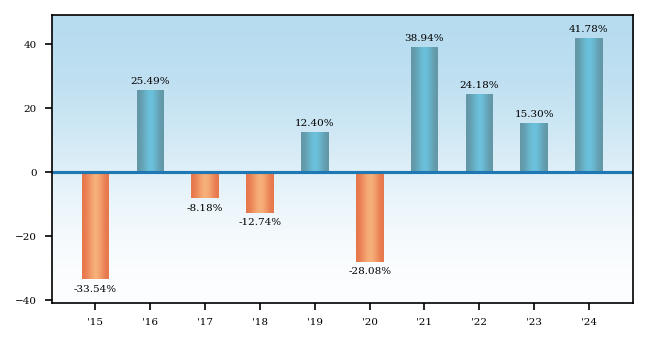
Best Quarter | ||
2020, Q2 | 43.64 | % |
Worst Quarter | ||
2020, Q1 | -53.70 | % |
tax-deferred arrangements, such as 401(k) plans or individual retirement accounts. After-tax returns shown are for Class I shares. After-tax returns for the other share classes may vary.
Average Annual Total Returns - Prospectus Summary - NYLI Cushing MLP Premier Fund |
Label |
1 Year |
5 Years |
10 Years |
Inception Date |
|
|---|---|---|---|---|---|---|
| Class A | 33.65% | 13.63% | 3.46% | Oct. 20, 2010 | ||
| Investor Class | 34.22% | 13.64% | 3.47% | Jul. 11, 2014 | ||
| Class C | 39.39% | 14.06% | 3.26% | Oct. 20, 2010 | ||
| Class I | 41.78% | 15.19% | 4.30% | Oct. 20, 2010 | ||
| Class I | After Taxes on Distributions | 41.09% | 14.16% | 3.70% | |||
| Class I | After Taxes on Distributions and Sales | 24.95% | 11.68% | 3.07% | |||
| Russell 3000® Index1 | Russell 3000® Index1 | [1] | 23.81% | 13.86% | 12.55% | |
| Alerian Midstream Energy Select Index2 | Alerian Midstream Energy Select Index2 | [2] | 43.13% | 16.31% | 6.90% | |
| Cushing MLP Premier Tiered Index3 | Cushing MLP Premier Tiered Index3 | [3] | 43.13% | 14.37% | 3.13% | |
| Alerian MLP Index4 | Alerian MLP Index4 | [4] | 24.41% | 15.56% | 3.67% | |
| [1] | The Russell 3000® Index measures the performance of the largest 3,000 U.S. companies representing approximately 98% of the investable U.S. equity market. |
| [2] | The Alerian Midstream Energy Select Index is a broad-based composite of North American energy infrastructure companies. The Alerian Midstream Energy Select Index is a capped, float-adjusted, capitalization-weighted index, whose constituents earn the majority of their cash flow from midstream activities involving energy commodities. |
| [3] | The returns for the tiered benchmark represent the returns of the Alerian MLP Index prior to December 1, 2020 and the returns of the Alerian Midstream Energy Select Index thereafter. |
| [4] | The Alerian MLP Index is an unmanaged, capped, float-adjusted, capitalization-weighted index and a leading gauge of energy MLPs. |