This table describes the fees and expenses that you may pay if you buy, hold and sell shares of the fund. You may pay other fees, such as brokerage commissions and other fees to financial intermediaries, which are not reflected in the table and examples below.
Annual Fund Operating Expenses |
Dreyfus Treasury and Agency Liquidity Money Market Fund
Single Share
|
|---|---|
| Management fees | 0.08% |
| Other expenses | 0.01% |
| Total annual fund operating expenses | 0.09% |
The Example is intended to help you compare the cost of investing in the fund with the cost of investing in other mutual funds. The Example assumes that you invest $10,000 in the fund for the time periods indicated and then hold or redeem all of your shares at the end of those periods. The Example also assumes that your investment has a 5% return each year and that the fund's operating expenses remain the same. Although your actual costs may be higher or lower, based on these assumptions your costs would be:
Expense Example |
Dreyfus Treasury and Agency Liquidity Money Market Fund
Single Share
USD ($)
|
|---|---|
| 1 Year | $ 9 |
| 3 Years | 29 |
| 5 Years | 51 |
| 10 Years | $ 115 |
The fund pursues its investment objective by investing only in U.S. Treasury securities, repurchase agreements collateralized solely by U.S. Treasury securities or securities issued by U.S. government agencies that are backed by the full faith and credit of the U.S. government, and cash. The fund is a money market fund subject to the maturity, quality, liquidity and diversification requirements of Rule 2a-7 under the Investment Company Act of 1940, as amended, and seeks to maintain a stable share price of $1.00.
The fund is a "government money market fund," as that term is defined in Rule 2a-7, and as such is required to invest at least 99.5% of its total assets in securities issued or guaranteed as to principal and interest by the U.S. government or its agencies or instrumentalities, repurchase agreements collateralized solely by cash and/or government securities, and cash.
The fund invests in U.S. Treasury securities and seeks to enter into repurchase agreements that present minimal credit risk, based on an assessment by Dreyfus, a division of Mellon Investments Corporation (Dreyfus), the fund's sub-adviser, of the issuer's, guarantor's or counterparty's credit quality and capacity to meet its financial obligations, among other factors. As part of this assessment, to the extent relevant information is available, Dreyfus also evaluates whether environmental, social and governance (ESG) factors could have a positive, negative or neutral impact on the entity's financial condition (including cash flows, revenues, and short-term debt coverage) and competitive positioning or reputation within the relevant sector. The relevance and significance of these ESG factors to an entity's financial condition, competitive positioning or reputation vary and are dependent on the specific sector in which an issuer, guarantor or counterparty operates.
With respect to counterparties to repurchase agreements, relevant ESG considerations may include carbon financing and exposure, privacy and data security, responsible investments, corporate governance, business ethics, and financial system stability.
As part of its credit risk analysis, Dreyfus evaluates material ESG factors for the U.S. government and U.S. government agencies. These factors are evaluated from a sovereign perspective and may include environmental risks such as natural disasters, weather patterns and climate change; social factors such as long-term demographic trends, health equality and education standards; and governance factors such as the quality of institutional frameworks. In this regard, ESG considerations are generally expected to have a neutral impact on investment decisions pertaining to U.S. Treasury securities or securities issued by U.S. government agencies that are backed by the full faith and credit of the U.S. government, as other factors such as the financial condition, liquidity and market positioning are expected to outweigh ESG factors.
In evaluating ESG factors, Dreyfus considers ESG research developed by one or more of its affiliates or third parties, including ESG assessments and commentary provided by credit rating agencies, and other material ESG information as available. Identified ESG factors are incorporated within Dreyfus's credit risk analysis to determine whether such ESG factors have a positive, negative or neutral impact on Dreyfus's assessment of creditworthiness. Based on this determination, the fund may adjust the applicable credit or maturity limits for the relevant issuer, guarantor or counterparty. Dreyfus, however, may determine, across all investments within the fund, that other attributes of creditworthiness, such as sources of liquidity and market positioning, outweigh ESG considerations when making an investment decision, and may not consider available ESG data in connection with every investment decision it makes on behalf of the fund. As a result, the fund may enter into repurchase agreements, for example, with counterparties that may be negatively impacted by ESG factors.
Risk Table - Dreyfus Treasury and Agency Liquidity Money Market Fund |
Risk [Text Block] |
|---|---|
| Principal Risks | Principal Risks An investment in the fund is not a bank account or a bank deposit. It is not insured or guaranteed by the Federal Deposit Insurance Corporation (FDIC) or any other government agency. You could lose money by investing in the fund. Although the fund seeks to preserve the value of your investment at $1.00 per share, it cannot guarantee it will do so. The fund's yield will fluctuate as the short-term securities in its portfolio mature or are sold and the proceeds are reinvested in securities with different interest rates. BNY Mellon Investment Adviser, Inc. and its affiliates are not required to reimburse the fund for losses, and you should not expect that BNY Mellon Investment Adviser, Inc. or its affiliates will provide financial support to the fund at any time, including during periods of market stress. The following are the principal risks that could reduce the fund's income level and/or share price: |
| Risk Lose Money [Member] | You could lose money by investing in the fund. |
| Risk Money Market Fund Price Fluctuates [Member] | The fund's yield will fluctuate as the short-term securities in its portfolio mature or are sold and the proceeds are reinvested in securities with different interest rates. |
| Risk Money Market Fund May Not Preserve Dollar [Member] | Although the fund seeks to preserve the value of your investment at $1.00 per share, it cannot guarantee it will do so. |
| Risk Not Insured [Member] | An investment in the fund is not a bank account or a bank deposit. It is not insured or guaranteed by the Federal Deposit Insurance Corporation (FDIC) or any other government agency. |
| · Interest rate risk | · Interest rate risk: This risk refers to the decline in the prices of fixed-income securities that may accompany a rise in the overall level of interest rates. A sharp and unexpected rise in interest rates could impair the fund's ability to maintain a stable net asset value. A wide variety of market factors can cause interest rates to rise, including central bank monetary policy, rising inflation and changes in general economic conditions. It is difficult to predict the pace at which central banks or monetary authorities may increase (or decrease) interest rates or the timing, frequency, or magnitude of such changes. Changing interest rates may have unpredictable effects on markets, may result in heightened market volatility and may detract from fund performance. |
| · Liquidity risk | · Liquidity risk: When there is little or no active trading market for specific types of securities, it can become more difficult to sell the securities in a timely manner at or near their perceived value. In such a market, the value of such securities may fall dramatically, potentially impairing the fund's ability to maintain a stable net asset value. |
| · Market risk | · Market risk: The value of the securities in which the fund invests may be affected by political, regulatory, economic and social developments. Events such as war, acts of terrorism, the spread of infectious illness or other public health issue, recessions, or other events could have a significant impact on the fund and its investments. Recent examples include pandemic risks related to COVID-19 and aggressive measures taken world-wide in response by governments, including closing borders, restricting international and domestic travel, and the imposition of prolonged quarantines of large populations, and by businesses, including changes to operations and reducing staff. |
| · U.S. Treasury securities risk | · U.S. Treasury securities risk: A security backed by the U.S. Treasury or the full faith and credit of the United States is guaranteed only as to the timely payment of interest and principal when held to maturity, but the market prices for such securities are not guaranteed and will fluctuate. |
| · Repurchase agreement counterparty risk | · Repurchase agreement counterparty risk: The fund is subject to the risk that a counterparty in a repurchase agreement could fail to honor the terms of the agreement. |
| · ESG evaluation risk | · ESG evaluation risk: As part of Dreyfus's assessment of an issuer's, guarantor's or counterparty's credit quality and capacity to meet its financial obligations, the consideration of ESG factors may contribute to the fund making different investments than funds that invest in money market securities but do not incorporate ESG considerations when selecting investments. Under certain economic conditions, this could cause the fund to underperform funds that do not incorporate ESG considerations. For example, the incorporation of ESG considerations may result in the fund forgoing opportunities to buy certain securities when it might otherwise be advantageous to do so or selling securities when it might otherwise be disadvantageous for the fund to do so. The incorporation of ESG considerations may also affect the fund's exposure to certain sectors and/or types of investments, which may adversely impact the fund's performance depending on whether such sectors or investments are in or out of favor in the market. Dreyfus's security selection process incorporates ESG data provided by affiliated and unaffiliated data providers, which may be limited for certain issuers, guarantors and repurchase agreement counterparties and/or only take into account one or a few ESG related components. In addition, ESG data may include quantitative and/or qualitative measures, and consideration of this data may be subjective. Different methodologies may be used by the various data sources that provide ESG data for issuers, guarantors and counterparties, including the issuers, guarantors and counterparties themselves. ESG data from data providers used by Dreyfus often lack standardization, consistency and transparency, and, for certain issuers, guarantors and counterparties, such data, including ESG ratings and scores, may not be available, complete or accurate. Dreyfus's evaluation of ESG factors relevant to the financial condition or risk profile of a particular issuer or guarantor of securities or repurchase agreement counterparty, or otherwise, may be adversely affected in such instances. As a result, the fund's investments may differ from, and potentially underperform, funds that incorporate ESG data from other sources or utilize other methodologies. |
The following bar chart and table provide some indication of the risks of investing in the fund. The bar chart shows changes in the performance of the fund's shares from year to year. The table shows the average annual total returns of the fund's shares over time. The fund's past performance is not necessarily an indication of how the fund will perform in the future. More recent performance information may be available at www.dreyfus.com.
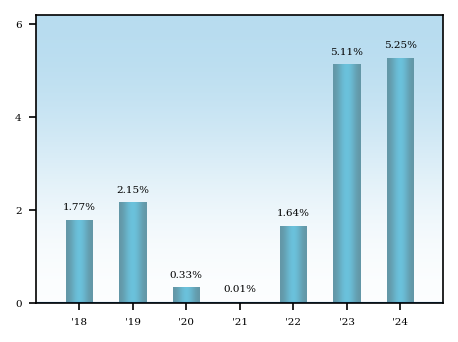
During the periods shown in the chart:
Best Quarter
2023,
Q4: 1.34
Worst Quarter
2021, Q4: 0.00
Average Annual Total Returns |
1 Year |
5 Years |
Since Inception |
Inception Date |
|---|---|---|---|---|
| Dreyfus Treasury and Agency Liquidity Money Market Fund | Single Share | 5.25% | 2.45% | 2.30% | Dec. 18, 2017 |