Investment Objective. The investment objective of the Fund is total return.
Fees and Expenses of the Fund. This table describes the fees and expenses that you may pay if you buy, hold, and sell shares of the Fund. You may pay other fees, such as brokerage commissions and other fees to financial intermediaries, which are not reflected in the table and example below. You may qualify for sales charge discounts if you and your household invest, or agree to invest in the future, at least $50,000 in the Fund. More information about these and other discounts is available from your financial professional and in the section captioned “Purchasing Shares” on page 20 of this prospectus and the section captioned “Purchases” beginning on page 32 of the Fund’s Statement of Additional Information (“SAI”).
Shareholder Fees - WP Large Cap Income Plus Fund |
Class A Shares |
Class C Shares |
Institutional Class Shares |
|
|---|---|---|---|---|
| Maximum Sales Charge (Load) Imposed on Purchases (as a percentage of offering price) | 5.50% | none | none | |
| Maximum Contingent Deferred Sales Charge (Load) (as a percentage of original purchase price or the amount redeemed, whichever is less) | 1.00% | [1] | 1.00% | none |
| [1] | Contingent Deferred Sales Charge applies to Class A shares only when a Shareholder purchase in the Fund totals $1 million or more and the shareholder redeems within 1 year of purchase. |
Annual Fund Operating Expenses - WP Large Cap Income Plus Fund |
Class A Shares |
[1] | Class C Shares |
[1] | Institutional Class Shares |
|
|---|---|---|---|---|---|---|
| Management Fees | 1.35% | 1.35% | 1.35% | |||
| Distribution and Service (12b-1) Fees | 0.25% | 1.00% | 0.10% | |||
| Other Expenses | [2] | 0.76% | 0.76% | 0.76% | ||
| Total Annual Fund Operating Expenses | [3] | 2.36% | 3.11% | 2.21% | ||
| [1] | Expenses for Class A shares and Class C shares are based on estimates since those classes have not yet commenced operations. |
| [2] | “Other Expenses” include 0.06% for payment of interest expenses related to the Fund’s option investing. |
| [3] | Total Annual Fund Operating Expenses have been restated for the Institutional Class Shares to reflect the reduction of the 12b-1 Fees from 0.25% to 0.10%. |
Example. The following Example is intended to help you compare the cost of investing in the Fund with the cost of investing in other mutual funds.
This expense example assumes that you invest $10,000 in the Fund for the time periods indicated and then redeem all of your shares at the end of those periods. The expense example also assumes that your investment has a 5% return each year and the Fund’s operating expenses remain the same. The Contingent Deferred Sales Charges (the “CDSCs”) are not included in these calculations for Class A Shares and Class C shares. If the CDSCs were included, your costs would be higher. See “Purchasing Shares – Choosing a Share Class” below. Although your actual costs may be higher or lower, based on these assumptions your cost would be:
Expense Example - WP Large Cap Income Plus Fund - USD ($) |
Expense Example, with Redemption, 1 Year |
Expense Example, with Redemption, 3 Years |
Expense Example, with Redemption, 5 Years |
Expense Example, with Redemption, 10 Years |
|---|---|---|---|---|
| Class A Shares | 776 | 1,246 | 1,741 | 3,098 |
| Class C Shares | 314 | 960 | 1,630 | 3,420 |
| Institutional Class Shares | 224 | 691 | 1,185 | 2,544 |
Portfolio Turnover. The Fund pays transaction costs, such as commissions, when it buys and sells securities (or “turns over” its portfolio). A higher portfolio turnover rate may indicate higher transaction costs and may result in higher taxes when Fund shares are held in a taxable account. These costs, which are not reflected in annual fund operating expenses or in the example, affect the Fund’s performance. For the fiscal year ended November 30, 2024, the Fund’s portfolio turnover rate was 1.51% of the average value of its portfolio.
Principal Investment Strategy of the Fund. The Fund’s investment objective is total return. To meet its investment objective, the Fund will invest at least 80% of its total assets in large cap domestic equity securities and exchange traded funds (“ETFs”) that primarily invest in large cap domestic equity securities. The Fund will seek income through dividends paid on such securities. The Fund will also seek to produce income (e.g., premium income on the sale of an option) and return stability through an options strategy.
The Advisor intends to sell covered call options on a portion of the Fund’s stock holdings. The extent of option selling will depend on market conditions and the Advisor’s consideration of the advantages of selling call options on the Fund’s equity investments.
The Fund may also sell put options on stocks and ETFs the Advisor believes are attractive for purchase at prices at or above the exercise price of the put options sold. The Fund may, in certain circumstances, purchase put options on the S&P 500 Composite Stock Price Index (the “S&P 500”) and on individual stocks to protect against a loss of principal value due to stock price decline. The extent of option selling and purchasing activity depends on market conditions and the Advisor’s judgment. The Fund may also seek to pursue its investment objective by selling a series of call and put option spread combinations on the S&P 500.
The Fund may be appropriate for investors with long-term horizons who are not sensitive to short-term losses and want to participate in the long-term growth of the financial markets. The Fund seeks to minimize the effects of inflation on its portfolio.
The bar chart and performance table on the next page provide some indication of the risks of investing in the Fund by showing how the Fund’s performance has varied over time. The performance shown for the Institutional Class shares for periods prior to August 20, 2018 reflects the performance of a series of 360 Funds, a Delaware statutory trust (the “Predecessor Fund”) that was reorganized into the Fund’s Institutional Class shares. While the Fund is substantially similar to the Predecessor Fund, the Fund’s performance may be different than the performance of the Predecessor Fund due to, among other things, differences in fees and expenses.
The bar chart depicts the change in performance from year to year during the periods indicated. The performance table compares the Fund’s average annual returns for the periods indicated to a broad-based securities market index. The bar charts and performance tables assume reinvestment of dividends and distributions. The Fund’s past performance (before and after taxes) may not be an indication of how it will perform in the future.
Updated performance information will be available at no cost by calling (866) 959-9260. Performance is not presented for Class A and Class C shares because they have not begun operations.
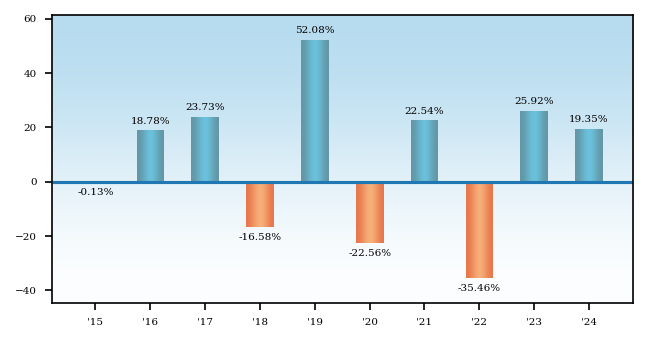
The Fund’s Institutional Class Shares total return through was . During the period shown in the bar chart, the was during the quarter ended and the was during the quarter ended .
Average Annual Total Returns - WP Large Cap Income Plus Fund |
1 Year |
5 Years |
10 Years |
|---|---|---|---|
| Institutional Class Shares | 19.35% | (1.64%) | 5.54% |
| Institutional Class Shares | After Taxes on Distributions | 19.35% | (1.72%) | 5.29% |
| Institutional Class Shares | After Taxes on Distributions and Sales | 11.46% | (1.28%) | 4.34% |
| S&P 500 Index | 25.02% | 14.53% | 13.10% |
| Dow Jones Industrial Average Index | 14.99% | 10.55% | 11.57% |
After-tax returns are calculated using the historical highest individual U.S. federal income tax rates in effect as of December 31, 2024 and do not reflect the impact of state and local taxes. Actual after-tax returns depend on an investor’s tax situation and may differ from those shown. After-tax returns shown are not relevant to investors who hold their Fund shares through tax-deferred arrangements, such as 401(k) plans or individual retirements accounts (“IRAs”).
Current performance of the Fund may be lower or higher than the performance quoted above.
| · | Market risk –Market risk refers to the risk that the value of securities in the Fund’s portfolio may decline due to daily fluctuations in the securities markets, including fluctuation in interest rates, national and international economic conditions and general equity market conditions. |
| · | Dividend strategy risk – There can be no assurances that the Advisor will be able to correctly anticipate the level of dividends that companies will pay in any given timeframe. If the Advisor’s expectations as to potential dividends are wrong, the Fund’s performance may be adversely affected. |
| · | Management style risk – To the extent the Fund focuses on a particular style of stocks, such as growth or value, its performance may at times be better or worse than that of similar funds with other focuses or that have a broader investment style. |
| · | Large company risk – The Fund will invest in larger, more established companies, which may be unable to respond quickly to new competitive challenges such as changes in consumer tastes or innovative smaller competitors. Also, large companies are sometimes unable to attain the high growth rates of successful, smaller companies, especially during extended periods of economic expansions. |
| · | Interest rate risk – Increases in interest rates typically lower the present value of a company’s future earnings stream. Accordingly, stock prices will generally decline when investors anticipate or experience rising interest rates. |
| · | Issuer risk – The value of an individual security or particular type of security can be more volatile and thus perform differently than the market as a whole. |
| · | Equity risk – Equity risk is the risk that securities held by the Fund will fall due to general market or economic conditions, perceptions regarding the industries in which the issuers of securities held by the Fund participate, and the particular circumstances and performance of those companies whose securities the Fund holds. |
| · | – You will indirectly bear fees and expenses charged by the underlying funds in which the Fund may invest in addition to the Fund’s direct fees and expenses and, as a result, your cost of investing in the Fund will generally be higher than the cost of investing directly in the underlying fund shares. Investments in ETFs bear the risk that the market price of the ETF’s shares may trade at a discount to their net asset value or that an active trading market for an ETF’s shares may not develop or be maintained. The Fund may place otherwise uninvested cash in money market mutual funds. |
| · | Sector Risk—The Fund may, at times, have significant investments in the securities of issuers in industries within a particular sector, any development affecting that sector will have a greater impact on the value of the net assets of the Fund than would be the case if the Fund did not have significant investments in that sector. In addition, this may increase the risk of loss of an investment in the Fund and increase the volatility of the Income Fund’s NAV per share. From time to time, circumstances may affect a particular sector and the companies within such sector. For instance, economic or market factors, regulation or deregulation, and technological or other developments may negatively impact all companies in a particular sector and therefore the value of the Fund’s portfolio will be adversely affected. As of the Fund’s latest fiscal year end, it had 38.65% of the value of its net assets invested in stocks within the Information Technology sector, and 37.57% of the value of its net assets invested in stocks within the Financials sector. |
Information Technology Companies Risk. Information technology companies are generally subject to the following risks: rapidly changing technologies; short product life cycles; fierce competition; aggressive pricing and reduced profit margins; the loss of patent, copyright and trademark protections; cyclical market patterns; evolving industry standards; and frequent new product introductions. Information technology companies may be smaller and less experienced companies, with limited product lines, markets or financial resources and fewer experienced management or marketing personnel. Information technology company stocks have experienced extreme price and volume fluctuations that are often unrelated to their operating performance.
Financial Companies Risk. Financial companies, such as retail and commercial banks, insurance companies and financial services companies, are especially subject to the adverse effects of economic recession, currency exchange rates, extensive government regulation, decreases in the availability of capital, volatile interest rates, portfolio concentrations in geographic markets, industries or products (such as commercial and residential real estate loans) and competition from new entrants and blurred distinctions in their fields of business.
| · | Options risk – Purchasing and selling put and call options are highly specialized activities and entail greater than ordinary investment risks. The successful use of options depends in part on the ability of the Advisor to manage future price fluctuations and the degree of correlation between the options and securities (or currency) markets. By selling put options on equity securities, the Fund gives up the opportunity to benefit from potential increases in the value of the underlying securities above the strike prices of the sold put options, but continues to bear the risk of declines in the value of underlying securities held by the Fund. The Fund will receive a premium from the purchaser of a covered call option sold by the Advisor, which it |
retains whether or not the option is exercised. The premium received from the sold options may not be sufficient to offset any losses sustained from the volatility of the underlying equity securities over time.
| · | Limits on option selling risk – The number of call options the Fund can sell is limited by the number of shares of common stock or ETFs or other securities the Fund holds and is further subject to limitations established by each of the exchanges, boards of trade or other trading facilities on which such options are traded. |
| · | Options strategy risk – The Fund’s option strategy consists of selling and purchasing put and call options on equity indexes and ETFs. The sale of put options generates income for the Fund but exposes it to the risk of declines in the value of the underlying assets. The risk in purchasing options is limited to the premium paid by the Fund for the options. The sale of call options generates income for the Fund but may limit the Fund's participation in equity market gains. |
| · | Derivatives risk – The use of derivatives can lead to losses because of adverse movements in the price. Losses may also occur because the value of the asset, index, rate or instrument underlying a derivative loses value, or due to failure of a counterparty or due to tax or regulatory constraints. Derivatives may create economic leverage in the Fund, which magnifies the Fund’s exposure to the underlying investment. The loss on derivative transactions may significantly exceed the initial investment. |
| · | Transaction cost risk – Transaction costs refer to the charges that are associated with buying and selling securities for the Fund. As a result of the Fund’s options strategy, the Fund may incur higher brokerage and transactional related charges than those associated with an average equity fund. These transaction costs increase the cost of your investment in the Fund. |
| · | General fund investing risk – The Fund is not a complete investment program and you may lose money by investing in the Fund. All investments carry a certain amount of risk and there is no guarantee that the Fund will be able to achieve its investment objective. Additionally, unexpected local, regional or global events, such as war; acts of terrorism; financial, political or social disruptions; natural, environmental or man-made disasters; the spread of infectious illnesses or other public health issues (such as COVID-19); and recessions and depressions could have a significant impact on the Fund and its investments and may impair market liquidity. Such events can cause investor fear, which can adversely affect the economies of nations, regions and the market in general, in ways that cannot necessarily be foreseen. |