CODE OF ETHICS
Most Recently Revised: January 2025
Last Reviewed: January 2025
_________________________________________________________________________________
PGIM Investments LLC (“PGIM Investments” or “PI”)
AST Investment Services, Inc. (“ASTIS”)
(Each, an "Adviser", collectively the “Advisers”)
Background
Rule 204A-1 under the Advisers Act requires each federally registered investment adviser to adopt a written code of ethics designed to prevent fraud by reinforcing the principles that govern the conduct of investment advisory firms and their personnel. In addition, the code of ethics must set forth specific requirements relating to personal securities trading activity including reporting transactions and holdings.
Generally, this Investment Adviser Code of Ethics (“Code”) applies to directors, officers and employees acting in an investment advisory capacity who are known as Supervised Persons and, in some cases, also as Access Persons of the Advisers.1 Supervised Persons covered by more than one code of ethics meeting the requirements of Rule 204A-1 will be subject to the code of the primary entity with which the Supervised Person is associated.
Employees identified as Supervised and Access Persons must comply with the Code. Employees can check their classification on Compliance Center. Supervised Persons must be provided and must acknowledge receipt of this Code and any amendments to the Code. They must also comply with the federal securities laws.
Policies and Procedures
Prudential holds its employees to the highest ethical standards. Maintaining high standards requires a total commitment to sound ethical principles and Prudential’s values. It also requires nurturing a business culture that supports decisions and actions based on what is right, not simply what is expedient.
It is the responsibility of management to make the Company’s ethical standards clear. At every level, employees must set the right example in their daily conduct. Prudential expects employees to be honest and forthright and to use good judgment. We expect them to deal fairly with customers, suppliers, competitors, and one another. We expect them to avoid taking unfair advantage of others through manipulation, concealment, abuse of confidential information or misrepresentation.
1Supervised Persons are defined as an officer, director or employee of a registered investment advisor, or are an individual who provides advice on behalf of the adviser and are subject to the adviser’s supervision and control. Access Persons are defined as an employee who works in or supports portfolio management activities and has access to non-public investment advisory client trading information, recommendations or has access to non-public portfolio holdings of mutual funds.
Moreover, employees must understand the expectations of the Company and apply these guidelines to analogous situations or seek guidance if they have questions about conduct in given circumstances.
It is each employee’s responsibility to ensure that we:
Nurture a company culture that is highly moral and make decisions based on what is right.
Build lasting customer relationships by offering only those products and services that are appropriate to customers’ needs and provide fair value.
Maintain an environment where employees conduct themselves with courage, integrity, honesty and fair dealing at all times.
Ensure no individual’s personal success or business group’s bottom line is more important than preserving the name and goodwill of Prudential.
Regularly monitor and work to improve our ethical work environment.
Because Ethics is not a science, there may be gray areas. We encourage individuals to ask for help in making the right decisions. Business Management, Business Ethics Officers, and our Human Resources, Law and Compliance and Enterprise Ethics professionals are all available for guidance at any time.
Investment Adviser Fiduciary Standards
Investment advisers are fiduciaries for clients. Fiduciary status may exist under contract; common law; state law; or federal laws, such as the Investment Advisers Act of 1940, the Investment Company Act of 1940 and ERISA.
Whenever a Prudential adviser acts in a fiduciary capacity, it will endeavor to consistently put the client’s interest ahead of the firm’s interests. It will disclose actual and potential meaningful conflicts of interest. It will manage actual conflicts in accordance with applicable legal standards. If applicable legal standards do not permit management of a conflict, the adviser will avoid the conflict. Adviser personnel will not engage in fraudulent, deceptive or manipulative conduct. Advisers will act with appropriate care, skill and diligence.
Advisory personnel are required to know when an adviser is acting as a fiduciary with respect to the work they are doing. In such cases, advisory personnel are expected to comply with all fiduciary standards applicable to the firm in performing their duties. In addition, they must also put the client’s interest ahead of their own personal interest. An employee’s fiduciary duty is a personal obligation. While advisory personnel may rely upon subordinates to perform many tasks that are part of their responsibilities, they are personally responsible for fiduciary obligations even if carried out through subordinates. Employees should be aware that failure to adhere to the standards under this Code might lead to disciplinary action up to and including termination of employment.
Reporting Violations of the Code
Failure to comply with any of the requirements (or report potential violations) of this Code and the other important policies listed above may result in violations of securities laws and regulations. Prudential takes such violations very seriously. Any potential violation of the provisions of this Code will be investigated by Law & Compliance. If a determination is made that a violation has occurred, we may impose appropriate sanctions, up to and including termination of employment or referral to regulatory, civil, or criminal authorities.
2
To report suspected violations, you should contact Compliance. If you feel uncomfortable reporting directly to Compliance, you may also report suspected violations to our Ethics Help Line (1-800-752- 70241) or Website https://prudential.ethicspoint.com. Prudential will not tolerate any discrimination, harassment, or retaliation against anyone who makes a good faith report or assists in an investigation.
You may voluntarily communicate with or provide information to government agencies regarding potential violations of the law without providing notice to, or obtaining approval, from Prudential. Nothing in these Standards is intended to, or should be interpreted, to preclude anyone from exercising these rights.
Incorporated Policies
This Code complements other important Prudential Policies that address ethics and conflicts, such as:
Code of Ethics – Personal Investing Standards. All investment advisory personnel are subject to the Code of Ethics – Personal Investing Standards and must comply with all requirements therein unless otherwise notified by Compliance.
Global Insider Trading Policy. All employees of Prudential are subject to the Global Insider Trading Policy and must comply with applicable requirements.
Insider Trading and Information Barrier Standards. All Supervised and Access Persons
receive training on their obligations and must comply with any information barrier restrictions applicable to their business unit or job function.
Compliance Policies and Procedures – all investment advisory personnel must comply with their applicable business unit policies and procedures.
Although not part of this Code, Prudential’s Code of Conduct, titled Making the Right Choices, applies to all Prudential employees. In addition to the Code, employees in the investment advisory business are also subject to all applicable compliance manuals, policies and procedures. If you have any questions as to your requirements under the Code or as to which registered investment adviser(s) you are affiliated with, please contact Compliance.
Related Policies:
Prudential’s Code of Conduct - Making the Right Choices
Prudential’s Code of Ethics – Personal Investing Standards
Prudential Global Insider Trading Policy
Prudential’s Insider Trading and Information Barrier Standards
3
Applies to:
All employees (full-time and part-time), globally, that work for, support, or are a registered representative of any of Prudential’s asset management, investment adviser, and broker dealer businesses (CIO, PAD, PGIM, PIMS, and PruCo)
All contractors, interns, temporary employees, and others who have been notified by compliance are subject to this policy.
Questions?
CONTACT: PST.Help@prudential.com
This policy complements other important Prudential policies that address ethics and conflicts, such as Prudential’s Code of Conduct
–Making the Right Choices, Conflicts of Interest Policy, Global Anti-Bribery and Anti- Corruption Policy, Information Barrier Standards, and Global Insider Trading Policy.
Code of Ethics
Personal Investing Standards
December 17, 2024
Prudential Financial, Inc.- Compliance Approval Required Prior to External Dissemination
Overview
Key Points
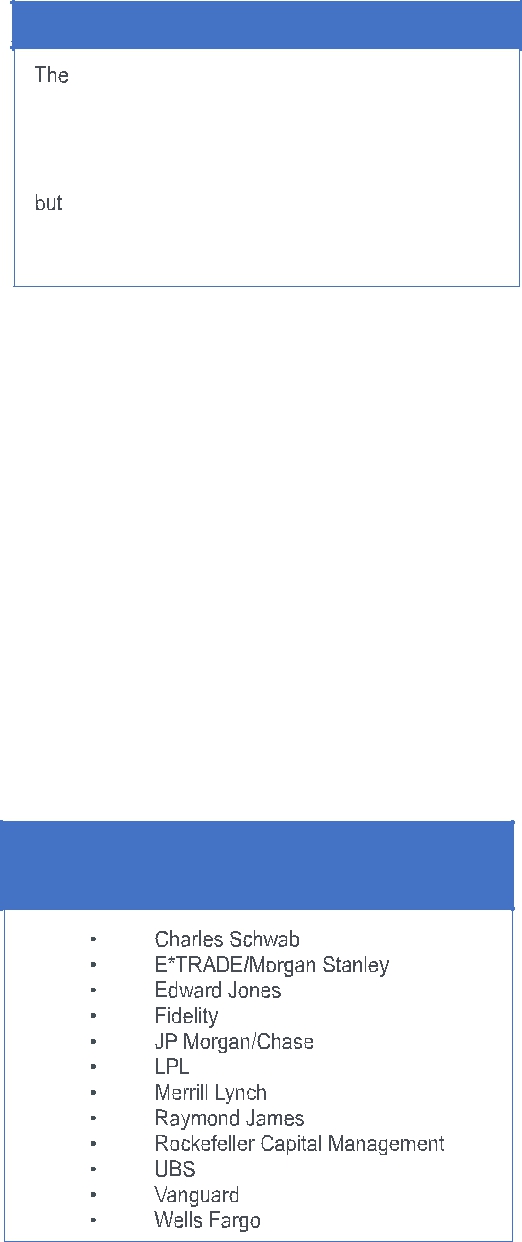
We are entrusted with our clients’ investment assets and as such, Prudential Financial, Inc. and its subsidiaries (collectively “Prudential,” “PFI” or the “Company”) aspire to the highest standard of business ethics. Per our Code of Conduct, “Making the Right Choices,” we have an obligation to place our clients’ interests before our own and manage conflicts of interest fairly. In addition to Making the Right Choices, our Code of Ethics - Personal Investing Standards (the “Code”) provides a framework to make sure we meet that obligation with our personal investments.
While the Code sets out several requirements, prohibitions, and conditions, it does not cover every possible scenario and cannot be a replacement for your good judgment. If the Code is unclear, consult with Compliance and evaluate your proposed course of conduct against our principles and core values:
✓We do the right thing by placing the interests of our clients first.
✓We avoid, mitigate and/or disclose relevant conflicts of interest.
✓We are committed to doing business in the right way, and comply with applicable laws, rules, and regulations.
✓We make and keep promises, which includes holding each other accountable by reporting any violations.
The Code is designed to comply with laws, rules, and regulations of the various jurisdictions where Prudential operates. You should consult with your Local Business Compliance Officer to confirm if there are any additional personal investing policies and procedures that are specific to your business.
Who is covered under these standards?
Except as otherwise noted, the Code applies globally to all directors, officers, and employees (including contractors, interns, temporary employees, and others who have been notified by compliance they are subject to this policy) of/or supporting Prudential asset management, investment adviser and/or broker-dealer businesses, including the Prudential Chief Investment Office (“CIO”), Prudential Annuities Distributors (“PAD”), PGIM, Prudential Investment Management Services (“PIMS”), and Prudential Financial Planning Services (“PruCo”), throughout the enterprise regardless of geographic location (“Employees”).
For the purposes of these standards, “PGIM” refers to all PGIM affiliated registered investment advisers, business units and their associated functional areas including AST Investment Services, PGIM Custom Harvest, PGIM DC Solutions, PGIM Global Services, PGIM Fixed Income, PGIM Institutional Advisory Services, PGIM Institutional Relationship Group, PGIM Investments, PGIM Multi-Asset Solutions, PGIM Quantitative Solutions, and PGIM Private Alternatives.
Roles and Responsibilities
|
Employees |
|
|
Compliance |
|
|
Ethics Committee |
|
|
|
|
|
|
|
|
• Upon hire, |
|
|
• Administers and monitors adherence to the Code, |
|
|
• Reviews the Code on a periodic basis in line with |
|
|
annually and any |
|
|
|
|
|
|
|
|
|
business changes and changes to regulation. |
|
|
time material |
|
|
|
|
|
|
|
including providing training, reviewing employees’ |
|
|
• Provides oversight of the Code, including by |
|
|
changes are |
|
|
|
|
|
|
|
|
disclosures and transactions, and identifying potential |
|
|
|
|
|
|
|
reviewing exceptions and addressing incidents |
|
|
made you will |
|
|
|
|
|
|
|
|
violations. |
|
|
|
|
|
|
|
|
and violations. Sanctions may include verbal |
|
|
attest and agree |
|
|
|
|
|
|
|
|
• Maintains and oversees the maintenance of certain |
|
|
|
|
|
|
|
|
reminders, educational letters, disciplinary letters, |
|
|
to comply with |
|
|
|
|
|
|
|
|
records in accordance with applicable legal and |
|
|
monetary penalties, suspension without pay, |
|
|
the requirements |
|
|
|
|
|
|
|
|
regulatory requirements. |
|
|
personal trading ban, reduction in PTO days, or |
|
|
of the Code. |
|
|
|
|
|
|
|
|
|
|
|
other disciplinary action up to and including |
|
|
|
|
|
|
|
|
|
|
|
|
|
|
|
|
termination of employment. |
|
|
|
|
|
|
4 |
|
Employee Classifications
Employee monitoring classifications are listed below. For ease of reference, the term Employee will be used throughout this document and multiple classifications may apply depending on your role.
Please see Exhibit A – Key Definitions for a full list of classifications.
|
Supervised |
|
Associated |
|
|
Access Persons |
|
|
Investment |
|
|
Designated Persons |
|
|
Persons |
|
Persons |
|
|
|
|
|
Persons |
|
|
|
|
|
|
|
|
|
|
|
|
|
|
|
|
|
|
|
Employees of a Prudential |
|
Employees who are |
|
Employees who are |
|
|
Employees who make or |
|
|
Employees who, during the |
|
|
registered investment |
|
associated with any |
|
associated with any |
|
|
participate in making |
|
|
normal course of their |
|
|
adviser, and other |
|
Prudential broker- |
|
Prudential broker-dealer |
|
|
recommendations |
|
|
employment, have routine |
|
|
individuals who provide |
|
dealer. |
|
and/or Employees who work |
|
|
regarding the purchase |
|
|
access to Material Nonpublic |
|
|
investment advice on |
|
|
|
for, or support, investment |
|
|
or sale of securities for |
|
|
Information about Prudential. |
|
|
behalf of the adviser and |
|
|
|
advisory activities and may |
|
|
client accounts (e.g., |
|
|
|
|
|
are subject to the adviser’s |
|
|
|
have access to nonpublic: |
|
|
portfolio managers and |
|
|
Material Nonpublic |
|
|
supervision and control. |
|
|
|
• |
advisory client trading |
|
|
research analysts). |
|
|
|
|
|
|
|
|
|
|
|
Information may consist of |
|
|
|
|
|
|
|
|
|
|
|
|
|
|
|
|
|
|
|
|
|
|
|
|
|
information, |
|
|
|
|
|
financial or non-financial |
|
|
|
|
|
|
• |
advisory client |
|
|
|
|
|
information about Prudential |
|
|
|
|
|
|
|
investment |
|
|
|
|
|
as a whole or one or more |
|
|
|
|
|
|
|
recommendations, or |
|
|
|
|
|
Divisions or Segments. |
|
|
|
|
|
|
• |
portfolio holdings. |
|
|
|
|
|
|
|
|
|
|
|
|
|
|
|
|
|
|
|
Please refer to Prudential’s |
|
|
|
|
|
|
|
|
|
|
|
|
|
Global Insider Trading Policy |
|
|
|
|
|
|
|
|
|
|
|
|
|
for specific requirements. |
|
|
|
|
|
|
|
|
|
|
|
|
|
|
|
Escalation Requirements
Failure to comply with any of the requirements of the Code or report potential violations may result in violations of securities regulations. Prudential takes violations very seriously. Any potential violation of the provisions of the Code will be investigated by Compliance and may be reported to the Ethics Committee.
If a determination is made that a violation has occurred, we may impose appropriate sanctions, including but not limited to one or more of the following: a written warning, profit surrender, personal trading ban, and termination of employment or referral to regulatory, civil, or criminal authorities.
To report suspected violations of the Code, you should contact Compliance. If you feel uncomfortable reporting directly to Compliance, you may also report suspected violations to our Ethics Help Line (1-800-752-7024) or website https://prudential.ethicspoint.com.
We will not tolerate any discrimination, harassment, or retaliation against anyone who makes a good faith report or assists in an investigation.
You may voluntarily communicate with or provide information to government agencies regarding potential violations of the law without providing notice to, or obtaining approval, from Prudential. Nothing in this Code is
intended to, or should be interpreted, to preclude anyone from exercising these rights.
Key Definitions
See Exhibit A.
5
Policy Requirements
Personal Trading
Key Principles
Your personal trading and investments may present an actual, potential, or apparent conflict of interest or other risk that could harm Prudential, our shareholders, or our clients. To help us identify and manage these conflicts and risks, depending on your employee classification (described above) you may be required to:
➢disclose Investment Securities Accounts and investment holdings where you have a Beneficial Interest (including those where you have influence or control),
➢receive pre-approval for certain personal trading activities, and
➢conduct approved securities transactions in accordance with the requirements of the Code.
Before engaging in any investment-related activity or transaction, you must carefully consider the nature of your responsibilities and the type of information that you might be deemed to possess regarding a particular securities transaction.
In addition:
➢You may not trade based on Material Nonpublic Information (MNPI) or Inside Information
➢You may not profit, or cause others to profit, based on your knowledge of completed or contemplated client transactions.
➢You may not improperly benefit by causing a client to act, or fail to act, in making investment decisions.
➢You may not trade in any manner that conflicts with the interests of our clients, the parameters set by the Code, or the restrictions imposed by our Restricted Lists.
➢You may not use a derivative (futures, options, and other types) or any other instrument or means to circumvent the Code if a direct investment in the underlying security is prohibited.
Trading Restrictions
Material Nonpublic Information (MNPI)
You may not buy or sell any security while in possession of MNPI. You may not recommend, advise, or encourage any other person to engage in such activity.
You may not use your knowledge of transactions in funds or other accounts advised by any Prudential entity to profit from the market effect of these transactions.
6
Investing in Prudential Funds
Prudential serves as the adviser to a variety of investment products including open-end mutual funds, exchange traded products and investment trusts. While you must disclose accounts that hold Prudential- affiliated open-end funds, you do not need to preclear transactions in such funds.
Be aware these funds may have restrictions on frequent trading and other restrictions as described in its fund prospectus.
Private Placements & Private Securities Transactions
You must obtain approval before investing in a private placement securities offering. Compliance approval may be granted after a review of the facts and circumstances, including whether:
▪an investment in the securities is likely to result in future conflicts with client accounts (e.g., upon a future public offering), and
▪you are being offered the opportunity due to your employment at or association with Prudential
Contact Compliance for assistance with these requests.
Initial Public Offerings (IPOs)
You may not participate in IPOs. Compliance will consider exceptions under limited circumstances.
Trading in Prudential Securities
Prudential Financial, Inc. (PFI) is a publicly traded company. You may not trade or cause someone else to trade in Prudential securities while in the possession of Material Nonpublic Information (MNPI) or Inside Information.
You may not engage in transactions in PFI securities if they are speculative or short-term in nature. Speculative trading includes short sales, transactions in “put” or “call” options or similar derivative transactions. For more information, see the Global Insider Trading Policy.
Gifts of Prudential Securities
Employees with Section 16-related filing obligations regarding securities of PFI or PGIM Closed-End Funds must preclear all gifts of such securities.
Board Memberships and Joint Ventures
You should be mindful that purchasing and/or selling shares of publicly traded companies when either you or your Immediate Family Member serves on that company’s Board of Directors may require additional reporting and/or prior approval by that company. Please contact the Compliance Department of that company for guidance.
Employees serving on the Board of Directors for Prudential-affiliated joint ventures may be subject to trading restrictions on shares issued by the joint venture’s partner(s). Please contact the Local Business Unit Compliance for guidance.
Short Sales
You may not short PFI related securities under any circumstances.
7
Beneficial Interest
Additionally, Investment Persons may not short sell any security which is owned by any portfolio managed by the business unit that they support except for short sales “against the box.” A short sale “against the box” refers to a short sale when the seller owns an equivalent amount of the same securities.
Associated, Access, & Investment Persons Account Reporting
What Must be Reported?
Initial Investment Securities Account Disclosures
If you are classified as either an Associated, Access, or Investment Person, within 10 calendar days of your start date, you must report all Investment Securities
Accounts in which you have a Beneficial Interest (see definition above). Additionally, you must disclose any account that holds or can hold Prudential products (e.g., mutual funds, hedge funds or sub-advised products).
Initial Holdings Disclosures
If you are classified as an Access or Investment person, within
10 calendar days of your start date, you must disclose all holdings in Covered Securities in which you have a Beneficial Interest.
Additionally, you must disclose any holdings in Prudential-managed products, including mutual funds, commingled pools, hedge funds or sub-advised products.
Holdings information must be current as of 45 days prior to your start date. See pages 10-11 below and Exhibit B for a detailed list of Covered and Non-Covered Securities.
Authorized Brokers for US Reportable Accounts
US-based reportable Investment Securities Accounts must be held at one or more of the firms on the Authorized Brokers List.
New employees must transfer all reportable accounts to an Authorized Broker within 45 days from the start of their employment.
Authorized Brokers List
This requirement does not apply to managed accounts that are exempt from certain provisions of the Code, employee stock purchase and stock option plans and other accounts (including health savings accounts, 529 plans, pension, retirement, and compensation accounts).
If you are granted an exception to hold your Investment Securities Accounts with a firm not on the Authorized Brokers List, you must manually enter all Covered Securities transactions into the STAR system as soon as possible, but no later than 10 days after the quarter ends. Additionally, you must periodically certify the accuracy of manually entered transactions.
8
Non-US Reportable Accounts
For non-US reportable Investment Securities Accounts, you must promptly disclose any newly opened accounts in which you have a Beneficial Interest.
You must ensure that Compliance receives duplicate statements and trade confirmations/contract notes in one of the three ways listed below.
1.Electronic feeds – You are encouraged to deal through brokers that provide Compliance with trade confirmations and holdings via electronic feed to the STAR system. This provides Compliance with the most timely and accurate personal trading information. All brokers on the Authorized List provide us with an electronic feed.
2.Broker Delivery of Duplicate Confirmations and Statements – In applicable jurisdictions, you should allow your brokers to provide delivery of duplicate confirmations and statements directly to your local compliance team.
3.You Upload Trade Information – If neither of the above options is possible, you are required to enter your trade details into STAR and upload the trade information (e.g., confirmation/contract notes, etc.) within 10 business days of executing a precleared trade. Additionally, you will be required to attest to your trades quarterly and upload statements quarterly.
Due to applicable laws, if you are located outside of the United States, you may not be required to disclose or report information regarding accounts for a spouse, dependent family member and/or minor child.
Please see Appendix D for jurisdiction-specific guidance, if your jurisdiction is not listed, contact your local Compliance for clarification.
Cryptocurrency
You are not required to disclose accounts for cryptocurrency (or other digital assets) if they do not have brokerage capabilities and are not linked to an account with brokerage capabilities (whether or not such capabilities are utilized).
If you need help confirming whether your cryptocurrency account has a brokerage component, contact local Compliance for assistance.
Ongoing Disclosure, Reporting, & Attestation Responsibilities
The table below summarizes ongoing disclosure, reporting and attestation responsibilities for those accounts in which you have a Beneficial Interest, depending on your Employee Classification.
|
Ongoing Responsibilities |
|
|
Associated Persons |
|
|
Access & Investment Persons |
|
|
|
|
|
|
|
|
|
|
|
|
|
|
|
|
|
Within 30 days – Disclose any newly opened |
|
|
Required |
|
|
Required |
|
|
accounts |
|
|
|
|
|
|
|
|
|
|
|
|
|
Within 30 days – Disclose the holdings |
|
Not Required |
|
|
Required |
contained in newly opened accounts |
|
|
|
|
|
|
|
|
|
|
Annually attest that you have disclosed all |
|
|
Required |
|
|
Required |
|
|
accounts |
|
|
|
|
|
|
|
|
|
|
|
|
|
Annually attest that you have disclosed all |
|
Not Required |
|
|
Required |
required holdings |
|
|
|
|
|
|
|
|
|
|
Quarterly Exception Account Attestation (for |
|
|
|
|
|
|
|
|
Investment Securities Accounts without direct |
|
|
Required |
|
|
Required |
|
|
electronic feed) |
|
|
|
|
|
|
|
|
|
|
|
|
9 |
|
In addition to the above, you may be required to complete other periodic attestations to meet jurisdictional and regulatory requirements.
Additional Requirements for Access and Investment Persons
Preclearance Process for Personal Trading
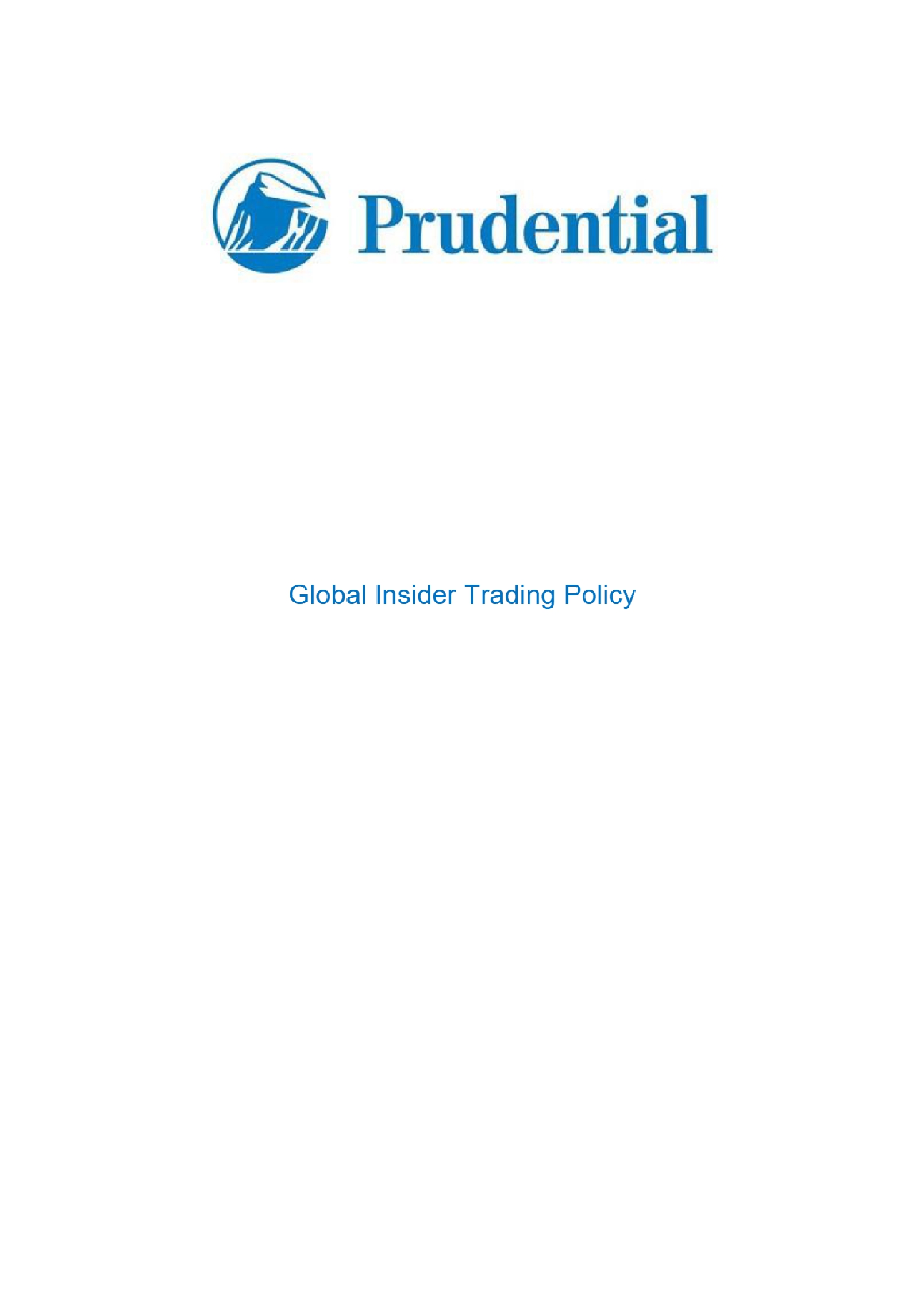
The requirements in the Code are designed to mitigate or eliminate any |
MOBILE INVESTING APPS |
potential or apparent conflict that may occur between your personal |
|
|
|
|
account dealing and client security dealing. The following requirements |
|
|
apply to your personal dealing in Covered Securities in Investment |
|
Securities Accounts for which you have a Beneficial Interest (See Exhibit C |
|
–Beneficial Interest).
What Trades Must Be Precleared?
If you are classified as an Access or Investment Person, you must receive approval before buying, selling, gifting and transferring ownership of
stocks, bonds, options, other publicly traded securities, and private placements (Covered Securities) in any reportable Investment Securities Account, unless included in the list below (Non-Covered Securities).
What Trades are Not Required to be Precleared?
You are not required to preclear the following (unless the business that you work for, or support centrally or directly, is specifically listed below):
|
Non-Covered Securities |
|
|
Must Preclear |
|
|
Prohibited from |
|
|
|
|
|
|
|
|
|
|
|
|
|
|
trading |
|
|
Select Broad Based Equity ETFs and related Options |
|
|
SIRG Custom Harvest |
|
|
|
|
|
Select equity index funds that are not specific to a sector and |
|
|
|
|
|
|
|
|
track an index with a minimum of 100 constituents that |
|
|
|
|
|
|
|
|
compliance has determined to be sufficient. See the |
|
|
|
|
|
|
|
|
document library in STAR for the current Approved List |
|
|
|
|
|
|
|
Broad Based ETFs and related Options ETFs that are not |
|
Fixed Income, SIRG, Custom Harvest |
|
|
|
specific to a sector and track an index with a minimum of 100 |
|
|
|
|
|
|
constituents that compliance has determined to be sufficient. |
|
|
|
|
|
|
See the document library in STAR for the current Approved |
|
|
|
|
|
|
List. |
|
|
|
|
|
|
|
Other ETFs |
|
|
Fixed Income, PQS, PGIM Investments, |
|
|
|
|
|
|
|
|
PGIM Custom Harvest, PGIM DC |
|
|
|
|
|
|
|
|
Solutions and GRES |
|
|
|
|
Futures options and futures on additional Broad Based |
|
Fixed Income |
|
NFA Associated |
Indices. (for example, FTSE 100, FTSE 250, MSCI EAFE, |
|
|
|
|
Persons are |
MSCI EM, NASDAQ 100, Nikkei 225, NSE S&P CNX, |
|
|
|
|
prohibited from |
Russell 1000, Russell 2000, Russell 3000, S&P 100, S&P |
|
|
|
|
trading in futures |
500, S&P Europe 350, and S&P MidCap 400) |
|
|
|
|
|
|
|
Options, futures, and other ETFs based on one or more |
|
|
Fixed Income |
|
|
NFA Associated |
|
|
instruments that are not covered securities (e.g., |
|
|
|
|
|
Persons are |
|
|
commodities, currencies, and U.S. Treasuries |
|
|
|
|
|
prohibited from |
|
|
|
|
|
|
|
|
trading in futures |
|
|
|
|
|
|
|
|
|
|
All debt issuances including bills, notes, bonds, and |
|
Fixed Income (except for U.S. Savings |
|
|
|
direct obligations of the U.S. Government including U.S. |
|
Bonds) |
|
|
|
Treasury bills, notes, and bonds |
|
|
|
|
|
|
|
Currencies |
|
|
Fixed Income |
|
|
|
|
Sovereign debt derivatives |
|
|
|
|
Fixed Income |
|
|
|
|
|
|
10 |

|
Non-Covered Securities |
|
|
Must Preclear |
|
|
Prohibited from |
|
|
|
|
|
|
|
|
|
|
|
|
|
|
trading |
|
|
Bankers’ acceptances and Bank Certificates of Deposit |
|
|
|
|
|
|
|
Commercial paper |
|
|
|
|
|
|
|
High quality short-term debt instruments (rated in one of |
|
|
|
|
|
|
|
|
the two highest categories by an NRSRO & maturity of less |
|
|
|
|
|
|
|
|
than 366 days), including repurchase agreements. |
|
|
|
|
|
|
|
Cryptocurrencies that are not securities |
|
|
|
|
|
|
|
Money market funds and Open-end mutual funds |
|
|
|
|
|
|
|
Unaffiliated annuities and life insurance contracts |
|
|
|
|
|
|
|
529 plans |
|
|
|
|
|
|
|
Unit Investment Trusts |
|
|
|
|
|
|
|
|
|
|
|
|
|
Prudential related securities |
|
|
Designated Persons at SVP level (or |
|
|
|
|
|
|
|
|
equivalent) and above. |
|
|
|
|
Where specific business units are identified above, the additional requirements (preclear or prohibited investments) extend to any employees who provide direct or central support to those business units.
While the above securities, commodities, currencies, and instruments are exempt from the specific preclearance requirements and investment restrictions set out in the Code, you should consider any potential conflicts of interest before trading.
Options & Futures
The purchase, sale and exercise of options and futures are generally subject to the same restrictions as applicable to the underlying security.
If a transaction in the underlying security does not require preclearance (e.g., certain ETFs, national government obligations, unit investment trusts), then an options or futures transaction on the underlying instrument does not require preclearance.
Preclearance is not required when you write (sell) an option, and the option is exercised without any action on your part.
You should be cautious when transacting in options since a client transaction in the underlying security or a restriction associated with the underlying security may prevent an option transaction from being closed or exercised.
How does the Preclearance Process Work?
You must preclear any trades in Covered Securities in an Investment Securities Account for which you have a Beneficial Interest.
U.S Based Employees |
Non-U.S. based Employees |
Employees preclear using STAR unless the transaction meets one of the provisions noted above.
Employees preclear using STAR when available.
Please note local law or administrative issues may limit the availability of STAR. In these cases, employee personal trading activity is approved, monitored, and tracked locally.
Please consult your Local Business Unit Compliance Officer for details.
11
Most requests are approved or denied immediately, but some may take longer to evaluate. Please note, a reason for denial may not be provided if it could result in the release of Confidential Information.
Two-Day Approval Window
Approvals and denials are communicated via email. If your requested transaction is approved and you choose to transact, you have until the end of the next calendar day to execute your transaction. If one of your approved days is on a weekend or market holiday, your approval does not carry over to the next business day. A new preclearance request will be required after the two calendar days have passed.
If the transaction is not placed and executed within the approved timeframe, you will need to submit a new trade request in STAR. Limit orders are allowed only if they are set to expire within the preclearance approval window.
If you engage in multi-day limit orders, you must obtain preclearance approval for the days that the order is outstanding. Transactions triggered by limit orders, margin calls, or margin account maintenance fees require preclearance approval and may result in violations.
Trading Restrictions
Excessive Trading
You may not engage in an excessive volume of trading in your personal accounts. High volumes of personal trading may raise concerns that your energies and interests are not aligned with client interests or our long-term investment philosophy and could potentially impact your ability to conduct assigned responsibilities. You and your supervisor may be notified when personal trading appears excessive (75 or more transactions per quarter).
Restricted Securities
You are prohibited from purchasing or selling securities of issuers on your respective business unit’s Restricted List(s).
The Local Business Unit Compliance Officers are responsible for maintaining these Restricted Lists and/or Watch Lists pursuant to their standard operating procedures. Restricted Lists and Watch Lists are confidential and may not be shared across different investment sectors.
Employees who acquired restricted securities prior to becoming subject to the Code or prior to the security being placed on the unit’s Restricted List or Watch List, must obtain written exception from their Local Business Unit Compliance Officer prior to the sale of such security.
Blackout Periods
You will not be granted preclearance to transact in a Covered Security when there is a pending buy or sell order for a client in that same security. Additionally:
▪Access Persons will not be granted preclearance to trade in a Covered Security on the same day a client trade occurs in the same security.
▪Investment Persons will not be granted preclearance to trade in a Covered Security within seven
(7) calendar days after a client trade occurs in the same security.
12
In addition, the Law Department may issue a trading restriction that applies to all or a certain subset of Employees on any Prudential-issued security or any security of a third-party issuer. The Law Department will notify impacted Employees directly with instructions regarding the trading restriction.
Short-Swing Profits & Minimum Holding Periods
Investment Persons are prohibited from profiting from a purchase and sale, or sale and purchase, of the same Covered Security within any sixty-calendar day period.
▪Transactions resulting in a loss are not subject to this prohibition.
▪For Investment Persons in SIRG, this prohibition is limited to the purchase and sale of the same or equivalent exchange traded funds.
In keeping with the spirit of this restriction, Investment Persons should not engage in options or other derivative strategies that lead to the exercise or assignment of Covered Securities that would result in a prohibited transaction (i.e., writing a short call or buying a long put with an expiration date of less than sixty days). Any violation of this prohibition will result in disgorgement of profit.
Minimum holding periods are applicable for any purchase and subsequent sale, or any sale then subsequent purchase (for short sales), of the same Covered Security.
Minimum holding periods for Covered Securities are as follows:
Profile |
Holding Period |
Investment Person |
Two months (60 calendar days) |
|
|
Employees located in Japan |
PGIM Fixed Income: Six months (180 calendar days) |
|
PGIM Real Estate: Three months (90 calendar days) |
With respect to derivatives, any transaction to close out a derivative position cannot be executed until the end of the holding period. The holding period starts the day after execution of your trade. Calculations are made using the “first-in, first-out” (FIFO) method unless a different method is required in your local jurisdiction. Any exceptions to the above will be made only after compliance review and written approval.
Exceptions (Blackout Periods, Short Swing Profits and Minimum Holding Period,)
Exceptions may be granted to the Minimum Holding Periods, Blackout Periods and Short Swing Profits Rule when the transaction is in a discretionary managed account, non-volitional, or below a certain de minimis threshold.
De minimis Amounts
De minimis amounts are based on USD and are calculated to the equivalent local currency when trading in non-US markets; aggregated over 30 days
Blackout Period & Minimum Holding Period |
Short Swing Profits Rule |
|
|
|
Equities |
Fixed Income |
All Securities (Equities, ETFs, Debt, etc.) |
|
|
|
$50,000 or less |
$100,000 or less |
$5,000 or less |
|
|
|
Minimum Holding are any trades, or series of trades |
Round-trip transactions over the minimum period |
effected over the minimum period |
(Buy and Sell or Sell and Buy) |
Transactions in Covered Securities involving no more than the amount listed in the table above will not violate the Code. Compliance has discretion up to the nearest round lot.
13
Additional Options Trading Restrictions for PGIM Employees
Trading options on a security held by any portfolio managed by your business unit is at the discretion of the respective Business Unit Compliance Officer.
If you are part of (or support) a PGIM business, you may not write uncovered call options or buy uncovered put options on a security owned by any portfolio managed by that business.
Investment Persons should keep in mind that the short-term trading profit rule might affect their ability to close out an option position at a profit as noted above in Short-Swing Profits.
Additional Restrictions for NFA Associated Persons
Employees who are Associated Persons with the National Futures Association, including those in PGIM, Inc., PGIM Investments and PGIM Quantitative Solutions LLC are prohibited from trading futures in their personal Investment Securities Accounts and are prohibited from maintaining a personal futures trading account.
Additional Restrictions for PGIM Fixed Income Employees
Employees in PGIM Fixed Income, and those that support PGIM Fixed Income, are prohibited from personally investing in sovereign debt derivatives of any kind including swaps, futures, options, or any other sovereign debt derivatives.
Additional Restrictions for PGIM Real Estate – Prudential Retirement Real Estate Fund (“PRREF”)
Employees in PGIM Real Estate, and those that support PGIM Real Estate, are prohibited from trading any real estate-related securities (including real estate investment trusts (REITs) and real estate operating companies (REOCs)).
PGIM Real Estate Employees, as well as certain other individuals who have been specifically notified, collectively called “PRREF Covered Individuals,” are subject to special restrictions and requirements including:
➢the PRREF trading window and blackout period procedures, and
➢only permitted to execute PRREF transactions during the respective open trading window
Controls have been established to prevent prohibited transactions during closed trading windows. If a blocking system fails, you are still responsible for adherence to the Code. PGIM Real Estate compliance staff will send PRREF trading window and blackout period notices to all PRREF Covered Persons
Certain limited transactions are permissible during blackout periods. Please contact your Compliance Officer for additional information regarding blackout period exclusions.
Investment Clubs
All employees are prohibited from participating in Investment Clubs.
14
Spread Betting
Spread betting is a speculative transaction that involves taking a bet on the price movement of a security, index, or other financial product via a spread betting company.
Spread betting on financial products is not permitted and you may not use spread betting accounts to circumvent the Code.
Spread betting on non-financial products, such as sporting events, is not covered by the Code.
Additional Requirements for Designated Persons
Trading Limited During Open Window
If you are identified as a Designated Person outlined in Prudential’s Global Insider Trading Policy, you may only trade PFI stock during an open Trading Window, or such other periods of time as determined at the discretion of the Law Department. The current Prudential Trading Window Calendar can be located in the Document Library in STAR.
Preclearance Required for Senior Vice Presidents and Above
Employee who are a level 1-4 or 56A (e.g., Senior Vice Presidents and above), must always preclear all PFI stock trades. Compliance & Legal will determine whether there is potential Material Nonpublic Information (“MNPI”) risk before you receive approval.
All employees are prohibited from trading PFI securities when in possession of MNPI regardless of pre- approval. Please contact Compliance with any questions.
Automatic investment plans, default activities, stock awards and grants are exempt from preclearance.
Exceptions
Excluded Transactions
The following transactions are excluded from the above trading restrictions:
▪Purchases or sales that are not voluntary, including tender offers and broker-initiated transactions.
▪Purchases or sales that are part of an automatic investment plan or discretionary managed account which have been approved by Compliance.
▪The acquisition of:
▪securities because of a corporate action
▪securities because of a gift or inheritance
▪securities through an employer retirement plan such as a 401(k) plan or stock purchase plan.
▪transfers in-kind of Covered Securities.
15
Discretionary Managed Accounts
Discretionary Accounts are managed for you by a registered investment adviser or bank/trust company over which you have no direct or indirect influence or control. These accounts need to be reported, and with approval from Compliance they are exempt from:
▪Quarterly transaction and annual holdings certifications
▪Access & Investment Person personal investing rules (such as pre-clearance requirements and minimum holding periods).
To receive approval, submit documentation to Compliance demonstrating that all trading in the account is under the sole discretion of your adviser or other designee. Discretionary accounts still require disclosure in STAR (or other approved process, for non-U.S. based employees) and transactions in private placements and limited offerings still require preclearance approval.
Additionally, annually you will attest and acknowledge that you:
➢had no direct or indirect influence or control over the trading decisions in your discretionary account(s), and.
➢did not suggest trades to the manager or in any way direct the manager to make any particular trades in securities for the discretionary account(s).
You are required to inform Compliance immediately if you terminate any approved advisory relationship or make management changes.
Exemptions While on Leave
All personal trade monitoring requirements outlined in the Code remain in effect while you are on leave of absence, disability, or vacation.
In certain circumstances, when you have no access to Prudential or its systems while on extended leave, you may request a temporary suspension from certain requirements. Please work with the appropriate Business Unit Compliance Officer (and management) to obtain an exemption.
Your Business Unit Compliance Officer may grant an exemption only when it would not violate laws or regulations. Until you receive confirmation of an exemption, all requirements remain in effect.
Non-Compliance
You are required to promptly report non-compliance of the Code to your business unit Chief Compliance Officer or their designee.
Incidences of non-compliance reported or detected through internal monitoring will be reported to the Ethics Committee. This Committee will review all incidents and determine any sanctions or other disciplinary actions that may be deemed appropriate.
Depending on the facts and circumstances of the incident, sanctions may include verbal reminders, educational letters, disciplinary letters, monetary penalties, suspension without pay, personal trading ban, reduction in PTO days, or other disciplinary action up to and including termination of employment. In accordance with FINRA Rule 3110, certain transactions by Registered Representatives prompting an investigation may require notification to the Self Reporting Organization.
16
Recordkeeping
Prudential’s registered investment advisers are required under the Investment Advisers Act of 1940 and the Investment Company Act of 1940 to keep records of certain transactions in which Access and Investment Persons have a direct or indirect beneficial interest.
Compliance maintains all records relating to compliance with the Code such as preclearance requests, exception reports, memoranda relating to non-compliant transactions, records of violations and any actions taken as a result thereof, acknowledgements, and the names of Access Persons.
These records are maintained in accordance with applicable law and Prudential’s Recordkeeping Standards.
17
Exhibit A – Key Definitions
Access Person: Any Employee who has access to nonpublic information regarding any client’s purchase or sale of securities or non-public information regarding the portfolio holdings of any client account or anyone identified by Compliance who should be held to the Code because of the activities conducted by their business unit.
Affiliated Open-End Mutual Fund: a proprietary investment company advised by Prudential, or a non- proprietary investment company sub-advised by Prudential, and any investment company whose investment adviser or principal underwriter is controlled by or under common control with Prudential.
Associated Person: Any officer, director or branch manager (or any person occupying a similar status or performing similar functions), any person directly or indirectly controlling, controlled by, or under common control with the broker-dealer, any Employee of the broker- dealer or individuals performing covered functions under the Operations Professional rule 1230 (b)(6), except someone whose functions are solely clerical or ministerial. This includes all Employees and support personnel who are registered with a FINRA member broker-dealer firm. For the purposes of the Code Associated Persons may be classified as either Associated, Access or an Investment Person.
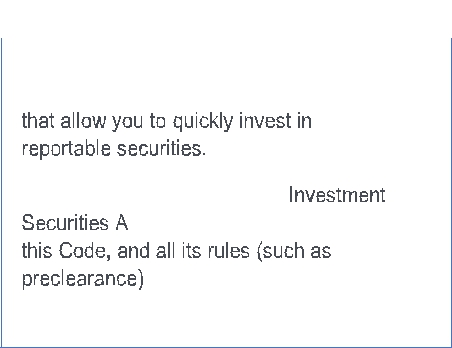
Authorized Broker-Dealer and Authorized Futures Commission Merchants (FCMs*):
• |
Charles Schwab* |
• |
JP Morgan/Chase |
• |
Rockefeller Capital |
• |
E*TRADE/Morgan |
• |
LPL |
• |
Management |
|
Stanley* |
• |
Merrill Lynch |
UBS* |
• |
Edward Jones |
• |
Raymond James |
• |
Vanguard |
• |
Fidelity |
|
|
• |
Wells Fargo |
U.S.-based reportable Investment Securities Accounts must be held at one of the above firms. Employees with non-U.S. reportable Investment Securities Accounts are encouraged to use firms that will provide an electronic feed to STAR.
Automatic Investment Plan: Regular periodic purchases (or withdrawals) that are made automatically in (or from) Investment Securities Accounts in accordance with a predetermined schedule and allocation. An automatic investment plan includes dividend reinvestment plans (“DRIPs”) and Employee Stock Purchase Plans (“ESPPs”).
Beneficial Interest: You have Beneficial Interest of any account or securities in which you have a direct or indirect financial interest. This includes accounts or securities held in your own name or the name of your spouse or equivalent domestic partner, your minor children, and relatives living with you and to whom you provide or receive financial support or whose investments for which you have discretion, influence, or control. This could include accounts or securities of individuals with whom you share living expenses, bank accounts, rent or mortgage payments, ownership of a home, or any other material financial support. See Exhibit C for more information.
CCO: Business Unit Chief Compliance Officer or their designee.
Company: Prudential Financial, Inc. and its subsidiaries, otherwise known as “Prudential.”
Covered Securities: In general, any securities (and derivatives thereof), including but not limited to individual stocks and bonds, exchange-traded products (ETFs and ETNs), closed-end funds, private placements, and limited offerings. See Exhibit B for a detailed list of Covered and Non-
Covered securities.
18
Designated Person: An Employee who, during the normal course of his or her job, has routine access to material nonpublic information about Prudential. Material Nonpublic Information may consist of financial or non-financial information about Prudential as a whole, or one or more Divisions or Segments. See the Global Insider Trading Policy for more information.
Discretionary Managed Account: An account managed on a discretionary basis by a person other than the Employee or an algorithmic tool (robo-adviser), over which the Employee has no direct or indirect influence or control over the selection or disposition of securities and no knowledge of transactions therein. A Discretionary Managed Account must have a formal investment management agreement that provides full discretionary authority to a third-party money manager.
Dividend Reinvestment Plan (“DRIPs:): A stock purchase plan offered by a corporation whereby shareholders purchase stock directly from the company (usually through a transfer agent) and allow investors to reinvest their cash dividends by purchasing additional shares or fractional shares.
Employees or You: All employees of Prudential, as well as certain others as identified by Compliance.
Ethics Committee: Governance committee composed of senior leaders throughout Prudential. The Committee meets quarterly, or more often as needed, to review potential violations of the Code.
FCA: Financial Conduct Authority – a U.K. regulator.
Initial Public Offering: An offering of securities registered under the Securities Act of 1933, the issuer of which immediately before registration was not subject to the reporting requirements of Section 13 or 15(d) of the Securities Exchange Act of 1934.
Investment Club: A group of two or more people, each of whom contributes monies to an investment pool and participates in the investment making decision process and shares in the investment returns.
Investment Persons: An Access Person who also makes or participates in making, decisions regarding the trading of securities in any client account, has access to such decisions or assists in the trade process. Investment Persons generally can include PMs, research analysts, traders, trade operations, compliance, investments, product development and certain ELT members.
Investment Securities Accounts: Any accounts in which you have a Beneficial Interest (defined above) and other accounts you could be expected to influence or control, in whole or in part, directly or indirectly, whether for securities or other financial instruments, and that can hold Covered Securities (defined above), whether or not such capability is utilized.
Immediate Family Member: Relatives who you share the same household with, and you provide, or receive, material financial support including child, stepchild, grandchild, parent, stepparent, grandparent, spouse, sibling, mother-in-law, father-in-law, son-in-law, daughter-in-law, etc.
Material Nonpublic Information (“MNPI”): Information that is not available to the investing public that an investor, considering all the surrounding facts and circumstances, would find important in deciding whether or when to buy, sell, or hold a security.
Monitored Persons: The term Monitored Persons refers collectively to Supervised Persons, Access Persons, Investment Persons, Associated Persons, and Designated Persons. This term is used by Compliance for back-end monitoring purposes.
NFA Associated Person: An individual who solicits orders, customers, or customer funds (or who supervises persons so engaged) on behalf of a commodity trading advisor (CTA) or commodity pool operator (CPO).
19
Non-Volitional: Investment Securities Account activity related to: i) transactions in approved Discretionary Managed Accounts; ii) transactions in pre-approved dividend reinvestment plans; iii) transactions resulting from automatic rebalancing plans; and v) receipt of employee stock or option bonus awards.
NRSRO: An SEC-registered Nationally Recognized Statistical Rating Organization (NRSRO). Such entities assess the creditworthiness of an obligor as an entity or with respect to specific securities or money market instruments.
Private Placement: An offering that is exempt from registration under the Securities Act of 1933, as amended, under Sections 4(2) or 4(6), or Rules 504, 505 or 506 there under.
Private Securities Transaction: Any securities transaction outside the regular course or scope of an associated person’s employment with a member, including but not limited to, new offerings of securities which are not registered with the Securities and Exchange Commission, but not including transactions in investment company and variable insurance and annuity securities. You are prohibited from investing in these transactions including Crowdfunding investments that are private placements without prior approval from their Local Compliance Officer, and as applicable, Broker- Dealer Compliance Officer based on a determination that no conflict of interest is involved.
Prudential or the Company: Prudential, its affiliates, and its subsidiaries.
Prudential Affiliated Funds: Proprietary funds advised by Prudential, or a non-proprietary fund sub- advised by Prudential, and any fund whose investment adviser or principal underwriter is controlled by or under common control with Prudential.
Prudential Securities Trading Window: The period of time commencing at the opening of business on the date that is two full trading days after an earnings release and ending at the close of business on the date that is two weeks prior to the end of each quarter, or such other period of time as determined at the discretion of the Law Department).
Star Compliance (STAR): The monitoring system utilized for all personal compliance disclosures including Personal Account Dealing.
Supervised Persons: Individuals who are officers, directors, and employees of a registered investment adviser, as well as certain other individuals who provide advice on behalf of the adviser and are subject to the adviser’s supervision and control.
SEC: U.S Securities and Exchange Commission – a U.S. regulator.
Uncovered Option: An option strategy where the options contract writer (i.e., the seller) does not hold the underlying asset to cover the contract in case of assignment (as opposed to a covered option). Nor does the seller hold any option of the same class on the same underlying asset that could protect against potential losses (options spread).
U.S. Government Entity: Any U.S. state or local government; any agency, authority, or instrumentality of a state or local government; any pool of assets sponsored by a state or local government (such as a defined benefit pension plan, separate account or general fund); and any participant-directed government plan (such as 529, 403(b), or 457 plans).
20
Exhibit B – Summary of Code Requirements by Employee Classification
Summary of Code Requirements by Employee Classification
|
|
Supervised |
Associated |
Access |
Investment |
|
|
|
|
|
|
|
|
|
Acknowledgement Requirements |
|
|
|
|
|
|
Complete new hire and other periodic certifications, attestations, and |
Required |
Required |
Required |
Required |
|
acknowledgments. |
|
|
|
|
|
|
|
|
|
|
|
|
|
|
|
|
|
|
|
Account Reporting Requirements
|
|
|
|
|
|
|
|
|
|
|
|
|
|
|
|
Report all Investment Securities Accounts and future accounts where |
|
|
|
|
|
|
|
|
|
|
|
|
|
you have a beneficial interest. |
|
Not |
|
Required |
|
Required |
|
Required |
|
|
|
|
Required |
|
|
|
|
|
|
|
|
|
|
|
|
|
|
|
|
|
|
|
|
|
|
|
|
|
|
|
|
|
|
|
|
Report transactions and holdings for all securities and future |
|
|
Not |
|
|
Required |
|
|
|
|
|
|
|
|
accounts where you have a beneficial interest. |
|
|
|
|
(transaction |
|
|
Required |
|
|
Required |
|
|
|
|
Required |
|
|
|
|
|
|
|
|
|
|
|
|
|
reporting only) |
|
|
|
|
|
|
|
|
|
|
|
|
|
|
|
|
|
|
|
|
|
|
Maintain Investment Securities Accounts at Authorized Broker- |
|
Not |
|
|
|
|
|
|
|
|
|
|
Dealers and Authorized Futures Commission Merchants |
|
|
Required |
|
Required |
|
Required |
|
|
Required |
|
|
|
|
|
|
|
|
|
|
|
|
|
|
|
|
|
|
|
|
|
|
|
|
|
|
|
|
|
|
|
Report Affiliated Open-End Mutual Fund Accounts and Prudential |
|
|
Not |
|
|
|
|
|
|
|
|
|
|
|
Sponsored Insurance/Annuity Products |
|
|
|
|
Required |
|
|
Required |
|
|
Required |
|
|
|
|
Required |
|
|
|
|
|
|
|
|
|
|
|
|
|
|
|
|
|
|
|
|
|
|
|
|
|
|
|
|
|
|
|
|
|
|
|
|
|
Report Retirement Accounts (e.g., 401K) that can hold individual |
|
|
|
|
|
|
|
|
|
|
|
|
|
securities or Prudential Affiliated Funds (Retirement accounts that do |
|
Not |
|
Required |
|
Required |
|
Required |
|
not hold securities, or Prudential affiliated funds do not have to be |
|
Required |
|
|
|
|
|
|
|
|
|
|
|
|
|
|
|
reported) |
|
|
|
|
|
|
|
|
|
|
|
|
|
Discretionary Managed Accounts |
|
|
Not |
|
|
Required |
|
|
Required |
|
|
Required |
|
|
|
|
|
Required |
|
|
|
|
|
|
|
|
|
|
|
|
|
|
|
|
|
|
|
|
|
|
Investment Restrictions |
|
|
|
|
|
|
|
|
|
|
|
|
|
|
|
|
|
|
|
|
|
|
|
Initial Public Offerings (IPOs) |
|
|
Prohibited |
|
|
Prohibited |
|
|
Prohibited |
|
|
Prohibited |
|
|
Investment Clubs |
|
Permitted |
|
Prohibited |
|
Prohibited |
|
Prohibited |
|
Blackout Period |
|
|
|
|
|
|
|
|
Required |
|
|
Required |
|
|
|
|
|
|
|
|
|
|
|
|
|
|
|
|
|
|
Does not |
|
|
Does not |
|
|
One-Day |
|
|
Seven-Day |
|
|
|
|
|
apply |
|
|
apply |
|
|
Certain Exclusions |
|
|
Certain Exclusions by |
|
|
|
|
|
|
|
|
|
|
|
by Business Unit |
|
|
Business Unit |
|
|
|
|
|
|
|
|
|
|
|
|
|
|
|
|
|
Minimum Holdings Periods and Short Swing Profit Rule |
|
Does not |
|
Does not |
|
|
|
|
Required |
|
|
|
|
|
|
Does Not Apply |
|
Certain Exceptions for |
|
|
|
|
apply |
|
apply |
|
|
|
|
|
|
|
|
|
|
|
SIRG |
|
|
|
|
|
|
|
|
|
|
|
|
|
|
Preclearance Requirements |
|
|
|
|
|
|
|
|
|
|
|
|
|
|
|
|
|
|
|
|
|
|
|
|
|
|
|
|
Covered Securities (including ETFs) |
|
|
|
|
|
|
|
Required |
|
|
|
|
|
|
|
|
|
|
|
|
|
Certain Exceptions |
|
|
|
|
|
|
|
|
|
|
|
|
|
See Preclearance |
|
Required |
|
|
|
|
Not |
|
|
|
|
Section in the |
|
Certain Exceptions – |
|
|
|
|
|
Not Required |
|
Code. |
|
See Preclearance |
|
|
|
|
Required |
|
|
|
|
|
|
|
|
|
|
|
Pruco Access |
|
Section in the Code. |
|
|
|
|
|
|
|
|
|
|
|
|
|
|
|
|
|
|
|
|
|
Persons may have |
|
|
|
|
|
|
|
|
|
|
|
|
|
additional |
|
|
|
|
|
|
|
|
|
|
|
|
|
exclusions |
|
|
|
|
Private Placements |
|
|
Depends – |
|
|
|
|
|
|
|
|
|
|
|
|
|
|
contact |
|
|
|
|
|
|
|
|
|
|
|
|
|
|
your local |
|
|
Required |
|
|
Required |
|
|
Required |
|
|
|
|
|
compliance |
|
|
|
|
|
|
|
|
|
|
|
|
|
|
officer |
|
|
|
|
|
|
|
|
|
|
|
Closed End Mutual Funds |
|
Not |
|
Not Required |
|
Required |
|
Required |
|
|
|
|
Required |
|
|
|
|
|
|
|
|
|
|
|
|
|
|
|
|
|
|
|
|
|
|
|
|
|
|
|
|
|
|
Open End Mutual Funds |
|
|
Not |
|
|
Not Required |
|
|
Not Required |
|
|
Not Required |
|
|
|
|
|
Required |
|
|
|
|
|
|
|
|
|
|
|
|
|
|
|
|
|
|
|
|
|
|
|
|
|
|
|
|
|
|
|
|
|
21 |
|
Summary of Code Requirements by Employee Classification
|
|
Supervised |
Associated |
|
Access |
|
Investment |
Preclearance Requirements |
|
|
|
|
|
|
|
|
|
|
|
|
|
|
|
|
|
|
|
|
|
Prudential Employee Savings Plan (PESP) |
|
Not |
Not Required |
|
Not Required |
|
Not Required |
|
|
Required |
|
|
|
|
|
|
|
|
|
|
|
|
Deferred Compensation Plan |
|
Not |
|
Not Required |
|
Not Required |
|
|
Not Required |
|
|
|
Required |
|
|
|
|
|
|
|
|
|
|
|
|
|
|
|
|
Non-Brokerage Health Savings Account (HSA) |
|
Not |
Not Required |
|
Not Required |
|
Not Required |
|
|
Required |
|
|
|
|
|
|
|
|
|
|
|
|
Discretionary Managed Accounts |
|
Not |
|
Not Required |
|
Not Required |
|
|
Not Required |
|
|
|
Required |
|
|
|
|
|
|
|
|
|
|
|
|
|
|
|
|
22
Exhibit C – Beneficial Interest
Beneficial Interest: The Code applies to all accounts and securities in which you have a Beneficial Interest (as defined above in Exhibit A – Key Definitions). This means that if you can profit, directly or indirectly, or share in any profit from a transaction, you have a Beneficial Interest. If you are unsure if an account or investment falls under your beneficial interest, contact Compliance for further guidance.
Employees Located Outside of the U.S.: If you are located outside of the United States, you may not be required to disclose or report information regarding accounts for which a spouse, dependent family member and/or minor child has a beneficial interest. Please contact your Local Business Unit Compliance Officer for clarification.
|
Beneficial Interest |
|
|
Not Beneficial Interest |
|
|
|
|
|
|
You have a spouse, domestic partner, or similar |
|
|
You have a roommate and do not share bank and |
|
|
cohabitation arrangement: If you contribute to the |
|
|
investment accounts or provide material financial |
|
|
maintenance of a household and the financial support of a |
|
|
support to one another. Roommates are presumed to be |
|
|
partner or vice versa, your partner’s accounts and |
|
|
temporary and therefore you do not have beneficial |
|
|
securities you have beneficial interest and are required to |
|
|
interest in one another’s accounts and securities and |
|
|
disclose. |
|
|
are not required to disclose. |
|
|
|
|
|
|
|
|
Your parents live with you: If you provide financial support |
|
|
|
|
|
to your parents, your parents’ accounts, and securities you |
|
|
|
|
|
have beneficial interest and are required to disclose. |
|
|
|
|
|
|
|
|
|
|
Your child has an investment account (e.g., UGMA/UTMA) |
|
|
Your child has an investment account (e.g., |
|
|
|
|
UGMA/UTMA) If someone other than you (or your |
|
|
If you (or your spouse) are the custodian for the minor |
|
|
|
|
|
|
spouse) is the custodian for your minor child’s account, |
|
|
child, the child’s accounts give you beneficial interest and |
|
|
|
|
|
|
the account does not give you beneficial interest and |
|
|
you are required to disclose. |
|
|
|
|
|
|
you are not required to disclose. |
|
|
|
|
|
|
|
|
|
|
|
|
|
You have an adult child living in your home: If you provide |
|
|
You have power of attorney: If you have been granted |
|
|
|
power of attorney over an account, you do not have |
|
financial support to your child, your child’s accounts and |
|
|
|
|
|
beneficial interest until the time that the power of |
|
securities give you beneficial interest and you are required |
|
|
|
|
|
attorney has been activated. Prior to activation, you do |
|
to disclose. |
|
|
|
|
|
not have to disclose; post activation you do. |
|
|
|
|
|
|
|
|
|
|
|
You have a college-age child: If your child is in college and |
|
|
|
|
|
you still claim the child as a dependent for tax purposes, |
|
|
|
|
|
you have beneficial interest of their accounts and securities |
|
|
|
|
|
and are required to disclose. |
|
|
|
|
|
|
|
|
|
|
|
You are the executor, trustee and/or the beneficiary of a |
|
|
|
|
|
trust: Due to the complexity and variety of trust |
|
|
|
|
|
agreements, these situations require case-by-case review |
|
|
|
|
|
by Compliance. |
|
|
|
|
|
|
|
|
|
|
|
23 |
|
Exhibit D – Jurisdictional Guidance
This table provides a summary of the application of the Code based on employee location. Contact your local Business Unit Compliance Officer if you have any questions.
Jurisdictional Area |
Code |
United States |
Applies in Full |
United Kingdom |
Applies in Full |
Netherlands |
Applies in Full |
Mexico |
Applies in Full |
Japan |
Applies in Full - in addition, local regulations may |
|
require more restrictive requirements – contact |
|
your local compliance department if you have any |
|
questions. |
Ireland |
Applies in Full |
References
The Code complements and should be read in conjunction with other Global Enterprise Policies that address ethics and conflicts, such as Making the Right Choices, Conflicts of Interest Policy, Global Anti- Bribery and Anti-Corruption Policy, and the Global Insider Trading Policy.
The Code is designed to comply with laws, rules, and regulations applicable to Prudential’s business across the globe, including but not limited to:
▪Section 206 of the US Investment Advisers Act of 1940
▪Section 17(j) of the US Investment Company Act of 1940
▪SEC Rule 17j-1, Personal Investment Activities of Investment Company Personnel
▪SEC Rule 204-2, Books and Records To Be Maintained by Investment Advisers
▪SEC Rule 204A-1, Investment Adviser Codes of Ethics
▪FINRA Rule 3210, Accounts At Other Broker-Dealers and Financial Institutions
▪FINRA Rule 3280, Private Securities Transactions of an Associate Person
▪FCA COBS 11.7 and 11.7A, Personal Account Dealing
▪Hong Kong SFC Code of Conduct for Persons Licensed by or Registered with the SFC Section 12.2
▪IMAS Code of Ethics & Standards of Professional Conduct 2.12, Personal Conduct and Training
▪NYSE Listing Rules 303A.10, Code of Business Conduct and Ethics Requirements
24
link
Applies to:
All employees (full-time and part-time), globally, that work for, or support, Prudential’s general account, institutional asset management, investment adviser, and broker dealer businesses (CIO, PGIM and PIMS).
All contractors, interns, temporary employees, and others who have been notified by compliance are subject to this policy.
Questions?
For any questions, please contact your local compliance officer.
These Standards complement other important Prudential policies that address ethics and conflicts, such as Prudential’s Code of Conduct
–Making the Right Choices, Conflicts of Interest Policy, Global Insider Trading Policy, and Code of Ethics – Personal Securities Investing Standards.

Overview...................................................................................................................................................................................... |
4 |
.................................................................................................................................................... |
4 |
....................................................................................................... |
4 |
.............................................................................................................................. |
5 |
............................................................................................................................................. |
5 |
Training and Confirmations/Attestation......................................................................................................................... |
7 |
................................................................................................................................................. |
7 |
......................................................................................................... |
7 |
Communications ....................................................................................................................................................................... |
7 |
.......................................................................... |
7 |
...................................................................................................... |
7 |
.................................................................................................................. |
8 |
................................................................................................. |
8 |
................................................................................................................... |
9 |
Access Restrictions .................................................................................................................................................................. |
9 |
.................................................................................................................................. |
9 |
.................................................................................................................................. |
9 |
............................................................................................................................................... |
10 |
........................................................................................................................................ |
10 |
.................................................................................................................................... |
10 |
Special Employee Classifications/Exceptions ............................................................................................................. |
10 |
.................................................................................................................................... |
10 |
...................................................................................................................... |
11 |
............................................................................................................ |
11 |
Approvals and Breaches ..................................................................................................................................................... |
12 |
Compliance Monitoring |
....................................................................................................................................................... 13 |
................................................................................................................................... |
13 |
|
.................................................................................................................13 |
|
................Error! Bookmark not defined. |
Miscellaneous ......................................................................................................................................................................... |
13 |
|
.......................................................13 |
............................................................................................................................................... |
14 |
|
.............................................................................................................14 |
..................................................................................................................................................... |
15 |
..................................................................................................................................................... |
16 |
We are entrusted with our clients’ investment assets and as such, Prudential Financial, Inc. and its subsidiaries (collectively “Prudential,” “PFI” or the “Company”) aspire to the highest standard of business ethics. Our Code of Conduct (Making the Right Choices) and Code of Ethics - Personal Securities Investing Standards require that our businesses that routinely have access to material non- public information (“MNPI”), also known as inside information, about Issuers or securities have reasonably designed policies and procedures to preserve the confidentiality of MNPI and limit its communication to other areas of the Company.
Our Insider Trading and Information Barriers Standards (“Standards”) allow us to properly protect MNPI and to comply with laws and regulations governing insider trading. These Standards are designed to manage the conflicts of interest arising by one Investment Sector receiving MNPI which would adversely impact the investment activity of other Investment Sectors.
These Standards provide a framework to ensure we meet our obligation regarding MNPI including:
providing ongoing employee training;
maintaining information barrier controls, physical and technological segregation, between investment sectors to limit the inadvertent dissemination of MNPI (See Exhibit A for list of Investment Sectors with distinct information barriers);
sharing MNPI only on a need-to-know basis;
maintaining Restricted Lists, and prohibiting client and personal trading in securities (and related financial instruments) of Identified Issuers; and
establishing compliance monitoring procedures.
You may not communicate any Confidential Information or MNPI of any Identified Issuer in your Investment Sector to anyone outside of your Investment Sector, unless you have received prior written approval of a Compliance Officer. Also, you may not elicit Confidential Information or MNPI from anyone including employees of another Investment Sector.
If you obtain MNPI from any source with respect to an Issuer, you must immediately notify your Investment Sector Compliance department.
Except as otherwise noted, these Standards apply globally to all directors, officers, and employees (including applicable contractors, interns, temporary employees, and others who have been notified by compliance) of/or supporting certain Prudential asset management, investment adviser and/or broker dealer businesses, including Prudential Chief Investment Office (“CIO”), PGIM, and Prudential Investment Management Services (“PIMS”), throughout the Company regardless of geographic location (“Employees”).
For the purposes of this policy, “PGIM” refers to all PGIM affiliated investment advisers, business units and their associated functional areas.
4
You are required to become familiar with and to comply with these Standards and to attest at least annually your understanding of and compliance with these Standards. Violations of these Standards will be considered serious matters and may lead to disciplinary actions, up to and including termination of employment in appropriate cases, to the extent consistent with local law.
Any questions with respect to these Standards should be referred to Compliance or the Law Department
Failure to comply with any of the requirements (or report potential violations) of these Standards may result in violations of securities laws and regulations. Prudential takes such violations very seriously. Any potential violation of the provisions of these Standards will be investigated by Law & Compliance. If a determination is made that a violation has occurred, we may impose appropriate sanctions, up to and including termination of employment or referral to regulatory, civil, or criminal authorities.
To report suspected violations of these Standards, you should contact Compliance. If you feel uncomfortable reporting directly to Compliance, you may also report suspected violations to our Ethics Help Line (1-800-752-70241) or Website https://prudential.ethicspoint.com. Prudential will not tolerate any discrimination, harassment, or retaliation against anyone who makes a good faith report or assists in an investigation.
You may voluntarily communicate with or provide information to government agencies regarding potential violations of the law without providing notice to, or obtaining approval, from Prudential. Nothing in these Standards is intended to, or should be interpreted, to preclude anyone from exercising these rights.
Above the Wall: For purposes of these Standards, means certain investment sector senior officers, and certain support functions that meet each of the requirements set forth below and are considered to be “above” any established information barriers. Anyone with this classification is subject to all of the Investment Sectors Restricted Lists and must adhere to all access and communication restrictions.
Chief Compliance Officer (CCO), Compliance Officer: For purposes of these Standards, means either the Prudential Chief Legal and Compliance Officer, the PGIM Chief Legal and Compliance Officer, or the relevant Investment Sector Chief Compliance Officer or a designee of any of the above.
Confidential Information: Information that the company has a contractual, legal or regulatory obligation to protect or for which unauthorized use or disclosure could negatively impact Prudential's customers or employees, business operations, reputation, or competitive advantage.
Company: Prudential Financial, Inc. and its subsidiaries, otherwise known as “Prudential.”
1International numbers are listed on the Ethics website and Prudential’s Code of Conduct: Making the Right Choices
5
Identified Issuers: For purposes of these Standards, an issuer is deemed “identified” for purposes of these Standards whenever the information in question either includes the issuer’s name or other facts from which a knowledgeable investment analyst could infer its identity, and there is a potential for MNPI.
Information Barrier: Controls (physical, procedural, and/or technology) that prevent the flow of MNPI between different investment sectors. in accordance with applicable global regulatory requirements, guidance and industry best practices.
Insider: Includes both traditional insiders and temporary insiders. A traditional insider is generally any officer, director, partner, controlling shareholder, manager, or employee of a company who obtains MNPI about an issuer by virtue of their position or relationship with the company. A temporary insider is any person who receives MNPI about an issuer while performing services for them (e.g., accountants, lawyers, consultants, or underwriters)
Investment Sectors: For purposes of these Standards, means each distinct business group listed in Exhibit A that has its own investment and/or trading team that has been designated or grouped separately from other investment units.
Isolated Information Barrier: For purposes of these Standards, means barriers around groups or subgroups of employees of one or more Investment Sectors with respect to potential receipt or sharing of MNPI that has been approved by Prudential’s Chief Legal & Compliance Officer or the PGIM Chief Legal and Compliance Officer.
Material Information: Information that a reasonable person, considering all the surrounding facts and circumstances, would consider important in deciding to buy, sell or hold a security. Both positive and negative information can be material. A change in facts and circumstances may change the nature of the information from non-material to material. Multiple data points of non-material information may in aggregate alter the “total mix” of available information regarding an issuer to be considered material.
Material Non-public Information (“MNPI”): Information that is not available to the general public that a reasonable person, considering all the surrounding facts and circumstances, would find important in deciding whether or when to buy, sell, or hold a security. MNPI can be obtained from a number of sources.
Non-public: Information that has not been disclosed to the general public. Information is considered public if it is widely disseminated (for example, public filings, newswire services, etc.) By contrast, information would likely not be considered widely disseminated if it is available only to a company’s employees, or if it is only available to a select group of analysts, brokers, and institutional investors.
Restricted List: A list of Identified Issuers with respect to which Investment Sectors have MNPI. Investment Sectors and their employees may have or be subject to other Restricted Lists that are outside the scope of these Standards. You are prohibited from purchasing or selling securities of Identified Issuers on your respective business unit’s Restricted List(s).
Shared Sales Personnel: Collaborate on sourcing clients, onboarding clients, and may participate in client calls, meetings, and presentations. Such personnel’s personal trading will be subject to the respective Investment Sector Restricted Lists they support. Exhibit B lists the Shared Sales Personnel and the Investment Sectors that they support.
6
If you are classified as an Investment Sector employee, you must complete training on these Standards within 30 days of joining the Investment Sector.
If you are transferring from another Investment Sector you will need to consult with your respective Investment Sector Compliance Department to determine if any additional controls are needed if you are aware of any potential MNPI as a result of your prior role. (e.g., trading restrictions, isolated information barriers, etc.)
Each Investment Sector employee will participate in periodic training on these Standards.
At least annually, you must confirm/attest that you have read, understand, and will comply with these Standards.
You should consider if the non-public information is material to the Identified Issuer or another related issuer (e.g., its affiliates, competitors, target of a merger or acquisition), or security or its equivalent (e.g. derivative) if the dissemination of such information could significantly impact the price of value of a security. Generally, you should consider any information that a reasonable person would consider important in deciding to buy, sell or hold a security to be material.
If you have any questions about the materiality of particular non-public information, please contact your Investment Sector Compliance Officers or the Law Department.
For purposes of these Standards, our investment business units have been designated as, or grouped, into distinct Investment Sectors, listed in Exhibit A. These Investment Sectors are presumed to have access to the same information about Identified Issuers and accordingly share the same Restricted Lists. Notwithstanding the aforementioned presumption, employees are reminded that they are only permitted to share MNPI with other employees, even of the same Investment Sector, on a need-to- know basis.
7
Each Investment Sector and its investment units and their employees are considered “walled off” from other Investment Sectors and are subject to access and communication restrictions about Identified Issuers as set forth in these Standards.
Investment Sectors and their employees are prohibited from trading securities of Identified Issuers on the Restricted List(s) to which they are subject, including for client, proprietary, or personal accounts.
You may not communicate to employee(s) in another Investment Sector any information:
about an Identified Issuer whose name appears on your Investment Sector’s Restricted List(s);
that may indirectly disclose any Identified Issuer in which you have MNPI; or
any specific Confidential Information of an Identified Issuer, a client, or prospective client of the Investment Sector.
In addition, you may not communicate with employees of another Investment Sector for the purpose of:
eliciting MNPI or Confidential Information with respect to any Issuer;
determining whether they have MNPI with respect to any particular Issuers or securities; or
determining whether the names of particular Issuers appear on another Investment Sector’s Restricted List.
These restrictions apply to all communications (oral, written, and digital) and must follow the Prudential Digital Communications and Acceptable Use Policy and Standards.
Business units from different Investment Sectors may establish a client and adviser relationship by entering into an investment management agreement. Communications between Investment Sectors that are limited to the client-advisory relationship are permitted and do not require Compliance preapproval (specific to the client’s portfolio(s)). These client advisory communications with affiliates should apply the same standards as third-party client advisory communications, such as avoiding selective disclosures and not disclosing MNPI.
Prior to communicating with a member of another Investment Sector, you must receive pre-approval from Compliance to determine if the topic of discussion relates to Issuers, Confidential Information or
8
MNPI.
Compliance Officers may approve certain communications otherwise prohibited above (Restricted Communications) as they deem appropriate. Such exceptions are subject to certain conditions imposed by Compliance, which may include:
monitoring of communications by Compliance Officers or the Law Department;
limiting the subjects to be addressed in oral communications;
pre-clearing written communications; and
requiring use of code names.
Investment Sector Compliance will maintain a log of approved cross-wall communications that involve Confidential Information or MNPI.
These Standards do not affect any party’s rights or obligations under confidentiality agreements or laws or regulations restricting the internal or external communication of issuer-related information by Prudential employees.
When an Investment Sector or any of its sub-divisions enters into a confidentiality agreement, governing information to be received from a third party in connection with an actual or potential investment, the employee signing the agreement is responsible for determining whether they will likely receive MNPI and notifying Compliance of the potential receipt of MNPI and notifying Investment Sector Compliance if/when they receive MNPI. Compliance will update the Investment Sector’s Restricted List(s) as necessary.
You must take precautions to ensure that Confidential Information, regardless of materiality, is not shared with individuals who do not need to know the information to perform their job role or function. In some cases, the terms of the confidentiality agreement may not permit the sharing of such information to other business units or Investment Sectors. Please consult the Law Department, as needed, in assessing the terms of any confidentiality agreement.
You should consult with your Investment Sector Compliance Officer before participating in external meetings that may provide access to Confidential Information about any Identified Issuer. Accessing such information can result in possible receipt of MNPI (e.g., confidential borrower information as loan syndicate members or creditors committee members).
When making presentations at any internal meetings (includes all formats – in person, teleconference, or videoconferencing) where employees of another Investment Sector are in attendance you must
9
adhere to the requirements listed above in Restricted Communications. Unless you are designated Above the Wall (See Exhibit A) or have received prior written approval from your Compliance Officer, you may not attend or participate in portions of any meetings, (including Board of Directors, Investment Committee, Capital and Financial Controls Committee, Risk Management, PGIM Investment Committee, etc.) during which employees of another Investment Sector are expected to discuss or present materials that include MNPI of an Identified Issuer.
Without the prior written approval of a Compliance Officer, you may not have access to any records (paper, electronic, databases, etc.) that contain MNPI for another Investment Sector (this includes board or committee memoranda, portfolio reports, Restricted Lists, trading records, non-public quality ratings assigned to issuers).
All office space occupied by Investment Sector employees must have appropriate controls to limit access to other Investment Sectors.
You are not permitted to enter the office space of another Investment Sector, unless you are classified as Above the Wall, have prior written approval of a Compliance Officer, or a Compliance-approved escort.
Compliance Officers may approve the location of non-investment personnel, who do not routinely access MNPI, on the same floor, provided there are reasonable controls. Such controls are determined by specific facts and circumstances.
You may not enter a trading room space maintained by another Investment Sector without a Compliance- approved escort
Certain Investment Sector Senior Officers and support functions (See Exhibit A) may need access across investment sectors to make strategic decisions or perform their job responsibilities. Employees designated as Above the Wall are not subject to the access and communication restrictions list above in these Standards
To be considered “above the wall”, you must meet each of the following conditions:
You are not a named portfolio manager and do not make security-specific trading or investment decisions for the Company or our clients;
10
You must receive and disseminate non-public information only on a need-to-know basis;
You must receive prior approval from a Compliance Officer before disclosing MNPI to an Investment Sector which is not already in receipt of the information; and
Your personal trading is subject to the Restricted Lists of all of the Investment Sectors
Investment Sectors may share sales personnel who may collaborate on sourcing clients, onboarding clients, and may participate in client calls, meetings, and presentations.
If Shared Sales Personnel obtain MNPI from an Investment Sector they support, they are required to escalate this to Compliance immediately. Compliance will determine whether additional controls will be implemented, including (but not limited to) additional client and personal trading restrictions, and/or the implementation of an Isolated Information Barrier.
Shared Sales Personnel need Compliance Officer approval to be granted any electronic or physical access to the Investment Sectors that they support, and their personal trading will be subject to any applicable Restricted List(s) for the relevant Investment Sectors.
In certain circumstances, the PGIM Chief Legal and Compliance Officer, may classify certain individuals as being “above” an information barrier and therefore not subject to the access and communication restrictions set forth in these Standards. Investment unit Compliance will advise such individuals in writing of their status and of any other necessary specific restrictions.
Employees provided this limited exception are prohibited from disclosing non-public information about an Identified Issuer to any Investment Sector employee who does not already have access to the information without prior approval from a Compliance Officer.
The PGIM Chief Legal and Compliance Officer or an Investment Sector Chief Compliance Officer may designate a sub-division of the respective Investment Sector as a separate sub-division information barrier (the “Sub-division Barrier”) for the purpose of receiving and containing MNPI separate from the rest of the Investment Sector.
The Sub-division Barrier should have sufficient managerial, physical, and technological separation from the rest of the Investment Sector and have additional controls as determined by Compliance. With reasonable controls, the receipt of MNPI by the members of the Sub- division Barrier would not restrict the Investment Sector unless the MNPI was intentionally or inadvertently shared.
Investment Sector Compliance is responsible for documenting the approval, maintaining the applicable controls and escalating and addressing any breaches of the Investment Sector Sub- Division Barrier(s).
11
In limited circumstances, the PGIM Chief Legal and Compliance Officer, or their designee, may approve certain cross-investment barrier project groups that may include individuals from different investment sectors to work together on specific business projects and would not be subject to access and communication restrictions set forth in these Standards in regard to the specific business project (e.g., forming a new fund; corporate strategic initiatives) on a temporary basis.
These employees are prohibited from disclosing non-public information about an Identified Issuer(s) to any employee that is not a member of the project group without prior approval from a Compliance Officer.
Prudential’s Chief Legal & Compliance Officer or the PGIM Chief Legal and Compliance Officer, may approve Isolated Information Barriers around one or a group of employees of one or more Investment Sectors with respect to potential receipt or sharing of MNPI.
Investment Sector Compliance is responsible for documenting the approval, maintaining the applicable controls and escalating and addressing any breaches of the Isolated Information Barrier.
PGIM’s Chief Legal and Compliance Officer is authorized to approve exceptions to and modifications of these Standards. Any requests should be documented and set forth the basis and rationale and any conditions to which the approval is subject.
Investment Sector Compliance will document any Information Barrier Breaches.
If a breach of an information barrier results in MNPI about an Identified Issuer being passed to another Investment Sector or within an Investment Sector but outside a sub-information barrier, the incident must be escalated to each Investment Sector’s Chief Compliance Officer or their designee.
Unless an Isolated Information Barrier is established, the Identified Issuer must be immediately added to each related Investment Sector’s Restricted List and will remain on the list until an assessment is made that the Investment Sector is no longer in receipt of MNPI.
12
Each Investment Sector Compliance team maintains a list of all Identified Issuers with respect to which Investment Sector Compliance was notified that its Investment Sector has MNPI.
You may not purchase or sell, for any account, securities of any Identified Issuer (including or any derivative contracts in respect of such securities) whose name appears on any applicable Restricted List, unless applicable law permits, and the compliance department approves. Subject to applicable law, exceptions to the above may be made if the purchase or sale is from or to the Identified Issuer, its’ underwriter for or a counterparty who also has access to the same MNPI.
Trading restrictions also apply to affiliated or unaffiliated funds (e.g., CLOs) if:
the underlying holdings include the Identified Issuer(s) of the Investment Sector; and
a reasonable investor would consider such composition of Identified Issuer(s) as material in making an investment decision.
If you obtain MNPI, from any source, with respect to an issuer, you must immediately notify your compliance department. Compliance will place the issuer’s name on the appropriate Investment Sector’s Restricted List(s) unless otherwise addressed (e.g., creation of Isolated Information Barriers). Trading restrictions will apply to related issuers (e.g. parents and subsidiaries) unless it can be determined that the MNPI is not material to those related issuers.
Once Compliance reasonably concludes that no employee of an Investment Sector possesses MNPI with respect to an Identified Issuer, they may remove such Identified Issuer from the applicable Restricted List(s).
For Investment Sectors that generally transact in private transactions with a party that has the same access to the MNPI, Compliance may limit the trading restriction to their employees’ personal trading account.
Compliance Officer approval is required when trading securities, instruments, or their equivalent with a party that does not have access to the same MNPI.
13
Exhibits A and B to these Standards may be amended with the approval of the PGIM Chief Legal and Compliance Officer.
PGIM Central Compliance shall maintain a central file of any written approvals, exceptions, confirmations, determinations, memoranda and communications required by this Statement of Standards
During business continuation events, Investment Sectors are permitted to operate in the same space subject to appropriate reasonable controls given the specific circumstances.
If the arrangement is expected to be less than 30 days, an Isolated Information Barrier Exception is not necessary.
Impacted employees will be required to certify/attest that MNPI was not shared or misused.
14
Investment Sectors
(also known as Information Barrier Groups)
Employees/Groups Designated as "Above the Wall"
Prudential Chief Investment Officer, Prudential Global Investment Strategy Managing Director, Prudential Head of Global Hedge Management, Prudential Chief of Global Portfolio Management, President & CEO of PGIM, Chief Operating Officer of PGIM, Chief Marketing Officer of PGIM, CEO of PGIM Multi- Asset Solutions, PGIM Chief Innovation Officer, CEO of PGIM Private Alternatives, President and CEO of PGIM Fixed Income, Chief Business Officer of PGIM Fixed Income, CEO and President of PGIM Investments, CEO President of PGIM Quantitative Solutions, and CEO of Jennison Associates
PGIM Compliance, PGIM Law, PGIM Finance, PGIM Risk Management, Enterprise Risk Management (Investment Risk and Market Risk), PGIM Institutional Relationship Group, PGIM Institutional Advisory & Solutions, PGIM Internal Audit (IA PGIM coverage), and PGIM Executive Support
|
|
PGIM Fixed |
Jennison |
PGIM |
PGIM |
Deerpath |
PGIM Real |
Montana |
Chief |
PGIM Multi- |
|
|
Associates |
Quantitative |
Private |
Capital |
Investment |
Asset |
|
PGIM Investments |
Income (FI) |
Capital |
Estate |
|
LLC |
Solutions |
Capital |
Partners |
Office |
Solutions |
|
Investment Sector |
Investment |
Investment |
Investment |
|
Investment |
Investment |
Investment |
Investment |
Investment |
Investment |
|
|
Sector* |
Sector |
Sector |
|
|
Sector |
Sector |
Sector |
Sector |
Sector |
Sector |
|
|
|
|
|
|
PGIM |
PGIM Fixed Income |
Jennison |
PGIM |
PGIM Private |
Deerpath |
All PGIM |
Montana |
Chief Investment |
PGIM Multi- |
|
Investments |
(all units and |
Associates |
Quantitative |
Capital |
Capital |
Real Estate |
Capital |
Office, including |
Asset |
|
(all units and locations, |
locations, and |
LLC |
Solutions |
(all units and |
(all units and |
(all units and |
Partners |
Global Hedge |
Solutions |
|
and investment sector |
investment sector |
(all units and |
(all units and |
locations, and |
locations, |
locations, |
(all units and |
Management |
(all units and |
|
support functions |
support functions |
locations, and |
locations, and |
investment |
and |
including |
locations, and |
|
locations, and |
|
deemed to be BU |
deemed to be BU |
investment |
investment |
sector support |
investment |
GRES and |
investment |
Prudential Select |
investment |
|
employees) |
employees |
sector support |
sector support |
functions |
sector |
investment |
sector support |
Strategies |
sector support |
|
|
|
functions |
functions |
deemed to be |
support |
sector |
functions |
|
functions |
|
PGIM Custom Harvest |
PGIM Japan Co. Ltd |
deemed to be |
deemed to be |
BU |
functions |
support |
deemed to be |
|
deemed to be |
|
LLC |
Sub-Division Barrier |
BU |
BU employees) |
employees) |
deemed to be |
functions |
BU employees) |
|
BU employees) |
|
|
Within FI: |
employees) |
|
|
BU |
deemed to be |
|
|
|
|
PGIM DC Solutions |
* Capital Markets |
|
|
|
employees) |
BU |
|
|
|
|
|
Group - Fixed |
|
|
|
|
employees) |
|
|
|
|
Strategic Investment |
Income Employees |
|
|
|
|
|
|
|
|
|
Group (SIRG) |
(also known as the |
|
|
|
|
|
|
|
|
|
|
PGIM FI Private |
|
|
|
|
Impact & |
|
|
|
|
|
Credit Team) |
|
|
|
|
Responsible |
|
|
|
|
|
|
|
|
|
|
Investing |
|
|
|
15
|
Shared Sales Personnel |
Shared Sales Personnel |
Investment Sectors Supported |
PGIM Private Alternatives Sales |
PGIM Real Estate |
Personnel |
PGIM Private Capital |
|
Deerpath Capital |
|
Montana Capital Partners |
16