This table describes the fees and expenses that you may pay if you buy, hold and sell shares of the fund. You may pay other fees, such as brokerage commissions and other fees to financial intermediaries, which are not reflected in the table and examples below.
Annual Fund Operating Expenses |
Prospectus Summary
BNY Mellon Balanced Opportunity Fund
J
|
|
|---|---|---|
| Management fees | 0.80% | |
| Total other expenses | 0.21% | |
| Total annual fund operating expenses | 1.01% | |
| Fee waiver and/or expense reimbursement | (0.11%) | [1] |
| Total annual fund operating expenses(after fee waiver and/or expense reimbursement) | 0.90% | |
| [1] | The fund's investment adviser, BNY Mellon Investment Adviser, Inc., has contractually agreed, until March 31, 2026, to waive receipt of its fees and/or assume the direct expenses of the fund so that the direct expenses of none of the fund's share classes (excluding Rule 12b-1 fees, shareholder services fees, taxes, interest expense, brokerage commissions, commitment fees on borrowings and extraordinary expenses) exceed .90%. On or after March 31, 2026, BNY Mellon Investment Adviser, Inc. may terminate this expense limitation agreement at any time. |
The Example is intended to help you compare the cost of investing in the fund with the cost of investing in other mutual funds. The Example assumes that you invest $10,000 in the fund for the time periods indicated and then hold or redeem all of your shares at the end of those periods. The Example also assumes that your investment has a 5% return each year and that the fund's operating expenses remain the same. The one-year example and the first year of the three-, five- and ten-years examples are based on net operating expenses, which reflect the expense limitation agreement by BNY Mellon Investment Adviser, Inc. Although your actual costs may be higher or lower, based on these assumptions your costs would be:
Expense Example |
Prospectus Summary
BNY Mellon Balanced Opportunity Fund
J
USD ($)
|
|---|---|
| 1 Year | $ 92 |
| 3 Years | 311 |
| 5 Years | 547 |
| 10 Years | $ 1,226 |
The fund pays transaction costs, such as commissions, when it buys and sells securities (or "turns over" its portfolio). A higher portfolio turnover may indicate higher transaction costs and may result in higher taxes when fund shares are held in a taxable account. These costs, which are not reflected in annual fund operating expenses or in the Example, affect the fund's performance. During the most recent fiscal year, the fund's portfolio turnover rate was 46.25% of the average value of its portfolio.
To pursue its goal, the fund invests in a diversified mix of stocks and fixed-income securities. Newton Investment Management North America, LLC (NIMNA), an affiliate of BNY Mellon Investment Adviser Inc., the fund's investment adviser, serves as the fund's sub-adviser responsible for overall asset allocation for the fund and for the portion of the fund's assets allocated to equity investments and fixed-income investments. NIMNA has engaged its affiliate, Newton Investment Management Limited (NIM), to provide the day-to-day management of the portion of the fund's assets allocated to fixed-income investments. NIMNA and NIM select securities for the fund that, in their judgment, will result in the highest total return consistent with preservation of principal. The mix of stocks and bonds varies from time to time, but normally the fund allocates between 75% to 50% of its assets to equities and between 25% and 50% of its assets to fixed-income securities. NIMNA allocates the fund's assets between equity and fixed-income securities, based on an assessment of the relative return and risk of each asset class, analyzing several factors, including
general economic conditions, anticipated future changes in interest rates and the outlook for stocks and fixed-income securities generally.
In seeking to achieve a high relative risk-adjusted return on the fund's equity investments, NIMNA creates a broadly diversified equity portfolio for the fund that includes a blend of growth stocks and value stocks. Stock selection is made through extensive quantitative and fundamental research. The fund may invest up to 20% of its assets in foreign equity securities.
For the fixed-income portion of the fund's portfolio, NIM combines a top-down approach, emphasizing economic trends and current investment themes, with bottom-up security selection based on fundamental research to allocate the fund's investments among and within fixed-income asset classes. In constructing the fixed-income portion of the fund's portfolio, NIM looks for what it considers to be the best opportunities in the fixed-income markets at any given time.
Risk Table - Prospectus Summary - BNY Mellon Balanced Opportunity Fund |
Risk [Text Block] |
|---|---|
| Principal Risks | Principal Risks An investment in the fund is not a bank deposit. It is not insured or guaranteed by the Federal Deposit Insurance Corporation (FDIC) or any other government agency. It is not a complete investment program. The fund's share price fluctuates, sometimes dramatically, which means you could lose money. |
| Risk Lose Money [Member] | The fund's share price fluctuates, sometimes dramatically, which means you could lose money. |
| Risk Not Insured [Member] | An investment in the fund is not a bank deposit. It is not insured or guaranteed by the Federal Deposit Insurance Corporation (FDIC) or any other government agency. |
| · Management risk | · Management risk: The investment process used by the fund's sub-adviser could fail to achieve the fund's investment goal and cause your fund investment to lose value. |
| · Correlation risk | · Correlation risk: Although the prices of equity securities and fixed-income securities often rise and fall at different times so that a fall in the price of one may be offset by a rise in the price of the other, in down markets the prices of these securities can also fall in tandem. |
| · Liquidity risk | · Liquidity risk: When there is little or no active trading market for specific types of securities, it can become more difficult to sell the securities in a timely manner at or near their perceived value. In such a market, the value of such securities and the fund's share price may fall dramatically. Investments that are illiquid or that trade in lower volumes may be more difficult to value. Investments in foreign securities tend to have greater exposure to liquidity risk than domestic securities. |
| · Issuer risk | · Issuer risk: A security's market value may decline for a number of reasons which directly relate to the issuer, such as management performance, financial leverage and reduced demand for the issuer's products or services, or factors that affect the issuer's industry, such as labor shortages or increased production costs and competitive conditions within an industry. |
| · Market risk | · Market risk: The value of the securities in which the fund invests may be affected by political, regulatory, economic and social developments, and developments that impact specific economic sectors, industries or segments of the market. In addition, turbulence in financial markets and reduced liquidity in equity, credit and/or fixed-income markets may negatively affect many issuers, which could adversely affect the fund. Global economies and financial markets are becoming increasingly interconnected, and conditions and events in one country, region or financial market may adversely impact issuers in a different country, region or financial market. These risks may be magnified if certain events or developments adversely interrupt the global supply chain; in these and other circumstances, such risks might affect companies world-wide. Risks Applicable to Equity and Equity-Related Investments |
| · Risks of stock investing | · Risks of stock investing: Stocks generally fluctuate more in value than bonds and may decline significantly over short time periods. There is the chance that stock prices overall will decline because stock markets tend to move in cycles, with periods of rising prices and falling prices. The market value of a stock may decline due to general market conditions or because of factors that affect the particular company or the company's industry. |
| · Growth and value stock risk | · Growth and value stock risk: By investing in a mix of growth and value companies, the fund assumes the risks of both. Investors often expect growth companies to increase their earnings at a certain rate. If these expectations are not met, investors can punish the stocks inordinately, even if earnings do increase. In addition, growth stocks may lack the dividend yield that may cushion stock prices in market downturns. Value stocks involve the risk that they may never reach their expected full market value, either because the market fails to recognize the stock's intrinsic worth or the expected value was misgauged. They also may decline in price even though in theory they are already undervalued. |
| · Foreign investment risk | · Foreign investment risk: To the extent the fund invests in foreign securities, the fund's performance will be influenced by political, social and economic factors affecting investments in foreign issuers. Special risks associated with investments in foreign issuers include exposure to currency fluctuations, less liquidity, less developed or less efficient trading markets, lack of comprehensive company information, political and economic instability and differing auditing and legal standards. Risks Applicable to Fixed-Income Investments |
| · Fixed-income market risk | · Fixed-income market risk: The market value of a fixed-income security may decline due to general market conditions that are not specifically related to a particular company, such as real or perceived adverse economic conditions, changes in the outlook for corporate earnings, changes in interest or currency rates or adverse investor sentiment generally. The fixed-income securities market can be susceptible to increases in volatility and decreases in liquidity. Liquidity can decline unpredictably in response to overall economic conditions or credit tightening. Increases in volatility and decreases in liquidity may be caused by a rise in interest rates (or the expectation of a rise in interest rates). An unexpected increase in fund redemption requests, including requests from shareholders who may own a significant percentage of the fund's shares, which may be triggered by market turmoil or an increase in interest rates, could cause the fund to sell its holdings at a loss or at undesirable prices and adversely affect the fund's share price and increase the fund's liquidity risk, fund expenses and/or taxable distributions. Federal Reserve policy in response to market conditions, including with respect to interest rates, may adversely affect the value, volatility and liquidity of dividend and interest paying securities. Policy and legislative changes worldwide are affecting many aspects of financial regulation. The impact of these changes on the markets and the practical implications for market participants may not be fully known for some time. |
| · Interest rate risk | · Interest rate risk: Prices of bonds and other fixed rate fixed-income securities tend to move inversely with changes in interest rates. Typically, a rise in rates will adversely affect fixed-income securities and, accordingly, will cause the value of the fund's investments in these securities to decline. A wide variety of market factors can cause interest rates to rise, including central bank monetary policy, rising inflation and changes in general economic conditions. It is difficult to predict the pace at which central banks or monetary authorities may increase (or decrease) interest rates or the timing, frequency, or magnitude of such changes. During periods of very low interest rates, which occur from time to time due to market forces or actions of governments and/or their central banks, including the Board of Governors of the Federal Reserve System in the U.S., the fund may be subject to a greater risk of principal decline from rising interest rates. When interest rates fall, the fund's investments in new securities may be at lower yields and may reduce the fund's income. Changing interest rates may have unpredictable effects on markets, may result in heightened market volatility and may detract from fund performance. The magnitude of these fluctuations in the market price of fixed-income securities is generally greater for securities with longer effective maturities and durations because such instruments do not mature, reset interest rates or become callable for longer periods of time. |
| · Credit risk | · Credit risk: Failure of an issuer of a security to make timely interest or principal payments when due, or a decline or perception of a decline in the credit quality of the security, can cause the security's price to fall. The lower a security's credit rating, the greater the chance that the issuer of the security will default or fail to meet its payment obligations. |
The following bar chart and table provide some indication of the risks of investing in the fund. The bar chart shows changes in the performance of the fund's Class J shares from year to year. The table compares the average annual total returns of the fund's Class J shares to those of the S&P 500® Index (S&P 500) and Bloomberg U.S. Aggregate Bond Index (Bloomberg Aggregate), broad measures of market performance, and a Customized Blended Index, which is comprised of 60% S&P 500 (which measures the performance of large-cap U.S. equities) and 40% Bloomberg Aggregate (which measures the performance of the investment grade, U.S. dollar-denominated, fixed-rate taxable bond market), to show how the fund's performance compares to a mix of equities and bonds. The fund's past performance (before and after taxes) is not necessarily an indication of how the fund will perform in the future. More recent performance information may be available at www.bny.com/investments.
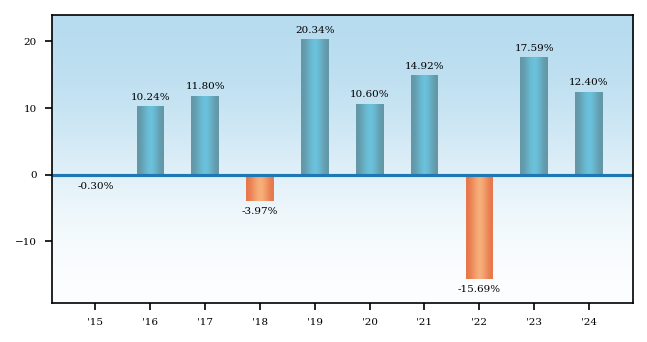
During the periods shown in the chart:
Best Quarter
2020,
Q2: 13.21
Worst Quarter
2020, Q1: (16.42)
After-tax returns are calculated using the historical highest individual federal marginal income tax rates, and do not reflect the impact of state and local taxes. Actual after-tax returns depend on the investor's tax situation and may differ from those shown, and the after-tax returns shown are not relevant to investors who hold their shares through U.S. tax-deferred arrangements such as 401(k) plans or individual retirement accounts.
Average Annual Total Returns - Prospectus Summary - BNY Mellon Balanced Opportunity Fund |
Label |
1 Year |
5 Years |
10 Years |
|
|---|---|---|---|---|---|
| J | returns before taxes | 12.40% | 7.21% | 7.24% | |
| J | After Taxes on Distributions | returns after taxes on distributions | 10.58% | 5.36% | 5.66% | |
| J | After Taxes on Distributions and Sales | returns after taxes on distributions and sale of fund shares | 8.25% | 5.31% | 5.45% | |
| S&P 500*, reflects no deductions for fees, expenses or taxes | [1] | S&P 500*, | 25.02% | 14.52% | 13.10% |
| Bloomberg Aggregate*, reflects no deductions for fees, expenses or taxes | [1] | Bloomberg Aggregate*, | 1.25% | (0.33%) | 1.35% |
| Customized Blended Index (60% S&P 500 and 40% Bloomberg Aggregate), reflects no deductions for fees, expenses or taxes | Customized Blended Index (60% S&P 500 and 40% Bloomberg Aggregate), | 15.04% | 8.67% | 8.52% | |
| [1] | In accordance with regulatory changes requiring the fund’s primary benchmark to represent the overall applicable market, the fund’s primary prospectus benchmark changed to the indicated benchmarks effective as of November 30, 2024. |