The North Country Large Cap Equity Fund (the “Fund”) seeks to provide investors with long-term capital appreciation.
This table describes the fees and expenses that you may pay if you buy, hold, and sell shares of the Fund. You may pay other fees, such as brokerage commissions and other fees to financial intermediaries, which are not reflected in the tables and examples below.
Shareholder Fees |
The North Country Large Cap Equity Fund
The North Country Large Cap Equity Fund
USD ($)
|
|---|---|
| Maximum Sales Charge (Load) Imposed on Reinvested Dividends and other Distributions | none |
| Maximum Deferred Sales Charge (Load) (as a percentage of the offering price) | none |
| Redemption Fee (as a percentage of the amount redeemed, if applicable) | none |
| Exchange Fee | none |
Annual Fund Operating Expenses |
The North Country Large Cap Equity Fund
The North Country Large Cap Equity Fund
|
|
|---|---|---|
| Management Fees | 0.70% | |
| Distribution (12b-1) Fees | none | |
| Other Expenses | 0.42% | |
| Total Annual Operating Expenses | 1.12% | |
| Fee Waiver | (0.09%) | [1] |
| Total Annual Operating Expenses After Fee Waiver | 1.03% | |
| [1] | Advisors Preferred LLC (the “Adviser”) has agreed, through February 26, 2027, to reduce its fees and/or absorb expenses of the Fund to ensure that total fund operating expenses do not exceed an annual rate of 1.03%. Operating expenses with respect to the Fund, are defined to include all expenses necessary or appropriate for the operation of the Fund and including the investment advisory fee and other expenses, but does not include any front-end or contingent deferred loads, taxes, leverage interest, brokerage commissions, expenses of underlying funds in which this Fund invests, expenses incurred in connection with any merger or reorganization, dividend expense on securities sold short, or extraordinary expenses such as litigation. The Adviser has right to receive reimbursement of any excess expense payments paid by it pursuant to the expense limitation agreement in future years on a rolling three-year basis from the time such fee is waived or reimbursed, if such reimbursement can be achieved both within the 1.03% operating expense limit and within any then-current operating expense limitation. This waiver may not be terminated prior to that date without the approval of the Board of Trustees of The North Country Funds. |
This Example is intended to help you compare the cost of investing in the Fund with the cost of investing in other mutual funds.
Expense Example |
Expense Example, with Redemption, 1 Year |
Expense Example, with Redemption, 3 Years |
Expense Example, with Redemption, 5 Years |
Expense Example, with Redemption, 10 Years |
|---|---|---|---|---|
| The North Country Large Cap Equity Fund | The North Country Large Cap Equity Fund | USD ($) | 105 | 339 | 601 | 1,351 |
The Fund pays transaction costs, such as commissions, when it buys and sells securities (or “turns over” its portfolio). A higher portfolio turnover rate may indicate higher transaction costs and may result in higher taxes when Fund shares are held in a taxable account. These costs, which are not reflected in annual fund operating expenses or in the Example, affect the Fund’s performance. During the most recent fiscal year, the Fund’s portfolio turnover rate was 3% of the average value of its portfolio.
The Fund seeks to achieve its investment objective by investing, under normal circumstances, at least 80% of its net assets, plus any borrowings for investment purposes, in equity securities of large capitalization companies. The Fund defines large capitalization companies as those companies whose market capitalizations are equal to or greater than $10 billion at the time of purchase. Equity securities include common stocks of domestic and foreign-domiciled companies, preferred stocks, convertible preferred stocks, and American Depository Receipts (“ADRs”). The Fund focuses primarily on market sectors such as Materials, Health Care, Utilities, Information Technology, Industrials, Consumer Discretionary, Consumer Staples, Financial Services, REITs, Energy, and Communication Services.
Advisors Preferred LLC (the “Adviser”) attempts to outperform the Fund’s benchmark index by varying the number and percentages of the Fund’s holdings and emphasizing one or more sectors in selecting its investments. The Adviser selects portfolio securities based on its analysis of various factors including price/earnings ratios, the strength or potential strength of a company’s competitive position, strength of management, marketing prowess and product development capabilities.
The Adviser utilizes a buy and hold approach, generally maintaining its position in a company’s stock without regard to day-to-day fluctuations in the market. However, the Adviser will frequently re-evaluate portfolio holdings, as it deems necessary, and will typically sell a stock when the reasons for buying or holding it no longer apply, such as a lack of performance, change in business direction, adverse changes in other factors or when the company begins to show deteriorating fundamentals.
You could lose money on your investment in the Fund, or the Fund may not perform as well as other possible investments. The net asset value of the Fund’s shares will fluctuate based on the value of the securities held in its portfolio. As with any mutual fund, there can be no guarantee that the investment objective of the Fund will be achieved. An investment in the Fund is not a deposit in a bank and is not insured or guaranteed by the Federal Deposit Insurance Corporation or any other governmental agency.
Market Risk. The net asset value of the Fund will fluctuate based on changes in the value of the securities in which the Fund invests. The Fund invests in equity securities (such as stocks), which are generally more volatile and carry more risk than some other forms of investments. The price of equity securities can rise or fall rapidly in response to developments affecting a specific company or industry, or to changing economic, political, social or market conditions. Stock prices in general may decline over short or extended periods of time, lowering the value of the Fund’s investments. Market prices of equity securities in broad market segments may be adversely affected by a prominent issuer having experienced losses or by the lack of earnings, by such an issuer’s failure to meet the market’s expectations with respect to new products or services, or even by factors wholly unrelated to the value or condition of the issuer, such as changes in interest rates, terrorism, war, natural disasters, and epidemics. There is also a risk that the Fund’s investments will underperform either the securities markets generally or particular segments of the securities markets.
Investing in Mutual Funds. All mutual funds carry a certain amount of risk. You may lose money on your investment in the Fund. As all investment securities are subject to inherent market risks and fluctuations in value due to earnings, economic and political conditions and other factors, the Fund cannot give any assurance that its investment objective will be achieved.
Issuer Specific Changes. The value of an individual security can be more volatile, and can perform differently, than the market as a whole. The price of an individual issuer’s securities can rise or fall dramatically in response to such things as earnings reports, news about the development of a promising product, or the changing of key management personnel.
Liquidity Risk. The Fund may invest in securities that are or become illiquid, and the Fund may not be able to sell such securities at the time and/or the price the Adviser believes would be advantageous.
Manager Risk. Investment in the Fund involves the risk that the Adviser’s assessment of the growth potential of specific securities may prove incorrect.
Foreign Securities Risk. Investments in foreign securities face specific risks, which include: reduced availability of information regarding foreign companies that may be subject to different accounting, auditing and financial standards and to less stringent reporting standards and requirements, reduced liquidity, increased market risk due to regional economic, financial, social and political instability, including but not limited to, international wars or conflicts (including Russia’s military invasion of Ukraine), instability in regions such as Asia, Eastern Europe and the Middle East, terrorism, natural disasters and public health epidemics (including the outbreak of COVID-19 globally), and the threat of nationalization and expropriation.
Large Cap Stock Risk. Because the investment focus of the Fund is on large cap stocks, the value of the Fund may be more volatile than the market as a whole and can perform differently from the value of the market as a whole because investments in larger, more established companies may involve certain risks associated with their larger size. For example, larger companies may be less able to respond quickly to new competitive challenges, such as changes in consumer tastes or innovation from smaller competitors. Also, larger companies are sometimes less able to achieve as high growth rates as successful smaller companies, especially during extended periods of economic expansion.
Sector Risk. To the extent the Fund invests a significant portion of its assets in a particular sector, a greater portion of the Fund’s performance may be affected by the general business and economic conditions affecting that sector. Each sector may share economic risk with the broader market, however there may be economic risks specific to each sector. As a result, returns from those sectors may trail returns from the overall stock market and it is possible that the Fund may underperform the broader market, or experience greater volatility.
Information Technology Sector Risk. Companies in the information technology sector may be adversely affected by the failure to obtain, or delays in obtaining, financing or regulatory approval, intense competition, both domestically and internationally, product compatibility, consumer preferences, corporate capital expenditure, rapid obsolescence and competition for the services of qualified personnel. Companies in the information technology sector also face competition or potential competition with numerous alternative technologies. In addition, the highly competitive information technology sector may cause the prices for these products and services to decline in the future. Information technology companies may have limited product lines, markets, financial resources or personnel.
Companies in the information technology sector are heavily dependent on patent and intellectual property rights. The loss or impairment of these rights may adversely affect the profitability of these companies. The information technology sector is subject to rapid and significant changes in technology that are evidenced by the increasing pace of technological upgrades, evolving industry standards, ongoing improvements in the capacity and quality of digital technology, shorter development cycles for new products and enhancements, developments in emerging wireless transmission technologies and changes in customer requirements and preferences. The success of sector participants depends substantially on the timely and successful introduction of new products.
Cybersecurity risk. Like other funds and business enterprises, the Fund, the Adviser and their service providers are subject to the risk of cyber incidents occurring from time to time. Cybersecurity incidents, whether intentionally caused by third parties or otherwise, may allow an unauthorized party to gain access to Fund assets, Fund or customer data (including private shareholder information), or proprietary information, cause the Fund, the Adviser and/or their service providers (including, but not limited to, fund accountants, custodians, sub-custodians, transfer agents and financial intermediaries) to suffer data breaches, data corruption or loss of operational functionality or prevent Fund investors from purchasing, redeeming or exchanging shares, receiving distributions or receiving timely information regarding the Fund or their investment in the Fund.
The Fund and the Adviser have limited ability to prevent or mitigate cybersecurity incidents affecting third party service providers, and such third-party service providers may have limited indemnification obligations to the Fund or the Adviser. Cybersecurity incidents may result in financial losses to the Fund and its shareholders, and substantial costs may be incurred in order to prevent or mitigate any future cybersecurity incidents. Issuers of securities in which the Fund invests are also subject to cybersecurity risks, and the value of these securities could decline if the issuers experience cybersecurity incidents. New ways to carry out cyber-attacks continue to develop. There is a chance that some risks have not been identified or prepared for, or that an attack may not be detected, which puts limitations on the Fund’s ability to plan for or respond to a cyber-attack.
Prior to March 30, 2021, the Fund was known as the North Country Equity Growth Fund and the strategy of the Fund differed from its current strategy. Accordingly, performance of the Fund for periods prior to March 30, 2021 may not be representative of the performance the Fund would have achieved had the Fund been following its current strategy.
The bar chart and table that follow provide some indication of the risks of investing in the Fund by showing changes in the performance of the Fund from year to year and by showing how the Fund’s average annual returns for 1, 5 and 10 years compare with those of a broad measure of market performance as well as with a supplemental index that is intended to measure the performance average of similar mutual funds. Please remember that the Fund’s past performance (before and after taxes) is not an indication of how the Fund will perform in the future.
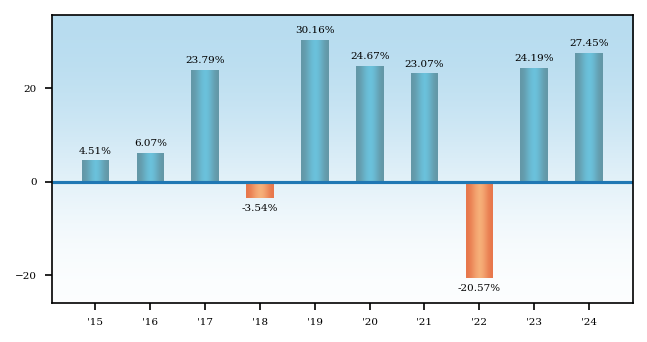
During the periods shown in the bar chart above, the Fund’s best quarterly performance was 21.11% (quarter ended June 30, 2020) and its lowest quarterly performance was -16.55% (quarter ended December 31, 2018).
Average Annual Total Returns - The North Country Large Cap Equity Fund |
Label |
1 Year |
5 Years |
10 Years |
|---|---|---|---|---|
| The North Country Large Cap Equity Fund | Return before taxes | 27.45% | 14.04% | 12.76% |
| The North Country Large Cap Equity Fund | Return after taxes on distributions | 24.22% | 11.07% | 10.55% | |
| The North Country Large Cap Equity Fund | Return after taxes on distributions and sale of Fund shares | 18.76% | 10.73% | 10.04% | |
| S&P 500 Index (reflects no deduction for fees, expenses or taxes) | 25.02% | 14.53% | 13.10% | |
| Lipper Large Cap Core Funds Index (reflects no deduction for fees, expenses or taxes) | 23.49% | 13.33% | 11.92% |
The S&P 500 is a market capitalization-weighted index of 500 widely held common stocks.
The Lipper Large Cap Core Funds Index is an unmanaged, equally weighted performance index of the 30 largest qualifying mutual funds (based on net assets) in the Lipper Large-Cap classification.
Investors cannot invest directly in an index.
The after-tax returns in the returns table above were calculated using the historical highest individual federal marginal income tax rates and do not reflect the impact of state and local taxes. Actual after-tax returns depend on an investor’s tax situation and may differ from those shown, and after-tax returns are not relevant to investors who hold shares of the Fund through tax-advantaged arrangements, such as 401(k) plans or individual retirement accounts.
In certain cases, after-tax returns may be higher than the other return figures for the same period. A higher after-tax return results when a capital loss occurs upon redemption and translates into an assumed tax deduction that benefits the shareholder.
Market Risk. The net asset value of the Fund will fluctuate based on changes in the value of the securities in which the Fund invests. The Fund invests in equity securities (such as stocks), which are generally more volatile and carry more risk than some other forms of investments. The price of equity securities can rise or fall rapidly in response to developments affecting a specific company or industry, or to changing economic, political, social or market conditions. Stock prices in general may decline over short or extended periods of time, lowering the value of the Fund’s investments. Market prices of equity securities in broad market segments may be adversely affected by a prominent issuer having experienced losses or by the lack of earnings, by such an issuer’s failure to meet the market’s expectations with respect to new products or services, or even by factors wholly unrelated to the value or condition of the issuer, such as changes in interest rates, terrorism, war, natural disasters, and epidemics. There is also a risk that the Fund’s investments will underperform either the securities markets generally or particular segments of the securities markets.
Investing in Mutual Funds. All mutual funds carry a certain amount of risk. You may lose money on your investment in the Fund. As all investment securities are subject to inherent market risks and fluctuations in value due to earnings, economic and political conditions and other factors, the Fund cannot give any assurance that its investment objective will be achieved.
Issuer Specific Changes. The value of an individual security can be more volatile, and can perform differently, than the market as a whole. The price of an individual issuer’s securities can rise or fall dramatically in response to such things as earnings reports, news about the development of a promising product, or the changing of key management personnel.
Liquidity Risk. The Fund may invest in securities that are or become illiquid, and the Fund may not be able to sell such securities at the time and/or the price the Adviser believes would be advantageous.
Manager Risk. Investment in the Fund involves the risk that the Adviser’s assessment of the growth potential of specific securities may prove incorrect.
Foreign Securities Risk. Investments in foreign securities face specific risks, which include: reduced availability of information regarding foreign companies that may be subject to different accounting, auditing and financial standards and to less stringent reporting standards and requirements, reduced liquidity, increased market risk due to regional economic, financial, social and political instability, including but not limited to, international wars or conflicts (including Russia’s military invasion of Ukraine), instability in regions such as Asia, Eastern Europe and the Middle East, terrorism, natural disasters and public health epidemics (including the outbreak of COVID-19 globally), and the threat of nationalization and expropriation.
Large Cap Stock Risk. Because the investment focus of the Fund is on large cap stocks, the value of the Fund may be more volatile than the market as a whole and can perform differently from the value of the market as a whole because investments in larger, more established companies may involve certain risks associated with their larger size. For example, larger companies may be less able to respond quickly to new competitive challenges, such as changes in consumer tastes or innovation from smaller competitors. Also, larger companies are sometimes less able to achieve as high growth rates as successful smaller companies, especially during extended periods of economic expansion.
Sector Risk. To the extent the Fund invests a significant portion of its assets in a particular sector, a greater portion of the Fund’s performance may be affected by the general business and economic conditions affecting that sector. Each sector may share economic risk with the broader market, however there may be economic risks specific to each sector. As a result, returns from those sectors may trail returns from the overall stock market and it is possible that the Fund may underperform the broader market, or experience greater volatility.
Information Technology Sector Risk. Companies in the information technology sector may be adversely affected by the failure to obtain, or delays in obtaining, financing or regulatory approval, intense competition, both domestically and internationally, product compatibility, consumer preferences, corporate capital expenditure, rapid obsolescence and competition for the services of qualified personnel. Companies in the information technology sector also face competition or potential competition with numerous alternative technologies. In addition, the highly competitive information technology sector may cause the prices for these products and services to decline in the future. Information technology companies may have limited product lines, markets, financial resources or personnel.
Companies in the information technology sector are heavily dependent on patent and intellectual property rights. The loss or impairment of these rights may adversely affect the profitability of these companies. The information technology sector is subject to rapid and significant changes in technology that are evidenced by the increasing pace of technological upgrades, evolving industry standards, ongoing improvements in the capacity and quality of digital technology, shorter development cycles for new products and enhancements, developments in emerging wireless transmission technologies and changes in customer requirements and preferences. The success of sector participants depends substantially on the timely and successful introduction of new products.
Cybersecurity risk. Like other funds and business enterprises, the Fund, the Adviser and their service providers are subject to the risk of cyber incidents occurring from time to time. Cybersecurity incidents, whether intentionally caused by third parties or otherwise, may allow an unauthorized party to gain access to Fund assets, Fund or customer data (including private shareholder information), or proprietary information, cause the Fund, the Adviser and/or their service providers (including, but not limited to, fund accountants, custodians, sub-custodians, transfer agents and financial intermediaries) to suffer data breaches, data corruption or loss of operational functionality or prevent Fund investors from purchasing, redeeming or exchanging shares, receiving distributions or receiving timely information regarding the Fund or their investment in the Fund.
The Fund and the Adviser have limited ability to prevent or mitigate cybersecurity incidents affecting third party service providers, and such third-party service providers may have limited indemnification obligations to the Fund or the Adviser. Cybersecurity incidents may result in financial losses to the Fund and its shareholders, and substantial costs may be incurred in order to prevent or mitigate any future cybersecurity incidents. Issuers of securities in which the Fund invests are also subject to cybersecurity risks, and the value of these securities could decline if the issuers experience cybersecurity incidents. New ways to carry out cyber-attacks continue to develop. There is a chance that some risks have not been identified or prepared for, or that an attack may not be detected, which puts limitations on the Fund’s ability to plan for or respond to a cyber-attack.